

Want to find great volunteers? The secret isn’t some slick sales pitch or a desperate post online. It’s about a gut-level shift in how you see the world.
Stop begging for help. Start inviting people to a mission they can’t stop thinking about.
From Asking For Help To Offering A Mission
Too many groups come from a place of scarcity. Their message screams, “We’re desperate! We need people!” This doesn’t inspire anyone. It feels heavy. It feels like a chore.
Think of it like building a campfire. You don’t run around town frantically begging strangers for a spare log. You bravely build a warm, bright, inviting fire. You create a space so full of light and laughter that people want to gather. A place where they feel an pull to add their own log, to share their story, and to feel a sense of real belonging.
This isn’t just some feel-good theory. It’s a strategy built on the courage to share your authentic ‘why’ and the kindness to make the experience joyful from the very first hello.
We're building a movement, not just filling a roster. It’s a lot easier to make an impact than you think. And it’s fun.
The Power of an Abundant Mindset
An abundant mindset flips the whole script. It says, "We have an incredible opportunity for you to find purpose, to grow, and to connect." It’s a genuine invitation to an adventure, not a transaction. This simple shift from a scarcity-based 'ask' to an abundance-based 'offer' changes everything.
This is what it looks like in practice.
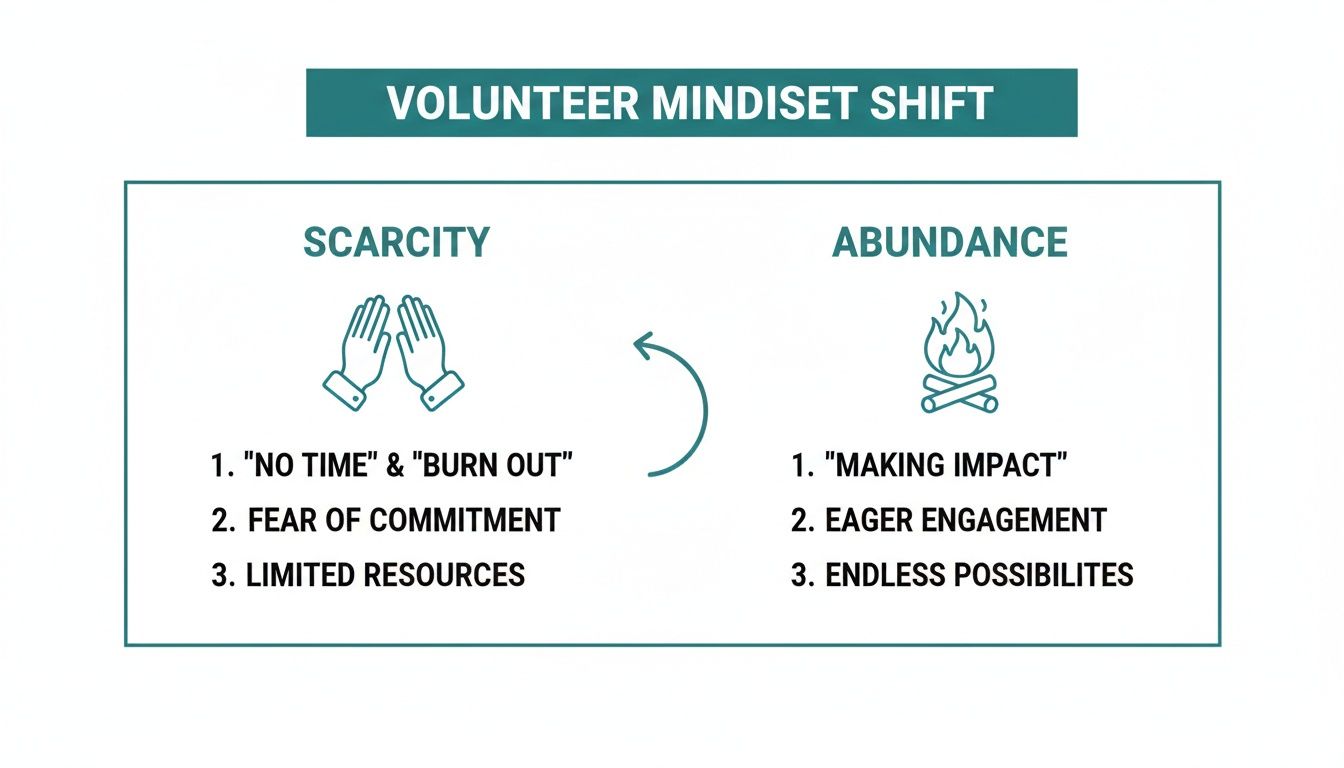
When you focus on the mission and the community you’re building, you attract people who are looking for more than just a task—they’re searching for connection and a chance to become more of who they are.
And the good news? People are actively looking for these opportunities. Data shows a huge rebound in volunteering, with 28.3% of people over 16 volunteering through an organization last year. That’s a massive pool of potential changemakers just waiting for the right invitation.
Here's a quick look at how to reframe your thinking.
From Scarcity to Abundance Mindset
| Old Tactic (Scarcity) | New Approach (Abundance) |
|---|---|
| "We desperately need your help." | "Join us in making a real difference." |
| Focuses on tasks and to-do lists. | Focuses on impact and shared purpose. |
| Makes people feel obligated. | Makes people feel inspired. |
| Transactional: "Give us your time." | Relational: "Become part of our community." |
| Leads to burnout and high turnover. | Leads to passion and long-term commitment. |
This isn't about sugarcoating the work. It's about grounding it in purpose.
The real work is not to convince people to help you. It’s to create something so meaningful that they are inspired to help themselves by helping you. Your mission is the magnet.
By focusing on the 'why' behind what you do, you give people a powerful reason to care. You offer them a chance to be part of something bigger than themselves.
If you're wondering where your own journey can begin, our guide on how to find volunteer work can help you discover those meaningful opportunities. This approach is how you find volunteers who don't just show up, but who show up with their whole hearts.
Craft Your Unforgettable Volunteer Story
Let's be real. People don't show up to fill a slot on a spreadsheet. They show up for a feeling, a connection, a story they can see themselves in. Before you even think about writing a role description or posting on Instagram, you have to ask yourself one question, and you have to be brutally honest: Why should anyone care?
This is where you find the emotional heart of your work. Forget the marketing spin and the perfect taglines. This is about finding your truth and sharing it with courage. Think of it like inviting people to your campfire; the story you tell is what makes them pull up a log and listen.
Unearth Your Core Narrative
Your core narrative is the "why" that gets you out of bed on the hard days. It’s the reason this work matters so much that you’d do it in a Chicago blizzard or a scorching heat wave. To find it, you have to dig past the tasks and get to the transformation.
Start by asking yourself these questions. Don't rush them. Let the real stories bubble up.
- When did you feel most proud of this work? Get specific. Picture that exact moment. Who was there? What did that feel like in your chest? Don't just say "we cleaned a park." Say, "I remember watching a little girl point at the new playground we cleared, a space that was covered in broken glass just two hours earlier."
- What problem truly breaks your heart? I mean, really gets under your skin. Is it the loneliness you see in your neighborhood? The litter that makes a beautiful street feel neglected? The lack of safe spaces for kids? Your anger and sadness are fuel for a powerful story.
- What change do you want to see in a person, not just a place? Maybe you want people to feel less alone, more connected to their neighbors, or prouder of where they live. This is the human impact—the real reason people will show up.
This isn't about finding volunteers; it’s about finding kindred spirits. Your story is a beacon. When you share it honestly, the right people will find their way to your fire. They won’t just see a task; they’ll see a mission they were already looking for.
From Task to Invitation
Once you've got that emotional core, you can reframe every volunteer need. You stop asking for help and start offering an opportunity for growth and connection. This is how you make your mission impossible to ignore.
Let’s look at a real-world example. A community garden in Chicago’s Englewood neighborhood could post a sign that says, “Volunteers needed for weeding on Saturday.” It's a task. It's functional, but it’s not inspiring.
Now, let’s inject the story.
"Tired of the concrete jungle? Come get your hands dirty with us this Saturday. We're not just pulling weeds; we're growing food and friendships, turning this empty lot into a place where our neighbors can connect and find a little peace. No green thumb required—just a good heart."
See the difference? The first is a chore. The second is an adventure. It speaks to a deeper human need for community, nature, and purpose. It’s an invitation to become part of something beautiful.
Here’s a simple way to transform your own volunteer posts:
| Instead Of This (The Task) | Try This (The Invitation) |
|---|---|
| "We need help sorting donations." | "Help us turn a box of donated clothes into a warm welcome for a family new to Chicago." |
| "Help us pick up trash at the park." | "Join our crew and help us reclaim this park for our community, one block at a time." |
| "We need someone to manage our social media." | "Use your creative skills to share our story and inspire more people to join our movement." |
This isn't about being clever. It's about being authentic. The most powerful way to find volunteers is to bravely share the heart of your mission and trust that it will hit home. Your story isn't just words; it’s the spark that will light up your entire community.
Find Your People Where They Already Are
You’ve got your story, your mission is clear. So, where do you find the people who will actually show up? The default move is to post on your own social media and just… wait. That’s like building a campfire in your backyard and just hoping the whole city smells the smoke. It doesn't work.
To find your volunteers, you have to go to them. You have to join the conversations they're already having and show up in the places they already gather. It's less about shouting into the void and more about finding the right rooms to speak in.

Go Digital, But Stay Human
Think of your online presence as a living extension of your group—real, messy, and fun. People connect with authenticity, not a polished corporate brochure.
Instagram Stories: The Real, Unfiltered View
Forget the perfect grid for a second. Your Instagram Stories are where you show the real soul of your work. This is the behind-the-scenes pass that makes people feel like they know you.
- Show the instant impact. Film a quick "before" of a trash-covered alley, then a quick "after" 30 minutes later showing it clean. That immediate transformation is ridiculously powerful.
- Feature your people (with permission, of course!). A short, candid clip asking a volunteer, "What made you come out today?" is a thousand times more compelling than a perfectly written caption. Show their sweaty, smiling faces. Show them laughing.
- Use polls and question stickers. Ask simple stuff like, "What neighborhood should we hit next?" This turns people who just watch into people who participate.
Local Facebook Groups & Meetup: The Community Hubs
This is where you find the people who are actively looking for something to do. We saw a Chicago group use this exact strategy and they doubled their volunteer numbers in three months. They didn't spam—they became part of the community.
Find groups like "Logan Square Community" or hobby-based groups that align with your mission (gardening, hiking, etc.). Introduce yourself, but don't just drop a link and run. Comment on other posts. Be a good neighbor first.
Then, post your invitation.
Here's a message that works:
"Hey everyone! We're a crew called the Litter Caterpillars, and we meet up every weekend to clean up different Chicago neighborhoods while making friends. It's surprisingly fun! Last week in Pilsen, we cleared an entire alleyway and found a vintage street sign. We're meeting in Lincoln Park this Saturday if anyone wants to join us in making our city a little brighter. No pressure, just good vibes."
It’s personal, specific, and low-pressure. It’s an invitation to an experience, not just a chore.
The Power of Old-School Connection
Don't sleep on face-to-face interaction. Real-world relationships are the bedrock of community organizing. It's about building trust, one conversation at a time. Think of local businesses as your allies, not just a place to hang a flyer.
Coffee Shops and Libraries: The Neighborhood Anchors
These places are the modern-day town square.
- Be a regular. Don’t just march in and ask for a favor. Go often. Learn the baristas' or librarians' names.
- Tell your "why." When they ask what you do, tell them your story with genuine passion. "I'm part of this amazing group that cleans up our parks. It started because I was just tired of seeing my own neighborhood look neglected."
- Make an easy ask. "Would it be cool if I left a small stack of these postcards on your community board? We'd love for more of our neighbors to join us."
These small acts build a real network. Pretty soon, the barista isn't just letting you put up a flyer; they're telling customers about that cool cleanup crew they met.
A Simple, Human-First Outreach Plan
Consistency is key, but you don't need a complicated marketing strategy. Here’s a simple checklist to get you started.
- [ ] Weekly Instagram Story: Post at least one behind-the-scenes video or volunteer highlight each week.
- [ ] Bi-Weekly Community Post: Share your invitation in one or two relevant local Facebook or Meetup groups.
- [ ] Monthly Local Visit: Connect with one new local business, library, or coffee shop. Be a person, not a marketer.
- [ ] Track Your Wins: Keep a simple note of where new folks are coming from. Is it Instagram? A coffee shop flyer? This tells you where to put your energy.
By showing up in both digital and physical spaces, you create more doorways for people to find you. Whether they're scrolling for weekend volunteer opportunities near you or just grabbing a latte, they’ll find an open invitation to be part of something real.
Your Welcome is Everything
Getting someone to click “RSVP” isn’t the finish line. It’s the starting pistol. The real work—the stuff that turns a curious stranger into a core member of your crew—begins the moment they say yes.
Think about it. When you invite someone to your home, do you greet them at the door with a rulebook? No. You smile, take their coat, and say, “I’m so glad you could make it.” That’s the vibe. Your welcome for a new volunteer needs to feel just like that: a real, human invitation to belong.
Ditch the bureaucratic confirmation email packed with sterile instructions. Your first job is to swap out those first-day jitters for genuine excitement. Small, thoughtful gestures are what build long-term commitment.
The First Touchpoint Has to Be Human
The second someone signs up, the clock starts. This is your first shot to show them what your group is really about. Sure, an automated confirmation email checks a box, but it's cold. It's forgettable.
What if you did something bolder?
A personal text from the group leader within a few hours? Game-changer. It’s totally unexpected and immediately makes the new person feel like they actually matter.
It doesn’t need to be some long, drawn-out message. Keep it simple.
Example Welcome Text:
"Hey, [Name]! Kevin here from Litter Caterpillars. Just saw you signed up for our cleanup on Saturday—awesome! We're super excited to have you. Just wanted to say hi and let you know you can text me if you have any questions before then."
That one text takes all of 30 seconds. But it tells them, “You’re not just a number on a spreadsheet. You’re a person, and we’re genuinely glad you’re here.” It builds an instant bridge.
Make Their First Day Feel Like Their Second
Nobody likes being the new kid in class, awkwardly standing in the corner. Your mission is to shatter that feeling as fast as possible. You have to be intentional about sparking connections from the second they walk up.
- The Buddy System: Don't just point them to a pile of tools and say "go for it." Pair them up with a friendly veteran volunteer. This isn't some formal mentorship program; it's just giving them a person—a friendly face to stick with, ask dumb questions, and share a laugh.
- A Simple One-Pager: Forget dense handbooks. Create a single, easy-to-read page that gives them the essential info. What’s our mission in one sentence? What does winning look like today? Who do I talk to if I need help? It shows you respect their time and sets them up to contribute with confidence.
These little things provide a safety net. It lets the new person relax and actually focus on the work and the people around them.
The most powerful onboarding tool you have is kindness. When people feel safe and valued from the start, they’re not just volunteering their time; they’re investing their heart.
Weave In Safety and Scheduling With Care
Even the boring stuff—the logistics—can be handled with a human touch. Talking about safety isn’t about scaring people; it’s about showing you actually care about them.
Instead of a dry list of "don'ts," frame it as a collective agreement.
- For safety: "We look out for each other here. That means always working with a buddy, wearing your gloves, and speaking up if something feels off. Your safety is always our #1 priority, no exceptions."
- For scheduling: "Look, life happens! If you can't make it, it's no big deal. Just shoot a quick message in the group chat so we know you're okay. We're always happy to see you whenever you can make it out."
This isn't about rigid rules; it’s about mutual respect. It reinforces that you're a team. When you welcome people with this much intention, you’re not just filling volunteer slots. You're building a community where everyone feels like they belong from day one.
Keep the Spark Alive for the Long Haul
Getting people to sign up is one thing. Building a crew that sticks around through thick and thin? That’s a whole different ballgame.
A thriving community isn’t measured by how many people show up once. It’s measured by how many people stay.
Keeping that initial spark alive isn’t about perks or free pizza. It’s about bravely and kindly creating a space where people feel seen, where their contribution actually matters, and where they can grow. This is how you turn a first-timer into a lifelong advocate for your cause.

Celebrate the Small Wins Like They're Everything
Think of appreciation as the fuel for your community engine. Without it, even the most passionate volunteer will eventually run out of gas. This isn’t about grand gestures; it’s about consistent, genuine recognition.
You have to hunt for those moments of impact and hold them up to the light for everyone to see.
- Handwritten Thank-You Notes: Seriously. In a world of fleeting digital pings, a simple, handwritten card feels monumental. After an event, take five minutes to write a note to someone who went the extra mile. Get specific. "Sarah, watching you help that new person figure out the recycling bags was pure kindness. Thank you."
- Shoutouts with Substance: Don't just post a generic "thanks to our volunteers!" Dig deeper. A weekly ‘Volunteer Spotlight’ on Instagram that tells a mini-story is incredibly powerful. "This is Maria. On Saturday, she single-handedly cleared the overgrown bushes blocking the sidewalk on 53rd Street. Because of her, our elderly neighbors can now walk there safely. Maria, you’re a rockstar."
This kind of specific praise does two things. It makes that person feel deeply valued, and it shows everyone else what your group’s values look like in action.
Create Pathways for Growth
People don't just volunteer to give their time; they also want to grow. They want to learn new things, challenge themselves, and maybe even discover strengths they didn't know they had. Your job is to create clear paths for that to happen.
Think of it like a video game. A player starts at level one, but they can always see the next level they can achieve. It keeps them hooked.
You’re not just managing tasks; you’re nurturing potential. The best way to keep a volunteer is to show them a future where they can become more than they are today.
Does someone have a knack for getting people excited? Ask them to lead the welcome circle at the next event. Is another person incredibly organized? Invite them to help you plan the logistics for the next big project. This proves you're paying attention to their unique talents.
It shows you see them as a whole person, not just a pair of hands. For more actionable guidance on fostering this kind of environment, check out our collection of volunteer tips.
Fearlessly Ask for Feedback
Asking for feedback is an act of bravery. It opens you up to criticism, and that can be scary. But it's also one of the most powerful ways to show your volunteers you respect them. It says, “Your voice matters here. Your experience matters here.”
Don’t wait for problems to bubble up. You have to proactively create channels for people to share their thoughts.
- Simple Surveys: Use a free tool like Google Forms to send out a quick, three-question survey once a quarter. Keep it short. "What's one thing we should start doing?" "What's one thing we should stop doing?"
- Listen, Then Act: This is the most important part. Share the results with the group—the good and the bad. Then, publicly commit to acting on one or two key pieces of feedback. This closes the loop and builds an incredible amount of trust.
This feedback loop is crucial because the volunteer world is always shifting. Recent data shows that while sign-ups are growing, retention is a top concern for over a third of organizations. People are short on time, pushing them toward shorter, more flexible opportunities. By listening, you can adapt to these needs instead of losing great people. You can discover more insights about the current state of volunteering on Signupgenius.com.
When you celebrate wins, foster growth, and listen with an open heart, you build something that sustains itself. You create a resilient, joyful, and powerful force for good.
Answering the Tough Questions
Starting a community group is an act of pure guts. You're putting your heart on the line for something you believe in, and let's be real—it's scary. Along the way, you're guaranteed to hit some bumps and face some tricky situations.
Don't let that stop you. These challenges are part of the deal. They’re a sign that you're doing something real and important. I've been there, and I've heard the same fears from so many other organizers. Let's tackle them head-on.
What If I Ask for Help and… Crickets? No One Signs Up.
This is the big one. The number one fear for just about every community leader out there. It’s brave just to admit it. First, take a breath. A slow start isn’t a verdict on you or your mission. It's just feedback.
Think of yourself as a scientist. If an experiment fails, you don't burn down the lab. You look at the formula and tweak it.
- Is Your Story Punching Hard Enough? Is your message clear and full of heart? Find a friend who knows absolutely nothing about your project and show them your call for volunteers. Can they tell you why it matters in 30 seconds? If not, you need to simplify. Get back to that core, emotional 'why' that got you started in the first place.
- Are You Shouting into the Void? Where did you post your ask? If it was just your personal Instagram, you've only hit up your existing circle. Get a little braver. Pick one new place to post—a local neighborhood Facebook group, a bulletin board at the library. Just go introduce yourself.
- Is Your "Ask" Too Big? A vague "we need help" is overwhelming. People don't know what they're signing up for. Instead, make your first ask ridiculously specific and easy. Don't say "we need volunteers." Try: "I need three people to help me hand out water for just one hour this Saturday." A small, concrete task is so much easier to say "yes" to. It builds that crucial momentum.
An empty sign-up sheet isn't failure. It's a compass. It’s pointing you toward a clearer message, a different audience, or a smaller first step. It’s just data, not a disaster.
How Do I Deal with a Volunteer Who Just Isn't Working Out?
Ugh, this is the toughest. It requires a tricky mix of kindness and courage. But letting a bad fit hang around can poison the atmosphere for everyone else. The kindest thing you can do for the whole group is to handle it—privately, directly, and quickly.
Pull them aside for a one-on-one chat. Start with "I" statements so they don't get defensive. Instead of "You're always late," try something like, "I've noticed it's been a struggle to get here on time, and I just wanted to check in and see if everything is okay."
A lot of the time, it's just a mismatch of what they expected versus what the role actually is. Talk about the role again and ask them point-blank if it still feels right for them. Maybe there's a different job where their skills would be a better fit.
But if the problem is their behavior—constant negativity, flakiness—you have to be lovingly firm. Bring it back to your group's values. It's okay to say, "For this community to feel safe and supportive, we all need to be able to count on each other. It feels like this role might not be the best match for you right now." Protecting the health and energy of your team is your most important job.
How Can I Find People with Specific Skills?
Okay, so you don't just need bodies—you need a graphic designer, or someone who actually understands a spreadsheet. This is when you switch from casting a wide net to fishing with a spear.
You have to be super explicit about what you need and, more importantly, the impact they'll have.
- Weak Ask: "Looking for a volunteer accountant." (Snooze.)
- Strong Ask: "Seeking a financial wizard to help our community kitchen manage its budget for two hours a month. Your skills will help us provide 500 more meals to our neighbors."
See the difference? Frame it as a high-impact, short-term project. This is gold for busy professionals who want to help but can't commit to showing up every single Saturday morning.
Use platforms like LinkedIn to find people with the right job titles in your area. Post in industry-specific Facebook groups. Ask your current volunteers if they know anyone. You can even reach out to the corporate social responsibility (CSR) person at local companies—they're often looking for skills-based volunteer gigs for their employees. And don't sleep on local universities; a student would probably kill for a real-world project to slap on their resume.
At Litter Caterpillars, we believe every single act of service, no matter how small, changes our city and changes us. If you’re ready to get your hands dirty, build real friendships, and see the impact you can make with your own two hands, come join us. Find your next chance to make a difference at https://www.littercaterpillars.com.
Leave a Reply