Tag: volunteer cleanup

  • Cleanup Volunteer Work: A Beginner’s Guide for 2026

    Cleanup Volunteer Work: A Beginner’s Guide for 2026

    The hail hit the Chicago Riverwalk sideways. I had one glove, a half-filled bag of dog waste and plastic shards, and frozen rain biting my bare hand while traffic roared along Wacker Drive. Five minutes later, three strangers were laughing, sharing grabbers, and working like teammates.

    You may want to find cleanup volunteer work, join a crew without feeling awkward, or organize your own event. I've done all three, and I've run the same weekly crew for three years through rain, heat, blizzards, wind chills, and hail. This guide covers the practical parts, including finding events in Chicago and other cities, showing up prepared, staying safe, building a crew, and solving the harder problem. How do you get people to return after the second week?

    The Day I Got Caught in a Hailstorm Picking Up Trash

    The sky over the Chicago Riverwalk turned the color of old steel. The river smelled like wet stone, diesel, and something sour hiding under the docks. Hail rattled against the railings and bounced off the pavement, leaving tiny white beads around my boots.

    My gloves filled with grit. Frozen rain stung the skin between my fingers. At my feet sat a bag that still needed room for a torn food wrapper, two plastic shards, and a leaking pouch of dog waste. I wanted to finish the block. I also wanted to crawl into a warm car.

    Then someone handed me a spare glove.

    A woman from the next group grabbed a litter picker. A man moved the bag away from the walking path. Another volunteer pointed toward a dry patch under the bridge. We didn't know each other, but cleanup work gives strangers a job before it gives them a conversation. Within five flat minutes, we had a plan.

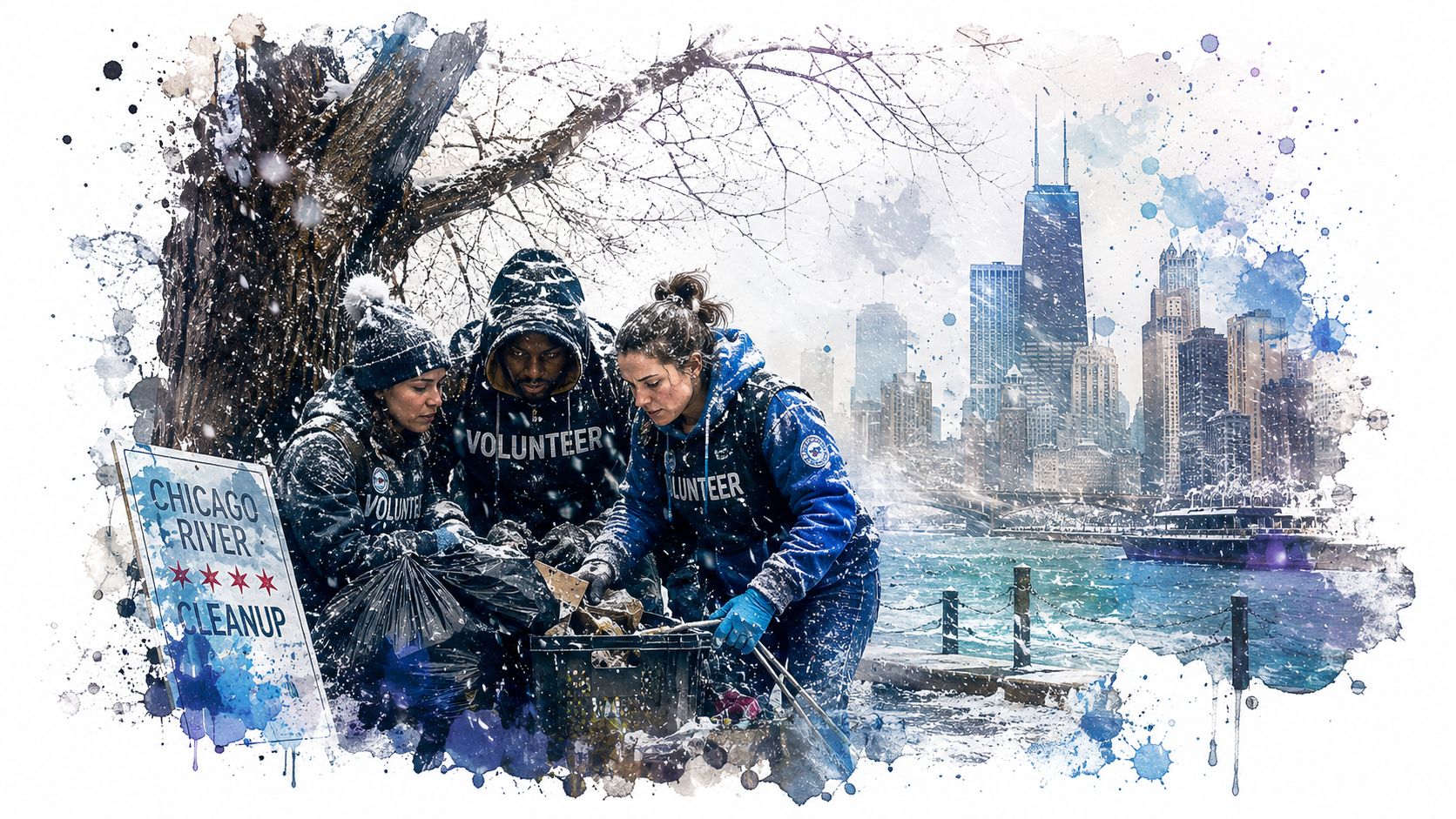
    A dedicated volunteer cleaning up litter along the snowy Chicago Riverwalk during a cold winter day.

    That's why I keep returning. The work can feel grimy, cold, repetitive, and occasionally ridiculous. It can also turn a silent morning into a shared story.

    If you're looking for cleanup volunteer work in Chicago, start with the Chicago Park District volunteer page, the Friends of the Chicago River calendar, alderperson-led neighborhood cleanups, or the city's Adopt-a-Portion program for street and alley segments. Other cities usually have similar routes through parks departments, watershed groups, conservancies, and neighborhood offices.

    I'll also show you how to join without standing alone beside the sign-in table, what to wear, what to leave untouched, and how to organize a safe event from scratch. Most of all, I'll focus on keeping people around after the first event, because a full sign-up sheet means little if the same people never return.

    Where to Find Cleanup Volunteer Work Near You

    I usually start local, then widen the search. In Chicago, the Chicago Park District volunteer page is useful for park projects, while Friends of the Chicago River lists river-related events. Alderperson offices often announce ward cleanups in newsletters and social posts. The city's Adopt-a-Portion program can connect volunteers with a street or alley segment that needs regular attention.

    Search by the place, not only by the activity. “Cleanup volunteer work Chicago” can return polished pages with no current event. “Litter pickup Logan Square,” “river cleanup near me,” “beach sweep South Shore,” or “trail cleanup Cook County” usually gets closer to an actual gathering.

    Search paths that usually work

    • VolunteerMatch: Filter by your ZIP code and search for litter, parks, rivers, or environmental volunteering.
    • All for Good: Search your city and nearby suburbs, then check the event date carefully.
    • Meetup: Filter by “environment” and “cleanup.” Some groups post recurring events there.
    • Eventbrite: Search local nonprofit listings, then confirm that the organizer still has supplies and permission.
    • Alliance for the Great Lakes: Look for shoreline cleanup events around the Great Lakes.
    • Forest preserve districts: Search for trail days, habitat workdays, and preserve volunteer calendars.

    Neighborhood Facebook groups and Nextdoor can surface small cleanups that never reach larger platforms. I also check Instagram accounts for local conservancies, park friends groups, and river organizations. A photo from last month may point you toward a recurring crew even when the group's website looks quiet.
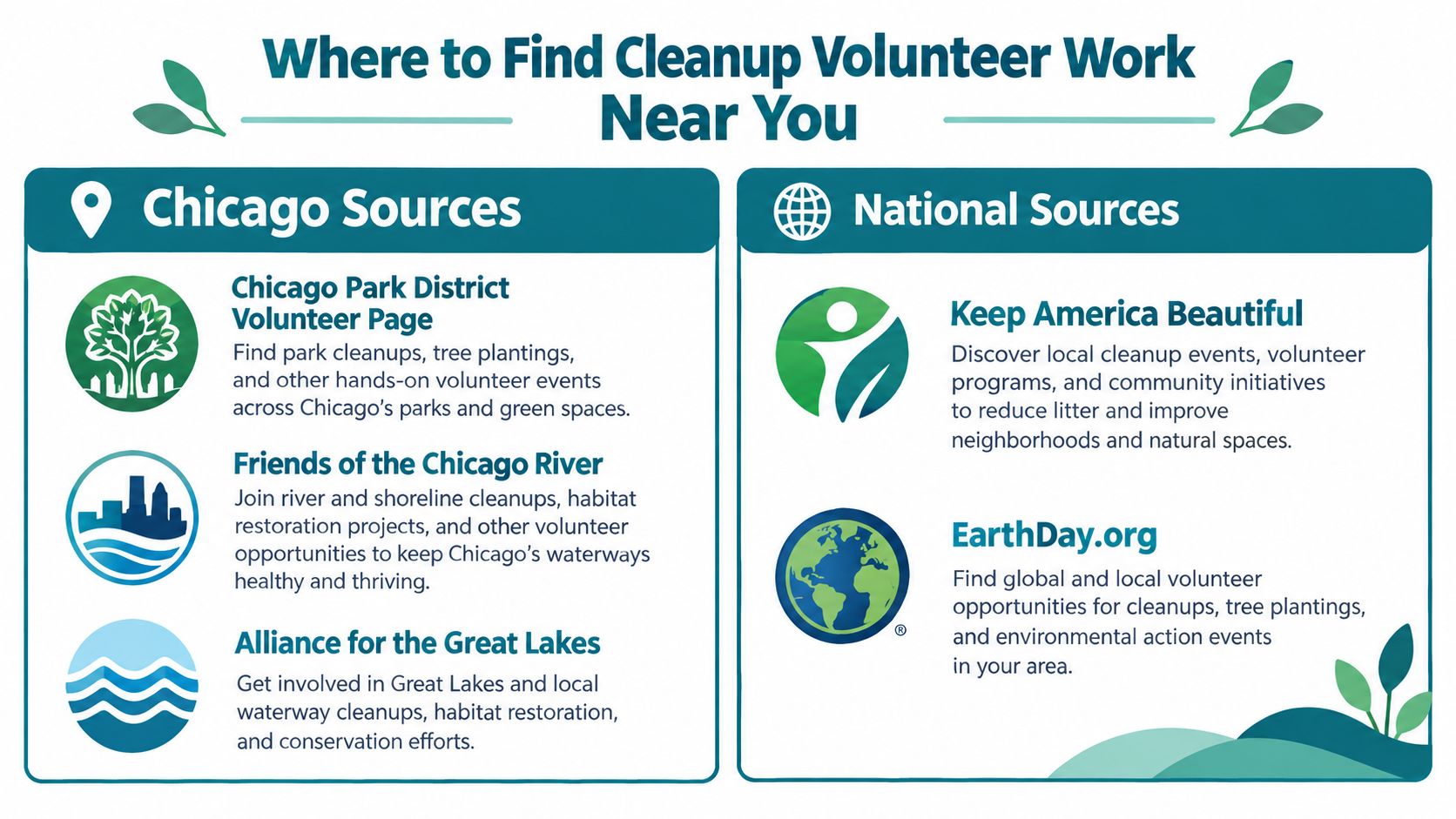
    An infographic titled Where to Find Cleanup Volunteer Work Near You listing Chicago and National sources.

    You can also browse this guide to environmental volunteering near you for additional search ideas.

    Try calling. The best event may live in an organizer's phone, not on a webpage. Ask three questions: where do volunteers meet, what equipment does the group provide, and what happens when the weather turns bad?

    How to Join Your First Cleanup Without Feeling Lost

    Your first event feels easier once you know the sequence. Register through the event link, then read the confirmation email all the way through. It should tell you the meeting point, parking options, start time, and what the organizer provides.

    Arrive ten minutes early. Find the person with the gloves and clipboard. That person usually knows where newcomers should sign in, where the bags sit, and which section needs the most help.

    Bring less than you think

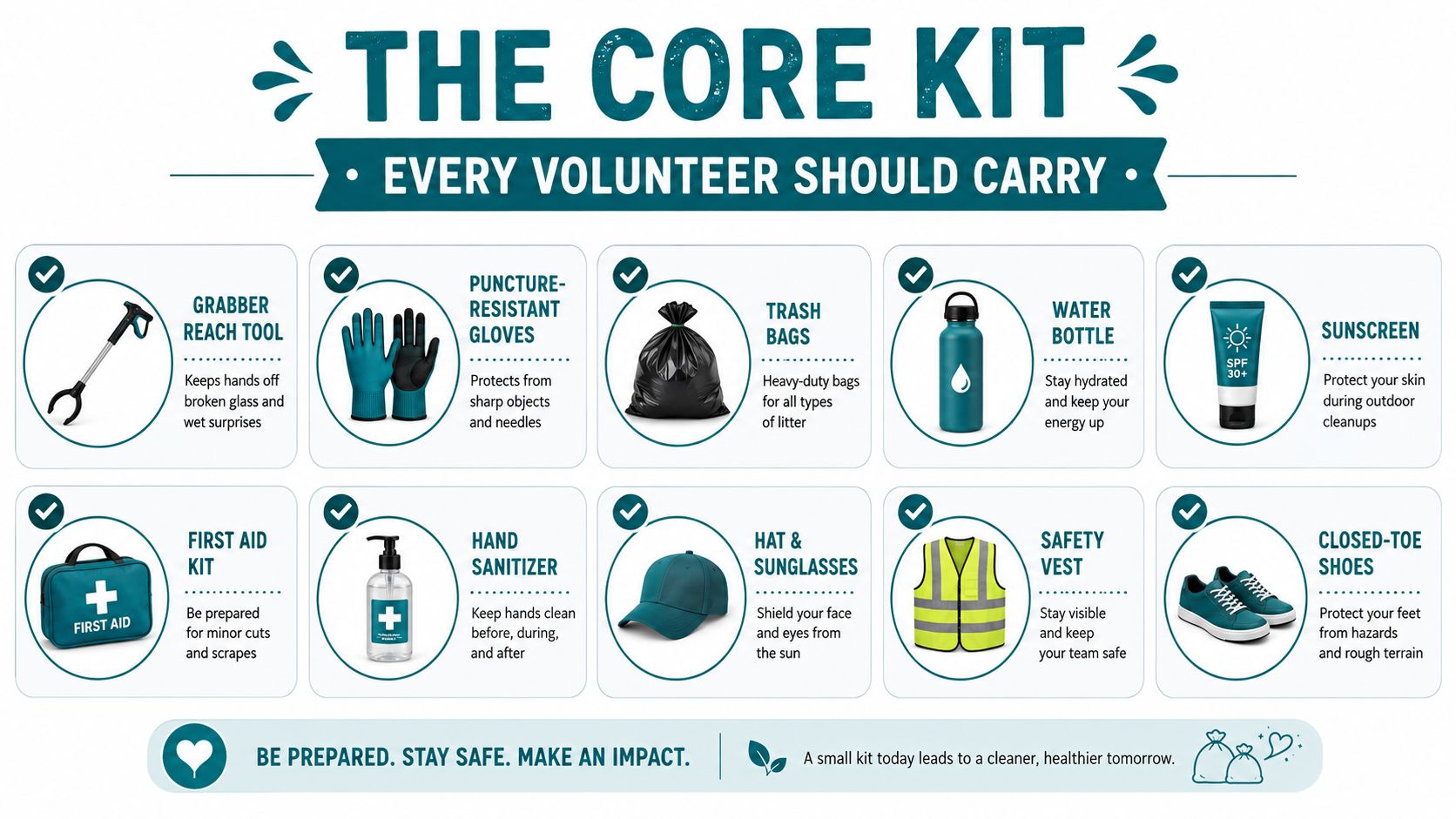
    Wear closed-toe shoes, layers, a hat, work gloves, and sunscreen. Carry water and a small backpack for your phone, keys, and anything you don't want inside a trash bag.

    Most organized crews lend grabbers, bags, and safety vests. Take a grabber even if you think you can work faster with your hands. You'll protect your back, avoid mystery residue, and reach beneath benches without kneeling in wet litter.

    Pair up with someone who has attended before. You don't need to make conversation right away. I've worked beside people for an hour before learning their names. The silence usually breaks at the bag pile, when someone pulls out a bicycle wheel, a bowling ball, or a tire and everyone wants to know the story.

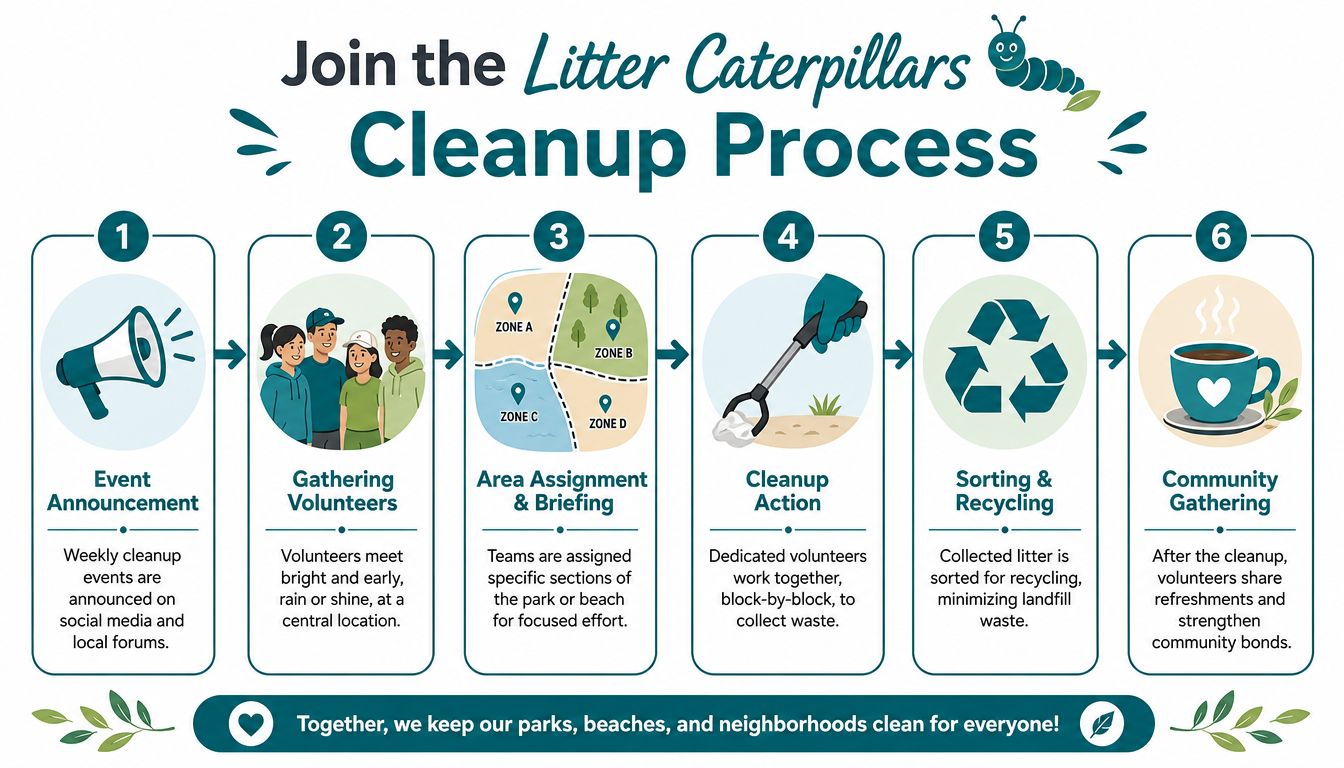
    A typical event starts with a short safety talk and a route assignment. Then you pick for sixty to ninety minutes, bring the bags back, weigh or count the results, and take a group photo. Some crews finish with coffee. Others find a nearby bar or café. The post-cleanup gathering often creates the friendships that make the next event feel less like an appointment.

    First-timer rule: Nobody expects you to perform. Pick up what you can handle, ask when you're unsure, and stay near the route.

    Before you leave, thank the organizer and join the email list or group chat. Mark the next date while the memory still feels fresh. This litter cleanup volunteer guide can help you compare different ways to get involved.

    Safety Rules Every Volunteer Crew Actually Uses

    I've watched a clean street turn dangerous in seconds. A car cuts too close. A volunteer reaches for something sharp. Heat builds under a dark shirt. Good crews prevent those moments before the first bag opens.

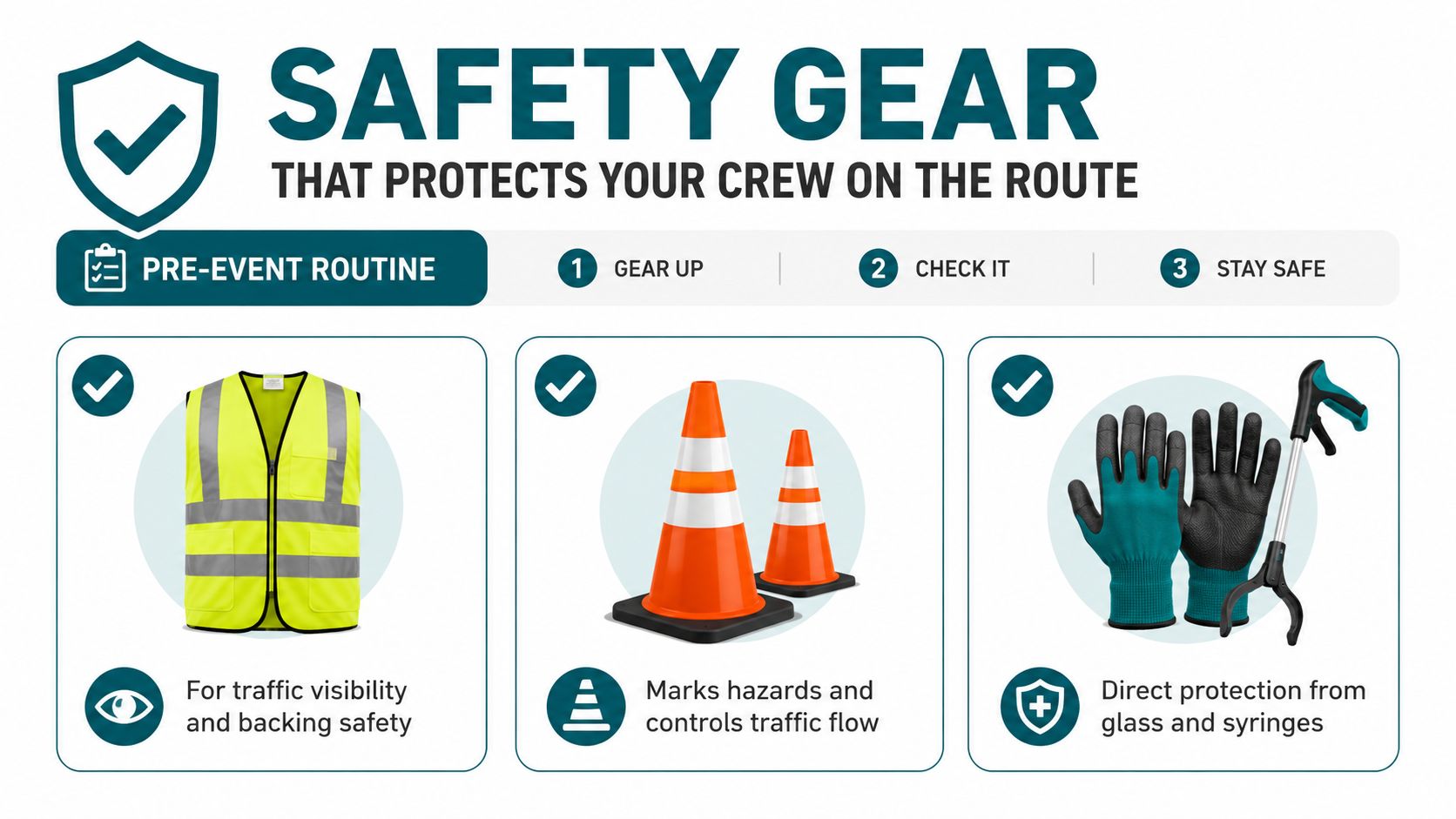
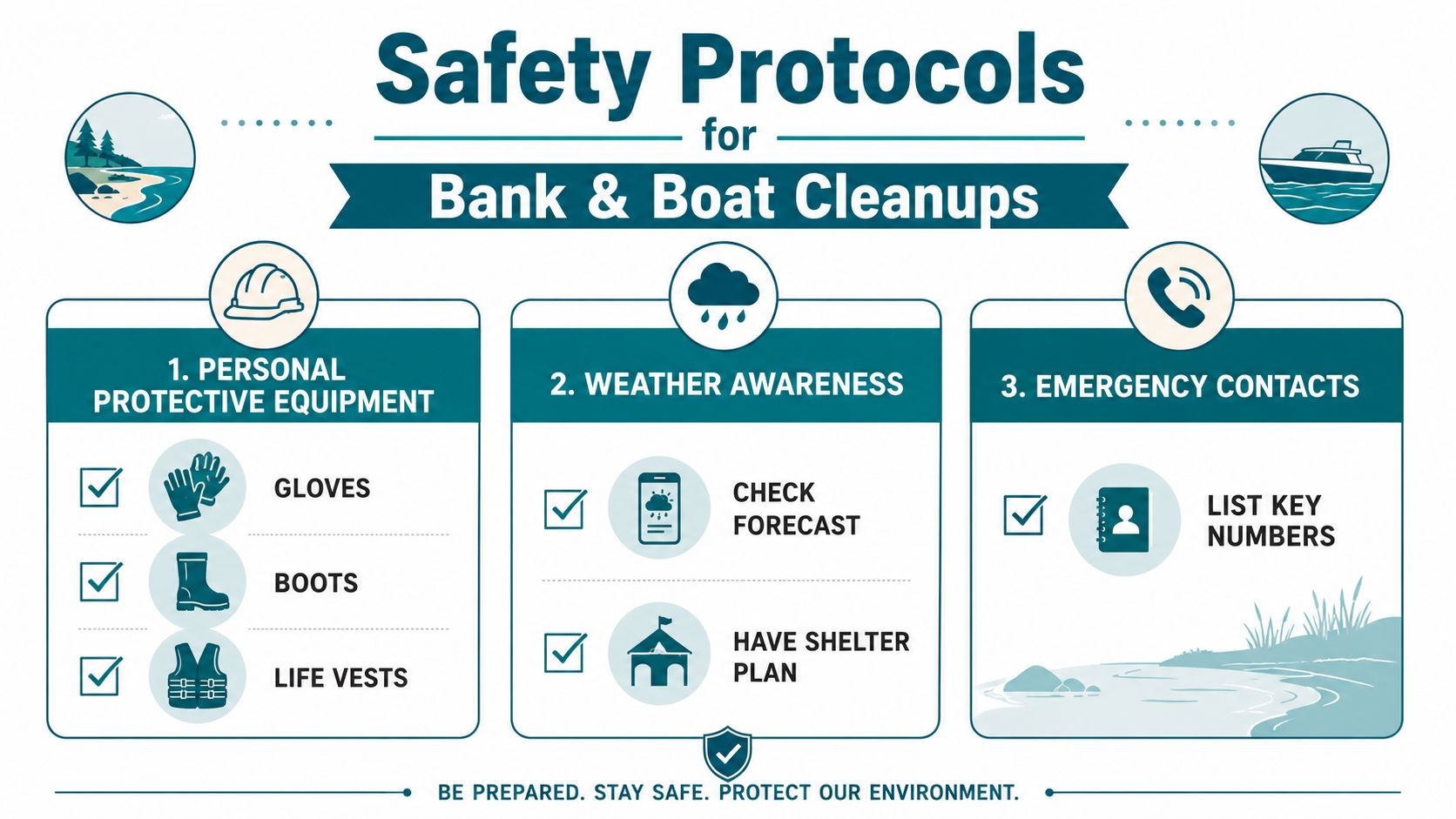
    Start with clothing. Wear closed-toe shoes, puncture-resistant gloves, long sleeves, and layers that match the weather. Use a high-visibility vest near streets. Bring water, sunscreen, and a small first-aid kit.

    Seattle guidance tells volunteers to stay out of roadways, medians, and roundabouts. It also warns against bridges, steep slopes, guardrails, construction areas, utility sites, headphones, alcohol, and mind-altering substances. Work in daylight only, and use a litter grabber instead of bare hands. You can review the Seattle Adopt-a-Street safety guide before planning roadside work.

    Treat unknown objects as unknown

    Use the stick-before-touch rule. Tap or move ordinary-looking material with a grabber or stick before you lift it. Annapolis guidance recommends using a rake or stick to identify an item, and sweeping dangerous litter with a broom and dustpan. Its cleanup checklist also tells volunteers to obey traffic signals and wear gloves.

    Leave needles, syringes, chemicals, weapons, medical waste, dead animals, and anything poisonous for trained handlers. Don't squeeze, kick, open, or carry an object just because it fits in your bag. Report illegal dumping through the city's 311 system when that route applies, and ask the organizer how the crew handles hazardous material.

    Jacksonville guidance says crews should park off the roadway, work on one side at a time, wear bright clothing, safety vests, gloves, and protective footwear, and carry plenty of water. It also says volunteers shouldn't enter the roadway or shoulder or work on bridges, tunnels, or overpasses. The Jacksonville cleanup safety guidance gives a clear model for leaders.

    North Carolina rules set a minimum age of 12, and volunteers aged 12 to 17 need supervision from adults aged 21 or older. The rules also require daylight work, a distance of at least five feet from the pavement edge, small groups, facing oncoming traffic, and stopping during bad weather. Read the North Carolina DOT safety rules before taking a crew beside a road.

    Before anyone starts, I run a quick check:

    • Route: Are we away from traffic, steep edges, unstable ground, and water hazards?
    • Gear: Does everyone have gloves, a grabber, a bag, and visible clothing where needed?
    • Buddy: Does every volunteer have a partner or a clear group?
    • Weather: Do we have water, shade, warm layers, and a stop plan?
    • Hazards: Does everyone know what stays on the ground?
    • Emergency: Does the leader have a phone, first-aid supplies, and emergency contacts?

    This volunteer safety checklist gives you a compact version to use before your next event.

    Why People Stop Showing Up and How to Keep Them

    The first Saturday can draw a crowd. The third Saturday tells you whether you built a crew.

    I've seen volunteers disappear after one cold morning, one confusing meeting point, or one event where nobody remembered their name. Cleanup programs often focus on sign-ups because sign-ups look good. I care more about the person who returns, learns the route, and starts bringing a friend.

    Make the event easy to remember

    Pick the same day, time, and meeting place whenever you can. People can build a cleanup into a weekly routine when they don't have to solve a new puzzle every time.

    Weather causes obvious trouble. Chicago can give you heat, rain, snow, wind, and hail in the same broad season. I use rain dates when possible, move seasonal events to more comfortable times, and keep an indoor backup task ready, like sorting recyclables or preparing supplies.

    Social connection matters, but you don't need forced games or loud introductions. A crew that grabs coffee afterward gives people a natural place to talk. Volunteers often connect while washing muddy tools, comparing strange finds, or arguing over whether a soaked sofa cushion counts as one item or two.

    People return when they know where to go, who will be there, and what their work changed.

    Show the work without turning it into a sales pitch

    Post bag counts, before-and-after photos, and short notes about the route. Keep a simple attendance record. The Durham Adopt-a-Street program tracked 10,914 pounds of litter over one year, with an average of 7.75 cleanup events and 893 pounds per month, then estimated the removed material at $21,037 using a public removal cost of $1.93 per pound. Its cost-benefit analysis shows why weight records tell a clearer story than bag counts alone.

    Give returning volunteers ownership. Ask one person to manage supplies. Ask another to lead a route. Celebrate milestones at five and twenty events, and use name tags so people don't have to rebuild the group from scratch each week.

    A retention benchmark cited in the provided volunteer-sector coverage places nonprofit volunteer retention at around 65%, meaning roughly one-third may not return year over year. The volunteer retention discussion makes the practical gap plain. Recruitment fills a calendar. Predictability, friendship, and visible results help fill the next one.

    How to Organize Your Own Cleanup From Scratch

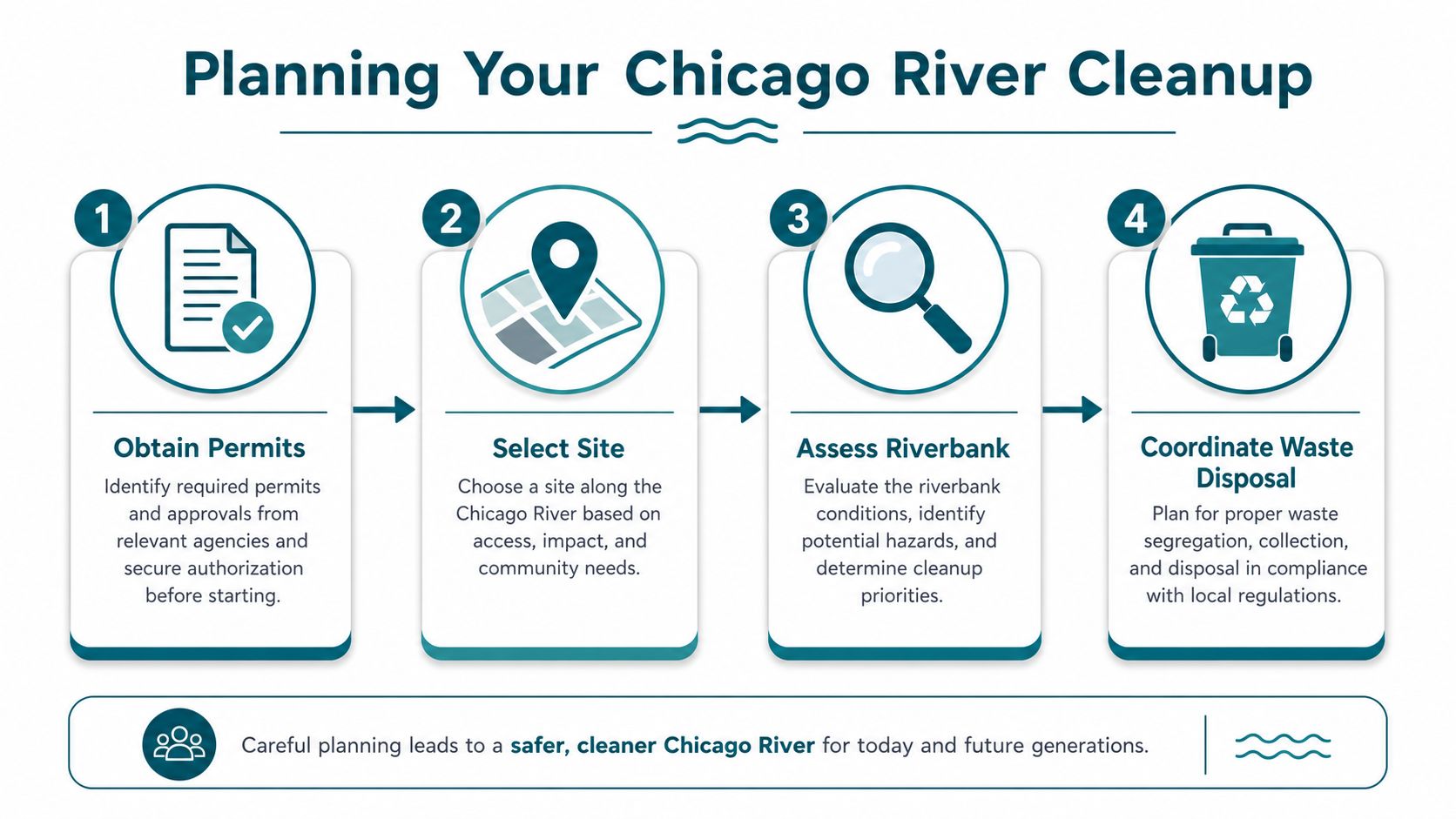
    Choose a site you can finish or revisit. A four-to-six-block stretch, one park, or a half-mile riverbank gives a new organizer a manageable boundary. Walk it first. Look for traffic, water, construction, broken glass, dumping, restrooms, shade, and a place to stage full bags.

    Get permission before you advertise. In Chicago, contact the Chicago Park District for park work, ask an alderperson's office about ward coordination, or approach Friends of the Parks for a park partnership. A short email should name the site, proposed date, cleanup limits, disposal plan, and safety approach.

    Build the smallest useful kit

    • Bags: Use 50-gallon contractor bags for bulky litter.
    • Tools: Gather grabbers, rakes, and dustpans.
    • Protection: Provide gloves, hand sanitizer, and a first-aid kit.
    • Water: Bring a cooler or water station.
    • Hazard control: Use sharps containers only through a trained disposal process.

    Recruit in places where people already gather. Post in neighborhood Facebook groups and Nextdoor. Contact LISC Chicago networks, university service boards, local businesses, and corporate volunteer coordinators. Ask a nearby café if it wants to host a post-cleanup stop.

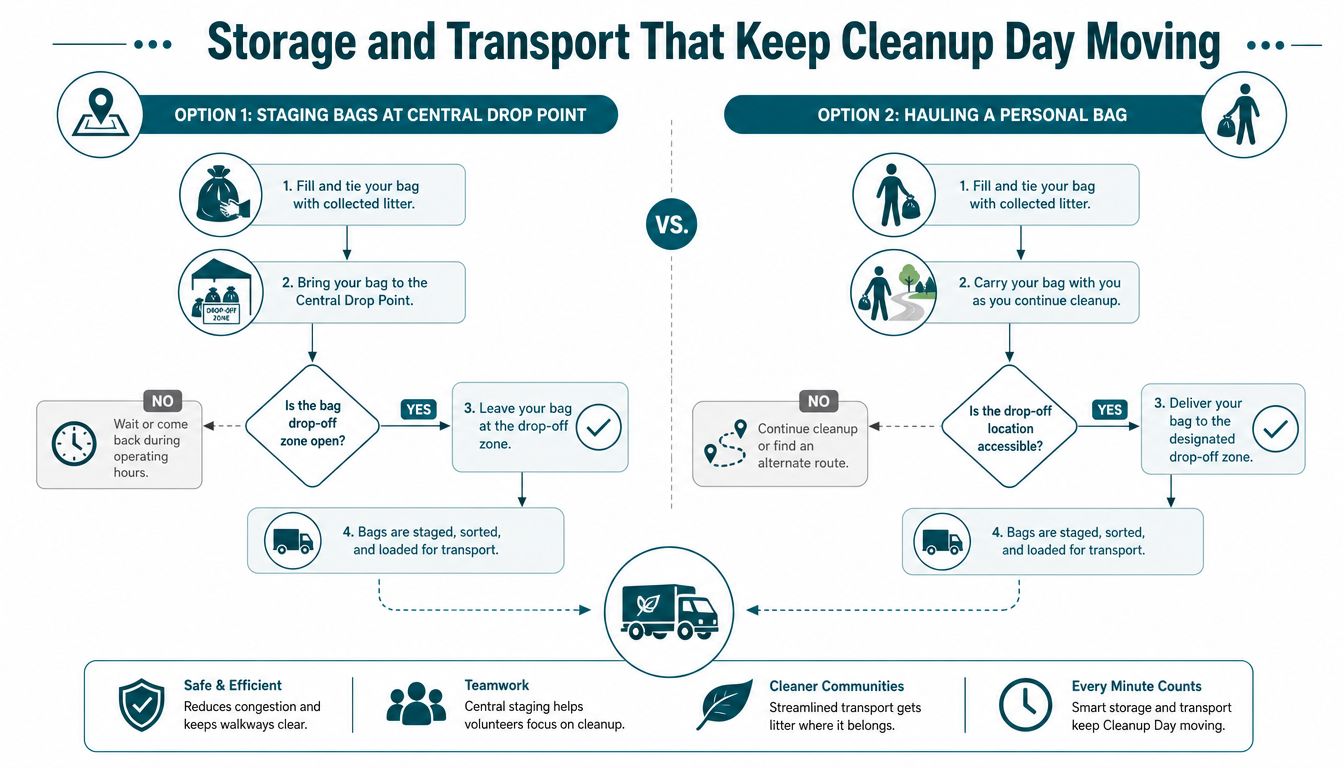
    Set one route captain at each boundary. Give everyone a meeting point and a stop time. Weigh the bags before disposal, record the date and site, and photograph the same view before and after the work. Ocean Conservancy's International Coastal Cleanup guidance also encourages item data and cleanup cards, so organizers can track what volunteers remove instead of relying on a vague pile of bags.

    Send a thank-you message soon after the event. Include the route photo, weight, next date, and one clear way to help. A person who returns quickly can become a route captain before the group loses momentum.

    Your First Saturday Morning and What Comes After

    I arrive before the crew. I check the meeting point, set out gloves and grabbers, and walk the first section for new hazards. Then people appear in twos and threes. We sign in, run the safety talk, pair up, and start at the first bend in the river or the first block of the park.

    The first ten minutes feel quiet. Then somebody finds a shopping cart. Somebody else pulls a tire from the weeds. A new volunteer asks where to put a cracked bottle, and suddenly they're part of the crew.

    After the bags go to the weigh-in spot, we take a photo and get coffee. That small ritual often matters more than a speech. On the second visit, people recognize the meeting place. On the third, they recognize each other.

    Over the next six months, you might join a smaller core group, take ownership of a parkway, or mentor the next newcomer. You don't need to plan six months today. You need to make the next Saturday easy.

    This week, RSVP to a Chicago cleanup through the Park District, Friends of the Chicago River, an alderperson's office, or a local group, then add the next event to your calendar before you leave. The second time you show up is where cleanup volunteer work starts becoming a habit.


    Litter Caterpillars organizes Chicago trash pickup events where volunteers gather, pair up, and clean neighborhood areas with supplies such as grabbers, bags, gloves, and hand sanitizer. Visit Litter Caterpillars to find a crew, join an upcoming pickup, and take your next Saturday morning outside.

  • Best Trash Pickup Schedule for Volunteer Groups

    Best Trash Pickup Schedule for Volunteer Groups

    At 9:14 on a Saturday morning, my gloves were soaked, the hail was bouncing off the cemetery pavement, and five of us were still trying to keep our trash bags from filling with water. That cleanup taught me the best trash pickup schedule isn't the one that looks neat on a calendar. It's the one people can trust.

    The First Pickup That Started Everything

    Our first cleanup began under a cemetery awning on Chicago's North Side. Hail hammered the sidewalk. The bags sagged like water weights, and every glove felt useless within minutes. Five volunteers huddled together, watching the sky and wondering whether the person who planned the event had lost his mind.

    That person was me.

    I had wanted a clean start, a simple act of service, and a reason to bring people together. Instead, I got a Chicago spring storm that turned a short litter walk into a cold endurance test. We still picked up what we could. We laughed at the absurdity, took shelter when the weather demanded it, and went home with a lesson I couldn't ignore.

    A schedule isn't bureaucracy. It's a promise between the organizer and the volunteer. It tells people when to wake up, what to wear, where to park, how long they'll work, and who will make the call if the weather turns rough. Without that promise, a cleanup depends on enthusiasm alone. Enthusiasm fades quickly when people don't know whether anyone else will show.

    Practical rule: A schedule should make showing up feel simple before the work begins.

    Municipal systems often use weekly collection as the baseline for basic household waste service. The UN SDG metadata defines basic collection as service at least once a week for one year, which helps explain why weekly pickup remains a familiar reference point in many communities (UN SDG metadata on household waste collection). Volunteer groups can borrow that rhythm without copying a city route. A recurring morning gives the group a dependable beat.

    Since that first storm, I've learned that the calendar matters less than the habit built around it. The rest of this guide draws from that hailstorm, winter cleanups, hot Chicago mornings, and every Saturday when a small crew became a reliable one.

    Choosing the Right Day Time and Frequency

    Start with your volunteers, not your preferred time. Send one simple poll: “What recurring cleanup slot can you attend most often?” Give people a short list of realistic choices, then choose the slot that receives dependable support rather than the slot that sounds ideal.

    Use a four-part decision

    1. Pick a fixed window. Try 8 a.m. Saturday for families and early risers, 6 p.m. Thursday for after-work crews, or the second Sunday of each month for a monthly stewardship group. Keep the day and start time stable long enough for people to build it into their lives.

    2. Match frequency to litter pressure. Busy corridors usually need a weekly visit. A park may work better on a biweekly rhythm, while a quieter greenway may only need a monthly cleanup. Waste collection systems already use different cadences for different streams. A 2020 door-to-door study found that households set out paper and cardboard at weekly, two-week, and monthly intervals, while glass followed a less frequent pattern for many participants (material-specific collection behavior in a door-to-door system). Your group can use the same logic. Let the site tell you how often to return.

    3. Set a route limit. Use the 60/90 rule. Plan for a route that takes about an hour, and never let the full event run longer than 90 minutes from arrival to group photo. Volunteers who finish with energy are more likely to come back. Volunteers who finish exhausted often remember the strain more clearly than the result.

    4. Review after several visits. Track attendance, bag count, weather, problem spots, and actual finish time. A mediocre slot that runs consistently for six months beats a perfect slot that your team abandons after three attempts.

    Route length also affects safety. A compact route keeps the group visible, makes supply support easier, and limits the distance people carry full bags. For larger service areas, use a planning sequence that moves from policy review to broad route design, route balancing, crew paths, and later adjustment. The waste collection planning guidance recommends compact, non-overlapping routes, balanced collection and hauling time, and avoiding heavily traveled streets during rush periods.

    I treat the schedule as a social contract. The route can change after you learn more, but the promise to meet should change only for a clear reason.

    Why Weekend Mornings Win Every Time

    The first cold Saturday morning usually reveals whether a cleanup can become a habit. People arrive with coffee, daylight, and enough time to settle into the route. Weekend mornings give volunteer groups a reliable starting point: cooler air makes walking and lifting easier, daylight exposes hazards, and coffee or brunch offers a social finish that a work shift rarely provides.

    Weekday evenings can serve a committed crew, especially near offices or transit. They bring more friction, though. Commuting delays, darkness, dinner plans, and end-of-day fatigue can turn a willing volunteer into a no-show. Evening events work best as a supplement, not the only chance to participate.

    Pop-up pickups help when a storm, festival, illegal dumping incident, or construction project changes a block quickly. Their flexibility comes at a cost. People cannot build a standing habit around an uncertain date. Recent operations research examines collection models that use bin-fill information, traffic, weather, and route re-optimization instead of relying on a rigid calendar (dynamic waste collection and route re-optimization research). Volunteer groups can borrow that flexibility for urgent work while keeping a dependable weekly rhythm for the people who return.

    Metric Weekend Morning Weekday Evening On-Demand / Pop-Up
    Attendance pattern Usually steadier for recurring groups More sensitive to work and travel Unpredictable unless the issue feels urgent
    Energy Fresh start, cooler conditions, daylight Mixed energy after the workday Depends on notice and event urgency
    Social habit Easy to connect cleanup with coffee or brunch Social time competes with dinner and commuting Requires fast coordination
    Best use Weekly community routine Supplementary crew or special route Overflow, urgent litter, or event response
    Main trade-off Competes with family, sports, and religious plans Darkness and fatigue Weak routine and difficult planning

    Before setting a recurring date, check youth sports schedules, religious calendars, neighborhood festivals, and major city events. A short local survey can prevent months of weak attendance. Organizers planning public-facing weekend outreach can also use these weekend canvassing best practices to manage arrival points and volunteer flow.

    The exact Chicago day may change, but consistency matters more than perfection. A weekend cleaning schedule gives people a repeatable way to make service part of their identity. Weekend mornings work for many groups because one time slot supports attendance, safety, conversation, and the return habit together.

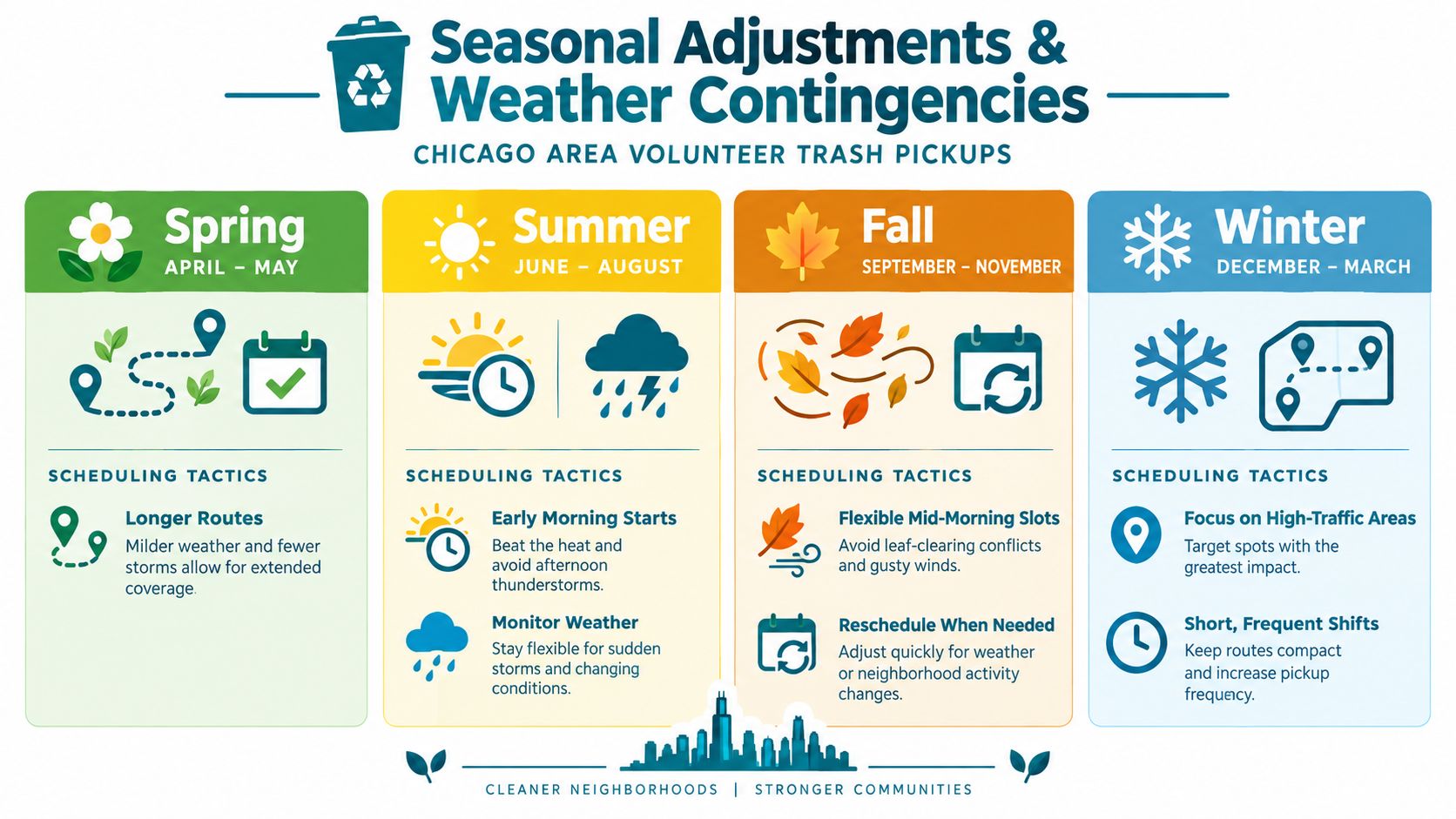
    Seasonal Adjustments and Weather Contingencies

    Chicago weather demands a plan with branches. I don't treat a forecast as an automatic cancellation. I treat it as a design variable that changes the route, start time, supplies, and decision deadline.

    An infographic detailing seasonal adjustments for volunteer trash collection in Chicago, including weather-specific scheduling strategies.

    Build the year around conditions

    Spring, April through May: Give the group its longest routes when temperatures feel manageable and daylight arrives early. Alley garbage often needs attention after winter, so start with routes that have visible accumulation. Keep a storm alternative ready because spring can turn quickly.

    Summer, June through August: Start at 7 a.m. to avoid the hottest part of the day. Cap the shift at 90 minutes, schedule hydration breaks every 30 minutes, provide sun protection, and use buddy checks every 20 minutes. If heat or thunderstorms threaten the route, shorten the coverage rather than asking people to push through.

    Fall, September through October: Return to the standard 8 to 10 a.m. window. Use the season to welcome people returning from summer travel, but watch for gusty conditions, wet leaves, and neighborhood conflicts around fall cleanup work.

    Winter, November through March: Compress the route to busy, visible areas. Shorten the shift to 60 minutes, prepare cold-injury training, and place hand warmers with the supplies. A small crew on a short route can do better work than a large group standing around in dangerous cold.

    Use three weather colors

    • Green, proceed: Keep the route and normal start time.
    • Yellow, proceed with adjustments: Shorten the route, add water or warm gear, change the start time, or move the meeting point.
    • Red, postpone: Cancel outdoor work or move indoors to sort recyclables and prepare supplies.

    The A Rocha cleanup manual recommends morning starts, daylight operations, and avoiding the coldest and hottest hours. It also advises fixed meeting points, closing times, multiple volunteer groups, and designated safety officers (community litter cleanup safety guidance).

    Check the forecast at 72, 48, and 12 hours before pickup. Send every update through one channel, whether that's a text tree, GroupMe, or WhatsApp. Name one cancellation authority. Volunteers shouldn't debate safety in five separate chats while standing outside in hail.

    Ready to Use Schedule Templates

    A reliable template protects volunteer energy before the first bag is filled. Keep the recurring pieces fixed, then put changing details in one shared Google Sheet. Static fields should cover safety rules, supply standards, waiver language, role descriptions, and the weather decision process. The sheet can track dates, captains, routes, attendance, conditions, and follow-up notes.

    Template A for a neighborhood cleanup

    Copy this structure into your event document:

    • Schedule: Second Saturday of every month, 9:00 to 10:30 a.m.
    • Meeting point: Park pavilion.
    • Route plan: Rotate three two-block routes.
    • Leadership: Two co-leaders, one route captain per assigned route.
    • Supplies: Gloves, bags, grabbers, first-aid kit, water, sanitizer, and a weighing method.
    • Registration: RSVP link plus emergency contact and waiver fields.
    • Closing ritual: Group photo, bag count, and post-pickup coffee.
    • Google Sheet fields: Month, route, captain, theme, attendance, conditions, supply gaps, and next action.

    The fixed structure makes the cleanup familiar, while the monthly route and theme give returning volunteers something new to own. Keep the signup fields, safety language, and role definitions fixed. Organizers building a shared sheet can also use these free volunteer scheduling tools.

    Use a 12-month map so each pickup has a clear reason to return:

    Month Route Captain Theme
    January Park edge Assigned captain Winter walkway check
    February Residential blocks Assigned captain Snowmelt litter sweep
    March Alley route Assigned captain Alley Sweep
    April Creek edge Assigned captain Creek Cleanup and Earth Day tie-in
    May Tree-lined blocks Assigned captain Arbor Day route
    June Park perimeter Assigned captain Summer Park Patrol
    July Commercial corridor Assigned captain Busy-block cleanup
    August Greenway Assigned captain Greenway Care
    September School approach Assigned captain Back-to-routine sweep
    October Alleys Assigned captain Fall Alley Sweep
    November River access route Assigned captain River Stewardship
    December Short central route Assigned captain Winter Welcome

    Change the captain and route in the sheet, but leave the operating language alone. For larger operations, organizers can adapt ideas from workflow scheduling for operations managers to clarify route ownership, dependencies, and handoffs. That distinction matters in Chicago: a familiar process helps people arrive ready, while clear ownership prevents a rainy morning or a missing supply from derailing the group.

    Template B for a special event pickup

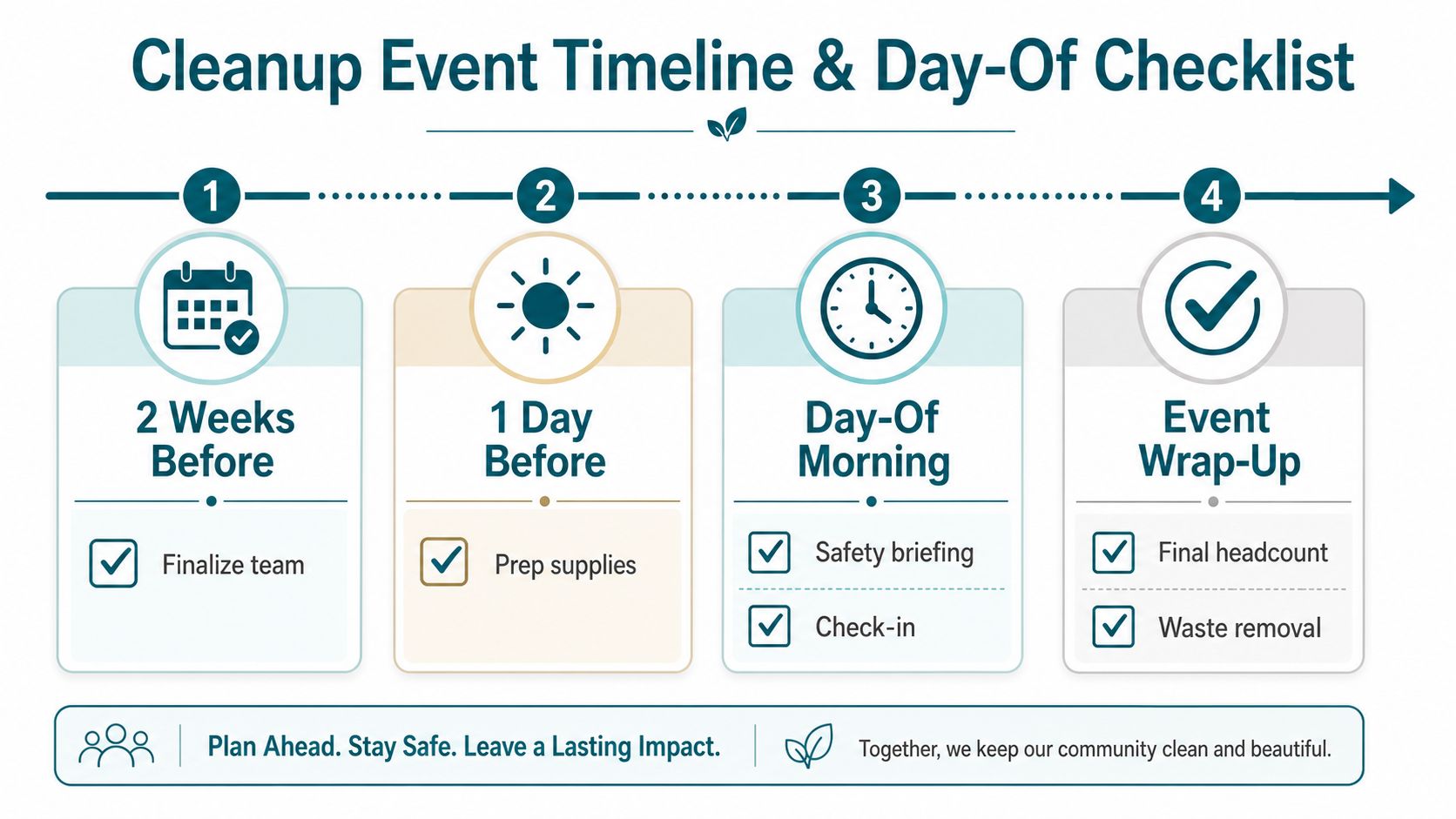
    Use the week before the event for permits, gear staging, and the volunteer roster. Set a cap of 40 volunteers so station leads can keep sight of the group. A larger crowd may collect more quickly, but it also creates more check-in, communication, and safety work. On event day, use this sequence:

    Time Action
    7:00 a.m. Setup, supplies, signs, and check-in
    8:00 a.m. Safety briefing and zone assignments
    8:30 a.m. Stations open
    11:30 a.m. Final sweep and bag consolidation
    Noon Wrap and group photo
    1:00 p.m. Debrief with station leads

    The Chicago River Day model offers a useful structure. Place stations at regular intervals, use color-coded zones, and complete release-of-liability paperwork before crews leave the meeting point. Keep the signup sheet consistent across both templates: name, email, t-shirt size, emergency contact, waiver status, and role. Roles should include greeter, photographer, route lead, and supply manager.

    Element Neighborhood Weekly Special Event
    Planning window Recurring monthly setup Pre-event permits and staging
    Volunteer size Flexible small crew Capped roster
    Route design Three rotating routes Color-coded zones and stations
    Leadership Two co-leaders Station leads and event coordinator
    Follow-up Coffee and next date Debrief and issue log

    Turning First Timers Into Regulars

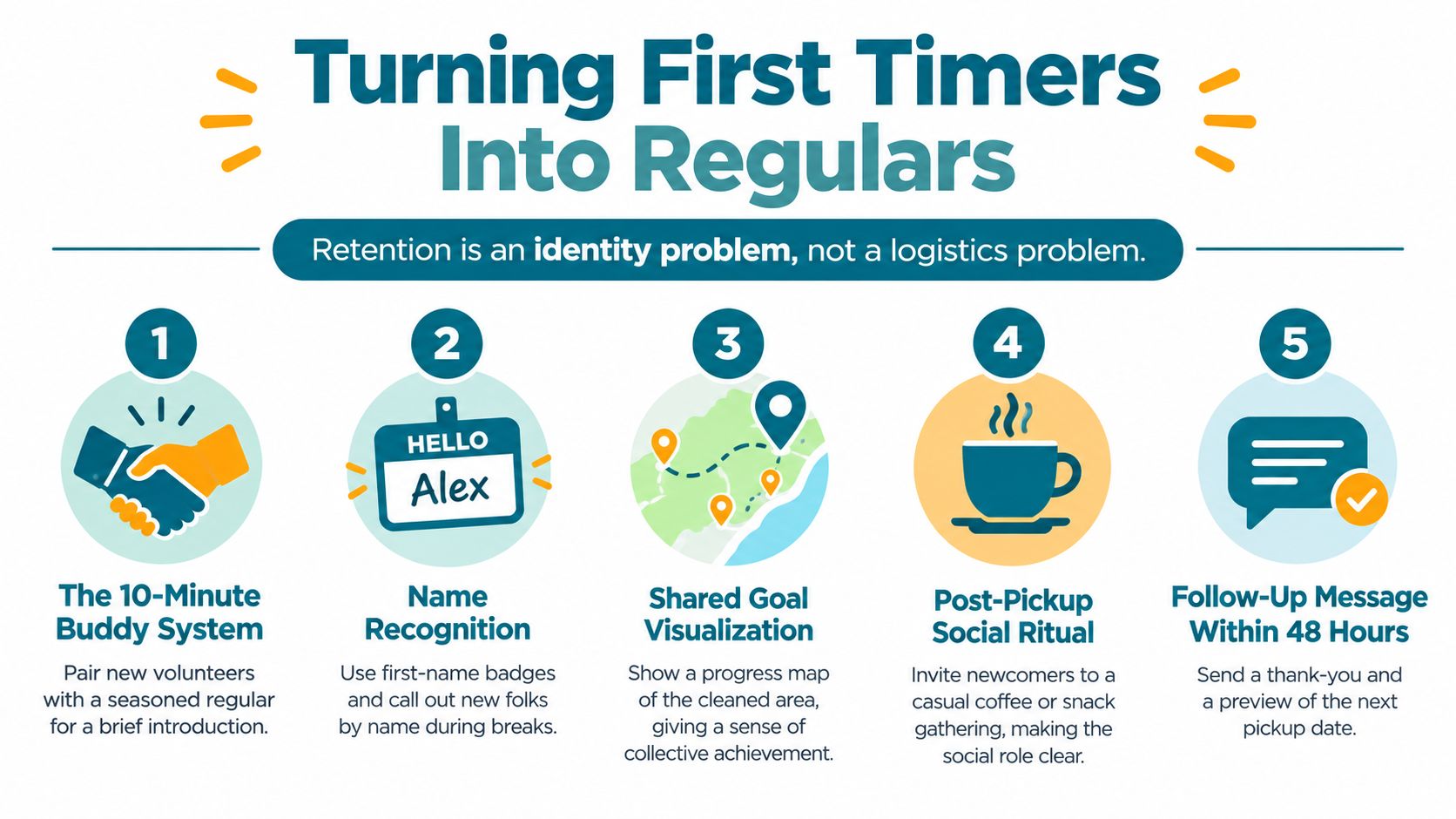
    A route map gets people to the meeting point. Belonging gets them back. After a first pickup, people return when the group remembers their name, trusts them with a role, and gives them a clear reason to expect the next meeting. That social habit matters as much as the schedule.

    Five habits that build return visits

    1. Start with a 10-minute welcome circle. Introduce everyone by first name, ask why they came, and pair newcomers with a buddy. Keep it brief so the work begins on time and nobody feels stuck before the cleanup.

    2. Make the result visible. Weigh the bags at the end of the shift and post the totals in a shared channel. A concrete record helps volunteers connect one hour of work with a visible result. Use the same simple process each week.

    3. Name the role, not the task. Assign titles such as Route Lead, Sort Captain, or Safety Officer. A title signals trust and clarifies how that person contributes. “Volunteer” explains why someone arrived. A role explains what they own.

    4. Build a closing ritual. Coffee, donuts, and a five-minute story from a returning member create a natural ending. People remember conversations, jokes, familiar faces, and the cleaned block together. That social connection makes the next invitation feel like a standing part of the neighborhood, rather than another obligation.

    5. Send the next invitation within 48 hours. Include a personal thank-you, a photo, and the next month's date. Make the return path obvious so the person does not have to search for the group again.

    These habits match the identity-first approach in volunteer retention strategies. The organizer's job is to remove the awkward gap between “I came once” and “this is my group.” In Chicago weather, that connection also helps people stay committed when a cold morning or a changed plan tests turnout.

    Neighborhood crews show the pattern in different ways. A Logan Square group I followed grew from a small starting crew into a much larger base of regulars. A Rogers Park shoreline team saw fewer dropouts after assigning clear roles, while a Pilsen cleanup brought more first-timers back after adding the 48-hour invitation. These are local operating stories from the groups used for this article, not published benchmarks. Use them to shape your own experiments, not to promise a fixed result.

    An infographic titled Turning First Timers Into Regulars outlining five steps to improve volunteer retention and engagement.

    Your First Month Checklist

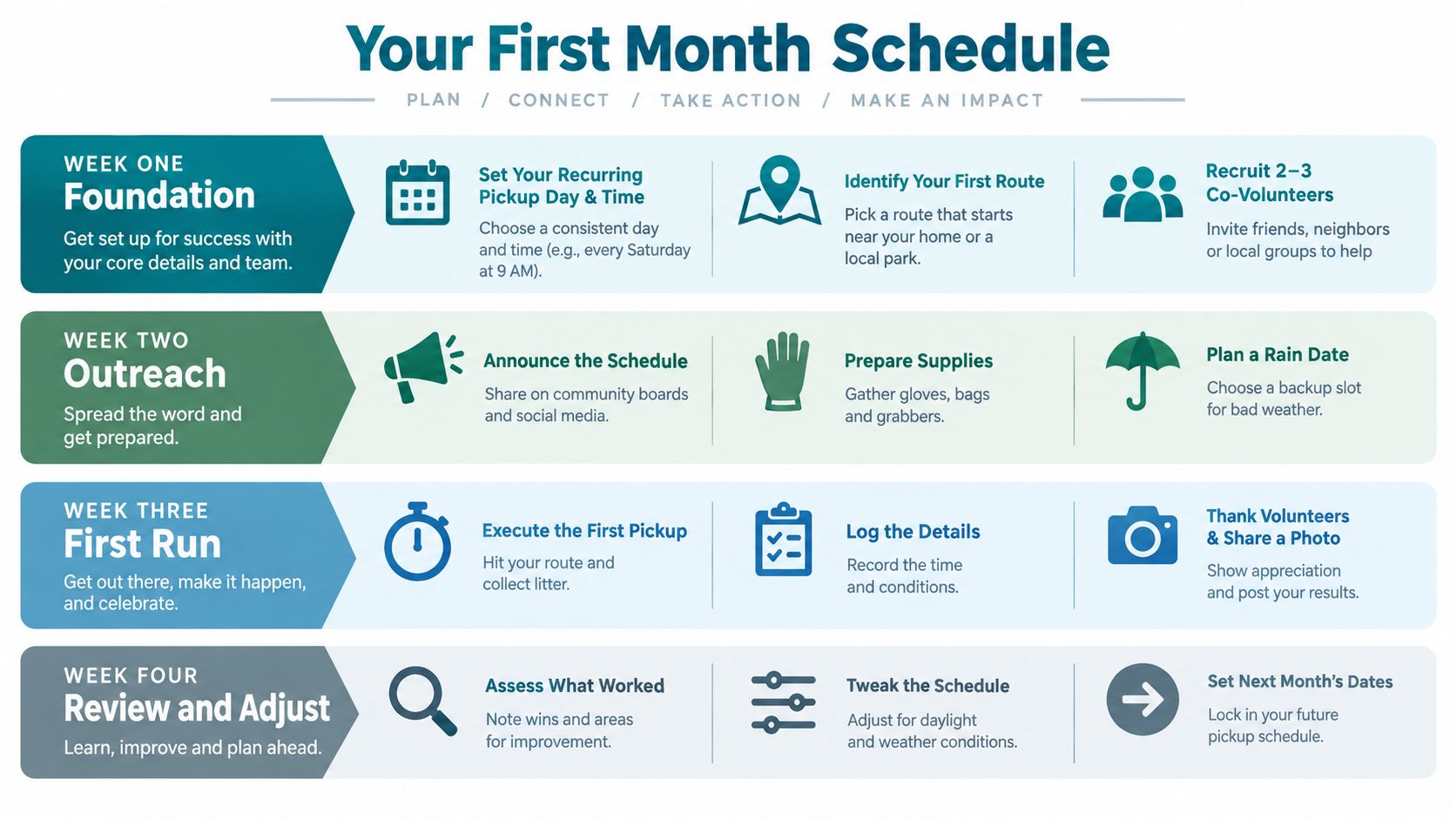
    A first month succeeds when volunteers know what will happen before they arrive, and when the organizer learns enough to make the next pickup easier. Track the meeting point, route length, timing, weather decision, and arrival instructions. These details turn a one-off event into a weekly habit.

    Week one, set the foundation

    • Announce the recurring Saturday slot.
    • Choose a first route near a home, park, or familiar landmark.
    • Assign a cleanup captain.
    • Recruit 2 to 3 co-volunteers.
    • Confirm gloves, bags, grabbers, water, first aid, and communication access.
    • Create a signup sheet with roles, emergency contacts, and waiver status.

    Keep the public message short. State the meeting point, arrival time, route length, expected finish, clothing advice, and weather policy. A clear commitment helps people decide quickly, especially when the cleanup competes with errands, family plans, or a cold Chicago morning.

    Week two, run the first pickup

    Arrive before the group. Test sign-in, inspect the route, and explain safety boundaries before anyone starts collecting. Record the actual start and finish times, weather, bag volume, confusing intersections, and locations that need city collection rather than volunteer handling.

    Run through the cancellation protocol, even under a calm forecast. Volunteers should know who sends the message, which channel carries it, and what happens after postponement. For a practical inspection routine, adapt use this checklist for daily walk-throughs to sidewalks, alleys, parks, and supply areas.

    Week three, adjust with evidence

    Review attendance and comments while the details are fresh. If people arrive late, clarify the arrival time or move the meeting point. If the route ends early, add a nearby block. If it runs long, remove the least visible segment. Change one variable at a time so the crew can tell what improved the experience.

    Send a thank-you message with a group photo and the next date. Ask one direct question: “What would make the next pickup easier to attend?”

    Week four, lock the backup plan

    Choose seasonal backup dates. Assign a co-organizer by day 30, so the schedule does not depend on one person's memory, phone, or energy. Store the route map, contact list, supply inventory, and weather decision in one shared location.

    Live litter reports, QR-code sign-ins, weather, traffic, and route changes may eventually help crews direct time toward areas that need attention. Those tools support judgment, but a dependable invitation still creates the habit. Volunteers return because the meeting rhythm is clear and the crew feels like theirs.

    Block the next four Saturdays now, then assign a cleanup captain to each one.

    A four-week infographic guide detailing a step-by-step schedule for organizing community trash pickup events and volunteer efforts.

  • How to Build a Community Litter Cleanup Program That Works

    How to Build a Community Litter Cleanup Program That Works

    At 7:30 on a Chicago Saturday morning, I hand an orange bucket to a new volunteer, point toward the alley, and watch the group split into pairs. By 10, the pop-up tent holds full bags, dusty grabbers, and a crew already asking where we're cleaning next.

    What a Weekly Cleanup Looks Like Before You Build One

    The first arrivals gather at a familiar corner. Someone brings coffee. Someone else checks the weather and counts gloves. I pass out orange buckets, grabbers, bags, and safety vests while people trade quick introductions.

    Then we move.

    Two volunteers take the alley on the east side of the block. Two head west. The grabbers make a light scraping sound against the pavement as they catch bottle caps, wrappers, food containers, and scraps of plastic tucked beneath parked cars. The work has a rhythm. Bend, pinch, lift, bag. Talk, laugh, point, keep moving.

    A homeowner opens the front door and offers lemonade. One volunteer switches to a smaller bag because the large one keeps dragging through the narrow passage. A child watches us sort the pile and asks why we leave recyclables on the curb. I explain that our disposal plan depends on the city and the site, so we separate what we can and never make promises we can't keep.

    At 10, we meet beneath the pop-up tent. We count bags, record the route, photograph the pile, and check that nobody has a cut, sore back, or overheated face. The numbers matter, though they never tell the whole story. The same corner looks different when people see us return every week.

    Our Chicago group cleans across all 50 wards every week, and we've learned that consistency carries more weight than a dramatic one-day push. The International Coastal Cleanup shows how far volunteer action can reach. In its 2023 report, nearly 470,000 volunteers across 97 countries collected more than 4,000 tons of trash and plastics, recording 15,519,392 items across 15,508 miles of coastline and waterways (Ocean Conservancy report).

    A diverse group of volunteers cleaning up litter in a park with a city skyline backdrop.

    That scene contains the whole machine in miniature: a meeting point, supplies, routes, captains, safety rules, records, and a reason to return. The rest of this guide breaks down the choices behind it.

    What a Community Litter Cleanup Program Actually Is

    A community litter cleanup program is a recurring volunteer group that removes litter from defined neighborhoods on a fixed schedule. The schedule matters because a one-time event can clear a place, while a recurring crew can notice what returns, who needs help, and which routes demand attention.

    I think of the program as a kitchen.

    The captains are the head chefs. They choose the site, brief the crew, assign routes, and stop work when conditions turn unsafe. Volunteers are the line cooks. They arrive ready to work, follow the site plan, and tell the captain when a task or object creates a problem. Routes are the menu, because they tell everyone where to go and what the crew can finish during that morning.

    Supplies are the pantry staples. Keep gloves, closed-toe shoes guidance, grabbers, bags, water, first aid supplies, and high-visibility vests ready before people arrive. A shared group chat is the open kitchen line. Volunteers use it to find the meeting point, report a blocked route, ask about disposal, and invite a friend.

    The basic operating pieces

    A small group can begin with a notebook and a phone. I'd still build these parts from the start:

    • Recurring time: Pick a day and hour people can remember.
    • Defined zone: Use a block, park edge, alley network, shoreline, or ward route.
    • Sign-in process: Record names, emergency contacts, and waivers where required.
    • Supply kit: Store gear in labeled bins so setup doesn't depend on one person's memory.
    • Data log: Track bags, weight when available, hours, location, and unusual hazards.
    • Newcomer path: Give people one simple page or group-chat message that shows the next event.

    Wollongong's Rise and Shine program began in 1986 and recorded 99 community volunteer events, 1,436 participants, and 44.58 tonnes of waste in 2025 (Mirage News). A program can start with three people on one block and grow into a citywide operation when every new site uses the same basic recipe.

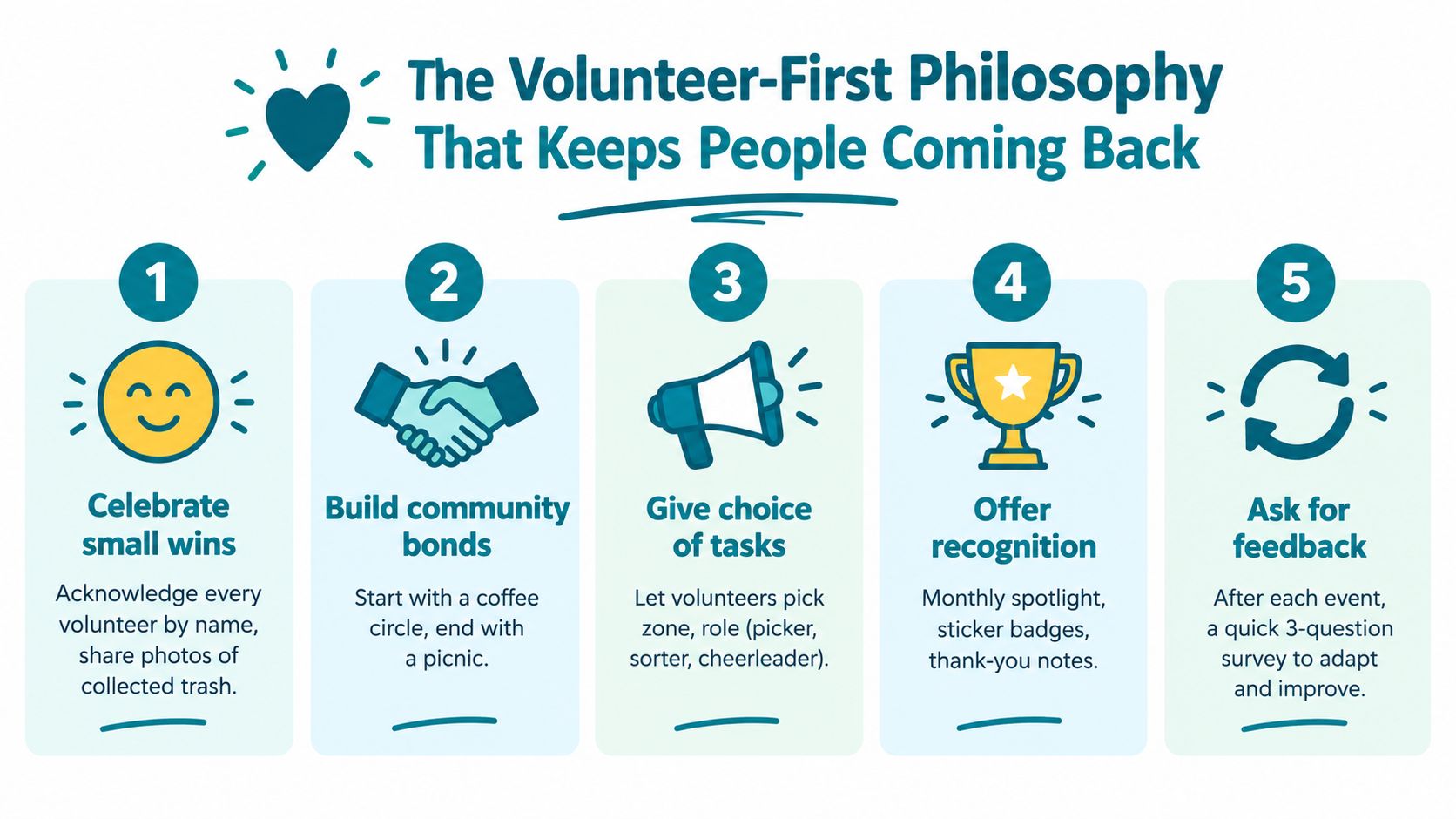
    A five-step guide on the volunteer-first philosophy to encourage community litter cleanup program participation and retention.

    The Volunteer-First Philosophy That Keeps People Coming Back

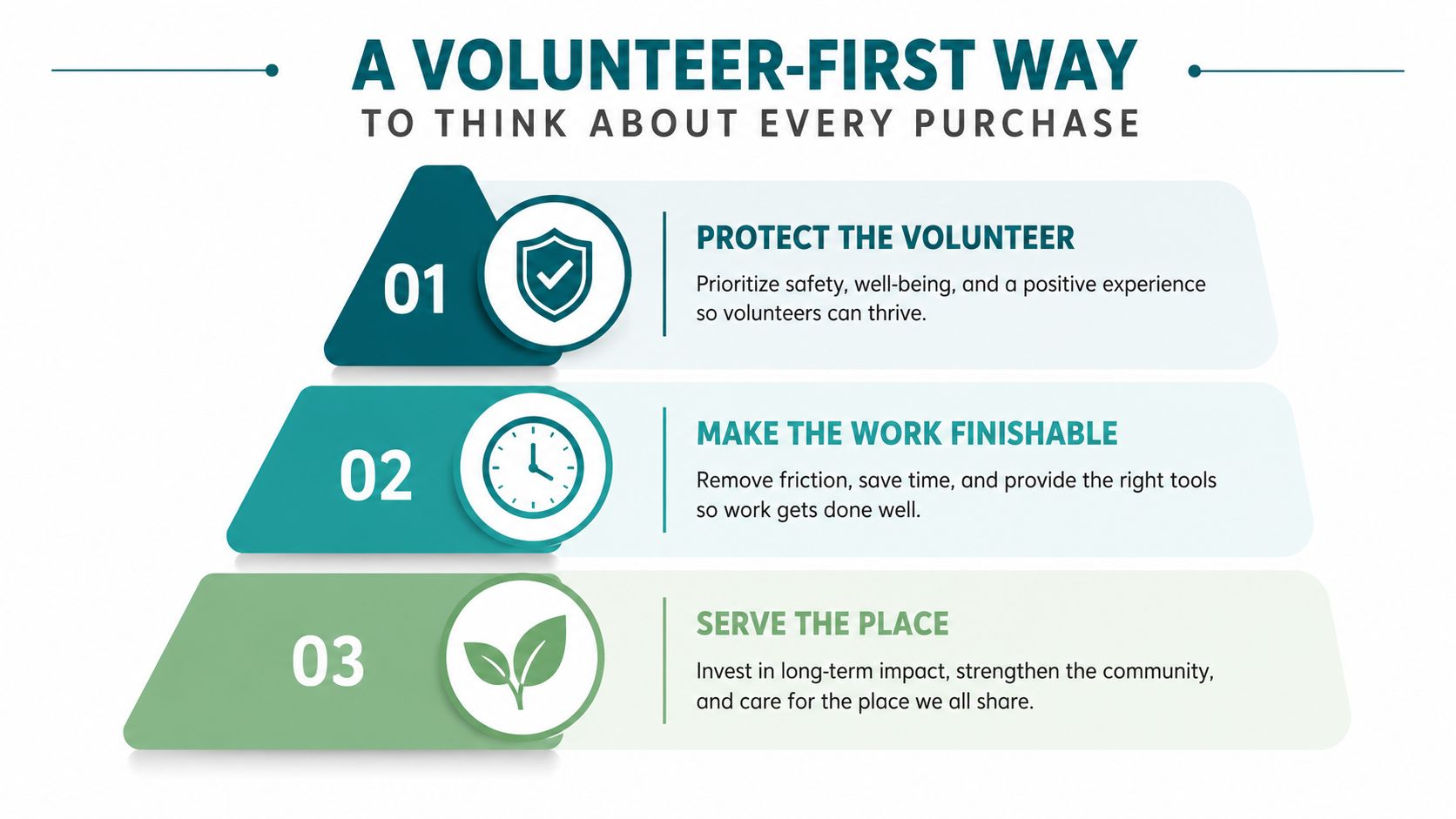
    I keep our values in the group chat because volunteers need to know what kind of room they're walking into. We talk about bravery, kindness, unity, and service. Those words only matter when they guide an uncomfortable decision.

    We schedule pickups on weekend mornings because working people need a real chance to attend. A volunteer shouldn't have to choose between earning a living and helping clean a block. Weekend timing also gives newcomers a predictable habit. They can bring a friend, learn the route, and return without asking when the next event will happen.

    Safety outranks donations. Happiness outranks publicity. We never pressure volunteers for money, and we won't ask anyone to touch a sharp object to make a photo look better.

    What the rule looks like on the pavement

    A new volunteer shadows a captain during the first session. The captain demonstrates how to use a grabber, where to place a bag, and when to step away. If someone finds glass, a needle, a suspicious container, or anything they can't identify, they call the captain instead of reaching in.

    Captains can cancel a site or change the route when weather, traffic, harassment, flooding, or unstable ground creates too much risk. That authority protects the crew from the quiet pressure to finish a route at any cost.

    Our working rule: A full bag never matters more than a volunteer going home safe and willing to return.

    Groups that chase sponsorship money before they protect volunteer energy often create the wrong bargain. They add meetings, branding demands, reporting tasks, or public appearances until the people doing the cleanup feel like unpaid marketing staff. Money can buy bags. It can't replace trust after a volunteer feels ignored or pushed into danger.

    We've used volunteer retention strategies to keep the focus on belonging, clear roles, and a reason to come back. If you're planning a cleanup with activities, polls, or team challenges, designing an interactive event can help you shape participation without turning the morning into a performance.

    The discipline compounds. First-timers learn the route. Regulars learn to lead. Captains learn to train someone else. That chain gives a community litter cleanup program a future beyond its founder.

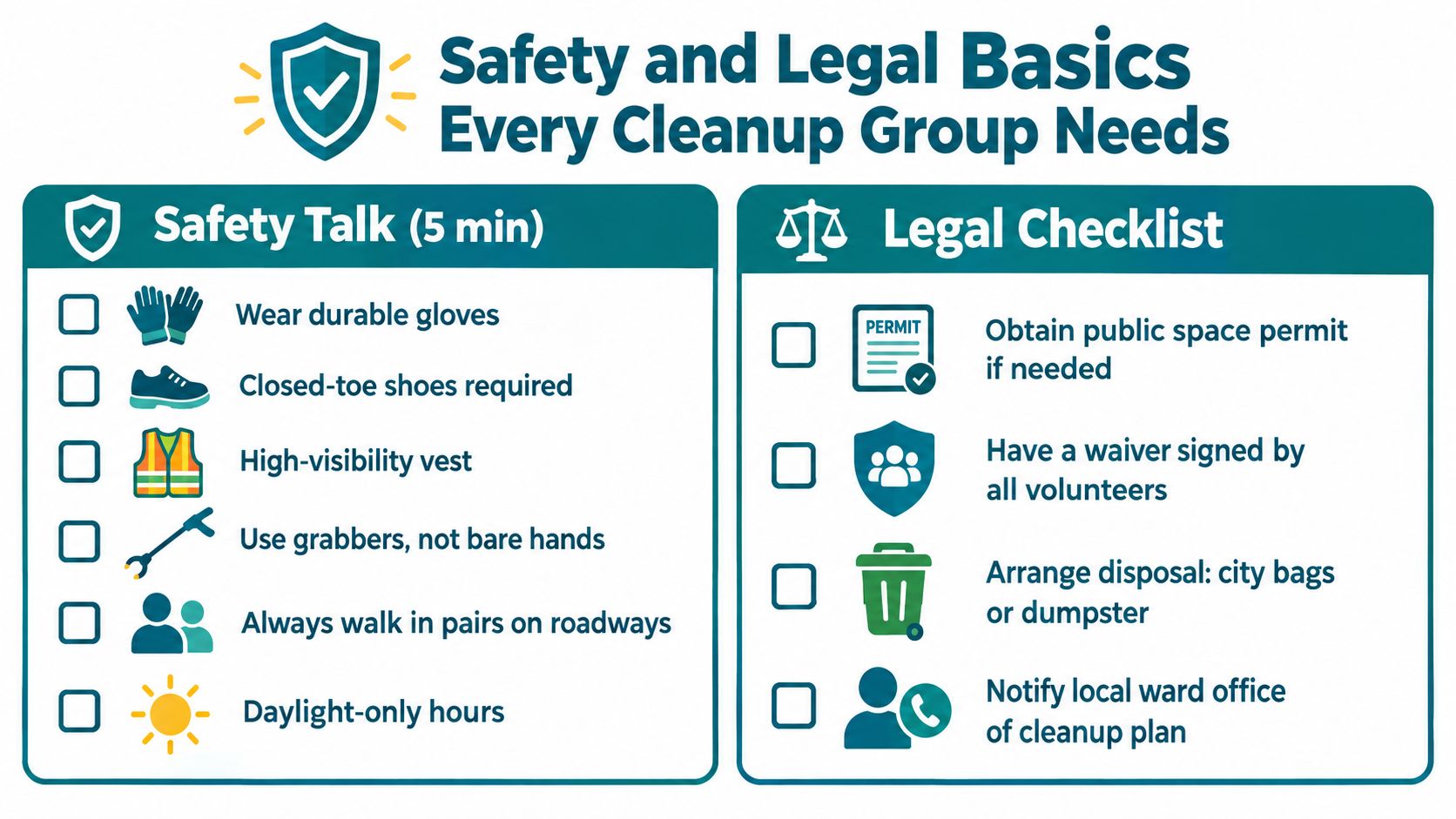
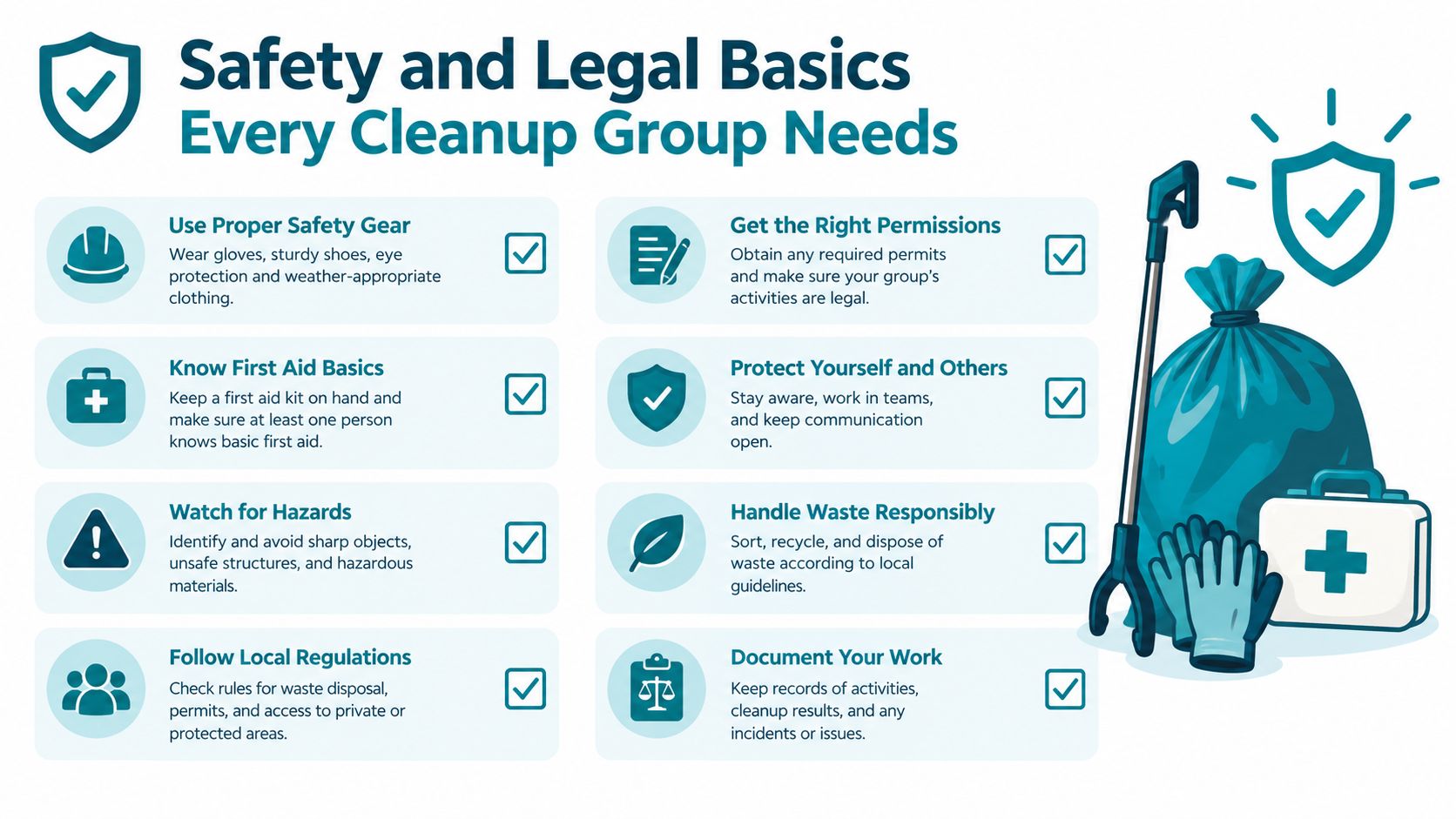
    An infographic titled Safety and Legal Basics for cleanup groups listing safety gear and legal requirements.

    Safety and Legal Basics Every Cleanup Group Needs

    I start with a five-minute safety talk, even when half the crew has attended before. Repetition catches the person who arrived late, the volunteer who forgot gloves, and the captain who assumes everyone understands roadside risk.

    Everyone needs durable gloves and closed-toe shoes. Give volunteers grabbers so they can keep bare hands away from the ground. Use high-visibility vests near traffic, keep work in daylight, and have people walk in pairs or groups of three instead of working alone. A volunteer safety briefing also warns against direct contact with broken glass, fish hooks, and hypodermic needles (Litter Free Dorset safety briefing).

    Match the plan to the site

    Parks need attention around play areas, benches, drainage points, and brush. Keep volunteers away from unstable branches, wildlife, steep slopes, and areas where children could encounter hidden sharps.

    Alleys require careful footing and awareness of vehicles, gates, dogs, and private property. Stay on approved public space, leave blocked or unsafe sections alone, and never enter a yard or building to reach litter.

    Roadways create the highest exposure to moving traffic. Stay off medians, bridges, roundabouts, rail tracks, construction zones, steep slopes, and high-traffic edges. One city guide limits adopt-a-street work to public property, daylight hours, and lower-risk locations (Seattle Public Utilities safety guidance).

    Waterways add slippery banks, hooks, changing water levels, and wildlife. Wear suitable footwear, keep a safe distance from the waterline, and stop when the bank becomes unstable.

    Never pick up needles, weapons, ammunition, car batteries, chemicals, dead wildlife, or unknown containers. Put distance between the item and the crew, keep children away, photograph the location if you can do so safely, and contact the responsible city department or trained responder. Public guidance draws this boundary clearly for hazardous litter (Cobb County volunteer guide).

    Handle the paperwork before people arrive

    Ask the parks, sanitation, transportation, or ward office whether your route needs a permit. Use a waiver suited to your location and group. Set an age policy, require adult supervision where appropriate, and keep emergency contacts with the captain.

    Bring water, a light snack, sunscreen, and a first aid kit. Hardware stores, municipal solid-waste departments, and neighborhood businesses may donate gloves, bags, vests, or grabbers. One cleanup guide lists garden gloves, closed-toe shoes, water, snacks, and grabbers as basic preparation (North Central Texas Council of Governments guidelines).

    If something goes wrong, the captain stops the route, moves volunteers away from danger, calls emergency services when needed, contacts the program lead, and records the time, place, object, weather, witnesses, and action taken. Keep the report factual. Don't hide a minor injury because you fear paperwork.

    An infographic titled Safety and Legal Basics for cleanup groups highlighting eight essential safety and compliance tips.

    For a printable preparation list, use this volunteer safety checklist.

    Partnerships and Funding Without Losing Your Independence

    I divide outside support into three lanes: in-kind donations, local sponsorships, and grants. Each lane can help, and each can change how your Saturday works.

    In-kind support usually creates the least paperwork. A hardware store might provide gloves, bags, or grabbers. A café might provide water. The trade is simple, though you still need to track what you receive and avoid promising public promotion you can't maintain.

    Local sponsorships can pay for shirts, storage, printing, or disposal. They also can bring logo requests, exclusive access demands, or pressure to post branded content. A sponsor should make the route easier. If the sponsor wants to approve every photo or claim ownership of a public space, the cost exceeds the check.

    Grants can support planning, equipment, and larger site work. They usually demand a clear proposal, a budget, progress records, and a final report. When I prepare a short inquiry, I explain the route, the volunteer need, the safety plan, the disposal plan, and the records we already keep. A resource on using Grantlas for grant letters can help organize that first written ask.

    Funding Type What You Get What It Costs You Best Fit For
    In-kind donations Bags, gloves, water, grabbers, printing Pickup coordination and basic thanks New groups and regular routes
    Local sponsorships Supplies, shirts, storage, disposal support Branding requests and relationship management Established neighborhood crews
    Grants Project funding and equipment Applications, budgets, reports, and deadlines Programs with records and a defined project

    Write a one-page ask

    Use a named location instead of a broad promise. Show a route photo, your schedule, the number of regular volunteers qualitatively, your safety controls, and the exact item or expense you need covered. Sponsors and funders want to see that their help will reach the pavement.

    I also avoid exclusive cleanup rights, mandatory logos on every shirt, and social-post quotas. Those terms can turn volunteers into a promotional channel.

    My partnership test: If the deal creates more Saturday work than it removes, I decline it.

    The International Coastal Cleanup tracks individual items as well as collected trash, which shows why a simple data log can make a volunteer program easier to explain to partners (Ocean Conservancy annual report). Your partner doesn't need a glossy presentation. They need a clear request, a safe plan, and honest evidence.

    Measuring Impact and Turning Cleanup Into a Park

    For years, I watched people count bags and stop there. Bags are easy to see, but they can hide the difference between a light route and a heavy one. They also say nothing about whether the same corner stays cleaner after the crew leaves.

    Our sheet now records the location, date, volunteer hours, bag count, weight when available, unusual litter categories, and a quick cleanliness score for repeat sites. We take a photo from the same position whenever possible. That turns a vague memory into a comparison.

    The five-minute field sheet

    At the end of each pickup, one person records:

    • Where: Street, alley, park edge, or waterway section.
    • Who: Volunteer count and total hours.
    • What: Bags, weight, and notable items.
    • Condition: A simple clean-to-heavy-litter rating.
    • Follow-up: Disposal completed, hazard reported, or return visit needed.

    The monthly summary should fit on one screen. List the locations, show the photos, name the volunteers who led routes, and explain what changed. People read records when the records help them see their own street.

    The data also gives you a way to ask harder questions. A route that produces fewer bags may have improved. A route with repeated heavy litter may need a bin, enforcement, better collection, or a conversation with the property owner. Cleanup removes the symptom. Source control and waste infrastructure still determine what returns.

    A major Australian litter report counted plastics at 80.8% of litter items in its reported litter stream (Clean Up Australia litter report). That kind of category record helps a group discuss prevention rather than treating every pickup as an isolated chore.

    From an empty lot to Caterpillar Park

    We photographed the same empty lot in Englewood during weekly pickups. The images showed the broken glass, wrappers, dumped material, and weeds, but they also showed people returning with a plan. Neighbors could point to a named place instead of describing a general problem.

    Those photos and route records helped us speak with the alderman, neighbors, and a land-bank partner. We won the empty lot at auction and turned it into Caterpillar Park. The park didn't appear because we had one heroic cleanup. It grew from repeated visits, visible care, and records that made the request concrete.

    The strongest measure remains simple: does the place we cleaned last month still look clean this month? This community impact measurement guide can help you build a record that people can understand and use.

    Your First 30 Days of Running a Cleanup Program

    Start small enough that you can keep your promise. Choose one neighborhood block and one recurring time slot. Don't begin by claiming an entire city if you haven't tested your supplies, route, waiver, disposal plan, and captain coverage.

    Week one, choose the ground

    Walk the block during daylight. Note traffic, alleys, vacant lots, drainage areas, steep sections, private property, and places where volunteers could step into danger. Contact the local parks or sanitation department and ask about permits, bags, disposal, and public-space rules.

    Pick a meeting point that people can find without guessing. Write the address, time, route boundary, weather policy, and contact person in one short message.

    Week two, recruit a small regular crew

    Print a flyer for the block. Publish one social post with the same details. Ask directly for five regulars, and give each person a role. One person can manage supplies, another can lead the route, another can record data, and another can welcome newcomers.

    Keep the invitation honest. Tell people how long the pickup lasts, what gear they need, what the group won't handle, and where the bags will go. People trust a clear boundary more than a grand promise.

    Week three, run the first cleanup

    Bring printed waivers, gloves, closed-toe footwear reminders, grabbers, bags, water, first aid supplies, and a phone with emergency contacts. Start with the safety talk. Keep people in pairs where traffic creates risk, stay in daylight, and stop for heat, cold, broken glass, needles, wildlife, harassment, or unsafe footing.

    Take a before photo. Record the route, volunteer hours, bags, weight if available, and unusual litter. Take an after photo from the same position. Dispose of the bags through the arrangement you confirmed before the event.

    Week four, return and review

    Repeat the same route at the same time. Ask each volunteer what felt smooth, what felt confusing, and what would make the next pickup easier. Store the answers with the field sheet instead of letting them vanish in conversation.

    At day 30, success looks modest and real:

    • A returning crew: People came back without needing a new sales pitch.
    • A shared calendar link: Everyone can find the next event.
    • A safer route: You removed or changed tasks that created risk.
    • A before-and-after pair: You can show one named place and what changed.
    • A usable record: You know what to repeat, revise, or stop.

    On Monday, walk one block and choose the first Saturday time. Then invite five people before you buy anything fancy. A community litter cleanup program becomes durable when the first promise stays small enough to keep.


    Litter Caterpillars organizes weekly volunteer trash pickups across Chicago, with supplies such as grabbers, bags, and gloves available for participants. Visit Litter Caterpillars to find a cleanup, meet the group, and turn your first route into a steady community practice.

  • Weekend Cleaning Schedule That Actually Sticks

    Weekend Cleaning Schedule That Actually Sticks

    At 6:10 on a Saturday morning, frost coated my gloves before the first bag filled. Three neighbors watched the street wake up, then one of them tied a second bag to the cart and said, “Let's keep going.”

    That small decision captures a weekend cleaning schedule better than any color-coded calendar. The hard part isn't writing a list. It's protecting enough energy, clarity, and goodwill for people to show up again next week.

    Why a Weekend Cleaning Schedule Is Worth Building

    At one cleanup, rain soaked my sleeves before the first row was finished. A volunteer who had never joined us before stood beside the bag pile, unsure where to start. Another regular greeted them, pointed out the boundary, and worked alongside them until the route felt familiar. By the end, the newcomer stayed for the final count and asked about the next Saturday.

    That morning changed how I judge a weekend cleaning schedule. Its value is not a prettier checklist. It is the shared ritual around the work: people know where to meet, what to bring, how long the effort lasts, and who will notice when they arrive.

    The household version carries a similar weight. A household cleaning survey reported by Home Clean Secrets found that Americans spend nearly six hours each week cleaning their homes. Without a plan, that work can occupy every spare pocket of a weekend. A scheduled block gives chores a visible place, so the rest of the day does not feel like an unfinished job waiting in every room.

    I learned the human side through small failures. One new volunteer left early because nobody explained the route. Another came back after a difficult week because someone greeted them by name, offered a familiar task, and showed them exactly where to work.

    Those details decide whether a group becomes a recurring crew. The greeting at arrival, the gear table, the safety circle, and the closing thank-you create a rhythm people can trust. Volunteers may forget how many bags they filled. They remember whether they felt lost, rushed, or welcome.

    Practical rule: Build the morning so a tired person can understand it within a few minutes.

    For a home reset, the same principle applies. A schedule should make the work visible without making the household feel trapped by it. The point is a repeatable Saturday ritual that leaves room for changing weather, uneven energy, and the people doing the work.

    Why Saturday Mornings Win for Cleaning

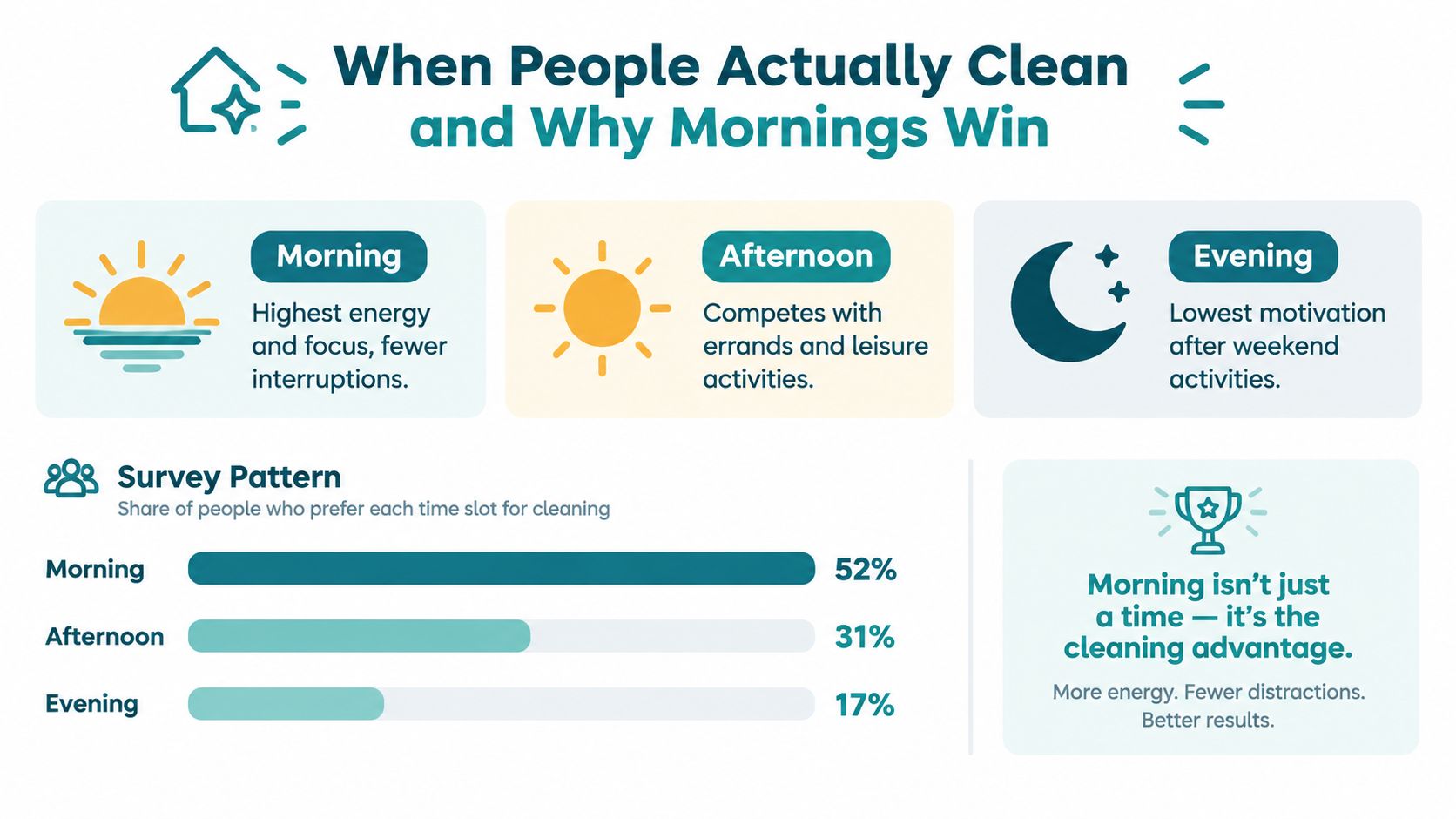
    An infographic showing that most people prefer cleaning in the morning due to higher energy and focus.

    At our Saturday cleanups, the first hour often decided the whole day. People arrived with more focus, daylight made hazards easier to see, and finishing early left room for family plans or recovery. A commissioned study likewise found Saturday morning was the most popular cleaning time, while Sunday night and early Monday morning ranked among the least popular periods, according to Study Finds' summary of the cleaning survey.

    That timing matters for a volunteer crew because energy is shared. On a hot morning, a clear start helped us collect more before fatigue turned small frustrations into arguments. In winter, daylight and a defined finish made the work feel manageable. The schedule had to respect the people carrying it, not only the bags or tools.

    U.S. time-use data shows that weekend days bring more housework than weekdays, 40% compared with 35%, while food preparation and cleanup appear slightly more often on weekdays, 66% compared with 63%, according to HerWay's household chore statistics. That supports a practical split. Put the higher-friction work in a weekend morning block, then leave space for errands, worship, rest, recreation, or an unplanned change of weather.

    Morning, afternoon, or evening

    Time What helps What gets in the way
    Morning Cooler air, daylight, sharper focus, and a clean finish before the day expands Shift workers, religious observance, sleeping children, and local noise rules
    Afternoon More daylight and easier access for people who need a slower start Heat, errands, sports, shopping, and family plans
    Evening Cooler temperatures in summer and availability after work Low motivation, darkness, traffic visibility, and Sunday-night fatigue

    A flexible household rhythm can also protect goodwill. People do not all bring the same energy each weekend, so the morning block should absorb the tasks that keep being postponed rather than demand one exhausting marathon.

    A workable default

    Start on Saturday at 8:00 a.m., work for three hours, and keep Sunday morning available for Saturday conflicts. In a home, shorten the block to the jobs that create the most resistance, while routine wiping, dishes, and tidying stay on other days. For overnight workers or people observing Saturday religious practices, Sunday morning preserves the same social ritual without asking anyone to choose between participation and personal commitments.

    Your Sample Weekend Morning Itinerary

    At 8:00 a.m., I put the map on the hood of the truck, greet each volunteer by name, and give the morning a visible shape. Short blocks keep instructions from competing with the work, while the closing count gives people proof that their cold hands or tired legs changed the site.

    The three-hour plan below follows the creek-litter cleanup protocol, using a briefing, fixed sections, a collection point, and material counting.

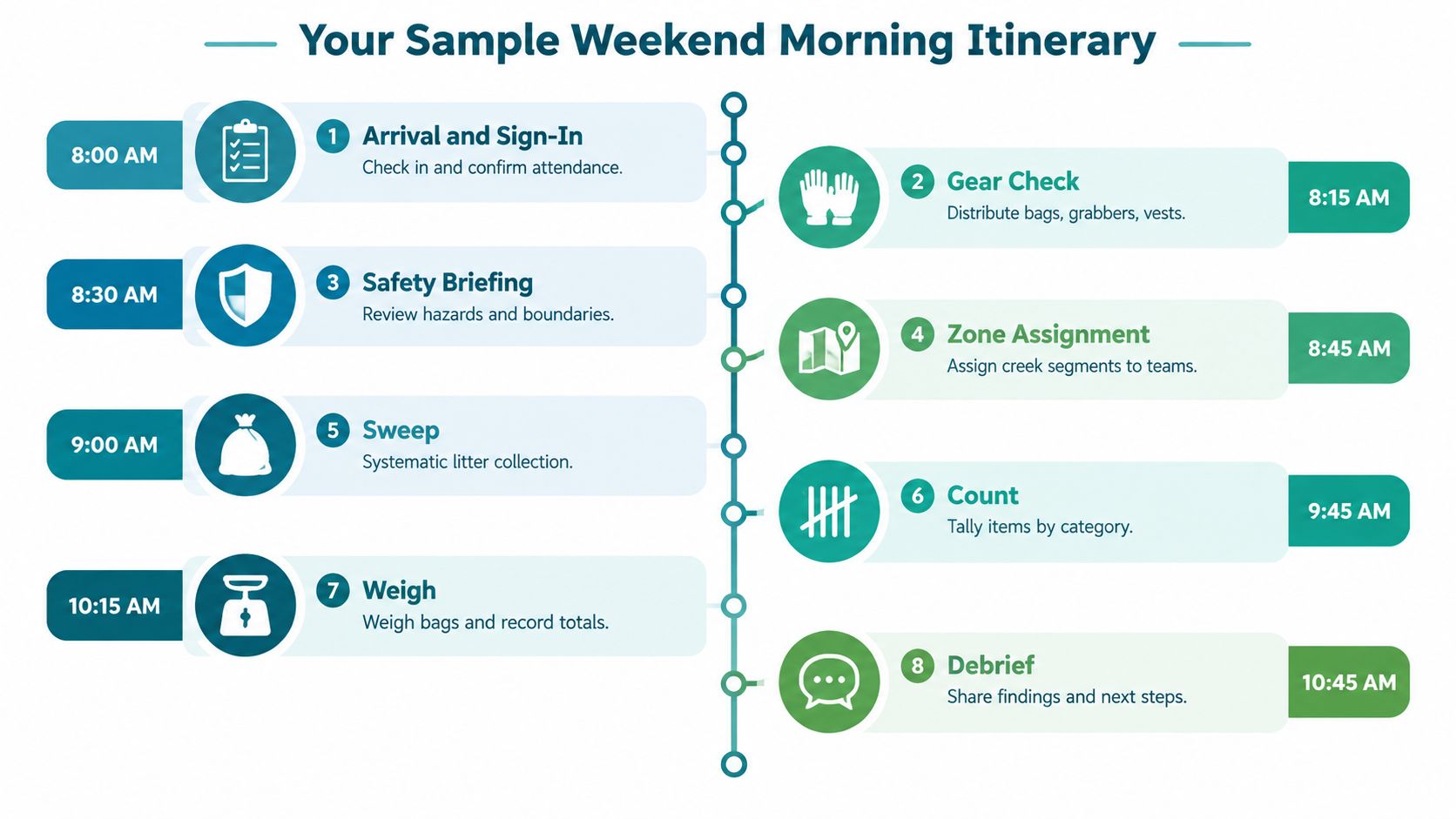
    A visual itinerary graphic showing eight sequential steps for a weekend volunteer community cleaning event schedule.

    The three-hour version

    • 8:00 to 8:15, arrival and sign-in: The captain greets each person, records attendance, checks emergency contacts if the group uses them, and hands out a map. Late arrivals use a visible sign-in point instead of breaking into the briefing.
    • 8:15 to 8:30, gear check: A supply lead distributes bags, grabbers, gloves, water reminders, and high-visibility clothing for roadside work. Everyone confirms a buddy before leaving the meeting point.
    • 8:30 to 8:45, safety briefing: The captain names boundaries, traffic risks, unstable ground, heat concerns, sharps handling, and the buddy rule. Volunteers learn which items stay untouched and whom to contact when they find one.
    • 8:45 to 9:00, zone assignment: The route lead gives each team a fixed start and end point. Volunteers repeat their segment aloud, which prevents wandering and makes the route easy to check.
    • 9:00 to 9:45, systematic sweep: Teams move in one direction, fill bags, leave hazardous items alone, and bring full bags to the agreed drop point. The lead watches the pace and checks that nobody works alone.
    • 9:45 to 10:15, count and sort: The sort team groups material by category and records totals on a tally sheet. A full count can expose debris a visual scan misses and show how material accumulates over time, as described in this roadside-litter audit framework.
    • 10:15 to 10:45, weigh and record: The captain records bag totals, unusual items, and unfinished areas. The group photographs the final collection point when that image will help plan the next visit.
    • 10:45 to 11:00, debrief and recognition: Each volunteer shares one observation. The captain thanks named contributors, then the team agrees on the next meeting point.

    The 90-minute version

    For a smaller group, use 8:00 to 8:15 for arrival and gear, 8:15 to 8:25 for safety, 8:25 to 8:35 for segment assignments, 8:35 to 9:10 for the sweep, 9:10 to 9:25 for sorting and counting, and 9:25 to 9:30 for weighing, cleanup, and thanks. Keep the order even when the blocks shrink.

    Captain's cue sheet: “Check in, choose a buddy, inspect your gear, hear the hazards, repeat your segment, sweep toward the drop point, leave dangerous objects alone, bring bags back, count what we collected, and finish together.”

    Splitting the Crew Into Roles and Segments

    At one cleanup, I told everyone to spread out and search. Within minutes, two volunteers were picking through the same pile while another stood alone near the road. Since then, I assign ownership before anyone leaves the parking lot. Clear roles protect the work and the people doing it.

    The creek-cleanup methodology uses briefings, subteams, fixed sections, and a central collection point. I adapt that structure for weekend mornings, where a familiar routine helps new volunteers join without feeling lost.

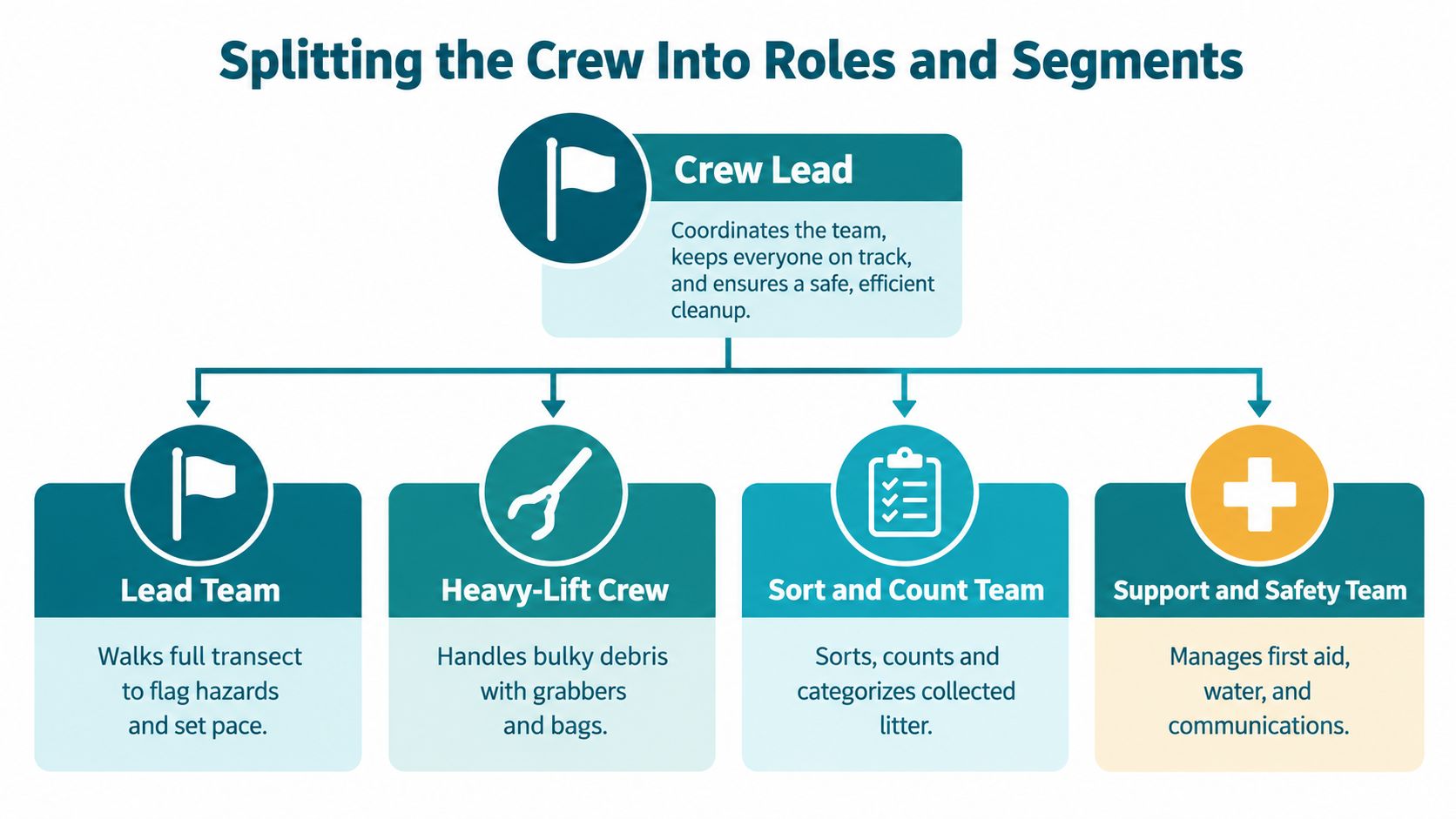
    A diagram outlining the roles and responsibilities of a cleanup crew, including leads, heavy-lift, sort, and safety.

    Four roles that prevent drift

    • Lead team: Two people check the route, mark hazards, confirm the boundaries, and set a pace that keeps volunteers connected.
    • Heavy-lift crew: Volunteers with grabbers and sturdy bags handle bulky debris within safe reach. They leave objects that are dangerously heavy, unstable, or too deep to retrieve.
    • Sort-and-count team: This group stays near the collection point, separates material by type, and records each category on a tally sheet. One litter audit recorded 5,348 items before an intervention and 4,933 afterward across 27 litter types. Your local count can be smaller. Consistency matters more than scale.
    • Support and safety team: This pair carries first-aid supplies, watches traffic and footing, tracks water pauses, and checks that each person remains with a buddy.

    I write every assignment on a card and tape it to a grabber or supply kit. New volunteers work beside experienced people for their first few sessions. They learn the route, the signals, and the quiet habits that keep a group together.

    Fixed segments make the work measurable

    Give each subteam a printed map showing its start, finish, bag drop, and regroup time. If one group finds a dense patch, the lead records it rather than sending everyone toward the same pile.

    A fixed segment also gives returning volunteers a clear memory of what changed. One litter report found that plastics made up 80.7% of counted litter at surveyed sites. That finding may support a plastic-focused plan on one route, while another area calls for attention to glass, food packaging, or construction scraps. The point is to let each weekend's record shape the next assignment, without turning volunteers into competing crews.

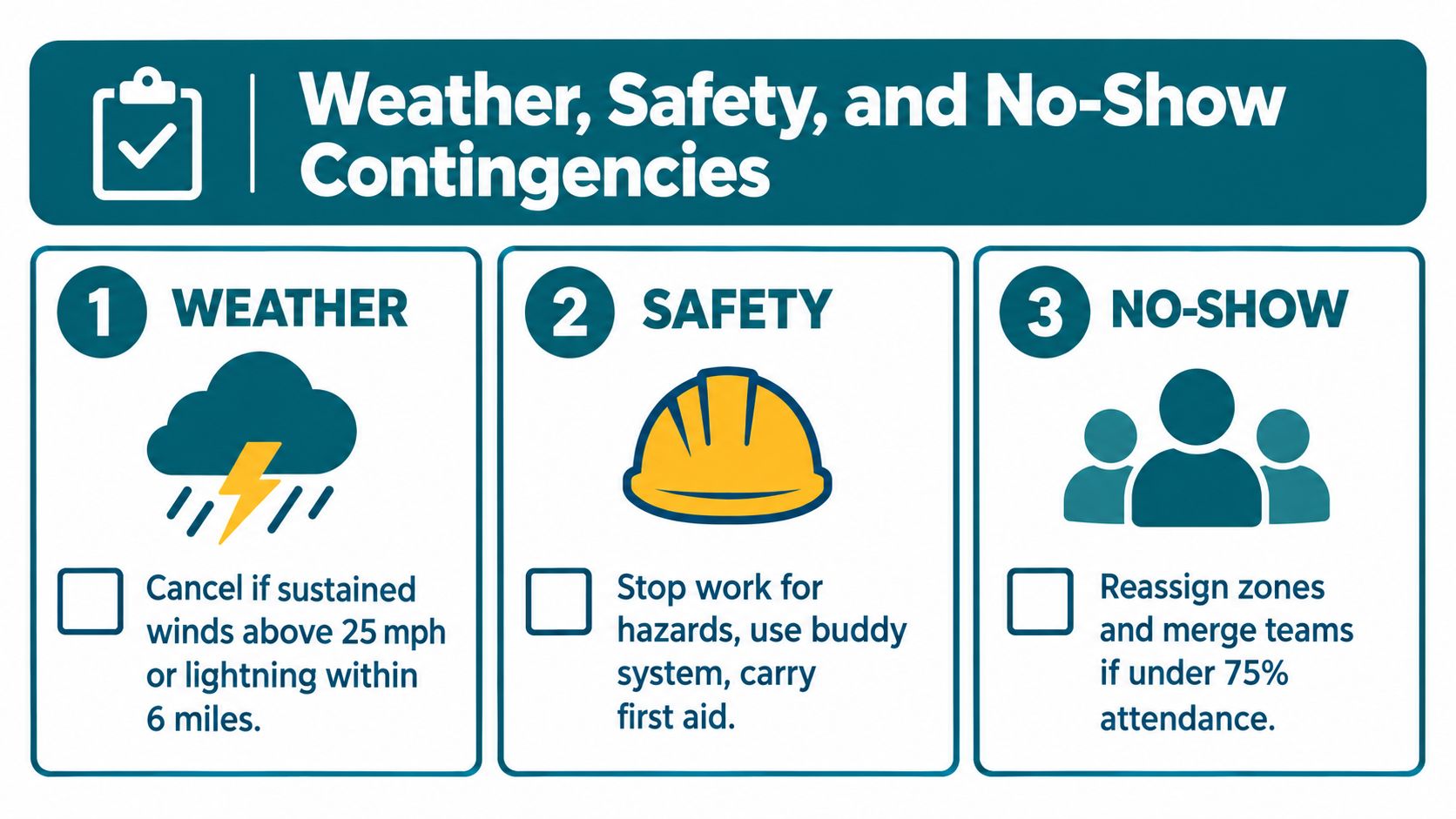
    Weather, Safety, and No-Show Contingencies

    Chicago has taught me to respect forecasts and distrust optimism. I've stood under hail with a crew that wanted to keep going, and I've sent people home on a bright morning because the route had become unsafe. A captain protects the people first, then the bags.

    Use a laminated contingency card. Read it before every cleanup, even when the sky looks friendly.

    A safety infographic detailing contingency plans for severe weather, workplace hazards, and low staff attendance rates.

    Weather changes the plan

    Set your weather decision before volunteers leave home. A captain can cancel, shorten, or move the event when conditions create unsafe footing, poor visibility, dangerous heat, or lightning exposure. Send the message early, include the next meeting option, and don't make people wait at the site for a debate.

    For hot mornings, start earlier, build in water pauses, and keep the route near shade when possible. For cold or wet mornings, ask volunteers to bring layers and spare socks. The volunteer site manager guide advises gloves, closed-toe or sturdy shoes, long pants or sleeves, bright clothing for roadside work, sunscreen, and water.

    Hazardous debris stops the sweep

    Never let enthusiasm turn into hand-to-hand contact with danger. Volunteers must leave syringes, needles, sharp metal, old batteries, and unidentifiable objects alone. Mark the location, notify the lead, and contact the responsible authority for disposal, following the guidance in this household hazardous-waste cleanup safety guide.

    Every volunteer should work with a buddy. Official cleanup guidance says crews should receive a safety briefing, work in teams of at least two, and use adult supervision for minors. The community cleanup safety checklist gives captains a practical reference for repeating that briefing.

    No-shows need a quiet backup plan

    Design each role so the work still functions when attendance drops. Pack supplies in role kits, print the tally sheet before arrival, and keep a two-person fallback team ready to absorb extra people or cover a missing group. If a zone becomes too large, close it and record it for a later morning instead of stretching volunteers beyond safe limits.

    Keeping Volunteers Coming Back Week After Week

    Pizza helps, but it rarely explains why someone returns in freezing rain. I've seen people come back because another volunteer remembered their name, handed them the flag, or saved them a place in the circle.

    People need a visible way to belong. A cloth patch or wristband after a volunteer completes a third cleanup gives regulars a small marker they can wear. A shared song, a group photo, or a familiar route can create the same feeling without spending much money.

    Give the morning a repeatable rhythm

    Start each event with the same short circle. Everyone says their name, assigned segment, and one small fact. The format takes little time, but it lets new people speak before the work begins and gives returning volunteers a reason to greet one another.

    End with a few rituals that make effort visible:

    • Read shoutouts aloud: Thank someone who carried heavy bags, helped a newcomer, spotted a hazard, or kept the count organized.
    • Update the tally board: Write the morning's categories where people can see them before they leave.
    • Take one group photo: Stand beside the collected bags, with permission from everyone included.
    • Rotate ownership: Let a different volunteer carry the flag, choose the song, lead the tally, or bring snacks.

    I've found that identity works better than pressure. Volunteers shouldn't feel trapped by guilt or asked to prove their worth. They should know that their presence changes the morning and that the group will welcome them when life interrupts.

    For more ideas on building a dependable group, review these volunteer retention strategies. Then send a short Sunday evening message with the count, two photos, and the next segment. That message keeps the thread alive without turning service into an obligation.

    Your First Saturday With This Schedule

    Your first event will feel exposed. People will watch for direction, the weather may change, and a small delay can decide whether the morning feels warm or chaotic. You don't need a perfect production. You need a captain who arrives prepared and speaks clearly.

    Arrive 15 minutes early. Post the route map, set out bags and grabbers, place water where everyone can see it, and keep a printed roster beside your phone. Run a brief safety talk, pair people into two- or three-person pods, and give every pod a fixed section. Announce the end time before anyone starts so parents, shift workers, and people with afternoon plans can trust the schedule.

    The final 10 minutes should include bag counting, one specific thank-you, and notes for next week. Write down a missing supply, a confusing turn, a slippery area, or a segment that took longer than expected. Those notes turn one morning into a system.

    First-weekend checklist

    • Route: Print the map and mark start, finish, bag drop, and regroup points.
    • Safety: Prepare the briefing, first-aid supplies, hazard instructions, and buddy assignments.
    • Gear: Pack gloves, grabbers, bags, bright clothing, and sturdy footwear.
    • Comfort: Bring water, sunscreen, layers, and a hat when conditions call for them.
    • Communication: Charge your phone and save the lead contact before arrival.
    • Attendance: Print the roster and leave space for walk-in volunteers.
    • Closeout: Carry a tally sheet, pen, camera, and a place to record next week's notes.

    Groups looking for a regular service rhythm can study weekend volunteer work on Saturdays and adapt the same approach to their own block, home, school, or park.

    The first Saturday may produce fewer bags than you hoped. That's fine. People will remember whether they felt safe, useful, and welcome. One morning repeated with care can outlast a large event that leaves everyone exhausted.


    Litter Caterpillars organizes recurring weekend morning trash pickups in Chicago, with clear meetup details, shared roles, and a volunteer-first approach to safety and friendship. Visit Litter Caterpillars to find an upcoming cleanup and bring this weekend cleaning schedule to life with a crew.

  • Why Is Stewardship Important: A Real Look at What It Does

    Why Is Stewardship Important: A Real Look at What It Does

    Kevin Tao's first Litter Caterpillars cleanup began with hail bouncing off a car hood, three people huddled beside a vacant lot, and a pickle picker that felt too small for the mess ahead. Someone lifted a grocery bag packed with wet cardboard, and the group decided to meet again the next Saturday.

    That scene taught me what stewardship looks like before anyone gives it a polished name. You take responsibility for a place you don't own, bring the tools you have, and return when the weather makes staying home easier.

    A Storm, Three People, and a Trash Picker

    Kevin stood in a Chicago vacant lot during a spring storm, gripping a pickle picker while hail struck his hood and the pavement. Two other people stood nearby, strangers at first, each trying to decide whether the cold had already beaten the plan.

    We talked about which block to tackle first. The conversation stayed practical because nobody knew what else to say. Then a picker caught the handle of a grocery bag. Kevin pulled, and the bag came up heavy with wet cardboard, food packaging, and water that ran down his glove.

    That first cleanup didn't look like a civic ceremony. It looked like three people shivering beside a pile of trash, making one small corner easier to walk through.

    A diverse group of volunteers collecting litter with grabber tools in a snowy urban field.

    I've learned that stewardship starts in the hands. A trash picker bends, closes, and lifts. A bag fills. A sidewalk appears beneath the wrappers. You don't need to feel ready before you begin, and you don't need to know everyone on the block.

    The group chose a return time for the following week. That small promise eventually became a weekly routine across Chicago, through rain, blizzards, wind chills, and heat. The question stayed with me: why does one uncomfortable Saturday keep sending people back?

    The answer has two parts. The street needs care, and people often find belonging, purpose, and a clear sense of progress while giving it.

    What Stewardship Really Means

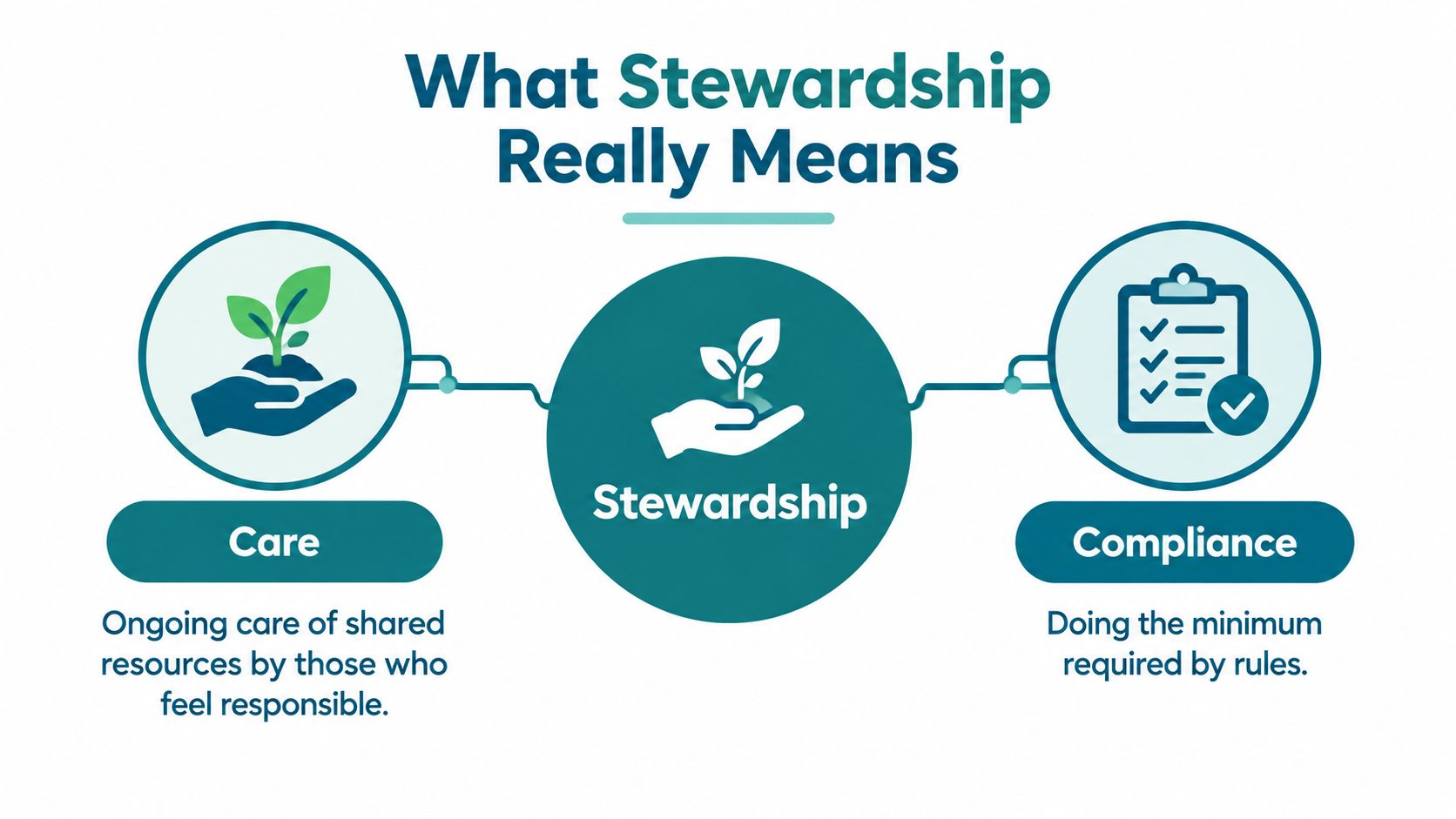
    I use stewardship to mean ongoing care for shared resources by people who may not own them but still feel responsible for their condition. A park, alley, riverbank, vacant lot, or sidewalk belongs to a larger public system. You live with its condition, so your choices affect it.

    Compliance asks you to meet a rule. Stewardship asks you to notice what the place needs after the rule stops speaking. The EPA's description of environmental stewardship includes people, businesses, communities, and governments sharing responsibility for environmental quality. The EPA also describes stewardship as action that goes beyond minimum compliance, including reducing pollution at its source, recycling as much as possible, and using energy and natural resources efficiently in its environmental stewardship guidance.

    An infographic titled What Stewardship Really Means, comparing the concepts of Care and Compliance.

    A clean block usually needs several hands:

    • A resident picks up loose litter before wind and rain move it.
    • A shop provides a bin and keeps its frontage clear.
    • A community group schedules volunteers and supplies a plan.
    • A sanitation crew handles the heavy haul and removes material that a small group can't safely move.

    Each actor handles a different part of the same job. One person can't repair every weak point, and a government crew can't see every wrapper as soon as it lands.

    For organizations choosing packaging, material decisions belong in this same conversation. A resource on biodegradable packaging material selection 2026 can help a business think about what happens before a discarded item reaches a sidewalk.

    Litter Caterpillars fits into this shared system by organizing volunteers across Chicago's 50 wards. The group doesn't replace sanitation crews, stores, or residents. It gives people a regular way to act alongside them.

    The Global Waste Problem You Can See on Your Block

    A curb can make a global waste problem feel ordinary. I see a plastic wrapper pressed against a storm drain, a cup tucked beneath a bus-stop bench, or a broken bottle shining in an alley. Each item looks small until rain, wind, traffic, and time move it somewhere harder to reach.

    The 2024 Global Waste Management Outlook from UNEP and ISWA reports that the world generated about 2.3 billion tonnes of municipal solid waste in 2023. The report projects that amount will reach 3.8 billion tonnes by 2050. In 2020, 38% of municipal solid waste, about 810 million tonnes, was uncontrolled, meaning people dumped it or burned it in the open.

    Waste management already costs money before pollution and illness enter the calculation. UNEP and ISWA put global waste-management spending at US$252 billion in 2020. When hidden costs from pollution, poor health, and climate change enter the estimate, the annual cost reached US$361 billion in 2020 and could rise to US$640.3 billion by 2050, a projection from the same outlook.

    Global Waste at a Glance

    Metric Figure
    Municipal solid waste generated in 2023 About 2.3 billion tonnes
    Projected municipal solid waste in 2050 3.8 billion tonnes
    Uncontrolled municipal solid waste in 2020 38%, about 810 million tonnes
    Global waste-management spending in 2020 US$252 billion
    Estimated annual cost including hidden costs in 2020 US$361 billion
    Projected annual cost including hidden costs in 2050 US$640.3 billion

    Those figures don't live in a distant spreadsheet. They show up as litter that blocks a drain, attracts pests, breaks into smaller pieces, and travels beyond the block where someone dropped it. A Saturday pickup can't solve the whole system, but it can interrupt one part of it with the simplest available action, remove the material before it moves.

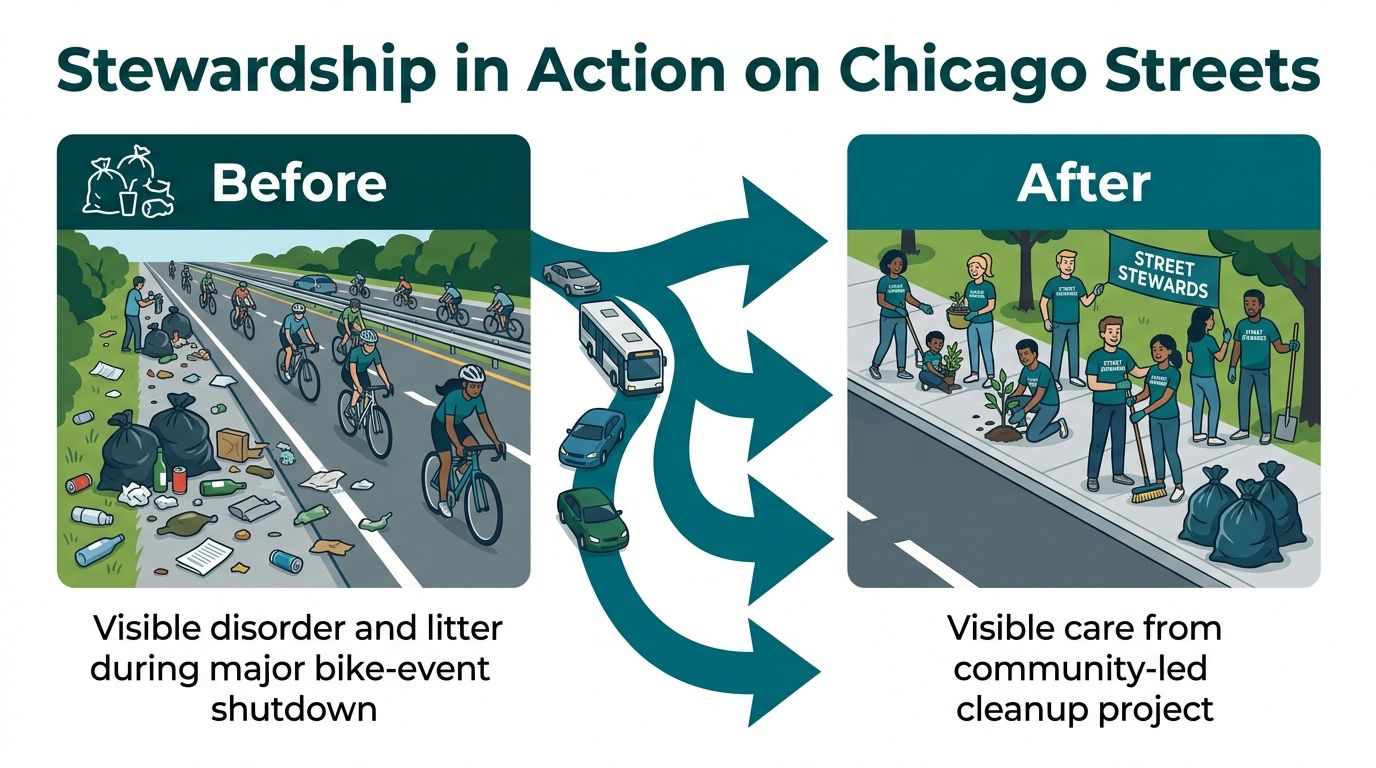
    Stewardship in Action on Chicago Streets

    During a major Chicago bike-event shutdown, diverted traffic exposed layers of roadside debris that regular movement had hidden. Volunteers put on safety vests, spread out with grabbers and bags, and worked lane by lane. In roughly three hours, the crew filled a truck.

    The work felt repetitive, which helped. One person watched the pavement. Another held the bag. A third checked the shoulder for glass and sharp metal. The group didn't need a grand speech. It needed a route, safe spacing, and people willing to keep bending down.

    A split image showing a litter-filled street during a bike event and volunteers cleaning the sidewalk.

    The second project began with an empty lot in Englewood. Dumped tires, mattresses, fast-food wrappers, and other debris covered the ground. Volunteers returned over four weekends, cleared the lot, planted native grasses, and turned the parcel into Caterpillar Park, a place neighbors could use and see from their porches.

    A cleanup becomes easier to repeat when people can see the change before they leave.

    The highway project removed a buried layer of roadside neglect. Caterpillar Park changed what an empty lot invited people to do. Both projects depended on the same ordinary sequence: plan the work, show up, lift the material, sort what you can, and return for the part that remains.

    Stewardship becomes muscle memory. You don't wait for perfect conditions. You build a routine that lets a group handle the next visible problem.

    How Litter Becomes a Water Problem

    Take one plastic bottle on a Chicago curb. On a dry morning, it looks stationary. Once rain arrives, the bottle can slide toward the gutter, catch against leaves, or break apart under traffic.

    Follow the route

    1. The curb collects runoff. Rainwater moves downhill along the street and carries loose wrappers, cigarette filters, grit, and fragments with it.
    2. The catch basin receives the flow. The drain gathers water from the gutter, along with whatever the water has picked up.
    3. The sewer carries the mixture. In parts of Chicago, combined sewers carry stormwater and wastewater through the same system.
    4. Heavy rain can push water into waterways. When the system overflows, polluted water can reach the Chicago River and Lake Michigan.

    Recent microbiology research describes urban runoff as a pathway carrying microplastics and other human-made pollution from catchments into local aquatic systems, with runoff management needed because litter discharge into nearby water environments remains prominent. You can read the findings in this research on microplastics and urban runoff.

    Litter doesn't stay where you see it. Storms and snowmelt mobilize it, and small pieces become harder to collect after they enter a drain or waterway. A pickup on a dry Saturday interrupts the route at the curb, before a treatment plant, riverbank crew, or shoreline volunteer has to deal with it.

    Visit the Litter Caterpillars watershed protection resources for more ways to connect street cleanup with water care.

    Practical rule: If you can safely remove litter before rain reaches it, you've chosen the simplest point in the chain.

    Pickup is prevention. One bag won't repair a sewer system, but it can keep loose material from entering one.

    Why People Keep Showing Up Week After Week

    At 9 a.m. on Saturday, the first volunteers usually look a little uncertain. They check the meeting point, adjust a glove, and ask whether they should take a picker or a bag. By the end, they talk about the strangest object they found and compare the block before and after.

    That rhythm gives people four reasons to return: belonging, learning, accomplishment, and a mental reset. The UBC study on stewardship volunteering found that the strongest motivators included accomplishment, group solidarity, learning and skills, and personal welfare, as described in this University of British Columbia research on stewardship volunteering.

    A separate study in the same source material found that continued participation connected more strongly with personal, social, and community-building goals than with environmental motives alone. That matches what I see in the group. People come for the street, then return for the people, the small skills, and the satisfaction of finishing something visible.

    Four Reasons Volunteers Return

    Reward What It Looks Like at a Cleanup Supporting Evidence
    Belonging Low-stakes conversation while two people share a route Group solidarity ranked among the strongest motivators in the UBC study
    Learning New volunteers learn safe handling, sorting, and route planning Learning and skills ranked among the strongest motivators in the UBC study
    Accomplishment A weigh-in station records what the crew collected Accomplishment ranked among the strongest motivators in the UBC study
    Mental reset Volunteers work outdoors, move their bodies, and leave with a clear finish Personal welfare ranked among the strongest motivators in the UBC study

    The schedule matters too. Finishing by 11 a.m. leaves the rest of Saturday open. Rotating the neighborhood keeps the route fresh, while the familiar start time gives the habit a place in the week.

    The pandemic showed how fragile that routine can become. Research on environmental stewardship groups found that 50% of groups reported volunteer-event cancellations as the most widespread pandemic impact, while 56% of respondents said they spent “a lot less” time engaging with stewardship groups after COVID-19 disruptions, according to the UNEP and ISWA executive summary.

    For people looking for a steady, friendly way to practice care, Litter Caterpillars' care-for-real approach puts that rhythm into a weekend activity.

    Small Cleanups, Big Compound Effects

    Someone eventually points at a half-filled bag and asks whether it can matter. I understand the question. One outing won't remove every piece of litter in Chicago, and a single volunteer can't repair every neglected lot.

    The answer comes from repetition. Litter Caterpillars has spent about three years cleaning across all 50 wards, according to the group's account of its weekly routine. The value sits in the return visits. A cleaner block makes the next piece of litter easier to notice, gives neighbors a reason to talk, and lets a group work on the same problem before it grows.

    What repeats can change

    • Visible norms: People see a maintained sidewalk and may think twice before dropping the next wrapper.
    • Civic trust: Residents see shared spaces receive regular care, while government crews gain clearer information about places that need larger work.
    • Volunteer capacity: One person brings a friend, the friend learns the routine, and the crew can cover another route.
    • Local use: A cleared lot such as Caterpillar Park gives neighbors a reason to walk through, gather, and watch the space.

    The social effect matters because stewardship depends on people continuing to participate. The Nature Conservancy's 2024 Volunteer Impact Report says more than 37% of volunteer time falls within the stewardship family. That figure places cleanup, restoration, and care within a large share of civic volunteering.

    England's government also reported that conservation volunteer hours rose 5% in the most recent year and 44% from 2000 to 2023, according to its volunteer time statistics. Participation can grow when groups make service easy to repeat.

    A symbolic cleanup can still lift morale. Structural change starts when someone records the problem, returns to it, recruits another person, and builds a routine that lasts.

    Your First Steps Into Stewardship

    You don't need to form an organization before you pick up your first bag. Join an existing group, learn its safety habits, and let someone else handle the route plan while you get comfortable.

    In Chicago, you can start with a Litter Caterpillars Saturday cleanup, a park conservancy, a riverkeeper chapter, or an Adopt-a-Highway program. The EPA's litter-management guidance describes volunteer cleanups as one way municipalities can organize residents, while community groups can run their own cleanup events and shifts.

    Bring a simple kit

    • Sturdy gloves: Choose a pair that protects your hands without making it hard to grip small pieces.
    • A trash picker: A grabber keeps your back straighter and helps you avoid direct contact.
    • A five-gallon bucket: Use it for heavier items or for separating material while you walk.
    • A high-visibility vest: Wear one near roads, parking lots, or moving vehicles.
    • Water: Bring enough for the weather and the amount of walking you expect.
    • A data sheet: Record what you collect, where you find it, and any repeated sources of litter.

    Start with one outing in a quarter if your schedule feels crowded. Move to monthly visits when the meeting time feels familiar. Try weekly service when you want the habit to carry itself.

    Take a before-and-after photo from the same position. Invite one friend, especially someone who says they want to help but doesn't know where to begin. Report hazards and larger dumping sites through your local 311 system, and keep volunteer collection data separate from municipal reports so each record stays clear.

    Safety comes first. Don't handle needles, unknown chemicals, unstable piles, or heavy objects alone. Ask the group leader how they mark hazards, where they place filled bags, and what they leave for a sanitation crew.

    Stewardship isn't a personality trait that some people inherit. It works more like a skill. You practice noticing, lifting, sorting, recording, and returning. After a while, Saturday morning feels less like an appointment and more like a promise you know how to keep.


    Litter Caterpillars organizes volunteer trash pickups across Chicago, giving you a practical way to care for streets, parks, lots, and waterways while meeting people who want the same kind of weekend service. Visit Litter Caterpillars to find a cleanup, bring a friend, and take your first Saturday shift.

  • Trash Pickup Equipment: What Volunteer Groups Actually Need

    Trash Pickup Equipment: What Volunteer Groups Actually Need

    In one October storm, twelve of us worked along the Lake Michigan shoreline with plastic grocery bags. Rain soaked the paper-thin gloves we had, wind pushed debris through our feet, and nobody had a real grabber. We finished the route, but the gear rescued us less often than we rescued the gear.

    After three years of weekly cleanups across Chicago, I judge trash pickup equipment by a simple test. Can a mixed group use it in rain, snow, cold wind, and summer heat without slowing down or getting hurt? The right tools don't need to look impressive. They need to keep working when cardboard turns to sludge, a bag catches on a thorn, or a volunteer finds broken glass under wet leaves.

    Why Equipment Choices Matter More Than You Think

    The first failures usually happen in predictable places: the grabber jaw stops closing, the glove seam splits, or the bag handle tears. A cheap kit can look fine on a store shelf and fall apart halfway through a cleanup. Then someone ties two grocery bags together, bends over every few steps, and starts handling litter with exposed fingers.

    That pattern creates a slow, frustrating morning. Volunteers wait for replacement tools, carry leaking bags, or leave a route unfinished because the equipment no longer matches the work. A new organizer often thinks the main job involves choosing a meeting point and sending reminders. Those tasks matter, but the equipment list decides whether people can finish the route comfortably.

    I've watched a group lose momentum because the only usable grabber belonged to the organizer. Everyone else stood around while one person picked up the small pieces. I've also seen a sturdy cart turn an awkward pile of wet bags into a clean handoff. The difference wasn't dramatic on paper. It came from choosing tools around real movement, real debris, and real weather.

    Start with the volunteer, not the catalog

    A volunteer may have long arms, short arms, a stiff back, small hands, or a wrist that tires quickly. One person may work on flat sidewalk, while another crosses muddy grass and a curb gutter. A single universal kit usually fits nobody especially well.

    Before buying, ask three questions:

    • What will people touch indirectly? Broken glass, wet food containers, needles, and sharp metal require reach tools and protective gloves.
    • Where will people carry the load? A long route needs better bags and a way to move full ones.
    • What happens when something fails? Bring spare grabbers, tape, gloves, and bags instead of hoping every item survives.

    The world generates about 11.2 billion tonnes of solid waste each year, and as of 2021, global collection covered 77% of solid waste while 33% was openly dumped, according to Waste360's account of refuse-truck evolution and collection conditions. That context doesn't tell you which grabber to buy, but it does explain why collection work demands equipment built for repeated handling and uneven conditions.

    Your job as a leader isn't to buy the most expensive pile of gear. It's to remove the small failures that make volunteers cold, tired, invisible, or unwilling to return. For liability planning alongside gear planning, review volunteer liability insurance considerations.

    The Core Kit Every Volunteer Should Carry

    A basic kit should let a volunteer reach litter, protect their hands, close a bag, and clean up afterward. I don't send people out with one tool and a cheerful warning to “be careful.” The pieces work together.

    An infographic titled The Core Kit displaying essential safety equipment for volunteers to carry during trash cleanups.

    The grabber does the reaching

    Choose a grabber with a jaw that closes firmly and a handle that feels natural in a gloved hand. The tool should pick up cans, wrappers, food containers, and small pieces of litter without forcing the volunteer to squeeze hard every time. A rotating jaw helps in some tight spaces, but simplicity often wins when several people share equipment.

    Test the trigger before an event. If it sticks, wobbles, or opens only halfway, put it aside. A grabber keeps hands away from broken glass and wet surprises, but it doesn't turn an unsafe object into a safe one. Volunteers still need permission to leave suspicious or dangerous items alone.
    Gloves need a real fit

    Use puncture-resistant gloves in several sizes. One oversized pair slips when someone grips a can, while a tight pair leaves fingertips sore. I keep nitrile-coated work gloves for wet gutter muck and cut-resistant gloves for broken glass or sharp metal.

    Gloves don't replace a grabber. They add a second layer between skin and the mess, especially when a volunteer holds a bag open or moves a harmless-looking object that shifts unexpectedly.

    Bags carry more than trash

    Heavy-duty contractor bags handle wet cardboard and rough pavement better than thin grocery bags. Use a bag hoop or have a second person hold the opening so the picker can work without wrestling the plastic. Tie full bags before they become too heavy to move.

    Closed-toe boots or sturdy sneakers belong in the kit conversation too. Sandals leave feet exposed to glass, nails, mud, and cold water. Add hand sanitizer and a basic first-aid item, then keep both with the route leader rather than burying them in a supply bin.

    Practical rule: Every item should prevent a specific failure. If you can't name the failure, reconsider the purchase.

    A high-visibility vest helps drivers and cyclists see volunteers along parkways and street edges. It also gives the group a visual identity, which makes it easier to spot someone who has wandered too far from the route. The vest doesn't control traffic, so keep people away from moving vehicles and use a separate traffic plan when the route demands it.

    Safety Gear That Protects Your Crew on the Route

    I run the safety briefing before anyone opens a bag. It takes a few minutes, and it changes how new volunteers read the route. I point out broken pavement, fast-moving traffic, steep banks, suspicious containers, and places where a vehicle might reverse.

    A safety infographic displaying high-visibility vests, traffic cones, and protective gloves for trash pickup teams.

    Build the check before the route

    Hand out gloves and grabbers first. Ask volunteers to show that their grabber closes and that their gloves fit. Then distribute high-visibility vests or tabards, check footwear, and point out the boundaries of the route.

    In summer, add hats, sunscreen, and water. In spring, pack extra layers because wind beside the lake can cut through a warm afternoon. In rain or snow, give people a clear stopping point. A volunteer who gets soaked early may lose warmth long before the event ends.

    Official guidance for volunteer litter picking calls for protective gloves and high-visibility clothing, with reflective clothing suited to roads where speed limits reach 30 mph or less, or up to 50 mph in one district guide, depending on the local guidance. Read the South Oxfordshire group litter-picking guidance before placing a crew near traffic. If the road runs faster than the guidance allows, choose another site or use stronger controls.

    Control movement around vehicles

    Cones help mark a boundary, but they don't give volunteers permission to stand in traffic. Larger crews may need flags, a spotter, or a route that keeps people away from the road edge. Small groups can sometimes work with vests and a tight boundary, but every group needs a rule about vehicles and backing.

    NIOSH recorded 450 refuse-collection worker deaths from 1980 to 1992, with 303, or 67%, vehicle-related. Among those vehicle-related deaths, 110 involved slipping, falling, being struck, or being run over by the refuse vehicle, and 20 happened during backing maneuvers, according to NIOSH guidance on preventing refuse-collection worker injuries. Your volunteers may collect litter rather than operate refuse trucks, but the lesson carries over: never assume a driver sees a person near a vehicle.

    Show volunteers how to use the grabber. No waving it around, no poking at people, and no running. A UK council briefing also recommends working in pairs, with one person holding the bag while the other picks, a simple relay that keeps hands and feet organized. Wash hands thoroughly after the cleanup, even if gloves stayed intact.

    Play the safety video before the first route if your group benefits from a visual briefing.

    If a volunteer reaches for a suspicious bucket, stop them. If someone finds a needle, aerosol container, chemical bottle, animal remains, or heavy object, they should mark the location and call the leader. No piece of trash deserves a hospital visit.

    Choosing Grabbers, Bags, and Gloves for Real Terrain

    Chicago routes change every few blocks. Parkway grass hides bottle caps and wire. Curb gutters hold oily grit and wet leaves. Wooded lots catch bags on thorny branches. Alleys punish weak wheels and thin plastic.

    A longer grabber gives more reach, but longer isn't always better. A 40-inch tool can feel useful beside a hedge and awkward in a tight creek bed. The extra shaft can reduce wrist control and make repeated pickups tiring. For most volunteers, a moderate-length grabber with a comfortable trigger works better than the longest model on the rack.

    Jaw style matters too. Wide rubber tips suit cans and paper. Narrow serrated jaws can hold small objects, but they may snag fabric or require more hand force. Test several tools with gloves on, because a trigger that feels easy barehanded can feel stiff after a morning of use.

    Match the kit to the ground

    Terrain Grabber Length Glove Type Bag Choice
    Parkway grass Medium reach, firm wide jaw General work glove with puncture resistance Heavy contractor bag
    Curb gutter Short to medium reach for control Nitrile-dipped glove Heavy contractor bag
    Wooded lots Medium reach with narrow jaw Cut-resistant glove Thick contractor bag, plus tape
    Alley pavement Medium reach, durable trigger Cut-resistant or coated work glove Contractor bag with strong tie handles

    Glove material should follow the debris. Nitrile-dipped gloves handle wet grime well. Cut-resistant gloves make more sense around broken glass. Leather can help with rough demolition lumber, but it isn't a reason to lift an object that feels unstable or too heavy.

    Bag choice creates its own trade-off. Contractor bags stretch and hold wet material, but wire can tear them. Leaf bags cost less for light, clean litter, yet sharp edges can split them quickly. For weekly mixed debris, 42-gallon contractor bags usually give me the most practical balance between capacity and handling.

    For a closer look at sack construction and load choices, use this MSP Packaging heavy duty sacks guide. I also keep one roll of strong tape in the route bin. A strip over a small tear can save a bag long enough to reach the drop point.

    The guide to picking up trash safely helps new volunteers connect the tool choice with the movement that follows. Equipment works best when people keep the grabber low, avoid twisting, and stop before a small object turns into a strained wrist.

    Budget-Friendly Equipment Plans for Any Group Size

    Your first purchase should match the group you have, not the group you hope to build. I'd rather equip five people properly than buy a large pile of weak tools for an imagined crowd.

    The amounts below are planning targets, not market quotes. Prices change by store, brand, and order size, so use the tiers to organize priorities rather than treat them as fixed invoices.

    Tier Group Size Total Budget Per-Volunteer Cost Key Gear
    Starter Five people Under $150 Under $30 Basic grabbers, bulk nitrile gloves, contractor bags
    Mid-range Ten to twenty people Not fixed Not fixed Hi-vis vests, first-aid kit, foldable cart
    Sustained Twenty or more people Not fixed Not fixed Bulk bags, rigid sharps containers, replacement grabbers

    The starter plan should spend first on reliable grabbers and gloves. Those items touch the work repeatedly, and failure there slows every person on the route. Buy contractor bags in a size that volunteers can carry when full, then add a small repair supply with tape and spare gloves.

    For occasional use, three items can stay simple: basic bag hoops, plain high-visibility vests, and a folding bucket for loose supplies. They don't need elaborate construction if the group uses them lightly and stores them indoors.

    A group of ten to twenty people benefits from a real first-aid kit and a foldable cart. Those additions reduce the amount of time the leader spends carrying supplies and give you a place to stage gloves, water, extra bags, and route maps. Keep replacement grabbers in reserve because a shared tool takes more abuse than a personal one.

    Plan for repeated mornings

    A sustained group of twenty or more should buy bags in bulk when storage allows, keep rigid containers for sharps, and set aside money for replacement grabbers. The equipment budget should include wear, not only the first purchase. A broken trigger on event day is a small expense that becomes a large coordination problem.

    I also label bins by function: personal kit, route safety, bag transport, and end-of-day handoff. That system costs almost nothing and lets a new leader find the supplies without emptying the entire trunk.

    Storage and Transport That Keep Cleanup Day Moving

    A cleanup can run smoothly on the route and fall apart at the drop point. Full bags become awkward fast, especially after rain. Volunteers carry one too far, set it on a sidewalk, and then someone has to retrace the route to collect it.

    Choose one of two systems. With a central drop point, volunteers carry smaller loads and return to the same place. That works well in parks, compact neighborhoods, and routes where a leader can watch the staging area. With personal carry bags, each person owns the load from pickup to handoff. That works better on spread-out routes where a central point would interrupt the walk.

    A foldable wagon handles several bags and supplies, but small wheels struggle with curbs. A two-wheel garden cart climbs a curb more cleanly when you tilt it, though it gives you less room for loose items. Test the wheels over the actual route before event day. A cheap cart that catches on every curb becomes another tool people avoid.

    A flowchart comparing two methods for managing litter bags during community cleanup events.

    Protect the vehicle

    Line a sedan trunk, SUV cargo area, or pickup bed before loading anything. A contractor bag works as a liner for smaller bins, while a rigid tote gives wet bags a stable wall. Keep full bags upright and separate recycling from general waste before the pile grows.

    For larger recurring cleanups, a trailer may make sense when the group moves carts, bins, or other heavy equipment. This guide to finding the right equipment hauling trailers can help you compare hauling setups without treating a personal car as a permanent utility vehicle.

    At the end, label bags for city pickup or the agreed disposal point. Separate recycling only when your local arrangement accepts it, and place sharps in a rigid container. Never toss a needle into a flexible plastic bag.

    Use free recycle bins for cleanup supplies when you need a simple way to separate recoverable material. Tape a checklist inside the trunk lid:

    • Load: Bags, cart, grabbers, gloves, vests, first aid.
    • Route: Map, meeting point, boundaries, emergency contact.
    • Handoff: General waste, recycling, rigid sharps container.
    • Reset: Dry tools, replace used gloves, restock bags.

    The next leader should be able to open the vehicle and understand the whole system in a minute.

    A Volunteer-First Way to Think About Every Purchase

    I make every equipment decision in this order:

    1. Does it protect the volunteer?
    2. Does it make the work finishable in a normal morning?
    3. Does it serve the place we're cleaning?

    That order changes small purchases. I'll choose cut-resistant gloves over the cheapest gloves when broken glass appears on a route, even if the stronger pair costs $4 more. I'll use high-visibility vests in a low-traffic park because cyclists, delivery workers, and other volunteers still need to see the group.

    I won't hand a rusty dollar-store grabber to a teenager on a highway-adjacent route. The tool may technically pick up a wrapper, but it sends the wrong message about what we expect people to risk. A volunteer sees the equipment before they see the route. That first impression tells them whether the organizer planned for their safety.

    A pyramid chart outlining a volunteer-first approach to purchasing, emphasizing safety, efficiency, and community impact.

    Safety comes before the tally

    A group I worked with changed its kit after a close call with broken glass. One volunteer reached through leaves, the grabber slipped, and the glass cracked against the pavement beside their shoe. Nobody needed medical care, but we stopped the route, replaced the weak tools, added better gloves, and changed the briefing.

    We never went back to the old setup. The upgrade didn't make volunteers reckless. It made them more willing to work carefully because they knew the group would not trade their safety for a fuller bag.

    The same thinking applies to larger waste operations. A worker safety asset management approach can help teams track equipment condition, inspections, and replacement needs. For a volunteer group, that may be as simple as a labeled checklist and a monthly tool check. The principle stays the same: a tool that fails repeatedly belongs on a replacement list, not in someone's hand.

    Finishable work keeps people returning

    I don't measure a cleanup only by bag count. I watch whether volunteers can walk, reach, lift, and pause without fighting the equipment. A cart that reduces long carries can matter more than another box of bags. A bag hoop can matter more than a larger bag if it keeps one person from holding plastic open all morning.

    The waste management equipment market was estimated at USD 19.93 billion in 2026 and projected to reach USD 25.64 billion by 2031, with a projected 5.17% CAGR from 2026 through 2031, according to Mordor Intelligence's waste management equipment market data. Volunteer leaders don't need industrial machinery for a neighborhood route, but the same practical question applies at every scale: does the equipment fit the work?

    Protect the volunteer first. Make the work finishable second. Serve the parkway, alley, shoreline, or vacant lot third. Volunteers who feel protected come back. Volunteers who feel used don't, and the equipment list is where that promise becomes real.


    Litter Caterpillars uses practical trash pickup equipment, including grabbers and heavy-duty contractor bags, for weekly Chicago cleanups across every ward and every season. Visit Litter Caterpillars to find an upcoming cleanup, meet the group, and bring your energy to a route where safety and friendship come first.

  • Chicago River Cleanup: Join or Organize Your Own Event

    Chicago River Cleanup: Join or Organize Your Own Event

    The first time I hauled trash off the Chicago River bank, a spring hail storm rolled in so hard it felt like somebody was throwing ice cubes at my face. Three of us crouched under a tree, wet through, while every Uber canceled one by one, and we laughed anyway because the river had finally found a way to humble us together.

    That day taught me something I still believe. A Chicago River cleanup is never only about the trash in your bag, it's about the person who shows up beside you when the weather turns rude and the work gets real.

    Why Showing Up Matters More Than You Think

    The weird truth about river cleanup is that the messy part isn't the litter. It's your own excuses, your own comfort, your own habit of saying “next weekend” when the bag is already in your hand. When I think about that hail-storm day, I don't remember the trash pile as much as I remember who stayed cheerful, who helped, and who turned a miserable afternoon into a story we still tell.

    What a rough cleanup day reveals

    You learn fast that cleanup work filters people. The ones who arrive on a freezing Saturday morning and still smile usually bring that same energy to friendship, work, and life. That matters because a cleanup group isn't built on one heroic day, it's built on repeated small acts, the kind that make strangers recognizable and then familiar.

    Practical rule: if someone only shows up when the weather is perfect, they're a visitor. If they show up in sleet, they're part of the crew.

    The culture around the river gets better when people treat service like a habit instead of a performance. That's why weekend mornings work so well for groups that want steady, service-minded volunteers. You're not just collecting trash, you're building a circle of people who don't flinch when the work gets uncomfortable.

    Three volunteers cleaning trash from the Chicago River bank during a snowy winter day in the city.

    Why the best groups feel like a team

    The strongest crews I've seen have a simple rhythm. They greet each other, they divide the load, and they laugh at the absurdity of pulling soda cups and snack wrappers out of cattails while their fingers go numb. That shared grit builds trust faster than small talk ever could.

    Litter Caterpillars talks about bravery, kindness, and unity, and that language makes sense to me because service changes how you carry yourself. You stop asking, “How little can I do?” and start asking, “Who can I help stand up a little straighter today?”

    Planning Your Cleanup From Permits to Site Selection

    A good cleanup starts before the first glove goes on. I've watched eager crews waste half a morning because nobody checked who owned the bank, where people could enter, or whether the ground near the water would hold a boot. The Chicago Rivers Demonstration Program handbook says strong projects begin with an in-depth understanding of ownership, permits, bank condition, wildlife use, access, vegetation, and public safety What's Working on Working Rivers.

    Start with the riverbank, not the trash bag

    I always tell people to stand on the site first and look around like they're new to the city. Who controls this stretch of bank? Can volunteers safely reach the edge? Is the ground muddy, steep, fenced, or packed with roots? If you can't answer those questions, you don't have a cleanup site yet, you have a problem in search of a plan.

    A smart organizer also maps where trash keeps coming from. Street runoff, storm drains, and access points often matter more than the single pile of litter you can see from the path. The city's guidance on cleanup work says debris washed from streets can enter the river, which is why street sweeping, source control, and proper trash disposal all belong in the same conversation Chicago River Agenda.

    Practical rule: don't chase every piece of visible litter if the same runoff path keeps feeding the river tomorrow.

    That mindset changes how you choose between a bank cleanup and a boat cleanup. Bank work is great for access points, embankments, and public-facing stretches. Boat work makes sense where litter gathers in the channel or where shore access is poor. I've seen crews get better results when they match the tool to the leak, instead of forcing one method onto every site.

    Use a simple planning checklist

    Before I invite volunteers, I want these questions answered.

    • Permits and permission: Who approves the work, and what limits apply to the site?
    • Access and exits: How do people get in safely, and how do they get out fast if weather shifts?
    • Bank condition: Is the ground stable, slippery, or cluttered with hazards?
    • Wildlife and vegetation: Are there nesting areas, sensitive plants, or protected habitat zones?
    • Waste handling: Where does the collected trash go after the event?

    If you want a practical planning template, I'd point you to Litter Caterpillars' volunteer event planning page, because the right prep makes the day feel calm instead of chaotic.

    An infographic showing four steps for planning a Chicago River cleanup, including permits, site selection, assessment, and disposal.

    If you want the organizing side of cleanup to feel less like guesswork, use the same method every time. Pick the site, walk it, note the leaks, then choose the cleanup style that fits the river instead of the one that looks best in a group photo.

    Safety Protocols for Bank and Boat Cleanups

    I've cleaned the river in scorching heat, in damp cold, and in wind so sharp it made my ears hurt. The day always starts the same way for me. A small crowd gathers, gloves on, coffee in hand, and somebody asks where the worst trash will be hiding. Then I give the same answer, the spots that look ordinary until you bend down and find glass, metal, or something nobody wants to name out loud.

    Safety comes first, then volunteer happiness, because once people feel rushed or exposed, the day goes sideways fast. That is why I never start an event without a briefing, even if everybody looks eager and ready to sprint. The point is to send people home tired, dirty, and proud, not limping back with a story nobody wants.

    What to cover before anyone touches trash

    A good safety talk should be short, direct, and specific. Tell people where sharp objects are likely to hide, how to handle anything that looks like medical waste or chemical waste, and where to go if they need help. Put the emergency contacts in everyone's phone before the event starts, not after someone loses a shoe in mud.

    For bank cleanups, I want gloves, sturdy boots, and a clear rule about staying away from unstable edges. Loose gravel, slick algae, hidden drop-offs, and half-buried rebar can turn a cheerful morning into a bad scene quickly. For boat cleanups, I want life vests, a calm operator, and an honest read on water conditions before launch. If weather changes, I'd rather stop early than pretend grit can cancel lightning, icy wind, or rising water.

    If the forecast looks ugly and the site feels worse, call it early. Volunteers remember that you protected them.

    Build a buddy system and respect the weather

    I like cleanup crews to move in pairs. One person scans the ground, the other watches the surroundings. That simple habit cuts down on missed hazards and keeps nobody isolated if something goes wrong.

    The same goes for temperature. On hot days, you need shade, water, and a pace that doesn't turn volunteers into fried extras in a riverbank movie. On bitter days, you need warm-up breaks and a hard line on frostbite risk. Volunteer-first groups get this right because they treat energy as fragile, not infinite.

    If you're organizing with boats, I'd also look at Litter Caterpillars' urban kayaks page for another example of how people approach water-based work and access.

    A safety infographic for bank and boat cleanups covering protective gear, weather awareness, and emergency contact procedures.

    The best safety culture I've seen is calm, not dramatic. Nobody gets praised for pushing through a bad call. People get praised for saying, “Hold up, this doesn't feel right,” and saving the group from a stupid mistake.

    Supplies, Disposal, and Partner Organizations

    A cleanup starts to feel real the moment the gloves come out of the bin and the trash bags stop looking symbolic. I've seen crews stall because nobody brought a grabber, and I've seen crews finish strong because one neighbor showed up with a box of extra work gloves and a steady hand for the sharp stuff. Good supplies keep the day moving, and good disposal plans keep the river from becoming a temporary storage unit for everything we just pulled out.

    What I pack and why it matters

    For a typical crew, I want gloves, grabbers, heavy-duty bags, and a first aid kit at minimum. I also want a way to separate sharp trash from regular trash, because nobody enjoys fishing a broken bottle out of a sagging sack with their elbow. The city asks residents to report dumping through 311, which helps teams respond where the litter keeps coming from. For hazardous items, I send people to Chicago hazardous waste disposal guidance so they know what belongs in a cleanup bag and what needs a different route.

    Essential Cleanup Supplies and Sources Quantity per 10 Volunteers Where to Source
    Work gloves 10 to 12 pairs Hardware stores, community donations
    Grabbers 4 to 6 Cleanup supply vendors, borrowed gear
    Heavy-duty bags 15 to 20 City supplies, bulk retailers
    First aid kit 1 Pharmacy, outdoor store
    Hand sanitizer 2 bottles Grocery store, pharmacy
    Sharps container or rigid box 1 Medical supply source or approved disposal partner

    How disposal and partnership work together

    The City of Chicago and the Metropolitan Water Reclamation District already run boats that clean the river and respond to citizen complaints. Their work matters because cleanup doesn't stop at the shoreline. It keeps moving through the system, from the street to the storm drain to the channel.

    Friends of the Chicago River keeps that reality in view. The group says the Chicago and Calumet system still gets an average of 3,095 cubic yards of trash a year from the Metropolitan Water Reclamation District and the City of Chicago, and it cites the 2020 National Litter Study showing U.S. litter cleanup costs at $11.5 billion each year, with 80% of that cost paid by businesses, plus property values can drop by over 7% in communities with heavy litter Friends of the Chicago River.

    That's why I like to think in partnerships, not just supplies. A local café can sponsor water. A neighborhood group can recruit hands. A city contact can help with disposal. A cleanup works better when each partner owns one piece of the job and nobody tries to carry the whole river alone.

    The newer floating-trash systems and skimmer boats point in the same direction. City and MWRD boats have pulled about 3,400 cubic yards of debris over two years from the river, and that kind of output comes from routine, not luck.

    Building a Volunteer Culture That Lasts

    A cleanup group can't run on guilt. It runs on belonging. People come back when they feel seen, when the work feels meaningful, and when the room has enough warmth to make a cold morning worth it.

    Identity beats obligation

    I've watched groups grow faster when they give people a shared identity. Flags, theme songs, badges, and inside jokes sound silly until you see them work. They turn “I helped once” into “I'm one of us.”

    That matters because service gets easier when it feels like home. Weekend morning events help with that, because they sort out people who want to give from people who want applause. The result is a crew that feels less like a sign-up sheet and more like a team.

    People don't stay for the trash bags. They stay for the friend who remembers their name and saves them a pair of dry gloves.

    Make joining easy, then protect the energy

    I like simple entry points. Meetup helps people find the event. Instagram helps them see the culture before they arrive. An open group chat helps the first-timer ask, “Where do I park?” without feeling awkward. That low-friction welcome is how strangers become regulars.

    A volunteer-first group also has to guard its tone. Don't pressure people for money. Don't make every conversation about output. Don't treat burnout like a badge of honor. When people trust that their energy won't get squeezed, they come back with friends.

    Litter Caterpillars fits naturally for me as one option among many. It runs cleanup events, uses a volunteer-first approach, and builds social glue around the work, which is exactly what a lot of river cleanup efforts need when they want people to return week after week.

    I've learned that a crew with good chemistry can survive bad weather, ugly debris, and long walks back to the car with soggy bags. A crew without that culture usually falls apart the first time the weather acts like Chicago.

    Your Event Timeline and Day-Of Checklist

    The best cleanup days feel smooth because somebody did the unglamorous prep early. I like a simple timeline that keeps people calm and gets the trash off the ground without turning the event into a circus.

    A timeline you can actually use

    • Two weeks before: lock the site, confirm permissions, recruit volunteers, and line up disposal.
    • One day before: check the forecast, prep supplies, and message the team with the meeting spot.
    • Day-of morning: do check-in, give the safety briefing, split people into zones, and hand out gear.
    • Event wrap-up: count heads, bag the last load, confirm waste removal, and thank the crew.

    A checklist that keeps the day on rails

    Use this before every event.

    • Permits and site access: confirmed
    • Supplies: gloves, bags, grabbers, first aid kit, water
    • Volunteer communication: meeting time, address, weather note
    • Safety plan: buddy system, emergency contacts, hazard rules
    • Weather watch: forecast checked one last time
    • Disposal plan: pickup or drop-off confirmed
    • Wrap-up plan: headcount, photos, partner updates

    A four-step cleanup event timeline and day-of checklist infographic to organize community cleaning activities successfully.

    A good wrap-up matters because it gives people closure. Send the photos, thank the volunteers, and tell them what changed block by block. That little habit turns one Saturday into the next one, and that's how a cleanup becomes a habit instead of a one-off.


    If you want to turn river cleanup into a real weekend rhythm, Litter Caterpillars runs volunteer-driven cleanup events in Chicago and keeps the focus on safety, friendship, and getting out there together. Visit the site, pick a date, and bring a friend who doesn't mind a little mud, because the river always has room for one more person willing to show up.

  • Explore Rainbow Park and Beach: Your Guide for 2026

    Explore Rainbow Park and Beach: Your Guide for 2026

    I still remember the first time I walked up to Rainbow Park and Beach and heard the city fade behind me. One minute I was in street noise and traffic hum, the next I was looking at water, sand, and a skyline that made me slow down without trying.

    Introduction

    That first visit hooked me because the place felt lived-in, not staged. I could see people arriving with towels, runners moving along the edge of the lakefront, and a few volunteers already bending down to pick up stray cups and wrappers before they got blown farther along the shore.

    Rainbow Park and Beach in Chicago has that kind of pull. It gives you a place to swim, sit, walk, and pitch in, all in one stop. If you want a lakeshore day that feels easy but still has a little motion in it, this is the stretch I'd point you to first. The practical part matters too, because a good beach day starts with the address, the hours, and a plan that doesn't leave you guessing.

    Understanding Rainbow Park and Beach

    One of the first things you notice at Rainbow Beach is how much room the place gives you to settle in. It sits in the South Chicago neighborhood as a 60.98-acre lakefront park, so the shoreline does not feel cramped or boxed in. You can spread out, find a quieter patch, or move toward a livelier corner without feeling like the whole day is pinned to one small stretch of sand. The park district also notes a gymnasium, fitness center, multipurpose rooms, handball courts, and one of the oldest community gardens in Chicago on the property, which makes the place feel bigger than a beach stop and more like a full neighborhood hangout.

    How the space feels on the ground

    The first time I walked through, I kept noticing how easy it was to shift from one mood to another without leaving the park. A friend can head for the water, someone else can sit on the grass with lunch, and another person can drift toward the courts or the garden and still feel part of the same outing. That kind of setup matters because a lakeshore day is rarely about just one thing.

    Rainbow Park and Beach works because it gives you options without making the day feel scattered. You can start with sand, move to open lawn, then follow your curiosity toward the garden or the indoor facilities if the weather or your energy changes. The community garden adds a different texture too, since it pulls the visit beyond the usual beach routine and gives you something living and local to watch besides the waves.

    The best shoreline spots let you change pace without changing the place.

    That is the part I keep coming back to here. I can stay for a short visit and still end up making a small loop, beach, path, lawn, garden, then back toward the water again. It keeps the whole outing relaxed.

    Why the layout matters for a visit

    The size of the park also changes how groups use it. Bigger lakefront spaces need a little more coordination because one person may want to stay near the water while someone else is looking for shade, a walk, or a game of catch. Rainbow Beach handles that well enough that splitting up does not feel like a hassle.

    I like telling friends to treat it like a layered outing. Bring a blanket, but keep your shoes close. Pack a snack, but do not plan to sit in one place the whole time. If you want a local example of that same easy mix of sand, room to move, and community energy, the setting around 12th Street Beach and its cleanup scene shows how a lakeshore can feel active without getting crowded. Rainbow Park gives you enough variety to make the day slower, longer, or more active, depending on who shows up with you.

    Planning Your Visit

    The first time I tried to meet someone at Rainbow Beach, I almost went to the wrong spot because I trusted memory more than the map. Don't do that. Use the address, check the hours, and keep one eye on the cross street so you don't wander around South Shore with a cooler in your hand and no clear target.

    An informational infographic about Rainbow Park and Beach in Chicago showing address, hours, accessibility, parking, and pets.

    The basics I'd keep on your phone

    • Address: Rainbow Beach sits at 3111 E 77th St in Chicago, with South Shore Drive listed as the cross street in one listing (Time Out Chicago).
    • Hours: Choose Chicago lists public hours of 11 a.m. to 7 p.m. (Choose Chicago).
    • Natural area note: The Chicago Park District page for Rainbow Beach Natural Area lists the area as open from dawn to dusk, which is one reason visitors sometimes find official pages a little out of sync (Chicago Park District natural area listing).
    • Route check: If you're meeting friends, share the exact street address before you leave. A beach day feels much smoother when everyone lands at the same entrance.

    I'd also open the internal cleanup guide before you go, especially if you're planning to join a volunteer morning later or you want to compare what a South Side cleanup looks like in practice: 12th Street Beach cleanup guide.

    How I'd plan the timing

    I like to arrive earlier than I think I need to. That gives me time to find the right path, settle my stuff, and take a slow lap before the crowd builds. If I'm going for a short visit, I treat the hours like a hard boundary and leave myself a cushion on the back end. If I'm meeting a group, I pick one landmark, one entrance, and one fallback place to wait.

    Bring the exact address with you. Lakeshore parking and curbside drop-offs get messy fast when you rely on memory.

    If you're trying to make the day easy, keep your plan simple. Know where you're going. Know when the park listing says you can be there. Know whether you're using the beach, the garden, or the paths first. That small bit of prep saves more friction than any beach bag trick I know.

    Activities and Highlights

    I've seen Rainbow Park and Beach work for three very different moods in one afternoon. One friend came for a sand nap and never left the towel. Another laced up for a run and treated the lakefront like a moving meditation. I spent part of one evening just watching the light change on the water, and that alone felt like enough.

    A colorful infographic illustrating five recreational activities at Rainbow Park and Beach, including sandcastle building, running, and kayaking.

    Sand, grass, and easy company

    Families tend to spread out fast here. Kids build sandcastles, then wander back to the grass with wet feet and a snack in hand. I like the way the place gives you a little buffer between the shoreline and the rest of the park, so a blanket can become a lunch spot, then a reading spot, then a people-watching spot without much effort.

    When I'm with a group, I keep one simple rule. I pick a base spot with a view of the water and the path. That way, nobody feels trapped in one lane. Someone can run to the restroom or jog a quick loop, and the rest of us still know where to land when it's time to regroup.

    Running, watching, and staying still

    The lakefront path is what I notice when I want motion. Runners can move through the park without the day getting crowded in on them, and that rhythm changes the whole feel of the visit. I've also seen birders set themselves up early and stay patient, which is a skill I admire because it asks for the opposite of hurry.

    If I bring a camera, I look for low angles near benches and open stretches of shoreline. Water shots work best when I don't force them. I wait for a calm patch, then frame the lake and sky together. At sunset, the surface gets soft enough that even an ordinary phone photo can feel better than expected.

    Water time and casual play

    Paddle sports fit the mood when the lake settles down. If I'm not on the water, I still like watching kayaks and paddleboards move across it because they add a steady line to the view. That's also why I tell people to pack light enough to change plans. You may come for one activity and end up doing a different one because the weather, the crowd, or your own energy shifts halfway through.

    If you're carrying a tripod or a bag with camera gear, keep a towel handy. Sand gets everywhere, and it doesn't care how careful you are.

    For a quick detour into more active shoreline outings, I'd also check this guide to urban kayak outings in Chicago: urban kayaks Chicago guide. It pairs well with a lakeshore day like this because the vibe is the same, easy movement, open air, and a lot of room to wander.

    Seasonal Conditions and Safety

    One thing I've learned on Lake Michigan beaches is that the water can feel completely different from one week to the next. That's why I don't treat a beach visit like a fixed script. I check conditions, I pack for cooler air than I expect, and I pay attention to whether I'm there to swim or just to sit near the water.

    What the water-quality note tells me

    A beach-quality source for Rainbow Park Beach says it passed water quality tests at least 95% of the time (Swim Guide). I take that as a useful threshold, not a promise for every single day. It tells me the water checks have often gone well enough to give swimmers a clearer read than a vague “looks clean” guess.

    That still leaves room for common sense. I keep an eye on the sky, the wind, and the water itself. If the lake looks rough or the day turns chilly, I switch from swim mode to walk-and-sit mode. That way, the visit still works even if I never step in.

    Gear I'd actually bring

    I dress for change, not for the first five minutes of the forecast. A hoodie, a towel, sunscreen, and shoes that can handle sand all make the day easier. If I'm planning to stay past midday, I want something dry to pull on later, because lake air can turn cool faster than people expect.

    I also pay attention to my own pace. Summer beach days can look lazy from the outside, but they go better when you manage energy the same way you manage gear. Drink water before you feel behind. Give yourself a break before you need one. Leave enough room in the plan to sit down and do nothing for a while.

    If the lake looks unsettled, I stay on shore and enjoy the park anyway. I'd rather have a slow day than a stressful one.

    That's the balance I use here. The best beach trip isn't the one where you force every activity. It's the one where the weather, the water, and your plan can all stay in the same conversation.

    Nearby Attractions and History

    One of the reasons I like Rainbow Beach is that it never feels isolated from the rest of South Shore. You can stand near the water, look inland, and feel how the beach fits into a neighborhood that has always lived close to the lake. It feels like part of a larger shoreline routine, with the same easy rhythm you see at other South Side beaches.

    The setting gives the beach its character. South Shore brings a residential feel, tree-lined streets, and a lakefront that opens up quickly once you get close enough to the water. That mix makes the visit feel local right away. You are still in the city, but the pace shifts the moment the lake comes into view.

    The shoreline around it

    I like starting with the shoreline itself, because that is where the history feels easiest to read. The beach sits within a stretch of public lakefront that has long shaped how people on the South Side spend summer days. Families spread out with coolers, walkers follow the path, and regulars treat the water like part of their own backyard.

    That continuity matters. The beach does not stand apart from nearby habits, it carries them forward. A short walk along the edge shows the same mix of recreation and routine that gives Chicago's lakefront so much of its appeal.

    The area also works well for a slower wander after you leave the sand. A few blocks in South Shore can tell you a lot, with neighborhood houses, local corners, and the kind of everyday street life that makes the beach feel connected to the city instead of separated from it. When I bring friends here, that is usually the part they remember most, the way the view opens to the lake while the neighborhood stays close enough to feel present.

    Why I keep coming back

    I keep coming back because the place stays practical without losing its charm. I can sit for a while, walk the edge, or swim if the day feels right. I can stay for a quick reset or stretch the visit into a full afternoon.

    The area gives me room to choose my own pace. Some visits are nothing more than a shoreline walk and a bench stop. Other times I pair the beach with a longer loop through the neighborhood, and the outing feels fuller without needing a long list of stops.

    For a closer look at how the beach fits into broader community care, the volunteer side matters too. A local beach can look relaxed from a distance, but it stays that way because people keep showing up for it, including groups like Litter Caterpillars' public beach cleanup efforts.

    Volunteer Cleanups and Community

    I first noticed a cleanup crew here when I was still half in beach mode and half in “maybe I should leave already” mode. Then I watched people fan out with bags, grabbers, and a clear sense of where they were headed, and the whole place changed in front of me. Trash stopped feeling like background noise and started feeling like something real people could deal with together.

    An infographic titled Litter Caterpillars Cleanup Process showing six numbered steps to organize community cleanup events.

    How the cleanup rhythm works

    The strongest thing about a good cleanup crew is that nobody has to guess what to do next. A clear start time, a meeting point, and a simple split of the site make the whole effort calmer. The process matters because Rainbow Beach has a lot going on, and the park district listing shows it's more than a single sand strip, which means a cleanup works better when people divide the area by section instead of treating it like one giant pile of litter (Chicago Park District).

    That's the approach I'd use anywhere along the beach. One person handles the edge near the sand. Another takes the grass. Another checks the path and the garden perimeter. When everyone knows their section, the job gets less messy and more human.

    A simple way to join in

    If you want to show up for a cleanup, keep it straightforward.

    1. Check the event notice. Look for the meeting time and location before you leave.
    2. Bring basic gear. Gloves, closed-toe shoes, and water go a long way.
    3. Listen to the briefing. Ask which zones need attention first.
    4. Work the area in pieces. Move slowly, bag by bag, instead of rushing.
    5. Sort what you collect. Recyclables and trash shouldn't go into the same pile if you can help it.
    6. Stay for the closing chat. That's where people trade notes and meet each other.

    I like cleanups because they turn a visit into a shared task. If you want the deeper background on that kind of volunteer habit around the lakefront, this page is a good companion read: public beach lake Michigan cleanup guide. It helps when you want to think through the people side of shoreline care, not just the logistics.

    Conclusion

    Rainbow Park and Beach gives you an easy lakeshore day with room to move, rest, and pitch in. I'd go for the water, stay for the skyline, and leave time for a cleanup if you want the visit to feel even more grounded. Pack light, check the hours, and give yourself space to wander. If you're ready for a shoreline day that feels like yours, go now, bring a friend, and make the first stop.


    A CTA for Litter Caterpillars.

  • Aurora Forest Preserve: Your Complete Guide

    Aurora Forest Preserve: Your Complete Guide

    The first time I walked into aurora forest preserve, I had that tight, overfull feeling in my chest that city weeks can give you. Ten minutes later, I was standing still beside tall grass, listening to wind move through it like someone slowly turning down the volume on my life.

    Discovering a Place to Breathe Near the City

    One Saturday last spring, I met a young volunteer at the trail edge who had come straight from a brutal workweek. He kept checking his phone for the first five minutes. By the time we reached the grasses, he slipped it into his pocket and laughed at himself. "I forgot I could feel this calm without earning it first," he said.

    That is the gift of aurora forest preserve.

    It gives city-tired people a place to soften. No polished outdoor persona required. You arrive carrying too much, and the land does not ask for an explanation.

    A young man with closed eyes enjoys a peaceful moment in a lush green forest park.

    When your mind needs a wider horizon

    I have learned to notice a certain warning sign in myself. My thoughts get cramped. Every small task starts acting bigger than it is. On days like that, I need open ground, a place where my eyes can travel farther than my worry.

    Aurora West offers that feeling of room. You step out, hear wind comb through the grasses, and the body begins to unclench before the mind has caught up. And that sense of space is significant.

    A preserve like this changes your scale. The inbox, the dishes, the awkward conversation you keep replaying, they still exist. They just stop being the only thing in view.

    A walk in a preserve can feel like sweeping a cluttered floor. You still own the room, but now you can move through it again.

    I have felt that same reset in other restored places too, especially on mornings spent walking the quiet trails at Waterfall Glen Forest Preserve, where the first mile can loosen a week of mental knots.

    Why restored land feels personal

    What stays with me here is not perfection. It is recovery.

    Aurora West was not preserved because nobody touched it. People put their hands back into damaged ground and chose to help it heal. Former farmland became habitat again through patient work, season after season. I am moved by that story of restoration. It is a reminder that repair is rarely dramatic.

    That lesson sits close to the heart of the Litter Caterpillars. We show up with bags, gloves, sore backs, and ordinary hope. We pick up what was discarded. We leave a place better than we found it. Then we come back and do it again. A forest preserve teaches the same rhythm. Care is repetitive. So is renewal.

    That is why a visit here never feels like escapism to me. It feels like recalibration.

    What you feel when you stop rushing

    Your first visit does not need to be ambitious. Some of the best hours I have spent in a preserve came from walking one easy stretch, then standing still long enough to hear red-winged blackbirds before I spotted them.

    If you want the day to open up a little more, try this:

    • Start with one easy loop: Let curiosity set the pace.
    • Keep your headphones in your pocket: Wind, birds, and rustling grass do better work than another playlist.
    • Watch the transitions: Prairie meeting marsh, shade meeting sun, still water beside moving stems. Life gathers at those edges.
    • Pause for a full minute: The preserve changes when you stop acting like a person passing through it.

    That small pause can do more than lower your pulse. It can remind you that healing is not always a dramatic turn. Sometimes it is a quiet return to attention, to gratitude, and to your place in a living community that includes soil, water, birds, neighbors, and you.

    Your Guide to Reaching Aurora Forest Preserve

    The first time I drove out there, I missed the mental turn before I ever missed a road. I was still carrying the city in my shoulders. Emails. Noise. That itchy habit of checking the time. Then the streets widened, the buildings thinned, and I remembered a small truth I have learned on cleanup days with the Litter Caterpillars. Sometimes the trip is part of the repair.

    If you are searching for aurora forest preserve, you are usually looking for Aurora West Forest Preserve, as noted earlier. The name matters because a calm morning can get scrambled fast when your map sends you somewhere close, but not quite right.

    I keep the plan simple. Pick your route the night before. Save the location in your map app before you leave. Put water and a pair of trail-ready shoes by the door. Those tiny acts feel ordinary, yet they create the kind of margin that lets you arrive open instead of rushed.

    Driving with less friction

    From Chicago or the inner suburbs, I like an early start.

    Morning light changes the whole approach. The roads feel quieter. The parking area usually feels easier. You step out with more patience, and patience is one of the best things you can bring to a preserve.

    I use the same rule I use for volunteer cleanup mornings. Leave early enough that one wrong turn, one train, or one stretch of traffic does not steal your mood. If you have done longer day trips like Waterfall Glen Forest Preserve, you already know how much smoother the day feels when travel is not a race.

    What to expect when you arrive

    Arrival here is gentle.

    You park, open the door, and the pace shifts. Gravel underfoot. Air that feels less used. Fewer signs asking for your attention. That first minute can do a surprising amount of good if you let it.

    A few habits help:

    1. Use the official entrance information from the forest preserve district before you leave. Access points can be labeled differently across apps.
    2. Bring your own water and a small snack. I have seen good walks cut short by simple underpacking.
    3. Wear shoes that can handle mixed ground. Restored land changes with the weather.
    4. Keep a towel or paper towels in the car. Mud, wet grass, and damp paws have a way of joining the trip home.

    Give the visit room to work on you

    I have brought friends to preserves when they were worn thin by work, grief, or just too much screen light. The ones who got the most from the day were not the ones with the tightest schedule. They were the ones who left space around the outing.

    Build your visit around daylight, weather, and your actual energy. Check the district listing for current hours, parking details, and any notices before you go. Then protect a little unclaimed time on both sides of the trip.

    That extra hour matters. It gives you room to walk slowly, sit longer than planned, and notice what service-minded people learn sooner or later. Care takes time. So does returning to yourself.

    Choose Your Adventure on the Trails

    Some days I want a trail that lets me think. Other days I want one that tires me out enough to stop thinking.

    Aurora forest preserve works well for both moods because the terrain feels varied, even when it stays approachable. You can walk it like a reflective pilgrim, a casual stroller, a birdwatcher, or the friend who says, “Let’s just keep going and see where this leads.”

    Infographic

    Three trail moods I come back to

    I do not think of preserve paths as lines on a map. I think of them as different conversations.

    A prairie path talks in long sentences. A woodland loop speaks more softly. A route near water keeps interrupting itself with flashes of movement and reflection.

    Here is the simple version.

    Aurora Forest Preserve Trail Overview Approx. Length (Miles) Difficulty What You'll See
    Gentle Prairie Stroll Varies Easy Open grassland views, breeze moving through tall plants, good sightlines for birds
    Forest Immersion Loop Varies Easy to moderate More shade, layered plant life, quieter stretches for slow walking
    Marsh and Edge Route Varies Easy Wetland scenery, shifting light, strong chance for still-water reflections and animal movement

    I am keeping the distances broad on purpose. Trail conditions, route choices, and your own wandering style can change how long a walk feels. On a preserve day, exact mileage matters less to me than matching the land to my state of mind.

    If you want calm, take the open route

    Open prairie paths do something special.

    They give your eyes distance. That sounds small, but it is not. When I spend too much time indoors, my focus narrows. Screens train you to stare at near things. Prairie trains you to widen again.

    Choose the broadest, flattest-looking route if you want:

    • A gentle reset: Less technical footing, more room to settle into rhythm.
    • Sky therapy: Big cloud views can change the whole emotional tone of a walk.
    • Birdwatching without effort: You can often notice movement from far off.

    This is the route I choose when my brain feels hot and crowded.

    If you want intimacy, take the wooded loop

    Woodland sections feel different right away. The air cools. Sound tightens. Your attention gets pulled closer to bark, leaves, and shadows.

    I like these loops when I need to get out of performance mode. Trees do not care if you have answers. They only ask that you notice them.

    A wooded walk fits you well if you want a bit more enclosure and a slower kind of discovery. It pairs nicely with solo walks, quiet conversation, and the kind of afternoon where you leave your phone in your pocket.

    For a broader look at protected natural spaces across the state, I also like this guide to a forest preserve in IL. It helps frame Aurora West as part of a larger culture of preserved land, not just a one-off escape.

    If you want distance, follow the connection outward

    One of the best features here is the preserve’s multi-purpose trail connection to the Virgil Gilman regional bike trail, noted on the preserve’s official listing earlier in this guide.

    That changes the feel of the place. It means your outing can stay local and contained, or it can become a longer moving day.

    The right trail is not the hardest one. It is the one that meets the version of you who showed up.

    If you are with friends, I suggest asking one question before you start. “Do we want to talk, wander, or move?” That answer usually picks the route for you.

    Meeting the Wild Heart of the Preserve

    I once stopped beside a wet patch at dusk and heard frogs before I saw anything else. The sound came up from the ground like the preserve had switched itself on.

    That is the part I love most. Not the map. Not the parking lot. The life.

    This land is alive because people repaired it

    Aurora West does not hide its history. The beauty here has effort behind it.

    The preserve is part of a restoration story shaped by work on hydrology, wetland recreation, prairie plant reintroduction, and invasive species removal, according to the preserve information cited earlier. You feel that in the variety of habitats. One minute you are looking across open prairie. Then you move toward marsh. Then woodland closes around the trail.

    That mosaic changes the way you walk. You stop scanning for one big attraction and start noticing many small ones.

    A gentle deer peeking through lush green leaves beside a sparkling stream in a watercolor art style.

    What to look for by season

    I do not treat wildlife spotting like a checklist. I treat it like learning the preserve’s mood.

    In spring, I look low first. Fresh growth, wetter ground, the sense that the whole place is waking up from underneath.

    In summer, the preserve feels full-bodied. Taller plants, stronger insect song, thicker greens, more motion if you stand still long enough.

    Fall sharpens everything. Seed heads catch the light. Grasses take on warmer tones. Birds seem to announce themselves differently because the visual texture changes around them.

    Winter strips the place to structure. Trails feel more skeletal, but also more honest. You notice shape, spacing, and the architecture of the land.

    Here are the clues I use:

    • Listen before you scan: Sound often reveals water, birds, and hidden movement first.
    • Watch transition zones: Where marsh meets prairie or woodland meets open ground, life tends to gather.
    • Pause near still water: Reflections pull your eye down, and animals often do the same.
    • Look twice at “empty” spaces: A lot of the preserve’s magic starts as something barely moving.

    Learning to see, not just look

    The first few times you visit a preserve, you may think nothing is happening.

    Then your eyes adjust.

    You notice how one patch of grass bends against the rest. You catch a bird rising where you thought there was only reeds. You see tracks in softer ground. The surroundings stop being background and start becoming conversation.

    That shift matters far beyond the trail. It teaches patience. It teaches attention without force. It reminds you that a restored place can hold more life than a rushed person first notices.

    Nature rewards the second look. Most beauty does not shout.

    When I bring someone new to a preserve, I never try to impress them with names. I just ask, “What changed since we stopped?” That question works almost every time.

    Making Your Trip Comfortable and Safe

    A good preserve day feels loose, but it works better when you prepare with respect. I have learned that simple habits give you more freedom once you are on the trail.

    Pack for comfort, not for fantasy

    I used to overpack for outdoor trips. Then I realized many individuals need less gear and better judgment.

    My standard setup is plain:

    • Water you already trust drinking
    • Shoes with grip
    • One extra layer
    • A snack that does not melt into chaos
    • A small bag for your own trash

    That last one matters. Nothing breaks the spell of a beautiful place faster than leaving a wrapper behind because there is no convenient bin in sight.

    Read the day before the trail reads you

    Weather around northern Illinois can turn quickly. I check conditions before I leave and again when I arrive.

    Wind changes how open areas feel. Recent rain changes footing. Strong sun can tire you out faster than a cool morning forecast suggests.

    A few safety habits carry most of the load:

    1. Stay on marked paths when possible. You protect both yourself and sensitive habitat.
    2. Give wildlife space. A good sighting is one that does not disturb the animal.
    3. Tell someone your rough plan if you are going alone.
    4. Turn back early if the day feels off. Pride is not a trail skill.

    Amenities and expectations

    I do not assume every preserve day comes with polished convenience. That mindset helps.

    Check the official district information before you go if you need specifics on restrooms, accessibility, picnic areas, or seasonal site details. If those features matter to your group, confirm them in advance rather than hoping the trailhead answers the question for you.

    I also keep expectations flexible. A preserve is not a theme park. Sometimes a bench is wet. Sometimes a path is muddy. Sometimes the best seat for lunch is a patch of sun beside the car after your walk.

    Comfort outdoors comes less from perfect amenities and more from bringing what lets you adapt calmly.

    If you are visiting with kids, older relatives, or anyone new to nature walks, start shorter than you think you need. Ending with energy still in the tank makes the next visit much easier.

    Join Us in Protecting These Wild Spaces

    Every preserve asks a quiet question.

    You came here for peace. Will you help protect the place that gave it to you?

    I think that question matters because restoration does not stay restored by accident. Trails need care. Habitats need attention. Invasive plants do not remove themselves. Litter does not walk out on its own.

    Conservation becomes real when you touch the work

    The first time you help care for land, the preserve stops feeling like scenery. It starts feeling like shared responsibility.

    Aurora West already carries the mark of public commitment. In Kane County, a 2001 referendum passed with 52% yes vote and authorized $68.5 million for land acquisition. Surveys also found 72% of residents were concerned about protecting existing open space, as reported in the DuPage Forest Preserve District year in review document that summarizes regional conservation context and Kane County support.

    I love those numbers because they do not feel abstract to me. They feel like trailheads, shade, frogsong, and places where a tired person can recover for an afternoon.

    A diverse group of people planting trees and cleaning up litter to help the environment together.

    Small acts count more than grand intentions

    You do not need to lead a major initiative to become useful.

    Start with one act that is easy to repeat:

    • Pick up a little litter on your way out: Bring a glove or bag and leave a stretch cleaner than you found it.
    • Join an official volunteer day: Habitat work feels better when local staff or stewards guide the effort.
    • Respect closures and restrictions: That includes wildlife protection rules, especially in sensitive areas.
    • Bring one friend next time: Stewardship spreads through relationships faster than speeches.

    That last point matters most. Care is contagious when people watch someone they know practice it.

    Why service changes the person doing it

    I have never believed environmental stewardship is only about the environment.

    It also changes the volunteer. You begin to trust yourself differently when you show up for something that cannot praise you back. Land does not flatter you. It only responds to care over time.

    That is why cleanup work, seed collection, invasive removal, and trail respect all matter. They train a deeper muscle than productivity. They train fidelity. You say you value beauty, and then you act like it.

    If that idea resonates with you, I recommend exploring examples of hands-on environmental stewardship programs. Practical service gives all this inspiration somewhere to go.

    Aurora forest preserve is not just a place to consume peace. It is a place to practice guardianship.


    If this kind of service speaks to you, Litter Caterpillars offers a welcoming way to turn that feeling into action. Join a cleanup, meet people who care, and build the habit of leaving every place better than you found it.