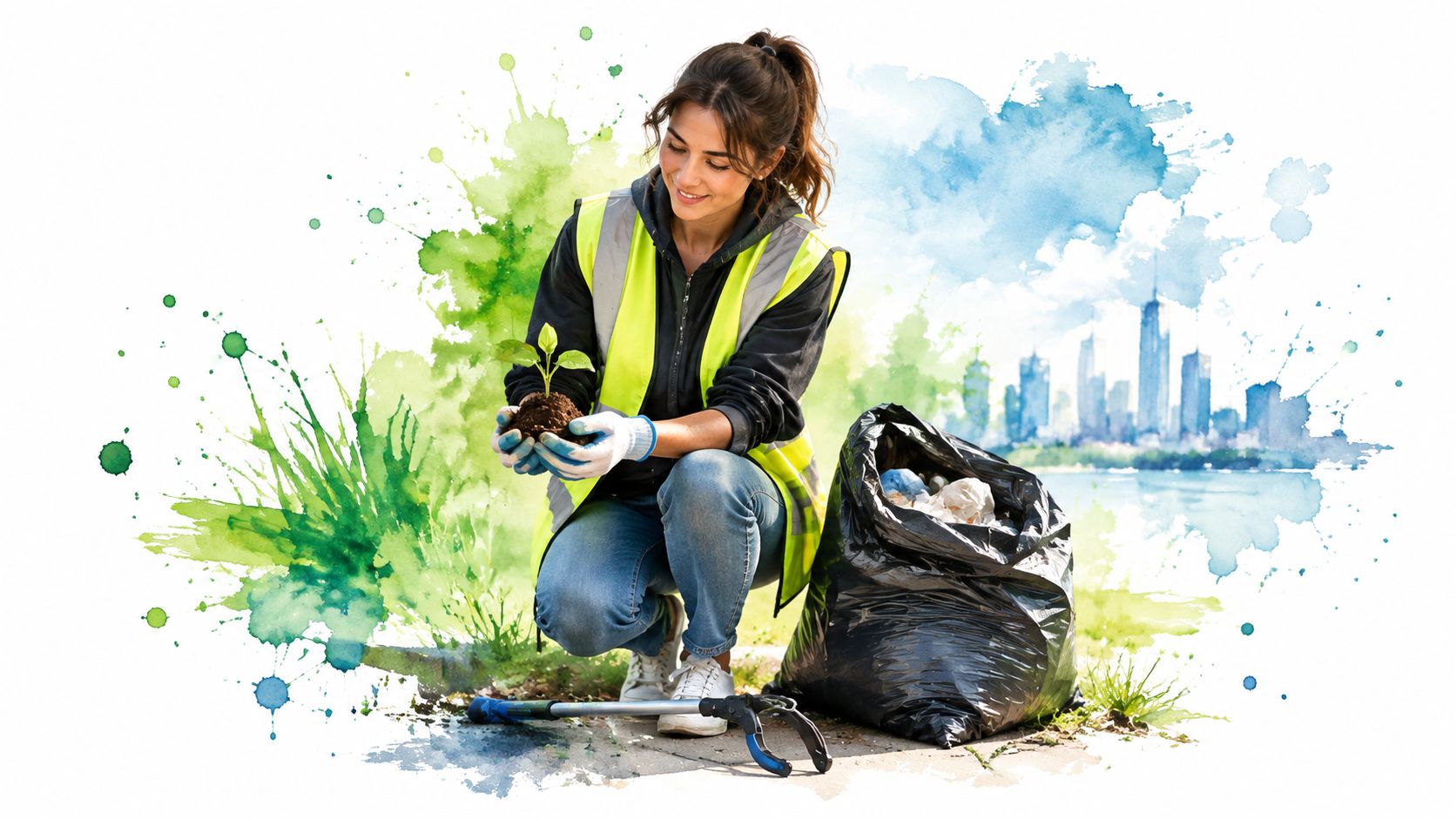
Kevin Tao's first Litter Caterpillars cleanup began with hail bouncing off a car hood, three people huddled beside a vacant lot, and a pickle picker that felt too small for the mess ahead. Someone lifted a grocery bag packed with wet cardboard, and the group decided to meet again the next Saturday.
That scene taught me what stewardship looks like before anyone gives it a polished name. You take responsibility for a place you don't own, bring the tools you have, and return when the weather makes staying home easier.
A Storm, Three People, and a Trash Picker
Kevin stood in a Chicago vacant lot during a spring storm, gripping a pickle picker while hail struck his hood and the pavement. Two other people stood nearby, strangers at first, each trying to decide whether the cold had already beaten the plan.
We talked about which block to tackle first. The conversation stayed practical because nobody knew what else to say. Then a picker caught the handle of a grocery bag. Kevin pulled, and the bag came up heavy with wet cardboard, food packaging, and water that ran down his glove.
That first cleanup didn't look like a civic ceremony. It looked like three people shivering beside a pile of trash, making one small corner easier to walk through.
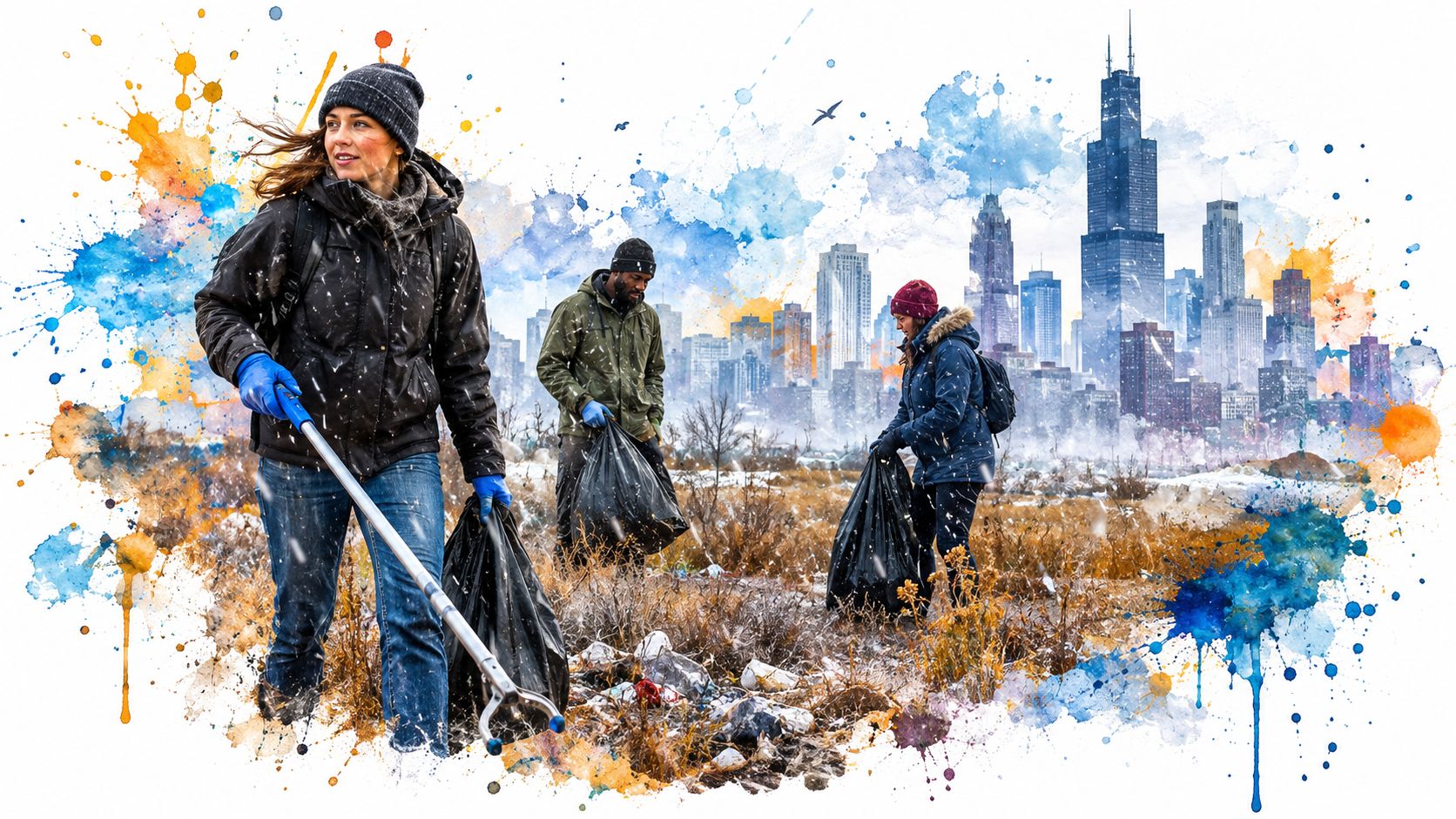
I've learned that stewardship starts in the hands. A trash picker bends, closes, and lifts. A bag fills. A sidewalk appears beneath the wrappers. You don't need to feel ready before you begin, and you don't need to know everyone on the block.
The group chose a return time for the following week. That small promise eventually became a weekly routine across Chicago, through rain, blizzards, wind chills, and heat. The question stayed with me: why does one uncomfortable Saturday keep sending people back?
The answer has two parts. The street needs care, and people often find belonging, purpose, and a clear sense of progress while giving it.
What Stewardship Really Means
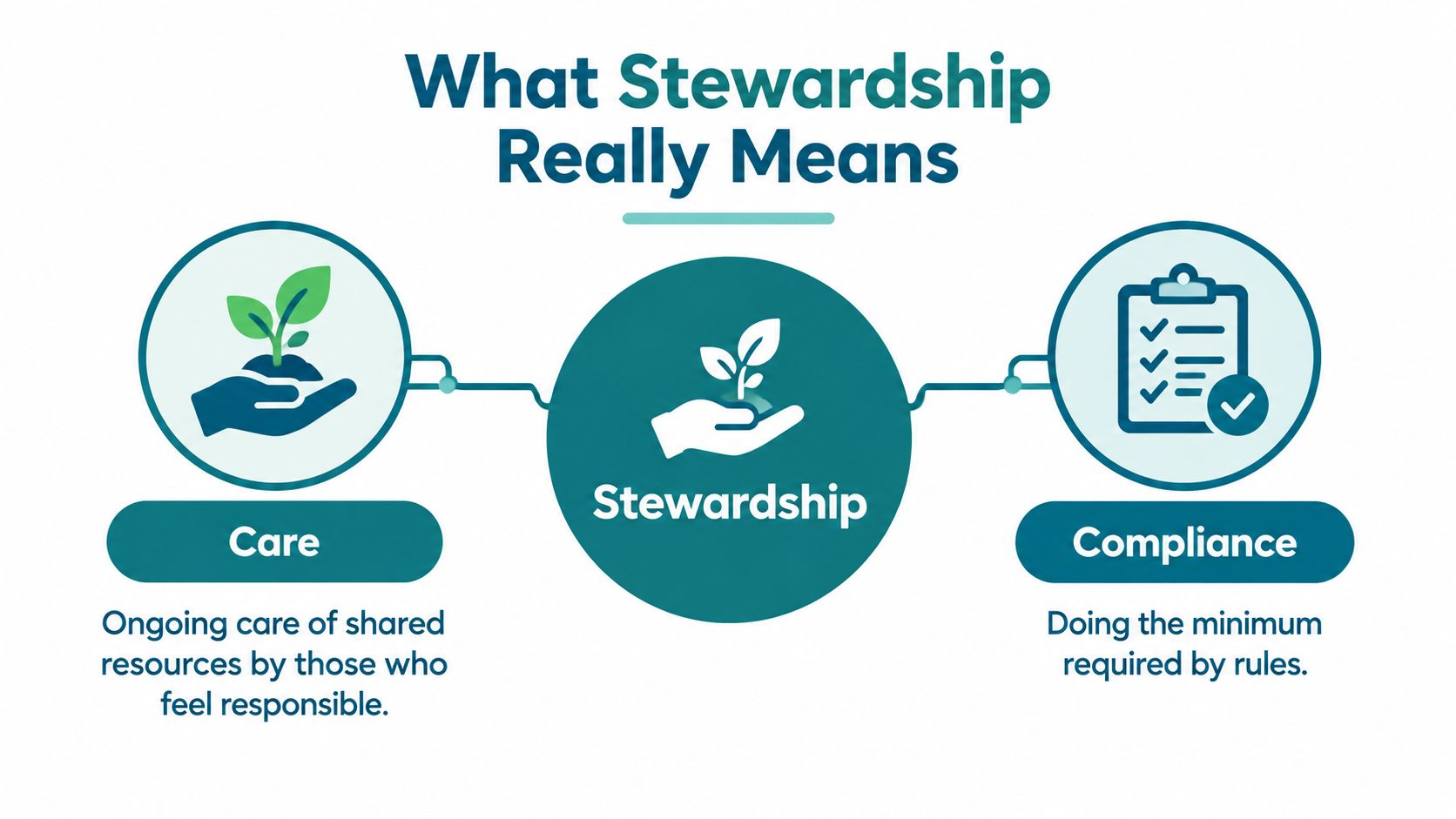
I use stewardship to mean ongoing care for shared resources by people who may not own them but still feel responsible for their condition. A park, alley, riverbank, vacant lot, or sidewalk belongs to a larger public system. You live with its condition, so your choices affect it.
Compliance asks you to meet a rule. Stewardship asks you to notice what the place needs after the rule stops speaking. The EPA's description of environmental stewardship includes people, businesses, communities, and governments sharing responsibility for environmental quality. The EPA also describes stewardship as action that goes beyond minimum compliance, including reducing pollution at its source, recycling as much as possible, and using energy and natural resources efficiently in its environmental stewardship guidance.
A clean block usually needs several hands:
- A resident picks up loose litter before wind and rain move it.
- A shop provides a bin and keeps its frontage clear.
- A community group schedules volunteers and supplies a plan.
- A sanitation crew handles the heavy haul and removes material that a small group can't safely move.
Each actor handles a different part of the same job. One person can't repair every weak point, and a government crew can't see every wrapper as soon as it lands.
For organizations choosing packaging, material decisions belong in this same conversation. A resource on biodegradable packaging material selection 2026 can help a business think about what happens before a discarded item reaches a sidewalk.
Litter Caterpillars fits into this shared system by organizing volunteers across Chicago's 50 wards. The group doesn't replace sanitation crews, stores, or residents. It gives people a regular way to act alongside them.
The Global Waste Problem You Can See on Your Block
A curb can make a global waste problem feel ordinary. I see a plastic wrapper pressed against a storm drain, a cup tucked beneath a bus-stop bench, or a broken bottle shining in an alley. Each item looks small until rain, wind, traffic, and time move it somewhere harder to reach.
The 2024 Global Waste Management Outlook from UNEP and ISWA reports that the world generated about 2.3 billion tonnes of municipal solid waste in 2023. The report projects that amount will reach 3.8 billion tonnes by 2050. In 2020, 38% of municipal solid waste, about 810 million tonnes, was uncontrolled, meaning people dumped it or burned it in the open.
Waste management already costs money before pollution and illness enter the calculation. UNEP and ISWA put global waste-management spending at US$252 billion in 2020. When hidden costs from pollution, poor health, and climate change enter the estimate, the annual cost reached US$361 billion in 2020 and could rise to US$640.3 billion by 2050, a projection from the same outlook.
Global Waste at a Glance
| Metric | Figure |
|---|---|
| Municipal solid waste generated in 2023 | About 2.3 billion tonnes |
| Projected municipal solid waste in 2050 | 3.8 billion tonnes |
| Uncontrolled municipal solid waste in 2020 | 38%, about 810 million tonnes |
| Global waste-management spending in 2020 | US$252 billion |
| Estimated annual cost including hidden costs in 2020 | US$361 billion |
| Projected annual cost including hidden costs in 2050 | US$640.3 billion |
Those figures don't live in a distant spreadsheet. They show up as litter that blocks a drain, attracts pests, breaks into smaller pieces, and travels beyond the block where someone dropped it. A Saturday pickup can't solve the whole system, but it can interrupt one part of it with the simplest available action, remove the material before it moves.
Stewardship in Action on Chicago Streets
During a major Chicago bike-event shutdown, diverted traffic exposed layers of roadside debris that regular movement had hidden. Volunteers put on safety vests, spread out with grabbers and bags, and worked lane by lane. In roughly three hours, the crew filled a truck.
The work felt repetitive, which helped. One person watched the pavement. Another held the bag. A third checked the shoulder for glass and sharp metal. The group didn't need a grand speech. It needed a route, safe spacing, and people willing to keep bending down.
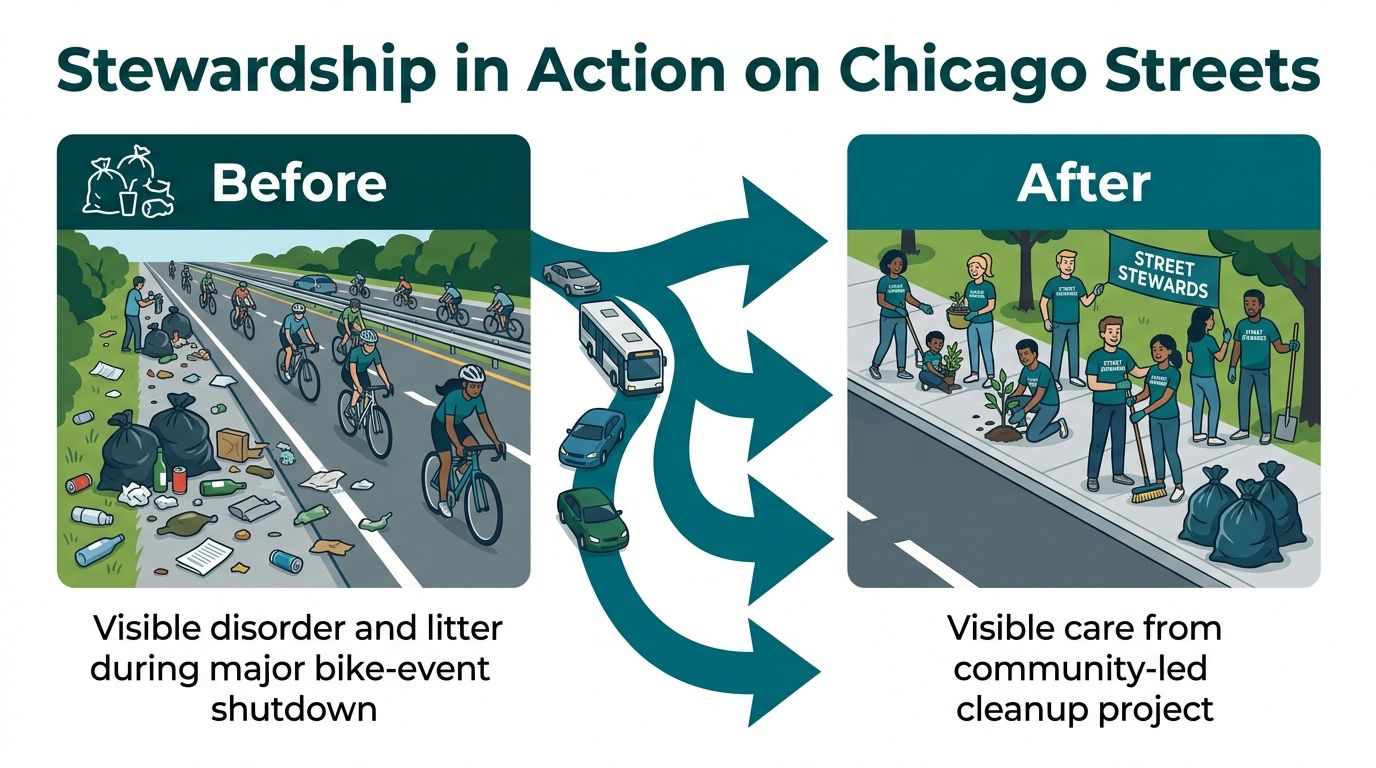
The second project began with an empty lot in Englewood. Dumped tires, mattresses, fast-food wrappers, and other debris covered the ground. Volunteers returned over four weekends, cleared the lot, planted native grasses, and turned the parcel into Caterpillar Park, a place neighbors could use and see from their porches.
A cleanup becomes easier to repeat when people can see the change before they leave.
The highway project removed a buried layer of roadside neglect. Caterpillar Park changed what an empty lot invited people to do. Both projects depended on the same ordinary sequence: plan the work, show up, lift the material, sort what you can, and return for the part that remains.
Stewardship becomes muscle memory. You don't wait for perfect conditions. You build a routine that lets a group handle the next visible problem.
How Litter Becomes a Water Problem
Take one plastic bottle on a Chicago curb. On a dry morning, it looks stationary. Once rain arrives, the bottle can slide toward the gutter, catch against leaves, or break apart under traffic.
Follow the route
- The curb collects runoff. Rainwater moves downhill along the street and carries loose wrappers, cigarette filters, grit, and fragments with it.
- The catch basin receives the flow. The drain gathers water from the gutter, along with whatever the water has picked up.
- The sewer carries the mixture. In parts of Chicago, combined sewers carry stormwater and wastewater through the same system.
- Heavy rain can push water into waterways. When the system overflows, polluted water can reach the Chicago River and Lake Michigan.
Recent microbiology research describes urban runoff as a pathway carrying microplastics and other human-made pollution from catchments into local aquatic systems, with runoff management needed because litter discharge into nearby water environments remains prominent. You can read the findings in this research on microplastics and urban runoff.
Litter doesn't stay where you see it. Storms and snowmelt mobilize it, and small pieces become harder to collect after they enter a drain or waterway. A pickup on a dry Saturday interrupts the route at the curb, before a treatment plant, riverbank crew, or shoreline volunteer has to deal with it.
Visit the Litter Caterpillars watershed protection resources for more ways to connect street cleanup with water care.
Practical rule: If you can safely remove litter before rain reaches it, you've chosen the simplest point in the chain.
Pickup is prevention. One bag won't repair a sewer system, but it can keep loose material from entering one.
Why People Keep Showing Up Week After Week
At 9 a.m. on Saturday, the first volunteers usually look a little uncertain. They check the meeting point, adjust a glove, and ask whether they should take a picker or a bag. By the end, they talk about the strangest object they found and compare the block before and after.
That rhythm gives people four reasons to return: belonging, learning, accomplishment, and a mental reset. The UBC study on stewardship volunteering found that the strongest motivators included accomplishment, group solidarity, learning and skills, and personal welfare, as described in this University of British Columbia research on stewardship volunteering.
A separate study in the same source material found that continued participation connected more strongly with personal, social, and community-building goals than with environmental motives alone. That matches what I see in the group. People come for the street, then return for the people, the small skills, and the satisfaction of finishing something visible.
Four Reasons Volunteers Return
| Reward | What It Looks Like at a Cleanup | Supporting Evidence |
|---|---|---|
| Belonging | Low-stakes conversation while two people share a route | Group solidarity ranked among the strongest motivators in the UBC study |
| Learning | New volunteers learn safe handling, sorting, and route planning | Learning and skills ranked among the strongest motivators in the UBC study |
| Accomplishment | A weigh-in station records what the crew collected | Accomplishment ranked among the strongest motivators in the UBC study |
| Mental reset | Volunteers work outdoors, move their bodies, and leave with a clear finish | Personal welfare ranked among the strongest motivators in the UBC study |
The schedule matters too. Finishing by 11 a.m. leaves the rest of Saturday open. Rotating the neighborhood keeps the route fresh, while the familiar start time gives the habit a place in the week.
The pandemic showed how fragile that routine can become. Research on environmental stewardship groups found that 50% of groups reported volunteer-event cancellations as the most widespread pandemic impact, while 56% of respondents said they spent “a lot less” time engaging with stewardship groups after COVID-19 disruptions, according to the UNEP and ISWA executive summary.
For people looking for a steady, friendly way to practice care, Litter Caterpillars' care-for-real approach puts that rhythm into a weekend activity.
Small Cleanups, Big Compound Effects
Someone eventually points at a half-filled bag and asks whether it can matter. I understand the question. One outing won't remove every piece of litter in Chicago, and a single volunteer can't repair every neglected lot.
The answer comes from repetition. Litter Caterpillars has spent about three years cleaning across all 50 wards, according to the group's account of its weekly routine. The value sits in the return visits. A cleaner block makes the next piece of litter easier to notice, gives neighbors a reason to talk, and lets a group work on the same problem before it grows.
What repeats can change
- Visible norms: People see a maintained sidewalk and may think twice before dropping the next wrapper.
- Civic trust: Residents see shared spaces receive regular care, while government crews gain clearer information about places that need larger work.
- Volunteer capacity: One person brings a friend, the friend learns the routine, and the crew can cover another route.
- Local use: A cleared lot such as Caterpillar Park gives neighbors a reason to walk through, gather, and watch the space.
The social effect matters because stewardship depends on people continuing to participate. The Nature Conservancy's 2024 Volunteer Impact Report says more than 37% of volunteer time falls within the stewardship family. That figure places cleanup, restoration, and care within a large share of civic volunteering.
England's government also reported that conservation volunteer hours rose 5% in the most recent year and 44% from 2000 to 2023, according to its volunteer time statistics. Participation can grow when groups make service easy to repeat.
A symbolic cleanup can still lift morale. Structural change starts when someone records the problem, returns to it, recruits another person, and builds a routine that lasts.
Your First Steps Into Stewardship
You don't need to form an organization before you pick up your first bag. Join an existing group, learn its safety habits, and let someone else handle the route plan while you get comfortable.
In Chicago, you can start with a Litter Caterpillars Saturday cleanup, a park conservancy, a riverkeeper chapter, or an Adopt-a-Highway program. The EPA's litter-management guidance describes volunteer cleanups as one way municipalities can organize residents, while community groups can run their own cleanup events and shifts.
Bring a simple kit
- Sturdy gloves: Choose a pair that protects your hands without making it hard to grip small pieces.
- A trash picker: A grabber keeps your back straighter and helps you avoid direct contact.
- A five-gallon bucket: Use it for heavier items or for separating material while you walk.
- A high-visibility vest: Wear one near roads, parking lots, or moving vehicles.
- Water: Bring enough for the weather and the amount of walking you expect.
- A data sheet: Record what you collect, where you find it, and any repeated sources of litter.
Start with one outing in a quarter if your schedule feels crowded. Move to monthly visits when the meeting time feels familiar. Try weekly service when you want the habit to carry itself.
Take a before-and-after photo from the same position. Invite one friend, especially someone who says they want to help but doesn't know where to begin. Report hazards and larger dumping sites through your local 311 system, and keep volunteer collection data separate from municipal reports so each record stays clear.
Safety comes first. Don't handle needles, unknown chemicals, unstable piles, or heavy objects alone. Ask the group leader how they mark hazards, where they place filled bags, and what they leave for a sanitation crew.
Stewardship isn't a personality trait that some people inherit. It works more like a skill. You practice noticing, lifting, sorting, recording, and returning. After a while, Saturday morning feels less like an appointment and more like a promise you know how to keep.
Litter Caterpillars organizes volunteer trash pickups across Chicago, giving you a practical way to care for streets, parks, lots, and waterways while meeting people who want the same kind of weekend service. Visit Litter Caterpillars to find a cleanup, bring a friend, and take your first Saturday shift.
Leave a Reply