Tag: community service

  • 9 Team Bonding Activities That Serve Chicago

    9 Team Bonding Activities That Serve Chicago

    Three of us crouched beneath a Chicago tree while hail struck the pavement and every Uber canceled. We had set out to pick up litter, yet that soaked, miserable morning gave us something better than a clean block. It gave us a shared task, a story, and a reason to return.

    That's the thread running through these team bonding activities. Service becomes the activity, and friendship becomes the bond. If you're organizing Chicago volunteers, I'll help you think through group size, supplies, safety, access, scheduling, identity, and simple ways to track results. Litter Caterpillars offers one local example, with weekend-morning cleanups, volunteer-first care, and visible block-by-block work across the city.

    You won't need an elaborate retreat or a forced game. A team can build trust while sorting gloves, carrying bags, checking a map, or laughing beside a pile of leaves. The right project gives people a reason to talk while their hands stay busy. It lets friendship grow without demanding a performance.

    1. Themed Service Days with Group Identity

    A purple flag snaps above the sidewalk. Someone starts a song. A new volunteer receives a small badge after finishing the cleanup. Suddenly, the group feels less like a collection of strangers and more like a crew with a story.

    I've seen how a shared identity changes the way people enter a difficult morning. Sports teams use jersey colors and songs to create loyalty. Military units use insignia and shared symbols to build recognition. A cleanup team can use the same simple language without turning service into theater.

    Litter Caterpillars connects its identity to that first hailstorm, when three people huddled under a tree and watched rides disappear from the app. The logo carries that messy beginning. Flags, theme songs, and badges give volunteers a way to remember what they did together.

    A diverse group of four smiling young adults standing together outdoors, wearing matching shirts with scarves and holding a flag.

    Build the symbol from a real memory

    Start with an event your group already remembers. Maybe your first cleanup ended beside a flooded alley, or your team rescued a park entrance before a neighborhood festival. Let volunteers help design the badge, choose the color, or suggest a song. People accept an identity more readily when they help shape it.

    Use the same symbol in your group chat, sign-up posts, shirts, and event photos. When a new person earns a badge, say what it means. A small ritual can give a cold morning some warmth.

    Practical rule: Let the identity grow from shared work. Don't force a slogan onto people who haven't created a memory together.

    For clothing ideas, compare this tournament-ready team apparel with a practical t shirts and hoodies guide. Keep the design comfortable, visible, and easy to recognize from across a Chicago block. You can also borrow ideas from Litter Caterpillars' theme songs for teams when you want the group to carry its identity beyond the cleanup.

    2. Consistent Weekend Morning Scheduling

    Saturday morning arrives. The coffee shop has just opened, the sidewalks still look damp, and the same people begin appearing with gloves and reusable water bottles. One person brings a friend. Another remembers someone's name from the previous week. That's how a service group starts to feel dependable.

    I prefer a fixed weekend-morning schedule because it makes attendance easier to understand. People who choose that time often want a regular service habit. The schedule also gives friendships a natural rhythm. You don't need to invent a separate reason to see one another when everyone already knows where to meet.

    Litter Caterpillars describes a weekly weekend-morning cleanup practice that has continued for about three years, including rain, snow, and heat. That kind of repetition turns a volunteer day into a standing appointment. The work matters, yet the expectation of seeing familiar faces matters too.

    Protect the appointment

    Publish the time and meeting place clearly on every channel. Keep the routine steady when turnout feels small. A quiet morning can still give two people enough time to talk, learn the route, and build trust.

    The Saturday volunteer work guide from Litter Caterpillars gives this schedule a practical shape. You can copy the habit without copying every detail. Choose a public meeting point, explain the route, name the finish time, and tell people what to bring.

    • Keep the calendar predictable: Let volunteers plan around the cleanup instead of waiting for a new announcement.
    • Recognize rough-weather attendance: Thank people who arrive prepared, while never shaming anyone who stays home for safety.
    • Use the walk to build friendship: Pair newcomers with regulars so conversation happens before the first bag fills.

    “The work gets easier when people know they'll see one another again.”

    A 2023 survey study found a significant relationship between how often employees joined team-building activities and both engagement and satisfaction. The same research reported that participants preferred recurring events over one-off gatherings, with 36.5% favoring monthly activities and 31.4% favoring quarterly activities in the study's cited survey data. For a Chicago cleanup crew, a monthly or quarterly fallback can help people stay connected when weekly attendance isn't realistic.

    3. Volunteer-First Fundraising and No-Pressure Donations

    A volunteer arrives ready to lift bags. Before the first introduction, someone asks for a donation. The volunteer's shoulders tighten. The morning now feels like a sales funnel.

    I'd rather protect the reason people came. A volunteer-first group tells participants that their time and energy matter more than their wallets. Litter Caterpillars follows that approach by avoiding pressure on volunteers to donate. Support can come from local businesses, foundations, grants, and people who want to give without joining a cleanup.

    That separation keeps the relationship clean. You show up to serve. Someone else may provide money, equipment, food, or printing. Nobody needs to prove their commitment with a payment.

    Make the funding story easy to understand

    Transparency still matters. Tell volunteers how the group pays for bags, gloves, grabbers, water, storage, transportation, and first-aid supplies. If a local business supplies equipment, thank it openly. If a supporter gives money, accept the gift without turning every volunteer into a prospect.

    Community gardens often use grants and in-kind support while keeping volunteer work separate from financial giving. Faith communities can do the same by separating service opportunities from donation appeals. The model works because people know where they stand.

    • Explain support without pressure: Share the basic funding picture during orientation or in the event description.
    • Invite practical contributions: Let people bring supplies if they want, but keep participation open to those who arrive with only themselves.
    • Thank ambassadors: Volunteers who enjoy the work may tell friends about it because they feel respected, not recruited.

    A field experiment on workplace bonding found stronger collegiality, better workplace friendships, and improved office-level performance after structured social connection interventions. It also reported a 40% reduction in short-run turnover, while finding no statistically significant improvement in individual productivity according to the study's findings. That distinction helps you judge a volunteer team fairly. Look for return visits, introductions, and group connection instead of demanding that each person work faster.

    4. Shared Adversity and Challenge-Based Activities

    The first Chicago hailstorm changed my view of discomfort. Three people stood under a tree, cold and annoyed, while rides canceled one after another. We could have called the cleanup a failure. Instead, the weather gave us a story nobody had to manufacture.

    Hard conditions can make people pay attention to one another. Someone checks whether you need dry gloves. Someone shares a poncho. Someone spots a dangerous piece of glass before you reach for it. Those small acts create a record of mutual care.

    Litter Caterpillars describes returning through blizzards, negative wind chills, rain, and scorching heat. You shouldn't treat dangerous weather as a badge of honor, though. Challenge works when volunteers can choose their limits and organizers take responsibility for the conditions.

    Three happy women wearing colorful rain gear and backpacks walking together through a rainstorm outdoors.

    Make difficulty hard, safe, and achievable

    Tell the group why the day may feel demanding. Then provide water, rest periods, weather alerts, reflective gear, gloves, and a clear stopping plan. Match the route to the group's ability. A short cleanup in cold rain can create a shared memory. A reckless route can break trust.

    Military training, wilderness expeditions, and sports teams all use shared challenge to create connection, yet volunteer organizers don't need to imitate their harshest methods. Your purpose is service and friendship, not punishment.

    After a difficult cleanup, sit down for a short debrief. Ask what surprised people, where they helped one another, and what the group should change next time. Give volunteers room to laugh about the soaked cardboard and the runaway bags. The story belongs to them.

    Safety boundary: A difficult morning should leave people proud and tired. It shouldn't leave anyone injured, stranded, or ashamed for turning back.

    5. Cross-Neighborhood Exploration and Presence

    A cleanup can begin with a map spread across a folding table. Volunteers lean over it, trace a route, and realize they've never walked that part of Chicago. By the end of the morning, they've learned a street name, met a neighbor, and left a visible change behind.

    Litter Caterpillars has committed to cleaning across all 50 Chicago wards, according to the group's own account. That kind of citywide route gives regular volunteers a shared expedition. Each weekend can bring a new corner, while repeated visits can help the team learn which local partners and safety conditions matter.

    The map also gives people something to discuss while they work. One person knows the nearest train stop. Another recognizes a community garden. A third notices that the same alley needs a different approach after rain.
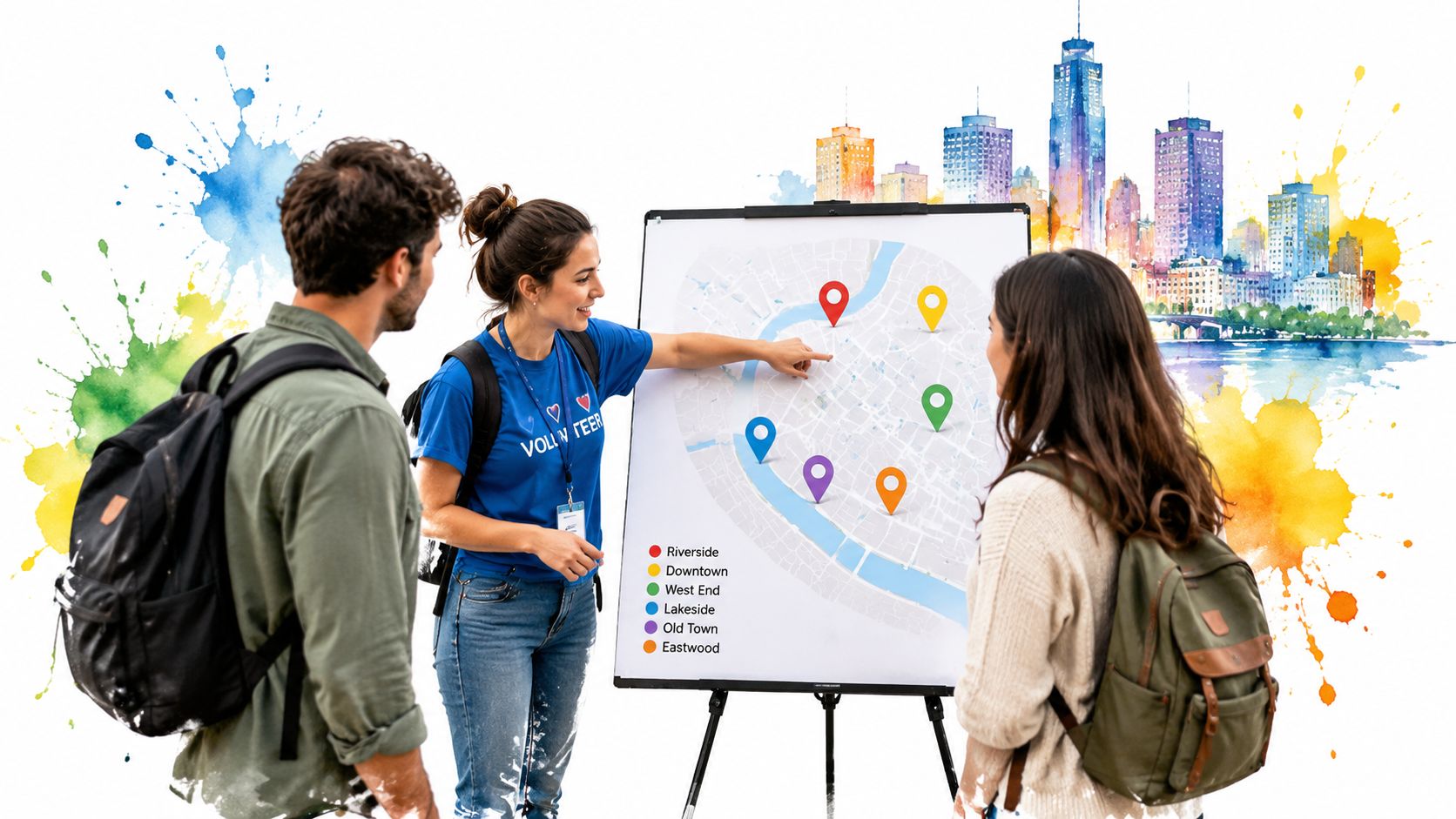
    A female volunteer explains map locations to two young volunteers during a team bonding activity.

    Give every route a human context

    Don't choose neighborhoods randomly and treat them like points on a game board. Contact local groups when possible. Ask about blocked sidewalks, upcoming events, disposal rules, and places where volunteers should avoid working alone. A neighborhood partner can give your team better information than a map can.

    Create a simple coverage map. Mark completed areas, recurring routes, and future stops. Take before-and-after photos from consistent angles, while respecting residents' privacy.

    • Rotate with purpose: Mix familiar routes, where relationships can grow, with new routes, where curiosity keeps the work fresh.
    • Record the story: Note what the group learned about the block, not only how many bags it filled.
    • Invite local knowledge: Let residents suggest problem areas and tell you what would help.

    The social connection evidence brief reports that conversation usually remains stable at about four participants, because larger groups face cognitive limits and become less efficient in its 2024 evidence summary. Split a large cleanup into small route teams, then bring everyone together for a short closing circle.

    6. Friendship-Building as the Primary Goal

    At the end of a cleanup, the bags sit by the disposal point. The volunteers stay. Someone asks about a new job. Someone else mentions a birthday. Two people compare coffee orders and make plans for the following Saturday.

    That scene tells me whether a service group has built connection. The litter gives people a reason to meet, yet friendship gives them a reason to return. Running clubs often work the same way. People arrive for the run and stay for the conversations afterward.

    You can design for that outcome without making the morning feel artificial. Ask volunteers about their lives, remember what they tell you, and make introductions that have a real basis. If someone just moved to Chicago, connect them with a person who knows the neighborhood. If two people share a hobby, let them discover it naturally.

    Leave room for the conversation

    Schedule coffee, a picnic, or a short social period after the cleanup. Keep it optional and accessible. Nobody should need to buy an expensive meal to belong. A thermos, a park bench, or a potluck can give people enough space to continue talking.

    • Pair newcomers thoughtfully: Match a first-time volunteer with someone who can explain the route and introduce them to others.
    • Remember personal details: Ask about the interview, class, race, move, or family event someone mentioned.
    • Celebrate life outside service: A new job or birthday can receive the same warmth as a completed cleanup area.
    • Create shared references: A funny sign, stubborn shopping cart, or muddy shortcut can become part of the group's language.

    Employee engagement research found a significant relationship between recurring team-building activity frequency, engagement, and satisfaction. In a related preference survey, 36.5% chose monthly activities and 31.4% chose quarterly activities in the reported findings. Use that as a planning signal, not a command. Choose a cadence your volunteers can sustain.

    7. Skill-Building and Personal Transformation Focus

    I started cleaning because I struggled with clutter, consistency, and bravery. A small piece of trash could feel heavier than it looked. Picking up someone else's mess became a way to practice moving through tasks that once stopped me.

    That story gives service another layer. A volunteer learns how to use a grabber, sort a route, speak with a neighbor, or lead a safety briefing. They also practice returning after a hard week. The physical task stays concrete, while the personal change happens through repetition.

    Litter Caterpillars uses the caterpillar as an image for that process. Volunteers don't need to arrive polished or fearless. They can arrive unsure, make mistakes, and learn alongside other people.

    Turn reflection into part of the activity

    Give the group a few minutes after cleanup to name one thing they learned. Keep the questions simple. What felt difficult? Who helped you? What would you try next time? A volunteer may mention a new skill, a brave conversation, or the moment they finally picked up an object they usually would have ignored.

    The volunteer mentor programs from Litter Caterpillars can inspire a buddy structure for people who want more responsibility. Pair an experienced volunteer with someone new, then let the new person take the lead when they feel ready.

    • Share your own story: Tell people why you began, without presenting yourself as finished.
    • Name small growth: Notice a first route briefing, a first return visit, or a first conversation with a resident.
    • Connect action to values: Use words like bravery, kindness, unity, and consistency.
    • Keep a reflection record: Invite volunteers to write a sentence after each event or share one thought in the group chat.

    A 2021 randomized study of team-building through video games found measurable gains in coordinated task performance. One task showed average improvement of 49.6% for teams receiving the team-building treatment, compared with 20.3% for control teams, a difference of 29.3 percentage points, with statistical significance reported at p<.001 in the study. The setting differs from a Chicago cleanup, yet the lesson fits: repeated shared objectives can give social connection a practical outlet.

    8. Safety-First Culture with Volunteer Happiness as Priority Two

    Before anyone reaches for a bag, I want the group to know the order: safety first, volunteer happiness second, task completion third. That order changes the morning. People feel more comfortable saying they need a break, avoiding broken glass, or leaving when weather turns dangerous.

    A cleanup leader should know the forecast, inspect the route, identify disposal points, and explain what volunteers shouldn't touch. You need a simple emergency plan. You also need a culture where nobody treats caution as weakness.

    Professional sports teams, climbing groups, and outdoor education programs build their activities around safety systems. A volunteer cleanup can use the same habit at a simpler scale. Start with a short briefing. Check in during the route. End with a headcount and a question about how people feel.

    Make safety visible

    Give every volunteer gloves, bags, and clear instructions. Add grabbers when the route includes sharp or unpleasant objects. Bring water, first-aid supplies, weather protection, and a way to communicate if the group splits.

    • Check the conditions: Adjust or cancel the route when heat, lightning, flooding, ice, or poor visibility creates an unsafe setting.
    • Name the hazards: Explain how to handle glass, needles, chemicals, heavy objects, and traffic-adjacent areas.
    • Invite people to stop: Tell volunteers they can tap out without explaining or apologizing.
    • Review the day: Ask what felt unsafe and change the plan before the next event.

    A 2021 randomized study found that structured team-building through video games improved performance on one controlled task, yet that result doesn't replace safety judgment in outdoor service as reported in the study. Your best outcome is a group that finishes safely and wants to come back.

    Here's a short visual reminder to place before the next planning meeting:

    9. Multi-Channel Accessibility and Low-Barrier Entry

    One person finds your cleanup on Meetup. Another sees an Instagram post. A neighbor hears about it in a group chat. Someone else arrives because a friend mentioned the corner while buying coffee.

    That mix matters because people don't all enter community life through the same door. Litter Caterpillars uses Meetup, Instagram, and open group chats so newcomers can find information in familiar places. A low barrier says, “You can join before you know everyone.”

    Make the practical details impossible to miss. State the date, time, meeting point, route, transit options, expected conditions, and supplies. Tell people whether they need to RSVP. If they can show up, say so.

    Remove the small frictions

    You don't need an application, a special title, or a perfect volunteer history. You need a clear welcome and a person ready to answer questions. A newcomer orientation can take a few minutes. Explain where to stand, how to use the equipment, what not to pick up, and who to ask for help.

    • Keep every channel current: Update Meetup, Instagram, and group chats when the location or weather plan changes.
    • Use welcoming language: Assume people want to help, even if they don't know the local vocabulary.
    • Answer quickly: A short reply can turn uncertainty into attendance.
    • Share real-time updates: Use the group chat for transit changes, route notes, and friendly introductions.
    • Skip unnecessary gatekeeping: Encourage RSVPs when they help with supplies, but don't make them a condition of belonging.

    Recent hybrid-work coverage describes structured virtual social events, asynchronous recognition, and virtual watercooler channels as low-cost ways to maintain connection. It also describes smaller wellbeing-oriented formats, including yoga, sound baths, and mindful workshops, for teams dealing with burnout in its discussion of remote and hybrid bonding. For a Chicago volunteer group, the same principle can mean a group chat check-in for people who can't attend every cleanup.

    9-Point Comparison of Team Bonding Activities

    Item 🔄 Implementation Complexity ⚡ Resource Requirements 📊 Expected Outcomes ⭐ Key Advantages 💡 Ideal Use Cases / Tips
    Themed Service Days with Group Identity Medium, requires brand design and rollout Moderate, merchandise, design time, production costs Greater cohesion, higher visibility, social sharing Builds belonging and recognition; attracts recruits Best for established groups; co-design with volunteers; base on origin story
    Consistent Weekend Morning Scheduling Low, set and maintain routine Low, scheduling discipline and communication Reliable turnout, habit formation, self-selection Filters committed volunteers; builds trust and predictability Stick to schedule; communicate clearly; celebrate dedication
    Volunteer-First Fundraising and No-Pressure Donations Medium, requires alternative funding strategy Moderate, time to cultivate grants/partners, donor relations Deep volunteer trust; volunteers become authentic ambassadors Protects volunteer energy; inclusive participation Be transparent about funding; pursue external partners; accept non-volunteer gifts
    Shared Adversity and Challenge-Based Activities Medium–High, needs planning and risk management Moderate, safety gear, training, contingency planning Strong bonds, resilience, memorable narratives Creates deep camaraderie; attracts purpose-driven people Frame challenges as growth; enforce safety; debrief after events
    Cross-Neighborhood Exploration and Presence Medium, logistics and rotation planning Moderate–High, transport, coordination, mapping tools Broad impact, novelty, stronger citywide relationships Demonstrates commitment across areas; builds diverse connections Map coverage; partner locally; document before/after
    Friendship-Building as the Primary Goal Medium, cultural shift and ongoing attention Low–Moderate, time for social moments and communications High retention, loyalty, organic recruitment Sustainable engagement; reduces turnover and burnout Schedule social time; pair newcomers with veterans; celebrate milestones
    Skill-Building and Personal Transformation Focus Medium, requires curriculum and reflection practices Moderate, mentors, facilitation time, materials Personal growth, increased commitment, self-efficacy Gives deeper meaning; attracts growth-seeking volunteers Share transformation stories; create reflection windows; track progress
    Safety-First Culture with Volunteer Happiness as Priority Two Medium, establish protocols and training Moderate–High, first aid kits, training, management time Increased trust, fewer incidents, psychological safety Signals care; lowers liability; enables authentic participation Start with safety briefings; use buddy systems; have clear weather policies
    Multi-Channel Accessibility and Low-Barrier Entry Medium, maintain multiple platforms consistently Low–Moderate, time to update channels and manage messages Wider reach, diverse participants, spontaneous engagement Low friction onboarding; flexible engagement options Keep info identical across channels; simplify join steps; respond promptly

    Turn One Cleanup Into a Team Habit

    Choose one activity, one Chicago location, one weekend morning, and one identity element. That's enough for a first event. You might clean a park entrance, meet near a transit stop, wear matching green shirts, and give every participant a simple route badge. Don't wait until you have a perfect logo, a large turnout, or a full year of dates.

    Start with a public place where your team can work without blocking pedestrians. Check the route before inviting people. Ask whether a neighborhood organization already knows about the area. Decide where full bags will go, how volunteers will get home, and what weather would change the plan.

    Bring the basics:

    • Gloves and bags: Give each volunteer equipment that fits the task.
    • Grabbers: Use them for objects that could cut, stain, or strain someone.
    • Water and weather protection: Prepare for Chicago sun, rain, cold, and sudden changes.
    • First-aid supplies: Keep them visible and assign someone to carry them.
    • Clear communication: Share the meeting point, route, safety rules, finish time, and cancellation plan.

    Open with a two-minute welcome. Tell people why you chose the block. Introduce newcomers to regulars. Explain what the team will do and what it won't do. Then send small groups onto the route so people can talk while they work.

    Afterward, measure the parts that tell you whether friendship and service are growing together. Record volunteer attendance, return rate, bags or areas completed, new introductions, and quick safety and happiness check-ins. Ask one simple question before people leave: “Would you want to do this again?” Track the answers over time instead of chasing a dramatic result from one morning.

    A historical review describes three phases in the development of team building: 1900 to 1950, when organizations recognized the value of workplace teams, 1950 to 1969, when social interaction received more attention, and 1970 to 1989, when team building became a stand-alone educational process in the review. Your volunteer day doesn't need corporate language. It can still use the same basic lesson: people work better together when they have repeated chances to communicate and trust one another.

    Research on team-building interventions in sports found that researchers needed an intervention period of at least two weeks before they observed measurable changes in group cohesion in the study. Treat that as a reason to schedule a short run of cleanups rather than judging the group after one awkward introduction. Return to the same place, then explore another route when the team has found its rhythm.

    Keep the focus where it belongs. You're not gathering people to complete a perfect performance. You're inviting them to serve safely, learn one another's names, and leave with a story worth retelling. Litter Caterpillars gives Chicago residents a local way to find that rhythm through its website, Meetup, Instagram, and open group chats. Show up with supplies, listen to your volunteers, and make the next invitation easy to accept.


    Litter Caterpillars brings Chicago volunteers together for recurring, weekend-morning trash pickups that build friendship through hands-on service. Visit Litter Caterpillars to find an upcoming cleanup, join the group through its open channels, and take part in a safe team habit that helps your block.

  • Why Is Stewardship Important: A Real Look at What It Does

    Why Is Stewardship Important: A Real Look at What It Does

    Kevin Tao's first Litter Caterpillars cleanup began with hail bouncing off a car hood, three people huddled beside a vacant lot, and a pickle picker that felt too small for the mess ahead. Someone lifted a grocery bag packed with wet cardboard, and the group decided to meet again the next Saturday.

    That scene taught me what stewardship looks like before anyone gives it a polished name. You take responsibility for a place you don't own, bring the tools you have, and return when the weather makes staying home easier.

    A Storm, Three People, and a Trash Picker

    Kevin stood in a Chicago vacant lot during a spring storm, gripping a pickle picker while hail struck his hood and the pavement. Two other people stood nearby, strangers at first, each trying to decide whether the cold had already beaten the plan.

    We talked about which block to tackle first. The conversation stayed practical because nobody knew what else to say. Then a picker caught the handle of a grocery bag. Kevin pulled, and the bag came up heavy with wet cardboard, food packaging, and water that ran down his glove.

    That first cleanup didn't look like a civic ceremony. It looked like three people shivering beside a pile of trash, making one small corner easier to walk through.

    A diverse group of volunteers collecting litter with grabber tools in a snowy urban field.

    I've learned that stewardship starts in the hands. A trash picker bends, closes, and lifts. A bag fills. A sidewalk appears beneath the wrappers. You don't need to feel ready before you begin, and you don't need to know everyone on the block.

    The group chose a return time for the following week. That small promise eventually became a weekly routine across Chicago, through rain, blizzards, wind chills, and heat. The question stayed with me: why does one uncomfortable Saturday keep sending people back?

    The answer has two parts. The street needs care, and people often find belonging, purpose, and a clear sense of progress while giving it.

    What Stewardship Really Means

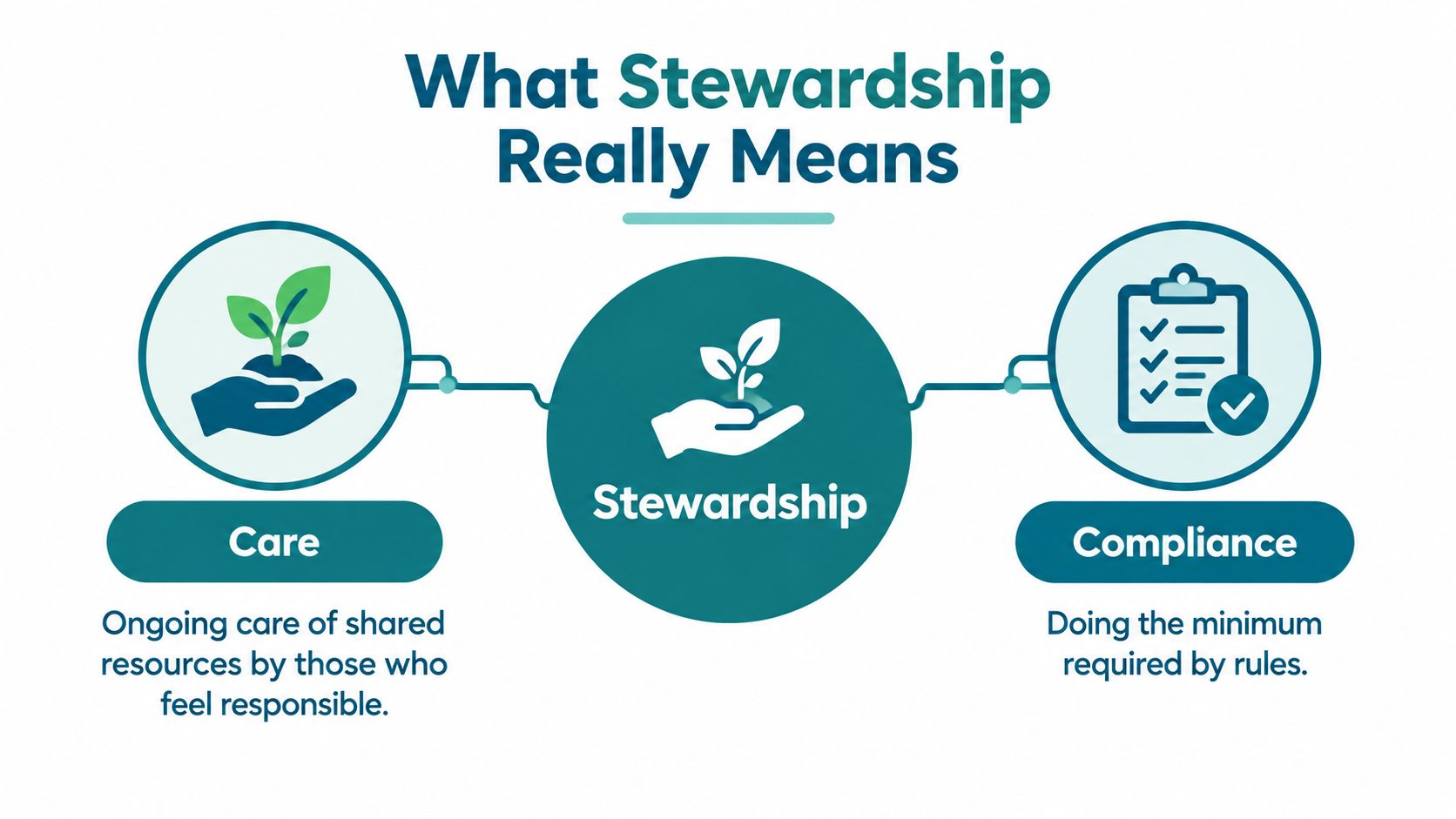
    I use stewardship to mean ongoing care for shared resources by people who may not own them but still feel responsible for their condition. A park, alley, riverbank, vacant lot, or sidewalk belongs to a larger public system. You live with its condition, so your choices affect it.

    Compliance asks you to meet a rule. Stewardship asks you to notice what the place needs after the rule stops speaking. The EPA's description of environmental stewardship includes people, businesses, communities, and governments sharing responsibility for environmental quality. The EPA also describes stewardship as action that goes beyond minimum compliance, including reducing pollution at its source, recycling as much as possible, and using energy and natural resources efficiently in its environmental stewardship guidance.

    An infographic titled What Stewardship Really Means, comparing the concepts of Care and Compliance.

    A clean block usually needs several hands:

    • A resident picks up loose litter before wind and rain move it.
    • A shop provides a bin and keeps its frontage clear.
    • A community group schedules volunteers and supplies a plan.
    • A sanitation crew handles the heavy haul and removes material that a small group can't safely move.

    Each actor handles a different part of the same job. One person can't repair every weak point, and a government crew can't see every wrapper as soon as it lands.

    For organizations choosing packaging, material decisions belong in this same conversation. A resource on biodegradable packaging material selection 2026 can help a business think about what happens before a discarded item reaches a sidewalk.

    Litter Caterpillars fits into this shared system by organizing volunteers across Chicago's 50 wards. The group doesn't replace sanitation crews, stores, or residents. It gives people a regular way to act alongside them.

    The Global Waste Problem You Can See on Your Block

    A curb can make a global waste problem feel ordinary. I see a plastic wrapper pressed against a storm drain, a cup tucked beneath a bus-stop bench, or a broken bottle shining in an alley. Each item looks small until rain, wind, traffic, and time move it somewhere harder to reach.

    The 2024 Global Waste Management Outlook from UNEP and ISWA reports that the world generated about 2.3 billion tonnes of municipal solid waste in 2023. The report projects that amount will reach 3.8 billion tonnes by 2050. In 2020, 38% of municipal solid waste, about 810 million tonnes, was uncontrolled, meaning people dumped it or burned it in the open.

    Waste management already costs money before pollution and illness enter the calculation. UNEP and ISWA put global waste-management spending at US$252 billion in 2020. When hidden costs from pollution, poor health, and climate change enter the estimate, the annual cost reached US$361 billion in 2020 and could rise to US$640.3 billion by 2050, a projection from the same outlook.

    Global Waste at a Glance

    Metric Figure
    Municipal solid waste generated in 2023 About 2.3 billion tonnes
    Projected municipal solid waste in 2050 3.8 billion tonnes
    Uncontrolled municipal solid waste in 2020 38%, about 810 million tonnes
    Global waste-management spending in 2020 US$252 billion
    Estimated annual cost including hidden costs in 2020 US$361 billion
    Projected annual cost including hidden costs in 2050 US$640.3 billion

    Those figures don't live in a distant spreadsheet. They show up as litter that blocks a drain, attracts pests, breaks into smaller pieces, and travels beyond the block where someone dropped it. A Saturday pickup can't solve the whole system, but it can interrupt one part of it with the simplest available action, remove the material before it moves.

    Stewardship in Action on Chicago Streets

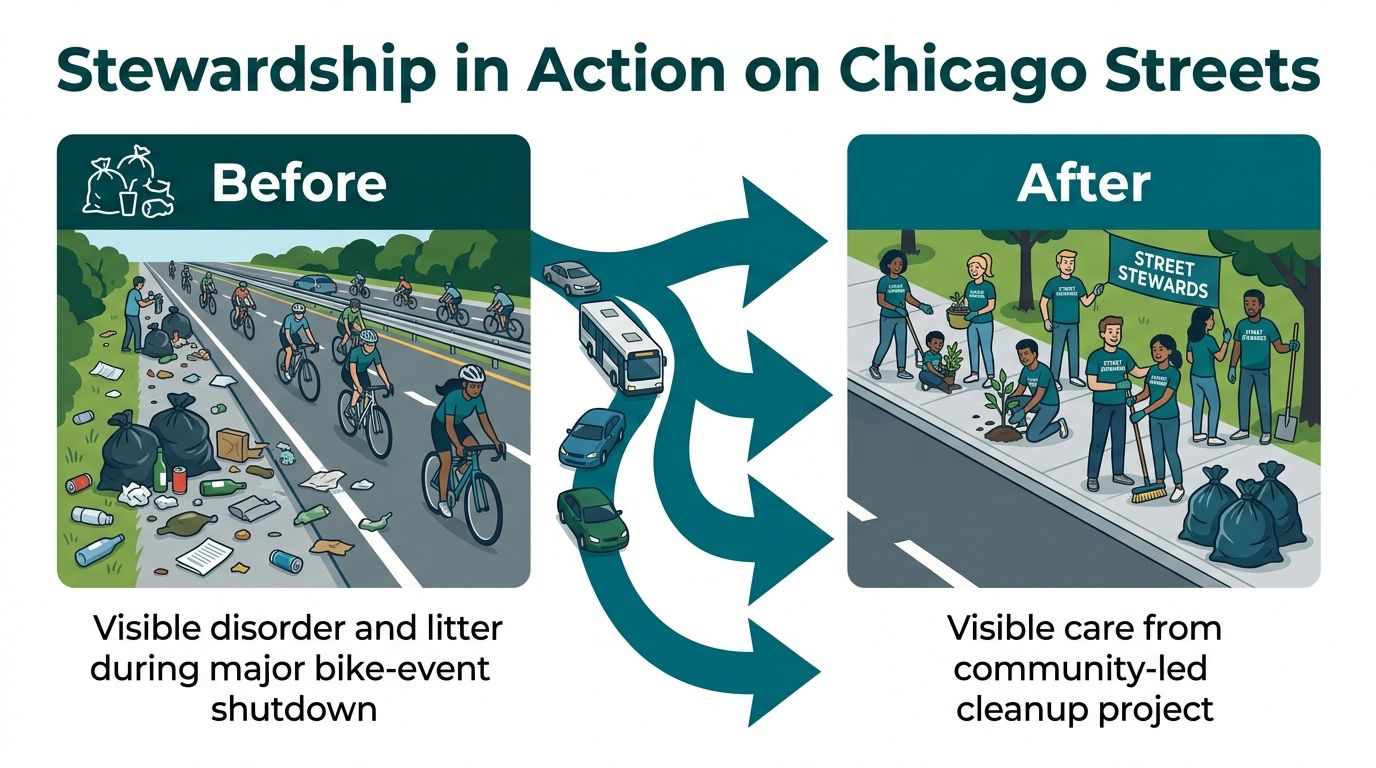
    During a major Chicago bike-event shutdown, diverted traffic exposed layers of roadside debris that regular movement had hidden. Volunteers put on safety vests, spread out with grabbers and bags, and worked lane by lane. In roughly three hours, the crew filled a truck.

    The work felt repetitive, which helped. One person watched the pavement. Another held the bag. A third checked the shoulder for glass and sharp metal. The group didn't need a grand speech. It needed a route, safe spacing, and people willing to keep bending down.

    A split image showing a litter-filled street during a bike event and volunteers cleaning the sidewalk.

    The second project began with an empty lot in Englewood. Dumped tires, mattresses, fast-food wrappers, and other debris covered the ground. Volunteers returned over four weekends, cleared the lot, planted native grasses, and turned the parcel into Caterpillar Park, a place neighbors could use and see from their porches.

    A cleanup becomes easier to repeat when people can see the change before they leave.

    The highway project removed a buried layer of roadside neglect. Caterpillar Park changed what an empty lot invited people to do. Both projects depended on the same ordinary sequence: plan the work, show up, lift the material, sort what you can, and return for the part that remains.

    Stewardship becomes muscle memory. You don't wait for perfect conditions. You build a routine that lets a group handle the next visible problem.

    How Litter Becomes a Water Problem

    Take one plastic bottle on a Chicago curb. On a dry morning, it looks stationary. Once rain arrives, the bottle can slide toward the gutter, catch against leaves, or break apart under traffic.

    Follow the route

    1. The curb collects runoff. Rainwater moves downhill along the street and carries loose wrappers, cigarette filters, grit, and fragments with it.
    2. The catch basin receives the flow. The drain gathers water from the gutter, along with whatever the water has picked up.
    3. The sewer carries the mixture. In parts of Chicago, combined sewers carry stormwater and wastewater through the same system.
    4. Heavy rain can push water into waterways. When the system overflows, polluted water can reach the Chicago River and Lake Michigan.

    Recent microbiology research describes urban runoff as a pathway carrying microplastics and other human-made pollution from catchments into local aquatic systems, with runoff management needed because litter discharge into nearby water environments remains prominent. You can read the findings in this research on microplastics and urban runoff.

    Litter doesn't stay where you see it. Storms and snowmelt mobilize it, and small pieces become harder to collect after they enter a drain or waterway. A pickup on a dry Saturday interrupts the route at the curb, before a treatment plant, riverbank crew, or shoreline volunteer has to deal with it.

    Visit the Litter Caterpillars watershed protection resources for more ways to connect street cleanup with water care.

    Practical rule: If you can safely remove litter before rain reaches it, you've chosen the simplest point in the chain.

    Pickup is prevention. One bag won't repair a sewer system, but it can keep loose material from entering one.

    Why People Keep Showing Up Week After Week

    At 9 a.m. on Saturday, the first volunteers usually look a little uncertain. They check the meeting point, adjust a glove, and ask whether they should take a picker or a bag. By the end, they talk about the strangest object they found and compare the block before and after.

    That rhythm gives people four reasons to return: belonging, learning, accomplishment, and a mental reset. The UBC study on stewardship volunteering found that the strongest motivators included accomplishment, group solidarity, learning and skills, and personal welfare, as described in this University of British Columbia research on stewardship volunteering.

    A separate study in the same source material found that continued participation connected more strongly with personal, social, and community-building goals than with environmental motives alone. That matches what I see in the group. People come for the street, then return for the people, the small skills, and the satisfaction of finishing something visible.

    Four Reasons Volunteers Return

    Reward What It Looks Like at a Cleanup Supporting Evidence
    Belonging Low-stakes conversation while two people share a route Group solidarity ranked among the strongest motivators in the UBC study
    Learning New volunteers learn safe handling, sorting, and route planning Learning and skills ranked among the strongest motivators in the UBC study
    Accomplishment A weigh-in station records what the crew collected Accomplishment ranked among the strongest motivators in the UBC study
    Mental reset Volunteers work outdoors, move their bodies, and leave with a clear finish Personal welfare ranked among the strongest motivators in the UBC study

    The schedule matters too. Finishing by 11 a.m. leaves the rest of Saturday open. Rotating the neighborhood keeps the route fresh, while the familiar start time gives the habit a place in the week.

    The pandemic showed how fragile that routine can become. Research on environmental stewardship groups found that 50% of groups reported volunteer-event cancellations as the most widespread pandemic impact, while 56% of respondents said they spent “a lot less” time engaging with stewardship groups after COVID-19 disruptions, according to the UNEP and ISWA executive summary.

    For people looking for a steady, friendly way to practice care, Litter Caterpillars' care-for-real approach puts that rhythm into a weekend activity.

    Small Cleanups, Big Compound Effects

    Someone eventually points at a half-filled bag and asks whether it can matter. I understand the question. One outing won't remove every piece of litter in Chicago, and a single volunteer can't repair every neglected lot.

    The answer comes from repetition. Litter Caterpillars has spent about three years cleaning across all 50 wards, according to the group's account of its weekly routine. The value sits in the return visits. A cleaner block makes the next piece of litter easier to notice, gives neighbors a reason to talk, and lets a group work on the same problem before it grows.

    What repeats can change

    • Visible norms: People see a maintained sidewalk and may think twice before dropping the next wrapper.
    • Civic trust: Residents see shared spaces receive regular care, while government crews gain clearer information about places that need larger work.
    • Volunteer capacity: One person brings a friend, the friend learns the routine, and the crew can cover another route.
    • Local use: A cleared lot such as Caterpillar Park gives neighbors a reason to walk through, gather, and watch the space.

    The social effect matters because stewardship depends on people continuing to participate. The Nature Conservancy's 2024 Volunteer Impact Report says more than 37% of volunteer time falls within the stewardship family. That figure places cleanup, restoration, and care within a large share of civic volunteering.

    England's government also reported that conservation volunteer hours rose 5% in the most recent year and 44% from 2000 to 2023, according to its volunteer time statistics. Participation can grow when groups make service easy to repeat.

    A symbolic cleanup can still lift morale. Structural change starts when someone records the problem, returns to it, recruits another person, and builds a routine that lasts.

    Your First Steps Into Stewardship

    You don't need to form an organization before you pick up your first bag. Join an existing group, learn its safety habits, and let someone else handle the route plan while you get comfortable.

    In Chicago, you can start with a Litter Caterpillars Saturday cleanup, a park conservancy, a riverkeeper chapter, or an Adopt-a-Highway program. The EPA's litter-management guidance describes volunteer cleanups as one way municipalities can organize residents, while community groups can run their own cleanup events and shifts.

    Bring a simple kit

    • Sturdy gloves: Choose a pair that protects your hands without making it hard to grip small pieces.
    • A trash picker: A grabber keeps your back straighter and helps you avoid direct contact.
    • A five-gallon bucket: Use it for heavier items or for separating material while you walk.
    • A high-visibility vest: Wear one near roads, parking lots, or moving vehicles.
    • Water: Bring enough for the weather and the amount of walking you expect.
    • A data sheet: Record what you collect, where you find it, and any repeated sources of litter.

    Start with one outing in a quarter if your schedule feels crowded. Move to monthly visits when the meeting time feels familiar. Try weekly service when you want the habit to carry itself.

    Take a before-and-after photo from the same position. Invite one friend, especially someone who says they want to help but doesn't know where to begin. Report hazards and larger dumping sites through your local 311 system, and keep volunteer collection data separate from municipal reports so each record stays clear.

    Safety comes first. Don't handle needles, unknown chemicals, unstable piles, or heavy objects alone. Ask the group leader how they mark hazards, where they place filled bags, and what they leave for a sanitation crew.

    Stewardship isn't a personality trait that some people inherit. It works more like a skill. You practice noticing, lifting, sorting, recording, and returning. After a while, Saturday morning feels less like an appointment and more like a promise you know how to keep.


    Litter Caterpillars organizes volunteer trash pickups across Chicago, giving you a practical way to care for streets, parks, lots, and waterways while meeting people who want the same kind of weekend service. Visit Litter Caterpillars to find a cleanup, bring a friend, and take your first Saturday shift.

  • 6 Community Cleanup Flyer Examples That Get Volunteers

    6 Community Cleanup Flyer Examples That Get Volunteers

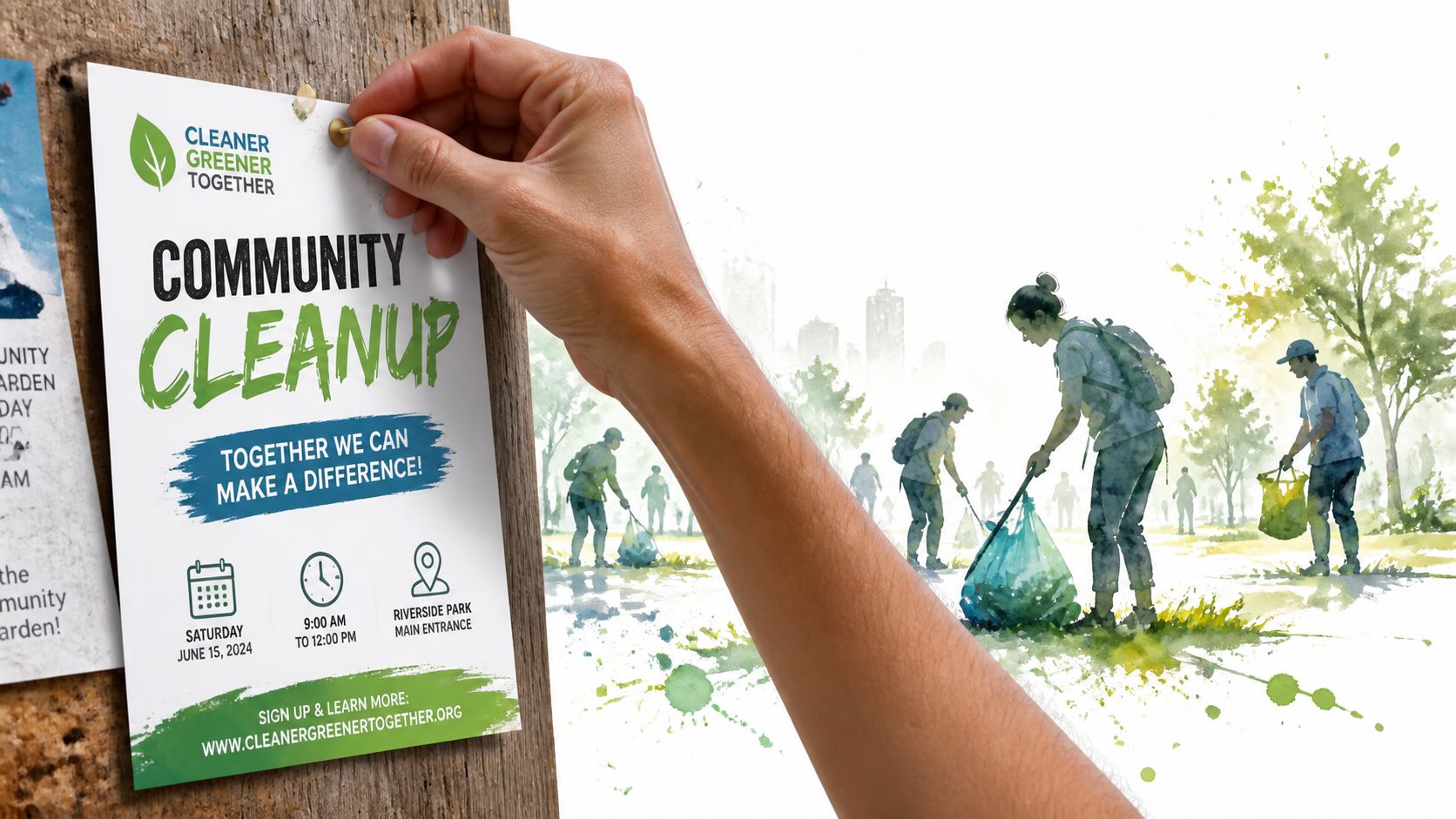
    A woman walks past a crowded bulletin board, catches one bold line, and slows down. Saturday morning. Bring a friend. Clean our block. She can keep walking, or she can scan the code and join. The strongest community cleanup flyer gives her one reason to care, one simple action, and enough detail to feel safe showing up. I'll walk through six formats built around bravery, friendship, clear logistics, neighborhood pride, and visible progress, then connect them to Litter Caterpillars' volunteer-first weekend mornings in Chicago. The group meets rain or shine, builds friendships through service, and never pressures volunteers for donations. Your flyer should create that same feeling before anyone reaches the first trash bag.
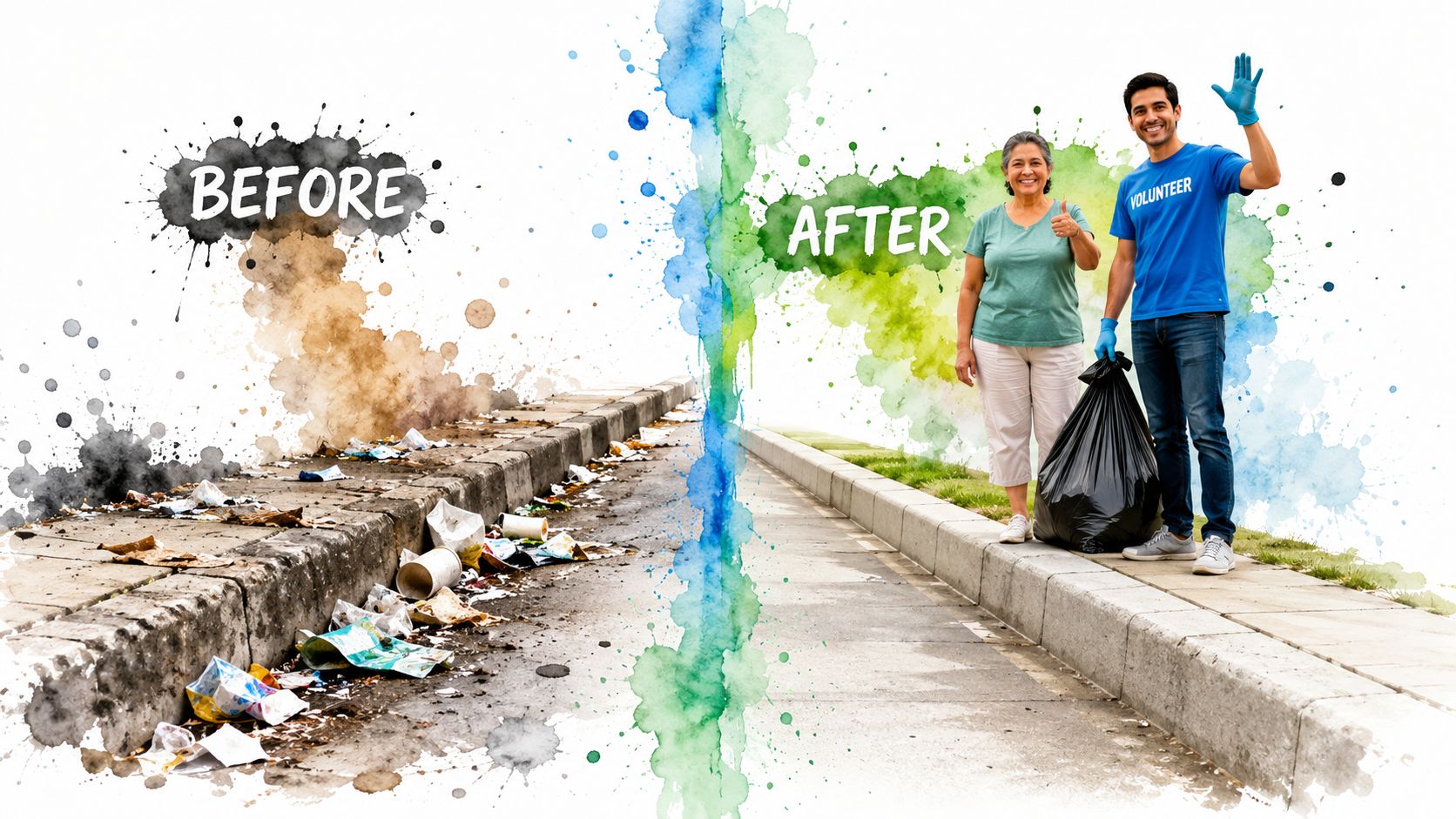
    1. Bold Call-to-Action Header with High-Contrast Colors

    A passerby has only a moment to notice your flyer. Give that moment a job.

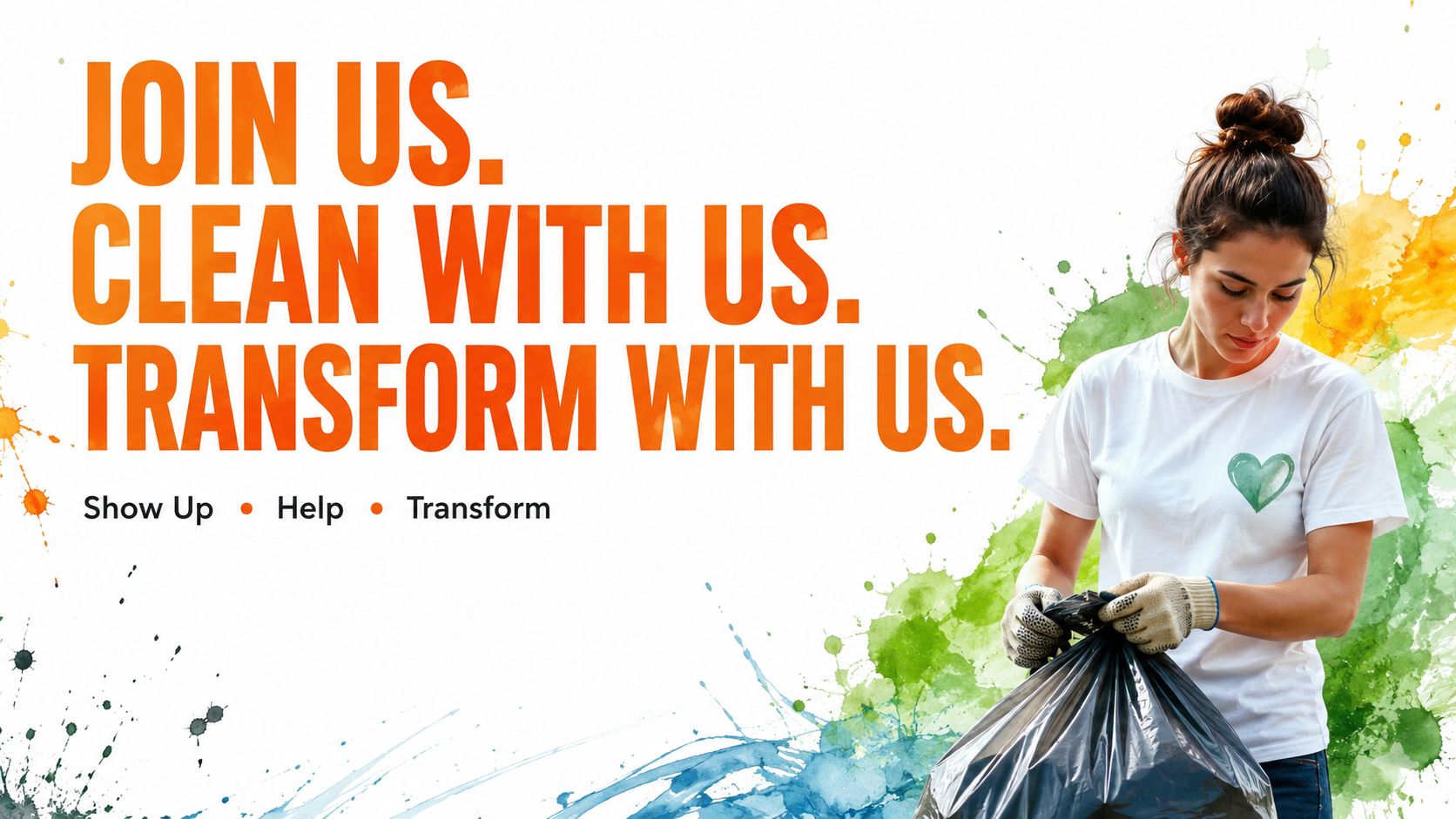
    Put the action at the top in large type. JOIN US. CLEAN WITH US. TRANSFORM WITH US. Bright colors can pop against a dark background, while a bold font can make the message readable from a distance. Chicago volunteer groups could place this format near L stations, coffee shops, libraries, and busy neighborhood entrances. A flyer for a Lincoln Square cleanup should say Lincoln Square early. A Pilsen event should name Pilsen before a reader has to hunt for it.

    A woman wearing a volunteer shirt picks up trash, with text encouraging community involvement and environmental action.

    Use your group's own colors when you have them. Litter Caterpillars could adapt the headline to SHOW UP. CLEAN UP. TRANSFORM UP. The words should sound like the group, while the next line should tell people exactly what happens next.

    Practical rule: Test the flyer from about fifteen feet away. If you can't read the main action, neither can someone hurrying past.

    Keep the lower half calm. Add the date, weekend-morning time, meeting place, and a QR code without competing with the headline. Use social media for volunteer recruitment to repeat the same short invitation online, then ask volunteers to share it with a friend.

    Your photo should show a real person doing the work. A gloved hand holding a grabber, a full bag beside a cleared sidewalk, or a smiling volunteer in a group shirt gives the headline a human landing place. Avoid turning the flyer into a donation appeal. The action is simple, show up and clean together.

    2. Story-Driven Personal Narrative Layout

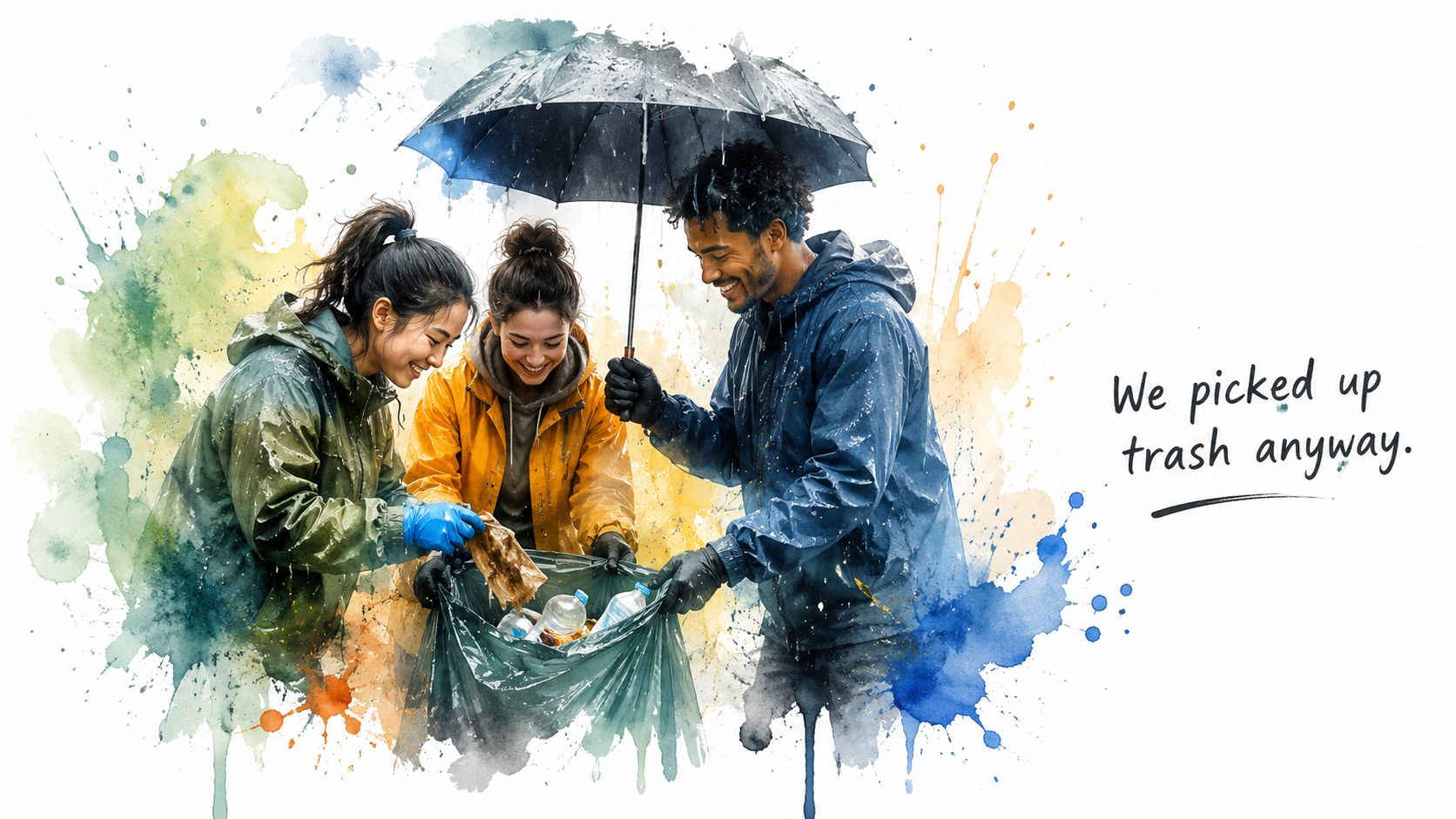
    Three people huddle under a tree while hail hits the pavement. Their Ubers keep canceling. The bags stay empty for a moment, then someone laughs, steps back into the storm, and grabs the first piece of litter.

    That moment can carry an entire flyer. Litter Caterpillars began with three people caught in a springtime hailstorm, and the group's story turns bad weather into a scene with tension, humor, and friendship. A reader doesn't need a broad promise about community improvement. The reader needs a reason to enter the story.

    Three volunteers in raincoats smiling while cleaning up litter in a bag during a rainy day.

    Write the opening like a real memory:

    • Start with a physical detail: hail on a jacket, wet gloves, a bus arriving, or the sharp smell after rain.
    • Give the reader a small problem: nobody knows whether the weather will break, the bags keep sliding, or the block looks worse than expected.
    • End with an invitation: “Come write the next part with us Saturday morning.”

    Use one strong photograph and plenty of white space. The story should remain readable beside the image. If a volunteer gave you permission to use a real quote, include that person's exact words and name. Otherwise, write in your own voice and label the moment accurately.

    “Cleaning someone else's mess felt easier than cleaning my own.”

    That line connects to the group's personal story without asking readers to pretend cleanup feels easy. The flyer can say that first-time volunteers may arrive alone, work beside others, and leave with a new friend. It can name Englewood, Rogers Park, or another specific neighborhood instead of hiding behind a generic city image.

    The final line should turn emotion into movement: Meet us at the listed location. Wear clothes you can work in. No experience needed.

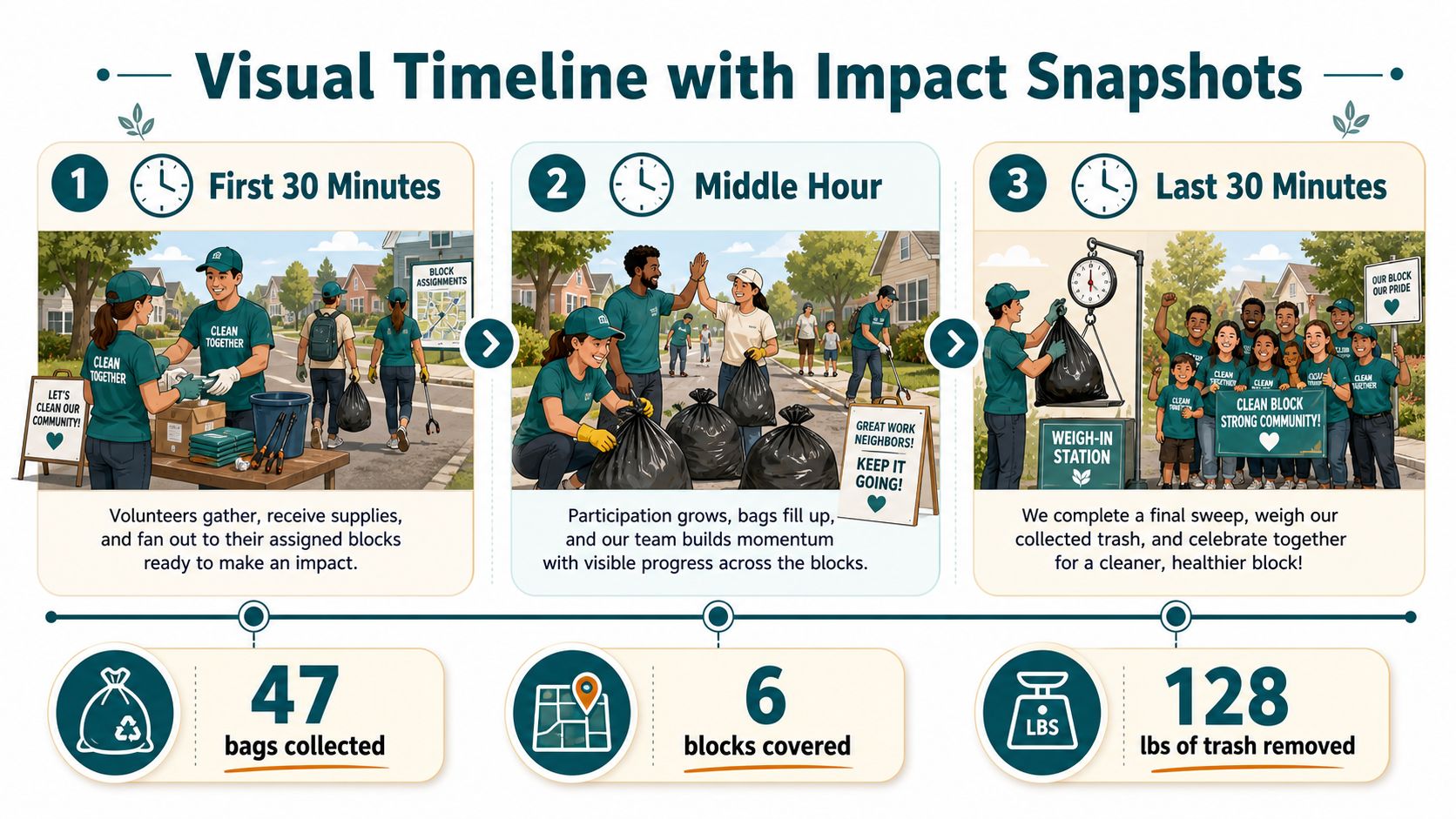
    3. Visual Timeline with Impact Snapshots

    A volunteer sees the first bag fill and realizes the block can change before lunch. A timeline lets someone feel that progression before arriving.

    Divide the flyer into clear stages. Use First 30 Minutes, Middle Hour, and Last 30 Minutes as visual anchors, then place a small photo or icon beside each stage. The first panel might show the team meeting, putting on gloves, and hearing the safety briefing. The middle panel might show volunteers sorting tasks, carrying bags, or logging litter. The final panel might show the cleared block and a team photo.

    Use actual photos from your own cleanups. A rainy-day beginning can lead into a row of full bags, then a bright group portrait. That sequence gives the reader a role in the story. They can see where they enter and what they'll do after they arrive.

    The timeline can also make room for different kinds of volunteers:

    • Trash pickup: Walk a defined area with gloves and a litter picker.
    • Data logging: Record what the group finds.
    • Traffic watch: Keep eyes on nearby movement and alert the team.
    • Photo support: Capture the work and the finished space.
    • Short-shift help: Join for one segment when a full event won't fit your schedule.

    Add small badges at the end of each segment if your group uses a badge system. A first badge might represent courage, another teamwork, and another a finished block. Keep the language honest. Say what volunteers did, rather than promising a dramatic result you can't document.

    The Great American Cleanup gives organizers a sense of the scale that a simple event can reach. In 2025, more than 60,000 community events took place in the United States, and participants cleaned more than 94,000 public spaces, according to Keep America Beautiful's Great American Cleanup details. Your flyer doesn't need giant numbers. It needs a visible sequence that makes the first step feel manageable.

    4. Community Map Highlighting Neighborhood Coverage

    A Chicago map can turn a flyer into a personal question: Do you see your block?

    Place the city map in the center, then mark the next cleanup with a bright color. Add the ward number and neighborhood name beside it. A legend should explain every symbol. One color can show completed areas, another can show upcoming events, and a third can invite people to suggest a new location. Keep the map readable. A dense outline with tiny labels will make people walk away.

    Litter Caterpillars can use this Northeastern Illinois map as a reference point for geographic communication, then build a Chicago version around its own events. The publisher describes a goal of cleaning across all 50 Chicago wards, so a map can show the next three scheduled cleanups while leaving room for neighbors to point toward another area.

    Add a recognizable landmark when it helps. A park, train station, school, or major intersection can answer the question people ask first: “Is this near me?” Use the meeting point in plain language underneath the map. A bright pin should never replace a street address.

    The map also works well for neighborhood-specific handouts. A flyer for one ward can show the current area in strong color, then use lighter marks for adjacent neighborhoods. That approach speaks to a resident who wants to help nearby without making the whole city feel abstract.

    Clean Up Australia's FY24 report records 1,077,127 registered volunteers at 16,320 cleanup sites, with about 2,154,254 hours contributed, according to its litter report. You don't need to copy that scale onto a local flyer. The useful lesson is simpler: show where people act, name the site, and give the next volunteer a clear place to join.

    A visual timeline infographic illustrating a successful community cleanup event with three stages and final impact results.

    5. Identity and Pride-Focused Design with Badges and Symbols

    A volunteer arrives wearing the same green shirt as someone they've never met. They spot the caterpillar logo, exchange a grin, and start filling bags together. Identity can make that first meeting less awkward.

    Build the flyer around a recognizable logo, mascot, color pair, or symbol. Litter Caterpillars can use its caterpillar transformation logo, green and orange colors, flags, theme songs, and badges. A group without a mascot can choose a simple neighborhood mark, an illustrated glove, or a symbol tied to the local park.

    Keep the visual system consistent across flyers, shirts, signs, and social posts. A person should recognize the group before reading every word. Use three to five badge designs only when the group can explain what each one means. Possible badges might represent a first cleanup, a new neighborhood, a safety role, or bringing a friend. Avoid making badges feel like a contest. Let them celebrate participation rather than rank people.

    Give the symbol a human story

    The logo can show the original three-person hailstorm, followed by a larger group holding flags. That image gives the flyer a beginning and a present-day invitation. A small music-note icon can point readers toward the group's theme song, if the song fits the event's tone.

    A pride-focused flyer still needs practical information. Place the identity artwork near the top, then reserve a clean section for date, meeting place, clothing, and safety. A beautiful badge won't tell someone whether they can bring a child, take a short shift, or avoid heavy lifting.

    Use language that welcomes newcomers:

    You don't need a uniform, a history with the group, or cleanup experience. Bring yourself, and we'll show you the first step.

    The design should make friendship visible without promising instant closeness. Show volunteers greeting each other, carrying bags side by side, or posing with flags after the work. Kindness, unity, and bravery can appear in the copy through specific actions. “We check on new volunteers before we start” feels more useful than a vague statement about values.

    6. Practical Details-First Template with Scannable Information Architecture

    A student finds your flyer outside a coffee shop. She has ten seconds before her bus arrives. She needs the date, place, time, and answer to one private question: “What do I need to bring?”

    Put logistics first. Use the largest type for When, Where, and How to Join. Divide the rest into short blocks:

    • When: Weekend morning, with the exact date and start time.
    • Where: Neighborhood, ward, meeting point, and a clear landmark.
    • What to wear: Closed-toe shoes, work clothes, gloves if the group asks volunteers to bring them, and weather-ready layers.
    • What we provide: Bags, litter pickers, briefing, and role choices when available.
    • Who you'll meet: Organizers, neighbors, first-time volunteers, and returning members.
    • How to join: QR code, Meetup, email, text, Instagram, or an open group chat.

    A QR code should lead directly to the signup page. Test it with more than one phone before printing. Put a short readable URL under it for anyone who prefers typing. For planning support, use volunteer event planning guidance from Litter Caterpillars, then adapt the wording to your actual event.

    Safety needs room on the page. Cleanup guidance says organizers should keep sites away from roadsides when possible, brief volunteers on local hazards, and provide gloves, high-visibility clothing, sensible footwear, and weather-appropriate clothing, as described in this community litter-picking safety guide. Another volunteer safety briefing says people should never use bare hands, should use litter pickers, and should leave weapons or medical waste for local officials.

    Add one friendly line: No experience needed. No donations asked. Just show up. Then check the print size with this marketing flyer size reference. A practical layout should help someone decide quickly, without forcing them to decode a crowded design.

    Community Cleanup Flyer Designs, 6-Point Comparison

    Template 🔄 Implementation complexity ⚡ Resource requirements 📊 Expected outcomes 💡 Ideal use cases ⭐ Key advantages
    Bold Call-to-Action Header with High-Contrast Colors Moderate, strong typography and color contrast skills required Low–Moderate, designer time, bold inks or bright digital assets; quick turnaround High visibility and immediate attention; fast responses from passersby High-traffic poles, bulletin boards, short-term recruitment drives Grabs attention from distance; very clear CTA; concise
    Story-Driven Personal Narrative Layout High, needs skilled writing and careful image selection Moderate, real photos or commissioned imagery and copy editing Strong emotional engagement and memory; attracts committed volunteers Recruiting committed volunteers, storytelling campaigns, newsletters Builds authenticity and belonging; filters for aligned volunteers
    Visual Timeline with Impact Snapshots Moderate, infographic/layout design with sequential flow Moderate, quality photos from events, metric collection, designer time Clear expectations and perceived progress; motivates repeat attendance Structured events, visual learners, recurring weekly cleanups Conveys concrete impact and satisfying progression
    Community Map Highlighting Neighborhood Coverage Moderate, map design and accurate geodata required Moderate, map assets, up-to-date location data, designer work Communicates scale and momentum; attracts geographically motivated helpers City-wide outreach, ward-based recruitment, expansion campaigns Shows organized reach and where help is needed; easy to update
    Identity and Pride-Focused Design with Badges and Symbols High, requires cohesive brand system and visual consistency High, logo/badge design, brand guidelines, possible merch production Strong retention and group identification; increased repeat participation Long-term community building, retention programs, brand-led events Creates pride/affiliation; differentiates group; encourages repeat turnout
    Practical Details-First Template with Scannable Information Architecture Low, straightforward hierarchy and clear sections Low, QR codes, clear type, basic layout; easy to update Reduces friction; quick decisions and higher sign-up conversions Coffee shops, community centers, posters where people need logistics fast Maximizes clarity and actionability; fast to scan and update

    Turn a Good Flyer Into a Show-Up Moment

    Choose one format that fits your group's real personality. A brave group may use the hailstorm story. A neighborhood network may need the map. A busy weekly cleanup may work best with the details-first layout. You can combine parts, too. Use the bold headline from the first format, the personal photo from the second, and the safety block from the sixth.

    Run a small print test before you cover every bulletin board. Ask someone who has never attended the cleanup to read the flyer from a distance. Ask them to find the meeting point, start time, clothing guidance, and signup link without help. Watch where their eyes go. If they miss the action, change the hierarchy.

    Check every date and location twice. Walk the route yourself. Confirm that the QR code opens the right page. If the event sits near traffic, rewrite the plan before you print. Road-cleanup guidance says volunteers should face oncoming traffic, wear high-visibility vests, work on one side at a time, and stay out of carriageways and restricted areas, as described in this community cleanup guide. A flyer should describe the conditions, not a safer version that exists only on paper.

    Place copies where volunteers already spend time. Try coffee shops, libraries, community centers, workplace boards, apartment entrances, and partner locations. Add a reminder online several days before the event, then ask a few people to invite someone directly. A Tunis neighborhood cleanup experiment found that flyer recruitment alone produced only 3% participation among initially recruited heads of household, and neighbor-to-neighbor pressure didn't meaningfully raise turnout, according to the study record. That result gives you a practical lesson: a flyer starts the conversation, while personal welcomes and reminders help people finish the decision.

    Your final print should feel like a handshake. Choose readable type and suitable stock, using this guide to paper choice for business flyers as a reference. Make the action easy, make the welcome clear, and give people a reason to show up together.


    Litter Caterpillars publishes Chicago cleanup events with a meeting time, an agenda, and a volunteer-first approach built around safety, friendship, and service. Visit Litter Caterpillars to find an event, see how the group organizes neighborhood cleanups, and join the next weekend morning.

  • How to Organize Volunteers for Cleanup Events

    How to Organize Volunteers for Cleanup Events

    The first Litter Caterpillars cleanup had three people, one borrowed truck, and trash bags that kept popping open in the rain. We huddled under a tree while Chicago threw hail at us, then went back to picking up cans.

    Three years later, we still meet every week, through heat, rain, blizzards, and the kind of wind that makes a trash grabber feel like a fishing rod. I've learned that how to organize volunteers has less to do with perfect plans and more to do with making the next Saturday easy to understand, safe to join, and worth remembering.

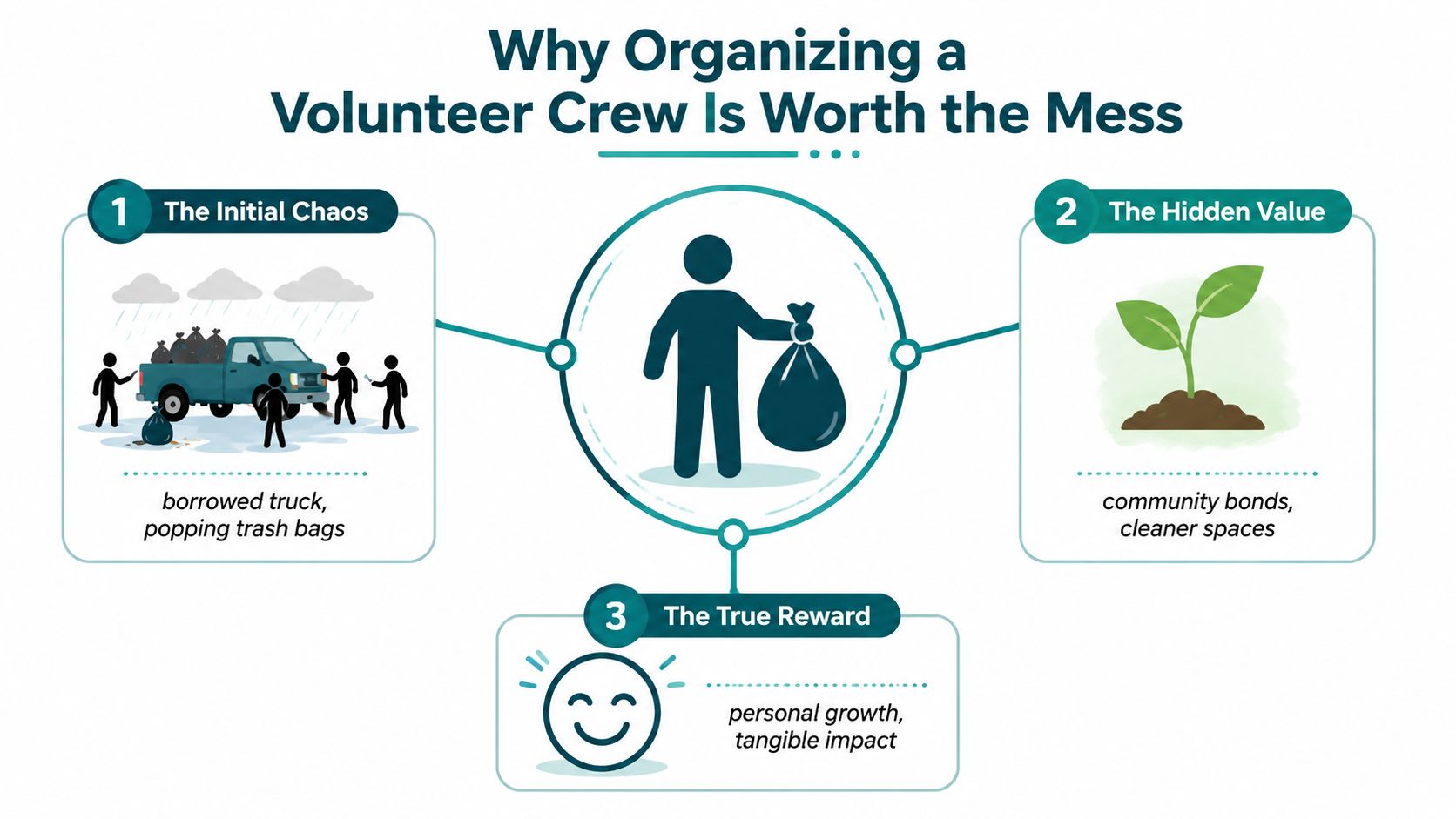
    Why Organizing a Volunteer Crew Is Worth the Mess

    That first pickup looked ridiculous. Water ran down the street, the truck bed filled with soggy bags, and every Uber seemed to cancel while we stood there shivering. Yet nobody wanted to leave empty-handed. We finished the block, loaded what we could, and took a photo that looked less like a nonprofit campaign and more like evidence from a minor weather disaster.

    That's the strange wealth a cleanup crew can build. You collect cleaner sidewalks, familiar faces, small jokes, and friendships that survive bad forecasts. You also get the quiet satisfaction of seeing a filthy stretch of Chicago become walkable again. The work stays physical and ordinary. That's exactly why people remember it.

    A recurring cleanup needs more structure than a casual “who wants to help?” message. A major 2023 volunteer-management survey found that 63% of nonprofits involving volunteers had a paid staff member or volunteer engagement professional managing volunteers, compared with 62% in 2003 and 65.2% in 2019. The median engagement professional spent 40% to 50% of their time on volunteer engagement in 2022, compared with about 30% in 2003. (The State of Volunteer Engagement)

    That doesn't mean you need a full-time coordinator for a Saturday cleanup. It means someone needs to own the details. A named person should know who signed up, where supplies are, what the weather looks like, and who can lead a new group.

    An infographic illustrating the challenges and rewards of organizing a volunteer trash cleanup crew.

    The mess teaches you what the spreadsheet misses

    You'll learn why vague meeting points create wandering volunteers. You'll learn why one experienced person can calm an entire first-timer group. You'll learn why a hot drink in November can matter more than a polished slogan.

    This field-tested playbook moves through the practical pieces:

    • Finding the first people: Where I post, what I say, and how I lower the ask.
    • Building one shift: Roles, time blocks, supplies, zones, and a clean ending.
    • Protecting the crew: Safety rules, waivers, emergency contacts, and incident notes.
    • Turning helpers into regulars: Onboarding, recognition, rituals, and shift leads.
    • Saving your evenings: Tools, templates, and a weekly rhythm that doesn't eat your life.

    If you want shirts, flags, or other identity pieces for a fundraiser, the 2026 nonprofit fundraising apparel guide from T-Shirt Envy can help you think through apparel without making it the center of the operation. Start with people, give them a clear job, and let the branding follow the friendships.

    Finding Your First Volunteers and Getting Them to Show Up

    Recruiting starts with a specific invitation. “Help clean Chicago” sounds noble, but it gives a stranger too many unanswered questions. Which neighborhood? What time? How long? Do I need equipment? Can I leave early?

    I use Meetup for the public event page, Instagram for photos and reach, and an open group chat for last-minute details. Litter Caterpillars also describes its approach to finding and coordinating participants through a Meetup page and group chat in its guide to finding volunteers.

    Give people a small first step

    My event copy usually names the exact place, the exact time, and the smallest reasonable commitment. You can adapt these examples:

    Meetup description

    Join us at McKinley Park near the fieldhouse on Saturday at 10 a.m. We'll clean the paths and nearby sidewalk for two hours. Bring water if you have it, and come for thirty minutes if that's all you can manage. We'll provide bags, grabbers, and gloves.

    Instagram caption

    Saturday cleanup at McKinley Park. Meet by the fieldhouse at 10 a.m. We're picking up litter, meeting neighbors, and heading home before lunch. Come for thirty minutes or stay for the full shift. First-timers are welcome.

    Neighborhood group-chat message

    Hey neighbors, I'm taking a small crew to clean the corner of 47th and Wolcott this Saturday at 9:30 a.m. We'll work for about two hours, but come for thirty minutes if you can. I'll bring bags and grabbers. Reply “in” and I'll send the meeting pin.

    Post early enough for people to see the invitation before their weekend fills up. Then send a direct reminder the day before. A reminder should repeat the meeting point, start time, expected duration, weather plan, and what you'll supply.

    The first event may feel like shouting into a canyon. Design the event so a small turnout can still finish a real patch of ground. One volunteer with a grabber can make a morning useful. Ten volunteers can make it lively.

    Screenshot from https://example.com/meetup-event-screenshot.png

    Invite by motivation, not by résumé

    People join for different reasons. One person wants a cleaner park. Another wants weekend friends. A student needs service hours. A newcomer wants to learn the city block by block. Your message should give each person a doorway.

    A 2025 volunteer-management survey identified role matching as a problem for 11.7% of organizations, alongside recruitment at 26.4% and retention at 9%. (Insight into Volunteering) I take that as a warning against one giant signup labeled “volunteer.” Write separate tasks instead: route scout, supply runner, photo helper, bag carrier, or zone captain.

    Designing One Cleanup Shift From Start to Finish

    A first-timer should know where to stand, what to carry, and when the work ends. If people need to decode the event while cars pass and bags blow down the sidewalk, you've already made the morning harder than it needs to be.

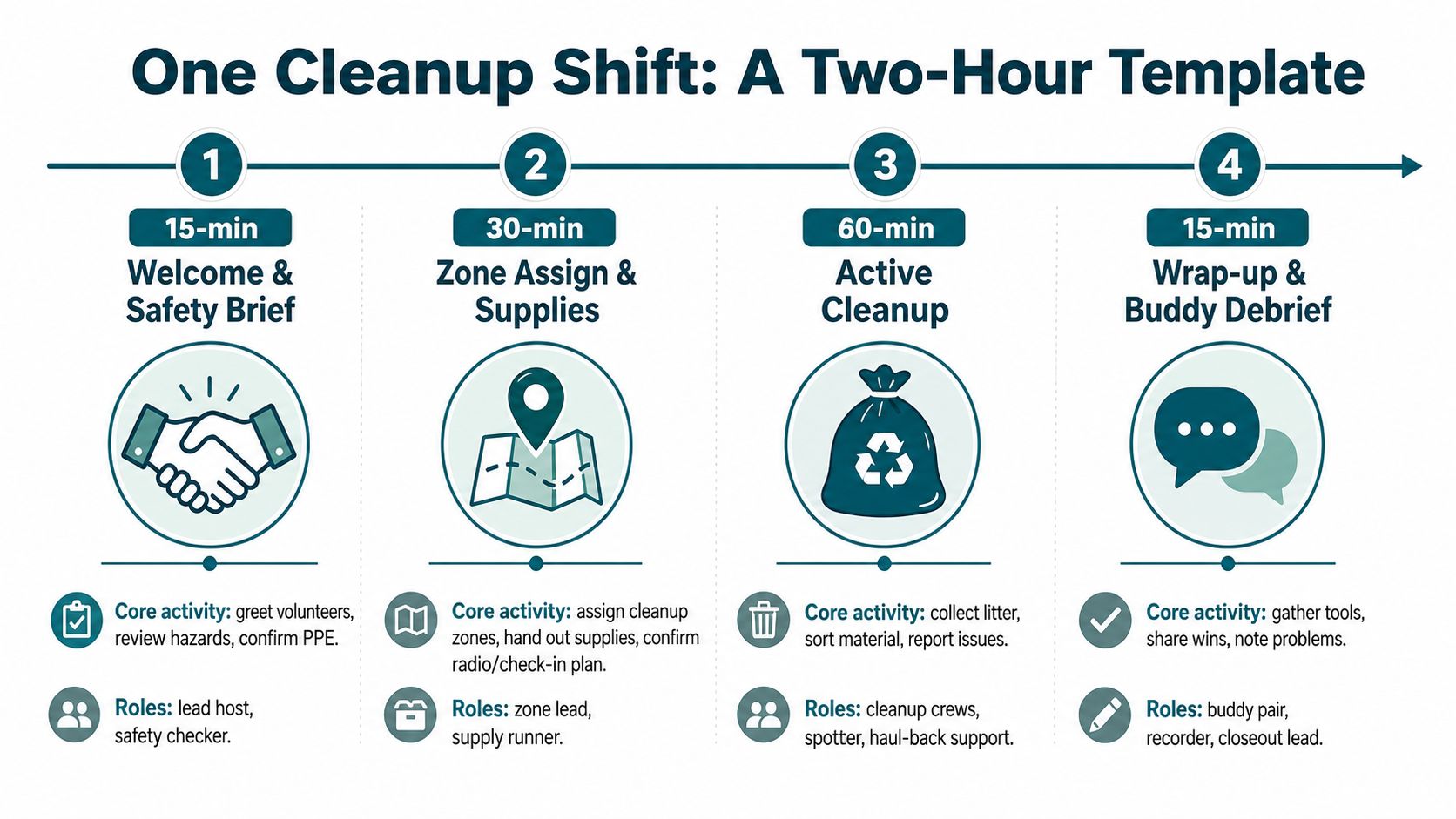
    I use a two-hour shape. It gives the shift a beginning, a middle, and a finish people can remember.

    An infographic titled One Cleanup Shift detailing a two-hour volunteer event schedule broken into four main phases.

    A simple two-hour template

    The exact breakdown can flex, but I plan the morning like this:

    1. 15 minutes for sign-in and safety: Welcome people, collect waivers, explain the route, point out the restrooms, and name the person handling questions.
    2. 75 minutes for pickup: Divide the area into assigned zones. Keep each group small enough for the captain to see everyone.
    3. 30 minutes for sorting and closing: Bring bags back, separate anything your local disposal plan requires, weigh bags if you track that, take a group photo, and finish with a cheer.

    A source on volunteer shifts recommends defining the task, location, and duration before anyone signs up. It also recommends immediate confirmation and reminders 48 to 72 hours before a shift, with day-of nudges for critical roles. (How to Schedule Volunteers) For a recurring crew, I split the schedule by area instead of dumping every assignment into one long list.

    Give every responsibility a name

    Keep the core crew roles to four:

    • Zone Captain: Explains the boundary, watches the group, and reports hazards.
    • Supply Chief: Carries bags, grabbers, gloves, sanitizer, water, and the sharps container.
    • Photo Lead: Takes the opening and closing photos, with permission from participants.
    • Waiver Wrangler: Checks forms, tracks attendance, and knows the emergency contact process.

    Here's my printable supply checklist:

    • Heavy-duty trash bags
    • Pickup grabbers
    • Work gloves in several sizes
    • Closed-toe footwear reminder
    • High-vis vests for roadside work
    • Sharps container
    • Hand sanitizer and wipes
    • Water and weather supplies
    • First-aid kit
    • Phone charger
    • Printed route map
    • Photo-release and emergency-contact records

    Draw the zone map like a child explaining a treasure hunt. Mark the meeting point with a star, the supply station with a square, and each boundary with a thick line. Write “return here” near the finish. Nobody should wonder whether the east side of the park belongs to them.

    The volunteer event planning guide can help you turn that outline into a repeatable event plan.

    Practical rule: Give people a clear job, a visible boundary, and a known ending. Confusion burns energy faster than trash pickup.

    Keeping the Crew Safe, Happy, and Protected From Liability

    Safety comes before fun, photos, and group identity. I'd rather have one untouched pile of litter than one volunteer walking away with an injury because I rushed the briefing.

    Start with rules people can understand without a legal dictionary. Closed-toe shoes stay on. Gloves stay on during pickup. High-vis vests go on near roads. Nobody reaches into a hidden pile. Nobody picks up needles, broken glass, or another sharp object by hand. The Zone Captain calls over the Supply Chief and uses the sharps container.

    A volunteer policy source says people should learn about foreseeable hazardous materials, equipment, and processes before they do the work. (Volunteer safety policy guidance) I explain the hazards before the first bag leaves the supply station.

    Build protection into the signup

    A short Google Form can collect:

    • Assumption of risk
    • Emergency contact
    • Photo release
    • Medical information the volunteer chooses to share
    • Agreement to follow the safety briefing
    • Permission to receive event updates

    Digital forms work better than a clipboard when rain turns paper into oatmeal. Keep the form readable, explain what volunteers should expect, and tell them how to ask questions before arrival. You can use these volunteer agreement templates from Closer Innovation Labs Corp. as a starting point, then ask a qualified professional to review language for your group and location.

    A cleanup group also needs a liability plan. You might arrange volunteer insurance, work with a sponsor nonprofit, or ask a local partner to review the activity before you invite the public. The Litter Caterpillars volunteer liability insurance guide gives organizers a place to begin that conversation.

    Make comfort part of safety

    Chicago weather doesn't care about your event calendar. I keep a stash of high-vis vests, watch heat and storms, and give people permission to stop. If someone feels unsafe stepping into the street, that person sits out. No debate, no guilt.

    In summer, shade matters. In November, hot cocoa can rescue the mood. At the end, I hold a short safety debrief and ask what felt unclear or risky. If an injury happens, I record it the same day with the date, location, people involved, what happened, and what action followed.

    Turning First-Timers Into Regulars Through Onboarding and Identity

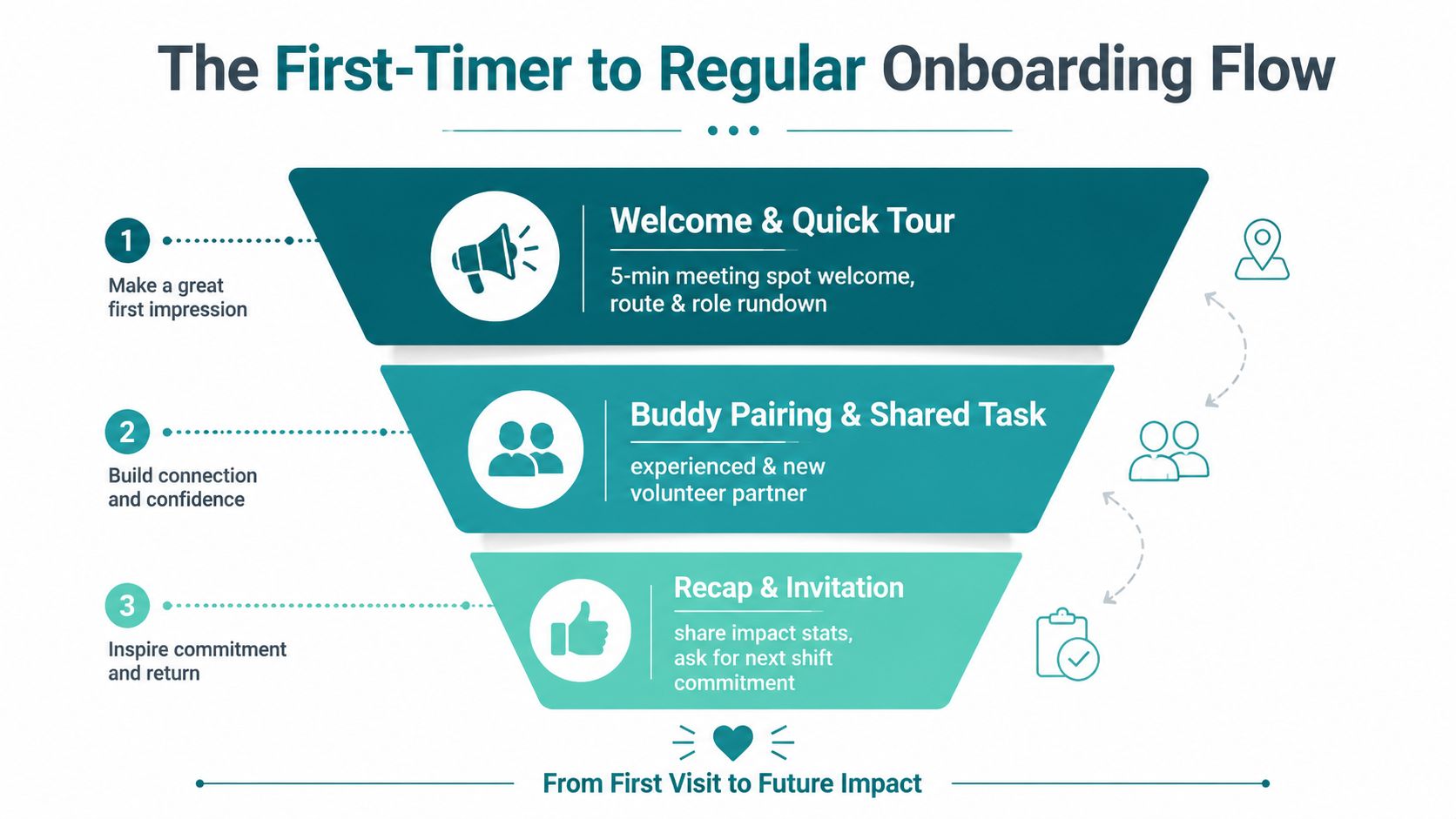
    The first shift decides whether someone sees your cleanup as a friendly invitation or a confusing errand. I try to make the first five minutes feel like entering a small club with the doors already open.

    I greet the new person by name, point out the meeting spot, explain the route, and give them one job they can finish quickly. Then I pair them with someone who has done a cleanup before. A new volunteer shouldn't spend the morning guessing which bag to use or wondering whether the group will notice if they fall behind.

    A systematic review and meta-analysis connected volunteer turnover with job satisfaction, affective commitment, engagement, organizational commitment, communication, organizational support, and leader-member relationships. (Volunteer turnover meta-analysis) A separate study found that appropriate training increased the odds of a volunteer becoming an organizational promoter by more than eight times, with an odds ratio of 8.457, in its original survey data. (Volunteer training and promotion study) I read that plainly: teach people what to do, answer them quickly, and let them feel useful.

    A three-step funnel infographic explaining the onboarding process for new volunteers to become regular contributors.

    Give the crew a vocabulary

    Names create memory. We have regulars, Zone Captains, the supply stash, the traveling flag, and the final cheer. A signature flag moves from park to park. A goofy theme song comes out of a Bluetooth speaker when the crew needs a lift. Stickers or photo badges can recognize five, ten, or twenty-five events.

    Recognition works because people want to know that someone noticed. A UK national volunteer-retention survey found that 80% of volunteers said they were likely to continue with their main organization over the next twelve months, while 53% said they were very likely. Attachment to the organization reached 52%, attachment to the cause reached 49%, and changing circumstances ranked as the most common reason for leaving at 33%. (Volunteer retention survey)

    That's why I'd choose a monthly Instagram shoutout, a Crew Member of the Month post, or a tiny trophy before I'd spend the whole budget on free pizza. Food is nice. Being known lasts longer.

    At the end of each shift, we form a recap circle. Each person shares one strange thing they found. Someone finds a garden gnome head. Someone else finds a receipt from a restaurant that closed years ago. The stories turn a pile of trash into a shared morning.

    Here's the handoff that keeps the founder from becoming a permanent bottleneck:

    1. Ask a reliable volunteer to lead one zone.
    2. Give that person the map, safety notes, contact list, and supply checklist.
    3. Let them run the briefing while you watch.
    4. Debrief privately afterward.
    5. Invite them to lead the next shift.

    A recent study found that experienced volunteers on a shift increased new volunteer retention by 52%, and by 125% for group volunteers. (Volunteer experience and retention study) Pairing people does more than make the work smoother. It gives a first-timer a human reason to return.

    Tools, Templates, and Weekly Rhythms That Save Your Sanity

    I don't need a complicated volunteer-management system for a Saturday cleanup. I need a few tools that each do one job and don't make me hunt through six apps for a phone number.

    • Meetup: Public event page, RSVPs, meeting details, and first-time discovery.
    • Instagram: Photos, volunteer stories, reminders, and repostable updates.
    • WhatsApp or GroupMe: Day-of logistics, weather calls, directions, and quick questions.
    • Google Forms: Waivers, emergency contacts, attendance, and post-event feedback.
    • Shared calendar: Recurring events, supply reminders, and leader assignments.

    The schedule below protects my Tuesday evening because I don't rebuild the event from scratch each week.

    Day Core Task Tool Used
    Sunday night Post the next cleanup Meetup and Instagram
    Tuesday Send an RSVP reminder Meetup and group chat
    Thursday Check the forecast and route Weather app and shared calendar
    Friday Confirm headcount and leaders Group chat and Google Forms
    Saturday morning Run the cleanup Printed map and supply checklist
    Sunday Post photos and thank-yous Instagram and group chat

    Keep four templates ready

    RSVP confirmation

    You're on the list for Saturday at [time] near [meeting spot]. We'll work for [duration]. I'll bring bags, grabbers, and gloves. Please wear closed-toe shoes. Reply here if you need directions or can't make it.

    Waiver form

    I understand the cleanup may include walking near roads, lifting bags, uneven ground, and contact with discarded materials. I'll follow the safety briefing, ask for help, and report hazards immediately. Emergency contact: [name and phone]. Photo preference: [choice].

    Shift-leader handoff

    Route: [area]. Meeting point: [location]. Supply location: [location]. Zone boundaries: [description]. Volunteers assigned: [names]. Weather plan: [plan]. Incident contact: [name and phone]. Closing task: [task].

    Recap post

    Today we cleaned [place] with [crew description]. We found [odd item], met [community detail], and left the route ready for the next walkers. Thanks to everyone who showed up. Next cleanup: [date, time, place].

    Set the event to repeat on your calendar. Save a weather-cancellation message. Keep one shared checklist for bags, gloves, grabbers, vests, water, first aid, and the sharps container. Your future self will thank you while drinking coffee instead of rebuilding a spreadsheet at midnight.

    Showing Up Is the Whole Point

    I used to think a successful cleanup needed a big crowd and a perfect result. Chicago corrected me. One volunteer, one Saturday, and one filled trash bag can start a habit that lasts longer than a grand plan sitting in a draft folder.

    The people matter more than the pound count. A first-timer who learns a neighbor's name may return next week. A regular who becomes a Zone Captain may bring someone who never would have come alone. A person who shows up in the rain learns that service can feel like a real part of life, not an item waiting for a convenient day.

    Build the smallest event you can repeat. Name the meeting spot. Bring enough gear. Give everyone a buddy. End with a cheer, a photo, or one ridiculous story from the sidewalk.

    My mantra is simple: make Saturday easy to join, useful to finish, and warm enough to remember.

    Post your next cleanup before the weekend ends. Choose one Chicago block, invite your group chat, and ask people to come for thirty minutes. Then show up, even if the forecast looks rude.


    Litter Caterpillars organizes weekly Chicago trash pickups where volunteers meet, learn the route, share gear, and clean together across the city's neighborhoods. If you want a practical place to start building your own crew, visit Litter Caterpillars, find an upcoming cleanup, and come see how a clear plan turns strangers into Saturday regulars.

  • How to Stay Committed When Motivation Fades

    How to Stay Committed When Motivation Fades

    The first time three of us picked up trash together, a Chicago hailstorm trapped us under a tree while every Uber canceled. We were cold, annoyed, and laughing anyway. Three years later, we still meet every weekend, because I learned that staying committed has less to do with feeling motivated and more to do with designing a life where showing up feels possible.

    The Hailstorm That Changed Everything

    The hail hit hard enough to sting my face. We had planned a simple cleanup, yet the weather turned the morning into a small survival story. Three of us crouched under a tree, watching canceled ride requests pile up on our phones, while trash waited along the street.

    I had started Litter Caterpillars because I struggled to clean and organize my own life. A piece of litter felt strangely heavy, even when it weighed almost nothing. Cleaning someone else's mess felt easier. Doing it with friends felt unexpectedly fun. The hail added a little flavor, the kind that makes an ordinary morning memorable.

    That morning changed my idea of commitment. I used to think I needed motivation first, followed by action. The order works the other way around. I took action, shared the discomfort with other people, and built a story I wanted to keep living.

    My rule: Make the next showing-up decision easier than the quitting decision.

    For three years, our group has picked up trash every week through rain, snow, bitter wind, and hot days. We meet on weekend mornings because the time filters out many distractions and attracts people who want to give their time. We use group chats, social meetups, flags, badges, and a theme song to make service feel social and recognizable.

    That doesn't mean I always feel ready. Some mornings, I want to stay in bed. Sometimes I look at the forecast and wonder why I'm doing this. Then I remember that bravery doesn't require comfort. It requires a small action that matches the person I want to become.

    You can apply the same idea to almost anything. If you want to write, prepare the desk before you need it. If you want to exercise, choose a place and time that remove decisions. If you want to volunteer, find a group with a regular schedule and a culture that respects your limits. You can read more about the service mindset behind our work in Care for Real.

    Commitment grows when your surroundings support it. Give yourself a cue, a place, a person, and a reason to return.

    Why Habits Take Longer Than You Think

    Two weeks into a new routine, the excitement has usually faded. The shoes remain by the door, the notebook stays open, or the volunteer reminder appears on your phone, yet showing up still feels like a decision. Commitment grows through a designed experience that makes returning familiar and manageable.

    The popular 21-day habit idea makes early difficulty feel like failure. Research offers a slower, more forgiving timeline. Phillippa Lally and colleagues reported in a 2010 study that a new daily behavior took 66 days on average to reach peak automaticity, while individual participants ranged from 18 to 254 days. The University of Surrey's explanation of the 66-day habit research provides background on those findings.

    An infographic showing that forming a new habit takes an average of 66 days, not 21.

    A 2024 systematic review and meta-analysis examined 20 studies with 2,601 participants. It found median habit-formation times between 59 and 66 days, while mean times ranged from 106 to 154 days, with some behaviors taking as long as 335 days. A routine can need months before it feels nearly automatic.

    A slower timeline gives you room

    Those findings point toward repeated practice, not passive waiting. Two difficult weeks often mark the beginning of the learning period. The routine still requires attention because the cue, action, and reward have not settled into place.

    Saturday cleanups benefit from a recognizable setting. A weekend-morning schedule, meeting point, bags, gloves, group chat, and identity badges reduce fresh decisions each time. The same activity returns in the same social context, and the visible result, a cleaner block, gives the effort a clear reward.

    Give repetition a place on your calendar

    Reserve a stable block for the behavior before the week fills up. Using blocks of time for focus can turn an intention into a calendar appointment rather than a choice controlled by your mood.

    For a first cycle, choose a manageable 6-8 week block and measure attendance instead of performance. Repeat the smallest useful version, then let your identity catch up with your actions. A regular cue and setting can support intrinsic motivation, giving you an internal reason to return when enthusiasm is absent.

    Building Your If-Then Commitment Protocol

    At 7:45 on a rainy Saturday, I have stood by the park entrance wondering whether anyone else would show up. A promise like “I'll volunteer more” offers no answer about the morning's decisions. The problem with vague promises is that they leave when, where, and how open at the moment you most need a plan.

    An if-then rule closes those gaps. You name the situation, then pair it with an exact response. Research on 94 independent tests found a medium-to-large effect on goal attainment, d = 0.65, including starting tasks, resisting distractions, and leaving plans that no longer work. The research on implementation intentions explains how an anticipated cue can prompt a prepared action with less internal debate.

    A diagram outlining a three-step commitment protocol for achieving goals using a clear trigger, location, and action.

    Write the three parts

    Use a specific cue, place, and action:

    1. When: Name the situation. “If it's Saturday at 8 a.m.”
    2. Where: Identify the location. “At the park entrance.”
    3. How: State the behavior. “I'll put on my cleanup gloves and join the group for the first task.”

    My version reads: If it's Saturday at 8 a.m., then I'll meet my group at the park entrance, put on my gloves, and start with one bag of litter.

    The same structure works beyond volunteering:

    • Writing: If I finish breakfast, then I'll sit at my desk and write one paragraph.
    • Fitness: If I leave work, then I'll go directly to the gym and change before checking my phone.
    • Study: If I sit on the train, then I'll open my course notes and review one section.

    Specificity does the work. “Later” cannot start a routine. A named time and place can point you toward the first action.

    Write the rule before the difficult moment arrives.

    Put it on the fridge, in your calendar, or in a phone reminder. Then decide what happens when the plan meets resistance. If heavy rain cancels the cleanup, choose in advance whether you will reschedule, complete a smaller indoor task, or return the following week without guilt.

    An if-then plan cannot prevent every problem. It removes the argument that usually delays the first step.

    Designing Your Commitment System

    Three years of weekend cleanups taught me a humbling lesson. On rainy mornings, after poor sleep, or during a stressful week, I have wanted to stay home. The group still met because we designed the experience to carry us through those moods. Our system rests on three parts: a dependable schedule, a welcoming environment, and visible signs of belonging.

    A diagram illustrating a commitment system framework with scheduling tactics, design choices, and accountability mechanisms.

    Start with the calendar

    We chose a weekend-morning slot, before errands and family plans crowded the day. New volunteers could see exactly when to find us, without waiting for a special campaign or a burst of enthusiasm. After three years, that recurring appointment still does much of the remembering for us.

    Pick a time that fits your actual life. Put it on the calendar, prepare equipment early, and make the first version manageable on a difficult day. A six-to-eight-week block can also make the commitment feel defined. You are agreeing to a clear stretch of sessions, rather than making an indefinite promise.

    Add people who notice your absence

    Our group chat handles practical details, from questions about meeting points to plans for the next cleanup. It also gives someone permission to ask, “Are you still coming?” A partner can provide the same support for a personal goal. The useful response is curiosity and honesty, not shame.

    A short weekly check-in creates room to adjust. We name what worked, identify the source of friction, and change the setup before frustration becomes disappearance.

    Give the behavior a visible identity

    Flags, badges, and a theme song turned attendance into something people could recognize and share. A badge on a backpack, a marked calendar, or a shared playlist makes the habit part of daily life. It reminds us that we belong to a group with a real practice, even on mornings when motivation is thin.

    Our volunteer-first approach protects that experience. Safety comes before output, and enjoyment comes before pressure. People are more willing to return when they feel respected, effective, connected, and able to manage the time involved. NCVO's volunteer-retention research discusses these conditions, including enjoyment, belonging, trust, feeling effective, and manageable time demands, in its findings on volunteer retention.

    Build the same structure around your goal. Schedule the action, prepare the setting, invite accountability, and choose one identity marker. Familiarity, social contact, and a clear time limit can make consistency easier to repeat.

    What to Do When You Fall Off Track

    You will miss a week. You may miss two. That lapse doesn't erase the work you already did, and it doesn't require a dramatic return.

    Volunteer retention research gives a more practical explanation for absence. People stop when their circumstances change, their health interferes, or they feel they've already done enough. Those reasons call for pacing and re-entry, not a lecture about willpower.

    Build the return before you need it

    Create a re-entry rule while things are going well:

    • After a missed session: Return at the next regular meeting instead of inventing a perfect restart date.
    • During a difficult week: Attend for a shorter period or take a lighter task.
    • After illness or injury: Ask what safe participation looks like, and wait when participation isn't safe.
    • When interest fades: Talk with a partner about changing the task, location, or social format.

    A fixed cue helps you find your way back. Research on habit formation describes repetition in the same context as a central part of building automatic behavior. A regular time and place keep the cue familiar, even when a gap interrupts the routine. A field experiment on recycling found improvement during the first two weeks, and the behavior remained consistent at a two-month follow-up. The recycling field experiment gives you a useful model for early practice followed by continued repetition.

    Treat a lapse as information

    Ask what blocked you. Did the time conflict with family needs? Did the task feel too hard? Did you lack a ride, equipment, or a person expecting you? The answer points toward a design change.

    You can also use a practical guide to overcoming procrastination when delay becomes the pattern. Come back without making an apology tour. The next action can be small, ordinary, and scheduled.

    A missed session is a data point. Your return is the practice.

    Commitment means binding yourself to future behavior, yet a binding can include humane terms. Leave room for health, changing responsibilities, and honest reassessment. A plan that lets you step back can keep you from walking away permanently.

    Your 12-Week Commitment Plan

    I use a 12-week plan because it gives a new routine enough room to pass through excitement, boredom, friction, and adjustment. Real-world habit-building data found 6 to 8 week commitments, weekly reporting to an external referee, and monetary stakes among the most successful structures examined in that research on habit-building commitments. You don't need money to use the same structure. You can use a friend, group chat, or volunteer coordinator as your referee.

    A 12-week commitment plan infographic illustrating phases for building habits, consistency, and long-term success.

    Weeks 1 and 2, learn the route

    Show up and learn the routine. Don't measure yourself by bags collected, pages written, miles run, or any other performance result. Your milestone is simple: you know where to go, what to bring, and how to begin.

    Ask yourself, “What made starting easier, and what created friction?” Write the answer after each attempt. Change one practical detail, such as packing supplies the night before or placing your shoes beside the door.

    Weeks 3 and 4, add a witness

    Choose one accountability person. Send a short weekly message with three details: whether you showed up, what got in the way, and what you'll do next.

    Refine your if-then rule from the evidence you gathered. If your original cue fails, replace it with a cue you encounter reliably. Your milestone is a plan that describes the actual version of your week, not the imaginary version.

    Weeks 5 through 8, protect the middle

    Novelty fades. Keep the task small enough to survive a difficult morning, and let your group carry some of the social energy. Celebrate concrete wins, like arriving on time, completing one manageable task, or returning after a missed week.

    Ask, “What can I reduce without abandoning the goal?” Shorten the session, simplify the equipment, or choose a lighter role. Keep the appointment alive while you adjust the workload.

    Weeks 9 through 12, decide with evidence

    Look at your notes. Do you feel connected to the activity? Does the schedule fit? Does the group or setting help you feel effective? Are the costs to your health, time, or relationships reasonable?

    Your final milestone isn't automatic perfection. It's an honest decision to continue, change the format, or stop and choose a better goal. If you continue, renew the next block before the current one ends. If you pivot, carry the lessons into the next commitment rather than treating the experiment as wasted effort.

    Print the plan. Put the first appointment on your calendar. Then tell one person exactly when and where you'll begin.


    Litter Caterpillars meets on weekend mornings for volunteer trash pickups, with group chats and social meetups that help people find the routine and meet neighbors. Visit Litter Caterpillars to choose a cleanup, write your if-then rule, and take the first small step toward a commitment you can repeat.

  • 7 Student Volunteer Opportunities Near Me in Chicago

    7 Student Volunteer Opportunities Near Me in Chicago

    You've got a free Saturday morning, but it isn't wide open. Maybe you can spare two hours before work. Maybe your club wants a structured indoor shift. Maybe you're ready for a full-day project that teaches you something practical. You search student volunteer opportunities near me, then face a wall of listings that all sound alike.

    The right choice depends on more than the cause. Your age, neighborhood, transit route, physical comfort, weather tolerance, waiver requirements, and preferred social setting all matter. A cleanup crew can give you fresh air and new friends. A food bank can give you an organized indoor shift. A build site can give you teamwork and hands-on skills.

    This Chicago guide organizes seven options by the kind of service day you can fit into your schedule. You'll find weekend cleanups, beach work, river restoration, park stewardship, food support, neighborhood projects, and Habitat for Humanity Chicago roles. You'll also get practical notes on sign-up steps, transportation, safety, accessibility, service-hour records, and bringing a friend.

    If you're curious about safety skills for outdoor work, you can also compare local wilderness first aid training near me. For now, start with the option that matches the Saturday you really have, not the ideal schedule you wish you had.

    1. Litter Caterpillars

    A student can finish a weekend cleanup before the rest of Saturday begins. Arrive with gloves and sturdy shoes, meet the group at a marked corner, then follow volunteers along a block as they pull bottles from weeds, lift bags from sidewalks, and clear litter from places people have stopped noticing. By the end, the route looks easier to walk.

    That is the Litter Caterpillars experience. Founded by Kevin Tao, this Chicago volunteer group organizes recurring trash pickups across the city, including areas other groups may avoid. The group has cleaned all 50 wards and won an empty lot at auction to create Caterpillar Park in Englewood, according to its official story and mission.

    Joining takes only a few checks. Find an upcoming event through Litter Caterpillars on Meetup or follow Litter Caterpillars on Instagram. Read the meeting point, time, and task details, then arrive ready for outdoor work. Open group chats keep volunteers connected between cleanups. Flags, badges, and a theme song give the morning a shared rhythm. You pick up bottles from weeds while swapping stories and learning names, a surprisingly social morning.

    Litter Caterpillars

    A good fit for a short social morning

    Weekend mornings suit students balancing classes, jobs, commutes, and club obligations. You can test one shift before committing to a regular schedule, notice how your body handles the work, and return with a friend if the format fits.

    Outdoor labor brings real tradeoffs. Rain, cold, snow, heat, uneven ground, sharp objects, and heavy bags may shape the day. Wear clothes you can move in, protect your hands, and bring water. Ask organizers about the meeting point, expected tasks, restroom access, walking distance, and any accommodation you may need before attending.

    Practical rule: Choose Litter Caterpillars when you want hands-on work, a friendly group, and a service routine that begins with one manageable weekend morning.

    The volunteer-first approach keeps participation free and avoids pressure to donate. For a student building a service record, save the event details and ask an organizer how to confirm your hours. A quick note after the shift can also help you remember the date, location, tasks, and skills you practiced.

    Weekend cleanup is physical and sometimes messy. It is also a clear way to meet people, improve a familiar block, and see the result before you leave. Check the next listing on Meetup or Instagram, confirm what to bring, and choose a route you can reach safely by transit or with a friend.

    2. Alliance for the Great Lakes Adopt-a-Beach

    A beach cleanup gives you a clear before-and-after task. You walk a section of Lake Michigan shoreline, collect litter, sort what you find, and record the results. The lake supplies the scenery, but the work stays concrete. A wrapper caught in beach grass becomes a piece of evidence you can log instead of leaving behind.

    The Alliance for the Great Lakes runs Adopt-a-Beach cleanups on Lake Michigan and throughout the Great Lakes. You can join a public cleanup or register a team through the Adopt-a-Beach volunteer page. Students can also connect the work to school projects through the free K–12 Great Lakes in My World curriculum.

    This option works especially well for a class, environmental club, or group of friends that wants a shared assignment. The litter audit gives everyone a job. One person collects, another records, and another helps sort or carry supplies. You leave with a cleaner shoreline and organized observations that advocates and agencies can use in regional work.

    Plan around the shoreline

    Most activity takes place in the warmer parts of the year, and weather can change the experience quickly. Wind, sun, damp sand, and uneven ground may challenge students with mobility limitations or health concerns. Contact the event leader before registering if you need a specific surface, restroom access, seating, shorter walking distance, or another accommodation.

    You can join an existing event for a simpler first experience. If you lead a team, you'll need to create an online account, collect waivers, and follow the organizer guidance. That extra setup makes sense for a school group, but it can feel like too much for a student looking for a spontaneous Saturday shift.

    • Best for a club: Use the team format when you want shared transportation and a clear group task.
    • Best for a solo student: Pick a public cleanup with a meeting point near your train or bus route.
    • Best for a class project: Pair the litter audit with the Great Lakes curriculum and a short reflection.

    The Alliance for the Great Lakes gives students a way to connect outdoor service with observation and civic action. Choose it when you want a lakeshore morning, can handle weather exposure, and prefer a cleanup with a defined recording process.

    3. Friends of the Chicago River Cleanups and Habitat Restoration

    A student with one free Saturday might start by filling trash bags along a riverbank. On a different shift, the same student could pull invasive plants, work with soil, or care for a natural area beside the water. Friends of the Chicago River offers both litter removal and habitat restoration, giving students a choice based on the kind of service day they can handle.

    The organization runs the large Chicago River Day and recurring site-based workdays throughout the watershed. Its volunteer information covers event logistics, what to bring, age policies, and family-friendly rules for major events. Many sites suit school groups, and several are reachable by public transit.

    Students looking for environmental work that goes beyond collecting litter will find both litter removal and habitat restoration on different shifts. Litter removal gives you a clear, visible result. Habitat work may require careful movement around plants, soil, and river-edge areas. Ask about the assignment before registering if you have a physical limitation, dislike bending or kneeling, or need a lower-impact role.

    Choose the event, then check the details

    Chicago River Day can bring a large volunteer turnout. Other workdays vary by site and date. A major event may feel lively and easy to join with friends, while a smaller site day can offer closer guidance from the site leader.

    Before you sign up, confirm:

    • Age rules: Some restoration tasks may limit participation by age or require extra safety steps.
    • Meeting point: River sites are spread across the city, so map the route before event morning.
    • Supplies: Check what the organizer provides and what you should bring.
    • Accessibility: Ask about paths, terrain, restrooms, and the distance from transit.

    For another Chicago cleanup perspective, read this guide to Chicago River cleanup work from Litter Caterpillars. The guide can help you compare a scheduled river event with a grassroots trash-pickup morning, including the practical demands of weekend cleanup work.

    Friends of the Chicago River fits students who can adjust to changing dates and assignments. Choose a shift that matches your route, mobility needs, and available time, then invite a classmate or club member to make the morning more social. Each completed shift also gives you a specific service example to describe on a resume.

    4. Chicago Park District Community Stewardship and One-Day Park Cleanups

    You check your neighborhood park, find a Saturday shift, and show up without needing prior experience. By the end of the morning, you may have removed litter, pulled invasive plants, cared for a natural area, or helped prepare a shared outdoor space for its next visitors.

    The Chicago Park District runs public stewardship days and one-day cleanups across city neighborhoods. Its volunteer page lists opportunities connected to parks and natural areas, along with citywide events including Earth Day and It's Your Park Day. Students, families, clubs, and school groups can find a practical entry point because the program supports many locations and group sign-ups.

    Location is the main advantage. A nearby park can turn volunteering into a realistic habit instead of a rare event that consumes half your day in transit. Search by park, compare the start time with your class or work schedule, and ask a club leader to register the group if you want to attend together.

    Chicago Park District Community Stewardship and One-Day Park Cleanups

    Start simple, then consider ongoing roles

    Public stewardship days can suit a first-time volunteer because you don't need specialized experience. Ongoing or indoor positions may involve applications or background checks, so read the role description before assuming every shift works as a drop-in activity.

    Weather also shapes the day. Wear layers, bring water, and check whether the event will continue in rain or extreme temperatures. If you use a wheelchair, cane, or other mobility aid, ask about the trail surface, grass conditions, slope, restroom access, and the distance between the transit stop and the work area.

    A short park cleanup can also help you build a service record. Ask the event leader how the organization verifies hours, then save confirmation emails and record the date, location, and task in your own notes.

    If you want to compare park work with a grassroots crew, read Litter Caterpillars' Chicago park cleanup guide. The Park District is a practical choice when proximity matters most and you want many neighborhood dates to choose from.

    5. Greater Chicago Food Depository Warehouse and Community Food Support

    A student arrives after class, steps into a warehouse, and takes a place beside a table of food supplies. A supervisor explains the station, teammates sort items, and packed boxes begin stacking nearby. For students who prefer indoor work, this setting offers a clear task and visible progress.

    The Greater Chicago Food Depository provides sorting, repacking, and community distribution roles. Its volunteer information explains age pathways for family shifts, supervised youth participation, and independent volunteers who meet the listed requirements. Structured shifts can suit classes, clubs, and student groups, provided everyone meets the stated conditions.

    A food bank shift follows a different rhythm from a cleanup. You might stand at a station, move items, inspect packaging, fill boxes, or prepare food for distribution. Repetition gives the group a steady pace. You know what to do, questions have a natural place, and the finished packages beside you show what the team completed.

    Match the shift to your group

    Read the age rules before inviting younger students. The Depository outlines separate pathways for families, youth, and independent volunteers, while individual shifts may add their own conditions. A teacher, parent, or club leader should confirm supervision and waivers before the group travels.

    Transit can shape the choice. Depending on where you live, the trip may involve a long bus or train ride, transfers, delays, and a walk from the stop. Build that travel time into the plan. If you need seated work, lower lifting demands, or another accommodation, contact the volunteer team before registering.

    • For a class: Ask about group availability and choose a shift everyone can reach.
    • For a first-timer: Select a structured role with clear instructions.
    • For service hours: Confirm how attendance and hours are recorded.

    Weekend work may leave students tired, especially after standing or lifting, so check the task description and plan clothing and transportation accordingly. The shift can still give classmates a simple way to work side by side and start a conversation with people outside their usual circle.

    Read Litter Caterpillars' Chicago food bank volunteer guide to compare warehouse service with outdoor cleanup work. Choose the Greater Chicago Food Depository for a predictable indoor setting and hands-on support for food distribution in the Chicago area.

    6. My Block, My Hood, My City

    A student group meets near an alley or vacant lot on Chicago's South or West Side. The work starts with gloves, bags, and a short explanation of the block's needs. The group clears litter, improves the space, and leaves knowing exactly which neighborhood received the effort.

    My Block, My Hood, My City connects volunteers with neighborhood cleanups, seasonal projects, supply distributions, and youth-focused community events. The organization coordinates with 100+ block clubs, according to its official volunteer and community information. Current opportunities appear through the website and Linktree, so you should check the latest listing before making plans.

    This option fits students who want place-based service. You aren't choosing an abstract project. You're working in a specific area with resident-led partners and a local task. That can make a short shift feel direct and easy to explain to a club, teacher, or family member.

    Confirm the details before you travel

    Some events appear on short notice, and age rules vary by task. Minors may need a parent or guardian, a waiver, or additional supervision. Read the event listing carefully, then contact the organizer if the wording leaves room for doubt.

    Transit planning matters here because the best opportunity may sit outside your own neighborhood. Share the meeting point with your group, plan a return route, and use a buddy system. Ask about restroom access, terrain, lifting, and the expected walking distance if you need accommodations.

    The organization suits students who want a short, energetic service day with a clear neighborhood connection. It can also work well for a student club that wants to choose a project together rather than assign everyone to separate roles. Check the current event posts, confirm the requirements, and bring enough water for the expected outdoor work.

    7. Habitat for Humanity Chicago Build Sites and ReStore Volunteering

    A supervisor walks you through tool safety, your team splits into stations, and by noon you may already have helped raise a wall frame. The work shows how many coordinated tasks turn an unfinished site into a home.

    Habitat for Humanity Chicago offers two service paths. Build-site roles center on construction and supervised hands-on work. ReStore shifts involve retail tasks, warehouse organization, and sorting donated materials. Review current openings on Habitat for Humanity Chicago's individual volunteer page.

    Build sites suit students who want teamwork, practical skills, and visible neighborhood work. They usually require more time and physical energy than a short cleanup. The plan notes identify construction roles as commonly limited to people 18 and older, while minors often find opportunities through ReStore. Check the current age rule on the specific role page before signing up.

    Pick the right Habitat path

    ReStore may fit younger students, indoor-work preferences, or schedules that cannot accommodate a full construction day. Most build-site roles provide on-site training and supervision, but you still need to be comfortable lifting, kneeling, standing for several hours, and working around tools or unfinished surfaces. Closed-toe shoes are required, and some shifts take place outdoors.

    Before choosing a shift, ask:

    • Age and supervision: Does the role accept your age group, and must an adult attend?
    • Schedule: Can you remain for the complete shift?
    • Physical demands: Will you lift, climb, kneel, stand, or work outdoors?
    • Service records: How will Habitat confirm your attendance and hours?

    A student sorting donated materials at ReStore can describe a different skill set than someone assisting with supervised site preparation. Keep that distinction in your service log and resume. Use precise wording such as “sorted donated materials” or “assisted with supervised site preparation,” and record the hours Habitat confirms. That detail gives a teacher, club adviser, or future employer a clear picture of your contribution.

    7 Local Student Volunteer Opportunities: Quick Comparison

    Organization 🔄 Complexity ⚡ Resource Requirements ⭐📊 Expected Outcomes 💡 Ideal Use Cases ⭐ Key Advantages
    Litter Caterpillars 🔄🔄 Volunteer-led weekly coordination; low formal admin ⚡ Low, volunteers, basic supplies, strong branding ⭐⭐⭐⭐ Visible, citywide litter removal; community-building (50 wards, park) Neighborhood cleanups; social, recurring volunteerism in Chicago Strong identity/pride; consistent action; free to join
    Alliance for the Great Lakes – Adopt-a‑Beach 🔄🔄 Event registration + standardized data collection ⚡ Moderate, seasonal teams, curriculum, audit tools ⭐⭐⭐ Data-driven litter audits feeding regional advocacy K–12 classes; service-learning; lake/beach cleanups Standardized data; free K–12 curriculum; advocacy link
    Friends of the Chicago River 🔄🔄 Site coordination + large event logistics ⚡ Moderate, tools for restoration, many accessible sites ⭐⭐⭐ Mix of litter removal and habitat restoration; large annual mobilization School groups; family-friendly river work; ecological projects Transit-friendly sites; restoration exposure; clear FAQs
    Chicago Park District 🔄 Low, frequent public stewardship days, simple sign-up ⚡ Low–Moderate, many sites, basic park tools provided ⭐⭐⭐ Regular park care and stewardship; intro to urban ecology Students, families, weekend group shifts across neighborhoods High availability; group sign-up support; citywide events
    Greater Chicago Food Depository 🔄 Low–Moderate, scheduled, structured shifts ⚡ Moderate, indoor facility, staffing; possible travel ⭐⭐⭐⭐ Tangible food sorting/distribution output; predictable shifts Students seeking structured, indoor volunteer hours Reliable operations; clear age pathways; measurable impact
    My Block, My Hood, My City (MBMHMC) 🔄 Low, event-based, community-coordinated ⚡ Low, local volunteers, short-term supplies ⭐⭐⭐ Hyperlocal beautification and youth enrichment Place-based student service; short, high-impact shifts Strong resident partnerships; youth focus; easy opportunity discovery
    Habitat for Humanity Chicago 🔄🔄🔄 High for build sites; moderate for ReStore roles ⚡ High, trained supervision, tools, full-day commitment ⭐⭐⭐⭐ Skill-building and visible housing impact; recognized service hours Students needing service hours; those seeking construction skills On-site training; multiple entry points; team skill development

    Turn One Volunteer Shift Into a Habit

    The best choice usually starts with your next available block of time. If you have a weekend morning and want outdoor work with a social group, try Litter Caterpillars. If you want a lakeshore cleanup, choose Alliance for the Great Lakes. If river ecology interests you, check Friends of the Chicago River. A nearby Chicago Park District shift can remove the transit problem. The Greater Chicago Food Depository fits students who prefer structured indoor work. My Block, My Hood, My City fits place-based neighborhood service. Habitat for Humanity Chicago works well when you want training, teamwork, and a longer project day.

    Before you register, open the current event page. Dates, locations, age rules, waivers, supplies, and accessibility details can change. Treat the listing like a route map, not a promise that every event fits every student.

    Age requirements deserve special attention. New York Cares says children ages 5-13 can volunteer only with a parent or legal guardian on projects marked Family Friendly, while teens ages 14-17 can volunteer solo or with a parent or guardian on Teen Friendly projects. Teens in that age group also need volunteer orientation before joining, according to New York Cares' youth guidance. The American Red Cross says high school and college students can join or start a Red Cross Club, and current college students can apply for internships connected to their studies and professional skills, as described by the American Red Cross student opportunities page.

    Requirements can go beyond a simple age check. A University of Arizona community volunteer listing for teens describes programs that may require a 16-year-old minimum and several intake steps, including an application, tour, orientation training, fingerprint clearance, and a pre-employment physical, according to the teen volunteer listing. Meals on Wheels of Central Maryland lists age-specific requirements for teen roles. Meal packing can accept ages 14-17 with an adult or liability waiver, while grocery shopping can require an adult, orientation, a background check, and a 9-12 month commitment. One school program for rising 9th-12th graders requires volunteer and TAP applications plus a signed parent or guardian waiver, as listed by Meals on Wheels of Central Maryland.

    That range of rules explains why a quick event page check matters. A two-hour cleanup and a recurring service placement may both appear under “volunteering,” yet they ask for different preparation.

    Your pre-shift checklist

    • Weather: Check the forecast and dress for heat, cold, rain, wind, or muddy ground.
    • Water and food: Bring water and a snack if the organizer allows them.
    • Gloves and supplies: Confirm whether the group provides gloves, bags, tools, or protective equipment.
    • Transit time: Plan the full route, including transfers, walking, delays, and the trip home.
    • Accessibility: Ask about terrain, stairs, restrooms, seating, lifting, and alternate tasks.
    • Emergency details: Share the meeting point and an emergency contact with someone you trust.
    • Service records: Record the date, organization, location, task, supervisor, and completed hours.

    Your resume can benefit from precision. Write what you did, how you worked with others, and what tools or procedures you learned. “Participated in cleanup” says little. “Collected and sorted litter with a neighborhood volunteer team” gives a future employer or school a clearer picture.

    Friendship can make returning easier. Tell one person in your class, residence hall, workplace, or student club about the event. Pick a meeting point together. Share the route. After the shift, decide whether you'll return to the same group or try another option. Students already volunteer at a substantial scale in the United States. Between 2013 and 2015, nearly 2.8 million high school students ages 15 and older volunteered about 237 million hours each year, while nearly 3.1 million college students volunteered close to 331 million hours annually. Participation rates reached 28.5% for high school students and 26.1% for college students during that period, according to the Do Good Institute's student volunteering analysis. The same source notes that rates remained below the higher peak recorded in the years after 9/11.

    You don't need to copy an old pattern or commit to every weekend immediately. Start with a shift you can reach, complete, and remember positively. Student volunteers also report strong experiences when programs create a good social and practical fit. One university study found that 95.4% of student volunteers rated the experience positively and would recommend it. Another survey found an average of 14.5 volunteer events during college and 5.4 in the past academic year, with mean satisfaction at 5.03 on a 7-point scale, according to the published university study.

    A short, peer-friendly event can lower the pressure of starting. A 2025 Gallup survey summarized in 2026 reporting found that about 80% of U.S. youth ages 12-25 prefer short-term, peer-led volunteering, while time limits and lack of awareness remain barriers, according to the survey summary. That preference makes weekend-only and two-hour searches practical filters, especially for students balancing school, jobs, and commuting.

    Choose one option today. Open the event page, confirm the rules, plan the route, and invite a friend. If you want your first Chicago service day to include fresh air, visible cleanup work, and a welcoming group, try Litter Caterpillars through Meetup or Instagram. A weekend morning may involve cold hands, full trash bags, jokes with people you just met, and the satisfying walk back past a cleaner block. One manageable shift can become a steady routine.


    Litter Caterpillars gives Chicago students free, weekend-morning trash pickups with a grassroots crew that uses Meetup, Instagram, group chats, flags, badges, and shared energy to make service social. Visit Litter Caterpillars, find an upcoming cleanup, and bring a friend for your first shift.

  • 10 Outdoor Volunteer Opportunities to Change Your Life

    10 Outdoor Volunteer Opportunities to Change Your Life

    Old jam in the fridge, a dead houseplant on the windowsill, a pile of unopened mail. I know what it feels like when your own space starts looking like a warning label. Then I found out that hauling trash out of a park, a riverbank, or a vacant lot can feel easier than fixing your own mess, and sometimes that's exactly the first honest step.

    The best outdoor volunteer opportunities don't ask you to become a saint. They ask you to show up, wear gloves, and keep moving. You sweep leaves off a path, pull weeds from a garden bed, or drag bags of litter to a truck, and somewhere in that simple work you start rebuilding your nerve. You meet people who also chose to leave the couch, the spiral, and the excuses behind.

    A lot of people think volunteering outdoors means one thing. It doesn't. You can spend an hour on a neighborhood cleanup, spend a season restoring prairie, or spend a Saturday morning helping a park group that knows every cracked sidewalk in the area. The point isn't to perform goodness. The point is to get outside, do useful work, and come home a little harder to shake.

    1. Find Your Crew on VolunteerMatch and Meetup

    The easiest first move is often the one people skip. Open a platform, search your area, and stop waiting for a perfect invitation that may never come. If you want a weekend beach cleanup, a garden workday, or a trail crew that meets before brunch, you can usually find it by searching the word you already care about and then reading the event details like you mean it.

    That matters because the fit matters. The National Environmental Education Foundation says volunteers should identify their skills, decide how often they can give time, and get the details before they commit, because outdoor work ranges from light cleanup to harder land work NEEF guidance on finding outdoor volunteer opportunities. If you want a low-risk, low-pressure start, look for a short cleanup in a city park or a community garden shift.

    I'd start with a narrow search and then get picky about the vibe. A group that sounds casual on paper can still be organized, friendly, and serious about showing up. If you want one concrete place to start looking for volunteer work, this guide can help you sort the options fast, how to find volunteer work.

    Practical rule: send the organizer a short message before you go. Ask what to wear, how long the work lasts, and whether the group welcomes first-timers.

    • Search by task, not just location: Try “cleanup,” “trail,” “garden,” or “park” in your area.
    • Check the commitment level: One-time events work well if you're nervous. Recurring groups work better if you want routine.
    • Read the description for tone: You can tell a lot from how a group talks about safety, tools, and new volunteers.

    2. Join a Hyper-Local Group Like Litter Caterpillars

    I learned fast that one block can change you. You carry one bag of trash, you meet the same people again and again, and the street starts to feel like yours in a way it never did before. Hyper-local groups do that. They turn a random Saturday into a place where you can prove something to yourself.

    I started Litter Caterpillars because my own life felt scattered, and I wanted a place to practice consistency, cleanliness, and bravery without pretending I already had them. We show up every week, rain or shine, and that repeat rhythm matters. Cold wind, wet snow, summer heat, all of it becomes part of the deal. After a while, you stop using discomfort as an excuse.

    That's the point. You are not just picking up what other people left behind. You are building the habit of staying present when the work is dull, muddy, or embarrassing. A local cleanup group can do that faster than a polished volunteer program because the feedback is immediate. You can see the curb, the lot, or the sidewalk change right in front of you.

    One of the strongest parts of a hyper-local crew is the pride it creates. In Chicago, volunteers have cleaned a highway during a bike-event shutdown, and Litter Caterpillars won an empty lot at auction to build Caterpillar Park in Englewood. Those moves did not start with a huge plan. They started with people who looked at one neglected place and decided it deserved care.

    Suffering together in the hail makes for a great story, and a better crew.

    • Look for weekend-morning events: They are easier to keep showing up for when you want a steady habit.
    • Start small if needed: Grab a bag, text a friend, and go once.
    • Stay with one group long enough to matter: Familiar people make hard work feel less awkward and more human.

    3. American Rivers

    A river cleanup changes the way you read a city. I've watched people arrive thinking they're signing up for a simple trash pickup, then notice how bottles, wrappers, and broken plastic travel with current, rain, and runoff. After that, the river stops feeling like scenery. It feels like a system, and your own habits start to look different too.

    American Rivers runs cleanup work along waterways, and the job is clear the moment you arrive. You pick up debris, sort what can be handled safely, and pay attention to where litter collects after storms and high water. For a local example of that kind of work, this page gives a direct entry point, cleaning up a river.

    What I'd bring to a river day

    • Waterproof boots: Mud and wet ground show up fast.
    • Extra gloves: Wet gloves turn a good shift into a miserable one.
    • A strong trash bag mindset: You'll see a lot of odd junk, and you need to keep moving.

    Chicago-area volunteers have removed debris from the Chicago River and its tributaries, and spring restoration season can bring multi-day events. I like river work because it teaches patience without asking for perfect strength. You learn to step carefully, work steadily, and trust your hands.

    4. The Trust for Public Land

    A vacant lot can feel like a sentence. Then a crew arrives, clears the weeds, lays out beds, and turns the place into something kids want to cross on the way home. I like that kind of work because it makes change visible before lunch.

    The Trust for Public Land builds parks in neighborhoods that need them, and volunteers help make that happen by clearing land, planting, and shaping spaces people can use. You might spend one weekend hauling brush, then return later to help set raised beds or prep a community garden opening. If you want a model of that kind of park work, start here, clean up a park.

    The work feels physical because it is physical. You drag, lift, sort, and plant. Then you step back and see the space breathe again. That moment can hit hard if you've spent a long time feeling stuck in your own life.

    Simple test: if you want a project that shows results in the same season, choose one site and keep going back.

    Chicago-area lot cleanups that became community gardens show how much a piece of land can change when neighbors keep returning. That repeat presence matters. You don't just help build a park. You become one of the people who knows how it got there.

    5. Illinois Department of Natural Resources Volunteer Programs

    State land work feels different from a one-off cleanup. You're not just collecting trash. You're walking into forests, prairies, wetlands, and other places that need hands, eyes, and patience. If you live in the city, that can feel like stepping into another state without leaving Illinois.

    The Illinois Department of Natural Resources connects volunteers to that work across the state. One day you might help with prairie restoration at Midewin National Tallgrass Prairie. Another day you might tackle trail building, trail maintenance, or invasive garlic mustard removal in spring. Over time, you start to understand why one patch of ground looks healthy and another doesn't.

    The best part is that newcomers can learn alongside people who already know the land. You don't need to walk in pretending to be a naturalist. You need layers, sturdy shoes, and enough humility to ask what the tool is called before you use it.

    A few ways to make your first field day easier

    • Wear layers: Field temperatures swing more than city sidewalks.
    • Ask about tools first: Every site has its own gear and habits.
    • Bring a friend: New volunteers relax faster when they know one person.

    There's something brave about stepping into wild space when your usual world is concrete and routine. You stop being a visitor to the city's edge and start learning how the land works.

    6. Openlands

    Openlands asks volunteers to protect green space in the Chicago region with real hands-on work. That can mean restoring oak savannas, pulling buckthorn, or helping habitat recover around rare plants. You won't just be tidying a space. You'll be helping it breathe again.

    I like this kind of work because it rewards attention. Once you've spent a morning dragging buckthorn out of a preserved area, you start noticing how invasive plants crowd out native growth. You also start seeing the region as a set of living places rather than a list of neighborhoods.

    A small field note before you go

    Wear pants and closed-toe shoes. Thorns don't care how optimistic you feel.

    Openlands work can take you across the collar counties and into nearby natural areas, which means you get to know the region through actual ground under your boots. Volunteers often return season after season, and that repetition helps you see recovery in real time. A patch that looked rough in spring can look steadier later, and your own habits can start to follow that same pattern.

    There's another benefit too. You begin to talk like someone who knows the land. You learn what buckthorn is, why native wildflowers matter, and how one site connects to another. That kind of knowledge can pull you out of your head fast.

    7. Chicago Park District Community Service Programs

    A neighborhood park tells the truth. If the grass is cut, the trash is gone, and the beds are cared for, people feel it the second they walk in. If the place is ignored, people feel that too. Chicago Park District community service events let you put your hands on that truth.

    The work is straightforward, and that's why it works. You pick up trash, remove graffiti, help with landscaping, or clean up garden beds in parks your neighbors use. If you want a park day that feels local from the first minute, it usually helps to focus on one place and return to it again and again.

    I like the repetition because it turns strangers into familiar faces. You start to know the regular walkers, the kids who cut across the grass, and the other volunteers who keep coming back. A park stops feeling anonymous, and that changes the way you treat it.

    There's also a practical side. Bring your own gloves and bags if the event asks for them, and check in with park staff before you begin. That tiny bit of coordination saves time and keeps the day moving. It also shows that you're there to help, not to improvise your own show.

    The park you work on becomes part of your routine. That's when you stop visiting and start belonging.

    8. Habitat for Humanity Chicago Volunteer Build Days

    Build days hit a different nerve than cleanup days. You're not only clearing space, you're helping create a home. That changes the mood from “I helped” to “I helped make this possible,” and I think people feel that difference in their chest.

    At Habitat for Humanity Chicago volunteer build days, you might paint, do carpentry, handle landscaping, or help with demolition and rehab work. The job can get messy, but the result has a longer shadow. You watch a house move from rough to ready, and you know that every measured cut and painted wall matters to a family waiting to move in.

    You should arrive early, listen closely, and ask questions. Mistakes on a build site can slow people down and create extra work, so humility helps more than swagger. Heavy shoes and work clothes matter too, because this is the kind of volunteer day that asks you to respect the space.

    Chicago build days also tend to pull in groups, which changes the energy. You meet people who came for a church group, a company outing, or a weekend with friends. Then you all spend the day learning how to move wood, paint straight lines, or clear debris without getting in each other's way.

    When you leave, your body will know it did real work. That feeling is honest, and I trust it.

    9. Chicago Audubon Society Habitat Restoration and Bird Monitoring

    Bird work pulls your attention upward. You start with your hands in dirt, then you catch yourself watching a warbler move through a tree line or listening for a call you can't name yet. That small shift can change the whole day.

    Chicago Audubon Society projects often involve native plant restoration, bird monitoring, and invasive species removal in places like parks and forest preserves. If you help restore the right plants, birds come back through the space with more reason to stop. That's the kind of outdoor service that makes you slower in a good way, because you have to look, wait, and listen.

    Why this work hooks people

    • You learn a real skill: Bird identification gets easier with repetition.
    • You see seasonal change: The same place looks and sounds different as birds move through.
    • You work with purpose: Every cut vine and planted native gives wildlife more room.

    I've known volunteers who began as casual helpers and ended up paying attention to migration patterns, nesting habits, and the difference between a quick glance and a real sighting. That kind of learning feels rewarding because it starts in the body, not in a textbook. Show up early if you can. Birds move early, and people who care about birds usually do too.

    10. Active Transportation Alliance Chicago Greenway and Street Cleanup Projects

    If you've ever walked a dirty bike lane or pushed a stroller through debris, you already know why street and greenway work matters. This kind of volunteer day doesn't stay in the park. It reaches the paths people use to move through the city.

    Active Transportation Alliance projects can include litter cleanup, debris removal, bike lane cleanup, and small improvements on greenways and pedestrian routes. You might help clear the Lakefront Trail, handle winter debris in the Chicago Pedway, or clean up a neighborhood route that gets ignored until someone decides it shouldn't be. That directness is part of the appeal.

    I like this work because it has a commuter's honesty. You see how people travel, where the trash piles up, and which corners need attention before someone gets hurt or frustrated. It also puts you near active streets, so bright clothing and extra gloves make sense.

    The first time you help with a route cleanup, you may think you're only picking up cans and wrappers. Then you realize you've made a lane easier to use for a parent, a rider, or a person walking home after dark. That's a good feeling, but I don't want you to romanticize it. It's work, and the work matters because it changes what people meet on their way through the city.

    Keep your eyes open. The clean line you leave behind is part of somebody else's daily life.

    Top 10 Outdoor Volunteer Opportunities Comparison

    Option Core features Experience & Impact ★ Value & access 💰 Target audience 👥 Unique selling points ✨
    Find Your Crew on VolunteerMatch & Meetup Search filters, RSVPs, organizer contact, mobile apps ★★★☆☆, wide variety; quality varies 💰 Free to join; trial-friendly 👥 Casual starters, flexible schedules ✨ Discover hyper-local groups; easy to try different causes
    🏆 Litter Caterpillars Weekly rain‑or‑shine cleanups; volunteer‑first; flags, songs, badges ★★★★★, consistent neighborhood transformation 💰 Free; no donation pressure; high social payoff 👥 Service‑minded locals building friendship & resilience ✨ Builds bravery, pride, lasting habits; grassroots park projects
    American Rivers River/stream cleanups, watershed training, tools provided ★★★★☆, visible water quality + education 💰 Free; training adds long‑term value 👥 Waterway stewards, eco‑learners ✨ Watershed science training; regional chapter network
    The Trust for Public Land Park creation, design workshops, long‑term stewardship ★★★★☆, tangible park and lot transformations 💰 Free; requires seasonal commitment 👥 Community builders, planners, long‑term volunteers ✨ Turn vacant lots into parks; influence design
    Illinois DNR Volunteer Programs Trail maintenance, invasive removal, habitat restoration, training ★★★★☆, structured ecological stewardship 💰 Free; some travel/time required 👥 Nature volunteers, learners seeking structure ✨ Work in state parks; hands‑on ecosystem training
    Openlands Ecological restoration, habitat monitoring, invasive control ★★★★☆, science‑driven conservation outcomes 💰 Free; high educational benefit 👥 Conservation‑focused volunteers, serious stewards ✨ Oak savanna & prairie restoration; ecologist collaboration
    Chicago Park District Community Service Park cleanups, graffiti removal, landscaping, facility support ★★★☆☆, immediate visible neighborhood impact 💰 Free; easy for organized groups 👥 Neighborhood teams, families, local groups ✨ Work across 50 wards; direct local park improvements
    Habitat for Humanity Chicago Build Days Home construction/renovation, skill workshops, homeowner engagement ★★★★★, permanent impact on families 💰 Free; higher time/skill commitment 👥 Skilled volunteers, team builders, trades learners ✨ Build homes, meet residents, learn construction skills
    Chicago Audubon Society Bird habitat restoration, nesting monitoring, education ★★★★☆, seasonal wildlife benefits; educational 💰 Free; niche appeal for birders 👥 Birders, native‑plant enthusiasts, monitors ✨ Combine habitat work with birdwatching & monitoring
    Active Transportation Alliance Greenway/street cleanups, bike/ped path work, advocacy training ★★★★☆, improves mobility and safety 💰 Free; civic engagement opportunities 👥 Cyclists, urban advocates, community organizers ✨ Pair cleanup with advocacy to reshape city infrastructure

    Your First Day

    You've seen the options. Now go do the awkward part. Fear is normal. So is feeling clumsy the first time you show up. I still think Tom Sawyer got something right when he made painting look like fun, because attitude changes everything once the work starts.

    Before you go, keep this simple.

    Safety first. Know where you're going. Tell someone your plan. Wear bright clothing near roads. Don't pick up anything that feels unsafe.

    Gear up. Sturdy, closed-toe shoes matter. Gloves matter. A reusable water bottle matters. Dress in layers because weather changes fast.

    Be social. Say your name. Ask questions. Offer to help carry something. The people beside you are part of the point.

    Make it stick. Go more than once if you can. A few steady weekends can do more for your confidence than one perfect afternoon ever will.

    If you want a group that meets weekly in Chicago and keeps the work simple, direct, and social, Litter Caterpillars is one option to try. I'd love for you to test that first brave step and see what changes when you trade a free afternoon for a bag, some gloves, and a street that needs you.


    If you want a place to start in Chicago, Litter Caterpillars runs weekly trash pickup events and keeps the focus on showing up, meeting people, and making visible change block by block. Visit the site, pick a morning, and come see how outdoor service can turn a rough week into your next strong habit.

  • Service Learning Chicago: A Complete Guide

    Service Learning Chicago: A Complete Guide

    Three of us stood under a tree in a spring hailstorm, laughing while our Uber kept canceling and a strip of trash sat in the gutter like it had nowhere else to go. I remember thinking that cleaning up Chicago can feel weirdly human, messy, cold, a little funny, and a lot more social than people expect. If you want the sidewalk version of service learning Chicago, start right there, not in a worksheet.

    Why Service Learning in Chicago Starts on the Sidewalk

    The first time I really got service learning, I wasn't in a classroom. I was outside, hands cold, shoes damp, trying to grab wrappers before the wind pushed them under parked cars. The whole thing felt less like a school task and more like a small act of paying attention to the block in front of me.

    That's why I like to think of service learning as something you do with your body first. You show up, you notice what's there, and you work with other people who care enough to keep going when the weather turns stupid. If you want a cleaner, more practical way to think about neighborhood action, I've put together a simple guide on how to clean sidewalks, because the details matter when you're on concrete, not in theory.

    What the sidewalk teaches

    The sidewalk tells the truth fast. You learn where the trash gathers, which corners need gloves, and how much easier it is to keep moving when someone next to you is doing the same work. That's the part most guides skip, the human rhythm of service.

    Service learning in Chicago makes the city feel like a classroom without walls. You still need planning, but the lesson changes once you're outside. You see how a weekend cleanup, a school project, or a neighborhood partnership can start with one block and end with a better habit.

    I'd rather talk to you about that than give you a polished slogan. If you've ever wanted to do something useful with a Saturday morning, this is the lane.

    What Service Learning Actually Means

    Service learning isn't just volunteering with a nicer label. I can donate a few hours, take a photo, and leave, and that's still volunteer work. Service learning asks for more structure than that, because it ties the work to learning, reflection, and a real question about the world around you.

    Think of ordinary volunteering like running a race without a coach. You move, you sweat, you finish, and you might feel good. Service learning is more like training with someone who helps you study the route, run the miles, and then look at the splits afterward.

    The three parts that make it learning

    The structure is simple, even if people skip it all the time.

    • Preparation: You learn the issue, the site, the people involved, and what the work asks of you.
    • Action: You do the service in the world, not just in a classroom discussion.
    • Reflection: You write, talk, or think through what happened and what changed.

    That last part matters more than many admit. Without reflection, service can turn into motion with no meaning attached. With reflection, the student starts making sense of the work, the neighborhood, and their own assumptions.

    Chicago's school framing leans hard into classroom integration, which is why this feels different from a one-off volunteer shift. The work gets tied to what students are already studying, so service sits inside the curriculum instead of hanging off the side like an optional extra.

    An infographic explaining the definition, key components, and beneficial results of a service learning educational approach.

    Practical rule: if nobody asks what you learned, who benefited, and what you'd change next time, you're probably looking at volunteering, not service learning.

    That's the cleanest way I know to separate the three. Community service is useful. Volunteer work is useful. Service learning turns the usefulness into a learning loop.

    How Chicago Public Schools Built Service Learning at City Scale

    I keep coming back to Chicago Public Schools because the district did something most systems only talk about. A student could finish school and have real neighborhood work attached to the transcript, not just a line about good citizenship. Beginning with the class of 2001, CPS made 40 hours of community service part of the graduation requirement, and by June 4, 2001, the district reported 82,224 students involved, 96.27% of seniors meeting the requirement, 1,719,747 service hours delivered to city recipients, and 188 agency partners (CPS report). That is a lot of clipboard work, bus rides, phone calls, and Saturday mornings stitched together across the city.

    From hours to projects

    The early model focused on time, which made sense for getting a citywide habit off the ground. Later, CPS pushed the work toward finished projects instead of raw hours. By the 2015-2016 school year, students completed 947 service-learning projects (CPS Ready to Engage). The district then shifted the graduation model in 2016-2017 from 40 service-learning hours to two service-learning projects (CPS service learning page).

    That change matters because it asks for more than attendance. A student has to identify a need, connect it to classwork, and finish something that leaves a mark beyond the day of service. CPS describes the current setup as two classroom-integrated service-learning projects, with one in Civics or AP U.S. Government and the other in a different course (CPS service learning). The district also frames the work around preparation, action, and reflection, along with student voice and curriculum links. That keeps service inside schoolwork, where teachers can connect it to what students are studying.

    A timeline infographic detailing the evolution of the service learning program at Chicago Public Schools since 2001.

    The broader context helps explain why Chicago stands out. CPS pointed to NCES survey data showing that only 32% of public schools nationwide had service-learning at all, including 46% of high schools, 38% of middle schools, and 25% of elementary schools (CPS Ready to Engage). Chicago chose a harder path than most districts, and it made that choice visible at scale.

    When I read the district's materials, I also think about how that structure lines up with the kind of weekend cleanup work I see around the city. A project only feels real when someone has to plan the route, show up, pick up the trash, and explain what changed afterward. That is the same logic behind how service learning benefits students and neighborhoods, even when the work starts with a broom instead of a classroom handout.

    Chicago moved from asking students to count service time to asking them to complete work tied to class, community, and reflection. That change feels concrete because it is concrete.

    The Benefits Students and Communities Feel

    I keep coming back to the same scene: a Saturday morning in Chicago, gloves on, grabbers in hand, and a few students trying to solve a sidewalk problem before the coffee gets cold. That is where service learning stops feeling like a school requirement and starts looking like real work. CPS names collaboration, communication, critical thinking/problem solving, and creativity as part of the learning around service, and those skills show up fast when the route changes, the bags fill up, and the group has to decide what to do next (CPS project-based service learning).

    What students gain and what partners need

    Students usually notice the shift first in their own bodies. They stop treating the day like a performance and start paying attention to the people beside them, the block in front of them, and the problem they are trying to solve together. I've watched that happen when a crew realizes that cleanup takes more than enthusiasm, it takes pacing, communication, and a little patience when one person misses a turn and the work slows down.

    Partner sites feel that difference too. When students show up as learners, they ask better questions, listen before they act, and leave space for the people already doing the work.

    For communities, the harder question sits underneath all of it. Does the project leave anything behind after the semester ends, or does it disappear when the last sign-in sheet gets packed away? A PubMed study on a culturally relevant, community-based service-learning health curriculum found gains for Latinx sixth graders' health knowledge and for nursing students who learned in ways classroom and clinical practicum could not. That tells me service learning can do more than fill a schedule, while also leaving the neighborhood question in place.

    That is why partnership-based work matters so much. Residents need a say in what gets done, how it gets done, and what success looks like once the work is over.

    If you want a plain-language breakdown of the payoff for students, organizers, and neighborhoods, I've also put together an overview of service learning benefits in practice.

    A Chicago Case Study in Service Learning Through Action

    Kevin Tao built Litter Caterpillars out of personal mess, and that matters to me because it keeps the whole thing grounded. He's said he struggled to clean and organize his own space, then decided to engineer his social circle around people who gave a damn about cleanup, consistency, and bravery. That's a very Chicago kind of origin story, blunt and practical, with no fake polish on it.

    The hailstorm that became a logo

    The first cleanup had only three volunteers. They got caught in a spring hailstorm, huddled under a tree, and watched Uber cancel after Uber cancel while trash sat there waiting for them. That moment became the logo story, and I love it because it sounds exactly like service in real life, inconvenient, a little absurd, and somehow fun once you're already in it.

    From there, the group kept going every week, rain or shine, in blizzards, negative wind chills, and scorching heat. They reached all 50 wards, including places other people warned against. That detail matters because it says the work didn't stay in easy neighborhoods or easy weather.

    The group also cleaned a highway during a bike-event shutdown and won an empty lot at auction to turn it into Caterpillar Park in Englewood. That's the part that makes the story feel less like a cleanup club and more like a habit that keeps finding new ground.

    The values that hold the group together

    Litter Caterpillars runs on bravery, kindness, unity, and volunteer-first values. The weekend-morning schedule filters out the energy they don't want, and the group protects volunteer safety and happiness before anything else. I respect that. It's a clean rule.

    Practical rule: if a service group treats people like free labor, I back away. If it treats people like humans who need safety, friendship, and clear expectations, I pay attention.

    The whole setup feels like service learning after the bell rings and after the syllabus closes. You can join, sweat, laugh, and leave with a story that sticks.

    How to Set Up or Join a Service Learning Project in Chicago

    I usually tell students to start with the shape of the class before they start hunting for a site. At CPS, service learning now centers on two service-learning projects, not hours alone, and the work has to connect to curriculum, student voice, and reflection. That means the cleanest projects usually begin with a teacher who already knows what the class is trying to learn, then find a neighborhood need that fits.

    A real example makes this easier. If your school already has an approved partner, use that. If it lets you propose a site, bring a contact person who can answer the phone, and explain why the site belongs in the class instead of just sounding charitable on paper. I've seen projects stall because the match looked good in a slide deck and fell apart once someone needed gloves, a meeting spot, or a backup plan for weather.

    A simple path for students, educators, and nonprofits

    For students, I'd keep the first move practical.

    1. Choose a partner or propose one. Make sure the site can host you and that someone there knows you're coming.
    2. Get the forms approved. Start with permission, not with a surprise.
    3. Do the work with a buddy system. Gloves, high-visibility vests, and weather planning are basics, not extras.
    4. Log what you did. Hours matter in some programs, projects matter in others.
    5. Write the reflection while the work is still fresh. That's where the learning lands.

    I've watched a Saturday cleanup go from awkward to useful once students knew exactly who was leading, what block they were covering, and where trash bags were going at the end. The job gets easier when the rules are plain.

    For educators, I'd build from the community need first, then map the class content onto it. Don't invent a fake problem so the lesson looks tidy. Start with something residents already care about, then build checkpoints for preparation, action, and reflection so the class can see its own progress without losing the neighborhood in the process.

    For nonprofits, the first job is to define the kind of learner you want in the space. Set a point of contact, write down the safety rules, and say what good behavior looks like before the day starts. If you want a model that keeps volunteers organized around repeated neighborhood work, Litter Caterpillars is one option I'd point to, and its service learning programs show how weekend cleanup events, open group chats, and clear social norms can keep people moving in the same direction.

    At the University of Chicago Laboratory Schools, the process gets more formal. Students start service learning in sophomore year, commit to 30 hours of service over the year, submit approved forms before they begin, turn in signed timesheets each quarter, and complete written reflections during and after the service (U-High service learning). It feels like a checkpoint trail, with each form opening the next gate.

    If a school or nonprofit wants a clearer picture of how a volunteer-led project gets organized from the ground up, that structure matters more than a polished slogan.

    Building Service Habits That Outlast a Semester

    One cleanup can feel good for a day. A weekly habit changes how you respond to discomfort, other people's mess, and your own excuses. That's why I keep coming back to repetition, because the first Saturday is about courage, and the twentieth Saturday is about identity.

    Tom Sawyer tricked his friends into painting a fence by making the work look like privilege instead of punishment. I think about that a lot in service learning. Pride changes behavior, and when people feel like they belong to something, hard work stops looking like a chore they have to survive.

    Chicago works the same way block by block. One ward at a time, one Saturday at a time, one pickup bag at a time, and you start seeing a city built out of ordinary people who kept showing up. That's not a slogan to me. That's a pattern you can join.

    Show up this weekend. Bring a friend. Let the habit do what it does.

    Service Learning Chicago Questions You Might Still Have

    I still get questions on Saturday mornings, usually while people are pulling gloves on, checking trash grabbers, or looking at the block and asking what service learning really means once you step outside the classroom. The quick version is this. It is structured work tied to learning, reflection, and community need, and in Chicago that can look a lot like a cleanup crew meeting before the city wakes up.

    How many hours do Loyola students need? Loyola University Chicago sets a minimum of 20 hours per semester for service-learning courses, and undergraduates also need at least one Engaged Learning course totaling at least 3 credit hours before graduation (Loyola service-learning courses).

    How does U-High handle it? At the University of Chicago Laboratory Schools, students begin in sophomore year, complete 30 hours over the year, get service forms approved before they begin, submit signed timesheets each quarter, and write reflections during and after the work.

    Is this the same as a club requirement? A club can ask for attendance. Service learning asks for preparation, action, and reflection tied to learning, so the work has to connect back to the experience, not just the calendar.

    Can adults outside universities join? Yes. Chicago neighborhood groups and volunteer projects often welcome adults, especially when they follow the site's safety rules and expectations. A weekend cleanup usually needs hands, attention, and people who will stay until the last bag is tied off.

    Litter Caterpillars is one Chicago option if you want weekend cleanup, real neighborhood work, and a group that treats service like a habit, not a performance. If you want to plug into that kind of Saturday morning action, visit Litter Caterpillars and find a way in that fits your schedule.

  • 8 Service Learning Benefits That Change You Forever

    8 Service Learning Benefits That Change You Forever

    It's easier to clean someone else's mess. I learned that the hard way, standing in a freezing Chicago hailstorm with a trash bag in one hand and my own life feeling like a landfill in the other. When you pick up what other people left behind, you start noticing how much of yourself you can finally carry.

    Service learning didn't feel noble to me at first. It felt wet, cold, awkward, and weirdly honest. That's why it worked. It gave me a place to do hard, physical work with other people, and that work started changing how I handled my friendships, my fear, my city, and even the way I talked to myself.

    1. Building Real Friendships Through Shared Purpose

    You don't build the best friendships by sitting across a polished table and trying to sound impressive. You build them when your hands are cold, your shoes are muddy, and you're both dragging the same trash bag toward the curb. That's what makes service learning benefits feel different from casual socializing, it gives you a reason to keep showing up, and that consistency does the heavy lifting.

    I've seen strangers turn into the kind of people who text each other after pickups, plan side hangouts, and show up for celebrations that have nothing to do with trash. New Chicagoans often find their first real connection through weekly cleanups, because nobody cares if you're polished. They care if you're present. If you move away later, the bond can still hold. That's the kind of friendship that survives weather, schedule chaos, and ordinary life.

    A diverse group of four volunteers smiling and holding a sustainability flag after a community cleanup event.

    Say the unglamorous thing out loud

    If you want real connection, stop trying to look effortless. Introduce yourself to one new person, every week, and mean it. Tell people when you're having a rough day, because honesty builds faster than polish.

    Practical rule: the person who shows up in bad weather often becomes the person you trust in good weather too.

    If you want a group that builds that kind of bond on purpose, the spirit behind Litter Caterpillars' community-building activities for adults is exactly that, repeated effort with real people, not fake networking.

    2. Developing Personal Resilience and Grit

    The first time I worked outside in a spring hailstorm, my body wanted out before my mind did. That's the moment when resilience stops being a word you nod at and turns into a fact you can feel in your fingers. You learn that discomfort isn't the boss of you.

    That lesson matters because service learning asks you to stay put when the weather turns ugly, when the route feels long, and when your motivation drops off a cliff. The federal Learn and Serve America report said high-quality service learning helps school attendance, classroom engagement, and academic achievement, and it also connects students to their communities while reducing risky behaviors, which tells me grit isn't just about toughness, it's about follow-through in real life (federal Learn and Serve America report).

    Hard work gives you evidence

    You don't need to romanticize the cold to get the point. You need proof that you can keep moving when your mood says quit. The first time you finish a miserable pickup, you carry that evidence into everything else, a tough conversation, a job search, a bad week, a lonely stretch.

    You can't always choose the weather. You can choose whether you quit in it.

    That's why the gritty side of service learning benefits sticks. It gives you a body-level memory of strength. You don't just tell yourself you're capable, you've already done the thing, hands numb, bag full, and still standing.

    3. Gaining Practical Civic Knowledge and Neighborhood Literacy

    Three years of picking up trash across Chicago changes the way you see a city. You stop thinking of neighborhoods as names on a map and start reading them like lived-in places with patterns, habits, and pressure points. You notice what gets ignored, what gets maintained, and where people are trying anyway.

    That kind of civic learning beats a lecture because your shoes are in the dirt. The service-learning model has long been tied to active civic understanding, and a national youth leadership summary says it affects civic engagement along with attitudes toward self, school, social skills, and academic performance (National Youth Leadership Council summary). You feel those categories in real time when you're talking to neighbors, watching runoff pile up, or seeing which blocks get attention and which don't.

    City knowledge starts with your feet

    I've watched volunteers start asking sharper questions after a few cleanups. Why does this corner flood? Why does that block look cared for while another one gets buried in litter? Those are civic questions, not just cleanup questions. They lead you toward policy, maintenance, business habits, and the way people treat shared space.

    If you want to turn that attention into action, the mindset behind what is civic engagement is simple, pay attention where you stand, then act like the block belongs to you too.

    4. Developing Leadership and Initiative Skills

    Leadership usually gets described like a title. In real life, it looks more like a person noticing what needs doing and moving first. You grab extra bags, help a newcomer tie one off, or suggest the next street before anyone else says a word.

    That's how service learning builds leadership. You don't wait for permission to care, and nobody hands you a script. The work forces you to practice initiative, especially when the group needs somebody to make a decision fast. Over time, the shy person who barely spoke on day one starts leading a team or organizing a cleanup without making a big speech about it.

    The small moves count

    A lot of people think leadership begins when a crowd starts listening. I think it begins when one person sees a task and does it. That could mean setting the pace, checking on a tired volunteer, or stepping up for a stretch of highway cleanup no one wanted to claim.

    Leadership gets real when you stop waiting to be picked and start picking up the work yourself.

    That matters because service learning benefits don't wait until you feel ready. They show up while you're still learning how to act. You become reliable by being useful, not by sounding like a leader.

    5. Building Environmental Awareness and Stewardship

    You don't understand litter until you've held too much of it in your hands. One fast-food wrapper is an annoyance. Hundreds of wrappers, bottles, bags, and cups tell you a story about habits, convenience, and neglect. You start seeing patterns your old self ignored.

    That's where environmental stewardship gets personal. A lot of people think it starts with a speech. It usually starts with disgust, then curiosity, then responsibility. Volunteers often cut their own household waste after they've seen how much trash collects in the same places again and again. They start caring more about recycling, waste reduction, and the choices they make in their own kitchens and cars.

    Your habits stop feeling abstract

    Once you've cleaned a block, waste stops feeling invisible. You look at packaging differently. You notice how weather pushes trash into drains and parks. You start asking where it came from, who used it, and why it ended up where it did.

    If you want that eye-opening kind of awareness to stick, the lesson behind what is environmental stewardship is blunt, you can't claim to care about a place if you never touch the mess on its ground. That's a hard truth, and it changes you.

    6. Increasing Sense of Personal Agency and Control

    There's a specific kind of hopelessness that hits when you look at a dirty block and think nobody's going to fix this. Then you show up anyway, and by the end of the day the place looks different because of what you did. That's agency, and it feels better than waiting around for someone else to save the day.

    The booby trap for a lot of people is believing that change only counts if it comes from a big institution. Service learning cuts through that lie. You may not control the economy or city hall, but you can control your bag, your time, and your effort. That's enough to start moving your world.

    The Litter Caterpillars story started with Kevin Tao feeling stuck in his own messy apartment and chaotic life, then taking a hard look at the things he avoided. That same move, from helplessness to action, is what makes service learning benefits hit so hard in the body.

    Proof beats worry

    You don't need to feel powerful before you act. You act, then you feel powerful because you've got evidence. Before-and-after photos help, sure, but the proof lives in you, in the way your shoulders feel after a job done and in the way your mind stops repeating the same dead-end story.

    If you can clean one block, you can stop calling yourself helpless.

    That's not motivational fluff. It's a training ground. Once you've seen a real change happen because you showed up, you stop treating your life like a locked room.

    7. Developing Emotional Maturity and Self-Forgiveness

    A lot of people bring their worst self-talk into service work. I've done it too. You show up angry, ashamed, heartbroken, or embarrassed, and then the work asks you to keep going anyway. That's where emotional maturity starts, not in a calm self-help quote, but in the middle of real discomfort.

    Service learning teaches you that you don't have to be perfect to be useful. You don't have to have a spotless apartment, a clean record, or a tidy relationship history to matter to a group. You can be messy and still be welcome. You can be in progress and still be loved.

    The research summary from the Texas Tech service-learning review says service learning has positive effects on personal insight and cognitive development, and another meta-analysis found gains in self-esteem, self-efficacy, educational engagement, altruism, cultural proficiency, and academic achievement versus control groups (Texas Tech service-learning meta-analysis summary, Center for Engaged Learning summary). That lines up with what I've watched happen in the field, people start softening toward themselves because they finally have somewhere to belong while they work.

    You can't heal by hiding

    When someone joins a cleanup group while carrying shame, the work gives them a different mirror. Other people accept them as they are, not as a polished version they invented for public use. That repeated acceptance can be a relief so deep it almost feels strange.

    Self-forgiveness gets easier when your hands are busy and your people are kind.

    That's one of the clearest service learning benefits I know. It turns your inner critic down a notch by giving you a place to prove you're still worth something, even on a bad day.

    8. Creating Visible Community Impact and Pride

    Some kinds of service happen where nobody sees them. Cleanup work doesn't hide. The block changes, the street looks different, and neighbors notice right away. Kids ask questions. Business owners say thank you. People who used to walk past the mess now see a cleaner place and a group that cared enough to do something.

    That visible result matters because it gives you pride with no performance attached. You don't need applause to know the work landed. You can point to a corner, an empty lot, or a street and say, we made that better. The Litter Caterpillars' Caterpillar Park in Englewood does exactly that, turning an empty lot into a place people can use and care for.

    The best service learning benefits leave a trace. They don't vanish when the volunteer shift ends. They change what people expect from a neighborhood and what they expect from themselves.

    Pride gets stronger when people can see the result

    Visible work also builds group identity. Flags, theme songs, badges, and before-and-after photos all matter more than people think because they tell volunteers, this effort counts, and your neighbors can see it too. That kind of public care can pull other people in without a lecture.

    A split image showing a dirty street before cleanup and a clean street with volunteers after cleanup.

    A cleaner block is more than a cleaner block. It's proof that someone stayed.

    And yes, there's a video worth watching if you want to feel the rhythm of the work in motion.

    8-Point Service-Learning Benefits Comparison

    Outcome 🔄 Implementation Complexity ⚡ Resource Requirements 📊 Expected Outcomes 💡 Ideal Use Cases ⭐ Key Advantages
    Building Real Friendships Through Shared Purpose Low, regular scheduling and group coordination Low, volunteers, basic supplies (bags, grabbers) High social bonding; lasting friendships and trust Newcomer integration, community cohesion, volunteer retention Organic, durable friendships; diverse networks; mutual trust
    Developing Personal Resilience and Grit Medium, exposes volunteers to harsh conditions; safety planning needed Low–Medium, weather gear, safety protocols, buddy systems Increased grit, confidence, tolerance for discomfort Personal growth, resilience training, preparation for stress Builds authentic self-efficacy via real-world challenges
    Gaining Practical Civic Knowledge and Neighborhood Literacy Medium, broad geographic coverage and sustained engagement Medium, travel/time, documentation, local partnerships Deep neighborhood knowledge; civic understanding; advocacy readiness Civic advocacy, urban planning research, community organizing Firsthand insight into policy impacts and local dynamics
    Developing Leadership and Initiative Skills Low, informal roles emerge through action Low, volunteer coordination tools, recognition tokens Improved initiative, decision-making, team coordination Emerging leaders, grassroots project organizers Practice-based leadership with transferable skills
    Building Environmental Awareness and Stewardship Low, routine activities with observational learning Low–Medium, sorting supplies, educational materials Heightened stewardship; reduced personal waste; advocacy Environmental education, behavior-change campaigns Hands-on learning yields sustained behavior change
    Increasing Sense of Personal Agency and Control Low, direct action with immediate feedback loops Low, basic tools and autonomy to choose projects Stronger agency; motivation to initiate local change Empowerment programs, people feeling stuck or powerless Tangible proof of impact; boosts motivation and initiative
    Developing Emotional Maturity and Self-Forgiveness Medium, requires psychological safety and repeated participation Low–Medium, supportive culture; occasional facilitation Greater self-compassion, reduced shame, emotional growth Mental-health support groups, recovery, belonging-focused work Cultivates vulnerability, acceptance, and lasting self-forgiveness
    Creating Visible Community Impact and Pride Low, visible results but needs consistency for recognition Low–Medium, photo documentation, outreach, symbols (flags) Community recognition; increased local pride and engagement Neighborhood revitalization, public awareness efforts Immediate, visible change that inspires community participation

    So, Are You Bold Enough?

    These benefits aren't theory. They show up in the cold, in the heat, and in the awkward, ordinary minutes when you decide to keep going anyway. I'm talking about real friendship, real grit, real city knowledge, real leadership, real agency, real self-forgiveness, and real pride you can point to with your own hands.

    The hard truth is simple. You don't get those service learning benefits by thinking about them in bed on a Sunday night. You get them by showing up with other people, getting uncomfortable, and doing work that leaves a mark on the street and on you. That's where the story changes.

    I've watched people walk in feeling stuck and walk out carrying a different posture. They stand a little straighter, talk a little more openly, and stop acting like their life is already decided. That kind of change doesn't come from waiting for confidence. It comes from earning it.

    So ask yourself straight. Are you ready to stop treating your life like a mess you can't touch? Are you ready to pick up a bag, meet real people, and let hard work make you stronger? Your next version is waiting on the other side of one messy, honest Saturday.


    If you want that kind of change in Chicago, Litter Caterpillars gives you a weekly place to clean, connect, and build grit with people who show up. Come for the trash pickup, stay for the friendship, the pride, and the version of you that gets built while you work.