Tag: community service

  • The Truth: Why Suffering Builds Character & How to Grow

    The Truth: Why Suffering Builds Character & How to Grow

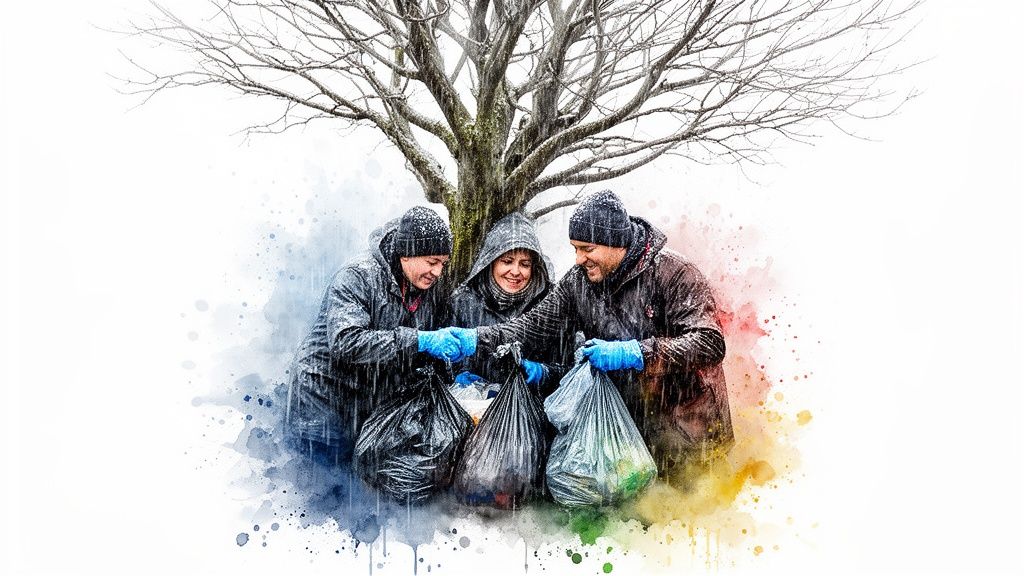
    Three of us stood under a skinny tree in Chicago, getting pelted by hail while our ride-shares kept canceling. We were cold, wet, holding a half-full trash bag, and somehow I was having a great time.

    That Time Freezing in a Hailstorm Felt Fun

    I still remember the sound first. Hail hitting the sidewalk. Hail hitting the trash grabber. Hail hitting the hood of a parked car so hard it sounded like handfuls of gravel.

    There were only three of us that day. We had gone out to do something simple. Pick up trash. That was it. No grand plan. No deep philosophy. Just gloves, bags, and a weird amount of optimism for Chicago weather.

    Then the sky flipped.

    We ran under a tree that barely helped. My hands were stiff. My shoes were soaked. Every time we checked for a ride home, another one canceled. We stood there laughing the kind of laugh you do when things get so inconvenient that your brain gives up and turns it into a joke.

    A diverse group of friends in colorful raincoats carry a large trash bag through a rainy Chicago.

    Misery that tasted oddly good

    That was the day something clicked for me.

    I realized there are at least two kinds of suffering. One kind drains the color out of life. The other kind adds flavor to it. Same cold rain. Same chattering teeth. Totally different meaning.

    That little hailstorm felt alive. It gave the day a plot. If we had picked up trash in perfect weather and gone home easily, I probably would've forgotten it. Instead, I can still feel that moment in my body. I can still see us huddled together, still half proud, half ridiculous, trying to do one decent thing while the city threw ice at us.

    Some hard moments don't feel good while you're in them. They feel good because of what they turn you into afterward.

    I think that's why the phrase suffering builds character hangs around. People have tasted this feeling before. They know that chosen difficulty can wake them up. It can make friendship tighter. It can make a boring life feel like a story again.

    The question people usually skip

    But I also think people say that phrase too casually.

    They use it like a rubber stamp. Lost your job? Suffering builds character. Bad relationship? Suffering builds character. Burned out, anxious, falling apart? Suffering builds character.

    I don't buy that.

    Some pain is a forge. Some pain is a shredder. If we blur those together, we start calling damage growth. That's where people get stuck in places that are hurting them.

    What I learned under that tree wasn't that all pain is good. I learned that chosen hardship in the right setting can feel almost playful. It can pull out bravery you didn't know you had. It can bond people fast. It can make service feel less like punishment and more like adventure.

    Here's the difference I keep coming back to:

    • Shared pain often feels lighter than isolated pain.
    • Chosen discomfort feels different from chaos forced on you.
    • Meaningful effort lands differently than pointless misery.

    That day in the hail didn't answer the whole question. It just made me curious enough to stop repeating slogans and start paying attention.

    Why Hardship Can Remake Your Mind

    When I talk about growth through hardship, I think about the gym.

    You lift something heavy. The strain matters. The effort matters. But the growth doesn't happen because the dumbbell is magical. The growth happens because your body responds, adapts, and rebuilds.

    Your mind works a lot like that.
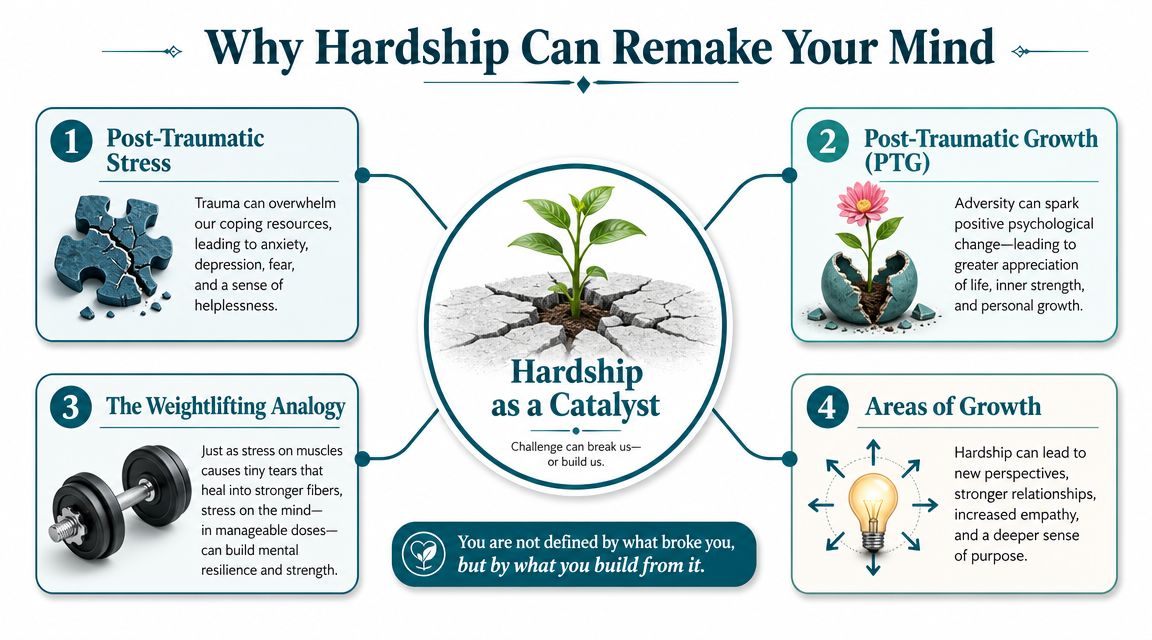
    An infographic illustrating how hardship acts as a catalyst for mental resilience, growth, and personal development.

    A hard event by itself doesn't hand you wisdom like a trophy. You still have to do something with it. You have to digest it. Name it. Fit it into a story you can live with.

    The story in your head changes the outcome

    That's the part people miss when they say suffering builds character as if hardship works automatically.

    Recent research on difficulty-as-improvement says something more careful. The belief that difficulty can mean improvement can sometimes support well-being and effortful engagement, but that depends on how people make meaning of hardship rather than on hardship itself, as described in this USC paper on difficulty-as-improvement in daily life.

    That makes sense to me.

    If I tell myself, "This is hard, so I must be growing," I might stay steady through a cold cleanup, a brutal workout, or a scary conversation. If I tell myself, "This is hard, so my life is falling apart," the exact same event can crush my spirit.

    The event matters. The interpretation matters too.

    Here's a useful way to consider this:

    Experience What hurts What can help
    Voluntary challenge Discomfort, fear, ego Purpose, recovery, supportive people
    Sudden loss or trauma Shock, confusion, overwhelm Safety, care, time, meaning-making
    Daily grind Fatigue, boredom, self-doubt Routine, community, intrinsic reasons

    If you want the inner engine for doing hard things, I like this piece on intrinsic motivation. It gets at a truth I've felt in my own life. You can endure a lot more when the reason comes from inside you.

    Hardship is raw material, not a guarantee

    I don't mean this in a cheesy way. I mean it like clay.

    Hardship gives you raw material. That's all. You can shape it into patience, humility, gratitude, and courage. Or it can harden into bitterness, fear, and numbness. Both outcomes are human.

    Practical rule: Ask, "What story am I building around this pain?" before you ask, "What is this pain doing to me?"

    Sometimes the healthiest story is, "This challenge is making me stronger." Sometimes the healthiest story is, "This situation is hurting me, and I need to leave."

    A short video can help put that mental shift into clearer language:

    That distinction matters more than the slogan. Pain doesn't shape you by default. You shape what pain becomes.

    When Suffering Just Plain Hurts

    I need to say this plainly. Some suffering doesn't build character. It just hurts.

    I've seen people cling to the phrase suffering builds character the way a drowning person clings to driftwood. They use it to justify staying in ugly relationships. They use it to excuse burnout. They use it to make themselves feel noble while they slowly come apart.

    That isn't wisdom. That's self-abandonment dressed up as grit.
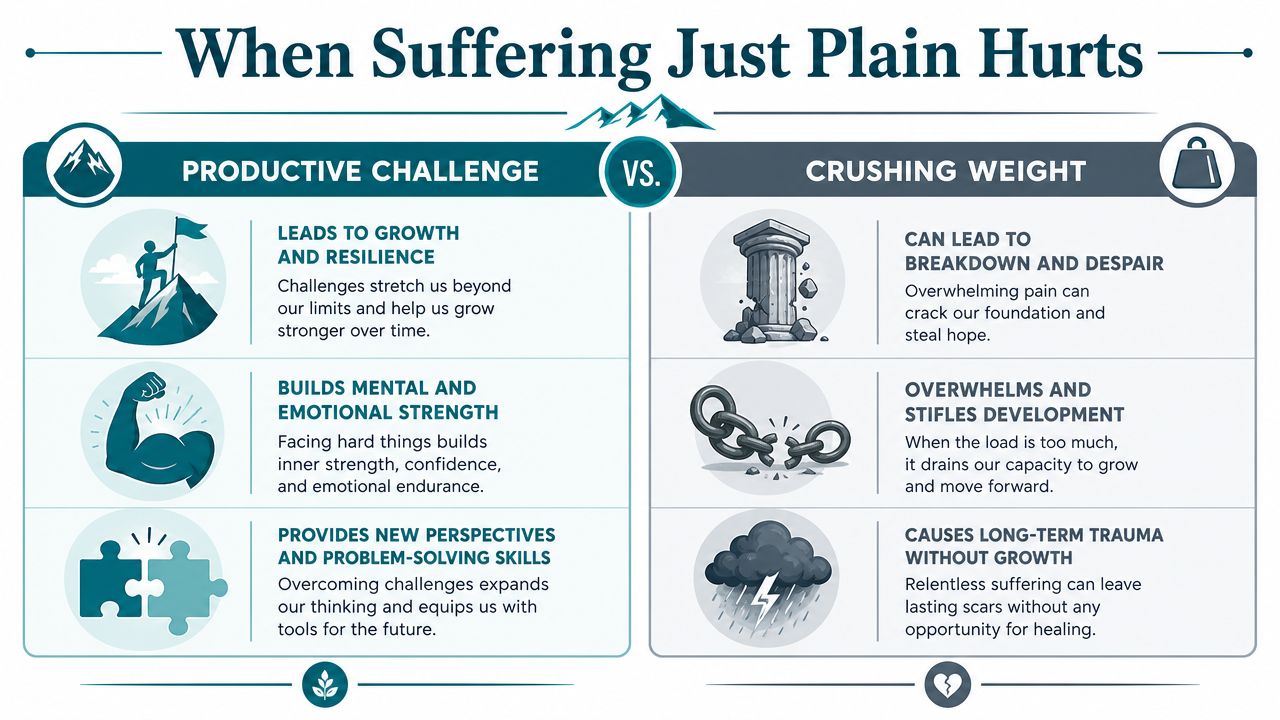
    A comparative infographic illustrating the differences between productive challenges that foster growth and crushing weights that cause despair.

    A hard truth from real data

    It is at this point that the romance around suffering breaks down.

    A 2022 longitudinal study published in PMC followed 1,402 flight attendants and found that higher levels of suffering were linked to worse later health and well-being across 16 outcomes measured over time. In that sample, suffering was tied to negative changes in all but two outcomes, according to the PMC study on suffering and later health outcomes.

    I keep coming back to that because it cuts through the motivational poster version of pain.

    More suffering did not automatically turn into more growth. In that study, suffering tracked with decline across a lot of human experience. That doesn't mean growth never happens. It means we shouldn't pretend suffering is some automatic character machine.

    Productive challenge versus crushing weight

    I think about it like carrying groceries.

    One bag in each hand can make you stronger. You stand up straighter. Your grip improves. You get home feeling capable.

    Now imagine someone drops a refrigerator on your back and tells you this is good for your development.

    That's the difference.

    • Productive hardship has edges. You can feel strain, but you can still think, choose, and recover.
    • Damaging hardship floods your system. It leaves no room for reflection, joy, or repair.
    • Healthy struggle usually has purpose and limits.
    • Harmful struggle keeps eating your sleep, focus, body, or sense of self.

    If a challenge keeps shrinking your life, it isn't building your character. It's taking pieces of you.

    Signs you need to stop calling it growth

    I wish someone had told me earlier that walking away can be brave.

    If you need a reality check, ask yourself these questions:

    1. Do I still have agency?
      Can you make choices, set limits, and say no? If not, that's a warning sign.

    2. Can I recover after this?
      Good strain usually leaves room for rest. Harm doesn't.

    3. Do I feel more like myself or less?
      Hard but healthy effort can deepen you. Ongoing damage can hollow you out.

    4. Am I using the phrase to avoid change?
      Sometimes "this is building me" really means "I'm scared to leave."

    I don't glorify suffering anymore. I sort it. I ask what kind it is. I ask who chose it. I ask whether it has a purpose, a boundary, and a way back to rest.

    If the answer is no, then healing matters more than endurance.

    Finding Your Own Fence to Paint

    My apartment used to embarrass me.

    Not in a cute, messy-artist way. I mean real chaos. Old food. Piles of stuff. Random objects carrying weird emotional weight. Every piece of trash had a story attached to it, and because it had a story, I couldn't throw it out.

    The old jar in the fridge was from a trip I didn't want to forget. The bag of nuts on the shelf was from the week I tried to become a healthy person. The receipt on the counter reminded me of some day that felt important for no good reason. Tiny objects became concrete blocks.

    My room looked like my mind felt. Jammed. Avoidant. Heavy.

    The breakup that forced the issue

    After a long, chaotic relationship ended, I hit a wall. I knew I couldn't keep living the same way. I needed to become cleaner, steadier, braver. I needed better habits and better people around me.

    But trying to fix my own mess head-on felt impossible.

    That was the weird part. I could stare at one bag of garbage in my own place and feel stuck. Yet if I saw a fast-food wrapper blowing down the street, I wanted to grab it. My brain resisted personal cleanup and accepted public cleanup.

    So I leaned into that.

    I started cleaning up other people's messes because I couldn't yet handle my own.

    Why service was easier than self-repair

    It still sounds backwards when I say it out loud, but it's true. Community service gave me a side door into my own transformation.

    Picking up litter outside felt simple. The rules were clear. Trash goes in bag. Block gets cleaner. You move your body. You breathe outdoor air. You stand next to other people doing the same thing. There isn't much room for spiraling.

    My private mess had shame in it. Public mess had purpose.

    That's where the Tom Sawyer image always comes back for me. He got stuck painting a fence and turned it into a game people wanted in on. I don't think that story is about manipulation as much as mindset. The task didn't change. The frame changed.

    The same thing happened to me. Hard, dirty work stopped feeling like punishment and started feeling almost mischievous. We were doing something useful, but we were also reclaiming effort itself. We were saying, "This counts as fun."

    Work changes shape when you share it with people who are glad you showed up.

    There's a similar emotional thread in this piece on how to overcome social anxiety. Sometimes you don't heal by staring at yourself harder. Sometimes you heal by moving beside other people toward a simple goal.

    The fence painted me back

    The strange part is that this small act of service started changing things I never meant it to change.

    I got more consistent because other people were expecting me.

    I got braver because weather didn't care about my comfort.

    I got cleaner because once I'd spent a morning filling bags with litter, I had less tolerance for living in chaos myself.

    I got pickier about friendship too. Shared service filters people. Weekend mornings, bad weather, muddy gloves, low glamour. That setup draws a certain kind of person. It tends to pull in people who want to give more than they want to pose.

    The suffering in my old life felt random. It tossed me around.

    This new hardship felt chosen. Small, steady, almost humble. It didn't ask me to be dramatic. It just asked me to show up.

    That kind of suffering built more character in me than all the chaos ever did.

    How to Practice Productive Hardship

    You don't need to wait for life to throw a brick through your window. You can choose a harder, better path on purpose.

    I think that's the cleanest answer I've found. If you want growth, don't worship pain. Design productive hardship instead.
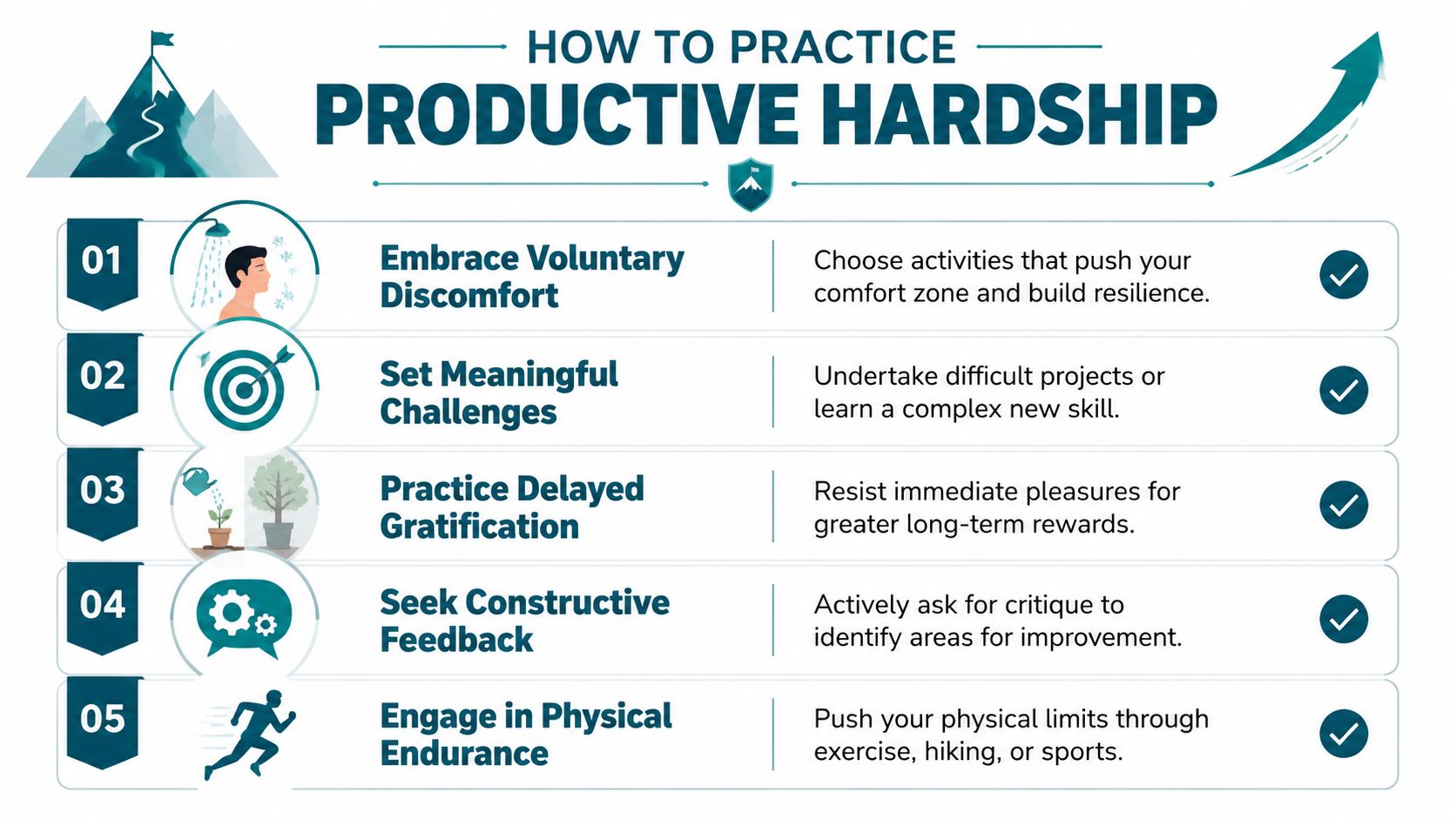
    An infographic titled How to Practice Productive Hardship featuring five tips for building resilience through voluntary challenges.

    What makes hardship productive

    For me, chosen hardship works best when it has three traits:

    • It's voluntary
      You picked it. That matters. Choice changes the whole texture of effort.

    • It has a purpose
      You're not suffering for vibes. You're building skill, courage, discipline, or service.

    • It has a recovery plan
      Hard effort without rest turns into stupidity fast.

    That could mean training for a race. Taking a public speaking class even though your stomach flips every time. Volunteering on cold mornings. Having one difficult conversation you've been postponing for months.

    One practical option is Care for Real, which gives people a way to serve through direct community support. Another option is a volunteer cleanup group like Litter Caterpillars, which organizes regular trash pickups in Chicago. The point isn't which banner you stand under. The point is choosing a form of effort that asks something real from you.

    A simple way to start this week

    If I were sitting across from you with coffee, I'd tell you to start smaller than your ego wants.

    Try one of these:

    1. Pick a weekly discomfort
      Commit to one thing that feels mildly inconvenient but clearly good. A dawn cleanup. A hard workout. A class that scares you.

    2. Tie it to service
      Self-improvement sticks better for me when somebody else benefits too. Service keeps pain from turning narcissistic.

    3. Keep the challenge boring enough to repeat
      You don't need an epic quest. You need something you can still do when you feel lazy.

    4. Reflect after, not during
      While you're in the middle of the hard thing, just do it. Later, ask what it taught you.

    Bravery, unity, consistency

    These are the three words I trust most.

    Bravery means you go anyway, even while your inner voice whines.

    Unity means you stop acting like growth is a solo sport. A friend beside you can turn dread into momentum.

    Consistency is where the identity change happens. Anybody can survive one dramatic day. Character grows when you repeat a modest hard thing until it becomes part of who you are.

    Choose a challenge that makes you a little uncomfortable and a little proud.

    The point of all this isn't to become a martyr. It isn't to collect suffering like merit badges. It is to train your soul gently, the way you train a muscle. Strain, rest, repeat. Enough challenge to wake you up. Enough meaning to keep you going.

    From Caterpillar to Something New

    So, does suffering build character?

    My answer is yes, sometimes. But only sometimes. And that one word matters.

    Unchosen, chaotic suffering can leave scars and confusion. It can shrink your world. It can hurt your health, your joy, your ability to trust yourself. I don't romanticize that anymore.

    Chosen hardship is different.

    When you choose a hard thing with a clear purpose, when you do it with good people, when you leave room for recovery, effort changes shape. Cold rain becomes a memory you laugh about. Service becomes training. Fear becomes proof that you're stretching into a larger self.

    Becoming through effort

    I like the caterpillar image because it gives me room to be unfinished.

    I'm not writing this as someone who mastered pain. I'm writing this as someone who has been shaped by two very different kinds of struggle. One kind left me lost. The other kind helped me become more honest, more useful, and more steady.

    That's what I want for you too.

    If you're in needless pain, I hope you stop calling it growth and get yourself somewhere safer.

    If you're hungry for growth, I hope you don't sit around waiting for tragedy to teach you. Pick your own fence to paint. Pick your own Saturday morning. Pick your own brave little task. Then keep showing up until the person doing it starts to change.

    We are all in some stage of becoming. That's the good news.

    You don't need perfect conditions. You just need a meaningful burden you can carry on purpose, with your eyes open, alongside other people, until your old skin doesn't fit anymore.


    If you want a hands-on way to practice service, friendship, and chosen challenge, take a look at Litter Caterpillars. It's a Chicago volunteer group that organizes regular neighborhood cleanups, and it's a simple way to turn a hard morning into something useful.
  • Your Guide to Chicago Food Bank Volunteer Opportunities

    Your Guide to Chicago Food Bank Volunteer Opportunities

    You feel that nudge, don't you? A quiet but persistent pulse telling you to do something real for Chicago. I know it well. Becoming a chicago food bank volunteer is one of the most direct ways I’ve found to answer that call, turning my time into a full table for a neighbor.

    Why This Work Actually Changes Everything

    I know that feeling. It’s a deep pull, a yearning to connect with your city beyond just living in it, to be a participant, not a spectator. It's the same energy that grabbed me and pulled me into community work years ago. This isn’t about checking off a "good deed" box; it's about answering an inner summons.

    When you sign up for a shift at a food bank, you make a conscious choice. You choose to be the reason a family gets to sit down together for a meal tonight. You become the hands that bridge a gap too wide for some to cross alone.

    A smiling volunteer gives a food box with fresh food to a happy mother and child with a city skyline.

    From One Person to a Citywide Movement

    Your single act of showing up is a stone tossed into Lake Michigan. The ripples spread, touching lives in neighborhoods you might never even visit, spreading outward in unseen waves of impact. You aren't just sorting cans. You aren’t just packing boxes. You are weaving resilience into the very fabric of our city.

    I remember my first shift. My stomach was a knot of nerves. I had no idea what to expect. But within minutes, I found myself shoulder-to-shoulder with strangers who felt like teammates, our focus narrowed to one simple, powerful goal. The energy was electric, a shared current running through us all.

    Your time is the fuel that powers Chicago’s fight against hunger. It’s not just about the food; it’s about you and me showing up for each other, proving this community takes care of its own.

    This collective effort creates a staggering impact. Think about the Greater Chicago Food Depository—every year, more than 25,000 volunteers like you and me put in nearly 100,000 hours of service. Our work gets over 7 million pounds of food repacked and out the door. That's millions of meals. You can read more about the vital role of volunteers on their site to see how it all adds up.

    Tying Your "Why" to the Work

    What really matters is the "why" that brought you here. Are you moved by a desire to fight injustice? Do you crave a real connection with people? Or is it just a simple, powerful urge to help?

    Hold onto that reason. It's the engine that transforms a few hours of your time into something monumental.

    • You're giving hope. For a family struggling, a box of groceries is a lifeline. It’s breathing room. It’s a moment of peace.
    • You're building community. When we serve together, we build trust. We tear down the invisible walls that separate us.
    • You're changing yourself. You will walk away different, with a clearer sense of your own power to make an impact.

    Becoming a Chicago food bank volunteer isn't just about what you give. It’s about who you become in the process. You are stepping up to be part of the solution, one shift at a time.

    Alright, you’re fired up and ready. But in a city as huge as Chicago, finding the right place can feel like searching for a specific face in a packed L train. It’s not just about finding an opening; it’s about finding your opening. Let’s find the spot where you don’t just show up, but where you truly belong.

    Think of it like choosing your spot at a Cubs game. Do you want to be in the bleachers, part of a massive, loud, energetic crowd? Or do you prefer a seat closer to the action, where you can see every play up close?

    The big players, like the massive Greater Chicago Food Depository, are the bleachers. They are incredible, well-oiled machines. I’ve volunteered at their repack shifts, and the sheer scale is mind-blowing—you’re part of a huge team making a dent in hunger on an industrial level. It's fast, loud, and you can physically see the pallets of food piling up around you.

    But the real heart of Chicago often beats on the side streets.

    Discovering Neighborhood Gems

    Tucked away in church basements and small storefronts, you'll find hundreds of local food pantries. These places serve their immediate blocks with a fierce, personal dedication. They know their neighbors by name. The St. Cyprian food pantry in Dunning is a perfect example of this.

    Volunteering at a smaller spot is a completely different vibe. It’s intimate. You’re not just packing a box; you might be having a real conversation with the person you’re helping. It’s less about the massive numbers and more about that direct, human connection. So, how do you find these hidden spots?

    • Go hyper-local with your search: I want you to forget generic terms. Try "food pantry near me" or "volunteer [your neighborhood] food bank." This will turn up places you walk by every day and never noticed.
    • Check the old-school spots: Look for flyers at your local library, coffee shop, or even your alderman’s office. I've found these places are still the central nervous system for community action.
    • Just walk around your block: Seriously. I have discovered some of the most dedicated, under-the-radar organizations just by being curious about a sign on a church door in my own neighborhood.

    Choosing where to be a Chicago food bank volunteer is a gut-check moment. Ask yourself: Do I want the energy of a huge team, or the quiet connection of a small one? There’s no wrong answer, only what’s right for you.

    Matching Your Vibe and Your Schedule

    Finding the right fit also means being brutally honest with yourself. Can you actually commit to a weekly shift every Tuesday morning, or is a one-off Saturday thing more your speed? Most places have online sign-up calendars where you can see every available slot. If you want to cast a wider net, our guide on the best volunteer opportunities in Chicago has even more ideas for you.

    Your personality matters, too. Some roles are all about being on your feet and interacting with people, while others are more focused and behind-the-scenes. I want you to think about what kind of work will leave you feeling energized, not drained.

    To give you a better idea, here's a quick breakdown of the most common jobs you'll find. Think about which one sounds less like work and more like you.

    Common Chicago Food Bank Volunteer Roles

    Volunteer Role Typical Tasks Best For You If…
    Warehouse Repacker I've sorted bulk food donations, packed boxes, and labeled cans. You love a fast-paced, physical task and the energy of a big team. Great for audiobook or podcast lovers.
    Pantry Distributor You'll greet guests, hand out groceries, and help people "shop" for their items. You're a people person who enjoys direct interaction and making others feel welcome and respected.
    Delivery Driver I've seen volunteers transport food from a central hub to smaller, local pantries across the city. You enjoy driving, know the city's streets, and prefer working more independently.

    The goal here isn't to just fill a slot—it's to find a role that lights you up. When you match what you’re good at with what the community needs, you’re not just helping out. You’re bringing your best self to the table, and that’s an impact that lasts.

    What Your First Volunteer Shift Will Really Be Like

    I get it. That little knot in your stomach before your first shift is real. You're probably wondering what it's actually going to be like. Will I know what to do? Will I just get in the way? I have been there, and I’m going to pull back the curtain for you.

    Forget any ideas about being thrown into chaos. These places are like a well-rehearsed play, and the shift supervisor is your director for the day. Their job is to get you up to speed and put you right where you're needed most.

    From Arrival to Action

    The moment you walk in, you’ll sign in, get a quick lay of the land, and meet the other folks you’ll be working alongside. The energy is usually upbeat and focused. We’re all there for the same reason—to get things done.

    You won't be left to figure things out on your own. The first few minutes are all about orientation. I’ll walk you through it: you’ll learn the basic rules (like how to safely lift boxes), get your specific task for the shift, and have a chance to ask any last-minute questions. It’s a smooth process, and you’re a key part of it for the next few hours.

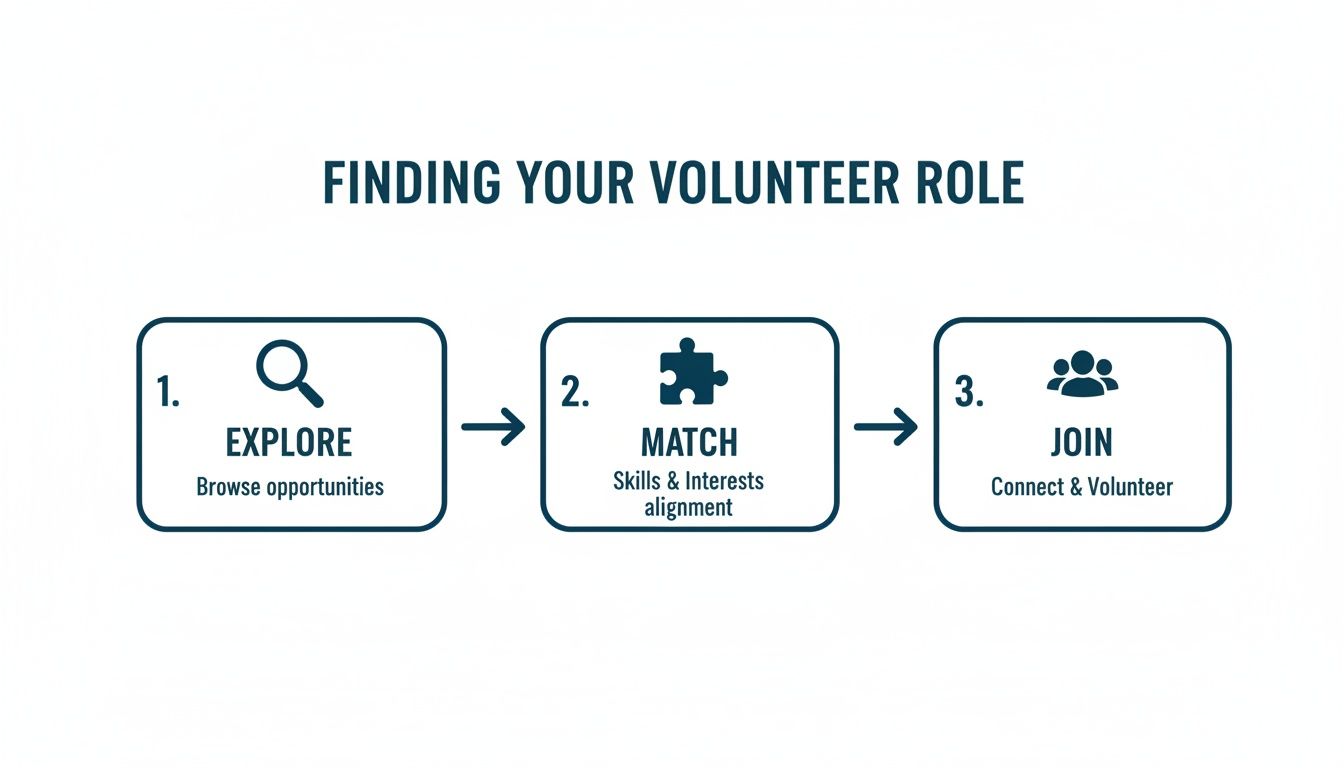
    This simple path from finding an opportunity to joining the team on the floor is designed to be straightforward.

    A three-step process for finding a volunteer role: explore opportunities, match skills, and join.

    By making it easy for you to find a role that fits, you show up for your shift ready to make a real impact from the get-go.

    What You'll Actually Be Doing

    Your job for the day depends entirely on the immediate need. A typical chicago food bank volunteer shift could have you doing any number of things:

    • Repacking Bulk Foods: You might find yourself on an assembly line, transforming giant bags of rice, pasta, or oats into smaller, family-sized packages. I've done this many times; it's rhythmic and satisfying.
    • Sorting Donations: This is like a treasure hunt with a purpose. You’ll be checking expiration dates and sorting canned goods, fresh produce, and other groceries into the right bins.
    • Building Emergency Boxes: This is where you assemble pre-packed boxes with a variety of staple foods, getting them ready to ship out to local pantries like the one at Casa Catalina. You can learn more about their work here.

    The work is tangible. I love that you can physically see the results of your effort as the pile of unsorted donations shrinks and the pallets of ready-to-go boxes grow taller.

    You're not just moving food around a warehouse. You’re moving hope. Every single box you pack is a direct lifeline to a family, a senior, or a child in our city.

    This is especially true as food distribution evolves. For instance, I've watched initiatives like Chicago's Community Kitchens work to distribute up to 10,000 prepared meals every day. And now, 32 percent of all food distributed is fresh fruits and vegetables. Your hands-on work is what makes this push for healthier, more dignified food access a reality.

    The hours will fly by. Before you know it, the shift manager will call out the final tally—how many pounds of food you sorted or how many boxes you packed. It’s a moment of shared victory with people who were strangers just a few hours before. You’ll leave tired, but you’ll also leave full, knowing you didn’t just spend your time; you invested it.

    Think Outside the Box: More Ways to Fight Hunger

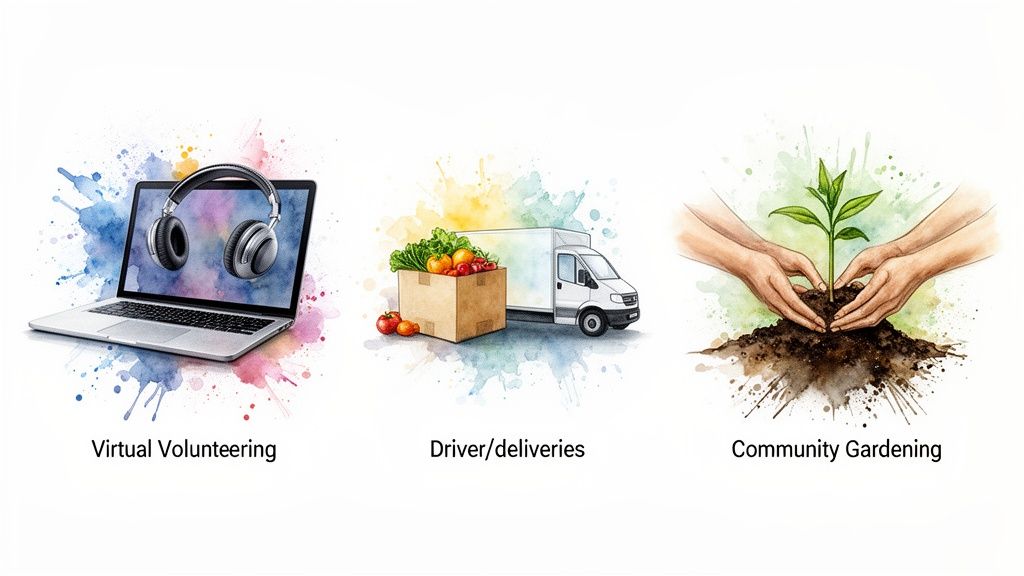
    Three illustrations showing virtual volunteering, food delivery, and community gardening activities.

    So, maybe the fast-paced warehouse shift just isn't your vibe. Or maybe your schedule is as unpredictable as Chicago weather in April. That’s more than okay. The most important thing you bring to this is your will to help.

    Fighting hunger is not a single-lane road; it's a giant highway with on-ramps everywhere. If packing boxes feels like a bad fit, I want you to know there are tons of other ways to be a chicago food bank volunteer. It's all about finding the role that just clicks for you.

    Your Skills Are a Superpower

    Seriously. Your professional talents are a secret weapon. Are you a wizard with spreadsheets? A creative genius with graphic design? A wordsmith who can tell a compelling story? I've seen firsthand how desperately food banks need these skills, and you can often contribute right from your own couch.

    It’s a different kind of impact, but it’s huge. Think about it:

    • Data Entry: You could be the person organizing volunteer lists or donation records from home, creating order from chaos.
    • Grant Writing: Your writing could be the very thing that secures thousands of dollars in funding for an organization.
    • Social Media: You could design a single post that brings in a flood of donations for a food drive.

    This is the behind-the-scenes work that keeps the whole operation moving. It’s like being the mission control for the rocket ship. While others are on the front lines, you're the one drawing the map that gets everyone where they need to go. You’re using your brain to tackle a massive problem.

    Hit the Road or Dig in the Dirt

    If you’d rather be out in the world but still want something different, there are some incredible options. Do you love driving and seeing the city? Volunteer drivers are the unsung heroes of this whole thing. I’ve heard stories from guys like Thomas LeClair, who’s put in hundreds of hours and says he meets the “most beautiful people” delivering food across Chicago. It's a way you can feel the real pulse of the city, one delivery at a time.

    Sometimes the most powerful work happens far from the main building. Your car can become a vehicle for hope. Your voice can become an engine for change.

    Or maybe you’re someone with a green thumb. I’ve seen urban farms and community gardens that supply fresh produce to food pantries, and they are always looking for help. Imagine spending a morning tending to basil and parsley, knowing it will end up on someone’s plate that very week.

    It all connects. When we take care of our communities—whether I’m delivering food or you’re beautifying a public space—we’re building a sense of pride and wellness that goes hand-in-hand with food security. You can even see how different acts of service add up by exploring other charities in Chicago and finding your fit. Every small act gets us closer to a stronger Chicago.

    From One Shift to Part of the Family

    You finish that first shift. You’re tired, your back might be a little sore, but you’re buzzing. It’s a good feeling—a real, earned sense of purpose.

    But that buzz from one shift? It’s just the ignition. The real magic happens when you decide to come back. That first time is a spark. Consistency is what builds the fire that keeps a community warm.

    Making It Your Thing

    I remember feeling that pull. That feeling that once wasn't enough. I needed to make my chicago food bank volunteer work a regular thing. The first real step was simple: I put it on my calendar. I treated it just like a doctor's appointment or a meeting with my boss.

    It became “my Tuesday morning shift.” It was no longer a question of if I was going, but when.

    This is how a good deed transforms into a habit of service. This is how you go from just helping out to being part of the bedrock of the organization. It's like a single drop of water, which does little, but a steady drip over time can carve stone. Your consistent effort has that same power.

    This isn't just a nice thought; it’s how massive change happens. Look at the Greater Chicago Food Depository. They went from distributing 500,000 pounds of food in their first year to 11.2 million pounds just four years later. That’s what a dedicated, volunteer-driven effort does. You can see how that grassroots fire started by learning about the Food Depository's early history.

    Finding Your People

    Then something else starts to happen. As you keep showing up, the faces you see every week stop being strangers. They become your crew.

    You start to learn their stories. You meet the retired firefighter who tends the hydroponic garden. You meet the flight attendant who’s a natural at guiding new volunteers. You meet the group of college friends who make packing produce boxes their weekly catch-up.

    You don't just find a place to volunteer; you find your tribe. You find the people who share your commitment to showing up for Chicago, and together, you become an unstoppable force.

    This is what keeps you coming back, even on those mornings when you’re tired or the weather sucks. You’re not just accountable to the mission anymore. You’re accountable to each other.

    Here’s how you make that happen:

    • Stick to the same shift. If you can, try to sign up for the same day and time. That's how I built connections with a core group of regulars.
    • Just be open. Ask people their names. Share a little about yourself. I’ve made some of my closest friends in this city just by starting a conversation over a pallet of potatoes.
    • Learn the ropes. Once you're a regular, people start to trust you with more. Maybe you’ll train newcomers or take the lead on a specific project. This is you, growing from a helper to a leader.

    Before you know it, volunteering stops being something you do. It becomes part of who you are. You start seeing Chicago not just as the place you live, but as the community you are actively building, one shift at a time.

    Got Questions? Let's Get Real.

    It's normal to have a million questions running through your head before your first shift. I’ve been there. You want to show up and do a good job, not get in the way. Let’s cut through the noise and get you some straight answers based on what I've seen and what I hear other first-timers ask all the time.

    Am I Too Young (or Old) for This?

    Every place is different, but most have a spot for you. Big operations like the Greater Chicago Food Depository are amazing—they often welcome volunteers as young as 11 as long as an adult is with them. I've seen it myself, and it's an incredible thing for a kid to witness that kind of impact firsthand.

    Smaller neighborhood pantries might need you to be 14 or 16 just because of the work or the size of their space. The golden rule is simple: just check the volunteer description before you sign up. They're always crystal clear about age.

    Can I Bring My Friends?

    Heck yes! Volunteering with your crew is one of the best ways I know to do it. It stops being a "shift" and starts being a bonding experience. I’ve seen corporate teams, high school clubs, and just groups of friends have an absolute blast sorting food and making a difference together.

    Most food banks love groups and have a separate sign-up for them. One piece of advice I can give you: plan ahead. Those group spots, especially on weekends or near the holidays, get snatched up months in advance.

    The most important skill you can bring to a Chicago food bank is a good attitude and a real willingness to help. I can teach you everything else you need to know in five minutes.

    Do I Need Any Special Skills?

    For 99% of the roles, you don't need any special skills. I'm serious. The work is designed for everyday people like you and me to show up and get it done. Your most powerful tool is your willingness to just be there and help.

    You'll get a quick orientation at the start that shows you exactly what to do, whether it's packing boxes or sorting produce. It's simple, satisfying work that adds up to something huge.

    What If I Have to Cancel?

    Life happens. Your kid gets sick, your boss moves a meeting, you just feel off. I get it, and so do the food banks. They rely on people like us, and they know that means being flexible.

    Most places have an online system where you can cancel your shift with a few clicks. When you do that, your spot opens up for someone else who's been waiting for a chance to help. The key is to give as much notice as you can—they plan their whole day around the number of volunteers they expect. Don't feel guilty, just be courteous and cancel as soon as you know.


    At Litter Caterpillars, we believe that showing up for your community—whether you’re packing food boxes or cleaning a park—is how you find your people and build a better Chicago. If you're looking for another way to serve, join us for a cleanup event and see the city change right before your eyes.

  • Care For Real: Why Showing Up Is The Only Thing That Matters

    Care For Real: Why Showing Up Is The Only Thing That Matters

    When I talk about care for real, I'm not picturing some caped crusader swooping in to save the day. It’s not about that at all. It’s about the quiet, consistent, often invisible work of just showing up. Especially when it’s hard.

    It’s you, looking at a mess—maybe it’s in your own life, maybe it’s the garbage strewn across your block—and deciding, right then and there, to do something about it. That simple, personal choice? It changes everything.

    Finding Purpose in the Mess

    My life was a dumpster fire. Seriously. My apartment looked like a tornado had a party in it, a perfect, chaotic mirror of the storm raging inside me after a brutal breakup.

    Every cluttered corner mocked me. Every pile of forgotten stuff screamed back at me, reflecting the emotional mess I’d become. I knew I had to build a new life from scratch, one founded on things I was starving for: consistency, real courage, and a tribe of people who actually showed up for each other. But I was paralyzed. It felt like trying to move a mountain of emotional junk, one tiny pebble at a time. It was just too much.

    Then, something clicked. I started thinking, what does it mean to care for real? It isn’t posting a cheesy quote on social media or just talking a big game about making a difference. It’s the opposite. It’s you, pulling on a pair of gloves on a freezing Saturday morning to clean up a mess you didn’t even make. It’s the gritty, unglamorous work nobody else wants to touch.

    To care for real is to dive headfirst into the difficult, the dirty, and the inconvenient, because that’s where you truly grow. It’s choosing service over your couch and real connection over being alone.

    This shift in perspective was my lifeline. I realized that tackling the physical clutter on the streets could be my way of starting to clear the clutter in my own heart. The act of cleaning became my metaphor for rebuilding my life. Every single piece of trash I picked up felt like a tiny victory against the chaos that had consumed me.

    That idea sparked Litter Caterpillars. I wanted to build a community around this one simple rule: show up, especially when it sucks. It's about creating a place where you can find purpose not by dodging the mess, but by wading right into it—together.

    It’s where you and I learn that the best connections aren’t made when life is easy. They’re forged in shared struggle and a common goal. This is how we begin to care, for real.

    Confronting The Overwhelming Mess Around Us

    Let’s get real. It’s so easy to feel completely powerless when you look at the sheer mountain of trash around us. The numbers are staggering, almost numbing.

    I see it every single day on the streets of Chicago, from the gorgeous lakefront to the quiet side streets in my neighborhood. It feels like an endless tide of wrappers, bottles, and plastic bags. It’s the kind of problem that makes you want to just throw your hands up and say, "What can I even do?"

    From Numbers to Neighbors

    The statistics paint a grim picture. The United States is a global champion in trash production. A 2025 report, the Global Waste Index, found that I, you, the average American, now churn out a mind-boggling 951 kilograms of municipal waste each year. Picture this: that's enough trash to fill almost three standard dumpsters every year—for just one person. You can see the full research on the world's biggest waste polluters on waste-management-world.com if you want the stark, unfiltered truth.

    We are just 4% of the world's population, yet we generate 12% of its garbage. This isn’t some abstract number; it’s a reality we live in, and honestly, it’s overwhelming.

    This is exactly where the idea to care for real becomes your superpower. It’s not about you trying to solve the entire global waste crisis by Sunday. That’s impossible. Thinking that way just leads you to burnout and giving up.

    Instead, you shrink the problem. Bring it down to a human scale. You look at the single city block right in front of your feet and decide, "This patch of ground matters. This is my home."

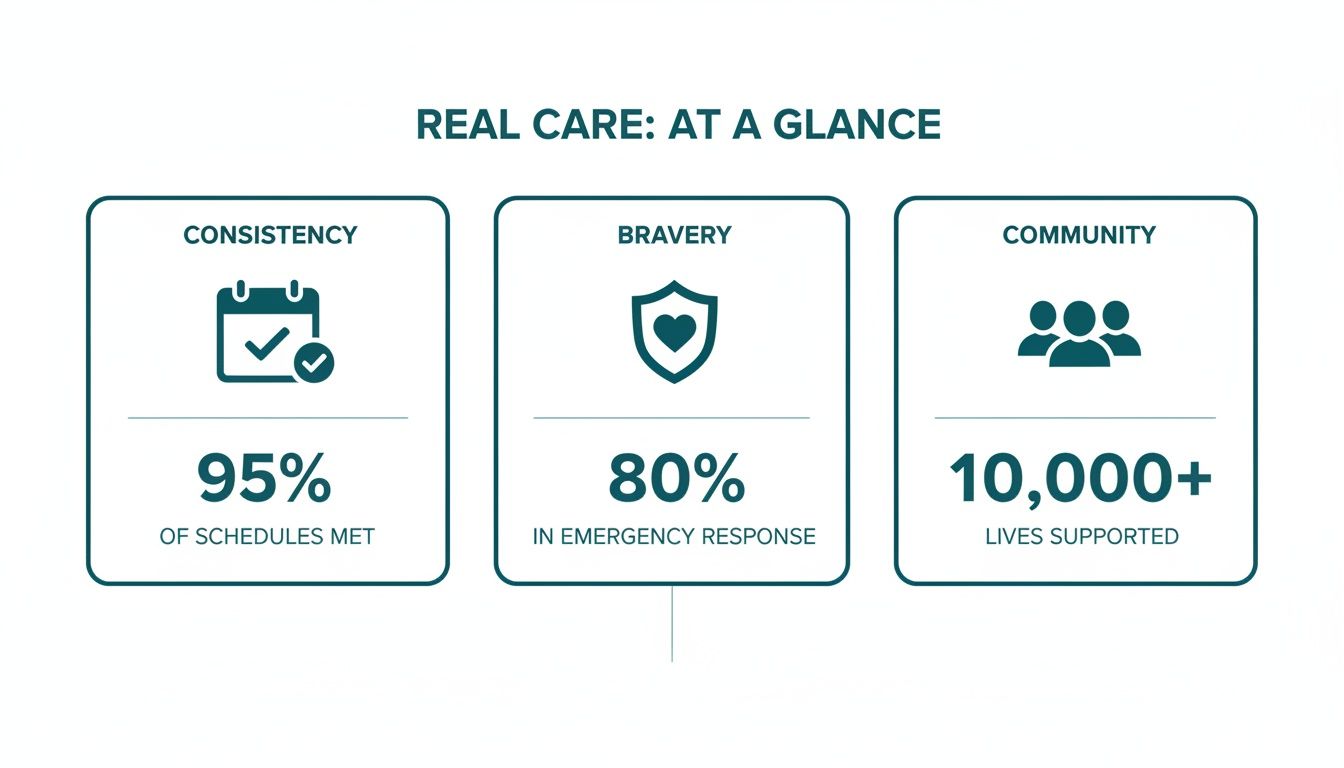
    This infographic shows you the mindset you need to turn that overwhelming feeling into action that actually means something.

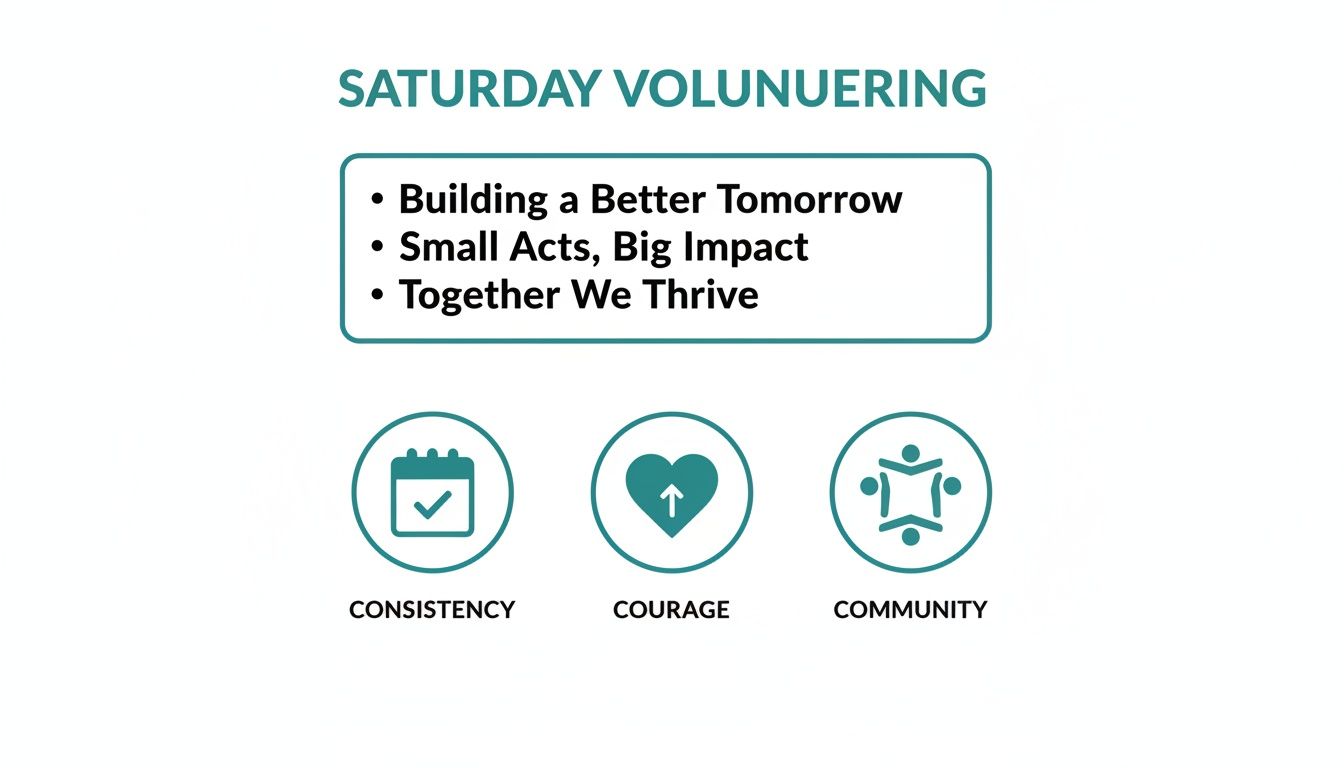
    Infographic showing real care metrics: 95% consistency, 80% emergency response, and 10,000+ lives supported.

    These icons for consistency, bravery, and community aren't just feel-good graphics. They are the tools you and I use to transform a massive, terrifying problem into something we can physically touch and solve.

    Taking Back Your Power

    You seize your power not by trying to fix the whole world at once, but by taking direct, visible action in your own small corner of it. Caring for real is about turning those suffocating statistics into a specific problem you can physically solve, one piece of trash at a time. It’s your act of defiance against that feeling of helplessness.

    When you choose to pick up that first bottle, you’re not just cleaning a street. You are making a powerful statement that you refuse to be a bystander in your own community.

    This is the very essence of environmental stewardship. By focusing on what’s right in front of us, you and I create a ripple effect that builds momentum and inspires others to join. It’s a practical approach that turns a global crisis into a local mission. And that is where real change begins. If this idea clicks with you, you might be interested in our guide on what environmental stewardship truly means.

    How We Put Real Care Into Action

    Our very first cleanup was a trial by fire. Or, more accurately, a trial by ice.

    Picture this: just three of us, ambushed by one of those freak Chicago hailstorms that drops out of a perfectly blue sky. We were huddled under a pathetic, flimsy tree, soaked to the bone and shivering uncontrollably.

    And in that moment of pure misery, something happened. It hit me like a ton of bricks. Facing a stranger’s garbage—no matter how disgusting—was a thousand times easier than facing my own. That shared struggle, that freezing moment under the tree, wasn't just a bad day. It was the beginning of our story.

    This is the beating heart of the Litter Caterpillars philosophy. We show up in blizzards. We show up in brutal heatwaves. You and I believe the hard parts are what make the work real. It's not about being comfortable; it's about being committed. This is what it means to care for real.

    Three smiling volunteers in winter clothing and blue gloves pick up trash under a bare tree.

    Living Our Values Every Single Weekend

    Talk is cheap. Real care is showing up. It’s about building a system where our values aren't just pretty words on a website but are lived out by you and me, every single weekend, on the streets of Chicago.

    We protect our volunteers above all else. Your safety and happiness are my number one priority. I will never pressure you to do more than you're comfortable with or to come out when you can't. I will also never ask you for a dime. Your time and energy are the only currency that matters here.

    Real community isn’t a transaction. It’s built on a shared commitment to showing up for one another and for the city we all call home. It’s about creating a space where you feel valued, not just used.

    There's a reason we meet on weekend mornings. It’s like a natural filter. It brings out people like you who are wired to give—the ones who find genuine joy in service and want to kick off their weekend with a sense of purpose. We're building a community of givers, one tough but incredibly rewarding morning at a time. The bonds we forge are sealed in that shared effort. To see more on how this works, check out our community engagement strategies that build real connection.

    The Litter Caterpillars Philosophy

    Putting these ideas into practice is how we turn a simple cleanup into something more. It's how you find transformation in the trash. Here’s a breakdown of our core values and how we put them into practice every week.

    Our Value What It Means To Us How We Live It
    Bravery Embracing fear, failure, and suffering as your tools for growth. Cleaning in all weather—blizzards, rain, or heat. Taking pride in our work with flags and theme songs.
    Kindness Putting our volunteers' well-being first and building unity. Prioritizing your safety and happiness. Never asking for donations. Fostering real friendships between people like us.
    Service The act of giving transforms you, me, and our environment. Meeting every weekend morning to attract givers. Cleaning all 50 wards, especially neglected areas.

    This isn't just a mission statement. It’s a promise you and I make to ourselves, to each other, and to Chicago every time we grab a trash bag.

    Finding Beauty In The Unwanted

    Hands hold a plastic bottle from which a vibrant plant with flowers grows amidst colorful watercolor splashes, symbolizing growth and care.

    Do you remember that story about Tom Sawyer tricking his friends into painting a fence? A brilliant move. He took a mind-numbing chore and, with a spark of genius, turned it into a privilege—something so special that kids actually paid him for the chance to do the work.

    That’s exactly how I see what you and I do with trash.

    Picking up litter isn't some miserable punishment for living in a messy world. For us, it’s a huge opportunity to transform ourselves. Every bottle cap, every forgotten plastic bag, every crushed can is a chance for you to practice bravery, build real friendships, and find beauty where other people only see garbage. This is the heart of what it means to care for real.

    The Plastic Tide and Our Personal Stand

    This mindset really hits home when you think about plastic. It feels like an unstoppable, suffocating tide washing over our cities, parks, and oceans. While politicians and corporations debate policies and global agreements, you and I choose to take action. Right here. Right now.

    The global numbers are staggering, telling a story of deep inequality. The United States leads the world in plastic production per person, but other countries are drowning in waste with far fewer resources to fight back. Imagine Brazil—it generates over 10 million tons of plastic trash every year but only recycles a tiny 1.28%. The rest just clogs their land and oceans. For us Chicagoans, these global stats aren't abstract; we see the consequences firsthand in our own neighborhoods. You can dig deeper into the global plastic pollution numbers on worldpopulationreview.com.

    This is where our mission gets crystal clear. While the world debates, we believe real change starts with small, consistent work done by people like you who care enough to show up. We make a real dent in a problem that feels impossibly big.

    We are Litter Caterpillars because we know that through service, we can transform not just our city, but ourselves. We are finding profound growth in the grit.

    Finding Growth in the Grit

    Think of it like gardening. You can’t just toss seeds on the ground and hope for a miracle. You have to get your hands dirty.

    You pull weeds, you work the soil, you nurture the ground. It’s tough, messy work, but the reward is seeing something beautiful and alive grow from your effort. That's exactly what you and I are doing every single weekend.

    Here’s how we flip the script on what it means to clean up:

    • The Unwanted Becomes an Opportunity: A trashed-out park isn’t a sign of defeat; for us, it’s a blank canvas for our community to create something amazing.
    • A Chore Becomes a Connection: Picking up trash side-by-side with a stranger builds a bond way faster than small talk ever could. I've seen it happen.
    • Suffering Becomes a Story: Facing a challenge together—like cleaning in the pouring rain—doesn’t just build your resilience. It creates a shared memory, a story that makes our community stronger.

    We aren't just cleaning up. We are actively choosing to find value and potential in the things our society has thrown away. And in doing that, you and I discover a stronger, more connected version of ourselves.

    How You Can Start Caring For Real Today

    So, how do you take this big idea of "caring for real" and actually make it part of your life? It’s not about launching some massive city-wide movement overnight. It starts with one small, consistent action. Just one.

    The first step—and honestly, the most important one—is deciding to show up for something bigger than yourself. It's that choice you make to get off the sidelines and into the game.

    Maybe picking up litter isn't your thing, and that's totally cool. Maybe your heart sings when you're walking dogs at a local shelter. Or maybe it's as simple as spending an hour a week with an elderly neighbor who could use a friend. The what isn't nearly as important as the why and your commitment behind it.

    The Power of Consistent Action

    Something wild happens when you commit to showing up, week after week. It’s like you’ve turned on a homing beacon for other givers.

    Your consistency acts as a magnet. It naturally draws in people who share your values and that same itch to make a difference. These are the people who become your tribe. Your community.

    True belonging isn’t found in what you believe, but in what you do together. Consistent, shared action is the glue that builds the strongest communities.

    This is exactly why we do things at Litter Caterpillars that might look a little silly from the outside. We wave flags. We have a theme song. We celebrate our work with a ton of pride because I believe kind people deserve to feel powerful in the good they do. This is about more than just cleaning up trash; it's about building an identity around service.

    From Small Actions to Big Impact

    Your small, steady efforts ripple out in ways you can't even imagine. It’s easy to feel hopeless. Many developed countries bury over half their waste in landfills. But then you see places like Switzerland, which sends zero waste to landfills, or Estonia, which shot up to be a top-three performer globally.

    Estonia is the perfect story of how committed, small-scale actions can snowball into massive, nationwide change. You can see how different countries stack up at Sensoneo.com. By building a proud identity around service—the same way a sports team does—you and I prove we can redeem both our environment and ourselves.

    So, I’m inviting you to find your thing. Whatever it is that lights a fire in you, commit to it. Show up for it, even when you don't feel like it. And just watch how that one steady act of purpose starts to change not just your neighborhood, but everything inside of you, too.

    Ready to see what that feels like with us? We’ve got a great guide on how to get started with volunteer trash pickup.

    A Few Questions I Hear a Lot

    People often have questions before they join, and I get it. Here are some of the most common things people ask me about Litter Caterpillars and what it really means to show up for your community.

    Do I Have To Be Brave Or Physically Fit To Join

    Absolutely not. When I talk about bravery, I'm not talking about being some fearless superhero or a gym rat. Real bravery is just showing up, especially when you feel nervous or a little out of your element.

    Think of it this way: your bravery is a muscle. You build it over time, and you build it with us. Our cleanups are for everybody, no matter your fitness level. Some people go fast and fill a ton of bags. Others take it slow. Both are exactly what we need from you.

    The biggest thing you can give is just your presence. I put your safety and comfort first, always. You can contribute in whatever way feels right for you.

    What If I Can Only Volunteer Occasionally

    That’s totally fine. The whole point of caring for real is being authentic, not being perfect.

    Look, consistency is what forges those deep bonds in a community, but I know your life gets in the way. It's messy and unpredictable. Showing up even once is infinitely better than never showing up at all.

    There's zero pressure here from me. Every single person who comes out, even if it's just for an hour, makes a difference you can actually see on our streets. Just follow us online, see where we’ll be next, and come when you can. I'll be happy to have you.

    The real work isn't just cleaning the streets; it's about building a resilient, kind, and connected community, one person at a time, whenever you can show up.

    Is This Really Just About Picking Up Trash

    On the surface? Yeah, we pick up trash. But that’s just the beginning. The trash is just the excuse we use to do something much deeper.

    For me, it’s a form of active meditation, a way to clear your head while you clear the sidewalks. It’s a workout that gets you outside. It's an adventure into neighborhoods you've never seen before, showing you a side of the city you've never noticed.

    But more than anything, it's a hell of a filter for finding your people. When you decide to tackle a challenge together—even something as simple as cleaning a park—you build connections that go way deeper than anything you'd find at a bar.

    The trash is just the catalyst. The real change happens inside of you, and between us.


    Ready to see what it feels like to care for real? Join a Litter Caterpillars cleanup and find out what happens when you show up for your city, and for yourself. Find our next event at https://www.littercaterpillars.com.

  • 10 Life-Changing Benefits of Volunteering for Students in 2026

    10 Life-Changing Benefits of Volunteering for Students in 2026

    I get it. Your schedule is a beast. Juggling classes, staring down study guides, maybe even slinging coffee for cash, makes volunteering feel like a luxury you can't afford. I was there. My own life was a disaster zone, literally and figuratively. My apartment was a museum of things I'd failed at, and every piece of trash felt like it weighed a ton. I was stuck.

    Then I stumbled onto a secret. Cleaning up someone else's mess is a million times easier than cleaning up your own. It's like hitting the reset button on your own life. For me, that reset switch flipped in a Chicago hailstorm, picking up soggy napkins with a handful of friends. Sounds insane, right? But that single moment—that shared battle against the ridiculous—changed everything. It was the birth of Litter Caterpillars, and it showed me a truth I have to share with you.

    The real benefits of volunteering for students aren't just about fluffing up your resume or checking a box for service hours. It's about building a life that feels lighter. More connected. A life humming with purpose. It's realizing that by showing up for your community, you are, in the most profound way, showing up for yourself. Let’s dive into the 10 ways giving your time can completely rewire your world.

    1. Build a Real Professional Network (Without the Awkward Handshakes)

    Forget those stuffy networking nights where you nervously orbit a cheese plate and swap business cards like they're trading cards. Picture this instead: you're building a powerful connection with a software engineer while pulling a rusty bike frame out of a bush. This is one of the most incredible benefits of volunteering for students: authentic networking. It puts you shoulder-to-shoulder with established pros from every corner of Chicago, all focused on a goal you actually believe in.

    Diverse young volunteers with gloves and trash bags cleaning up a park area.

    You will meet people in tech, healthcare, the arts. Not because you're trying to sell them something, but because you're both dedicated to making the city better. I've personally watched students land amazing internships and find mentors for life just by striking up a conversation over a full trash bag. These aren't just flimsy business connections. They are real friendships, cemented by a shared mission. You're not just a student asking for a favor; you're a teammate making a real difference.

    How to Make it Happen

    • Show Up Consistently: Attend cleanups regularly. This is how you build deep roots with other volunteers. Familiar faces bloom into meaningful conversations.
    • Be Curious: Ask people about what they do and what lights them up. You'll be floored by who you meet.
    • Share Your Goals: Don't be shy about your own dreams. Volunteers genuinely want to lift each other up.
    • Take the Lead: Volunteer for a role like a ward coordinator. It raises your visibility and lets you work side-by-side with community leaders.

    This approach turns networking from a cringe-worthy chore into an adventure. You can find more about building your career through service at our young professional networking events.

    2. Develop Leadership and Responsibility Through Consistent Commitment

    True leadership isn't a title someone gives you; it's the reputation you earn by showing up when it's hard. It's proving you are the person people can count on, especially when the rain is pouring down or the task is gritty. This is where consistent volunteering forges a kind of responsibility that no classroom can teach. It’s one of the most powerful benefits of volunteering for students: building resilience through unwavering dedication.

    This is not a one-and-done event. It is a promise. At Litter Caterpillars, we've been cleaning up Chicago every single weekend for over three years. Rain. Shine. Blizzards. Negative wind chills. When you show up, week after week, you're not just a volunteer anymore; you're a pillar of a team. You build the kind of accountability that defines a true leader. I've seen students like Kevin Tao completely transform their own habits, building a three-year weekly tradition of service that has inspired hundreds of people. That is the kind of story that defines your character.

    How to Make it Happen

    • Start with Attendance: Your first mission is just to show up. Week in, week out. Consistency is the bedrock of trust and responsibility.
    • Lead a Ward: Once you're a familiar face, volunteer to be a ward coordinator. You'll manage logistics, guide others, and take direct ownership of your community's success.
    • Mentor Newcomers: Take a new volunteer under your wing. Guiding someone else is an incredible way to solidify your own leadership chops.
    • Embrace the Challenge: Don't duck out on the tough days. Leading a cleanup during a surprise downpour shows a level of commitment people never forget.

    This journey from participant to leader is at the very core of what we do. You can start building your own leadership legacy by joining one of our upcoming cleanup events.

    3. Improve Mental Health Through Outdoor Service and Community Connection

    The relentless drumbeat of exams, deadlines, and social pressure can seriously mess with your head. Volunteering offers a powerful way out. It's a cocktail of physical activity, sunlight, and genuine human connection. Getting outside and focusing on a simple, tangible mission—like cleaning a park—quiets the frantic buzzing in your brain. Think of it as active mindfulness. It grounds you in the present, pulling you away from academic stress and the endless scroll of digital isolation.

    Smiling woman on a park bench with a full trash bag, holding a coffee cup, surrounded by watercolor art.

    This benefit of volunteering for students is deeply personal for me. I've watched students use our weekend cleanups as their escape hatch, finding that a few hours of service does more for their mood than a whole day locked inside. Research from the University of Chicago even backs this up, confirming that outdoor volunteering can slash symptoms of depression and anxiety. You are not just cleaning a street; you are clearing your mind. Building your own resilience. The simple act of turning a trashed space into a beautiful one is a mirror for the personal growth you're experiencing inside.

    How to Make it Happen

    • Be Consistent: Try to attend cleanups for at least a month. You'll feel the mental health benefits multiply as it becomes a restorative habit.
    • Practice Mindfulness: Focus on the physical task. The sounds of the city, the fresh air, the feeling of making a visible difference. Let your worries dissolve.
    • Connect with Others: Don't be afraid to share what's on your mind. Real community is built on mutual support, and you'll find others who just get it.
    • Invite a Friend: If you know someone who's feeling isolated, invite them to join you. Sharing this experience can strengthen your bond and their well-being.

    Volunteering is this unique space where you get to care for your community and yourself at the exact same time. See how our community comes together at our next neighborhood cleanup event.

    4. Create Lasting Friendships and Find Your People

    College can feel like an island, and making friends who really get you isn't always easy. But imagine finding your tribe not in a chaotic dorm party, but while working together to bring a neglected park back to life. This is one of the most powerful benefits of volunteering for students: it blasts past superficial small talk and forges connections based on shared values and action. It’s about building a real community.

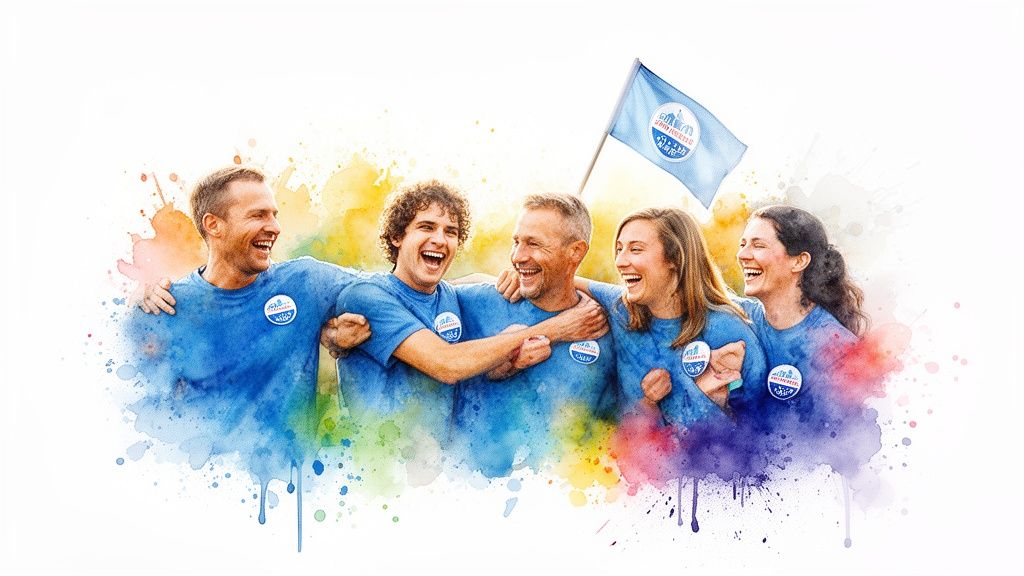
    Five diverse, joyful volunteers in blue shirts embracing, with colorful watercolor art splashes.

    At Litter Caterpillars, we're all about building friendships. Our inside jokes, our badges, and our consistent weekend cleanups create this incredible sense of belonging, like a sports team but with more trash bags. I have seen students who felt completely adrift find their closest friends here, bonding over a shared mission to serve all 50 Chicago wards. These are not flimsy connections. They are friendships forged in the trenches of shared purpose—and sometimes shared absurdity, like when our three co-founders bonded forever during that sudden hailstorm cleanup.

    How to Make it Happen

    • Pick a Ward and Stick With It: Show up at the same neighborhood cleanup consistently. Seeing the same faces week after week is the fastest way to turn strangers into friends.
    • Be Brave, Exchange Info: After a few cleanups, don't be shy. Suggest grabbing a coffee or swap social media handles to stay in touch.
    • Invite a Friend Along: Bringing a buddy can make the first time less intimidating, and the shared mission will strengthen your bond.
    • Get Involved Online: Jump into the group chats and follow the social media pages. Stay plugged into the community vibe between cleanups.

    This transforms the hunt for community from a stressful chore into a natural side effect of doing good. You can find more ideas for connection in our guide to community building activities for adults.

    5. Gain Real-World Environmental and Sustainability Impact

    Reading about climate change can leave you feeling powerless, like a tiny boat in a giant storm. You might wonder if anything you do even matters. When you volunteer with an organization like Litter Caterpillars, you get to see the immediate, undeniable results of your hard work. This is one of the most incredible benefits of volunteering for students: you witness environmental change with your own eyes, one filled trash bag at a time.

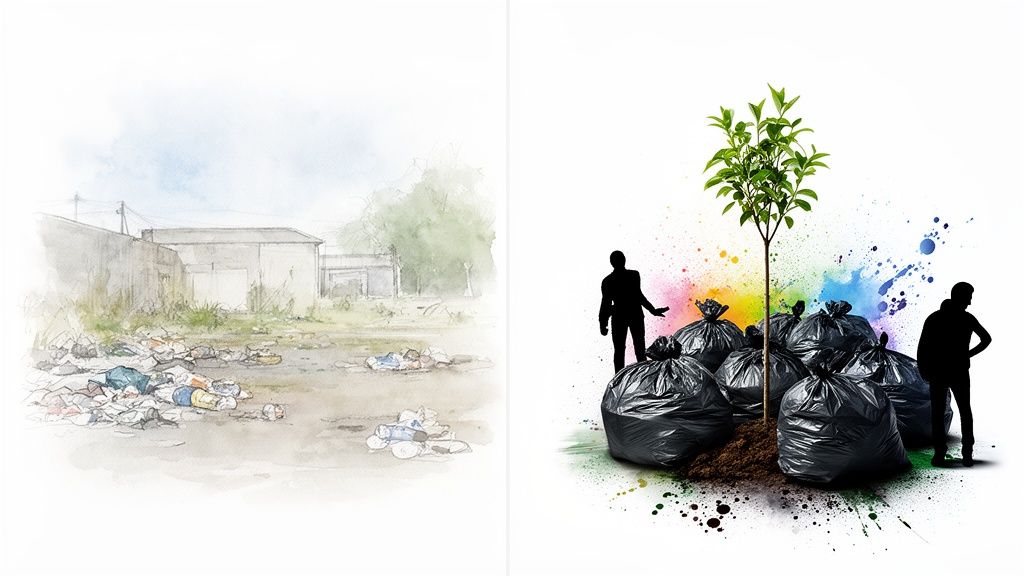
    Contrasting scenes: a polluted lot with trash on the left, and a planted tree, people, and trash bags with vibrant splatters on the right.

    This is not a theoretical discussion. This is direct action. You are physically removing garbage that chokes wildlife, reclaiming public spaces for people to enjoy, and stopping waste from clogging our city's arteries. I have seen our teams transform a neglected, trashed-out lot in Englewood into a beautiful community park. I’ve seen us collect literal tons of litter during a highway shutdown for a bike event. Your efforts create a measurable ecological impact and provide concrete proof that your actions are powerful.

    How to Make it Happen

    • Track Your Impact: Keep a personal log of bags you've filled or blocks you've cleared. Watching the numbers climb is insanely motivating.
    • Document Everything: Snap before-and-after photos of the areas you clean. This visual proof is gold for your portfolio or for sharing on social media to inspire others.
    • Understand the 'Why': Dig into local environmental issues. See how your cleanup work plugs into the bigger picture of urban sustainability.
    • Connect Your Actions: Realize that every piece of plastic you pick up helps protect local birds and improves water quality in our lake.

    This hands-on work transforms abstract environmental worries into a personal, winnable mission. You can explore a deeper understanding of these principles and learn more about what environmental stewardship means on our blog.

    6. Build Resilience and Overcome Fear Through Consistent Courage

    Academic pressure and life's sudden left turns can feel crushing. What if you could train your brain to see challenges not as walls, but as jungle gyms? This is another core benefit of volunteering for students: it builds real psychological armor. It’s about learning that fear, failure, and even suffering are not things to be dodged, but ingredients for a stronger, more interesting you.

    When you show up for a cleanup in a blizzard, with negative wind chills clawing at your face, you're doing more than just picking up trash. You are teaching yourself that you can handle discomfort. That you are tougher than you think. I will never forget our first hailstorm cleanup; that's when it hit me that suffering truly adds flavor to life and moves the plot forward. This mindset, forged in the crucible of Chicago weather, becomes a superpower you can use to ace exams, tackle tough projects, and face down any obstacle life throws at you.

    How to Make it Happen

    • Embrace Discomfort: Intentionally sign up for a cleanup on a day with "bad" weather. Consider it your resilience training ground.
    • Reframe Your Mindset: When you feel challenged, tell yourself, "This is making me stronger." Turn that negative inner voice into your personal hype man.
    • Share Your Fears: Be open with other volunteers about what scares you. Vulnerability is a superpower that builds incredible bonds and shows you you're not alone.
    • Transfer the Skill: Apply the same courage you used to face the freezing cold to that intimidating class presentation or that difficult conversation you've been avoiding.

    This is how you build an unbreakable spirit, one brave choice at a time. You can start practicing this unique form of courage at our next Litter Caterpillars cleanup event.

    7. Explore Chicago Neighborhoods and Discover Community Resources

    Your life as a student can easily become a bubble, trapped between campus and a few favorite haunts. Volunteering pops that bubble. It turns the entire city of Chicago into your living classroom. Imagine truly getting to know the diverse, vibrant soul of this city—from the murals of Pilsen to the lakefront trails of Rogers Park—not as a tourist, but as a community partner. This is a huge benefit of volunteering for students: it’s a ground-level education in urban geography and sociology.

    With Litter Caterpillars' mission to serve all 50 wards, you're not just cleaning a street; you are unlocking a new part of the city every single weekend. You will meet the small business owners who are the beating heart of their communities. You will learn from residents who have watched their neighborhoods change over decades. You will discover incredible local nonprofits you never knew existed. I have seen students find their favorite taco spot in Englewood after a cleanup or connect with a community garden in Humboldt Park that sparks a whole new passion. This is how you weave yourself into the real fabric of the city.

    How to Make it Happen

    • Be a Neighborhood Explorer: Intentionally sign up for cleanups in wards you've never even heard of. Make a goal to volunteer in a new corner of the city each month.
    • Talk to Locals: Ask long-time residents about their neighborhood’s story and what makes it special. Their memories offer insights you'll never find in a guidebook.
    • Support Local Businesses: After your cleanup, grab a coffee or a bite to eat at a neighborhood spot. It's a fantastic way to support the community you just served.
    • Document Your Journey: Take photos and jot down notes about what you discover in each neighborhood. It will deepen your love for Chicago’s incredible diversity.

    This transforms your service into an urban adventure, making you not just a student in Chicago, but a true Chicagoan. Ready to start exploring? Check out our upcoming city-wide cleanup events.

    8. Develop Practical Skills in Project Management and Event Coordination

    Your resume says you have "leadership skills," but what does that even mean? Volunteering is your chance to prove it. Forget abstract classroom theories; this is where you can manage a real project from start to finish. It’s one of the most practical benefits of volunteering for students because it gives you a low-stakes place to gain high-stakes professional skills. You are not just picking up trash; you are coordinating logistics, managing people, and executing a plan that gets real results.

    Imagine telling a future employer you organized a 50-person cleanup event across three different neighborhoods. You had to manage supplies, communicate schedules, pivot when the weather suddenly changed, and make sure everyone had a great experience. That is project management. When I see students step up to lead a ward cleanup, they are learning how to allocate resources, motivate a team, and track outcomes—skills that are directly transferable to any career path you can imagine.

    How to Make it Happen

    • Ask for Responsibility: Raise your hand to be a ward coordinator or help plan a special event. Leadership roles are often just waiting for someone to ask.
    • Document Everything: Create supply checklists, draft communication templates for volunteers, and track key metrics like attendance or bags collected. This is how you build your project portfolio.
    • Shadow an Expert: Learn from experienced coordinators. Watch how they handle curveballs and manage group dynamics before you take the lead yourself.
    • Master the Tools: Get comfortable using platforms like Meetup or group chats to manage RSVPs, send out updates, and keep your team fired up.

    This kind of hands-on experience is worth a thousand lines on a resume. You can start building these skills today by signing up to help lead a local cleanup at our volunteer opportunities page.

    9. Build Confidence and Self-Trust Through Demonstrated Accomplishment

    Classes and exams often test what you know in theory, which can leave you wondering what you're actually capable of in the real world. This is where volunteering offers one of its most life-changing benefits for students: it builds rock-solid confidence through tangible results. You are not just studying theories of social change; you are making change happen, one filled trash bag at a time. It’s about proving to yourself, through undeniable action, that you can make a real impact.

    When you see a park go from neglected to beautiful because of your work, that visual proof is electric. Our founder, Kevin Tao, started out feeling swamped by even the smallest tasks, but consistent, focused action turned that doubt into a city-wide movement. Each cleanup you do provides concrete evidence of your competence and your contribution. This feeling of self-efficacy doesn't stay in the park; it follows you into your exams, your interviews, and your future career challenges, reminding you that you are a person who can overcome obstacles and create real results.

    How to Make it Happen

    • Track Your Impact: Keep a running tally of your attendance or the number of bags you help fill. Seeing those numbers grow over months is undeniable proof of your dedication.
    • Take Before-and-After Photos: Document the spaces you help transform. Visually seeing the change you created is a massive confidence booster.
    • Celebrate Small Wins: Acknowledge every achievement. Filling your first bag. Making a new friend. Leading a small group. Each one is a brick in the foundation of your self-trust.
    • Journal Your Journey: Write down how you feel before and after a cleanup. Notice your own evolution from feeling nervous at your first event to feeling like a seasoned community leader.

    This process turns volunteering into a powerful personal development tool, transforming you just as you transform our neighborhoods. You can start your own transformation story at our next community cleanup event.

    10. Learn Kindness, Unity, and Service-Oriented Values Through Practice

    You can read about values like kindness and unity in a book, but you can only truly learn them by living them. This is where volunteering becomes more than a resume booster; it becomes a character-building forge. It is your chance to actively practice service-oriented values in a community that lives and breathes them, transforming who you are from the inside out. This is one of the most profound benefits of volunteering for students: it’s a workout for your integrity.

    At Litter Caterpillars, I see this magic happen every single weekend. Our "volunteer-first" philosophy means we put your safety and happiness above everything else, rejecting the typical donation-based model to keep the focus purely on service. This culture is deliberate. By showing up on a Saturday morning, you are choosing to be part of a group that values community over comfort. You are internalizing principles not through lectures, but through repeated choices—like deciding to help a new volunteer or working together to clear a tough spot. These small actions build a foundation of character that will guide your decisions for the rest of your life.

    How to Make it Happen

    • Notice Values in Action: Pay attention to how people treat each other. See how decisions are made. Ask yourself what principles are guiding this group.
    • Discuss What You See: Talk with other volunteers about the values you observe. These conversations make your own commitment deeper.
    • Reflect on Your Growth: After each event, take a moment. Think about how your own choices reflected values like kindness or teamwork.
    • Bring Values Elsewhere: Apply the service-oriented mindset you're building to your studies, your friendships, and your future career.

    This is not passive learning; it is an active process of becoming a more compassionate and community-minded person. You can start building your character with us at our next neighborhood cleanup event.

    10-Point Student Volunteering Benefits Comparison

    Program 🔄 Implementation complexity ⚡ Resource requirements 📊 Expected outcomes ⭐ Ideal use cases 💡 Key tips
    Build Professional Network and Career Connections Low–Medium: recurring meetups + informal outreach Low: weekly time, basic social tools New professional contacts, mentorships, internship leads Students seeking internships, career connections Attend consistently, share goals, connect on socials
    Develop Leadership and Responsibility Through Consistent Commitment Medium–High: sustained commitment, coordination roles Medium: time, coordination skills, minimal admin tools Verifiable leadership experience, project ownership Applicants needing leadership evidence, résumé builders Start with steady attendance, volunteer as ward coordinator
    Improve Mental Health Through Outdoor Service and Community Connection Low: simple to join but needs routine Low: time, outdoor attire, travel to sites Reduced anxiety/isolation, improved routine and resilience Students needing routine, mood support, social contact Commit 4–8 weeks, practice mindfulness, bring a friend
    Create Lasting Friendships and Find Your People Low: social engagement through repeat attendance Low: time, participation in events Deepened friendships, sense of belonging Students seeking authentic social networks Attend same ward regularly, exchange contacts, join events
    Gain Real-World Environmental and Sustainability Impact Medium: scalable logistics for measurable projects Medium–High: supplies, coordination, data tracking Tangible cleanup results, park creation, local ecological benefits Environmental coursework, civic engagement, advocacy Track metrics, take before/after photos, partner with orgs
    Build Resilience and Overcome Fear Through Consistent Courage Medium: repeated exposure to discomfort required Low: time, willingness to face challenging conditions Increased grit, growth mindset, greater tolerance for adversity Personal development, resilience training Start with a challenging cleanup, reframe discomfort as growth
    Explore Chicago Neighborhoods and Discover Community Resources Medium: travel logistics across wards Medium: time, transport, basic research Geographic knowledge, community contacts, resource discovery Urban studies, local internships, community research Research wards beforehand, talk with residents, take notes
    Develop Practical Skills in Project Management and Event Coordination High: complex logistics, multi-ward planning Medium: tools, communication platforms, leadership time Project management experience, logistics and budgeting skills Students pursuing nonprofit/business/administration roles Volunteer for coordinator roles, document processes, track metrics
    Build Confidence and Self-Trust Through Demonstrated Accomplishment Low–Medium: consistent participation and reflection Low: time, tracking tools (simple log/journal) Improved self-efficacy, reduced imposter syndrome Those building self-confidence, preparing applications Log attendance and outcomes, celebrate small wins, journal progress
    Learn Kindness, Unity, and Service-Oriented Values Through Practice Low: cultural immersion via repeated service Low: time, engagement in community norms Internalized service values, stronger ethical habits Character development, values-based leadership Discuss values with peers, reflect, model behaviors consistently

    Ready to Start Your Transformation? Here’s Your First Step.

    You’ve reached the end of this list. But you’re really standing at a new beginning. We’ve journeyed through ten powerful benefits of volunteering for students, blowing past the simple resume boost. We've seen how picking up a single piece of litter can be the first move in building a professional network, developing unshakeable confidence, and finding friendships that feel like coming home.

    This isn't just a theory. It's your map. Think of your life as a tangled ball of yarn. Each thread is a different part of you: your career dreams, your hunger for connection, your need for purpose, your mental health. Volunteering is the act of gently pulling on just one of those threads. As you pull, you find it’s connected to all the others. And slowly, the entire knot begins to loosen, revealing a clear, strong line.

    Your Path from Insight to Impact

    The journey from reading this article to changing your life is paved with one simple action: showing up. The gap between the person you are right now and the person you want to become isn't some giant chasm you have to leap across. It's just a series of small, doable steps.

    • You learned that consistent commitment builds leadership. Your first step is to sign up for just one event. Forget next month. Just focus on this weekend.
    • You saw how service forges real friendships. Your first step is to smile and say "hello" to the person working next to you.
    • You discovered that small actions build self-trust. Your first step is to pick up one bag of trash and feel that immediate rush of a job well done.

    This is the real secret behind the benefits of volunteering for students. The transformation isn't a lightning strike. It is the gentle, persistent growth that comes from planting a seed and actually tending to it. We are the Litter Caterpillars because we believe in this process of metamorphosis. We aren't perfect people. We are just people trying to grow. To become something more. Through service, you learn to trust yourself, forgive your past mistakes, and build a life defined not by your plans, but by your purpose.

    It all starts with that first courageous step. You don't have to have it all figured out. You don't have to be the most outgoing person there. You just have to be willing. Your future self is waiting for you to take this chance. Let’s get to work.


    Ready to take that first step and experience the benefits of volunteering firsthand? Join Litter Caterpillars at our next Chicago cleanup. Find an event and connect with a community dedicated to transformation by visiting our website at Litter Caterpillars.

  • Volunteer tips for volunteer work on saturdays to start a weekend habit

    Volunteer tips for volunteer work on saturdays to start a weekend habit

    Finding meaningful volunteer work on saturdays can feel like the perfect cure for a chaotic work week. I know you're looking for a way to trade a few hours of your weekend for a feeling of purpose, of real connection, of making a dent in a problem you can actually see. This guide is all about helping you find that perfect fit, a place where you belong.

    Your Weekend Can Be More Than Just An Escape

    I know how it feels. The work week is a frantic blur of deadlines and demands, and Saturday is your one sacred day to just breathe. To escape. But what if I told you that giving away just a couple of hours on a Saturday morning could actually give you more energy back than sleeping in ever could?

    Let me tell you my story. A few years ago, I hit a wall. My life felt like a cluttered room I just couldn't figure out how to clean. A long, draining relationship had just cratered, leaving me feeling… well, stuck. I knew I needed to change something fundamental about how I spent my time. I had to build consistency, find some courage, and surround myself with genuinely good people who showed up.

    So, on a whim, I did something that felt totally radical to me then. I signed up for a Saturday morning trash pickup.

    A Surprising Discovery in the Rain

    That first day, it was just me and two other souls. And within an hour, a classic Chicago storm rolled in—a bizarre, biting mix of freezing rain and hail. We were huddled under a tree, shivering, watching Ubers cancel on us one by one. It was miserable. But in that misery, something incredible happened. I realized that cleaning up someone else’s mess was a lot simpler, a lot more direct, than trying to untangle my own.

    That shared struggle, that moment of absurd "fun," became a turning point for me. It taught me a few things pretty quickly:

    • Action Creates Clarity: Focusing on a simple, physical task cleared my head in a way that just thinking about my problems never could. It was like meditation, but with a trash grabber.
    • Shared Hardship Builds Bonds: The freezing rain was a better icebreaker than any forced small talk. It created an instant "we're in this together" feeling that was raw and real.
    • Purpose Is Energizing: I went home cold and wet, but I felt more alive than I had in months. I had turned my weekend into something that mattered.

    That day, I learned that a Saturday morning doesn't have to be an escape from your week. It can be the foundation for a better one. It’s about building a life you don't need to escape from.

    This isn’t just about picking up litter. It’s about you finding a rhythm of service that grounds you. It’s a way to meet people who show up, who care, and who, like you, want to make things a little bit better.

    If you're ready to start this journey, learning how to find volunteer work is the essential first step. This guide will help you discover that perfect opportunity to make your weekend mean something more.

    Finding Your Volunteer Tribe

    So, you’re ready. You've decided to trade a lazy Saturday morning for a meaningful one, but that big question is hanging in the air: where do you even start? It can feel like searching for a specific book in a library with no catalog. I get it. When I first started, I felt the exact same way.

    The good news is, you’re looking at the perfect time. The world has shifted, and organizations finally understand that you need flexibility. Short, predictable shifts—like a couple of hours on a Saturday—are becoming the new normal for volunteering. It’s no surprise that formal volunteering in the U.S. shot up by a massive 22.1% between 2022 and 2023. This boom is happening because groups are finally offering these manageable, weekend-friendly roles that actually fit into your life.

    My own group, Litter Caterpillars, was born on Meetup. I think it's a fantastic place to start because it’s built around shared interests and community, not just tasks. You get a real feel for a group's personality before you even show up. But don't sleep on the old-school approach, either.

    Where To Find Your People

    Finding the right group is like finding a good pair of shoes; they have to fit your style and your energy. To help you zero in on your perfect match, here's a quick rundown of the most effective places I've found to look.

    Where To Find Your Saturday Volunteer Crew

    Platform Best For What to Look For
    Online Platforms Niche interests & city-wide groups Use filters for "Saturday" or "weekend" on Meetup, VolunteerMatch, and local Facebook groups.
    Community Boards Hyper-local neighborhood projects Check the bulletin boards at your local library, coffee shop, or community center for flyers.
    Nonprofit Websites Supporting a cause you already love Look for a "Volunteer" or "Get Involved" page on the websites of your favorite animal shelters or food banks.

    These are the big three, and mixing and matching them is usually the fastest way you'll find a group that clicks. You might find a big park cleanup on Meetup one week and then spot a flyer for a small community garden project the next. Keep your eyes open!

    This image really captures the three core elements that make Saturday volunteering so powerful.

    A graphic about Saturday volunteering, highlighting consistency, courage, and community themes.

    It’s all about consistency, courage, and community coming together. When you find a group that nurtures all three, you’ve hit the jackpot.

    Spotting Red Flags and Green Lights

    As you start exploring, you have to be a bit of a detective. Not all groups are created equal, and the vibe matters more than you think. A great organization makes you feel valued from the first email; a bad one makes you feel like just another cog in a machine.

    A huge green light is a group that puts its volunteers' happiness and safety first. If their first message is an ask for a donation, or they seem disorganized and never reply, that’s a big red flag. You're giving your most valuable asset—your time. It should be respected.

    Look for a crew with a clear mission and a welcoming vibe. Do they post photos of smiling volunteers? Do they share stories about their impact? These are signs of a healthy, thriving community where you won't just be volunteering—you'll feel like you belong.

    If you want to see some concrete examples, we’ve put together a list of great weekend volunteer opportunities near me.

    Navigating Your First Day With Confidence

    Walking into a group of total strangers can be terrifying. I still get flashbacks to my first time—that awkward hesitation, the internal debate about whether I’d know anyone, or if I’d just end up glued to my phone to avoid eye contact. It’s basically the first day of school all over again, but for adults.

    Let’s walk through it together. My goal here is to get you so prepped that you can show up feeling less like a nervous newcomer and more like you actually belong. This isn't just about showing up; it's about owning it.

    A smiling young man, a volunteer, in a safety vest and gloves holding a bottle and can, amidst colorful watercolor splashes.

    What To Bring And Wear

    First, let's get the practical stuff out of the way. Think of this as your personal adventure kit. For any volunteer work on Saturdays, especially somewhere like Chicago where the weather has a personality of its own, layers are your best friend. Seriously.

    A comfy t-shirt, a hoodie or fleece, and maybe a light jacket will let you adapt to whatever the morning decides to do. You’ll be moving, bending, and lifting, so wear clothes you don’t mind getting a little dirt on.

    Here’s a quick-and-dirty checklist for your bag:

    • A reusable water bottle. You’ll be surprised how thirsty you get.
    • A small snack, like a granola bar. A little fuel goes a long, long way.
    • Your phone, fully charged. For directions, photos, and swapping numbers with new friends.
    • An open mind. Honestly, this is the most important thing on the list.

    Breaking The Social Ice

    Okay, now for the part that trips most people up: talking to strangers. Here's the secret—the beauty of volunteering is that the work itself is the ultimate icebreaker. You don’t need some clever opening line when you can just turn to the person next to you and ask, "Hey, have you seen any other plastic bottles over here?"

    The shared task completely removes the social pressure. I've seen the shyest people I know absolutely blossom when they’re focused on a common goal right alongside someone else. The minute you put on your gloves, you’re already a team.

    It's completely okay to just listen at first. You’re there to contribute, not to perform. Your presence alone says you care, and that’s the only introduction you really need.

    And remember this: every single person there was new once. The volunteer working next to you probably felt the exact same way on their first Saturday. They aren’t judging you; they’re just happy to have another set of hands. You’ve already done the hardest part by stepping out of your comfort zone.

    How To Turn One Saturday Into A Lasting Habit

    One awesome Saturday of volunteering feels great. But a real habit of showing up? That's life-changing. Let’s be real, though—how do you make it stick when your calendar is a mess and your bed is screaming your name?

    It’s not about having some kind of superhuman willpower. It's about building a system so simple and rewarding that showing up feels way easier than staying home. Think of it like learning to play guitar. You don't start by shredding a crazy solo; you start with basic chords until it becomes muscle memory.

    Building Your System For Showing Up

    Your first few Saturdays are all about laying down the tracks. You want to make the path to volunteering so ridiculously smooth that you just glide right into it. The whole point is to kill every little bit of friction that could give you an excuse to bail.

    Here’s the simple system I stumbled into:

    • Prep The Night Before: I lay out my "volunteer uniform"—old jeans, a comfy shirt, sturdy boots—before I even think about going to bed. This one tiny step saves my groggy Saturday morning brain from having to make a single decision.
    • Link It To A Reward: My post-cleanup ritual is grabbing a coffee from a favorite local spot. This anchors the whole experience with something I genuinely look forward to, turning the morning into a positive feedback loop.
    • Put It In Your Calendar: Seriously, treat it like a doctor's appointment you can't miss. That little block on your digital calendar is a promise you’re making to yourself and your community.

    The Power Of A Shared Struggle

    Consistency isn't just about showing up on the sunny days. It’s forged in those moments when you’d rather be literally anywhere else.

    I'll never forget our first "official" Litter Caterpillars event. It was a classic Chicago spring day that turned on a dime—one minute it was cloudy, the next we were getting pelted with actual hail.

    There were only three of us, huddled under a tree, just laughing at how absurd it all was. We were cold, soaked, and pretty miserable. But that shared struggle bonded us more than a hundred perfect, sunny days ever could have. We had a story.

    That’s the secret sauce. When you show up on the hard days—the rainy, cold, or just plain "I don't feel like it" days—you’re not just picking up trash. You’re building resilience and a deep, unspoken trust with the people right there next to you.

    This is why volunteer work on saturdays becomes such a huge deal globally. Big international networks often mobilize thousands of people for city-wide service campaigns on specific Saturdays to maximize this shared energy. For instance, some groups coordinate an annual Global Volunteer Day on a Saturday in May, getting people in dozens of cities to serve their communities all at once.

    Finding Your Accountability Partner

    Somewhere in your new volunteer tribe, find one person who makes you want to show up. This doesn't have to be some formal thing. Just find someone whose energy you vibe with and make a point to check in. A simple "See you Saturday?" text can be the nudge you both need.

    This person becomes your anchor. They're living proof that you’re part of something real. Celebrate the small wins together—a ridiculously clean block, a hilarious story from the morning. These little moments are the glue that holds the habit together.

    And for those of you leading groups, we have a whole guide on volunteer retention strategies that digs way deeper into this idea.

    The Unexpected Rewards Of Showing Up Consistently

    You might sign up for your first Saturday morning volunteer gig thinking it’s about cleaning up a park or planting a tree. That’s what I thought, too. But after years of doing this, I can tell you that the real payoff has almost nothing to do with the task itself.

    The magic is in the consistency. It’s what happens when you show up again and again, especially on the days you really don't feel like it.

    Happy man and woman smiling while planting a small green tree, hands in the soil.

    You Build Real Resilience

    Something powerful happens when you willingly face a little discomfort. Dragging yourself out of bed on a drizzly, gray Saturday morning to do something for someone else builds a kind of inner strength that spills over into every other part of your life.

    It's like a workout for your soul.

    That project you’ve been avoiding at work? Suddenly, it doesn’t seem so bad compared to picking up trash in 40-degree rain. You learn that a little hardship won’t break you. In fact, it makes you stronger, more capable, and a whole lot less likely to quit when things get tough anywhere else.

    You Find Your People, Not Your Network

    Forget those awkward networking events. The friendships you forge while doing volunteer work on Saturdays are different. They're built on a foundation of shared action and shared values, not on what you can do for each other professionally.

    These are the people who see you at your most authentic—sleepy-eyed, wearing old clothes, and totally focused on a common goal. This shared purpose strips away all the pretense. You’re not trying to impress anyone; you’re just trying to get the job done, together.

    This isn’t networking; it's community. It’s the kind of genuine connection we’re all starving for, found not over cocktails, but over a shared pair of work gloves and a desire to make things a little bit better.

    You Take Ownership Of Your City

    Finally, there’s an incredible sense of pride that comes from consistently caring for your community. You start to see the city not just as a place you live, but as your place. That park isn’t just some random patch of green; it’s the park you helped clean.

    This feeling connects you to something much bigger than yourself. It’s a powerful antidote to feeling small or helpless in a huge city.

    And this is why Saturday volunteering is so widespread. In just one year, about 75.7 million U.S. adults volunteered, with a huge chunk of them giving up a slice of their weekend. Organizations know that scheduling recurring Saturday shifts is a strategic choice—it attracts people willing to sacrifice leisure time, which is a strong predictor of long-term commitment. You can check out some fascinating volunteer statistics on ActivateGood.org that show just how much this time is valued.

    You’re not just a resident anymore. You become a guardian, a caretaker, and an active participant in the story of your neighborhood.

    Answering Your Questions About Saturday Volunteering

    Got questions spinning around in your head? Good. That means you’re actually thinking about this. It means you’re on the verge of doing something incredible.

    I’ve heard a lot of the same worries pop up over the years, so let’s just tackle them head-on, right now. Think of this as our little pre-game huddle. Once we get these out of the way, you’ll be ready to jump in.

    What If I Can’t Commit To Every Single Saturday?

    This is the big one. And the answer is simple: don’t. That’s totally fine.

    Any group worth your time will never, ever pressure you to show up. My whole philosophy is "come when you can." Your time is a gift, not a contract. Honestly, showing up just one Saturday a month is huge. It all adds up.

    The goal isn't perfect attendance; it's finding a crew that gets it. A place that’s just happy to have you when you can make it. It’s about contribution, not checking a box.

    I’m Shy And Awkward Around New People. Is This Really For Me?

    Yes. Absolutely. In fact, volunteering might just be the best place for introverts.

    This isn’t some loud party where you have to force small talk. Here, we have a job to do. We have a shared mission. You can just focus on the task—picking up the trash, pulling the weeds, whatever it is—and the conversation just… happens. It grows naturally out of the work.

    There's zero pressure to be "on." Some of our most dedicated people are the quiet ones who just love getting in the zone and making a difference.

    The task is the icebreaker. When you're working side-by-side toward a common goal, the connection builds itself. You don’t have to force a thing.

    Do I Need Special Skills Or My Own Equipment?

    For the kind of volunteer work on saturdays we do, like a neighborhood cleanup, you need zero special skills. I'm serious. If you can show up, you’re qualified.

    We’ve got all the gear you’ll need: gloves, bags, grabbers, the works. Just bring a good attitude. That’s the real beauty of this—it’s simple, direct, and you can see the impact you’ve made by the end of the morning. No experience necessary.

    What If The Weather Is Bad On Saturday Morning?

    Ah, my favorite question. This is where the real magic happens.

    We go out rain or shine, cold or heat. I’m telling you, pushing through a little bad weather together is what forges the strongest bonds. It gives the group a story. You’ll be laughing about that time it hailed on you in May for years to come.

    Of course, safety is always priority number one. We’ll cancel for anything truly dangerous like lightning. But overcoming a little discomfort? That shows you what you’re made of. Those are the days you remember.


    At Litter Caterpillars, we live these principles every single weekend. We’re the volunteer crew out there cleaning up Chicago, building a community of brave, kind people who aren’t afraid of a little hard work.

    If you’re ready to see what your Saturdays can really be, we’d love for you to join us. Find our next event and become part of the story at https://www.littercaterpillars.com.

  • How to Find Volunteer Work That Truly Inspires You

    How to Find Volunteer Work That Truly Inspires You

    That little whisper inside you, the one nudging you to do something that matters? That’s not just a fleeting thought. It’s the starting line of a really cool adventure.

    But here’s a secret I’ve learned: finding volunteer work that actually feels good isn't about luck. It’s about looking inward first, before you even start looking around. This guide is all about helping you connect what you care about with a real-world need. It's a LOT easier to make an impact than you think. And it's FUN!

    Find Your Why Before Your Where

    That desire to contribute is a powerful thing. But for a lot of us, it gets stuck right at the beginning. The options feel endless, the path is foggy, and we just keep asking, "Where do I even begin?" It's easy to get paralyzed.

    A thoughtful young woman sits at a wooden desk with a backpack, open notebook, and compass.

    The trick is to flip the question. Forget "where" for a minute. Let's start with "why."

    Think of it like planning a road trip. You wouldn’t just start driving. You'd pull out a map and decide on a destination first, right? Your "why" is your destination—it tells you which direction to point the car.

    Figure Out What Really Drives You

    Your personal mission is your compass. Once you know what you genuinely care about, the whole search process transforms from a chore into a treasure hunt for a role that feels like it was made for you.

    To get there, ask yourself a few honest questions:

    • What breaks your heart? Is it seeing trash all over your favorite park? Thinking about lonely animals in shelters? Or seeing kids in your community who could use a mentor?
    • What skills do you actually enjoy using? Do you get a weird satisfaction from organizing chaotic spaces? Are you a natural at striking up conversations with new people? Do you love getting your hands dirty outside?
    • What kind of change do you want to see? Are you looking for a tangible result, like a freshly painted community center, or a deeper personal connection, like helping someone learn to read?

    Answering these helps you find your lane. If animals are your thing, you can laser-focus on local rescues. If you're happiest outdoors, environmental cleanups are your jam. This isn’t about limiting yourself; it’s about aiming your energy where it will have the biggest impact—both on the world and on you.

    Before you start searching, take a moment to think about what truly motivates you. This table is a quick way to help you connect your personal passions with potential volunteer roles.

    Your Volunteering Compass: What's Your 'Why'?

    If You Love… You Might Enjoy Volunteering For… Keywords to Search
    Animals & Nature Animal shelters, park cleanups, wildlife rehab centers, community gardens "animal rescue," "trail maintenance," "urban gardening"
    People & Community Food banks, homeless shelters, mentoring programs, senior centers, local festivals "food pantry," "youth mentor," "community event"
    Hands-On Projects Building homes (like Habitat for Humanity), painting murals, repair cafés "community build," "beautification project," "fix-it clinic"
    Skills & Organization Tutoring, helping with taxes, grant writing, event planning for a non-profit "tutor," "VITA volunteer," "non-profit event"

    Thinking this through first makes the search way less overwhelming and way more exciting. You’re not just looking for any opportunity; you’re looking for your opportunity.

    The most powerful impact comes from a place of genuine connection. When your heart is in the work, it stops feeling like work and starts feeling like purpose.

    And you're definitely not alone in feeling this way. People are showing up. Formal volunteering in the U.S. jumped to 28.3% of adults between 2022 and 2023. That’s 75.7 million people—a massive 22% spike from 2021. You're becoming part of a huge, kind-hearted movement. You can discover more insights about the state of volunteering from SignUpGenius.

    So, let's use this guide as your map. We'll explore exactly how to find volunteer work that lights you up, making the experience not just helpful for others, but deeply rewarding for you, too.

    Discover Opportunities Beyond a Google Search

    Alright, you're ready to jump in. While a quick Google search is an obvious first step, the truly rewarding stuff—the opportunities that stick with you—are usually hiding just out of sight.

    Think of it like trying to find the best local pizza joint in a new city. You could look at the flashy ads, or you could ask a friend who lives there where the real hidden gems are. Let's be that friend. This is about finding the groups making a real, tangible difference, block by block.

    Tap into Specialized Volunteer Platforms

    The internet isn't just for cat videos; it's also home to massive databases designed to connect good people with good causes. These platforms are basically matchmaking services for your skills and passions. Instead of scrolling forever, you can use their filters to find exactly what you're looking for.

    Two of the best places to start are:

    • VolunteerMatch A huge network that lets you filter by cause, location, and even whether you want to help out online or in person.
    • Idealist This site is fantastic for finding not just volunteer roles but also jobs and internships with non-profits and mission-driven organizations all over the world.

    These hubs are clutch, especially now. The whole game is changing—short-term, flexible roles are getting super popular. In fact, 18% of formal volunteers now serve online. Platforms like these get it, and they’re making it easier than ever to connect people to the right opportunities. You can learn more about these volunteering statistics from ActivateGood.

    Here’s a peek at what you’ll see on VolunteerMatch. Notice how you can immediately start narrowing things down by what you care about and where you are.

    Overhead view of a volunteer app on a smartphone, coffee, and three papers with watercolor art.

    They put the "Cause" and "Location" filters right up front, so you don't waste time sifting through things that aren't a good fit.

    Go Hyper-Local for Maximum Impact

    While the big platforms are great, sometimes the real magic happens at the grassroots level. Your own neighborhood is probably buzzing with chances to help out, and these are the opportunities where you can see the impact of your work every single day.

    The most profound changes don’t always come from the biggest organizations. They come from a few dedicated people deciding to show up for their own street corner, their own park, their own community.

    Think smaller. Maybe even go analog. Here’s where to look:

    • Your Local Library: Seriously. Libraries are community cornerstones. Check the bulletin board for flyers from local groups needing help, from book clubs for seniors to tutoring programs for kids.
    • Community Facebook Groups: Search for your neighborhood’s name on Facebook. These groups are constantly sharing info about local cleanups, food drives, and events that need a few extra hands.
    • Meetup: This app isn't just for hiking clubs or learning to code. It’s a powerhouse for finding service-oriented groups, like our own Litter Caterpillars, who organize weekend cleanups all over Chicago. If you're in the area, you can check out some of our volunteer opportunities in Chicago and see what I mean.

    Finding volunteer work this way just feels different. You’re not just a name on a list; you’re a neighbor. You're meeting the people you're helping and building real friendships with fellow volunteers. This is how a one-time event can spark a lifelong passion for service. It’s authentic, it’s fun, and it’s right outside your door.

    Your Day Job Might Be Your Secret Volunteering Weapon

    What if you could make a real difference, not just on your weekends, but on the company clock? It sounds a little wild, I know. But one of the best-kept secrets for finding meaningful volunteer work is sitting right under your nose: your employer.

    Most of us never think to connect our 9-to-5 with our desire to give back. We keep those worlds separate. But more and more companies are building that bridge through corporate volunteering programs, and you should absolutely take advantage of it.

    This isn't just about a once-a-year "service day" photo-op. It’s a structured way to lend your professional skills to causes that desperately need them.

    Turn Your Professional Skills into a Superpower

    Think about it this way: your knack for project management could help a local food pantry organize its biggest donation drive ever. Or your coding skills could build a slick new website for an animal shelter, helping more dogs find their forever homes. That’s the ultimate win-win.

    You get to sharpen your skills in a totally new environment, your company gets to build a culture that isn't just about profits, and a cause you care about gets expert-level help they could never afford otherwise. It’s about turning what you do every day into a genuine force for good.

    You are an expert in something. Whether it's wrangling spreadsheets, writing clearly, or leading a team, those professional skills are like superpowers to a nonprofit running on a shoestring budget.

    This whole idea is catching on, big time. Corporate volunteering is booming, with 61% of CSR professionals reporting a jump in employee participation for 2025—the third year in a row it's grown. If you want to see the numbers for yourself, you can read the full report from Goodera on corporate volunteering. This movement is real.

    How to Find Out What Your Company Offers

    So, how do you tap into this? It’s way easier than you think. You just have to be brave enough to ask. Your Human Resources or People Operations department is the best place to start.

    Here’s exactly what to ask to get the ball rolling:

    • "Do we have a Volunteer Time Off (VTO) policy?" This is the holy grail—paid time off specifically for volunteering. It’s the clearest sign that your company actually backs this up.
    • "Are there any company-sponsored service days coming up?" These group events are a fantastic way to dip your toes in and meet other people at your company who actually care.
    • "Does the company help match our professional skills with nonprofits?" Some really forward-thinking places will actively connect your talents with organizations that need them.
    • "Is there a matching program for employee donations?" While it's not volunteering your time, it shows the company is willing to put its money where its mouth is.

    Don't be shy about starting this conversation. You're not just asking for a perk; you're showing that you’re invested in representing the company's values out in the real world.

    And who knows? You might even be the spark that gets a program started if one doesn't exist yet. That’s how real change happens—with one person having the guts to ask, “How can we help?”

    Make Your First Contact with Confidence

    Okay, you've found them. An organization that actually gets you excited. Now it's time to reach out and say hello.

    I get it. This part can feel like you're gearing up for a first date—a little awkward, with a lot of pressure to make a good first impression.

    Let's flip the script on that. You are not an inconvenience. You are the person they've been hoping would show up. These groups genuinely need people just like you, and that first "hello" is really just a warm handshake waiting to happen.

    Overhead shot of a person working on a laptop with a notebook, pen, coffee, and envelope.

    Ditch the Robot and Sound Like a Human

    Your first message doesn't need to read like a stuffy cover letter. It just needs to be human. The goal is to show you’re enthusiastic and dependable without sounding like you’re applying for a corporate gig.

    Keep it simple and sincere. Here's a quick message you can steal and tweak:

    Subject: Eager to Volunteer!

    "Hi [Organizer’s Name],

    I was so excited to find [Organization’s Name]! I’m really passionate about [Your 'Why' – e.g., cleaning up our parks, helping animals] and would love to get involved with your upcoming [Event Name or general need].

    I’m available [mention your general availability, like 'most Saturday mornings']. Please let me know the best way to get started.

    Looking forward to helping out!

    Best,
    [Your Name]"

    That's it. It’s friendly, direct, and gets straight to the point. No fluff needed.

    Your First Contact Checklist

    Before you hit 'send' or show up for your first day, take a moment for a quick gut check. Volunteering should fill your cup, not drain it. You deserve to feel safe, valued, and genuinely excited. If something feels off, trust that feeling.

    Your time and energy are precious gifts. Be brave enough to offer them to an organization that truly honors and protects that generosity.

    Before you commit, run through this quick safety and fit check. It'll help you make sure this is a good match for you.

    Checklist Item Why It Matters What to Look For
    Clear Communication It shows they respect your time and know how to set expectations. Do they respond in a reasonable time? Is the event info clear and easy to find? Or is it a confusing mess?
    Safety First Your well-being is non-negotiable. Period. Do they mention safety guidelines? Provide gear (like gloves or vests)? Is the location public and well-lit?
    Good Vibes You should feel welcomed, not like you're crashing a party. Is their language friendly and inclusive? Do photos from past events show people who look genuinely happy and engaged?

    This little bit of homework upfront can save you a ton of hassle later and get you plugged into a group where you'll actually thrive.

    Finding your footing is all part of the journey. For more guidance on making your volunteer experience a great one, check out our collection of valuable volunteer tips. This is about finding your people and your place.

    Making Your First Day Count

    Showing up to something new is always a trip.There’s that mix of excitement and a low-key fear simmering in your gut. Will I know what to do? Are the other people cool? What if I totally screw up?

    Let's just toss that whole script out the window right now.

    Two smiling professionals in work attire shaking hands, representing partnership and successful collaboration.

    Your first day volunteering isn't some high-stakes test. It's just page one of a new story. Your only job is to be open, listen, and learn what’s going on.

    Think of it like being a guest in someone's home. You wouldn't just walk in and start rearranging their furniture, right? You're there to help out and respect their vibe. The best way to do that is just to be present and pay attention.

    Your First-Day Game Plan

    Walking in with even a loose plan can totally dissolve those first-day jitters. Don't overthink it. Just focus on a few simple things that will set you up to have a good time and actually connect with the people there. It’s all about showing up ready to be a kind, engaged part of the crew.

    Here’s a quick checklist to get you squared away:

    • Dress the part. If you're cleaning up a park, wear clothes that can get muddy and shoes that won't fall apart. If you’re helping in an office, dress comfortably but respectfully. When in doubt, just shoot the organizer a message and ask.
    • Bring your gear. A water bottle, a snack, and your phone (with a full battery) are non-negotiable. Leave anything valuable or sentimental at home—you don't need that stress.
    • Get there a little early. This gives you a minute to breathe, find the bathroom, and maybe meet the organizer before the chaos begins. It's a small thing that makes a huge difference.

    This isn’t about being perfect from the jump. It’s about being ready to learn something new.

    Ask Questions, Listen, and Connect

    Honestly, your best tool on day one is just being curious. The volunteer coordinator is your new best friend—they want you to ask questions. It shows you’re paying attention and actually want to do things right.

    The most valuable thing you bring isn't your expertise; it's your willingness. A curious mind and a kind heart are the only qualifications you truly need.

    But don't just ask "what do I do?" questions. Try to connect on a human level. Ask the organizer what got them into this work in the first place. That one question can open up a killer conversation and give you a much deeper feel for the mission.

    And definitely make an effort to chat with the other volunteers. A simple, "Hey, is this your first time here too?" is the easiest way to start a real friendship. These are your people. They showed up for the same reasons you did. They're your tribe.

    By the end of the day, you won't just know your tasks. You'll have started building those genuine human connections that make this whole thing so damn rewarding. It’s not just about the work; it’s about the people you do it with. That’s where the real magic is.

    Turn Volunteering into a Joyful Habit

    You know that feeling right after you finish volunteering? That glow? It’s real. It’s a mix of pride, connection, and pure, simple joy. But how do you keep it going? How do you stop it from being just a one-time thing?

    The secret isn’t about gritting your teeth and forcing yourself to do more. It’s about finding a rhythm that actually gives you energy. This is how you turn a single act of kindness into a sustainable, life-giving habit.

    Find Your People and Your Pace

    The people who stick with volunteering for years don't treat it like a second job. They treat it like seeing their best friends.

    The biggest piece of the puzzle is finding your community. When you're surrounded by people you genuinely like, the work itself completely changes. Picking up trash on a Saturday morning isn't a chore anymore; it’s an excuse to catch up, laugh, and share stories with your crew.

    The work is the excuse. The connection is the reason. Find a group where you feel like you belong, and you’ll never have to force yourself to show up again.

    This is how a simple activity becomes a tradition, something you actually look forward to. It becomes an anchor in your week, a source of stability and friendship. That consistency—even if it's just a few hours a month—is what builds the momentum that changes both you and your community.

    Let Your Role Evolve with You

    Life happens. You get busy, your priorities shift, and your capacity to give will change over time. That’s not just okay; it’s completely normal. The bravest thing you can do is be honest about what you can offer.

    A good organization won’t guilt you for needing to step back. They’ll thank you for the time you’ve given and leave the door open for your return. The goal isn’t to be a perfect volunteer; it’s to be a human one.

    Maybe you start out showing up every single weekend. Then, a new job means you can only make it once a month. That’s not a failure—that’s just adapting.

    Perhaps your role itself changes. One year you’re all about the physical work, and the next you find more joy helping organize the events. Your journey as a volunteer should grow and change right alongside you.

    My friend Maria started out just fostering a single dog from a local shelter. Two years later, she’s the one coordinating all the foster placements. Her passion didn’t fade; it just found a new way to express itself. She let her role evolve, and because of that, her impact deepened.

    For those looking to find that welcoming and consistent community, exploring different weekend volunteer opportunities near me can be the perfect first step to finding your rhythm.

    Allow yourself the grace to adjust your commitment. True, lasting change comes from showing up with a happy heart, not a heavy one.


    At Litter Caterpillars, we believe service has the power to transform us. We meet every weekend to clean up our city, build friendships, and find our bravery together. Join our crew and discover how good it feels to make a real, visible impact. Learn more at https://www.littercaterpillars.com.