Tag: volunteer opportunities

  • Outdoor Group Activities for Adults: 12 Inspiring Ideas to Try This Season

    Outdoor Group Activities for Adults: 12 Inspiring Ideas to Try This Season

    Remember that time you tried to organize a group outing? The endless back-and-forth, the canceled plans, the feeling that you were herding cats. I've been there. My life used to feel like a cluttered room, each piece of junk holding a story I couldn't let go of. A four-year-old jar of jam from a trip to Michigan wasn't just jam; it was a 500-pound weight of indecision.

    Breaking free from a messy relationship forced me to confront the mess in my own life. I realized I needed a change, not just a tidy apartment, but a tidy soul. I decided to engineer my social circle for givers, for people who show up. That's how I discovered that cleaning up someone else's mess is way easier than cleaning up your own.

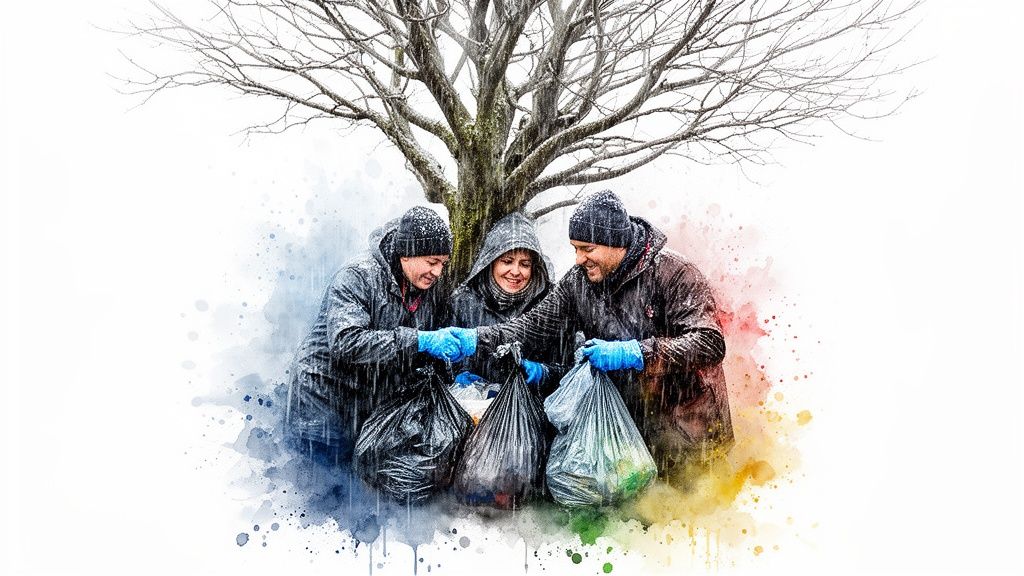
    It's how I learned that suffering through a Chicago hailstorm with two friends, trying to pick up trash, could be the most profound kind of fun. It adds flavor to the story of your life. You're here because you're looking for more than just another brunch. You want connection, purpose, and a story worth telling. This list of outdoor group activities for adults is your map to finding your people and transforming yourself through shared action.

    1. Community Litter Cleanup Events

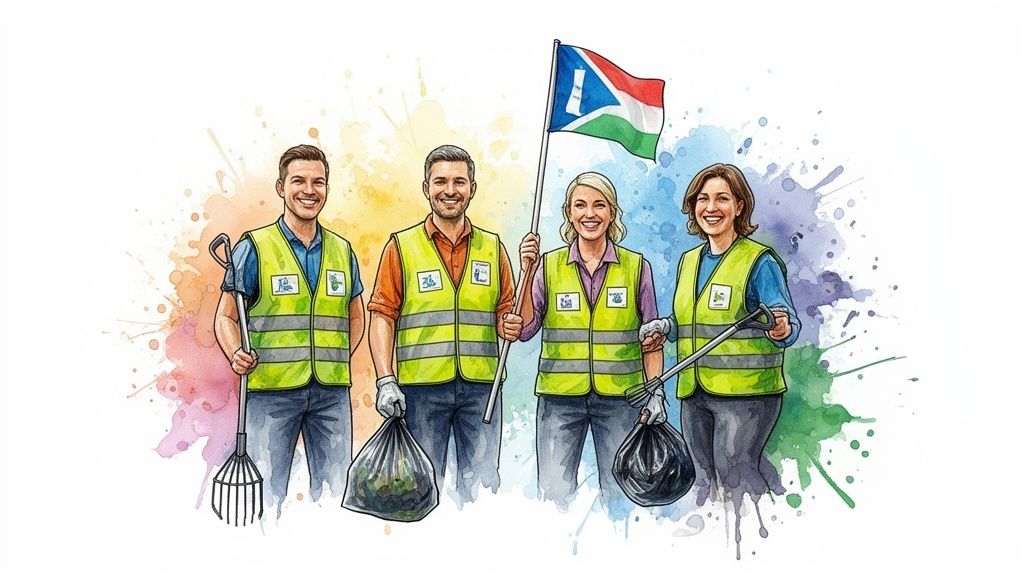
    You can transform your local park. Imagine it. Neglected one moment, cherished the next, all in a single morning. Community litter cleanups are powerful outdoor group activities for adults that merge environmental action with real human connection. You and your group adopt a public space, whether it's a neighborhood street, a park, or a riverbank, and you work together to clear it of trash. It’s more than just picking up wrappers; it's a way you can reclaim and beautify your shared environment, one bag at a time. I've found this simple act builds immense pride in your community.

    The key is consistency and creating a sense of team identity. Look at the Chicago-based group Litter Caterpillars. They organize cleanups every weekend, rain or shine, across all 50 city wards. This creates a reliable and welcoming opportunity for anyone to join in.

    Pro-Tip: Make your event an experience. I suggest creating a team name, designing a simple flag or logo for t-shirts, and even making a group playlist. These small touches transform a chore into a mission, turning volunteers into a proud, unified team.

    You can easily organize your own. Use social media or Meetup to schedule your first event, partner with local businesses for supplies or post-cleanup coffee, and always prioritize safety with gloves and clear instructions. By documenting the before-and-after results, you create a powerful visual story that inspires others to join. For a deep dive into organizing your own successful initiative, you can learn more about the community cleanup model and its impact.

    2. Neighborhood Walking Tours with Environmental Focus

    Imagine exploring a new corner of your city not just as a tourist, but as a caretaker. Neighborhood walking tours with an environmental focus are fantastic outdoor group activities for adults that blend urban discovery with a mission. Your group embarks on a guided walk through a local neighborhood, uncovering its history and unique character while also identifying and addressing small environmental issues, like picking up litter along the way. It’s a chance for you to see your city with fresh eyes and leave it a little better than you found it.

    This approach transforms a simple walk into a shared adventure, connecting you to new places and to each other. I see it as an ideal activity for newcomers looking to understand their city's fabric or for long-time residents eager to explore all of its hidden gems. By combining light cleanup with learning, you create an accessible entry point for community service that feels more like an exploration than a chore.
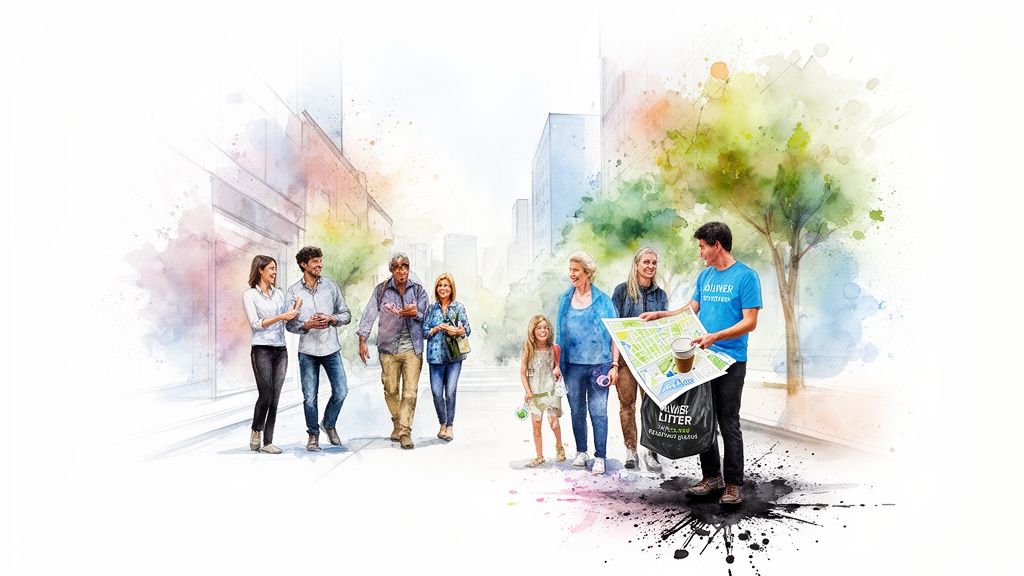
    A diverse group of people, including volunteers, engaging in outdoor community activities with a map and litter bag.

    Pro-Tip: Partner with a local historian or a passionate community leader to guide the tour. Their stories bring a neighborhood's architecture, green spaces, and culture to life. I believe this adds an authentic, personal layer that Google Maps can't replicate, making the experience truly memorable.

    You can easily get one started by picking a theme, like "Historic Pubs and Parks" or "Street Art and Green Alleys," to attract a specific crowd. Promote it on social media as a beginner-friendly way to get involved with groups like Litter Caterpillars. I recommend ending the walk at a local coffee shop or eatery to support small businesses and give everyone a chance to connect. To get inspired, you can explore some of Chicago's unique neighborhoods and start planning your first route.

    3. Group Hiking and Trail Maintenance

    Imagine turning a day hike into an act of creation. A world where every step you take helps preserve the path for others. Group hiking and trail maintenance combines the physical challenge of exploring nature with the rewarding work of environmental stewardship. You and your group can adopt a trail in a local park or forest preserve, clearing overgrown paths, removing invasive species, and ensuring the route remains safe and accessible. It’s one of the most hands-on outdoor group activities for adults, forging a deep connection to the land you’re enjoying.

    This isn't just about pulling weeds; it's about you actively shaping the wilderness for the better. I see groups like those organized through the Chicago Parks Foundation or the American Hiking Society show how powerful this model can be. They empower volunteers to become caretakers of beloved natural spaces.

    Pro-Tip: Turn your hike into a story. I encourage you to document the "before" state of a cluttered or overgrown trail section and celebrate the "after" transformation. Sharing this visual progress builds a powerful sense of accomplishment and inspires more people to join your cause.

    Organizing is straightforward. Partner with your local park district for guidance and tools, and offer hikes with varying difficulty levels to include everyone. You can learn more about how a simple group outing can make a real difference by exploring the impact of trail stewardship and seeing what’s possible.

    4. Social Sports Leagues and Outdoor Games

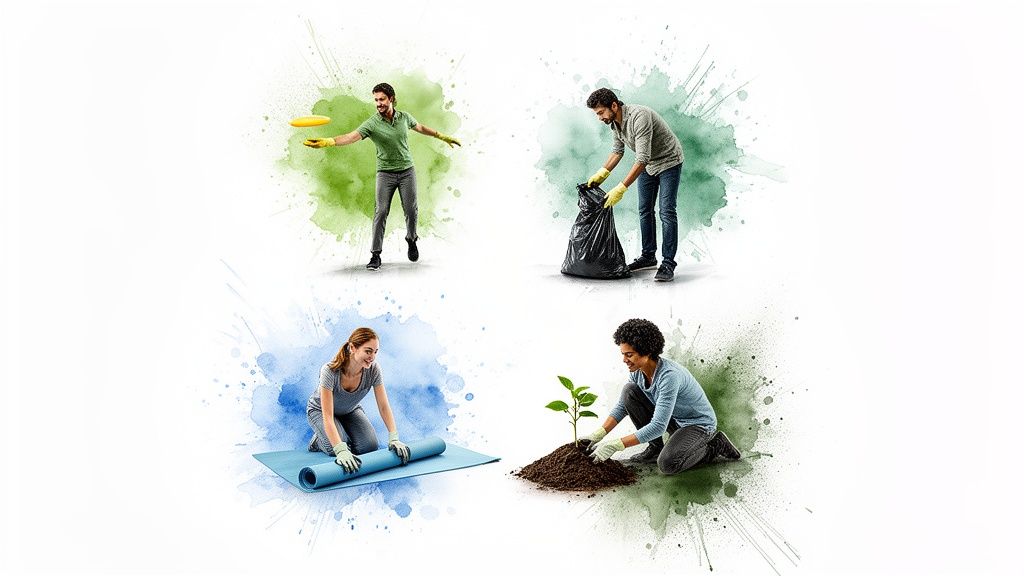
    Picture yourself under the sun. You're diving for a frisbee or kicking a ball past the goalie, surrounded by friends who are cheering you on. Social sports leagues are fantastic outdoor group activities for adults that prioritize fun and friendship over fierce competition. You and your group can join or create a team for kickball, volleyball, or even frisbee golf, turning a public park into your very own stadium of camaraderie. It’s less about the final score and more about the shared laughter and high-fives I see along the way.

    The goal is to build community through accessible, lighthearted play. Look at groups like Rage Volleyball, which offers recreational leagues nationwide where anyone can join, regardless of skill. I've seen how they focus on creating a welcoming space where making friends is just as important as playing the game.

    Pro-Tip: Weave purpose into your play. You could create team names tied to your neighborhoods or a cause you support. I've even seen leagues require a small volunteer commitment as part of participation, such as joining one park cleanup a season, to strengthen community bonds beyond the field.

    You can start by joining an existing league or gathering friends for a weekly game. Use social media to find local pickup games or check out park district programs. I always suggest scheduling post-game social time at a local spot to build friendships. To see how recreational sports can build a strong, positive community, you can learn more about the Rage Volleyball model and its approach to inclusive fun.

    5. Community Garden and Green Space Projects

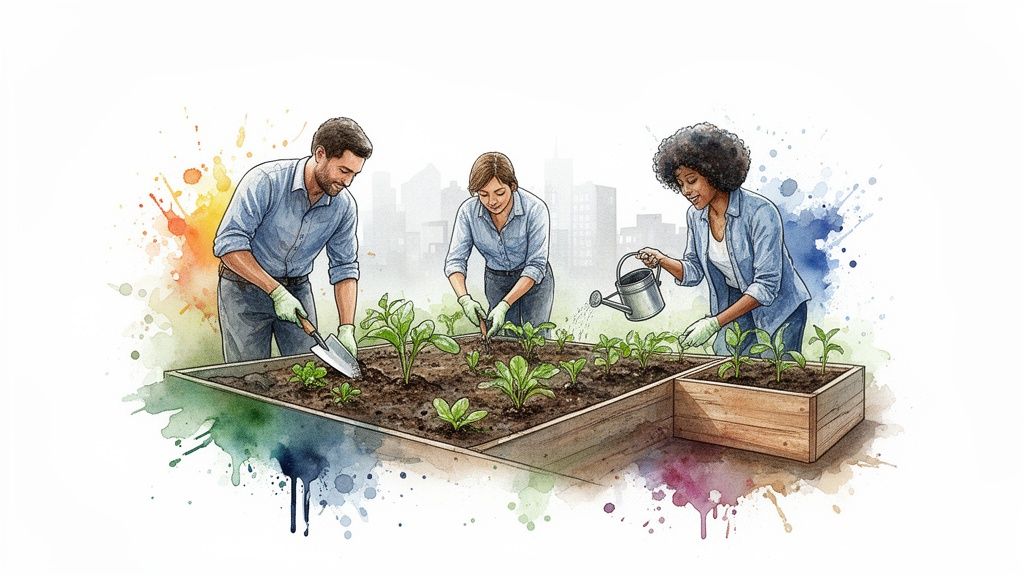
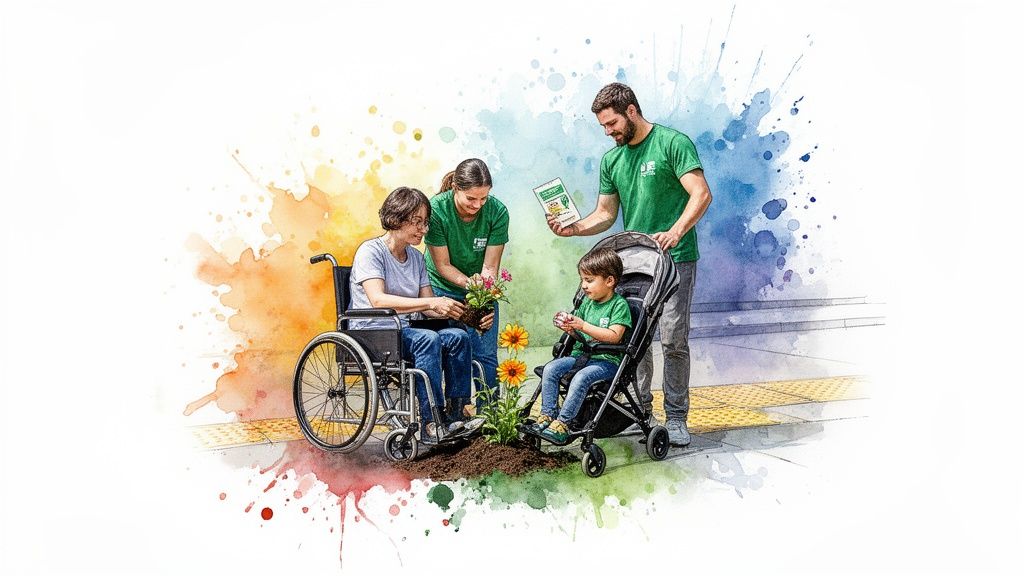
    Imagine turning a forgotten, vacant lot into a vibrant garden buzzing with life. Community garden and green space projects are incredible outdoor group activities for adults that let you put down roots, literally and figuratively. Your group can adopt a neglected patch of public land, transforming it into a pocket park, a pollinator haven, or a productive vegetable garden. This is more than just planting flowers; it's an act of permanent, beautiful change that nourishes both the environment and your community’s spirit.
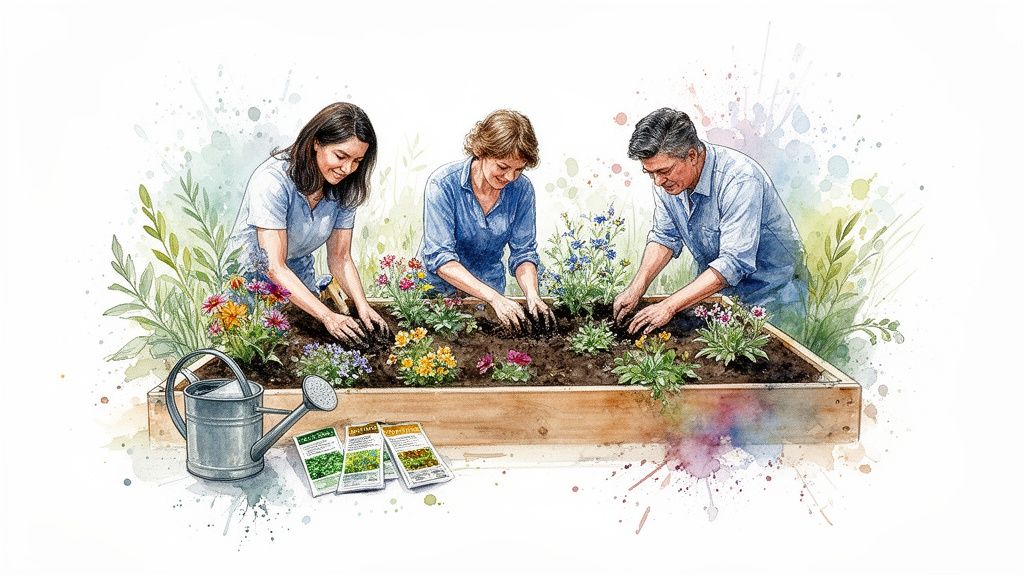
    Three adults happily planting colorful flowers in a raised garden bed, surrounded by lush plants and gardening tools.

    The power lies in collective, consistent effort. I look at Caterpillar Park in Englewood, a space created by volunteers from the Litter Caterpillars. They turned an abandoned lot into a green oasis, showing how dedicated groups can create lasting assets. This kind of project offers a tangible legacy that grows and evolves with each passing season.

    Pro-Tip: Make your planting days a celebration. You should host a "Planting Party" with music, food, and drinks. Create educational signs for the plants you've chosen, explaining their benefits to local wildlife. I find this turns the hard work into a festive community event and a shared learning experience.

    You can start your own green space revival. Partner with local schools or community centers to find a suitable plot, and focus on native plants that thrive in the Chicago climate. I recommend creating a simple online sign-up for watering and maintenance duties to keep the garden flourishing. By documenting the transformation from a barren lot to a lush garden, you create a powerful visual story that will inspire your neighbors to grab a trowel and join in. For a deeper look at urban farming and community impact, you can explore the Growing Power model.

    6. Outdoor Documentary Screenings and Nature Talks

    Imagine gathering with friends under the stars. But not for a blockbuster movie. For a powerful story about our planet. Outdoor documentary screenings and nature talks are inspiring outdoor group activities for adults that turn a park or public square into a classroom and a catalyst for change. You and your group can organize an event to watch a film, listen to a local expert on conservation or ecology, and discuss how to take meaningful action together. It’s a perfect blend of entertainment, education, and community connection.

    This approach combines the relaxed atmosphere of a picnic with the intellectual spark of a great discussion. I see many cities hosting environmental film festivals in outdoor settings, drawing crowds to learn about critical issues. By choosing films that highlight both problems and solutions, you can motivate your group to move from awareness to action.

    Pro-Tip: Make your screening a complete experience. I suggest you invite a local biologist or a leader from an environmental nonprofit to introduce the film and lead a Q&A session afterward. Partner with a local food truck for snacks, and have a QR code ready that links to a resource guide with volunteer opportunities.

    You can easily get started by using a projector and a portable screen in a local park (be sure to check permit requirements). Promote your event on social media, focusing on the film’s theme and the opportunity for great conversation. I find these screenings are a fantastic way to build a volunteer pipeline, turning an evening of shared learning into a team ready for your next big project. For inspiration, check out the programming at events like the Chicago Environmental Film Festival to see how powerful stories can be.

    7. Outdoor Fitness Classes and Wellness Groups

    Imagine starting your weekend with deep breaths of fresh park air, surrounded by neighbors moving and stretching together. Outdoor fitness classes are incredible group activities for adults that fuse your physical health with the joy of community. You and your friends can join or organize anything from yoga and bootcamps to running clubs, all held in the open beauty of a local park. It’s about building strength and resilience together, turning a simple workout into a shared experience of wellness and connection.

    This approach thrives on accessibility and a welcoming spirit. I look at the global phenomenon of Parkrun, which hosts free, volunteer-led 5K runs every weekend. It’s not about speed; it's about participation and creating a positive, supportive atmosphere where everyone from seasoned runners to first-time walkers feels they belong.

    Pro-Tip: Integrate your wellness with service. I suggest scheduling a quick 15-minute park cleanup before your yoga session or after your run. This small act connects your group’s commitment to personal health with a shared responsibility for your community’s environment, making your fitness routine even more meaningful.

    Organizing your own group is simple. Start with a free yoga or stretching session on a Saturday morning and spread the word on social media. I recommend partnering with a local fitness instructor or even a health-conscious brand for equipment. By creating a consistent, friendly space, you build more than muscle; you build a resilient community. For inspiration on free, community-led fitness, you can explore the Parkrun model and see how it brings people together worldwide.

    8. Outdoor Skill-Building Workshops and Training

    Imagine learning how to build a rain barrel, identify invasive plants, or master basic wilderness first aid alongside your friends. Outdoor skill-building workshops are incredible group activities for adults that turn a day in the park into a hands-on classroom. Your group gathers to learn a practical, real-world competency from an expert, building confidence and capability that you can apply to future service projects or your own backyard. It’s about gaining competence, not just completing a task.

    The goal is to create a cycle of learning and doing. I see organizations like the Chicago Park District and local REI stores offering a wide range of these programs, teaching everything from Leave No Trace principles to urban ecology. By participating, you’re not just having fun; you're becoming a more skilled and valuable steward of your environment.

    Pro-Tip: Start a mentorship program within your group. I recommend pairing seasoned volunteers with newcomers for a specific skill, like using a new tool or leading a small team. This personal connection speeds up learning and builds strong bonds founded on mutual support and shared growth.

    You can easily set up your own workshop. Partner with a local expert, community garden, or nonprofit to host a session. I think you should focus on high-value, accessible skills first, like proper tool safety or basic plant identification. You could host a CPR and first aid certification day to prepare everyone for future events. To learn more about the types of skills that can benefit your group, you can explore offerings from outdoor education leaders for inspiration.

    9. Outdoor Social Dining and Picnic Gatherings

    Picture a long table in a sunlit park. It’s filled with shared dishes and new friends, the air alive with laughter and conversation. Outdoor social dining and picnic gatherings are incredible outdoor group activities for adults that turn a simple meal into a cornerstone of community. You and your group come together for a potluck, a themed barbecue, or a celebratory feast in a public space. I find it’s a powerful way to build genuine connections, transforming a casual get-together into a meaningful tradition.

    The magic lies in making the meal an event in itself. You should consider tying it to another activity, like a volunteer appreciation barbecue after a park cleanup or a solstice potluck to mark the changing seasons. I believe this creates a shared experience that feels earned and celebratory.

    Pro-Tip: Make it a potluck with a theme. An international heritage potluck where everyone brings a dish representing their background, for instance, sparks conversation and creates a rich, inclusive dining experience. I find this approach lowers costs and gives everyone a stake in the gathering’s success.

    You can easily set this up. Secure any necessary permits, especially for larger groups in places like Chicago parks, and establish clear food safety guidelines. By incorporating music, games, or celebrating milestones, you build a welcoming atmosphere that people will want to return to again and again. I know these gatherings are more than just food; they are about nourishing community bonds.

    10. Outdoor Art Projects and Community Murals

    Imagine turning a dull, gray wall into a vibrant canvas that tells your community's story. Outdoor art projects are fantastic group activities for adults that transform public spaces with creativity and color. You and your group can collaborate on painting a large-scale mural or creating a public sculpture, turning a neglected corner into a landmark. This isn't just about painting; it's a powerful act of collective expression that builds deep-seated neighborhood pride and visual identity.

    Two people painting a large board with colorful watercolor splashes, using paint rollers and surrounded by paint cans.

    The core idea is creative collaboration and ownership. I look at Philadelphia's Mural Arts program, which has created thousands of public artworks across the city. They engage community members in every step, from design concepts to the final brushstroke, ensuring the art truly reflects the people who live there. I believe this approach makes residents stakeholders in their environment's beauty.

    Pro-Tip: Host a "design day" where neighbors can vote on mural themes or contribute ideas. I think this ensures the final piece resonates deeply with everyone. Partner with a local artist to guide the process, but let the community's voice lead the creative direction.

    You can start small by securing permission for a single wall. Use social media to recruit volunteers and partner with local hardware stores for paint donations. I recommend documenting the transformation with before-and-after photos to create a compelling narrative that can inspire future projects and secure more support. To see how large-scale initiatives operate, you can explore the Mural Arts Philadelphia model and see its city-wide impact.

    11. Outdoor Documentary-Inspired Service Challenges

    Imagine turning the powerful message of an environmental documentary into a real-world mission. Outdoor documentary-inspired service challenges are exciting outdoor group activities for adults that transform education into action. Your group chooses an environmental theme, like plastic reduction or local biodiversity, and builds a team-based competition around it. You don't just learn about a problem; you actively work together to solve a piece of it, documenting your impact along the way. It’s like being the heroes in your own environmental story.

    The goal is to gamify volunteerism with a purpose. I think of events like the Great American Cleanup, but with a thematic, competitive twist. Teams might earn points for bags of invasive species removed, the number of native trees planted, or the most creative "upcycled" art piece made from collected waste. This structure channels competitive energy into positive, measurable outcomes.

    Pro-Tip: Focus on celebrating participation over just winning. You should create multiple award categories—like "Most Spirited Team," "Best Educational Post," or "Biggest Impact"—so everyone feels recognized. I believe this keeps the spirit of service and unity at the heart of the challenge, preventing it from becoming just another competition.

    You can organize your own challenge by picking a documentary or a local issue that resonates with your group. Create a simple scorecard, set a timeline, and use social media to share progress and inspire friendly rivalry. I know the real prize is the collective achievement and the story you create together. When you tie action to education, you build a deeper, more lasting commitment to protecting our shared planet.

    12. Outdoor Networking and Professional Development Events

    Imagine building your professional network not in a stuffy conference room. But while restoring a community garden or clearing a local trail. Service-oriented outdoor gatherings are fantastic group activities for adults that blend your career growth with tangible community impact. You and other professionals volunteer on a shared project, allowing for authentic connections to form naturally. It’s less about exchanging business cards and more about collaborating on a meaningful task, which I believe reveals character and builds trust far better than a typical mixer.

    This model turns networking from a transactional chore into a shared mission. I've noticed professional associations and even LinkedIn groups are starting to organize these events, recognizing that applying skills like project management or strategic planning to a volunteer project creates powerful bonds. It’s an opportunity for mentorship to flourish as senior and junior professionals work side-by-side, solving real problems together.

    Pro-Tip: Frame the event as authentic community service, not just a resume-builder. I encourage you to foster mentorship across all experience levels and host a casual post-event gathering at a local park or cafe to continue the conversations. This keeps the focus on genuine relationship building.

    You can initiate this within your own company or professional circle. Partner with a local nonprofit that needs skilled volunteers, or team up with your chamber of commerce. By focusing on the shared work and the collective impact, you create a space where professional growth and community service become one and the same. For ideas on how groups can organize with purpose, you can learn more about the Litter Caterpillars' community-first model and its values of kindness and unity.

    12-Item Comparison: Adult Outdoor Group Activities

    Activity Implementation Complexity 🔄 Resource Requirements ⚡ Expected Outcomes 📊 Ideal Use Cases 💡 Key Advantages ⭐
    Community Litter Cleanup Events Moderate — recurring coordination, safety & disposal logistics Low–Moderate — volunteers, gloves, bags, waste partnerships Regular visible cleanliness, steady volunteer retention, social cohesion Urban neighborhoods, underserved corridors, routine stewardship High-impact, inclusive, easy volunteer entry
    Neighborhood Walking Tours with Environmental Focus Low–Moderate — route planning and knowledgeable guides needed Low — volunteers, maps, light cleanup supplies Increased neighborhood awareness, new volunteer recruitment Newcomer engagement, outreach across multiple wards Educational, low-barrier, builds local familiarity
    Group Hiking and Trail Maintenance Moderate–High — permits, travel logistics, technical tasks Moderate–High — transportation, tools, trained leaders Protected trails, improved access, strong fitness community Regional parks, forest preserves, ecological restoration projects Combines fitness with conservation; attracts committed volunteers
    Social Sports Leagues and Outdoor Games Moderate — scheduling, venues, inclusive management Moderate — fields/courts, equipment, organizers Strong friendships, regular attendance, gateway to service Young professionals, recreational-focused recruitment Fun-first engagement that converts to service participation
    Community Garden and Green Space Projects High — land agreements, long-term maintenance planning High — soil, plants, water access, horticultural expertise Lasting beautification, food/education benefits, biodiversity gains Vacant lot transformations, food security initiatives Permanent visible change; skills-building and multi-season engagement
    Outdoor Documentary Screenings & Nature Talks Low — event planning and AV setup Low — AV equipment, permits, speaker honoraria Increased awareness, inspiration, volunteer pipeline growth Awareness campaigns, community education, pre-service outreach Low physical barrier; scalable and partnership-friendly
    Outdoor Fitness Classes & Wellness Groups Low–Moderate — instructor recruitment, liability management Low — instructors, minimal equipment, permits Improved fitness, recurring engagement, volunteer readiness Health-focused outreach, prep for heavier service tasks Regular habit formation; attracts health-conscious participants
    Outdoor Skill-Building Workshops & Training Moderate — qualified instructors and curriculum design Moderate — tools, materials, certified trainers Improved volunteer competence, leadership development Preparing volunteers for complex projects and safety-critical roles Builds capability and confidence; creates leadership pipeline
    Outdoor Social Dining & Picnic Gatherings Low — permits and food-safety planning Low — food coordination, seating, permits Strong social bonds, volunteer appreciation, retention Celebration events, post-service gatherings, cultural exchange High warmth and retention effects; accessible to all
    Outdoor Art Projects & Community Murals High — design approvals, property agreements, multi-day events High — artists, paint, scaffolding, permits Dramatic placemaking, neighborhood pride, reduced blight Beautification campaigns, community identity projects Highly visible, creative engagement; strong publicity potential
    Documentary-Inspired Service Challenges Moderate — rules, tracking, documentation systems Moderate — tracking tools, prizes, coordination Measurable impact, increased engagement, social media content Short-term campaigns, fundraising drives, team competitions Gamifies service to boost motivation and measurable outcomes
    Outdoor Networking & Professional Development Events Moderate — curated programming, balance of service/networking Moderate — venues, facilitation, coordination Professional connections, leadership recruitment, sponsorships Corporate volunteer days, young professional outreach Leverages career motivations for sustained civic engagement

    Your Next Chapter Starts Outside

    We’ve just walked through twelve different doorways. From community cleanups and trail maintenance to outdoor art projects and social picnics, each one is an invitation. An invitation for you to step out of the quiet isolation of your daily routine and into a world buzzing with connection, purpose, and fresh air. Think of this list not as a set of instructions, but as a map of possibilities for finding incredible outdoor group activities for adults.

    I see so many of us living like caterpillars, inching along in our own little worlds, focused on our immediate tasks. We're all good, well-intentioned people, but we're often separate. We’ve been told that changing the world is some grand, impossible task, so we focus on our own small leaf. But what if we started inching along together? The activities we covered show that building community and making an impact doesn't require a heroic solo effort. It just requires you showing up.

    Finding Your Fence to Paint

    Remember the story of Tom Sawyer? He turned the chore of painting a fence into the most sought-after activity in town. He didn't just get the fence painted; he created an experience. He made his friends feel like they were part of something exclusive, something adventurous. That's the real magic behind every idea I've shared in this article.

    • Community Litter Cleanup: It's not just picking up trash. It's you reclaiming your neighborhood's pride, one piece at a time, with people who care as much as you do.
    • Group Hiking and Trail Maintenance: It’s more than a workout. It's about you being a guardian of the wild spaces that give us peace, ensuring others can find that same solace.
    • Community Garden Projects: You're not just digging in the dirt. You are a co-creator of a living, breathing oasis that will feed and inspire your neighbors.

    The power of these outdoor group activities for adults lies in this shift in perspective. You're not just "volunteering" or "exercising." You are building something tangible, forging genuine friendships, and writing a new story for yourself and your community. Pride, identity, and unity aren't just for sports teams anymore. It's time for kind, dedicated people like you to claim that feeling.

    So, what are you waiting for? Your next chapter really does start outside. Don't overthink it. Don't wait for the perfect moment or the perfect group of friends. Just pick one. Show up. The adventure, and the people you're meant to meet, are already out there waiting for you.


    Ready to turn that first step into a powerful stride? At Litter Caterpillars, we make community cleanups simple, social, and incredibly fun, embodying the spirit of these outdoor group activities for adults. Join an event or learn how to lead your own at Litter Caterpillars and start your transformation today.


  • Your Guide to Exploring Blackwell Forest Preserve

    Your Guide to Exploring Blackwell Forest Preserve

    Sometimes you just need to get away. Not on a plane, not on a long road trip, but just… away. Away from the noise, the concrete, the constant hum of the city. For me, that place is a sprawling 1,366-acre sanctuary just west of Chicago. This is Blackwell Forest Preserve, and I want to tell you why it’s more than a park—it’s my escape hatch.

    Welcome To Your Blackwell Forest Preserve Adventure

    Think of this as me sitting down with you, sharing a map scrawled with my favorite spots. I’m not just going to give you facts; I want to tell you stories about this place, and help you find your own story here. Imagine a world of towering oaks, lakes that catch the sunlight like scattered diamonds, and hills that let you steal a glance at the Chicago skyline, a tiny reminder of how close, yet how wonderfully far, you really are.

    This is where I come to breathe. To move. To feel like myself again. I want to help you find that same feeling.

    A vibrant watercolor painting of a person walking on a path in a park towards a city skyline.

    More Than Just a Park

    Blackwell isn't a patch of green on a map. No. It’s land with a deep story, a history I can feel under my feet when I walk its trails. Glaciers shaped this ground, but it’s the people who gave it a soul.

    It’s a place holding a surprising past. I learned that back in 1967, Dr. Martin Luther King Jr. actually spoke here. He connected the struggle for civil rights to the simple idea of open, public spaces for everyone. He saw that access to nature wasn’t some fancy extra. It was a basic right.

    "Everyone’s welcome in the forest, and I think that’s a wonderful thing."

    That single idea—that’s the soul of Blackwell. It was built for you, for me, for all of us. I promise you, no matter who you are, there's a piece of this place waiting for you.

    Your Adventure Starts Here

    As we dive in, I'll show you what makes the Blackwell Forest Preserve a true gem. I want to walk you through:

    • The unbelievable story of how this land was utterly transformed.
    • My personal favorite trails for a good, heart-pumping hike or just a quiet moment.
    • The amazing wildlife you can actually see if you just stand still and listen.

    I’ve found so much clarity on these paths. I hope by the end of this, you’ll be itching to find your own story here. Let’s go.

    From a Garbage Dump to a Landmark? The Story of Blackwell

    Every place has a story. Most are boring. This one isn't. The story of Blackwell Forest Preserve is something I think about a lot, because it feels like my own life. We all have our messes, right? The parts of our past we'd rather just bury. Well, this land did exactly that. Literally.

    Glaciers carved this whole area thousands of years ago, leaving the rolling hills we climb today. But the really wild part of Blackwell's story, the chapter that gave it its grit, started in 1965. That's when a huge piece of this beautiful land officially became a sanitary landfill.
    Yes. A garbage dump. It's strange to stand in this vibrant, living place and picture it piled high with our trash. It’s like looking at an old photo of yourself you’d rather forget. But that mess became its greatest teacher. It forced the county to get smart about waste, about restoration, and about how to heal a piece of the earth we had broken.

    A Mountain Made of Trash

    Today, that old landfill is Mount Hoy, a massive 150-foot hill that gives you some of the best views in DuPage County. On a clear day, you can see 30 miles out, all the way to the Chicago skyline. Just stop and think about that. The ugliest, most shameful part of this land’s past became its highest point.

    This is the stuff that gets me. It’s a real-life, dirt-under-your-fingernails analogy for our own lives. It’s proof that we can climb out of our own messes to get a better view. This land shows us that even the most scarred places can be reborn into something strong and beautiful. It's a lesson I carry with me every single time I visit.

    This place is a partnership. It’s what happens when we decide to work with nature to fix our mistakes. It’s a testament to nature's will to heal and our ability to give it a helping hand.

    Blackwell Forest Preserve is a giant, a 1,366-acre beast of a park in Warrenville. Its history is layered with glacial savannas, an 1830s grist mill, and a quarry they filled to become Silver Lake. But for me, it’s this story—turning a landfill into a landmark—that defines the place. You can feel that gritty, resilient spirit in the air here. If you want to go deeper, you can dig into the full historical analysis from the DuPage Forest Preserve District.

    How To Choose Your Perfect Trail Adventure

    Alright, let's find your path. I remember my first time standing at a trailhead here, staring at the signs, totally paralyzed by choice. It's like standing in front of an ice cream counter with fifty flavors. But I learned fast that you can't really go wrong. You just have to pick a direction and start walking.

    Think of it like picking a soundtrack for your day. Do you need a long, winding acoustic song or a short, punchy pop hit? Let me show you a few of my personal favorites to help you find your rhythm.

    A Quick Guide to My Favorite Trails

    To make it easy, here’s a quick rundown of the main trails. Each one offers a totally different experience, so you can match the path to your mood.

    | Blackwell Forest Preserve Trail Guide |
    | :— | :— | :— | :— |
    | Trail Name | Distance | Difficulty | Best For |
    | McKee Marsh Loop | 6.1 miles | Moderate | A long, immersive hike with varied scenery. |
    | White Pine Pond Path | 2.3 miles | Easy | A quiet, reflective walk for clearing your head. |

    This little table helps you get started, but the real magic is in the stories of each trail. Let's dive deeper.

    For a Real Escape: The McKee Marsh Loop

    When I need to properly vanish for a few hours, my go-to is the 6.1-mile loop circling McKee Marsh. It’s what hikers call a “lollipop” trail—you walk down a straight path which opens up into a big, beautiful loop before you head back the way you came. It’s a perfect design, giving you a taste of everything.

    You’ll wander through wide-open, sun-drenched prairies that just explode with goldenrod and milkweed in late summer, buzzing with more butterflies than you can count. It's an incredible feeling of being small in a big, beautiful world.

    The trail itself tells a story in two parts:

    • Bobolink Trail: This section is mostly out in the open, taking you right through the heart of the restored prairie. Get ready for some sun.
    • Catbird Trail: Just when you need a break, the path ducks into the cool shade of massive, old oak trees. It’s a welcome change of pace.

    I love this blend of sun and shade, prairie and woods. It makes the loop feel like a complete journey.

    For a Quick Reset: The White Pine Pond Path

    If you're looking for something quieter, more meditative, I always point people toward the 2.3-mile path around White Pine Pond. This one isn’t about a big physical challenge; it’s an invitation to just slow down and breathe.

    This is where I go when my own thoughts feel like a tangled ball of yarn. Something about the simple act of walking among the quiet pines helps everything fall into place. It’s on these shorter walks that I’ve had some of my best wildlife sightings—like watching a family of deer grazing by the water, completely unbothered by me.

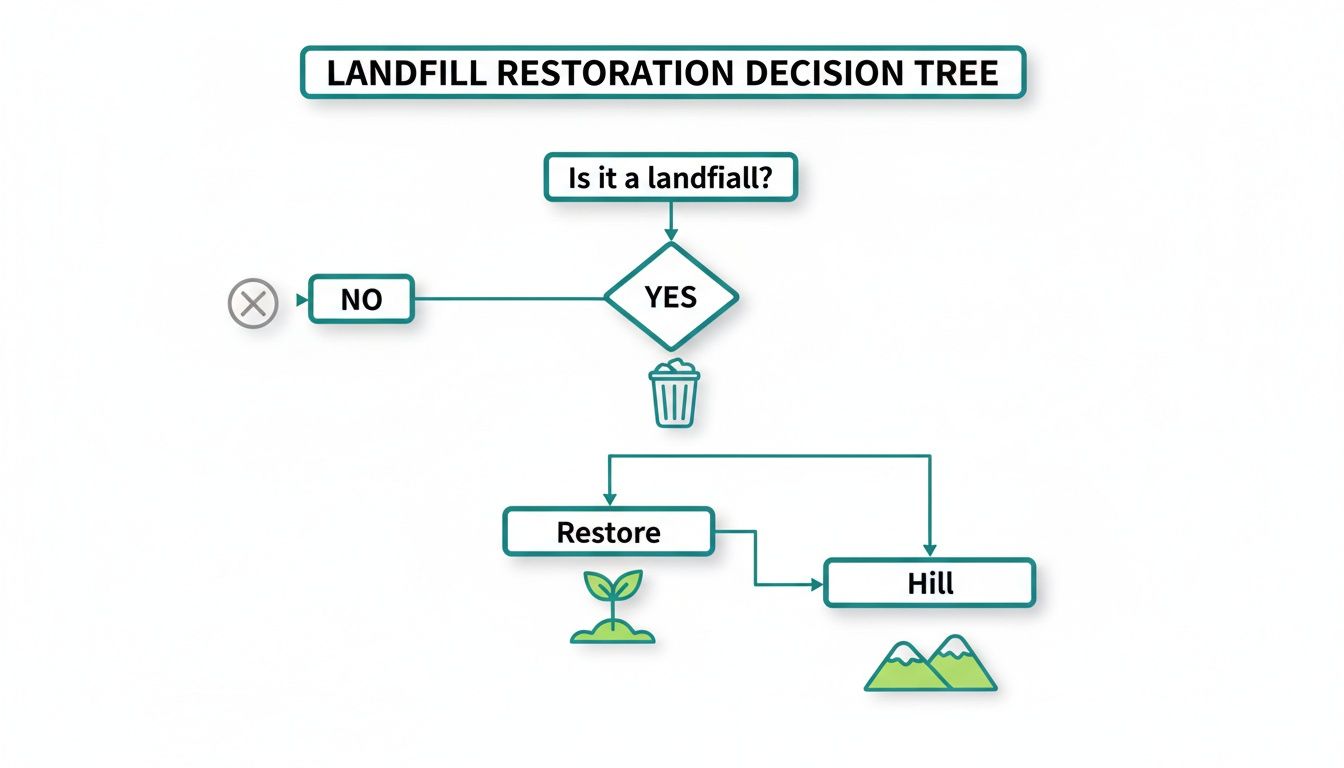
    The story of this place is as powerful as its trails. As you walk, it helps to know that much of Blackwell, including its highest point, was built from a literal landfill.

    A flowchart titled 'Landfill Restoration Decision Tree' showing options for landfills, leading to restoration or hills.

    It’s a real-life example of how we can heal a place, turning forgotten waste into something full of wonder. Every step you take is on land that was intentionally healed. You are walking on a story of redemption.

    No matter which path you choose, you’re not just going for a hike. You’re stepping into a story of resilience. And if you love exploring these kinds of reclaimed natural spaces, you should definitely check out our guide to the incredible trails at Waterfall Glen Forest Preserve.

    Discover The Mammoth Secret Of McKee Marsh

    Alright, let's talk about what I think is the true heart of Blackwell Forest Preserve, the place I always return to: McKee Marsh. This isn't just a pretty wetland. It’s a comeback story. It was DuPage County’s first big wetland restoration project, and now it buzzes with a kind of life you can feel in the air.

    When I walk the trails, it’s like listening to music. The hum of dragonflies, the whisper of wind in the reeds, a heron calling in the distance. If you're into birdwatching, this spot is a gold mine. You’ll see majestic herons, graceful egrets, and that sudden, electric flash of a bluebird. It feels like stepping into a world that's both ancient and brand new.

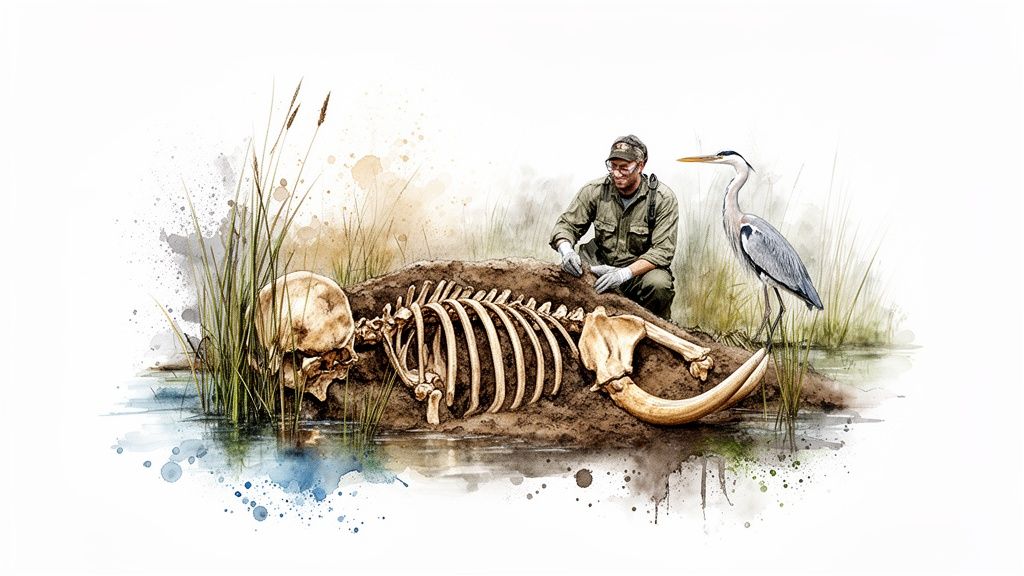
    Watercolor illustration of a paleontologist examining a partially excavated ancient mammoth skeleton in a marsh, observed by a heron.

    An Ice Age Revelation

    But there's a much deeper story buried here. A secret that completely changed how I see this land. Just imagine this for a second: It’s June 21, 1977. An operator, Gary Jones, is digging clay. Just another Tuesday. Then his machine hits something huge. Not a rock. Bone.

    What he pulled from the earth that day was the skeleton of a 13,000-year-old woolly mammoth. It turned out to be one of the oldest ever found in northeastern Illinois. Carbon-14 dating placed the bones at an incredible 13,130 years old, found in soil from before the last glaciers even melted. A single discovery that rewrote the history of Ice Age life right here. You can even learn more about this incredible mammoth find directly from the Forest Preserve.

    Knowing you’re walking on ground that holds such profound history adds a layer of awe to every step. It’s a powerful reminder that the earth beneath our feet is filled with stories we can't even imagine.

    There’s something humbling about walking through that kind of deep time. You're not just on a trail; you’re tracing the path of giants who were here thousands of years before any of us.

    A Living, Breathing Ecosystem

    Today, the marsh is this beautiful, thriving place, all thanks to that restoration work. It’s a living lesson in how nature can bounce back if you just give it a chance.

    The biodiversity is amazing. It's not just a collection of plants and animals; it's a real community.

    • Tall grasses and wildflowers: They provide the food and shelter that insects and small mammals need to survive.
    • Majestic oak trees: These stand like old guardians, offering shade and a home for countless birds.
    • The wetlands themselves: This is the critical habitat for amphibians, reptiles, and all sorts of waterfowl.

    Every single piece works together, creating a tough, resilient system. If this deep history gets you excited about our native ecosystems, you might like my guide on the different kinds of trees in Illinois that make places like McKee Marsh possible. A trip here isn't just a hike; it’s a conversation with history itself.

    Turn Your Visit Into Meaningful Action

    Have you ever left a beautiful place like Blackwell and felt that spark? A pull to do something more than just visit? I want to show you how to take that feeling and turn it into real-world action, the kind that protects these exact places.

    It might sound strange, but I figured something out when I started this journey: cleaning up messes left by other people is a lot easier than facing your own. I started Litter Caterpillars because my life was a complete mess, and I felt stuck. Picking up one piece of trash was a simple action I could control—a small win that started to add up.

    I learned that service is like a muscle. The more you use it, the stronger your sense of bravery, kindness, and community gets. It's a way to get your feet back on the ground when everything else feels shaky.

    From Visitor to Volunteer

    We host cleanup events in spots just like Blackwell all the time. Think of it as trading a weekend morning for a chance to give back and meet new friends who actually show up. You don’t need any special skills—just a willingness to be there with me.

    This is about more than just trash. It’s about taking pride in our shared spaces and, in the process, taking a little more pride in ourselves.

    I truly believe service is the fastest way to build courage. When you show up for a place, you start to show up for yourself in a new way. It’s a chance to give back to this incredible preserve and find a bit of your own strength along the way.

    Joining us is easy. It’s not some huge commitment; it’s just one morning. Let me show you how you can find an event and start your own story.

    How to Join a Cleanup Event

    I made the sign-up process as simple as I could. The hardest part should be dragging yourself out of bed on a Saturday, not fighting with a confusing website. I want you out there with us, not stuck behind a screen.

    Here’s the simple, three-step process:

    1. Visit Our Volunteer Page: This is our main hub for all upcoming events. We post all the dates, times, and locations here.
    2. Choose Your Event: Find a cleanup that works for you. We move all over the Chicago area, so you might find us at Blackwell one week and a city neighborhood the next.
    3. Sign Up: Found one? Just follow the link to sign up. We use platforms like Meetup to keep it simple, so you’ll get all the details and reminders you need.

    That’s it. You’re in. You can check out all our upcoming events and learn more about our mission in my guide to volunteer trash pickup events in the Chicago area. Your next trip to Blackwell could be the start of something amazing.

    Your Blackwell Questions, Answered

    Alright, let's talk logistics. I get it. Before you head out to a new place, even one in your own backyard, you've got questions. I've been there, and I’ve probably forgotten my water bottle more times than I can count, so I've got the answers you're looking for.

    Here’s my rundown on the most common things people ask me about visiting Blackwell Forest Preserve.

    Can I Bring My Dog?

    Absolutely. My dog comes with me all the time—it’s a fantastic spot for them to get their sniff on. Just keep them on a leash. It's a simple rule that keeps the deer from getting spooked and makes sure everyone, two-legged and four-legged, has a good time.

    And this should be obvious, but I have to say it: clean up after your pet. Please. It’s a tiny act of respect that keeps this place beautiful for the next person who comes along.

    What Are the Hours? Does It Cost Anything?

    Here’s the best part. The preserve is open every single day, from one hour after sunrise to one hour after sunset. That gives you a huge window to explore.

    And the price? It's completely free. There is no entrance fee to get in and enjoy the trails.

    That's it. No catch. An incredible natural space, open to everyone. For me, that's exactly how it should be. Sure, if you want to rent a boat or snag a campsite for the night, there are separate fees for those. But just for a day of walking? Zero cost.

    Is Fishing or Boating Allowed?

    You bet. If you're looking for a quiet day on the water, Blackwell is your place. You can fish at both Silver Lake and White Pine Pond, just make sure you have your Illinois fishing license with you.

    You can also bring your own kayak, canoe, or a small boat with an electric motor. In the warmer months, they even have rentals right there, so you can just show up and get out on the water. It’s perfect.


    At Litter Caterpillars, I believe that when you connect with a place like Blackwell, it changes you. It makes you want to protect it. Every can or wrapper we pick up is our way of saying thanks. If you feel that same pull and want to be part of a community that’s making a real, tangible difference, find your next cleanup event with us.

  • How I Fought My Social Anxiety, One Piece of Trash at a Time

    How I Fought My Social Anxiety, One Piece of Trash at a Time

    Let me tell you a story about a four-year-old jar of blueberry jam. For me, social anxiety wasn't just sweaty palms in a crowd. It wasn’t a racing heart before a party. It was a physical weight, a quiet paralysis that made my world shrink day by day until it was the size of my messy apartment.

    It was the force that kept me from cleaning out my own fridge. That jam jar sat in the back, a small, sticky monument to a life I had put on hold. A souvenir from a Michigan trip four years ago. And like so many other things in my home, it felt immovable. Each item tethered to a memory, a failure, a future I was too scared to face. Cleaning up my own space felt impossible. Each piece of trash, no matter how small, carried the weight of my past. To me, that jar might as well have weighed 500 pounds.

    My Breaking Point

    My life hit a wall after a chaotic, painful breakup. Suddenly I was alone, surrounded by the physical and emotional clutter of a relationship that had drained every ounce of my energy. I was stuck. The person I’d been with was always out, always partying. I realized I had been living a life that wasn't mine. At all.

    That’s when I knew. Something had to change. A deep, fundamental shift.

    I made two promises to myself. First, I would mindfully engineer my social world. I would filter for kindness and filter out selfishness. I desperately needed people who gave more than they took. Second, I would directly confront the things that had always been my personal demons: cleanliness, consistency, and bravery.

    This journey to beat social anxiety didn’t start at a loud party. It didn’t begin at a networking event. It started with a quiet decision to face myself, my apartment, and the life I had let spiral completely out of control.

    Surprisingly, this path didn’t lead me to a therapist's office. Not at first. It led me to picking up other people's trash on the streets of Chicago.

    From a Messy Fridge to a Cleaner City

    I stumbled on a strange truth. Cleaning up other people's messes was profoundly easier than cleaning up my own. It disconnected the task from all the emotional baggage I was carrying. My own trash screamed failure; a stranger's trash was just… trash. This small insight was the seed that grew into Litter Caterpillars, a community cleanup group I started.

    This is the raw story of how I began to dismantle my fear. If you're struggling to figure out how to overcome social anxiety, you might find the answer isn't always about forcing yourself into the situations you dread most.

    Sometimes, it’s about finding a new way to show up in the world. It's about discovering an activity with a purpose that's bigger than your fear. If this approach resonates with you, you can learn more about how to start volunteering and find a group that fits.

    This was my first step. It wasn't about conquering a crowd. It was about conquering my own life, one small, messy, and surprisingly empowering step at a time.

    What Social Anxiety Actually Feels Like

    Let's get real about what it’s like to live with social anxiety. It’s not just being “shy.” It’s not being an “introvert.” It’s a full-body, five-alarm fire that goes off in situations most people don’t even think twice about. A complete system meltdown.

    For me, it was that gut-wrenching panic before making a simple phone call. I’d spend an hour scripting the first line, rehearsing it over and over, only to let the call go to voicemail anyway. Then, for hours, my mind would spin. A vicious cycle, replaying every word I managed to say in a conversation, absolutely convinced I sounded like a complete and utter idiot.

    And the inner critic? That voice is relentless. It’s the constant whisper that everyone is judging you. That your hands are shaking too much. That the blush creeping up your neck is a giant neon sign broadcasting your own inadequacy to the entire world. It’s an emotional and physical beatdown. Day after day.

    Why Your Brain Gets Stuck on Red Alert

    Think of your brain's fear center—the amygdala—as a security guard who’s had way too much coffee. A jumpy, overzealous guard. In social anxiety, that guard works overtime, flagging everything as a potential threat. A quick chat with a cashier? Threat. A team meeting at work? Major threat. It sees danger everywhere.

    Your brain actually gets rewired by this constant alarm. It carves a well-worn path for that fear response. The more you avoid the things that set off the alarm, the more you convince your brain the danger is real. You're teaching it to be afraid.

    The urge to just stay home—to say no to the party, to ignore the call—feels like self-protection. But that avoidance is the very thing that feeds the anxiety. It makes its cage smaller and tighter every single time you give in.

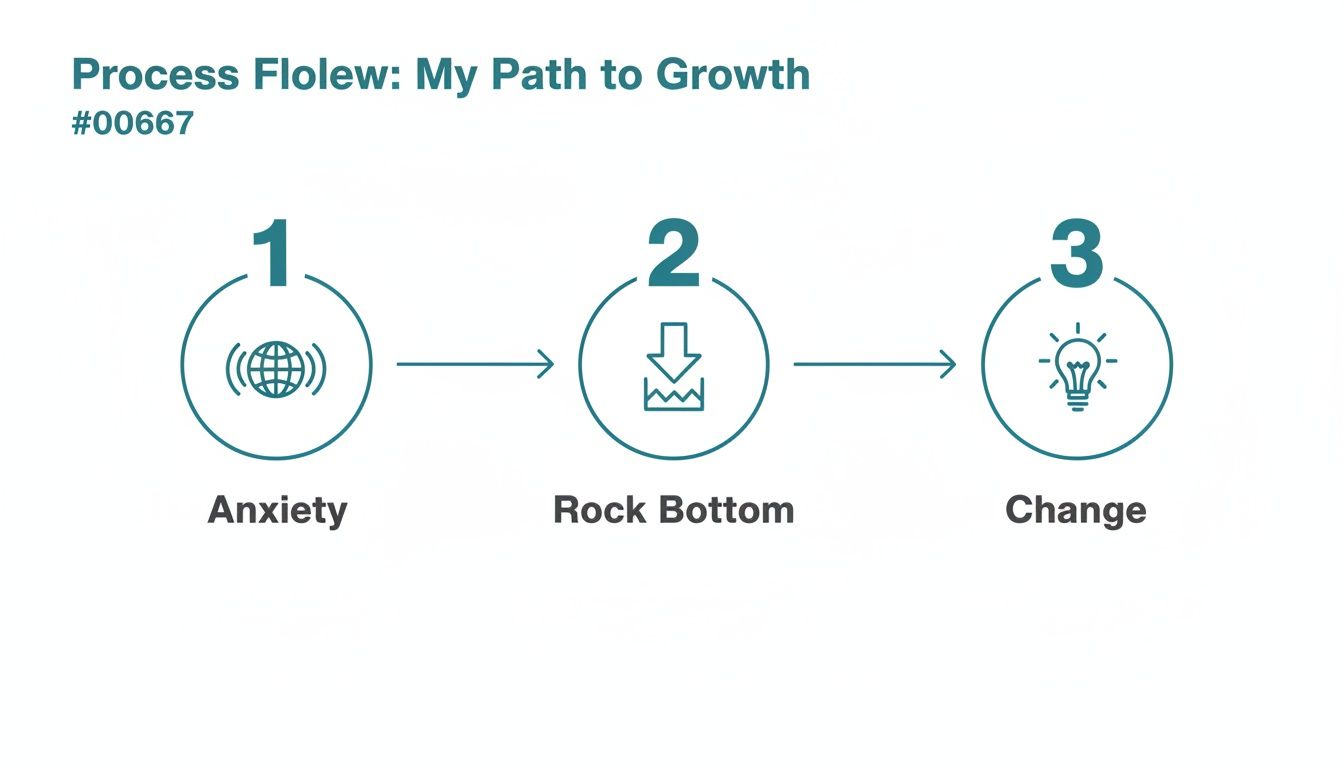
    This is the trap. The thing you do to feel safe in the moment is what keeps you stuck for the long haul. My own path out started when I saw this cycle for what it was. Sometimes, you have to hit a low point before you can find the fire to break free.

    A three-step process graphic illustrating the path from anxiety to rock bottom and ultimately to change.

    As you can see, that breaking point is often the catalyst. It’s the moment that finally forces us to find a new way forward. To decide to face the fear head-on.

    You Are So Far from Alone in This

    If this struggle makes you feel isolated, I need you to hear this: you're not. That feeling of your heart pounding as you think about joining a group of strangers for a weekend cleanup? That exact feeling is shared by 7.1% of U.S. adults. That’s about 15 million people. Think about that. You are part of a huge, unseen community.

    And there’s so much hope in what we know works. The science is on our side. Exposure therapy, the gold standard for treatment, shows that 60-90% of people see a huge drop in their symptoms after just 12-16 weeks of practice. That's incredible.

    In fact, studies show that getting out there in the real world—like joining a friendly group to pick up litter—can slash avoidance behaviors by 75% on average. You can read more about these stats straight from the National Institute of Mental Health.

    The numbers prove your experience is valid, but they also light up the path forward. It’s not about suddenly becoming a social butterfly. It’s about learning to sit with the discomfort and retrain your brain. It's about teaching that over-caffeinated security guard that it can finally, finally stand down. You can learn that the "threats" aren't threats at all.

    Finding Your Purpose to Push Through the Fear

    My biggest breakthrough didn't come from a therapist's couch. It happened on a miserable Saturday, stuck in a freak Chicago hailstorm with two people I’d just met. It was my first cleanup with a group I founded, Litter Caterpillars. As we huddled under a flimsy awning, something clicked. We were cold. We were wet. Our Ubers kept canceling. But we were suffering with a purpose.

    That hailstorm became my anchor. It taught me that having a "why" that’s bigger than your fear is the most powerful weapon you can wield. This is how you find your own hailstorm moment—an activity that completely flips the script on what you think you can handle.

    Three cheerful people in reflective vests participating in an outdoor community cleanup.

    Building Your Personal Exposure Ladder

    The idea of "exposure" therapy sounds terrifying, I know. It makes you think of being forced into your worst nightmare, like giving a speech to a stadium packed with critics. That's not what this is. We’re building a ladder. One tiny, manageable step at a time. The first step should feel almost laughably small.

    Your first step might literally be opening your front door and standing outside for 60 seconds. That's it. Or maybe walking to the end of the block and back. The point isn’t to conquer a huge fear on day one. It's to do one tiny thing your brain is screaming at you not to do, and survive.

    The secret is finding a structured, low-pressure social setting where the focus isn't on you. It's about having a shared task. A mission. Something that gives you something to do with your hands and a natural reason for being there.

    This changes everything. That crushing pressure to be charming or funny just melts away when the real goal is, say, pulling an old, rusty tire out of a bush together.

    The Power of a Shared Task

    My time with Litter Caterpillars taught me a crucial lesson. When you show up to clean a park, the task itself creates a perfect social buffer. It's like a shield. It solves three of the biggest problems social anxiety throws at you:

    • The Pressure to Talk: You don't have to scramble for things to say. The trash is the built-in talking point. "Wow, can you believe someone just left this here?" is the easiest conversation starter in the world. No clever anecdotes required.
    • The Fear of Awkward Silence: Silence isn't awkward when you're both focused on picking up litter. It’s just comfortable, parallel activity. You can work next to someone for 20 minutes without a word, and it feels completely normal. Productive, even.
    • The Worry About Being Judged: Let’s be real. Anyone willing to spend their Saturday morning picking up trash is probably not there to scrutinize your every move. An activity like this naturally filters for kind, non-judgmental people. The jerks are still in bed.

    It’s like being a character in a play. You have a role (cleaner), a set (the park), and even a loose script (talk about the trash). This structure removes the terrifying guesswork of a normal social event. It gives your anxious brain a job, pulling its focus away from the internal chaos and onto the outside world.

    Finding an activity with this kind of built-in purpose taps into a special kind of drive. You can learn more about how this works by exploring what intrinsic motivation is and how it helps you push through discomfort.

    Finding Your "Why"

    Your "why" doesn't have to be some grand mission to save the planet. It just has to matter to you more than staying home does. Think about what genuinely pulls at you. What do you care about?

    • Do you love animals? Volunteer to walk dogs at a shelter. The dog gives you a purpose and is an instant, non-judgmental buddy. They don't care if you say something awkward.
    • Find peace in nature? Join a group that maintains hiking trails or works in a community garden. Feel the dirt under your fingernails.
    • Are you passionate about books? See if you can help sort donations at your local library. The quiet rustle of pages is a comforting soundtrack.

    The key is to connect your action to a value you truly hold. When your motivation comes from a place of real purpose, it creates a strange and powerful kind of courage. You stop thinking, "I'm so anxious about meeting people," and start thinking, "Those dogs really need a walk," or "This park needs our help."

    This is how you find a reason to show up that's more compelling than your fear's reason for you to hide. It's how you start turning that suffering into a story. And your fear into fuel.

    Building Resilience Through Community and Action

    Social anxiety loves to keep you isolated. It's a hermit. It whispers that you’re the only one who feels this way and that hiding is the safest bet. But community is its kryptonite. Getting involved with other people on a shared mission is where the real, lasting change happens.

    I’m talking about the simple, almost profound act of just showing up. Again and again. Week after week. It's a quiet promise you make to yourself and to the group. Over time, that consistency builds a new kind of self-trust you can actually lean on. A foundation.

    The Psychology of Getting Your Hands Dirty

    The real shift happens when you’re forced to get out of your own head. An activity-based community service, like a cleanup, yanks your focus outward. You stop replaying every awkward word you might have said because you’re too busy looking for the next piece of trash or asking someone to help you lift a heavy bag. Your brain literally has a better job to do.

    This gives you a tangible sense of competence. You're not just thinking; you are doing. Your hands are busy, your body is moving, and you can see the direct result of your effort. A cleaner park is undeniable proof that you showed up. That you made a difference.

    Your inner story starts to change. The narrative shifts from, "I am the anxious person in this group," to, "I am one of the people cleaning this park." You begin to define yourself by your actions, not just your internal feelings.

    This action-oriented identity is a powerful shield against anxiety's lies. You're building a new mental muscle, one that gets stronger every single time you show up.

    Finding a Safe Place to Be Brave

    A truly supportive community doesn't happen by accident. You have to build it. At Litter Caterpillars, we built our entire philosophy on three pillars: bravery, kindness, and unity. We deliberately created a space where it's safe to be imperfect. Bravery isn't about being fearless; it's about showing up even when you're scared. Especially then.

    Kindness is our filter, and unity is our glue. You aren't just picking up litter. You are picking up resilience. You're building a new foundation for yourself, piece by piece, alongside people who actually get it.

    It's a surprisingly common struggle, and this approach is more effective than you might think. While an estimated 5-10% of people worldwide grapple with social anxiety—making it the third most common mental disorder—consistent community service acts as a powerful antidote.

    In fact, data shows that weekly group activities can lead to a 50-65% reduction in symptoms within just 3-6 months. One analysis even tied volunteering to a 40% drop in anxiety scores, a trend we’ve seen firsthand at Litter Caterpillars through three years of weekly cleanups. It's a clear roadmap for shifting your focus from internal fear to external purpose. If you want to go deeper, you can explore more social anxiety epidemiology research.

    How to Build Your Crew

    The goal is to find or create a community where your presence genuinely matters. You don't have to start something as big as Litter Caterpillars. It can be small. You just have to start.

    • Look for purpose-driven groups. Search for local park cleanups, trail maintenance crews, or animal shelter volunteer days. The shared task is your social safety net.
    • Start with one friend. Ask one person to join you for a simple, consistent activity, like a weekly walk to pick up litter on your own block. Building consistency with just one other person is a huge win. A massive step.
    • Be the spark. If you can't find a group, be the person who creates one. Post on a neighborhood board or a local social media page. You’d be surprised how many people are out there, just waiting for someone else to take the first step.

    By doing this, you're not just hoping to find friends; you're actively building your own support system. For more ideas on getting started, check out our guide to community building activities for adults. You're rewriting your story from 'I am anxious' to 'I am someone who shows up and contributes.'

    Rewriting Your Inner Story from Anxious to Brave

    A person gently places a caterpillar on another person, who has colorful butterfly wings, symbolizing transformation.

    Let's get one thing straight: you're never going to "cure" fear. It's not a disease. Trying to erase it is an impossible mission that will just burn you out. The real work is changing how you see it. Fear doesn't have to be a stop sign. It can be a compass, pointing you directly toward growth.

    It reminds me of the Tom Sawyer principle. His aunt punishes him by making him paint a fence, a boring chore. But he doesn't sulk. He flips the script. He masterfully reframes the work as an exclusive, can't-miss adventure, and soon his friends are begging him for a chance to paint.

    You can do the same thing with your anxiety. Those scary social moments aren't punishments. They are opportunities. Chances to practice being the person you want to become. This is about the internal work—the mental tools you need to fight back against the stories that keep you stuck.

    Challenge Your Anxious Thoughts

    Your anxious brain is an incredible storyteller. Seriously, it could win an Oscar for fiction. It can spin a whole epic of rejection and humiliation from a single missed glance. Someone looks away while you're talking, and your mind doesn't just think, "Oh, they're distracted." It screams, "I'm boring! They hate me! Everyone thinks I'm a fraud!"

    This is what therapists call cognitive distortions. It’s your mind playing tricks on you, and the first step is to stop falling for them. You have to become a detective. You must search for the facts, not just the feelings.

    When you feel that spiral starting, pull out these questions:

    • "What's the actual evidence this person is judging me right now?" (Spoiler: there's usually none.)
    • "What are some other, way more likely reasons for what just happened?" (Maybe they're tired. Maybe their shoe is untied. Maybe they're thinking about lunch.)
    • "If my best friend told me this exact story, what advice would I give them?" (You'd tell them to stop being so hard on themselves, wouldn't you?)

    Fighting these thoughts feels like house-training a puppy. It's messy at first. It feels like you're getting nowhere. But with enough consistency, you can train your mind to stop jumping to the worst-case scenario every single time.

    Build a New Identity

    For years, my identity was just "the anxious guy." That was the label I wore. It decided what I did and, more often, what I didn't do. But you are not your anxiety. It's something you experience, not who you are.

    This sounds small, but it’s a massive shift. At Litter Caterpillars, we do things that might seem a little silly, like using theme songs and giving out badges for milestones. But it's all intentional. These symbols create a sense of shared pride and forward motion. They give you a new identity to try on.

    You stop being "the anxious person" and start becoming a "Caterpillar"—someone who shows up, someone who helps out, someone who is brave enough to be in the middle of a transformation. Your identity gets tied to your actions, not your fears.

    What new identity could you build? Maybe you want to be "the person who loves walking dogs at the shelter" or "the one who helps out at the community garden." Give yourself a new role to play, and then start showing up for it. Act as if.

    Forgive Your Past Self

    One of the heaviest parts of social anxiety is the shame. All the parties you bailed on. The friendships that faded. The opportunities you watched fly by while you stood frozen on the sidelines. That regret can chain you to the person you used to be.

    You have to forgive yourself. Your past self wasn't weak or flawed. They were just trying to protect you from what felt like a very real danger, using the only tools they had at the time.

    Think of it this way: avoidance was a coping strategy. A flawed one, sure, but it's what you knew. Thank that part of you for trying to keep you safe, and then gently let it know that you’ve got a new strategy now. You're taking the wheel.

    This self-compassion is absolutely non-negotiable. Beating yourself up for past avoidance just fuels more anxiety for the future. True bravery starts with being kind to the person you were. You aren't erasing that chapter of your story; you're just finally, finally turning the page.

    Got Questions? Let's Talk.

    If you're still reading, it means a part of you is ready. Ready to do something different. That’s huge. But I also know that's when the "what ifs" start getting really loud. I’ve been there. Let’s get into those fears, because they’re real and they’re what hold us back.

    It’s completely normal to feel that knot in your stomach. The idea of just showing up somewhere new is terrifying. It feels like jumping into a cold lake—you know the shock is coming. But we aren't about cannonballing into the deep end here. We're about dipping a toe in. Then maybe an ankle.

    "But What if I Have a Panic Attack?"

    This is the big one, right? The fear that you’ll lose control. That you'll melt down right there, in front of everybody. I get it. I’ve had my heart try to beat its way out of my chest in a room full of people. I’ve felt that hot wave of dread that makes you want to dematerialize.

    Here’s the thing I had to learn the hard way: the point isn’t to never feel panic. The point is to learn you can handle it. That you can ride the wave.

    With a group like Litter Caterpillars, the focus is already on something else—the trash, the park, the task at hand. If you feel that panic creeping in, you have built-in outs. You can take a minute to yourself. You can get really focused on bagging up litter. You can just quietly tell someone, "Hey, I need a second." People are a lot more understanding than your anxiety wants you to believe.

    A game-changer for me was creating an escape plan that wasn't just "bolt for home." My plan became: "I'll walk to the end of the block, do my breathing exercise for two minutes, and then I will walk back." Just doing that proves to your brain that you are in charge, not the anxiety.

    "I'm Not in Chicago. How Can I Find a Group?"

    What we do at Litter Caterpillars isn't about some kind of Chicago magic—it’s about a simple, powerful formula you can find or create almost anywhere. You just need a shared activity and a regular meetup. That's the secret sauce.

    • Look for activity-first volunteer groups. Check out sites like VolunteerMatch or Meetup, and even local groups on Facebook. Search for things like park cleanups, animal shelter dog walking, or community gardens.
    • The shared purpose is everything. The activity needs to be the main event. This takes all the pressure off you to be a sparkling conversationalist. You’re there to do a thing together, and any chat that happens is a bonus, not a requirement.
    • Don't be afraid to start it yourself. Seriously. If you can’t find a group, be the one who starts it. It can be as simple as you and one friend deciding to clean up a local park every other Saturday. You might just be the person other people have been waiting for.

    "When Is It Time for Professional Help?"

    Community and self-help are incredibly powerful. They are life-changing. But they aren't a substitute for professional care, especially when things are really tough. I think of it this way: our group is the practice field where you run the plays. A good therapist is your expert coach, helping you perfect your technique and strategy.

    If your social anxiety is making it impossible to work, to keep up with your relationships, or even to leave your house, that's a clear signal to get professional help. If you're also struggling with depression or have any thoughts of harming yourself, please, reach out to a professional immediately. Today.

    A therapist who specializes in Cognitive Behavioral Therapy (CBT) can give you a structured plan that works right alongside the real-world practice you're getting. There is zero shame in getting that kind of expert guidance. It's a sign of strength to build the best support team you possibly can.


    This whole journey is about transformation. One small, brave step at a time. If you're in Chicago and you're ready to take that step with a crew that gets it, come join us at Litter Caterpillars. We’re here to help you find your purpose, build your confidence, and make a real difference—for the city and for yourself.

    Learn more and sign up at https://www.littercaterpillars.com. We'll see you out there.

  • Care For Real: Why Showing Up Is The Only Thing That Matters

    Care For Real: Why Showing Up Is The Only Thing That Matters

    When I talk about care for real, I'm not picturing some caped crusader swooping in to save the day. It’s not about that at all. It’s about the quiet, consistent, often invisible work of just showing up. Especially when it’s hard.

    It’s you, looking at a mess—maybe it’s in your own life, maybe it’s the garbage strewn across your block—and deciding, right then and there, to do something about it. That simple, personal choice? It changes everything.

    Finding Purpose in the Mess

    My life was a dumpster fire. Seriously. My apartment looked like a tornado had a party in it, a perfect, chaotic mirror of the storm raging inside me after a brutal breakup.

    Every cluttered corner mocked me. Every pile of forgotten stuff screamed back at me, reflecting the emotional mess I’d become. I knew I had to build a new life from scratch, one founded on things I was starving for: consistency, real courage, and a tribe of people who actually showed up for each other. But I was paralyzed. It felt like trying to move a mountain of emotional junk, one tiny pebble at a time. It was just too much.

    Then, something clicked. I started thinking, what does it mean to care for real? It isn’t posting a cheesy quote on social media or just talking a big game about making a difference. It’s the opposite. It’s you, pulling on a pair of gloves on a freezing Saturday morning to clean up a mess you didn’t even make. It’s the gritty, unglamorous work nobody else wants to touch.

    To care for real is to dive headfirst into the difficult, the dirty, and the inconvenient, because that’s where you truly grow. It’s choosing service over your couch and real connection over being alone.

    This shift in perspective was my lifeline. I realized that tackling the physical clutter on the streets could be my way of starting to clear the clutter in my own heart. The act of cleaning became my metaphor for rebuilding my life. Every single piece of trash I picked up felt like a tiny victory against the chaos that had consumed me.

    That idea sparked Litter Caterpillars. I wanted to build a community around this one simple rule: show up, especially when it sucks. It's about creating a place where you can find purpose not by dodging the mess, but by wading right into it—together.

    It’s where you and I learn that the best connections aren’t made when life is easy. They’re forged in shared struggle and a common goal. This is how we begin to care, for real.

    Confronting The Overwhelming Mess Around Us

    Let’s get real. It’s so easy to feel completely powerless when you look at the sheer mountain of trash around us. The numbers are staggering, almost numbing.

    I see it every single day on the streets of Chicago, from the gorgeous lakefront to the quiet side streets in my neighborhood. It feels like an endless tide of wrappers, bottles, and plastic bags. It’s the kind of problem that makes you want to just throw your hands up and say, "What can I even do?"

    From Numbers to Neighbors

    The statistics paint a grim picture. The United States is a global champion in trash production. A 2025 report, the Global Waste Index, found that I, you, the average American, now churn out a mind-boggling 951 kilograms of municipal waste each year. Picture this: that's enough trash to fill almost three standard dumpsters every year—for just one person. You can see the full research on the world's biggest waste polluters on waste-management-world.com if you want the stark, unfiltered truth.

    We are just 4% of the world's population, yet we generate 12% of its garbage. This isn’t some abstract number; it’s a reality we live in, and honestly, it’s overwhelming.

    This is exactly where the idea to care for real becomes your superpower. It’s not about you trying to solve the entire global waste crisis by Sunday. That’s impossible. Thinking that way just leads you to burnout and giving up.

    Instead, you shrink the problem. Bring it down to a human scale. You look at the single city block right in front of your feet and decide, "This patch of ground matters. This is my home."

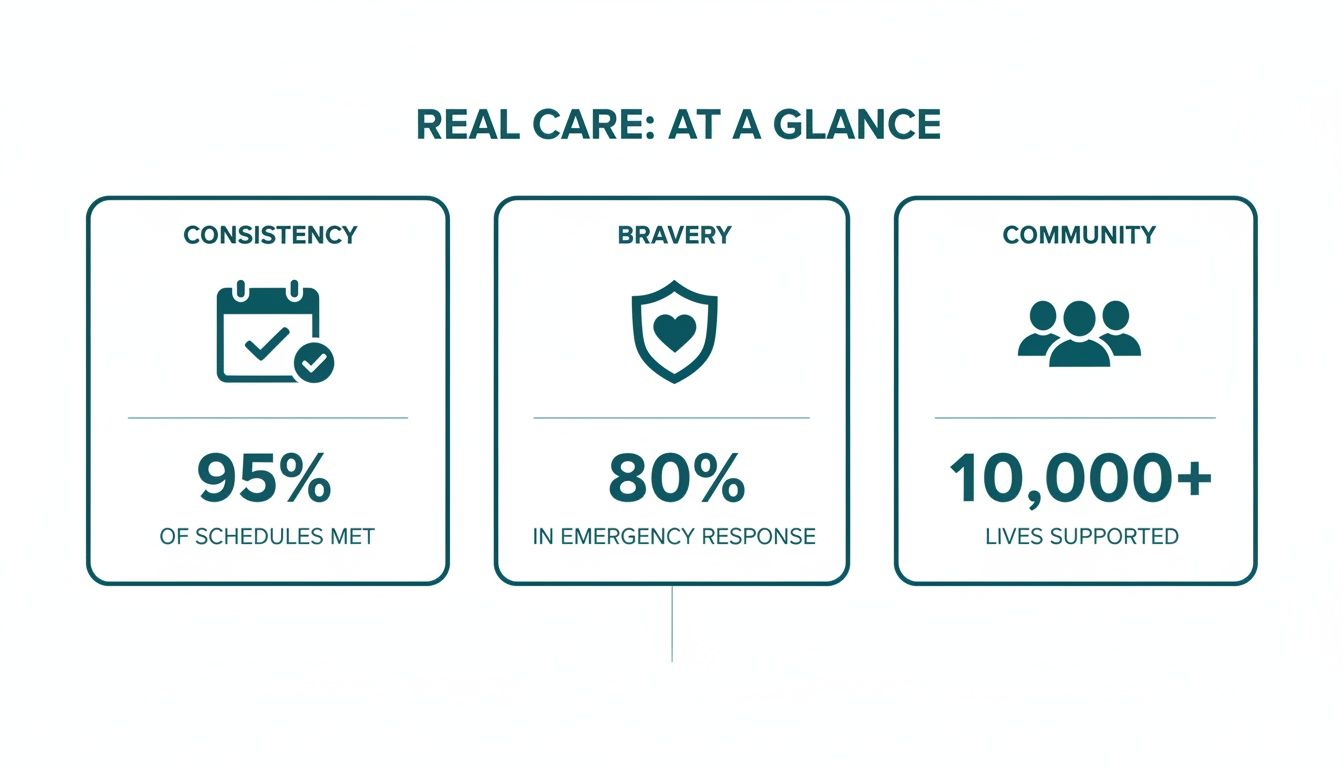
    This infographic shows you the mindset you need to turn that overwhelming feeling into action that actually means something.

    Infographic showing real care metrics: 95% consistency, 80% emergency response, and 10,000+ lives supported.

    These icons for consistency, bravery, and community aren't just feel-good graphics. They are the tools you and I use to transform a massive, terrifying problem into something we can physically touch and solve.

    Taking Back Your Power

    You seize your power not by trying to fix the whole world at once, but by taking direct, visible action in your own small corner of it. Caring for real is about turning those suffocating statistics into a specific problem you can physically solve, one piece of trash at a time. It’s your act of defiance against that feeling of helplessness.

    When you choose to pick up that first bottle, you’re not just cleaning a street. You are making a powerful statement that you refuse to be a bystander in your own community.

    This is the very essence of environmental stewardship. By focusing on what’s right in front of us, you and I create a ripple effect that builds momentum and inspires others to join. It’s a practical approach that turns a global crisis into a local mission. And that is where real change begins. If this idea clicks with you, you might be interested in our guide on what environmental stewardship truly means.

    How We Put Real Care Into Action

    Our very first cleanup was a trial by fire. Or, more accurately, a trial by ice.

    Picture this: just three of us, ambushed by one of those freak Chicago hailstorms that drops out of a perfectly blue sky. We were huddled under a pathetic, flimsy tree, soaked to the bone and shivering uncontrollably.

    And in that moment of pure misery, something happened. It hit me like a ton of bricks. Facing a stranger’s garbage—no matter how disgusting—was a thousand times easier than facing my own. That shared struggle, that freezing moment under the tree, wasn't just a bad day. It was the beginning of our story.

    This is the beating heart of the Litter Caterpillars philosophy. We show up in blizzards. We show up in brutal heatwaves. You and I believe the hard parts are what make the work real. It's not about being comfortable; it's about being committed. This is what it means to care for real.

    Three smiling volunteers in winter clothing and blue gloves pick up trash under a bare tree.

    Living Our Values Every Single Weekend

    Talk is cheap. Real care is showing up. It’s about building a system where our values aren't just pretty words on a website but are lived out by you and me, every single weekend, on the streets of Chicago.

    We protect our volunteers above all else. Your safety and happiness are my number one priority. I will never pressure you to do more than you're comfortable with or to come out when you can't. I will also never ask you for a dime. Your time and energy are the only currency that matters here.

    Real community isn’t a transaction. It’s built on a shared commitment to showing up for one another and for the city we all call home. It’s about creating a space where you feel valued, not just used.

    There's a reason we meet on weekend mornings. It’s like a natural filter. It brings out people like you who are wired to give—the ones who find genuine joy in service and want to kick off their weekend with a sense of purpose. We're building a community of givers, one tough but incredibly rewarding morning at a time. The bonds we forge are sealed in that shared effort. To see more on how this works, check out our community engagement strategies that build real connection.

    The Litter Caterpillars Philosophy

    Putting these ideas into practice is how we turn a simple cleanup into something more. It's how you find transformation in the trash. Here’s a breakdown of our core values and how we put them into practice every week.

    Our Value What It Means To Us How We Live It
    Bravery Embracing fear, failure, and suffering as your tools for growth. Cleaning in all weather—blizzards, rain, or heat. Taking pride in our work with flags and theme songs.
    Kindness Putting our volunteers' well-being first and building unity. Prioritizing your safety and happiness. Never asking for donations. Fostering real friendships between people like us.
    Service The act of giving transforms you, me, and our environment. Meeting every weekend morning to attract givers. Cleaning all 50 wards, especially neglected areas.

    This isn't just a mission statement. It’s a promise you and I make to ourselves, to each other, and to Chicago every time we grab a trash bag.

    Finding Beauty In The Unwanted

    Hands hold a plastic bottle from which a vibrant plant with flowers grows amidst colorful watercolor splashes, symbolizing growth and care.

    Do you remember that story about Tom Sawyer tricking his friends into painting a fence? A brilliant move. He took a mind-numbing chore and, with a spark of genius, turned it into a privilege—something so special that kids actually paid him for the chance to do the work.

    That’s exactly how I see what you and I do with trash.

    Picking up litter isn't some miserable punishment for living in a messy world. For us, it’s a huge opportunity to transform ourselves. Every bottle cap, every forgotten plastic bag, every crushed can is a chance for you to practice bravery, build real friendships, and find beauty where other people only see garbage. This is the heart of what it means to care for real.

    The Plastic Tide and Our Personal Stand

    This mindset really hits home when you think about plastic. It feels like an unstoppable, suffocating tide washing over our cities, parks, and oceans. While politicians and corporations debate policies and global agreements, you and I choose to take action. Right here. Right now.

    The global numbers are staggering, telling a story of deep inequality. The United States leads the world in plastic production per person, but other countries are drowning in waste with far fewer resources to fight back. Imagine Brazil—it generates over 10 million tons of plastic trash every year but only recycles a tiny 1.28%. The rest just clogs their land and oceans. For us Chicagoans, these global stats aren't abstract; we see the consequences firsthand in our own neighborhoods. You can dig deeper into the global plastic pollution numbers on worldpopulationreview.com.

    This is where our mission gets crystal clear. While the world debates, we believe real change starts with small, consistent work done by people like you who care enough to show up. We make a real dent in a problem that feels impossibly big.

    We are Litter Caterpillars because we know that through service, we can transform not just our city, but ourselves. We are finding profound growth in the grit.

    Finding Growth in the Grit

    Think of it like gardening. You can’t just toss seeds on the ground and hope for a miracle. You have to get your hands dirty.

    You pull weeds, you work the soil, you nurture the ground. It’s tough, messy work, but the reward is seeing something beautiful and alive grow from your effort. That's exactly what you and I are doing every single weekend.

    Here’s how we flip the script on what it means to clean up:

    • The Unwanted Becomes an Opportunity: A trashed-out park isn’t a sign of defeat; for us, it’s a blank canvas for our community to create something amazing.
    • A Chore Becomes a Connection: Picking up trash side-by-side with a stranger builds a bond way faster than small talk ever could. I've seen it happen.
    • Suffering Becomes a Story: Facing a challenge together—like cleaning in the pouring rain—doesn’t just build your resilience. It creates a shared memory, a story that makes our community stronger.

    We aren't just cleaning up. We are actively choosing to find value and potential in the things our society has thrown away. And in doing that, you and I discover a stronger, more connected version of ourselves.

    How You Can Start Caring For Real Today

    So, how do you take this big idea of "caring for real" and actually make it part of your life? It’s not about launching some massive city-wide movement overnight. It starts with one small, consistent action. Just one.

    The first step—and honestly, the most important one—is deciding to show up for something bigger than yourself. It's that choice you make to get off the sidelines and into the game.

    Maybe picking up litter isn't your thing, and that's totally cool. Maybe your heart sings when you're walking dogs at a local shelter. Or maybe it's as simple as spending an hour a week with an elderly neighbor who could use a friend. The what isn't nearly as important as the why and your commitment behind it.

    The Power of Consistent Action

    Something wild happens when you commit to showing up, week after week. It’s like you’ve turned on a homing beacon for other givers.

    Your consistency acts as a magnet. It naturally draws in people who share your values and that same itch to make a difference. These are the people who become your tribe. Your community.

    True belonging isn’t found in what you believe, but in what you do together. Consistent, shared action is the glue that builds the strongest communities.

    This is exactly why we do things at Litter Caterpillars that might look a little silly from the outside. We wave flags. We have a theme song. We celebrate our work with a ton of pride because I believe kind people deserve to feel powerful in the good they do. This is about more than just cleaning up trash; it's about building an identity around service.

    From Small Actions to Big Impact

    Your small, steady efforts ripple out in ways you can't even imagine. It’s easy to feel hopeless. Many developed countries bury over half their waste in landfills. But then you see places like Switzerland, which sends zero waste to landfills, or Estonia, which shot up to be a top-three performer globally.

    Estonia is the perfect story of how committed, small-scale actions can snowball into massive, nationwide change. You can see how different countries stack up at Sensoneo.com. By building a proud identity around service—the same way a sports team does—you and I prove we can redeem both our environment and ourselves.

    So, I’m inviting you to find your thing. Whatever it is that lights a fire in you, commit to it. Show up for it, even when you don't feel like it. And just watch how that one steady act of purpose starts to change not just your neighborhood, but everything inside of you, too.

    Ready to see what that feels like with us? We’ve got a great guide on how to get started with volunteer trash pickup.

    A Few Questions I Hear a Lot

    People often have questions before they join, and I get it. Here are some of the most common things people ask me about Litter Caterpillars and what it really means to show up for your community.

    Do I Have To Be Brave Or Physically Fit To Join

    Absolutely not. When I talk about bravery, I'm not talking about being some fearless superhero or a gym rat. Real bravery is just showing up, especially when you feel nervous or a little out of your element.

    Think of it this way: your bravery is a muscle. You build it over time, and you build it with us. Our cleanups are for everybody, no matter your fitness level. Some people go fast and fill a ton of bags. Others take it slow. Both are exactly what we need from you.

    The biggest thing you can give is just your presence. I put your safety and comfort first, always. You can contribute in whatever way feels right for you.

    What If I Can Only Volunteer Occasionally

    That’s totally fine. The whole point of caring for real is being authentic, not being perfect.

    Look, consistency is what forges those deep bonds in a community, but I know your life gets in the way. It's messy and unpredictable. Showing up even once is infinitely better than never showing up at all.

    There's zero pressure here from me. Every single person who comes out, even if it's just for an hour, makes a difference you can actually see on our streets. Just follow us online, see where we’ll be next, and come when you can. I'll be happy to have you.

    The real work isn't just cleaning the streets; it's about building a resilient, kind, and connected community, one person at a time, whenever you can show up.

    Is This Really Just About Picking Up Trash

    On the surface? Yeah, we pick up trash. But that’s just the beginning. The trash is just the excuse we use to do something much deeper.

    For me, it’s a form of active meditation, a way to clear your head while you clear the sidewalks. It’s a workout that gets you outside. It's an adventure into neighborhoods you've never seen before, showing you a side of the city you've never noticed.

    But more than anything, it's a hell of a filter for finding your people. When you decide to tackle a challenge together—even something as simple as cleaning a park—you build connections that go way deeper than anything you'd find at a bar.

    The trash is just the catalyst. The real change happens inside of you, and between us.


    Ready to see what it feels like to care for real? Join a Litter Caterpillars cleanup and find out what happens when you show up for your city, and for yourself. Find our next event at https://www.littercaterpillars.com.

  • 10 Transformative Ways to Give Back to Community in 2026

    10 Transformative Ways to Give Back to Community in 2026

    I’ll let you in on a secret. My life used to be a wreck. A total mess. My apartment was a disaster, and if I'm being honest, so was my head. Every piece of trash had a story, a weight I just couldn't seem to lift. I felt stuck, completely paralyzed. Then, one day, something inside me just snapped. I decided I had to change. I needed to find people who were givers, not takers. So I started by cleaning up someone else's mess—the litter scattered across Chicago's streets.

    Huddled under a tree during a freak hailstorm with two new friends, shivering and laughing hysterically, I had an epiphany. Facing a little hardship together wasn't just fun; it was electric. It was transformative. That’s how my group, Litter Caterpillars, was born. You see, the most powerful ways to give back to community aren't just about changing the world out there; they're about rewiring the world inside you. It's about finding your strength. Your people. Your purpose. One small, brave act at a time.

    This guide is for you, for anyone who feels that same pull. We're going to skip the vague, fluffy advice and dive straight into things you can do today. This weekend. This year. Whether you have 30 minutes or want to lead a movement, I promise there’s a place for you here. Let’s find it together.
    1. Neighborhood Litter Cleanup Drives

    Imagine walking down your street and seeing it completely clean. No discarded wrappers. No bottles. No debris. This isn't a fantasy. It’s what happens when you organize a neighborhood litter cleanup, one of the most direct ways you can give back to your community. It’s a grassroots lightning strike. This effort pulls neighbors together, transforming shared spaces through pure collective action. You don't just clean up trash; you build relationships and shout from the rooftops that you care about your home.

    How It Works & Why It Matters

    A litter cleanup is simple yet profound. You and a group of volunteers gather on a specific day, armed with bags, gloves, and grabbers, and you systematically clear an area. The impact is immediate. It’s inspiring. You are reclaiming your environment, one block at a time. The real magic happens when people see you out there. They get inspired. Maybe they join in, or maybe they just think twice before dropping something. That ripple effect strengthens community pride and weaves a culture of shared responsibility.

    Getting Started: Actionable Tips

    • Rally Your Troops: I use tools like Meetup or Instagram to get the word out. Schedule your cleanups for weekend mornings; that's when you'll get the most people.
    • Equip for Success: You should provide all the necessary supplies, like gloves and trash bags, so anyone can join without a second thought. I've found that partnerships with local waste management can help with getting rid of the trash afterward.
    • Build a Brand: My group, Chicago's own Litter Caterpillars, created a strong identity that now spans all 50 city wards. Think about a fun name. A flag. Even team T-shirts. You need something that builds camaraderie.
    • Celebrate Your Impact: You should always track how many bags of trash you collect and share those numbers with your volunteers. Celebrating these wins builds momentum and keeps everyone fired up.

    Ready to make a visible difference in your neighborhood? Starting your own group is easier than you think. For a step-by-step guide, check out this fantastic resource on how to start a volunteer trash pickup and bring this incredible community-building activity to your own streets.

    2. Community Garden and Green Space Development

    Picture this: an overgrown, forgotten lot in your neighborhood transforms into a vibrant hub of life. I'm talking raised garden beds overflowing with vegetables and neighbors laughing together. This is the reality of community gardening, one of the most powerful ways you can give back to your community. You aren't just planting seeds in the ground; you're planting seeds of connection, improving local food access, and creating beautiful, shared spaces where friendships can bloom. It's like building a living room for your entire neighborhood.

    Three diverse people gardening in raised beds with a city skyline, in a vibrant watercolor style.

    How It Works & Why It Matters

    A community garden is a metamorphosis. It takes underused land and turns it into a productive green space where you and your neighbors can grow your own food or simply enjoy nature. The process builds a deep sense of ownership and pride. By working the soil side-by-side, you create more than just a garden; you weave a stronger social fabric. This effort directly tackles issues like food deserts, beautifies the neighborhood, and provides a peaceful sanctuary for everyone to enjoy. It’s a living testament to what you and your neighbors can achieve together.

    Getting Started: Actionable Tips

    • Build Your Team: Before you even touch a shovel, you need to gather neighbors who share your vision. I suggest using social media or flyers to host an initial interest meeting.
    • Secure the Land: You'll have to identify a vacant lot and work with your local government or the landowners to get permission. Organizations like the Trust for Public Land can be invaluable partners in this process.
    • Create a Plan: Sketch out your garden layout and create a sustainable maintenance plan. You should establish volunteer rotations for watering and weeding to ensure it succeeds long-term.
    • Engage Everyone: Host workshops, potlucks, and planting days in the garden. This keeps the community involved. And make sure you celebrate your first harvest together to build momentum.

    Ready to bring a green oasis to your block? Learn from pioneers like Ron Finley and see how you can start your own urban gardening movement. This is more than just a project; it's a legacy of health and community.

    3. Youth and Student Volunteer Programs

    Imagine taking the raw energy and idealism of students and aiming it directly at your community's challenges. That's the heart of youth and student volunteer programs, one of the most potent ways to give back to community. These initiatives create structured pathways for you and other young people to contribute your skills, learn about civic responsibility, and build a lifelong habit of service. It’s not just about getting a task done. It's about investing in the next generation of leaders and seeing your city through their fresh, determined eyes.

    How It Works & Why It Matters

    Think of it like a matchmaking service. Youth volunteer programs connect students with vetted opportunities that fit their schedules and interests. They often partner with schools, universities, and local nonprofits to address real community needs, from mentoring younger kids to restoring local parks. This matters because it provides a crucial doorway into civic life. For many of us, it's our first taste of meaningful community work, building confidence, leadership skills, and a network of peers who believe in making a difference.

    Getting Started: Actionable Tips

    • Connect with Campuses: If you want to recruit passionate students, partner with local high schools and university service centers, like those at Northwestern or the University of Chicago.
    • Offer Flexibility: You have to provide evening and weekend opportunities to accommodate academic schedules. Be ready to document service hours for school requirements or resumes.
    • Create Peer Leadership: Empower dedicated student volunteers with leadership roles. Let them help manage events and recruit friends. This fosters a deeper sense of ownership.
    • Build Community: You should host social events after service projects to help volunteers connect and build friendships. This transforms a one-time activity into a lasting community.
    • Leverage Social Media: I use platforms like Instagram to share our stories, post opportunities, and celebrate the impact my young volunteers are making.

    Ready to engage the next generation? Look into programs like Chicago ServiceCorps for inspiration on how structured service can empower young adults and transform neighborhoods.

    4. Environmental Education and Awareness Campaigns

    Picking up trash is powerful, I know. But what if you could stop it from ever being dropped in the first place? This is where education becomes one of the most transformative ways to give back to community. When you create awareness campaigns, you move beyond treating the symptoms and start attacking the cause. You’re not just cleaning a park; you’re planting seeds of consciousness that grow into lasting, sustainable change for everyone. You're changing hearts and minds.

    How It Works & Why It Matters

    An awareness campaign is like translating passion into knowledge. You use storytelling, data, and compelling visuals to inform your neighbors about environmental issues and inspire them to act. The goal is to shift mindsets from passive coexistence to active stewardship. When I understand why a plastic bottle harms local wildlife or how my actions contribute to a larger problem, my behavior changes. This creates a powerful, self-sustaining cycle of care that multiplies the impact of every single cleanup event.

    Getting Started: Actionable Tips

    • Tell a Visual Story: You should use social media platforms like Instagram to share dramatic before-and-after photos of cleaned areas. I create short, engaging Reels that show the process and the impact.
    • Partner with Schools: Connect with your local schools to develop simple, age-appropriate presentations or activities. If you educate the next generation, you build a foundation for a cleaner future.
    • Share Shocking Stats: You can create simple, shareable infographics about local environmental data. Something like, "Did you know our neighborhood produces X tons of single-use plastic waste each month?" can be a real eye-opener.
    • Host Community Workshops: Try organizing monthly info sessions at a local library or community center on topics like composting, recycling best practices, or reducing household waste.

    Ready to inspire your neighbors and create a ripple effect of change? You can learn from the masters of environmental storytelling at organizations like the Ocean Conservancy and adapt their powerful techniques to your own local campaigns.

    5. Neighborhood Friendship and Social Connection Networks

    What if volunteering wasn’t just about the task, but about the people I do it with? Giving back to the community can be the most powerful antidote to loneliness. You can create genuine friendships and social bonds that last long after the work is done. This approach recognizes that when we serve together, we don't just transform our environment; we transform ourselves. We build resilience, a sense of belonging, and real, human connections. It's like finding your tribe while changing the world.

    Four smiling volunteers, three men and one woman, enjoy a coffee break after a community cleanup.

    How It Works & Why It Matters

    A friendship network built on service intentionally carves out space for connection beyond the task at hand. Your goal becomes twofold: make a tangible impact and build a supportive "tribe." It's about seeing the same faces each week, learning their stories, and celebrating shared accomplishments. The magic here is simple but profound: a shared purpose forges unbreakable bonds. Organizations like Rotary Clubs and my own Litter Caterpillars prove that when you put people first, the mission becomes even more meaningful and sustainable.

    Getting Started: Actionable Tips

    • Create Social Rituals: Don't let the event end with the cleanup. I always schedule a post-service coffee or meal to let people unwind and connect on a personal level.
    • Build a Buddy System: You should pair new volunteers with experienced members. This mentorship helps newcomers feel welcome and integrated from day one.
    • Celebrate People, Not Just Stats: I make a point to acknowledge volunteer anniversaries and personal milestones. You have to make everyone feel seen and valued as an individual, not just a helper.
    • Foster Group Identity: Create a fun name, a group chat for non-event chatter, or even team T-shirts. This builds a shared sense of pride and belonging.

    Ready to find your community while making a difference? Explore some proven community building activities for adults to see how service and friendship can create an unstoppable force for good in your neighborhood.

    6. Corporate and Business Partnership Programs

    Imagine your grassroots volunteer group suddenly having the resources of a local company behind it. That's the power of corporate and business partnerships. It’s a strategic way for you to amplify your impact. Think of it as a collaboration where businesses offer support—funding, supplies, or employee volunteers—and in return, they boost their community presence and engage their teams. You’re not just asking for a handout; you’re building a symbiotic relationship that fuels positive change for everyone involved.

    How It Works & Why It Matters

    A corporate partnership is like a perfect marriage. You align your community initiative with a business that shares your values. The company might sponsor your cleanup event, provide professional services, or offer matching grants for employee donations. This collaboration gives your project credibility and provides the resources you need to scale up. The magic is in finding that perfect match, where a business’s brand mission and your community goals overlap, creating a powerful story of shared purpose. It’s one of the most effective ways to give back to your community.

    Getting Started: Actionable Tips

    • Find Your Match: You should look for businesses whose mission aligns with yours. For my environmental group, a partnership with a company like Patagonia or Seventh Generation makes perfect sense.
    • Create a Clear Proposal: Outline exactly what you need and what the business gets in return, such as brand visibility or structured volunteer events for their staff. You have to make it a win-win.
    • Offer Turnkey Opportunities: Businesses are busy. You should design volunteer-ready projects that are easy for their employees to join, like a pre-organized park cleanup or a donation sorting day.

    • Showcase the Impact: I always share success stories, photos, and metrics with my partners. Host appreciation events to celebrate your joint achievements and strengthen the relationship.

    Ready to find a business ally for your cause? Building these connections can be a game-changer. For inspiration on how companies integrate giving back, explore how B Corporations are redefining business success to include social and environmental performance.

    7. Accessibility and Inclusive Volunteering Models

    What if everyone who wanted to help their community actually could? This powerful idea is the heart of inclusive volunteering. It’s a model that intentionally designs opportunities to welcome people of all abilities, backgrounds, and life circumstances. It’s about you moving beyond a one-size-fits-all approach and asking, "How can we remove the barriers?" When we do this, we don't just expand our volunteer pool; we create a richer, more representative, and truly unified community effort.

    A diverse group, including a woman in a wheelchair, adults, and a child, plants flowers as community service.

    How It Works & Why It Matters

    Inclusive volunteering means you build flexibility into your program from the ground up. It could look like offering virtual roles for me if I have mobility challenges, providing childcare so parents can participate, or ensuring event instructions are available in multiple languages. This isn't just about being nice; it’s about recognizing that diverse life experiences are a community's greatest asset. By making volunteering accessible, you unlock untapped potential and ensure that the solutions you create are truly for everyone.

    Getting Started: Actionable Tips

    • Audit Your Events: Before you plan, think about accessibility. Is the location wheelchair accessible? Are there clear paths? Is it near public transportation?
    • Offer Flexible Roles: You should create both in-person and virtual tasks. Not everyone can show up on a Saturday morning, but they might be able to help with online outreach or data entry from home.
    • Provide Support: Consider offering childcare or a quiet space for volunteers who may need a sensory break. You should ask volunteers what they need to succeed when they sign up.
    • Use Inclusive Language: Ensure your recruitment materials speak to everyone. A simple phrase like, "We are committed to creating an accessible event; please let us know your needs," makes a huge difference.

    Making your volunteer efforts more inclusive is one of the most powerful ways to give back to your community because it multiplies your impact. To learn more about universal design principles that can guide you, explore the resources from the National Center on Accessibility.

    8. Neighborhood Exploration and City Discovery Initiatives

    Imagine giving back to your community not just in one place, but across every single unique corner of your city. This is the soul of neighborhood exploration initiatives. It's a powerful model that combines volunteer service with intentional city discovery. You get to help clean, build, or support different neighborhoods while connecting with the diverse cultures and people that make your city vibrant. You break out of your bubble, build city-wide relationships, and truly understand the fabric of your home. It’s like being a tourist in your own town, but with a purpose.

    How It Works & Why It Matters

    These initiatives are about purposeful movement. Instead of focusing on a single location, you and your volunteer group systematically plan events in different neighborhoods, often with a goal to visit every single one. This approach turns giving back into an adventure. It combats the geographic and social divisions that can exist in a large city. It’s a profound way to foster a sense of shared identity and responsibility, showing that every community, from the quietest residential street to the busiest downtown corridor, matters equally.

    Getting Started: Actionable Tips

    • Map Your Mission: You should set a clear goal, like visiting all 50 of Chicago’s wards, as we did with the Litter Caterpillars. I use a map to track our progress and build excitement around the journey.
    • Partner with Locals: Before you visit a new neighborhood, connect with local community organizations or long-time residents. Ask them to share stories or highlight specific areas of need.
    • Create Discovery Guides: Develop simple "neighborhood cards" with interesting historical facts, local landmarks, or fun trivia. You can share these with your volunteers and deepen their connection to the area.
    • Document and Share: I use photos and social media to chronicle our journey through the city. This not only celebrates our impact but also inspires others to explore and appreciate the diversity of their own city.

    Ready to see your city in a whole new light while making a tangible difference? For inspiration on city-wide exploration, check out local groups like Chicago Detours to see how they bring neighborhood stories to life.

    9. Resilience Building and Personal Transformation Through Service

    What if giving back to your community could also be a profound journey of self-discovery? This approach to service isn't just about the outcome; it's about what you become in the process. It's you, volunteering with the intentional goal of building your own resilience, courage, and self-compassion by embracing challenges. Whether that’s facing harsh weather, navigating difficult tasks, or overcoming personal fears. This is where service transforms you as much as you transform your community.

    How It Works & Why It Matters

    This isn't your average volunteer gig. It's a framework where I see challenges as opportunities for growth. Think of my Litter Caterpillars crew showing up in a blizzard, not just to clean, but to prove we can. It’s the same transformative spirit you find in military service or Outward Bound programs. When you intentionally step into discomfort for a greater cause, you rewire your brain. You build mental toughness. You discover a strength you never knew you had. It’s a powerful way to give back that also gives you an unshakable sense of purpose.

    Getting Started: Actionable Tips

    • Frame the Challenge: Don't just announce a cleanup; frame it as an opportunity. “Let’s show this heatwave what we’re made of!” I use storytelling to reframe difficulty as an adventure.
    • Create Rituals: You should start with a team huddle or end with a moment of reflection. Celebrate perseverance with group photos, or even create unique team badges for conquering tough conditions.
    • Embrace Vulnerability: Create a safe space where you and other volunteers can share your struggles and triumphs. Brené Brown's research taught me that vulnerability is the birthplace of courage and connection.
    • Build Peer Support: Encourage mentorship and a strong team bond. Knowing you’re facing a challenge together makes it far less daunting and builds lasting friendships.

    Ready to see what you're made of while improving your neighborhood? Explore how groups like the Litter Caterpillars turn tough days into transformative experiences and join a movement that builds stronger communities and stronger people.

    10. Volunteer-Led Advocacy and Policy Change Initiatives

    Picking up a piece of litter is a powerful act, but what if you could stop it from ever hitting the ground? This is where your volunteer efforts can evolve into something even bigger: advocacy. By using the data, stories, and networks from your service work, you can influence systemic change at the city level. This approach transforms you from a volunteer into a community organizer. You start tackling the root causes of problems and not just the symptoms. You become the change.

    How It Works & Why It Matters

    Volunteer-led advocacy turns your on-the-ground experience into a powerful weapon for change. When my cleanup group documents that a certain intersection is always full of trash from an overflowing public can, we have evidence. When I share that evidence with a local alderperson, I’m no longer just cleaning; I’m advocating for better waste management services. This is one of the most impactful ways to give back to your community because it creates lasting solutions that benefit everyone, long after a cleanup event ends.

    Getting Started: Actionable Tips

    • Document Everything: You must take photos and notes during your volunteer activities. Track the types and sources of litter you find. Data is your most persuasive ally.
    • Collect and Share Stories: The human element is powerful. I share my volunteers' firsthand accounts of what they see and how it affects them. You can use these stories on social media and in meetings with officials.
    • Build Relationships: Get to know your city council members and their staff. I attend local meetings and introduce myself. A familiar face is more likely to be heard.
    • Create Clear Asks: Don't just present a problem; you have to propose a solution. Advocate for specific policy changes, like more public bins, better recycling programs, or stronger anti-littering enforcement.

    Ready to take your community service to the next level? You can multiply your impact by organizing for policy change. To get started, learn more about the fundamentals with this great overview of what community organizing is and how you can use its principles to create a better neighborhood.

    10 Ways to Give Back — Comparison

    🔄 Implementation complexity ⚡ Resource requirements & speed 📊 Expected outcomes & ⭐ Ideal use cases 💡 Key advantages / Tips
    Neighborhood Litter Cleanup Drives — Low to Moderate (volunteer coordination, scheduling) ⚡ Low cost; basic supplies; rapid visible results Improved streetscape, recurring volunteer habits — ⭐⭐⭐⭐ Urban blocks, quick wins, community engagement 💡 Weekend mornings; supply provision; partner with waste services
    Community Garden & Green Space Development — High (land, legal, long-term maintenance) ⚡ High upfront capital and labor; slow-to-mature benefits Long-term assets, food access, property value uplift — ⭐⭐⭐⭐ Vacant lots, food-security projects, neighborhood revitalization 💡 Partner with city, clear maintenance plan, diversify funding
    Youth & Student Volunteer Programs — Moderate (supervision, calendar alignment) ⚡ Moderate resources; fast mobilization during term times Leadership development, energetic turnout, networks — ⭐⭐⭐⭐ Universities, high schools, recruitment and skill-building 💡 Offer service-hour docs, peer leaders, social events
    Environmental Education & Awareness Campaigns — Low to Moderate (content, outreach) ⚡ Low cost and highly scalable; behavior change is gradual Increased knowledge and motivation; broader reach — ⭐⭐⭐ Schools, city-wide outreach, digital audiences 💡 Use compelling visuals, school partnerships, shareable infographics
    Neighborhood Friendship & Social Connection Networks — Moderate (facilitation, inclusion) ⚡ Low–medium cost; impact on retention builds over time Strong social cohesion and volunteer retention — ⭐⭐⭐⭐ Newcomer integration, loneliness reduction, retention-focused efforts 💡 Host post-service socials, assign buddies, celebrate milestones
    Corporate & Business Partnership Programs — Moderate to High (relationship mgmt, agreements) ⚡ High resource potential (funding, skills); can scale rapidly Major resource boost, professional expertise; expanded capacity — ⭐⭐⭐⭐ Scaling initiatives, sponsorship needs, skilled pro support 💡 Align missions, clear agreements, protect volunteer-first ethos
    Accessibility & Inclusive Volunteering Models — Moderate to High (accommodations, training) ⚡ Medium resources to implement accommodations; expands pool quickly More diverse participation and equitable access — ⭐⭐⭐⭐ Programs serving diverse abilities, parents, multilingual communities 💡 Audit accessibility, offer multiple roles, provide childcare/transport
    Neighborhood Exploration & City Discovery Initiatives — Moderate (logistics, routing) ⚡ Medium resources (transport, coordination); novelty drives quick engagement Broadened city knowledge and cross-neighborhood ties — ⭐⭐⭐ New residents, adventurous volunteers, city-wide coverage goals 💡 Plan routes, partner with local groups, document stories/photos
    Resilience Building & Personal Transformation — High (skilled facilitation, support) ⚡ Medium–high resources for training and mentorship; outcomes long-term Deep personal growth, resilience, mental-health benefits — ⭐⭐⭐⭐ Cohort programs, leadership development, healing-through-service 💡 Frame challenges as growth, build peer support, share transformation stories
    Volunteer-Led Advocacy & Policy Change Initiatives — High (data, coalition building) ⚡ Medium resources; slower timeline but systemic impact Policy and structural change; scalable long-term improvements — ⭐⭐⭐⭐ Addressing root causes, municipal budget/policy influence 💡 Collect systematic data, train citizen advocates, build official relationships

    Go Far, Go Together

    We've walked through so many different avenues in this guide. We've seen everything from quick, impactful acts of kindness to deep, recurring commitments that reshape our neighborhoods. You've seen how a simple litter cleanup can blossom into a city-wide movement. How a community garden can nourish more than just our bodies. How your voice can spark real policy change. The core lesson isn't just about the what or the how, but the who you become along the way.

    Finding ways to give back to community is like planting a tree. You might not see the full-grown oak overnight, but every single act, every bag of trash I collect, every seed you plant, is a commitment to a future you believe in. It’s a declaration. A statement that you see the potential in your surroundings and, more importantly, in yourself. The journey we've explored is about transforming passive hope into active participation.

    Your Path is Your Own, But You Don't Have to Walk It Alone

    Think about the paths we've covered:

    • The Spark of Connection: You can build friendship networks and simply check on a neighbor.
    • The Power of Green: We can nurture community gardens and reclaim public spaces.
    • The Voice of Change: You can engage in advocacy and shape a more inclusive, accessible community.

    Each of these isn't a separate, isolated task. They are threads in a larger tapestry. When you pick up litter, you're not just cleaning; you're making a space more welcoming for a community gathering. When I teach a child about recycling, I'm not just sharing facts; I'm investing in a more sustainable future. Every action you take creates ripples that you may never fully see, but their effects are undeniable.

    The most crucial takeaway is this: you don't need a grand plan or a perfect moment to start. You just need to take a single step. The old saying is true: if you want to go fast, go alone, but if you want to go far, go together. Finding ways to give back to community is never just about the task. It's about the 'together.' It’s about realizing you’re not the only one who cares.

    It's about building the kind of friendships that can withstand a hailstorm and showing up for each other, week after week. We are Caterpillars because we know we're not perfect, but we are all trying to transform.

    Through service, sunlight, and friendship, you learn to trust and forgive yourself. You find your pride. So find your people, grab a flag, and start your own story. The community, and the person you're becoming, is waiting for you.


    If you're ready to take that first step and find your people in Chicago, join us at Litter Caterpillars. We make giving back to the community fun, social, and deeply rewarding, exploring a new neighborhood every weekend. Find your next adventure and your new friends at Litter Caterpillars.

  • Discover young professional networking events: 8 Chicago picks for connections

    Discover young professional networking events: 8 Chicago picks for connections

    I remember it. The stale air. The forced smiles. That lukewarm glass of wine in my hand, a flimsy shield against the awkwardness. You’re supposed to be "networking," but it feels like you're performing a role in a play you never auditioned for. It’s a transaction. A hollow exchange of titles and elevator pitches. I’ve been there. You’ve been there. It’s exhausting.

    For a long time, I thought this was just the price of admission. The cost of climbing some ladder I wasn't even sure I wanted to be on. I’d come home with a pocketful of business cards, these little paper tombstones of conversations I’d already forgotten. But here’s the secret: the problem isn’t you. It never was. The problem is the game itself. A game designed for shallow handshakes, not deep hand-holds.

    What if we just ripped up the rulebook? Imagine networking wasn't something you did, but something that happened. Something that grew organically while you were busy doing something else—something meaningful. Like solving a real problem with a small team of brilliant people. Or discovering a hidden corner of your city. That’s what we’re going to explore.

    I’m going to walk you through 8 kinds of young professional networking events that feel less like work and more like life. These aren't about collecting contacts like they're trading cards. This is about finding your people. The ones who get it. The ones you build things with.

    1. Volunteer-First Community Service Events

    Picture this. You're not balancing a tiny plate of cheese cubes and trying to shout over music. Instead, you're side-by-side with someone, both of you covered in a little bit of dirt, working to restore a neighborhood garden. You laugh about a stubborn weed. You high-five after planting a tree. That’s where the real connection happens. Volunteer-first events are like a networking life-hack; they flip the entire script. The goal isn't to network. The goal is to get something done, together. The networking? That’s just the beautiful, inevitable consequence.

    You show up. You grab a tool. You start working. Suddenly, you're not a "Marketing Manager" talking to a "Software Engineer." You're just two people, united in purpose. The conversations flow without effort because they’re rooted in a shared action, not a shared agenda. I promise you, the strongest professional relationships I’ve ever built were forged not in boardrooms, but in parks and on trails.

    Who This Suits Best

    This is for you. If you're done with the performance of networking and you just want something real. It’s a magnet for people who are driven by purpose, not just profit. You’ll find your tribe here if you believe that what you do is more important than what you call yourself.

    Real-World Examples in Action

    • Litter Caterpillars: I have to start here. This Chicago group turned weekly cleanups in all 50 city wards into a movement. You explore the city, you make a real, visible difference, and you meet amazing people. It’s brilliant.
    • Surfrider Foundation: Their beach cleanups are electric. You connect with other young professionals who are just as passionate about protecting our oceans as you are.
    • Sierra Club Chapters: They host trail maintenance days that are perfect for people who want to mix their love for the outdoors with genuine community building.

    Key Insight: Think of it like building a bridge. You can talk about building a bridge all day, or you can pick up a hammer and start building it with someone. Which one creates a stronger bond?

    How to Maximize Your Experience

    To turn these young professional networking events into a core part of your life, you have to treat it like a relationship, not a transaction.

    • Become a Regular: Show up. Again and again. Consistency is the soil where deep roots grow. When people see you week after week, trust builds naturally.
    • Arrive Early, Stay Late: The real gold is often found in the margins. The conversations you have while setting up, or the casual coffee you grab with a few people after the event is done—that’s where friendships start.
    • Mentor a Newcomer: Once you know the ropes, take a new person under your wing. Be their guide for the day. Teaching is one of the most powerful ways to connect and establish yourself as a leader.

    You build your best network when you’re not trying to build a network at all. You just show up to serve. If you feel that spark, go find volunteer work near you that speaks to your soul.

    2. Skills-Swap and Peer Learning Circles

    Forget the sage on the stage. The one-way firehose of information that puts you to sleep. Imagine a circle. A small group where, one minute, you’re the student, soaking up knowledge, and the next, you’re the teacher, sharing your own expertise. This is a skills-swap. It’s a living, breathing workshop where networking is transformed from a passive sport into a collaborative jam session.

    You might show up to learn the basics of SEO from a digital marketing guru. And that same guru might be there to learn your secrets for crafting a killer presentation. The whole pyramid of hierarchy just melts away. Respect here isn't earned from a fancy job title. It’s earned by what you know and your willingness to share it. It’s a community built on a simple, powerful idea: let’s all get better, together.

    Who This Suits Best

    This is your jam if you learn by doing. If you believe that everyone has something to teach and something to learn. This space is built for ambitious people who want to collect skills, not just business cards. If you want a network of people you can actually call when you’re stuck on a problem, you’ve found your home.

    Real-World Examples in Action

    • Lean In Circles: These are powerhouse groups for women. They meet regularly in a confidential space to mentor each other, learn new leadership skills, and tackle challenges as a team.
    • Nonprofit Leadership Cohorts: I’ve seen organizations like Nonprofit HR create these amazing cohorts where emerging leaders come together to share their struggles and master everything from fundraising to board management.
    • Tech Community "Lunch and Learns": A classic for a reason. Developers, designers, and project managers get together over pizza to teach each other the latest coding trick or design tool. It’s simple, effective, and collaborative.

    Key Insight: Teaching is like learning something twice. When you teach a skill, you solidify it for yourself and earn someone's deep respect. When you learn from a peer, you create a bond of gratitude that lasts.

    How to Maximize Your Experience

    To squeeze every drop of value from these young professional networking events, you have to be more than just a face in the crowd. You have to be a participant.

    • Offer to Lead a Session: Don't wait for an invitation. Step up. You have a skill someone else wants to learn, whether it’s managing your inbox or reading a spreadsheet. Proposing a topic is the fastest way to become a leader in the group.
    • Come Prepared to Learn: When it’s your turn to be the student, do your homework. If the topic is new to you, read an article or two beforehand. Showing up with thoughtful questions tells the facilitator you value their time.
    • Follow Up with Action: This is the big one. If someone teaches you a new skill, go use it. Then, circle back and tell them how it went. "Hey, I used that Excel formula you taught me and it saved me an hour." That feedback is pure gold and cements your connection.

    You’re not just trading information. You’re trading trust. You’re building a network of people you’ve actively helped and who have actively helped you.

    3. Themed Neighborhood Exploration Tours

    Stop thinking of networking as an event you have to endure. Start thinking of it as an adventure you get to join. Imagine you’re not in a beige conference room; you’re walking through a historic Chicago neighborhood, uncovering its secrets. Then, you and your new friends roll up your sleeves to help clean a local park. This is what a themed neighborhood tour does—it combines the thrill of discovery with the soul of community service.

    The city becomes your meeting room. Your agenda is a map. The conversations happen naturally as you walk, discovering a hidden piece of street art or learning the story behind an old building. The shared experience of seeing your city with fresh eyes, and then leaving it a little better than you found it, is a powerful glue.

    A young couple walks a city street, man points, holding coffee, map floats by vibrant graffiti wall.

    Who This Suits Best

    This is for the curious. The explorer. The person who believes that the best way to understand a place is to walk its streets. If you want to build a connection to your city while you build connections with people, this is for you. It attracts an adventurous, open-minded crowd that cares about the story of their community.

    Real-World Examples in Action

    • Litter Caterpillars: Their 50-ward model is genius. Each event is a deep dive into a new Chicago neighborhood. You learn its history, meet its people, support its local businesses, and clean its streets.
    • Jane's Walk: These are citizen-led walking tours inspired by the great urbanist Jane Jacobs. They are less of a tour and more of a walking conversation about what makes a neighborhood tick.
    • Neighborhood-Focused Groups: I’ve seen so many young professional groups do this. They'll organize a food tour of a specific neighborhood, or a historical walk that ends at a local brewery. It’s social, educational, and fun.

    Key Insight: Think about your best travel memories. They’re almost always tied to a specific place and a shared experience. These tours do the same thing, but in your own backyard. You’re creating a shared memory, and that's a powerful foundation for any relationship.

    How to Maximize Your Experience

    To make these explorations more than just a pleasant afternoon, you have to be an active participant in the adventure.

    • Create a 'Passport': Get a small notebook. Every time you explore a new neighborhood, jot down one cool fact you learned and the name of one person you connected with. It turns the series of events into a personal quest.
    • Be the Storyteller: Before you go, spend five minutes on Google. Find one fascinating, obscure fact about the neighborhood. Sharing that with the group is a simple, powerful way to add value and start a conversation.
    • Lead a 'Before & After': Offer to be the unofficial photographer. Snap a picture of a spot before the cleanup and another one after. It's a small act of leadership that gets you talking to everyone and creates a great story to share online later.

    When you turn your city into a playground for connection, you build a network that’s as rich and diverse as the neighborhoods themselves.

    4. Purpose-Driven Cohort Programs

    Imagine this. You're not just at a one-off event. You've joined a crew. A team of twenty other passionate people, all committed to tackling a massive challenge together over the next six months—like launching a city-wide composting initiative. You meet every week. You learn together. You push each other. You build something real. That’s a purpose-driven cohort.

    This model is the antithesis of the fleeting, superficial networking event. It’s an investment. It’s a commitment. You're not just meeting people; you're becoming part of a tribe that is moving in a single, powerful direction. The bonds you forge in a cohort are different. They're deeper. They're forged in the fires of shared struggle and shared success. These aren’t just contacts; they become your allies.

    Who This Suits Best

    This is for you if you're hungry for depth and accountability. If you’re tired of conversations that only scratch the surface and you want to be part of something bigger than yourself. A cohort is a launchpad for ambitious people who want a structured journey toward growth, supported by a community that has their back.

    Real-World Examples in Action

    • StartingBloc: They run these incredible fellowship programs that are like a boot camp for social innovators. You go through an intensive institute and then you have this lifelong network of support.
    • Green 2.0 Leadership Program: This is a cohort-based program laser-focused on advancing racial equity in the environmental movement. It’s powerful, necessary work.
    • Local Caterpillar 'Leadership Track': This is the next level. They train small, local cohorts to become leaders who can organize their own community cleanup groups. It’s about creating a ripple effect of impact.

    Key Insight: It’s like the difference between being a fan in the stands and a player on the team. When you’re on the team, you’re invested. You win together, you lose together, and you build a bond that spectators can only imagine.

    How to Maximize Your Experience

    To truly harness the power of these intensive young professional networking events, you have to go all in.

    • Commit Fully: Show up. To everything. The retreats, the weekly calls, the optional coffee meetups. The real magic happens in the consistent, cumulative time you spend together.
    • Be Vulnerable and Open: The strength of the cohort is directly proportional to the honesty of its members. Share your real struggles, not just your polished wins. That’s what allows the group to actually help you.
    • Champion Others: Make it your mission to help your fellow members succeed. Make introductions for them. Share resources that could help them. Celebrate their victories as if they were your own. What you give, you will get back tenfold.

    Joining a cohort isn't like attending an event. It’s like enrolling in a shared destiny. You’re building a network that will be a foundational part of your career for years to come.

    5. Impact-Focused Happy Hours and Social Gatherings

    Picture a happy hour. But instead of the usual forced chatter about quarterly reports, the room is buzzing with conversations about building a better city. The energy is different. It’s inspiring. This is an impact-focused happy hour, where the price of admission isn't a business card, but a shared passion for making a difference.

    These gatherings intentionally lower the stakes. They’re casual, often held in a local coffee shop or a park. The goal is to strip away the pretense and create a space where you can connect as a human first, and a professional second. The conversations naturally shift from "So, what do you do?" to "So, what are you passionate about?" And that one small change makes all the difference in the world.

    Four diverse young professionals networking over coffee and croissants at a vibrant event.

    Who This Suits Best

    This is your scene if you believe your work should mean something. It’s for you if you’re tired of the schmooze-fest and you want to build a network of people who are driven by purpose. If you want to leave a networking event feeling energized and inspired, not drained and cynical, this is your place.

    Real-World Examples in Action

    • Litter Caterpillars: After their weekly cleanups, the group often heads to a local coffee shop. This is where the magic really solidifies. Over a warm drink, volunteers share stories, laugh, and build real friendships.
    • B1G1 (Business for Good): Their mixers are incredible. They bring together entrepreneurs and professionals who are all focused on embedding social impact directly into their business.
    • Impact Hub Chicago: This is a nexus for social innovators. Their community events, from workshops to casual social hours, are a magnet for people who want to change the world.

    Key Insight: It's like tuning a radio. When you tune it to a specific frequency—in this case, "purpose"—you filter out all the static. You attract people who are on your wavelength, and the connection is immediate and clear.

    How to Maximize Your Experience

    To make these young professional networking events more than just a pleasant evening, you need to be a gentle catalyst for connection.

    • Invite a Speaker: Ask a leader from a local nonprofit or a social entrepreneur to come share a five-minute story. It sets the tone and gives everyone something meaningful to talk about.
    • Show Up with Questions: Have a couple of go-to questions that go beyond the surface. Something like, "What's a project you're working on that you're really excited about right now?"
    • Rotate Venues: By hosting these in different neighborhoods each month, you make it easier for new people to join and you get to support a bunch of cool local businesses.
    • Be a Connector: If you see someone standing alone, bring them into your conversation. The simple act of introduction is a powerful form of leadership that makes the whole community stronger.

    When you center your social gatherings on purpose, you create an environment where authentic relationships aren't just possible; they’re inevitable. Dig into these community building activities for adults for more ideas.

    6. Mentorship Matching and One-on-One Programs

    Forget trying to get five minutes with a keynote speaker in a crowded ballroom. Imagine having their undivided attention for an hour, every month. A dedicated guide. Someone who’s already walked the path you’re on, who is there just for you. This is the superpower of mentorship programs. They swap the chaos of the crowd for the focused intimacy of a one-on-one relationship.

    These programs aren’t about random chance. They are about intentional connection. You are thoughtfully paired with an experienced professional whose job is to help you navigate your next steps, build new skills, and avoid the pitfalls they fell into. It’s not about collecting a contact. It's about gaining a champion, an advisor, and a confidante.

    Who This Suits Best

    This is for you if you’re at a crossroads. If you feel stuck, or you’re thinking about a big career change, or you simply want to fast-track your growth. A mentor provides the kind of personalized, strategic guidance you will never find at a happy hour. It’s for people who value the depth of one strong relationship over the breadth of a hundred shallow ones.

    Real-World Examples in Action

    • Green 2.0: This organization runs mentorship programs specifically designed to lift up leaders of color in the environmental sector. It’s about creating real pathways to power and influence.
    • Local Lean In Circles: Many local chapters build mentorship right into their programming, connecting women with experienced leaders who can help them break through barriers.
    • University Partnerships: Your alumni association is a goldmine. Many of them have formal programs that will pair you, a recent grad, with a seasoned pro in your field. It’s a direct line to invaluable industry wisdom.

    Key Insight: A good mentor is like a personal trainer for your career. They don’t lift the weights for you, but they show you the right form, push you to do one more rep, and spot you so you don’t get crushed.

    How to Maximize Your Experience

    To turn a mentorship into a truly life-changing relationship, you have to be the one driving it. You are the CEO of this relationship.

    • Set Clear Goals: Before you even meet, know what you want. A promotion? A new skill? Advice on a specific project? Write it down and share it with your mentor in the first meeting.
    • Drive the Agenda: Don't show up and say, "So, what should we talk about?" That's your job. Come to every single meeting with a list of questions, challenges, and ideas you want to workshop.
    • Follow Through and Report Back: This is crucial. When your mentor gives you advice or suggests an action, go do it. Then, in your next meeting, report back on how it went. This shows them you’re serious and builds momentum.

    When you invest in these structured young professional networking events, you’re not just growing your network. You’re building a personal board of directors for your career.

    7. Project-Based Collaborative Teams

    Let’s move beyond just talking. Let’s build something. Imagine you and a small, dedicated team spend the next three months turning a vacant, trash-filled lot into a beautiful community garden. Or maybe you work together to develop a real policy proposal for your city council. This is the power of a project-based team. It turns networking from a conversation into a creation.

    Four young professionals discuss a landscape design model with miniature trees and blueprints.

    This is a whole different ballgame. It requires you to rely on each other, to solve problems on the fly, to navigate disagreements, and to celebrate a shared victory. The relationships you build in the trenches of a real project are incredibly strong. They are forged in the heat of action.

    Who This Suits Best

    This is for the doers. The builders. The people who get more satisfaction from a finished project than a finished conversation. If you want to develop real, tangible skills—like project management, leadership, and teamwork—while making a visible impact on your community, this is where you belong.

    Real-World Examples in Action

    • Litter Caterpillars: Their "Caterpillar Park" project is the perfect example. A team of volunteers took an empty lot in Englewood and, through sheer teamwork and dedication, transformed it into a vibrant public space.
    • Code for America Brigades: These are local squads of tech professionals who team up to build apps and websites that solve real civic problems for their city. It’s collaborative, high-impact work.
    • Young Invincibles: They often launch project-based campaigns, like advocating for environmental justice policies, where young professionals work together as a team to research, strategize, and make their voices heard.

    Key Insight: When you build something together, you create a shared story of success. The professional connections you make aren't just contacts anymore. They become your co-conspirators, your partners in creation.

    How to Maximize Your Experience

    To make these young professional networking events a success for both you and the project, you need to show up ready to collaborate.

    • Choose a Passion Project: Don't just pick any project. Pick the one that makes your heart beat a little faster. Your genuine passion will be a magnet for other passionate people.
    • Define Roles Early: The first thing your team should do is figure out who is doing what. Having clear roles and responsibilities is the secret to a happy, effective team.
    • Document the Journey: Be the team's storyteller. Take pictures. Write short updates. When you’re done, you’ll have this amazing record of what you accomplished together, which is powerful for everyone's portfolio and for the soul.

    By creating something real with other people, you build a network that is grounded in shared accomplishment. If you want to dive deeper, you can explore these powerful community engagement strategies.

    8. Identity-Driven Community and Cultural Affinity Networking

    Imagine you walk into a room and you can just… breathe. You don't have to explain yourself. You don't have to translate your experiences. You are seen. You are understood. This is the profound power of identity-driven networking. These are events created by and for young professionals who share a common identity—be it race, gender, ethnicity, or sexual orientation.

    These spaces are sanctuaries. They are designed for connection, for solidarity, and for the celebration of shared culture. The networking that happens here is different. It’s less about climbing a ladder and more about building a foundation. It’s about finding your people, sharing strategies for navigating systems that weren't built for you, and drawing incredible strength from the community.

    Who This Suits Best

    This is for you if you've ever felt like the "only one" in the room. If you are tired of code-switching and you just want to connect with peers who get it without you having to say a word. If you see your identity not as a barrier, but as a source of immense power and pride, these are your spaces.

    Real-World Examples in Action

    • Sanctuary 'Queer in Green': These groups create these amazing, vibrant communities across the country for LGBTQ+ professionals in the environmental movement to connect, collaborate, and support each other.
    • Chicago Black Environmental Activists: This group is a vital hub for Black leaders to network, organize, and fight for environmental justice in their own communities.
    • 1% for the Planet: They have specific programs that focus on women in sustainability, creating powerful mentorship opportunities and support systems for female leaders in a male-dominated field.

    Key Insight: Psychological safety is the bedrock of genuine connection. When you feel safe enough to bring your whole, authentic self to the table, networking ceases to be a performance and becomes an act of community building.

    How to Maximize Your Experience

    To honor and contribute to these essential young professional networking events, you have to show up with a spirit of mutual support.

    • Invest in the Community: Don't just be a taker. Be a giver. Actively participate. Offer your help. Share your knowledge. The strength of the community depends on the contributions of its members.
    • Share Your Story: Vulnerability is the currency of trust. Sharing your own journey—the highs and the lows—is what forges the deep, authentic bonds that make these groups so powerful.
    • Become a Mentor or Mentee: Look for ways to lift as you climb. Offer to mentor someone who is just starting out, or seek guidance from someone who has navigated the path ahead of you. This is how we build collective power.

    By connecting with your community, you build a network that is more than just a professional asset. It is a lifeline. A source of strength, resilience, and profound belonging.

    8-Format Comparison: Young Professional Networking Events

    Program 🔄 Implementation complexity ⚡ Resource requirements 📊 Expected outcomes 💡 Ideal use cases ⭐ Key advantages
    Volunteer-First Community Service Events Medium — ongoing coordination, volunteer leadership needed Low–Medium — volunteers, basic supplies, light refreshments Tangible neighborhood impact, steady visibility, authentic friendships Young professionals seeking purpose-driven social bonds and city exploration Builds deep bonds, filters for values-aligned members, habit-forming
    Skills-Swap and Peer Learning Circles Low–Medium — small-group facilitation, rotating leaders Low — space (or virtual), facilitators, simple materials Improved skills, leadership development, stronger professional ties Peers wanting practical skill exchange and leadership practice Empowers participants as teachers; low cost; repeatable
    Themed Neighborhood Exploration Tours Medium–High — route planning, partner coordination, logistics Medium — guides/partners, transit, partner refreshments Discovery-driven engagement, local business support, shareable content Newcomers and adventurous professionals who want exploration + service High appeal for exploration; creates cross-ward connections and social content
    Purpose-Driven Cohort Programs High — curriculum design, cohort management, alumni systems High — facilitators, materials, possible retreat/event costs Deep relationships, measurable growth, ongoing alumni network Professionals seeking sustained development and accountability Creates lasting networks, clear milestones, high retention of committed members
    Impact-Focused Happy Hours & Socials Low — venue booking and light facilitation Low–Medium — venue/refreshments, occasional speaker fees Low-commitment engagement, moderate relationship formation, community outreach Introverts/newcomers and those preferring casual entry to community Accessible, low barrier to entry; easy to run regularly; supports local venues
    Mentorship Matching & One-on-One Programs Medium–High — careful matching, training, ongoing support Medium — mentor recruitment, training, coordination tools High-impact personal growth, retention, leadership development Individuals seeking tailored career guidance and long-term growth Produces highest-impact professional relationships; personalized guidance
    Project-Based Collaborative Teams High — project scoping, team management, deliverable oversight Medium–High — materials, facilitation, sustained volunteer time Tangible community projects, portfolio outcomes, strong team bonds Action-oriented professionals who want measurable community impact Delivers concrete outcomes and develops diverse skills through collaboration
    Identity-Driven Community & Cultural Affinity Networking Medium — skilled facilitation, cultural competency, outreach Low–Medium — facilitators, safe-space resources, accessibility supports Increased belonging, representation, leadership within identity groups Young professionals seeking identity-affirming spaces (e.g., women, BIPOC, LGBTQ+) Fosters belonging and safety; accelerates leadership from underrepresented groups

    Your Network Is Your Life – Start Building It That Way

    So, there you have it. A whole universe of possibilities beyond the stuffy mixer. We’ve journeyed from cleaning up parks to building civic apps, from learning new skills in a small circle to finding strength in a shared identity. The old way—the transactional, soul-crushing way—is dead. It’s over. You have a choice. You can build a network based on something real.

    Modern young professional networking events are an inversion of the old model. They are not about what you can get. They are about what you can give. What you can contribute. What you can build. The connection is the byproduct of the mission. It’s that simple. And each of the paths we explored is just a different door into that same, beautiful truth.

    From Ideas to Action: Your First Step

    I know what you might be thinking. It's so much easier to just stay on the couch. Showing up somewhere new, by yourself, takes courage. I get it. But let me offer you a new frame. Every single person you meet is a potential new direction for your life. The right conversation can unlock an opportunity you never knew existed. The right friendship can change the way you see everything.

    My own life changed forever not at some fancy gala, but while picking up trash in a hailstorm. Seriously. I was huddled under a tree with two strangers, all of us soaked and laughing, and I realized: this is it. This is community. It wasn’t a business card exchange. It was a shared experience. A tiny, perfect moment of shared purpose. And it taught me a lesson I will never forget:

    The strongest bonds aren’t forged over cocktails; they’re forged in collaboration. They are built when you’re side-by-side, working towards a common goal, creating tangible change.

    That’s the secret sauce. You don’t have to be the smoothest talker in the room. You just have to be willing to roll up your sleeves. The pressure to "perform" evaporates when the focus is on the work, not on you.

    Your Challenge: Just Pick One

    So here is my challenge to you. Pick one. That’s it. Just one of these ideas that made something flicker inside you. Don't analyze it to death. Don't wait for the perfect moment.

    • Feel a pull to learn something new? Find a skills-swap.
    • Crave a tangible, visible impact? Sign up for a volunteer event.
    • Longing for a community that just gets you? Seek out an affinity group.

    The goal is to break the inertia. To move from thinking to doing. Show up. Bring your curiosity. Offer your help. The people you’re meant to meet are out there, waiting. They’re not at a mixer. They’re out there, doing the work. Go find them. Your network is not just a tool for your career; it is the fabric of your life. Start weaving it with purpose.


    Ready to put this all into action? The best way to build a network with impact is to start with service. Join me and a community of incredible people at Litter Caterpillars, where we turn neighborhood cleanups into the most meaningful (and fun) young professional networking events in Chicago. Find your next event and sign up at Litter Caterpillars.

  • Your 2026 Guide to the Top 12 Recycling Centers Chicago Volunteers Trust

    Your 2026 Guide to the Top 12 Recycling Centers Chicago Volunteers Trust

    My life felt like a cluttered garage. You know the one. Full of things I couldn't part with. An old bike tire wasn't just rubber; it was that one perfect summer afternoon. Every piece of junk had a story, a weight that pulled me down, even if it was just a few ounces. It’s funny how memories can feel like anchors.

    Then, a sudden storm in my personal life forced me to clean house. I realized I had to build something new, something that demanded the very things I’d always dodged: consistency, cleanliness, courage. And just like that, Litter Caterpillars crawled into existence.

    I remember our first cleanup. Three of us, caught in a freak Chicago hailstorm. We huddled under an oak tree, soaked and shivering, watching Ubers cancel on us one by one. And in that miserable, beautiful moment, a thought struck me like lightning. Cleaning up a stranger's mess is a thousand times easier than facing your own. It was fun. It became a story. We weren't just picking up trash anymore; we were writing a new chapter.

    That day, I learned that tackling a huge, messy problem together makes you stronger. A huge part of that is knowing what to do with everything you find. It’s not just about bagging it. It's about giving it a second chance. This guide isn't just a list of addresses for you. It's my map, our playbook for turning forgotten waste into a resource. These are the very recycling centers Chicago needs to complete the circle, to make our hard work mean something. Think of this as your secret weapon for making a real, lasting mark on our city, one bottle, one box, one piece of forgotten metal at a time.

    1. Recycle by City – Chicago: Your Official Blue Cart Rulebook

    Before you haul anything anywhere, you have to start here. This is your foundation. Think of this website as the official rulebook for the game of Chicago recycling. It’s the ground truth for everyone with a blue cart, cutting through the fog of "I think this is recyclable?" that so often sends our good intentions straight to the dump. I pull it up on my phone constantly. It’s my North Star for sorting.

    Recycle by City – Chicago: Your Official Blue Cart Rulebook

    I tell every Litter Caterpillars volunteer that this resource is non-negotiable. When you’re out there leading a cleanup and someone holds up a greasy pizza box or a weird plastic clamshell, you become the judge and jury. You can settle the debate instantly. The “What Goes Where” search tool is my favorite part; it’s like having a recycling guru in your pocket, whispering the right answer. It makes sure our efforts actually feed the recycling stream, not just clog it with trash. It’s free, it works on your phone, and it’s the first step to understanding the system.

    Key Features & Assessment

    Feature My Take
    "What Goes Where" Tool Your secret weapon for on-the-spot checks. No more "wish-cycling."
    Pickup Schedules Look up your blue cart day by address. Perfect for planning.
    Drop-Off Center Info All the details for the city's Household Chemicals & Computer Recycling Facilities (HCCRF).
    • Pros: It’s the official word, straight from the city. The mobile site is clean and dead simple to use.
    • Cons: It only covers residential blue carts and city-run spots, so you won't find help for commercial needs or specialty items here.

    Website: https://www.recyclebycity.com/chicago

    2. Chicago Recycles (Recycle Coach portal)

    If Recycle by City is the rulebook, think of Chicago Recycles as your personal coach. This isn't just a static website; it’s an active partner. You plug in your address, and it builds a personalized game plan just for you. A calendar. Pickup reminders. Hyper-specific instructions. It’s like having a friend who texts you, "Hey, don't forget the blue cart goes out tomorrow!"

    Chicago Recycles (Recycle Coach portal)

    I love this tool for its pure, simple convenience, especially when I'm organizing a weekend cleanup. You can quickly check pickup days for any address we're targeting, which means the bags we collect don't sit on the curb for a week like sad, forgotten soldiers. The "What Goes Where" search is just as powerful as the main city site, but it's wrapped in a slicker package. This portal also becomes a star during special city events, like the holiday tree recycling program. It’s the perfect digital sidekick for your recycling life, whether for your own home or for a massive neighborhood effort.

    Key Features & Assessment

    Feature My Take
    Address-Based Calendars Takes all the guesswork out of your pickup day. A lifesaver if you're new to a neighborhood or helping out elsewhere.
    Collection Alerts The app pings you so you never miss a collection. It's surprisingly motivating.
    "What Goes Where" Tool A fast, reliable search for tricky items, right in the app or on the site.
    • Pros: It’s an official city tool, totally free, and easy to use. The personalized alerts make it incredibly practical.
    • Cons: This is purely for information and scheduling. It won't help you find private recycling centers in Chicago or book any services.

    Website: https://chicagorecycles.org

    3. Illinois EPA – Household Hazardous Waste (HHW) Collections

    Then you find the weird stuff. The really nasty stuff. A half-empty can of paint from the 90s. Mysterious cleaning chemicals under the sink. A mountain of dead batteries. Your blue cart can't help you here. This is when you turn to the Illinois EPA's website. I see it as the hazardous materials command center, the place you go to learn how to handle the things that could seriously poison our corner of the world. It’s the official source, giving you the confidence that you’re doing it right.

    Illinois EPA – Household Hazardous Waste (HHW) collections

    For Litter Caterpillars, this page is our mission control when we organize a special collection day for electronics or hazardous materials. We use it to lock down the hours and exact location of Chicago's permanent facility on North Branch Street before we even tell anyone about the event. The list of what they take—and what they don't—is critical. It stops us from collecting a pile of, say, latex paint only to find out it’s not accepted (pro-tip: you have to dry it out first!). This site makes our specialized efforts smart and effective.

    Key Features & Assessment

    Feature My Take
    Official HCCRF Info The final word on Chicago’s permanent HHW facility hours and address.
    Statewide Site Listings Great for finding other drop-off points if the Chicago location is out of your way.
    Accepted Materials List A clear, authoritative guide on what you can and cannot bring. Plan your attack with this.
    • Pros: It’s an authoritative, state-level resource that’s regularly updated. It clears up the confusing rules around hazardous and electronic waste.
    • Cons: It's a library, not an interactive tool. You might still need to call the facility if you have a really weird item.

    Website: https://epa.illinois.gov/topics/waste-management/waste-disposal/household-hazardous-waste/collections.html

    4. LRS (Lakeshore Recycling Systems): The Big-Project Powerhouse

    Sometimes you graduate from bags to mountains. A gut rehab. A massive spring cleaning. Or when a Litter Caterpillars cleanup uncovers a huge illegal dump site. Your blue cart will just laugh at you. That's when you call in the big guns. That’s LRS. Think of them as the special forces of recycling for businesses, big apartment buildings, and huge community projects. This isn't a place you drop off your weekly cans; it's who you call for a full-scale assault on waste.

    I remember we once coordinated a vacant lot overhaul in Englewood that needed a massive roll-off dumpster. LRS was the company that made it happen. Their website is your portal to these larger services, from ordering construction and demolition recycling containers to setting up ongoing commercial pickups. They're a key part of the city’s whole recycling machine, running one of the major material recovery facilities (MRFs) where everything gets sorted. Knowing about them helps you see the entire picture of how our city's waste gets a new life.

    Key Features & Assessment

    Feature My Take
    Commercial & Construction Recycling Essential for businesses and contractors who need a reliable, scheduled service.
    Roll-Off Container Ordering The go-to solution for huge cleanups, renovations, or community projects.
    Material Recovery Facility (MRF) They operate key infrastructure, making them a pillar of Chicago's recycling system.
    Service Scalability They handle everything from small business bins to giant industrial compactors.
    • Pros: An established local player with immense capacity for big jobs. They fill a critical gap the city can't.
    • Cons: Not a public walk-in place for you and me. All services are by contract and need a quote, so it’s not for casual drop-offs.

    Website: https://www.lrsrecycles.com/

    5. GreenWay Recycling Services: Get Paid for Your Recycling Efforts

    Your garage is bursting with cardboard from a move. You've collected a mountain of plastic bottles after a block party. The blue cart isn't big enough. You need a place like GreenWay Recycling Services. This is one of the few real-deal recycling centers in Chicago where you, a regular person, can drive right up, weigh your materials, and sometimes even walk away with cash in your pocket. It’s a total game-changer.

    GreenWay Recycling Services

    I’ve brought truckloads here after our biggest Litter Caterpillars events, especially when we’ve sorted out a huge volume of good, clean cardboard. Driving onto their scale feels powerful. It's like you’re pulling back the curtain and seeing the industrial heart of recycling. It reminds you that these materials aren't just trash; they have real value. Seeing that firsthand is incredibly motivating. Their website is your first stop to check their hours—thankfully including Saturdays—and see what they're buying.

    Key Features & Assessment

    Feature My Take
    Public Drop-Off & Scale A drive-through process for dropping off large volumes of recyclables.
    Material Purchasing They buy qualifying materials like cardboard and certain plastics, with rates that change with the market.
    Extended Hours Open on Saturdays, which is a massive help for weekend warriors like us.
    • Pros: You can get paid for your work. Their central location is convenient, and the process is easy for large quantities.
    • Cons: It’s an industrial site, so you have to follow their safety rules. The list of what they buy and how much they pay can change, so always check their site first.

    Website: https://www.greenwayrecycles.com/

    6. Sims Metal – Chicago (Smith Park yard)

    When our cleanups unearth heavy-duty stuff—old pipes, rusty fences, a dead washing machine—it’s a whole different ballgame. This isn’t just about diverting waste from a landfill. It's an opportunity. You can turn that trash into treasure. That's where a professional scrap yard like Sims Metal becomes your secret weapon. You shouldn't think of it as just a drop-off; it’s a fundraising engine fueled by metal.

    Sims Metal – Chicago (Smith Park yard)

    I've organized community scrap drives with our Litter Caterpillars volunteers, and the experience at Sims is surprisingly simple. You haul in your metal, they weigh it on a giant scale, and you get paid on the spot. It's an incredible feeling to watch a pile of blight from a vacant lot transform into actual money that buys more gloves and bags for the next event. Their website is your pre-game strategy guide; use it to see what they accept so you can sort everything and get the biggest payout. It’s one of the most direct ways you can see your hard work pay off.

    Key Features & Assessment

    Feature My Take
    Public Scrap Buying Getting paid for scrap is a game-changer for fundraising.
    Accepted Materials List You have to check their site before you go to avoid rejected items. Pre-sorting is key.
    Location & Hours Convenient weekday and Saturday hours make it accessible for weekend cleanups.
    • Pros: It’s a reputable, professional operation. They offer a transparent way to make money from metal waste. Great for big cleanups.
    • Cons: This is only for metal. It's not a solution for your everyday plastics, paper, or glass. Scrap prices also change every single day.

    Website: https://www.simsmm.com/locations/chicago-artesian/

    7. United Scrap Metal (Cicero)

    Sometimes, you find more than just bottles and cans. When we tackle illegal dump sites or help people clear out alleys, we find metal. Piles of it. Old appliances, rusty pipes, discarded construction materials. My brain immediately switches from the blue cart to a place like United Scrap Metal. This isn't your normal recycling center. It's a place where junk metal transforms from a neighborhood eyesore into actual cash, money we can pour right back into our community projects.

    United Scrap Metal (Cicero)

    They're just outside the city in Cicero, but their public yard and pickup services make them a vital resource for all of us in Chicagoland. I've used their website to figure out exactly what kinds of metals they accept and to get the details I need to schedule a pickup for a really big haul. There’s something empowering about taking a pile of what someone considered worthless trash and watching it get weighed, valued, and properly recycled. This is one of the best recycling centers Chicago volunteers can use for a massive metal clear-out.

    Key Features & Assessment

    Feature My Take
    Public Retail Yard Great for dropping off metal you collected during a cleanup and getting paid for it.
    Commercial Programs For bigger, ongoing projects, this is how you can form a more formal partnership.
    Pickup Scheduling A lifesaver when you’ve collected too much scrap to fit in a volunteer's pickup truck.
    • Pros: They pay you for your scrap metal, which can be a great fundraising source. Their capacity is huge, and they offer convenient pickups for large loads.
    • Cons: It's a commercial operation, so wait times and rates can vary. I always call ahead to confirm the details before I drive over with a full load.

    Website: https://unitedscrap.com/

    8. COM2 Recycling Solutions

    E-waste is one of the biggest monsters we have to face. Finding a place you can trust with your old electronics can feel like a quest. COM2 Recycling Solutions attacks this problem head-on with a process so simple and clear, it removes all the usual excuses. What I love about their website is the transparency. They built an online checkout system for dropping off items, so you know exactly what you'll pay, if anything, before you even leave home. No surprises. No mystery fees.

    COM2 Recycling Solutions

    This system is a revolution for our neighborhood e-waste drives. Instead of guessing, we can point everyone to their site to pre-pay for their old TVs or monitors. It makes our event logistics so much smoother. Knowing they are a certified recycler gives me peace of mind that the devices we collect are being handled with integrity, not just dumped in a landfill overseas. It’s a professional-level solution that’s open to every single resident, making it an essential tool for any group serious about tackling electronic waste in Chicago.

    Key Features & Assessment

    Feature My Take
    Online Checkout/Pre-payment Brilliant. You pay for your TV/monitor recycling online and just bring the receipt. It simplifies everything.
    Free Core E-Waste Recycling They take computers, laptops, tablets, phones, and more for free, which covers most of what you have.
    Clear Fee Structure All potential costs for bulky items are posted right on their website. The transparency is a breath of fresh air.
    • Pros: The pre-payment system is unique and incredibly smart. Their certified status means they do things the right way.
    • Cons: You have to unload your own car, so be ready to lift. The program is only for the electronics listed on their site.

    Website: https://com2recycling.com/checkout.php

    9. AVA Recycling: The E-Waste Professionals with Security in Mind

    When you're dealing with electronics, it's about more than just keeping heavy metals out of the ground. It's about data security. AVA Recycling understands this perfectly. For our Litter Caterpillars events, especially when we partner with local businesses or after a big neighborhood garage sale, we end up with a pile of old computers, monitors, and printers. AVA is my go-to recommendation for anyone worried about the personal info left on those old hard drives. They don't just recycle your hardware; they vaporize your digital ghost.

    AVA Recycling

    What makes them different is their professional touch. They offer scheduled pickups, which is a godsend when you’re dealing with bulky items like an old tube TV or a whole office's worth of desktops. They can even give you certificates of data destruction, which is official proof that your sensitive information was handled properly. This professional-grade service, available for both you and for businesses, makes AVA one of the most trusted e-waste recycling centers in Chicago when you need that extra layer of security and convenience.

    Key Features & Assessment

    Feature My Take
    Scheduled Pickups Incredibly convenient for large quantities or heavy items like TVs and appliances.
    Secure Data Destruction NIST-compliant data wiping with optional certificates. This is a huge peace-of-mind feature.
    Broad Coverage They serve the entire Chicagoland area, making them accessible for almost any project.
    • Pros: They combine secure e-waste recycling with convenience. The certificate of destruction is a major plus for businesses or anyone with sensitive data.
    • Cons: This isn't a free service. Pricing is based on a quote, and certain items like old CRT TVs will have a fee, so you need to plan ahead.

    Website: https://www.avarecycling.com/chicago-recycling

    10. Call2Recycle – Battery drop-off locator

    You’ve found one. A rogue battery during a cleanup. It feels like a tiny, hazardous hot potato. You can't put it in the blue cart, and you definitely can't toss it in the trash where it can leak or start a fire. This is where Call2Recycle becomes one of my most important digital tools. It’s not one single center, but a powerful map that turns places you already go—like Home Depot or Staples—into convenient drop-off points for rechargeable batteries.

    This website is a game-changer for our post-cleanup sorting parties. Instead of hoarding old laptop batteries or power tool cells until someone can make a special trip, we can instantly find a dozen nearby drop-off spots. I especially appreciate their clear instructions on how to safely prep batteries for recycling, like taping the ends. It’s a simple step that prevents fires and shows a level of care that I think reflects our whole mission. For anyone searching for recycling centers in Chicago specifically for batteries, this is where you start.

    Key Features & Assessment

    Feature My Take
    Drop-Off Locator Type in a zip code and get an instant map of participating stores. Simple and brilliant.
    Safe Handling Guides Essential for preventing fires. Their visual guides make it easy to do it right.
    Battery ID Resources Helps you figure out what kind of battery you've got and if they'll take it.
    • Pros: It’s a free, massive network that makes responsible battery disposal incredibly easy. The safety advice is top-notch.
    • Cons: Not all locations take every type of battery, and single-use alkaline battery acceptance can be spotty, so you might need to check with the store first.

    Website: https://www.call2recycle.org/recycle-your-batteries/

    11. Earth911 – Recycling Locator

    The city’s blue cart program is great, but it has its limits. Earth911 is the search engine that takes over where the official resources stop. I think of it as the wise old librarian of recycling. You can bring it your weirdest problems—a pile of old batteries, a can of latex paint, a worn-out yoga mat—and it pulls out a map showing you exactly who in your area wants it. It’s my secret weapon for finding specialty recycling centers in Chicago beyond the usual suspects.

    For Litter Caterpillars, this tool is a lifesaver when we find hazardous or unusual stuff during a cleanup. Instead of just shrugging and bagging something questionable for the landfill, we can quickly search Earth911 by material and zip code. This helps us responsibly handle things that don't belong in a blue cart, like single-use batteries, making our cleanups as sustainable as they can be. For example, I used it to find drop-off points for a bag of old batteries we collected, which you can read more about our battery recycling process.

    Key Features & Assessment

    Feature My Take
    Material & Zip-Code Search The core function is incredibly powerful. You can search for almost anything, from aerosol cans to Ziploc bags.
    Center Details & Accepted Items It gives you addresses, hours, and contact info for each location, saving you a ton of research.
    Educational Articles Great for learning the "why" behind recycling certain things, not just the "where."
    • Pros: The massive size of its database for specialty items is unmatched. It’s an essential tool for finding private recyclers who handle what the city can’t.
    • Cons: Because it's a national database, sometimes the listings can be out of date. I always, always call a place to confirm before I drive over.

    Website: https://search.earth911.com

    12. Resource Center (Chicago)

    If you're looking for a recycling partner with a deep, soulful connection to Chicago, you've found it. The Resource Center is it. They started way back in 1975. This nonprofit isn't just a service; it's part of the city's DNA. I think of them as the seasoned community organizers of the recycling world, focused on a mission, not just on hauling stuff. Their work fits perfectly with the Litter Caterpillars idea of creating real, grassroots change that lasts.

    Resource Center (Chicago)

    For me, the Resource Center is the ideal partner for bigger community events or for setting up a new neighborhood recycling program. When we're planning a big cleanup and need more than just a place to drop bags, this is who I think of. They get the subtleties of community engagement and zero-waste projects from the ground up. Partnering with them means you're not just hiring a hauler; you're investing in a local organization that has been fighting the good fight for sustainability in Chicago for decades.

    Key Features & Assessment

    Feature My Take
    Community Diversion Programs Their expertise goes way beyond bins, focusing on education and community-based solutions.
    Nonprofit Mission Working with them means our efforts support a local nonprofit, not some corporate bottom line.
    Zero-Waste Initiatives Great for event planning when you're trying to have a minimal impact on the landfill.
    Local Focus They have an institutional knowledge of Chicago's neighborhoods that is priceless.
    • Pros: Deep local roots and a mission-driven approach. They're experienced in community programs, making them a perfect partner for events.
    • Cons: Their website and programs can be in flux because of organizational changes. You absolutely have to call to check on their current services, hours, and availability.

    Website: https://theresourcecenterchicago.org/

    Comparison of 12 Chicago Recycling Centers

    Resource Core offering Standout feature ✨ Quality / Access ★ Best for 👥 Cost / Value 💰🏆
    Recycle by City – Chicago Official City recycling guide; address-based rules & HCCRF info Item-level "What Goes Where" + HCCRF details ✨ ★★★★★ — authoritative, mobile-friendly Residents seeking official rules 👥 Free 💰 — official source 🏆
    Chicago Recycles (Recycle Coach) City-backed schedule + app reminders & guidance App + tailored pickup calendars & alerts ✨ ★★★★ — easy onboarding, localized Residents who want reminders & calendars 👥 Free 💰
    Illinois EPA – HHW collections State listing of HHW sites, hours, and policies Statewide HHW site options & policy updates ✨ ★★★★★ — authoritative for hazardous items Residents with hazardous/electronic waste 👥 Free 💰 — authoritative guidance 🏆
    LRS (Lakeshore Recycling Systems) Commercial hauler; roll-off dumpsters & MRF services Scalable commercial & construction services ✨ ★★★★ — large local operator Businesses, multi-unit buildings, projects 👥 Quote/contract pricing 💰
    GreenWay Recycling Services Public drop-off MRF; buys recyclables; dumpsters Public scale house + possible rebates/payments ✨ ★★★ — convenient drop-off, bilingual support Residents & small businesses wanting drop-off 👥 Possible rebates; fees vary 💰
    Sims Metal – Chicago Public scrap-metal yard; instant pay by weight Fast pay-for-scrap for many metals ✨ ★★★★ — reputable, transparent pay Metal-heavy cleanups & fundraising drives 👥 Market-based pay 💰🏆
    United Scrap Metal (Cicero) Regional scrap yard; drop-off & scheduled pickups Woman-owned, pickup dispatch available ✨ ★★★ — good capacity; variable wait times Sellers of scrap metal & large loads 👥 Market rates; call ahead 💰
    COM2 Recycling Solutions Certified e-waste recycler with online checkout Posted fees & pre-payment for TVs/monitors ✨ ★★★★ — transparent pricing for e-waste Residential e-waste drop-offs 👥 Posted fees; receipts provided 💰
    AVA Recycling E-waste pickup + secure data destruction NIST-compliant data destruction certificates ✨ ★★★★ — broad service area & documentation Businesses/residents needing secure disposal 👥 Quote-based; item fees apply 💰
    Call2Recycle – Battery locator Locator for battery drop-off sites & prep guidance Retail network + battery safety prep tips ✨ ★★★★ — widely available network Consumers with rechargeable batteries 👥 Free at participating stores 💰
    Earth911 – Recycling locator National recycling search by material type Broad specialty coverage & education ✨ ★★★ — comprehensive but listings can lag Users seeking specialty recyclers or comparisons 👥 Free 💰
    Resource Center (Chicago) Nonprofit recycling & community diversion programs Mission-driven partnerships & zero-waste support ✨ ★★★ — deep local roots; program variability Events, nonprofits, community partnerships 👥 Variable; mission-aligned value 💰

    Join Us: Let's Go Far, Together

    We've just walked through a hidden map of our city. This isn't a map of 'L' stops or tourist spots. It’s a map of renewal, a network of places from the City of Chicago's official blue cart program to specialized powerhouses like Sims Metal and COM2 Recycling Solutions. Looking at this list, you can see that recycling is so much more than just a bin on the curb.

    It’s a city-wide circulatory system. It's powered by people who believe that waste is just a resource in the wrong place. Each of the recycling centers in Chicago that we explored is like a different organ, each with a special job. One handles the city’s metallic skeleton, another its electronic brain, and yet another safely processes the toxic stuff we can’t just toss away.

    When you know how to navigate this system, something inside you shifts. You’re no longer just a person throwing things away; you become an active participant in our city’s health and rebirth.

    From Information to Action

    I remember feeling overwhelmed when I first started this journey. I had a bag full of dead batteries, a broken laptop, and a can of old paint, and I felt paralyzed. Where do I even start? This guide is the answer I wish I had back then. It’s a tool. A compass.

    • For everyday items: Rely on your blue cart and the Chicago Recycles portal. It’s your foundation for building great habits.
    • For the tricky stuff: Bookmark the Illinois EPA's HHW page and the Earth911 locator. These are your go-to resources for those "what do I do with this?" moments.
    • For large or specialized loads: Places like LRS, GreenWay, and United Scrap Metal are your heavy hitters. They’re built for the big jobs, turning what looks like junk into valuable raw materials.

    Think of it like learning to cook. At first, you follow a recipe exactly. But soon, you understand how the ingredients work together. You start to improvise. To create. This guide is your recipe book. The more you use it, the more you’ll understand the rhythm of recycling in Chicago, and the more confident you'll become in your ability to make a real difference.

    More Than Just Trash

    Remember Tom Sawyer convincing his friends that painting a fence was a grand adventure? I believe cleaning our city is one of the most fun and rewarding things you can do. I can tell you from experience, it’s about so much more than picking up litter.

    It’s about taking tangible pride in our home. It’s about showing up, rain or shine, and doing something real with your hands and your heart. Most of all, it’s about the incredible friendships you forge when you're working side-by-side for a common goal. I’ve met some of my closest friends while sorting recyclables and clearing out a neglected alley.

    We are the Litter Caterpillars because we know we’re not perfect. We’re all just trying to transform, to grow into something better. Through service, you learn to trust yourself, forgive your mistakes, and evolve. This guide to recycling centers in Chicago is a powerful tool, but the real power comes from you. It comes from your decision to show up. To be brave. And to be kind.

    There’s an old saying I love: "If you want to go fast, go alone. If you want to go far, go together." We want to go far. Come with us.


    Ready to turn this knowledge into action and meet amazing people along the way? Join Litter Caterpillars this weekend. We use this guide every week to properly dispose of everything we collect, turning neighborhood cleanups into true recycling missions. Find your community and make a real impact with us at Litter Caterpillars.

  • Community Building Activities for Adults: 10 Fearless Ways to Build Real Friends

    Community Building Activities for Adults: 10 Fearless Ways to Build Real Friends

    It can feel like a secret, but cleaning up other people’s messes is way easier than cleaning up our own. And somewhere between a plastic bottle and a forgotten shopping bag, a strange, new kind of fun is born, the kind that builds real friendships.

    For three years, every single week, the Litter Caterpillars have shown up in Chicago. Rain, shine, blizzard, or heatwave. We discovered that suffering through a little hail together isn't a bug; it's a feature. It adds flavor. It advances the plot of your life. This isn't just a list of 'nice' ideas. This is a fearless guide to community building activities for adults that forge the kind of bonds that last, proving that changing your world (and finding your people) is a lot easier, and way more fun, than you think.

    Making friends as an adult often feels like a puzzle with missing pieces. We wait for the perfect moment or the right group to appear, but the truth is simpler and more profound: shared purpose is the shortcut. It’s the powerful, magnetic force that pulls people together, transforming strangers into a team. When you work side-by-side to make something better, you skip the small talk and get straight to what matters.

    This guide is our blueprint, built from thousands of hours spent on Chicago’s streets. We’ll show you how to turn a simple cleanup into a neighborhood celebration, how to build skills that empower you and your neighbors, and how to create a support system that feels like family. These aren't just theories; they are field-tested strategies for creating connection, sparking joy, and making a tangible impact. Let’s get started.

    1. Weekly Themed Group Cleanups with Identity & Pride Elements

    Imagine transforming a simple, solitary act like picking up litter into a weekly celebration of community, connection, and shared purpose. This is the magic behind consistent, themed group cleanups. It's more than just tidying up a neighborhood; it's about creating a reliable rhythm where people know they can show up, belong, and make a tangible difference together. By establishing a fixed day and time, you build a dependable social anchor in people’s lives, turning strangers into a true team.

    Four smiling volunteers in safety vests with cleanup tools, trash bags, and a flag.

    The secret sauce is identity. Think of it like a sports team. A logo, a team song, or even just matching vests gives everyone a visual cue that they are part of something bigger. Chicago's own Litter Caterpillars mastered this by creating a vibrant, consistent presence across the city's 50 wards for over three years. Their flag isn't just fabric; it's a beacon of hope and a symbol of unity.

    How to Make It Happen

    This approach is one of the most powerful community building activities for adults because it combines purpose with predictability. It’s perfect for new groups wanting to establish a strong foundation or existing organizations aiming to deepen member engagement.

    • Set a Rhythm: Lock in a consistent day and time (e.g., every Saturday at 10 AM). This removes the mental load of scheduling and builds a powerful habit for your members.
    • Build an Identity: Invest in simple, visible branding. This could be a shared theme song played at the start, custom-designed badges, or a group flag. These small symbols create immense pride and a sense of belonging.
    • Rotate Locations: To build a city-wide community, rotate cleanup locations. This demonstrates an equitable commitment to all neighborhoods and keeps the experience fresh and adventurous for your volunteers.
    • Celebrate People, Not Just Pounds: Focus on celebrating individual contributions and personal growth. Acknowledge a new volunteer’s first event or a regular’s 10th cleanup. The real victory is the community you build, not just the trash you collect.

    2. Neighborhood Exploration & Friendship-First Service Outings

    What if a community event felt less like a chore and more like an urban adventure with new friends? This is the heart of a "friendship-first" service outing, where the main goal isn't just cleaning a street, but discovering the soul of a neighborhood and forging genuine connections. It transforms service into a vehicle for exploration and belonging, making it perfect for newcomers or anyone looking to deepen their relationship with their city. The service activity becomes the perfect excuse to explore, ask questions, and meet people.

    Four smiling adults walk down a vibrant street, holding books and connecting.

    This approach shifts the focus from task to experience. Instead of just picking up litter, you’re on a guided tour of a community's hidden gems, led by the very people who live there. It’s an invitation to see the city not as a map, but as a collection of stories. Organizations like Litter Caterpillars use this model to explore Chicago's 50 wards, turning each event into a unique expedition. This method makes making an impact feel fun and effortless, proving you can build friendships and a better city at the same time.

    How to Make It Happen

    This is one of the most welcoming community building activities for adults because it lowers the barrier to entry and prioritizes human connection over output. It’s ideal for groups aiming to attract new members or those wanting to foster a more inclusive and adventurous culture.

    • Frame it as an Adventure: Market your events as neighborhood tours or "service safaris." This sparks curiosity and appeals to people's desire for new experiences, not just their sense of duty.
    • Create a "Passport": Design a simple booklet or digital tracker where volunteers can get a stamp for each new neighborhood they serve in. This gamifies the experience and encourages consistent participation across different areas.
    • Invite Local Storytellers: Partner with long-time residents or local historians to share stories about the neighborhood's landmarks, history, and culture during the event. This adds incredible depth and value.
    • Plan a "Third Place": Always schedule a post-event gathering at a local coffee shop, brewery, or park. This designated social time is where the real bonding happens, allowing conversations to continue naturally.

    3. Skill-Building Workshops & Personal Transformation Circles

    Community service is often a powerful catalyst for personal change. Imagine a space where cleaning up a neighborhood and cleaning up your own life happen side-by-side, supported by a group that understands both struggles. This is the heart of a skill-building workshop or personal transformation circle. It’s a brave space built on the truth that many of us, even those leading the charge, grapple with messiness, inconsistency, or disorganization in our own homes and habits.

    These gatherings merge the accountability of recovery programs with the vulnerability of Brené Brown’s courage-building groups. It’s a profound acknowledgment that showing up for the community is an act of showing up for yourself. The weekly cleanup becomes more than a civic duty; it becomes the hands-on practice for the personal goals we set together, proving that small, consistent actions create massive change both inside and out.

    How to Make It Happen

    This is one of the most transformative community building activities for adults because it directly links external action with internal growth. It’s ideal for groups who want to foster deep, authentic connections and support members holistically.

    • Lead with Vulnerability: Start by sharing a personal story. The Litter Caterpillars founder often talks about how her own journey from personal messiness to community service sparked the entire movement. This creates a foundation of trust and authenticity.
    • Create Consent Structures: Make it clear that sharing is always optional. Use phrases like, "I'd like to open the floor for anyone who feels called to share." This ensures the circle remains a safe space, not a pressure cooker.
    • Link Service to Personal Goals: Frame the cleanup as the "lab" for personal development. If someone’s goal is consistency, their accountability is simply showing up to the next event. The action reinforces the habit.
    • Celebrate Personal Wins: Acknowledge personal victories with the same energy as community milestones. Cheer for someone who organized their closet for the first time just as loud as you would for collecting 10 bags of trash. This shows you value the whole person.

    4. Community Land Transformation & Place-Making Projects

    What if you could turn a forgotten patch of earth into a vibrant testament to your community's love and resilience? This is the heart of place-making. It’s a journey that moves beyond temporary cleanups into creating permanent, cherished assets, transforming neglected dumping grounds into beautiful, functional spaces that reflect the soul of the neighborhood. This isn't just about planting flowers; it's about planting roots of ownership and pride that will grow for years.

    This deeper level of engagement forges an unbreakable bond among volunteers. When a group collectively dreams, plans, and builds something tangible, like Litter Caterpillars' Caterpillar Park in Englewood, they create a shared legacy. They turn an eyesore into a landmark, a symbol of what’s possible when people refuse to accept blight and instead choose to build beauty.

    How to Make It Happen

    This is one of the most profound community building activities for adults because it creates a permanent, positive footprint. It’s ideal for established groups ready to take their commitment to the next level, cementing their impact and inspiring long-term neighborhood investment.

    • Listen First, Build Second: Begin by asking neighbors what they truly want for the space, not what you think they need. Host listening sessions to ensure the project reflects the community's desires and dreams.
    • Document the Transformation: Capture every step of the journey with photos and videos. This creates a powerful story to share on social media, demonstrating your impact and inspiring others to join or donate.
    • Create Diverse Roles: A transformation project needs more than just muscle. Create volunteer roles for designers, fundraisers, event planners, and maintenance crew leaders. This allows people with different skills to contribute meaningfully.
    • Plan for the Future: Before the grand opening, establish a clear maintenance plan. Create rotating volunteer schedules or an "adopt-a-plot" system to ensure the space remains beautiful and cared for long after the initial build.
    • Celebrate the Victory: Host a grand opening celebration to honor the volunteers and officially gift the space to the neighborhood. This event cements the feeling of shared ownership and marks a powerful moment of collective achievement.

    5. Adversity Bonding Challenges & 'Flavor-Adding' Events

    Most groups cancel events when the weather turns bad. We lean into it. This approach transforms potential setbacks like a sudden downpour, biting wind, or even a hailstorm into the very catalyst for your community's strongest bonds. It's founded on a simple, powerful truth: shared struggle creates unshakable connection. By intentionally embracing difficulty, you reframe hardship not as something to be avoided, but as an ingredient that “adds flavor” to the experience and “advances the plot” of your group’s story.

    This philosophy is baked into the DNA of Litter Caterpillars. Our very first event was hit by an unexpected, freezing hailstorm. We could have scattered, but we stayed, laughing and working through the chaos. That single moment became our origin myth, a legendary tale of resilience that bonded the founding members instantly. It taught us that overcoming a challenge together is a far more potent community glue than a perfect, sunny day ever could be.

    How to Make It Happen

    This strategy is one of the most profound community building activities for adults because it builds not just camaraderie, but deep psychological resilience. It’s perfect for groups ready to move beyond surface-level connections and forge a core identity rooted in shared strength and memorable stories.

    • Frame the Narrative: Use language that transforms difficulty into adventure. Talk about "adding flavor" or "advancing the plot." Lead with your own stories of overcoming challenges, like our founding hailstorm, to set an inspirational tone.
    • Prioritize Safety Invisibly: Have robust safety protocols in place, but don't make them the focus. Volunteers should feel an exhilarating sense of challenge while knowing, implicitly, that their well-being is guaranteed.
    • Capture the Moment: Document everything. Photos and videos of people smiling, laughing, and working together through tough conditions are powerful proof of your community's spirit. These images become legendary.
    • Create a Ritual of Celebration: After a challenging event, immediately create a space for connection and reflection. Sharing warm drinks after a cold cleanup or celebrating in a dry spot after a rainy one allows the group to bond over their shared accomplishment.

    6. Social Accountability Partnerships & Volunteer Matching

    The biggest barrier to consistent action isn't a lack of desire; it's the quiet battle we fight alone to just show up. An Accountability Partnership transforms this solo struggle into a shared journey. It pairs two people together with one simple, powerful mission: help each other get out the door. This isn't about pressure; it's about mutual encouragement, turning the intimidating act of joining a group into an exciting pact between friends.

    Think of the proven power behind an AA sponsor, a marathon training buddy, or a Peloton partner. These systems work because they build a direct, personal link of support. A simple text message like, “Hey, you still coming Saturday?” can be the difference between a volunteer staying home and them showing up to make an impact. It forges deep, meaningful friendships within the larger community, creating a resilient network of people who genuinely care for one another.

    How to Make It Happen

    This is one of the most effective community building activities for adults because it tackles the universal challenge of inertia head-on. It’s perfect for groups looking to boost attendance, reduce volunteer drop-off, and cultivate a culture of unwavering support. It also provides a structured way to find new volunteers by offering an immediate support system.

    • Host "Partner Pairing" Events: Dedicate specific meetups for new and existing members to connect. Use simple icebreakers focused on shared goals or neighborhoods to help people find a good match.
    • Match Strategically: When pairing people manually, consider proximity (can they commute together?), shared personal goals, and personality. The goal is to create a natural, easy connection.
    • Keep Check-ins Simple: Create a simple text message template for partners to use (e.g., "See you Saturday at 10?"). Simplicity is key to making the system stick.
    • Celebrate the Partnerships: Publicly celebrate partner milestones and share their stories on social media. This reinforces the value of the system and inspires others to join in. Framing it as mutual support, not judgment, is crucial.

    7. Volunteer Recognition & Celebration Ceremonies

    True community isn't built on tasks completed; it's forged in shared moments of acknowledgment and celebration. A recognition ceremony transforms volunteering from a transactional activity into a journey of personal evolution. It’s a powerful ritual that publicly honors the bravery, kindness, and growth of individuals, reminding everyone that their personal transformation is just as important as the physical work they do. This is how you build a culture where people feel seen, valued, and inspired.

    The power lies in celebrating the story behind the contribution. Think of the military’s use of medals and ranks or even TED Talks elevating speakers to a global stage. These systems aren't just about rewarding effort; they are about creating symbols of identity and shared values. When you award a badge for consistency or a certificate for kindness, you’re not just giving paper or fabric. You’re giving someone a tangible piece of their own inspiring story, a symbol that says, “You showed up, you grew, and you made us all better.”

    How to Make It Happen

    This is one of the most profound community building activities for adults because it reinforces the human element of your mission. It's perfect for groups looking to deepen bonds, reduce volunteer burnout, and create a legacy of positive role models.

    • Celebrate Transformation, Not Just Tasks: Frame recognition around personal growth. Did someone overcome their shyness to lead a small group? Did a volunteer invent a new, more efficient way to work? Share these stories to show that the real impact is personal.
    • Create Meaningful Symbols: Develop simple, inexpensive but meaningful symbols of recognition like custom badges, certificates, or even special titles. Link each symbol to a core value, such as “The Kindness Captain” or “The Consistency Champion.”
    • Empower Peer-to-Peer Recognition: Don't let recognition be a top-down process. Create a simple system, like a "shout-out jar" or a dedicated Slack channel, where members can publicly acknowledge and celebrate each other’s acts of kindness and bravery.
    • Focus on Inspiration: When presenting an award, frame it as, “You inspire us because…” This shifts the focus from competition to collective inspiration. Feature recognized volunteers and their stories on social media to amplify their impact and motivate others.

    8. Barrier-Free Volunteer Accessibility & Inclusive Participation Tracks

    True community is a circle where everyone has a space, regardless of their physical ability, schedule, or life circumstances. This principle transforms volunteering from a simple task into a profound act of inclusion. By intentionally designing multiple ways to contribute, you’re not just getting more done; you’re sending a powerful message that every person’s contribution is valued and necessary. It’s about recognizing that strength isn’t just about lifting heavy bags, it’s also about coordinating logistics, offering a ride, or providing a warm smile.

    This approach dismantles the hidden barriers that keep willing hearts on the sidelines. Think of organizations like Move for Hunger, which offers diverse roles from packing boxes and driving to coordinating events and virtual advocacy. They understand that the collective power of a community comes from embracing its diverse talents. By creating different "tracks" for participation, you ensure that anyone who wants to help can find a meaningful way to do so, fostering a genuinely welcoming environment.

    How to Make It Happen

    This is one of the most vital community building activities for adults because it prioritizes kindness and ensures your group’s growth is sustainable and equitable. It's perfect for any organization that wants to authentically live its values and attract a wider, more diverse group of members.

    • Offer Diverse Roles: Create and clearly define roles that don't require physical labor. This could include a "Welcome Captain" to greet new volunteers, a "Social Media Ambassador" to document the event, or a "Logistics Guru" to manage supplies.
    • Ask, Don't Assume: Proactively and kindly ask about accessibility needs in your sign-up forms or welcome emails. Frame it as a way to ensure everyone has a great experience, not as a burden.
    • Make Accessibility the Default: Design your events with inclusivity in mind from the start. Choose locations that are wheelchair accessible and close to public transit. Consider offering childcare or creating family-friendly roles.
    • Celebrate All Contributions: Shine an equal spotlight on every type of volunteer. Feature the person who coordinated transportation on social media with the same enthusiasm as the person who collected the most litter. This reinforces that every role is heroic.

    9. Partnership & Sponsorship Development for Volunteer Support

    Imagine your volunteer group is a well-loved local sports team. While the players' passion is the heart of the game, the support from the community, like local shops providing water or a restaurant offering post-game meals, makes the season possible. Strategic partnerships are that essential support system. This isn't about chasing corporate dollars; it's about building genuine relationships with businesses and institutions that believe in your mission and want to help your volunteers thrive.

    This approach creates a powerful win-win scenario. Partners gain a meaningful association with dedicated community members, and your group gets the tools, spaces, or resources needed to create exceptional experiences. Litter Caterpillars, for example, partners with local Chicago businesses not for cash, but for tangible support like providing supplies or hosting events. It’s about creating a true ecosystem of community care where everyone contributes what they can.

    How to Make It Happen

    This is one of the most sustainable community building activities for adults because it amplifies your impact without compromising your volunteer-first philosophy. It’s perfect for groups ready to scale their operations or enhance the quality of their events.

    • Start with Specific Asks: Instead of a vague request for "sponsorship," approach a potential partner with a concrete need. Ask a hardware store for 20 pairs of gloves or a local café for coffee for a chilly morning event. These small, tangible requests are easy to say "yes" to.
    • Align Your Values: Seek out partners who genuinely share your community's ethos. A partnership with a local, eco-conscious business will feel more authentic and meaningful than one with a random corporation.
    • Create "Partner Volunteer Days": Invite your partners to step away from the sidelines and join the action. When their employees volunteer alongside your members, it transforms a transactional relationship into a personal, shared experience.
    • Celebrate, Don't Advertise: Visibly thank your partners on social media, at events, and in newsletters. Frame their contribution as support for the volunteers, ensuring the focus remains on the people doing the work, not just the brand providing the supplies.

    10. Neighborhood-Based Micro-Communities & Ward Captains Leadership Structure

    True, lasting change doesn't come from a single hero at the top; it grows from empowered leaders on every block. This is the heart of a decentralized, ward-based model. Instead of relying on a central command, you cultivate a network of passionate, local "Ward Captains" who become the champions for their own neighborhoods. This structure transforms a city-wide movement into a deeply personal, hyper-local mission, creating ownership and a sense of place.

    This approach turns your organization into a living, breathing ecosystem. Each micro-community, led by its Ward Captain, can adapt to the unique needs, culture, and rhythm of its specific area while staying connected to the larger group's identity and mission. It's like a franchise model for doing good, where the core values are shared, but the local flavor is celebrated. This is how you build a resilient, scalable community that can make a genuine, lasting impact across an entire city.

    How to Make It Happen

    This is one of the most advanced community building activities for adults, perfect for established groups ready to scale their impact and empower their members. It’s about building leaders, not just followers.

    • Identify Natural Leaders: Look for volunteers who consistently show initiative, welcome newcomers, and embody your group's spirit. These are your future Ward Captains.
    • Define the Role Clearly: Create a clear, manageable role description for Ward Captains. Outline their responsibilities, like organizing local events and communicating with their ward's volunteers, so they know exactly how to succeed.
    • Invest in Training: Develop a robust onboarding process and offer monthly training sessions. Equip your captains with the skills they need for leadership, conflict resolution, and effective outreach. For more ideas on this, explore our guide on community engagement strategies.
    • Foster Peer Support: Create a dedicated communication channel (like a group chat) for all Ward Captains. This allows them to share victories, solve problems together, and build a powerful support network. The best mentors are often their peers on the same journey.
    • Celebrate Your Captains: Your Ward Captains are the backbone of your organization. Acknowledge their hard work publicly, feature them in communications, and create pathways for their continued growth. They are the living proof that anyone can step up and make a difference.

    10-Point Comparison: Adult Community-Building Activities

    Option Implementation Complexity 🔄 Resource Requirements ⚡ Expected Outcomes 📊 Ideal Use Cases 💡 Key Advantages ⭐
    Weekly Themed Group Cleanups with Identity & Pride Elements 🔄🔄 — scheduled leadership, branding upkeep ⚡⚡ — basic supplies, apparel, comms Predictable attendance; community cohesion; measurable cleanup impact; ⭐⭐⭐⭐ Build regular volunteer base; newcomers seeking belonging; weekend engagement Predictable touchpoints; strong identity/pride; easy impact tracking
    Neighborhood Exploration & Friendship-First Service Outings 🔄🔄🔄 — route planning, neighborhood research ⚡⚡ — route guides, light refreshments, comms Deep friendships; neighborhood knowledge; higher retention; ⭐⭐⭐⭐ Newcomers, explorers, young professionals wanting social-first service Service feels like adventure; natural conversation starters; local investment
    Skill-Building Workshops & Personal Transformation Circles 🔄🔄🔄 — facilitator training; psychological safety needs ⚡⚡ — facilitator time, materials, small-group space Faster vulnerability and retention; habit change; personal transformation; ⭐⭐⭐⭐ People seeking growth, habit-change, and consistent accountability Addresses root motivation; strong word-of-mouth via transformations
    Community Land Transformation & Place‑Making Projects 🔄🔄🔄 — permits, long planning, multi-stakeholder coordination ⚡⚡⚡⚡ — funding, materials, partner support, maintenance plans Permanent visible legacy; media attention; long-term ownership; ⭐⭐⭐⭐⭐ Long-term volunteers; neighborhood revitalization projects; fundraising cases Tangible lasting impact; attracts partners; inspires community pride
    Adversity Bonding Challenges & "Flavor-Adding" Events 🔄🔄 — safety protocols and messaging required ⚡⚡ — gear, documentation, post-event hospitality Intense bonding; resilience-building; compelling stories; ⭐⭐⭐⭐ Adventurous volunteers seeking growth and memorable experiences Creates memorable narratives; filters for values-aligned volunteers
    Social Accountability Partnerships & Volunteer Matching 🔄🔄 — matching logistics and check-in systems ⚡⚡ — coordination time, simple templates/tools Increased attendance and consistency; intimate friendships; ⭐⭐⭐⭐ Introverts, newcomers, people needing accountability Boosts show-up rates; fosters deep one-on-one support
    Volunteer Recognition & Celebration Ceremonies 🔄🔄 — event planning, inclusive design ⚡⚡ — badges, certificates, events, social content Reinforced pride and identity; role modeling; retention boost; ⭐⭐⭐ All volunteers, especially those seeking validation and inspiration Makes emotional work visible; creates aspirational volunteers
    Barrier‑Free Volunteer Accessibility & Inclusive Tracks 🔄🔄🔄 — program design for multiple tracks and accommodations ⚡⚡⚡ — adaptive equipment, training, support services Broader participation; diverse skills leveraged; stronger inclusion; ⭐⭐⭐⭐ People with disabilities, caregivers, remote contributors Expands volunteer base; honors inclusion; increases resilience
    Partnership & Sponsorship Development for Volunteer Support 🔄🔄 — relationship building and alignment management ⚡⚡⚡ — staff time to cultivate partners, logistics coordination Improved volunteer experience; reduced costs; expanded capacity; ⭐⭐⭐⭐ Scaling operations; corporate engagement; supply/resource needs In‑kind support, enhanced credibility, volunteer-first resourcing
    Neighborhood-Based Micro‑Communities & Ward Captains Leadership Structure 🔄🔄🔄 — distributed leadership training and governance ⚡⚡⚡ — onboarding, regular training, coordination systems Distributed ownership; leadership pipeline; sustainable scale; ⭐⭐⭐⭐⭐ City-wide growth; building local leaders and deep neighborhood trust Scalable, resilient model; hyperlocal customization and pride

    You’re Not Alone in This. Now, Go Advance the Plot.

    We've just walked through a whole universe of community building activities for adults, from themed cleanups that spark neighborhood pride to personal transformation circles that build deep, resilient bonds. We’ve talked about turning forgotten lots into vibrant gardens, celebrating every small victory, and designing events where every single person feels not just welcome, but truly needed. But let’s be honest. This isn't just a list of things to do. It’s a map to a different way of living.

    Think of your life as a story. Are you a background character, waiting for something to happen? Or are you the protagonist, the one who decides to turn the page? For a long time, many of us feel like we’re waiting. Waiting for the right friends, the right moment, the right feeling of belonging. The secret we've discovered, picking up litter on a Saturday morning with strangers, is that belonging isn’t something you find. It’s something you build, one brave and kind act at a time.

    The Real Takeaway: From Ideas to Identity

    The true power behind every activity we discussed isn’t the activity itself. It’s the shift in mindset that comes with it.

    • Action Creates Connection: You don't make friends by thinking about making friends. You make them by doing things alongside them. Shared purpose is the most powerful social glue on the planet. When you work together to clean a park or plant a garden, the conversations flow naturally. The shared accomplishment forges a bond much stronger than small talk ever could.
    • Vulnerability is a Superpower: Showing up to a volunteer event, especially for the first time, is an act of courage. It says, "I care, and I'm willing to be seen caring." This vulnerability is magnetic. It attracts other people who also care, creating a space where authenticity isn't just allowed; it's the entire point.
    • You Are More Capable Than You Think: Many of our volunteers arrive thinking they're just there to pick up trash. They leave realizing they can lead a team, organize a project, or inspire a stranger. Service reveals the strength you never knew you had. It’s a direct path to personal growth disguised as a neighborhood cleanup.

    The Tom Sawyer Effect in Real Life

    Remember the story of Tom Sawyer tricking his friends into whitewashing a fence? He made the chore look so desirable, so exclusive, that everyone was begging to take a turn. That’s the magic we’ve tapped into. The "chore" of cleaning our city isn't a punishment; it's an invitation. It's a chance to be part of something bigger, to reclaim our public spaces, and to find our people while doing it.

    We’ve seen it happen hundreds of times. A person shows up, quiet and hesitant, holding a trash grabber for the first time. By the end of the day, they're laughing with new friends, taking a proud selfie in front of 20 bags of collected litter, and already planning which event they’ll attend next week. They didn't just clean a street; they advanced the plot of their own lives. They chose to become a main character.

    This is your invitation. Stop waiting for the community you crave to appear out of thin air. Grab a bucket, extend a hand, and start building it. The world is desperate for more kind people to step into their power and prove that making a massive impact is easier, and a lot more fun, than anyone imagines. Be brave. Be kind. And watch how beautifully your world, and your story, begins to change.


    Ready to stop reading about community and start building it? Litter Caterpillars is your launchpad for meaningful community building activities for adults right here in Chicago. Join one of our upcoming events and discover how simple acts of service can lead to profound friendships and personal transformation.

  • How to Find Volunteer Work That Truly Inspires You

    How to Find Volunteer Work That Truly Inspires You

    That little whisper inside you, the one nudging you to do something that matters? That’s not just a fleeting thought. It’s the starting line of a really cool adventure.

    But here’s a secret I’ve learned: finding volunteer work that actually feels good isn't about luck. It’s about looking inward first, before you even start looking around. This guide is all about helping you connect what you care about with a real-world need. It's a LOT easier to make an impact than you think. And it's FUN!

    Find Your Why Before Your Where

    That desire to contribute is a powerful thing. But for a lot of us, it gets stuck right at the beginning. The options feel endless, the path is foggy, and we just keep asking, "Where do I even begin?" It's easy to get paralyzed.

    A thoughtful young woman sits at a wooden desk with a backpack, open notebook, and compass.

    The trick is to flip the question. Forget "where" for a minute. Let's start with "why."

    Think of it like planning a road trip. You wouldn’t just start driving. You'd pull out a map and decide on a destination first, right? Your "why" is your destination—it tells you which direction to point the car.

    Figure Out What Really Drives You

    Your personal mission is your compass. Once you know what you genuinely care about, the whole search process transforms from a chore into a treasure hunt for a role that feels like it was made for you.

    To get there, ask yourself a few honest questions:

    • What breaks your heart? Is it seeing trash all over your favorite park? Thinking about lonely animals in shelters? Or seeing kids in your community who could use a mentor?
    • What skills do you actually enjoy using? Do you get a weird satisfaction from organizing chaotic spaces? Are you a natural at striking up conversations with new people? Do you love getting your hands dirty outside?
    • What kind of change do you want to see? Are you looking for a tangible result, like a freshly painted community center, or a deeper personal connection, like helping someone learn to read?

    Answering these helps you find your lane. If animals are your thing, you can laser-focus on local rescues. If you're happiest outdoors, environmental cleanups are your jam. This isn’t about limiting yourself; it’s about aiming your energy where it will have the biggest impact—both on the world and on you.

    Before you start searching, take a moment to think about what truly motivates you. This table is a quick way to help you connect your personal passions with potential volunteer roles.

    Your Volunteering Compass: What's Your 'Why'?

    If You Love… You Might Enjoy Volunteering For… Keywords to Search
    Animals & Nature Animal shelters, park cleanups, wildlife rehab centers, community gardens "animal rescue," "trail maintenance," "urban gardening"
    People & Community Food banks, homeless shelters, mentoring programs, senior centers, local festivals "food pantry," "youth mentor," "community event"
    Hands-On Projects Building homes (like Habitat for Humanity), painting murals, repair cafés "community build," "beautification project," "fix-it clinic"
    Skills & Organization Tutoring, helping with taxes, grant writing, event planning for a non-profit "tutor," "VITA volunteer," "non-profit event"

    Thinking this through first makes the search way less overwhelming and way more exciting. You’re not just looking for any opportunity; you’re looking for your opportunity.

    The most powerful impact comes from a place of genuine connection. When your heart is in the work, it stops feeling like work and starts feeling like purpose.

    And you're definitely not alone in feeling this way. People are showing up. Formal volunteering in the U.S. jumped to 28.3% of adults between 2022 and 2023. That’s 75.7 million people—a massive 22% spike from 2021. You're becoming part of a huge, kind-hearted movement. You can discover more insights about the state of volunteering from SignUpGenius.

    So, let's use this guide as your map. We'll explore exactly how to find volunteer work that lights you up, making the experience not just helpful for others, but deeply rewarding for you, too.

    Discover Opportunities Beyond a Google Search

    Alright, you're ready to jump in. While a quick Google search is an obvious first step, the truly rewarding stuff—the opportunities that stick with you—are usually hiding just out of sight.

    Think of it like trying to find the best local pizza joint in a new city. You could look at the flashy ads, or you could ask a friend who lives there where the real hidden gems are. Let's be that friend. This is about finding the groups making a real, tangible difference, block by block.

    Tap into Specialized Volunteer Platforms

    The internet isn't just for cat videos; it's also home to massive databases designed to connect good people with good causes. These platforms are basically matchmaking services for your skills and passions. Instead of scrolling forever, you can use their filters to find exactly what you're looking for.

    Two of the best places to start are:

    • VolunteerMatch A huge network that lets you filter by cause, location, and even whether you want to help out online or in person.
    • Idealist This site is fantastic for finding not just volunteer roles but also jobs and internships with non-profits and mission-driven organizations all over the world.

    These hubs are clutch, especially now. The whole game is changing—short-term, flexible roles are getting super popular. In fact, 18% of formal volunteers now serve online. Platforms like these get it, and they’re making it easier than ever to connect people to the right opportunities. You can learn more about these volunteering statistics from ActivateGood.

    Here’s a peek at what you’ll see on VolunteerMatch. Notice how you can immediately start narrowing things down by what you care about and where you are.

    Overhead view of a volunteer app on a smartphone, coffee, and three papers with watercolor art.

    They put the "Cause" and "Location" filters right up front, so you don't waste time sifting through things that aren't a good fit.

    Go Hyper-Local for Maximum Impact

    While the big platforms are great, sometimes the real magic happens at the grassroots level. Your own neighborhood is probably buzzing with chances to help out, and these are the opportunities where you can see the impact of your work every single day.

    The most profound changes don’t always come from the biggest organizations. They come from a few dedicated people deciding to show up for their own street corner, their own park, their own community.

    Think smaller. Maybe even go analog. Here’s where to look:

    • Your Local Library: Seriously. Libraries are community cornerstones. Check the bulletin board for flyers from local groups needing help, from book clubs for seniors to tutoring programs for kids.
    • Community Facebook Groups: Search for your neighborhood’s name on Facebook. These groups are constantly sharing info about local cleanups, food drives, and events that need a few extra hands.
    • Meetup: This app isn't just for hiking clubs or learning to code. It’s a powerhouse for finding service-oriented groups, like our own Litter Caterpillars, who organize weekend cleanups all over Chicago. If you're in the area, you can check out some of our volunteer opportunities in Chicago and see what I mean.

    Finding volunteer work this way just feels different. You’re not just a name on a list; you’re a neighbor. You're meeting the people you're helping and building real friendships with fellow volunteers. This is how a one-time event can spark a lifelong passion for service. It’s authentic, it’s fun, and it’s right outside your door.

    Your Day Job Might Be Your Secret Volunteering Weapon

    What if you could make a real difference, not just on your weekends, but on the company clock? It sounds a little wild, I know. But one of the best-kept secrets for finding meaningful volunteer work is sitting right under your nose: your employer.

    Most of us never think to connect our 9-to-5 with our desire to give back. We keep those worlds separate. But more and more companies are building that bridge through corporate volunteering programs, and you should absolutely take advantage of it.

    This isn't just about a once-a-year "service day" photo-op. It’s a structured way to lend your professional skills to causes that desperately need them.

    Turn Your Professional Skills into a Superpower

    Think about it this way: your knack for project management could help a local food pantry organize its biggest donation drive ever. Or your coding skills could build a slick new website for an animal shelter, helping more dogs find their forever homes. That’s the ultimate win-win.

    You get to sharpen your skills in a totally new environment, your company gets to build a culture that isn't just about profits, and a cause you care about gets expert-level help they could never afford otherwise. It’s about turning what you do every day into a genuine force for good.

    You are an expert in something. Whether it's wrangling spreadsheets, writing clearly, or leading a team, those professional skills are like superpowers to a nonprofit running on a shoestring budget.

    This whole idea is catching on, big time. Corporate volunteering is booming, with 61% of CSR professionals reporting a jump in employee participation for 2025—the third year in a row it's grown. If you want to see the numbers for yourself, you can read the full report from Goodera on corporate volunteering. This movement is real.

    How to Find Out What Your Company Offers

    So, how do you tap into this? It’s way easier than you think. You just have to be brave enough to ask. Your Human Resources or People Operations department is the best place to start.

    Here’s exactly what to ask to get the ball rolling:

    • "Do we have a Volunteer Time Off (VTO) policy?" This is the holy grail—paid time off specifically for volunteering. It’s the clearest sign that your company actually backs this up.
    • "Are there any company-sponsored service days coming up?" These group events are a fantastic way to dip your toes in and meet other people at your company who actually care.
    • "Does the company help match our professional skills with nonprofits?" Some really forward-thinking places will actively connect your talents with organizations that need them.
    • "Is there a matching program for employee donations?" While it's not volunteering your time, it shows the company is willing to put its money where its mouth is.

    Don't be shy about starting this conversation. You're not just asking for a perk; you're showing that you’re invested in representing the company's values out in the real world.

    And who knows? You might even be the spark that gets a program started if one doesn't exist yet. That’s how real change happens—with one person having the guts to ask, “How can we help?”

    Make Your First Contact with Confidence

    Okay, you've found them. An organization that actually gets you excited. Now it's time to reach out and say hello.

    I get it. This part can feel like you're gearing up for a first date—a little awkward, with a lot of pressure to make a good first impression.

    Let's flip the script on that. You are not an inconvenience. You are the person they've been hoping would show up. These groups genuinely need people just like you, and that first "hello" is really just a warm handshake waiting to happen.

    Overhead shot of a person working on a laptop with a notebook, pen, coffee, and envelope.

    Ditch the Robot and Sound Like a Human

    Your first message doesn't need to read like a stuffy cover letter. It just needs to be human. The goal is to show you’re enthusiastic and dependable without sounding like you’re applying for a corporate gig.

    Keep it simple and sincere. Here's a quick message you can steal and tweak:

    Subject: Eager to Volunteer!

    "Hi [Organizer’s Name],

    I was so excited to find [Organization’s Name]! I’m really passionate about [Your 'Why' – e.g., cleaning up our parks, helping animals] and would love to get involved with your upcoming [Event Name or general need].

    I’m available [mention your general availability, like 'most Saturday mornings']. Please let me know the best way to get started.

    Looking forward to helping out!

    Best,
    [Your Name]"

    That's it. It’s friendly, direct, and gets straight to the point. No fluff needed.

    Your First Contact Checklist

    Before you hit 'send' or show up for your first day, take a moment for a quick gut check. Volunteering should fill your cup, not drain it. You deserve to feel safe, valued, and genuinely excited. If something feels off, trust that feeling.

    Your time and energy are precious gifts. Be brave enough to offer them to an organization that truly honors and protects that generosity.

    Before you commit, run through this quick safety and fit check. It'll help you make sure this is a good match for you.

    Checklist Item Why It Matters What to Look For
    Clear Communication It shows they respect your time and know how to set expectations. Do they respond in a reasonable time? Is the event info clear and easy to find? Or is it a confusing mess?
    Safety First Your well-being is non-negotiable. Period. Do they mention safety guidelines? Provide gear (like gloves or vests)? Is the location public and well-lit?
    Good Vibes You should feel welcomed, not like you're crashing a party. Is their language friendly and inclusive? Do photos from past events show people who look genuinely happy and engaged?

    This little bit of homework upfront can save you a ton of hassle later and get you plugged into a group where you'll actually thrive.

    Finding your footing is all part of the journey. For more guidance on making your volunteer experience a great one, check out our collection of valuable volunteer tips. This is about finding your people and your place.

    Making Your First Day Count

    Showing up to something new is always a trip.There’s that mix of excitement and a low-key fear simmering in your gut. Will I know what to do? Are the other people cool? What if I totally screw up?

    Let's just toss that whole script out the window right now.

    Two smiling professionals in work attire shaking hands, representing partnership and successful collaboration.

    Your first day volunteering isn't some high-stakes test. It's just page one of a new story. Your only job is to be open, listen, and learn what’s going on.

    Think of it like being a guest in someone's home. You wouldn't just walk in and start rearranging their furniture, right? You're there to help out and respect their vibe. The best way to do that is just to be present and pay attention.

    Your First-Day Game Plan

    Walking in with even a loose plan can totally dissolve those first-day jitters. Don't overthink it. Just focus on a few simple things that will set you up to have a good time and actually connect with the people there. It’s all about showing up ready to be a kind, engaged part of the crew.

    Here’s a quick checklist to get you squared away:

    • Dress the part. If you're cleaning up a park, wear clothes that can get muddy and shoes that won't fall apart. If you’re helping in an office, dress comfortably but respectfully. When in doubt, just shoot the organizer a message and ask.
    • Bring your gear. A water bottle, a snack, and your phone (with a full battery) are non-negotiable. Leave anything valuable or sentimental at home—you don't need that stress.
    • Get there a little early. This gives you a minute to breathe, find the bathroom, and maybe meet the organizer before the chaos begins. It's a small thing that makes a huge difference.

    This isn’t about being perfect from the jump. It’s about being ready to learn something new.

    Ask Questions, Listen, and Connect

    Honestly, your best tool on day one is just being curious. The volunteer coordinator is your new best friend—they want you to ask questions. It shows you’re paying attention and actually want to do things right.

    The most valuable thing you bring isn't your expertise; it's your willingness. A curious mind and a kind heart are the only qualifications you truly need.

    But don't just ask "what do I do?" questions. Try to connect on a human level. Ask the organizer what got them into this work in the first place. That one question can open up a killer conversation and give you a much deeper feel for the mission.

    And definitely make an effort to chat with the other volunteers. A simple, "Hey, is this your first time here too?" is the easiest way to start a real friendship. These are your people. They showed up for the same reasons you did. They're your tribe.

    By the end of the day, you won't just know your tasks. You'll have started building those genuine human connections that make this whole thing so damn rewarding. It’s not just about the work; it’s about the people you do it with. That’s where the real magic is.

    Turn Volunteering into a Joyful Habit

    You know that feeling right after you finish volunteering? That glow? It’s real. It’s a mix of pride, connection, and pure, simple joy. But how do you keep it going? How do you stop it from being just a one-time thing?

    The secret isn’t about gritting your teeth and forcing yourself to do more. It’s about finding a rhythm that actually gives you energy. This is how you turn a single act of kindness into a sustainable, life-giving habit.

    Find Your People and Your Pace

    The people who stick with volunteering for years don't treat it like a second job. They treat it like seeing their best friends.

    The biggest piece of the puzzle is finding your community. When you're surrounded by people you genuinely like, the work itself completely changes. Picking up trash on a Saturday morning isn't a chore anymore; it’s an excuse to catch up, laugh, and share stories with your crew.

    The work is the excuse. The connection is the reason. Find a group where you feel like you belong, and you’ll never have to force yourself to show up again.

    This is how a simple activity becomes a tradition, something you actually look forward to. It becomes an anchor in your week, a source of stability and friendship. That consistency—even if it's just a few hours a month—is what builds the momentum that changes both you and your community.

    Let Your Role Evolve with You

    Life happens. You get busy, your priorities shift, and your capacity to give will change over time. That’s not just okay; it’s completely normal. The bravest thing you can do is be honest about what you can offer.

    A good organization won’t guilt you for needing to step back. They’ll thank you for the time you’ve given and leave the door open for your return. The goal isn’t to be a perfect volunteer; it’s to be a human one.

    Maybe you start out showing up every single weekend. Then, a new job means you can only make it once a month. That’s not a failure—that’s just adapting.

    Perhaps your role itself changes. One year you’re all about the physical work, and the next you find more joy helping organize the events. Your journey as a volunteer should grow and change right alongside you.

    My friend Maria started out just fostering a single dog from a local shelter. Two years later, she’s the one coordinating all the foster placements. Her passion didn’t fade; it just found a new way to express itself. She let her role evolve, and because of that, her impact deepened.

    For those looking to find that welcoming and consistent community, exploring different weekend volunteer opportunities near me can be the perfect first step to finding your rhythm.

    Allow yourself the grace to adjust your commitment. True, lasting change comes from showing up with a happy heart, not a heavy one.


    At Litter Caterpillars, we believe service has the power to transform us. We meet every weekend to clean up our city, build friendships, and find our bravery together. Join our crew and discover how good it feels to make a real, visible impact. Learn more at https://www.littercaterpillars.com.