
Category: Uncategorized

  • Hope for Every Island with Trash

    Hope for Every Island with Trash

    A jar of blueberry jam sat in the back of my fridge for years. I could not throw it away, not because it was useful, but because it had a memory attached to it, and that memory made the jar feel heavier than glass.

    We All Have Our Own Island of Trash

    My first island with trash was not in the Pacific. It was my room.

    I know how strange that sounds when people use the phrase to talk about floating plastic far out at sea. But for me, the feeling started at home. A bag of nuts from my failed healthy phase. Old receipts. Empty boxes. Food I was “saving” because part of me still believed I might become the person who used it all wisely.

    None of it looked dramatic on its own. That was the trick.

    When trash carries a story

    Every object had a tiny emotional hook in it. The jam reminded me of a trip. The nuts reminded me of hope. A shirt on the floor reminded me of who I was when I bought it. I was not staring at garbage. I was staring at unfinished chapters of my life.

    That is why mess can feel impossible. You are not just cleaning. You are deciding what version of yourself to keep.

    I used to look around and feel pinned in place. A single piece of trash weighed almost nothing in my hand, but inside my mind it felt like a boulder. My space became crowded, then my schedule became crowded, then my relationships got crowded too. Chaos on the floor started to rhyme with chaos everywhere else.

    The room and the planet

    That personal mess taught me something uncomfortable. Trash does not stay “outside” the story. It enters it.

    The same thing happens on a global scale. A bottle tossed somewhere else does not disappear. It travels. It waits. It lands in someone else’s life, or on someone else’s shore, or in the path of an animal that never asked for any of it.

    My apartment was a tiny model of the larger world. Delay the hard decision long enough, and the pile grows into a vast accumulation. Ignore enough objects, and they start shaping how you move, how you think, how you feel.

    Key takeaway: The first battle with an island with trash is often emotional, not physical.

    That is why I do not like shame-based talk about cleanup. Shame freezes people. It makes the room feel smaller and the pile feel taller. Compassion does the opposite. Compassion gives you enough air to pick up one thing.

    One piece at a time

    I did not wake up one morning and become organized. I started smaller than that.

    I threw away one expired thing. Then another. Then I wiped one shelf. Then I tied one trash bag and took it outside. None of those actions felt heroic. But each one broke the spell.

    That matters because the world’s trash crisis also feels too big when you stare at it all at once. Too much plastic. Too much drift. Too much history already baked into the mess.

    So I come back to the same lesson. You do not defeat chaos by arguing with its size. You defeat it by touching one piece and moving it somewhere better.

    That is how I learned to look at any island with trash, whether it is a room, a street, a beach, or a patch of ocean. Not as proof that people are hopeless, but as an invitation to begin.

    Understanding the Two Types of Trash Islands

    The first time I understood this, the whole problem stopped feeling like one giant blur.

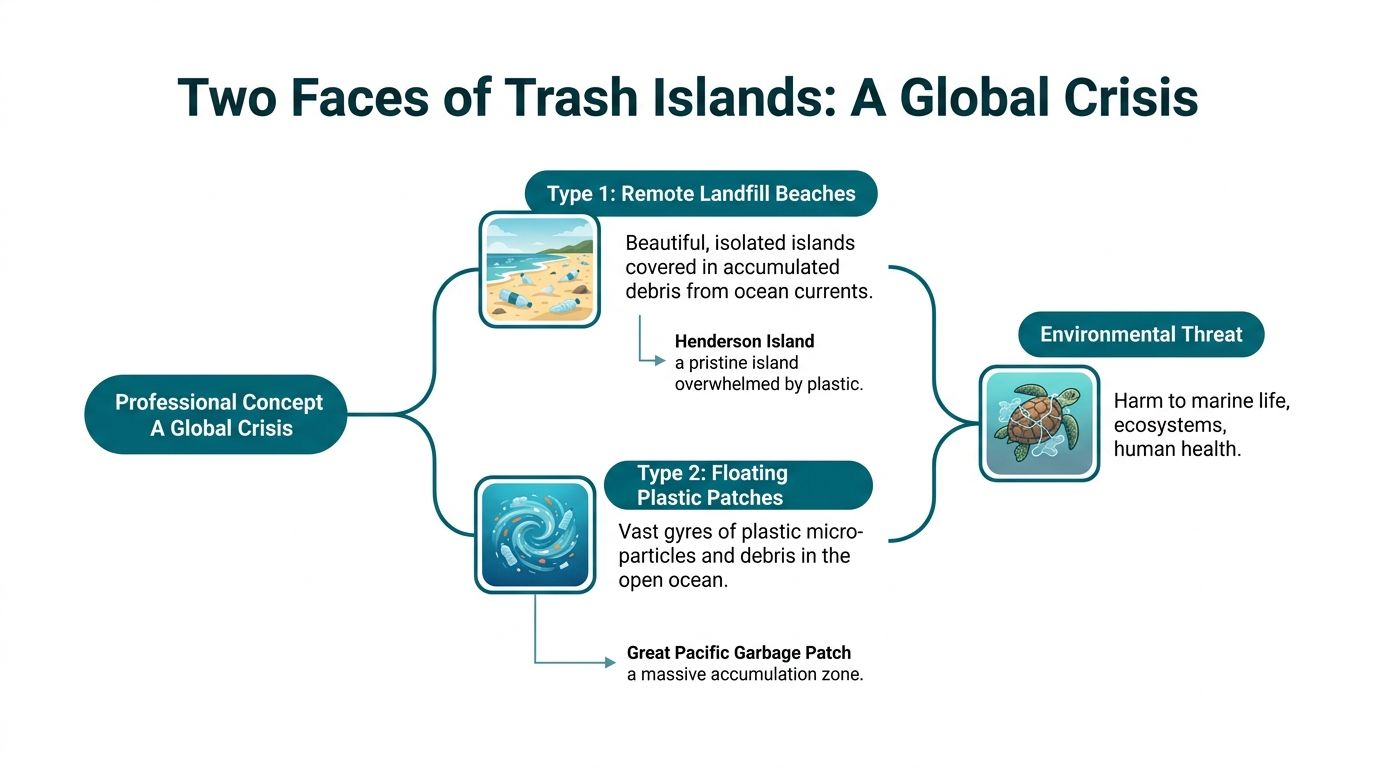
    A beach choked with bottles and fishing rope is one kind of island with trash. A drifting mass of plastic caught in ocean currents is another. They are related, but they are not the same thing, and that difference changes how we respond.

    Type one is a real island that keeps receiving what the world throws away

    Some islands are what you picture. Shoreline. Birds. Plants. Quiet.

    Then the currents arrive with our leftovers.

    Henderson Island is one of the clearest examples. It is remote, uninhabited, and known for its ecological importance. Yet wave after wave of debris has washed onto its beaches, turning a protected place into a receiving point for plastic from far beyond its own shores.

    I keep coming back to that image because it feels familiar. Sometimes a person becomes like that island. You did not create every part of the mess around you, but somehow you are still the one standing in the middle of it, sorting what arrived.

    That is one type of trash island. A real piece of land that becomes a collection point.

    Type two forms out at sea

    The second kind has no firm ground under it.

    It develops in open water where large circulating currents, called gyres, gather floating debris and keep it moving in broad loops. The plastic does not pile up into a walkable heap. It spreads across the surface and through the upper water in fragments, nets, containers, pellets, and pieces too small to spot from far away.

    The Great Pacific Garbage Patch is the example many people know best. It sits between California and Hawaii, not as a solid island, but as a vast accumulation zone.
    Infographic

    That misunderstanding matters. People hear “island” and picture something they could step onto with a trash bag and a pair of gloves. Open-water patches do not work like that.

    A simple way to separate them

    Type What it is How it collects trash What it feels like
    Remote landfill beach A real island or shoreline Currents and waves wash debris onto land A beautiful place forced to hold what drifted in
    Floating plastic patch A moving accumulation zone in open ocean Rotating currents keep debris circulating A diffuse, hard-to-reach spread of plastic in many sizes

    Cleanup changes with the setting.

    • On land: People can remove debris from beaches and coves, even when the work is slow and access is difficult.
    • At sea: Crews have to deal with a scattered field of floating and submerged plastic across an enormous area.
    • In both cases: The waste usually started somewhere else.

    That last part stays with me most. An island can suffer from trash it never used. A patch in the ocean can hold pieces from thousands of ordinary decisions made far away.

    Once I saw those two forms separately, I also saw something hopeful. If trash can travel piece by piece, care can travel that way too. One bottle refused. One bag picked up. One beach cleaned with friends. That is how a global mess starts, and it is also how change starts.

    The Unsettling Life on Floating Trash Islands

    The strangest part of this story is that floating plastic does not remain empty for long. Life moves in.

    A bottle cap or polyethylene fragment drifts through the sea, and tiny organisms begin treating it like real habitat. That should unsettle us, because the ocean is adapting to our garbage in ways that make the problem harder, not easier.

    Plastic becomes a raft

    Scientists now describe floating trash islands as novel ecosystems. Plastic’s hydrophobic surfaces show biofouling rates 2 to 5 times higher than natural substrates, and polyethylene fragments can gather up to 1,000 barnacles per square meter within 60 days, according to this report on the research.

    That means the plastic becomes less like litter and more like a raft. Algae cling to it. Barnacles stack onto it. Small creatures use it as shelter or transport.

    A surreal illustration of an island made of discarded plastic bottles and waste floating in water.

    Wood and seaweed break down. Plastic lingers. It keeps offering a ride.

    The ocean did not ask for this architecture

    I find that detail hard to shake. We did not just dirty the water. We accidentally built floating neighborhoods.

    Those neighborhoods can carry species across entire ocean basins. Organisms that would never have crossed naturally can now hitch a ride on our debris and arrive in places where they do not belong. That changes competition, feeding patterns, and local balance.

    The visual is almost absurd. A cracked fragment of consumer plastic, once part of a throwaway object, drifts across blue water carrying life on its back like a little stolen continent.

    Why cleanup gets more complicated

    This changes the moral picture in a subtle way. Most of us think of trash as dead matter. Pick it up and the job is done.

    At sea, it is no longer that simple. The debris is still pollution, but it can also host living communities. Removing it remains necessary, yet the delay creates extra ecological knots. Every extra day gives more time for colonization, transport, and disruption.

    A few realities sit side by side here:

    • Plastic is still harmful. Its presence alters where species can live and travel.
    • Life is opportunistic. Organisms use whatever stable surface they can find.
    • Cleanup timing matters. Fresh debris is different from long-drifting debris coated in growth.

    Practical insight: The longer plastic stays afloat, the more it stops behaving like a simple piece of trash and starts behaving like infrastructure.

    That is what makes an island with trash so eerie in open water. It is not only a monument to waste. It is a world we should never have built.

    A World Tour of Infamous Trash Islands

    The first time I saw photos of Henderson Island, I felt the same shame I feel when a junk drawer spills open and proves I have been postponing a mess for too long. Henderson is remote, uninhabited, and famous for its ecological value. Still, waves keep laying our leftovers at its feet.

    A conceptual illustration showing a world map with various people and a large pile of plastic waste

    Henderson Island feels like a betrayal

    Researchers found Henderson covered with plastic at a scale that shocked even people who study pollution for a living. As noted earlier, the island holds millions of pieces of trash, much of it plastic, and a large share is buried in the sand rather than sitting plainly on top.

    That buried detail stays with me.

    A beach can look quiet and still be full of evidence. You see a little on the surface, then learn that much more is packed underneath, like personal clutter stuffed into closets before guests arrive. Henderson makes the global crisis feel intimate in that way. We hide nothing from the ocean. We only send it somewhere else, and the tide keeps returning it.

    Scientists tracing the problem have linked debris there to both fishing activity and land-based waste carried by currents. The island did not create this mess. It received it.

    The Great Pacific Garbage Patch is a spread-out trap

    Far offshore, the Great Pacific Garbage Patch gathers waste into a huge circulating zone between California and Hawaii. It is not a neat raft or a solid island. It is a loose field of floating debris, ghost gear, and tiny fragments suspended through the water.

    A 2018 Nature study, summarized by Iberdrola, describes it as spanning 1.6 million square kilometers and containing 80,000 tonnes of plastic made up of 1.8 trillion pieces, with 94% microplastics too small to spot from satellites, according to Iberdrola’s overview of the Great Pacific Garbage Patch.

    That mismatch matters. People hear “island” and picture something they could point to, walk across, and clean in a weekend with enough gloves and grit. The situation is harder. The mess is dispersed, weathered, and constantly moving.

    What the patch reveals about us

    The materials in the patch tell a blunt story about human habits. Iberdrola’s summary says 46% of the mass is fishing gear such as nets, ropes, and buoys. It also notes major origin shares from Japan, China, South Korea, the USA, and Taiwan.

    So this is not only a story about careless beachgoers dropping bottles after a picnic. It is also a story about industry, supply chains, lost gear, and systems big enough to feel faceless. If you want a clearer explanation of how these currents gather debris, the Litter Caterpillars guide to the ocean garbage patch breaks it down in plain language.

    A short visual can help turn those facts into something your brain can hold.

    Two places, one human pattern

    Henderson Island and the Great Pacific Garbage Patch are different forms of the same confession. One catches debris on shore. The other gathers it in motion. Both exist because people made something, used it briefly, and let distance hide the consequence.

    That is why cleanup matters at more than one scale.

    A person picking up a bottle from a park is not solving the Pacific alone. But that act pushes against the same habit that created these infamous trash islands in the first place. The outer mess and the inner mess come from a similar lie, that someone else will deal with it later.

    The hopeful part is simple. Communities can interrupt that pattern. One bag filled on a local walk. One fishing system improved. One crew deciding that service is better than denial. That is how an abstract horror on a world map becomes a personal practice, one piece of trash at a time.

    The Hidden Scars Our Plastic Leaves Behind

    A piece of plastic rarely harms the world in only one way. It keeps changing form, and each form creates a new kind of damage.

    First it is a visible object. Then it becomes fragments. Then it enters bodies, habitats, and food chains. The bottle you ignore today can become tomorrow’s invisible problem.

    Big plastic hurts in obvious ways

    On beaches and in open water, larger debris can trap animals or block their movement. The Henderson findings describe entanglement and ingestion risks to nesting sea turtles and endangered petrels. The Great Pacific Garbage Patch also kills marine animals through ingestion and entanglement, as noted in the earlier section’s cited reporting.

    This is the kind of harm that people can picture fast. A turtle caught in a net. A bird feeding plastic to its chick. A seal dragging line behind it.

    The pain is direct. The cause is direct too.

    Small plastic slips past our defenses

    Then the sun, salt, and wave action grind larger objects into smaller pieces. In the Great Pacific Garbage Patch, 94% of the pieces are microplastics, according to the Iberdrola source cited earlier.

    That detail changes everything. You cannot clean microplastics the same way you pick up a bottle from sand. Tiny fragments spread through water, move through ecosystems, and become easy for animals to swallow. This is comparable to breaking a plate on the kitchen floor. A whole plate is easy to see. The glittering dust afterward is what keeps cutting you.

    The scar is ecological and personal

    Plastic also changes the places it touches. On Henderson, much of the debris is buried in sediment, which means the mess is not only on the surface. It works its way into the structure of the beach itself.

    In floating patches, colonized plastic carries organisms across the sea, altering habitats in motion. That does not stay “out there.” Oceans feed coastlines, wildlife, weather patterns, and human communities. The line from a city sidewalk to the ocean is longer than one might assume, but it is still one line.

    A few connections matter in daily life:

    • Street litter can travel. Rain pulls it into drains, rivers, and eventually larger waters.
    • Single-use habits add up. One item feels trivial until millions of people repeat the same motion.
    • Invisible pollution still counts. When plastic becomes tiny, it becomes harder to confront, not less dangerous.

    Remember: The ugliest part of plastic pollution is not what you can see on top. It is what keeps happening after the item breaks apart.

    That is why cleanup matters so much. You are not just making a place look better. You are interrupting a chain reaction.

    How to Paint the Fence and Clean the World

    I stopped seeing cleanup as punishment when I remembered Tom Sawyer.

    He got stuck painting a fence, then turned the whole thing inside out. He made the task look meaningful, playful, even desirable. His friends wanted in. That old story sticks because it names a deep truth. The frame changes the feeling.

    A chore can become a dare

    When I hit a breaking point in my own life, I realized something odd. Cleaning my own mess felt emotionally loaded. Cleaning somebody else’s mess felt lighter.

    Not because the work was easier in a technical sense. It was easier because the shame was gone. I could step into service instead of self-judgment.

    That shift matters for any island with trash, from a cluttered block to an overwhelmed shoreline. If you tell yourself, “I have to fix everything,” you freeze. If you tell yourself, “I get to help this place breathe,” your body moves.

    A group of happy children painting a colorful picket fence made from recycled plastic bottles together outdoors.

    Shared hardship changes the mood

    Some of my favorite cleanup memories were not comfortable. Cold wind. Wet shoes. Bad timing. The kind of day when any reasonable person would stay home.

    But shared discomfort can turn into glue. When people face a hard task together, the story changes. It stops being “I did a chore.” It becomes “We survived that ridiculous morning together.”

    That is one reason service builds friendship so fast. You are not only collecting trash. You are making a memory in public, with a purpose.

    The practical side of this mindset is simple:

    • Bring symbols of pride. A flag, a shirt color, a team name, a little ritual before you begin.
    • Treat the event like an adventure. Walk a route. Notice the neighborhood. Celebrate weird weather.
    • Measure success by showing up. The habit matters as much as the haul.

    If you want ideas for larger-scale ocean responses, this overview of solutions for pollution in the oceans offers a useful set of approaches.

    Bravery matters more than perfection

    Many individuals wait to help until they feel ready. I think that is backwards.

    Bravery comes first. Readiness often follows. You show up awkward, unsure, underdressed, a little embarrassed, maybe carrying the wrong gloves. Then you learn by doing.

    I love that because it gives ordinary people a real entry point. You do not need to become a perfect environmental saint. You need to become someone willing to touch the mess.

    Best mindset: Do not ask whether cleanup feels glamorous. Ask whether it makes you more alive, more useful, and more connected.

    That question has changed my life. It can change yours too.

    An island with trash can break your heart. It can also train your courage. The same hands that once avoided the mess can become the hands that start clearing it.

    Join the Transformation and Find Your Crew

    A giant ocean patch can make you feel tiny. Your own block can make you feel powerful again.

    That is where I would start. Not with fantasies of solving the whole planet by yourself. Start with one corner, one morning, one bag, one friend.

    Why people hesitate

    The primary obstacle is often emotional before it is practical. On remote islands like Henderson, psychological barriers and isolation can deter volunteers. That same pattern shows up in cities too. Personal “trash stories” and the heaviness we attach to mess can stop us from acting, while cleaning other people’s messes often feels easier and shared hardship can make the work feel fun, according to Atlas Obscura’s reporting on the human side of cleanup.

    That insight gave me relief. If cleanup feels easier in a group, that is not weakness. It is a clue.

    How to build a cleanup crew

    You do not need a complicated system. You need a repeatable one.

    1. Pick a simple time
      Weekend mornings work well because they attract people who want to give their energy, not just squeeze in an obligation.

    2. Protect safety first
      Choose visible areas. Wear gloves. Bring bags. Watch traffic. Stop if conditions feel risky. Service should strengthen people, not grind them down.

    3. Make the group memorable
      Names matter. So do songs, badges, inside jokes, photos, and little traditions. People return to belonging, not just to tasks.

    4. Keep the first event small
      A short route beats an overambitious one. End while people still feel good.

    5. Stay volunteer-first
      Nobody likes feeling used. Build friendship. Share water. Thank people. Let the group become a place where people can breathe.

    For anyone ready to find a hands-on event, this volunteer trash pickup page shows what joining a cleanup community can look like.

    What transformation looks like

    Transformation is not dramatic most days. It is quiet.

    You become the kind of person who notices a bottle and picks it up. You become the kind of friend who invites somebody else. You become the kind of neighbor who leaves a place lighter than you found it.

    That identity grows slowly, like anything alive.

    • You gain trust in yourself because you did what you said you would do.
    • You gain resilience because weather, awkwardness, and inconvenience stop scaring you as much.
    • You gain community because useful people tend to find each other.

    Start where you stand: You do not need to reach a remote island with trash to join this story. Your sidewalk counts.

    I think that is the most hopeful part of all this. The world’s waste crisis is enormous, yes. But service shrinks the distance between helplessness and action. One bag closes that distance. One morning closes it more. One crew closes it faster.

    And somewhere along the way, while you are cleaning the street, you may notice that another mess is clearing too. The one inside you.


    If this way of serving speaks to you, join Litter Caterpillars. Show up for a cleanup, meet people who care, and turn one ordinary morning into a small act of transformation.


  • 10 Native Trees of Illinois to Plant in 2026

    10 Native Trees of Illinois to Plant in 2026

    I remember the first time I got caught in one of those wild Chicago spring storms, hail and all, with our tiny group of Litter Caterpillars. We huddled under a shivering tree. And I realized something powerful. Cleaning up a mess that isn't yours is easier than facing your own. That suffering, that shared struggle—it advances the plot of your life. It’s the same with planting a tree. You’re not just putting a sapling in the ground. It’s an act of bravery. A vote for the future.

    You're planting a landmark for future volunteers to meet under. You're giving shade for summer picnics. You're adding a new character to your neighborhood's story. Just like cleaning up, planting these native trees of Illinois is my way, our way, to transform ourselves and our city, one brave act at a time. It’s how I turned a messy lot, like my own life once was, into something with purpose and beauty.

    I wrote this guide as your blueprint for that transformation. It’s more than a list; it’s a story starter. For each tree, you’ll find:

    • Actionable ID Tips: I'll show you how to spot a Bur Oak on your block or a Serviceberry in a park.
    • Site-Specific Advice: You'll learn which trees thrive in the tight spaces of Lincoln Park versus the open areas of Pullman.
    • Planting & Care: I give you simple, direct guidance to help your tree survive and flourish.
    • Community Projects: I've included ideas to rally your neighbors and make a real, visible impact.

    We're not just picking up trash anymore; we're building a forest. I invite you to help us write the next chapter. Let's dig in.

    1. White Oak (Quercus alba)

    The White Oak is more than just a tree; it’s a living monument. When you plant a White Oak, you are making a promise to the future, a commitment that will stand strong for hundreds of years. Imagine it like building a natural cathedral. It’s a place of shelter and life that will serve generations long after you and I are gone. Its incredible longevity, often stretching past 300 years, makes it one of the most foundational native trees of Illinois. For me and the Litter Caterpillars, the White Oak symbolizes the permanence we strive for. It will provide shade for future volunteers gathering in the very parks we clean today.

    A Keystone for Urban Ecosystems

    This isn't just a pretty tree. It's an ecological powerhouse. The White Oak supports more than 500 species of caterpillars alone, making it a critical food source for birds and other wildlife. You can see majestic examples standing tall in historic Chicago parks like Lincoln Park or within the restored oak groves of Grant Park. These trees are living proof that nature can thrive in the heart of the city. They create pockets of biodiversity that enrich our urban landscape. Planting one is like plugging an entire ecosystem into your neighborhood.

    The White Oak is a true legacy tree. Planting one is an act of profound optimism, a gift to a future you may never see, but one you are helping create right now.

    How to Plant a Legacy

    Are you ready to make a long-term impact? Planting a White Oak is a powerful step. Here’s how you can ensure its success:

    • Timing is Key: You should plant in the fall, ideally between October and November. This gives the tree's roots time to establish before the ground freezes, setting it up for strong spring growth.
    • Site Selection: Find a spot with well-drained soil, away from areas where road salt accumulates in winter. You must give it plenty of room to grow to its magnificent full size.
    • Initial Care: You need to water it deeply once a week during its first year. Apply a 3-4 inch layer of mulch around its base, but be sure to keep the mulch from touching the trunk itself to prevent rot.

    Imagine a White Oak as the centerpiece of a new community pocket park or lining a restored streetscape. Its strong branches and dense summer canopy offer incredible shade and beauty. If you want to dig deeper into choosing the right species, you can explore our guide to trees in Illinois for more project ideas.

    2. Black Walnut (Juglans nigra)

    The Black Walnut is a tree with a powerful, almost magical quality. It’s an architect of its own environment, thoughtfully clearing the space around it to ensure it can thrive. For me, the Black Walnut represents nature’s own tidying crew. Its roots release a substance called juglone, which acts as a natural herbicide, preventing many invasive plants from crowding its space. This tree teaches me that sometimes, creating a healthy ecosystem means setting boundaries. It means curating a space for what truly matters. As one of the most distinctive native trees of Illinois, it’s a living lesson in self-regulation and strength.

    A Keystone for Urban Ecosystems

    This is a tree of immense character and value. The Black Walnut is a living workshop. It produces rich, dark wood prized by artisans and delicious nuts that are a high-energy food source for wildlife and people like you and me. You can find beautiful specimens in the native groves of DuPage County or standing proudly in the University of Illinois research forests. In an urban setting, this tree offers a unique opportunity for education. Its ability to manage its understory shows how ecosystems can maintain their own balance, a powerful concept I love to share with volunteers cleaning up our city parks.

    The Black Walnut is nature's minimalist. It reminds me that a healthy environment isn't about having more, but about having what’s right, and clearing out what doesn't belong.

    How to Plant a Legacy

    Are you ready to plant a tree that actively manages its own little corner of the world? A Black Walnut makes a bold statement. Here’s how you can help it succeed:

    • Timing is Key: Plant your Black Walnut in late fall, after it has gone dormant but before the ground freezes solid. This helps the roots acclimate without the stress of summer heat.
    • Site Selection: This is the most critical step. You have to choose a location with deep, well-drained soil, at least 50-60 feet away from gardens, sensitive shrubs, or other trees that might be affected by its juglone. It’s perfect for a large, open area in a park restoration zone.
    • Initial Care: You should water it generously during its first few growing seasons, especially during dry spells. An annual application of compost in the spring will give it the nutrients it needs to grow strong and healthy.

    Imagine a grove of Black Walnuts in a newly restored natural area, their fallen branches used in community nature art projects. Their presence naturally reduces weedy ground cover, making long-term maintenance easier for volunteer teams like ours. If you want to dig deeper into choosing the right species, you can explore our guide to trees in Illinois for more project ideas.

    3. Sugar Maple (Acer saccharum)

    The Sugar Maple is the artist of the Illinois autumn. It paints our neighborhoods in brilliant shades of yellow, orange, and red. When you plant one, it’s like setting a yearly appointment with beauty. A promise that every fall will bring a breathtaking finale to the season. For me, the Sugar Maple represents renewal and transformation. It’s a living symbol of how my cleanup efforts pave the way for lasting, visible change, turning a forgotten corner into a community landmark. Its reliable beauty and sturdy presence make it one of the most cherished native trees of Illinois.

    A vibrant autumn tree with bright orange and red leaves, a bench, and two people in a watercolor style.

    A Keystone for Urban Ecosystems

    Beyond its spectacular fall display, the Sugar Maple is a workhorse for urban health. Its dense canopy provides significant summer shade, cooling your streets and reducing energy costs, while its root system helps manage stormwater runoff. You can see glorious examples adding grace to the tree-lined streets of the North Shore or standing as focal points within the Chicago Botanic Garden. These trees are living proof that ecological function and stunning aesthetics can go hand-in-hand. They improve our city one block at a time.

    The Sugar Maple reminds me that community work is not just about cleaning up; it’s about creating moments of shared joy, like a neighborhood walk under a canopy of autumn fire.

    How to Plant a Legacy

    Ready to bring this seasonal spectacle to your neighborhood? Planting a Sugar Maple is a wonderful community project you can start. Here’s how you can get it started:

    • Timing is Key: You should plant in the fall to give its roots a head start. This allows the tree to establish itself during the dormant season for vigorous growth in the spring.
    • Site Selection: Choose a location protected from road salt and heavy foot traffic, which can compact the soil. You need to give it room to spread, spacing it 30-40 feet from other large trees or buildings.
    • Initial Care: Water it regularly during its first year, especially during dry spells. You should apply a 3-4 inch layer of organic mulch around the base, keeping it away from the trunk to prevent moisture buildup and potential rot.

    Imagine organizing community "fall foliage walks" where your neighbors can connect and admire the trees you planted together. If you want to dig deeper into choosing the right species, you can explore our guide to trees in Illinois for more project ideas.

    4. Eastern Redbud (Cercis canadensis)

    The Eastern Redbud is the joyful announcement that spring has officially arrived. After a long gray winter, its burst of vibrant magenta-pink flowers is a powerful symbol of renewal and hope. For me, the Redbud represents the beauty that emerges from our collective effort, like a splash of color appearing in a park we just finished cleaning. This small, graceful tree doesn't demand vast open spaces. It thrives in the margins, bringing life to the edges of our urban world and reminding me that beauty can flourish anywhere you make a little room for it.

    A Beacon of Hope for City Spaces

    The Eastern Redbud is perfectly suited for city life. Its smaller stature and tolerance for partial shade make it a star player in tight urban quarters where larger trees won't fit. You can see its spectacular spring show at the Chicago Botanic Garden or brightening the restored landscapes of Grant Park. Imagine clusters of these trees transforming a neglected neighborhood pocket park into a springtime destination. Planting a Redbud is like painting with nature; you're adding a stroke of brilliant color that signals new beginnings for your whole community. As one of the most brilliant native trees of Illinois, it’s a perfect choice for beautification projects.

    The Eastern Redbud teaches me that even in the toughest urban environments, startling beauty can emerge. It's a living reminder that our work creates space for hope to bloom.

    How to Plant a Pop of Color

    Are you ready to bring this burst of spring joy to your neighborhood? Planting an Eastern Redbud is a simple yet impactful project. Here’s how you can get it started:

    • Group for Impact: You should plant Redbuds in small clusters of 3-5. This mimics their natural growth habit and creates a stunning, concentrated floral display in the spring.
    • Find the Right Spot: Choose a location with well-drained soil that gets some afternoon shade. This protects the tree from the harshest summer sun and helps it thrive.
    • Planting and Care: The best time for you to plant is in the fall, around October, to give its roots a head start. It needs minimal pruning; just remove any dead wood each year to keep it healthy and shapely.

    A row of Eastern Redbuds can turn a simple sidewalk into a breathtaking spring walkway. You might consider underplanting them with shade-loving perennials to create a layered garden effect. If you're inspired to organize a community planting day, you can find saplings and other native plants at our upcoming Litter Caterpillars native plant sale.

    5. Red Maple (Acer rubrum)

    The Red Maple is the sprinter of the urban forest. While an oak builds its legacy over centuries, the Red Maple bursts onto the scene. It offers quick, visible change that can transform a neglected space in just a few years. It’s a symbol of accelerated results. The perfect tree for demonstrating the immediate connection between your cleanup efforts and the beautiful, green future you’re building. For me, the Red Maple represents a 'quick win' for a neighborhood, showing everyone how fast their hard work can bear fruit, making it one of the most rewarding native trees of Illinois.

    A Keystone for Urban Ecosystems

    Don’t let its speed fool you; the Red Maple is a versatile champion. Its brilliant red flowers are among the first signs of spring, providing a critical early-season nectar source for bees. Its adaptability is remarkable. It thrives in the wet, compacted soils often found in urban areas where other trees struggle. You can see its vibrant fall colors lighting up the perimeters of Millennium Park and along campus walkways at the University of Chicago. It’s a fantastic choice for wetland restoration projects, proving that even challenging sites can become havens for wildlife.

    The Red Maple is a catalyst for change. Planting one is an investment in rapid transformation, a way for you to show a community that a greener, more beautiful tomorrow can start today.

    How to Plant a Legacy

    Ready to bring some fast-growing beauty to your neighborhood? Planting a Red Maple is a fantastic way to create immediate impact. Here’s how you can make sure it thrives:

    • Timing is Key: You should plant in early spring or fall. This allows the tree to establish its root system during cooler, wetter weather, preparing it for summer heat or winter cold.
    • Site Selection: Red Maples are incredibly adaptable but perform best with full to partial sun. They are an excellent choice for rain gardens or areas with poor drainage. You need to give each tree about 25-30 feet of space to allow its crown to develop fully.
    • Initial Care: Water it deeply once a week during its first two years, especially during dry spells. If you prune it early, you will help establish a strong central leader and a good branching structure for a long, healthy life.

    Imagine a row of Red Maples bringing a splash of year-round color to a once-barren street, their growth documented month-by-month to inspire your fellow volunteers. For more ideas on how to use fast-growing species in your projects, you can explore our guide to trees in Illinois to get started.

    6. Shagbark Hickory (Carya ovata)

    The Shagbark Hickory is a tree with character. I can spot it from a distance by its unique, shaggy bark that peels away in long, curving strips. It looks like it’s wearing a rugged, layered coat. For me and the Litter Caterpillars, this tree is a landmark. Its unforgettable texture stands out in a forest, serving as a perfect meeting point or a natural marker showing how far we’ve cleaned. More than just a visual anchor, the Shagbark Hickory is one of the most resilient and historically significant native trees of Illinois, a living sculpture that connects me to the state's primeval forests.

    An Anchor for Restored Woodlands

    This tree is a true survivor. It's a cornerstone of forest health. It’s not one for your manicured city streets; it belongs in wilder spaces where its deep taproot can dig in without disturbance. You can find beautiful specimens in the restored woodlands of the Midewin National Tallgrass Prairie or within the forest remnants of Cook County, where they provide food and shelter for countless species. The nuts are a vital food source for squirrels, woodpeckers, and foxes, and their sweet flavor was prized by Native Americans and early settlers. Planting one is an act of rewilding, bringing a piece of Illinois's untamed spirit back to our parks and preserves.

    The Shagbark Hickory teaches me that true strength often has a rough exterior. Its shaggy bark is a record of its journey, a beautiful testament to its resilience and longevity.

    How to Plant a Forest Landmark

    Are you ready to add this distinctive character to a restoration project? The Shagbark Hickory requires a bit more patience from you, but the payoff is a tree that will define the landscape for over a century. Here's how you can plant one:

    • Timing is Key: Plant in the fall to allow its sensitive taproot to get established before winter. I've found that growing from a locally sourced nut is often the best way to ensure it’s adapted to your specific site.
    • Site Selection: You must find a spot in a larger, naturalized area with well-drained soil. It needs room to grow and does not tolerate soil compaction, so you have to keep it away from high-traffic paths.
    • Initial Care: Water it deeply during its first few years. You'll want to apply a thick, 4-6 inch layer of mulch to mimic a natural forest floor, conserve moisture, and protect its roots, but keep mulch from touching the trunk.

    7. American Elm (Ulmus americana)

    The American Elm is a story of resilience, a symbol of Chicago’s ability to recover and rebuild. For decades, its graceful, vase-shaped canopy formed cathedral-like arches over our city streets, defining the character of entire neighborhoods. While Dutch Elm Disease devastated these urban forests, the story isn't over. I’ve seen new disease-resistant cultivars making a comeback, allowing us to restore this iconic species. For me, planting an American Elm is an act of reclamation, a way to bring back a piece of Chicago's soul and provide a majestic canopy for the communities you and I serve.

    Restoring a Living Legacy

    This isn't just about planting a tree. It's about restoring a historic streetscape and reviving a key part of our urban forest. The American Elm’s fast growth and arching branches create magnificent shade. This makes it a perfect choice for parks and wide parkways. You can witness the beginning of this comeback in restoration projects within Lincoln Park and Grant Park, where new generations of elms are taking root. Planting these trees is my way of honoring the past while building a greener, more beautiful future, one street at a time.

    The American Elm represents urban renewal in its purest form. When you replant it, you are not just restoring a tree; you are restoring neighborhood identity and a piece of our shared history.

    How to Plant for a Comeback

    Ready to join the elm revival? Planting disease-resistant American Elms is a powerful statement of hope and dedication you can make. Here's how you can ensure these graceful giants thrive:

    • Choose Wisely: You must only plant certified disease-resistant cultivars like 'Accolade', 'Princeton', or 'New Harmony'. This is the most critical step for long-term survival.
    • Give It Space: You need to select a site with excellent drainage and good air circulation. To create that classic arched canopy, space trees 40-50 feet apart.
    • Plant for Impact: I suggest you organize a community planting event to restore an entire block. This creates a powerful visual and celebrates Chicago's heritage, turning a simple planting day into a story of neighborhood transformation.

    Imagine a row of young American Elms lining a street that your team just cleaned, their branches beginning to reach for each other. They stand as a living testament to community effort and renewal, one of the most inspiring native trees of Illinois. To get involved in similar restoration projects, you can explore our guide to trees in Illinois for more ideas.

    8. Bur Oak (Quercus macrocarpa)

    The Bur Oak is the definition of strength through adversity. With its thick, corky bark that can resist fire and its massive, spreading form, this tree embodies sheer resilience. I see the Bur Oak as a symbol of our own work at Litter Caterpillars: thriving in difficult urban environments and transforming neglected spaces into shaded, welcoming gathering areas. This iconic savanna tree is one of the toughest native trees of Illinois. A true survivor built for the long haul. Its presence on the landscape is a quiet declaration of persistence.

    A Keystone for Urban Resilience

    This is a tree built for the city’s challenges. The Bur Oak is incredibly tolerant of drought, heat, and poor soils once it’s established, making it a perfect candidate for harsh urban sites where other trees might fail. You can witness its powerful stature in the restored oak savannas of Grant Park or as a signature tree standing against the open skies at Midewin National Tallgrass Prairie. Planting a Bur Oak is like installing a living anchor in your community, a point of stability that will grow stronger with each passing year.

    The Bur Oak teaches me a lesson in patience and strength. Its slow, steady growth is a testament to the idea that lasting change doesn't happen overnight, but through your consistent, determined effort.

    How to Plant a Survivor

    Ready to plant a tree that will stand as a landmark for future generations? The Bur Oak is a powerful choice for you. Here’s how you can give it a strong start:

    • Start Young: You should plant young nursery stock (1-2 inches in trunk diameter) for a much higher survival rate and better root establishment.
    • Site Selection: Give it what it craves: full sun and well-drained soil. This tree needs space, so you must plan for its mature crown by spacing it 40-50 feet away from buildings and other trees.
    • Initial Care: Water it deeply during its establishment period, which can last 3-5 years. After that, it’s remarkably self-sufficient. Minimal pruning is required; just let it develop its natural, majestic form.

    Imagine a row of young Bur Oaks transforming a barren parkway or a single, magnificent specimen becoming the centerpiece of a community garden. You can see similar historic oaks anchoring the landscapes in many of our local nature sanctuaries. To get inspired by these foundational ecosystems, you can discover the beauty of Forest Preserves in Illinois and see what’s possible.

    9. Serviceberry/Amelanchier (Amelanchier species)

    The Serviceberry is the quiet artist of the Illinois landscape. While some trees shout for attention with their size, the Serviceberry whispers. It has delicate white spring flowers that offer a gentle beauty that feels personal and welcoming. For me, it represents the power of subtle, yet meaningful, transformation. It shows how even the smallest spaces, like forgotten corners of a park or narrow planting strips, can be turned into something beautiful and productive. This graceful tree is one of the most versatile native trees of Illinois, a perfect fit for the intimate scale of your neighborhood greening.

    An Edible Oasis in Urban Spaces

    This small tree is a powerhouse of generosity. It offers something for everyone. Its early spring blossoms are among the first food sources for pollinators, and its sweet, blueberry-like summer fruits are a feast for birds and people like us. You can see its multi-stemmed elegance in the understory plantings at the Chicago Botanic Garden or tucked into the woodland edges at the University of Chicago. When you plant a Serviceberry, it's like opening a small, four-season cafe for local wildlife, creating a reliable source of food and shelter right where it’s needed most.

    The Serviceberry reminds me that true impact isn't always about grand scale. It's about providing consistent, accessible nourishment and beauty, one small, graceful act at a time.

    How to Plant a Community Gem

    Ready to bring this four-season star to your neighborhood? Planting a Serviceberry is a simple way you can add beauty and ecological value. Here’s how you can make it thrive:

    • Timing is Key: You should plant in the fall or early spring. This allows the root system to establish before the stress of summer heat or winter cold.
    • Site Selection: Find a spot with dappled sunlight, mimicking its natural understory habitat. It’s adaptable to various soils but prefers good drainage. I suggest you plant in groups of 3-5 for a stunning floral display and better berry production.
    • Initial Care: Water it deeply once a week during its first year, especially in dry spells. You should apply a 3-4 inch layer of mulch to retain moisture, but keep it from touching the trunk. A little pruning to remove dead wood will maintain its lovely form.

    Imagine a small grove of Serviceberries at the entrance to a community garden, welcoming you with spring flowers and offering a sweet snack in the summer. For more ideas on integrating understory trees into your projects, you can explore our guide to trees in Illinois to find the perfect fit.

    10. American Sycamore (Platanus occidentalis)

    The American Sycamore is a tree of dramatic presence. Its most striking feature is its beautiful, exfoliating bark. It peels back to reveal a patchwork of white, gray, and tan, almost like a natural work of camouflage art. For me, the Sycamore represents visible, breathtaking transformation. Just as its bark sheds its old layers to reveal something bright and new beneath, you can transform overlooked, damp corners of your communities into stunning landmarks. A single Sycamore can redefine a forgotten streamside, turning it into a destination.

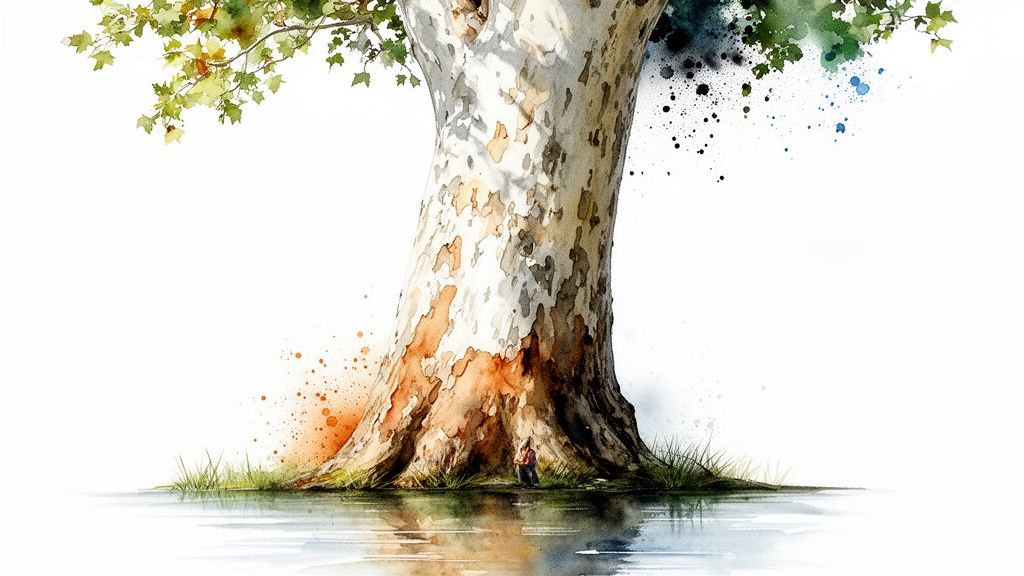
    Watercolor art of a sycamore tree with green leaves, textured bark, water, and colorful paint splatters.

    A Guardian of the Waterways

    This tree is an absolute giant. A true master of moist bottomlands and riverbanks. It thrives in wet soil, growing quickly and providing immense ecological benefits. You can see these magnificent trees along the Des Plaines River greenway or as part of riparian restoration efforts along Salt Creek, where their roots stabilize the soil and prevent erosion. By planting Sycamores, you’re not just adding beauty; you are actively restoring the health of our local waterways and creating vital habitats. It’s a perfect choice for one of the most important native trees of Illinois.

    The American Sycamore is a living sculpture. Its ghostly white branches reaching into the winter sky are an unforgettable sight, a reminder that you can find beauty and strength even in the harshest seasons.

    How to Plant a Riverside Giant

    Ready to create a neighborhood landmark? The Sycamore needs a specific home, but when you site it correctly, it works wonders. Here’s how you can make it happen:

    • Location, Location, Location: This is not a tree for a small, dry yard. You must plant it exclusively in moist to wet areas like stream banks, detention basins, or low-lying parklands where water collects.
    • Give It Space: This tree gets enormous. You have to plan for its mature size by spacing it at least 50-60 feet away from buildings, power lines, and other trees.
    • Waterway Restoration: Coordinate with local watershed groups or your park district. Planting Sycamores as part of a riparian buffer is a powerful way for you to contribute to larger conservation goals and improve water quality.

    Imagine a line of Sycamores marking a newly restored creek, their white branches visible from blocks away, creating a beautiful and functional green corridor. Their massive, welcoming shade is perfect for your future volunteer gatherings after a clean-up event. If you want to dig deeper into choosing the right species, you can explore our guide to trees in Illinois for more project ideas.

    Comparison of 10 Native Illinois Trees

    Tree 🔄 Implementation Complexity ⚡ Resource Requirements 📊 Expected Outcomes 💡 Ideal Use Cases ⭐ Key Advantages
    White Oak (Quercus alba) High — large specimen planting, slow establishment (3–5+ yrs) High space/cost; deep soil, long-term maintenance Long-term canopy, legacy shade, high biodiversity (200–300+ yrs) Parks, major streetscapes, legacy community plantings Exceptional longevity, wildlife support, stormwater benefits
    Black Walnut (Juglans nigra) Medium–High — juglone planning, large root system Medium — wide spacing, nut/branch management, timber value Cleaner understory, nut production, ecological demonstration Large restoration zones, educational sites, woodcraft projects Natural understory control, edible nuts, timber value
    Sugar Maple (Acer saccharum) Medium — moderate establishment, sensitive to salt/compaction Medium — moisture needs early, spaced planting, moderate cost Strong seasonal aesthetics, cooling and stormwater mitigation Streetscapes, parks, neighborhood beautification Brilliant fall color, cooling, long-lived landmark
    Eastern Redbud (Cercis canadensis) Low–Medium — small tree, prone to canker if stressed Low — small footprint, minimal initial maintenance Early spring color, pollinator support, quick visual uplift Pocket parks, understory plantings, school projects Early blooms, ideal for tight spaces, pollinator attraction
    Red Maple (Acer rubrum) Low — fast-growing, needs early pruning for form Low–Medium — adaptable soils, regular early watering Rapid canopy cover, four‑season interest, quick neighborhood impact Rapid greening, wet areas, rain gardens Fast growth, adaptable, cost-effective for quick wins
    Shagbark Hickory (Carya ovata) High — slow establishment, sensitive taproot, woodland preference Medium–High — well‑drained uplands, long-term care, nut cleanup Distinctive landmark, wildlife food source, long-term woodland recovery Woodland and savanna restorations, legacy plantings Unique bark, edible nuts, drought-tolerant once established
    American Elm (Ulmus americana) Medium — use certified resistant cultivars, disease monitoring Medium — certified stock, good drainage, spacing for vase form Rapid shade restoration, historic streetscape re-establishment Streetscapes, community canopy restoration, memorial plantings Iconic vase form, fast establishment, disease-resistant options
    Bur Oak (Quercus macrocarpa) High — very slow growth, long-term planning required Medium–High — full sun, well-drained sites, young stock preferred Durable canopy, exceptional drought/heat tolerance, savanna character Harsh urban sites, savanna restoration, climate-resilient projects Extreme resilience, long lifespan, wildlife-supporting acorns
    Serviceberry (Amelanchier spp.) Low — easy understory planting, simple pruning Low — small footprint, low cost, moderate moisture early Multi-season interest (flowers, berries, fall color), wildlife food Pocket parks, understory buffers, community foraging areas Edible berries, low maintenance, four‑season appeal
    American Sycamore (Platanus occidentalis) High — very large, needs riparian siting and structural pruning High — significant space, consistent moisture, professional planting Dramatic landmark tree, rapid transformation, riparian benefits Floodplains, waterways, riparian restoration corridors Extremely fast growth, striking exfoliating bark, massive shade

    Your Turn to Paint the Fence

    Do you remember Tom Sawyer? He was punished and forced to whitewash a fence, but he reframed the entire experience. He convinced his friends it wasn't a chore; it was a rare and wonderful opportunity. Soon, they were not only doing the work for him but actually paying him for the privilege.

    That's the spirit I want you to carry forward from this article. Planting native trees of Illinois isn't a task for you to check off a list. It’s a chance to "paint the fence" in your own corner of the world, to turn a simple action into an act of creation, community, and profound connection.

    From List to Legacy

    We've just walked through a gallery of Illinois's most resilient and beautiful residents. You've met the stately White Oak, a living monument that can stand for centuries. And the cheerful Eastern Redbud, which paints our gray cityscapes with vibrant magenta each spring. You've learned how the rugged Bur Oak can thrive even in the packed clay of a Chicago parkway, and how a single Serviceberry can feed dozens of bird species.

    This isn't just botanical trivia. This is your toolkit. These are the "paintbrushes" I was talking about. Each species offers you a different stroke, a different color, a different texture for the canvas of our community.

    • A Shagbark Hickory you plant in a park isn't just a tree; it’s a future food source for wildlife and a living sculpture with its unique, peeling bark.
    • An American Sycamore along a riverbank isn't just for shade; its massive roots are actively fighting erosion, holding our precious soil in place.
    • A row of Sugar Maples on a residential street isn't just for curb appeal; it’s a promise of fiery autumn color and a collective memory for generations of your neighbors.

    The most important takeaway for you is this: you hold the power to make a tangible, lasting impact. You don't need a massive budget or a city permit to start. You just need a shovel, a bit of knowledge from this guide, and the will to begin.

    Your First Brushstroke

    So, where do you start? The thought of planting a tree can feel big, but your first step is small. It starts with you looking at your own block with new eyes.

    Is there a barren patch of grass in front of your apartment building? That's a spot for a Redbud. Is there a wide-open space in your local park that gets tons of sun? That’s where a mighty Oak belongs. The real magic happens when you stop seeing empty spaces and start seeing possibilities.

    I believe in the power of service, sunlight, and friendship to transform us, just like a caterpillar. You don't have to be perfect. You just have to be willing to show up.

    This isn’t about you becoming a master arborist overnight. It’s about you taking one small, courageous action. It’s about choosing a tree from this list, finding a spot that needs it, and putting a root ball in the ground. It’s about watering it through that first hot summer and watching, with a sense of pride, as it begins to grow.

    The fence is waiting. Our city is waiting. It’s your turn to pick up a brush and leave your mark, to help us paint Chicago a vibrant, living green.


    Ready to stop reading and start doing? Join Litter Caterpillars this weekend. I turn the work of planting native trees and beautifying neighborhoods into a fun, social event where you’ll make a real impact and even better friends. Find your next project and grab a shovel with us at Litter Caterpillars.

  • My Top 7 Picks for a Bike Trail in Illinois for 2026

    My Top 7 Picks for a Bike Trail in Illinois for 2026

    Have you ever felt that pull? The one that says you need to get outside, feel the wind, and see something new. For me, that feeling almost always leads to my bike. It's not just about exercise; it’s about changing my perspective, one pedal stroke at a time. My bike feels like my own personal transformation machine.

    I started Litter Caterpillars because I needed to clean up my own life, literally and figuratively. I found that cleaning up other people's messes was way easier, and it connected me with incredible, giving people. That same spirit of transformation and discovery is what I chase on a bike trail in Illinois. It's a feeling of freedom and purpose rolled into one. You're not just moving through a landscape; you're moving through your own thoughts, finding clarity with every mile.

    This isn't just another list of trails. This is a collection of my favorite places to find that feeling-places where you can ride, reflect, and maybe even find a piece of yourself you didn't know was there.

    I’ll walk you through the very best paths the state has to offer, from Chicago’s iconic lakefront to the quiet, tree-canopied tunnels of Southern Illinois. For each trail, I'm sharing everything you need to know:

    • The practical details: distance, difficulty, and surface type.
    • My personal stories: what I love about each spot.
    • How to get there: trailheads, parking, and transit options.
    • Ways to give back: connections to Litter Caterpillars volunteer events nearby.

    Think of this as your personal guide to your next great adventure. Let’s get rolling and find your new favorite bike trail in Illinois.

    1. Chicago Lakefront Trail

    To ride the Chicago Lakefront Trail is to feel the city’s pulse. This isn't just a path. It’s the main artery of Chicago's cycling soul, an 18-mile ribbon of pavement unspooling between the iconic skyline and the vast, freshwater sea of Lake Michigan. I’ve found that no two rides here are ever the same. You become part of a moving mosaic of commuters, marathon trainers, families, and tourists, all sharing this incredible public space. It's a journey that feels like watching a highlight reel of Chicago itself, gliding past world-class museums, sandy beaches, bustling harbors, and serene nature sanctuaries.

    Chicago Lakefront Trail

    I once started a ride at the southern terminus at dawn. I watched the sun climb over the lake and set the skyscrapers ablaze with golden light. It was one of those unforgettable moments that solidifies your love for this city. That's the magic of the Lakefront Trail; it’s more than just a place to pedal, it's a shared experience connecting millions of us to the water, the sky, and each other.

    Planning Your Ride

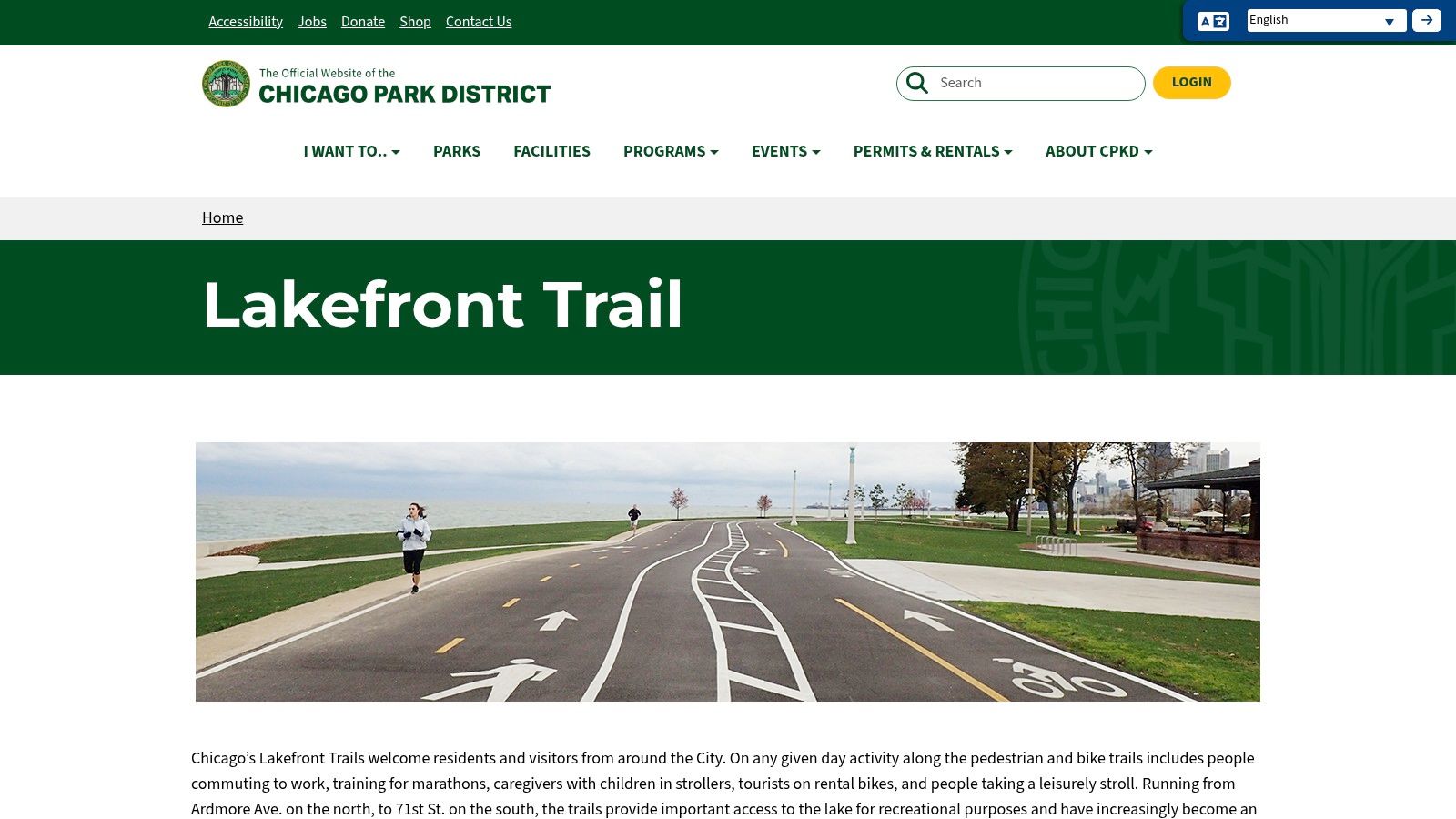
    The Chicago Park District website is your essential co-pilot for any Lakefront adventure. It’s a no-frills, practical resource that gives you exactly what you need to plan your outing.

    • Section Maps: The site provides clear maps that break the 18-mile trail into manageable sections. I use these to plan shorter rides, deciding whether I want the architectural grandeur of the downtown segment or the quieter, more natural feel of the south shore.
    • Access & Facilities: You can easily find info on parking, restroom locations, and water fountains. Multiple CTA and Metra stops are located just blocks from the trail, making a car-free trip completely doable.
    • Alerts: I check the website for any closures or detours, especially after big storms when wind and waves can wash sand and debris onto the path.

    Why It Belongs at #1

    What makes this the premier bike trail in Illinois is its sheer energy and accessibility. It's a continuous, car-free path that offers unparalleled views and a seamless connection through the heart of the city. While it can get crowded on beautiful weekend afternoons, recent improvements have separated bike and pedestrian paths along most of its length, which has made a huge difference in safety and flow. The trail is free and open 24/7, though parks and beaches along the route close at 11 PM. If you're looking for another great urban ride that offers a different kind of scenery, you can explore the wooded escape of the Des Plaines River Trail for a more rustic experience.

    Visit the Chicago Park District's Lakefront Trail Page

    2. Illinois Prairie Path

    If the Lakefront Trail is the city’s pulse, the Illinois Prairie Path is its quiet, contemplative breath. This trail is a different kind of Illinois journey, a 60-mile network that trades skyscrapers for leafy canopies and the roar of traffic for the crunch of limestone under your tires. I think of it as a time machine. As you pedal along this historic rail-to-trail conversion, you're rolling through the very corridors that once connected the suburbs to the city, passing through charming town centers that feel preserved in amber. It’s a ride that encourages you to slow down, to notice the wildflowers, and to feel a connection to the state’s pioneering spirit.

    Illinois Prairie Path

    My favorite rides on the Prairie Path involve making a day of it. I’ll pick a branch, ride from one town to the next, grab lunch at a local cafe, and then pedal back. It feels less like training and more like exploring. The path connects you to the authentic, everyday life of suburban Chicago, offering a peaceful, low-stress escape that’s incredibly accessible. This is where you go to clear your head and cover some serious, uninterrupted miles.

    Planning Your Ride

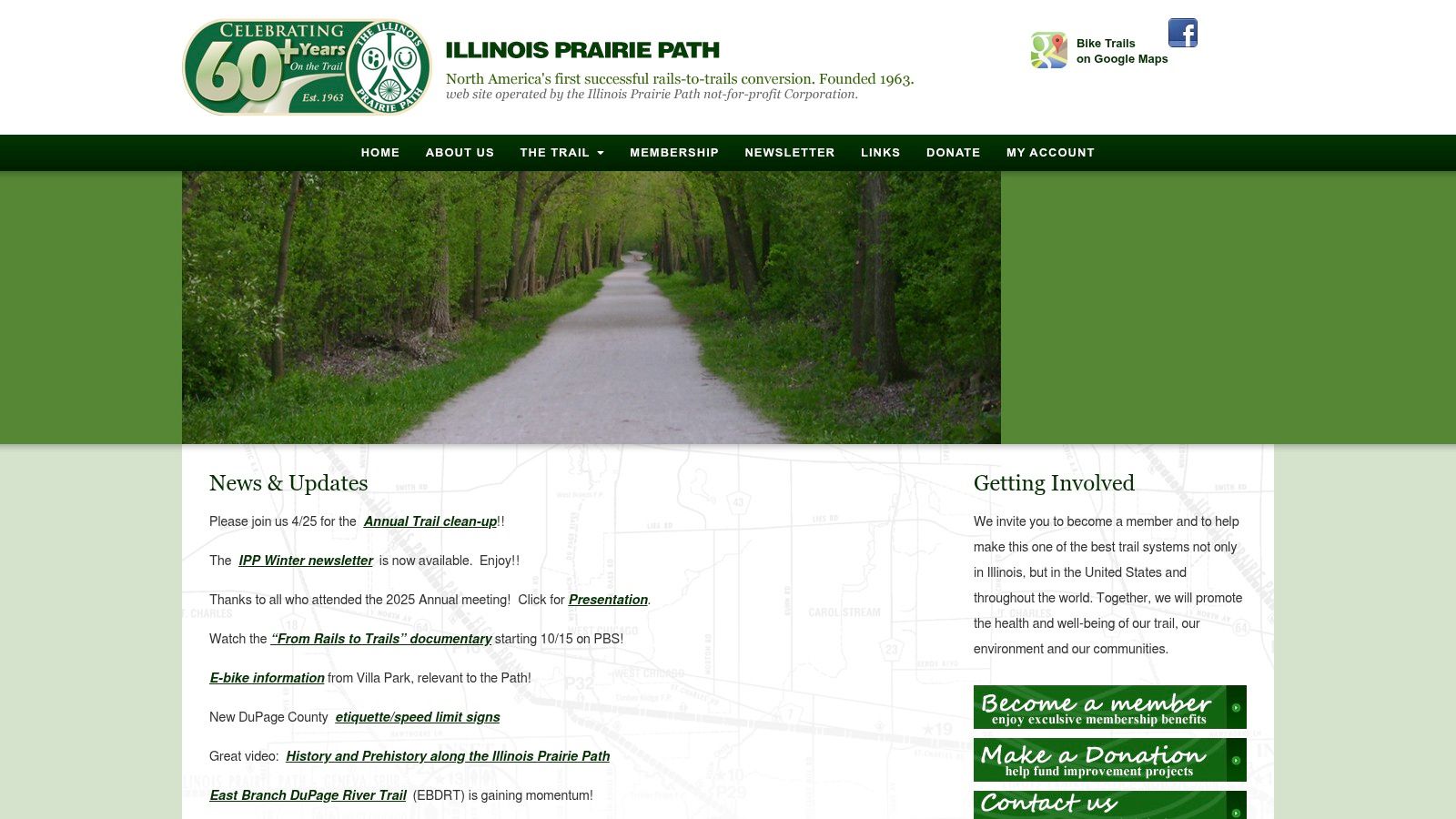
    The official Illinois Prairie Path website (ipp.org) is the definitive guide for this sprawling network, run by the very nonprofit that stewards the trail. It’s a passion project, and it shows, offering everything you need to plan a successful ride.

    • Interactive Maps: The site's greatest strength is its detailed map, which clearly shows the Main Stem and its offshoots like the Aurora, Elgin, and Batavia spurs. I use this to visualize longer routes and see exactly how the path connects to Metra stations or other trails.
    • Trail Conditions & News: This is your source for real-time information. You can check for any temporary closures, detours, or even find out about volunteer cleanup events. I see it's kept up-to-date by people who genuinely care about the path.
    • Access Points: The website lists numerous trailheads and access points, often with details on parking. I find it most useful for planning point-to-point rides using the Metra, as it helps me locate the nearest station to hop on or off the trail.

    Why It Belongs at #2

    The Illinois Prairie Path earns its spot as a top-tier bike trail in Illinois for being a monumental achievement in conservation and recreation. It’s one of America’s first rail-to-trail successes, providing a massive, mostly flat, and car-free greenway for long-distance riding. While the crushed limestone surface is best for hybrid or gravel bikes, it’s a forgiving and scenic ride. The path’s genius is how it links dozens of communities, allowing you to create countless ride variations. For another excellent example of a suburban trail connecting multiple towns, you can check out the paved and forested Old Plank Road Trail south of the city.

    Visit the Illinois Prairie Path's Official Website

    3. Fox River Trail

    If the Lakefront Trail is the city's pulse, the Fox River Trail is its gentle, flowing breath. This corridor is where I go to escape the urban grid and follow the current. Spanning more than 40 miles along the beautiful Fox River, it connects a string of charming river towns like a thread of pearls, from Algonquin down to Aurora. The scenery shifts constantly but gracefully. One moment you're gliding through a dense forest preserve with a canopy of green. The next you're rolling past a historic dam or crossing an old steel truss bridge into a town center. It's a trail of discovery, with each bend in the river revealing something new.

    I remember a perfect fall afternoon ride starting in St. Charles, with the leaves just starting to turn. I stopped for a coffee, then rode south towards Batavia, the low sun glinting off the water. The path is a social one, shared with families and fellow cyclists, but it never feels crowded. You feel connected to the towns and the nature that thrives between them. That’s the real appeal of the Fox River Trail; it’s a journey that feels both invigorating and incredibly peaceful.

    Planning Your Ride

    The Fox Valley Park District website is your primary resource for navigating this extensive trail system. While it's a municipal site, I've found it to be surprisingly helpful for planning longer, multi-town rides, offering the core details you need to set out with confidence.

    • Trail Maps & Access: The site offers downloadable maps that show the trail's route, major trailheads, and key access points within towns like Batavia, Geneva, and St. Charles. I use these to plan my entry and exit points, especially when I'm meeting up with friends.
    • Connections: A key feature is understanding how the Fox River Trail links to other major routes. You can see exactly where it intersects with the Illinois Prairie Path and the Great Western Trail, which lets you plan epic, multi-trail adventures.
    • Facilities & Parks: The website provides information on the various forest preserves and parks along the route. This is essential for locating parking, restrooms, and picnic areas, making it easy to plan a full day out.

    Why It Belongs at #3

    The Fox River Trail earns its spot as a top bike trail in Illinois for its incredible variety and accessibility. It delivers a perfect blend of natural scenery and small-town charm that you just can't find on a city path. The trail is mostly paved or crushed limestone, making it suitable for all kinds of bikes and skill levels. Its length and numerous access points mean you can ride for 5 miles or 50. While certain segments through towns can get busy, the sheer scale of the trail means you can always find a quiet stretch. For a similar long-distance experience with a more historic, railroad-grade feel, try exploring the Illinois Prairie Path, which conveniently connects to this trail.

    Visit the Fox Valley Park District's Trail Page

    4. Cal-Sag Trail

    There's a gritty, determined beauty to the Cal-Sag Trail. A path forged where industry and nature meet. This isn't a ride through manicured parks. It’s a 26-mile journey along the Calumet-Sag Channel, telling a story of the region's working past and its ecological renewal. I find this trail offers a different kind of inspiration. It’s a long, straight shot that allows you to get into a rhythm, to just pedal and think, watching as barges glide by and herons stalk the wetlands. It feels real, powerful, and deeply connected to the South Side's spirit of endurance and transformation.

    Cal-Sag Trail

    My favorite part of the Cal-Sag is its honesty. You'll pedal past old industrial sites, then suddenly find yourself in a quiet, restored prairie within a forest preserve. This contrast makes you appreciate the resilience of nature and the dedication of the people who envisioned and built this greenway. It’s less crowded than the lakefront. This makes it perfect for those days when you need to clear your head and just put in the miles.

    Planning Your Ride

    The Cal-Sag Trail's official website is a testament to the community spirit behind the trail. It's built and maintained by advocates, and their passion shines through in the practical, rider-focused information they provide.

    • Trail Facts & Map: The "Trail Facts" page is your primary resource. It has a clear, interactive map showing the full route, trailheads, and crucial connection points to other trail systems like the I&M Canal Trail. I use it to plan my entry points, whether I'm starting in Lemont or further east.
    • Parking & Access: The site clearly marks parking locations at various forest preserves and access points along the 26-mile stretch. This is essential, as services are more spread out than on urban-center trails.
    • Event Information: Because the trail is a favorite for group rides, I've noticed the website often lists organized events and volunteer opportunities. It’s a great way to connect with the local cycling community.

    Why It Belongs at #4

    The Cal-Sag Trail earns its spot as a top bike trail in Illinois because it provides a fantastic corridor for serious, uninterrupted riding. It’s a long, paved, and relatively flat path that’s ideal for training and building endurance away from tourist crowds. Its real strength is its role as a super-connector, linking dozens of communities and vast networks of forest preserve trails in the Palos region. The trail is free and open from sunrise to sunset. While you will encounter some road crossings and a few windy, open sections, the feeling of discovery and connection to this unique landscape is well worth it. For another ride that mixes natural beauty with historic infrastructure, consider checking out the I&M Canal State Trail which connects directly to the Cal-Sag.

    Visit the Cal-Sag Trail's Trail Facts Page

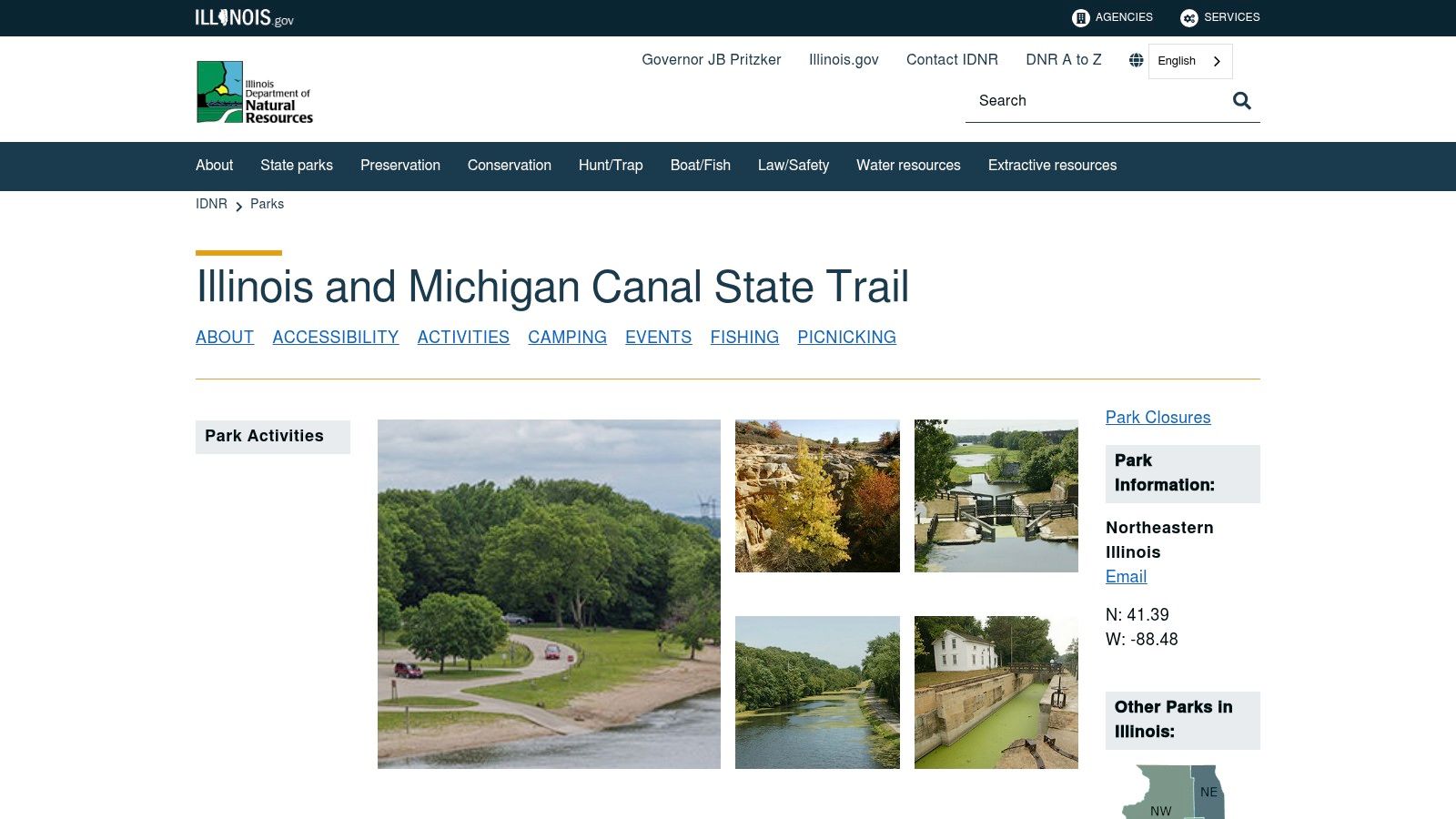
    5. Illinois & Michigan (I&M) Canal State Trail

    Riding the Illinois & Michigan Canal State Trail is like pedaling back in time. This isn't just a path through nature. It's a 61.5-mile journey along the very towpath where mules once pulled barges down a canal that changed American history. You can feel the quiet importance of the place as you glide on the crushed limestone, paralleling the calm waters of the canal. The ride connects you to a story of industrial ambition and westward expansion, with original locks, aqueducts, and historic canal towns dotting the route from Rockdale to LaSalle. It’s a beautifully serene and historically rich experience.

    Illinois & Michigan (I&M) Canal State Trail

    I remember a long weekend I spent bike-packing a large portion of the trail. The steady rhythm of the pedals on the flat terrain became almost meditative. Passing by a hulking, silent lock tender's house and then bursting out into an open prairie with the Illinois River bluffs in the distance creates a powerful sense of scale and history. This trail offers a deeper, quieter kind of ride, one that connects you to the landscape and the stories buried within it.

    Planning Your Ride

    The Illinois Department of Natural Resources (DNR) website for the I&M Canal is your primary source for planning this historical expedition. It’s a straightforward, functional site that gives you the core details you need to prepare for a day trip or a multi-day adventure.

    • Trail Map & Guide: The site offers a downloadable map and guide that is essential for your trip. I used it to identify trailheads, parking areas, and points of historical interest like the Gebhard Woods and Channahon State Parks.
    • Park Information: You can find specifics on the various state parks that the trail runs through. This helps you plan where to stop for restrooms, picnics, or just a scenic break. These parks are the main hubs for services along the trail.
    • Trail Conditions: The DNR site is the place to check for any official alerts on trail status. Given the limestone surface, I always recommend checking for updates after heavy rain, as some sections can become soft and muddy.

    Why It Belongs at #5

    The I&M Canal State Trail earns its spot as a top bike trail in Illinois because it offers a unique blend of history, endurance, and natural beauty. It’s one of the best places in the state for a gravel bike or a long, uninterrupted ride away from city noise. The flat, consistent terrain is perfect for building mileage, while the historical artifacts provide a constant source of fascination. Though you need to be self-sufficient with water and snacks between towns, the sense of accomplishment and connection to Illinois's past is incredible. The trail also passes through some beautiful natural areas, and if you’re inspired by the trail’s journey through state parks, you can find out more about your local forest preserve in IL and its unique ecosystems.

    Visit the DNR's I&M Canal State Trail Page

    6. North Branch Trail System

    If the Lakefront Trail is the city's pulse, the North Branch Trail System is its deep, calming breath. This is where you go to escape the concrete. You can feel the deep shade of a true forest canopy. The trail follows the meandering North Branch of the Chicago River, creating a green corridor that feels worlds away from the city's hustle. I’ve spent countless hours on this trail, watching deer graze in the early morning and listening to the rustle of leaves instead of the roar of traffic. It's a journey through serene woodlands, past tranquil lagoons, and all the way to the curated beauty of the Chicago Botanic Garden.

    North Branch Trail System

    One of my favorite memories is packing a simple picnic and riding from the city's edge to the Skokie Lagoons. We spent the afternoon just watching kayakers paddle by. We felt completely disconnected from our daily routines. The North Branch Trail isn’t just a path. It's a transportive experience, a reminder of the wild, natural beauty that coexists with our urban environment. It's the perfect place for a long, meditative training ride or a slow, exploratory family outing.

    Planning Your Ride

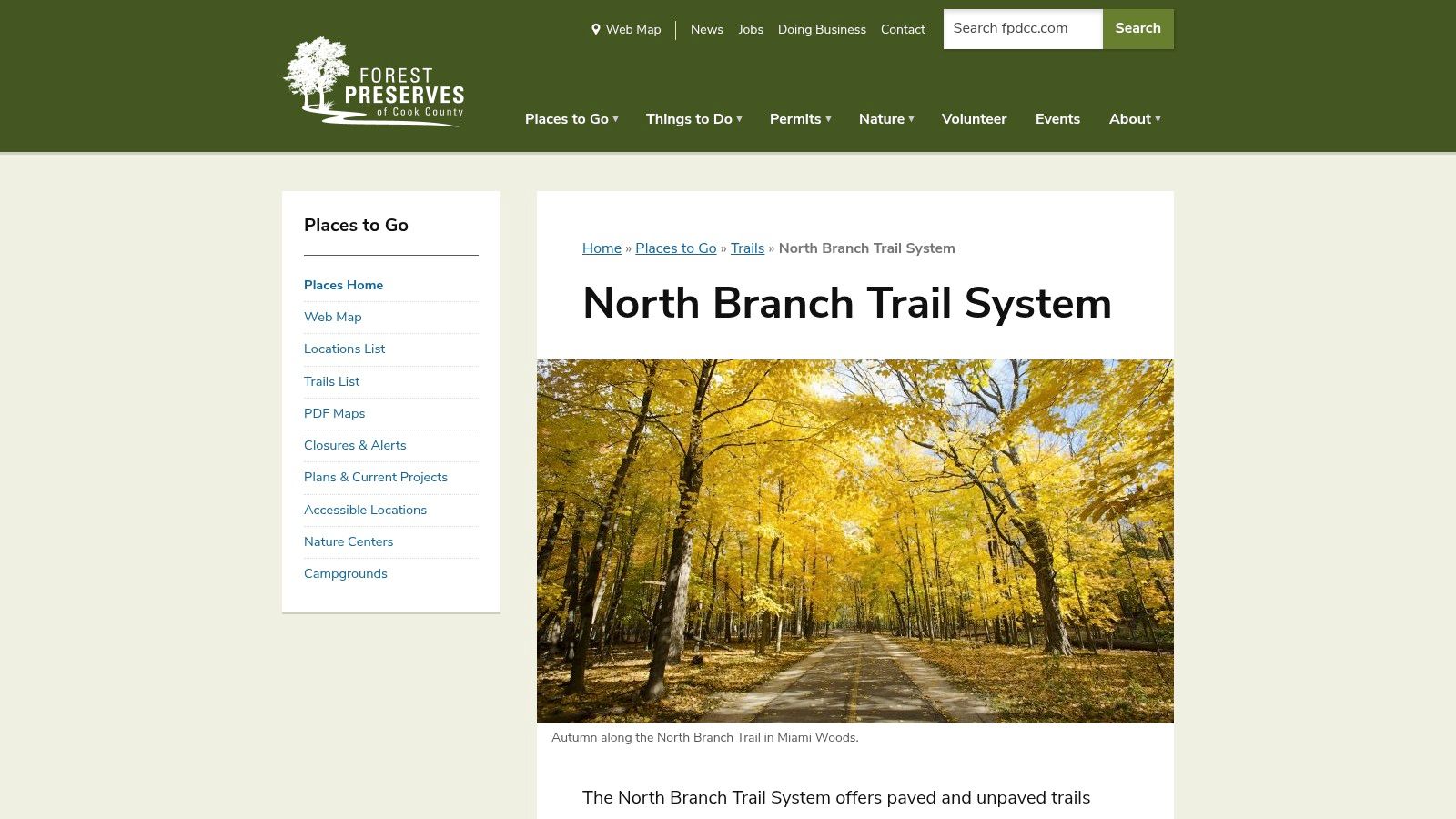
    The Forest Preserves of Cook County (FPCC) website is your guide for this woodland adventure. While the site covers the entire county's vast network, it provides all the necessary details for tackling the North Branch Trail.

    • Interactive Maps: The FPCC's interactive web map is great for seeing the whole system at a glance. I use it to locate specific trailheads, picnic groves, and restrooms along the nearly 20-mile main spine. You can see how the loops and spurs connect, which helps in planning a ride that's just the right length.
    • Trail Information: The site lists key access points, mileage, and surface types. This is essential because while the main trail is paved, some connectors and loops are crushed stone, so you can choose your route based on your bike and comfort level.
    • Permits & Alerts: Before you go, it's smart to check for any trail closures, especially during spring thaws or after heavy rains which can cause flooding in low-lying areas near the river.

    Why It Belongs at #6

    The North Branch Trail System earns its spot as a top bike trail in Illinois for offering a genuine, car-free forest escape that’s incredibly accessible to millions of city and suburban residents. Its tree cover provides welcome relief from the summer sun and wind, making it a reliable and comfortable ride. The direct, seamless access into the Chicago Botanic Garden is a unique feature that turns a simple bike ride into a full day's destination. While it gets busy near popular groves and the Botanic Garden entrance on weekends, the trail's length provides plenty of space to find your own quiet stretch. The trail is free, but your access is limited to daylight hours, from sunrise to sunset.

    Visit the FPCC's North Branch Trail System Page

    7. Tunnel Hill State Trail

    If Illinois has a ride that feels like a true backcountry adventure, this is it. The Tunnel Hill State Trail is a journey into the wild heart of Southern Illinois, a 45-mile gravel path that cuts through the forests and wetlands of the Shawnee Hills. Riding here is a complete escape. The only skyline you see is made of ancient bluffs and towering oak trees. I remember my first time approaching the namesake tunnel. The air grew cool. The world outside faded into a pinprick of light as I plunged into the 543-foot darkness. It's moments like that, surrounded by the quiet sounds of nature and the crunch of gravel under your tires, that make this trail so special.

    Tunnel Hill State Trail

    This isn't a quick urban loop; it’s a destination. You feel a real sense of accomplishment as you cross the two dozen trestle bridges, some soaring high above the canopy, offering views that stretch for miles. It’s a place for long, contemplative rides where you can challenge your endurance and reconnect with a quieter, more rugged side of the state.

    Planning Your Ride

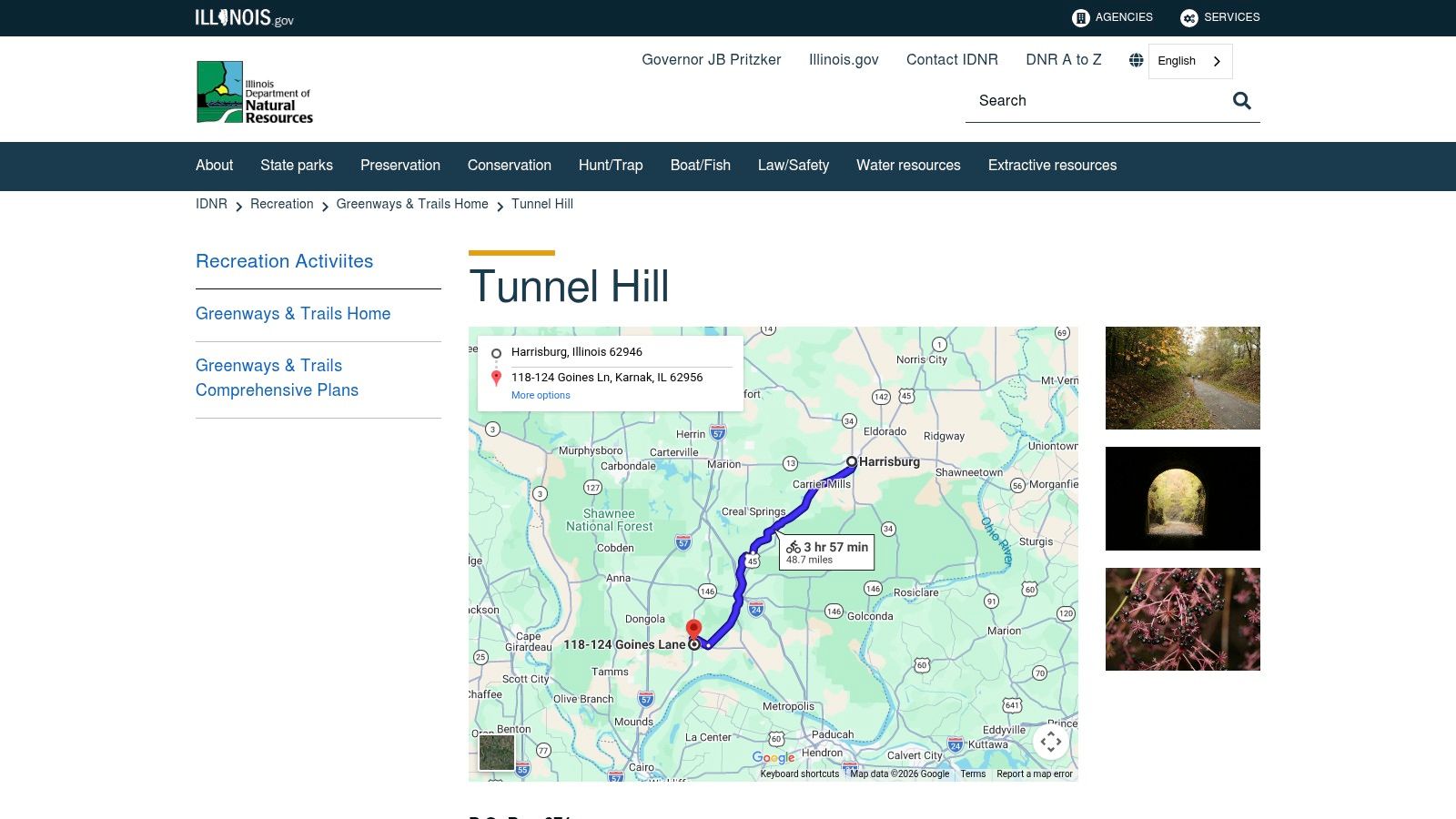
    The Illinois Department of Natural Resources (DNR) website is your go-to guide for preparing for a Tunnel Hill expedition. It’s a straightforward, facts-first resource that gives you all the critical details for a safe and successful trip.

    • Trail Map & Access: The site offers a detailed map showing the main trail from Harrisburg to Karnak, plus access points and facilities along the way. I use this to plan my entry point and decide how long of a segment I want to tackle.
    • Facilities & Rules: You'll find a clear list of what's available at each trailhead, like parking, water, and vault toilets. Critically, it also outlines trail rules, like the requirement for a bright headlight and taillight for navigating the unlit tunnel.
    • Regional Connections: I noticed the DNR page mentions the trail's connection to larger routes like the River-to-River Trail and the American Discovery Trail, which is perfect for planning multi-day bike-packing adventures.

    Why It Belongs at #7

    The Tunnel Hill State Trail earns its spot as a premier bike trail in Illinois by offering an unmatched long-distance gravel experience. Its gentle railroad grade makes it accessible to most endurance levels, while its remote character provides a genuine sense of adventure that you just can't find on a city path. While you need to be self-sufficient with water and repair kits, and a bike with wider tires (I’d suggest at least 32mm) is a must, the payoff is immense. It's a free trail, open year-round, that invites you to lose yourself in some of the state's most stunning natural landscapes.

    Visit the DNR's Tunnel Hill State Trail Page

    7 Illinois Bike Trails Comparison

    Trail 🔄 Implementation complexity ⚡ Resource requirements 📊 Expected outcomes 💡 Ideal use cases ⭐ Key advantages
    Chicago Lakefront Trail Low — fully developed, mostly separated lanes; clear signage Urban/road or hybrid bike; minimal gear; frequent services & transit access Scenic waterfront rides; reliable commuting; can be crowded on warm weekends Commuting, fitness, sightseeing Continuous 18-mile lakefront path; abundant amenities and transit links
    Illinois Prairie Path Medium — multi-branch crushed‑limestone network; some at‑grade crossings Hybrid/gravel or wider tires; moderate upkeep; strong volunteer maintenance Long, low‑stress suburban rides with town connections Endurance suburban rides, connectors between towns/trails 60+ mile network; strong stewardship; many town access points
    Fox River Trail Medium — riverside corridor with bridges and occasional detours Road/hybrid bike; services in towns; wayfinding available Varied scenery and easy mileage; family‑friendly; busy in popular towns Family/group rides, scenic tours, stops at river towns River views, town amenities, strong regional connections
    Cal‑Sag Trail Medium — long paved corridor with some road crossings and open stretches Road/fitness bike; services spread out — plan for supplies Steady training mileage; less tourist traffic; windy/open sections possible Training rides, longer steady efforts, organized group rides 26‑mile continuous paved greenway; good connectivity to regional trails
    I&M Canal State Trail Medium — long crushed‑limestone towpath with historic infrastructure; some soft segments after rain Gravel/fitness bike with wider tires; carry water and spares; limited services between towns History‑rich bike‑packing and day trips; consistent endurance surface Bike‑packing, history‑centric trips, long day rides 61.5 miles of towpath; historical features and state park facilities
    North Branch Trail System Low–Medium — paved main spine plus loops and connectors; many access points Road/hybrid bike; easy access to parking/transit; family facilities Shaded forest rides; good training and family outings; weekend congestion near attractions Family rides, training, nature outings, botanic garden visits Car‑free forest riding; multiple loops and abundant access points
    Tunnel Hill State Trail Medium — long gravel rail‑grade with tunnel and many trestles; remote stretches Gravel/32mm+ tires; lights for tunnel, water and spares; limited services Highly scenic long gravel experience; ideal for bike‑packing; remote sections Gravel touring, bike‑packing, scenic endurance rides Signature 543‑ft tunnel and 20+ trestles; gentle grades through Shawnee hills

    Become a Trail Guardian With Us

    We’ve journeyed together across the state. From the shimmering edge of Lake Michigan to the deep, cool quiet of a southern Illinois tunnel. You've seen the urban energy of the Chicago Lakefront Trail, the pioneering spirit of the Illinois Prairie Path, and the serene flow of the Fox River Trail. We've explored the industrial rebirth along the Cal-Sag, traced history on the I&M Canal, found woodland peace on the North Branch, and discovered the unique thrill of the Tunnel Hill State Trail. Each bike trail in Illinois is more than just a path. It's a story. A living artery pumping life, health, and connection through our communities.

    Riding these trails always brings me back to a core belief I hold dear, one that fuels our work at Litter Caterpillars: service to our environment is really service to ourselves. It's about a deep, meaningful connection. Think of it like tending a garden. You don't just plant the seeds and walk away. You water them. You pull the weeds. You nurture the soil. The reward isn't just the eventual harvest, but the act of caring itself. It grounds you and makes the final bloom that much sweeter.

    From Rider to Guardian: Your Next Adventure

    So, how do you go from simply using a trail to truly connecting with it? It starts with a simple shift in perspective. You're not just a visitor passing through; you're part of its ecosystem. Here are a few ways you can start your own journey as a trail guardian:

    • The One-Bag Challenge: The next time you gear up for a ride, tuck a small, foldable bag and a pair of gloves into your pack. As you ride, or when you stop for a water break, take just two minutes to pick up any litter you see. It sounds small, but imagine if a hundred riders did this on a single Saturday. The impact is huge. It’s an immediate, tangible way you can say "thank you" to the path that carries you.
    • See with New Eyes: You must begin to notice the details. Is there a section where water is eroding the path? Is there an invasive plant species creeping in? You don't have to be an expert to observe. Simply being aware is the first step. I believe sharing these observations with local park districts or trail authorities can provide them with valuable on-the-ground information they might not have.
    • Share the Story: Your experience on a bike trail in Illinois has power. When you get home, don’t just post a picture of your bike. Tell the story of the trail. Talk about the wildlife you saw, the kindness of a fellow rider, or the sense of peace you found. I think inspiring others to appreciate these places is a powerful form of stewardship.

    Finding Your Path, Finding Your Purpose

    Every one of these trails tells a story. They are veins of joy, health, and connection for our communities. But like any precious resource, they need our care. This isn't just about keeping things clean. It's about strengthening our connection to these places, about earning our right to enjoy them. It's about changing ourselves by changing our surroundings.

    When you're out there, feeling the wind and the burn in your legs, what if you also felt a sense of ownership? A sense of pride? I challenge you to see the trail not just as a route, but as a place you can give back to. Find your trail, find your rhythm, and find a way to leave it a little better than you found it. That’s the real adventure.


    Ready to turn your inspiration into action? Join us at Litter Caterpillars. We organize community cleanups along many of these trails and the parks they connect, making it easy and fun to give back to the places you love. Find your next volunteer adventure and become part of a community that cares at Litter Caterpillars.

  • Your Guide to Busse Forest South and Its Wonders in 2026

    Your Guide to Busse Forest South and Its Wonders in 2026

    Are you tired of the city's concrete jungle? I know a place. It’s a place where all that noise just dissolves, and you can finally hear yourself think. I call it Busse Forest South, and it's so much more than a park. For me, it's a sanctuary. It’s my training ground. It's where I go to touch something real again.

    Your Adventure into Chicago's Secret Garden

    I want you to think of Busse Forest South as a living, breathing piece of Chicago's soul, like a secret garden that most people just speed past on the highway. My mission here is to personally walk you through this incredible spot, sharing the trails I’ve hiked a hundred times and the lessons this forest has taught me. Consider this guide your key. A key to unlocking its deepest secrets, from the most silent paths for a quiet walk to the easiest places to park your car.

    The air out here just feels different, doesn't it? It’s a place where you can truly breathe again. But like anything precious, keeping it this way takes real work. This isn't just me showing you a pretty trail; it’s an invitation. I'm asking you to join us and become part of its story.

    A Legacy Worth Protecting

    The very ground you're walking on has a story that stretches way, way back. You see, Busse Forest South is just one part of the larger Ned Brown Forest Preserve, a massive area that some incredibly forward-thinking people started protecting way back in 1918. It’s like they left a gift for us, a gift from a century ago. They had the foresight to set this land aside for you and me. That's over 100 years of history right under your feet.

    Knowing that makes our work feel so much bigger than just picking up someone else's trash. When I’m out here cleaning up with my crew, I feel like we’re honoring a promise made a hundred years ago. We are continuing that legacy.

    The map below gives you a bird's-eye view of just how immense the Ned Brown Forest Preserve really is. You can see Busse Lake, a glittering jewel, and the web of trails spun around it—our little corner, Busse Forest South, is tucked right in there.

    This map helps you grasp the scale. It's a huge network of ancient woods and quiet waters, a wild kingdom right in our own backyard.

    More Than Just a Walk in the Park

    My real goal here is to show you how a simple visit can become something more. It's an opportunity to build a community, to push yourself physically and mentally, and to do some actual good for a place that gives us so much. For me and my friends at Litter Caterpillars, this forest preserve in IL is where our core values of service and friendship really come to life.

    This guide is my personal invitation. It’s a challenge, really. I’m daring you to turn a simple weekend walk into something truly meaningful. It's a chance to find your people and become a guardian of this incredible place. Let's start this adventure together.

    Hitting the Trails and Waterways

    Alright, you've made it. Now for the fun part: deciding what to conquer first. Busse Forest South isn't just a park; it's a sprawling, living network of trails and water that practically begs you to explore it. Imagine its nearly 13 miles of paths as arteries, pumping life and adventure throughout the entire landscape.

    I’ll never forget my first time trying to navigate this trail system. It felt like a massive, beautiful maze, a labyrinth of green, until I finally found my way to the main 7.3-mile loop. This paved path is the absolute heart of the preserve. It’s the perfect place for hikers, runners, and cyclists to really stretch their legs. The trail is mostly flat and wide, which makes it an amazing spot for a family bike ride or a long, meditative run where you can just get lost in your own thoughts.

    But here’s the real secret, the bit of magic I want to share with you. The best parts happen when you dare to venture off that main drag. The smaller spurs branching off are where I've discovered my favorite quiet spots—hidden groves and peaceful watersides that most people just pedal right past, completely unaware.

    Charting Your Course

    The trails here cater to just about every mood you could possibly be in. Some are easy, paved paths perfect for a casual stroll with a friend or for pushing a stroller. Others are unpaved, giving you that satisfying, primal crunch of leaves and dirt under your shoes. It’s this rich mix of experiences that keeps me coming back, again and again.

    The forest is so much more than just a place to get your steps in; it's a central hub connecting adventure, history, and our local community.

    A concept map showing Busse Forest South offering adventure, history, community, recreation, and preserving the past.

    You can see how everything weaves together, a beautiful tapestry proving this preserve is a living, breathing part of our area.

    More Than Just Dirt Paths

    Are you looking for something beyond the trails? The massive 590-acre Busse Lake is waiting for you. It’s the largest body of water for paddling in all of Cook County, a shimmering expanse that’s a dream for kayakers, canoers, and anglers. Trust me on this one, there is nothing quite like gliding across that calm water as the sun comes up and the morning mist hangs heavy in the air. It’s a kind of peace that’s hard to find these days.

    To give you a quick idea of what's available, I’ve put together a simple breakdown of the main activities.

    Activities at Busse Forest South

    Activity Best For What to Expect
    Hiking & Running All levels The main 7.3-mile paved loop is flat and totally accessible. The smaller, unpaved trails offer a more rugged, challenging terrain.
    Biking Families, long-distance cyclists You get a smooth, easy ride on the main loop with plenty of room. It’s a fantastic way to cover a lot of ground quickly.
    Paddling Kayakers, canoers A huge, open lake with multiple boat launches awaits you. Perfect for a long, peaceful day spent out on the water.
    Fishing Anglers of all skill levels Shoreline and boat fishing are both super popular here. The lake is regularly stocked with a wide variety of fish species.

    This table is just a starting point. The best way to get to know this forest is to just get out there and explore it for yourself.

    This entire playground is part of the larger 3,700-acre Ned Brown Forest Preserve, which beautifully balances ancient, primeval forests with modern recreation. It's no wonder it's one of Illinois' most-visited natural spots, open every single day from sunrise to sunset.

    The forest has a personality all its own, and the best way I know to get acquainted is by wandering its trails and waterways. If you love exploring trail systems like this one, you should definitely check out our guide to the Des Plaines River Trail for another incredible local adventure.

    A Living Museum of Rare Habitats

    When I tell you Busse Forest South isn't just another walk in the park, I really mean it. This place is different. It’s a living museum, a time capsule holding onto some of Illinois's rarest habitats, and it’s so important that it's officially recognized as a National Natural Landmark.

    Watercolor painting of a misty forest with red-barked trees, white trilliums, and Jack-in-the-pulpits by a pond.

    I want you to picture the ground you're standing on as the floor of an ancient, shallow bowl carved out by glaciers thousands of years ago. It's like a geological memory. Those depressions created something very special called "flatwoods," a type of damp-ground forest that used to be common around here but is now incredibly, heartbreakingly rare. This isn't just some random feature of the forest; it is the heart and soul of Busse Forest South.

    A Fragile, Timeless World

    Walking through these flatwoods feels like stepping into the past. It’s a journey back in time. You’re surrounded by towering swamp white oaks and brilliant red maples. In the spring, the ground is a carpet of delicate trilliums and the weird, hooded shape of jack-in-the-pulpit flowers.

    This isn’t just a pretty picture; it's a fragile, delicate ecosystem that desperately needs our protection. That’s why back in January 1965, this specific 440-acre section was designated as the third Illinois Nature Preserve. This status officially protects these flatwoods and all the life they support—from the black ash trees to the vibrant blueflag iris. You can read more about this special designation on the Illinois DNR website.

    Knowing this history really changes how you see the place. It connects you to a story much, much older than any of us.

    The Threats This Museum Faces

    But just like any precious museum, this one is under constant attack. The quiet beauty of these woods is in a constant, silent battle, and it's a fight we can see happening right in front of our eyes.

    Here’s what we’re up against:

    • Invasive Species: These are like bullies on a playground. Aggressive, non-native plants are always trying to push out the native wildflowers and saplings that belong here, stealing space and vital resources.
    • The Emerald Ash Borer: This tiny, destructive beetle has absolutely wrecked ash tree populations all over the Midwest. You can see the damage here, with huge gaps in the canopy where massive trees used to stand proud.
    • Deer Over-browsing: The deer population is so high that the tender shoots of young trees and wildflowers get eaten before they even have a chance to grow. The forest can't regrow on its own.

    Understanding these struggles makes a simple walk in the woods feel so much more meaningful. You’re not just a visitor; you're a witness to a living, breathing history that needs our help to survive.

    This is where service gets personal for me. When you join one of our cleanups, you’re not just picking up a plastic bottle. You’re becoming a guardian of this living museum, actively protecting its story for the future.

    Join Us and Become a Forest Guardian

    This is where you come in. I’ve always found that cleaning up other people's messes is WAY easier than cleaning up our own. This is your chance to prove it. Joining one of our cleanups at Busse Forest South is about so much more than just picking up trash—it’s about finding a strength inside yourself you never knew you had.

    This whole group started in a hailstorm. Seriously. There were only three of us, freezing and laughing at how absurd it all was. In that struggle, we found a strange, profound kind of joy. That’s the spirit we bring to every single event, and it’s something you can find here, too.

    How We Turn Service into Adventure

    We meet on weekend mornings, rain or shine. I schedule them that way on purpose because it acts as a filter. It’s like a magnet for givers—the kind of people who show up not because it's easy, but because it matters. When you volunteer with Litter Caterpillars, you'll find yourself surrounded by folks who just get it, people who believe in bravery, kindness, and sticking together.

    We bring the flags, the theme song, and the community. All you have to bring is yourself.

    Our events are designed to be simple and empowering. Here’s what you can expect:

    • Safety and Happiness First: Your well-being is everything to me. We provide all the supplies—gloves, bags, and litter grabbers—so you can just focus on the mission.
    • No Pressure, Just Purpose: We will never, ever ask you for money. Ever. Your volunteer energy is the most valuable thing we have, and we protect it fiercely.
    • Building Friendships: These events are a powerful way to meet people who think like you. The shared work and seeing the tangible impact you've made creates bonds that last long after the cleanup ends.

    Finding Your Power in the Forest

    This isn't about obligation. It's about you finding your own power in a simple act of service. It’s about turning what some people see as a chore into a real, thrilling adventure. Each piece of trash you pull from the beautiful trails of Busse Forest South is a small victory, a tiny battle won for this incredible place.

    You’re not just cleaning; you are reclaiming the landscape. You are pushing back against neglect and showing the world that people actually care. This is an act of defiance, a powerful statement that this place is worth protecting.

    We see our work as a kind of personal transformation. Through service, we learn to trust ourselves and each other. We prove that small, consistent actions can lead to massive change, both in our parks and deep inside ourselves. It’s a journey of growth, and I'm personally inviting you to take that first step with us.

    If you’re ready to see how service can change your whole perspective, check out our environmental stewardship programs to learn more about our philosophy. We’re building a community of guardians, and there’s a place for you here.

    Finding Your Way to Nature's Doorstep

    Watercolor illustration of a man checking his phone at a trailhead with a car and map.

    Getting to Busse Forest South is your first test. It’s the gatekeeper’s riddle. Pass it, and you're rewarded with something that feels like a hidden treasure. Fail it, and you’ll end up like I did my first time—driving in frustrating circles while my GPS confidently led me to a dead end.

    Don't be that person. Let me give you the cheat codes so your adventure starts the second you step out of your car, not while you’re cursing at a map.

    Finding the right entrance is like knowing a secret handshake. Once you know it, you’re in. There are a few ways in, but not all of them drop you right where you want to be.

    Parking Made Simple

    Listen up. For the easiest, most no-fuss access, you want the lots right off Higgins Road (Route 72). These put you right at the heart of the main trail loop and give you an incredible, sweeping view of Busse Lake right from the get-go.

    • The Main Boating Center: This is your command center. It’s a huge lot and the perfect spot to launch a hike, bike ride, or paddle. On a weekend morning, this place is buzzing. It's where all the action is.
    • Smaller Trailhead Lots: Sometimes you don’t want the buzz. If you’re like me and you need a quieter start, hunt for the smaller, almost-hidden lots along the southern and eastern edges. They’re a much more peaceful gateway into the woods.

    My pro tip? Get here early. I’m serious. Getting here before everyone else doesn’t just mean you get a prime parking spot. It means you get the forest all to yourself, when it’s at its most magical and still.

    Arriving by Public Transit

    No car? No problem at all. You don’t need one. The Pace bus system is your ticket in. Several routes run through Schaumburg and Elk Grove Village, dropping you within walking or biking distance of the preserve.

    I’ve had friends take the bus to a stop near Higgins and just walk the last little bit. Think of it as a small urban warm-up before your real hike begins.

    Just do yourself a huge favor and check the Pace bus schedules online before you leave. Weekend service can be a different beast entirely. Consider it the first leg of your journey.

    Questions I Get All The Time About Busse Forest South

    Got questions before you head out? Good. That means you're already thinking like an adventurer. Whether you're coming out for the first time or you're joining us for a cleanup, a little bit of prep goes a long, long way.

    Here’s the inside scoop on the most common things people ask me. Think of it as our little pre-game huddle.

    Is Busse Forest South a Good Spot for Beginners?

    Totally. You absolutely do not need to be a grizzled, trail-worn expert to have a blast here. The main paved trail is a 7.3-mile loop that’s wide and pretty flat—perfect for a chill hike, a bike ride, or even pushing a stroller. It’s a fantastic first step into the woods.

    And when you feel that little itch for something more, there are plenty of unpaved side trails. You get that real "dirt under your feet" feeling without it being some crazy-hard challenge. It’s the perfect place to level up your outdoor confidence.

    What Gear Do I Need for a Litter Caterpillars Event?

    This is the best question because the answer is so simple: just you. Bring your energy and a good attitude, and you’re set. That’s it. We’ve got the gloves, the bags, the grabbers—all of it. My only advice? Wear comfy shoes you don’t mind getting a little dirty and check the weather before you leave the house.

    Look, we’re here to make volunteering as easy as possible. We’re filtering for givers and good people, not for folks with expensive gear. Your willingness to show up is what truly matters to us.

    Can I Bring My Dog to Busse Forest South?

    Yes! And you absolutely should. You’ll see tons of happy dogs out on the trails. It's a fantastic spot to explore with your four-legged buddy.

    Just be sure to keep them on a leash that's 10 feet or shorter, and—this is a huge one for us—always, always clean up after them. It’s a simple act of kindness that keeps the park beautiful for everyone.

    Where’s the Best Place to Park?

    My go-to spot is the main Boating Center lot right off Higgins Road (Route 72). It’s huge, and it drops you right in the middle of everything. You can’t go wrong.

    If you’re looking for a quieter start or those lots are full, the smaller lots scattered along the southern end of the preserve are great little secrets.


    At Litter Caterpillars, we know that showing up for our parks is how we show up for ourselves and our city. It’s how we transform. If you’re ready to be part of something real, we’d love to have you. Find your next cleanup adventure at https://www.littercaterpillars.com.

  • A Guide to Lyons Woods Forest Preserve

    A Guide to Lyons Woods Forest Preserve

    Sometimes you just need to escape the city's noise, you know? That constant buzz. I’ve found my go-to spot just outside of Chicago, where the only sounds are rustling leaves and birdsong. It's called Lyons Woods Forest Preserve, and it's this little slice of wild in Waukegan that I've gotten to know really well. It's not just some park; it’s a whole story of nature and people coming together, and I want to tell you all about it.

    Your Guide to a Waukegan Hidden Gem

    Let me be your guide here. I want you to see Lyons Woods the way I do—not just as a spot on a map, but as a living, breathing place that calls to hikers, birders, and anyone who just needs a quiet minute. It's this deep feeling of finding the wild so close to home that keeps me and my friends at Litter Caterpillars going, making us fight to protect these places for everyone. You see, these pockets of nature are like lungs for the city, and when you step into one, you can finally take a full, deep breath.

    How This Place Came to Be

    This isn't just another park. Lyons Woods is what happens when a community decides to save a piece of nature for itself. I see it tucked away in Waukegan, a refuge covering 345 acres of woods, prairies, and wetlands that feel worlds away from the city. You know, the land was pieced together between 1976 and 1986, but it wasn't until 1996 that the trails and parking lot officially opened. You and I owe that to the voters who stepped up and supported a Forest Preserve referendum. When you walk here, you can still feel that community spirit under your feet.

    Today, you’ll find those 2.5 miles of gravel trails are perfect for hiking, biking, or even cross-country skiing when the snow flies. The best part? They link up with other regional paths, making it a key piece of a much larger greenway.

    I like to think of it as a neighborhood, but for nature. Each preserve has its own personality, but they're all connected, making the whole system stronger and more alive. It's a beautiful, sprawling tapestry woven from individual threads of green.

    To give you a quick idea of what to expect, here's a rundown of the essentials I put together.

    Lyons Woods at a Glance

    This table breaks down the key features and amenities you'll find when you visit. I find it’s a great little cheat sheet for planning your first trip.

    Feature Details
    Total Area 345 acres
    Trail Length 2.5 miles (gravel surface)
    Permitted Activities Hiking, Biking, Cross-Country Skiing, Fishing
    Dogs Allowed? Yes, on leash
    Parking On-site lot available
    Key Habitats Woodlands, Prairie, Wetlands

    It’s a straightforward, no-fuss kind of place, which is exactly why I love it.

    It’s More Than Just a Trail

    The first thing you’ll notice is how the scenery changes. One minute you're deep in the woods, wrapped in a cool, earthy scent, and the next, you're looking across a wide-open prairie where the sun warms your face. This mix is exactly what makes it such a critical sanctuary for wildlife. It reminds me a lot of the same feeling I get when we're out cleaning up other local gems. You can see what I mean by reading about our adventures at MacArthur Woods Forest Preserve.

    What I really want you to get from this is a sense of possibility. This place is a blank canvas. Every time you visit, you'll see something new. Whether you’re trying to catch the perfect sunrise with your camera or just looking for a quiet bench to sit and think, Lyons Woods has you covered. It's a place where you can feel the rhythm of nature and find a piece of yourself you didn't know was missing.

    So, let's get you ready to explore it.

    Exploring the Trails of Lyons Woods

    Alright, let's talk trails. When you’re at Lyons Woods, this is where the real magic happens. I want to take you on a walk with me, show you what I see, and get you ready to hit the ground running.

    The heart and soul of the preserve is a 2.5-mile gravel loop trail. This isn't some hardcore, expert-only path. It’s for everyone. I see families with rugged strollers, runners getting their miles in, and people just looking for a quiet place to think. I find myself on this loop all the time because of its gentle, rolling hills—just enough to make you feel like you’re working, but not so tough you miss the beauty around you.

    It’s a friendly trail that just flows, like a good conversation.

    Infographic about Lyons Woods: 345 acres, 2.5 miles of trails, located in Waukegan, IL.

    Navigating the Trail System

    One of my favorite things about this loop is that it’s not the end of the story. It’s the beginning. As you walk, you’ll spot little connector paths branching off. You follow them, and suddenly you find yourself on the McClory Trail.

    This is where your adventure can really expand. Suddenly, your simple 2.5-mile walk can become a serious journey. It’s awesome for you cyclists or anyone wanting to go the distance. Think of the main loop as your friendly neighborhood street and the McClory Trail as the highway it connects to, opening up the whole area for you to discover.

    I always tell people to treat the main loop as your home base. Explore it, learn its rhythm, and then when you're ready, take one of the side paths. See where it leads. You never know what you'll find. It’s like a choose-your-own-adventure story written in dirt and gravel.

    The feel of these trails changes completely depending on when you go.

    • Spring and Summer: The gravel is packed down and fast. In some spots, the trees are so full they form this incredible green tunnel. It feels like you’ve found a secret world.
    • Autumn: My absolute favorite time. You get the crunch of leaves under your feet, the crisp air, and the wild colors—it’s perfect. As the leaves fall, you start to see views you missed all summer.
    • Winter: After a good snow, the whole place goes quiet. It becomes this peaceful escape for cross-country skiing or just a bundled-up hike. You feel the silence; it’s something special.

    My Personal Tips for Your Hike

    A little bit of prep makes all the difference. While the trail is mostly gentle, a couple of the hills can sneak up on you. I think they’re great for getting your heart pumping!

    Also, you should keep an eye out for the benches along the loop. I’ve stopped at every single one. They’re in the perfect spots to catch your breath, have some water, and just listen to the woods.

    If you love this kind of trail system, you should definitely check out our guide on Waterfall Glen Forest. It's another one of my go-to spots, with its own unique vibe and challenges.

    No matter what you do out here—walk, run, or ski—the trails at Lyons Woods give you a chance to just be. They’re an invitation to slow down, breathe deep, and reconnect.

    Discover a Sanctuary for Wildlife

    When I first stepped into Lyons Woods, I didn't just see a bunch of trees. I saw a secret, bustling city, one that’s alive with creatures most people never notice. This place isn't just a park for us; it’s a living, breathing sanctuary for an incredible amount of wildlife. Let me introduce you to some of the locals.

    People watch a hawk and a small bird over a beautiful, vibrant marsh landscape.

    This place is an ecological powerhouse. It's a safe harbor for five state-endangered species, with one so rare its very existence is on the line. To give them a fighting chance, ecologists and volunteers have been putting in the work, planting over 1,000 native trees and shrubs. You can see them constantly battling invasive species with controlled burns and hard-nosed clearing.

    That's a story of resilience that hits close to home for me. It's exactly what we do at Litter Caterpillars—showing up, doing the tough stuff, and making a real, visible difference. If you want the full story on what makes this habitat tick, you can learn more about the ecological treasures of Lyons Woods on LCFPD.org.

    A Paradise for Birdwatchers

    If you’re a birder, you need to get here. Lyons Woods is smack-dab on the Lake Michigan flyway, which is basically a superhighway for migrating birds. I’ve lost hours just watching them pass through. In spring and fall, the sky just explodes with life.

    I remember one crisp autumn morning, standing on the observation deck, watching a northern goshawk just circle high above the prairie. Total freedom. It’s moments like that that remind you why you're out here in the first place. You feel a connection to something ancient and wild.

    The sheer variety is unreal. You might spot:

    • Majestic Raptors: Keep your eyes peeled for the northern goshawk, a powerful and elusive hunter.
    • Rare Visitors: Birds like the Townsend's solitaire and the white-winged crossbill sometimes make special appearances during their long journeys.
    • Colorful Warblers: The preserve hosts one of Lake County's highest diversities of breeding warblers, including the common yellowthroat, blue-winged warbler, and ovenbird.

    Their songs are the soundtrack of the woods. It’s a constant, cheerful chatter that fills the air. It’s like nature’s own orchestra, and you’ve got a front-row seat.

    Life Beyond the Birds

    But the life here isn’t just in the sky. As you walk the trails, you're moving through a whole world of prairies, woodlands, and savannas, each buzzing with its own unique community.

    I love climbing the observation deck and just taking it all in. From up there, you can see the whole dance unfold—butterflies drifting over fields of wildflowers, tall prairie grasses swaying, maybe even a white-tailed deer slipping out from the treeline at dusk. The landscape itself is part of the story, a patchwork of habitats that supports everything.

    This rich variety of plant life is the foundation holding it all together. Once you start to understand what's growing here, you see the whole ecosystem differently. If you’re curious about the flora that makes places like this possible, check out our guide on native and notable trees in Illinois.

    Lyons Woods teaches you a crucial lesson: everything is connected. The soil, the plants, the insects, the birds, and us. Protecting these places isn’t just about saving a few rare species. It’s about protecting the entire, fragile web of life—and proving that this wild city will keep thriving for generations to come, all because we cared enough to try.

    Uncovering the History Beneath Your Feet

    Every time I walk through Lyons Woods, I get this feeling that I'm not just walking on dirt and leaves. I'm walking through layers of history. It's like flipping through a really old book, and it gives a totally different weight to my experience.

    The story starts way back in 1843. A settler named Isaac Reed Lyons claimed this land as his own. You can almost picture it—a wild, untouched canvas that he was just beginning to shape. That was the first chapter.

    But this isn't just a story about one family's homestead. This land was meant for something much, much bigger.

    A Sanctuary for Freedom

    The property eventually ended up in the hands of an abolitionist, Philip Blanchard. And this is where the story gives me chills. Blanchard's home became a critical stop on the Underground Railroad, a secret network offering a path to freedom for people escaping slavery.

    Just stop and think about that for a second. Right where you might be standing, listening to the birds, a family could have been hiding, praying for the cover of darkness. The rustle of leaves you hear today might have been the sound that signaled safety—or danger—to someone risking everything for their life.

    This ground is hallowed. It was a place of unbelievable courage, for both the freedom seekers who risked it all and for allies like Blanchard who opened their homes and their hearts. It’s a powerful reminder that this land has always been a place of sanctuary and hope. It’s like a quiet monument to human bravery.

    This history of quiet, brave action hits me right in the gut. It's exactly what we believe in at Litter Caterpillars—that small acts of courage, done with real conviction, can literally change the world for someone.

    From Private Land to Public Trust

    The story keeps going. For a long time, the land was a patchwork of private properties, but its deeper meaning was never lost. The land that belonged to Isaac Lyons and later Philip Blanchard eventually became part of a bigger vision for conservation. Now, it's owned by the Lake County Forest Preserve District, which is Illinois' second-largest, taking care of over 31,200 acres and 200 miles of trails since it started in 1958. This move from private hands to a public trust means these powerful stories and precious habitats are protected for good. You can dig deeper into the history of this incredible spot on the Illinois DNR website.

    This whole arc—from settler's claim to a stop on the road to freedom, and finally to a preserved public space—is what makes Lyons Woods so special. I feel it’s more than just a beautiful hike; it’s a pilgrimage.

    • 1843: Isaac Reed Lyons settles the land.
    • Mid-1800s: Philip Blanchard's property becomes a stop on the Underground Railroad, a lifeline for those escaping slavery and heading toward Canada.
    • 1958: The Lake County Forest Preserve District is born, kicking off a new era of conservation.
    • Today: The preserve stands as a monument to both the power of nature and the bravery of people.

    Knowing these stories changes everything about your visit. You're not just a hiker anymore; you're a witness. You're connecting with the generations who fought for liberty, who found sanctuary here, and who had the vision to protect this place for you, right where you stand. It fills me with a sense of purpose every single time I'm here.

    How to Plan Your Visit to Lyons Woods

    Every adventure, even a small one, starts with knowing where you're going. You wouldn't just wander into a new neighborhood without a map, right? So let’s get the practical stuff out of the way.

    This is our pre-hike huddle. I’ll give you the basic details so you can show up ready to explore, not scrambling to figure out logistics.

    Getting There and Getting Started

    Finding Lyons Woods is easy. The main parking lot is right at the corner of Blanchard Road and Sheridan Road in Waukegan. You can't miss it. You pull in, you park, and the trails are right there waiting for you.

    The preserve is open every single day of the year, from 6:30 a.m. to sunset. That means you can get there for a quiet sunrise or catch that amazing late afternoon light filtering through the trees. No excuses.

    This place is a reliable escape. For a group like our Litter Caterpillars, a spot that's open 365 days a year is a goldmine for volunteer cleanups. It’s where we can practice bravery and come together to protect these natural spots so close to the city. You can get more of the official details from the Lake County Forest Preserve District's official page.

    The Rules of the Trail

    Don't think of these as "rules." I think of them as the basic respect we show the place and each other. It’s how you and I keep the woods healthy for the animals and safe for everyone.

    • Dogs: You should bring your four-legged friends! They're welcome, but you have to keep them on a leash (no more than 10 feet long) and on the trails.
    • Bikes: You can ride your bike on the main gravel trails. It’s a great, casual ride and even connects over to the McClory Trail if you want to go farther.
    • Fishing: Yes, you can fish here. Just make sure you have your Illinois fishing license first.

    Following these is just common sense. It's a simple handshake with nature, a sign of mutual respect that makes it a good experience for you and everyone else.

    Staying Safe and Prepared

    Your safety is the top priority. It's the same thing I stress at every Litter Caterpillars cleanup. A little bit of prep makes all the difference, especially with Chicago weather being so famously unpredictable. I always check the forecast and dress in layers you can add or remove.

    If you see wildlife, like a deer or a coyote, just give it space. You’re in their home. Watch from a distance, appreciate the moment, and move on. Never, ever feed them.

    And one last thing—I tell someone where I'm going and when I think I'll be back. I do this every time I go out, whether I'm with a group or by myself. It's a simple habit that brings peace of mind. Now you're ready. Go explore and let the wildness of Lyons Woods do its thing.

    Are You Tough Enough to Protect This Place?

    Feeling something? Good. When you walk through Lyons Woods Forest Preserve, you get this quiet but powerful feeling—a sense of what’s possible when people actually show up for the places they love. Now, I’m personally asking you to turn that feeling into action.

    Six smiling volunteers hold black trash bags in a forest preserve cleanup, wearing t-shirts and gloves.

    This isn’t just about picking up some trash. It’s about transforming ourselves and our city, one empty bottle and chip bag at a time. It’s about you and me building a crew of people who care enough to do something.

    We’re Not Your Average Cleanup Group

    At Litter Caterpillars, we have this crazy idea that cleaning up other people's messes can actually be fun. I know, it sounds nuts. But something happens when you’re out there with a group of people who are just as committed as you are. You make friendships. You actually look forward to the next weekend. This habit of service just becomes part of who you are.

    It’s like I always say: cleaning other people's messes is WAY easier than cleaning up our own.

    We have just one rule: you show up. That’s it. That’s the first step to changing everything.

    I’ve learned that suffering and freezing in a Chicago hailstorm is way easier with friends. It adds flavor to the story. It advances the plot. This is how we build resilience, together, by turning challenges into adventures.

    The spirit of restoration is baked into this place. The Lyons Prairie and Woods Nature Preserve, a 272-acre section right inside the larger forest, was officially dedicated on March 1, 2002. It protects some of the last original habitat in the area—the kind of stuff Illinois looked like before we paved everything over. I see that dedication as a mirror of our own grit. You can read more about this dedicated nature preserve on the Illinois DNR website.

    Your Invitation to Join the Movement

    So, how do you get in on this? I want to make it dead simple for you to join us. We’re a friendly bunch, I swear. This is your personal invitation to jump in.

    Here’s how you can connect with the Litter Caterpillars and find your first cleanup, whether it’s at Lyons Woods or another one of our spots around Chicago:

    • Find Our Next Event on Meetup: This is our command center. You can see where we’ll be this weekend, what time to meet, and what to expect. Just search for "Litter Caterpillars" and join the group.
    • Connect With Us on Instagram: Follow our story @littercaterpillars for a look behind the scenes, event photos, and your daily dose of inspiration. It’s the best way to see our community in action.
    • Just Show Up: Seriously. You find an event that works for you and come say hi. We’ll have all the gear you need—gloves, bags, the works.

    This is your shot to be part of something real. It’s about taking pride in our city, making friends who give a damn, and proving that kind, brave people can make a huge difference.

    I can't wait to see you out there.

    A Few Final Things

    Got some questions before you head out? Good. I think planning is part of the adventure. I get tons of questions about Lyons Woods, so I've put the most common ones right here. Let’s get them sorted so you can get out there.

    Can I Bring My Dog to Lyons Woods?

    Yes! Your dog is welcome. I love seeing dogs on the trail, but you and I have to be good neighbors to the space and to other people.

    Just keep them on a leash—no longer than 10 feet—and stay on the paths. And, of course, you have to pick up what they leave behind. It’s a simple act of respect that keeps the preserve beautiful for the wildlife and for every single person who comes after you.

    How Accessible Is the Preserve?

    This is a really important question. The main loop is a 2.5-mile trail made of crushed gravel. I've seen some heavy-duty strollers and wheelchairs make it through, but it’s not a smooth, paved path. For some, it could be a real challenge.

    There is accessible parking, which is great.

    My advice is to think of it like any adventure: know your gear and know your limits. If you have specific accessibility needs, I'd give the Lake County Forest Preserves a call before you go. A little prep work makes sure your day is about enjoying nature, not fighting with the terrain.

    What's the Best Season to Visit?

    People ask me this all the time, and honestly, there's no wrong answer. Asking me for the "best" season at Lyons Woods is like asking which part of a song is the best—you need the whole thing to get the full story.

    • Spring is a straight-up explosion of life. You see wildflowers are everywhere, and the birds are back, making a racket.
    • Summer is all about that deep, lush green. The tree canopy creates these cool, shaded tunnels that are a gift on a hot day.
    • Fall is a show-off. The colors get so intense you’ll think your eyes are playing tricks on you. It's breathtaking.
    • Winter is quiet and peaceful. A fresh snowfall turns the whole place into a silent, white wonderland. I find it perfect for a walk to clear my head.

    Like we say at Litter Caterpillars, don’t let the weather dictate your life. A little rain or snow just adds flavor to the story.


    Ready to turn your inspiration into action? At Litter Caterpillars, we believe in the power of showing up and making a difference together. Find our next cleanup event and join a community that’s changing Chicago one piece of trash at a time. Learn more and join us here.

  • 10 Transformative Adventures at a Forest Preserve in IL You Can’t Miss in 2026

    10 Transformative Adventures at a Forest Preserve in IL You Can’t Miss in 2026

    I know what it’s like to feel stuck. Imagine your life is a refrigerator full of old jam and bags from failed health kicks. That was me. Each piece of trash felt like a 500-pound weight, a story I couldn't move past. I had to end a bad relationship to finally see it. I realized I needed to face the things that terrified me: cleanliness, consistency, and being brave enough to start over.

    So, I started picking up trash. It's a strange hobby, I know. But cleaning up other people's messes felt so much easier than tackling my own. And you know what? I found a weird kind of fun in it, especially when things got tough. I remember my very first cleanup, huddled under a tree with two friends during a freak Chicago hailstorm. We were shivering. Ubers were canceling. But in that moment, I realized something powerful. Suffering together adds flavor to the story. It moves the plot forward.

    That’s how I started Litter Caterpillars. We believe in showing up—for our city, for our parks, and for ourselves. The spaces in this guide, from a sprawling forest preserve in IL to a dense city park, are not just land. Think of them as canvases for your own transformation. Let me show you 10 places where you can find that for yourself.

    1. Schiller Woods Forest Preserve: A Gateway to the Des Plaines River Trail

    You step into Schiller Woods and feel it instantly. The city's hum fades away, replaced by the rustle of ancient oak trees. This classic forest preserve in IL is more than just green space; it's a living portal, a doorway to the vast Des Plaines River Trail. For me and my crew, it’s a frontline where we protect a vital waterway.

    Cleaning along the riverbanks here feels incredibly direct. It’s like being a goalie for the environment. I remember one Saturday morning, we were pulling out forgotten fishing lines, picnic leftovers, and all the usual city debris from the water's edge. Each piece I grabbed was one less item that could float downstream and pollute the river. It's a powerful act of interception.

    Why You Should Go

    Schiller Woods is a perfect spot whether you're new to this or a seasoned pro. The trails are mostly flat and easy, so you can cover a lot of ground. Plus, its connection to the Des Plaines River means your work sends ripples of positive change through an entire ecosystem.

    "When you tackle the litter here, you feel like you're healing a small part of something much larger. You watch the river flow on, relentless and steady, and you know you helped it stay clean."

    Get Involved:

    • Your Mission: Focus on the riverbanks. That's where trash gets stuck before the water can sweep it away.
    • Actionable Tip: You should bring waders or waterproof boots. This lets you safely grab the litter tangled just offshore that other people can't reach.
    • Learn More: Find details on parking and trail maps on the Forest Preserves of Cook County website.

    2. The Chicago Botanic Garden (Glencoe)

    When you walk into the Chicago Botanic Garden, you don't feel like you're in a typical forest preserve. It's more like a perfectly curated masterpiece of nature. This 385-acre living museum isn’t just for looking at beautiful flowers; it’s a powerhouse for restoring native habitats. For us, it offers a unique chance to protect delicate ecosystems where manicured gardens and wild nature meet.

    I once volunteered during a prairie cleanup here, working right alongside their expert staff. We weren't just picking up stray wrappers. No. We were learning to identify and remove invasive plants that were choking out the native grasses. Pulling each invasive thistle felt like a direct action, a way to help the local ecosystem flourish. It was a hands-on lesson in ecological stewardship.

    Why You Should Go

    The Garden is an amazing place if you want a deeper, more educational cleanup experience. The work here is about precision and care, like a surgeon protecting sensitive plant life while removing litter. Your effort supports the conservation of rare and beautiful native Illinois flora in a truly world-class setting.

    "Working here is like being a surgeon for the prairie. You’re not just clearing debris; you are making careful, intentional moves to help a beautiful, complex system heal and thrive."

    Get Involved:

    • Your Mission: You should focus on the edges of the naturalized areas, like the Skokie River Corridor and the Dixon Prairie. That’s where litter and invasive species often sneak in.
    • Actionable Tip: Partner up with the Garden’s volunteer coordinator. They can align our cleanup efforts with their seasonal needs, like seed collecting or invasive species removal days.
    • Learn More: Discover volunteer opportunities and plan your visit on the Chicago Botanic Garden website.

    3. Lincoln Park: Urban Oasis, Crucial Cleanup Zone

    You might not think of Lincoln Park when you hear “forest preserve in IL,” but don't be fooled. This sprawling urban oasis is a critical ecosystem on the front lines of our city. It stretches for miles along Lake Michigan, a mosaic of beaches, gardens, and wooded paths right in the heart of Chicago. For us, its high visibility and heavy foot traffic make it a top priority for litter interception.

    I remember leading a cleanup at North Avenue Beach right after a big storm. The sheer amount of plastic debris washed ashore was jarring. It was a plastic graveyard. But as my group and I worked, clearing section by section, we saw the immediate difference. We weren't just cleaning sand; we were stopping that pollution from going back into the lake, protecting a vital source of fresh water for millions of people.

    Why You Should Go

    Lincoln Park's incredible diversity makes it an ideal spot for any kind of cleanup. You can tackle high-traffic picnic areas one day and feel like you're in a remote nature sanctuary the next. Its location makes it super accessible, letting you organize focused, neighborhood-based efforts that have a massive impact.

    "Cleaning Lincoln Park is a direct act of service to the city itself. You’re protecting a shared space that brings joy to so many, and you can see the immediate, positive result of your work right before your eyes."

    Get Involved:

    • Your Mission: Focus on areas right after big events or storms. That's when debris is most concentrated, especially along the lakefront.
    • Actionable Tip: You should divide and conquer. Split the park's six-mile stretch into zones and assign a team to each. This systematic approach ensures no area gets missed.
    • Learn More: Connect with the Lincoln Park Conservancy for resources and to coordinate your cleanup efforts with their ongoing work.

    4. Humboldt Park: Urban Preservation and Community Power

    Humboldt Park stands as a testament to the power of a community green space. This 207-acre park on Chicago's West Side isn't just a bunch of trees and fields; it's the vibrant, breathing heart of its neighborhoods. It’s an urban forest preserve in IL where our mission goes beyond just picking up litter and into building real, human connections.

    I’ll never forget a cleanup we organized around the lagoon. We partnered with a local neighborhood group, and what I thought would be a small event blossomed into a full-on community gathering. We shared stories, we shared donuts, and we shared a common goal. Removing bags of storm debris and picnic trash from the water's edge felt like we were restoring a community landmark, not just cleaning a park.

    Why You Should Go

    Humboldt Park is where our work feels most connected to people. It's the perfect spot if you want to see your efforts build community pride. The mix of manicured parkland, natural wooded areas, and the iconic lagoon presents a unique set of challenges and incredibly rewarding moments.

    "Cleaning here is about more than the environment; it’s about showing love for a neighborhood. You can see the 'before and after' in the landscape and in the smiles of the people who call this park their own."

    Get Involved:

    • Your Mission: You should concentrate on the lagoon edges and the natural wooded sections where trash often gets hidden from view.
    • Actionable Tip: Schedule cleanups for early weekend mornings, between 8 and 10 AM. This is a sweet spot for safety and attracting the most community volunteers before the park gets too busy.
    • Learn More: Discover more about this historic park on the Chicago Park District website.

    5. Grant Park: Restoring Chicago's Iconic Front Yard

    While it's not a traditional forest preserve in IL, Grant Park is Chicago's public heart. It's our sprawling front yard along Lake Michigan. For us, cleaning here is an act of pure civic pride, a high-visibility effort that shows thousands of people what community care looks like in action. It’s about protecting the city's most iconic gathering space.

    I’ll never forget a post-festival cleanup we organized. The sheer volume of discarded items was overwhelming. It looked like a party had exploded. But as we worked, dozens of passersby stopped to thank us, and a few even jumped in to help. We weren't just picking up trash; we were inspiring a sense of collective ownership over this incredible public asset.

    Why You Should Go

    Grant Park is the ultimate stage for showing what we do. The high foot traffic means your efforts are seen by everyone, creating a powerful recruiting opportunity. By partnering with the Grant Park Conservancy or joining post-event cleanups, you can directly support Chicago’s cultural backbone and keep its most famous park beautiful.

    "Cleaning in Grant Park feels different. You’re not hidden away in the woods; you are on full display, restoring a space that belongs to everyone. Each piece of litter you grab is a direct contribution to the city's spirit."

    Get Involved:

    • Your Mission: Focus on the less-maintained borders of Millennium Park and Museum Campus, where trash often piles up.
    • Actionable Tip: You can schedule your cleanup to coincide with a major cultural event. You’ll find more volunteers and create opportunities to partner with event organizers.
    • Learn More: Connect with the Grant Park Conservancy to find official volunteer events and coordinate your own group cleanup.

    6. Busse Woods Forest Preserve (Rolling Meadows/Des Plaines)

    Busse Woods feels like you've stepped into a completely different world. With over 3,000 acres, it’s a vast expanse of woodlands and wetlands that shows what a dedicated forest preserve in IL can truly protect. This isn't just a park; it's a genuine ecosystem where our work feels less like tidying up and more like real habitat restoration.

    A person in a high-visibility vest cleans a forest path beside a lake, with two deer in the misty background.

    Our first volunteer day trip here was an eye-opener for me. We partnered with the Forest Preserve District and focused on a section of trail near the elk pasture. Instead of just picking up wrappers, we were learning to identify and remove invasive garlic mustard. It felt like we were giving the native wildflowers a fighting chance, directly contributing to the health of the entire forest understory.

    Why You Should Go

    Busse Woods is perfect for you if you want to go deeper than just a surface-level cleanup. It’s an opportunity to learn about habitat restoration and see the direct impact of removing invasive species. The sheer scale of the preserve means our efforts are crucial for maintaining its wild character for both wildlife and visitors.

    "Working in Busse Woods is like being a gardener for a giant, wild forest. You're not just picking up trash; you're helping native plants thrive and protecting the homes of countless animals. It’s a powerful feeling."

    Get Involved:

    • Your Mission: Focus on trail edges and undergrowth for invasive species removal and accumulated litter. Its immense size means there's always a new area to restore.
    • Actionable Tip: You should organize a carpool day trip. Since it’s a bit of a drive from the city, making it a group event with shared transport builds community and makes it easier for everyone to participate.
    • Learn More: Explore volunteer opportunities and preserve details on the Forest Preserves of Cook County website.

    7. Garfield Park (Douglas Park Historic District): A Partnership in Urban Renewal

    Garfield Park isn't just a park; it's the heart of a community. Spanning 185 acres on the West Side, its historic lagoons, formal gardens, and the stunning Garfield Park Conservatory act as a vital green haven. For us, this isn't a typical forest preserve in IL; it's a chance to build deep community partnerships and restore a piece of Chicago's legacy.

    I'll never forget a cleanup we did near the lagoon. We worked alongside a neighborhood group that had been caring for the park for years. We weren’t just picking up litter. No, we were sharing stories, learning about the area’s history, and becoming part of a local movement. It showed me that our work here is about more than just trash; it's about solidarity.

    Why You Should Go

    Garfield Park is where you can make a profound, visible impact. The need is significant, but the potential for collaboration with groups like the Garfield Park Conservancy is even greater. This is a place to invest your energy where it will be seen, felt, and celebrated by the people who call this park their home.

    "Cleaning up here is an act of respect. You're showing the community that you see their efforts and want to stand with them. It’s about building trust, one piece of litter at a time."

    Get Involved:

    • Your Mission: Your first goal should be to build relationships. You need to connect with local organizations before you even plan a cleanup.
    • Actionable Tip: Schedule early morning cleanups (7-9 AM) with clear safety protocols. This respects the park's daily rhythm and ensures your volunteers feel comfortable.
    • Learn More: Discover the incredible community work happening and see how you can join in by exploring our guide to Garfield Park.

    8. Navy Pier Lakefront & Easternmost Edge

    While not a traditional forest preserve in IL, the public lakefront surrounding Navy Pier offers a unique and vital urban cleanup frontier. The pier itself is private, but the surrounding pedestrian paths and shoreline are where the city’s energy meets Lake Michigan’s vastness. This intersection creates a high-impact zone for our cleanup efforts, protecting a world-renowned waterfront.

    I’ll never forget an early morning cleanup we organized here. The city was just waking up, and we patrolled the eastern edge, collecting countless plastic bottles, food wrappers, and windblown debris. With the iconic skyline behind us, every bag we filled felt like a direct gift back to the city and the lake. It was like giving Chicago a thank-you note.

    Why You Should Go

    The Navy Pier lakefront is an incredible spot to show the power of community action in a highly visible area. The constant foot traffic means there is always work to be done, and the urban setting allows us to engage with tourists and locals alike, spreading awareness about litter prevention.

    "Cleaning here is a powerful statement. You’re standing at the edge of one of the world's great cities, physically stopping pollution from entering one of the world's great lakes."

    Get Involved:

    • Your Mission: You need to target the water’s edge and the rocky revetments along the easternmost point where trash gets trapped by the waves.
    • Actionable Tip: Schedule your cleanups for early mornings or weekdays to avoid the largest crowds. This gives you better access and makes the work much more efficient.
    • Learn More: Coordinate with the Navy Pier sustainability team for access and to see how your efforts can support their larger environmental initiatives.

    9. Des Plaines River Corridor & Restoration Areas

    The Des Plaines River isn't just one forest preserve in IL; it's a vital artery flowing through dozens of them. It snakes over 80 miles, a long, winding corridor connecting communities and ecosystems. For us, this isn't a single site but a massive, linear opportunity to defend an entire watershed from pollution.
    A man in a green shirt cleans up litter by a winding river with reeds in watercolor.

    I think of the river as a story that we can help rewrite. We've worked at access points from the Salt Creek confluence all the way north, and the mission is always the same: stop trash before it travels. A single plastic bottle you remove here won't end up miles downstream, and that’s a victory you can see and feel in real-time.

    Why You Should Go

    The Des Plaines River Corridor is perfect for you if you want to see your impact scale up. Cleaning just one section contributes to the health of the entire river system. It’s an ideal setting for ongoing projects, where you can "adopt" an access point and witness its transformation week after week.

    "Working along the river feels like you're part of a relay race for conservation. Every cleanup event passes the baton of a cleaner waterway to the next community downstream."

    Get Involved:

    • Your Mission: You should focus on the riparian zone—that critical area where land meets water. This is where litter gets snagged in reeds and roots.
    • Actionable Tip: You can partner with a group like the Des Plaines River Watershed Group for larger, coordinated cleanups that will amplify your impact.
    • Learn More: Discover more about the many access points by exploring our guide to the Des Plaines River Trail.

    10. Cantigny Park & Neighboring Woods (Wheaton/DuPage): A Fusion of History and Habitat

    Cantigny Park offers something different. It’s a beautifully curated estate where manicured gardens meet authentic woodland habitat. While not a traditional forest preserve in IL, its 500 acres in Wheaton represent a significant commitment to preserving natural spaces. For us, it’s an opportunity to blend our cleanup mission with history, education, and community partnership.

    I think of it as a destination cleanup. We once organized a day-trip here. We started the morning by clearing debris from the edges of the woodland trails, where nature meets the more formal park areas. After our work, we explored the museums and gardens. It turned a simple cleanup into a rich, rewarding experience for everyone, showing that stewardship can be part of a larger, wonderful day out.

    Why You Should Go

    Cantigny is ideal for a more structured volunteer event. The park is well-maintained, but the borders between the wilder sections and curated landscapes are prime spots for stray litter. It’s a perfect place to introduce new volunteers to our work in a setting that feels safe, inspiring, and full of other activities.

    "Cleaning up at Cantigny feels like you’re protecting a living museum. You’re not just picking up trash; you’re helping preserve a piece of Illinois history and its natural legacy for families and visitors."

    Get Involved:

    • Your Mission: Focus on the woodland trail edges and the borders of the native plant gardens. These transitional zones are where litter often gets overlooked.
    • Actionable Tip: You must contact the park’s volunteer office beforehand to coordinate your group's visit. This can open doors for partnerships and ensure you’re helping in the most impactful way.
    • Learn More: Plan your trip and explore partnership opportunities on the Cantigny Park website.

    Top 10 Illinois Forest Preserves & Parks Comparison

    Site 🔄 Implementation Complexity ⚡ Resource Requirements 📊 Expected Outcomes (⭐) 💡 Ideal Use Cases ⭐ Key Advantages
    Millennium Park & AT&T Plaza High — permit coordination & crowd management Medium — volunteer teams, early-morning staffing, park coordination ⭐⭐⭐⭐ — immediate visible improvement & media attention Urban volunteer recruitment; high-visibility campaigns Partnerships with city/cultural institutions; strong media appeal
    Chicago Botanic Garden (Glencoe) Medium — sensitive habitats require coordination with staff Medium — trained volunteers, transport for urban groups, educational materials ⭐⭐⭐⭐ — habitat restoration & volunteer retention Ecology-focused cleanups and educational workshops Established volunteer network; strong education potential
    Lincoln Park High — large geographic scope and multi-agency logistics High — many volunteers, equipment, ongoing scheduling ⭐⭐⭐⭐ — sustained lakefront and neighborhood impact Rotating weekly zones; large-group lake/beach cleanups Diverse ecosystems for varied volunteer experiences; strong recruitment
    Humboldt Park Medium — safety planning and community trust-building Medium — consistent volunteer commitment, local partnerships ⭐⭐⭐⭐ — neighborhood pride and meaningful environmental justice impact Building community relationships in underserved areas Strong local engagement; visible neighborhood benefits
    Grant Park High — event schedules, permits, dense crowds High — large volunteer drives, coordination with institutions ⭐⭐⭐⭐⭐ — maximum visibility and media/social reach Media-focused recruitment; post-event cleanups Iconic location; high volunteer influx and partnership potential
    Busse Woods Forest Preserve Medium — transportation logistics to suburban site Medium — trail tools, day-trip coordination, fewer volunteers needed ⭐⭐⭐⭐ — strong habitat and trail preservation outcomes Authentic forest preservation and trail maintenance trips True natural preserve experience; safer, less-crowded work
    Garfield Park (Douglas Park Historic District) Medium–High — community engagement and safety protocols Medium — regular volunteer cadence, conservatory coordination ⭐⭐⭐⭐ — deep community impact and restoration gains Long-term neighborhood partnership projects Conservatory partnerships; multigenerational volunteer potential
    Navy Pier Lakefront & Easternmost Edge High — intense crowds, commercial coordination, water safety High — strict timing, safety gear, coordination with Navy Pier ⭐⭐⭐⭐⭐ — high social-media impact and visible litter removal Tourist engagement; photo-driven volunteer recruitment Iconic skyline/backdrop; exceptional social visibility
    Des Plaines River Corridor & Restoration Areas Medium — dispersed sites require transport planning Medium — trail/river gear, partner coordination, variable access ⭐⭐⭐⭐ — measurable watershed and riparian habitat benefits Sequential ward-by-ward or watershed restoration campaigns Linear coverage enables consistent weekly presence; educational value
    Cantigny Park & Neighboring Woods Low–Medium — coordinate with institutional staff, smaller scale Medium — transport, small-group tools, museum coordination ⭐⭐⭐⭐ — combined preservation and educational outcomes Day-trip volunteer experiences blending history and ecology Strong educational partnerships; intimate woodland stewardship

    Your Story Is Waiting in the Woods

    We’ve walked together, virtually, through ten incredible green spaces. From the sculpted gardens of the Chicago Botanic Garden to the wild, sprawling trails of the Des Plaines River Corridor, each place offers you more than just scenery. They are invitations. They are blank pages waiting for your story.

    I remember my first real cleanup. It was a cold, drizzly Saturday at Busse Woods. Honestly, I didn't want to go. I was tired, feeling a little lost in my own life, and the idea of picking up soggy fast-food wrappers felt anything but inspiring. But I showed up. And within an hour, something inside me shifted. Working alongside strangers, sharing a thermos of hot coffee, and watching a patch of woodland slowly return to its natural state changed me. It wasn't about the trash. It was about the shared effort. It was about taking a small, messy corner of the world and making it whole again.

    That simple act became my lifeline. I found that every piece of litter I picked up felt like I was clearing away a piece of my own internal clutter. Every restored prairie I saw was a metaphor for my own potential to grow. These places, these beautiful examples of a forest preserve in IL, are not just for you to look at. They are dynamic arenas for action and connection.

    You don't need a grand plan to start. Your journey can begin with a single step onto a trail at Cantigny Park or a quiet moment watching the birds in Humboldt Park. Let the peace of the woods settle your mind.

    But if you feel a deeper calling, a pull to do more, then that’s where the real story begins.

    • Your Next Step: You should choose one location from this list that speaks to you. Don't overthink it. Just pick one and make a plan to visit within the next week.
    • Your First Action: Go for a walk. That's it. No pressure. Just observe. Notice the light filtering through the trees, the sound of your own footsteps, the feel of the air. See what feelings come up for you.
    • Your Community: If you feel that spark, that desire to protect these spaces, then you know where to find us. You know there’s a community waiting for you with open arms, a trash bag, and a shared purpose.

    This is your story. It might start with a simple walk in a park, but it can lead you to discover your own strength, find your people, and realize you have the power to create real, tangible change. Your transformation is waiting for you. It might just be under a piece of litter in a forest preserve in IL.


    Ready to turn your inspiration into action? Join Litter Caterpillars and become part of a community dedicated to restoring the beauty of our local parks and preserves. We provide the gear and the camaraderie; you provide the heart. Find your next cleanup event and start your story with us at Litter Caterpillars.

  • 12 Winning Garden Grants for Schools: Your 2026 Funding Guide

    12 Winning Garden Grants for Schools: Your 2026 Funding Guide

    I know that ache in your chest. You stand there, staring at a cracked patch of asphalt at school, but in your mind's eye, you see it. You see kids with dirt under their fingernails. You see them tasting a carrot they grew themselves. You see a green sanctuary humming with life, built by their own small hands. But then, the real world crashes in. Soil, seeds, lumber, shovels… it all costs money. Your dream feels like a boulder you’re supposed to move all by yourself.

    When I first started Litter Caterpillars, I stumbled upon a weird little secret. It's often easier to clean up someone else's mess—or in this case, to green up a shared space—than it is to tackle the clutter in our own lives. There's a power in shared purpose. You just need a nudge, a map, and a few friends to help you lift.

    This is your map. I'm going to guide you through the maze of garden grants for schools, but not like some boring textbook. Think of this as a treasure hunt. We’ll unearth national giants like the USDA and the Whole Kids Foundation, and we’ll also dig into hyper-local champions like Chicago's Space to Grow. For every grant, I’ll tell you the real story—the deadlines, the dollar amounts, and the insider tips that make an application sing.

    I'll show you exactly where to dig to find the gold that turns concrete into a classroom. This isn't just about getting a check. It’s about building something that echoes. Something that teaches courage, kindness, and togetherness, one tiny seed at a time. Let's go find that money and get our hands dirty.

    1. Whole Kids Foundation – Garden Grant

    If you're just dipping your toes into the world of garden grants for schools, let me introduce you to the Whole Kids Foundation. Think of them as the friendly, reliable neighbor who gets you started. Their whole process feels less like a sterile application and more like a handshake from a partner who genuinely wants to see you succeed. They have a predictable annual cycle, which is a gift when you're trying to plan a project.

    This grant is a beautiful, straightforward $3,000 cash award. You can use it for anything—from building the raised beds themselves to buying the soil that fills them and the seeds that will sprout from them. They designed it specifically for educational gardens, whether you’re breaking ground for the first time or expanding a garden you already love. Because they're so well-known, you can find stories of past winners all over the internet. It’s like getting a peek into hundreds of other schools' dreams to fuel your own.

    Now, while that $3,000 is a perfect catalyst for many, it can be competitive. My advice? Don't put all your seeds in one pot. You can learn how to mix and match funding by checking out our guide on finding a variety of grants for your garden.

    • Award: $3,000
    • Eligibility: K–12 schools, school districts, and non-profit organizations.
    • Best For: You, if you’re looking for a simple cash grant to kickstart or grow your educational garden.

    Apply Here

    2. USDA Farm to School Grant Program (Food and Nutrition Service)

    What if you're dreaming bigger than just a few garden beds? What if you see a future where your whole district changes its relationship with food? Then you need to meet the USDA Farm to School Grant Program. This is the heavyweight champion. This isn't just about planting kale; it's about rewriting the entire food story of your school, connecting the garden plot directly to the cafeteria tray, and building an educational legacy. The federal application is a beast, I won't lie. But the power you can unleash is breathtaking.

    USDA Farm to School Grant Program (Food and Nutrition Service)

    This grant is all about scale. With awards climbing up to half a million dollars, you can fund everything from curriculum design and teacher training to massive high-tunnel greenhouses. It’s built for sprawling, comprehensive projects that weave together local food, school lunches, and classroom lessons. You can see how different "tracks," like "Implementation" or "State Agency," let you choose your own adventure based on how big your dream is.

    The flip side of that massive potential? You need a team. You can't write this grant on a single Saturday. It’s an ironman triathlon, not a 5K. But it’s an opportunity to forge the partnerships and build the administrative muscle you need for real, systemic change, especially if you’re chasing those bigger garden grants for schools.

    • Award: Up to $500,000, depending on the grant track.
    • Eligibility: Schools, school districts, state and local agencies, tribal organizations, and non-profits working with you.
    • Best For: You and your district, if you're ready to build a comprehensive farm-to-school program with a serious budget.

    Apply Here

    3. KidsGardening – Youth Garden Grant

    If you're looking for the godmother of school garden grants, you’ve found her. KidsGardening has been doing this for decades, and you can feel their wisdom in every part of the process. Winning their Youth Garden Grant is like being welcomed into a long, proud lineage of garden educators. They provide a mix of cash and gear to bring your garden vision to life.

    KidsGardening – Youth Garden Grant

    What I love about this program is its holistic approach. You don't just get a check. You get a package that often includes cash alongside a thoughtfully curated box of tools, seeds, and curriculum from amazing sponsors. And get this—they have a Common Application system. You fill out one application and they consider you for several of their grant opportunities. It's a brilliant time-saver that gets your school’s story in front of multiple funders at once.

    The catch? This incredible support makes it fiercely competitive. Also, the award packages change from year to year depending on who the sponsors are, so you might not know the exact value when you apply. You have to think of it less like a guaranteed cash prize and more like a complete "garden-in-a-box" starter kit, which, for many of us, is exactly what we need.

    • Award: Varies; typically a package of cash and in-kind products/tools.
    • Eligibility: PreK–12 schools, school districts, and non-profit youth organizations in the US.
    • Best For: You, if you want a comprehensive package of funding, tools, and curriculum to launch or enrich your garden program.

    Apply Here

    4. GroMoreGood Grassroots Grant (KidsGardening + The Scotts Miracle‑Gro Foundation)

    Sometimes, you just need a little push. A little gust of wind at your back to get a project moving. The GroMoreGood Grassroots Grant, a team-up between KidsGardening and The Scotts Miracle-Gro Foundation, is that push. I tell everyone who feels intimidated by massive federal grants to look here first. It's designed to be approachable, to sprinkle its impact far and wide. The application is refreshingly simple, and they even offer it in Spanish, which tells me they really care about reaching everyone.

    GroMoreGood Grassroots Grant (KidsGardening + The Scotts Miracle‑Gro Foundation)

    What makes this grant a gem is its focus on small, winnable goals and the sheer number of awards they give out. You should think of it less as funding for a total garden makeover and more as a seed packet of money to buy your first raised bed, a fresh set of trowels, or a small hydroponics tower. A typical award is around $750, making it one of the absolute best garden grants for schools that are just starting or just need one specific thing to take their garden to the next level.

    That modest award size is its strength. It’s perfect for a specific need, but it won't build you a whole new garden from scratch. But because of that, your odds of winning are higher than with some of the bigger fish. It’s a fantastic confidence-builder. So don't be afraid to apply for just one piece of your bigger garden puzzle.

    • Award: Typically around $750
    • Eligibility: Schools and non-profit youth-serving organizations.
    • Best For: You, if you're a first-timer or just need a quick shot of cash for a specific garden part or upgrade.

    Apply Here

    5. Captain Planet Foundation – Project Learning Garden (PLG)

    If you're looking for the "easy button," the Captain Planet Foundation’s Project Learning Garden (PLG) is it. I think of this less as a grant and more like a complete garden starter kit dropped on your school's doorstep by a friendly superhero. They designed this program to eliminate the headaches. They give you everything you need to get growing, from the garden beds themselves to a mobile kitchen cart for cooking lessons. It’s an unbelievable resource if you feel overwhelmed by the thought of sourcing every single item yourself.

    Captain Planet Foundation – Project Learning Garden (PLG)

    The magic of PLG is its turnkey approach. Instead of cash, you typically get an in-kind package valued at around $6,000. That includes supplies, curriculum, and even training for you. It's one of the best garden grants for schools if you want to dive deep into hands-on learning and nutrition education. The foundation also partners with companies for regional contests, sometimes giving away full installations, which makes it even more exciting.

    The big challenge here is that availability is often tied to specific regions and corporate sponsorships. That makes it super competitive and not always an annual option where you live. You have to watch their website like a hawk for announcements in your area. But even if you don't win, the resources they offer are a fantastic blueprint for planning your own program.

    • Award: In-kind package (garden beds, supplies, mobile kitchen, curriculum) valued at ~$6,000.
    • Eligibility: K–12 schools, with availability dependent on regional sponsorships.
    • Best For: You, if you want a complete, turnkey garden and curriculum package with a strong focus on hands-on cooking and learning.

    Apply Here

    6. Captain Planet Foundation – ecoSolution Grants

    What if you could empower your students to be the heroes of their own environmental story? The Captain Planet Foundation's ecoSolution Grants are designed for exactly that. These grants are for projects driven by the kids themselves. It shifts the focus from just building a garden to solving a real-world environmental problem, making the garden a tool for change. This is the perfect way to connect your garden project to STEM goals and let genuine student leadership bloom.

    These grants are amazing because they are flexible and they celebrate creativity. They support a huge range of projects, from creating pollinator habitats to building hydroponic systems, as long as your students are in the driver's seat. Because the awards are smaller, it feels more attainable for schools just starting to explore grants. You can think of it as a powerful first step that validates your students' big ideas and gives them the confidence to dream even bigger next time.

    Now, while these smaller awards are perfect for specific projects, you'll likely need to pair them with other funds to build out a full garden. But I see this as an incredible teaching opportunity. This grant lets you teach your students about project management and budgeting, showing them how to build something meaningful, piece by piece. It’s a real-world lesson in what environmental stewardship means, right in your own schoolyard. You can dive deeper into this idea with your class by exploring what environmental stewardship means.

    • Award: Varies, typically $500–$2,500
    • Eligibility: K–12 schools and non-profit organizations.
    • Best For: You and your classroom, if you want to fund a student-led, problem-solving environmental project with strong STEM connections.

    Apply Here

    7. SeedMoney – Garden Grants + Crowdfunding Challenge

    If you're ready to rally your entire community, SeedMoney offers a unique and powerful way to secure garden grants for schools. It isn’t just a one-time handout. Instead, they give you a platform that combines a small starter grant with a 30-day crowdfunding challenge. It’s like a digital barn-raising for your garden. SeedMoney provides the first few beams, and then they empower you to build the rest with support from parents, local shops, and neighbors. You get to build both a garden and a loyal support system at the same time.

    SeedMoney – Garden Grants + Crowdfunding Challenge

    The real genius is in this hybrid model. You start with a small grant from them, then you launch your own fundraising page on their site. You keep 100% of the money you raise, and you can even win extra bonus grants by being one of the top fundraisers. They give you toolkits, graphics, and even garden design software to help you succeed. This approach means your funding isn't capped; it’s scalable.

    The main thing to know is that this requires you to run an active campaign. Your success is all about your ability to reach out and get people excited. If your school has a buzzing PTA or a strong social media game, this could be the most rewarding path you take. It turns the boring grant process into an inspiring, community-wide celebration.

    • Award: Micro-grants plus 100% of funds raised via crowdfunding and potential bonus grants.
    • Eligibility: Public and private schools, non-profits, and community groups planning food garden projects.
    • Best For: You and your school, if you have a strong community network you can activate for a fun fundraising campaign.

    Apply Here

    8. Wild Ones – Lorrie Otto Seeds for Education (SFE) Grants

    If your vision for a school garden is less about neat rows of lettuce and more about buzzing bees, fluttering butterflies, and plants that sing a song of your local ecosystem, then you need to know about the Wild Ones Lorrie Otto Seeds for Education Grant. This isn't just about getting money; it’s about joining a tribe. A tribe of people who are passionate about restoring native habitats. They don't just mail you a check. They connect you with a network of local chapter members who become your mentors, helping you choose the right native species and plan your planting day.

    Wild Ones – Lorrie Otto Seeds for Education (SFE) Grants

    This grant is specifically for creating outdoor classrooms that feature native plants. The funding is usually modest, but it’s perfectly aimed at buying the materials you need for a pollinator or habitat garden. What makes this program truly special is the emphasis on getting kids involved and the incredible support from the Wild Ones chapter network. These local experts give you priceless advice, turning your grant from a simple transaction into a long-term community partnership. This is one of the best garden grants for schools that want to focus on ecology.

    Now, while this is a golden opportunity for a habitat project, you have to remember its specific focus. This grant isn't for edible vegetable gardens. If your dream is a "farm-to-table" program, you’ll need to look at other options on this list. But if you want to teach your students about biodiversity and the magic of your local ecosystem, the SFE grant gives you the seed money—and more importantly, the community roots—to make it happen.

    • Award: Varies, typically around $500 in funds and/or materials.
    • Eligibility: Schools and non-profit organizations serving youth (preschool through high school).
    • Best For: You, if you're focused on creating native plant habitats, pollinator gardens, and outdoor ecological classrooms.

    Apply Here

    9. American Heart Association – Teaching Gardens / Teaching Gardens Network

    What if your school garden was more than just a place to grow vegetables? What if it became a living, breathing laboratory for heart health and good nutrition? That's the powerful vision behind the American Heart Association's Teaching Gardens Network. I think this program is brilliant because it frames the garden's purpose in a way that your principal and district leaders will instantly understand and support: it’s about student wellness. When you connect your garden to health outcomes, you make an incredibly strong case for support.

    American Heart Association – Teaching Gardens / Teaching Gardens Network

    Joining their network is free, and it immediately unlocks a treasure chest of resources for you—lesson plans, training, and a community of other educators. While this isn’t a traditional grant with a guaranteed annual check, the AHA periodically offers mini-grants or fully-stocked garden kits to members of its network. You should think of it less as a one-time funding shot and more as a long-term partnership. The free resources help you build a stronger program, which makes your school a top candidate when those special funding opportunities do pop up. It's a fantastic way to find other funding while tying your garden to a mission of lifelong health. Plus, you can always integrate native plants to attract wildlife and teach ecology, which you can learn about at your local native plant sale.

    Even if the funding isn't a sure thing every year, the educational framework they give you is priceless. The real value is the powerful, health-focused story it helps you tell about your project.

    • Award: Varies; periodic mini-grants and garden kits. Main benefit is free access to a resource network.
    • Eligibility: K–12 schools can join the free network; grant opportunities are for network members.
    • Best For: You, if you want to connect your garden to a strong health and nutrition curriculum and gain access to a supportive educational community.

    Apply Here

    10. Sprouts Healthy Communities Foundation – School Garden Support

    If your school is lucky enough to be near a Sprouts Farmers Market, you have an incredible partner hiding in plain sight. The Sprouts Healthy Communities Foundation doesn’t just write checks from a distance; they roll up their sleeves and dive in with you. Think of them as the energetic neighbor who shows up on build day with tools, a team of helpers, and expert advice, turning your garden project into a true community festival. Their support goes way beyond a simple cash award, often including donated materials and, best of all, volunteer build days with their own team members.

    Sprouts Healthy Communities Foundation – School Garden Support

    This foundation is unique because it invests in the whole school garden ecosystem. Yes, they give grants, but they also fund professional development for teachers and host summits to help you become a more confident garden leader. This focus on building your capacity means their impact lasts long after the grant money has been spent. They fund schools directly and also support the local non-profits that help school gardens thrive, creating a powerful web of resources.

    The main thing to keep in mind is geography—their support is focused on communities near their stores. Some of their funding might also be by invitation only. My advice? Get to know your local Sprouts store manager. Making that personal connection can be the single best first step you take toward securing one of these valuable garden grants for schools.

    • Award: Varies (includes financial grants, in-kind support, and volunteer labor).
    • Eligibility: K–12 schools and non-profit organizations located near Sprouts Farmers Market stores.
    • Best For: You, if your school is in a Sprouts community and you're looking for a hands-on partner to help with builds, training, and community buzz.

    Apply Here

    11. Illinois Schoolyard Habitat Action Grant (SHAG)

    For my fellow Illinois educators, especially those of you in the Chicago area, let me put a spotlight on the Schoolyard Habitat Action Grant, or SHAG. This isn't your average garden grant. It’s a special program designed to help you transform a piece of your school grounds into a vibrant native Illinois habitat. I want you to think less about vegetable rows and more about creating a pocket of prairie, a pollinator garden buzzing with life, or a rain garden that solves a drainage problem while teaching science. It’s about building a living lab that connects your students directly to our state's natural heritage.

    Illinois Schoolyard Habitat Action Grant (SHAG)

    The state's focus on native species makes this grant a perfect match for integrating local ecology into your science lessons. They give you two paths: one provides a pre-selected pollinator garden kit, and the other lets you design a more custom habitat project for up to $2,000. This is one of the most powerful garden grants for schools if you want to foster biodiversity and teach critical environmental science.

    Here's the key thing you need to plan for: this is a reimbursement grant. That means your school has to buy the materials first and then submit the receipts to get paid back. So, this works best if you have some starter funds or a super supportive PTO. Also, since edible gardens aren't eligible, you need to be sure your vision aligns perfectly with creating a native Illinois ecosystem on your campus.

    • Award: Up to $2,000 (reimbursement-based).
    • Eligibility: Illinois schools, both public and private.
    • Best For: You, if you're an Illinois educator focused on creating a native pollinator, prairie, or rain garden that connects to your science standards.

    Apply Here

    12. Space to Grow – Chicago Green Schoolyards (CPS partnership program)

    For my Chicago Public Schools family, let's talk about dreaming big. I mean, really big. Space to Grow isn't a garden grant; it's a total schoolyard reinvention. This is a powerful partnership between Healthy Schools Campaign, Openlands, and CPS that transforms entire asphalt deserts into vibrant green spaces with outdoor classrooms, natural play areas, and stunning native gardens.

    Space to Grow – Chicago Green Schoolyards (CPS partnership program)

    This is the ultimate makeover for a CPS schoolyard. Instead of giving you a check, Space to Grow brings in a team of experts to design and build a green schoolyard that also manages stormwater—a huge issue for our city. It's a complete campus revitalization that gives your students a world-class outdoor environment for years to come. You have to think of this less as a grant and more as a deep, multi-year collaboration.

    Because this is a massive capital project, the process is much longer and more competitive than a simple equipment grant. This isn't a quick victory. It's a deep, lasting one for the schools that are chosen for the cohort. If your school is ready for a major, transformative change, you have to explore a partnership with Space to Grow.

    • Award: Full schoolyard redesign and capital project (value is in the hundreds of thousands).
    • Eligibility: Chicago Public Schools (CPS) only.
    • Best For: You, if your CPS school is ready for a major, long-term capital improvement project that integrates gardens, play, and environmental education.

    Apply Here

    School Garden Grants: 12-Program Comparison

    Program Funding & Value 💰 Core Features ✨ Best for 👥 Ease & Admin ★ Standout 🏆
    Whole Kids Foundation – Garden Grant 💰 $3,000 flat ✨ Annual cycle, webinars, K–12 edible gardens 👥 Schools & youth orgs starting edible gardens ★★★★☆ (straightforward) 🏆 Predictable, educator-focused
    USDA Farm to School Grant Program 💰 High — multi-year/district funding ✨ Multiple tracks; equipment, training, curriculum support 👥 Districts & multi-site programs ★★☆☆☆ (complex federal process) 🏆 Large-scale, systemic impact
    KidsGardening – Youth Garden Grant 💰 Variable (competitively awarded) ✨ Common Application; strong educator resources 👥 PreK–12 classrooms & youth groups ★★★★☆ (streamlined across programs) 🏆 Teacher-friendly support & materials
    GroMoreGood Grassroots Grant 💰 ~$750 micro-grant ✨ Many awards; flexible uses; Spanish materials 👥 First-time applicants & small projects ★★★★★ (easy, short app) 🏆 Accessible with high award odds
    Captain Planet – Project Learning Garden 💰 In-kind package ≈ $6,000 value ✨ Turnkey beds, Mobile Kitchen Cart, curriculum & installs 👥 Schools wanting turnkey garden + cooking lessons ★★★☆☆ (region/sponsor-dependent) 🏆 Reduces procurement & logistics
    Captain Planet – ecoSolution Grants 💰 Small mini-grants ✨ Student-led, STEM-linked projects with measurable outcomes 👥 Student teams & project-based classrooms ★★★★☆ (flexible, project-focused) 🏆 Emphasis on student leadership
    SeedMoney – Grants + Crowdfunding Challenge 💰 Variable — crowdfunding + bonuses ✨ Hybrid micro-grant + 30-day campaign; toolkits & design tools 👥 Schools with strong community outreach ★★★☆☆ (requires active fundraising) 🏆 Scalable via community donations
    Wild Ones – Lorrie Otto Seeds for Education 💰 Modest awards for native plants ✨ Native/pollinator focus; chapter mentorship & plant sourcing 👥 Schools building pollinator/native habitats ★★★★☆ (local chapter support) 🏆 Excellent for native habitat education
    American Heart Association – Teaching Gardens 💰 Variable; network resources often free ✨ Nutrition & heart-health curriculum, training, mini-grants 👥 Schools tying gardens to health education ★★★★☆ (resource-rich network) 🏆 Health framing aids district buy-in
    Sprouts Healthy Communities Foundation 💰 Grants & in-kind near Sprouts markets ✨ Volunteer build days, PD, media support 👥 Schools/partners in Sprouts communities ★★★☆☆ (geo-limited/opportunity-based) 🏆 High-visibility volunteer engagement
    Illinois Schoolyard Habitat Action Grant (SHAG) 💰 Up to $2,000 (reimbursement) ✨ Native habitat projects; clear tutorial & options 👥 Illinois schools (Chicago-area relevant) ★★★☆☆ (reimbursement admin) 🏆 State-tailored for Illinois ecology
    Space to Grow – Chicago Green Schoolyards 💰 Capital program — major builds ✨ Full yard redesign, stormwater, outdoor classrooms 👥 Chicago Public Schools seeking large transformation ★★☆☆☆ (competitive, long timeline) 🏆 Transformational, multi-agency backed

    Your Turn to Be Brave: How to Make Your Garden Dream a Reality

    So, we've walked through a whole forest of possibilities. You've met the big national players like the Whole Kids Foundation and the USDA Farm to School Grant, programs that can fund enormous projects. We've peeked into specialized paths, like the Wild Ones grant for native habitats or the brilliant crowdfunding model of SeedMoney. And for my fellow Chicagoans, we've zeroed in on our local heroes like the Illinois Schoolyard Habitat Action Grant and the game-changing Space to Grow program.

    I get it. It’s a lot. Looking at all those applications and deadlines can make your field of dreams feel more like a mountain of paperwork. But let me tell you a secret I learned during a freak Chicago hailstorm, huddled under an awning with the very first Litter Caterpillars volunteers. We were cold. We were soaked. We had only cleaned up half a block. It felt like we were failing.

    But you know what? That struggle is the best part of our story now. It's the flavor. Shivering together is what bonded us. It’s what made the eventual sunshine feel so much warmer.

    From List to Action: Your First Brave Step

    The real challenge isn’t finding the right grant. It’s finding the courage to start writing. It’s scary to ask for money. I know. It feels vulnerable to put your school's dream on paper, knowing you might get a "no."

    But that fear is the price of admission for doing something meaningful. It's true for starting a community group, and it's absolutely true for you as you chase one of these garden grants for schools. The fear tells you that you're aiming for something that matters.

    So, here is my challenge to you:

    1. Pick just one. Don't let yourself get overwhelmed. Are you just starting out? The KidsGardening Youth Garden Grant is a fantastic place to begin. Are you an established Chicago program ready for a massive transformation? You need to look hard at Space to Grow. Choose the one that whispers, "this could be us."
    2. Download the application. Go to the website right now. Find the PDF. Look at the online portal. Just look at it. You don't have to fill it out yet. I just want you to do this one simple thing. It turns an abstract idea into a concrete task.
    3. Start telling your story. Forget what you think "grant writing" sounds like. Just write. Why do you want this garden? What's the story of that ugly asphalt lot you want to destroy? Who is the one student you keep picturing with their hands in the soil for the first time? You need to tell that story. Perfection is a myth. Passion is a magnet.

    Your first grant application might feel small and clumsy. You might feel like just a few people shivering under a tree. That’s okay. That is exactly how transformations begin. Every beautiful community garden you've ever admired started with one person's brave "what if."

    Remember, grant funders don't just fund projects; they invest in your vision and in you. They want to know you have support. They want to see that you have a team. Sometimes, the best way to show them that is to get your hands dirty before you even get the check.

    Think about it. A proposal that says, "We partnered with a local volunteer group to clean up our proposed garden site" is a hundred times stronger than one that doesn't. It shows you have initiative. It shows you can rally people. It shows you’re a good bet.

    So go be brave. Go download that application. Go paint that fence, or pull those weeds, or just start talking to people. You have everything you need to begin.


    Ready to show grant funders you have real community buy-in for your school garden project? Partner with Litter Caterpillars for a schoolyard cleanup event that proves you’re ready to build. We bring the people, the energy, and the spirit of service to make your site sparkle, giving you the perfect "before" and "after" story for your application. Get in touch with Litter Caterpillars today and let’s build this dream together.

  • Your Ultimate Guide to the Des Plaines River Trail Chicago IL in 2026

    Your Ultimate Guide to the Des Plaines River Trail Chicago IL in 2026

    Let me tell you about my escape hatch. It's a place that feels miles away from the city's ceaseless hum, a green ribbon of a path that I swear has saved my sanity more than once: the Des Plaines River Trail Chicago IL.

    My Story with This Trail

    I've been on this trail in every kind of Chicago weather you can imagine—those freezing mornings where your breath hangs in the air like a ghost, and those sticky summer days where you feel like you're wading through soup. For me, and for you too I hope, a trail isn't just a strip of dirt. It's a reset button.

    You know that feeling when you finally clean a hopelessly messy room, and suddenly you can think straight? That’s what this trail does for me. It's my go-to place for untangling the knots in my head. In fact, it’s the very reason our group, Litter Caterpillars, even exists—this wild idea that you can find your own purpose by cleaning up a mess, whether it's the clutter in your own life or a forgotten stretch of riverbank.

    This trail is a beast. The Des Plaines River Trail (DPRT) unfurls for an insane 56.1 miles, a winding journey from the Wisconsin border all the way down to River Grove. I see it as this vital green artery, a life-giving pulse cutting through Lake and Cook Counties, a real-deal escape for the 9.5 million people packed in around here. You can see its entire magnificent scope and history over on TrailLink.

    I believe the trail is alive. Every time I'm on it, it feels like a conversation. It'll test me with a muddy, washed-out path, then turn around and reward me with a quiet moment of staggering beauty I never saw coming.

    Your Map to Getting Out There

    Think of this guide as your personal cheat sheet. I want to help you skip all the "where do I even start?" paralysis and get right to the good stuff.

    We’re going to cover everything you actually need to know so your first (or next) trip is a smashing success:

    • The best spots to park your car and hit the trail.
    • What the path actually feels like to walk, run, or bike on.
    • How you can avoid getting caught off guard by Chicago's famously bipolar weather.

    My goal here is simple: I want to give you the confidence to just go. This trail has been a huge chapter in my own story, and I’m ready for it to become part of yours. Let's get you out there.

    Finding Your Perfect Starting Point

    Staring at a map of a 56-mile trail can feel like staring at a messy room you’ve been avoiding for weeks. You know you want to tackle it, but every corner looks like its own overwhelming project. The secret, I've found, is that once you just pick a spot and begin, you're already moving. The Des Plaines River Trail is full of these starting points, and I want to help you skip the "where do I even park?" headache and get right to the good stuff.

    Let's cut through the analysis paralysis. I'm going to walk you through my favorite trailheads in Cook County, the ones I find myself returning to, the ones closest to the city. My goal is to get you off the pavement and onto the path, soaking up that nature you came for.

    This decision tree might help you figure out your vibe for the day.

    The first step is always the hardest. Let’s take it together.

    My Go-To Trailheads Near Chicago

    Think of these trailheads as different doors into the same wild, wonderful world. Some are bustling with energy, vibrant hubs of activity, while others are quiet little secrets waiting to be discovered. The right one for you just depends on the kind of day you’re looking to have.

    Here are a few I keep coming back to.

    • Allison Woods (North): This is a popular spot, and for good reason. You'll find a massive parking lot and a gateway to a seriously beautiful, wooded part of the trail. It's my pick for a long, uninterrupted walk or ride. This is also where my Litter Caterpillars crew had one of our most epic cleanups. We pulled over 50 bags of trash out of the woods after a spring flood and felt like absolute champions. The energy here is just different.

    • Dam No. 4 Woods-East (Central): If you want to get right up next to the river, this is your place. The trail hugs the water here, and the views are incredible. The parking lot is smaller, so my advice is to hit it on a weekday or get there early on the weekend. It’s a peaceful spot to launch a shorter, more thoughtful journey.

    I remember standing here one quiet Tuesday morning, just watching a heron stalk its breakfast in the shallows. It’s those small, unexpected moments that really get me. They remind you there’s this whole other world humming with life right next to our own.

    • Sunset Bridge Meadow (South): This is the southern anchor of the Cook County trail, and it has a more open, prairie-like feel in some spots. It's a fantastic access point if you're coming from the city or want to connect for a longer ride heading south. If you're getting fired up about exploring and cleaning up our local trails, you might dig what we've written about other local paths. You can check out our guide on the Old Plank Road Trail for more ideas.

    To make it even easier, I've put my favorite access points into a quick table.

    Key Trailheads for the Des Plaines River Trail (Cook County)

    Here's a simple breakdown of the best places for you to park and hop on the trail. No guesswork needed.

    Trailhead Name Nearest Major Intersection Parking Notes Why I Like It
    Allison Woods (North) Milwaukee Ave & IL-294 Large, paved lot. Can fill up on peak weekends, but you can usually find a spot. Great for long distances. You connect to scenic, wooded sections. Home of an epic Litter Caterpillars cleanup!
    Dam No. 4 Woods-East W. Higgins Rd & N. River Rd Smaller gravel lot. You should arrive early or on a weekday to guarantee a spot. Unbeatable river views. The trail is right on the water. It feels quiet and secluded.
    Sunset Bridge Meadow W. North Ave & N. 1st Ave Ample parking in a large, paved lot. Good signage from North Ave. Perfect southern access point. You connect to different ecosystems (prairie, woods). Easy to get to from Chicago.
    Catherine Chevalier Woods E. River Rd & W. Foster Ave Huge lot, but it serves a popular picnic area. Can get very busy, especially summer weekends. Super close to the city and O'Hare. Great for a quick escape. A good place to see deer.

    Choosing any of these spots is a solid win. Just pick one, get out there, and see what you find.

    What to Expect From the Trail Surface

    Close-up of a person's feet in blue running shoes next to a bicycle on a gravel path near a river.

    Look, if you want a perfectly smooth ride, go to a spin class. The Des Plaines River Trail Chicago IL isn't like that, and that’s exactly why I love it. It’s got a bit of grit, a bit of character. It’s real.

    Most of the trail in Cook County is crushed limestone gravel. It's packed down hard, so it's not like you're slogging through sand, but it's not a city sidewalk either. You feel the trail under you. That crunch of gravel is the sound of you leaving the pavement—and all its nonsense—behind.

    I think that not everything has to be easy to be good. Sometimes, the little bit of roughness is what makes it an adventure. It forces you to pay attention and be present.

    Biking This Thing

    If you’re biking, leave your skinny-tired road bike at home. Seriously. It’ll feel jumpy and you’ll spend the whole time worrying about a flat instead of enjoying the ride. You need a bike that can handle a little bit of life.

    Here's what I see working out here:

    • Hybrid Bikes: The jack-of-all-trades. Perfect for riding from your apartment right onto the trail.
    • Gravel Bikes: The name says it all. They were born for this.
    • Mountain Bikes: Total overkill, but you'll feel like you can ride over anything. And honestly, that’s a great feeling to have.

    Bringing the right bike is like showing up to a cleanup with a grabber and a bag—it just makes everything better. You can actually focus on the beauty around you instead of fighting your equipment.

    For the Walkers and Runners

    If you're on foot, your regular running shoes are all you need. I find the gravel is actually way easier on my joints than pounding the concrete mile after mile. You get that satisfying crunch with every step, a rhythm that connects you to the ground.

    And the best part? The trail is almost completely flat. No soul-crushing hills. Nothing. This is what makes the Des Plaines River Trail Chicago IL so incredible—it's for everyone. You can go for an hour or an entire day, and the only thing stopping you is how far you want to go.

    It’s a place for you to find your pace, to let your mind wander, to just be. The lack of hills makes it a mental game, a meditation. It’s about endurance, not just power. Knowing this stuff before you go means you show up ready for the trail's real, unfiltered, and deeply rewarding character.

    Navigating the Seasons and Staying Safe

    Chicago weather. It’s a force of nature, and it doesn't care about your plans. One minute it's a perfect sunny day; the next, you're getting pelted with hail. I learned this the hard way during one of our very first Litter Caterpillar cleanups—three of us, huddled under a tree, shivering, as a freak hailstorm hit.

    The Des Plaines River Trail goes through this same drama every year. Each season tells a different story, and if you want to be part of it, you better learn how to read the signs and prepare for a plot twist.

    Spring Thaws and River Highs

    Spring on the trail is incredible. Wildflowers are pushing up through the dirt, and the whole world feels like it's waking up. But this season has a dark side: flooding. I've learned that the trail's biggest strength—its closeness to the river—is also its biggest weakness.

    The Des Plaines River Trail runs for 31.4 miles through Lake County, cutting through some gorgeous forest preserves. But that whole area is a natural floodplain. When the spring rains come hard, you can expect up to 20-30% of the trail to be underwater and closed off. It's a humbling reminder that we're just guests here. You can even see how serious enthusiasts track these conditions on route-logging sites.

    Before you even think about heading out, you should check the Forest Preserves of Cook County website for closures. It takes literally ten seconds and can save you from a miserable, water-logged failure of a trip.

    Summer Buzz and Autumn Hues

    Summer is when the trail is bursting with life, a dense, green tunnel that feels wild and ancient. It’s beautiful, but you're not the only one out there. I find the mosquitoes are no joke, especially in the humid, shady spots near the water. I never leave home without bug spray, and I always pack more water than I think I’ll need. Don't be a hero; you have to stay hydrated.

    Then comes fall—my absolute favorite time on the trail. The world turns into a masterpiece of red, orange, and gold. The air gets that perfect crispness, the bugs finally die off, and the only sound is the crunch of leaves under your tires or feet. It's pure magic.

    At our cleanups, the safety of our volunteers is our first priority. Always. I believe the same principle applies to any adventure—your safety is the foundation. Being smart about it is what allows you to truly enjoy yourself.

    Your Trail Safety Checklist

    Being safe isn't about being scared; it's about being smart so you can stop worrying and actually have fun. You can think of it like packing the right gear for a cleanup—it's the prep work that makes the real work possible.

    • Tell Someone Your Plan: This is non-negotiable. You must let a friend know where you're going and when you plan to be back. It’s the simplest, most important thing you can do.
    • Be Aware of Your Surroundings: You should ditch both earbuds. Stay present. Say "hello" to people you pass. Your awareness is your best defense.
    • Follow Trail Etiquette: Yell "on your left!" when you're passing. It’s a shared space, and a little common courtesy makes it better for everyone.
    • Pack Smart: Water, a basic first-aid kit, a charged phone, and a snack. It's not much, but it can be a lifesaver if your quick trip turns into a longer-than-expected adventure.

    The Trail Needs You. Are You Bold Enough?

    Happy woman in gloves collects trash into a white bag by a river, two black bags beside her.

    I started Litter Caterpillars because, for most of my life, my own room was a disaster. Cleaning it felt impossible. It was this weird mental block. But I discovered something powerful: cleaning up someone else's mess is WAY easier. It’s a shot of pure satisfaction. It's taking control.

    The Des Plaines River Trail is one of those places I love, a real sanctuary from the city. But let’s be real—its popularity and the river's tendency to flood mean it becomes a magnet for trash. You'll see a plastic bag tangled in a bush, a coffee cup peeking out of the mud… it's the price of being a well-loved place.

    This is where the story gets good. This is where you come in.

    We're the Caterpillars. Join Us.

    I want you to join one of our official Litter Caterpillar events on the Des Plaines River Trail Chicago IL this year, in 2026. Forget what you think you know about cleanup groups. We’re a little different. We bring the gear—gloves, bags, grabbers—and we definitely bring the energy. We even have a theme song.

    When you join us, you’re not just picking up trash. You’re finding your people. You’ll be laughing and sharing stories with a crew that believes showing up—rain or shine—can actually change things. It’s not just work; it's an adventure.

    I’ve learned that cleaning up someone else's mess is way easier than cleaning up your own. It gives you a sense of power and control, a feeling that you can make things right. I believe it’s not just about trash; it’s about taking pride in your home and proving that kindness and a little bit of bravery can actually change the world.

    Or, Start Your Own Adventure

    Can't make an official event? No problem. Maybe you’re a lone wolf. I respect that. Turning any hike into your own cleanup mission is one of the most rewarding feelings there is. It's simple.

    All you need is the will to do it, and a few basic tools:

    • A tough trash bag (a reusable one is a boss move).
    • A pair of thick work or garden gloves. You have to protect your hands.
    • A "grabber" tool. It’s a total back-saver, trust me.

    Just filling one bag on your own is a huge win. You’ll be shocked at how fast it fills and how good you feel. You've literally made the world a better place. If you want to get in the right mindset, you can read our thoughts on cleaning up a river and the philosophy behind it.

    Whether you roll with our crew or go solo, you’re making a statement. You're showing you care. That one brave act inspires others and helps make the Des Plaines River Trail Chicago IL a place we can all be proud of.

    A Few of My Favorite Trail Plans

    Sometimes, you just need a roadmap. It’s like when we show up for a cleanup; knowing the game plan makes everything flow. Whether you have an hour or a whole day for the Des Plaines River Trail, I’ve put together a few of my personal go-to trips to get you started.

    Think of these as story prompts. I’m giving you the setting and the first line; you go out there and write the plot. These are the exact routes I take when I need to clear my head, reconnect with myself, and remember why we do what we do.

    The Quick Escape

    Life gets crazy. I get it. This is your one-hour reset button.

    You should start at Catherine Chevalier Woods, which is surprisingly close to the city. From the parking lot, just head north on the trail for 30 minutes. You’ll find yourself surrounded by trees so fast you’ll forget you were just stuck in traffic. The path is wide, the air feels different, and you can just… walk. After 30 minutes, turn around and walk back. It’s a simple, perfect little journey that delivers an instant dose of nature.

    I truly believe an hour in the woods can do more for you than a week of trying to "relax" at home. It’s about changing your environment to change your mind.

    The Half-Day Biker's Loop

    Are you ready for a little more adventure? This is a killer 12-mile loop that shows you a beautiful, diverse stretch of the trail.

    I recommend you begin at Allison Woods and ride south. You'll pass through shady forests and catch glimpses of the river. Your destination is the Dam No. 4 Woods-East trailhead. It's a great spot to pause, have a snack by the water, and just appreciate the view. Then, hop back on your bike and ride north, retracing your path. The journey back always feels different, I promise.

    And hey, if you're inspired by our local green spaces, you should check out another one of my favorite spots in our guide to Waterfall Glen Forest.

    The Full Nature Immersion

    For those days when you need to go deeper. This is about losing track of time and connecting with the quiet rhythm of the trail itself.

    I suggest you start at Sunset Bridge Meadow and head north. Just keep going. The further you go, the quieter it gets. Don't set a distance goal. Your only goal is to walk until you feel that mental shift—the moment the noise in your head finally fades away and all you can hear is the world around you.

    To help you get a clearer picture, I've put some of these ideas into a table. You can mix and match them, or use them as a jumping-off point to create your own adventure.

    Sample Trail Itineraries

    Itinerary Name Best For Suggested Start Point Approx. Time/Distance
    The Quick Escape A fast, one-hour mental reset Catherine Chevalier Woods 1 hour / ~3 miles
    Half-Day Biker's Loop Seeing a diverse stretch by bike Allison Woods 2-3 hours / 12 miles
    The Full Immersion A long, meditative walk to disconnect Sunset Bridge Meadow As long as you need

    These aren't rules; they're invitations. The real magic happens when you get out there and let the trail guide you. Go find your own favorite spot.

    Stuff You Gotta Know Before You Go

    After what feels like a lifetime spent on this trail—riding it, walking it, and cleaning up every inch of it—you start to hear the same questions over and over. Here’s the real scoop on what people ask me about the Des Plaines River Trail Chicago IL.

    Can I Ride My Road Bike?

    I see this all the time. Someone shows up with their skinny-tired race bike, all excited, and then they hit the trail. The surface is mostly crushed limestone. It's packed, sure, but it's not a silky-smooth road.

    Think of it like this: I believe trying to ride a road bike on this trail is like trying to run a marathon in flip-flops. You might finish, but you're going to be miserable, and you’ll probably break something. Do yourself a favor and bring a hybrid, gravel, or mountain bike. Your teeth (and your bike) will thank you.

    Can I Bring My Dog?

    Absolutely, and you should! This trail is a paradise for dogs. You just have to keep them on a leash—that's the rule, and it's about respecting everyone else out here.

    It’s simple, really. You have to be a good trail citizen. Bring water for your pup, and for the love of all that is good, you must pack out their waste. It's a small thing that makes a huge difference in keeping this place somewhere we all want to be.

    I see bringing your dog as being like bringing a friend to a party. You want them to have a great time, but you're also responsible for making sure they're a good guest.

    How Do I Know if It's Flooded?

    This is a big one, especially in the spring. That river doesn't mess around, and parts of the trail can disappear underwater fast. You shouldn't just show up and hope for the best.

    Your best bet is the Forest Preserves of Cook County website. They have an "Alerts and Closures" page that's usually up-to-date. A ten-second check before you leave the house can save you from a completely wasted trip and a pair of soaked, muddy shoes. Trust me on this.

    Are There Bathrooms?

    Yes, there are—usually. You'll find them at the main trailheads and bigger forest preserve groves. But here’s the reality: "usually" isn't "always." They can be locked up in the off-season or just… out of service.

    My advice? It's the same advice my dad gave me on road trips. You should go before you go. Use the bathroom when you see one at your starting point. You don't want to find yourself doing the potty dance with five miles of trail between you and relief.


    Join us at Litter Caterpillars and turn your love for the trail into action. You can find an event and help us keep Chicago beautiful. https://www.littercaterpillars.com

  • Your Ultimate Guide to the Old Plank Trail Adventure

    Your Ultimate Guide to the Old Plank Trail Adventure

    The Old Plank Trail. For most, it's just a 22-mile bike path. A pleasant way to get your heart pumping on a sunny Saturday. But I see something more. It's the place where I first understood we could stop just talking and actually build something tangible, something real. It's where I realized we had a chance.

    This Isn’t Your Average Trail Guide

    A person with a backpack walks on a wooden bridge towards a foggy forest on the Old Plank Trail, surrounded by watercolor splashes.

    I want you to see this guide as my personal invitation. Not merely to bike or to walk, but to see this trail through my eyes. As a place that needs us.

    The first time I truly explored the Old Plank Trail, it hit me like a revelation. This wasn't just asphalt and trees. It was a living artery, a vibrant ribbon connecting our communities, our history, and the quiet, forgotten nature that tenaciously hangs on in the suburbs. I saw its immense potential, but I also saw the neglect. The little bits of trash, each one telling a small story of carelessness.

    That’s when it clicked. This trail could be a training ground. A canvas. It's our proving ground, a place where we can show ourselves that we are capable of making a genuine difference. This guide will give you everything you need to know to get out there—the access points, the quietest spots, the deep history. But my real hope, my true aim, is that you’ll see it as a place worth fighting for.

    What is the Old Plank Trail, Really?

    On a map, you see a thin line connecting towns. But in reality, it's so much more. It's a corridor where you can escape the ceaseless noise of life and feel the world slow down to a human pace. It’s a place that ties our scattered suburban lives together, a shared thread in our communal fabric.

    • It’s our shared backyard. The trail weaves through Chicago Heights, Frankfort, New Lenox, and a half-dozen other towns, finally reaching its end in Joliet. It is the common ground for all of us.
    • It’s a lifeline for nature. I see this path as a precious refuge for wildlife, preserving slivers of the prairie and woodlands that once blanketed this entire area. It’s a ghost of a wilder past.
    • It’s a connection to people. You're never really alone out there. You share the path with families teaching their kids to ride, with serious cyclists pushing their limits, and with people just like me, looking for a simple moment of peace.

    The Old Plank Road Trail runs for a remarkable 22 miles across Cook and Will counties. It follows the phantom route of a historic 19th-century railway, connecting communities and preserving a vital green corridor in the heart of Chicagoland. It stands as one of the most significant trail systems we have, and it’s right on our doorstep.

    This isn't just some random path. It’s a massive piece of local infrastructure with a story etched into its very soul. You can lose yourself in the details of its past by reading the story of the Old Plank Road Trail), and when you do, you start to realize just how important it is.

    Before you go, here's my quick-and-dirty summary.

    Old Plank Trail at a Glance

    I’ve put together a quick summary of what you need to know before you head out.

    Feature Details
    Length 22 miles one-way
    Surface Asphalt, fully paved
    Difficulty Easy. Mostly flat, suitable for all skill levels (walking, biking, running).
    Endpoints East: Chicago Heights (Western Ave)
    West: Joliet (Washington St)
    Main Towns Chicago Heights, Park Forest, Matteson, Frankfort, New Lenox, Joliet
    Open Year-round, sunrise to sunset
    Best For Biking, walking, running, inline skating, family outings

    This table gives you the basics, but it can't capture the feeling of the trail. The way the scenery shifts from town to forest preserve. The quiet pride after a long ride. The way the light hits the trees.

    It's More Than a Path. It's a Challenge.

    When you’re out there, you’ll feel it. The quiet. The space. You'll see the profound beauty, but if you look closely, you’ll also see the work that needs to be done. The challenge laid bare.

    This is the experience I want for you. An experience that’s real and a little raw. One that makes you want to do more than just pass through. Join me. Let's see what we can do with this place, together.

    How to Actually Get on the Trail (And Not Get Lost)

    A grey backpack, a folded map, a modern train, and a 'Trail' signpost, all against colorful watercolor splashes.

    Okay, so a 22-mile trail sounds amazing until you’re staring at a map, wondering where the heck you’re supposed to start. It feels a bit like planning our first few Litter Caterpillar cleanups—total chaos at first, but pure gold once you find your entry point. A puzzle waiting to be solved.

    Don't you worry. I’ve already made all the wrong turns for you. Let’s get you on the path.

    My Favorite Starting Lines

    Downtown Frankfort is, hands down, the easiest and most rewarding place for you to start. It's like the trail's welcome mat. The path cuts right through town. Park your car, get your miles in, and then you’ve earned a coffee or lunch at one of the local spots. It’s my personal go-to for a perfect weekend morning.

    If you want something a bit more rugged, I suggest hitting the western end in Joliet. It feels less like a suburban path and more like the beginning of a real adventure, especially since it connects you to the historic I&M Canal trail system. A gateway to something bigger.

    My Personal Pro Tip: The Hickory Creek Preserve trailhead near Mokena is the real hidden gem. I feel like I'm letting you in on a secret. It’s got tons of parking and clean bathrooms (a huge win!), and it drops you onto a gorgeous, wooded stretch of trail that feels like you're a hundred miles from civilization. This is my secret spot for a quiet walk to clear my head.

    Figuring out a trail is a lot like cleaning up a park—you need a strategy. You need a plan. We apply the same kind of planning when we tackle other local spots. If you're looking for another great place to explore, check out our guide on Waterfall Glen Forest.

    Ditch the Car: Riding the Rails to the Trail

    No car? Coming from the city? I’ve got a game-changer for you: the Metra Electric Line. I’ve done this a few times, and it’s brilliant. The train is your chariot, letting you off in Matteson, just a short bike ride from the trail.

    This little trick transforms a simple trail day into a proper journey. A quest. You feel like a real explorer, using public transit to find the wild spots hidden in plain sight.

    • The Move: You grab your bike and hop on the Metra Electric Line, heading south to the Matteson station. Just double-check Metra’s bike rules before you go.
    • The Gap: It’s a safe, easy one-mile ride on local roads from the station to the Old Plank Trail. A small bridge between two worlds.
    • The Payoff: You skip all the weekend traffic, never have to hunt for parking, and get to feel a little smug about your cleverness.

    Choose Your Vibe: Crowds or Quiet?

    Not every part of the Old Plank Trail feels the same, and that’s what makes it great. You can pick your experience like choosing a song.

    The sections winding through Frankfort and New Lenox are the social hubs. On a nice weekend, they're buzzing with families, runners, and cyclists. The energy is fantastic, but it’s not where you go for silent reflection.

    If you’re craving peace and quiet, I head to the bookends of the trail. The eastern miles near Chicago Heights and Park Forest, or the far western approach to Joliet, are your best bets. These stretches are way less traveled. It's where you find those long, uninterrupted moments with just the sound of your own footsteps and the wind. It’s where I go when I really need to think.

    Discovering the Trail's Historic Prairies and Towns

    Artistic watercolor landscape featuring a vibrant field of wildflowers, a wooden plank, and distant homes.

    When you step onto the Old Plank Trail, you're not just on some asphalt path. You're walking on layers of time. It's like a story unfolding right under your feet, a palimpsest of history. This trail has been a Native American path, a 19th-century plank road for wagons clattering westward, and a railroad line that built this entire region. Now? Now it’s our quiet escape.

    I want you to feel that history with me. Each mile marker is a new chapter in a long, unfolding book. As you pass through the towns, the entire personality of the trail changes, showing you a new side of itself.

    A Living Museum of Tallgrass Prairie

    The moments that hit me hardest on this trail were when I first really saw the prairies. These aren't just patches of grass. They're incredible, living pieces of a wilder Illinois, a biological echo. Just think about it—these little strips of nature somehow survived centuries of farming and development, all because they were tucked away on land that was never plowed. They are time capsules.

    The story of this land is amazing. The Old Plank Road Trail was pieced together over a 14-year period between 1992 and 2006. It was a monumental effort to turn 135 acres of a dead railroad line into the living greenway we have today. And the craziest part? Slivers of land along the path still hold original tallgrass prairie, a direct window into what this place looked like back in 1850. You can get lost in this story and see how the trail's history shaped our local landscape.

    When you see these rare plants and flowers, you realize that picking up a single piece of trash is an act of preservation. It connects your small, simple effort to this much bigger story of resilience.

    This is why our cleanup work feels so important to me. When you protect a place like this, you’re not just cleaning up for today. You’re honoring its entire history and fighting for its future. You become a steward.

    The Personalities of the Trail Towns

    As you head west, you'll see that every town brings its own energy to the trail. You're not just biking through suburbs; you're visiting distinct communities, each with its own story to tell.

    • Frankfort: I always call this the trail's living room. It's so welcoming and charming, and there’s always something going on. The path slices right through its historic downtown, making it the perfect spot to start your day or end it with a coffee from a local shop.
    • New Lenox: I think of this part as the trail's beating heart. It feels alive and active, connecting tons of parks and neighborhoods. You’ll see families, runners, and cyclists all sharing the space—a real feeling of community in motion.

    These towns are destinations, not just scenery. Exploring them on foot or by bike is one of my favorite ways to spend a weekend. If you love discovering places this way, you'll probably enjoy our collection of self-guided Chicago walking tours too.

    The Old Plank Trail is a journey that connects us—to nature, to our history, and to each other. It's a powerful reminder of what we can save when we actually work together.

    Staying Safe and Prepared for Your Adventure

    Emergency preparedness kit items: water bottle, first-aid kit, smartphone, and reusable bag.

    Being brave on the trail is one thing. Being prepared is everything.

    Having a great—and safe—day on the Old Plank Trail isn't about luck. It’s about being ready for whatever the trail decides to throw at you, because trails have minds of their own. I've spent countless hours out here, and I want to share what I've learned so you can focus on the journey, not a painful blister or a forgotten water bottle.

    My first rule, especially if you’re riding solo: always tell someone your plan. Just a quick text with your route and when you think you'll be back is a huge safety net. It’s a tiny action that makes a big difference.

    The Unwritten Rules of the Trail

    The Old Plank Trail is a shared space, a communal living room, and that means we have to be good neighbors. It's just like driving—simple rules keep everyone moving safely. This is a multi-use path, so you'll be sharing it with walkers, runners, families pushing strollers, and cyclists of all speeds.

    Your best tool out here is simple awareness.

    • Stay Right, Pass Left: It’s just like the highway. You, if you're slower, keep to the right. If you need to pass, give a clear and friendly "On your left!" a few seconds before you go around. No surprises.
    • Keep Your Ears Open: If you’re listening to music or a podcast, I urge you to keep the volume low or just use one earbud. You absolutely have to hear cyclists or runners coming up behind you.
    • Manage Your Crew: Walking with friends or family? Don't spread out and block the whole path. Fall into a single-file line, especially when it's crowded, to let others get by easily.

    I see being a good trail citizen as simple. It all comes down to respect and awareness. Every time you call out a pass or make room for someone, you're helping create a safe, positive vibe for everyone who loves this trail.

    My Must-Haves for Any Season

    I learned about being prepared the hard way during a surprise springtime hailstorm at one of our very first Litter Caterpillars cleanups. That lesson stuck. It was a baptism by ice. Now, I’ve got a simple checklist that I tweak a little depending on the season.

    A hot summer day means I pack extra water and sunscreen. A crisp fall afternoon calls for a windbreaker and maybe a hat. But a few things are always in my bag, no matter what the weather looks like.

    My non-negotiable kit includes:

    1. Water: Always bring more than you think you’ll need. Dehydration is a silent thief.
    2. Snacks: A simple granola bar or some nuts can be a total lifesaver when your energy crashes.
    3. Basic First-Aid: A few bandages and some antiseptic wipes weigh nothing and can handle minor scrapes and cuts.
    4. A Litter Bag: Of course! I never go anywhere without a small, reusable bag to grab any trash I see. It’s the easiest way to leave the trail a little better than you found it.

    Being ready for anything is a type of freedom. It means you can let go and just enjoy the moment, knowing you can handle whatever comes your way.

    Let's Keep This Place Beautiful, Together

    After you’ve been out here, after you’ve felt the sun and the breeze on the trail, you might feel a little pull. A feeling in your gut. I know I did. It’s that feeling of seeing something special and wanting to protect it. That’s where the real work—the real fun—begins.

    The Old Plank Trail is our shared backyard, but it doesn't stay beautiful on its own. It’s just like my own life used to be. A messy apartment, a messy head. Everything felt chaotic. It wasn't until I started taking small, real actions that things started to change for me. Cleaning up this trail is the same idea, just on a bigger scale. It's therapy for the soul.

    So, this is my personal invitation to you. I don't see this as a chore. It's a chance to join us, the Litter Caterpillars, and do something that actually matters.

    What It's Really Like to Volunteer

    I want you to forget what you think a "cleanup event" is. This isn't quiet, solo work. Think of it more like an outdoor get-together with a mission. We show up, we laugh, and in just a few hours, we make a difference you can literally see with your own eyes.

    You’re not just picking up trash; you're becoming part of the trail's living story.

    • You'll meet real people. Our volunteers are givers. They show up on a weekend morning because they want to build something better, not just talk about it.
    • You'll see instant results. There’s nothing like looking back at a stretch of trail and knowing it’s clean because you were there. It’s satisfying on a deep, primal level.
    • You'll have fun. I promise you this. We make it an adventure. It’s about the stories we share and the mission we're on together.

    The real change isn’t just on the ground—it’s in you. When you start caring for a public space, you start seeing your whole city differently. You become a guardian. An owner. It's an empowering feeling that's hard to describe until you've experienced it yourself.

    We Fill in the Gaps

    Look, the official agencies do what they can, and I think they do a great job with the big stuff. A seven-mile section of this very trail just got a $1.3 million overhaul with new pavement and better access. That’s huge, and it shows our local governments care. You can even see how those major trail projects come together.

    But they can't be everywhere, every day. That’s where we come in.

    We’re the nimble ones. We're the on-the-ground crew that handles the daily stuff—the coffee cups, the plastic bags, the little things that pile up and whisper neglect. We are the connective tissue, filling the gaps between those big-budget projects to keep the trail pristine for every single person who comes out to enjoy it.

    When you join a cleanup, you’re not just picking up a bottle. You’re protecting that $1.3 million investment. You’re making sure the trail stays as amazing as it was meant to be.

    Ready to make a real difference with us? I invite you to check out our upcoming volunteer trash pickup events and find one that works for you. Let's get out there.

    Old Plank Trail: Your Questions, My Answers

    People ask me a lot of questions about the Old Plank Trail. I love it. It shows you’re thinking, you're curious, and you're ready to get out there. It reminds me of our cleanups—a little bit of prep makes all the difference. So let’s get into the nitty-gritty so you can hit the trail feeling like you own it.

    Is the Old Plank Trail Too Hard for a Beginner?

    Not a chance. I promise you this trail is as friendly as they come.

    The whole thing is paved asphalt and almost perfectly flat. Don't you dare picture some tough, rugged hike. Think of it more like a really, really long sidewalk that cuts right through fields and forests. A gentle introduction. It’s perfect if you’re just starting out, have kids in a stroller, or just want an easy, chill day.

    There are no surprise hills waiting to crush your soul. This is a place to build your confidence, to feel what it’s like to cover some ground. It’s how you fall in love with this stuff.

    Can I Bring My Dog?

    Yes! Your dog is welcome on the trail. I love seeing pups out there, enjoying the day just as much as we are. Just be cool about it and follow the basic rules so we can all keep enjoying this privilege.

    • Leash Up: Your dog must be on a leash. Period. It's for their safety, other people's safety, and the local wildlife. I make no exceptions to this in my own mind.
    • Pack It Out: You know the deal. Always pick up after your dog. I always bring more bags than I think I’ll need. This is a non-negotiable part of being a good human on the trail.
    • Keep It Tight: When people are passing, I keep my own dog on a short leash right by my side. Don't let the leash become a tripwire across the path.

    Look, I see bringing a dog on the trail as a privilege we all share. When we all follow these simple rules, we're protecting that privilege for everyone. It’s a small thing, but it’s how we take care of our community and the spaces we love.

    What About Bathrooms and Water?

    Super important question. The short answer from me is: yes, but don't count on them being everywhere.

    You’ll find bathrooms and water fountains at the main trailheads and parks, especially in towns like Frankfort and New Lenox. But once you're on the trail, there can be long, desolate stretches with absolutely nothing.

    Here’s my advice: always start your trip with a full water bottle. Always. And if you see a bathroom, use it. Don't play the "I'll wait for the next one" game. A little planning avoids a lot of misery later. Trust me on that one.


    Ready to turn that inspiration into action? Join me at Litter Caterpillars. Help us keep this trail and other incredible Chicago spaces clean for everyone. Find an event and sign up at https://www.littercaterpillars.com.

  • Your Guide to MacArthur Woods Forest Preserve

    Your Guide to MacArthur Woods Forest Preserve

    Have you ever felt so tangled up in your own head that you can't see the way out? That was me. City life, deadlines, the constant noise—it all just becomes a mess. Then I found MacArthur Woods Forest Preserve.

    This place isn't some manicured park with a playground. It's wild. It's real. And I think it's the perfect place for you to untangle your life, one step at a time.

    A Wild Escape for the Brave and Kind

    I want to show you this place. Not just as a guide, but as someone who found a piece of myself on these trails. Imagine a sanctuary where you can finally hear yourself think. It’s a place that asks you to be brave enough to get a little lost, and kind enough to leave it better than you found it.

    The first time I came here, I was just looking to escape. What I found was a place that puts everything in perspective. The sheer size of the trees, the profound quiet—it’s like the forest doesn't care about your problems, and in a weird way, that’s exactly what you need to hear. It forces you to just be.

    Step Into a Living Piece of History

    This isn't just a patch of woods. It’s a genuine window, a portal, into what Illinois looked like centuries ago. I discovered that MacArthur Woods is a massive 491-acre remnant of the original forests that grew along the Des Plaines River Valley. It was officially dedicated as a state nature preserve way back in July 1981 because it’s just that special. You can dig into the specifics of its unique ecology on the state's official profile, which details its special status and biodiversity.

    What makes it so incredible is the mix of different forest communities, each with its own vibe:

    • Dry-Mesic Upland Forests: Here, you find the old guard. Think ancient, sturdy white oaks and a more open canopy letting sunlight splash on the ground.
    • Mesic Floodplain Forests: Closer to the river, things get lush with silver maples and bur oaks. You can feel the life in the damp air.
    • Northern Flatwoods: Swamp white oaks rule these unique, wet patches of forest, creating a world all their own.

    This variety is why MacArthur Woods is a hotspot for wildlife, especially for forest birds that need deep, unbroken woods to breed. You should keep your eyes peeled for the elusive brown creeper, the powerful red-shouldered hawk, or even hear the crazy, echoing call of a pileated woodpecker.

    This Isn't Just a Walk

    Coming here is a chance for you to practice paying attention. To notice the little things—the way the sun cuts through the leaves like a spotlight, a chipmunk scrambling over a log, the feel of bark on a tree that's older than your great-grandparents. It pulls you out of your head and into the real world.

    I see the preserve as a partner in an adventure. It provides the rugged, stunning backdrop. You bring your curiosity and a promise to be respectful. It’s a place to feel small, but in the best way possible; humbled by something so old and resilient. Let's dig in and see what makes this place a refuge for both rare animals and anyone like you or me just needing to get away.

    Navigating the Trails of MacArthur Woods

    So, you're ready to hit the trails? Good. Getting your boots muddy is the first step. The paths at MacArthur Woods aren't just dirt tracks; they're more like a ‘choose your own adventure’ book, and I’ve found that every choice leads to a different kind of magic.

    I’ll never forget one crisp autumn day, I took a path I'd never noticed before, just following the late afternoon sun. The air was sharp, and the ground was a thick carpet of gold and orange leaves. It led me to this tiny, hidden clearing, a perfect circle of silence where the only thing I could hear was my own breath. That’s this place. You find what you need, even when you aren't looking for it.

    Your Path, Your Journey

    Picking a trail here isn't about getting from Point A to Point B. It’s about what you’re looking for today. Do you need a quiet walk to clear your head? Or are you itching to push deeper into the wild and get your heart pumping?

    This isn't a map, it's a guide to help you find the experience you're craving.

    A flowchart presenting the MacArthur Woods Exploration Guide, outlining paths for quiet mind and wild discovery.

    Think of it as a way to match your mood to the woods. It’s all about you deciding if you’re out for a moment of peace or a day of discovery.

    A Quick Guide to the Trails

    To help you choose, here's a quick look at the main loops you'll find at MacArthur Woods.

    Trail Name/Loop Approx. Length (Miles) Difficulty What You'll See
    River Overlook Trail 1.0 Easy Gentle path on the bluff, peeks of the Des Plaines River
    Upland Forest Loop 1.5 Moderate Rugged trail, ancient white oaks, gentle inclines
    Floodplain Path Varies Easy-Moderate Soft, damp ground, silver maples, deer and songbirds

    These are just starting points. The real fun for you begins when you start combining them to make your own adventure.

    The Main Loops: A Hiker's Primer

    Forget perfectly paved sidewalks. The trails here are the real deal—unpaved, natural paths that wind through the preserve. You’ll find uneven ground, exposed tree roots, and some mud after a good rain. It’s what makes it feel like a true escape for you.

    The best part is that the main loops are all interconnected. You can easily create a hike that’s as short or as long as you want.

    Here’s a breakdown of what you can expect from my favorite spots:

    • The River Overlook Trail: This is my go-to for a quick hike that still feels like a full dose of nature. The path is pretty gentle and follows the bluffs over the Des Plaines River. You get these incredible, stark views of the water through the trees, especially in fall and winter when the leaves are gone.
    • The Upland Forest Loop: If you want to feel small next to something ancient and powerful, this is your trail. It takes you right through the heart of the upland forest, where you’ll walk among towering white oaks that have been here for hundreds of years. The path gets a little more rugged, with some hills that will definitely get your blood moving.
    • The Floodplain Path: For a totally different feel, you can follow the trails that dip down into the floodplain. The air gets cooler and damper, and the ground feels softer under your feet. It's a great spot for spotting deer and just listening to the songbirds calling from the dense silver maples.

    Walking these trails is like learning the forest’s language. You start to recognize the drumming of a woodpecker, the rustle of a squirrel in the leaves, the smell of damp earth after a rain. It's a conversation that connects you right to the land.

    The way the paths weave together at MacArthur Woods reminds me a lot of Waterfall Glen, another incredible place where the trails offer so much diversity. If you love exploring different kinds of terrain, you should check out our guide to the best trails at Waterfall Glen Forest Preserve for your next trip.

    Honestly, the best advice I can give you is to just start walking and let your curiosity take over. You can’t really get lost here—you can only discover something new.

    Get to Know the Living History of the Preserve

    Walking into MacArthur Woods is like time-traveling. Seriously. You're not just stepping into another forest; you're entering a living, breathing timeline of what Illinois was long before we were here. I want to introduce you to the old-timers, the ones who hold the real history of this land in their roots and feathers.

    Watercolor illustration of a vibrant tree with a red-headed woodpecker and colorful splashes at the base.

    This place isn't just a bunch of trees—it's a community with its own stories. If you learn to shut up and listen for a minute, it’ll tell you everything.

    The Silent Witnesses

    The first thing that always gets me are the white oaks. These aren’t just trees; they’re silent giants who have witnessed centuries of change. Some of them were already ancient when the first European settlers showed up.

    Putting your hand on the deep, grooved bark of one of these guys is something else. It feels like you’re shaking hands with history itself. I find myself just standing there, feeling the resilience these trees give off. They’ve survived everything—brutal storms, droughts, and a changing world—and they're still here. I think they teach you a thing or two about strength without saying a word.

    This deep sense of history is why the place is protected. Back in July 1981, MacArthur Woods was officially named a dedicated nature preserve. It’s a 491-acre slice of the nearly-vanished forests of the Northeastern Morainal Natural Division. It's raw, it's real, and it’s a mix of different worlds like dry uplands, green floodplains, and boggy flatwoods. You can dig into its conservation story and the mission to protect these habitats on the Forest Preserves of Cook County website.

    Learning the Language of the Forest

    Beyond the old trees, there's a whole world of wildlife living out their own dramas. I’ve found that learning to spot them is like picking up a new language—one that connects you right to the pulse of the land.

    I’ve spent a ton of time trying to get fluent in it. At first, I only saw the obvious stuff, like a deer peeking through the brush at dawn, its ears twitching at my every move. But then I started to notice the smaller stories.

    It's in the flash of a white tail as a rabbit bolts, the frantic scratching of a chipmunk hiding nuts, or the nearly invisible spiderweb catching the morning dew. Each one is a character playing its part.

    The real kick for me, though, was when I started to listen. The forest has its own soundtrack. If you can quiet the noise in your own head, you’ll hear it. It’s the sharp, piercing scream of a hawk circling overhead, a sound that puts the whole woods on alert. It’s a language of survival.

    The Punk-Rock Birds and Winged Hunters

    My absolute favorites here are the pileated woodpeckers. These birds are the punk rockers of the forest—they’re huge, have these fiery red crests, and make a call that sounds almost like a crazy laugh. The first time I saw one, I couldn't believe it was real.

    It was just hammering away at a dead tree, sending massive chips of wood flying everywhere. The sound was this deep, echoing thump-thump-thump. Seeing one feels like a real reward for being patient and paying attention.

    This isn't an accident. The preserve is a refuge for sensitive species that just can't make it in places chopped up by human activity. That makes it a goldmine for you if you're a birdwatcher looking for rare warblers or the awesome red-shouldered hawk.

    • Pileated Woodpeckers: Listen for that loud drumming and look for big, rectangular holes in dead trees. They're hard to miss.
    • Red-Shouldered Hawks: You’ll often hear their sharp "kee-yar" call before you spot them soaring over the treetops.
    • White-Tailed Deer: Your best chance to see them is early in the morning or around dusk at the edge of clearings.
    • Rare Warblers: These little guys are flashes of color that pass through during spring and fall migration, zipping through the lower branches.

    This kind of wild experience reminds me of other amazing preserves nearby. If you dig the untamed vibe of MacArthur Woods, you should check out our guide to the diverse ecosystems at Blackwell Forest Preserve. It's another fantastic place to get lost in nature's stories. I believe every visit to MacArthur Woods is a chance for you to add a new page to your own story, one tied to a history way bigger than any of us.

    The Nitty-Gritty: Parking, Amenities, and What You Need to Know

    Look, before you can get lost in the beauty of the woods, you have to actually get there. So let’s cover the practical stuff first. I’ve learned that getting the boring details right means you can spend your time worrying about which trail to take, not where to park.

    The first thing you need to know is that MacArthur Woods Forest Preserve is beautifully secluded. It's in Mettawa, Illinois, just off St. Mary's Road, but it feels a hundred miles away from any suburb. That quiet is exactly why I love it, but it also means you can’t just stumble upon it. You have to know where you’re going.

    Finding the Trailhead

    The main entrance is your mission control. It’s where you’ll park and where the trails begin. But it's not a giant, sprawling lot. It’s small. On a perfect fall Saturday, it will fill up, and it will fill up fast. My advice? Get there early. Beat the crowds and get the woods all to yourself for a little while. It's a totally different, more peaceful experience.

    This map shows you the only public parking lot, right on St. Mary's Road. This is your way in.

    As you can see, the lot drops you right at the trailhead. No long walks to get to the good stuff. You park, you step out of your car, and you’re immediately in it.

    What to Expect (and What NOT to Expect)

    Let’s be real about the amenities here. This is a true nature preserve, not a city park with manicured lawns and snack bars. The whole point is to keep it wild and untouched. So here’s the honest truth for you:

    • Parking: One simple gravel lot. It does the job, but it’s basic.
    • Restrooms: There's a portable toilet at the trailhead. It’s there if you need it, but don't expect a fancy restroom building. You should plan ahead.
    • Accessibility: The trails are dirt, roots, and sometimes mud. They're amazing for a good hike, but they're not built for wheelchairs or most strollers.

    Here's the deal: The preserve offers you an escape into raw nature, not a list of conveniences. You’re trading a paved path for a real one. It’s a trade I’ll make every single time.

    This stripped-down, "nature-first" approach is exactly what makes this place special. It forces you to be a little more self-reliant. You’re not just visiting; you're exploring.

    Because of this, I never show up empty-handed. I bring a small "go-kit" and you should too. At a minimum, pack plenty of water, a few snacks, your phone (with a full battery), and maybe a little first-aid kit. A little preparation goes a long way to making sure your day is about the adventure, not about what you forgot.

    Become a Guardian of the Woods

    If this place makes you feel something, I get it. And if you're looking to do more than just walk through it, you've found the right people. This is where my personal mission, a group I started called Litter Caterpillars, finds its purpose in a place like MacArthur Woods Forest Preserve.

    Four smiling volunteers are cleaning up plastic bottles and waste in a forest.

    I started this group because cleaning up messes—my own, mostly—felt impossible. Imagine trying to lift something that weighs 500 pounds. A single piece of trash could feel like that, bolted to the ground by some story or failure I couldn't let go of. But I found a secret: cleaning up other people's messes, for a place we all love, changes everything.

    The work stops being a chore. It becomes something that builds you, connects you, and, weirdly enough, is actually a lot of fun.

    A Mission of Brave Kindness

    At Litter Caterpillars, we believe service is an act of bravery and kindness. Showing up to clean MacArthur Woods isn't just about bagging up soggy chip bags and forgotten plastic bottles. It’s about you choosing to be a giver, to face a problem without flinching, and building real friendships while you do it.

    It’s about deciding to be the kind of person who shows up. You're building a community of people who look out for each other and the world around them.

    And this hands-on work really, truly matters. I've learned that it directly supports the massive restoration efforts happening across Lake County. In a recent two-year period, crews planted 204 trees and 326 shrubs at sites like Fort Sheridan. In fall 2022 alone, they got 831 trees and 1,723 shrubs into the ground. Our small acts of cleaning up make it possible for this new life to thrive.

    What to Expect at Your First Cleanup

    Joining us is simple. No complicated sign-ups, no fees. We bring the gloves, bags, and trash grabbers. You just bring yourself.

    At Litter Caterpillars, our mindset is volunteer-first. Your safety and happiness are the top priority. This isn't about pressure. It's about positive action and connection.

    Here’s the basic flow of our mornings:

    1. The Welcome: We circle up for quick intros, a safety chat, and the plan for the day. You won't be a stranger here for long.
    2. The Gear-Up: We hand out all the supplies. All you need is a can-do attitude (and maybe a water bottle).
    3. The Cleanup: We spread out and get to work. It’s surprisingly peaceful. You can chat with new friends or just pop in headphones and find your focus.
    4. The Wrap-Up: We gather the bags, take a group photo to admire our work, and appreciate the visible difference we just made together.

    I started this group over three years ago with just three of us shivering under a tree in a freak hailstorm. That wild day taught me that getting through a challenge together builds some serious resilience and friendship. Now, MacArthur Woods is calling for new guardians—for brave people like you, ready to filter out the world's selfishness and build something good.

    This is a direct path to growing as a person while connecting with others. You can see how we apply these ideas across all our projects by checking out our environmental stewardship programs. It’s a journey of transforming ourselves right alongside the places we care for.

    Your Questions Answered

    Got a question about MacArthur Woods? Or maybe you’re curious about joining a cleanup? Good. Curiosity leads to growth. Here are the things I get asked all the time.

    Can I Bring My Dog?

    Yes, you can bring your furry friend. But—and this is a big but—you have to keep them on a leash, and it can’t be longer than 10 feet. No exceptions.

    This isn’t just some random rule. It's about protecting what makes this place special. Lots of birds build their nests right on the forest floor, and even the friendliest dog can accidentally cause a ton of harm. I see it as your act of service to the wildlife. Oh, and you must always, always clean up after them.

    When’s the Best Time for Wildflowers?

    You want to see the real magic? You should come in the spring. It’s like the forest floor decides to throw a wild, colorful party before the big trees get all the attention.

    That sweet spot, usually from late April through May, is when the sunlight still hits the ground. It triggers an explosion of spring beauties, trout lilies, and trilliums. It’s a show that doesn't last long, but man, it is absolutely worth it for you to see.

    Do I Need Experience to Volunteer with Litter Caterpillars?

    Absolutely not! In fact, having no experience is perfect. I want you to know that every single one of us started exactly where you are. I started this group because my own life was a mess, and I found that cleaning up someone else's mess was way easier.

    We bring all the gear—gloves, bags, and those fun grabber-claw things. We start every event with a quick safety chat and a chance to connect. This isn't about being a perfect volunteer; it's about showing up and trying. It's about bravery. You just need to bring yourself.

    Are the Trails Any Good in the Winter?

    Winter is my secret favorite season here. The trails are unpaved, which means they get snowy and icy. And honestly? That's what makes it an adventure.

    Get yourself a good pair of boots with traction, maybe some microspikes, and you'll see a whole different side of the woods. The snow makes everything quiet, and you can see all the animal tracks you miss in the summer. It's peaceful and raw. I think it teaches you something.


    Ready to stop thinking and start doing? I hope you’ll join us at Litter Caterpillars and help us protect beautiful places like MacArthur Woods. You can find out about our next cleanup and become part of the story at https://www.littercaterpillars.com.