Category: Uncategorized

  • Your Guide to Becoming a Picking Up Trash Volunteer

    Your Guide to Becoming a Picking Up Trash Volunteer

    I believe becoming a picking up trash volunteer is more than just a good deed. It's a surprisingly simple act that can completely shift your world.

    You're literally sorting through other people's messes, and in doing so, you start organizing your own life, one discarded bottle cap at a time. It's an adventure. It might start with you holding a single trash bag, but I've seen it lead people to real personal growth and a sense of community they never saw coming.

    How Picking Up Trash Can Transform Your Life

    I never would have guessed that dedicating my weekends to sifting through garbage would be the thing that helped me get my own life together. For years, my apartment was a shipwreck, and my life felt just as cluttered. Every single piece of junk—old food, forgotten trinkets—held a story I couldn't seem to let go of. That weight was an anchor, and moving forward felt like trying to swim with it chained to my ankle.
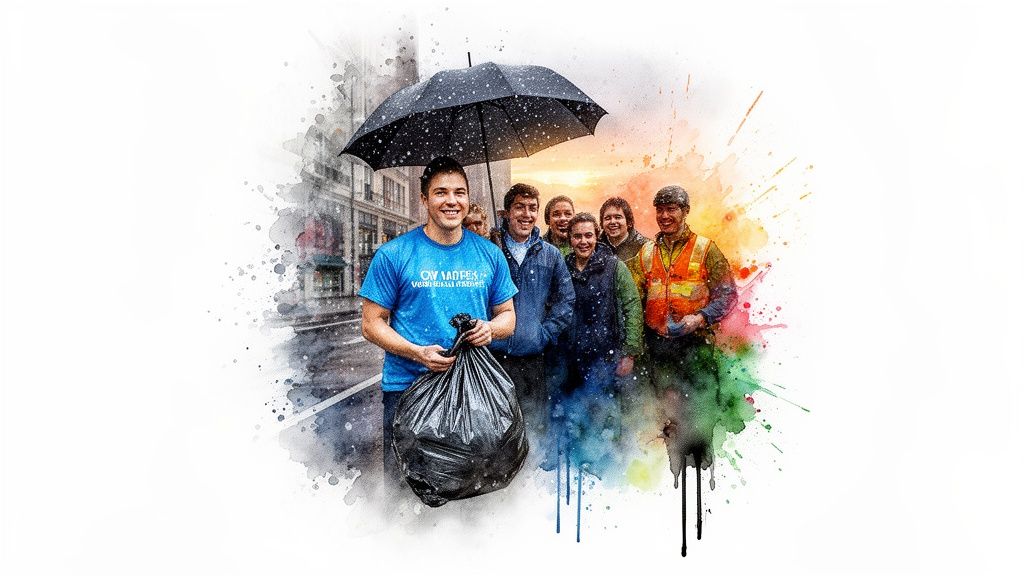
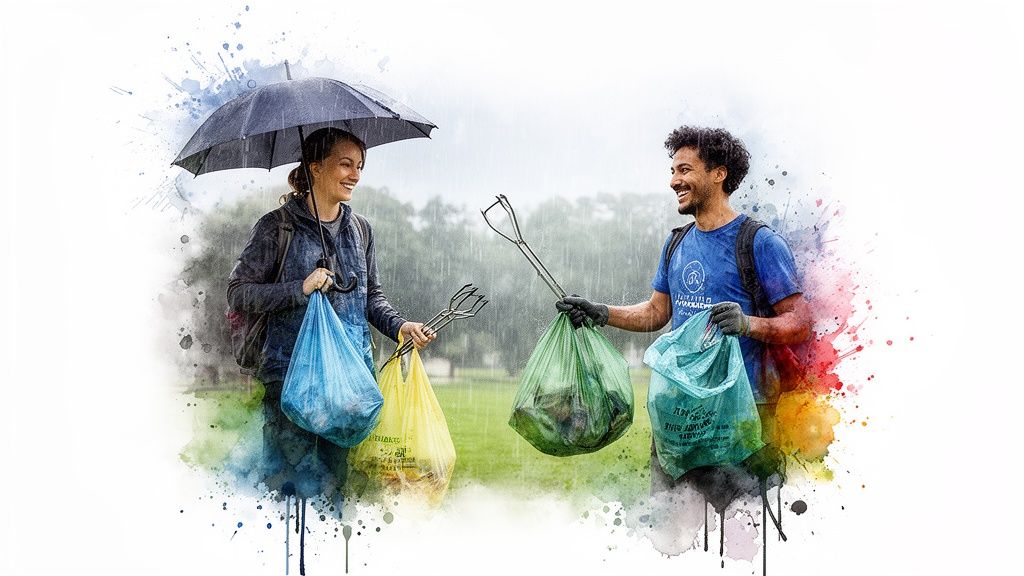
    Smiling diverse volunteers with an umbrella, holding a trash bag during a community cleanup on a street.

    Then, a long, chaotic relationship finally imploded. I knew something had to give. I decided to lean into the things that had always been the hardest for me: cleanliness, consistency, and bravery. And that's how Litter Caterpillars was born—out of my own personal need to create order from chaos.

    The Origin Story in a Hailstorm

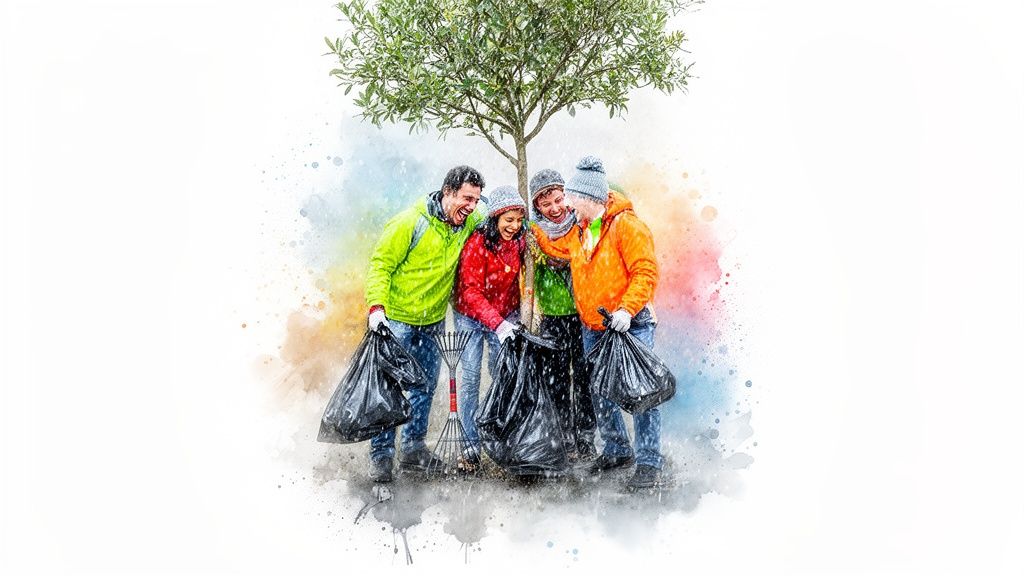
    Our very first cleanup was a complete comedy of errors. A tiny crew of three of us showed up, and within minutes, the Chicago sky just ripped open with a wild hailstorm. We were soaked, freezing, huddled under a tree as every single Uber canceled on us, one by one. It should have been a total disaster.

    But it wasn't. It became our origin story.

    In that moment of shared misery, something clicked for me. I realized that cleaning up someone else’s mess was way easier than facing my own. This tiny, miserable adventure bonded us in a way nothing else could. I saw that it was never just about picking up trash; it was about showing up for each other. You can read more about my philosophy on cleaning up trash on our site.

    We discovered that suffering together builds resilience. It forges the most unlikely friendships. It adds a flavor to life, another page to the story. It advances the plot.

    Finding Joy in Simple Service

    Now, three years later, we meet every single week, no matter what. We’ve faced blizzards, negative wind chills, and scorching summer days. And each time we show up, we prove to ourselves that we're capable of more than we think.

    This simple act of service has taught me more than I ever could have imagined:

    • Tangible Impact: You can physically see the difference you're making, block by block. It's an instant reward, a hit of pure satisfaction.
    • Building Resilience: Braving the elements to do something good for your community builds an incredible inner strength. You feel like a low-key superhero.
    • Forging Friendships: There's a special connection, a kind of battlefield camaraderie, that forms when you work alongside others toward a common goal.

    Becoming a picking up trash volunteer isn’t just about the environment. It's about clearing your mind, building your character, and finding your people. I invite you to see the world—and yourself—in a totally new light.

    Finding Your Volunteer Cleanup Crew

    So, you feel that pull. That little spark that says you want to get out there and actually do something. But where do you even start? Where do you find your people? It can feel a bit like you’re trying to find a secret club, but I promise, it's easier than you think to find a community that’s as passionate about picking up trash as you are.
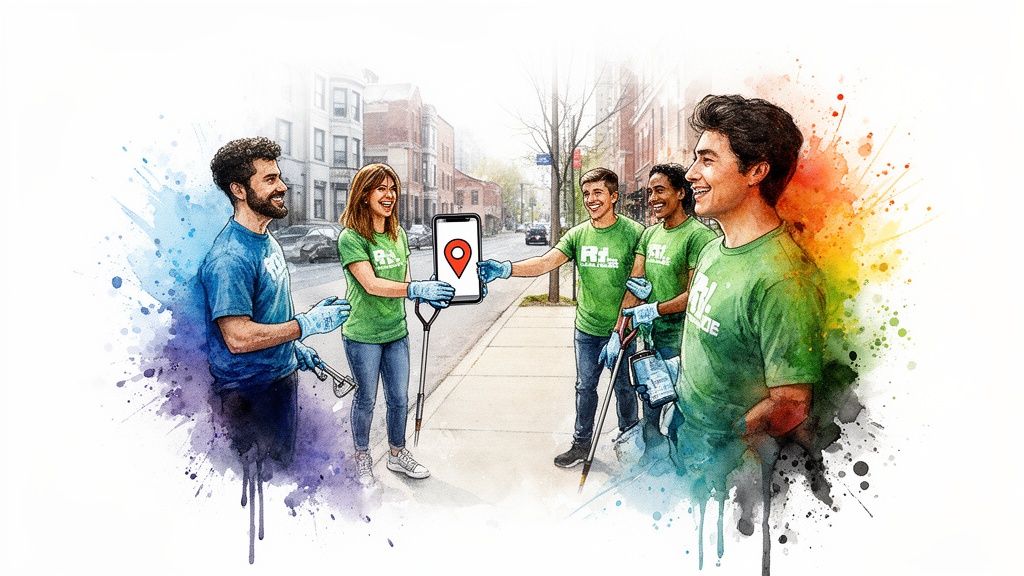
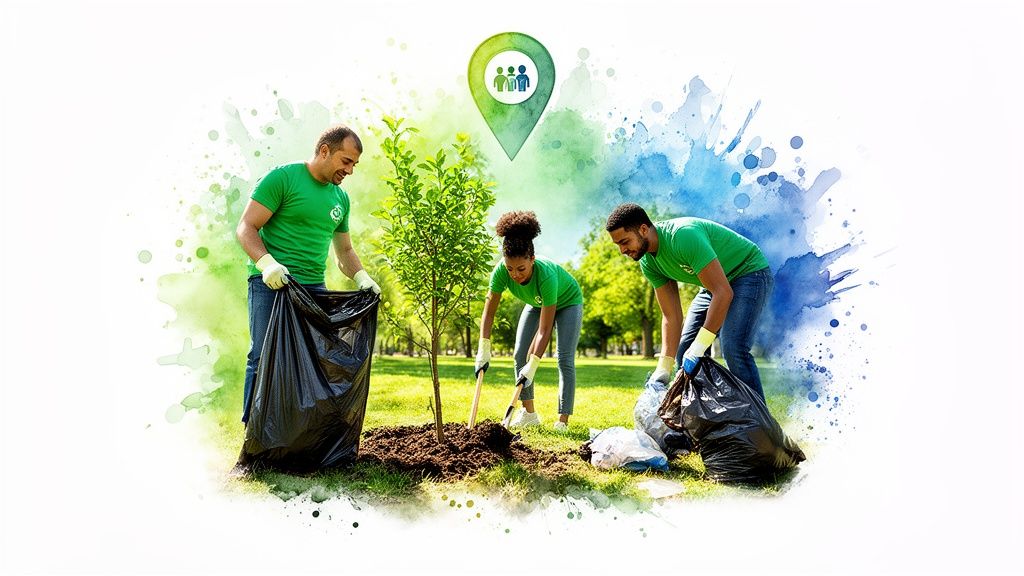
    Diverse volunteers happily cleaning a city street, using an app to locate cleanup areas.

    Think of it like dating—you’ve got to figure out what you’re looking for. Are you after a casual, once-a-month meetup? Or are you ready to join a hardcore crew like mine that shows up every single weekend, no matter what Chicago's weather throws at us? Both exist, and both are awesome.

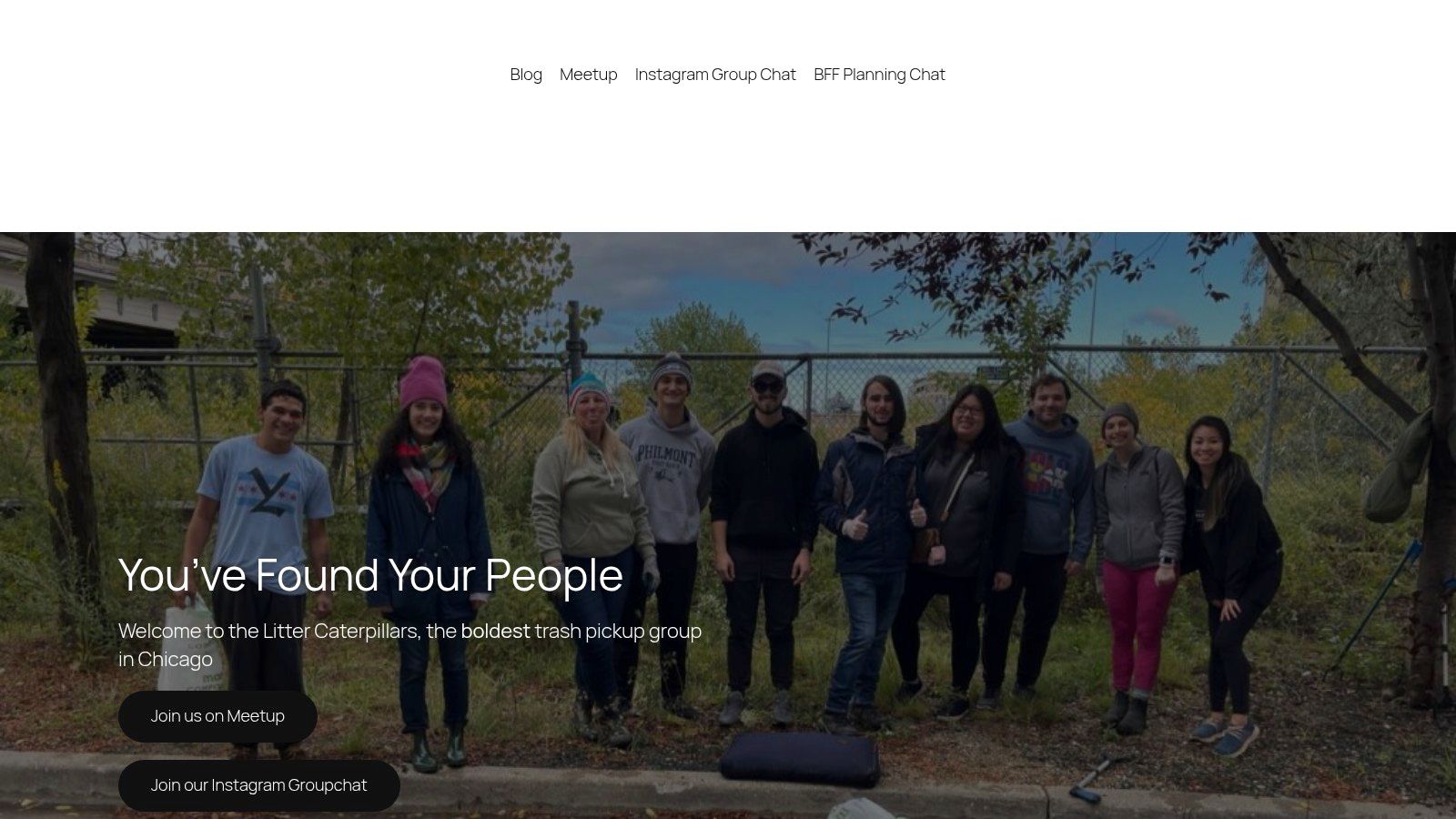
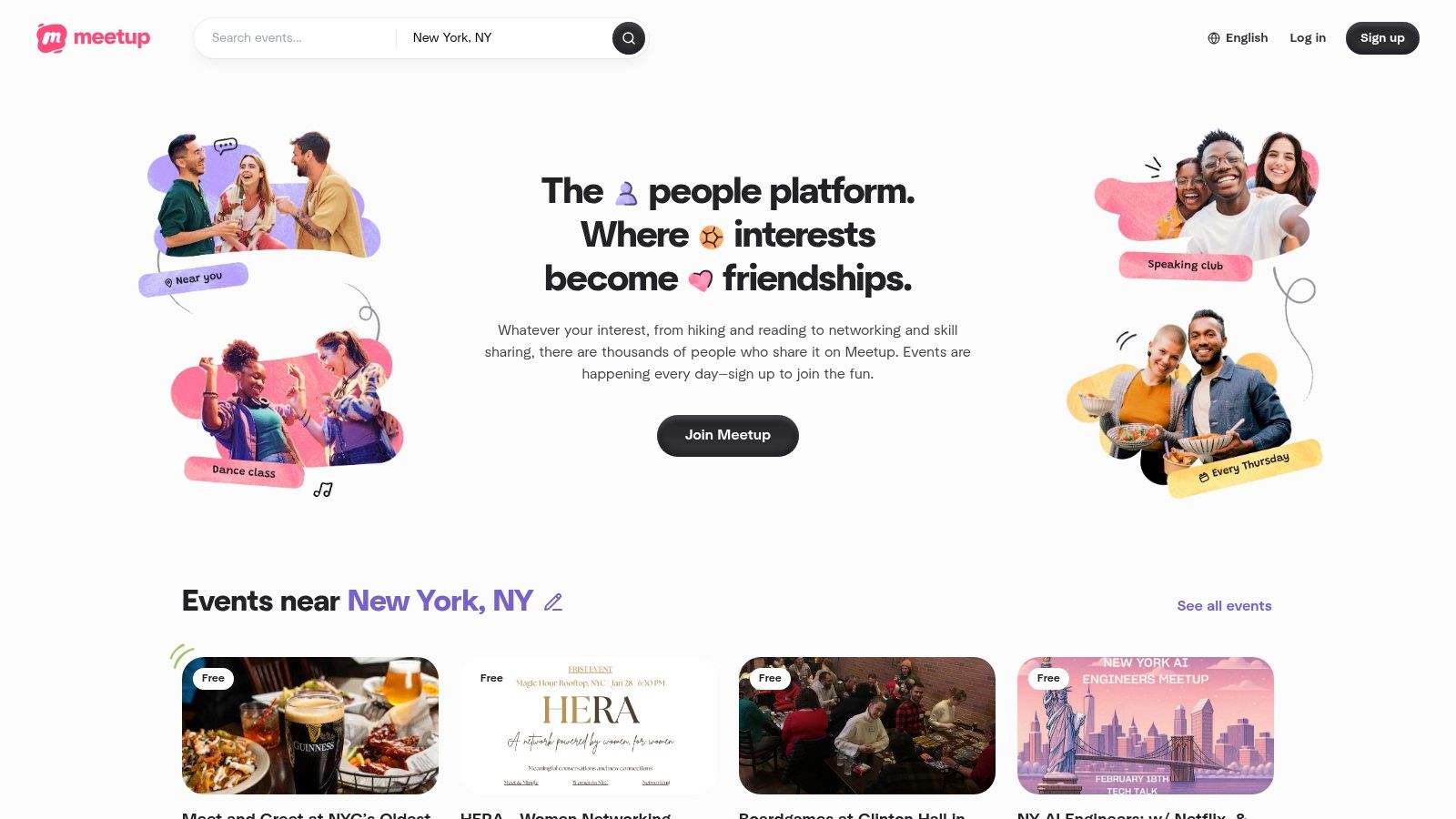
    Here at Litter Caterpillars, we use platforms like Meetup and Instagram to connect with new faces every week. I see people join our group who are brand new to the city, just looking to make friends and explore neighborhoods they’ve never seen. They find us, show up one Saturday morning, and by noon, they’re laughing with total strangers, feeling like they’ve finally found their tribe.

    How to Find Your People

    Your search can start with a few simple clicks. I want you to just cast a wide net and see what you can catch. These platforms are buzzing with groups just waiting for someone like you to join in.

    • Meetup: This is my personal favorite and how most of our members find us. A quick search for "litter cleanup" or "environmental volunteering" will probably pull up groups right in your neighborhood.
    • Social Media: Instagram and Facebook are goldmines. Search hashtags like #trashcleanup, #plogging, or #[YourCity]volunteers. You’ll discover posts, events, and groups you can join on the spot.
    • Local Organizations: Don’t forget to check the websites for your city’s park district or local environmental non-profits. They’re often hosting or promoting cleanup events.

    A great volunteer group doesn’t just clean up; it builds you up. It should feel like a team where everyone has your back, ensuring you’re safe, valued, and actually having a good time while doing important work.

    Vetting a Group for Safety and Vibe

    Once you find a potential crew, I recommend you do a little homework. Look at their past event photos. Do people look happy? Engaged?

    Most importantly, a good group will make their commitment to volunteer safety crystal clear. At Litter Caterpillars, this is our absolute top priority. I kick off every single event with a safety talk because I want you focused on the fun and the impact, not worrying about hazards.

    Finding a group that matches your energy is everything. I’ve seen people join us who were initially shy and reserved. But after a few cleanups—sharing stories while bagging up litter—they open up and become the heart of our crew. That’s the magic of it.

    For more guidance on finding opportunities, you can explore our tips on environmental volunteering near you. Take that first step; your crew is out there waiting for you.

    The Essential Gear and Safety Checklist

    Showing up is half the battle when you decide to become a picking up trash volunteer. But showing up prepared? That’s what separates a one-time good deed from a legit, safe, and surprisingly fun habit.

    I want you to think of it this way: Batman doesn't just wander out of the Batcave. He has his utility belt. Your gear is your utility belt. It’s what gives you the confidence to face down whatever mess the city throws at you.

    Here at Litter Caterpillars, I’ve seen countless people go from nervously standing on the sidewalk to becoming cleanup pros. That transformation always starts with getting your hands on the right tools. You don't need a ton of stuff, but what you have needs to be right.

    Your Must-Have Cleanup Kit

    First, let's talk about the absolute essentials. I consider these the non-negotiables that keep you safe and make the work a million times easier. I’ve been to enough cleanups to know that the people having the most fun are the ones who feel protected and ready for anything.

    Here’s what I never leave the house without:

    • Sturdy Gloves: This is your first line of defense. Don't even think about those flimsy latex gloves. You need real protection—think gardening or work gloves that can handle sharp edges and mystery goo.
    • A Litter Grabber: This thing is a total game-changer. It saves your back and keeps you a safe distance from whatever you’re picking up. Plus, let's be honest, it’s basically a real-life claw machine where you win every single time.
    • Durable Trash Bags: You need bags that won't give up and split open at the first sign of a pointy stick. Contractor bags are the gold standard, but any heavy-duty bag will work.
    • Closed-Toe Shoes: This is a big one. I'm serious. You’ll be on uneven ground, maybe near broken glass or rusty metal. Protect your feet. Sturdy sneakers or boots are a must.

    To make it even easier, here's a quick rundown of the gear we recommend at Litter Caterpillars, separating the must-haves from the nice-to-haves.

    Essential Cleanup Gear at a Glance

    Item Why You Need It Pro Tip from Me
    Sturdy Gloves Protects your hands from sharp objects, chemicals, and general grossness. We prefer leather-palmed work gloves. They last longer and offer the best protection.
    Litter Grabber Saves your back from endless bending and keeps you from directly touching trash. Look for one with a rubberized grip. It makes grabbing small, slick items way easier.
    Heavy-Duty Bags Prevents rips and spills. A broken bag is a huge mess and morale killer. 30-gallon contractor bags are our go-to. They're tough enough for almost anything.
    Closed-Toe Shoes Shields your feet from glass, nails, and uneven terrain. A top safety rule. Waterproof boots are a godsend on dewy mornings or after it rains. Dry feet = happy volunteer.
    Water Bottle (Optional) Hydration is key, especially during our summer cleanups. You'll be working up a sweat. I suggest you get a reusable bottle with a carabiner clip so you can attach it to your belt or bag.
    Sunscreen/Hat (Optional) Protects you from sunburn. Even on cloudy days, the sun can get you. A wide-brimmed hat is better than a baseball cap for protecting your neck and ears.

    Having the right gear isn't just about safety; it’s about feeling capable and ready to make a real difference without worrying about the small stuff.

    Safety Is the Main Event

    Look, picking up trash in a city like Chicago has its own set of rules. We've cleaned along busy highways, in overgrown lots, and under sketchy bridges. In every single situation, your safety isn't just a talking point—it's everything. Your well-being is always more important than a stray bottle cap.

    I remember we were clearing a dense patch of weeds near an off-ramp, and someone found a little baggie with some weird stuff in it. They didn't touch it. They remembered my rule: when in doubt, leave it out. We marked the spot and moved on. That's the mindset. You're here to pick up litter, not to become a hazmat expert.

    Your most important tool is your awareness. Always pay attention to traffic. Watch where you step. Look at what you’re about to pick up. A safe volunteer is an effective volunteer.

    Always bring water, especially on those hot days that sneak up on you. Wear bright clothes so cars and your teammates can see you. We also insist on working in pairs or groups—it's safer, and honestly, way more fun. You’re part of a crew, never out there alone.

    For things that need special handling, you have to know what to do. My guide on City of Chicago hazardous waste disposal breaks down what to leave for the professionals. Being a great volunteer means knowing your limits. With the right gear and a safety-first attitude, you’re ready to go.

    How to Organize Your Own Neighborhood Cleanup

    See that little spark you're feeling? That voice in your head saying, "I could do this"? That's exactly how I got started with Litter Caterpillars. Leading the charge is an incredible feeling. Putting together your own cleanup multiplies your impact in ways you can’t even imagine yet. It’s like planting a single seed and watching a whole garden bloom.

    This is your roadmap. It doesn't matter if you're wrangling three of your best friends or thirty neighbors you've never met. The principles are the same, and I'm going to share everything I learned turning a personal mission into a city-wide movement.

    Laying the Groundwork for Success

    Before you send a single text or make a social media post, you need a plan. A great cleanup isn't just about showing up with a trash bag. It's about making it easy and inspiring for others to show up with you. I want you to think of yourself as a party host—your job is to create the right vibe and handle the logistics so everyone else can have a good, meaningful time.

    One of my first big lessons was about timing. I quickly learned that scheduling on weekend mornings, especially Saturdays, taps into a unique energy. The people who show up are givers, ready to kick off their weekend with purpose.

    Here’s where you should start:

    • Scout Your Location: Walk around your neighborhood with fresh eyes. Is there a park that needs some love? A specific street that’s always a mess? Pick a spot where your crew's efforts will make a huge, visible difference.
    • Set a Date and Time: Choose a weekend morning a few weeks out. This gives people enough time to plan and builds a little anticipation. A two-hour window is perfect—long enough to make an impact, but short enough that it doesn't feel like a huge commitment.
    • Define a Clear Goal: Is the mission to clear one block? A whole park? Having a specific, achievable goal keeps everyone focused and motivated. "Let's clean the entire city" is daunting. "Let's make this playground beautiful again" is inspiring.

    You’re not just cleaning a street; you’re building a temporary community centered on a shared goal. Your planning is the foundation that makes the whole experience feel powerful and worthwhile for every single picking up trash volunteer.

    Building Your Crew and Gathering Supplies

    Once your plan is in place, it’s time to rally the troops. I know this part can feel intimidating, but people genuinely want to help. You just have to give them a clear and easy way to say "yes."

    I suggest starting with your inner circle—friends, family, coworkers. A simple, personal text or call is incredibly effective. From there, you can branch out. Post in neighborhood Facebook groups or on Nextdoor. Keep the message simple and positive: "Join me for a couple of hours to make our neighborhood shine!"

    As you recruit, you also need to think about supplies. You don't need a massive budget. In fact, you can often get everything you need for free. Before you spend a dime, reach out to local hardware stores or even cafes. You’d be surprised how many businesses are willing to donate a box of trash bags or a case of water to support a local effort.

    For any new organizer, I believe it's crucial to have the essential gear on hand so everyone can participate safely and effectively.
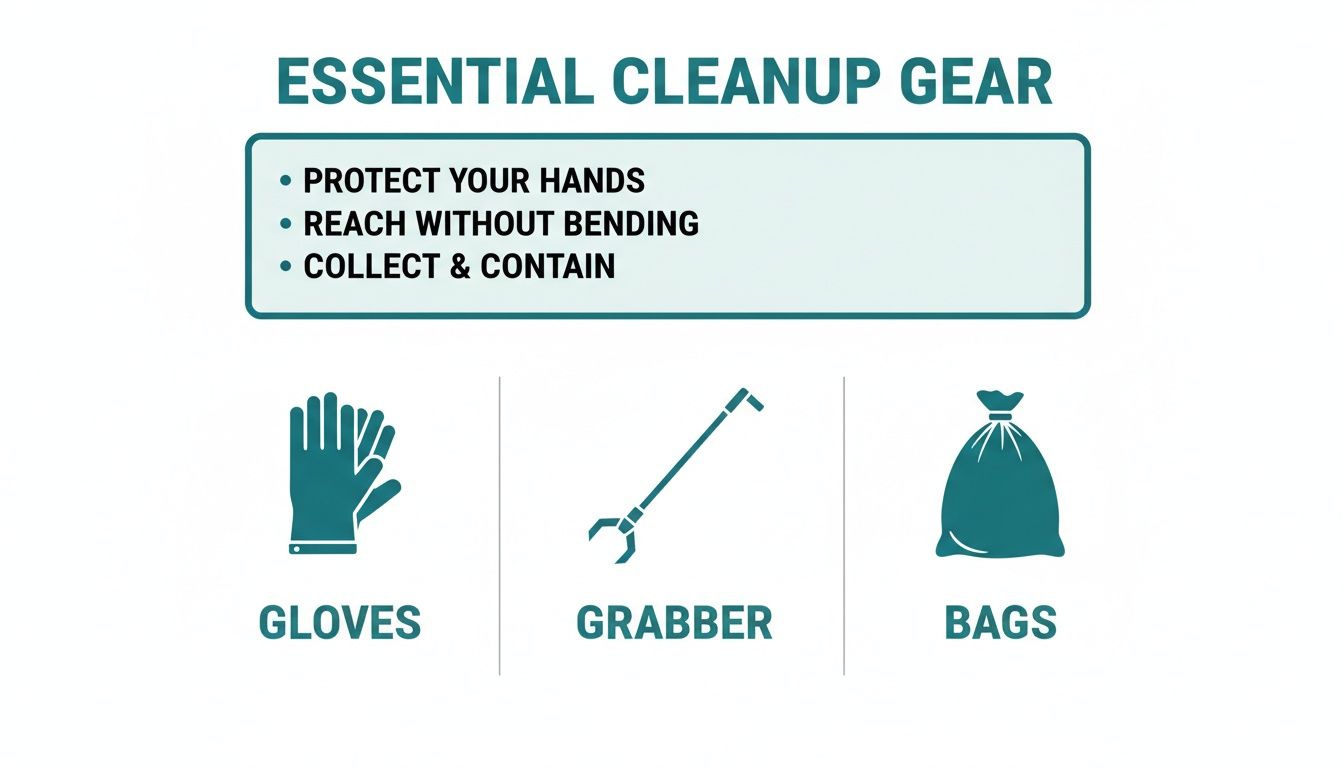
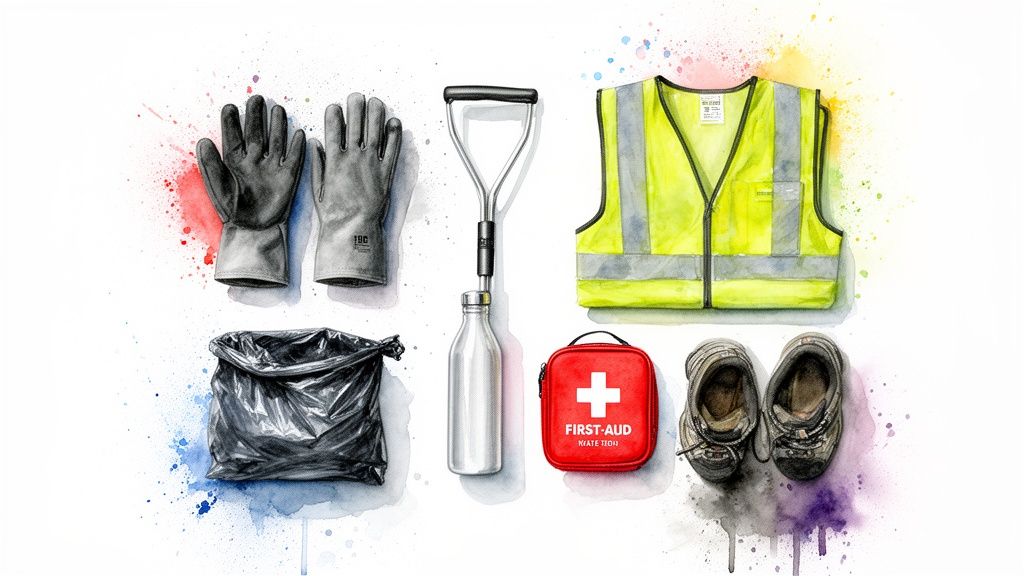
    Essential cleanup gear: gloves, grabber tool, and trash bags for safe and efficient waste collection.

    This picture nails the three non-negotiables: tough gloves, a reliable grabber, and strong bags.

    The final piece of the puzzle is figuring out trash disposal. For a small group, you might be able to use your own residential bins. For a bigger haul, a quick call to your city’s sanitation department is all it takes. Many cities offer special pickups for volunteer cleanups if you schedule it in advance.

    Organizing your first event might feel like a huge leap, but it really just starts with one small step. I remember when my little crew from Litter Caterpillars won a vacant lot at a city auction. It started as just another cleanup spot, but it became a dream. We’re now turning it into a community park.

    That's what's possible when you decide to lead.

    Your Local Effort Is a Global Movement

    I get it. Sometimes, when I'm out on a quiet Chicago street with just a grabber and a bag, it's easy to feel small. You look at the sheer scale of the mess and think, "Am I even making a dent?" It feels like you’re just one person trying to bail out the ocean with a teacup.

    But then I remember something incredible. You aren't just one person. When you decide to start picking up trash, you're stepping into a current, joining a massive river of millions of people all over the world who are doing the exact same thing. You’re part of a global team.

    That little piece of plastic you just snagged? Someone in Tokyo and someone in Rio de Janeiro just did the same thing. That feeling of satisfaction you get from seeing a clean patch of grass? That feeling is being shared right now, across continents.

    The Power of Millions of Teacups

    It's so easy to dismiss our own actions, but when millions of us act together, the numbers become staggering. They paint a picture of what's possible when we all just decide to show up.

    Just look at the International Coastal Cleanup (ICC), an event that shatters records year after year. In one massive push, over 486,000 volunteers worldwide collected more than 7.4 million pounds of trash. That’s not just a statistic; that’s nearly half a million stories of people, just like you, showing up.

    Your single act of service isn't a drop in the ocean. It's the drop that starts the ripple, which joins another ripple, until it becomes a wave of change felt across the globe.

    Think about that for a second. That’s the collective power of individuals who refused to feel small. Among that haul, they scooped up over 1.4 million food wrappers alone, turning ordinary citizens into debris detectives who help scientists and policymakers understand the true scale of our plastic problem.

    You Are Part of the Solution

    Every time you fill a bag, you're adding to this global momentum. You're not just cleaning a single block in your city; you're casting a vote for a cleaner world. You are a crucial part of a worldwide wave of positive change.

    So, the next time you're out there, feeling like your effort is just a tiny gesture, I want you to remember those numbers. Remember the hundreds of thousands of others standing with you in spirit.

    • You're joining a movement that spans borders and languages.
    • You're providing real-world data that drives policy change.
    • You're inspiring others in your own community to join in, even if you don't realize it.

    Your work matters far beyond what you can see at your feet. It’s proof that no act of kindness is too small when we all do it together. You are the movement.

    Your Cleanup Questions Answered

    Jumping into your first trash pickup can feel like the first day of school. You're excited, maybe a little nervous, and you definitely have questions. I've heard them all at our Litter Caterpillars meetups, and I want to tackle the ones that pop up most often.

    Think of this as our little chat before the main event. It's the part where you realize everyone's here for the same reason—to do a little good and meet some great people along the way.

    What If I Can Only Come Sometimes?

    That's totally fine! Life is messy and unpredictable. I believe your volunteer energy is a precious thing, and you should use it when you feel inspired, not because you feel obligated.

    The best groups, including mine, are built on a "come when you can" philosophy. Just showing up once makes a real difference. This is about building a positive, sustainable habit, not adding another chore to your to-do list.

    Your presence is a gift, never an expectation. Whether you join us once a year or every single Saturday, you are a valued part of the crew from the moment you arrive.

    Do I Need to Bring My Own Gear?

    Good question. It really depends on the group. Many established crews like Litter Caterpillars provide all the essentials—we’ve got a stash of grabbers, gloves, and bags ready for you.

    Still, it's always smart to check the event description or shoot the organizer a quick message beforehand. If you get hooked and plan on making this a regular thing, I think investing in your own comfy gloves or a lightweight grabber is a great move. The one thing you should always bring is a pair of sturdy, closed-toe shoes. Your feet will thank you.

    How Safe Is It, Really?

    Your safety is the absolute number one priority. Period. A responsible volunteer group will always start with clear safety guidelines. It’s not about being fearful; it’s about being smart so you can focus on the rewarding work.

    I kick off every single one of our events with a quick safety briefing. This always covers a few key rules:

    • Know what to avoid: Never, ever touch sharps, broken glass, or anything that looks like hazardous waste.
    • Stay aware of your surroundings: Keep an eye on traffic and watch where you step. It's easy to get in the zone.
    • Work with your crew: Sticking together is way safer and honestly, a lot more fun.

    Follow these simple rules, and you'll have an incredibly safe and fulfilling experience.

    What Happens to All the Trash?

    Ah, the logistics puzzle! For smaller cleanups, we might just use our personal waste bins. For our bigger events, I coordinate directly with the city’s sanitation department for a special pickup. We always have a solid disposal plan before the event even starts, so all you have to do is focus on cleaning.


    Ready to turn that inspiration into action? Join Litter Caterpillars at our next cleanup and see for yourself how a simple act of service can build friendships and transform our city. Find our next event and become part of our story at https://www.littercaterpillars.com.
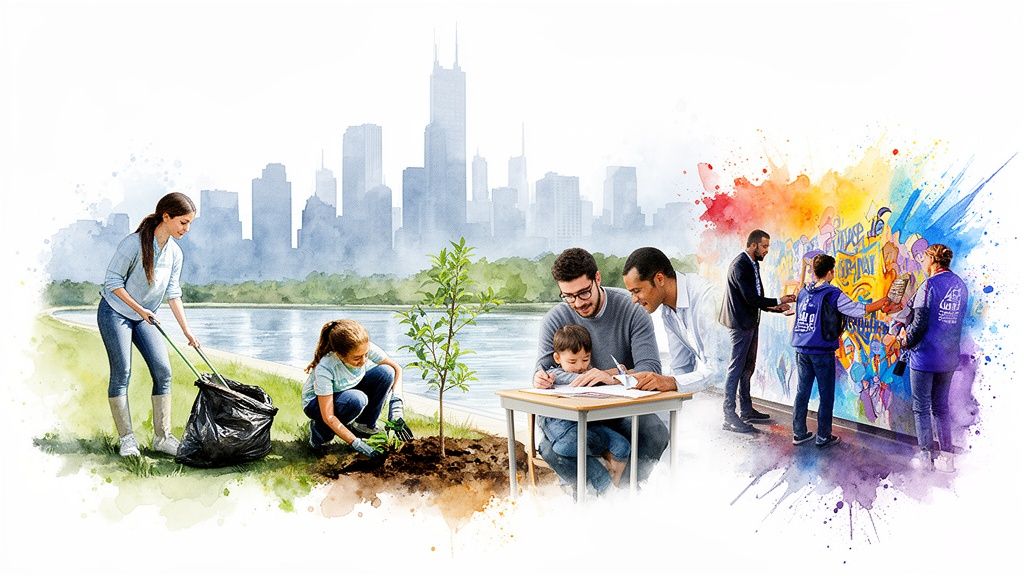
  • 7 Great Community Service Options Chicago Has to Offer in 2026

    7 Great Community Service Options Chicago Has to Offer in 2026

    I remember the exact moment. The click. Standing under a tree, me and two friends, shivering in a freak Chicago hailstorm. We just wanted to do a simple neighborhood cleanup. But the city threw everything at us. Ubers kept canceling. Soaked. And yet…it was fun. Like we were characters in a story, and the plot had just kicked into high gear.

    That was the day I realized cleaning up someone else's mess is a million times easier than dealing with your own. It plugs you into something bigger. If you're reading this, you feel that same pull. You want to connect. You want to make a real, visible dent in this amazing, chaotic city of ours. But where do you start? Finding the right fit can feel like trying to find the perfect deep-dish pizza—everyone has an opinion, and the options? Overwhelming. You just want a place where you can show up, be you, and leave things a little better than you found them.

    Think of me as your friend who already did the homework. I’ve cut through the noise. I'm bringing you the best community service options Chicago has, from on-the-ground groups like the fantastic Litter Caterpillars to giant platforms like Chicago Cares and VolunteerMatch. These are places where you can forge friendships, learn something new about yourself, and see the real-world result of your time and energy.

    Want to get your hands dirty on a weekend morning? Mentor a kid? Lend your professional skills to a cause you believe in? There’s a spot for you here. Each entry breaks down exactly what you'll find, who can join, and how you can sign up, with direct links to get you moving. Let’s dive in and find your perfect match. Together.

    1. Litter Caterpillars

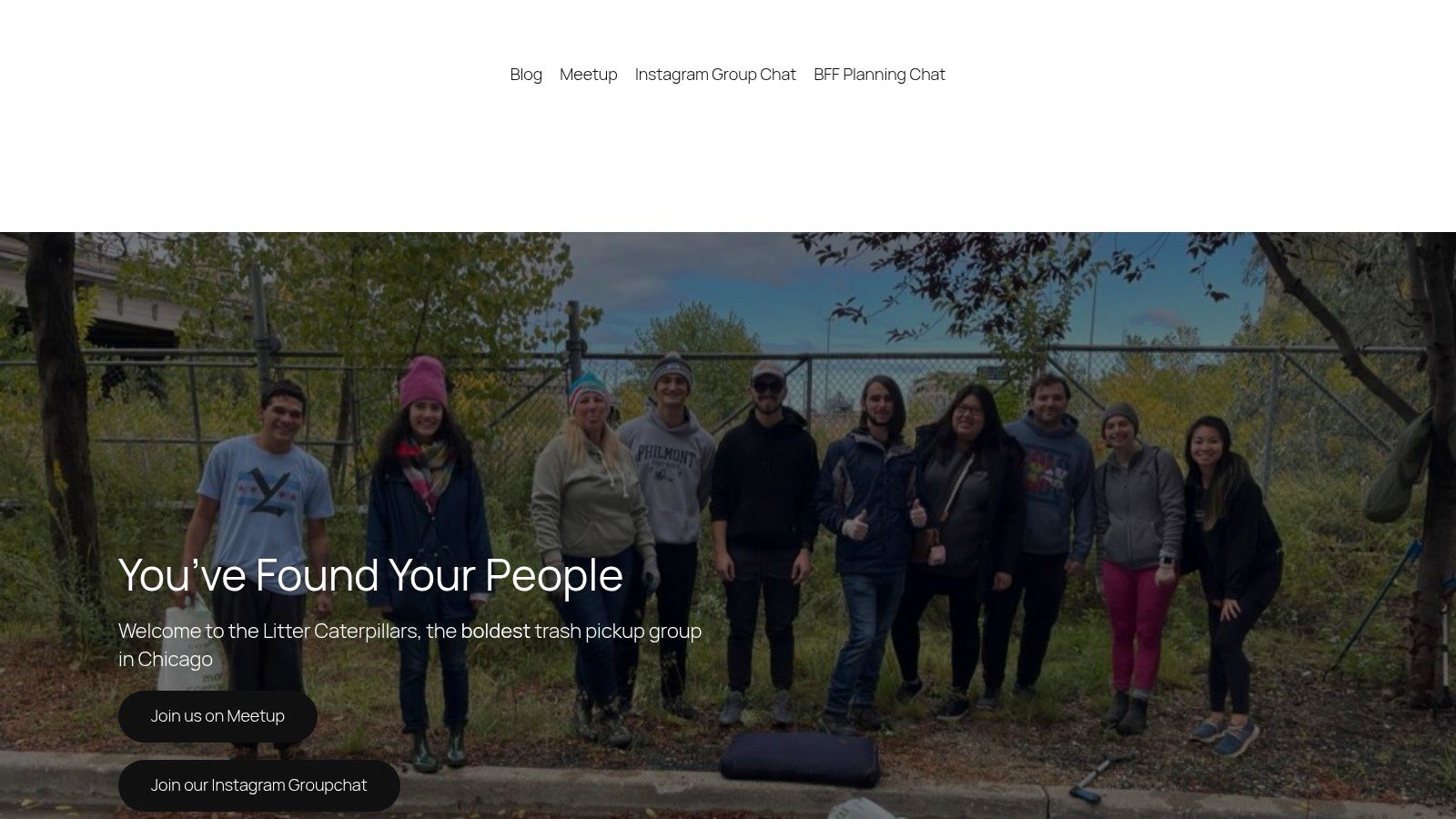
    If you're looking for a community service option in Chicago that feels less like a chore and more like an adventure with friends, I want you to meet Litter Caterpillars. This isn't your average, once-a-year neighborhood cleanup. I want you to imagine a dedicated crew, led by founder Kevin Tao. A crew that gathers every single weekend, rain or shine or blizzard, to make a visible, block-by-block difference across all 50 of Chicago's wards. They’ve been out there in the worst weather, driven by a simple yet powerful mission of bravery, kindness, and unity.

    What started with just three of us in a hailstorm has exploded into a citywide movement. Litter Caterpillars is this incredible mix of direct action and a vibrant, playful culture that makes you want to come back. It’s a community. You show up, grab a picker, and immediately start making things better alongside people who share your passion for this city.

    Litter Caterpillars volunteers cleaning a Chicago neighborhood street

    Why Litter Caterpillars Is a Standout Choice

    What makes this group so special is its volunteer-first philosophy. I’ve seen so many organizations where fundraising becomes the whole point. But Litter Caterpillars flips that script. Their core belief? Your time and energy are the most valuable gifts you can possibly offer. You will never, ever be pressured to donate; the focus is 100% on creating a positive, safe, and empowering experience for you.

    This approach makes it incredibly easy for you to get involved. No long-term commitment. No special skills needed. You just find their next event on Meetup or Instagram, show up on a weekend morning, and you’re in. It's a fantastic way for you to meet people or for you to explore parts of the city you’ve never seen.

    The group’s impact isn't just picking up trash. They have achieved incredible, concrete wins that show you how ambitious they are:

    • Citywide Coverage: They are the first group to consistently clean in all 50 Chicago wards. All of them. Including areas that often get overlooked.
    • Highway Cleanup: They organized a massive cleanup of a highway during a bike event shutdown. Just pure creativity and high-impact thinking.
    • Caterpillar Park: In a truly inspiring move, they won an empty lot at auction and are transforming it into Caterpillar Park in Englewood, a lasting green space for the community.

    What to Expect When You Volunteer

    When you join Litter Caterpillars, it's more than service. You're joining a tribe. They have a strong identity—flags, a theme song, even merit badges to celebrate your milestones. This sense of camaraderie and fun is what turns a one-time volunteer into a regular. The weekly weekend morning schedule is designed to build a consistent habit, creating a reliable rhythm of service and friendship in your life.

    Their social media channels on Instagram and TikTok are bursting with testimonials from people just like you, showing off the joyful and welcoming atmosphere you'll find.

    How to Get Started

    Getting involved is simple. Your best bet is to connect with them on their social channels to see where they'll be this weekend.

    Resource How to Use It
    Official Website Visit their main site so you can understand their mission and values.
    Meetup & Instagram Follow these channels for the most up-to-date event schedules and locations.
    Group Chats Join their open chats to connect with other volunteers before you even show up.

    If you're ready to dive in and learn more about their approach to making a difference, you can find detailed information on how to participate in a volunteer trash pickup on their website.

    Pros:

    • Citywide Impact: Consistently serves all 50 Chicago wards.
    • Community-First Culture: Weekly meetups build strong friendships and consistent habits.
    • Volunteer-Focused: Zero pressure to donate; your time is the priority.
    • Proven Results: Ambitious projects like Caterpillar Park create lasting change.
    • Strong Identity: A fun and engaging culture keeps morale high.

    Cons:

    • Grassroots Model: As a volunteer-run group, resources can fluctuate.
    • Limited Schedule: Events are primarily on weekend mornings, which may not work for everyone.

    Website: https://www.littercaterpillars.com

    2. Chicago Cares

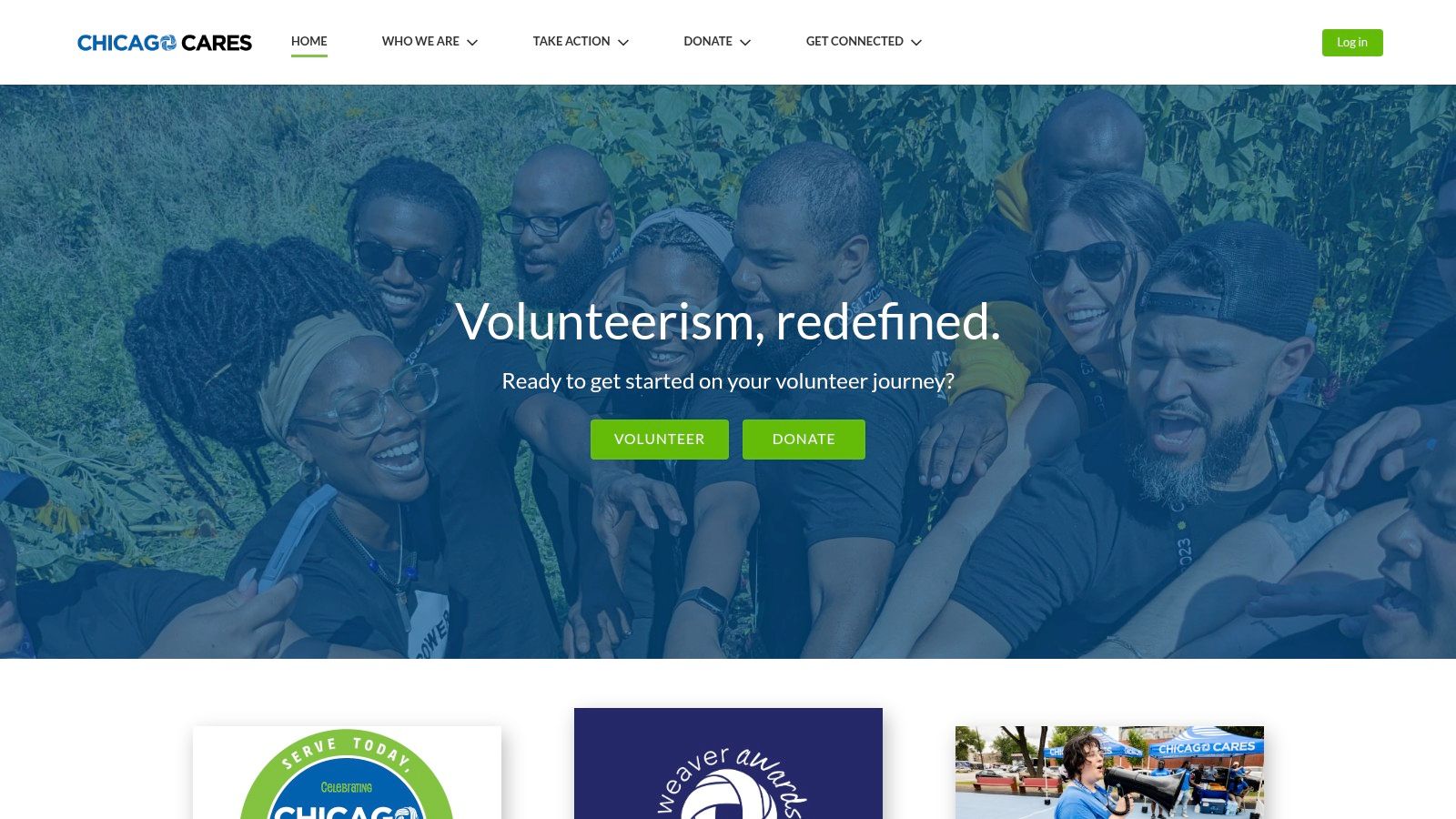
    If you're looking for the Grand Central Station of volunteering in Chicago, you've found it. I want you to think of Chicago Cares as your personal concierge for community service. Instead of you spending hours searching for individual organizations, this platform brings hundreds of vetted, one-time, and recurring opportunities right to your screen. It's the perfect launchpad if you feel that pull to help but you just don't know where to start.

    A group of volunteers working together at a Chicago Cares event, sorting donations and smiling.

    The power of Chicago Cares is its simplicity. Its scope. You create a free account, browse a live calendar packed with projects, and sign up for a spot with just a few clicks. It’s that easy. One Saturday you could be sorting fresh produce at a food pantry in Pilsen. The next, you might be helping seniors with technology in Lincoln Park. The variety is insane. This whole structure just removes the guesswork, making it one of the best community service options Chicago offers for first-timers or anyone with a busy, unpredictable life like mine.

    Making the Most of Chicago Cares

    To get started, you just head to their website and create a profile. It’s free. From there, you can filter opportunities by cause area (like education or hunger relief), day of the week, or neighborhood. This lets you find something that genuinely speaks to you and fits your life.

    A huge benefit here is that every project is led by a trained Chicago Cares volunteer leader. This means you’re never just dropped into a situation cold. When you show up, someone is there to welcome you, explain the tasks, and make sure the whole experience is meaningful and organized. It’s an ideal setup for you as an individual, but they are also masters at coordinating group and corporate volunteer events.

    At a Glance: Chicago Cares

    Feature Details
    Primary Focus Centralized hub for diverse, staff-led volunteer projects across Chicago.
    Best For First-time volunteers, weekend service, corporate teams, trying different causes.
    Time Commitment Flexible; most projects are 2-4 hour, one-time commitments.
    Neighborhoods Citywide, with a searchable calendar to find projects near you.
    Access Free account creation is required to sign up for projects.

    Pro Tip: I have to tell you, popular weekend projects can fill up a week or more in advance. I recommend you browse the calendar on a Monday or Tuesday to snag a spot for the upcoming weekend. A little reminder on your phone can make all the difference.

    While I've found their website can sometimes be a little tricky on a mobile browser, the sheer convenience and reliability of their events are just unmatched. For a structured, impactful, and easy way for you to dive into the local service scene, Chicago Cares is an essential tool.

    Website: https://www.chicagocares.org/

    3. VolunteerMatch (Chicago city page)

    If Chicago Cares is the curated boutique of volunteering, then I see VolunteerMatch as the sprawling, vibrant marketplace. It's a massive, searchable database. A digital warehouse where thousands of nonprofits post their needs, giving you an unparalleled view of the city's entire service landscape. This is where you go when you want to see everything at once. From tiny neighborhood block clubs to major citywide institutions, all in a single feed. It’s less hand-holding, more of a powerful DIY tool for finding your perfect fit.

    The real strength of VolunteerMatch is its powerful filtering tools. You can take a seemingly endless list of possibilities and narrow it down by cause, skills you want to use, age group, and even whether the opportunity is virtual or in-person. This makes it one of the most efficient community service options Chicago has if you have a specific goal in mind. You want to use your graphic design skills for a youth arts program in Logan Square? A few clicks will show you exactly who needs your help.

    Making the Most of VolunteerMatch

    The key to success on VolunteerMatch is using its filters like a pro. Start by creating a free account, then dive into the search page. Don't just browse. You should actively filter by "Homeless & Housing," "Environment," or "Seniors" to connect with your passion. You can also filter by date, which is perfect for finding a last-minute weekend project or something to do on a specific day off. You'll quickly see how this platform is your gateway to finding volunteer work that aligns perfectly with your schedule and your interests.

    I need you to keep one thing in mind: VolunteerMatch is an aggregator, not a direct organizer. When you express interest, your info is sent to the nonprofit, and then the conversation usually moves to email. This means the experience can vary. Some organizations respond in hours. Others might be slower. The platform puts the power of choice directly in your hands, giving you the freedom to explore a huge volume of roles and connect with causes that truly speak to you.

    At a Glance: VolunteerMatch

    Feature Details
    Primary Focus A large, open marketplace connecting volunteers to nonprofits.
    Best For Finding specific roles, using professional skills, exploring a wide variety of causes.
    Time Commitment Highly variable; from one-time event help to long-term, recurring roles.
    Neighborhoods Citywide and suburbs, with strong location and distance-based filtering.
    Access Free account is recommended to track applications and get alerts.

    Pro Tip: You should set up saved searches for your favorite causes or neighborhoods. VolunteerMatch will then email you a digest of new opportunities that match your criteria. It does the searching for you, making sure you never miss a chance to help.

    While you might occasionally find an outdated post, the sheer volume and variety of listings make it an indispensable tool. If you're a self-motivated volunteer who wants to cast a wide net and see all that Chicago has to offer, you have to visit VolunteerMatch.

    Website: https://www.volunteermatch.org/city/Chicago

    4. Idealist (Chicago Hub)

    If you're looking to find a volunteer role that feels less like a task and more like a calling, I think Idealist is your platform. Think of it as the thoughtful, mission-driven cousin to the big volunteer marketplaces. Idealist specializes in connecting passionate people with nonprofits doing impactful work, and its Chicago hub is a curated collection of meaningful opportunities. It's the place you go when you want to align your service with your personal values and even your career goals.

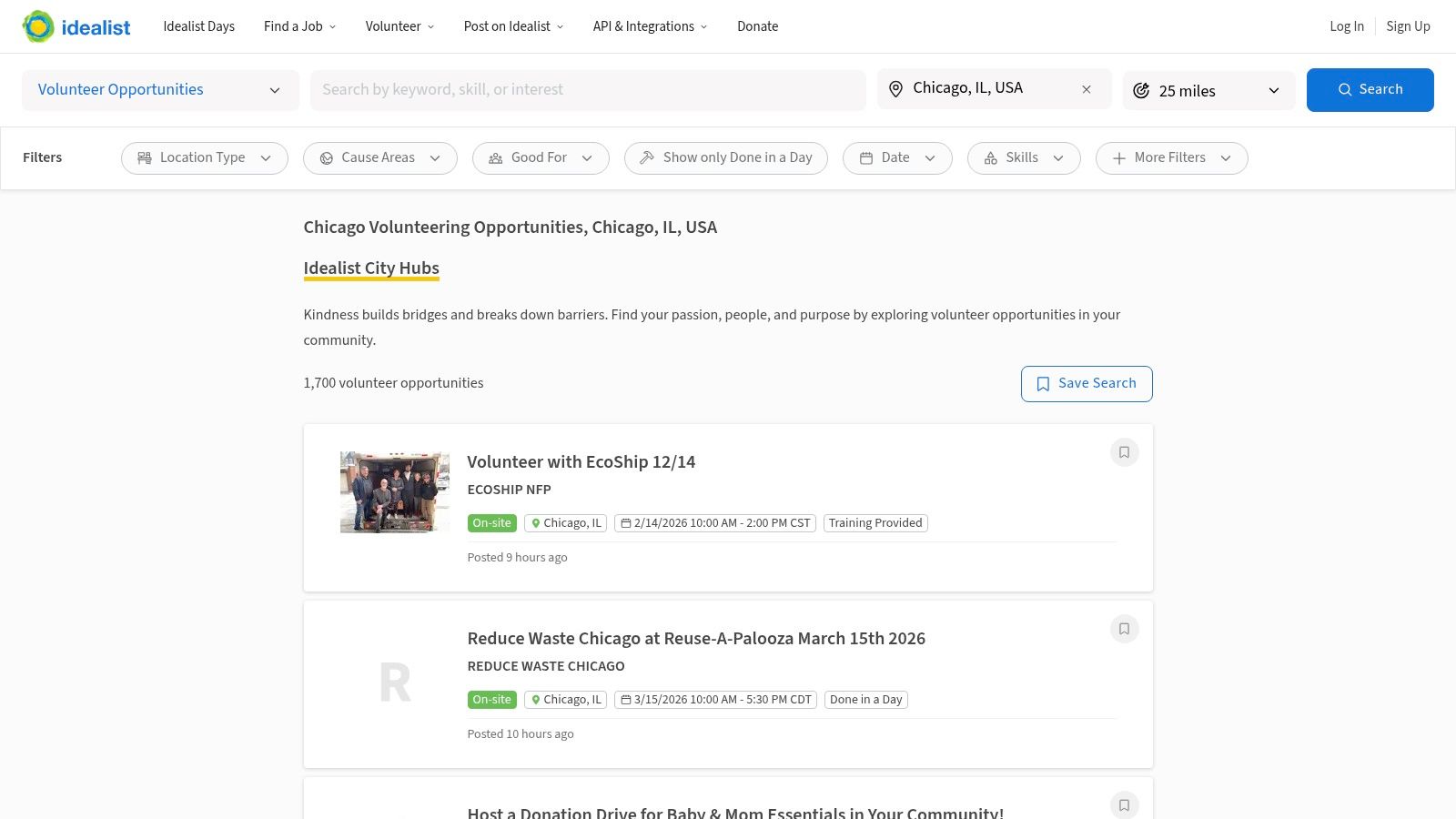
    A screenshot of the Idealist website showing a search for volunteer opportunities in Chicago.

    What I love about Idealist is the quality of its listings. The platform is less about sheer volume and more about depth. You'll find a fantastic mix of one-time events alongside more substantial, ongoing roles. Things like mentoring a high school student, assisting with grant writing, or providing admin support for a cultural institution. This makes it one of the premier community service options Chicago has for students, young professionals, and anyone seeking to build skills while you make a difference.

    Making the Most of Idealist

    The user experience on Idealist is clean. Straightforward. You can immediately filter your search in Chicago by cause, skills you want to use, or even if the role is family-friendly. The real power, I've found, is in its alert system. You can save a specific search—say for "environmental justice volunteer roles on weekends"—and Idealist will email you whenever a new opportunity matching your criteria is posted. This takes the repetitive work out of your search.

    I find this platform particularly useful if you're looking for something more consistent than a single Saturday event. Many organizations on Idealist are seeking volunteers for longer-term commitments, which is perfect for building relationships and seeing the direct impact of your contributions over time. It’s a space built for you to find your nonprofit home.

    At a Glance: Idealist (Chicago Hub)

    Feature Details
    Primary Focus Connecting volunteers with mission-aligned, often skill-based, nonprofit roles.
    Best For Students, professionals, mission-driven individuals, finding long-term roles.
    Time Commitment Varies widely, from one-time events to ongoing weekly commitments.
    Neighborhoods Citywide; listings specify the organization's location.
    Access Free to browse and apply; creating a profile allows you to save searches and get alerts.

    Pro Tip: You have to use the "Skills" filter to your advantage. If you're a graphic designer, accountant, or writer, you can find specific roles where your professional expertise is desperately needed. It's a fantastic way to build your portfolio while you support a great cause.

    While its inventory might not be as vast as some larger platforms, the quality and integrity of the organizations featured are consistently high. For a focused, intentional search that connects your heart and your hands to a cause you believe in, Idealist is an invaluable resource for you.

    Website: https://www.idealist.org/en/volunteer-in-chicago

    5. My CHI. My Future.

    If you know a young person in Chicago eager to make a difference, or if you're an adult looking to support youth-led initiatives, this is your resource. I'm talking about My CHI. My Future. It's the City of Chicago's official digital playground for connecting teens and young adults with safe, meaningful, and impactful opportunities. It’s less of a volunteer clearinghouse and more of a curated launchpad. A launchpad for the next generation of Chicago's leaders, thinkers, and helpers.

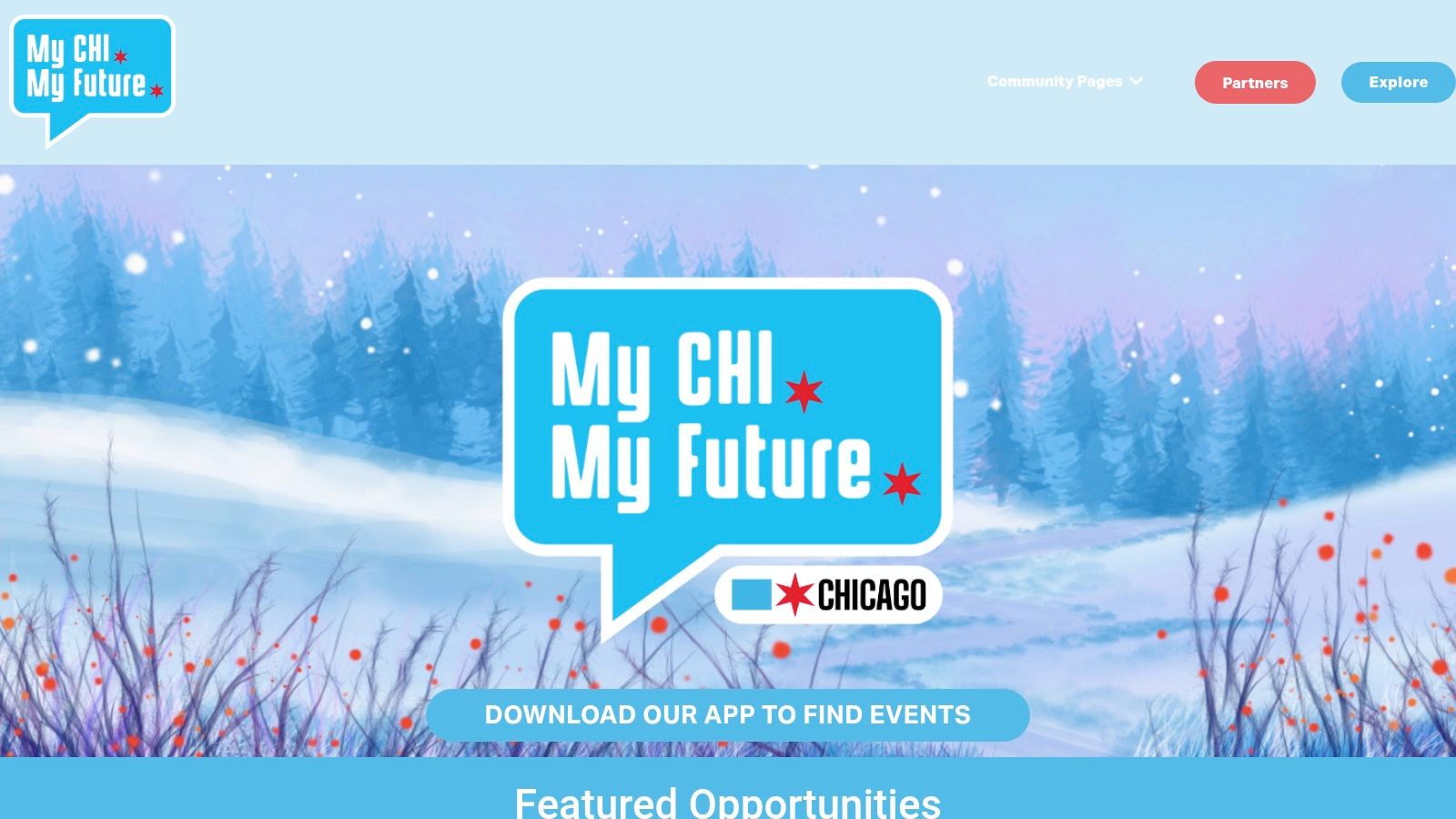
    The homepage of the My CHI. My Future. website, showcasing programs for Chicago youth during the winter season.

    What truly sets this platform apart is its youth-centric design and its direct connection to city-vetted programs. You won't find just any listing here. You'll find structured pathways like the Chicago Youth Service Corps, which provides stipends for participants. It's an incredible tool that transforms the abstract idea of "getting involved" into a tangible, browsable map of possibilities. You can join a local park advisory council or participate in a neighborhood beautification project. This focus on structured, supervised engagement makes it one of the most trusted community service options Chicago offers for young people.

    Making the Most of My CHI. My Future.

    The best way for you to dive in is by using the interactive map on their website. You can filter by interest tags like "Helping Your Community" or "Leadership & Activism" to see what's happening right in your neighborhood. The platform is designed to be incredibly user-friendly, especially for a younger audience, with a bright interface and clear program descriptions.

    A key highlight is its emphasis on both one-off events and longer-term, paid opportunities. This mix provides an accessible entry point for someone just starting their service journey. It also offers a clear path toward deeper, skill-building engagement. It's a fantastic resource for parents, educators, and mentors who want to guide young people toward productive and positive activities that look great on a resume and build real-world experience.

    At a Glance: My CHI. My Future.

    Feature Details
    Primary Focus Connecting youth (ages 13-24) to city-vetted programs, jobs, and service opportunities.
    Best For Teens, young adults, parents/mentors, and youth group leaders.
    Time Commitment Varies widely from single-day events to summer-long paid corps programs.
    Neighborhoods Citywide, covering all 77 community areas with a strong focus on local access.
    Access The website and app are completely free to use and browse.

    Pro Tip: You should look for seasonal applications for programs like the Chicago Youth Service Corps. These often open months in advance of the program start date (like spring applications for summer programs). If you sign up for email alerts, you can get a head start.

    While its strength is its focus on youth, if you're an adult looking for general volunteering roles you might find the options limited. However, for its target audience, My CHI. My Future. is an unparalleled, official guide to becoming an active and engaged young citizen in Chicago.

    Website: https://explore.mychimyfuture.org/

    6. United Way of Metro Chicago

    When you want to tap into the deeply rooted network of service in Chicago, United Way is a powerhouse. You should think of it as a strategic partner in your volunteer journey. It connects you not just to random events, but to the core needs identified by community leaders across the metro area. It excels at aggregating opportunities from its vast network of trusted partner agencies and creating large-scale, high-impact events perfect for groups.

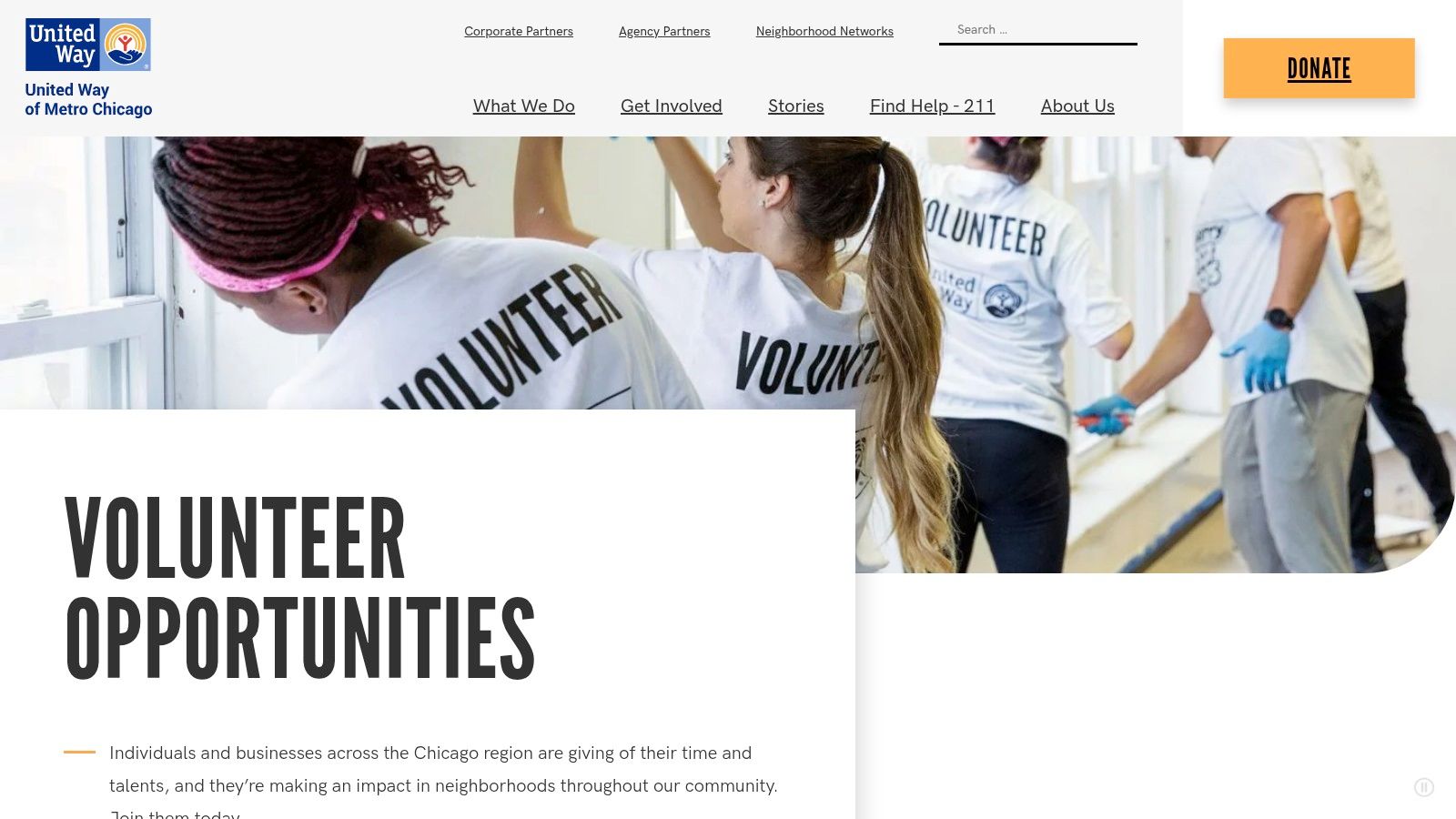
    A group of corporate volunteers from United Way of Metro Chicago working together to assemble kits for community members.

    What sets United Way apart is its focus on organized, often turnkey, projects. While you can find individual opportunities like mentoring or helping at a food pantry, their signature strength lies in coordinating "Days of Action" and kit-packing events. These are perfect for corporate teams, school groups, or even a large group of your friends who want to make a tangible impact together. This curated approach makes it one of the most reliable community service options Chicago offers for anyone looking to organize a group effort without the logistical headache.

    Making the Most of United Way

    To get started, you should head to their volunteer portal. There, you can browse a curated list of needs from their partner organizations. The portal allows you to search for opportunities and sign up directly with the agencies that align with your passion, whether it's workforce support or neighborhood beautification. It's a great way to find established and vetted programs.

    The real magic, especially for teams, is in their signature events and turnkey projects. These are pre-organized, high-energy events where all you have to do is show up ready to work. Packing hygiene kits. Assembling school supply bags. Participating in a citywide day of service. These are common examples. This structured format is one of the most effective ways to give back to the community when you have a group ready to mobilize.

    At a Glance: United Way

    Feature Details
    Primary Focus Connecting volunteers to a network of partner agencies and hosting large-scale, turnkey group projects.
    Best For Corporate teams, school groups, organized "Days of Action," and kit-building events.
    Time Commitment Varies; individual opportunities are flexible, while signature events are typically a half-day or full-day commitment.
    Neighborhoods Metro-wide, with projects spanning across the city and suburbs.
    Access Free to browse the portal; some corporate team projects may involve sponsorship or material costs.

    Pro Tip: If you're a team leader at your workplace or school, I recommend you reach out to United Way directly about their corporate engagement opportunities. They can often customize a project that aligns perfectly with your group's size and mission, making you look like a volunteer-coordinating superstar.

    While the portal might have fewer spontaneous, last-minute listings than other platforms, the quality and impact of its partnerships are top-notch. For a structured, reliable, and powerful way for you to engage with Chicago's foundational nonprofit network, United Way is an incredible resource.

    Website: https://liveunitedchicago.org/get-involved/volunteers/

    7. Chicago Park District (Volunteer Programs)

    If the concrete jungle sometimes makes you long for a patch of green, here’s your chance to nurture it. The Chicago Park District isn't just a place for picnics and pickup games. It’s a living, breathing network that depends on hands like yours to thrive. Volunteering here is your direct line to beautifying the spaces you walk, jog, and relax in every single day. It's one of the most personal and impactful community service options Chicago provides.

    A group of volunteers with the Chicago Park District planting flowers and gardening in a public park space.

    What makes this so special is its hyper-local focus. You can literally roll up your sleeves and improve the park at the end of your block. Opportunities range from one-day park cleanups and mulching events to more dedicated roles. You can support the Special Olympics, become a steward for a natural area, or help maintain a community garden. It's a tangible way for you to see your effort bloom right in your own neighborhood.

    Making the Most of the Park District

    The best way for you to get started is by visiting the volunteer portal on their website. For one-day events, the process is often as simple as signing a waiver. If you’re looking for something more consistent, like becoming a regular garden volunteer or a play garden attendant, you’ll likely need to complete a background check. It's a straightforward online process.

    A huge advantage is the sheer variety of roles that cater to different interests. If you love nature, the "Natural Areas Stewardship" program lets you help restore native habitats. If you're great with people and events, you can assist with everything from races to cultural festivals. They are also incredibly welcoming to groups, making it a fantastic choice for a corporate service day or a weekend activity with your friends.

    At a Glance: Chicago Park District

    Feature Details
    Primary Focus Neighborhood beautification, park maintenance, and event support.
    Best For Outdoor enthusiasts, neighborhood groups, group service days, environmentalists.
    Time Commitment Varies; one-day cleanups to recurring stewardship and garden roles.
    Neighborhoods Citywide; opportunities available in nearly every park across Chicago.
    Access Simple waiver for one-day events; background check for long-term roles.

    Pro Tip: Don't just look at the main website. I want you to know that many individual parks have their own Advisory Councils (PACs) that organize specific volunteer days. You should find your local park's page or Facebook group to tap into events that might not be on the central calendar.

    While finding opportunities can sometimes require you to reach out to a specific park's supervisor, the ability to directly serve your immediate community is unparalleled. For a hands-on, see-the-results-of-your-work experience, there’s nothing quite like giving back to Chicago’s beloved green spaces.

    Website: https://www.chicagoparkdistrict.com/volunteer

    7-Way Comparison: Chicago Community Service Options

    Program 🔄 Implementation complexity ⚡ Resource requirements 📊 Expected outcomes 💡 Ideal use cases ⭐ Key advantages
    Litter Caterpillars Low — volunteer-led, repeat weekly meetups Low — volunteers, basic tools, occasional coordination Visible block-by-block cleanup, community habit-building Hands-on neighborhood cleanups, social volunteering, newcomers Citywide ward coverage, strong culture and retention
    Chicago Cares Moderate — staff-organized, scheduled events Moderate — staff, partner orgs, sign-up system Reliable, structured projects across multiple causes First-time volunteers, corporate/group service days Large curated calendar, onboarding and hour-tracking
    VolunteerMatch (Chicago) Low for volunteers; variable by org Low — platform search; orgs supply roles Wide variety of opportunities; quality varies Last-minute, one-off, skill-based searches Huge volume and powerful filters, fast applications
    Idealist (Chicago) Low–Moderate — curated nonprofit listings Low — search tools and alerts Higher-quality, mission-aligned ongoing roles Students, early-career volunteers, recurring commitments Consistent, reputable postings and helpful filters
    My CHI. My Future. Moderate — city-run, program enrollment Moderate — city departments, supervised staff Structured youth pathways and supervised opportunities Teens, youth groups, supervised service programs Official city hub with youth-focused, neighborhood reach
    United Way of Metro Chicago Moderate — partner coordination, signature events Moderate–High — partner logistics, material costs for kits Reliable group experiences and community partner impact Corporate/team days, turnkey kit/pack events Strong partner network and turnkey team projects
    Chicago Park District (Volunteer Programs) Moderate — park coordination, some background checks Moderate — tools, staff liaison, possible clearances Park beautification, stewardship, event support Outdoor cleanups, community gardening, Special Olympics City-run park reach, many outdoor and weekend options

    Your Turn: Go Make Your Mark on Chicago

    So, there you have it. You've journeyed through a landscape of connection. The grassroots energy of Litter Caterpillars. The massive, city-spanning networks of Chicago Cares and VolunteerMatch. We’ve seen how you can find opportunities tailored to your skills on Idealist, mentor the next generation with My CHI. My Future., or join forces with major players like the United Way and the Chicago Park District. Each one is a different door, but they all open onto the same street: a more vibrant, connected Chicago.

    That feeling you have right now? That little spark telling you to get involved? That’s your starting line. I want you to think of it like a seed. It’s small, but it holds immense potential. You can’t just let it sit on a shelf; you have to plant it somewhere it can grow. And the good news is, this city is fertile ground.

    Choosing Your Starting Point

    The list in front of you isn't a ladder you have to climb. It’s a menu. You don't have to pick the "best" one, just the one that feels right for you, right now.

    • Craving Immediate, Tangible Impact? You saw it with Litter Caterpillars. You show up, you clean, you see the difference in ninety minutes. It’s direct, satisfying, and you’re side-by-side with your neighbors.
    • Need Flexibility and Variety? Dive into VolunteerMatch or Chicago Cares. These platforms are your personal volunteering concierges, letting you filter by cause, date, and neighborhood until you find that perfect fit.
    • Ready to Use Your Professional Skills? Head over to Idealist. This is where your day-job expertise in marketing, finance, or tech can become a superpower for a nonprofit that desperately needs it.
    • Passionate About Chicago's Youth? The answer is clear: My CHI. My Future. You can become a mentor, a guide, a consistent presence that can genuinely alter the course of a young person’s life.

    I started my own journey because my life felt messy. I needed to clean something. It began as an external fix for an internal feeling of chaos. But something unexpected happened. Showing up to pick up trash gave me consistency when I felt adrift. Bravery when I felt timid. And a whole new community when I felt alone. That's the beautiful, transformative secret of service. It has a funny way of giving back far more than you put in.

    Your First Step is the Only One That Matters

    The sheer number of community service options in Chicago can feel overwhelming, I get it. It’s so easy to get stuck in "analysis paralysis," endlessly comparing missions and schedules, trying to find the absolute perfect volunteer gig. But perfection is the enemy of action.

    My only real advice is this: just pick one. Don’t overthink it. Click a link from this article, find one event that fits your calendar, and you sign up. Then, the most important part: just show up. See how it feels for you to be there. You might get caught in a little rain. You might meet your new best friend. Or you might just discover a stronger, more connected version of yourself waiting for you. This city isn't just a place you live in; it’s a story you help write. Go find your chapter.


    Ready to make a visible impact and meet awesome people this weekend? Check out the event calendar for Litter Caterpillars. We're a grassroots crew making Chicago neighborhoods sparkle, one block at a time, and we’d love for you to join the story at Litter Caterpillars.

  • 10 Transformative Ways to Give Back to Community in 2026

    10 Transformative Ways to Give Back to Community in 2026

    I’ll let you in on a secret. My life used to be a wreck. A total mess. My apartment was a disaster, and if I'm being honest, so was my head. Every piece of trash had a story, a weight I just couldn't seem to lift. I felt stuck, completely paralyzed. Then, one day, something inside me just snapped. I decided I had to change. I needed to find people who were givers, not takers. So I started by cleaning up someone else's mess—the litter scattered across Chicago's streets.

    Huddled under a tree during a freak hailstorm with two new friends, shivering and laughing hysterically, I had an epiphany. Facing a little hardship together wasn't just fun; it was electric. It was transformative. That’s how my group, Litter Caterpillars, was born. You see, the most powerful ways to give back to community aren't just about changing the world out there; they're about rewiring the world inside you. It's about finding your strength. Your people. Your purpose. One small, brave act at a time.

    This guide is for you, for anyone who feels that same pull. We're going to skip the vague, fluffy advice and dive straight into things you can do today. This weekend. This year. Whether you have 30 minutes or want to lead a movement, I promise there’s a place for you here. Let’s find it together.

    1. Neighborhood Litter Cleanup Drives

    Imagine walking down your street and seeing it completely clean. No discarded wrappers. No bottles. No debris. This isn't a fantasy. It’s what happens when you organize a neighborhood litter cleanup, one of the most direct ways you can give back to your community. It’s a grassroots lightning strike. This effort pulls neighbors together, transforming shared spaces through pure collective action. You don't just clean up trash; you build relationships and shout from the rooftops that you care about your home.

    How It Works & Why It Matters

    A litter cleanup is simple yet profound. You and a group of volunteers gather on a specific day, armed with bags, gloves, and grabbers, and you systematically clear an area. The impact is immediate. It’s inspiring. You are reclaiming your environment, one block at a time. The real magic happens when people see you out there. They get inspired. Maybe they join in, or maybe they just think twice before dropping something. That ripple effect strengthens community pride and weaves a culture of shared responsibility.

    Getting Started: Actionable Tips

    • Rally Your Troops: I use tools like Meetup or Instagram to get the word out. Schedule your cleanups for weekend mornings; that's when you'll get the most people.
    • Equip for Success: You should provide all the necessary supplies, like gloves and trash bags, so anyone can join without a second thought. I've found that partnerships with local waste management can help with getting rid of the trash afterward.
    • Build a Brand: My group, Chicago's own Litter Caterpillars, created a strong identity that now spans all 50 city wards. Think about a fun name. A flag. Even team T-shirts. You need something that builds camaraderie.
    • Celebrate Your Impact: You should always track how many bags of trash you collect and share those numbers with your volunteers. Celebrating these wins builds momentum and keeps everyone fired up.

    Ready to make a visible difference in your neighborhood? Starting your own group is easier than you think. For a step-by-step guide, check out this fantastic resource on how to start a volunteer trash pickup and bring this incredible community-building activity to your own streets.

    2. Community Garden and Green Space Development

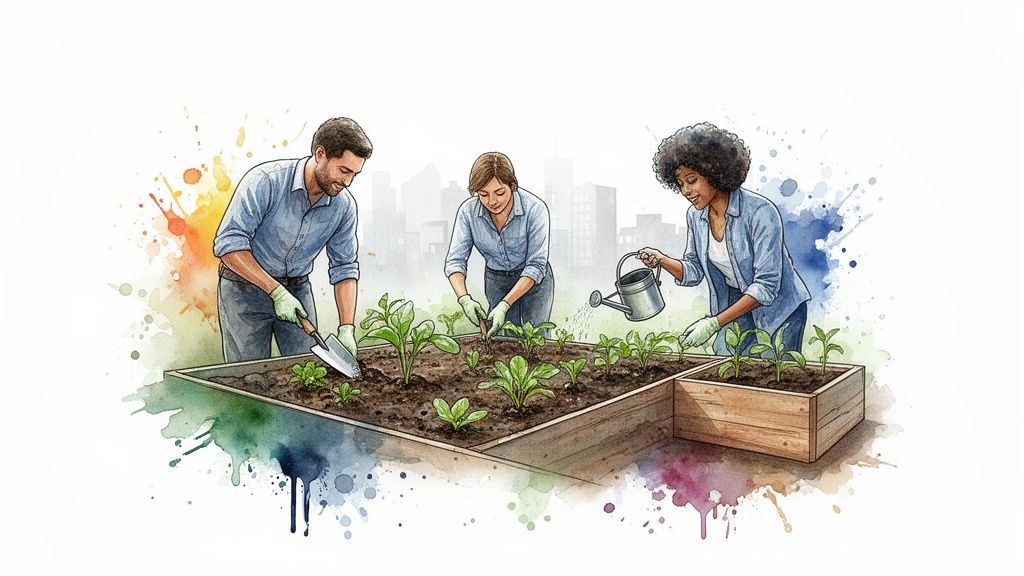
    Picture this: an overgrown, forgotten lot in your neighborhood transforms into a vibrant hub of life. I'm talking raised garden beds overflowing with vegetables and neighbors laughing together. This is the reality of community gardening, one of the most powerful ways you can give back to your community. You aren't just planting seeds in the ground; you're planting seeds of connection, improving local food access, and creating beautiful, shared spaces where friendships can bloom. It's like building a living room for your entire neighborhood.

    Three diverse people gardening in raised beds with a city skyline, in a vibrant watercolor style.

    How It Works & Why It Matters

    A community garden is a metamorphosis. It takes underused land and turns it into a productive green space where you and your neighbors can grow your own food or simply enjoy nature. The process builds a deep sense of ownership and pride. By working the soil side-by-side, you create more than just a garden; you weave a stronger social fabric. This effort directly tackles issues like food deserts, beautifies the neighborhood, and provides a peaceful sanctuary for everyone to enjoy. It’s a living testament to what you and your neighbors can achieve together.

    Getting Started: Actionable Tips

    • Build Your Team: Before you even touch a shovel, you need to gather neighbors who share your vision. I suggest using social media or flyers to host an initial interest meeting.
    • Secure the Land: You'll have to identify a vacant lot and work with your local government or the landowners to get permission. Organizations like the Trust for Public Land can be invaluable partners in this process.
    • Create a Plan: Sketch out your garden layout and create a sustainable maintenance plan. You should establish volunteer rotations for watering and weeding to ensure it succeeds long-term.
    • Engage Everyone: Host workshops, potlucks, and planting days in the garden. This keeps the community involved. And make sure you celebrate your first harvest together to build momentum.

    Ready to bring a green oasis to your block? Learn from pioneers like Ron Finley and see how you can start your own urban gardening movement. This is more than just a project; it's a legacy of health and community.

    3. Youth and Student Volunteer Programs

    Imagine taking the raw energy and idealism of students and aiming it directly at your community's challenges. That's the heart of youth and student volunteer programs, one of the most potent ways to give back to community. These initiatives create structured pathways for you and other young people to contribute your skills, learn about civic responsibility, and build a lifelong habit of service. It’s not just about getting a task done. It's about investing in the next generation of leaders and seeing your city through their fresh, determined eyes.

    How It Works & Why It Matters

    Think of it like a matchmaking service. Youth volunteer programs connect students with vetted opportunities that fit their schedules and interests. They often partner with schools, universities, and local nonprofits to address real community needs, from mentoring younger kids to restoring local parks. This matters because it provides a crucial doorway into civic life. For many of us, it's our first taste of meaningful community work, building confidence, leadership skills, and a network of peers who believe in making a difference.

    Getting Started: Actionable Tips

    • Connect with Campuses: If you want to recruit passionate students, partner with local high schools and university service centers, like those at Northwestern or the University of Chicago.
    • Offer Flexibility: You have to provide evening and weekend opportunities to accommodate academic schedules. Be ready to document service hours for school requirements or resumes.
    • Create Peer Leadership: Empower dedicated student volunteers with leadership roles. Let them help manage events and recruit friends. This fosters a deeper sense of ownership.
    • Build Community: You should host social events after service projects to help volunteers connect and build friendships. This transforms a one-time activity into a lasting community.
    • Leverage Social Media: I use platforms like Instagram to share our stories, post opportunities, and celebrate the impact my young volunteers are making.

    Ready to engage the next generation? Look into programs like Chicago ServiceCorps for inspiration on how structured service can empower young adults and transform neighborhoods.

    4. Environmental Education and Awareness Campaigns

    Picking up trash is powerful, I know. But what if you could stop it from ever being dropped in the first place? This is where education becomes one of the most transformative ways to give back to community. When you create awareness campaigns, you move beyond treating the symptoms and start attacking the cause. You’re not just cleaning a park; you’re planting seeds of consciousness that grow into lasting, sustainable change for everyone. You're changing hearts and minds.

    How It Works & Why It Matters

    An awareness campaign is like translating passion into knowledge. You use storytelling, data, and compelling visuals to inform your neighbors about environmental issues and inspire them to act. The goal is to shift mindsets from passive coexistence to active stewardship. When I understand why a plastic bottle harms local wildlife or how my actions contribute to a larger problem, my behavior changes. This creates a powerful, self-sustaining cycle of care that multiplies the impact of every single cleanup event.

    Getting Started: Actionable Tips

    • Tell a Visual Story: You should use social media platforms like Instagram to share dramatic before-and-after photos of cleaned areas. I create short, engaging Reels that show the process and the impact.
    • Partner with Schools: Connect with your local schools to develop simple, age-appropriate presentations or activities. If you educate the next generation, you build a foundation for a cleaner future.
    • Share Shocking Stats: You can create simple, shareable infographics about local environmental data. Something like, "Did you know our neighborhood produces X tons of single-use plastic waste each month?" can be a real eye-opener.
    • Host Community Workshops: Try organizing monthly info sessions at a local library or community center on topics like composting, recycling best practices, or reducing household waste.

    Ready to inspire your neighbors and create a ripple effect of change? You can learn from the masters of environmental storytelling at organizations like the Ocean Conservancy and adapt their powerful techniques to your own local campaigns.

    5. Neighborhood Friendship and Social Connection Networks

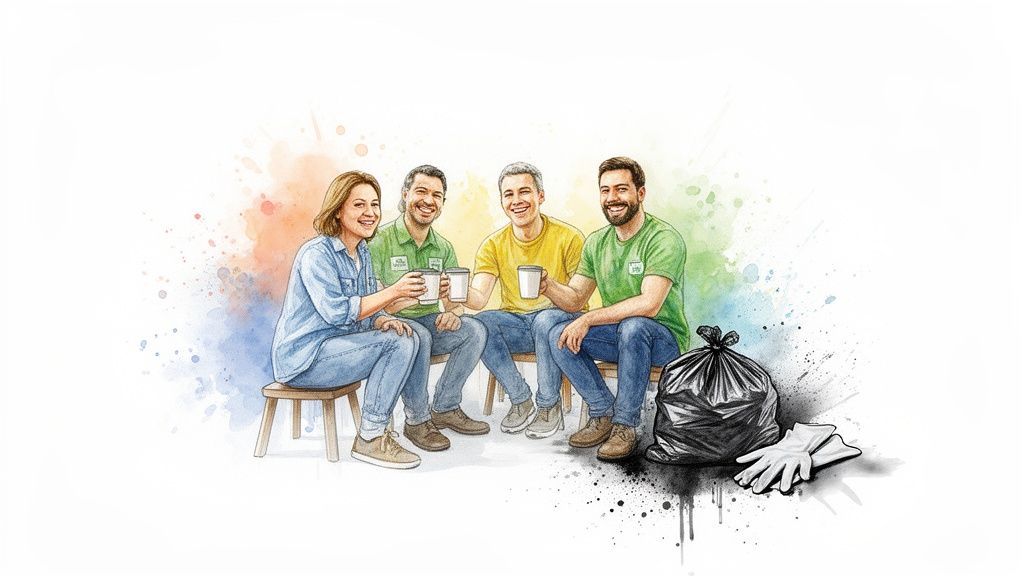
    What if volunteering wasn’t just about the task, but about the people I do it with? Giving back to the community can be the most powerful antidote to loneliness. You can create genuine friendships and social bonds that last long after the work is done. This approach recognizes that when we serve together, we don't just transform our environment; we transform ourselves. We build resilience, a sense of belonging, and real, human connections. It's like finding your tribe while changing the world.

    Four smiling volunteers, three men and one woman, enjoy a coffee break after a community cleanup.

    How It Works & Why It Matters

    A friendship network built on service intentionally carves out space for connection beyond the task at hand. Your goal becomes twofold: make a tangible impact and build a supportive "tribe." It's about seeing the same faces each week, learning their stories, and celebrating shared accomplishments. The magic here is simple but profound: a shared purpose forges unbreakable bonds. Organizations like Rotary Clubs and my own Litter Caterpillars prove that when you put people first, the mission becomes even more meaningful and sustainable.

    Getting Started: Actionable Tips

    • Create Social Rituals: Don't let the event end with the cleanup. I always schedule a post-service coffee or meal to let people unwind and connect on a personal level.
    • Build a Buddy System: You should pair new volunteers with experienced members. This mentorship helps newcomers feel welcome and integrated from day one.
    • Celebrate People, Not Just Stats: I make a point to acknowledge volunteer anniversaries and personal milestones. You have to make everyone feel seen and valued as an individual, not just a helper.
    • Foster Group Identity: Create a fun name, a group chat for non-event chatter, or even team T-shirts. This builds a shared sense of pride and belonging.

    Ready to find your community while making a difference? Explore some proven community building activities for adults to see how service and friendship can create an unstoppable force for good in your neighborhood.

    6. Corporate and Business Partnership Programs

    Imagine your grassroots volunteer group suddenly having the resources of a local company behind it. That's the power of corporate and business partnerships. It’s a strategic way for you to amplify your impact. Think of it as a collaboration where businesses offer support—funding, supplies, or employee volunteers—and in return, they boost their community presence and engage their teams. You’re not just asking for a handout; you’re building a symbiotic relationship that fuels positive change for everyone involved.

    How It Works & Why It Matters

    A corporate partnership is like a perfect marriage. You align your community initiative with a business that shares your values. The company might sponsor your cleanup event, provide professional services, or offer matching grants for employee donations. This collaboration gives your project credibility and provides the resources you need to scale up. The magic is in finding that perfect match, where a business’s brand mission and your community goals overlap, creating a powerful story of shared purpose. It’s one of the most effective ways to give back to your community.

    Getting Started: Actionable Tips

    • Find Your Match: You should look for businesses whose mission aligns with yours. For my environmental group, a partnership with a company like Patagonia or Seventh Generation makes perfect sense.
    • Create a Clear Proposal: Outline exactly what you need and what the business gets in return, such as brand visibility or structured volunteer events for their staff. You have to make it a win-win.
    • Offer Turnkey Opportunities: Businesses are busy. You should design volunteer-ready projects that are easy for their employees to join, like a pre-organized park cleanup or a donation sorting day.
    • Showcase the Impact: I always share success stories, photos, and metrics with my partners. Host appreciation events to celebrate your joint achievements and strengthen the relationship.

    Ready to find a business ally for your cause? Building these connections can be a game-changer. For inspiration on how companies integrate giving back, explore how B Corporations are redefining business success to include social and environmental performance.

    7. Accessibility and Inclusive Volunteering Models

    What if everyone who wanted to help their community actually could? This powerful idea is the heart of inclusive volunteering. It’s a model that intentionally designs opportunities to welcome people of all abilities, backgrounds, and life circumstances. It’s about you moving beyond a one-size-fits-all approach and asking, "How can we remove the barriers?" When we do this, we don't just expand our volunteer pool; we create a richer, more representative, and truly unified community effort.

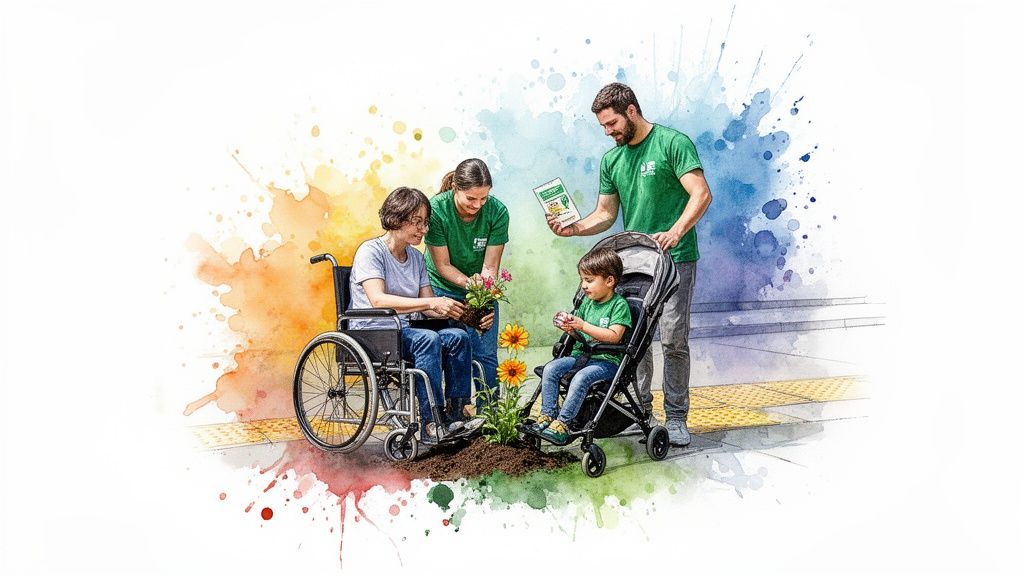
    A diverse group, including a woman in a wheelchair, adults, and a child, plants flowers as community service.

    How It Works & Why It Matters

    Inclusive volunteering means you build flexibility into your program from the ground up. It could look like offering virtual roles for me if I have mobility challenges, providing childcare so parents can participate, or ensuring event instructions are available in multiple languages. This isn't just about being nice; it’s about recognizing that diverse life experiences are a community's greatest asset. By making volunteering accessible, you unlock untapped potential and ensure that the solutions you create are truly for everyone.

    Getting Started: Actionable Tips

    • Audit Your Events: Before you plan, think about accessibility. Is the location wheelchair accessible? Are there clear paths? Is it near public transportation?
    • Offer Flexible Roles: You should create both in-person and virtual tasks. Not everyone can show up on a Saturday morning, but they might be able to help with online outreach or data entry from home.
    • Provide Support: Consider offering childcare or a quiet space for volunteers who may need a sensory break. You should ask volunteers what they need to succeed when they sign up.
    • Use Inclusive Language: Ensure your recruitment materials speak to everyone. A simple phrase like, "We are committed to creating an accessible event; please let us know your needs," makes a huge difference.

    Making your volunteer efforts more inclusive is one of the most powerful ways to give back to your community because it multiplies your impact. To learn more about universal design principles that can guide you, explore the resources from the National Center on Accessibility.

    8. Neighborhood Exploration and City Discovery Initiatives

    Imagine giving back to your community not just in one place, but across every single unique corner of your city. This is the soul of neighborhood exploration initiatives. It's a powerful model that combines volunteer service with intentional city discovery. You get to help clean, build, or support different neighborhoods while connecting with the diverse cultures and people that make your city vibrant. You break out of your bubble, build city-wide relationships, and truly understand the fabric of your home. It’s like being a tourist in your own town, but with a purpose.

    How It Works & Why It Matters

    These initiatives are about purposeful movement. Instead of focusing on a single location, you and your volunteer group systematically plan events in different neighborhoods, often with a goal to visit every single one. This approach turns giving back into an adventure. It combats the geographic and social divisions that can exist in a large city. It’s a profound way to foster a sense of shared identity and responsibility, showing that every community, from the quietest residential street to the busiest downtown corridor, matters equally.

    Getting Started: Actionable Tips

    • Map Your Mission: You should set a clear goal, like visiting all 50 of Chicago’s wards, as we did with the Litter Caterpillars. I use a map to track our progress and build excitement around the journey.
    • Partner with Locals: Before you visit a new neighborhood, connect with local community organizations or long-time residents. Ask them to share stories or highlight specific areas of need.
    • Create Discovery Guides: Develop simple "neighborhood cards" with interesting historical facts, local landmarks, or fun trivia. You can share these with your volunteers and deepen their connection to the area.
    • Document and Share: I use photos and social media to chronicle our journey through the city. This not only celebrates our impact but also inspires others to explore and appreciate the diversity of their own city.

    Ready to see your city in a whole new light while making a tangible difference? For inspiration on city-wide exploration, check out local groups like Chicago Detours to see how they bring neighborhood stories to life.

    9. Resilience Building and Personal Transformation Through Service

    What if giving back to your community could also be a profound journey of self-discovery? This approach to service isn't just about the outcome; it's about what you become in the process. It's you, volunteering with the intentional goal of building your own resilience, courage, and self-compassion by embracing challenges. Whether that’s facing harsh weather, navigating difficult tasks, or overcoming personal fears. This is where service transforms you as much as you transform your community.

    How It Works & Why It Matters

    This isn't your average volunteer gig. It's a framework where I see challenges as opportunities for growth. Think of my Litter Caterpillars crew showing up in a blizzard, not just to clean, but to prove we can. It’s the same transformative spirit you find in military service or Outward Bound programs. When you intentionally step into discomfort for a greater cause, you rewire your brain. You build mental toughness. You discover a strength you never knew you had. It’s a powerful way to give back that also gives you an unshakable sense of purpose.

    Getting Started: Actionable Tips

    • Frame the Challenge: Don't just announce a cleanup; frame it as an opportunity. “Let’s show this heatwave what we’re made of!” I use storytelling to reframe difficulty as an adventure.
    • Create Rituals: You should start with a team huddle or end with a moment of reflection. Celebrate perseverance with group photos, or even create unique team badges for conquering tough conditions.
    • Embrace Vulnerability: Create a safe space where you and other volunteers can share your struggles and triumphs. Brené Brown's research taught me that vulnerability is the birthplace of courage and connection.
    • Build Peer Support: Encourage mentorship and a strong team bond. Knowing you’re facing a challenge together makes it far less daunting and builds lasting friendships.

    Ready to see what you're made of while improving your neighborhood? Explore how groups like the Litter Caterpillars turn tough days into transformative experiences and join a movement that builds stronger communities and stronger people.

    10. Volunteer-Led Advocacy and Policy Change Initiatives

    Picking up a piece of litter is a powerful act, but what if you could stop it from ever hitting the ground? This is where your volunteer efforts can evolve into something even bigger: advocacy. By using the data, stories, and networks from your service work, you can influence systemic change at the city level. This approach transforms you from a volunteer into a community organizer. You start tackling the root causes of problems and not just the symptoms. You become the change.

    How It Works & Why It Matters

    Volunteer-led advocacy turns your on-the-ground experience into a powerful weapon for change. When my cleanup group documents that a certain intersection is always full of trash from an overflowing public can, we have evidence. When I share that evidence with a local alderperson, I’m no longer just cleaning; I’m advocating for better waste management services. This is one of the most impactful ways to give back to your community because it creates lasting solutions that benefit everyone, long after a cleanup event ends.

    Getting Started: Actionable Tips

    • Document Everything: You must take photos and notes during your volunteer activities. Track the types and sources of litter you find. Data is your most persuasive ally.
    • Collect and Share Stories: The human element is powerful. I share my volunteers' firsthand accounts of what they see and how it affects them. You can use these stories on social media and in meetings with officials.
    • Build Relationships: Get to know your city council members and their staff. I attend local meetings and introduce myself. A familiar face is more likely to be heard.
    • Create Clear Asks: Don't just present a problem; you have to propose a solution. Advocate for specific policy changes, like more public bins, better recycling programs, or stronger anti-littering enforcement.

    Ready to take your community service to the next level? You can multiply your impact by organizing for policy change. To get started, learn more about the fundamentals with this great overview of what community organizing is and how you can use its principles to create a better neighborhood.

    10 Ways to Give Back — Comparison

    🔄 Implementation complexity ⚡ Resource requirements & speed 📊 Expected outcomes & ⭐ Ideal use cases 💡 Key advantages / Tips
    Neighborhood Litter Cleanup Drives — Low to Moderate (volunteer coordination, scheduling) ⚡ Low cost; basic supplies; rapid visible results Improved streetscape, recurring volunteer habits — ⭐⭐⭐⭐ Urban blocks, quick wins, community engagement 💡 Weekend mornings; supply provision; partner with waste services
    Community Garden & Green Space Development — High (land, legal, long-term maintenance) ⚡ High upfront capital and labor; slow-to-mature benefits Long-term assets, food access, property value uplift — ⭐⭐⭐⭐ Vacant lots, food-security projects, neighborhood revitalization 💡 Partner with city, clear maintenance plan, diversify funding
    Youth & Student Volunteer Programs — Moderate (supervision, calendar alignment) ⚡ Moderate resources; fast mobilization during term times Leadership development, energetic turnout, networks — ⭐⭐⭐⭐ Universities, high schools, recruitment and skill-building 💡 Offer service-hour docs, peer leaders, social events
    Environmental Education & Awareness Campaigns — Low to Moderate (content, outreach) ⚡ Low cost and highly scalable; behavior change is gradual Increased knowledge and motivation; broader reach — ⭐⭐⭐ Schools, city-wide outreach, digital audiences 💡 Use compelling visuals, school partnerships, shareable infographics
    Neighborhood Friendship & Social Connection Networks — Moderate (facilitation, inclusion) ⚡ Low–medium cost; impact on retention builds over time Strong social cohesion and volunteer retention — ⭐⭐⭐⭐ Newcomer integration, loneliness reduction, retention-focused efforts 💡 Host post-service socials, assign buddies, celebrate milestones
    Corporate & Business Partnership Programs — Moderate to High (relationship mgmt, agreements) ⚡ High resource potential (funding, skills); can scale rapidly Major resource boost, professional expertise; expanded capacity — ⭐⭐⭐⭐ Scaling initiatives, sponsorship needs, skilled pro support 💡 Align missions, clear agreements, protect volunteer-first ethos
    Accessibility & Inclusive Volunteering Models — Moderate to High (accommodations, training) ⚡ Medium resources to implement accommodations; expands pool quickly More diverse participation and equitable access — ⭐⭐⭐⭐ Programs serving diverse abilities, parents, multilingual communities 💡 Audit accessibility, offer multiple roles, provide childcare/transport
    Neighborhood Exploration & City Discovery Initiatives — Moderate (logistics, routing) ⚡ Medium resources (transport, coordination); novelty drives quick engagement Broadened city knowledge and cross-neighborhood ties — ⭐⭐⭐ New residents, adventurous volunteers, city-wide coverage goals 💡 Plan routes, partner with local groups, document stories/photos
    Resilience Building & Personal Transformation — High (skilled facilitation, support) ⚡ Medium–high resources for training and mentorship; outcomes long-term Deep personal growth, resilience, mental-health benefits — ⭐⭐⭐⭐ Cohort programs, leadership development, healing-through-service 💡 Frame challenges as growth, build peer support, share transformation stories
    Volunteer-Led Advocacy & Policy Change Initiatives — High (data, coalition building) ⚡ Medium resources; slower timeline but systemic impact Policy and structural change; scalable long-term improvements — ⭐⭐⭐⭐ Addressing root causes, municipal budget/policy influence 💡 Collect systematic data, train citizen advocates, build official relationships

    Go Far, Go Together

    We've walked through so many different avenues in this guide. We've seen everything from quick, impactful acts of kindness to deep, recurring commitments that reshape our neighborhoods. You've seen how a simple litter cleanup can blossom into a city-wide movement. How a community garden can nourish more than just our bodies. How your voice can spark real policy change. The core lesson isn't just about the what or the how, but the who you become along the way.

    Finding ways to give back to community is like planting a tree. You might not see the full-grown oak overnight, but every single act, every bag of trash I collect, every seed you plant, is a commitment to a future you believe in. It’s a declaration. A statement that you see the potential in your surroundings and, more importantly, in yourself. The journey we've explored is about transforming passive hope into active participation.

    Your Path is Your Own, But You Don't Have to Walk It Alone

    Think about the paths we've covered:

    • The Spark of Connection: You can build friendship networks and simply check on a neighbor.
    • The Power of Green: We can nurture community gardens and reclaim public spaces.
    • The Voice of Change: You can engage in advocacy and shape a more inclusive, accessible community.

    Each of these isn't a separate, isolated task. They are threads in a larger tapestry. When you pick up litter, you're not just cleaning; you're making a space more welcoming for a community gathering. When I teach a child about recycling, I'm not just sharing facts; I'm investing in a more sustainable future. Every action you take creates ripples that you may never fully see, but their effects are undeniable.

    The most crucial takeaway is this: you don't need a grand plan or a perfect moment to start. You just need to take a single step. The old saying is true: if you want to go fast, go alone, but if you want to go far, go together. Finding ways to give back to community is never just about the task. It's about the 'together.' It’s about realizing you’re not the only one who cares.

    It's about building the kind of friendships that can withstand a hailstorm and showing up for each other, week after week. We are Caterpillars because we know we're not perfect, but we are all trying to transform.

    Through service, sunlight, and friendship, you learn to trust and forgive yourself. You find your pride. So find your people, grab a flag, and start your own story. The community, and the person you're becoming, is waiting for you.


    If you're ready to take that first step and find your people in Chicago, join us at Litter Caterpillars. We make giving back to the community fun, social, and deeply rewarding, exploring a new neighborhood every weekend. Find your next adventure and your new friends at Litter Caterpillars.

  • What Is Environmental Activism: A Guide for People Ready to Make a Difference

    What Is Environmental Activism: A Guide for People Ready to Make a Difference

    What is environmental activism, really?

    Let me tell you. At its core, it's the conscious choice you make to stop being a bystander and start being a participant in the story of our planet's future. It's any action—big or small—you take to protect our shared home.

    Redefining What It Means to Be an Activist

    When you hear "environmental activism," your mind probably leaps straight to dramatic protests, people chaining themselves to ancient trees. And yes, that's one theatrical scene in a much larger play. But the real story? It's much simpler, much closer to home, and frankly, much more accessible to you and me. It's less a job title and more a state of mind.

    Imagine our world as a vast, sprawling garden. Some people possess the influence to plant entire forests, shifting national policies with the stroke of a pen. Others, like me, start by pulling a single, stubborn weed when we pick up litter on a Chicago street. Both actions matter. Both are, in their own way, profound acts of activism.

    I founded Litter Caterpillars during a time when my own life felt chaotic, completely out of my control. The simple, tangible act of cleaning up trash became my anchor; I could make one small corner of the world visibly, undeniably better. It returned a sense of purpose to me.

    That's the essence right there—recognizing a problem, whether it's the colossal threat of global climate change or a single plastic bottle marring your sidewalk, and deciding you will be part of the solution.

    From Global Ideas to Personal Action

    The beautiful thing about activism is its scalability. A global concern, like the deluge of plastic choking our oceans, can cascade down to inspire local community action, which is ultimately powered by your personal decision to show up. It's a direct current flowing from the grand, abstract idea right down to your own two hands.

    This map illustrates precisely how those levels interconnect, from the highest echelons of global awareness to the local and personal actions you can take.

    The crucial takeaway? You don't have to carry the weight of solving the world's problems all at once. Your true power lies in translating those big, intimidating ideas into small, consistent actions, right where you stand.

    This concept of taking personal responsibility for our shared spaces is incredibly potent. It's often the first step toward something even bigger: what is known as environmental stewardship. If you're curious how these ideas intertwine, our guide breaks it all down. It begins with that simple, powerful choice to care.

    The Many Faces of Environmental Activism

    Activism is not a monolith; it's a vibrant spectrum of action. There's a place for you, regardless of your personality or resources. Here’s a glimpse at the different ways people show up, from sweeping global movements right down to what you can do on your own block.

    Type of Activism What It Looks Like Who It's For
    Community-Based Action Organizing neighborhood cleanups, planting community gardens, setting up local recycling drives. People like you who love hands-on work and seeing immediate, tangible results in their own neighborhood.
    Policy & Legal Advocacy Calling elected officials, signing petitions, supporting environmental legislation, or even filing lawsuits. Those of you passionate about systems-level change, unafraid to engage with the political machinery.
    Education & Awareness Writing blog posts, creating social media content, giving talks at schools, or just sharing what you know with friends and family. The natural teachers and storytellers among us who want to inspire others to join the cause.
    Direct Action & Protest Participating in marches, sit-ins, and public demonstrations to draw urgent attention to a critical issue. Anyone willing to be a visible, vocal presence for a cause that sets their heart on fire.
    Lifestyle Choices Reducing personal waste, composting, choosing sustainable products, biking instead of driving. Absolutely everyone. This is the foundation—the daily, personal choices that reflect your deepest values.

    This table merely scratches the surface, but it proves there's no single "right" way to be an activist. It’s about you finding the method that resonates with your spirit and fits into your life.

    This reframing is vital. Environmental activism isn't some exclusive club for a heroic, chosen few. It is a series of choices available to every single one of us, every single day. You find it in the reusable cup you carry, the local cleanup you join, or the conversation you start with a friend.

    It’s you, deciding to make a difference.

    How a Single Spark Can Ignite a Global Movement

    Every monumental movement you've ever read about in a history book began with a single person. You and I forget this so easily when we see massive crowds on the news, but it is the simple, unvarnished truth. It always starts with one individual who looks at a problem and decides, “Okay, I’m going to do something about this.” Everything else is just a ripple effect.

    Think about Greta Thunberg. She was just a teenager who decided one Friday to skip school and protest climate inaction outside the Swedish parliament. Can you imagine how small, how utterly futile that might have felt at first? But that single, solitary act of courage was a spark.

    That spark ignited a wildfire that swept the globe. Her solo protest inspired millions of students across the world to join her, birthing the Fridays for Future movement. That is the incredible, almost alchemical power of one person’s conviction.

    Your individual actions, no matter how insignificant they seem to you, possess the latent potential to create massive, unpredictable waves of change. It’s not about becoming a perfect hero; it's about being a person who simply shows up.

    The Power of Showing Up

    I know this from my own experience. I will never forget the very first Litter Caterpillars cleanup. There were just three of us, and we were ambushed by a freak Chicago hailstorm. We huddled under a tree, shivering, watching Ubers cancel on us one after another.

    It felt small, miserable, and frankly, a bit ridiculous. But that shared ordeal forged an unbreakable bond between us. We learned the most important lesson about what environmental activism truly is: simply showing up, especially when it’s hard, is how real movements are born.

    That small, soggy beginning blossomed into a community that meets every single week, regardless of the weather. It all started because three people decided to try.

    From One Voice to Millions

    This isn't just some feel-good story; it’s a proven pattern. The initial spark from one person can snowball into something that shapes history. For example, the youth-led movements inspired by that single school strike culminated in the Global Climate Strike of 2019, which mobilized an estimated 4 million protesters worldwide.

    It was the largest coordinated climate demonstration in history. Protests erupted in over 150 countries, all because one person decided her voice mattered. You can dive into more data about global protest trends at the Carnegie Endowment for International Peace.

    This is the central lesson for anyone wondering how they can possibly make a difference. It doesn't begin with a crowd. It begins with you. It begins with your decision to pick up one piece of trash, join one local meeting, or have one difficult conversation. That’s your spark.

    Does All That Noise Actually Work?

    You see the headlines, the massive crowds, the passionate speeches. It's only natural to wonder if all that noise actually adds up to tangible change.

    The short answer is yes, but the mechanism is not as straightforward as you might think. Marches and protests are exceptionally good at one thing: seizing attention. They get people talking, dominate news cycles, and can genuinely make people care about an issue. They force a conversation that might otherwise remain buried under the weight of indifference.

    But here’s the strange paradox I keep observing. More and more people tell surveyors they're deeply worried about the climate, but that visceral fear doesn't consistently translate into action. It's a bizarre sensation, like knowing your house is on fire but feeling like you don't have a bucket.

    The Growing Gap Between Knowing and Doing

    This is the great challenge we face: how do we transform that helpless anxiety into real, meaningful action? It’s something I ponder constantly. The problem feels so colossal that picking up a single piece of trash can feel like trying to empty Lake Michigan with a teaspoon.

    The data tells a fascinating, almost contradictory story. On one hand, research absolutely confirms that activism works. A comprehensive review of 50 different studies found 'strong evidence' that protests crank up climate awareness without alienating the public. In Germany, major climate events actually boosted public concern by 1.2 percentage points.

    But then you look at another global survey and see a punch to the gut: the number of people who identify as 'activists or willing contributors' is actually decreasing. You can delve into the nitty-gritty of these studies over at The Commons Social Change Library.

    That’s the chasm, right there. More awareness, but less action. People feel the immense weight of the problem, but they don't see their own role in the solution.

    How Your Own Two Hands Bridge That Gap

    I see this gap play out every single weekend with Litter Caterpillars. People arrive at our cleanups feeling utterly overwhelmed by the tide of trash choking Chicago’s parks and streets. They carry all this frustration and awareness bottled up with nowhere for it to go.

    Then something incredible happens.

    They spend just one morning with us, and by the end, they are holding a full garbage bag. They can point to a patch of ground and say, "I cleared that." They have transmuted that giant, crushing feeling into a concrete, physical result.

    That is the magic of rolling up your sleeves and getting your hands dirty. It closes that chasm between knowing and doing. It takes an impossibly big problem and shrinks it down to a single bag of trash—a visible task you can complete right alongside other people who feel the exact same way you do. It’s the perfect first step.

    Finding Your First Step Into Activism in Chicago

    So, you feel that fire in your gut. You’re ready to do something. But the question looms large: what can I actually do?

    Let's make this simple. Forget about saving the entire world by next Tuesday. Your entire journey can begin with one single step, and I believe the easiest, most powerful first step is to just volunteer.

    Find a local group whose mission resonates with you, and just show up. That’s it. For us at Litter Caterpillars, that simple idea is everything.

    We meet every single weekend, rain or shine. You don't need any experience—just bring yourself. We have the gloves, the bags, the grabbers, and most importantly, the community. Showing up to clean a local park is environmental activism in its purest, most immediate form.

    Why Volunteering Is Your Secret Weapon

    Volunteering might seem like a small thing, but it’s a direct conduit to making a real difference. It’s not about sending an email and hoping someone reads it; it's about physically transforming the space around you for the better. This hands-on work builds a crucial bridge between your concern and a concrete result.

    It is also the ultimate antidote to feeling overwhelmed. The world's problems can feel crushing, but a few hours of service provide you with a tangible victory. You can look at a clean stretch of sidewalk and know, "I did that."

    That feeling is everything. It’s not about guilt or obligation. It's about you finding genuine joy in the action itself. That joy is what keeps you coming back, turning a one-time event into a lifelong habit of making an impact.

    How to Find Your Tribe in Chicago

    Finding the right group is like finding the right friends—it’s about shared values and a vibe that feels like home. Chicago is brimming with amazing people doing incredible work. You just need to know where to look.

    Here are a few practical ways for you to start your search:

    • Explore Local Cleanup Groups: Start with organizations in your own neighborhood. We operate all over the city, but you can also find groups dedicated to specific parks, rivers, or communities. Check out our guide on environmental volunteer opportunities in Chicago to see a whole list of groups you can join.
    • Check Out Community Gardens: If you love getting your hands dirty, look for urban farms or community gardens. These are amazing hubs for people who care about local food, green spaces, and sustainability.
    • Connect with Nature Preserves: The Forest Preserves of Cook County and other local conservation groups often need volunteers for trail maintenance, invasive species removal, and habitat restoration.

    Your first step doesn't need to be perfect. Just pick one, sign up, and show up. You will be amazed at how quickly you find your place and your people. It’s all about building a better world, one garbage bag and one new friend at a time.

    Building a Movement One Friendship at a Time

    Here’s a secret about activism they don't always tell you: it’s not just about the cause. It's about the people.

    The real reason Litter Caterpillars has survived Chicago blizzards and brutal heatwaves isn't just because we all hate litter. It’s because we have built something much stronger: a real community. We've built friendships.

    When you’re standing in the freezing cold with someone, sharing a laugh while picking up soggy pizza boxes from a gutter, you form a bond that plunges far deeper than a shared interest. That shared struggle, that moment of doing something hard together, is the very adhesive that holds a movement together.

    The Power of Showing Up for Each Other

    I started this group with a clear purpose: to mindfully filter selfish people out of my life and find fellow 'givers.' Our weekend morning schedule is not an accident; it is part of that filter. It takes a certain kind of person to consistently choose service over sleeping in.

    This shared commitment creates a powerful foundation. Lasting change, the kind that survives bad weather and burnout, is always powered by human connection. It's the feeling that you’re not just fighting for something, but you’re fighting with people who have your back.

    Activism is sustained by relationships. The cause gets you in the door, but the community is what makes you stay. When you feel like you belong, you feel like you can change the world.

    This section is all about the 'how' behind building that kind of resilient community. It’s about creating an environment where you feel seen, valued, and inspired to keep coming back.

    More Than a Cleanup, It’s a Team

    We intentionally borrow ideas from sports teams and other groups that build incredible pride and identity. I want people to feel like they are part of something special, because they are.

    • Flags and a Theme Song: We use flags and even have our own theme song to build a sense of unity and pride. It might sound silly, but it gives us an identity—it makes our shared effort feel like a celebration, not just a chore.
    • Core Values: Everything we do is guided by our core values: bravery, kindness, and unity. These aren't just words on a website; they are the principles that shape how we treat each other and the city we serve.
    • Building Friendships First: I always say that our real mission is to help people make friends. The clean city is just a happy byproduct of that. You can learn more about how we structure our events to encourage connection in our guide to community building activities for adults.

    Making the world a better place shouldn't feel like a punishment. It should be inspiring, joyful, and make you feel like you’ve finally found your people. That's the energy that fuels a true movement, one friendship at a time.

    Why Your Local Action Is More Important Than Ever

    Let's be real for a moment. Despite all the headlines, the protests, and the billions thrown at clean energy, we are not winning the fight against climate change. When you look at the actual data, it's a gut punch.

    The global response is falling tragically short, and almost every single indicator is flashing bright red. It's so easy to hear that and just feel… defeated. I get it. I really do.

    But I don't see that as a reason to give up. I see it as a call to arms. It means the gritty, volunteer-led, local work—the work we do right here on the ground—is more critical now than it has ever been.

    When Top-Down Fails, We Rise From the Bottom Up

    When the big, top-down solutions falter, bottom-up change becomes our most potent hope. This is the entire reason we do what we do at Litter Caterpillars.

    It’s why my friends and I bought an empty lot at a city auction to build a community park in Englewood. It’s why we cleaned an entire highway during a bike event.

    These are not just feel-good stories; they're acts of defiance against despair. They are living, breathing proof that a small group of dedicated people can physically reshape their own environment. You do not have to wait for anyone's permission.

    This is the hard truth that should light a fire under you: the global progress is 'alarmingly inadequate.' Your energy, your time, and your hands are the most valuable resources we have left.

    The World Resources Institute's 2025 climate report is brutally blunt. It shows that while clean energy investment hit a record $1.3 trillion in 2023, nearly all of the 45 key climate indicators are "well off track." This means the pace of change needs to literally double or even quadruple to hit our goals. You can see all the details in the State of Climate Action 2025 report.

    Your Energy Is the Resource That Matters Most

    That gap—the one between all that money and the real-world results—is where you come in. It’s where environmental activism on a local scale becomes the true engine for change.

    We aren't waiting for some perfect global plan to save us. We are out here picking up trash, planting gardens, and building community on our own streets, right now.

    Your choice to show up for your neighborhood isn't just a drop in the ocean. In a world of inadequate responses, it's the start of a tidal wave.

    Your Questions Answered

    Jumping into something new always brings questions. I get it. Every weekend, I see new faces at our cleanups, and many of you share the same worries. It’s completely normal, so let’s get those out of the way right now.

    The biggest thing I want you to hear is this: your willingness to show up is the only qualification you will ever need.

    "Do I Need Any Special Skills?"

    Nope! Absolutely not. This is probably the number one myth that keeps good people like you on the sidelines. You do not need a degree in environmental science or a background in policy to make a real difference. Honestly, the most powerful activism begins with just showing up.

    For a group like ours, the only "skill" you need is being able to pick something up off the ground. We handle the rest—the gloves, the bags, the plan. A good attitude is worth more to me than a PhD out here. You will learn everything you need to know on the job, side-by-side with people who are happy to show you how it’s done.

    "What if I Don't Have Much Time?"

    That’s life! It’s busy, and I don't expect you to drop everything. Any time you can give is a gift, so never feel bad about what you can't do. People often think they need to commit their whole lives to a cause, but even one hour a month sends ripples out into the community.

    We meet at Litter Caterpillars every week, but we have zero attendance requirements. Some folks are with us every Saturday, rain or shine. Others pop in once a season when they have a free morning. Both are perfect.

    The goal is for you to find a rhythm that feels good and sustainable for you. Don't let the idea of a "perfect" commitment stop you from doing any good at all.

    Whatever you can give, it matters. Period.

    "Is It Safe?"

    Safety is everything. It is, without a doubt, my number one priority. Nothing else happens if our volunteers aren't safe—it's the foundation of everything we do.

    We provide high-visibility safety vests, tough gloves, and I give clear instructions before anyone picks up a single piece of trash. We stick together in groups, and we make sure everyone knows the game plan. Any group worth its salt will have safety locked down, but if you ever feel unsure, just ask the organizer. Your well-being is what makes all of this possible.


    Ready to see for yourself? Come join Litter Caterpillars at our next cleanup. We’re a no-pressure, friendly crew making Chicago beautiful and building a real community, one block at a time. Find our next event and sign up here!

  • Your Guide to Becoming a Trash pickup Volunteer in Chicago

    Your Guide to Becoming a Trash pickup Volunteer in Chicago

    Becoming a trash pickup volunteer does more than just clean up the streets. It's a real, hands-on way for you to reclaim your community and, weirdly enough, find a little piece of yourself you didn't know was missing. This simple act connects you with people who actually care. It creates an immediate, visible impact you can point to and say, "I did that."

    How Volunteering Transforms More Than Just the Streets

    Let's be real. When you picture a life-changing experience, picking up soggy fast-food wrappers on a Saturday morning probably doesn’t come to mind. I get it. Three years ago, my apartment was a mess, my mind was a mess, and my life felt completely stuck. The last thing I thought I needed was to clean up someone else's disaster.

    But I was so wrong.

    I stumbled onto something incredible: tackling the clutter on the streets was way easier than facing the chaos in my own home and my own head. It was a first step. Each piece of litter I bagged felt like a small win, a tiny bit of order I could create in a world that felt out of control. Think of it like organizing one bookshelf before you try to tackle the entire library of your life. That small action gave me the momentum I desperately needed.

    This journey from my messy apartment to founding Litter Caterpillars showed me a surprising truth. The simple act of cleaning, of serving, of just showing up for your city, builds a unique kind of resilience. It's an adventure in self-discovery disguised as community service.

    The Ripple Effect of Showing Up

    This isn't just my story; it's a movement. Since it kicked off, National Cleanup Day has sparked over 10 million volunteer hours across the country, turning neglected lots into points of pride. The impact is huge: these events boost environmental awareness by 70% and strengthen community ties for 72% of participants, forging real connections block by block.

    This infographic breaks down some of the awesome stats behind what happens when people like you decide to show up.

    Infographic showing the impact of volunteer cleanup: 10M+ hours, 72% community boost, and 70% environmental awareness.

    The numbers don't lie. Your time and effort add up to a massive collective impact, building stronger neighborhoods and a greater understanding of our environment. For more practical advice on getting started, you should check out our guide on cleaning up trash effectively.

    Finding Your First Cleanup Event

    So, you're feeling that urge to get out there and actually do something. Awesome. That's the most important part—that little spark that gets you off the couch. Finding your first event can feel like trying to find the start of a hidden trail, but once you know where to look, it’s a piece of cake.

    Most of our new crew members find us through simple platforms like Meetup and Instagram. Seriously, a quick search for hashtags like #ChicagoCleanup or #VolunteerChicago will drop you right into the middle of the action. It's how you find your people.

    Two happy volunteers picking up trash in the rain, holding bags and grabber tools.

    What to Expect on Your First Day

    Your first cleanup will probably be on a weekend morning. You’ll show up, maybe a little nervous, and see a bunch of us in bright vests, armed with grabbers and trash bags. There's this immediate feeling of, "Okay, we're all here for the same reason." We do a quick welcome, go over the game plan, and then we’re off.

    I’ll never forget our first-ever cleanup. It was just three of us. A classic Chicago spring day decided to hit us with a hailstorm out of nowhere. We were huddled under a tree, shivering, watching Ubers cancel on us one by one. It was equal parts miserable and hilarious.

    In that moment, freezing our butts off, we figured something out: cleaning up someone else’s mess is way easier than cleaning your own. And that shared struggle? It builds friendships faster than any sunny, easy day ever could.

    That memory is the core of what Litter Caterpillars is all about. It’s not about waiting for perfect weather. It’s about you showing up, laughing at the absurdity of it all, and knowing the person next to you is in it with you. You'll go home with tired arms, muddy shoes, and a feeling of accomplishment that’s hard to beat.

    Locating Groups in Your Area

    Finding a group is easier than you’d think. Social media is great, but don't forget to check with local environmental organizations or even your park district—they often have scheduled cleanups that are perfect for first-timers.

    • Meetup.com: You can just search for "litter pickup," "environmental volunteer," or "community cleanup." This is where we post all our events.
    • Local Community Pages: Your neighborhood Facebook group is a goldmine for grassroots cleanups organized by passionate locals.
    • Environmental Non-Profits: Groups like the Alliance for the Great Lakes or Friends of the Parks host massive, impactful events.

    My best advice? Just pick one and show up. Don't overthink it. If you're in our neck of the woods, you can check out our upcoming volunteer opportunities in Chicago to find one that fits your schedule. Just bring yourself—we'll handle the rest.

    Essential Gear and Your Safety Checklist

    Before you charge into your first cleanup, let's talk about what to bring to the battle. You don’t need a superhero’s utility belt, but a few simple items can make the difference between a great morning and a frustrating one.

    It all starts with the basics. We’re out there in Chicago weather, which means we see it all—rain, sun, and even snow. Dressing in layers is your best strategy. And good, sturdy, closed-toe shoes are a must. You’ll be walking on uneven ground, and the last thing anyone wants is a twisted ankle or something sharp poking through a flimsy sneaker.

    A flat lay of volunteer cleanup essentials: gloves, vest, trash bag, grabber, first-aid kit, and shoes.

    Most importantly, we bring thick, sturdy gloves for everyone. They are your first and best line of defense. This isn't about being reckless; it’s about being prepared so we can be brave and effective together.

    Our Volunteer-First Philosophy

    Here’s something you need to know about us: your safety and well-being are everything. That's our volunteer-first philosophy.

    We will never ask you for money. Your time, your energy, your positive spirit—that’s the real currency that powers this whole operation. We take safety seriously so you can focus on the fun and the impact. This means we always stick together, we stay aware of our surroundings, and we have a simple protocol for anything that looks tricky.

    We teach everyone how to handle potentially sharp objects—like broken glass or metal—by clearing the area and using tools, never bare hands. It's common sense, but it’s a rule we live by. Your hands are precious; we protect them.

    We also stress staying hydrated, even on cool days. You're moving your body, and that requires fuel. Simple acts of preparation are what allow us to be bold and tackle the tough spots nobody else will touch.

    Your Trash Pickup Go-Bag Checklist

    I keep a simple "go-bag" ready for every event. It makes getting out the door on a Saturday morning that much easier. Here's a quick look at what I recommend you bring along to stay comfortable and ready for anything.

    Item Category Essential Items Why It's Important
    Hydration & Fuel Reusable Water Bottle, Snack (granola bar, fruit) You'll be surprised how much you sweat! A quick snack is a game-changer when your energy dips.
    Protection Sunscreen, Hat/Beanie, Layers You need to protect your skin from the sun (even on cloudy days) and stay warm or cool as needed.
    Personal Hand Sanitizer, Small First-Aid Kit For a quick clean-up before you grab that snack or head home. You should be prepared for minor scrapes.
    Footwear Sturdy, Closed-Toe Shoes (boots, sneakers) This is crucial for protecting your feet from sharp objects and navigating uneven terrain safely.

    We provide the main gear like bags, grabbers, and safety vests, but having these personal items will make your day so much more comfortable.

    Finally, for the stuff we can't pick up—like batteries, chemicals, or other weird finds—it helps to know the rules. You can learn more from our guide on hazardous waste disposal in Chicago. It's all about being smart, safe, and ready for action.

    The Unspoken Rules of Community Cleanups

    Every crew has its own vibe, and we're no different. When you show up to a Litter Caterpillars event, you’re joining a group that’s built on respect and a shared mission. I’ve always loved that old saying: "If you want to go fast, go alone. If you want to go far, go together." We’re all about going far.

    This is about more than just trash bags. It's about bringing together people from every corner of Chicago—all different backgrounds, all walks of life—to do something good. It’s a simple act, but it creates this incredible sense of unity.

    Four diverse volunteers in blue shirts high-fiving over a trash bag with colorful splashes.

    And it’s not just us feeling this. This is a global thing. During the 2023 International Coastal Cleanup, nearly 470,000 volunteers got together across 97 countries. The results? 72% of them felt more connected to their local community. Almost half were brand new to volunteering. You can read more about the powerful impact of these cleanups to see just how big this movement really is.

    How to Be a Great Team Member

    Being a great trash pickup volunteer isn't about how much you can carry. It’s about how you show up for the people next to you.

    • Talk it out. If you see a really nasty spot that needs backup, yell it out. If your bag is getting too heavy, ask for a hand. We're a team, not a bunch of solo acts.
    • Celebrate the little things. Give someone a high-five after clearing a gnarly corner. A simple "nice job!" makes a huge difference, especially on those cold Chicago mornings. That’s the energy that keeps us going.
    • Be patient. Some people are sprinters, others are methodical. There's no "right" way for you to do this. Just be kind, be supportive, and remember we're all here for the same reason.

    Why We Own Our Weekend Mornings

    Our schedule isn't random. There’s a reason we meet on Saturday or Sunday mornings. It attracts a certain kind of person: a giver.

    When you choose to get up early on a weekend to serve your community, you’re making a statement. You’re showing you’re serious about making a difference. It’s a built-in filter for people who are truly dedicated.

    That simple decision helps us build a core group of kind, brave, and consistent people. It creates an environment where real friendships start. You’ll find yourself surrounded by folks who inspire you, and honestly, that’s a powerful way to kick off a weekend. You’re not just cleaning a street; you’re finding your people.

    How to Turn Volunteering Into a Habit

    Showing up for one cleanup is awesome, but the real change happens when you keep coming back. That's how you really become a caterpillar—slowly, steadily transforming yourself through the simple act of service. It’s about turning a one-time thing into a habit that actually gives back to you.

    At Litter Caterpillars, we have what I call our "Tom Sawyer" philosophy. If you know the story, Tom gets stuck with the punishment of painting a fence. But instead of moping, he flips the script. He convinces all his friends that painting the fence is an amazing, exclusive privilege. Before you know it, they're literally paying him for a turn with the brush.

    That’s exactly what this is. The work is tough, no doubt. But it's your perspective that makes it fun. Think of it as an adventure, not a chore.

    Building Pride in Your Service

    So, how do you drag yourself out of bed when it's freezing cold or you'd rather be doing anything else? You build an identity around it. You make it a part of who you are. We borrow from the best—sports teams, countries, social movements—to give our crew a powerful sense of pride.

    Think about it. A flag isn't just a piece of fabric. A theme song isn't just a catchy tune. They are powerful symbols of belonging and shared purpose.

    • Our Flag: When we plant our Litter Caterpillars flag at a cleanup, we’re making a statement. It says, "We are here. We care about this place."
    • Our Badges: We give out badges for hitting milestones. It might seem like a small thing, but it’s a tangible symbol of your commitment and your bravery.
    • Our Theme Song: Yep, we have a theme song! It's a little goofy, totally heartfelt, and it instantly connects us. It’s a reminder that we're all part of something bigger than just picking up trash.

    You can check out our official theme song, created by the amazing Ella Duke, on SoundCloud. It perfectly captures our spirit: turning hard work into a joyful adventure.

    This isn't just about cleaning up the streets. It's about building a culture where service is celebrated. A culture where you can be proud of the dirt under your fingernails.

    The Power of Showing Up for Yourself

    Ultimately, making volunteering a habit is an act of self-care. Every time you show up, you're doing more than cleaning a park; you're building trust with yourself. You're proving to yourself that you can be consistent, brave, and kind—even when it's hard.

    I know this firsthand. My own life was a mess, and the idea of being consistent at anything felt impossible. But each cleanup was a small promise I kept to myself. One cleanup at a time, I learned to forgive myself for my past messes and started to believe I could build something better—one full trash bag at a time. This is your chance to do the same.

    Alright, you're ready to jump in. You get the mission, you understand the "why," and you know that just showing up is half the battle. So, what's next?

    This is your official invitation to roll with us, the Litter Caterpillars.

    Look, we’re not perfect. We’re just a bunch of regular, brave, and kind people who got tired of waiting for someone else to clean up our city. We’re out there every single week, no matter what Chicago decides to throw at us—blizzards, heatwaves, you name it. We do it to make our home a little better and, honestly, to make ourselves a little stronger.

    And this isn't just some small Chicago thing. We're part of a massive global pulse. In 2023, World Cleanup Day got an insane 19.1 million volunteers on the streets in over 91% of the world's countries. Together, they collected a mind-blowing 205,000 tons of trash. Think about that. From a 101-year-old in Curaçao to moms with their babies in Estonia, people are proving that anyone, anywhere, can be part of the fix. You can read the full story on this global effort and see the scale of what we're all a part of.

    So, How Do You Find Us?

    Joining is easy. No complicated applications, no membership fees. Just show up with an open mind and be ready to get your hands a little dirty. We post all our events in two main spots to make it simple for you to find us.

    • Our Meetup Group: This is home base. Every cleanup, every special event, and any last-minute plans get posted here first. It's the most reliable way for you to see what's coming up and RSVP.
    • Our Instagram Page: Want a preview of the action? Our Instagram is where we post the pictures, the stories, and the real-life vibe of our cleanups. It’s the perfect way for you to see the impact we’re making week after week.

    This isn't just a call to action; it’s a call to adventure. It’s an invitation to find your people, to fall in love with Chicago all over again, and to discover what you’re capable of when you decide to serve something bigger than yourself. We’re out there. Come find us.

    Got Questions? We've Got Answers.

    Jumping into something new always brings up a million questions. I get it. When I first started this, I had plenty of my own. So let's tackle a few of the most common things people ask before their first trash pickup volunteer event.

    "What If I Can't Come Every Week?"

    This is probably the biggest one. Life is chaotic, schedules change, and sometimes you just need a weekend to sleep in.

    Let me be clear: this isn't a job. There's no time clock for you to punch. You should show up when you can, and don't sweat it when you can't. We're just happy to have you when you're here. Every single person who shows up, even just once, makes a real difference.

    "Do I Need to Bring My Own Gear?"

    Nope! We’ve got you covered. We bring all the gloves, bags, and those super-clutch trash grabbers.

    You just show up dressed for the weather—and you know how Chicago weather is. Layers are your friend. We'll handle the rest.

    "Is It Safe to Go Into All These Neighborhoods?"

    Absolutely. Your safety is our number one priority, full stop. We never go it alone. We always work in groups, we stay aware of our surroundings, and we have experienced leaders at every single event.

    Look, we're on a mission to clean up all 50 wards of Chicago. All of them. That includes the ones some people might tell you to avoid. Why? Because we believe breaking down those invisible walls is the only way to build real unity in this city.

    It’s about showing up for all of our neighbors and discovering the true fabric of Chicago, from Rogers Park to Englewood. It's an adventure, and we always, always do it together.


    Ready to join the adventure? Come find your people and discover your city with Litter Caterpillars. All our events are posted on our Meetup page.

  • 7 Ways to Find Environmental Volunteering Near Me in 2026

    7 Ways to Find Environmental Volunteering Near Me in 2026

    I get it. You stare at that search bar—'environmental volunteering near me'—and it’s like looking into a closet you haven't opened in years. A jumble. Everything inside feels heavy with forgotten purpose. Where do you even begin? I remember my own room, my own life, feeling just like that. A chaotic mess where every old jam jar and bag of nuts whispered a story, making it impossible to just toss them. My life felt just as cluttered.

    Then, a tectonic shift. I walked away from a messy relationship and knew, with a sudden, gut-wrenching clarity, that I had to conquer the things that felt impossibly heavy: cleanliness, consistency, bravery. And from that personal earthquake, my group, Litter Caterpillars, emerged. One freezing, hailstorm-y Chicago day, huddled under a shivering tree with two friends, a simple truth struck me. Cleaning up someone else’s mess is so much easier than facing your own.

    And when you do it together? Even when it’s miserable? It adds a certain flavor. A bizarre, wonderful 'fun' that transforms suffering into a story. It advances the plot of your life.

    You don’t have to ignite a whole movement to feel that same spark. You just need to find your crew. I’m going to show you exactly where I’ve found the best places to connect with real, impactful environmental work, right in your own backyard. We’ll skip the fluff. We’ll get straight to the groups and platforms that will help you turn that desire to help into actual dirt under your fingernails and new friends by your side. For each option, I’ll give you the screenshots and direct links. Let's find your perfect spot.

    1. Litter Caterpillars

    If you’re searching for "environmental volunteering near me" and crave something that feels less like a chore and more like a shared adventure, let me introduce you to us. Litter Caterpillars. This isn’t your once-a-year park cleanup. We are a bold, volunteer-powered movement reclaiming Chicago's streets every single weekend. We transform forgotten spaces, block by block, and build a genuine community while we do it.

    Our mission is simple yet powerful: show up consistently, be kind, and make a visible difference. We meet weekly. Rain, shine, through biting blizzards and the sweltering humid grasp of summer. This unwavering commitment propelled us to become the first group to clean all 50 of Chicago's wards, diving into neighborhoods that other organizations often glance over. Can you imagine joining a crew so dedicated that we even cleaned a highway during a bike event shutdown? That’s the level of bravery, the level of impact, I’m talking about.

    Litter Caterpillars volunteers cleaning up a Chicago neighborhood

    Why It Stands Out: Beyond Just Picking Up Litter

    What truly sets Litter Caterpillars apart is our volunteer-first culture. I built this on the idea that doing good should also feel good. You'll find no pressure to donate. No formal fundraising asks. No complicated sign-up processes. You just show up. This model creates an atmosphere of pure, grassroots service where your time, your energy, is the most valued currency.

    Our achievements speak for themselves. We famously won an empty lot at a city auction and are now transforming it into Caterpillar Park in the Englewood neighborhood. This isn't just about temporary cleanups; it’s about creating lasting, positive change and tangible community assets.

    "Litter Caterpillars is rooted in four core values: Bravery, Kindness, Unity, and a Volunteer-First Philosophy. It’s about more than just cleaning; it’s about transforming ourselves and our city together."

    I designed the experience to be fun, to build camaraderie. With our colorful flags, a catchy theme song, and achievement badges, we foster a unique and powerful identity. Our volunteers consistently share on social media how they’ve made new friends, discovered hidden corners of Chicago, and found a profound sense of pride in their weekend work. It's a habit-forming routine that feeds your soul.

    How to Get Involved

    Joining us is incredibly straightforward. You don't need to fill out lengthy applications. You don't need prior experience. The best way to find out about our next event is to connect with us directly through our online platforms.

    • Meetup: This is our primary hub for event schedules and RSVPs. Just find our group and join.
    • Instagram: Follow us for inspiring updates, photos, and stories from recent cleanups.
    • Website: Visit our main site for more information about our mission and impact.

    All events are completely free to join. We provide the necessary supplies like bags, gloves, and litter grabbers. You just need to bring a positive attitude and a willingness to get your hands dirty.

    What Makes This a Top Choice?

    Feature Practical Benefit for You
    Consistent Weekly Schedule You can easily build volunteering into your weekend routine, creating a sustainable habit of service and accountability.
    Citywide Reach You get to explore and positively impact all of Chicago's diverse neighborhoods, not just the usual spots.
    Volunteer-First Culture You can enjoy a pressure-free environment focused on your well-being, safety, and happiness. It’s all about the joy of giving back.
    Tangible, Visible Impact You'll see immediate results from your work and contribute to long-term projects like Caterpillar Park, creating a lasting legacy.

    Pros:

    • A powerful, low-barrier model that is free and accessible to everyone.
    • Consistent weekend schedule that fosters true community and friendships.
    • Bold, citywide impact, including the creation of a new community park.
    • A fun and distinctive culture that makes volunteering an adventure.

    Cons:

    • As a volunteer-driven initiative, we lack the formal structure and resources of a traditional nonprofit.
    • The work is physically demanding and takes place in all weather conditions, which may not be suitable for everyone.

    If you're ready to find your tribe and make a real, lasting impact on Chicago, Litter Caterpillars offers one of the most inspiring and effective environmental volunteering opportunities near you.

    Website: https://www.littercaterpillars.com

    2. Idealist (includes VolunteerMatch)

    Imagine you walk into a massive, bustling library, but instead of books, every single shelf overflows with chances to change the world. That’s the feeling I get when I land on Idealist. It’s a powerhouse platform, a true giant dedicated to social impact, and for us, it’s a goldmine for finding local environmental volunteering near me.

    What makes Idealist so special is its sheer, breathtaking scale. In early 2025, it joined forces with VolunteerMatch, another titan in the volunteering world. This merger forged a single, comprehensive hub. Think of it as the ultimate one-stop shop. You can find everything from a weekend park cleanup in Lincoln Park to an ongoing urban gardening project in Pilsen. Instead of bouncing between a dozen different websites, you now have a massive, unified directory right at your fingertips.

    Navigating the Ocean of Opportunity

    The platform’s real strength is its robust filtering system. You aren’t just scrolling endlessly; you’re on a mission. Here’s how I make the most of it:

    • Start with the "Environment" Cause: This is your home base. Select this filter, and you immediately narrow down tens of thousands of listings to those focused on conservation, sustainability, and green initiatives.
    • Filter by Location and Proximity: This is where the magic really happens. You can search by your ZIP code, set a radius (like "within 5 miles"), and even filter by specific neighborhoods. It helps you find something genuinely near you, not halfway across the city.
    • Set Your Schedule: Are you only free on Saturdays? Do you have a few hours after work on Tuesdays? Use the time and schedule filters to find opportunities that fit your life, not the other way around.

    What to Expect

    Once you find a listing that sparks your interest, you’ll see all the key details: the organization’s mission, the specific tasks you’ll be doing, and the time commitment. Some listings let you sign up directly on Idealist. Others might redirect you to the nonprofit’s own website to fill out an application. It’s a small extra step, but that's how many grassroots organizations manage their volunteer intake.

    Key Insight: The merger with VolunteerMatch means Idealist now has an unparalleled network of small, local organizations. You’re just as likely to find an opportunity with a neighborhood block club as you are with a major national nonprofit.

    While the sheer volume of listings is a huge advantage, it means you'll sometimes stumble upon older posts. I always check the date the opportunity was posted to make sure it’s still active. If you're new to the search, exploring different search strategies can be a big help; our guide on how to find the right volunteer work for you offers some great tips for navigating platforms like this.

    Find your next green adventure at: https://www.idealist.org

    3. Points of Light Engage

    If Idealist is the giant library, then I think of Points of Light Engage as a curated, high-energy community center. It’s the successor to the well-known All for Good platform, and it comes with a fresh, modern feel. Backed by the global nonprofit Points of Light, this site is built to mobilize people, making it another fantastic resource for your "local environmental volunteering near me" search.

    What sets Engage apart is its focus on action and empowerment. It’s not just a database; it’s a launchpad. The platform aggregates opportunities from across the country, serving as a powerful complement to other large-scale sites. For someone like me in Chicago, this means I might find a river cleanup in Bridgeport one day and a community garden build in Logan Square the next, all sourced from different local partners but housed in one easy-to-navigate space.

    A screenshot of the Points of Light Engage website showing search filters for environmental volunteering opportunities.

    A Toolkit for Action

    Engage shines with its straightforward search and clear presentation. The interface feels clean and user-friendly, guiding you directly to what you're looking for without overwhelming you with choices. Here’s how you can find your perfect match:

    • Filter by "Environment & Animals": Start here to instantly see all the green opportunities. The platform groups these causes together, giving you a broad look at everything from wildlife conservation to urban sustainability projects.
    • Use Your Location: Pop in your ZIP code or city to zero in on what’s happening in your neighborhood. You can find hyper-local events that might not be listed on larger, more generalized job boards.
    • Search for Groups: This is a standout feature for me. If you’re trying to organize a day of service with friends or coworkers, you can specifically search for opportunities that can accommodate a team.

    What to Expect

    The listings on Engage are typically clear and concise. You'll get the essential details upfront: what the organization does, what your role will be, and how to sign up. The platform also features "DIY" project guides, which are perfect if you're feeling inspired to organize your own neighborhood cleanup or sustainability drive. It provides you with the tools to be a leader, not just a participant.

    Key Insight: Points of Light Engage is excellent for discovering opportunities with organizations you might not have found otherwise. Because it aggregates listings, it acts as a discovery engine, pulling in unique events from a wide array of partners.

    While it has a strong national presence, the number of listings can sometimes vary depending on your specific metro area. Densely populated areas like Chicago usually have a steady stream of new postings, but I always think it's a good idea to check back regularly. The platform’s strength lies in its quality and reliability, ensuring the opportunities you find are from vetted, mission-driven organizations.

    Get started with your next project at: https://engage.pointsoflight.org

    4. Volunteer.gov (Public Lands)

    Have you ever dreamed of trading city streets for forest trails, even for just a day? Volunteer.gov is your direct portal to that experience. This isn't some third-party aggregator; it's the official federal gateway for volunteering on America’s public lands. I think of it as the backstage pass to working with the National Park Service, the U.S. Forest Service, and other agencies that protect our nation’s most stunning natural treasures.

    If you’re looking for genuine, hands-on environmental volunteering near me, this platform connects you directly with the source. You could find yourself restoring habitats for the U.S. Fish & Wildlife Service one weekend or maintaining a beloved trail in a national forest the next. It’s an incredible resource for anyone who feels that deep, primal pull to work directly on the land.

    A volunteer clearing a forest trail, showcasing environmental volunteering opportunities.

    From National Parks to Local Forests

    The beauty of Volunteer.gov is its authoritative and specific nature. The roles are posted by the land managers themselves, so you get clear, detailed descriptions of what you’ll be doing. Here’s how I navigate this treasure map of conservation work:

    • Search Across Agencies: The platform centralizes opportunities from multiple federal land-management bodies. You can search by a specific agency (like the National Park Service) or cast a wider net to see everything available in your region.
    • Filter by Activity and Effort: This is where you can truly tailor the search to you. You can filter by activity type, like "Trail/Campground Maintenance" or "Visitor Services." You can even filter by physical difficulty, from "Easy" to "Strenuous," ensuring you find a role that matches your fitness level.
    • Pinpoint Your Location: Enter your city or ZIP code to find opportunities on federal lands nearby. While many roles are in more rural settings, you might be surprised to find national wildlife refuges or historical sites closer than you think.

    What to Expect

    Each listing provides a wealth of official information: the specific tasks, necessary skills or training, required gear, and the time commitment. Some are single-day events, like those for National Public Lands Day, while others might be seasonal roles for campground hosts or interpretive guides. Applying is straightforward, as you’re connecting directly with the volunteer coordinator for that park or forest.

    Key Insight: This platform is the ultimate source for anyone serious about conservation fieldwork. The roles are often more physically involved and offer a deeper connection to ecological stewardship than a typical urban cleanup.

    Because these are federal lands, many opportunities may be a bit of a drive for city dwellers, so be prepared for a potential day trip. You’ll also notice that some longer-term positions might have specific age or vehicle requirements. But for an authentic, impactful day spent protecting America's wild places, I know there’s no better resource.

    Find your next public lands project at: https://www.volunteer.gov

    5. Keep America Beautiful (KAB) Volunteer Portal and Affiliates

    Have you ever seen a group of neighbors in bright vests, armed with trash bags and grabbers, transforming a local park and thought, "I want to be a part of that"? That’s the exact energy Keep America Beautiful (KAB) channels into a nationwide movement. It’s less like a centralized database and more of a powerful, grassroots network dedicated to making our communities cleaner and greener, one block at a time.

    What sets KAB apart is its hyper-local affiliate model. Instead of just listing opportunities, KAB empowers local chapters across the country to organize their own events, like the famous Great American Cleanup. This means when you find a KAB event, you’re not just signing up for a task; you’re joining your actual neighbors. It’s the ultimate platform for finding environmental volunteering near me that has an immediate, visible impact right outside your front door.

    Joining a Neighborhood Effort

    The KAB portal is your gateway, but the real action happens through its local affiliates. This structure is their strength, connecting you directly with the people leading the charge in your town.

    • Find Your Local Affiliate: Your first step is to use their website to find the KAB chapter in your city or county. This is your direct line to local cleanups, beautification projects, and recycling drives.
    • Explore Seasonal Campaigns: KAB is famous for its large-scale events, especially the Great American Cleanup, which typically runs in the spring. I keep an eye out during this time, as affiliates host a huge number of events that are perfect for first-timers and families.
    • Come as You Are: One of the best parts about KAB events is that they are incredibly accessible. Affiliates often provide all the necessary supplies like gloves, bags, and safety vests. You just need to show up with a positive attitude.

    What to Expect

    When you connect with a local KAB affiliate, you’ll find that events are well-organized and community-focused. The affiliate handles the logistics, like coordinating with local waste management to haul away the collected trash. This makes it a seamless experience for you. You get to focus on the fun part: making a tangible difference and meeting like-minded people.

    The opportunities are primarily centered around litter abatement and beautification, making them a fantastic entry point into environmental work. It’s less about policy and more about direct action.

    Key Insight: The affiliate model means that even if the national KAB portal doesn't show an event right in your ZIP code, your local chapter’s website or social media page is likely buzzing with activity. I always check the local affiliate directly for the most up-to-date schedule.

    While the primary focus is on cleanups, the skills and community connections you build are invaluable. Participating in a volunteer trash pickup is one of the most direct ways you can improve your local environment. The downside is that event frequency can vary by location, and some affiliates are more active than others. But when they happen, they bring the whole community together.

    Find your local chapter at: https://volunteer.kab.org

    6. EarthDay.org – Great Global Cleanup Map

    Imagine a world map. But instead of just showing cities and mountains, every pin on it represents a group of people coming together to heal the planet, one neighborhood at a time. That’s the beautiful vision behind the EarthDay.org Great Global Cleanup Map. It’s a powerful, visual tool that connects you directly to the hands-on work of environmental volunteering near me, turning a global movement into your local mission.

    EarthDay.org – Great Global Cleanup Map

    While many platforms are year-round directories, EarthDay.org shines brightest during its peak season in April, mobilizing millions for Earth Month. This platform isn't just a list; it's a rally point. I think it’s especially brilliant for grassroots organizers who want to put their local park or river cleanup on a global stage, and for volunteers like you looking to join a wave of collective action.

    Navigating the Global Rally Point

    The strength of this platform is its simplicity and focus. You won't get lost in complex features; you'll get straight to the action. Here's how I dive in:

    • Explore the Interactive Map: The core of the experience is the map. You can zoom into your city, like Chicago, and see pins pop up representing registered cleanups. Click on one, and you’ll get the core details: date, time, location, and a link for more information.
    • Search by Location: If you prefer a more direct approach, simply enter your ZIP code or city to find events happening in your immediate vicinity. It’s a fast and efficient way to see what’s happening down the street.
    • Register Your Own Cleanup: Are you feeling inspired to lead? The platform makes it incredibly easy for you to become an organizer. You can register your own event, set it as public or private, and even manage volunteer capacity, all for free.

    What to Expect

    When you find a cleanup, you’ll typically see a brief description and a link that directs you to the organizer’s sign-up page, which could be a Facebook event, an Eventbrite page, or a different volunteer portal. This direct connection ensures you get information straight from the source. The platform is a fantastic starting point for finding dedicated, one-off events that channel the energy of a global celebration into tangible local impact.

    Key Insight: The Great Global Cleanup Map is an outstanding tool for finding and amplifying hyper-local events. An organizer of a small neighborhood cleanup can use EarthDay.org’s massive brand recognition during April to attract more volunteers than they might on their own.

    While the map is most populated around Earth Month in April, many organizers keep their events listed year-round. It’s a powerful reminder that every cleanup is a local act of environmental stewardship, contributing to a much larger story. If you're inspired to learn more about this concept, our guide on what is environmental stewardship offers a deeper look into the philosophy behind these actions.

    Join the global movement at: https://www.earthday.org/actions/register-a-cleanup/

    7. Meetup

    Sometimes, the best way to make a difference is to start with the people on your street. If you're looking for less of a formal application process and more of a "hey, let's meet at the park and pick up trash" kind of vibe, then Meetup is your go-to platform. It’s less like a job board and more like a community bulletin board for passionate locals creating their own environmental volunteering near me events.

    What makes Meetup so powerful is its hyper-local and social-first approach. It’s built around groups, not just one-off events. You can join a "Lincoln Square Cleanup Crew" or a "Hyde Park Gardeners" group and find recurring opportunities that fit into your life. This turns volunteering from a single act into a sustainable habit and, honestly, a great way to meet like-minded neighbors.

    Meetup

    Finding Your Local Crew

    The platform’s location-aware discovery is its secret weapon. It’s designed to connect you with people and events happening just around the corner. Here's how I dive in and find a group:

    • Search by Interest and Location: I start with broad terms like "park cleanup," "sustainability," or "urban gardening" and let Meetup's algorithm show me groups and events nearby. Its location detection is excellent for uncovering hidden gems.
    • Look for Recurring Events: Many of the best environmental groups on Meetup host weekly or monthly cleanups. This consistency is perfect for building a routine and seeing the long-term impact of your work in a specific area.
    • Read Group Descriptions Carefully: Each group is run by an independent organizer, so the vibe and requirements can vary. I always check the "About" section to understand their mission and what they typically do.

    What to Expect

    The experience is often casual and social. You RSVP, show up, and get to work alongside friendly faces. Since these events are often grassroots, communication is key. I always read the event details closely to see what I need to bring, like gloves or a water bottle. Organizers are usually very responsive to questions posted on the event page.

    Key Insight: The true magic of Meetup is community. You aren't just volunteering; you're building relationships with people who share your passion for the local environment. Many groups I know grab coffee or a bite to eat after their events.

    One thing you should keep in mind is that the quality and consistency of events depend entirely on the group organizer. Groups can become inactive if the organizer stops paying the subscription fee or gets too busy. However, the high chance of finding a regular, informal, and friendly cleanup right in your neighborhood makes it an invaluable resource for me.

    Find your next green meetup at: https://www.meetup.com

    Local Environmental Volunteering: 7-Platform Comparison

    Program Implementation complexity 🔄 Resource & speed ⚡ Expected outcomes 📊 Ideal use cases 💡 Key advantages ⭐
    Litter Caterpillars Low 🔄: volunteer-run, informal weekly coordination Low ⚡: minimal funds, quick onboarding; physically demanding High 📊: visible local cleanups, sustained ward coverage, strong retention Local, regular urban litter pickups and community-building ⭐: consistent weekly turnout, bold culture, tangible neighborhood impact
    Idealist (includes VolunteerMatch) Low 🔄: searchable directory; minimal volunteer setup Low ⚡: free search with broad listings; response times vary Variable 📊: wide selection; match quality depends on listing recency Finding diverse local volunteer opportunities across causes by ZIP ⭐: extensive coverage and filters; VolunteerMatch network included
    Points of Light Engage Low 🔄: national catalog with robust filters Low ⚡: free and regularly updated; regional listing variability Moderate 📊: good for discovering vetted opportunities and DIY guides Individuals/groups seeking vetted, cause-filtered opportunities ⭐: reputable nonprofit backing and group-friendly search
    Volunteer.gov (Public Lands) Moderate 🔄: official agency listings with role requirements Medium ⚡: authoritative postings; may require travel or commitments High 📊: hands-on conservation, trail/habitat work with clear roles Trail work, habitat restoration, conservation events on federal lands ⭐: direct agency engagement and detailed role descriptions
    Keep America Beautiful (KAB) Volunteer Portal and Affiliates Low 🔄: national portal plus local affiliates; event registration Medium ⚡: affiliates often supply gear and haul-away support Moderate 📊: accessible, family-friendly beautification and litter abatement Community/suburban cleanups, seasonal campaigns (Earth Month) ⭐: broad affiliate network and supplied resources
    EarthDay.org – Great Global Cleanup Map Low 🔄: map-based listings and event submission Low ⚡: free to list; highest visibility around Earth Month Variable 📊: can boost turnout seasonally; complements local platforms Organizers recruiting volunteers, Earth Month/global cleanups ⭐: global visibility and easy organizer listing
    Meetup Low–Moderate 🔄: group creation or RSVP; organizer subscription may be required Low ⚡: instant RSVPs, recurring events, social features Moderate 📊: builds regular social groups and volunteer habits Building community-oriented, recurring local cleanups and social routines ⭐: excellent for consistent meetups and community building

    It's About More Than Just Trash

    So there you have it. We've journeyed through seven powerful tools, each a unique doorway into the world of environmental volunteering near me. We've seen how a hyper-local force like Litter Caterpillars can transform a neighborhood block by block. We've explored how vast databases like Idealist and Points of Light Engage can connect you to thousands of opportunities with just a few clicks.

    From the rugged, natural beauty protected by volunteers on public lands through Volunteer.gov to the community-driven initiatives championed by Keep America Beautiful affiliates, you have so many paths. We saw how global movements like the Great Global Cleanup find their footing right here in our local parks, and how a simple social platform like Meetup can connect you with neighbors who share your passion for a greener city.

    Rewriting Your Community's Story

    I want to leave you with one final thought. When you show up to a park cleanup, you're doing so much more than just picking up someone else's trash. You are an editor. You’re stepping into a story that has gone a little off track.

    Imagine a small, neglected park. The story it tells now is one of abandonment. Of a community that has turned its back. But then you arrive, bucket and grabber in hand. With every piece of litter you remove, you are deleting a line of that sad story. You and your fellow volunteers are not just cleaning; you are actively rewriting the narrative. You infuse the space with care, with attention, with hope. The new story becomes one of resilience. Of community pride. Of a place that is loved and looked after.

    Your Own Transformation

    And here’s the most incredible part: in rewriting the story of that space, you begin to rewrite your own. It's a subtle but powerful shift. That feeling of helplessness you might have about the state of the environment? It starts to fade. It gets replaced by a tangible sense of agency. You are no longer just a spectator to the problem; you are an active participant in the solution.

    This work is like a compass for the soul. It reconnects you. It connects you to the physical ground beneath your feet, to the neighbors working alongside you, and most importantly, to that part of yourself that believes in a better world. Just like a caterpillar, you're not just moving through the world; you're fundamentally transforming. You build trust in your own ability to make a difference. You connect with people who share your values. You prove to yourself that we can heal our communities one small, brave act at a time.

    Your Next Step: Just Show Up

    The journey from "I want to help" to "I am helping" can feel daunting. We've laid out the map, but you still have to take the first step. The hardest part is simply starting. So, which path resonates with you?

    • Seeking a tight-knit community and immediate local impact? Litter Caterpillars is your answer.
    • Want a massive, searchable database for nonprofit roles? Dive into Idealist or VolunteerMatch.
    • Looking to join a national movement with local chapters? Check out Keep America Beautiful.
    • Craving fresh air and work on public lands? Volunteer.gov is waiting for your boots on the ground.

    Pick one. Just one. Don't overthink it. Click the link, find an event that fits your schedule, and sign up. Then, just show up. I promise you, the simple act of showing up is where the magic begins. You won’t regret it.


    Ready to start your journey with a group that’s all about local impact and building friendships? Join us at Litter Caterpillars for one of our upcoming neighborhood cleanups in Chicago. We make finding "environmental volunteering near me" simple, fun, and incredibly rewarding. Find your first event and see the transformation for yourself at Litter Caterpillars.

  • 10 Volunteer Management Best Practices That Actually Build Community in 2026

    10 Volunteer Management Best Practices That Actually Build Community in 2026

    I'll tell you a secret. The hardest mess I ever cleaned wasn't on some grimy Chicago street corner. It was inside my own apartment, inside my own life. My refrigerator was a grotesque museum of expired dreams, my social life just as chaotic. Every piece of trash I couldn’t toss out held a story, a weight I couldn't seem to shift. It took the painful end of a draining relationship for me to finally see it: I had to change everything.

    I decided to build a life around givers, not takers. To face the things that terrified me most—cleanliness, consistency, bravery. So I started Litter Caterpillars. Just me and two friends in a freak Chicago hailstorm. As we shivered under a tree, a thought struck me like lightning. Cleaning up other people's messes is so much easier than cleaning up our own. And suffering together? It creates an unbreakable bond. It pushes the plot of your life forward.

    That's the real heart of what we do. It’s not about trash. It’s about transformation. Most volunteer programs feel like a cold transaction, a chore you just check off a list. They get it so wrong because they miss the human part, the deep craving for connection and purpose that drives every single one of us. They manage tasks. We lead people.

    This article isn't some dry, corporate checklist. It's our playbook. It was forged in blizzards and brutal heatwaves, a guide for building a volunteer movement that people are genuinely proud to join. We'll dive deep into the 10 volunteer management best practices that turned my personal mess into a city-wide mission. These aren’t just theories. They are the exact strategies I used to grow a tiny group of friends into a powerful community force, creating a space where people find friendship, purpose, and a renewed sense of who they are. Let's get it right, together.

    1. Clear Mission and Values Alignment

    Before you dare post a single sign-up sheet or send one email, you have to answer a powerful, one-word question: Why? I’m not talking about what you do, like picking up litter. I’m talking about the heart thumping behind the work. One of the most critical volunteer management best practices I know is forging a crystal-clear mission and aligning every single action with your core values. This is your organization's soul. It's the magnetic force that pulls the right people straight to you. It’s the difference between asking someone to fill a garbage bag and inviting them to reclaim a neighborhood's spirit.

    At Litter Caterpillars, my mission isn't just "clean Chicago." It’s about transformation. I believe that by cleaning our streets, we transform ourselves and our communities, fueled by values of service, bravery, and kindness. This "why" is a magnet for volunteers who aren’t just looking for a task but for a purpose. They want to be part of a story, a movement that changes how we see our city and each other.

    Man holding a white flag with a heart and leaf logo, standing before a colorful watercolor splash.

    How I Build My "Why"

    So, how do you put this into practice? You have to start with intentional communication. Your mission should feel like an emotional anchor, not some corporate slogan you cooked up in a boardroom.

    • Tell a Human Story: I often share my own story, my personal journey from feeling disconnected to finding purpose by cleaning one block. Stories connect far more deeply than any statistic ever will.
    • Weave Values Everywhere: Your values shouldn't just live on an "About Us" page. You should mention them in your volunteer orientation, your social media posts, your thank-you notes. When I recognize a volunteer, I praise their bravery for showing up in a new neighborhood or their kindness for helping a newcomer.
    • Live It from the Top: As a leader, you are the living, breathing embodiment of your values. Your decisions, your words, and your actions must reflect what you claim to believe. This consistency builds trust and inspires your volunteers to follow your lead.

    When your "why" is clear, you stop recruiting hands and you start attracting hearts. People show up not because you need them, but because they need the mission.

    2. Volunteer Identity and Pride Building

    Once you’ve captured their hearts with your "why," how do you keep them all beating together as one? The answer is creating a shared identity. I’m not talking about uniforms or a bunch of rigid rules. I’m talking about building a tribe. A real tribe, with its own symbols, its own rituals, and a powerful sense of collective spirit. One of the most potent volunteer management best practices is to forge a tangible group identity that makes people feel they belong to something special, something bigger than themselves. It's like turning an individual act of service into a team sport.

    At Litter Caterpillars, we aren’t just a random group of people picking up trash. We are a team, and we have the gear to prove it. Our custom flags wave proudly at every cleanup, our theme song (written by the incredible Ella Duke) gets us fired up, and our volunteers earn badges that celebrate their commitment. These aren’t just trinkets. They are symbols of our shared mission and the pride we take in our work. They turn a simple Saturday morning into a celebrated event.

    Three branded items: a button, a pin, and a flag, displayed on colorful watercolor splashes.

    How You Can Build Your Identity

    So, how can you create these powerful symbols of belonging? You have to make your culture visible. You have to make it felt.

    • Co-Create Your Symbols: Don't just hand down a logo from on high. Involve your volunteers in the creative process. You could host a contest to design a t-shirt or write a group cheer. When they help create it, their sense of ownership deepens immensely.
    • Make Your Presence Known: Use flags or banners at every single event. These aren't just for marketing; they are rallying points. They signal to your volunteers, "We are here," and they tell the community, "We are proud of what we do."
    • Celebrate with Rituals: Start each event by playing your theme song. End with a group photo where everyone holds up their earned badges. These simple, repeated actions reinforce your group identity and create powerful shared memories.
    • Give Wearable Pride: Buttons, patches, and wristbands are small but mighty tools. They let volunteers carry a piece of the mission with them, sparking conversations and strengthening their connection to the group long after the event is over.

    When people feel like part of a team, their commitment just skyrockets. They don't just show up to volunteer; they show up to represent.

    3. Strategic Scheduling for Volunteer Accessibility

    When should you schedule your events? The easy answer is "whenever." But the best answer, one of the most overlooked volunteer management best practices, is far more intentional. When you meet is just as important as why you meet. Your schedule isn't just a logistical detail; it’s a powerful filter and a magnet. It communicates your priorities, shapes your entire culture, and ultimately determines who shows up.

    At Litter Caterpillars, I deliberately chose Saturday mornings. This wasn't some random guess. I wanted to attract people who were ready to start their weekend with purpose, not people looking to end their Friday night with us. The 9 a.m. start time attracts committed, service-minded individuals who see this work as a real priority. That simple choice cultivates a community of givers, not just socializers, and it builds a reliable, consistent core of volunteers who return week after week.

    How You Can Schedule with Purpose

    Building a schedule that works for you and your ideal volunteers requires discipline and a clear vision. It’s less about accommodating everyone and more about serving your mission effectively.

    • Choose a Time that Reflects Your Values: Think about your target volunteer. Is it a student? A working professional? A retiree? Think of it like a CrossFit gym’s 6 a.m. class—it builds a very specific community of dedicated athletes. Your time slot will build your unique volunteer community.
    • Embrace Radical Consistency: Pick a day and time and stick to it. Habitat for Humanity’s predictable Saturday builds and the Rotary Club’s weekly meetings create a powerful habit. Your volunteers don't have to wonder, "Are they meeting this week?" They just know.
    • Communicate Your Commitment: I make it clear that we meet rain, shine, or even snow. This isn't about being tough; it's about being dependable. When volunteers see your unwavering commitment, it inspires theirs. It shows them the work is too important to be derailed by a little bad weather.

    Your schedule is a promise. By keeping it consistently, you build trust and create a reliable rhythm that becomes the very heartbeat of your volunteer program.

    4. Volunteer-First Organizational Philosophy

    What if your most valuable resource isn’t your budget, but your volunteers' goodwill? A true volunteer-first philosophy flips the traditional model completely on its head. It’s a radical commitment you make to prioritize the well-being, the happiness, and the experience of your volunteers above all else—above organizational convenience, above external metrics, and especially, above revenue generation. It's the ultimate expression of respect, treating volunteer energy not as a commodity to be exploited, but as a fragile, precious gift that you must protect.

    At Litter Caterpillars, I have a hard and fast rule: we will never, ever pressure a volunteer for a donation. Their time and their energy are the most valuable contributions they can possibly make. This isn't just a policy; it’s a promise. This approach builds a fortress of trust. It attracts people who are here for the mission, not because they feel obligated. It creates a community where people feel safe, seen, and valued for who they are, not for what they can give.

    How You Can Prioritize Your People

    Adopting this philosophy requires you to make a conscious shift in your organizational mindset. It’s about putting your people at the center of every single decision.

    • Publish a "Volunteer Bill of Rights": Create and publicly share a document that explicitly states your commitments. You should include a no-pressure donation policy, a guarantee of a safe and respectful environment, and a promise to listen to and act on their feedback.
    • Separate Giving from Serving: Develop entirely separate channels for fundraising, like grants, corporate sponsorships, or a dedicated donor circle. This ensures that your communications with volunteers are purely about the mission and their experience, completely free from any financial asks.
    • Prioritize Safety Above All: Your first duty is to protect your volunteers. This means comprehensive safety protocols, thorough training, and never asking someone to do something that makes them feel unsafe, no matter how important the task seems.
    • Celebrate Their Choice to Be There: You must constantly acknowledge that their presence is a choice. Thank them not just for what they do, but for choosing to spend their precious free time with you. This simple act of recognition reinforces that they are valued partners, not just free labor.

    When you truly put your volunteers first, you’re not just managing a workforce; you’re nurturing a community. This is one of the most powerful volunteer management best practices because it fosters a loyalty and passion that no amount of money could ever buy.

    5. Multi-Channel Volunteer Recruitment and Communication

    If your mission is the heart of your organization, then your communication channels are the arteries that carry its lifeblood. You can have the most compelling "why" in the world, but if you're only shouting it from one street corner, you'll miss the crowds on every other block. A key element of volunteer management best practices is meeting people where they already are. This means you have to use a diverse mix of platforms to not only find new volunteers but also to keep your existing community engaged and informed.

    At Litter Caterpillars, I know that a student might find us through an Instagram story, a working professional might discover us on Meetup, and a dedicated regular will rely on our WhatsApp group for last-minute updates. I don’t force everyone into one box. Instead, I build bridges across different digital spaces, making it incredibly easy for anyone, anywhere, to join our movement. This multi-channel approach removes barriers and respects that everyone communicates differently.

    How You Can Build Your Communication Ecosystem

    Creating a robust multi-channel strategy doesn't mean you have to be on every platform. It means being strategic on the right ones.

    • Choose Your Core Platforms: Start with 3-4 channels that align with your audience. For me, Meetup is fantastic for discoverability and event RSVPs. Instagram tells our visual story and attracts a younger, action-oriented crowd. And a private WhatsApp group fosters a tight-knit community for my core team.
    • Create Consistent Cross-Talk: Make your channels work together. Put your Instagram handle in your Meetup event descriptions. Share a "link in bio" on Instagram that directs people to your event schedule. This creates a seamless web that guides people to the information they need. If you're looking for more creative ways to connect with potential helpers, you can find a deeper dive into how to find volunteers for your cause.
    • Tailor Your Content: Don't just copy and paste the same message everywhere. You should use Instagram for powerful before-and-after photos and inspiring video clips. Use Meetup for detailed event logistics like maps and what to bring. Use your group chat for informal reminders and celebrating small wins together.

    When you open multiple doors, you invite more people inside. Your volunteer base becomes more diverse, your communication more resilient, and your community more connected.

    6. Neighborhood-Specific Expansion with Geographic Coverage Goals

    A single spark can light a fire, but how do you make sure that warmth reaches every corner of the city? It’s not enough to just clean; you have to clean with intention and with equity. One of the most powerful volunteer management best practices is moving beyond random acts of service to a systematic, neighborhood-by-neighborhood expansion. It’s the difference between hosting one big, flashy event and building a lasting, citywide movement.

    At Litter Caterpillars, my vision is bold: to serve every single one of Chicago's 50 wards. This isn't just a number; it's a promise. It communicates to residents in every neighborhood, from Rogers Park to Pullman, that they are seen, that they are valued, and that they are part of our mission. This geographic goal transforms our work from a series of disconnected events into a unified, strategic campaign to uplift the entire city.

    How You Can Expand with Purpose

    Expanding your reach requires a map, both literally and figuratively. It’s about building relationships and trust, one block at a time.

    • Visualize Your Impact: Create a public map of your target areas. I have a "Ward Progress Tracker" on our site that visually shows our journey. It’s a powerful motivator for volunteers and a clear signal to communities that we’re on our way.
    • Rotate and Engage: Don't just stay in familiar territory. You must intentionally schedule events in new neighborhoods. This rotation builds momentum and shows you're committed to the entire community, not just a select few. You can learn more about how we foster this in our guide on community engagement best practices.
    • Empower Local Leaders: Identify passionate volunteers and empower them to become "Neighborhood Ambassadors." These local champions can organize smaller, more frequent cleanups, becoming the face of your mission in their own community and building grassroots trust.
    • Celebrate Milestones: When a neighborhood reaches a goal or a ward is fully covered, you have to celebrate it! This reinforces a sense of shared accomplishment and shows everyone that their collective effort is creating tangible, citywide change.

    When you expand with a clear geographic goal, you show people you’re not just visiting; you’re invested in their future. You’re building a legacy of care that blankets the entire city.

    7. Experiential Storytelling and Personal Transformation Narratives

    Beyond the schedules and the tasks, what truly fuels a volunteer movement? It’s the story. People aren't just motivated by what they do; they’re moved by who they can become. One of the most magnetic volunteer management best practices you can use is harnessing the power of personal transformation narratives. This isn’t about marketing slogans. It's about sharing authentic stories of change, showing how picking up a piece of litter can, in fact, pick up a person's spirit.

    At Litter Caterpillars, our most powerful recruitment tool is my own honest story. I often share how my personal life felt messy and directionless before I started. Cleaning up just one block gave me a sense of control and purpose that rippled through every other part of my life. This story doesn't just explain what we do; it invites others who feel that same sense of messiness to find their own transformation with us. It makes the abstract value of "service" a tangible, emotional journey.

    How You Can Share Transformative Stories

    So, how do you turn individual experiences into a compelling invitation? You become a collector and an amplifier of your community's stories.

    • Share Your "Messy" Origin: Don't just share the polished success story. Talk about the struggle, the doubt, the moment of inspiration. My story resonates because it's vulnerable. It shows that service isn't for perfect people; it's a path to becoming better.
    • Create a "Story Spotlight": You should actively collect and share the journeys of your volunteers. Did someone gain confidence? Make their first friend in Chicago? Discover a new career path? Feature these stories in your newsletter, on social media, or at team meetups.
    • Use Video Testimonials: Ask a long-term volunteer to share their "before and after" story on camera. I promise you, a two-minute video capturing their emotional journey from feeling isolated to feeling like part of a family is more powerful than any flyer you could ever design.

    When you focus on transformation, you stop advertising a task and start offering a life-changing experience. People will show up not just to help your cause, but to write the next chapter of their own story.

    8. Low-Barrier Entry and Inclusive Volunteer Onboarding

    The single biggest hurdle for a potential volunteer isn't the work itself; it's the sign-up process. How easy is it to say yes? One of the most impactful volunteer management best practices is to remove every possible point of friction between a person's good intention and their first day of service. You have to create a simple, welcoming, and inclusive onboarding experience that builds confidence from the very first click. It’s the difference between a convoluted application and a simple invitation to just show up.

    At Litter Caterpillars, I built our entire model around this idea. We primarily use Meetup.com, which allows someone to find an event and RSVP with a single tap. There are no lengthy forms, no background checks, and no mandatory orientations before you can pick up a single piece of trash. I recognize that the courage it takes to join a new group of strangers is a far greater challenge than learning how to use a litter grabber. My job is to make that first step feel effortless and safe.

    How You Can Make Showing Up Easy

    Making your volunteer process accessible is an act of radical welcome. It communicates that you value people's time and enthusiasm more than bureaucratic hoops.

    • Simplify the Signup: You can use platforms like Meetup or a super-simple Google Form. Ask for only what you absolutely need: a name and an email. The goal is to get them from "interested" to "attending" in under 60 seconds.
    • Designate a Welcomer: Have a specific person whose only job for the first 15 minutes is to greet newcomers. A warm smile and a friendly "I'm so glad you made it!" can instantly dissolve anxiety.
    • Pair Newcomers with Veterans: I call this the "buddy system." I pair a first-timer with a regular volunteer. This provides an instant friend, a guide for any questions, and an immediate sense of belonging.
    • Give a First-Timer Shout-Out: At the end of every event, I make a point to thank our first-time volunteers by name (with their permission). This public acknowledgment celebrates their courage and makes them feel seen.

    When you lower the barrier to entry, you open the door to a wider, more diverse group of people who want to help but might be intimidated by a formal process. You show them that their presence is the only prerequisite that truly matters.

    9. Safety-First Culture and Risk Management

    Beyond the mission, beyond the schedule, there lies a foundational promise you must make to every single volunteer: you will keep them safe. This isn't just about having a first-aid kit in your car. It’s about building an unwavering, safety-first culture where you weave risk management into the fabric of every decision. It means putting your volunteers' well-being above all else, including the day's goals. It’s the sacred trust that allows people to show up, give their all, and go home unharmed.

    At Litter Caterpillars, I have a simple hierarchy: safety first, happiness second, and getting the work done third. This isn't just a slogan; it's our operational code. If there’s a choice between picking up a dangerous item and leaving it for the city professionals, we always choose safety. This commitment, a core tenet of effective volunteer management best practices, ensures our team feels protected and valued, not just as workers, but as human beings.

    Flat lay of workplace safety essentials: a high-visibility vest, work gloves, first aid kit, and clipboard.

    How You Can Build Your Safety Culture

    Building a culture of safety is an active, ongoing process. It requires clear communication, consistent reinforcement, and you leading by example.

    • Provide the Right Gear and Knowledge: Every volunteer gets thick gloves, a brightly colored safety vest, and a briefing on potential hazards before we start. I demonstrate how to use equipment properly and what to avoid, like broken glass or hazardous materials.
    • Establish Non-Negotiable Protocols: We have clear rules for everything from crossing busy Chicago streets to handling bad weather. If there's lightning, we cancel. No questions asked. These aren't suggestions; they are standards that protect everyone.
    • Empower Volunteers to Speak Up: The most important rule is that anyone can call a "safety stop" at any time, for any reason, without judgment. If someone feels unsafe or sees a potential hazard, their voice is the most important one in that moment.

    When you make safety a visible, celebrated priority, you show your volunteers they are more important than the task at hand. That respect is the ultimate retention tool.

    10. Friendship and Community Building as Core Outcome

    What if the most important thing your volunteers take home isn't just a sense of accomplishment, but a new friend's phone number? A powerful shift in volunteer management best practices is treating social connection not as a happy accident, but as a primary goal. When you stop seeing people as just hands to do a task and start seeing them as humans seeking connection, you unlock a powerful, self-sustaining motivation. It’s the difference between showing up for a cleanup and showing up for your friends.

    At Litter Caterpillars, I'm explicit about this. We market our events as a way to build "friendships and resilience" alongside cleaning our streets. The work is the context, but the community is the outcome. This focus attracts volunteers who are not just looking for a weekend activity but are genuinely searching for their people, their place in the city. They come to pick up litter, but they stay for the laughter and camaraderie.

    Three diverse, happy people laughing together, with vibrant watercolor splashes around them.

    How You Can Make Friendship the Mission

    Building genuine bonds requires intentional design. It doesn't just happen; you have to create the space for it. This is about nurturing the human element of your work.

    • Build in Social Time: Don’t rush from start to finish. I always schedule at least 15-20 minutes before or after our cleanups for people to just hang out, chat, and grab a coffee together. This unstructured time is where the real magic happens.
    • Facilitate Introductions: As a leader, you must act as a social catalyst. Learn names and make personal introductions. Saying, "Sarah, this is Mike. You both live in Logan Square and love dogs," creates an instant, easy bridge for conversation.
    • Create Shared Experiences: Inside jokes and shared stories are the glue of any community. You should lean into the funny moments, like battling a windy day or finding a bizarre piece of trash. These become the "remember when" stories that bond your group together.
    • Celebrate People, Not Just Work: Shift your focus from "we collected 20 bags" to "look at these amazing people connecting." Share photos on social media that highlight volunteers laughing and talking, not just working. You can celebrate personal milestones like birthdays or volunteer anniversaries.

    When you prioritize community, retention soars. People will always return to a place where they feel they belong. For more ideas, you can explore our guide on community building activities for adults.

    Top 10 Volunteer Management Best Practices — Comparison

    Initiative Implementation Complexity 🔄 Resource Requirements ⚡ Expected Outcomes 📊 Ideal Use Cases 💡 Key Advantages ⭐
    Clear Mission and Values Alignment Medium — leadership time and consensus building Low — staff time, some facilitation Strong volunteer alignment and retention Organizations building long-term culture Attracts committed, mission-aligned volunteers
    Volunteer Identity and Pride Building Low–Medium — design and rollout work Low–Medium — branding, merchandise costs Increased pride, visibility, social sharing Groups seeking stronger public identity Boosts morale and memorable volunteer experience
    Strategic Scheduling for Volunteer Accessibility Low — scheduling policy and habit-setting Low — coordinator time, predictable logistics More consistent attendance and reliability Programs needing dependable core volunteers Builds habitual participation and filters commitment
    Volunteer-First Organizational Philosophy Medium — policy changes and culture work Medium — alternative fundraising, training Deep trust, lower burnout, sustained engagement Ethics-focused or volunteer-centric orgs Protects volunteer energy and fosters loyalty
    Multi-Channel Volunteer Recruitment and Communication Medium — platform management and content Medium — time, content creation tools Broader demographic reach and engagement Urban/digital-native target audiences Multiple touchpoints reduce single-point failures
    Neighborhood-Specific Expansion with Geographic Coverage Goals High — planning, mapping, logistics High — transport, staff, partnerships Measurable, equitable local impact across areas Citywide or ward-by-ward campaigns Ensures equitable service and clear milestones
    Experiential Storytelling and Personal Transformation Narratives Low–Medium — story collection and production Low — content creation (video/text) Emotional recruitment and stronger identification Founder-led or transformation-focused missions Makes mission relatable and drives signups
    Low-Barrier Entry and Inclusive Volunteer Onboarding Low — simplify processes and greeter roles Low–Medium — mentors, orientation time Higher participation and greater diversity Newcomer-friendly, casual-entry programs Low friction increases turnout and inclusivity
    Safety-First Culture and Risk Management Medium–High — protocols, training, updates Medium–High — equipment, training resources Fewer incidents, higher volunteer confidence High-risk outdoor or tool-based activities Protects volunteers and reduces liability
    Friendship and Community Building as Core Outcome Low–Medium — event design and facilitation Low — time for social elements and spaces Strong retention, intrinsic motivation, advocacy Programs prioritizing retention and wellbeing Creates durable social bonds that sustain involvement

    Your Turn: Go Make a Beautiful Mess

    Look, I get it. Managing volunteers can feel like trying to paint a fence, just like Tom Sawyer. You can see it as a punishment, a chore you have to get through. Or, you can see it for what it is: an invitation. It's your chance to convince others, and yourself, that showing up for your community is the most fun you can have.

    These ten best practices aren't just abstract theories; they're the engine of Litter Caterpillars. They're how we’ve turned a simple idea into a city-wide movement that turns up every single week, rain or shine, to do the work. This whole thing started with my own personal mess, my own need for connection, and it grew into a community that is cleaning up Chicago, one block at a time. This journey has taught me that effective volunteer management best practices are less about spreadsheets and more about heart.

    The Real Secret: From Chore to Calling

    Let's boil it all down. What's the thread connecting everything we've talked about? It's about shifting your perspective. It's about seeing your volunteers not as a resource to be managed, but as partners in a shared mission.

    • It’s about Identity, not just tasks. You’re not just asking people to pick up trash. You’re inviting them to become a Litter Caterpillar, a guardian of their neighborhood. That pride is more powerful than any incentive you could ever offer.
    • It’s about Connection, not just coordination. A well-organized schedule is great, but it's the friendships forged over a shared task, the laughter echoing down a city block, that will bring people back again and again. You're building a community, not just filling a roster.
    • It’s about Transformation, not just transactions. People don’t just show up to give their time; they show up to find something. A sense of purpose, a new friend, a deeper connection to their city. Your job is to create the space where that personal transformation can happen.

    Remember our volunteer-first philosophy. When you design every single process, from onboarding to communication, around their experience, you build an organization that people are desperate to be a part of. The key isn't having the perfect system on day one. It's having the right mindset.

    Your First Step is the Hardest (and Easiest)

    You don't need a massive budget or a fancy downtown office. You just need a clear 'why,' a bit of bravery, and a relentless commitment to putting your people first.

    Think of it like tending a garden. You can’t force a seed to grow. You can only create the right conditions: good soil, enough water, and plenty of sunlight. These volunteer management best practices are your tools for creating those conditions. Your clear mission is the soil. Your inclusive onboarding and communication are the water. Your celebration of community and friendship? That’s the sunlight.

    So take these ideas. Steal them, adapt them, make them your own. Start small. Maybe you focus on just one thing this month, like telling a better story on your Instagram or making your next onboarding session feel less like an orientation and more like a welcome party. The goal isn’t perfection; it’s momentum.

    Go make your own kind of mess. The good kind. The kind that brings people together, sparks new friendships, and leaves your little corner of the world a whole lot cleaner and more beautiful than you found it.


    Ready to see these volunteer management best practices in action or join a community that puts people first? Come make a beautiful mess with us at Litter Caterpillars and experience firsthand how we're building a cleaner, more connected Chicago, one block at a time. Find your next cleanup event and become part of the story at Litter Caterpillars.

  • A Guide to Volunteer Team Building Activities for Community Cleanup

    A Guide to Volunteer Team Building Activities for Community Cleanup

    Let me tell you a story. It starts with a messy apartment and a chaotic breakup. My life felt like the back of my fridge, full of old things I couldn't bring myself to throw away. Each piece of trash, each forgotten jam jar, was a weight. It wasn't until I faced a different kind of mess, the litter on Chicago's streets, that I found a way forward.

    Huddled under a tree during a freak hailstorm with two other volunteers, shivering and laughing, I realized something profound: cleaning up someone else's mess can actually help you clean up your own. This journey isn't just about making our city sparkle. It's about personal transformation, about forging unbreakable bonds through shared challenges. We, the Litter Caterpillars, believe that the best volunteer team building activities aren't about trust falls or corporate icebreakers; they're about showing up, together, when it's hard.

    These activities are the bedrock of our movement, turning a simple chore into an epic quest and a group of strangers into a chosen family. You'll discover how to create a team that's resilient, deeply connected, and powered by a shared mission. If you're ready to build a volunteer team that feels more like a legendary crew, a group that finds joy and purpose in every collected bottle cap and windswept wrapper, you've come to the right place. This guide is your blueprint for building something that truly matters.

    1. Themed Cleanup Challenges with Pride & Identity

    Ever notice how wearing a team jersey makes you feel part of something bigger? You can bring that same electric energy to your cleanups. Instead of just picking up litter, you’re creating a tribe, a shared mission with its own unique culture. This is one of the most powerful volunteer team building activities because it transforms a chore into a celebrated ritual, building deep bonds and a fierce sense of belonging.

    Three diverse volunteers smiling, holding flags and a trash bag, against a colorful watercolor background.

    I believe this approach is about creating an identity that volunteers are proud to wear. Think of it like a local sports team for neighborhood good. It’s not just about the work; it’s about the symbols, the stories, and the shared victories. My goal is to make every volunteer feel like a hero in an ongoing saga of community improvement.

    How to Bring It to Life

    The key is to build a universe around your cleanup efforts. You can start small and let your volunteers co-create the identity with you.

    • Create Your Team Identity: Brainstorm a team name, colors, and a simple logo. Maybe you're the "Wicker Park Warriors" or the "Lincoln Park Litter Legends." I suggest getting t-shirts printed or simply providing colored bandanas.
    • Develop Rituals and Symbols: Design a team flag to plant at your meeting spot. You can create a simple team chant or song to kick off and close each event. These small rituals build powerful muscle memory for team spirit.
    • Implement a Badge System: Recognize achievements with tangible rewards. The Litter Caterpillars, a Chicago-based group I'm a part of, mastered this by creating a series of collectible badges for milestones like "First Cleanup," "Recycling Rockstar," or "Rainy Day Hero." You can learn more from their detailed guide on community engagement best practices. Awarding these badges in a small ceremony makes each volunteer's contribution feel seen and valued.

    This strategy works because it taps into a fundamental human need: to belong and be recognized. By turning cleanups into themed missions, you’re not just cleaning a street; you’re building a community legend, one piece of litter at a time.

    2. Neighborhood Rotation & Ward-by-Ward Coverage

    Imagine your volunteer group as explorers, charting a map of your entire city, not with ink, but with acts of care. Instead of sticking to the same familiar blocks, you embark on a systematic journey, ensuring no neighborhood is left behind. This is one of the most expansive volunteer team building activities because it breaks down invisible city barriers, fosters a deeper sense of civic unity, and shows every community that they matter.

    I see this model as a tool for equitable impact and shared discovery. By systematically rotating through different wards or districts, your team gains a comprehensive understanding of the city's diverse challenges and charms. It transforms your group from a localized crew into a city-wide force for good, building bonds not just with each other, but with the very fabric of the metropolis.

    How to Bring It to Life

    The key is to create a clear, visible, and exciting schedule that turns your coverage plan into an adventure for everyone.

    • Create a Visible Rotation Map: I recommend you design a large map of your city and color in each neighborhood or ward as you clean it. Post this online and bring it to events. This visual progress tracker builds anticipation and a powerful sense of collective accomplishment.
    • Partner with Local Insiders: Before you visit a new neighborhood, connect with a local community organization, library, or residents' association. They can provide crucial context on problem spots and help you invite local residents to join, making your efforts a true collaboration.
    • Celebrate Each Neighborhood's Story: Use your social media to spotlight the unique character of each area you visit. I’d share before-and-after photos, but also highlight a local landmark, a great coffee shop, or a story you learned from a resident. Frame each cleanup as a chapter in your city-wide exploration. The Litter Caterpillars, for example, are on a mission to cover all 50 of Chicago's wards, using our journey to help volunteers discover the entire city.

    This strategy works because it broadens horizons and demonstrates a profound commitment to fairness. By exploring and serving every corner of your city, you’re not just picking up trash; you're weaving a stronger, more connected community, one neighborhood at a time.

    3. Weather-Defiant Consistency (Rain, Snow, Heat Protocol)

    What separates a casual hobby from a true commitment? I think it’s showing up when it’s hard. By establishing a protocol to serve in almost any weather, you’re not just cleaning up; you’re forging an unbreakable team identity. This is one of the most profound volunteer team building activities because it turns an obstacle into a legendary origin story, attracting the most dedicated and passionate individuals.

    A man in a yellow raincoat and green boots holds an umbrella and a rake in the rain.

    This approach transforms adverse weather from a deterrent into a badge of honor. You communicate a powerful message: our mission is more important than our comfort. The stories born from these challenging days, like the Litter Caterpillars' infamous first cleanup in a hailstorm that I mentioned, become the folklore that binds your group together and inspires new members to join a team that means business.

    How to Bring It to Life

    Your goal should be to frame weather challenges as character-building flavor, not as punishment. Safety and preparation are everything.

    • Establish Clear Safety Thresholds: Your commitment is inspiring, but safety comes first. You must define non-negotiable limits for wind speed, extreme temperatures, or lightning. Communicate these clearly so everyone knows you’re prepared, not reckless.
    • Provide Weather-Appropriate Gear: I suggest building a small "weather library" of extra gloves, rain ponchos, hand warmers, or cooling towels. This simple act shows you care and removes a barrier for volunteers who might not have the right equipment.
    • Celebrate the Survivors: Create a "Weather Warrior" award or a "Legend Board" to publicly recognize those who show up on the toughest days. You can document these moments on social media; a photo of smiling volunteers in the snow is far more powerful than a sunny day shot.
    • Adapt the Mission: Don’t just cancel. You can shorten the event during a heatwave or shift focus to a covered area during rain. For truly severe weather, have a cozy indoor alternative planned, like sorting recyclables or planning the next event at a local coffee shop.

    This strategy works because shared hardship creates the strongest bonds. When your team looks back and says, "Remember that time we cleaned up in a blizzard?" they’re not just recalling an event; they’re celebrating their collective resilience and unwavering dedication to the cause.

    4. Open-Access Digital Community Building (Meetup, Social Media, Group Chats)

    The magic of a great cleanup doesn't have to end when the last bag of litter is tied. Think of your volunteer group like a garden. The cleanup events are when you plant the seeds, but the real growth happens between gatherings. This is where accessible digital tools come in, turning one-time helpers into a vibrant, year-round family. These platforms are powerful volunteer team building activities because they keep the fire of connection burning long after the work is done.

    I believe this strategy is about meeting people where they are: online. By creating low-barrier entry points like a free Meetup group, an engaging Instagram profile, and a casual group chat, you build an ecosystem of connection. You ensure no one feels left out and empower volunteers to build genuine friendships, share their stories, and stay motivated. The goal is to make your volunteer group feel less like an event and more like a social hub with a shared purpose.

    How to Bring It to Life

    Building a digital home for your community is about consistency and authenticity. Let your platforms reflect the warm, welcoming spirit of your in-person events.

    • Be a Beacon on Meetup: This is your front door. I advise you to post your cleanup events at a consistent day and time, like every Saturday morning. This predictability helps volunteers build a routine. Make your event descriptions warm and inviting, emphasizing the social aspect as much as the cleanup itself.
    • Tell Your Story on Instagram: This is your highlight reel. You should post photos that feature your volunteers' smiling faces, not just bags of trash. Share their stories in the captions. Use Instagram Stories during events for real-time updates and Reels to create compelling before-and-after transformation videos.
    • Foster Friendship in Group Chats: This is your living room. Create a space on a platform like WhatsApp or Discord for casual conversation. Sure, you can post logistics, but also encourage members to share photos of their pets, ask for local recommendations, or organize informal social meetups. I always try to keep it personal and fun, not corporate.

    This approach works because it nurtures the human connections that are the true foundation of any volunteer movement. Groups like the Litter Caterpillars have used this model to grow a thriving community, proving that by making it easy to join and stay connected online, you build a resilient, passionate team that shows up offline.

    5. Skill-Building Through Service (Resilience, Consistency, Courage)

    What if volunteering wasn't just about giving back, but also about building yourself up? Imagine framing every cleanup as a workout for your character, a gym for your soul. This approach transforms service from a simple act of charity into a powerful journey of personal development, making it one of the most profound volunteer team building activities you can facilitate.

    The idea is to explicitly connect the physical act of cleaning with the internal growth of virtues like resilience, consistency, and courage. When I see a volunteer show up on a cold, drizzly morning, they aren't just picking up trash; they're practicing resilience. When they attend their tenth event in a row, they are building the muscle of consistency. This reframe makes every action meaningful on multiple levels.

    How to Bring It to Life

    You can intentionally weave personal growth into the fabric of your volunteer program. It starts with being transparent about this dual mission: we’re here to clean our community and to become better versions of ourselves.

    • Define Your Core Skills: Be explicit about the virtues you want to cultivate. The Litter Caterpillars, for example, built our entire mission around developing "bravery, kindness, and unity." You should choose skills that resonate with your group's purpose.
    • Share Transformation Stories: Authenticity is key. I share my own story of how leading or participating has changed me. You can feature volunteer spotlights on social media that go beyond their cleanup efforts and touch on how they've grown personally.
    • Create Growth-Oriented Rituals: Start a "consistency club" with special recognition or badges for attendance streaks. You can end events with a brief reflection circle, asking questions like, "What felt brave for you today?" or "Where did you have to be resilient?"
    • Connect Service to Personal Goals: Help volunteers see the link between showing up for a cleanup and achieving their own dreams. I have found this powerful connection is a cornerstone of effective volunteer retention strategies.

    This strategy works because it offers a dual reward. Volunteers see a tangible impact on their neighborhood and feel a profound, internal shift in themselves. You’re not just creating a cleaner city; you’re building stronger, more courageous citizens.

    6. Weekend Morning Scheduling to Attract 'Givers' and Filter Values Alignment

    Think about the most dedicated communities you know. Military units doing PT at dawn, religious groups gathering for morning services, or committed athletes training before the world wakes up. What do they have in common? I believe they show up when it’s not always easy. This same principle can transform your volunteer group into a tight-knit force for good.

    Strategic scheduling is one of the most underrated volunteer team building activities because it’s a silent filter. By hosting events on weekend mornings, you naturally attract people whose primary motivation is service, not a social alternative to a night out. This isn't about exclusion; it's about building a culture of dedication and shared values from the moment people decide to show up. It sends a clear message: we are here to make a real difference, together.

    How to Bring It to Life

    The magic is in the consistency and the framing. You’re not just asking people to wake up early; you’re inviting them to start their weekend with purpose and a sense of accomplishment that lasts.

    • Communicate Your "Why": Be transparent about your scheduling philosophy in your recruitment materials. You can frame it as a positive: "We meet on Saturday mornings to start our weekend with positive action and a clear mind." This turns the timing into a feature, not a bug.
    • Create Morning Rituals: Make the morning special. I recommend you start with a quick team huddle, a shared coffee, or a simple theme song. These rituals become anchors that make the early start a cherished part of the experience.
    • Share Transformation Stories: Feature volunteers who initially struggled with the timing but now love it. A simple social media post like, "I used to sleep in, but now I can't imagine my Saturday without this team!" is incredibly powerful.
    • Stay Welcoming and Flexible: Emphasize that early rising is part of the culture, not a strict requirement. You must be incredibly kind and welcoming to those who can only make it occasionally. You can also offer a few special weekday evening events a year to include everyone.

    This approach works because it builds a team around a shared sense of discipline and commitment. When people choose to give their weekend morning, they're making a statement about their values, forging powerful bonds with others who made the same choice. You're not just cleaning a park; you're building a culture of givers.

    7. Volunteer-First Fundraising (No Pressure Donations, Partner Sponsorships)

    Nothing drains the energy from a passion project faster than the constant pressure to ask for money. When you start asking your volunteers to open their wallets, you risk changing the entire dynamic. This is why a volunteer-first fundraising model is one of the most powerful, trust-building volunteer team building activities you can adopt. It protects the core mission by ensuring your volunteers’ time and energy are the most valued currency, not their cash.

    This approach reframes your financial strategy to be about community partnership, not participant obligation. It makes your group accessible to everyone, regardless of their financial situation, and keeps the focus purely on the collective action of cleaning up. My goal is to build a sustainable organization where volunteers feel appreciated for their work, not sized up for their donation potential.

    How to Bring It to Life

    Shifting your focus to external support builds incredible goodwill and keeps your internal culture pure. You’re building a movement, and you want everyone to feel they belong.

    • Proactively Seek Partnerships: Instead of asking volunteers for five dollars, I would ask a local coffee shop to sponsor a cleanup. You can approach real estate agents, hardware stores, and local restaurants who benefit directly from cleaner, more beautiful streets. Frame it as a partnership in community improvement.
    • Create Graceful Donation Channels: Have a donation link on your website, but never push it during events. You should frame it for those who want to give financially but may not have the time to volunteer. This respects both forms of contribution equally.
    • Maintain Radical Transparency: One of the best ways I have found to build trust is to show exactly where the money goes. The Litter Caterpillars, for example, maintain a public ledger of all our expenses. When people see that funds are used for essentials like trash bags, gloves, and community grants, they are more inspired to support the mission without ever being asked.
    • Celebrate All Contributions: When you thank your community, always lead by thanking your volunteers for their time and effort. You should acknowledge your financial sponsors and donors separately but equally. This reinforces the core value that time is just as precious as money.

    This strategy works because it removes a major barrier to participation and eliminates the awkwardness of mixing passion with financial asks. By focusing on partnerships, you’re not just funding your activities; you’re weaving your organization into the very fabric of the local economy and community.

    8. Friendship-First Community Building (Social Connection Over Task Completion)

    What if the primary goal of your cleanup wasn't cleaning up? Imagine framing your events so the litter collected is simply the byproduct of a more important mission: building genuine friendships. This approach flips the script, positioning your group as a community hub first and a cleanup crew second. It's one of the most fulfilling volunteer team building activities because it tackles loneliness head-on, creating a support system that lasts long after the trash bags are full.

    This philosophy is about intentionally designing your events for human connection. The cleanup itself becomes the perfect, low-pressure backdrop for conversation and shared experience. You're not just picking up trash side-by-side; you're sharing stories, discovering common interests, and building the foundation of real relationships that make a neighborhood feel like home.

    How to Bring It to Life

    The key is to create dedicated, structured time for socializing and to celebrate the relationships being built. It’s about being explicit that friendship is the real prize.

    • Schedule Social Time: I recommend you formally block out 20-30 minutes before or after every cleanup for coffee, snacks, and unstructured conversation. Don't make it optional; frame it as a core part of the event itself.
    • Pair People Up: Use a buddy system, intentionally pairing newcomers with veteran members. This simple act removes the anxiety of joining a new group and immediately gives someone a friendly face to connect with.
    • Host Social-Only Events: Organize monthly potlucks, game nights, or park hangouts that have nothing to do with cleaning. This reinforces that the group's value lies in its people, not just its work. You can discover more ideas for fostering these connections in this guide to community building activities for adults.
    • Celebrate Friendships Publicly: When you share photos on social media, don't just post pictures of the work. I would post pictures of volunteers laughing together and write captions that celebrate the friendships being formed.

    This strategy works because it addresses a deep human need for connection. By making friendship the mission, you create a powerful, self-sustaining community where people show up for each other first and the cause second, ensuring long-term passion and participation.

    9. Safety-First Protocol & Volunteer Wellbeing as Primary Priority

    Imagine an adventure guide who puts your safety above reaching the summit. That’s the mindset that transforms a good volunteer group into a truly great one. By making volunteer safety and wellbeing the absolute top priority, you build a foundation of trust that is unshakable. This isn't just about avoiding accidents; it’s one of the most profound volunteer team building activities because it communicates a powerful message: "You are more important than the mission."

    This approach establishes a culture where every single person feels secure, respected, and genuinely cared for. When volunteers know you have their back, they can fully invest their energy and spirit into the work and each other. My goal is to create an environment of psychological and physical safety so strong that it becomes the team’s defining characteristic.

    How to Bring It to Life

    Building a safety-first culture requires deliberate, consistent action. It’s about embedding care into every part of your process.

    • Launch with a Safety Huddle: Start every single event with a brief, mandatory safety huddle. This isn't a long lecture; it's a quick, engaging check-in. You should cover the day's potential hazards, review hand signals, and remind everyone that their comfort comes first.
    • Arm Your Team with Knowledge & Gear: Don't just hand out gloves; explain why they're important. I suggest you provide a full kit: thick gloves, hand sanitizer, and bright vests if near traffic. Create and distribute a one-page safety guide before their first event so everyone arrives prepared.
    • Prioritize People Over Goals: Make it a public mantra. Groups like the Litter Caterpillars state it plainly: "Safety of the volunteers always takes first priority. Happiness takes second." I explicitly tell my team that no bag of trash is worth an injury or even just feeling uncomfortable. Empower them to stop, rest, or skip an area if they feel unsure.
    • Train Your Leaders: Equip your team leaders with basic first-aid training and mental health awareness. This prepares them to handle everything from a small cut to noticing if someone seems overwhelmed, ensuring they can provide immediate and compassionate support.

    This strategy works because true community is built on mutual care. When you prioritize the wellbeing of your volunteers above all else, you’re not just managing a cleanup; you’re nurturing a family that looks out for one another.

    10. Transformation Narrative & Storytelling (Origin Story, Volunteer Journeys, Community Impact)

    Facts and figures can show impact, but a story is what truly moves people to action. What’s the spark that started your group? Why does that one volunteer show up every single weekend, rain or shine? These narratives are the emotional core of your mission, transforming abstract goals into deeply human experiences. This is one of the most profound volunteer team building activities because it connects the simple act of picking up litter to a much larger, more inspiring journey of personal and community change.

    I believe this approach is about weaving a compelling tapestry of stories that volunteers can see themselves in. You're not just a group that cleans; you're a collection of individuals who found purpose, friendship, and a way to heal their corner of the world. My goal is to make every volunteer feel like a vital character in an unfolding story of positive transformation, inspiring both current and future members.

    How to Bring It to Life

    The key is to actively find, shape, and share the powerful stories happening within your group. Make storytelling a conscious and consistent part of your culture.

    • Share Your Origin Story: Be vulnerable and authentic about what started it all. Was it a moment of frustration, a personal turning point, or a sudden inspiration? My own Litter Caterpillars origin story, for example, is rooted in a personal crisis that led to a powerful realization about taking control of one's environment. Sharing this creates an immediate, relatable connection.
    • Create a "Volunteer Spotlight" Series: Once a month, you should interview a volunteer. Ask them what brought them here, what they've learned, and how this work has impacted their life. Share their story through your newsletter or social media. This celebrates individual journeys and shows the diverse motivations within your team.
    • Document Neighborhood Transformations: Go beyond simple before-and-after photos. I recommend capturing quotes from residents about how a cleaner park or street has changed their daily experience. Did kids start playing in the park again? Did a local business see more foot traffic? These testimonials connect your work to tangible community benefits.
    • Invite Shared Storytelling: At the end of an event, you can create a space for volunteers to share a small victory or a meaningful moment from the day. It could be a strange item they found or a positive interaction with a neighbor. This builds a shared history and reinforces the value of each person's contribution.

    This strategy works because it taps into our innate desire for meaning and connection. By framing your work through the lens of transformation, you're not just tidying up a neighborhood; you’re co-authoring a powerful story of hope, one volunteer at a time.

    Volunteer Team-Building Activities — 10-Item Comparison

    Item 🔄 Implementation Complexity ⚡ Resource & Operational Efficiency 📊 Expected Outcomes & ⭐ Effectiveness 💡 Ideal Use Cases & Quick Tips
    Themed Cleanup Challenges with Pride & Identity Medium–High: design, branding, creative leadership required Moderate: upfront cost for flags/badges; efficient for retention over time High engagement & retention; strong identity formation — ⭐⭐⭐⭐ Community-building, social media growth — involve volunteers in design; rotate themes
    Neighborhood Rotation & Ward-by-Ward Coverage High: detailed scheduling and logistics across areas Moderate–High: travel/time costs; needs tracking systems Broad city impact and equity; builds diverse networks — ⭐⭐⭐⭐ Ideal for citywide equity campaigns — publish rotation map; partner with local orgs
    Weather-Defiant Consistency (Rain/Snow/Heat) Medium: clear policies and safety protocols needed Moderate: weather gear, emergency planning; operationally demanding in extremes Filters for committed volunteers; creates memorable stories — ⭐⭐⭐ Use to strengthen commitment culture — set safety thresholds; offer indoor alternatives
    Open-Access Digital Community Building (Meetup, Social) Low: platform setup simple, but needs ongoing moderation Low cost monetarily; time cost for content + moderation High discoverability and entry rates; builds ongoing connection — ⭐⭐⭐ Best for onboarding newcomers — post consistently; moderate chats; feature volunteer stories
    Skill-Building Through Service (Resilience, Consistency) Medium: integrate reflection, tracking and leader coaching Low–Moderate: materials and facilitator time Strong personal development and intrinsic motivation — ⭐⭐⭐⭐ Targets growth-minded volunteers — use badges, reflection prompts, share transformations
    Weekend Morning Scheduling to Attract 'Givers' Low: scheduling policy and consistent messaging Low: minimal resource burden; simple logistics Cultivates values-aligned, consistent cohort — ⭐⭐⭐ Use as cultural filter — explain philosophy; offer occasional alternatives for inclusivity
    Volunteer-First Fundraising (No-Pressure) Medium: establish sponsor pipelines and transparent budgets Moderate: time to secure sponsors/grants; reduces volunteer fundraising burden Preserves morale and accessibility; builds authentic partnerships — ⭐⭐⭐ For sustaining events without pressuring volunteers — publish budget; thank sponsors publicly
    Friendship-First Community Building Medium: requires skilled facilitation and social planning Low–Moderate: social events/time investment Very high retention and volunteer satisfaction — ⭐⭐⭐⭐ Ideal for friendship-driven recruitment — schedule post-cleanup social time; use buddy system
    Safety-First Protocol & Volunteer Wellbeing High: comprehensive training, policies, and leader accountability High: PPE, training, incident processes; ongoing review needed High trust, inclusivity, and reduced liability — ⭐⭐⭐⭐ Essential where safety risks exist — mandatory safety huddles; provide PPE; collect feedback
    Transformation Narrative & Storytelling Low–Medium: consistent content creation and authentic sharing Low: time for interviews and documentation; minimal cost Strong emotional engagement and recruitment; brand identity boost — ⭐⭐⭐⭐ Use to inspire and recruit — share founder/volunteer stories; document before/after results

    Your Turn to Paint the Fence

    Remember Tom Sawyer? He was handed the dreaded chore of whitewashing a long, boring fence. Punishment. But with a little bit of flair and a shift in perspective, he transformed that tedious task into the most desirable, exclusive activity in town. Friends were practically begging him for a chance to paint a few planks.

    That’s the exact magic we’ve been exploring together. The ten strategies we've walked through aren't just about picking up litter. They are about turning the "chore" of community service into a profound adventure, a source of deep friendship, and a catalyst for your own personal transformation. Each idea is a brushstroke you can use to paint a more vibrant, connected, and meaningful life for yourself and your neighbors.

    Recapping Your Toolkit for Transformation

    You now have a complete blueprint. I've shown you how to build a powerful community from the ground up, one that thrives not on obligation, but on genuine connection and shared purpose.

    • Identity and Pride: We covered how themed cleanups, team flags, and neighborhood rotations aren't just logistics; they are rituals that build a powerful sense of belonging. You’re not just a random person with a trash bag; you’re part of a tribe, on a mission.
    • Resilience and Consistency: My discussions on weather-defiant scheduling and weekend morning meetups weren't just about timing. They were about building personal resilience and creating a community of people who show up, for the cause and for each other, no matter what. That consistency is where the real change happens.
    • Connection and Safety: We emphasized a "friendship-first" and "safety-first" philosophy. This ensures your group is a haven, a place where people feel seen, valued, and protected. It shifts the focus from the task (cleaning) to the people, which is the secret ingredient that makes volunteers return week after week.
    • Storytelling and Impact: Finally, I talked about the power of narrative. Sharing your origin story, celebrating volunteer journeys, and tracking your impact isn't about vanity metrics. It’s about making the intangible, tangible. It’s about showing everyone, including yourself, that your small, consistent actions are adding up to create a massive, beautiful wave of change.

    You don’t need a massive budget. You don’t need a perfectly polished five-year plan. You don’t need permission from anyone to start making a difference.

    All you need to do is pick one thing.

    Maybe it’s creating a simple, hand-drawn logo for your local crew. Perhaps it’s committing to one specific street corner every Saturday morning, rain or shine, and seeing who joins you. Or maybe it’s just starting a group chat to share photos of your progress and celebrate the small wins.

    The goal was never to have a perfectly clean city overnight. The real prize is in the bonds you forge and the person you become while trying. These volunteer team building activities are a powerful vehicle for discovering your own strength, courage, and capacity for leadership. You are not just cleaning a street; you are building a legacy of connection and rewriting your own story, one piece of litter at a time.

    You have the map. You have the tools. Go be a Caterpillar. Go transform.


    Ready to stop thinking and start doing? At Litter Caterpillars, we put all these principles into practice every weekend, creating a fun, safe, and inspiring community for people just like you. Join a cleanup this weekend and see for yourself how powerful these volunteer team building activities can be at Litter Caterpillars.

  • What is Community Organizing? what is community organizing

    What is Community Organizing? what is community organizing

    Let's be real. Community organizing is the art of gathering folks together to untangle the messes that affect all of you. It’s about building a muscular kind of power, as a unit, to forge lasting change—not just slapping a flimsy bandage on a wound and calling it healed.

    More Than Just Helping Out

    Have you ever looked around your neighborhood and felt a knot of frustration tighten in your gut? Maybe it's the overflowing trash cans, a dangerous intersection everyone treats like a racetrack, or that overgrown, creepy vacant lot. I know that feeling intimately. My own journey, believe it or not, didn't start on the streets. It began inside my own disastrously messy apartment, a perfect mirror for how I felt inside: completely and utterly stuck.

    I stumbled upon a profound truth: cleaning up someone else’s mess is shockingly easier than facing your own. From that simple, almost selfish realization, Litter Caterpillars was born.

    Through that whole whirlwind, I unearthed the crucial difference between helping, advocating, and organizing. They all have a pulse, they all have a place, but they are not the same animal. To truly get what community organizing is, you first have to understand what it isn't.

    "If you want to go fast, go alone. If you want to go far, go together."

    This isn’t just some pretty quote you'd find on a coffee mug; it's the very heartbeat of organizing. It marks the moment you stop thinking in terms of "I" and start breathing in the world of "we."

    Organizing vs Volunteering vs Advocacy

    To really feel the difference in your bones, here’s a quick guide to how these actions stack up when you’re trying to actually make change happen.

    Action Type Core Goal Focus Example
    Volunteering Provide direct service Addressing immediate needs (the symptom) Picking up litter at the park every weekend.
    Advocacy Influence decision-makers Speaking for a group to people in power Calling the city to complain about the lack of trash cans.
    Organizing Build collective power Mobilizing a group to act for themselves Getting neighbors together to demand more bins and a recycling program from the city.

    Each path is valuable, but it is organizing that fundamentally shifts the power dynamic, creating solutions that have roots and can weather the storm.

    Let’s use an analogy to break it down. Imagine your favorite local park is constantly a mess.

    • Volunteering is you, armed with a trash bag, heading out there every Saturday morning. You’re providing a service. It helps immensely for that single day, but a part of you knows, with a sinking feeling, that the trash will be back next week. You're treating the symptom.

    • Advocacy is you picking up the phone to call the city council or firing off letters. You're speaking for the community, pleading with someone in a position of power to please, for the love of God, fix the problem. You're a representative, a voice, but the real power still rests with them.

    • Organizing? That’s where the lightning strikes. You start talking to your neighbors—the other parents, the dog walkers, the kids kicking a soccer ball around. You discover they're just as fed up as you are. Together, you realize the bins are always overflowing by Thursday. You forge a small team, you map out a plan, and you show up at the city meeting together to demand more bins and a new recycling program.

    Do you see the tectonic shift? You’re not just politely asking for change; you're building the power to demand it. You’re not just cleaning up the mess for a day; you’re rewiring the system so the mess doesn't happen in the first place.

    It's that old saying: give a person a fish, and you feed them for a day. Teach them to fish, and you feed them for a lifetime. But organizing is getting all the fishers together to buy the lake and ensure it never gets polluted.

    When I started my cleanup group, I wasn't some kind of expert. I was just a guy who realized that fixing problems with my neighbors was infinitely more powerful than trying to do it all myself. That is the soul of community organizing: building relationships and transforming shared frustration into collective, unstoppable action.

    Uncovering the History of People Power

    When my friends and I are out there, picking up trash in the middle of a Chicago blizzard, shivering and laughing at the absurdity of it all, I feel like we’re part of something vast. We are. This entire concept of people linking arms to demand change isn’t some new-fangled idea. It has deep, powerful roots right here in our city. It's a history that ignites a fire in me, and I hope it does for you, too.

    The story of modern community organizing practically erupts from the South Side of Chicago back in the 1930s. This was an era of intense struggle, a time when people felt utterly powerless against the crushing weight of big industry and broken systems. A man named Saul Alinsky witnessed this widespread frustration and had a revolutionary thought: what if everyday people could build their own power?

    He believed that power wasn't a gift bestowed from on high; it was something you seized by organizing. So, he began the painstaking work of uniting local churches, unions, and neighborhood groups—people who didn't necessarily agree on everything but who were bound by a shared, desperate desire for better lives.

    From Frustration to a Movement

    This wasn't just about yelling and protesting. Alinsky's method was a meticulous process of building relationships, identifying shared problems, and crafting a real strategy to apply pressure on the people in charge. In 1940, he created the Industrial Areas Foundation (IAF), which became a living blueprint for how regular folks could band together and exert real influence. By the 1940s, this 'Alinsky-style' organizing had already chalked up major victories, like improving wages and living conditions for thousands. Fast forward, and by 2015, you could find at least 180 similar faith-based organizations across the US, all tracing their lineage back to this initial spark. You can trace this incredible growth and learn more about its impact on the history of community organizing.

    This historical thread illuminates how shared frustration can be woven into the fabric of collective action. It's proof that when we feel ignored or overlooked, the answer isn’t to wait for a hero to swoop in. The answer is to find our neighbors and become the heroes ourselves.

    The purpose of an organization is to build power for people. It is a simple, straightforward, and honest statement. Power is the reason for being of organizations.

    This concept is the very bedrock of everything we do. It’s not about winning a single fight; it’s about building a muscle. You begin with small lifts, like getting a stop sign installed. Then you move on to heavier weights, like demanding cleaner air or better schools.

    The journey from one concerned person to a powerful collective often follows a clear path. This timeline shows how individual actions evolve into organized movements that create lasting change.

    A three-step timeline titled 'Creating Change', featuring volunteer, advocate, and organize actions over three years.

    This visual journey highlights that organizing is the ultimate step in building sustainable community power, moving beyond individual service to create systemic solutions.

    Your Place in This Long Legacy

    So, what does this history lesson mean for you and me, today? It means that when you join a group like Litter Caterpillars, you're not just picking up trash. You are stepping into a long and proud tradition of people who refused to accept the status quo. You are part of a legacy that includes:

    • The Civil Rights Movement: Where organizers used community-based strategies like boycotts and sit-ins to dismantle the brutal architecture of segregation.
    • The Labor Movement: Which built power through unions to fight for fair wages, safe working conditions, and the 8-hour workday.
    • Environmental Justice Groups: That organize residents in poisoned neighborhoods to fight for their fundamental right to clean air and water.

    Each of these monumental movements was powered by ordinary people who decided their voices mattered more together than they ever could alone. They understood, deep in their bones, that consistent, organized action was the only way to shift power and create a better world.

    This history isn't just something to read in a book. It’s a living, breathing wellspring of strength. It reminds me that our small, consistent actions are part of a much larger, more magnificent story. It’s the proof that when we stand together, we are unstoppable.

    The Essential Ingredients for Building a Movement

    So, how does a tiny spark of an idea actually catch fire and roar into a real, on-the-ground movement? It’s not magic, I can tell you that. It’s about having the right ingredients, stirred together with a whole lot of heart and a dash of shrewd strategy. I've watched it happen with my own eyes, seeing my own little group grow from just three of us shivering in a blizzard to a city-wide force for good.

    It all begins with something surprisingly simple.

    A diverse group of smiling people look at a map with watercolor splashes.

    Building Authentic Relationships

    Before you can organize anyone, you have to truly connect with them. And I’m not talking about networking or collecting contacts like they're trading cards. I mean building real, genuine relationships, grounded in shared values and mutual respect.

    Think of it like tending a garden. You can’t just fling seeds onto the hard ground and expect a bountiful harvest. You have to first prepare the soil, give them water, and make sure they get sunlight. In the world of community organizing, that rich soil is trust, and the water is shared experience.

    This means you’ve got to spend real time just listening to people. What makes them proud? What keeps them tossing and turning at night? What do they wish was different about the place they call home? These one-on-one conversations are the bedrock upon which everything else is built.

    The purpose of activism is not primarily to win this or that given ‘ask’ but to build power—reflected in the relationships, resilience and self confidence of communities.

    This insight is everything. Wins are fantastic, they’re the fuel, but the real, lasting victory is the strong, interconnected web of people you build along the way. That’s the part that endures. You can learn more about how these connections are the absolute key to building resilient communities in our detailed guide.

    Identifying Natural Leaders

    Once you start genuinely talking to people, you'll begin to notice something fascinating. Leaders are everywhere, but they rarely look the way you'd expect. They aren’t always the loudest person in the room or the one with a fancy title after their name.

    A community leader might be:

    • The grandmother who knows everyone on her block by their first name.
    • The young person who organizes pickup basketball games at the local park.
    • The quiet neighbor who, without fail, always shows up to help when someone is in need.

    These are the people others naturally trust and listen to. Your job as an organizer isn’t to create leaders from scratch; it's to find these folks, lift them up, and give them the tools to become even more effective. You're just identifying and empowering the incredible leaders who are already there.

    This is the alchemical process that transforms a collection of individuals into a coordinated team, poised and ready to act. It's how you turn passive concern into active, potent participation.

    Understanding and Building Power

    Let's talk about the word "power." For a lot of us, it can feel like a dirty word, something that corrupts or oppresses. But in community organizing, we see power through a completely different lens.

    Power is simply the ability to act.

    Imagine you want to move a giant boulder that's blocking a path. By yourself, you have very little power. But if you gather ten of your neighbors, you suddenly possess the collective power to move it. That’s what we’re building.

    Building power is a lot like building a muscle. You don't walk into the gym for the first time and try to lift 500 pounds. You start with small reps, consistently.

    • First, you organize a small cleanup. That's a small win.
    • Next, you get a new trash can installed. That's a bigger win.
    • Then, you partner with local businesses for a neighborhood-wide recycling drive. Now you're building real, undeniable momentum.

    Each small victory builds confidence, deepens relationships, and flexes your collective strength. It shows everyone—including those in charge—that you are a force to be reckoned with. When our group started, our "power" was just the three of us with trash bags. Now, it’s hundreds of people showing up every week, changing the face of our city, block by block.

    This is the heart of what community organizing is. It's the slow, steady, and incredibly rewarding work of turning shared frustration into shared power, and shared power into lasting, meaningful change. You don't need anyone's permission to start. You just need to begin.

    Strategies and Tactics That Actually Work

    So, you’ve gathered your people and built a real foundation of trust. What’s next? This is where the real fun begins. Community organizing isn't just about feeling good together; it’s about doing things together.

    We have a whole toolbox of strategies, and it’s not always about marching in the streets—though that definitely has its time and place.

    Think of it like you're a chef. You wouldn't use a whisk to chop vegetables, would you? Of course not. You need the right tool for the right recipe. The same exact logic applies to organizing. A petition might be the perfect instrument for one goal, while a neighborhood-wide cleanup is a better choice for another.

    An illustration showing community organizing tools: a petition, recycling bin, papers, neighborhood map, and megaphone.

    Building Power Through Action

    The heart of every single tactic is to build your group's power. Each action you take, no matter how small it may seem, sends a clear, ringing message: "We are here, we are united, and we are paying attention." Choosing the right move depends entirely on what you're trying to achieve.

    Here are some of the most effective tools in the organizer's kitchen:

    • One-on-One Meetings: This is the bedrock, the foundation of it all. It's where you sit down with a neighbor, maybe over a cup of coffee, and you just listen. You learn their story, their frustrations, and their deepest hopes. This isn't about recruiting; it's about making a genuine human connection.
    • Community Gatherings: Think bigger than just meetings. This could be a neighborhood potluck, a storytelling night, or a full-blown block party. These events weave the social fabric that transforms a group of strangers into a real, resilient community.
    • Door-to-Door Canvassing: Walking the streets and knocking on doors is one of the oldest and most potent tactics for a reason. It’s personal, it's direct, and it shows an incredible level of commitment. In fact, studies show that simple door-to-door canvassing can spike voter turnout by 2.5 percentage points. This isn't just about politics; it’s a proven method to connect with people right where they live.
    • Direct Action: This is when you collectively and publicly apply pressure to a decision-maker. It could be a rally, a sit-in, or a coordinated call-in day. The goal is to make it impossible for those in power to ignore your community's voice.

    A Story of Winning the Lot

    I want to share a story that shows how these pieces snap together. For years, there was this overgrown, garbage-strewn vacant lot in a neighborhood we cared deeply about. It was a festering symbol of neglect. We decided we wanted to transform it into a community park.

    We started with one-on-one meetings. We talked to everyone living near the lot, hearing their stories of frustration and their dreams for that little patch of land. We did our homework and learned it was owned by the city and was slated to go up for auction.

    Next, we held community gatherings in a local church basement. We shared our research, brainstormed wild ideas for the park, and hammered out a shared strategy. We weren't just a few angry people anymore; we were an organized force with a unified plan.

    Our power doesn't come from money or titles. It comes from our relationships, our numbers, and our commitment to a shared vision.

    Finally, we took direct action. We all showed up at the city auction, a sea of us in matching t-shirts, each of us holding a sign with a kid's crayon drawing of the future park. We made damn sure they saw us. When the auction began, we had a single representative bid on our behalf.

    And we won. We bought that lot for our community. That space is now Caterpillar Park. It wasn't one tactic that won the day; it was the strategic combination of relationship-building, meticulous planning, and bold, collective action. You can discover more about how we apply these lessons in our guide to community engagement best practices.

    Choosing the right strategy is an art, but it always starts with a simple question: What will build our power and get us closer to our goal? Start there, and I promise you, you'll find your path.

    Your First Steps to Making a Difference

    So you’ve got that spark. That little voice in the back of your head whispering, “I’ve got to do something.” That is a powerful, precious feeling. Let's make sure that incredible energy doesn't just fizzle out into nothing.

    This is your roadmap to taking that first brave step, whether you want to join a crew that's already rolling or get something brand new started in your own backyard. This isn't about becoming a full-time activist overnight. It's about channeling that fire into real, tangible action. I know it can feel like a huge, intimidating leap, but just remember, every single big movement in history started with one person simply talking to another.

    Finding Your People

    First things first: you need to find the people who care about the same things you do. I promise you, you are not alone in your frustrations. The real trick is bridging the vast chasm between feeling isolated and finding your allies.

    It’s often simpler than it sounds. You could try:

    • Diving into local forums or social media groups. Just search your neighborhood's name along with words like "improvement," "community," or "safety."
    • Showing up to neighborhood association or local government meetings. This is where you'll find the folks who are already in the game.
    • Just talking to your neighbors. Seriously. The next time you see someone on your block, start a conversation. "Hey, have you ever noticed…?" You'd be amazed how a shared annoyance can blossom into a shared purpose.

    When I started Litter Caterpillars, I used a simple filter to find my kind of people. I always scheduled our events on weekend mornings. This was a deliberate choice. It naturally attracted givers—people willing to trade a lazy Saturday morning for something bigger than themselves. That one tiny decision was key to building our core community of committed, kind-hearted people.

    Set Your First Tiny Goal

    Okay, once you have a few folks on board, you must fight the urge to go solve world hunger. You need a small, achievable win to build momentum. It’s like learning to lift weights; you don't walk in and immediately try to bench press 300 pounds.

    Your first goal should be:

    1. Specific: Not "clean up the neighborhood," but "clear the trash around the bus stop on Elm Street."
    2. Visible: Pick something people will actually see. The visual proof of your work feels amazing.
    3. Achievable: Choose a goal you can realistically knock out in a couple of hours with a small group.

    That first win is everything. It's not really about the trash or the weeds; it's about proving to yourselves that you can work together and make a real, visible difference.

    This idea isn't just a local thing; it's a model that has exploded globally. In Serbia, youth groups organized to get a new community center. In Slovakia, groups scrambled to create mutual aid networks for rural Roma communities during the pandemic. By 2015, Australia's Sydney Alliance was a powerhouse, building its strength entirely on volunteer leaders instead of paid staff. You can read more about the global spread of community organizing and its impact.

    "The most common way people give up their power is by thinking they don't have any." – Alice Walker

    This quote nails it. Your first small goal is all about taking that power back, one tiny victory at a time. For more ideas on getting started, check out our guide on proven community engagement strategies.

    Plan a Meeting People Actually Want to Attend

    Forget everything you know about boring meetings with rigid agendas and formal minutes. Your first get-together should feel more like hanging out with friends. The objective is connection, not bureaucracy. Keep it simple, keep it fun, and make sure every single person feels heard.

    And here’s the most important part: after you crush that first small goal, celebrate it. Grab some pizza. Share the photos online. Give each other high-fives. That celebration is what turns a one-off activity into the start of a real community. It’s the glue that will bring everyone back for the next challenge.

    Some Questions I Get Asked A Lot

    When I first started Litter Caterpillars, people began asking me questions. As we grew, the questions kept coming. People were curious, sometimes a little confused, maybe even a little intimidated. I totally get it. "Community organizing" sounds like this big, serious job for professionals, not for regular people like you and me.

    But that's dead wrong. It's for you, it's for me. It’s for anyone who has ever looked around and thought, "This is messed up. We can do better."

    These are the most common questions I get. I'm going to answer them from my own experience, straight from what I've learned picking up other people's garbage on the streets of Chicago.

    What’s the Difference Between Community Organizing and Activism?

    Great question. The two definitely get tangled up. Here's how I see it.

    Activism is often the loud, urgent response to a specific problem. It’s showing up for a protest, signing a petition, making a sign. It's the fire, the immediate pushback against something wrong. And it's absolutely necessary. We need that raw energy.

    Community organizing, on the other hand, is the slow, patient work of building relationships before the crisis even hits. It’s weaving people together into a resilient web of trust. It's the hundreds of quiet conversations, the shared meals, the check-in texts. It's building the "we" so that when it’s time to act, you’re already a formidable force.

    Think of it this way: activism is the lightning strike. It’s bright, powerful, and gets everyone’s attention. Organizing is the slow work of building the storm cloud, of gathering all that energy in one place so the lightning can happen. One is the moment; the other is the long, hard, beautiful work that makes the moment possible.

    Do I Need to Be an Expert to Be a Community Organizer?

    God, no. Actually, I think being an "expert" can sometimes get in the way.

    The best organizers I've ever met are just people who are stubbornly, deeply in love with their community. They listen far more than they talk. They connect people. They show up when they say they will.

    You don't need a fancy degree. The most important qualities are curiosity and being someone people can count on. Are you willing to listen, really listen, to your neighbors? Will you do what you say you’re going to do? That’s it. That’s the entire magic formula.

    Your lived experience is your expertise. Your passion is your credential.

    I started Litter Caterpillars because my own apartment was a disaster and my life felt just as chaotic. I was the farthest thing from an expert on cleanliness! All I had was a desperate need to change something, anything. Your job isn’t to have all the answers. It’s to get people in a room to find the answers together.

    How Do You Handle Disagreements Within the Group?

    If everyone agrees all the time, you're probably not doing anything important. Disagreements are a sign of life. It means people care enough to have an opinion, to fight for what they believe in.

    The trick isn’t to avoid conflict, but to build a foundation so strong that it can handle the shaking. For Litter Caterpillars, that foundation is our three core values: Bravery, Kindness, and Unity. When we're stuck, we always come back to those. "Is this decision brave? Is it kind? Does it bring us together?"

    We've worked really hard to create a space where it's safe to argue because we trust each other. We've built that trust by showing up for each other, week after week, in the rain and the sun. We all know we're there for the same reason: to make our city better. That shared purpose is the glue. It holds us together even when we're pulling in different directions.

    How Do You Measure the Success of Community Organizing?

    This is my favorite question because the answer isn't about spreadsheets. In a world obsessed with data, the real impact of organizing is often invisible. But it's the most real thing there is.

    Sure, you have the clear wins. You fought for a new stop sign and got it. You cleaned a park and it's staying clean. You should absolutely celebrate those things! They build hope and show people that their work matters.

    But the real success? It’s all about the people.

    • Are new leaders popping up?
    • Are people who were strangers a year ago now close friends?
    • Do people feel less alone, more connected to their home?

    For me, the biggest win is seeing someone who showed up to their first cleanup, quiet and nervous, and six months later they're the one leading the team, cracking jokes, and welcoming the new person. That’s it. That’s the whole game. It means you’re not just picking up trash; you're building a tough, loving, powerful community, one person at a time.


    At Litter Caterpillars, we believe in the power of showing up for each other and our city. If you’re ready to turn your frustration into action and find your people, join us at an upcoming event. Explore our upcoming cleanups and get involved!