Category: Uncategorized

  • Recycle Batteries Chicago: A Fearless Guide to Your Junk Drawer Mission

    Recycle Batteries Chicago: A Fearless Guide to Your Junk Drawer Mission

    You can recycle batteries in Chicago by dropping them off at special collection sites, like city-run hazardous waste spots or big retailers like The Home Depot and Best Buy. But whatever you do, never toss them in your blue curbside bin—they're a huge fire risk for the people who handle our city's waste.

    The Hidden Power in Your Junk Drawer

    We all have one. That drawer, that box, that dark corner of a closet where dead batteries go to die. The AAs from the remote that saw you through a thousand movie nights, the 9-volt from the smoke detector that kept your family safe, the lithium-ion cell from an old phone holding years of memories. Each one is a tiny, forgotten monument.

    But let's be real. It’s a mess. A pile of clutter and procrastination that feels way heavier than it actually is.

    For years, my own apartment was a mirror of that drawer. Every old jam jar, every expired bag of nuts—it all had a story, and I couldn't let go. Each thing weighed less than a pound, but emotionally, it might as well have been 500. Trying to clean that personal mess felt impossible.

    From Personal Mess to Public Mission

    Then, something clicked. I realized cleaning up someone else's mess—litter on the sidewalk, trash in a park—was so much easier. That's how Litter Caterpillars got started. A few of us met to pick up trash, got caught in a classic Chicago hailstorm, and discovered something wild: tackling a visible, shared problem together isn't just easy, it's fun. It builds guts and connection.

    That small act of cleaning a public space started a chain reaction. It gave me the strength to deal with my own messes, physical and emotional. This guide to recycling batteries in Chicago is built on that very same idea.

    We believe taking care of the small, forgotten things is an act of bravery. It’s how you practice kindness, build trust in yourself, and prove that making a real impact is way easier than you think.

    This isn’t just a how-to guide. It's an invitation. A challenge to see that junk drawer not as a burden, but as your next big adventure. It’s your first step.

    One Battery at a Time

    That single dead battery? That's where you start. Think of it like the first domino. When you choose to recycle batteries in Chicago, you’re doing more than just preventing a fire at a sorting facility or keeping toxic metals out of the ground. You’re taking control. You're making a choice to leave things better than you found them.

    This simple move plugs you into a whole city of people who care. And just like picking up that first piece of litter, it can spark something bigger inside you.

    • It’s personal growth: Cleaning up small messes builds the muscle you need to tackle bigger challenges in your life.
    • It’s an act of kindness: You’re protecting sanitation workers and making our city safer for everyone.
    • It’s a source of real joy: There's a special kind of satisfaction that comes from doing the right thing, especially when you do it with others.

    So, let's open that drawer together. Let’s grab those spent batteries and get them ready for their next life. Your mission, should you choose to accept it, starts right now.

    Your Chicago Battery Recycling Mission Briefing

    Alright, you’ve decided to tackle that drawer full of old batteries. Awesome. Before you charge in, let's talk strategy. Think of this as your field guide for doing it right, because knowing why this matters is just as important as knowing how.

    Not all batteries are created equal. Some are steady, everyday workhorses, while others are tiny powerhouses that need a bit more respect.

    Getting to Know Your Battery Stash

    Let's break down the common types you’ll find lurking in your home. This isn't a pop quiz; it’s about knowing your gear so you can handle it properly.

    Here’s a quick rundown of the usual suspects.

    Your Guide to Common Household Batteries
    Battery Type Commonly Found In How to Prepare for Recycling
    Alkaline (AA, AAA, C, D, 9V) Remote controls, flashlights, clocks, kids' toys. The classics. Just bag them up. For 9V batteries, tape the two little metal snaps on top. Easy.
    Lithium-Ion & Lithium Polymer (Li-ion, LiPo) The rechargeable crew: Old cell phones, laptops, tablets, vapes, cordless drills. CRITICAL: Tape the metal ends with clear or electrical tape. This prevents them from sparking. Bag them separately.
    Button & Coin Cells The tiny silver discs: Watches, hearing aids, car key fobs, singing greeting cards. Tape these little guys, too, or stick them on a strip of packing tape. They’re small but potent.

    Each of these powered a small part of your life. Now, it's our turn to give them a second one.

    The #1 Rule: Never, Ever Use the Blue Bin

    Listen up, because this is the most important part: batteries of any kind can absolutely never go in your blue curbside recycling bin. Seriously.

    Think of that bin like a party with a very strict guest list: paper, cardboard, cans, and plastic bottles only. Batteries are the gate-crashers that start fires.

    When a battery, especially a lithium-ion one, gets crushed in a recycling truck, it can spark and ignite all the dry paper around it. This is a huge fire hazard that puts sanitation workers and entire recycling facilities at risk.

    Keeping batteries out of the blue bin is a simple act of kindness. It protects the people who work hard every day to keep our city running. You’re looking out for your team.

    Prep Work: A Simple Act of Care

    Getting your batteries ready for their journey is easy, but it’s a crucial sign of respect for everyone down the line. It's a small, mindful act that prevents big, dangerous problems.

    For any rechargeable battery (like from a laptop) or any battery with exposed metal ends (like a 9-volt), the most important step is to tape the ends. A small piece of clear packing tape or electrical tape over the contacts is all you need. This simple move is like putting a safety on a firework—it prevents sparks.

    This visual guide breaks down the simple choices you'll make.
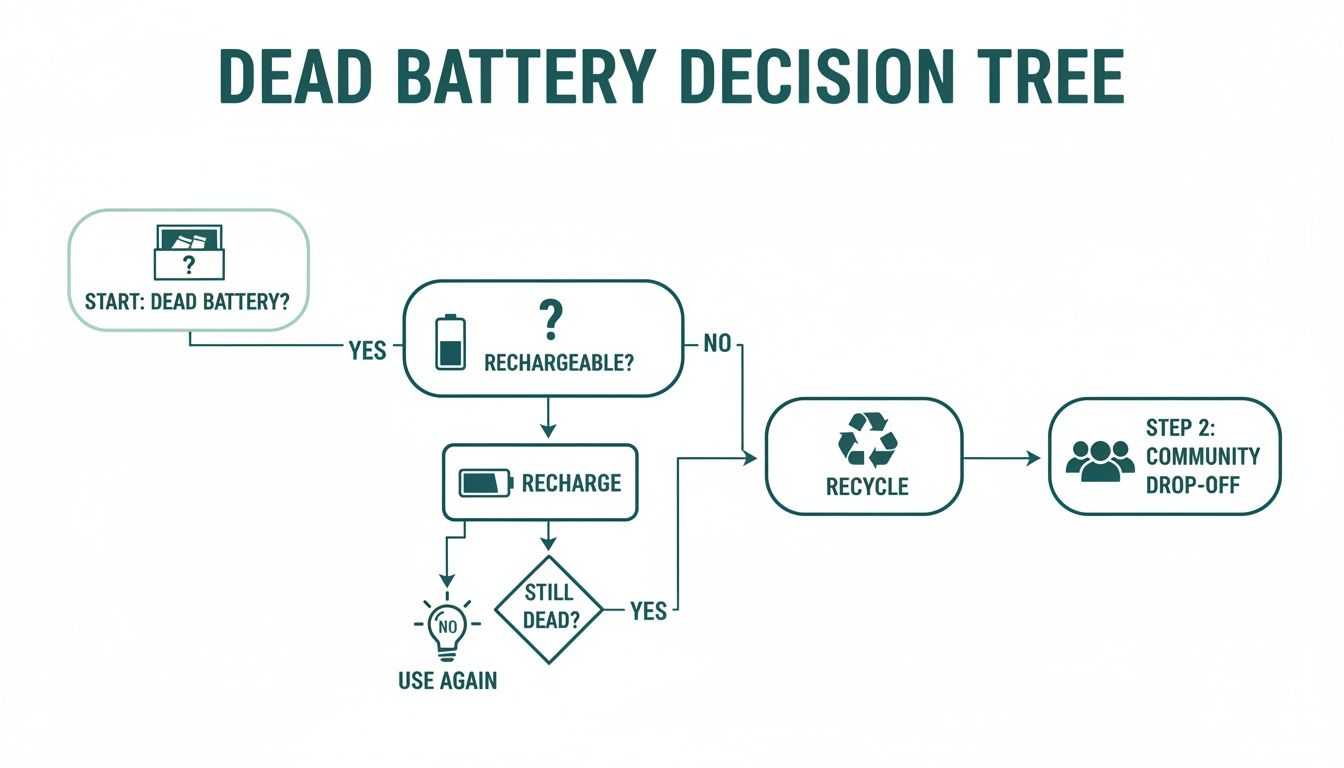
    A decision tree flowchart for dead batteries, guiding users on whether to recharge, recycle, or drop off for disposal.

    As you can see, every battery has a path forward, and it’s a lot simpler than you think to make the right call.

    The Bigger Picture in Chicago

    Your personal mission connects to a much larger city-wide effort. The truth is, Chicago has a lot of room for improvement. Our city's recycling rates are stubbornly low, and a big reason is "contamination"—when the wrong things get thrown in the blue bin.

    The good news? Illinois recently passed a law that requires battery producers to fund better collection programs, with big goals to recover 60-70 percent of batteries. For groups like ours, this is huge.

    A stronger city-wide system means the batteries we all collect have a better chance of actually being recycled. This new framework promises more drop-off points and better support, making it easier for every single one of us to do our part. By joining this effort, you're not just cleaning a drawer; you're helping build a more resilient Chicago.

    If this kind of hands-on work inspires you, check out our guide to environmental volunteer opportunities in Chicago to find more ways to make a difference.

    Find Your Local Battery Drop Off Point

    Alright, your batteries are taped, bagged, and ready for their next adventure. You’ve done the hard part—you faced the drawer. Now comes the fun part: finding them a new home.

    Think of this as your guide to the network of good people and places across Chicago ready to help you do the right thing. You’re not alone in this; a whole system is waiting for you.
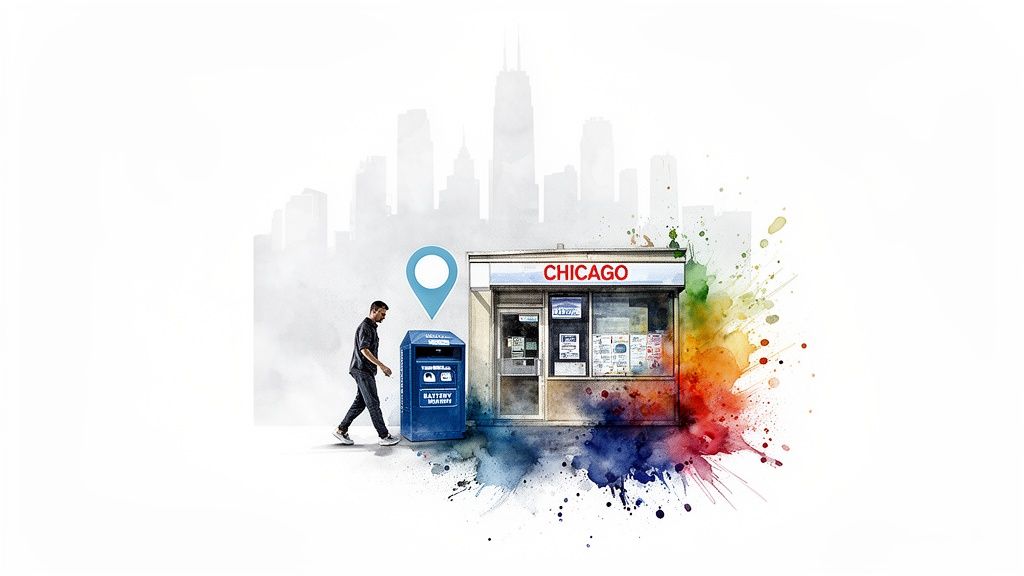
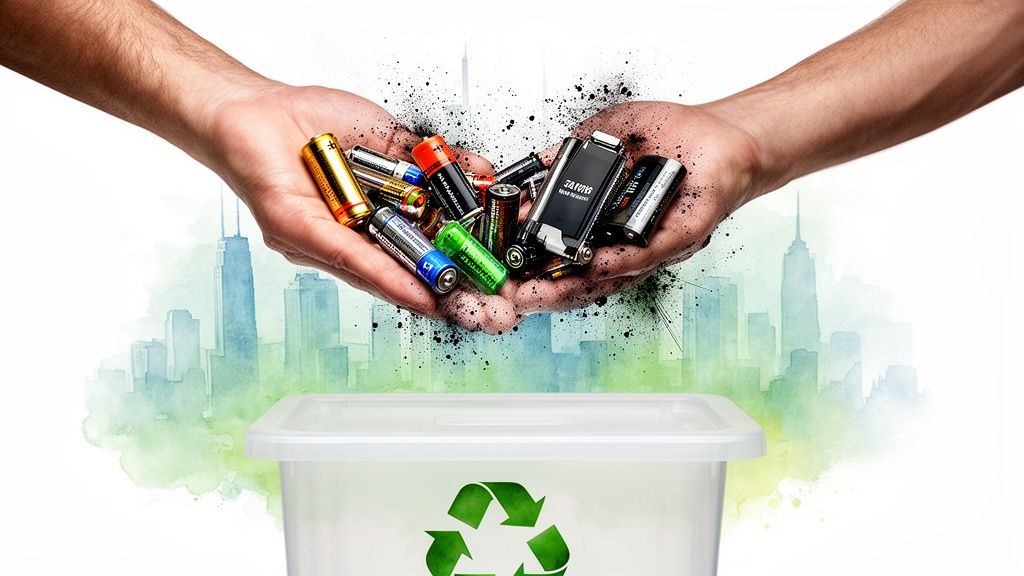
    Man walks by a blue battery recycling bin in a watercolor-style illustration of Chicago.

    City Of Chicago Household Hazardous Waste (HHW) Sites

    This is the big one. The City of Chicago runs a permanent drop-off facility for all sorts of household hazardous waste, and your old batteries are VIPs on their guest list. This is the official route to ensure your batteries are handled with the most care.

    It’s located at 1150 N. North Branch Street on Goose Island. Think of it as Grand Central Station for tricky-to-recycle items. It’s a drive-through service, which makes things incredibly simple.

    • When to Go: Tuesdays (7:00 AM to 12:00 PM), Thursdays (2:00 PM to 7:00 PM), and the first Saturday of every month (8:00 AM to 3:00 PM).
    • What to Expect: Seriously, it’s a no-fuss process. You don't even need to get out of your car. Just have your batteries ready in your trunk or back seat.
    • Pro Tip: This is the absolute best place to take any damaged, swollen, or leaking batteries. The staff there are trained pros. Don't mess around with those.

    The city also hosts periodic HHW collection events across different wards. Keep an eye on the Department of Streets and Sanitation website for an event near you. These pop-ups bring the service right to your neighborhood.

    Your Neighborhood Retail Partners

    Sometimes, a special trip isn't in the cards. That’s where many big-box retailers have stepped up to become community collection hubs. You’re probably already shopping at these places anyway.

    These stores are like friendly outposts on your recycling journey.

    • The Home Depot & Lowe's: Look for the Call2Recycle collection boxes, usually right near the entrance or by customer service. They’re a fantastic spot for rechargeable batteries from power tools, laptops, and phones.
    • Best Buy: This is my go-to for all sorts of electronic waste, including rechargeable batteries. Their collection kiosks are typically just inside the main entrance. You can’t miss them.
    • Staples: Another great spot for rechargeable batteries. Their drop-off bins are often located near their tech recycling services area.

    The simple act of adding "drop off batteries" to your weekend to-do list alongside "buy groceries" is a powerful habit. It transforms a chore into a seamless act of community care.

    The Hidden Network of Call2Recycle

    Beyond the big stores, there's a huge, unsung network of drop-off spots powered by Call2Recycle. This is where the real treasure hunt begins, uncovering convenient spots you might walk past every day.

    Call2Recycle is a non-profit that has placed collection boxes in thousands of local hardware stores, libraries, and municipal buildings. Finding one in Chicago is as easy as using their online locator. You’ll be surprised to discover a drop-off point in a local library or a small hardware store just a few blocks away.

    This network is proof that opportunities to do good are all around us, often hidden in plain sight.

    Taking this extra step is a small act of bravery that ripples through the entire system. When things like batteries get tossed in the blue bin, they can ruin entire batches of good recyclables. By using these dedicated drop-off points, you’re helping solve that problem directly.

    It’s like clearing a path for others to follow. And just like we find ways to recycle Christmas trees in Chicago after the holidays, finding a home for old batteries is a seasonal cleanup we can all get behind.

    Become a Recycling Hero in Your Community

    One person choosing to recycle batteries in Chicago is a great start. But an entire apartment building? A whole block?

    That’s a movement.

    This is your call to action. We live by the idea that "if you want to go far, go together." A single person cleaning a park is nice. A group of people cleaning a park becomes a force of nature.

    Three smiling people, two men and a woman, actively placing batteries into a collection bin, surrounded by colorful watercolor splashes.

    This is your fearless guide to becoming that force of nature right where you live. It’s about organizing your own community battery drive and showing everyone how easy it is to make an impact together.

    The Power of a Single Cardboard Box

    You don’t need a grant or a permit to start. All you need is a cardboard box and a little bit of courage.

    Think about a central spot where people already go. The lobby of your building, the mailroom, the counter at your favorite local coffee shop. These are perfect headquarters for your mission.

    One of our volunteers, Sarah, started this way. She put a clearly labeled box next to the mailboxes in her Logan Square three-flat with a simple, handwritten sign: "Dead Batteries Live Here!" Within a week, it was half full. Her neighbors didn't need a lecture; they just needed an easy way to do the right thing.

    Spreading the Word with Kindness

    Once your box is in place, it’s time to rally the troops. This isn't about shaming people into action. It's about inviting them on a fun, simple mission.

    Create a simple flyer—you can design one for free online or just write it out. The key is to keep the message clear, kind, and empowering.

    Your Flyer Should Include:

    • A Friendly Headline: "Let's Power Up Our Recycling!" or "Give Your Old Batteries a New Life!"
    • The Why (in one sentence): "Did you know batteries can cause fires in recycling trucks? Let's keep our sanitation workers safe!"
    • The How (super simple): "Just drop your old household batteries in the collection box in the lobby. Please tape the ends of rechargeable ones!"
    • The Who: "Your neighbor, [Your Name] from Apt 3B."

    Put these flyers on a community bulletin board or slip them under doors. People want to help. You're just making it ridiculously easy for them.

    The goal isn't just to collect batteries. It's to create a small act of connection. It’s a way of saying, "Hey, we're in this together, and we can make our little corner of the world better."

    This small effort turns an individual task into a shared victory. It’s the same spirit we bring when we’re cleaning up trash across the city, turning a chore into a chance for community.

    Making It an Event

    Want to take it to the next level? Make it an event. Announce a "Battery Drive Weekend" for your building or your block.

    Set up a collection table for a few hours on a Saturday morning. Bring some coffee or donuts. Play some music. Suddenly, recycling isn't a chore; it’s a neighborhood get-together. It’s a chance to meet the people you share walls with.

    This is how movements start. Not with a grand plan, but with small, consistent acts of service that bring people together. A few years ago, there were just three of us picking up trash in a hailstorm. Now, we're a city-wide family. Your battery drive can be the spark that builds a stronger, kinder community right where you are.

    Once your box is full, you become the hero who completes the mission. Bag up the batteries, make sure the terminals are taped, and take them to a drop-off spot. Then, post a "Thank You" note celebrating your collective success. You didn't just recycle batteries; you built something together.

    So, you’ve done it. You stared down the junk drawer, learned what goes where, and found the drop-off spots. You get it now—choosing to recycle batteries in Chicago isn't just another chore. It's a way of showing up for our city and, more importantly, for yourself.

    It reminds me of that first trash pickup, the one where we got caught in a hailstorm. We didn't set out with some grand mission to clean all 50 wards. It started with just showing up. Your journey is the same. It starts with one battery.

    This Is Just the Beginning

    This guide isn’t the finish line; it’s the starting block. When you take care of these small, forgotten things, you're building a powerful kind of self-trust. You're learning to handle your own messes, both the ones in your drawer and the ones in your life, one AA at a time.

    Service has a funny way of changing you from the inside out. It makes you more resilient. It proves you have the power to make things better, right where you are. That feeling you get from doing the right thing becomes its own reward, fueling the next brave step you take.

    The real transformation doesn’t happen when the battery lands in the recycling bin. It happens the moment you decide to act. That's the spark.

    Come Find Your People

    We’d love for you to join us, the Litter Caterpillars. This isn't just an invitation to pick up trash. It's an invitation to find real friendship, discover a deeper purpose, and experience the weird kind of joy that comes from showing up for Chicago and for each other.

    There’s a whole community of givers here, ready to welcome you. People who, like us, think that suffering through a little cold or rain for a good cause is a lot more interesting than sitting at home.

    Your transformation is waiting. It’s in that junk drawer. It’s on the sidewalk outside your door. It all starts with one small choice.

    What’s your next move?

    Common Questions We Get About Battery Recycling

    Thinking about how to recycle batteries in Chicago brings up a lot of questions. That’s a good thing. It means you're being intentional. Let's tackle some of the most common ones we hear.

    Can I Really Not Put Any Batteries in My Blue Bin?

    Yep, that's 100% correct. Never, ever, ever put batteries of any kind in your blue curbside recycling bin. Think of the blue bin as being just for paper, cans, and plastics.

    Batteries are like special agents on a different mission. When they end up in the wrong place, they get crushed, spark, and cause devastating fires that risk the lives of sanitation workers. It's a tiny choice for you that makes a world of difference for them. It’s a small act of bravery and kindness.

    What's the Biggest Mistake People Make?

    The most common—and most dangerous—mistake is not taping the ends of rechargeable, lithium-ion, or 9-volt batteries. It sounds so small, but when those metal ends touch each other or another piece of metal, they can short-circuit and ignite.

    A simple piece of clear tape over the ends is a tiny act of care that prevents a huge safety hazard.

    The second biggest mistake is what we call "wish-cycling"—tossing them in the blue bin and just hoping for the best. Hope is awesome, but for batteries, we need a plan.

    How Do I Handle a Swollen or Damaged Battery?

    A swollen, puffy, or damaged battery is a serious fire risk and must be handled with extreme care. This is a moment that calls for both bravery and caution.

    Don't just toss it in the trash or a regular recycling bin. Instead, place it in a non-flammable container like a glass jar filled with sand or kitty litter to keep it stable. Immediately take it to a City of Chicago Household Hazardous Waste (HHW) facility and let the staff know you have a damaged battery. They are trained to handle these things safely.

    Are Alkaline Batteries Like AAs Still Hazardous?

    Modern alkaline batteries (the AAs and AAAs in your remote) are way safer than their older, mercury-filled ancestors. While they can legally go in the trash in many places, recycling them is always the kinder, more impactful choice. It's about leaving things better than you found them.

    Recycling alkaline batteries recovers valuable materials like steel and zinc, reduces the need for destructive mining, and keeps even small amounts of heavy metals out of our landfills. It’s an easy win for the planet and a simple way to practice service in our daily lives.


    Ready to take the next brave step? Join Litter Caterpillars at one of our weekly cleanups and discover the power of service, friendship, and showing up for our city. Find your next event and your new community at https://www.littercaterpillars.com.


  • How to Recycle Christmas Trees in Chicago: Give Your Tree a Heroic Finale

    How to Recycle Christmas Trees in Chicago: Give Your Tree a Heroic Finale

    The holiday lights are packed away, but your Christmas tree's story isn't over. Don't just drag it to the curb. Imagine it embarking on a heroic new adventure, becoming vital mulch for Chicago's parks.

    It's shockingly simple to join thousands of your neighbors in this city-wide act of kindness. You can turn your tree's final chapter into a beautiful gift for the entire community. It’s a lot easier to make an impact than you think. And it's fun.

    Give Your Christmas Tree a Heroic Finale

    Think of your Christmas tree not just as a holiday decoration, but as a temporary visitor with a greater purpose. For a few weeks, it filled your home with joy and the scent of pine. Now, it has one last brave mission to complete: nourishing the very soil of our city.

    This isn’t about just getting rid of something; it’s about transformation. It's a small, kind act that ripples outward in a massive way. Instead of a lonely trip to the landfill, your tree can join a powerful movement.

    A happy couple carries a Christmas tree with a red ribbon through a watercolor-style city park.

    A Story of Collective Impact

    Every January, something amazing happens in Chicago. It’s a quiet but powerful parade of cars pulling up to local parks, each carrying a tree ready for its next chapter.

    This isn't just a city service; it's a community ritual. It's neighbors helping neighbors create a greener city, one tree at a time. This simple act of dropping off your tree is a vote for a healthier Chicago.

    This collective kindness has a huge effect. Chicago’s Holiday Tree Recycling program is a cornerstone of our city's green initiatives. In 2023 alone, residents helped divert over 20,000 trees—that’s about 730,000 pounds of organic material kept out of landfills where it would release harmful methane gas. That's a powerful example of how small, individual actions add up to a monumental impact.

    More Than Just Mulch

    This guide is your map for how to recycle Christmas trees in Chicago. But it's more than just logistics. It’s an invitation to see this final step as part of the holiday spirit itself—an act of giving back.

    Your tree's journey from a festive centerpiece to protective mulch is a perfect circle of life. The very thing that brought warmth and light into your home now protects the roots of new life in our public gardens and parks.

    Joining this effort connects you to something bigger than yourself. It’s like the work we do when we clean up a park; you take one small, brave step, and suddenly you’re part of a team making a visible, tangible difference. It feels good because it is good.

    Let’s make your tree’s finale a heroic one.

    How to Prep Your Tree for Its New Life

    Alright, before your tree gets its second chance as fragrant mulch for Chicago’s parks, it needs a little TLC from you. Don't think of it as a chore. Think of it as sending a friend off on their next great adventure—you’ve got to make sure they're packed right.

    This is the final step, a quick but crucial send-off for the tree that brought so much cheer into your home.

    Hands decorate a Christmas tree with colorful lights and ornaments, a box of tangled decorations nearby.

    Making Sure Your Tree is Ready to Recycle

    This is the most important part: your tree has to be completely bare. Naked. Back to its natural state, just like the day it was cut. That means every last ornament, every string of lights, and all that sneaky tinsel has got to go.

    Why the fuss? Because even one tiny metal hook or a single strand of tinsel can bring the entire recycling operation to a screeching halt. Those wood chippers are powerful, but they’re not designed to chew through metal, plastic, or glass.

    When a machine gets jammed, it's not just a minor hiccup. It causes delays for the whole program, slowing down the process of creating that awesome mulch our parks desperately need.

    The "Undecorating" Checklist

    Give your tree a good once-over to make sure you've caught everything. Here's what you need to strip away:

    • Ornaments: All of them. Glass balls, wooden soldiers, your kid’s macaroni masterpiece—everything.
    • Lights: Take your time and unwind every single strand.
    • Tinsel and Garland: This stuff is the absolute worst for the machinery. Be thorough.
    • Tree Stand: The base, whether it's metal or plastic, has to come off.
    • Bags & Skirts: Don't wrap your tree in a plastic bag or leave the skirt on it. Just the tree, please!

    I like to think of this as the tree's final act of service. By stripping it down, you're honoring its journey and making sure it can give back to the earth in a meaningful way.

    One quick but important note: flocked trees can't be recycled. That fake snow spray contains adhesives and other gunk that contaminates the mulch and makes it unusable for city parks. If you have a flocked tree, it needs to go out with your regular bulk trash.

    Taking a few extra minutes to prep your tree properly makes a huge difference. It’s a simple act of respect for the city workers, the equipment, and the green spaces that will benefit from your tree's next chapter.

    How to Recycle Your Tree with the City of Chicago

    Look, Chicago gets it. After the holidays, you’ve got this giant, drying-out tree in your living room, and you want to do the right thing. The good news is, the city’s official program makes it ridiculously easy to give your tree a second life instead of just chucking it in a landfill.

    This isn't just about getting rid of something; it's about being part of a massive, city-wide effort. Think about it: your one tree, combined with tens of thousands of others, becomes a huge pile of mulch that protects the soil in our parks. It's a small act with a big, tangible payoff for the city we all share.

    Finding Your Local Drop-Off Spot

    Every January, the city transforms dozens of parks into tree recycling hubs. Seriously, they're everywhere—from the far North Side to the deepest South Side. There’s almost definitely one just a short drive from your place.

    The program usually kicks off the first Saturday after New Year's and runs for about two weeks. This gives you plenty of time to untangle the last of the lights and haul it over. To find the spot closest to you, just head to the Chicago Park District website. They post an updated map and list of locations every year.

    There's something really cool about showing up and seeing that growing mountain of trees. It feels like you're part of a secret club of people who actually care. You realize you're not the only one making this small effort, and it’s a quiet, powerful reminder that we're all in this together.

    Live in a House or Small Building? You Might Get Curbside Pickup

    For some Chicagoans, it gets even easier. If you live in a single-family home or a smaller apartment building (usually four units or less) that gets its regular trash and recycling picked up by the Department of Streets and Sanitation (DSS), they'll come get your tree right from your alley or curb.

    You just have to strip it bare—no lights, no tinsel, no stand—and put it out during the designated collection weeks in January. DSS crews will grab it along with the regular trash.

    A word of caution: if you're in a big condo building or a high-rise with a private trash contract, this isn't for you. You'll need to use one of the park drop-off spots or find another option.

    The Best Part: Taking Home Free Mulch

    This is where the whole thing comes full circle, and it’s honestly pretty beautiful. The city doesn't just hoard all that amazing mulch for itself. After they've chipped all those thousands of trees, they give it right back to us.

    Starting around the second week of January, six specific parks become distribution centers where you can go and get free mulch for your own garden beds or backyard projects.

    Here’s what you need to know before you go:

    • It’s DIY. Bring your own shovels and bags or buckets. Nobody is there to load it for you.
    • It’s first-come, first-served. The mulch is available only while supplies last, so don't wait until the last minute.
    • It’s a connection. You’re literally bringing your tree's story back home, using its remains to nourish your own little piece of Chicago.

    It’s the perfect end to the story. The tree that lit up your home for a month gets to return the favor, protecting the plants in your garden. It’s a simple, powerful reminder that doing good for your community can also be good for you.

    Creative Alternatives to City Drop Off

    The city’s program is a fantastic way to recycle Christmas trees in Chicago, but life doesn't always fit neatly into a two-week window. Maybe your schedule is insane, you don't have a car, or you just want a more direct, personal way to give back. That’s more than okay; it’s an opportunity to get brave and find a different path.

    Think of it like Tom Sawyer painting the fence. He turned a boring punishment into an adventure his friends paid to join. Your tree's final journey doesn't have to be a chore. It can be a creative act of kindness that feels uniquely you. The city park isn't the only destination; it's just the most well-known road.

    Forge Your Own Green Path

    What if your tree could help a small, local business thrive? Or become a tasty snack for some very happy animals? These aren't just ideas; they're real options that let you make an impact on your own terms.

    • Private Haul-Away Services: For a fee, companies like City Tree Delivery will come right to your door, grab your tree, and make sure it gets recycled properly. It’s the ultimate convenience, especially if you're in a high-rise or don't have a vehicle. You're not just buying a service; you're supporting a local business that makes sustainability easy.

    • Goat-astic Donations: This one is my absolute favorite. Local farms and animal sanctuaries sometimes accept Christmas tree donations because goats, in particular, think pine needles are a delicious and nutritious winter treat! A quick search for "goat farm near Chicago" or a call to an animal rescue can turn your old tree into a feast. It’s a beautiful, direct way to give back.

    • Backyard Bird Sanctuary: You can give your tree an extended life right in your own yard. Just prop it up in a corner and decorate it with bird feeders, suet cages, and strings of popcorn. It provides crucial shelter for birds during the harsh Chicago winter, turning your yard into a lively little haven.

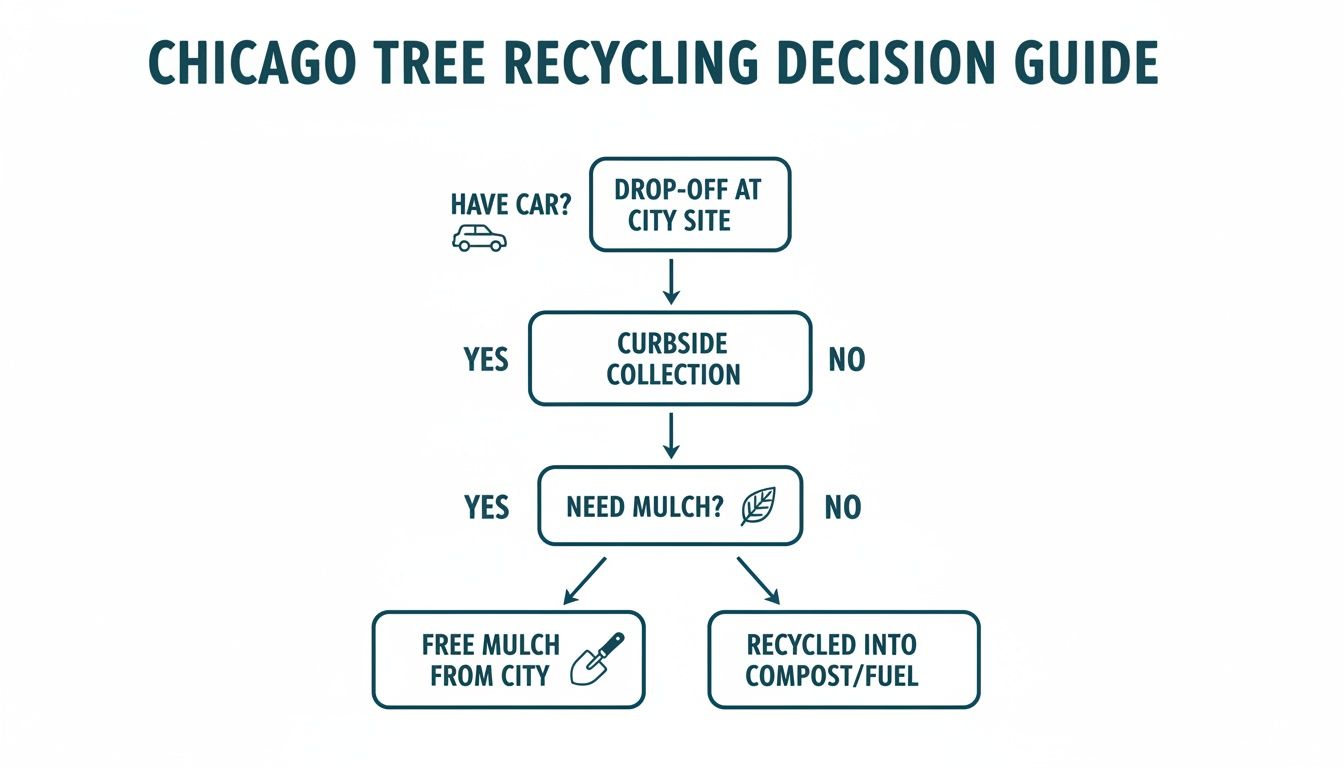
    This simple decision tree can help you visualize your options.

    A flowchart guiding Chicago residents on how to recycle their Christmas trees, offering options like drop-off, curbside, mulch, or composting.

    As the flowchart shows, your best choice often comes down to simple logistics, like whether you have a car or need mulch for your garden.

    Rally Your Community for Collective Action

    You don't have to do this alone. The most powerful changes happen when we team up. If you're feeling inspired, why not organize a tree collection event for your block or building?

    It’s way simpler than you think. Pick a weekend, spread the word on a neighborhood Facebook group, and have everyone bring their trees to one spot. From there, you can either hire a single private service to pick them all up at once—splitting the cost makes it super affordable—or organize a carpool to the nearest city drop-off.

    This is where the magic happens. A simple task becomes a community-building event. You’re not just recycling trees; you’re building connections, sharing a purpose, and making your corner of the world a little kinder and greener.

    This is the very spirit that drives community action. If the idea of bringing neighbors together for a common cause lights a fire in you, you might be a perfect fit for volunteer opportunities in Chicago that focus on hands-on, local impact. It's about finding joy in service, together.

    What Good Does Recycling One Tree Really Do?

    It’s a fair question. You look at your single, solitary tree and think, "What difference can this possibly make?" By itself, one tree feels small, almost insignificant.

    But your tree isn't alone. It’s part of a massive, city-wide effort. Think of it like a single raindrop. Alone, it’s just a drop. But when it joins millions of others, it becomes a powerful river, capable of changing the entire landscape.

    When you recycle Christmas trees in Chicago, you’re joining that river with thousands of your neighbors. This collective action is what turns a small choice into a tidal wave of positive change.

    From Your Living Room to a Healthier Planet

    The story of your tree doesn’t end when you drop it off at the park. Its final chapter is directly tied to the health of our planet. When a tree gets tossed in a landfill, it’s like sealing it in a plastic bag and burying it. Starved of oxygen, it can’t decompose the way it’s supposed to.

    Instead, it releases methane, a greenhouse gas that’s over 25 times more potent than carbon dioxide at trapping heat. That one small act of tossing a tree in the alley has a surprisingly big, negative footprint.

    Recycling flips the script completely. Chipping that same tree into mulch lets it break down naturally, feeding the soil instead of poisoning the air. It’s a brave choice that actively fights back against climate change.

    The Real Tree vs. Fake Tree Showdown

    So, what about the alternative? The artificial tree. It seems reusable, maybe even eco-friendly at first glance, but its story is often much darker. Most are made from non-biodegradable PVC plastics and shipped thousands of miles, leaving a huge carbon footprint.

    When they eventually break or just go out of style, their final stop is almost always the landfill, where they’ll sit for centuries without breaking down.

    A real tree, on the other hand, completes a beautiful, natural cycle when you recycle it. And this isn't just a local thing; it's a national movement. A staggering 93% of U.S. consumers who buy real trees recycle them. This commitment shows up big time right here in Chicago, where the city's program has diverted hundreds of thousands of pounds of waste, turning would-be pollutants into precious resources for our parks.

    Choosing to recycle your real tree isn't just about avoiding the landfill. It's a vote for a sustainable, renewable system where nature’s gifts are honored from start to finish. You’re choosing a living thing that, even in its final act, continues to give back.

    This is the power of a single choice. It’s the same spirit we channel when we focus on cleaning up trash one piece at a time. A small, local action creates a real, global impact. This is how we build a kinder, greener world together.

    Answering Your Chicago Tree Recycling Questions

    We get it. You've got questions. That's a great sign—it means you're already thinking about how to do the right thing, the brave thing. Fear and "what ifs" can stop us cold, but a little knowledge is all it takes to light up the path. Let's tackle those common questions so you can get moving with confidence.

    What If I Miss the City's Recycling Dates?

    It happens! Life gets chaotic, and suddenly you realize the city's drop-off window slammed shut. Don't let that little hiccup send your tree to a landfill. Think of it as a detour, not a dead end.

    You've still got great options. Plenty of private haulers will pick up trees well into January. Or get creative and call up a local community garden. Sometimes they'll take trees for composting or to lay down on their pathways. The only wrong move is just leaving it in the alley. Then it’s just trash, not a gift back to the earth.

    Can I Recycle My Wreath or Other Greenery?

    This is a fantastic question because it shows you're thinking beyond just the big tree. The short answer is, unfortunately, no—at least not in the city’s program. Most wreaths and garlands are sneakily built on a hidden wire frame.

    That little bit of wire is like a secret agent of destruction for the giant wood chippers they use. It can jam up the whole operation.

    But you can still be a hero here. Just take a few minutes to snip the greenery off the wire frame yourself. The branches can go into a home compost bin, and you can toss the metal frame in with your other recycling. It’s a small extra step that makes a huge difference.

    My Tree Is Flocked. What Should I Do?

    Ah, the flocked tree. It looks like a winter dream, but it's a recycling nightmare. That beautiful fake snow is made of adhesives and chemicals that poison the mulch, making it totally unsafe for our city's parks and gardens.

    For a flocked tree, your only real option is to schedule a bulk trash pickup. It’s a bummer, I know. But look at it this way: now you have a powerful piece of knowledge for next year. Choosing a natural, unflocked tree from the get-go is an act of kindness to Chicago's green spaces.

    How Can I Organize a Tree Collection in My Neighborhood?

    What a powerful, kind idea! This is exactly how real community gets built—by turning a small personal chore into a shared mission. It reminds me of Tom Sawyer convincing his friends that painting a fence was an honor, not a punishment.

    Start small. Post on your neighborhood Facebook group or on Nextdoor. Pick a central spot—someone's big driveway works great—and set a date. From there, you can either organize a carpool to the nearest city drop-off or call a private hauler to get a bulk quote. When everyone chips in a few bucks, it becomes super affordable.

    You’re not just moving trees; you’re building friendships and showing everyone how easy it is to make a huge impact when we work together.


    At Litter Caterpillars, we believe these small, brave acts of service are what transform our city and ourselves. If you love the feeling of teaming up to make Chicago a better place, we invite you to join us. Check out our upcoming events at https://www.littercaterpillars.com.

  • Cleaning Up a River: Your Guide to Making a Real Difference

    Cleaning Up a River: Your Guide to Making a Real Difference

    It all starts with one person and one trash bag.

    Seriously. That’s it. That’s the secret to sparking massive, positive change in your community. Forget needing some grand, complicated plan or a massive team. You just have to be brave enough to start.

    The Unbelievable Power of a Single Trash Bag

    Man in a cap and shirt carrying a bag walks along a serene riverbank at golden hour.

    You know that feeling, right? You're walking along the river, and you see plastic bottles and old bags tangled in the reeds. Your heart sinks. It's that familiar pang of sadness mixed with a heavy dose of helplessness, the sense that the problem is just too big for one person to tackle.

    We're here to tell you that’s a lie. The real magic isn't in some massive, top-down initiative. It's in the simple, brave act of just starting.

    This whole guide is built on one core belief: you have the power to create incredible change.

    We’ve seen it happen. I remember a few friends who were just fed up with seeing the same stretch of their local river choked with trash. One Saturday, armed with nothing more than gloves, trash bags, and a shared feeling of "enough is enough," they just started cleaning. That one small act of bravery snowballed into a community-wide movement that made the whole town proud.

    From Helpless to Hopeful

    This isn't about being some credentialed environmental expert. It's about being a neighbor who gives a damn. We want to help you shift your mindset from "someone should really do something about this" to "I can actually do something amazing."

    The journey of cleaning up a river isn't just about the impact—it's deeply rewarding and, believe it or not, a ton of fun. You meet people who care as much as you do. You get to see the direct result of your work. It's pure, simple, and good.

    Sure, the scale of the problem can feel overwhelming. Globally, it’s estimated that 1.95 million metric tonnes of plastic flows down our rivers every single year. But that number isn’t a reason for despair; it's a call to action. Small, dedicated groups are already making a huge dent in it, one kind act at a time.

    "Think of a river cleanup like Tom Sawyer painting the fence. He didn't see it as a chore; he made it an adventure so compelling that his friends literally paid him for the chance to help. That’s the spirit we’re channeling here—turning service into something joyful and magnetic."

    This guide is your playbook for turning that spark of inspiration into a real, tangible, and fun event. It’s as much about your personal growth as it is about community service. You'll find that the tools you need for both are way simpler than you think. In fact, you can apply these same principles anywhere—you might even check out our guide on cleaning up trash in your neighborhood.

    Let's get one thing straight: it’s a LOT easier to make an impact than you think. Let's show you how.

    How to Plan Your First Cleanup Adventure

    That little spark you're feeling? Let's turn it into a full-blown bonfire. This is where your good intentions start growing legs, where your kindness gets an action plan. But hold off on the complicated spreadsheets and dry logistics for now. The real adventure of cleaning up a river starts with something much simpler: a walk.

    The very first step is just about getting out there and being a curious explorer in your own backyard. Lace up some comfy shoes and go scout a stretch of your local river. What do you actually see? Is it a minefield of plastic bottles tangled in tree branches? A sad graveyard of old tires half-sunk in the mud? Or is it maybe just a light dusting of everyday trash that feels totally doable for a small crew?

    I'll never forget a story I heard about a group out in the Midwest. They were scouting a park that looked pretty clean on the surface. But one person, with a bit of a brave streak, spotted a faint trail of old construction debris leading into the woods. They followed it. Not even 50 yards off the main path, they discovered a massive illegal dumping site, completely hidden from sight. That one curious walk turned their small litter pickup into a major restoration project. That’s the power of looking a little closer.

    Become a River Detective

    Think of this first walk as a recon mission. You’re gathering intel. You're not just spotting trash; you're getting a feel for the terrain, understanding the challenges, and seeing the opportunities. It's like mapping out a hiking trail before you lead a group on it. A little prep work here builds a ton of confidence for the main event.

    Before you start planning anything, you need to know what you're up against. Your initial scouting trip is all about gathering the on-the-ground facts that will shape your entire event.

    Use this checklist as your guide when you first walk the site. It’ll help you spot the critical details that make the difference between a chaotic day and a smooth, successful cleanup.

    Your Initial River Scouting Checklist

    Area to Assess What to Look For (Examples) Why It Matters
    Volunteer Access Are there official parking lots? Paved or unpaved trails? Public boat ramps or easy-to-walk-down banks? You need safe, clear entry points for your crew. Kindness means not making people scramble down a treacherous, muddy hill to help out.
    Trash Hotspots Look for eddies where trash collects, areas under bridges, or sections near storm drains. This helps you focus your energy. You can direct teams to the highest-impact zones right away instead of having them wander aimlessly.
    Safety Hazards Steep, slippery banks? Patches of poison ivy? Areas with fast-moving water or hidden drop-offs? Volunteer safety is everything. Identifying hazards beforehand lets you warn everyone and mark off any no-go zones on the day of the event. Being brave doesn't mean being reckless.
    The "Big Stuff" Discarded furniture, shopping carts, tires, appliances, or anything that looks like it might contain chemicals. These items often require special equipment, more people, or specific disposal methods. You need to know about them early to plan properly.

    This scouting trip does more than just give you data; it gives you a story. It transforms your mission from a vague "let's clean the river" into a powerful, concrete goal: "We're going to clear that huge pile of styrofoam from under the old bridge." That’s something people can rally behind.

    Starting the Conversation with Your City

    Alright, now for the part that sometimes makes people nervous: talking to local officials. Let's reframe this. This isn't some bureaucratic chore; it's a conversation with a potential partner. You're the one bravely stepping up to improve a public space—most city and park departments will be thrilled to have your help.

    Your first call should probably be to your local Parks and Recreation Department. When you connect, be direct, friendly, and fearless.

    Instead of asking, "Am I allowed to do this?" try framing it this way: "Hi! I'm leading a group of neighbors who are excited to help clean up the riverbank at Lincoln Park. What’s the best way we can coordinate with you to make sure our event is safe and successful?"

    That small shift in language changes the entire dynamic. You’re not a kid asking for permission; you’re an organized leader asking for a partnership. It shows you’re serious and that you respect the process.

    This one conversation can be a goldmine. They can give you crucial info on waste disposal, flag any sensitive wildlife areas to avoid, and sometimes even provide supplies like bags and gloves. Building this relationship from the start makes your event solid, safe, and way more impactful.

    How to Rally Your Crew of River Champions

    A river cleanup is a team sport. Its magic doesn’t come from a perfectly executed plan; it comes from people showing up for each other and for a piece of earth they care about. This is where we gather your crew, but let’s throw out the idea of a boring, formal volunteer call.

    Think of this as inviting friends to a party with a purpose. Your passion is the real invitation.

    This isn’t about begging for help. It’s about sharing an opportunity to do something that feels good, something that connects us to our community and to each other. It’s a chance to spend a few hours outside, get our hands a little dirty, and see a tangible, beautiful result at the end of it.

    The real power of cleaning up a river is that it’s a shared victory.

    Finding Your First Believers

    Forget mass emails and generic flyers, at least for now. Your first champions are probably already in your life.

    Start with the people who get you. The friend you go hiking with, the person you grab coffee with every week, the neighbor who also complains about the trash in the park. Your invitation can be as simple as: “Hey, I’m putting together a small group to clean up that messy spot by the old bridge next Saturday morning. Want to join me? We’ll grab pizza after.”

    That’s it. It’s personal, it’s kind, and it’s brave. You’re stepping up and inviting others into your vision.

    The goal isn't to recruit an army overnight. It's to find your first few "yeses." Those first few people are like the kindling for a campfire; their energy and belief will attract others and help the movement grow.

    From there, the circle widens. Think about the natural gathering spots in your community. Where do people who care about local spaces already hang out?

    • Local Coffee Shops: Chat with the owner or manager. Ask if you can leave a small, story-driven postcard at the counter.
    • Outdoor & Hobby Groups: Connect with local hiking clubs, bird-watching societies, or even book groups. Their members already value community and the outdoors.
    • Neighborhood Social Media Pages: Craft a post that tells a story, not just a call for volunteers. Instead of "Volunteers Needed," try something like, "Felt heartbroken seeing all the plastic along our river this morning. I’m going out with a few friends on Saturday at 10 AM to do something about it. Anyone want to be a hero with us?"

    Telling a simple, authentic story connects with people on an emotional level. It transforms a task into a mission. And if you’re looking for more creative ways to spread the word, our guide on how to find volunteers offers even more ideas for building your team.

    The Gentle Art of Asking for Help

    Now let’s talk about partnerships. Asking a local business for support can feel intimidating, but it’s just another conversation. You’re not asking for a handout; you’re offering them a chance to be a hero in their own community story.

    People want to help—they often just need a clear and kind invitation. When you walk into that local hardware store or pizzeria, go in with a smile and a simple, direct request.

    Scenario: Asking a Hardware Store for Supplies

    • Don't say: "Can you donate something to my event?"
    • Do say: "Hi, I’m Sarah. A few of us neighbors are cleaning up the riverbank behind the library this weekend. We're so excited, but we're short on work gloves for everyone. Would you be willing to help us out by donating a few pairs? We’d be sure to give your store a huge thank you on our social media page."

    Scenario: Asking a Pizzeria for Post-Cleanup Food

    • Don't say: "We need food for our volunteers."
    • Do say: "Hi, I’m Mike. Our community group is spending Saturday morning cleaning up trash along Miller Creek. We’re expecting about 20 people to come out. We’d love to celebrate their hard work afterward and were wondering if you might be able to help us with a couple of pizzas? It would mean the world to our crew."

    This approach is kind, specific, and honors their contribution. You are inviting them to be part of the celebration.

    Building these small, local partnerships is how a one-day event starts to feel like a true community movement. You’re not just cleaning up a river; you’re weaving a stronger, more connected neighborhood, one brave and kind conversation at a time.

    Your Game Plan for a Safe and Unforgettable Cleanup Day

    The big day is finally here. This is the moment it all pays off. What follows is your playbook for turning a great idea into a lasting memory—an event that’s not just effective, but safe, fun, and genuinely empowering for every single person who shows up.

    Forget the dry, boring safety manuals. Today, you're not just an organizer; you're an expedition leader. Your job is to make safety feel like empowerment, not a list of restrictive rules. It’s about creating an atmosphere where everyone feels looked after, confident, and ready to make a real difference.

    Crafting a Safety Briefing That Actually Connects

    Think of the pre-cleanup huddle as a campfire gathering, not a lecture. This is your chance to set the tone for the whole day. Get everyone in a circle, make eye contact, and speak from the heart. This is where a group of strangers becomes a unified, caring team.

    A good briefing is the foundation of a safe event. Keep it engaging, clear, and kind.

    • Talk About the Hazards Honestly: Be upfront about the real risks. Mention slippery banks, poison ivy, and the potential for sharp objects. You're not trying to scare people; you're equipping them. Frame it like, "We're going to be brave and smart out there today, and that means looking out for each other."
    • Show, Don't Just Tell: Demonstrate how to do things right. The most important one? Show everyone the proper way to lift a heavy bag—bend with your knees, not your back. It’s a simple move that prevents a world of hurt.
    • Make the Buddy System Mandatory: This one is non-negotiable. Pair people up and tell them their main job is to keep an eye on their partner. This instantly builds camaraderie and creates a web of safety across the entire group.

    The story of the Citarum River in Indonesia really puts this in perspective. Cleanup crews there pulled a staggering 3,200 tons of waste from the river in a single year. That same river has mercury levels 100 times above safety standards. It’s a stark reminder of why safety has to be number one—you never know what’s lurking in the water.

    Your Essential Gear Checklist

    Having the right equipment is an act of care for your volunteers. It tells them you’ve thought about their well-being from the start. You don't need a warehouse full of gear, just the smart essentials.

    Here’s a simple, can't-skip list:

    • Puncture-Proof Gloves: This is your #1 priority. Hands need to be protected from glass, metal, and whatever else is hiding in the mud.
    • Sturdy Trash Bags: Get the heavy-duty kind. The last thing you want are bags ripping open when they're full of wet, jagged debris.
    • A Well-Stocked First-Aid Kit: Make sure it's easy to find and at least one other person knows where it is. Stock it with bandages, antiseptic wipes, pain relievers, and anything else you might need.
    • Hand Sanitizer and Wipes: An absolute must for a quick clean-up before grabbing a snack or after handling particularly grimy trash.
    • Buckets or Tubs: These are surprisingly useful for carrying smaller bits of trash or consolidating half-full bags, which makes the whole process way more efficient.

    These principles for a safe event apply everywhere, from riverbanks to city squares. For more tips on group safety and logistics, check out our guide on how to clean up a park.

    Building Your Base Camp and Logistics Flow

    Every great expedition needs a base camp. For your cleanup, this is the heart of the operation—a central spot where people check in, grab supplies, take a break, and connect. It doesn't have to be fancy. A pop-up tent or a couple of folding tables under a shady tree works perfectly.

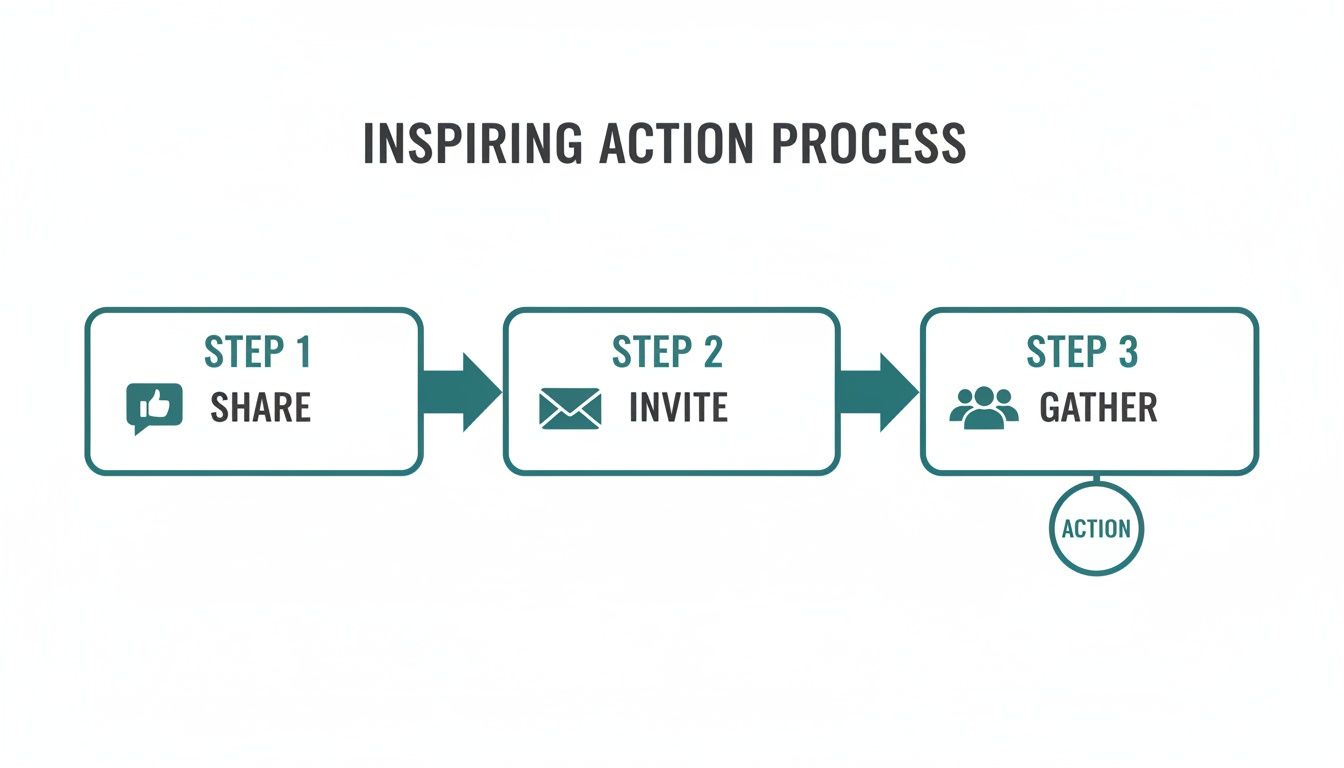
    This graphic shows the simple journey that got you and your team to this point.

    A graphic illustrating a team building journey with three steps: Inspire, Partner, and Gather.

    Each step—inspiring others, partnering with your community, and gathering your crew—is what makes a successful and safe cleanup day possible.

    "A well-organized base camp is a message to your volunteers: 'You are valued here. Your comfort and safety matter.' It turns a tough job into a supported mission."

    Set up clear stations for water, snacks, and sorting the trash. A simple system—one pile for recycling, one for general trash—makes the final disposal so much easier. This central hub ensures nobody gets lost, everyone stays hydrated, and the day runs like a well-oiled machine. Make sure you've coordinated your waste pickup ahead of time so the fruits of your labor don't just become a new eyesore.

    Finally, designate a photographer. Capturing the smiles, the teamwork, and the triumphant moments will tell the story of your success long after the last bag is gone.

    How to Turn One Great Day into a Lasting Movement

    Six diverse volunteers celebrate a successful outdoor cleanup, displaying a '2,000lb removed' sign.

    The last bag of trash is tied off, and that quiet sense of victory settles over your crew. This feeling right here? This is the most important part of your entire river cleanup. It's the spark that can ignite a lasting movement, but only if you tend to it.

    Don't let this incredible energy just fizzle out as people head home. The work isn't truly over until you’ve honored the effort. This is your victory lap, and it's where a one-day event transforms into a real community of river champions.

    Celebrate Your Champions

    Think of your cleanup as a championship game. You wouldn't win the Super Bowl and then just quietly walk off the field, right? You celebrate! Your volunteers are the MVPs, and they absolutely deserve to feel like it.

    A celebration doesn't need to be fancy or expensive. Its only job is to be genuine.

    • Host an immediate after-party. This could be as simple as pizzas and sodas at a nearby park or moving the crew to a local cafe that offered you a discount. The goal is to give everyone a chance to connect as friends, not just as fellow workers.
    • Give a heartfelt thank you speech. Before everyone scatters, get them together. Look them in the eye and tell them what their effort means. Share a specific, memorable moment from the day—maybe someone pulling a particularly gnarly tire from the mud.
    • Share the glory. Get photos up on your social media pages within 24 hours. Tag anyone you can, and shower praise on your team and community partners. Make your volunteers the heroes of the story, because they are.

    This simple act of celebration tells every single person that their time and sweat were seen, valued, and deeply appreciated. That feeling is what brings them back.

    The Power of Cold, Hard Data

    Now, let's give all that hard work a voice that can speak to city councils, potential sponsors, and future volunteers. The most powerful way to do that is with data. Numbers tell a story that's impossible to ignore.

    Before the trash is hauled away, take a few minutes for this crucial step: weigh the collected trash. A simple bathroom scale or a luggage scale can do the trick. Tally up the total weight and count the number of bags you filled.

    Imagine telling your town, "Today, our team of 50 neighbors removed 2,000 pounds of plastic, tires, and debris from our river in just three hours." That’s not just a feel-good story; it’s a headline that demands attention and inspires action.

    This data becomes your proof of impact. It’s the evidence you can use in grant applications, partnership proposals, and media outreach. It quantifies your effort and turns a day of cleaning up into a measurable community achievement.

    Keeping the Campfire Burning

    Your event created a powerful burst of positive energy. The final piece of the puzzle is to capture that energy and keep it glowing. Don't let the community you just built fade away.

    This is about creating a real legacy for your river.

    1. Follow Up Fast: Send a thank-you email to all participants within 48 hours. Share the final stats (pounds of trash collected!), include a link to the photo gallery, and give a shout-out to your partners.
    2. Create a Hub: Start a simple Facebook group or an email newsletter. This gives your river champions a place to stay connected, share ideas, and hear about future events. It’s their community space.
    3. Plant the Seed for Next Time: In your follow-up, mention that you're already thinking about the next cleanup. This simple act turns a single event into the beginning of a sustained effort.

    This data-driven approach is critical on a global scale, too. We know that ten major rivers are responsible for an astonishing 90% of all plastic that flows into the world's oceans. Reporting your local data contributes to a bigger picture, showing how targeted cleanups can make a massive difference. You can read more about these global pollution statistics and discover why every piece of data matters.

    By celebrating your people, measuring your impact, and building a community, you turn one great day into an unstoppable force for good. You’ve shown everyone just how easy—and fun—it is to make a real difference.

    Your Questions About River Cleanups Answered

    So, you feel that pull. You're ready to do something brave and kind for your river. But then the questions start creeping in, the little "what ifs" that can stop you cold if you let them.

    Let's drag those questions out into the sunlight and tackle them head-on. These aren't roadblocks; they're just the last few turns you need to figure out before the real adventure begins. We've been there, and we've got the answers to help you lead with confidence.

    What If I Can't Get Official Permission?

    This is a classic fear, but don't let it kill your momentum. It's almost never a hard "no." It's usually just a matter of finding the right person to talk to.

    Your first stop should be your local parks and recreation department. When you call, don't frame it as asking for permission. Frame it as offering a gift. You're a community leader bringing a team of passionate people to beautify a public space they're in charge of—for free.

    If that’s a dead end, look up a local environmental nonprofit. These folks often have relationships with city officials already baked in. They might partner with you or just give you the right name to call.

    "Sometimes, the kindest path is the simplest one. Grab a few friends for a 'plogging' walk—jogging and picking up litter. This small, brave act often requires no permits and shows you're serious. It builds the foundation for something much bigger."

    How Do We Handle Large or Hazardous Items?

    Your crew's safety is everything. This is where your kindness as a leader has to be fierce. Their job is the everyday stuff—plastic bottles, foam cups, chip bags. For anything else, the rule is simple and absolute.

    If you come across big items like tires or furniture, or anything that looks sketchy like sealed drums or chemical containers, the rule is: Do Not Touch.

    In this situation, your team's job is to become expert witnesses.

    • Flag it: Have volunteers mark the spot so it's easy to find again.
    • Document it: Snap a quick photo on a phone.
    • Report it: Mark the location on a map and call it in to the right people, like your city’s public works or environmental protection agency.

    You're their eyes on the ground. Reporting these bigger problems is a huge part of the mission. It’s an act of bravery that protects your people and the river.

    How Can I Keep Volunteers Motivated for Future Events?

    The trick to turning first-timers into a loyal crew isn't complicated: make them feel seen, valued, and part of a team that wins. You’re not just filling a roster; you're building a community.

    It all starts on cleanup day. Be organized. Be positive. Thank everyone, out loud, for their hard work. Let them stand back and see the massive pile of trash they collected together. Let them feel their impact.

    Then, follow up within 48 hours. Send an email celebrating what you all accomplished. Use the numbers: “Together, we pulled 800 pounds of trash out of our river!” Fill it with pictures of people smiling, working, and looking proud.

    The real magic, though, is giving that energy a home. Start a simple Facebook group or an email list to share updates and celebrate the wins. When you focus on the shared passion, the cleanup stops being a one-time chore and becomes a joyful, ongoing movement they can't wait to join again.


    At Litter Caterpillars, we believe in showing up for our city and each other, one piece of trash at a time. If you’re in Chicago and ready to find friendship and purpose through service, join our next adventure. Learn more about our mission and find an event at https://www.littercaterpillars.com.
  • Clean Up a Park: How One Brave Act Can Change Everything

    Clean Up a Park: How One Brave Act Can Change Everything

    You don't need a master plan. You don't need a city permit. To clean up a park, all you need is a garbage bag, a pair of gloves, and the guts to start.

    Seriously. That’s it.

    This whole thing is a lot easier than you think. Grab a bag, ask a friend to come along, and just begin. This one small, brave act is a stone tossed into a still pond. The ripples will surprise you.

    The Moment You Decide to Be the Change

    It always starts with a walk. You're in your favorite park, maybe cutting through on your way to work, and you see it. A crumpled chip bag. A plastic bottle hiding in the grass. That familiar annoyance creeps in, and you think, "Someone really ought to clean this up."

    That's the moment. That's the spark.

    Most people just keep walking. But you're reading this, which means that thought stuck with you. You started asking yourself, "What if I'm that someone?"

    This isn't about being a superhero. It's about having the quiet courage to bend over and pick up a piece of trash. It's realizing you don't need anyone's permission to care for a place that brings you peace.

    From Frustration to Action

    That feeling of frustration? It's a superpower. It’s a sign that you give a damn. The trick is to aim that fire at the problem instead of letting it burn you out.

    Think of that annoyance as a seed. On its own, it’s nothing. But with a little action, it can grow into something incredible.

    This mental shift is everything. It's the difference between feeling helpless and feeling powerful. You stop waiting for someone else to fix the problem and realize you already have everything you need to start.

    The biggest community movements don’t start in boardrooms. They start with one person who decides to show up. Your decision to clean up a park is a brave act of kindness that will ripple out in ways you can't even imagine.

    This journey is also one of massive personal growth. When you decide to pick up that first piece of litter, you’re not just cleaning a physical space; you’re cleaning out a corner of your own mind. You're proving to yourself that you can face a problem head-on, that you can be consistent, and that your actions count.

    This isn't about being perfect. It's about showing up. It’s a joyful rebellion against apathy, and it's proof that one person’s initiative is the foundation of every great community movement.

    If you want to connect with others who feel the same way, you can even check out resources on how to find volunteer work.

    You are that someone. Let's get started.

    Your Blueprint for a Successful Cleanup Day

    That spark you feel? The one that says, "Someone should do something about this"? That's powerful. You’ve decided to be that someone, and now it’s time to turn that feeling into a real-world impact. This isn't about getting bogged down in spreadsheets; it's about drawing a simple map so you can focus on the mission, not the minutiae.

    Think of it like planning a surprise party for a friend. You scout the location, get the supplies, and invite the guests. A park cleanup is the same thing—it's a party with a purpose. A little bit of planning upfront ensures everyone has a fantastic, impactful time.

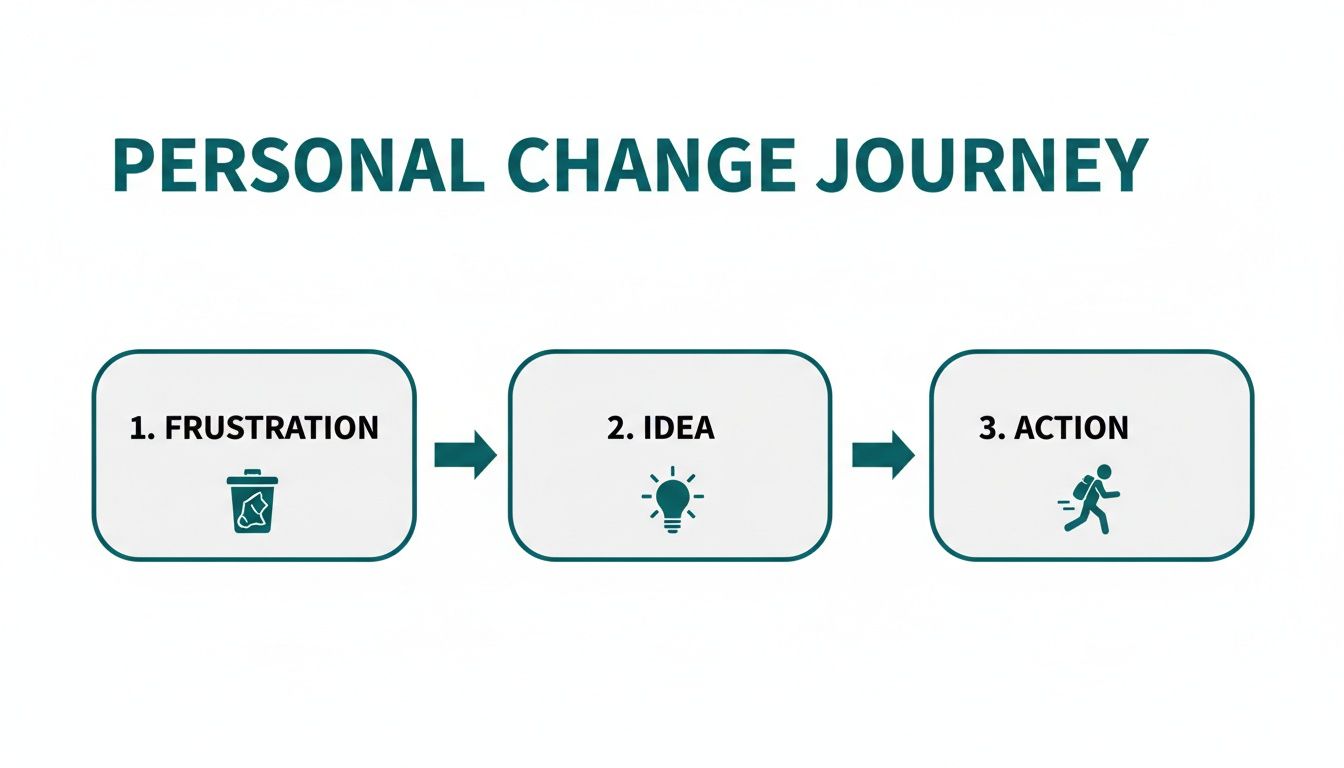
    This is the journey you're on right now. That moment of frustration leads to an idea, which leads to the brave action you're about to take.

    A diagram illustrates the personal change journey with three steps: frustration, idea, and action, connected by arrows.

    This simple progression is the heart of all community improvement. It’s how one person's vision becomes a win for everyone.

    Scout Your Park With Purpose

    Before you do anything else, go back to the park. But this time, look at it with new eyes—not just as a spot you enjoy, but as a project you're about to lead. Walk the entire perimeter and take notes.

    Where does the litter pile up the most? Is it near the picnic tables, along a fence line, or tucked into the bushes? These are your litter hotspots.

    Then, think logistics. Where will your volunteers meet up? Is there easy parking? What's the best spot to set up a home base with water and supplies? Nailing these details now will make the actual day feel smooth and effortless. This little recon mission is your first real act of leadership.

    Navigating Permits The Fearless Way

    The word "permit" can scare people off. Don't let it. Honestly, for a small cleanup with a few friends, you probably don't need one. But if you plan on inviting the public, getting a permit is your best friend.

    It's not red tape; it's a partnership. A permit lets the Parks and Rec department know you’ll be there, so they can arrange for trash collection and make sure you don’t clash with another event. Most city websites have a simple "volunteer event" or "special use" form. Fill it out with confidence—you're doing them a favor!

    You are not asking for permission to do good. You are coordinating with the city to make your act of kindness as effective as possible. Frame it that way in your mind, and any fear of paperwork melts away.

    Build Your Master Supply List

    The right tools make all the difference. Going beyond just bags and gloves shows your volunteers that you care about their safety and comfort. A well-stocked supply station is an act of kindness.

    You never know what you'll find out there. I've pulled everything from old tires to a single, sad baby shoe out of the bushes. The Global Ocean Cleanup initiative found 47.4 tons of waste across 25 countries, from fishing nets to medical syringes. Being prepared for anything is key to a safe and effective cleanup.

    Here’s a checklist to get you started.

    Essential Cleanup Supply Checklist

    A solid supply list is the backbone of a smooth event. Covering these bases ensures your crew is safe, effective, and comfortable from start to finish.

    Category Essential Items Pro-Tip (Nice to Have)
    Gear Thick, puncture-resistant work gloves and heavy-duty trash bags (for both recycling and landfill). Litter grabbers (a back-saver and great for thorny areas) and a few buckets for sharp objects like glass.
    Safety A fully stocked first-aid kit, hand sanitizer, and a designated sharps container (a hard plastic jug works great). Sunscreen, bug spray, and bright safety vests, especially if you're working near a road.
    Organization A foldable table for your check-in station, a clear sign so people can find you, and a clipboard with a sign-in sheet. Name tags to help people connect and a portable speaker to play some music and set a fun vibe.
    Hydration Large water coolers (ask volunteers to bring reusable bottles!) and some simple snacks like granola bars or fruit. A thermos of hot coffee on a chilly morning—it's a small gesture that goes a long way.

    Having these items ready to go will make you look like a seasoned pro, even if it's your first time.

    Create Your Simple Timeline

    Don't let the planning drag on. Momentum is everything. A clear, simple timeline keeps you on track and helps build excitement without the stress.

    • Four Weeks Out: Scout your park and submit your permit application.
    • Three Weeks Out: Start spreading the word to friends, family, and on social media.
    • Two Weeks Out: Finalize your supply list and start gathering your gear.
    • One Week Out: Send a reminder email to everyone who has shown interest.
    • Event Day: Arrive early, set up your station, and greet your fellow champions with a huge smile.

    This blueprint isn’t about being perfect. It’s about taking brave, clear steps forward. You’ve got this.

    Building Your Team of Park Champions

    A park cleanup is really just a party with a purpose. You’ve scouted the location and figured out the supplies, and now it's time to invite your guests. But this isn't about sending a generic invite and hoping for the best; it's about starting a small, brave fire that others will want to gather around.

    You don't need a marketing degree to do this. You just need to be real.

    Think about why you started this in the first place. Was it a specific memory in that park? A feeling of frustration that turned into hope? That’s your story. That’s the magic you need to share.

    Crafting an Invitation from the Heart

    Forget corporate jargon. Your invitation—whether it’s a social media post, an email, or a flyer you tack onto a telephone pole—should sound like you. Speak from the heart.

    I remember standing in my local park, watching the wind blow a plastic bag across the field where my friends and I used to play. I felt that familiar sting of annoyance, but then I thought about the kindness of this place, how it had given me a space to breathe on tough days.

    So when I first asked for help, I didn't say, "Join my environmental initiative." I said, "This park means a lot to me, and it’s hurting. Let’s spend a couple of hours on Saturday showing it some love."

    That’s it. That’s the secret. People don't show up for a task; they show up for a feeling. They show up for a story they can see themselves in.

    Your vulnerability is your greatest recruitment tool. When you share why you care, you give others permission to care, too. You make it personal, and that’s what inspires brave action.

    Start by telling your story. It doesn’t have to be dramatic. It just has to be true. This authenticity is the magnet that will draw your first champions to your side.

    Building Your Community Crew

    Once you have your story, it’s time to find your people. Your goal is to make it incredibly easy for others to say "yes!" You aren't just looking for bodies to fill bags; you're building a team.

    • Start with Your Inner Circle: Your friends, family, and coworkers are your first believers. A personal text or call is way more powerful than a hundred social media posts.
    • Connect with Local Hubs: Think about where people in your neighborhood gather. That local coffee shop with the community bulletin board? That's your stage. Ask the owner if you can put up a flyer. They’re often excited to support local efforts.
    • Partner with Like-Minded Groups: Local schools, running clubs, and faith groups are often looking for meaningful service projects. A single email to the right person can bring a whole team of enthusiastic helpers.

    Don't be afraid to ask for help. When a massive illegal dumpsite with over 4,000 tires was discovered in a Philadelphia park, the city didn't go it alone. They partnered with multiple local green organizations to rally the community, turning a daunting task into a unified, high-impact event.

    For an even deeper dive into this topic, you can explore our full guide on how to find volunteers for your cause.

    A Welcome Worth Showing Up For

    The first five minutes of the event set the tone for everything. Your check-in process shouldn’t feel like a chore; it should feel like the welcome mat to your party.

    Keep it simple. A foldable table with a sign-in sheet is all you need. Greet every single person with a genuine smile and thank them for being there. This small act of kindness is huge. It tells them, "You are seen. You are valued. I’m so glad you came."

    Have a stack of gloves and bags ready to go. Point them to the water and snacks. Introduce them to someone else who just arrived. These tiny connections are what turn a group of strangers into a team. You're not just organizing a cleanup; you're building a community, one brave and kind person at a time.

    Leading the Event with Confidence and Joy

    The big day is here. After all the planning and dreaming, this is the moment it all comes together. Your most important job right now isn't to pick up the most trash—it's to be the calm, confident host who makes everyone feel welcome, safe, and ready to make a difference.

    You're the conductor of this awesome orchestra of kindness. Your energy is the music.

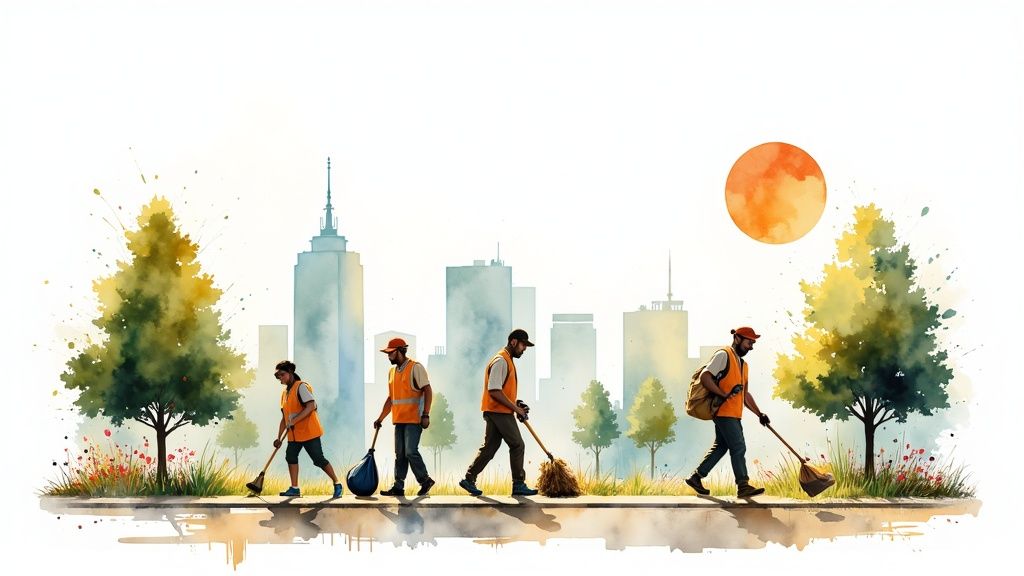
    Four individuals in orange safety vests and jeans using brooms to clean a dry, dusty outdoor area.

    This isn't about being a boss; it's about being the heart of the event. Greet every single person with a genuine smile. Thank them for showing up. Your warmth is the fuel that will power everything.

    The Energizing Huddle

    Ditch the boring safety briefing. This is your kickoff, your pre-game huddle. Get everyone in a circle, look them in the eye, and connect. This is where you turn a list of rules into a shared mission.

    Start with a quick, punchy kickoff. Remind everyone why you're all here. It's not just to clean up a park—it's about reclaiming a space for the entire community.

    Keep the safety talk simple and direct.

    • Gloves stay on. This one's non-negotiable.
    • Watch where you step. Keep an eye out for uneven ground or hidden junk.
    • If you don't know what it is, don't touch it. Just point it out to a team lead. We'll handle weird stuff like broken glass or mysterious containers separately.
    • Stay hydrated. Point out the water station and tell people to take breaks.

    This huddle isn't just about safety; it's about unity. It's the moment you transform a group of individuals into a team ready to make a visible, tangible difference together.

    Orchestrating the Cleanup Effort

    Once everyone is fired up, it’s time to unleash the kindness. The key is to organize the effort so people feel effective, not overwhelmed.

    Remember that scouting mission you did? Now's the time to use that knowledge. Break the park up into zones and assign small groups to different areas—the playground, the walking path, the tree line. This "divide and conquer" approach makes the task feel manageable and gives teams a clear win as they see their zone transform.

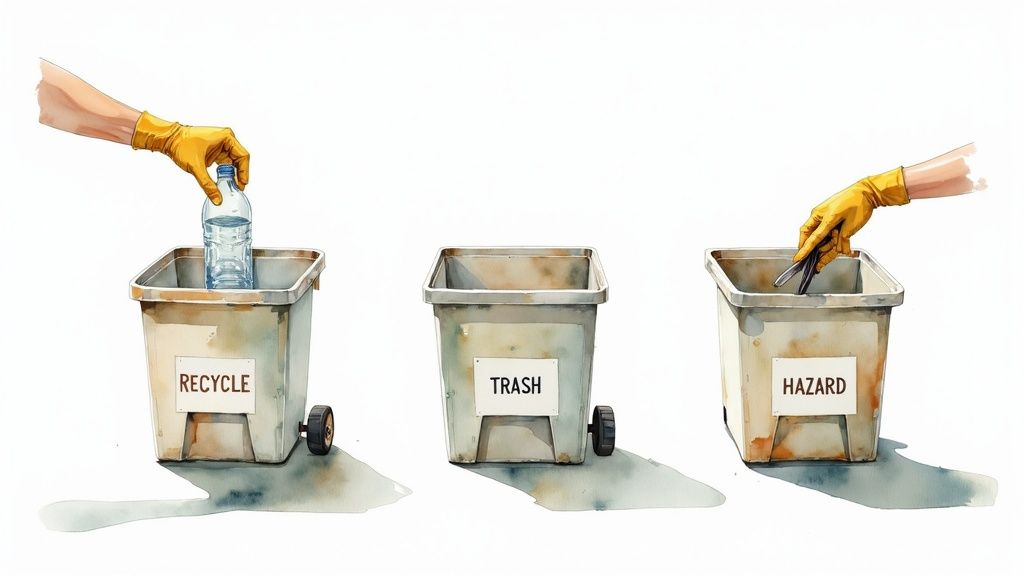
    Set up a central station for waste sorting. This is your command center. Have clearly labeled areas for three main categories:

    1. Recycling: For plastic bottles, aluminum cans, and clean cardboard.
    2. Landfill: For non-recyclable items like chip bags, foam containers, and other general waste.
    3. Hazardous/Bulky Items: A separate, safe spot for things like broken glass, sharp metal, or anything that needs special handling.

    Your job is to make doing the right thing easy. Clear signage and a quick explanation empower every volunteer to sort waste correctly, multiplying your environmental impact far beyond just collecting litter.

    This system turns a potentially chaotic process into a smooth, efficient operation. It respects your volunteers' time and maximizes the good you're all doing.

    Keeping Morale High and Handling the Unexpected

    As the leader, you're also the head cheerleader. Walk around, check in with your teams, and celebrate the small wins. Crack a joke about the weirdest piece of trash someone found. Take photos. High-five people. Your positive energy is infectious.

    Of course, not everything will go perfectly. The weather might turn, or you might find a bigger mess than you anticipated. This is where you shine. If it starts to drizzle, smile and say, "A little rain won't stop us!" Your can-do attitude is the antidote to any setback.

    Remember, you’re part of a massive global family. On World Cleanup Day, over 114 million people came together across 190 countries, showing the incredible power of organized community action. Your local effort channels that same spirit. To see the incredible impact, check out the global movement at World Cleanup Day.

    Celebrating and Sustaining Your Impact

    The work isn't finished when the last bag of trash is tied. That’s just the end of chapter one. The real magic happens now, turning the energy of one great day into a lasting movement.

    Think of your cleanup as a campfire. You gathered everyone, you built something warm and bright, and it lit up the darkness. Your job now is to keep those embers glowing long after everyone has gone home.

    Two smiling people in overalls high-five next to newly planted trees and a '300 lbs removed' sign.

    This next part is where you show the world—and your volunteers—that their effort created real, measurable change. It’s the proof that their bravery mattered.

    From Trash Bags to Powerful Stories

    Numbers are powerful, but they don't tell the whole story. Saying "we collected 50 bags" is fine, but it lacks heart. The real impact comes from translating that effort into a narrative that resonates.

    Instead of just counting bags, get a cheap luggage scale and weigh them. Suddenly, "50 bags" becomes "we removed 300 pounds of waste from our shared home" or "we diverted over 100 pounds of plastic and aluminum from the landfill." Now that's a story people can feel proud of.

    This data is your most powerful tool for advocacy. The Surfrider Foundation, for example, discovered that a staggering 83% of all items collected during their cleanups were single-use plastics. That one stat transformed their work from simple beach cleaning into a powerful argument for policy change. You can see more about their impact on PR Newswire.

    When you measure your impact, you're not just doing math. You’re writing the next chapter of your park's story—one where data becomes the voice for change, proving that a cleaner future is possible.

    Share these victories! Post the numbers, the photos, and the stories on social media. Tag your volunteers and partners. Make the celebration public and joyful, so everyone who participated feels like the hero they are.

    Keeping the Momentum Going

    After the celebration, the most common question is, "What's next?" Your goal is to make the answer easy and exciting. You’ve created a spark of community; now, you need to fan the flames.

    Don’t let that amazing energy fade away.

    • Send Heartfelt Gratitude: Within 48 hours, shoot a personal thank-you email to every volunteer. Share the final impact numbers and a link to photos from the day.
    • Gauge Interest for Round Two: In that same email, ask a simple question: "We had such an amazing time, and we're thinking of doing this again next season. Would you be interested?" A simple poll can capture that enthusiasm immediately.
    • Create a Community Hub: Start a simple social media group or email list for your "Park Champions." This gives people a space to connect beyond the events and build real friendships.

    This follow-up is an act of kindness. It shows you see your volunteers as people, not just a pair of hands for a day. It honors their contribution and invites them to be part of an ongoing story.

    From One-Time Event to Lasting Legacy

    The ultimate goal is to make your effort sustainable. One person can start a movement, but a community is what keeps it alive.

    Look for those passionate volunteers who showed leadership during the cleanup. Could one of them co-organize the next event with you? Empowering others is the most fearless act of a leader. It ensures the mission is bigger than any single person.

    By sharing the story, celebrating the wins, and creating a community, you do more than just clean up a park. You build a network of brave, kind people who are ready to show up for their neighborhood again and again. For more ideas and inspiration, check out our deeper guide to the nuts and bolts of cleaning up trash effectively. This is how you build a legacy of care that will last for years.

    Questions That Might Be Holding You Back

    That little voice of doubt whispering in your ear? It asks questions that feel like giant roadblocks, but I promise you, they're just small hurdles. Let's tackle them head-on.

    Think of these questions not as stop signs, but as trail markers. Every single person who has ever organized a cleanup has asked them. Answering them is part of the journey.

    Do I Really Need a Permit to Clean Up a Park?

    This one causes so much unnecessary fear. Let me clear it up: if you're just grabbing a few friends for a casual cleanup, you almost certainly don't need one. Just show up and do good.

    But if you’re planning a bigger event and promoting it publicly, the answer is usually yes. Please don't see this as red tape! A permit is basically a high-five from the city. It lets them know you're coming so they can support you, and often they'll even arrange to pick up all the trash bags you collect. It's a tool for teamwork, not a barrier.

    What's the Most Important Thing to Bring?

    Beyond a good attitude, a well-stocked first-aid kit is non-negotiable. Safety is the ultimate act of kindness to your volunteers.

    After that, water is key. But from a gear standpoint, the real game-changer is thick, sturdy work gloves. Seriously. Those thin latex ones will tear on the first piece of broken glass. Investing in durable gloves shows you care about keeping everyone's hands safe.

    The most crucial tool isn't a litter grabber or a fancy bag—it's preparation. Thinking ahead about safety and comfort is what transforms a good idea into a great and memorable experience for everyone.

    How Do I Handle Hazardous Stuff We Find?

    The fact you're even asking this question shows you're already a great leader. Your number one rule, which you need to state clearly in your safety briefing, should be: "If you don't know what it is, don't touch it!"

    For things like syringes or sketchy-looking chemical containers, they cannot go into the regular trash. Here’s the protocol:

    • Designate a Container: Before the event starts, have a specific, sturdy, sealed container ready—like a sharps container from a pharmacy, or even just a hard plastic bucket with a secure lid.
    • Create a Protocol: Tell your volunteers to flag you or another designated leader down if they find something hazardous. Never let a volunteer handle it themselves.
    • Plan for Disposal: Check your local sanitation department’s website ahead of time. They’ll have clear instructions on how to dispose of hazardous waste.

    What If Only a Few People Show Up?

    Then you celebrate them! A small, passionate crew isn't a failure; it’s the founding chapter of your movement. I'm serious. Two or three dedicated people can make a massive dent in a park's litter problem.

    Think of it like this: your small group is the spark. You'll forge stronger connections, take amazing photos, and share a story of dedication that will inspire more people to join next time. Your impact isn't measured by headcount; it's measured by the courage you showed in starting something that matters.


    The journey to clean up a park is really a journey of self-transformation. At Litter Caterpillars, we believe that serving our community is how we grow stronger, kinder, and braver together. If you're ready to find your crew and make a real difference, we're here waiting for you. Come join us at https://www.littercaterpillars.com.
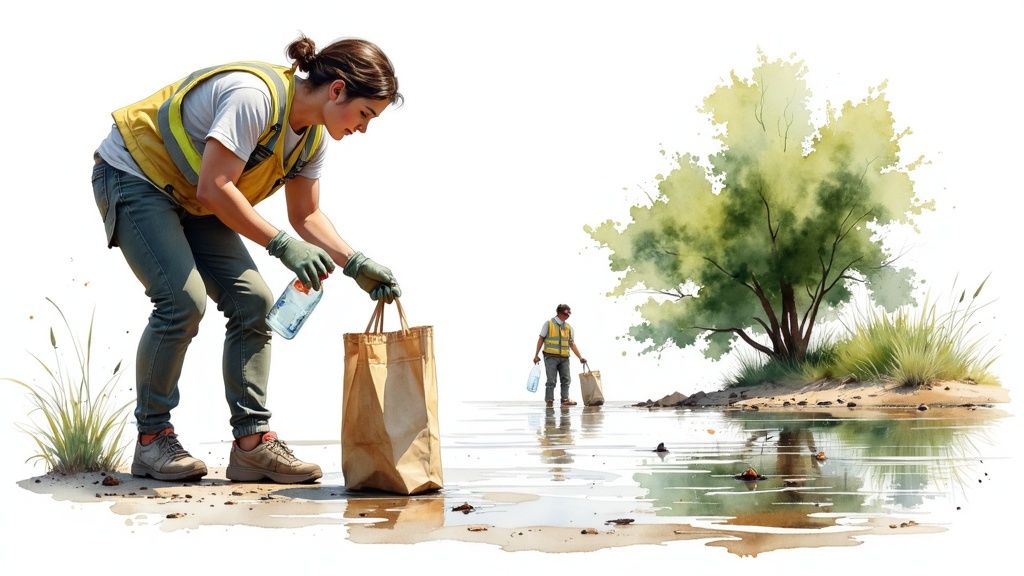
  • Cleaning up trash: How small actions transform communities

    Cleaning up trash: How small actions transform communities

    Cleaning up trash is a brave, simple choice to care for the world right outside your door. It starts small—one person, one bag—but that single act has the power to inspire an entire community. This is the journey of turning that feeling of frustration into action, and discovering just how damn fun and fulfilling it can be to make a real difference.

    The Moment You Decide to Make a Difference

    Watercolor illustration of a young man kneeling on a sidewalk, holding a bag, possibly cleaning up trash.

    It always starts with a feeling, doesn't it? You’re walking your usual route and see it again. That same crushed can or fast-food wrapper tucked into the bushes. At first, it's just a mild annoyance. But then it morphs into a question: "Why doesn't someone do something about this?"

    That question is a seed. It can die right there, or it can grow into something powerful. The moment it really takes root is when you realize the simple, profound truth: you are that someone.

    This is the turning point. It's not about becoming a superhero overnight or solving the world's problems in one afternoon. It’s about the brave, kind decision to change the small slice of the world you walk through every day. It's about personal growth, about deciding you have the power to make things better, right here, right now.

    From Observer to Participant

    Once you make that switch, it’s like seeing your neighborhood in a totally new light. Before, the litter was just background noise, an ugly part of the landscape. Now, each piece represents a choice—a choice someone made to toss it, and a choice you can make to pick it up.

    This feels deeply personal. It's a quiet declaration that you care, a commitment to kindness for the shared spaces we all use. The first time you bend down to pick up a piece of trash, you're drawing a line in the sand. You’re saying, “This matters to me.”

    “Cleaning other people's messes is WAY easier than cleaning up our own. It brings about a strange, new form of 'fun.' Suffering and freezing… actually makes things interesting. It adds a type of 'flavor.' Another page in the story. It 'advanced' the plot!”

    That first step is the bravest one. It might feel small, maybe even invisible, but its impact is huge. A neighbor sees you and feels inspired. Someone else notices the cleaner street and feels a bit more pride. It’s a lot easier to make an impact than you think. If you're looking for that initial spark, you can explore guides on how to find volunteer work that speaks to you.

    The journey starts with you, a bag, and the decision to just do it. It’s an adventure in kindness, a practice in bravery, and proof that one person really can make a world of difference.

    Your Cleanup Toolkit From Simple to Pro

    A flat lay of essential items for litter cleanup, including a trash bag, gloves, and a grabber tool, next to a first aid kit and a yellow high-visibility safety vest, all on a white background.

    You really don’t need a bunch of high-tech gear to make a difference. Honestly, you can start this journey right now with two things you probably have: a bag from your kitchen and a pair of gloves.

    That's it. That’s your ticket to the game.

    Think of it like learning to cook. You don't start with a sous vide machine. You start with a pan and a spatula. The gear doesn't make the change—you do. The gear just makes the work safer, easier, and a hell of a lot more comfortable. So let’s build your kit, from the bare essentials to a full-blown "pro" setup. This is all about making it feel easy and fun.

    The Scrappy Starter Pack

    This is your go-to for spontaneous action. It's light, costs nothing, and proves you don’t need to spend a dime to be a force for good.

    • A Simple Bag: Any sturdy bag works. A reusable tote, a plastic grocery bag you've been saving, a small trash bag from under the sink. Doesn't matter.
    • Basic Gloves: A pair of gardening or work gloves is perfect. They create that crucial barrier between your hands and whatever gnarly thing you’re about to pick up.

    That’s all you need to get going. This minimalist approach removes every excuse. It's about grabbing what you have and just walking out the door.

    Leveling Up Your Gear

    Once you get a taste for it, you’ll want to upgrade. This isn’t about looking official; it’s about protecting yourself and being able to stay out there longer. It's about self-kindness.

    First on the list: puncture-proof gloves. These are your best friends. They shield you from the nasty surprises—broken glass, sharp metal, or worse—that can turn a good deed into a trip to urgent care.

    Next up, get yourself a litter grabber. This tool is a complete game-changer. It saves your back from bending over a hundred times, extends your reach into thorny bushes, and keeps you at a safe distance from sketchy items. It’s the key to making this a sustainable, and even fun, habit.

    “When you adopt a spot, you’re not just cleaning up — you’re showing pride in the place we all call home.”

    Finally, a high-visibility vest is a non-negotiable if you’re cleaning anywhere near a road. This simple piece of gear makes you seen. It yells to drivers, cyclists, and pedestrians that you’re there. It's a loud, clear signal that says, "I'm here, I'm helping, and my safety matters."

    Building Your Pro Kit for Group Events

    When you start leading others, your toolkit has to grow with you. Suddenly, you're not just responsible for yourself—you’re creating a safe and effective experience for your whole crew. Think of yourself as the host of a party. Your job is to have everything ready so your volunteers can just show up and focus on the good work. It's surprisingly fun to be this prepared.

    Here’s what you’ll need to put together a solid group cleanup kit.

    Essential Cleanup Gear Guide

    Gear Item Why You Need It (The Real Talk) Where to Find It
    Heavy-Duty Trash Bags Flimsy bags rip, creating a second mess. Strong bags hold more and just don't quit. Don't be that person. Hardware stores or online bulk supply retailers.
    Variety of Gloves Bring extras in different sizes. I promise, someone will always forget theirs or need a fresh pair after a gross find. Buy multi-packs from a home improvement store like Home Depot.
    First-Aid Kit Scrapes happen. Being ready with bandages shows you genuinely care about your team's safety. It's simple kindness. Any pharmacy or supermarket. Keep it stocked.
    5-Gallon Buckets These are perfect for safely collecting sharp stuff like broken glass or needles that could easily pierce a bag. Old paint buckets (cleaned out) or durable bins from a hardware store.
    Hand Sanitizer & Wipes A must-have. It lets everyone clean up before grabbing a drink or heading home. It's a small detail that shows you care. Drugstores or ordered in bulk online.

    Having this gear on hand makes your event run smoothly and shows your volunteers that you’re a prepared and thoughtful leader. It’s these little details that make people want to come back. And don't forget to check with local resources! Your city's public works department often provides supplies for free. All you have to do is ask. They want to help you.

    Rallying Your Crew and Sparking a Movement

    Picking up trash by yourself is a noble act. But doing it with others? That's when you become a force of nature. That's where the real magic is—you're not just cleaning streets, you're building a tribe of people who give a damn. It's FUN.

    Asking people to join you can feel weird, I get it. What if no one shows up? Let that fear go. You're not begging for help. You're offering a connection, a chance to do something real that leaves a tangible mark of kindness on your neighborhood.

    Imagine lighting a campfire. You start with one spark—just you. To make it grow, you invite others to bring their own logs to the fire. It's about sharing warmth and light, not demanding help.

    How to Craft an Invitation That Actually Works

    Forget the boring flyers. The secret to a great invitation is genuine human connection. Your goal isn't just to find "volunteers"; it's to create an experience people actually want to be part of.

    So, how do you do that? You tell a story.

    Instead of posting, "Volunteer cleanup this Saturday," try coming from the heart. Post a photo of a spot that breaks your heart a little—that park bench covered in coffee cups, that beautiful trail spoiled by plastic bags. Then, share your vision for it.

    Here’s an example for a local Facebook group:

    "Hey neighbors! I walk past the little playground on Elm Street every morning, and the trash lately has been really getting to me. I keep picturing how amazing it would be for the kids. I'm going to be out there this Saturday at 10 AM with a box of trash bags to do something about it, and I'd love some company! Let's spend an hour making our corner of the world a little brighter. I'll bring coffee for everyone who shows up."

    See the difference? It's personal, it's specific, and it has a clear, kind call to action. It’s not a chore; it’s a shared mission. It promises good company, a feeling of accomplishment, and coffee! That’s the kind of authentic invitation people respond to.

    Small Groups Create Big Movements

    Every big movement starts small. The Litter Caterpillars began with just three of us huddled under a tree during a freak hailstorm, shivering but laughing our butts off. We didn't set out to clean the whole city; we just wanted to clean one block.

    Your first cleanup might just be you and a friend. That's a huge win! Celebrate it. Take a picture of your full trash bags and post it with a thank you. People need to see the impact. Your consistency is what will turn that duo into a dozen.

    When you share your "why"—your personal reason for caring—you give people something to connect with on a human level. It’s not about the trash; it’s about the community you’re building, one piece of litter at a time.

    This isn't just a local problem. Globally, we produce over 2 billion tonnes of municipal solid waste each year. And get this: high-income countries, with just 16% of the world's population, generate over a third of it. Your small, local action is a brave pushback against a massive global problem. You can learn more about the staggering scale of it all over at 4thbin.com.

    Building Your Tribe

    Once people start showing up, your job is to make the experience fun and welcoming. Remember names. Introduce people. Create a space where friendships can spark. The trash is the excuse to gather, but the connection is the reason people stay.

    Here are a few ways to build that community spirit:

    • Make it easy to join: Use platforms people already use, like a local Meetup group or an Instagram page. Keep the instructions simple and the vibe low-pressure. For a deeper dive, check out our guide on how to find volunteers who share your passion.
    • Celebrate everyone: Acknowledge every single person who shows up. A simple "So glad you could make it today!" goes a long, long way.
    • End on a high note: Always finish with a social element, even if it's just five minutes of chatting over coffee or donuts. This is where the real community building happens.

    You're the host of a party where the main activity is cleaning up trash. Your energy sets the tone. Be brave, be kind, and be unapologetically enthusiastic. People are drawn to that passion, and soon, you won't be inviting people to a cleanup; you'll be gathering your tribe.

    Your Cleanup Day Playbook for Success

    This is where it all comes together. You've got the gear, you've rallied your crew, and now it's game day. This is your playbook for turning good intentions into a smooth, safe, and ridiculously successful cleanup. Forget about boring safety talks and logistical nightmares. We're keeping it simple, brave, and focused on what really matters.

    Think of yourself as the captain of a sports team. Your job isn't to micromanage every move. It's to set the strategy, make sure everyone's equipped, and keep the energy high. A little prep work ensures the day feels less like a chore and more like a victory lap.

    Choosing Your Battlefield

    Where you decide to clean is everything. You're looking for a spot where your efforts will make a huge, visible impact. This is about strategic kindness. Picking a high-traffic park or a neglected neighborhood block sends a powerful message: this space is loved.

    Don't overthink it. Pick a place that speaks to you, a spot you know could be beautiful if it just got a little attention.

    • Go for visibility: A cleanup along a busy street inspires others. It shows the whole community what you’re about.
    • Target a 'forgotten' area: Cleaning up a neglected alleyway or a small patch of woods can completely transform the feel of a neighborhood.
    • Keep it manageable: Don’t try to clean the entire city in one day. Pick a defined zone so your team can see their progress and leave with a real sense of accomplishment.

    Safety That Actually Sticks

    Long, preachy safety speeches are where good intentions go to die. Nobody remembers a ten-minute lecture. What they do remember is a simple, clear rule that gets stuck in their head.

    Here’s our one and only safety rule: "If it’s sharp, glassy, or sketchy—leave it!"

    That's it. Repeat it. Make it your mantra. This single phrase covers 99% of what people need to know. It empowers them to use their own judgment and reminds them that their safety is the top priority. No bag of trash is worth a trip to the ER. For those few sketchy items, have a designated sharps container or a sturdy bucket ready.

    “When Tom Sawyer was punished by his aunt and was forced to paint a fence, he could have wallowed and complained. Instead he convinced his friends that painting the fence was actually extremely fun. His friends even paid him with an apple for the opportunity! We believe that a big part of bravery is also pride / inspiration.”

    Demystifying the Paperwork

    Let’s talk permits. The word itself sounds intimidating, but it’s usually way easier than you think. See your local council or parks department not as a barrier, but as a potential partner. They want people like you helping to keep the city clean.

    A quick phone call or email is often all it takes. Just explain who you are, what you want to do, and ask what they need from you. Many cities will not only grant permission but will also provide free supplies and arrange to pick up the trash you collect. For those eager to jump in, checking a list of weekend volunteer opportunities near me can connect you with established groups that already have these relationships figured out.

    This simple visual breaks down the core process of turning your idea into a community event.

    A flowchart illustrates the 'Inspiring Action Process' with three steps: Share, Invite, and Gather, leading to action.

    The flow is straightforward: bravely share your vision, kindly invite others to join, and gather as a community to make a real impact.

    Keeping Your Crew Happy

    Your final job as the leader is to be the chief of good vibes. A successful event is one where people feel appreciated, stay hydrated, and have a genuinely good time.

    • Hydration is non-negotiable: Bring a big cooler of water. Gently nag people to drink it.
    • Snacks are magic: Seriously. A box of donuts or a bag of oranges can completely change the mood and turn a group of strangers into a team of friends.
    • Crank the tunes: A portable speaker with an upbeat playlist makes everything more fun.
    • Celebrate the wins: Point out the progress. Take before-and-after photos. End the event by gathering everyone to admire the mountain of trash bags you’ve all collected together.

    This isn’t just about picking up trash. It’s about building a community of givers. A little planning makes sure everyone leaves feeling safe, valued, and pumped for the next one.

    Beyond the Bag: What to Do With the Trash You Collect

    Hands in yellow gloves sorting a plastic bottle, general trash, and hazardous waste into labeled bins.

    There's no feeling quite like seeing that mountain of full trash bags at the end of a cleanup. It’s a trophy. It’s tangible proof of your hard work, your kindness, and your bravery. You stood up and did something.

    But the job isn't quite done yet.

    Now comes the final, crucial step: what do you do with it all? Responsible disposal is the last link in the chain, ensuring your good deed doesn’t just move a problem from a park to an overflowing city can.

    Think of it like finishing a race. You don’t stop one foot from the finish line—you have to cross it. Sorting and properly disposing of the trash you’ve collected is that final, powerful stride. It’s how you complete the act of care you started.

    The Simple Art of Sorting

    Sorting doesn't have to be complicated. You’re not expected to be a waste management expert! The goal is just to make a good-faith effort to separate the obvious stuff. A quick sort can make a huge difference.

    We usually set up a few distinct collection points right at our cleanup site. A few separate bags or buckets make it easy for everyone to pitch in.

    • General Waste: This is for the majority of what you’ll find—food wrappers, weird plastics, and other random gunk. This is your main pile.
    • Recyclables: Focus on the easy wins. Aluminum cans, plastic bottles, and glass are the low-hanging fruit.
    • Sharps & Hazardous Items: Anything that feels dangerous goes into a separate, puncture-proof container, like a 5-gallon bucket. This includes broken glass, needles, and batteries. Safety first, always.

    This simple system keeps everyone safe and makes the final disposal process much smoother. It’s a small bit of extra effort that honors the work you’ve already done.

    The act of sorting is an act of intention. It’s recognizing that not all trash is created equal and that with a little thought, we can help reduce the burden on our planet’s systems.

    You’re Now on the Front Lines of the Plastic Problem

    Once you start cleaning up trash, you’ll quickly notice one thing: plastic is everywhere. Bags, bottles, straws, and a million tiny fragments.

    You're now face-to-face with a massive challenge. Global plastic waste has now hit a record 225 million tonnes, with a staggering 72 million tonnes of that ending up mismanaged, polluting our oceans, rivers, and soil. When you pick up a plastic bottle, you are directly intervening in this cycle of pollution. You can dive deeper into the global plastic waste crisis at letsrecycle.com.

    Knowing this doesn’t make the work feel heavier; it makes it feel more important. Every piece you remove is one less piece choking our environment.

    Logistics of the Last Mile

    So, where does it all go? You have a few options for the final disposal, and a little pre-planning can save you a major headache.

    Connect with Your City
    Your local public works or sanitation department can be your biggest ally. Give them a call before your event. Many cities are thrilled to support volunteer cleanups and will arrange a special pickup for your collected bags. They might even provide the bags and gloves themselves.

    Leverage Your Own Bins
    For smaller, solo cleanups, using your own residential bins is perfectly fine. Just be mindful not to overwhelm them.

    Find Local Drop-Off Sites
    For specific items, you might need a dedicated drop-off location.

    • Hazardous Waste: Your county likely has a designated facility for hazardous materials like paint, chemicals, and batteries. Never put these in regular trash.
    • Scrap Metal: Items like old appliances or large metal pieces can often be taken to a local scrap yard, which may even pay you for them.
    • Recycling Centers: For large quantities of sorted recyclables, a dedicated recycling center is your best bet.

    Your hard work deserves a thoughtful finish. By taking these final steps, you ensure your impact is positive and lasting, turning a simple cleanup into a truly sustainable act of community care.

    How to Keep the Momentum Going

    You did it. You filled the bags, cleared the space, and left a small corner of the world a little brighter. That feeling is electric, right? A mix of exhaustion and pure, unfiltered pride.

    A single cleanup is a victory. It’s a powerful statement.

    But a recurring one? That’s how you start a revolution.

    The real magic isn't in the one-time event; it's in the echo it creates. It’s in turning that incredible day into a sustainable movement, a rhythm of kindness that becomes part of your community’s heartbeat. This is how you keep the fire going, not just for others, but for yourself. It’s the ultimate act of personal growth.

    The Power of Appreciation and Proof

    After the last bag is tied, the most important part begins, and it has nothing to do with trash. It’s about celebrating the people who showed up.

    A simple, heartfelt thank-you is the fuel that powers a volunteer movement. Send a group message, but not some generic "Thanks." Give it real warmth. Mention a specific moment—how awesome it was to see everyone tackle that overgrown trail, or how much you all laughed when that surprise rain shower hit.

    Then, give them proof of their impact. Before-and-after photos are your superpower.

    Juxtapose the image of a trashed park with a photo of the same spot, clean and beautiful, with your crew standing proudly in the middle. This visual evidence is undeniable. It screams, "Look what we did together!" It transforms an abstract idea of "helping" into a tangible, beautiful reality.

    “When we share the results, we’re not just showing off our work. We’re building a story of collective power, a story people will want to be a part of again and again.”

    Strike While the Iron Is Hot

    The energy after a successful cleanup is a precious, fleeting thing. Don't let it fade. The best time to schedule the next event is right after the last one ends, while everyone is still buzzing.

    You don't need a firm date. Just plant the seed: "This was amazing. Let's do the other side of the park next month!" This small step turns a one-off event into a series, a habit of service. It gives people something to look forward to and solidifies the idea that this isn't just something you did; it's something you do. It's a lot easier to build momentum than you think.

    Connecting Your Work to the Bigger Picture

    It’s easy to feel like your local cleanup is just a drop in the ocean. But every piece of trash you pick up is part of a much larger story.

    Think about the challenge of food waste, which represents a colossal cleanup burden on our planet. Globally, a staggering 1.3 billion tonnes are discarded every year. This waste rots in landfills, releasing methane that contributes 8-10% to global emissions. You can dive deeper into these global waste trends and their impact to see the scale of the problem.

    When you’re out there cleaning up, you are on the front lines, fighting back against this tide of waste. You are not just cleaning a street; you are participating in a global act of stewardship.

    Framing your work this way empowers everyone. It connects your small, brave actions to a worldwide movement of people who refuse to just stand by. You are proving, one bag at a time, that a small group of kind, brave people can indeed change the world. Keep going.


    At Litter Caterpillars, we believe in the power of showing up, for our city and for ourselves. We're out there every weekend, turning frustration into action and strangers into friends. Join our movement and discover how fun and fulfilling it is to make a real difference, one block at a time. Learn more and find your next cleanup at https://www.littercaterpillars.com.

  • How to Find Volunteers Who Will Change Your World

    How to Find Volunteers Who Will Change Your World

    Want to find great volunteers? The secret isn’t some slick sales pitch or a desperate post online. It’s about a gut-level shift in how you see the world.

    Stop begging for help. Start inviting people to a mission they can’t stop thinking about.

    From Asking For Help To Offering A Mission

    Too many groups come from a place of scarcity. Their message screams, “We’re desperate! We need people!” This doesn’t inspire anyone. It feels heavy. It feels like a chore.

    Think of it like building a campfire. You don’t run around town frantically begging strangers for a spare log. You bravely build a warm, bright, inviting fire. You create a space so full of light and laughter that people want to gather. A place where they feel an pull to add their own log, to share their story, and to feel a sense of real belonging.

    This isn’t just some feel-good theory. It’s a strategy built on the courage to share your authentic ‘why’ and the kindness to make the experience joyful from the very first hello.

    We're building a movement, not just filling a roster. It’s a lot easier to make an impact than you think. And it’s fun.

    The Power of an Abundant Mindset

    An abundant mindset flips the whole script. It says, "We have an incredible opportunity for you to find purpose, to grow, and to connect." It’s a genuine invitation to an adventure, not a transaction. This simple shift from a scarcity-based 'ask' to an abundance-based 'offer' changes everything.

    This is what it looks like in practice.

    A diagram illustrating the volunteer mindset shift from scarcity to abundance, listing key differences.

    When you focus on the mission and the community you’re building, you attract people who are looking for more than just a task—they’re searching for connection and a chance to become more of who they are.

    And the good news? People are actively looking for these opportunities. Data shows a huge rebound in volunteering, with 28.3% of people over 16 volunteering through an organization last year. That’s a massive pool of potential changemakers just waiting for the right invitation.

    Here's a quick look at how to reframe your thinking.

    From Scarcity to Abundance Mindset

    Old Tactic (Scarcity) New Approach (Abundance)
    "We desperately need your help." "Join us in making a real difference."
    Focuses on tasks and to-do lists. Focuses on impact and shared purpose.
    Makes people feel obligated. Makes people feel inspired.
    Transactional: "Give us your time." Relational: "Become part of our community."
    Leads to burnout and high turnover. Leads to passion and long-term commitment.

    This isn't about sugarcoating the work. It's about grounding it in purpose.

    The real work is not to convince people to help you. It’s to create something so meaningful that they are inspired to help themselves by helping you. Your mission is the magnet.

    By focusing on the 'why' behind what you do, you give people a powerful reason to care. You offer them a chance to be part of something bigger than themselves.

    If you're wondering where your own journey can begin, our guide on how to find volunteer work can help you discover those meaningful opportunities. This approach is how you find volunteers who don't just show up, but who show up with their whole hearts.

    Craft Your Unforgettable Volunteer Story

    Let's be real. People don't show up to fill a slot on a spreadsheet. They show up for a feeling, a connection, a story they can see themselves in. Before you even think about writing a role description or posting on Instagram, you have to ask yourself one question, and you have to be brutally honest: Why should anyone care?

    This is where you find the emotional heart of your work. Forget the marketing spin and the perfect taglines. This is about finding your truth and sharing it with courage. Think of it like inviting people to your campfire; the story you tell is what makes them pull up a log and listen.

    A diverse group of happy friends sitting around a glowing campfire, some holding a heart.

    Unearth Your Core Narrative

    Your core narrative is the "why" that gets you out of bed on the hard days. It’s the reason this work matters so much that you’d do it in a Chicago blizzard or a scorching heat wave. To find it, you have to dig past the tasks and get to the transformation.

    Start by asking yourself these questions. Don't rush them. Let the real stories bubble up.

    • When did you feel most proud of this work? Get specific. Picture that exact moment. Who was there? What did that feel like in your chest? Don't just say "we cleaned a park." Say, "I remember watching a little girl point at the new playground we cleared, a space that was covered in broken glass just two hours earlier."
    • What problem truly breaks your heart? I mean, really gets under your skin. Is it the loneliness you see in your neighborhood? The litter that makes a beautiful street feel neglected? The lack of safe spaces for kids? Your anger and sadness are fuel for a powerful story.
    • What change do you want to see in a person, not just a place? Maybe you want people to feel less alone, more connected to their neighbors, or prouder of where they live. This is the human impact—the real reason people will show up.

    This isn't about finding volunteers; it’s about finding kindred spirits. Your story is a beacon. When you share it honestly, the right people will find their way to your fire. They won’t just see a task; they’ll see a mission they were already looking for.

    From Task to Invitation

    Once you've got that emotional core, you can reframe every volunteer need. You stop asking for help and start offering an opportunity for growth and connection. This is how you make your mission impossible to ignore.

    Let’s look at a real-world example. A community garden in Chicago’s Englewood neighborhood could post a sign that says, “Volunteers needed for weeding on Saturday.” It's a task. It's functional, but it’s not inspiring.

    Now, let’s inject the story.

    "Tired of the concrete jungle? Come get your hands dirty with us this Saturday. We're not just pulling weeds; we're growing food and friendships, turning this empty lot into a place where our neighbors can connect and find a little peace. No green thumb required—just a good heart."

    See the difference? The first is a chore. The second is an adventure. It speaks to a deeper human need for community, nature, and purpose. It’s an invitation to become part of something beautiful.

    Here’s a simple way to transform your own volunteer posts:

    Instead Of This (The Task) Try This (The Invitation)
    "We need help sorting donations." "Help us turn a box of donated clothes into a warm welcome for a family new to Chicago."
    "Help us pick up trash at the park." "Join our crew and help us reclaim this park for our community, one block at a time."
    "We need someone to manage our social media." "Use your creative skills to share our story and inspire more people to join our movement."

    This isn't about being clever. It's about being authentic. The most powerful way to find volunteers is to bravely share the heart of your mission and trust that it will hit home. Your story isn't just words; it’s the spark that will light up your entire community.

    Find Your People Where They Already Are

    You’ve got your story, your mission is clear. So, where do you find the people who will actually show up? The default move is to post on your own social media and just… wait. That’s like building a campfire in your backyard and just hoping the whole city smells the smoke. It doesn't work.

    To find your volunteers, you have to go to them. You have to join the conversations they're already having and show up in the places they already gather. It's less about shouting into the void and more about finding the right rooms to speak in.

    Hands gently holding a small green plant growing from soil, symbolizing growth and care.

    Go Digital, But Stay Human

    Think of your online presence as a living extension of your group—real, messy, and fun. People connect with authenticity, not a polished corporate brochure.

    Instagram Stories: The Real, Unfiltered View
    Forget the perfect grid for a second. Your Instagram Stories are where you show the real soul of your work. This is the behind-the-scenes pass that makes people feel like they know you.

    • Show the instant impact. Film a quick "before" of a trash-covered alley, then a quick "after" 30 minutes later showing it clean. That immediate transformation is ridiculously powerful.
    • Feature your people (with permission, of course!). A short, candid clip asking a volunteer, "What made you come out today?" is a thousand times more compelling than a perfectly written caption. Show their sweaty, smiling faces. Show them laughing.
    • Use polls and question stickers. Ask simple stuff like, "What neighborhood should we hit next?" This turns people who just watch into people who participate.

    Local Facebook Groups & Meetup: The Community Hubs
    This is where you find the people who are actively looking for something to do. We saw a Chicago group use this exact strategy and they doubled their volunteer numbers in three months. They didn't spam—they became part of the community.

    Find groups like "Logan Square Community" or hobby-based groups that align with your mission (gardening, hiking, etc.). Introduce yourself, but don't just drop a link and run. Comment on other posts. Be a good neighbor first.

    Then, post your invitation.

    Here's a message that works:
    "Hey everyone! We're a crew called the Litter Caterpillars, and we meet up every weekend to clean up different Chicago neighborhoods while making friends. It's surprisingly fun! Last week in Pilsen, we cleared an entire alleyway and found a vintage street sign. We're meeting in Lincoln Park this Saturday if anyone wants to join us in making our city a little brighter. No pressure, just good vibes."

    It’s personal, specific, and low-pressure. It’s an invitation to an experience, not just a chore.

    The Power of Old-School Connection

    Don't sleep on face-to-face interaction. Real-world relationships are the bedrock of community organizing. It's about building trust, one conversation at a time. Think of local businesses as your allies, not just a place to hang a flyer.

    Coffee Shops and Libraries: The Neighborhood Anchors
    These places are the modern-day town square.

    1. Be a regular. Don’t just march in and ask for a favor. Go often. Learn the baristas' or librarians' names.
    2. Tell your "why." When they ask what you do, tell them your story with genuine passion. "I'm part of this amazing group that cleans up our parks. It started because I was just tired of seeing my own neighborhood look neglected."
    3. Make an easy ask. "Would it be cool if I left a small stack of these postcards on your community board? We'd love for more of our neighbors to join us."

    These small acts build a real network. Pretty soon, the barista isn't just letting you put up a flyer; they're telling customers about that cool cleanup crew they met.

    A Simple, Human-First Outreach Plan

    Consistency is key, but you don't need a complicated marketing strategy. Here’s a simple checklist to get you started.

    • [ ] Weekly Instagram Story: Post at least one behind-the-scenes video or volunteer highlight each week.
    • [ ] Bi-Weekly Community Post: Share your invitation in one or two relevant local Facebook or Meetup groups.
    • [ ] Monthly Local Visit: Connect with one new local business, library, or coffee shop. Be a person, not a marketer.
    • [ ] Track Your Wins: Keep a simple note of where new folks are coming from. Is it Instagram? A coffee shop flyer? This tells you where to put your energy.

    By showing up in both digital and physical spaces, you create more doorways for people to find you. Whether they're scrolling for weekend volunteer opportunities near you or just grabbing a latte, they’ll find an open invitation to be part of something real.

    Your Welcome is Everything

    Getting someone to click “RSVP” isn’t the finish line. It’s the starting pistol. The real work—the stuff that turns a curious stranger into a core member of your crew—begins the moment they say yes.

    Think about it. When you invite someone to your home, do you greet them at the door with a rulebook? No. You smile, take their coat, and say, “I’m so glad you could make it.” That’s the vibe. Your welcome for a new volunteer needs to feel just like that: a real, human invitation to belong.

    Ditch the bureaucratic confirmation email packed with sterile instructions. Your first job is to swap out those first-day jitters for genuine excitement. Small, thoughtful gestures are what build long-term commitment.

    The First Touchpoint Has to Be Human

    The second someone signs up, the clock starts. This is your first shot to show them what your group is really about. Sure, an automated confirmation email checks a box, but it's cold. It's forgettable.

    What if you did something bolder?

    A personal text from the group leader within a few hours? Game-changer. It’s totally unexpected and immediately makes the new person feel like they actually matter.

    It doesn’t need to be some long, drawn-out message. Keep it simple.

    Example Welcome Text:
    "Hey, [Name]! Kevin here from Litter Caterpillars. Just saw you signed up for our cleanup on Saturday—awesome! We're super excited to have you. Just wanted to say hi and let you know you can text me if you have any questions before then."

    That one text takes all of 30 seconds. But it tells them, “You’re not just a number on a spreadsheet. You’re a person, and we’re genuinely glad you’re here.” It builds an instant bridge.

    Make Their First Day Feel Like Their Second

    Nobody likes being the new kid in class, awkwardly standing in the corner. Your mission is to shatter that feeling as fast as possible. You have to be intentional about sparking connections from the second they walk up.

    • The Buddy System: Don't just point them to a pile of tools and say "go for it." Pair them up with a friendly veteran volunteer. This isn't some formal mentorship program; it's just giving them a person—a friendly face to stick with, ask dumb questions, and share a laugh.
    • A Simple One-Pager: Forget dense handbooks. Create a single, easy-to-read page that gives them the essential info. What’s our mission in one sentence? What does winning look like today? Who do I talk to if I need help? It shows you respect their time and sets them up to contribute with confidence.

    These little things provide a safety net. It lets the new person relax and actually focus on the work and the people around them.

    The most powerful onboarding tool you have is kindness. When people feel safe and valued from the start, they’re not just volunteering their time; they’re investing their heart.

    Weave In Safety and Scheduling With Care

    Even the boring stuff—the logistics—can be handled with a human touch. Talking about safety isn’t about scaring people; it’s about showing you actually care about them.

    Instead of a dry list of "don'ts," frame it as a collective agreement.

    • For safety: "We look out for each other here. That means always working with a buddy, wearing your gloves, and speaking up if something feels off. Your safety is always our #1 priority, no exceptions."
    • For scheduling: "Look, life happens! If you can't make it, it's no big deal. Just shoot a quick message in the group chat so we know you're okay. We're always happy to see you whenever you can make it out."

    This isn't about rigid rules; it’s about mutual respect. It reinforces that you're a team. When you welcome people with this much intention, you’re not just filling volunteer slots. You're building a community where everyone feels like they belong from day one.

    Keep the Spark Alive for the Long Haul

    Getting people to sign up is one thing. Building a crew that sticks around through thick and thin? That’s a whole different ballgame.

    A thriving community isn’t measured by how many people show up once. It’s measured by how many people stay.

    Keeping that initial spark alive isn’t about perks or free pizza. It’s about bravely and kindly creating a space where people feel seen, where their contribution actually matters, and where they can grow. This is how you turn a first-timer into a lifelong advocate for your cause.

    Two happy people embrace affectionately, one in a beret, with a plant and book nearby.

    Celebrate the Small Wins Like They're Everything

    Think of appreciation as the fuel for your community engine. Without it, even the most passionate volunteer will eventually run out of gas. This isn’t about grand gestures; it’s about consistent, genuine recognition.

    You have to hunt for those moments of impact and hold them up to the light for everyone to see.

    • Handwritten Thank-You Notes: Seriously. In a world of fleeting digital pings, a simple, handwritten card feels monumental. After an event, take five minutes to write a note to someone who went the extra mile. Get specific. "Sarah, watching you help that new person figure out the recycling bags was pure kindness. Thank you."
    • Shoutouts with Substance: Don't just post a generic "thanks to our volunteers!" Dig deeper. A weekly ‘Volunteer Spotlight’ on Instagram that tells a mini-story is incredibly powerful. "This is Maria. On Saturday, she single-handedly cleared the overgrown bushes blocking the sidewalk on 53rd Street. Because of her, our elderly neighbors can now walk there safely. Maria, you’re a rockstar."

    This kind of specific praise does two things. It makes that person feel deeply valued, and it shows everyone else what your group’s values look like in action.

    Create Pathways for Growth

    People don't just volunteer to give their time; they also want to grow. They want to learn new things, challenge themselves, and maybe even discover strengths they didn't know they had. Your job is to create clear paths for that to happen.

    Think of it like a video game. A player starts at level one, but they can always see the next level they can achieve. It keeps them hooked.

    You’re not just managing tasks; you’re nurturing potential. The best way to keep a volunteer is to show them a future where they can become more than they are today.

    Does someone have a knack for getting people excited? Ask them to lead the welcome circle at the next event. Is another person incredibly organized? Invite them to help you plan the logistics for the next big project. This proves you're paying attention to their unique talents.

    It shows you see them as a whole person, not just a pair of hands. For more actionable guidance on fostering this kind of environment, check out our collection of volunteer tips.

    Fearlessly Ask for Feedback

    Asking for feedback is an act of bravery. It opens you up to criticism, and that can be scary. But it's also one of the most powerful ways to show your volunteers you respect them. It says, “Your voice matters here. Your experience matters here.”

    Don’t wait for problems to bubble up. You have to proactively create channels for people to share their thoughts.

    • Simple Surveys: Use a free tool like Google Forms to send out a quick, three-question survey once a quarter. Keep it short. "What's one thing we should start doing?" "What's one thing we should stop doing?"
    • Listen, Then Act: This is the most important part. Share the results with the group—the good and the bad. Then, publicly commit to acting on one or two key pieces of feedback. This closes the loop and builds an incredible amount of trust.

    This feedback loop is crucial because the volunteer world is always shifting. Recent data shows that while sign-ups are growing, retention is a top concern for over a third of organizations. People are short on time, pushing them toward shorter, more flexible opportunities. By listening, you can adapt to these needs instead of losing great people. You can discover more insights about the current state of volunteering on Signupgenius.com.

    When you celebrate wins, foster growth, and listen with an open heart, you build something that sustains itself. You create a resilient, joyful, and powerful force for good.

    Answering the Tough Questions

    Starting a community group is an act of pure guts. You're putting your heart on the line for something you believe in, and let's be real—it's scary. Along the way, you're guaranteed to hit some bumps and face some tricky situations.

    Don't let that stop you. These challenges are part of the deal. They’re a sign that you're doing something real and important. I've been there, and I've heard the same fears from so many other organizers. Let's tackle them head-on.

    What If I Ask for Help and… Crickets? No One Signs Up.

    This is the big one. The number one fear for just about every community leader out there. It’s brave just to admit it. First, take a breath. A slow start isn’t a verdict on you or your mission. It's just feedback.

    Think of yourself as a scientist. If an experiment fails, you don't burn down the lab. You look at the formula and tweak it.

    • Is Your Story Punching Hard Enough? Is your message clear and full of heart? Find a friend who knows absolutely nothing about your project and show them your call for volunteers. Can they tell you why it matters in 30 seconds? If not, you need to simplify. Get back to that core, emotional 'why' that got you started in the first place.
    • Are You Shouting into the Void? Where did you post your ask? If it was just your personal Instagram, you've only hit up your existing circle. Get a little braver. Pick one new place to post—a local neighborhood Facebook group, a bulletin board at the library. Just go introduce yourself.
    • Is Your "Ask" Too Big? A vague "we need help" is overwhelming. People don't know what they're signing up for. Instead, make your first ask ridiculously specific and easy. Don't say "we need volunteers." Try: "I need three people to help me hand out water for just one hour this Saturday." A small, concrete task is so much easier to say "yes" to. It builds that crucial momentum.

    An empty sign-up sheet isn't failure. It's a compass. It’s pointing you toward a clearer message, a different audience, or a smaller first step. It’s just data, not a disaster.

    How Do I Deal with a Volunteer Who Just Isn't Working Out?

    Ugh, this is the toughest. It requires a tricky mix of kindness and courage. But letting a bad fit hang around can poison the atmosphere for everyone else. The kindest thing you can do for the whole group is to handle it—privately, directly, and quickly.

    Pull them aside for a one-on-one chat. Start with "I" statements so they don't get defensive. Instead of "You're always late," try something like, "I've noticed it's been a struggle to get here on time, and I just wanted to check in and see if everything is okay."

    A lot of the time, it's just a mismatch of what they expected versus what the role actually is. Talk about the role again and ask them point-blank if it still feels right for them. Maybe there's a different job where their skills would be a better fit.

    But if the problem is their behavior—constant negativity, flakiness—you have to be lovingly firm. Bring it back to your group's values. It's okay to say, "For this community to feel safe and supportive, we all need to be able to count on each other. It feels like this role might not be the best match for you right now." Protecting the health and energy of your team is your most important job.

    How Can I Find People with Specific Skills?

    Okay, so you don't just need bodies—you need a graphic designer, or someone who actually understands a spreadsheet. This is when you switch from casting a wide net to fishing with a spear.

    You have to be super explicit about what you need and, more importantly, the impact they'll have.

    • Weak Ask: "Looking for a volunteer accountant." (Snooze.)
    • Strong Ask: "Seeking a financial wizard to help our community kitchen manage its budget for two hours a month. Your skills will help us provide 500 more meals to our neighbors."

    See the difference? Frame it as a high-impact, short-term project. This is gold for busy professionals who want to help but can't commit to showing up every single Saturday morning.

    Use platforms like LinkedIn to find people with the right job titles in your area. Post in industry-specific Facebook groups. Ask your current volunteers if they know anyone. You can even reach out to the corporate social responsibility (CSR) person at local companies—they're often looking for skills-based volunteer gigs for their employees. And don't sleep on local universities; a student would probably kill for a real-world project to slap on their resume.


    At Litter Caterpillars, we believe every single act of service, no matter how small, changes our city and changes us. If you’re ready to get your hands dirty, build real friendships, and see the impact you can make with your own two hands, come join us. Find your next chance to make a difference at https://www.littercaterpillars.com.
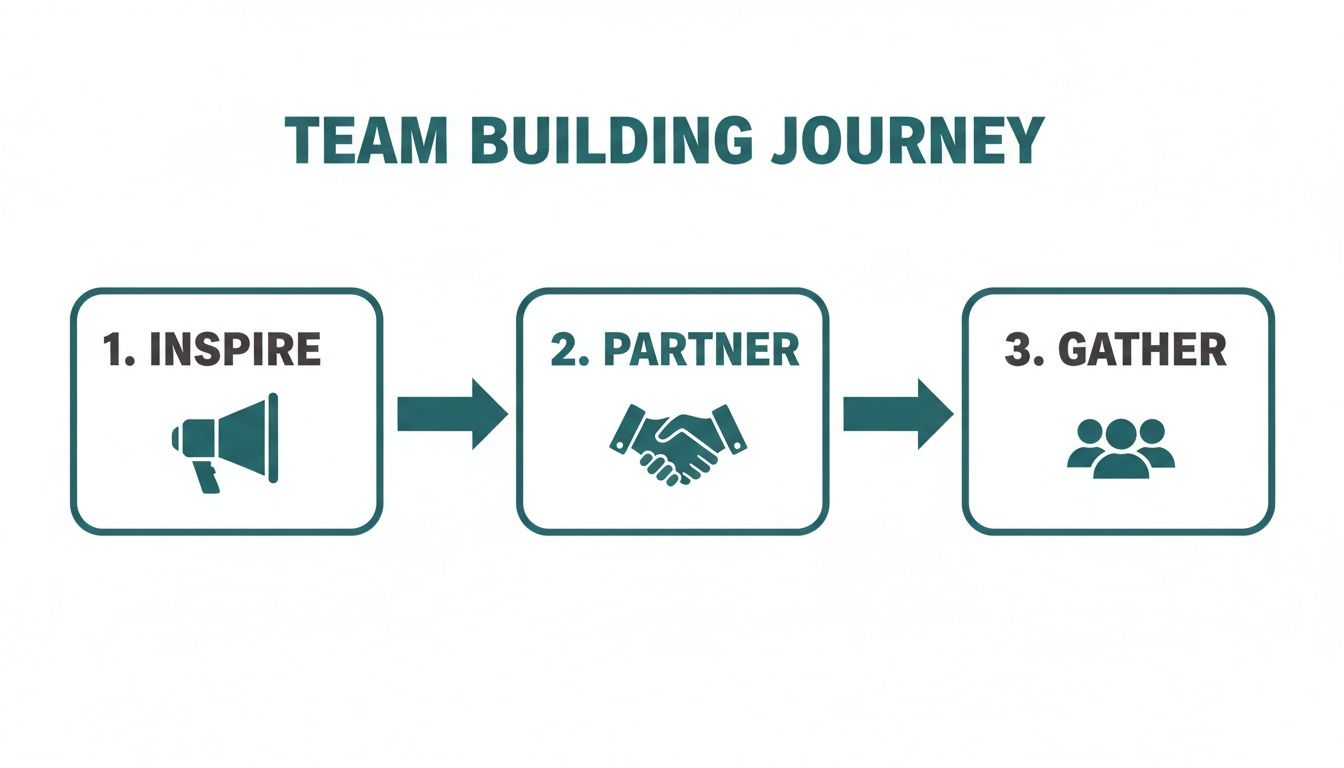
  • How to Find Volunteer Work That Truly Inspires You

    How to Find Volunteer Work That Truly Inspires You

    That little whisper inside you, the one nudging you to do something that matters? That’s not just a fleeting thought. It’s the starting line of a really cool adventure.

    But here’s a secret I’ve learned: finding volunteer work that actually feels good isn't about luck. It’s about looking inward first, before you even start looking around. This guide is all about helping you connect what you care about with a real-world need. It's a LOT easier to make an impact than you think. And it's FUN!

    Find Your Why Before Your Where

    That desire to contribute is a powerful thing. But for a lot of us, it gets stuck right at the beginning. The options feel endless, the path is foggy, and we just keep asking, "Where do I even begin?" It's easy to get paralyzed.

    A thoughtful young woman sits at a wooden desk with a backpack, open notebook, and compass.

    The trick is to flip the question. Forget "where" for a minute. Let's start with "why."

    Think of it like planning a road trip. You wouldn’t just start driving. You'd pull out a map and decide on a destination first, right? Your "why" is your destination—it tells you which direction to point the car.

    Figure Out What Really Drives You

    Your personal mission is your compass. Once you know what you genuinely care about, the whole search process transforms from a chore into a treasure hunt for a role that feels like it was made for you.

    To get there, ask yourself a few honest questions:

    • What breaks your heart? Is it seeing trash all over your favorite park? Thinking about lonely animals in shelters? Or seeing kids in your community who could use a mentor?
    • What skills do you actually enjoy using? Do you get a weird satisfaction from organizing chaotic spaces? Are you a natural at striking up conversations with new people? Do you love getting your hands dirty outside?
    • What kind of change do you want to see? Are you looking for a tangible result, like a freshly painted community center, or a deeper personal connection, like helping someone learn to read?

    Answering these helps you find your lane. If animals are your thing, you can laser-focus on local rescues. If you're happiest outdoors, environmental cleanups are your jam. This isn’t about limiting yourself; it’s about aiming your energy where it will have the biggest impact—both on the world and on you.

    Before you start searching, take a moment to think about what truly motivates you. This table is a quick way to help you connect your personal passions with potential volunteer roles.

    Your Volunteering Compass: What's Your 'Why'?

    If You Love… You Might Enjoy Volunteering For… Keywords to Search
    Animals & Nature Animal shelters, park cleanups, wildlife rehab centers, community gardens "animal rescue," "trail maintenance," "urban gardening"
    People & Community Food banks, homeless shelters, mentoring programs, senior centers, local festivals "food pantry," "youth mentor," "community event"
    Hands-On Projects Building homes (like Habitat for Humanity), painting murals, repair cafés "community build," "beautification project," "fix-it clinic"
    Skills & Organization Tutoring, helping with taxes, grant writing, event planning for a non-profit "tutor," "VITA volunteer," "non-profit event"

    Thinking this through first makes the search way less overwhelming and way more exciting. You’re not just looking for any opportunity; you’re looking for your opportunity.

    The most powerful impact comes from a place of genuine connection. When your heart is in the work, it stops feeling like work and starts feeling like purpose.

    And you're definitely not alone in feeling this way. People are showing up. Formal volunteering in the U.S. jumped to 28.3% of adults between 2022 and 2023. That’s 75.7 million people—a massive 22% spike from 2021. You're becoming part of a huge, kind-hearted movement. You can discover more insights about the state of volunteering from SignUpGenius.

    So, let's use this guide as your map. We'll explore exactly how to find volunteer work that lights you up, making the experience not just helpful for others, but deeply rewarding for you, too.

    Discover Opportunities Beyond a Google Search

    Alright, you're ready to jump in. While a quick Google search is an obvious first step, the truly rewarding stuff—the opportunities that stick with you—are usually hiding just out of sight.

    Think of it like trying to find the best local pizza joint in a new city. You could look at the flashy ads, or you could ask a friend who lives there where the real hidden gems are. Let's be that friend. This is about finding the groups making a real, tangible difference, block by block.

    Tap into Specialized Volunteer Platforms

    The internet isn't just for cat videos; it's also home to massive databases designed to connect good people with good causes. These platforms are basically matchmaking services for your skills and passions. Instead of scrolling forever, you can use their filters to find exactly what you're looking for.

    Two of the best places to start are:

    • VolunteerMatch A huge network that lets you filter by cause, location, and even whether you want to help out online or in person.
    • Idealist This site is fantastic for finding not just volunteer roles but also jobs and internships with non-profits and mission-driven organizations all over the world.

    These hubs are clutch, especially now. The whole game is changing—short-term, flexible roles are getting super popular. In fact, 18% of formal volunteers now serve online. Platforms like these get it, and they’re making it easier than ever to connect people to the right opportunities. You can learn more about these volunteering statistics from ActivateGood.

    Here’s a peek at what you’ll see on VolunteerMatch. Notice how you can immediately start narrowing things down by what you care about and where you are.

    Overhead view of a volunteer app on a smartphone, coffee, and three papers with watercolor art.

    They put the "Cause" and "Location" filters right up front, so you don't waste time sifting through things that aren't a good fit.

    Go Hyper-Local for Maximum Impact

    While the big platforms are great, sometimes the real magic happens at the grassroots level. Your own neighborhood is probably buzzing with chances to help out, and these are the opportunities where you can see the impact of your work every single day.

    The most profound changes don’t always come from the biggest organizations. They come from a few dedicated people deciding to show up for their own street corner, their own park, their own community.

    Think smaller. Maybe even go analog. Here’s where to look:

    • Your Local Library: Seriously. Libraries are community cornerstones. Check the bulletin board for flyers from local groups needing help, from book clubs for seniors to tutoring programs for kids.
    • Community Facebook Groups: Search for your neighborhood’s name on Facebook. These groups are constantly sharing info about local cleanups, food drives, and events that need a few extra hands.
    • Meetup: This app isn't just for hiking clubs or learning to code. It’s a powerhouse for finding service-oriented groups, like our own Litter Caterpillars, who organize weekend cleanups all over Chicago. If you're in the area, you can check out some of our volunteer opportunities in Chicago and see what I mean.

    Finding volunteer work this way just feels different. You’re not just a name on a list; you’re a neighbor. You're meeting the people you're helping and building real friendships with fellow volunteers. This is how a one-time event can spark a lifelong passion for service. It’s authentic, it’s fun, and it’s right outside your door.

    Your Day Job Might Be Your Secret Volunteering Weapon

    What if you could make a real difference, not just on your weekends, but on the company clock? It sounds a little wild, I know. But one of the best-kept secrets for finding meaningful volunteer work is sitting right under your nose: your employer.

    Most of us never think to connect our 9-to-5 with our desire to give back. We keep those worlds separate. But more and more companies are building that bridge through corporate volunteering programs, and you should absolutely take advantage of it.

    This isn't just about a once-a-year "service day" photo-op. It’s a structured way to lend your professional skills to causes that desperately need them.

    Turn Your Professional Skills into a Superpower

    Think about it this way: your knack for project management could help a local food pantry organize its biggest donation drive ever. Or your coding skills could build a slick new website for an animal shelter, helping more dogs find their forever homes. That’s the ultimate win-win.

    You get to sharpen your skills in a totally new environment, your company gets to build a culture that isn't just about profits, and a cause you care about gets expert-level help they could never afford otherwise. It’s about turning what you do every day into a genuine force for good.

    You are an expert in something. Whether it's wrangling spreadsheets, writing clearly, or leading a team, those professional skills are like superpowers to a nonprofit running on a shoestring budget.

    This whole idea is catching on, big time. Corporate volunteering is booming, with 61% of CSR professionals reporting a jump in employee participation for 2025—the third year in a row it's grown. If you want to see the numbers for yourself, you can read the full report from Goodera on corporate volunteering. This movement is real.

    How to Find Out What Your Company Offers

    So, how do you tap into this? It’s way easier than you think. You just have to be brave enough to ask. Your Human Resources or People Operations department is the best place to start.

    Here’s exactly what to ask to get the ball rolling:

    • "Do we have a Volunteer Time Off (VTO) policy?" This is the holy grail—paid time off specifically for volunteering. It’s the clearest sign that your company actually backs this up.
    • "Are there any company-sponsored service days coming up?" These group events are a fantastic way to dip your toes in and meet other people at your company who actually care.
    • "Does the company help match our professional skills with nonprofits?" Some really forward-thinking places will actively connect your talents with organizations that need them.
    • "Is there a matching program for employee donations?" While it's not volunteering your time, it shows the company is willing to put its money where its mouth is.

    Don't be shy about starting this conversation. You're not just asking for a perk; you're showing that you’re invested in representing the company's values out in the real world.

    And who knows? You might even be the spark that gets a program started if one doesn't exist yet. That’s how real change happens—with one person having the guts to ask, “How can we help?”

    Make Your First Contact with Confidence

    Okay, you've found them. An organization that actually gets you excited. Now it's time to reach out and say hello.

    I get it. This part can feel like you're gearing up for a first date—a little awkward, with a lot of pressure to make a good first impression.

    Let's flip the script on that. You are not an inconvenience. You are the person they've been hoping would show up. These groups genuinely need people just like you, and that first "hello" is really just a warm handshake waiting to happen.

    Overhead shot of a person working on a laptop with a notebook, pen, coffee, and envelope.

    Ditch the Robot and Sound Like a Human

    Your first message doesn't need to read like a stuffy cover letter. It just needs to be human. The goal is to show you’re enthusiastic and dependable without sounding like you’re applying for a corporate gig.

    Keep it simple and sincere. Here's a quick message you can steal and tweak:

    Subject: Eager to Volunteer!

    "Hi [Organizer’s Name],

    I was so excited to find [Organization’s Name]! I’m really passionate about [Your 'Why' – e.g., cleaning up our parks, helping animals] and would love to get involved with your upcoming [Event Name or general need].

    I’m available [mention your general availability, like 'most Saturday mornings']. Please let me know the best way to get started.

    Looking forward to helping out!

    Best,
    [Your Name]"

    That's it. It’s friendly, direct, and gets straight to the point. No fluff needed.

    Your First Contact Checklist

    Before you hit 'send' or show up for your first day, take a moment for a quick gut check. Volunteering should fill your cup, not drain it. You deserve to feel safe, valued, and genuinely excited. If something feels off, trust that feeling.

    Your time and energy are precious gifts. Be brave enough to offer them to an organization that truly honors and protects that generosity.

    Before you commit, run through this quick safety and fit check. It'll help you make sure this is a good match for you.

    Checklist Item Why It Matters What to Look For
    Clear Communication It shows they respect your time and know how to set expectations. Do they respond in a reasonable time? Is the event info clear and easy to find? Or is it a confusing mess?
    Safety First Your well-being is non-negotiable. Period. Do they mention safety guidelines? Provide gear (like gloves or vests)? Is the location public and well-lit?
    Good Vibes You should feel welcomed, not like you're crashing a party. Is their language friendly and inclusive? Do photos from past events show people who look genuinely happy and engaged?

    This little bit of homework upfront can save you a ton of hassle later and get you plugged into a group where you'll actually thrive.

    Finding your footing is all part of the journey. For more guidance on making your volunteer experience a great one, check out our collection of valuable volunteer tips. This is about finding your people and your place.

    Making Your First Day Count

    Showing up to something new is always a trip.There’s that mix of excitement and a low-key fear simmering in your gut. Will I know what to do? Are the other people cool? What if I totally screw up?

    Let's just toss that whole script out the window right now.

    Two smiling professionals in work attire shaking hands, representing partnership and successful collaboration.

    Your first day volunteering isn't some high-stakes test. It's just page one of a new story. Your only job is to be open, listen, and learn what’s going on.

    Think of it like being a guest in someone's home. You wouldn't just walk in and start rearranging their furniture, right? You're there to help out and respect their vibe. The best way to do that is just to be present and pay attention.

    Your First-Day Game Plan

    Walking in with even a loose plan can totally dissolve those first-day jitters. Don't overthink it. Just focus on a few simple things that will set you up to have a good time and actually connect with the people there. It’s all about showing up ready to be a kind, engaged part of the crew.

    Here’s a quick checklist to get you squared away:

    • Dress the part. If you're cleaning up a park, wear clothes that can get muddy and shoes that won't fall apart. If you’re helping in an office, dress comfortably but respectfully. When in doubt, just shoot the organizer a message and ask.
    • Bring your gear. A water bottle, a snack, and your phone (with a full battery) are non-negotiable. Leave anything valuable or sentimental at home—you don't need that stress.
    • Get there a little early. This gives you a minute to breathe, find the bathroom, and maybe meet the organizer before the chaos begins. It's a small thing that makes a huge difference.

    This isn’t about being perfect from the jump. It’s about being ready to learn something new.

    Ask Questions, Listen, and Connect

    Honestly, your best tool on day one is just being curious. The volunteer coordinator is your new best friend—they want you to ask questions. It shows you’re paying attention and actually want to do things right.

    The most valuable thing you bring isn't your expertise; it's your willingness. A curious mind and a kind heart are the only qualifications you truly need.

    But don't just ask "what do I do?" questions. Try to connect on a human level. Ask the organizer what got them into this work in the first place. That one question can open up a killer conversation and give you a much deeper feel for the mission.

    And definitely make an effort to chat with the other volunteers. A simple, "Hey, is this your first time here too?" is the easiest way to start a real friendship. These are your people. They showed up for the same reasons you did. They're your tribe.

    By the end of the day, you won't just know your tasks. You'll have started building those genuine human connections that make this whole thing so damn rewarding. It’s not just about the work; it’s about the people you do it with. That’s where the real magic is.

    Turn Volunteering into a Joyful Habit

    You know that feeling right after you finish volunteering? That glow? It’s real. It’s a mix of pride, connection, and pure, simple joy. But how do you keep it going? How do you stop it from being just a one-time thing?

    The secret isn’t about gritting your teeth and forcing yourself to do more. It’s about finding a rhythm that actually gives you energy. This is how you turn a single act of kindness into a sustainable, life-giving habit.

    Find Your People and Your Pace

    The people who stick with volunteering for years don't treat it like a second job. They treat it like seeing their best friends.

    The biggest piece of the puzzle is finding your community. When you're surrounded by people you genuinely like, the work itself completely changes. Picking up trash on a Saturday morning isn't a chore anymore; it’s an excuse to catch up, laugh, and share stories with your crew.

    The work is the excuse. The connection is the reason. Find a group where you feel like you belong, and you’ll never have to force yourself to show up again.

    This is how a simple activity becomes a tradition, something you actually look forward to. It becomes an anchor in your week, a source of stability and friendship. That consistency—even if it's just a few hours a month—is what builds the momentum that changes both you and your community.

    Let Your Role Evolve with You

    Life happens. You get busy, your priorities shift, and your capacity to give will change over time. That’s not just okay; it’s completely normal. The bravest thing you can do is be honest about what you can offer.

    A good organization won’t guilt you for needing to step back. They’ll thank you for the time you’ve given and leave the door open for your return. The goal isn’t to be a perfect volunteer; it’s to be a human one.

    Maybe you start out showing up every single weekend. Then, a new job means you can only make it once a month. That’s not a failure—that’s just adapting.

    Perhaps your role itself changes. One year you’re all about the physical work, and the next you find more joy helping organize the events. Your journey as a volunteer should grow and change right alongside you.

    My friend Maria started out just fostering a single dog from a local shelter. Two years later, she’s the one coordinating all the foster placements. Her passion didn’t fade; it just found a new way to express itself. She let her role evolve, and because of that, her impact deepened.

    For those looking to find that welcoming and consistent community, exploring different weekend volunteer opportunities near me can be the perfect first step to finding your rhythm.

    Allow yourself the grace to adjust your commitment. True, lasting change comes from showing up with a happy heart, not a heavy one.


    At Litter Caterpillars, we believe service has the power to transform us. We meet every weekend to clean up our city, build friendships, and find our bravery together. Join our crew and discover how good it feels to make a real, visible impact. Learn more at https://www.littercaterpillars.com.

  • Discover weekend volunteer opportunities near me and Start Giving Back Today

    Discover weekend volunteer opportunities near me and Start Giving Back Today

    Imagine your Saturday morning as the opening scene of your own hero’s journey—gloves in hand, determination in your heart, ready to transform a littered block into a piece of art. If you’re searching for weekend volunteer opportunities near me, juggling life’s demands can feel daunting. But just like planting a seed, a small act of service blossoms into confidence, friendships, and cleaner streets—and it’s a LOT easier to make impact than you think! And it’s FUN!

    Here’s what you’ll find in this listicle:

    • A curated set of 7 platforms for weekend volunteer opportunities near me, each with screenshots and direct links
    • Step-by-step join instructions to help you sign up in under five minutes
    • Practical tips on gear essentials, safety checks and easy transit routes
    • A featured profile of Litter Caterpillars so you can launch your first cleanup with courage
    • Fresh ideas to connect with new friends and boost your personal growth

    Ready to dive in and unlock your volunteer superpower? Let’s go.

    1. Litter Caterpillars

    Litter Caterpillars turns a regular weekend into an urban adventure. Imagine you’re Indiana Jones of city streets—except your treasure is cleaner sidewalks and new friendships. On my first cleanup, I knocked on doors in Englewood with a buddy and discovered how one block can feel brand new.

    Litter Caterpillars

    Why It Stands Out

    • Volunteer-first philosophy
      No donation pressure—just pure community service and camaraderie
    • Consistent weekend meetups
      Rain or shine, Saturday and Sunday mornings become your new ritual
    • Citywide reach
      From Lincoln Park to Little Village, every ward counts
    • Identity and rituals
      Bright green flags, catchy chants, and matching badges unite the crew
    • Safety and happiness focus
      Buddy systems, pre-event checklists, and volunteer-led coordination

    Learn more about Litter Caterpillars on domain.com

    Feature Comparison Table

    Feature Benefit
    Free to join Zero cost—just bring gloves and water
    All-weather commitment Builds resilience and consistency
    Nonprofit-like impact Cleansed 50 wards, won auction for Caterpillar Park
    Social channels Real-time updates, event photos and stories

    How to Get Started

    1. Visit littercaterpillars.com and click “Join a Cleanup”
    2. RSVP on Meetup or send a DM on Instagram
    3. Bring gloves, sturdy shoes and reusable bag
    4. Arrive 10 minutes early for safety briefing

    Insider Tips

    • Arrive caffeinated and with a snack to keep energy high
    • Team up with a friend and share a “before and after” photo
    • Look for the bright green flags—they mark your cleanup zone

    Pros and Cons

    Pros

    • Proven impact across all Chicago wards
    • Strong social network builds friendships
    • Completely free with no fundraising pressure

    Cons

    • Not a registered 501(c)(3), so donations aren’t tax-deductible
    • Physically demanding in extreme weather or challenging neighborhoods

    Litter Caterpillars shows that making an impact can be as effortless as stepping outside on a Saturday morning. It’s a fun, fearless way to transform your community and yourself.

    2. Idealist (Volunteer Opportunities)

    Idealist is like a treasure map of good deeds—your X marks the spot for a park cleanup one weekend, a literacy session the next. Scrolling feels as easy as browsing your favorite shopping app, but instead of adding sneakers to your cart, you add volunteer slots that light you up.

    Idealist (Volunteer Opportunities)

    Why Idealist Shines

    • Massive selection: thousands of listings updated daily
    • Location flexibility: radius, on-site, hybrid or remote roles
    • Free and easy to browse and apply
    • Aggregates partner and direct nonprofit posts for variety

    Key Features

    1. Date filter: pinpoint roles on specific weekends or days
    2. Saved searches: store filters and keywords for quick access
    3. Email alerts: get notified when new weekend events appear
    4. Cause categories: dive into environment, education, health and more

    Feature Comparison

    Feature Benefit
    Date Filter Zero in on weekend openings
    Location Radius Find roles near your neighborhood
    Email Alerts Stay ahead of fresh listings
    Cause Filters Match passion with purpose

    Tips for Using Idealist Effectively

    • Use specific keywords like Chicago park cleanup
    • Adjust radius to 5–10 miles for neighborhood impact
    • Subscribe to email alerts for weekend slots
    • Check listing dates frequently to avoid stale posts

    Pros and Cons

    Pros

    • Huge inventory across the US
    • Free to browse and apply
    • Alerts catch newly posted events

    Cons

    • Response times vary by nonprofit
    • Occasional outdated listings remain live

    Ready to dive in? Save time and make a real difference every weekend. Learn more about Idealist (Volunteer Opportunities) on LitterCaterpillars.com and start your next adventure.

    3. Points of Light Engage (formerly All for Good)

    Points of Light Engage is browsing Instagram for good deeds—swipe to find your next park cleanup or virtual mentoring slot. When I dove in, I earned my first badge within an hour, and that digital star felt like a gold medal.

    Points of Light Engage (formerly All for Good)

    Why Points of Light Engage Shines

    • Broad coverage: thousands of local weekend events updated daily
    • One-day focus: perfect for spontaneous Saturday or Sunday service
    • Affiliate perks: earn badges, unlock certificates, join recognition programs
    • Hybrid roles: on-site park pickups or virtual youth tutoring
    • Zip code search: zero in on Lincoln Park or Hyde Park projects

    Key Features

    1. Location-based search: filter by city or ZIP code for “weekend volunteer opportunities near me”
    2. Aggregated listings: pulls opportunities from Points of Light affiliates and partners
    3. Recognition engine: track hours, earn awards, share your impact on social media
    4. Flexible filters: choose in-person, virtual, date range, or cause type

    Feature Comparison

    Feature Benefit
    Zip Code Filter Pinpoint weekend events steps from your doorstep
    Aggregation Engine One-stop hub—no more juggling multiple sites
    Recognition Badges Stay motivated by earning local and national awards
    Date Range Selector Schedule service around busy life commitments

    Tips for Using Points of Light Engage Effectively

    • Set the date filter to “This Weekend” to skip weekday listings
    • Bookmark 2–3 projects to compare time commitments and travel
    • Opt into recognition programs to rally friends and spark friendly challenges
    • Use specific keywords (for example “Riverwalk cleanup Chicago”)

    Pros and Cons

    Pros

    • Massive, free database backed by a respected national nonprofit
    • Easy city/ZIP lookup delivers immediate weekend options
    • Gamified badges and certificates drive engagement

    Cons

    • Some listings redirect to partner sites for final signup
    • Filtering depth varies by source—expect occasional detours

    Ready to spark joy and accelerate your personal growth through weekend service? Discover your next adventure on Points of Light Engage and watch real impact bloom.

    4. JustServe

    JustServe is like a friendly map drawn by neighbors—click and you see a pizza-box cleanup two blocks away. Boom, instant hero status. It’s clean, it’s quick, and it’s open to everyone, making weekend volunteering feel as easy as ordering a snack.

    JustServe

    Why JustServe Shines

    • Wide range of one-day and ongoing projects for flexible schedules
    • Family-friendly events that let you bring kids or friends along
    • No subscription barriers or hidden fees, making volunteering accessible
    • Instant visibility of community needs across neighborhoods

    Key Features

    1. Location filters: search by ZIP code or city to pinpoint nearby projects
    2. Availability tags: instantly spot weekend-only or multi-day shifts
    3. In-person and remote options: join a park cleanup or support an online tutoring session
    4. Quick signup flow: register and commit in under two minutes

    Feature Comparison

    Feature Benefit
    ZIP/City Search Drill down to your neighborhood with precision
    Availability Filter Focus on weekend slots without scrolling weekdays
    Project Variety Choose between one-off cleanups or long-term roles
    Quick Signup Flow Stay spontaneous with last-minute registrations

    Tips for Using JustServe Effectively

    • Set filters for “weekend” and your preferred cause to see relevant shifts immediately
    • Bookmark saved searches in your profile for fast access on Friday evenings
    • Check new postings early in the morning for last-minute openings
    • Pack essentials like gloves, water, snacks, and a sun hat for outdoor work

    Pros and Cons

    Pros

    • Completely free platform with no paywalls
    • Family-friendly and community-led projects
    • Easy, last-minute signups

    Cons

    • Listing density varies by city and ZIP code
    • Requires an account to track and manage signups

    Ready to dive in? Find your next last-minute weekend opportunity and see how easy it is to make an impact. Visit JustServe. Learn more about JustServe park cleanups on LitterCaterpillars.com.

    5. United Way Volunteer Portals (national network)

    United Way’s portals feel like a well-stocked market—each affiliate curates fresh events like a chef choosing seasonal produce. Want a Saturday park restoration or a Sunday school supply drive? It’s on the shelf, ready for your cart.

    Why United Way Shines

    • Local focus: affiliates vet partners and update listings weekly
    • Weekend-ready: built-in Sat/Sun calendar filters highlight shifts
    • Group-friendly: sign up teams for Days of Caring and drives
    • Seamless signup: integrates directly with nonprofit registration

    Key Features

    1. Day-of-week filters: view only Saturday or Sunday slots
    2. Time-of-day options: morning, afternoon or evening shifts
    3. Local inventories: hundreds of events per metro region
    4. Direct integrations: register on the nonprofit’s own system

    Feature Comparison

    Feature Benefit
    Weekend Calendar Zero in on Saturday/Sunday availability
    Affiliate Curation Reliable events vetted by local experts
    Group Signup Organize friends or corporate teams easily
    Nonprofit Integration Streamlined registration and hour tracking

    Tips for Using United Way Portals Effectively

    • Bookmark your city portal for quick access each weekend
    • Set filters to “Saturday” and “Sunday” before browsing
    • Invite friends directly through group signup links
    • Check back monthly for seasonal drives and big events

    Pros and Cons

    Pros

    • Strong local curation means higher-quality events
    • Many community-wide Days of Caring bring big impact

    Cons

    • Activity level varies by city affiliate
    • You must create an account to apply

    Ready to turn a free weekend into a force for good? Learn more about United Way Volunteer Portals and discover hundreds of weekend volunteer opportunities near me at https://volunteer.unitedway.org. Start your next adventure and watch your neighborhood blossom.
    6. GivePulse

    GivePulse is like a Spotify playlist for service—you filter by date and distance, hit play on a weekend cleanup, and track your hours as if they were tracks on your favorite album.
    Why GivePulse Shines

    • Versatile access: university hubs, city programs and nonprofits all in one place
    • Real-time filters for date, cause and distance
    • Instant impact logs so you track verified hours without hassle
    • Peer-to-peer and group sign-ups encourage friends to join

    Key Features

    1. Date and availability filters: lock in Saturday or Sunday slots
    2. Distance radius: find cleanup events a short walk or bus ride away
    3. One-click registration: save your profile and RSVP in seconds
    4. Built-in hour tracking: log your service as soon as you finish

    Feature Comparison

    Feature Benefit
    Date Filter Zero in on specific weekend windows
    Distance Radius Scope to your neighborhood radius
    One-Click Registration Instant RSVPs without extra forms
    Hour Tracking Automatic logs for resumes and reports

    Tips for Using GivePulse Effectively

    • Set date filters to “This Weekend” to catch fresh events
    • Pin your home city radius to avoid long commutes
    • Sync with peers by sharing event links in group chats
    • Export hour logs monthly to celebrate your impact

    Pros and Cons

    Pros

    • Robust, layered filters for fine-tuned searches
    • Strong presence at universities and in city-run hubs
    • Instant tracking ideal for students and professionals

    Cons

    • Varies by region; smaller towns have fewer listings
    • Requires an account to unlock full features

    Ready to transform your free time into community impact? Visit GivePulse now and discover weekend volunteer opportunities near me in your neighborhood.

    7. AARP Create the Good

    AARP Create the Good is like a personalized event chef—matches you to projects based on your skills, stirs in curated guides, and serves up weekend volunteer opportunities near me on a welcome platter.

    AARP Create the Good

    Why AARP Create the Good Shines

    • Tailored matches: uses your skills, interests, and location to surface ideal roles every weekend
    • US-only focus: filters for in-person Chicago events and at-home service projects
    • DIY project guides: thorough checklists, sample outreach templates, and safety tips
    • Aggregated listings: pulls roles from Engage, VolunteerMatch, and local partners

    Key Features

    1. Location and remote filters: switch between neighborhood cleanups and at-home phone banking
    2. Profile-driven suggestions: AI-backed matches highlight weekend volunteer opportunities near me
    3. Project guides: customizable plans with timelines, supplies lists, and outreach email templates
    4. Aggregated listings: find events syndicated from partner sites to maximize weekend options

    Feature Comparison

    Feature Benefit
    Profile Suggestions Matches you to roles based on experience and interests
    Local + Remote Filters Zero in on Chicago neighborhoods or at-home opportunities
    DIY Project Guides Plans, checklists, and templates simplify event organization
    Aggregated Listings Broader weekend options via partner platform syndication

    Tips for Using AARP Create the Good Effectively

    • Fill out your profile fully, including skills and availability, to unlock precise matches
    • Use neighborhood keywords like “South Loop park” or “Wicker Park mural” for pinpoint weekend searches
    • Bookmark project guides on Thursday to gather supplies and volunteer buddies in time
    • Check the Trending Projects section each Friday morning for brand-new weekend slots

    Pros and Cons

    Pros

    • Free and intuitive interface perfect for skill-based and first-time volunteers
    • Comprehensive guides help small groups launch their own weekend service projects

    Cons

    • Some Chicago ZIP codes show fewer listings than giants like VolunteerMatch
    • You may need to broaden your search radius beyond city center for more weekend roles

    Ready to spark change on your next weekend? Learn more and start your journey with AARP Create the Good.

    7-Platform Comparison: Weekend Volunteer Opportunities

    Program 🔄 Implementation complexity ⚡ Resource requirements ⭐ Expected outcomes 💡 Ideal use cases 📊 Key advantages
    Litter Caterpillars Medium — recurring weekend logistics Low monetary, high volunteer time & effort ⭐⭐⭐ — visible cleanup + social cohesion Hands-on weekend volunteers seeking community & identity Strong local presence, consistent meetups, volunteer-first culture
    Idealist (Volunteer Opportunities) Low — search/filters; few barriers Low user time; no fees to browse/apply ⭐⭐ — broad options; match quality varies One-off or recurring weekend roles across causes Very large inventory, date filters, saved searches & alerts
    Points of Light Engage Low–Medium — aggregated listings Low user effort; occasional external signups ⭐⭐ — good for one-day projects; recognition Quick weekend sign-ups and civic volunteer events Backed by national nonprofit, wide aggregated coverage
    JustServe Low — minimal interface, quick signup Low time investment; account required ⭐⭐ — family-friendly, short-term projects Last-minute weekend volunteering and family groups Clean UX, quick browsing, community partner projects
    United Way Volunteer Portals Medium — varies by affiliate Moderate — account needed; local coordination ⭐⭐⭐ — reliable local events and drives Metro-area weekend shifts, group or corporate teams Strong local curation, links to trusted community partners
    GivePulse Medium — robust platform Moderate — account needed; integrated tracking ⭐⭐⭐ — verified hours and campus/municipal events Students, universities, clubs needing hour verification Powerful filters, one-click registration, verified impact logs
    AARP Create the Good Low — profile-driven suggestions Low — best for experienced/skills-based volunteers ⭐⭐ — curated matches for older adults Adults 50+ or volunteers seeking guided, skill-based projects Project guides, profile suggestions, resources for DIY service

    Your Next Steps to Weekend Impact

    As you close this roundup of weekend volunteer opportunities near me, you have all the ingredients to make a real difference. Below are the key takeaways and actionable steps to turn inspiration into impact.

    Key Insights to Remember

    Volunteering is like planting seeds in different neighborhoods—each effort blossoms into cleaner streets, stronger communities, and new friendships.

    • Litter Caterpillars offers hands-on cleanup meetups in Chicago’s parks and streets
    • Idealist and Points of Light Engage connect you with thousands of local projects
    • JustServe and United Way Volunteer Portals streamline sign-ups for causes you care about
    • GivePulse tracks your service hours and helps build your volunteer resume
    • AARP Create the Good welcomes all ages for community improvement events

    Choosing Your Perfect Volunteer Match

    1. Reflect on what excites you—environmental cleanup, neighborhood beautification, or social services
    2. Compare meetup times and locations to fit your weekend schedule
    3. Read real volunteer stories and profiles to feel confident about joining
    4. Sign up on the platform that best fits your style—app-based ease or email reminders

    Factors to Consider Before You Dive In

    • Equipment and attire: sturdy shoes, gloves, and a refillable water bottle
    • Safety and accessibility: check public transit routes or carpool with new friends
    • Group dynamics: small crews feel cozy; large groups create big visual impact
    • Event flexibility: look for drop-in events or sign up in advance to secure your spot

    Bringing It All Together

    • Plan your weekend volunteer like a mini adventure
    • Treat each meetup as an opportunity to meet neighbors, explore new areas, and build skills
    • Use the tools above to track your progress and share stories on social media
    • Celebrate small victories—a clean block, a revived park, or a new friend

    Remember, making impact starts with a single step out your door. Whether you choose a 90-minute park pickup or a multi-hour neighborhood paint day, your courage and kindness will inspire others.

    Keep this list handy, revisit it before each weekend, and watch how small actions add up. The community is waiting for someone just like you to bring energy, ideas, and heart to Chicago’s streets. Your next weekend volunteer adventure is closer than you think.


    Ready to start cleaning up your corner of Chicago? Check out Litter Caterpillars for guided, friendly cleanups, expert gear tips, and a welcoming crew. Join us and discover why local volunteers choose Litter Caterpillars for the best weekend volunteer opportunities near me.

  • Discover environmental volunteer opportunities in chicago today

    Discover environmental volunteer opportunities in chicago today

    Let's be real. It's easy to feel like your living space, and your life, is a mess. I know I did. My fridge was a museum of old jam and failed health kicks. The old blueberry jam in the back of my fridge I got 4 years ago from that one trip to Michigan. The bag of nuts from that time I tried to eat healthy but failed. Each piece of trash felt like it weighed 500 pounds, a tiny monument to something I couldn't move past. My life was stuck.

    Then, I ended a long and chaotic relationship and decided to tackle the hardest things I could think of: consistency, cleanliness, and bravery. I started picking up trash. Not my trash, but everyone's. And a funny thing happened. It was easier than cleaning my own mess. It was fun.

    Even when three of us got caught in a Chicago spring hailstorm, huddled under a tree as Ubers canceled on us, we weren't miserable. We were in a story. We were advancing the plot. That's how the Litter Caterpillars were born. We believe service transforms you. It's not about being perfect; it's about trying, together.

    This list isn't just a directory; it's an invitation to find your own "hailstorm moment" and discover that making an impact is simpler and more rewarding than you've ever been told. Here are the best environmental volunteer opportunities Chicago has to offer, from recurring cleanups to habitat restoration, all with direct links and details to get you started. This guide solves the problem of not knowing where to begin by putting the city's most effective and inspiring programs right at your fingertips. Let’s find your crew.

    1. Litter Caterpillars

    WARNING: We're not your Grandpa's trash pickup group!

    Are you tough enough? We're the toughest trash pickup group in Chicago—we pick up trash rain or shine, in the coldest days of winter and the hottest days of summer! We're the first and only trash pickup group to clean up all 50 wards of Chicago, including the ones you've been told to stay away from! And we're the first and only trash pickup group that has won an empty lot at auction to build a park. Help us build Caterpillar Park in Englewood!

    The Litter Caterpillars were born from a personal breaking point. My own living space was a mess, and so was my life. After ending a chaotic relationship, I resolved to engineer my social circle to filter out selfish people and to tackle the things that have always been difficult for me: cleanliness, consistency, and bravery. Our logo represents our very first cleanup. There were only three of us, and we got caught in a springtime hailstorm. Huddled under a tree, shivering, I realized something: cleaning other people's messes is WAY easier than cleaning our own. And suffering in the hail actually makes things interesting. It adds "flavor." It advances the plot.

    Why It's a Top Choice for Environmental Volunteering in Chicago

    For three years, every single week, we’ve picked up trash. Our central vision is the redeeming and transforming power of service, outdoors, sunlight, and friendship. That’s why we are Caterpillars. We are not perfect, but we are all trying to transform! We believe in two core values: Bravery and Kindness. Bravery means embracing fear and failure as tools for growth. Kindness means building unity and putting our volunteers first—their energy, safety, and happiness are what matter most.

    This group is a standout choice for anyone looking for consistent, high-impact environmental volunteer opportunities in Chicago where you can forge genuine connections and see the difference you're making.

    "Fear is good. Failure is good. Suffering is good. It’s what leads to growth. When Tom Sawyer was punished by his aunt and was forced to paint a fence, he could have wallowed and complained. Instead he convinced his friends that painting the fence was actually extremely fun."

    How to Get Involved

    Joining is designed to be effortless. We intentionally avoid bureaucracy to focus on direct action and community. We meet on weekend mornings to filter for givers. We'll never pump our volunteers for money. The only requirement is your willingness to show up.

    This structure makes it incredibly accessible for students, young professionals, and anyone new to Chicago looking to make friends while making a difference.

    The Details

    • Cost: Free. All events are volunteer-organized and supplies are provided.

    • Schedule: Every weekend morning, year-round, in various locations across Chicago's 50 wards.

    • Vibe: Brave, kind, unified, and tough. A welcoming community built on shared effort and mutual respect.

    • Website: littercaterpillars.com

    2. Idealist (includes VolunteerMatch)

    Think of Idealist as the Grand Central Station for Chicago’s entire volunteer world. It’s not just one organization; it's a massive, searchable hub where hundreds of nonprofits post their needs. Following its merger with VolunteerMatch, it has become the single largest, most comprehensive platform for finding ways to give back, making it an essential first stop for anyone looking to find environmental volunteer opportunities in Chicago.

    A screenshot of the Idealist website showing a search for environmental volunteer opportunities in Chicago, with multiple listings displayed.

    This platform isn't about one specific mission. It’s about choice and access. Whether you want to plant trees with Openlands, restore a prairie with the Chicago Park District, or help an advocacy group with data entry from your couch, you’ll find it here. The sheer volume can feel overwhelming, but its power lies in its detailed filters. You can instantly narrow your search to find the perfect fit for your schedule, location, and passion.

    How to Find Your Perfect Environmental Role

    Navigating the site is straightforward. You create a free account, which allows you to save opportunities and receive updates when new roles that match your interests are posted.

    Here’s a simple strategy to get started:

    1. Go to the Chicago volunteer page.

    2. Use the search bar and filters immediately. Type in keywords like "environment," "sustainability," "gardening," or "conservation."

    3. Filter by "Environment & Sustainability" under the "Cause Area" to see only relevant listings.

    4. Adjust the location radius. You can search for opportunities within a specific distance of your home or work.

    5. Sort by "Most Recent" to see the newest postings, as popular events can fill up quickly.

    Pro-Tip: Don't just look for "cleanups." Broaden your search with terms like "stewardship," "habitat," or "advocacy." You might discover unique roles like monitoring local wildlife populations or helping organize a sustainability fair.

    Why Idealist Stands Out

    The biggest advantage is efficiency. Instead of visiting dozens of individual nonprofit websites, you get a bird's-eye view of what’s happening across the city. The merger with VolunteerMatch has only amplified this, creating an unparalleled marketplace of opportunities. This makes it an invaluable tool for exploring the diverse landscape of Chicago-based volunteering.

    Pros:

    • Massive Selection: The single largest database of volunteer roles, covering everything from hands-on restoration to administrative support.

    • Powerful Filters: Easily narrow down options by cause, location, date, and whether the role is on-site or virtual.

    • User-Friendly: Simple to sign up, search, and apply directly through the platform or linked organizational sites.

    Cons:

    • Variable Quality: As an aggregator, the detail and quality of each listing depend on the organization that posted it.

    • Time-Sensitive: Many listings are for one-time events, so you need to check back frequently for new opportunities.

    Website: https://www.idealist.org/en/volunteer-in-chicago

    3. Chicago Park District — Natural Areas Community Stewardship Days

    If you want to feel the earth in your hands and see the direct results of your work on Chicago’s beautiful natural landscapes, this is where you start. The Chicago Park District’s Community Stewardship program is your ticket to becoming a hands-on guardian of the city’s precious prairies, dunes, wetlands, and woodlands. This isn't just about picking up trash; it's about deep ecological healing, one workday at a time.

    A screenshot of the Chicago Park District's Community Stewardship Days webpage, showing a calendar of events and information for volunteers.

    The program is incredibly well-run and offers a tangible way to connect with the nature right in your neighborhood. Volunteers get involved in essential restoration tasks like removing invasive plant species, planting native wildflowers and grasses, collecting seeds, and mulching trails. It’s a powerful way to learn about local ecosystems while making a visible, lasting impact. I've personally volunteered with this program and can vouch for how rewarding and well-organized it is.

    How to Find Your Perfect Environmental Role

    Getting started is simple, as the Park District provides a clear calendar and all the necessary support for newcomers. They want you to succeed and feel welcome.

    Here’s a simple strategy to get started:

    1. Visit the Stewardship Days calendar page. This is your main hub for all upcoming events.

    2. Browse by location or date. You can find a workday at a park near you, whether it’s a lakefront dune or a riverbank woodland.

    3. Find an event and RSVP. Each listing includes the site steward’s contact information. A quick email is usually all that’s needed to confirm your spot.

    4. Complete the online waiver before you go to save time.

    5. Show up ready to work! Tools and guidance are always provided, so no prior experience is necessary.

    Pro-Tip: Don't be shy about asking questions! The site stewards are passionate experts who love sharing their knowledge about local ecology. This is one of the best environmental volunteer opportunities in Chicago to learn about native plants and restoration techniques.

    Why The Park District Program Stands Out

    The biggest advantage here is authenticity and direct impact. You are working on land owned and managed for the public good, contributing to a legacy of conservation. You can return to the same spot months or years later and see the native garden you planted now thriving. The program also offers a clear path for growth, from a one-day helper to a certified Lead Steward, for those who want a deeper commitment. For a deeper dive into their offerings, learn more about the Chicago Park District — Natural Areas Community Stewardship Days.

    Pros:

    • Direct Ecological Impact: Your work directly restores and protects vital local habitats.

    • Accessible to All: Frequent events across the city make it easy to find an opportunity near you. It’s perfect for beginners, families, and groups.

    • All Tools Provided: No need to bring anything but yourself, water, and weather-appropriate clothes.

    Cons:

    • Weather-Dependent: Events can be canceled due to extreme weather, so always check before you go.

    • Amenities Vary: Some natural areas are more rustic than others and may have limited access to restrooms or water fountains.

    Website: https://www.chicagoparkdistrict.com/get-involved/volunteer/natural-areas-community-stewardship-days

    4. Friends of the Chicago River

    If you’ve ever admired the Chicago River and felt a pull to protect it, Friends of the Chicago River is your direct connection to its restoration. This organization is laser-focused on the health and vitality of the Chicago-Calumet River system. They don’t just advocate for the river; they get their hands dirty improving it, offering some of the most impactful and unique environmental volunteer opportunities Chicago has to offer.

    A screenshot of the Friends of the Chicago River volunteer page, showing clear calls to action and images of volunteers at work.

    This is where passion for our city's iconic waterway transforms into action. Opportunities range from clearing invasive species along the riverbanks to planting native vegetation from a canoe. Their flagship event, Chicago River Day, is a massive city-wide cleanup that personally inspired the creation of the Litter Caterpillars. We owe our first trash grabber claws to Brian Pesta and the incredible team at Friends of the Chicago River.

    How to Find Your Perfect Environmental Role

    The website’s event calendar is the central hub for finding and signing up for activities. It’s organized, up-to-date, and makes getting involved straightforward.

    Here’s a simple strategy to get started:

    1. Visit the volunteer page. This is your starting point for all opportunities.

    2. Sign up to be a “Chicago River Eco-Warrior.” This gets you on their monthly CREW email list, which delivers tailored opportunities directly to your inbox.

    3. Browse the Events Calendar. This is where you’ll find one-time events like Chicago River Day and recurring stewardship workdays.

    4. Look for Specialized Training. Keep an eye out for unique roles like Volunteer Canoe Guides, which require training but offer an incredible way to experience the river.

    5. Follow the signup instructions for your chosen event, which are clearly listed for each posting.

    Pro-Tip: Don’t be intimidated by specialized roles like becoming a canoe guide. Friends of the Chicago River provides all the necessary training. It’s a fantastic way to develop new skills, deepen your knowledge, and become a leader in the river’s restoration movement.

    Why Friends of the Chicago River Stands Out

    The biggest advantage is the direct, tangible impact on a single, vital ecosystem. While other platforms offer broad choices, this organization provides a deep dive into watershed health. You aren't just cleaning a park; you're restoring a living river system that is central to Chicago's identity. This focused mission creates a strong sense of purpose and community among its volunteers.

    Pros:

    • Mission-Focused: Every activity directly contributes to the health of the Chicago River, with clear ecological goals.

    • Variety of Roles: Offers a mix of hands-on fieldwork, educational outreach, and major events to fit different skills and interests.

    • Skill-Building Opportunities: Provides specialized training for unique roles like canoe guides and habitat restoration leaders.

    Cons:

    • Seasonal Limitations: Many on-the-water and planting activities are concentrated in the spring, summer, and fall.

    • Potential for Weather Cancellations: River-edge work is dependent on safe weather and water level conditions.

    Website: https://www.chicagoriver.org/get_involved/volunteer/

    5. Forest Preserves of Cook County (FPDCC)

    If you're ready to get your hands dirty and truly connect with the wild heart of Chicagoland, the Forest Preserves of Cook County (FPDCC) is your destination. Managing a breathtaking 69,000 acres of prairies, woodlands, and wetlands, this is where you can step out of the urban grind and into the essential work of habitat restoration. The FPDCC offers some of the most impactful and structured environmental volunteer opportunities in Chicago and its surrounding suburbs.

    Volunteers working together during an event with the Forest Preserves of Cook County (FPDCC).

    Volunteering here is about more than just picking up litter; it’s about becoming a steward of the land. You could be clearing invasive buckthorn to let native oaks breathe, collecting precious prairie seeds for future growth, or maintaining trails that allow thousands to enjoy these natural treasures. The FPDCC provides the tools, training, and guidance, making it accessible for everyone from seasoned ecologists to first-time volunteers.

    How to Find Your Perfect Environmental Role

    The FPDCC's volunteer portal is organized to help you find an opportunity that matches your commitment level and interests. They offer multiple pathways to get involved, from one-day events to ongoing leadership roles.

    Here’s a simple strategy to get started:

    1. Explore the Volunteer Portal. Visit the main volunteer page to see the different programs available.

    2. Check the Public Workday Calendar. This is the fastest way to join a scheduled event. You can find stewardship days focused on specific tasks like brush removal or seed harvesting.

    3. Consider a Program. Look into structured opportunities like becoming a Trail Watch monitor, joining the Master Naturalist program, or leading an "Adopt-A-Site" cleanup group.

    4. Sign Up for an Event. Most public workdays require a simple online registration and waiver, which helps the organizers plan for tools and supervision.

    Pro-Tip: Don’t be intimidated by terms like “brush pile burns” or “invasive removal.” These activities are supervised by trained staff and are incredibly satisfying. It’s a powerful feeling to physically remove a threat to the ecosystem and see the immediate positive impact.

    Why FPDCC Stands Out

    The sheer scale and diversity of the Forest Preserves make it a unique and vital resource. Volunteering here connects you to a county-wide conservation effort, providing a deep sense of purpose and a direct link to the region's ecological health. The organization's commitment to training and safety also makes it an excellent environment for learning new skills and for group volunteering.

    Pros:

    • High Availability: A packed calendar of restoration days and events runs year-round across a huge diversity of habitats.

    • Structured Support: The county provides excellent coordination, safety protocols, tools, and training, making it ideal for groups and new volunteers.

    • Meaningful Impact: The work directly contributes to the long-term health of local ecosystems, from prairies to wetlands.

    Cons:

    • Travel Required: Many of the preserves are located in the suburbs, so access may require a car or significant public transit time.

    • Registration Needed: Some roles and all public workdays require advance registration and waivers, and leadership positions involve dedicated training.

    Website: https://fpdcc.com/volunteer/

    6. Openlands — TreeKeepers

    If you’ve ever walked through a Chicago neighborhood and admired its leafy canopy, you have organizations like Openlands to thank. This isn’t just about scattering seeds; it's about building a living, breathing urban forest. The TreeKeepers program is their flagship initiative that transforms passionate residents into certified, skilled stewards of Chicago’s most vital green infrastructure: our trees.

    A volunteer from the Openlands TreeKeepers program carefully planting a new tree in a Chicago parkway.

    This program offers a deeper level of engagement than a typical one-day event. It’s an immersive educational course that teaches you everything from tree identification and biology to proper planting, pruning, and care. I have personally volunteered with Openlands' tree planting opportunities and can attest to the amazing work they do. Once certified, you join a dedicated network of alumni who lead and participate in tree-planting and care events across the region, making a tangible, long-lasting impact on our city’s health and beauty.

    How to Find Your Perfect Environmental Role

    Becoming a TreeKeeper involves a structured certification course, but once you're in, a world of specialized volunteer events opens up. The training itself is one of the most rewarding environmental volunteer opportunities in Chicago.

    Here’s a simple strategy to get started:

    1. Visit the TreeKeepers Program Page. Start here to learn about the course curriculum, schedules, and registration details.

    2. Enroll in the Certification Course. The English course typically costs around $150 (scholarships are often available), and a Spanish-language version is offered for free when available.

    3. Complete Your Training. The course involves both classroom learning and hands-on fieldwork, taught by forestry experts.

    4. Join the Alumni Network. After certification, you’ll gain access to the volunteer events calendar.

    5. Sign Up for Workdays. Browse opportunities for planting, pruning, and tree-care events and sign up for those that fit your schedule.

    Pro-Tip: Even if you can't commit to the full course right away, check the main Openlands volunteer page. They sometimes have general planting days that are open to the public and don't require certification, giving you a taste of the great work they do.

    Why Openlands Stands Out

    Openlands provides an unparalleled depth of knowledge. You don't just plant a tree; you learn why you're planting it there, how it will thrive, and what it needs to live for generations. This focus on education and skill-building empowers volunteers to become true community leaders and advocates for the urban canopy. The program’s impact is visible in thousands of healthy trees that cool our streets, clean our air, and beautify our neighborhoods. You can learn more about other impactful environmental volunteering opportunities that build a greener Chicago.

    Pros:

    • High-Quality Training: Gain expert-level skills in urban forestry, a valuable and empowering experience.

    • Significant Impact: Well-organized events directly contribute to increasing the city's tree canopy and improving neighborhood health.

    • Strong Community: The alumni network provides a sense of camaraderie and ongoing opportunities for leadership.

    Cons:

    • Time and Cost Commitment: The certification course requires a fee and a significant time investment.

    • Niche Focus: Opportunities are almost exclusively centered on tree planting and care, offering less variety than aggregator sites.

    Website: https://openlands.org/programs/treekeepers-certification-and-program/

    7. More Awesome Chicago Environmental Groups

    The spirit of service in Chicago is huge! Here are some other incredible organizations that I've either personally volunteered with or highly recommend. They all offer fantastic ways to get involved and make a difference.

    • Wild Mile Chicago: This is my favorite place in Chicago. Help build and maintain the amazing floating gardens on the Chicago River. A huge shoutout to Nick Wesley and the whole team there. You can even kayak for free!

    • Cleanup Club Chicago & Garbage Gals: Two more fantastic, grassroots cleanup groups making a visible impact on our city's streets. I haven't volunteered with them yet, but they are highly recommended.

    • Urban Gardening: Get your hands in the soil with groups like Cedillos in Englewood or Just Roots Chicago (https://justrootschicago.org/get-involved/).

    • Westlawn Conservation Club: A great local group focused on conservation efforts on the Southwest Side.

    • Alliance for the Great Lakes: Join their Adopt-a-Beach™ program to lead or join cleanups along our beautiful lakefront (https://adopt.greatlakes.org/s/find-a-cleanup).

    • Shedd Aquarium Action Days: Join Shedd Aquarium staff for science-led restoration and cleanup events along the lakefront and river.

      Shedd Aquarium — Action Days

    Website: https://www.sheddaquarium.org/care-and-conservation/take-action-for-animals/shedd-aquarium-action-days

    Stop Thinking, Start Doing: Your Next Chapter Awaits

    You’ve reached the end of this guide, but you’re standing at the beginning of something much more exciting: your own story of impact. We’ve journeyed through a landscape rich with environmental volunteer opportunities in Chicago, from the quiet dedication of the Chicago Park District’s stewardship days to the ambitious habitat restoration projects of the Forest Preserves of Cook County. Each path offers a different kind of adventure.

    Maybe you felt a pull towards the methodical, rewarding work of planting a forest of tomorrow with Openlands, or the innovative spirit of building floating gardens with the team at Wild Mile. Perhaps the idea of becoming a guardian of our city's vital waterway with the Friends of the Chicago River, the very group that inspired our own beginnings, sparked something in you.

    Each opportunity is more than just a task; it's a doorway. It's a chance to step outside your routine, to meet people who share your values, and to see your city not just as a place you live, but as a place you help shape.

    Finding Your "Tom Sawyer" Moment

    Remember the story of Tom Sawyer? He was given a punishment, a chore to paint a fence. He could have complained. He could have seen it as a burden. Instead, he reframed it as the most exciting, exclusive activity in town. Soon, his friends were literally paying him with an apple for the privilege of helping.

    That’s the secret we’ve discovered. The hard work, the challenges, even the discomfort, they aren't obstacles. They are the “flavor” of the experience. They are what makes the story interesting. When we started Litter Caterpillars, we got caught in a freak hailstorm on our very first cleanup. Huddled under a tree, shivering, we realized that suffering together wasn't suffering at all, it was an adventure. It advanced the plot.

    Every organization on this list offers you a chance to find your own "Tom Sawyer" moment. It’s the moment you stop seeing service as a chore and start seeing it as a powerful, transformative, and genuinely fun part of your life.

    Which Path is Yours? Your Action Plan.

    Don't let analysis paralysis stop you. The best way to choose is to simply choose. Here’s how to take that first brave step:

    • If you crave consistency and community: Find a recurring event. The Park District stewardship days, a regular meetup with Garbage Gals, or our weekly Litter Caterpillars cleanups offer a chance to build real friendships while making a visible difference.

    • If you want to learn a specific skill: Look into the Openlands TreeKeepers program to become a certified tree expert or join a Shedd Aquarium Action Day to learn about coastal habitat restoration.

    • If you have just one day to give: Mark your calendar for a big annual event like Chicago River Day. It's an incredible introduction to the city's environmental community and a powerful way to make an immediate impact.

    • If you feel a bit lost and overwhelmed: Start where I did. My life was a mess, and cleaning up someone else’s mess was strangely easier than facing my own. It gave me the strength to tackle the bigger things. Just show up to one event. That’s it.

    The most important takeaway is this: you are more powerful than you think. Your hands can plant a tree that will provide shade for generations. Your time can help restore a riverbank, making it a home for wildlife once more. Your presence can turn a neglected lot into a vibrant community park, just as we are doing with Caterpillar Park in Englewood.

    You don't need to be perfect. You just need to be willing. We are the Caterpillars, after all. We aren’t butterflies yet, but we are all committed to the transformation. It’s time to stop thinking and start doing. Your next chapter is waiting for you to write it.


    Ready to find your strength, your community, and your next adventure? Join the Litter Caterpillars as we transform ourselves and our city, one piece of trash at a time. Visit the official Litter Caterpillars website to find our next event and become part of the story. 🌿🐛

  • 7 Unforgettable Volunteer Opportunities Chicago Offers in 2026

    7 Unforgettable Volunteer Opportunities Chicago Offers in 2026

    Feeling that itch to do something more? To connect with your city in a way that’s real, raw, and leaves a visible mark? You’re not alone. The truth is, making an impact in Chicago is a lot easier, and a lot more fun, than you think. It's not just about grand gestures; it's about showing up, finding your people, and embracing a little grit to transform not just a neighborhood, but yourself.

    This isn't your grandpa's charity bake sale. This is about finding bravery in the unexpected, kindness in shared work, and discovering the incredible power you hold to build a better city, one weekend at a time. My own journey started when I realized cleaning up other people's messes was way easier than cleaning up my own. That simple act, picking up litter with a few friends in a freak hailstorm, sparked a movement and taught me that a little suffering can make life interesting. It "advanced the plot" of my life, and it can do the same for yours.

    We believe in the redeeming and transforming power of service, sunlight, and friendship. We are all caterpillars trying to transform ourselves. This guide is your starting point. We've cut through the noise to bring you a comprehensive roundup of the best groups and platforms to find volunteer opportunities in Chicago. From gritty, all-weather cleanup crews like the Litter Caterpillars to city-wide platforms connecting you with hundreds of nonprofits, we’ll show you exactly where to look. Each entry includes details on how to join, what to expect, and direct links to get you started immediately. Ready to find your crew and start your transformation? Let's dive in.

    1. Litter Caterpillars

    WARNING: We're not your Grandpa's trash pickup group! For those searching for truly impactful volunteer opportunities in Chicago, Litter Caterpillars offers an experience that is as unconventional as it is transformative. We're the toughest trash pickup group in Chicago—we pick up trash rain or shine, in the coldest days of winter and the hottest days of summer. This is for the brave, the kind, and anyone ready to turn a simple act of service into a powerful engine for personal and community growth.

    We're the first and only trash pickup group to clean up all 50 wards of Chicago, including the ones you've been told to stay away from. And we're the first and only trash pickup group that has won an empty lot at auction—we're currently building Caterpillar Park in Englewood! Our central vision is simple: We believe in the redeeming power of service, outdoors, sunlight, and friendship. That’s why we are Caterpillars. We are not perfect, but we are all trying to transform ourselves.

    A group of Litter Caterpillars volunteers posing with trash bags and pickup tools after a successful neighborhood cleanup event in Chicago.

    What Makes Litter Caterpillars a Standout Choice?

    Litter Caterpillars stands apart with its fierce, volunteer-first philosophy. Volunteer energy is the force with which the world changes. It is fragile and must be protected above all else. That's why the safety and happiness of our volunteers always come first. Unlike other 501c3s, we will never pump our volunteers for money. We do everything we can to encourage the growth of friendships. We believe that fear, failure, and even suffering are good—they lead to growth.

    Sports teams and countries have long realized the power of giving people pride and identity; it’s time that kind people step into our power too. We borrow flags, badges, and even a theme song to give people pride. This approach transforms volunteering from a chore into an adventure, fostering a community of "givers" who are committed to consistency, kindness, and bravery. So here's our question for you: Are you tough enough?

    How to Get Involved and What to Expect

    Joining the Litter Caterpillars is refreshingly simple and designed for immediate action. There are no lengthy applications or formal orientations. The best way to jump in is through our active online communities.

    • Find Your Crew: Connect instantly by joining our Instagram group chat or our community on Geneva. Event details, locations, and updates are shared here. You can also follow our journey on Meetup and Instagram.
    • What to Bring: Just bring yourself and a positive attitude. The group provides all necessary supplies like gloves, bags, and trash grabbers. Dress for the weather, be it sun, rain, or snow.
    • The Vibe: Expect high energy, friendly faces, and a powerful sense of accomplishment. Weekend morning meetups are intentionally scheduled to attract service-minded individuals and filter out selfishness, making it a fantastic way to build a social circle rooted in shared values.

    This organization is perfect for anyone seeking a low-commitment but high-impact way to make friends, improve Chicago’s neighborhoods, and challenge themselves.


    Feature Breakdown How Litter Caterpillars Delivers
    Accessibility Extremely High. No formal sign-up needed. Join via Instagram or Geneva group chats and just show up.
    Commitment Level Flexible. Come once or become a weekly regular. The consistent schedule makes it easy to build a habit.
    Community & Social Central Focus. Culture is built around forming friendships, mutual support, and shared pride in the work.
    Impact Citywide & Tangible. Cleaned all 50 wards, building a park from an auctioned lot. You see the results of your work immediately.

    Pros and Cons for the Aspiring Volunteer

    Pros:

    • Unmatched Citywide Impact: A proven track record of cleaning every single Chicago ward and creating a permanent community green space.
    • Strong, Welcoming Community: A "volunteer-first" culture that prioritizes safety, happiness, and building genuine friendships over fundraising.
    • Consistent and Reliable Schedule: Weekly weekend morning events create a dependable outlet for service and help foster commitment.
    • High-Energy and Inspirational: Documented cleanups and popular social media presence create momentum and make it easy to see the group’s impact. You can learn more about our mission and recent projects on the Litter Caterpillars blog.

    Cons:

    • Physically Demanding: The work involves being outdoors in all weather conditions, which may not be suitable for everyone.
    • Non-Traditional Structure: As it's not a standard 501(c)(3), there is no formal fundraising arm or promise of tax-deductible donations.

    Ultimately, Litter Caterpillars asks a simple question: Are you tough enough? If you’re ready to prove that kindness and bravery can change a city, you’ll find your people here.

    Visit the Litter Caterpillars Website

    2. Idealist (includes VolunteerMatch listings)

    If you’re looking for the most comprehensive, one-stop shop for volunteer opportunities in Chicago, Idealist is the digital equivalent of Grand Central Station for social impact. It’s a massive, trusted marketplace where countless nonprofits, grassroots groups, and community organizations post their needs. What makes it especially powerful today is its integration with VolunteerMatch, effectively combining two of the largest volunteer databases into a single, searchable platform. This means you get an unparalleled breadth of options, from one-time event help at a neighborhood festival to long-term board service for a major cultural institution.

    Idealist (includes VolunteerMatch listings)

    The platform is designed for discovery. You can start with a broad search for "Chicago" and then use its robust filtering system to narrow down the perfect role. This isn't just about finding something to do; it's about finding the right something. You can filter by cause area (like environmental work or youth mentoring), skills you want to use (like graphic design or event planning), and even commitment level. This precision helps transform what could be an overwhelming firehose of listings into a manageable, personalized list of possibilities.

    Key Insight: The true power of Idealist lies in its consolidation. By bringing VolunteerMatch into its fold, it saves you from having to search multiple sites. This efficiency is crucial, allowing you to spend less time searching and more time doing what matters: making a difference.

    What to Expect When You Use Idealist

    The user experience is straightforward. Each listing typically includes a detailed role description, the organization's mission, time commitment, and application instructions. This clarity is a huge advantage, as it helps you understand exactly what you're signing up for before you even click "apply." While some listings redirect to an organization's own website to complete an application, many allow you to express interest directly through the Idealist platform.

    The sheer volume is both a strength and a potential challenge. For every polished listing from a large nonprofit, you might find a sparser one from a smaller, all-volunteer group. This is where your bravery and kindness come in. Don't dismiss an opportunity just because the posting isn't perfect. That small group might be doing incredible work and just needs someone with your spirit to jump in. Like us Litter Caterpillars, they might be small but mighty, focused on the real work of transformation.

    How to Find Your Perfect Match on Idealist

    To get the most out of the platform, follow these simple steps:

    1. Start Broad, Then Filter: Begin with a general search for "volunteer opportunities Chicago" to see the full scope.
    2. Use Keywords: Search for specific interests like "park cleanup," "tutoring," or "food pantry."
    3. Filter with Intention: Use the filters on the left-hand side to specify your availability (e.g., "Good for Weekends"), whether you want an in-person or remote role, and the type of work you'd like to do.
    4. Save Your Search: Create an account to save your search parameters and receive email alerts when new opportunities that match your criteria are posted.

    Website: https://www.idealist.org/en/volunteer-in-chicago/

    3. Points of Light Engage (formerly All for Good)

    If you’re the type of person who thrives on concrete action, Points of Light’s Engage platform is where you’ll find your rhythm. This national powerhouse, which absorbed the popular All for Good site, is dedicated to mobilizing volunteers for hands-on service. It’s less about abstract roles and more about tangible, shift-based work. For those looking for volunteer opportunities in Chicago that involve rolling up your sleeves, this is a go-to resource for food banks, health organizations, and event-based service.

    Points of Light Engage (formerly All for Good)

    The platform excels at logistics. Its listings often include specific shift times, locations, and the exact tasks you’ll be performing, like sorting donations at a warehouse or serving meals at a shelter. This clarity makes it incredibly easy to plan and commit, whether you’re organizing a corporate service day or just looking to fill a free Saturday morning with meaningful work. It cuts through the ambiguity and gets straight to the action, connecting you directly with the frontline needs of Chicago communities.

    Key Insight: The strength of Points of Light Engage lies in its focus on structured, in-person service. This makes it an invaluable tool for groups and individuals who want to show up, do the work, and see an immediate impact without a lengthy onboarding process.

    What to Expect When You Use Points of Light Engage

    The platform feels like a straightforward, no-nonsense directory. You search by location, and it presents you with a list of time-sensitive needs. Each posting details the what, when, and where, often with a direct link to sign up on the organization's own calendar. This direct pipeline to organizations like the Greater Chicago Food Depository or local marathon organizers is highly efficient.

    Because it aggregates posts from many different partners, the level of detail can vary. Some listings are incredibly thorough, while others might be more basic. This is where your bravery comes into play. A simple posting might be from an organization that puts all its energy into service, not marketing. These are often the places where your help is needed most, places that value doing over talking, just like we do when we're out cleaning a forgotten lot, rain or shine.

    How to Find Your Perfect Match on Points of Light Engage

    To navigate the site effectively and find an opportunity that energizes you, try these steps:

    1. Use the Map and Location Search: Start by entering "Chicago, IL" to see all local listings. Use the map view to find opportunities in your neighborhood or an area you want to support.
    2. Filter by "Good For": The filters are your best friend here. You can select "Good for Groups," "Good for Kids," or "Good for 55+" to find roles suited to your specific situation.
    3. Look for Specific Tasks: Search for keywords related to hands-on work, such as "food pantry," "sorting," "event staff," or "warehouse."
    4. Check the Calendar: Pay close attention to the dates and times listed. Many opportunities are for specific, one-time events, making it easy to drop in and make a difference.

    Website: https://engage.pointsoflight.org/

    4. Chicago Cares

    If you're looking for a curated, hyper-local gateway into the heart of Chicago’s volunteer scene, Chicago Cares is your answer. For decades, this organization has been the city's premier volunteer connector, building deep relationships with community partners and creating hands-on projects that address real, neighborhood-driven needs. It's less of a massive, open marketplace and more of a guided tour, making it an incredible on-ramp for anyone new to volunteering or seeking structured, staff-supported experiences. This is where you can truly show up and make an immediate, tangible impact.

    Chicago Cares

    The platform specializes in translating community needs, particularly on the South and West Sides, into accessible service projects. You'll find a centralized calendar packed with everything from sorting donations at a food pantry to revitalizing a community garden or helping students with their homework. Their focus on providing orientation and support makes it easy for first-timers to dive in without feeling intimidated. It’s about building a city where everyone can be a part of the solution, fostering kindness and unity through shared action.

    Key Insight: Chicago Cares excels at removing the friction for new volunteers. Their structured, pre-planned projects mean you don't have to coordinate logistics; you just sign up, show up, and contribute. This managed approach makes it one of the best places to start your journey of giving back in Chicago.

    What to Expect When You Use Chicago Cares

    The user experience is built around a project calendar. Each listing clearly outlines the project's goal, the community partner you'll be serving, the time and location, and any specific requirements. The registration process is simple and handled directly through their site. Because they vet and organize these events, you can trust that your time will be used effectively.

    This focus on well-organized projects is a huge benefit, but it also means that popular events can fill up quickly. This isn't a flaw; it's a sign of a vibrant, engaged community. It teaches a valuable lesson in bravery and persistence. If you miss one opportunity, another is always around the corner. Like us at Litter Caterpillars, the goal is consistent action. We know that showing up, week after week, is how true transformation happens.

    How to Find Your Perfect Match on Chicago Cares

    To make the most of what Chicago Cares offers, try these steps:

    1. Explore the Volunteer Calendar: Browse the calendar to get a feel for the types of projects available and see what sparks your interest.
    2. Filter by Cause or Community: Use the filters to find opportunities aligned with your passions, whether it's education, hunger, or the environment. You can also search for projects in specific neighborhoods.
    3. Sign Up for an Orientation: If you're new to the platform, consider attending a new volunteer orientation to learn more about their work and how to get involved.
    4. Register for a Project: Don't hesitate! When you find a project that excites you, sign up. These spots are valuable because they represent a real commitment to a community partner.

    Website: https://www.chicagocares.org/

    5. United Way of Metro Chicago – Volunteer Portal

    If you’re looking for curated, high-impact volunteer opportunities in Chicago with trusted, pre-vetted nonprofits, the United Way of Metro Chicago’s portal is a fantastic, focused resource. Unlike massive, open-ended search engines, United Way acts as a guide, connecting you directly with its network of community partners. This creates a sense of trust and quality control, ensuring that your time and energy are channeled into well-organized, meaningful projects that address critical needs across the city and suburbs.

    This portal is particularly powerful for those who appreciate structure. Whether you're an individual looking to help out for a day or a corporate team seeking a large-scale service event, United Way offers a clear path. You’ll find everything from on-site roles like supporting a food pantry in Rogers Park or gardening at a community center in Englewood to virtual opportunities like conducting mock interviews for job seekers. It’s a direct line to the heartbeat of Chicago’s established social good network.

    Key Insight: United Way excels at creating organized, turnkey volunteer experiences. By focusing on its partner agencies, it removes the guesswork and connects you with reputable organizations that are deeply embedded in their communities, making it an excellent starting point for both individuals and corporate groups.

    What to Expect When You Use the United Way Portal

    The experience is built around a self-service portal that is clean and easy to navigate. Each opportunity is clearly detailed, outlining the specific tasks, the partner organization's mission, the time commitment, and the location. This clarity helps you feel confident and prepared before you even sign up. The platform also allows you to track your volunteer hours, follow your favorite agencies, and easily coordinate sign-ups for small groups.

    The portal's strength is its connection to United Way's annual campaigns and "Days of Action," which mobilize hundreds of volunteers for concentrated, one-day service blitzes. While the overall inventory of opportunities might be smaller than a national platform, the quality and organization are top-notch. It’s a reminder that sometimes the most powerful acts of service come from joining an established, coordinated effort. It’s about bravely stepping into a structured role where your kindness can have an immediate and visible impact.

    How to Find Your Perfect Match on the Portal

    To get the most out of the United Way platform, try these steps:

    1. Browse Current Opportunities: Start by exploring the main volunteer page to see what's available right now, from kit-packing drives to seasonal events.
    2. Filter by Interest and Location: Use the portal's search functions to narrow down roles by cause area (like education or health) and location across Cook County.
    3. Look for "Days of Action": Keep an eye out for their large-scale annual service events, which are a great way to meet fellow volunteers and make a big impact in a single day.
    4. Explore Corporate & Group Options: If you're organizing a team, check out their specific offerings for corporate groups, which often include tailored events.

    Website: https://liveunitedchicago.org/volunteers/

    6. Serve Illinois (State of Illinois volunteer portal)

    For those drawn to civic duty and state-supported initiatives, Serve Illinois acts as the official gateway. This isn't just another search engine; it's the portal from the Serve Illinois Commission, part of the Department of Human Services. Think of it as the state government's handshake, inviting you to take part in everything from large-scale disaster response training to hyper-local service day events. It’s a credible, official starting point for finding volunteer opportunities in Chicago that are connected to public service and community resilience.

    Serve Illinois (State of Illinois volunteer portal)

    Unlike a traditional volunteer marketplace, Serve Illinois is more of a central hub that connects you to other resources. It shines by providing clear pathways into national service programs like AmeriCorps and VISTA, which are incredible opportunities for deep, transformative experiences. It also serves as a directory, pointing you toward vetted partner organizations (like Chicago Cares) that manage the on-the-ground sign-ups. This approach positions it as a trusted guide rather than an all-in-one platform.

    Key Insight: Serve Illinois is your best bet for finding volunteer roles that align with state and national service priorities. It’s less about sifting through hundreds of grassroots listings and more about stepping into structured, often impactful, programs that have government backing and a wide-reaching vision.

    What to Expect When You Use Serve Illinois

    The user experience is more informational than interactive. You won't find thousands of filterable listings directly on the site. Instead, you'll find resources, program descriptions, and links that direct you to the right place. For example, you might discover a statewide call for volunteers for a specific service day or find a direct link to the AmeriCorps application portal.

    This structure requires a bit of bravery and an extra click or two. You’re navigating a system, not just a website. But this is where kindness to yourself comes in handy. Be patient. The opportunities it uncovers are often unique, providing a different flavor of service compared to other platforms. It’s about finding a role that fits into a larger, coordinated effort to uplift communities across the entire state, starting right here in Chicago.

    How to Find Your Perfect Match on Serve Illinois

    To effectively use this state-level resource, adjust your approach:

    1. Explore the Programs: Start by reading about the major initiatives like AmeriCorps, Senior Corps, and the Governor's Volunteer Service Awards to see what inspires you.
    2. Use the Directory: Look for the "Volunteer Connector Organizations" to find local partners in Chicago and Cook County that have their own databases of opportunities.
    3. Check for Service Days: Keep an eye out for announcements about major events like MLK Day of Service, where the state coordinates widespread volunteer efforts.
    4. Follow the Links: Don't be afraid to click through to partner websites. Serve Illinois has done the work of vetting these organizations for you.

    Website: https://serve.illinois.gov/

    7. Chicago Park District – Volunteer Programs

    If your idea of making a difference involves fresh air, green spaces, and the satisfying feeling of dirt under your fingernails, the Chicago Park District is your direct portal to hands-on environmental action. This isn't just a website; it's an invitation to become a guardian of the city's lungs. From the sandy shores of Lake Michigan to the quiet nature sanctuaries tucked away in neighborhoods, the Park District offers a structured way to connect with the land and leave it better than you found it. It’s the perfect place for those who want to see the immediate, tangible results of their kindness.

    Chicago Park District – Volunteer Programs

    The platform is designed for direct engagement with Chicago's natural beauty. It provides clear pathways for every level of commitment, whether you're looking to join a one-day park cleanup with your friends or want to dive deeper into long-term ecological stewardship. You can help mulch trees, remove invasive species, assist with community garden projects, or support a massive city-wide event. This variety ensures you can find a role that fits your schedule, interests, and desire to work outdoors.

    Key Insight: The true value here is hyper-local impact. You aren't just volunteering in Chicago; you are nurturing the specific park down the street where kids play and neighbors gather. This direct connection to your own community's green space makes the work deeply personal and rewarding.

    What to Expect When You Use the Park District Portal

    The experience is straightforward and geared toward getting you on-site. One-day events and community stewardship workdays often have minimal barriers to entry; you can typically sign up, fill out a waiver, and show up ready to work. For longer-term or specialized roles, especially those involving coaching youth sports or acting as a docent, expect a more formal application process that includes a background check. This layered approach ensures both accessibility for casual volunteers and safety for dedicated programs.

    The opportunities are incredibly diverse but can be seasonal and weather-dependent, which requires a bit of flexibility and bravery. Like us at Litter Caterpillars, we know that a little rain (or even a Chicago-style blizzard) can’t stop a determined heart. That’s the spirit you’ll find among fellow park volunteers, people who aren’t afraid to get a little muddy for a great cause.

    How to Find Your Perfect Match with the Park District

    To find the right role for your outdoor spirit, follow these steps:

    1. Explore the Main Volunteer Page: Start by visiting the central volunteer hub to see the main categories, like "Natural Areas," "One-Day Service Projects," and "Long-Term Volunteers."
    2. Check the Events Calendar: The Park District often lists large-scale cleanup events and workdays on their main events calendar.
    3. Identify Your Local Park Advisory Council (PAC): Many individual parks have their own PACs that organize local volunteer efforts. Find your local PAC to get involved right in your neighborhood.
    4. Be Prepared for the Elements: Once you sign up, dress for the weather. True transformation happens when you show up, rain or shine, ready to contribute.

    Website: https://www.chicagoparkdistrict.com/volunteer

    7-Way Comparison of Chicago Volunteer Opportunities

    Program Implementation Complexity 🔄 Resource Requirements ⚡ Expected Outcomes 📊 Ideal Use Cases 💡 Key Advantages ⭐
    Litter Caterpillars Low formal admin; volunteer-led weekly meetups Minimal funds; supplies (bags/gloves) and volunteer time Visible neighborhood cleanups and a built community park Weekend neighborhood cleanups; low-commitment social volunteering High local visibility and consistent turnout; strong community culture
    Idealist (inc. VolunteerMatch) Moderate — centralized marketplace with many listings Internet access; time to search/filter and apply Broad selection of roles with mixed quality/detail Searching many causes, remote/hybrid or specific skills Very large inventory; trusted brand and aggregated listings
    Points of Light Engage Moderate — searchable portal with shift calendars Web access; ability to sign up for scheduled shifts Reliable shift-based placements (one-day and recurring) Group logistics, event staffing, and hands-on service days Strong pipeline for warehousing/meal service; clear shift times
    Chicago Cares Low–Moderate — staff-curated local projects and support Volunteer time; orientation provided for newcomers Staff-supported neighborhood projects and youth-friendly roles First-time volunteers, groups, and neighborhood partnership work Local curation and strong community partner relationships
    United Way of Metro Chicago – Volunteer Portal Moderate — portal with group coordination features Portal access; scheduling and group-signup tools Structured, partner-driven events and volunteer-hour tracking Corporate teams, organized group events, seasonal drives Quality control via United Way partners; solid group tools
    Serve Illinois (state portal) Low — informational hub linking to partners Web access; follow-through on partner sites for sign-up Access to state initiatives, disaster response, AmeriCorps pathways Public-sector/aligned volunteering and service-day events Official state-backed credibility and national service pathways
    Chicago Park District – Volunteer Programs Moderate — site-specific scheduling; screening for long roles Outdoor gear; occasional background checks for youth roles Recurring park stewardship, events, and long-term docent roles Environmental stewardship, youth sports, park event support Hyper-local impact, frequent workdays, clear stewardship paths

    So, Are You Tough Enough to Be Kind?

    We’ve journeyed through a landscape of opportunities, a map of Chicago drawn not by streets and L stops, but by the potential for impact. From the city-wide reach of Chicago Cares to the specific environmental missions of the Chicago Park District, the tools and platforms are laid out before you. The path to making a difference has never been clearer or more accessible. You've seen how platforms like Idealist and Points of Light Engage can act as your personal compass, pointing you toward a cause that resonates with your soul.

    But knowing where to go is only the first step. The real question isn't about the tools, it's about the will. Finding the right volunteer opportunity is a lot like mindfully engineering your social circle. It’s a deliberate act of filtering for what truly matters: kindness, consistency, and a healthy dose of bravery. It’s about deciding who you want to be and surrounding yourself with the people and experiences that will help you become that person. This isn't just about giving your time; it's about investing in your own transformation.

    Choosing Your Path to Impact

    Remember, the goal isn't to find the "perfect" opportunity. The goal is to start. Each platform we’ve explored serves a unique purpose, just as each act of service creates a unique ripple.

    • For the Connector: If you thrive on options and want to survey the entire landscape, portals like Idealist and Serve Illinois are your go-to. They are vast libraries of need, waiting for you to find your chapter.
    • For the Team Player: If you're looking to join a structured, team-based project, especially for corporate groups or those new to volunteering, Chicago Cares and the United Way of Metro Chicago offer curated, well-organized experiences that make it easy to jump in.
    • For the Nature Lover: If your heart calls you outdoors, the Chicago Park District’s programs offer a direct line to preserving the green spaces that are the lungs of our city.

    The most important takeaway is this: action is the antidote to apathy. Every piece of trash has a story, a weight. For me, it used to feel like 500 pounds. But I learned a powerful secret: cleaning up someone else's mess is infinitely easier than cleaning up our own. In that simple act, you discover a strange and wonderful kind of fun. You prove to yourself that you can face a challenge, endure a little discomfort, and come out stronger on the other side.

    Advancing Your Own Plot

    Life isn't a straight line. It’s a story filled with unexpected hailstorms, canceled Ubers, and moments of doubt. But suffering, failing, and trying again? That’s not the end of the story. That’s the flavor. That’s what advances the plot.

    Whether you're braving a Chicago blizzard to clean a neglected lot or mentoring a student on a quiet Saturday, you are writing your next chapter. You are building the muscle of bravery. You are choosing kindness. You are showing up for yourself by showing up for your community. Don't wait for the perfect moment or for the fear to disappear. It won’t. But you can act anyway. Pick one opportunity from this list. Just one. Show up. And discover just how tough, how kind, and how powerful you truly are.

    Chicago isn't just a place on a map. It’s a community, a living entity that thrives on the collective energy of its people. It's waiting for you to add your verse.


    Ready to prove you're tough enough to be kind? Join the Litter Caterpillars for a Chicago volunteer opportunity where bravery, friendship, and service collide. We’re out there every single week, rain or shine, transforming ourselves and our city, one piece of trash at a time. Learn more and sign up for our next event at Litter Caterpillars.

    Article created using Outrank