Category: Uncategorized

  • What Is Environmental Restoration and How Can You Be a Part of It

    What Is Environmental Restoration and How Can You Be a Part of It

    So, what exactly is environmental restoration? I find the textbook answer a bit dry: assisting the recovery of an ecosystem that has been degraded, damaged, or destroyed.

    That definition misses the soul of it. A better way I think about it is giving nature a helping hand, like a friend, so it can start to heal itself. It's an act of hope.

    What Is Environmental Restoration Anyway?

    Have you ever felt like your own life was a total mess? I know I have. There were times my apartment got so cluttered, old food piling up in the fridge, that every single object felt like it weighed 500 pounds, loaded down with stories I just couldn't let go of. My life felt just as disorganized as my living space.

    This personal struggle I faced is the perfect analogy for understanding environmental restoration. Imagine a vacant city lot. It's choked with weeds. It's covered in trash and broken glass. This is a space that's been neglected, damaged, and forgotten. You can't just leave it alone and hope for the best; the damage is already done.

    That’s where you and I come in. Environmental restoration is our act of stepping into that lot, clearing out all the junk, and actively working to bring it back to life. I want you to see that it’s not just about cleaning up—it’s about rebuilding from the ground up, with purpose.

    More Than Just a Cleanup Job

    Honestly, the real reason I started Litter Caterpillars was to clean up my own life. I discovered something strange: cleaning up someone else’s mess—the city's mess—was way easier and more empowering. This is the exact same idea in restoration. We aren't just tidying up a space; we are creating the right conditions for life to come roaring back.

    This process involves a few key, deliberate steps I've learned to take:

    • Removing Harm: This means you get rid of the bad stuff first. Think pollutants, invasive weeds, or all the physical trash that’s stopping the ecosystem from working properly.
    • Reintroducing Life: Once the junk is gone, we bring back the good stuff. You can plant native flowers, trees, and grasses that actually belong in that specific place.
    • Rebuilding Structure: Sometimes you have to rebuild the foundation itself, like restoring the natural bends in a stream or rebuilding the soil health so new plants can actually take root.

    Essentially, we’re giving that little piece of land the tools it needs to start its own healing journey. I see it as a true partnership with nature.

    It helps me to see how restoration stacks up against other environmental actions people talk about. They're all important, but you'll see they are not the same thing.

    Restoration vs Other Green Actions

    Understanding the key differences between common environmental terms.

    Action What It Means Real-World Analogy
    Restoration Actively rebuilding a damaged ecosystem to its former state. Performing surgery and physical therapy after a serious injury.
    Conservation Protecting existing healthy ecosystems from future harm. Eating healthy and exercising to prevent future health problems.
    Remediation Focusing specifically on cleaning up pollutants from soil or water. Detoxing the body by removing a specific harmful substance.
    Rehabilitation Improving a degraded ecosystem without aiming for its original state. Helping someone walk again with a prosthetic leg—it's functional, but not the original.

    Each of these plays a role, but restoration is unique because it's about actively turning back the clock on damage.

    A Journey of Transformation

    My own transformation started the moment I decided to face the things that were hardest for me: cleanliness, consistency, and bravery. I started a trash pickup group to intentionally build my social circle with givers and to prove to myself I could actually show up, week after week.

    This act of service became a mirror for my own restoration. By cleaning up our city, I was cleaning up my own internal landscape. We are all caterpillars, trying to transform ourselves. Helping our environment is a powerful way for you to begin.

    This is the core of what environmental restoration feels like. It’s an active, hopeful process. It’s about taking a broken piece of the world and, with our own two hands, helping it become whole again.

    For anyone curious about how this connects to a broader sense of responsibility, you might be interested in our guide on environmental stewardship. It's a powerful framework for understanding our role in protecting and healing the planet.

    From Your Block to the Entire Planet

    Have you ever picked up a single plastic bottle and wondered, does this even matter? I’m here to tell you: it’s everything. That one small act connects you to a massive, global movement of healing. Each piece of trash you bag, each native seed you plant, creates a ripple that travels far beyond your block.

    I’ll never forget our first Litter Caterpillars outing. A wild story. There were only three of us, and in classic Chicago fashion, a beautiful spring day turned on us and unleashed a freak hailstorm. We huddled under a tree, shivering, watching every single Uber cancel on us one by one. And in that moment, I had a strange thought: this is actually fun. The suffering added a kind of flavor to it.

    Cold and miserable, that's where our identity was forged. We learned that cleaning up other people's messes is incredibly empowering. I realized it takes a certain kind of bravery to serve your community, especially when it’s uncomfortable.

    The Power in a Single Action

    That spirit of "bravery in service," born in a hailstorm, is the exact same energy that fuels enormous international restoration projects. Your effort on a Saturday morning isn't some isolated good deed; you are part of something huge. The core of what is environmental restoration is simply taking action, no matter how small it feels.

    The decision to show up for your patch of earth—your park, your block, your riverbank—is the first and most important step. It’s a vote of confidence in the future, a declaration that you believe things can get better.

    This is what we're talking about. Restoration isn't some fuzzy concept; it's about real work.
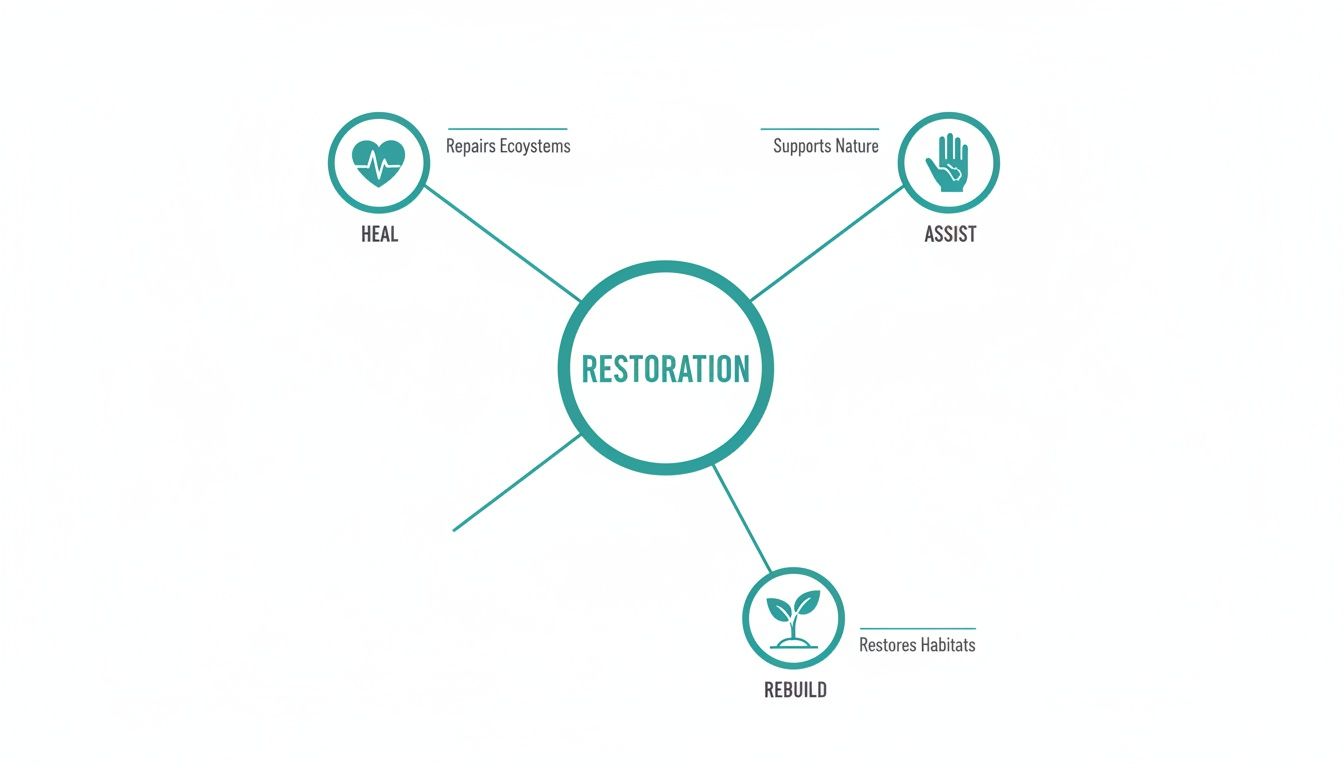
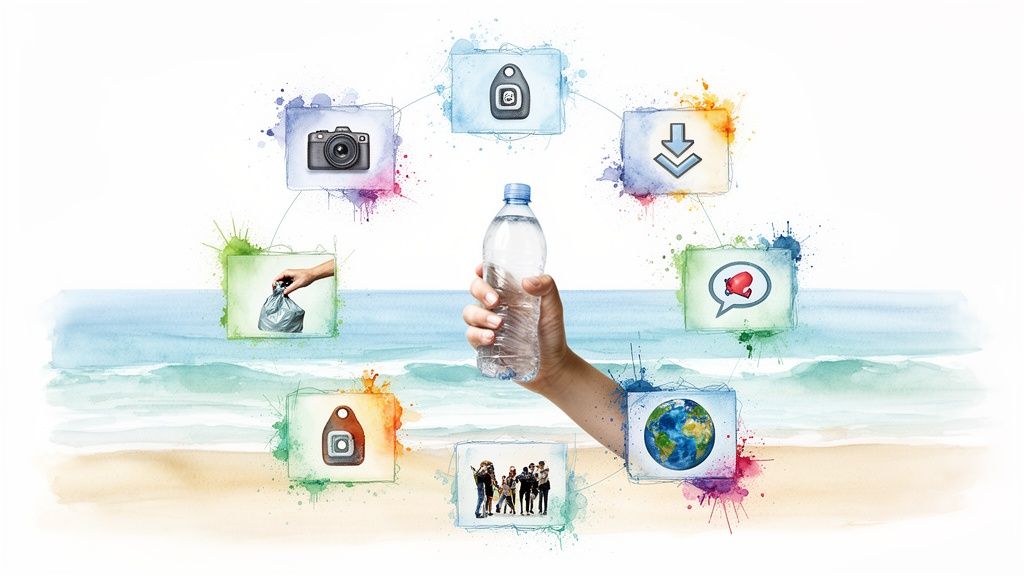
    Diagram explaining environmental restoration through healing ecosystems, assisting nature, and rebuilding habitats with icons.

    It boils down to healing what's broken, giving nature a helping hand to recover, and actively rebuilding habitats that have been lost. It’s a powerful mix of hands-on help and letting nature do what it does best.

    A Global Ripple Effect

    Those small, local actions you take? They add up to a tremendous global force. Our planet is facing huge challenges from deforestation, unchecked city growth, and a climate that’s spinning out of control. But people everywhere are responding. They're creating not just ecological change but massive economic momentum, too.

    The push to restore degraded lands is now a booming industry. In 2023, the global ecological restoration market was valued at an incredible USD 14.25 billion. It’s projected to surge to USD 24.65 billion by 2033, growing at a steady 5.63% each year. This isn't just about planting trees; it’s about creating jobs, building resilient communities, and investing in a healthier planet. You can see the explosive growth for yourself in recent market reports.

    This growth proves that governments and big industries are finally catching on to what volunteers like you have known all along: healing our environment is one of the best investments we can possibly make. It's proof that the work you do matters on a scale you might not even be able to see.

    You Are Part of the Wave

    When we started Litter Caterpillars, we weren’t thinking about global markets. I was thinking about the trash on our streets in Chicago. But the truth is, the two are directly connected.

    Community-led projects like ours create waves. They inspire others, they build local skills, and they show what's possible when people work together. This local momentum often pushes for bigger, system-wide changes.

    • You build community resilience: Cleaning a park with your neighbors isn't just about picking up litter. You're building relationships and a shared sense of ownership.
    • You create a proof of concept: A small, successful project can attract more resources for bigger efforts down the line. It shows the world what works.
    • You inspire a culture of stewardship: Your actions show others that they can make a difference, too, creating a cycle of positive change.

    So, the next time you’re out there, know that your hands are part of a global force for good. That one bottle you grab is one less piece of plastic in the ocean. That one invasive weed you pull gives a native plant a fighting chance. You are part of the answer.

    The Different Ways We Heal Our World

    Environmental restoration isn’t some magic wand you can wave over a trashed-out landscape. It’s more like a doctor's bag, but for the Earth. You wouldn't put a band-aid on a broken bone, right? Same idea here. You can’t use the same technique for a forest after a wildfire as you would for a polluted river snaking through a city.

    Every single place has its own story of what went wrong. Our job is to listen to that story—really listen—and then pick the right tools to help it start healing. The real skill behind what is environmental restoration is knowing what to do and when. It’s creative, it’s hands-on, and it’s happening all around you.

    From Forests to Floodplains

    When most people I talk to think of restoration, they probably picture planting trees. And yeah, reforestation is a huge one. After a fire torches a mountainside, I see replanting as giving it a fresh start. It stops the soil from washing away and brings back a home for all the critters that lost theirs.

    Then you have wetland restoration. I think of this as unclogging our planet's kidneys. Wetlands are supposed to be these incredible natural filters that clean our water and soak up floods. But for centuries, we've just been draining them to build stuff. Bringing them back means restoring that natural sponge, which is one of our best defenses against pollution and crazy weather.

    And of course, you've got coastal restoration. This is all about rebuilding sand dunes, replanting marshes, and even restoring oyster reefs to protect our shorelines. These living barriers honestly work better than concrete seawalls, and they’re usually cheaper too.

    This isn't just some niche hobby for nature lovers anymore; it's becoming a massive global movement. The market for this kind of work is projected to be worth $5 billion in 2025 and is expected to shoot up to $9 billion by 2033. That growth is happening because we’re finally getting serious about biodiversity loss and climate change, and people are realizing nature has the best solutions. You can read more about these exciting market trends to see how healing nature is becoming big business.

    Urban Restoration: A Special Kind of Healing

    My passion, and the work we do every single week at Litter Caterpillars, is a special category: urban restoration. Here in Chicago, we see firsthand how even the most forgotten, junk-filled corners of a city can be brought back to life. We’re turning trashed-out lots into vibrant green spaces that actually serve the community.

    Urban restoration is different because it’s not just about healing the land; it’s about healing people and neighborhoods, too. When we turn an empty lot into a little park, we're not just planting flowers. We’re creating a place for neighbors to meet, for kids to play safely.

    There are some amazing techniques we can use right here in the city:

    • The Miyawaki Method: This is an incredible approach where you plant a super-dense, diverse mix of native plants in a small area. Because they have to compete for sunlight, they grow insanely fast—up to 10 times faster than normal. You can basically create a tiny, self-sufficient forest in just a few years.
    • Soil Bioremediation: Sometimes the ground itself is sick, contaminated with all sorts of nasty stuff. We can actually use special plants and microbes to "supercharge" the soil, helping it break down those toxins and become healthy enough to support life again.
    • Green Infrastructure: This just means using nature to solve city problems. Think rain gardens that soak up stormwater so our sewers don't overflow, or green roofs that cool down buildings and cut energy bills.

    At its heart, urban restoration is an act of hope. It’s a declaration that no space is too small or too damaged to be healed. It’s about seeing the potential for life in a patch of dirt and having the bravery to help bring it forth.

    From a massive coastline to a small park down your street, the idea is the same. We figure out what’s wrong, pick the right remedy, and give nature the support it needs to come roaring back. You have the power to be a part of this healing, right where you are.

    Stories of Transformation: Real Restoration in Action
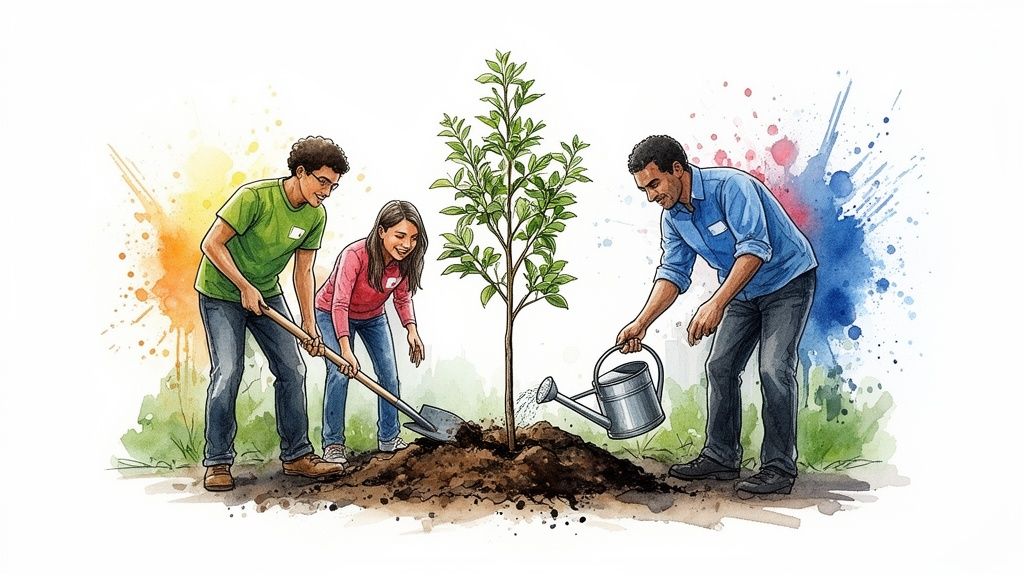
    A man plants a young tree in a field of vibrant wildflowers with a spade.

    It’s easy for me to talk about restoration methods, but seeing a place change with your own eyes? That’s something else entirely. The real power is in the stories. They show that behind all the science, there are people—full of hope and bravery—making a real difference.

    Let me tell you one of those stories. It’s one that’s still being written, and it’s one that I and the Litter Caterpillars are incredibly proud to be a part of. It’s the story of Caterpillar Park.

    From Abandoned Lot to Community Asset

    In the heart of Englewood, on Chicago’s South Side, there was an empty lot. Like a lot of them, it was just a forgotten space, collecting trash and telling a story of neglect. But we looked at it and saw something totally different. We saw potential.

    So we did something that felt a little nuts at the time: we entered a city auction and bought it. Just like that, this abandoned piece of land was ours. This wasn't just a purchase; it was a commitment. It was us putting our values of bravery, kindness, and unity into action.

    Our dream for this lot is to turn it from a forgotten space into a living, breathing part of the community. This is what environmental restoration is all about on the ground floor. It’s about taking ownership, getting your hands dirty, and believing you can bring life back to a place that desperately needs it. Caterpillar Park is our living experiment in urban restoration.

    This project is more than just planting flowers. It's about planting roots in a community and showing that with a little courage and a lot of teamwork, we can create pockets of beauty and hope right where we live.

    The Big Picture: A Global Goal

    Our work in Englewood is just one tiny piece of a huge puzzle. While we’re focused on a single lot in Chicago, it’s inspiring to know we’re not alone. People all over the world are working toward the exact same goal, but on a massive scale.

    In fact, the world has set some incredibly ambitious targets. One of the boldest is a global agreement to get at least 30% of the world’s degraded lands and seas under effective restoration by 2030. This isn't some vague promise; it's a real, measurable target that countries are working on right now under the Kunming-Montreal Global Biodiversity Framework. Starting in 2026, nations will report their progress, turning these big ideas into real action. If you're curious, you can learn more about countries advancing their restoration monitoring.

    It just goes to show that from a small group of volunteers in one city to a coordinated global effort, the mission is exactly the same: to heal our planet, piece by piece.

    Inspiring Projects Near and Far

    This spirit of restoration is catching fire everywhere, with incredible stories popping up all over. These projects, big and small, show the amazing creativity and dedication people bring to healing their own local environments.

    Here are a few that I find really inspiring:

    • Oyster Reef Restoration: On Long Island Sound, I see groups rebuilding oyster reefs. This isn't just about seafood; these reefs are natural walls that protect coastlines from erosion and act as powerful water filters, cleaning the entire area.
    • Indigenous-Led Learning: A project in Connecticut is building a center that mixes modern green design with traditional Tribal knowledge. I find this a beautiful example of how respecting cultural heritage can lead to stronger, more sustainable communities.
    • From Soil to Sound: A college in New York is showing urban agriculture students how soil health directly impacts the health of nearby waterways. They’re learning firsthand how to use green infrastructure to fight city pollution.

    These stories, from our own Caterpillar Park to the shores of the Atlantic, are all part of the same powerful movement. They prove that restoration is happening everywhere, driven by people who believe in a better future. The problems we face, like waste and pollution, are everywhere, which is why actions even far from the coast matter. For a closer look at that connection, you can read also about the impact of littering on our beaches. Every piece of land is connected to our water.

    Why This Is So Much Bigger Than a Clean Park

    The benefits of environmental restoration go way beyond just having a cleaner-looking neighborhood. When we get our hands dirty, we’re not just picking up litter; we’re transforming ourselves and our communities from the inside out. I see it happen every single week.

    This work sparks change on three different levels all at once: for nature, for us as people, and even for our wallets. It's an investment that pays you back in ways you’d never expect.

    The Big Win for Nature

    First, let's talk about the ecological win. When we restore a piece of land, we’re doing a lot more than just making it look nice. We’re bringing back biodiversity. A healthy ecosystem isn't some neat, tidy lawn; it’s a chaotic, beautiful symphony of different plants, insects, and animals all working together.

    Think of a restored area as a stronger, more resilient community. I've seen how a single native garden can support hundreds of species of bees and butterflies. A mowed lawn? It supports almost nothing. By bringing back what's supposed to be there, we’re creating a much tougher, more adaptable environment.

    It's like building an immune system for our planet. A diverse ecosystem can handle shocks like droughts or floods, just like a healthy body can fight off a cold. Restoration makes our shared home stronger.

    This resilience is everything. I've read about how a healthy floodplain can soak up massive amounts of rainwater, protecting homes from getting destroyed. Restored coastal marshes become natural shields against storm surges. We're not just planting flowers; we're rebuilding nature's own defense system.

    The Big Win for People

    This is the part that gets me the most fired up. When I first started Litter Caterpillars, I had a secret mission: I wanted to engineer my social circle with givers. I was sick of selfishness and wanted to surround myself with people who show up. It worked better than I ever could have imagined.

    Our weekend morning meetups do exactly that. They build real, solid friendships. When you work side-by-side with someone—sweating, laughing, and getting dirty for a cause you both believe in—you build a kind of trust you just can't get anywhere else.

    • Building Real Community: These projects become magnets for people who actually care. You meet your neighbors, you hear their stories, and you build a shared pride in the place you all call home.
    • Fixing Your Headspace: Being outside, working with your hands, and seeing the direct impact of your effort is unbelievably good for the soul. I find it fights that feeling of helplessness and gives you a powerful sense of purpose.
    • Learning to Trust Yourself: This has been a huge one for me personally. The simple act of service—of just showing up, again and again—helps you learn to trust and forgive yourself. It’s not just about the trash; it’s about personal growth, unity, and the redemption that comes from serving something bigger than yourself.

    The Big Win for Your Wallet

    Okay, let's talk about the money. It might sound weird to connect volunteer work with economic benefits, but the link is there and it's crystal clear. Environmental restoration is actually an economic engine.

    It all starts with jobs. I see ecologists, landscape architects, equipment operators, and nursery workers—all these people are needed for bigger projects. This creates stable, green jobs that put money directly back into local communities.

    But the benefits don't stop there. Study after study shows that green spaces jack up property values. A clean, beautiful park makes a neighborhood a place where people want to live. That empty lot we turned into a garden? It just made the whole block more valuable.

    So, the next time you see a group of volunteers out on a Saturday morning, remember what’s really going on. They aren’t just cleaning a park. They’re rebuilding an ecosystem, forging a stronger community, and creating real economic value—all at the same time. This is the profound, layered impact of what we do.

    How You Can Step Up and Join Us
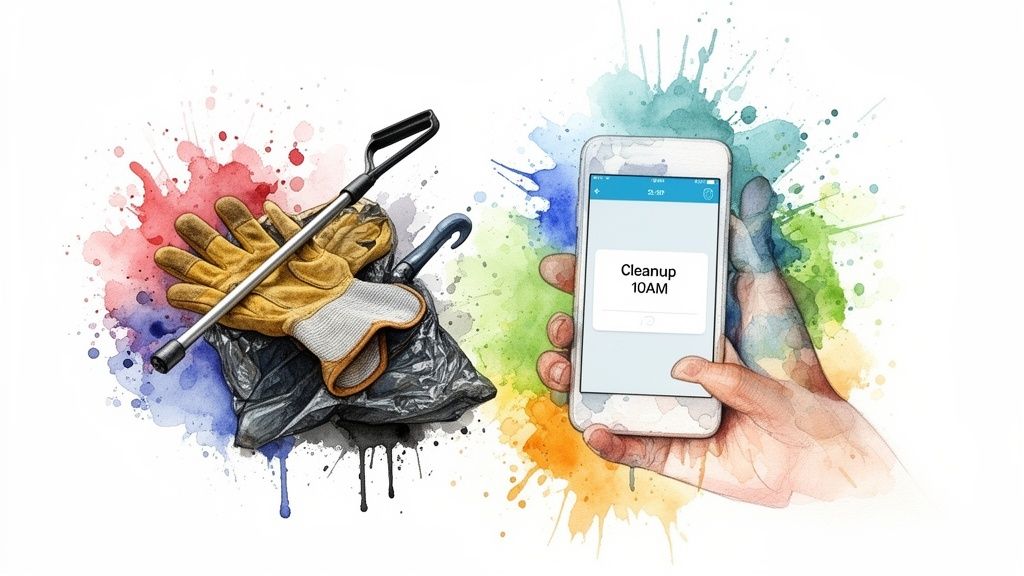
    Watercolor art of cleaning tools, a trash bag, and a smartphone with a 'Cleanup 10AM' reminder.

    Okay, so you feel it, right? That little fire starting inside you. The voice that says, "I can do that. I want to do that." Good. That's exactly how this whole thing starts. The best part is, you don’t need a special degree or a bunch of free time to make a real, visible impact.

    I get it, though. It can feel like a big leap. But joining a group like ours, the Litter Caterpillars, is about as simple as it gets. We post all our cleanups on Meetup and Instagram. There are never any strings attached. We put the happiness and safety of our volunteers above all else—it’s our core belief. Just show up, and we'll put everything you need right in your hands.

    Find Your Crew (Or Build It)

    If you're in Chicago, finding us is easy. But what if you're not? The spirit of environmental restoration isn't confined to one city. You can bring this energy right to your own hometown. Remember Tom Sawyer? He was stuck with a boring chore—painting a fence—but he convinced all his friends it was the most fun thing they could possibly do.

    You can create that exact same magic. Here's a simple way I'd start:

    • Find Your Spot: Is there a park, a street corner, or a local trail that’s been bugging you? That’s it. That’s your ground zero.
    • Rally a Couple of Friends: Just send a text. "Hey, I'm going to clean up this spot on Saturday at 10 AM. Want to join for an hour?" Keep it simple.
    • Embrace the Adventure: Bring some gloves, bags, and just begin. I promise, the first five minutes might feel a little awkward, but that feeling will melt away fast. You might even get hailed on, and you’ll walk away with an amazing story to tell.

    This is your chance to step into your power, make new friends, and become a part of your city's transformation story. It’s not just about picking up trash; it’s about choosing to be a giver.

    It All Starts With One Small Step

    The most critical part is simply starting. The journey from a trashed-out lot to a beautiful community garden begins with one person deciding to pick up one piece of litter. Every single restoration project, no matter how big, starts with that one small act of bravery.

    You have that bravery in you. You have the power to organize a small group and carve out a pocket of beauty and hope in your own neighborhood. We’ve put together some practical advice if you'd like to learn more about how to start a volunteer trash pickup. I think you'll find it's a lot simpler than you imagine.

    Your community is waiting for someone just like you to take that first step. Will it be you?

    Your Questions, Answered

    Whenever I share our story, people get fired up. I love it. But then the questions start bubbling up—the "buts" and "what ifs" that can stop you from taking that first step. I get it. I’ve been there. Let's tackle some of the big ones.

    "But I Don't Have Any Skills… Or a Grabber."

    You don't need them. Seriously. The only thing you need to bring is yourself.

    Your willingness to show up on a chilly Saturday morning is the only skill that matters. At Litter Caterpillars, we handle the rest—gloves, bags, the plan. My job is to make sure you're safe and that you connect with someone new. A positive attitude is the only tool we require. Just show up.

    "How Do I Know It's Not Just a Waste of Time?"

    This is a real question. You want to know that your sweat and effort are actually changing things, not just a feel-good moment. I respect that. Look for the groups who are obsessed with the "after" picture.

    The best projects are the ones that are in it for the long haul. They use native plants, they bring in local experts, and they build a community that keeps coming back. If a group is tracking things—like counting the birds that return or testing the water to see if it’s getting cleaner—that’s a huge sign they’re serious about real, lasting change.

    "Isn't This Just Conservation?"

    Ah, yes. The classic. They sound the same, but they're worlds apart. Let me break it down the way I see it:

    • Conservation is about protecting what's already perfect. It's building a fortress around a pristine, untouched forest to keep it safe. It’s important, but it's a defensive game.
    • Restoration is about healing what's broken. It's active. It's like being a surgeon for the land, stitching wounds and helping that struggling patch of earth grow back stronger than before.

    One prevents the wound; the other heals it. Both are crucial, but restoration is where we get our hands dirty. It’s where we get to bring life back to the places our cities forgot.


    Ready to stop asking questions and start making a difference? Litter Caterpillars is your crew. We make it simple to find a cleanup, meet other givers, and become part of your city's comeback story. Check out our upcoming events and join us!
  • Outdoor Group Activities for Adults: 12 Inspiring Ideas to Try This Season

    Outdoor Group Activities for Adults: 12 Inspiring Ideas to Try This Season

    Remember that time you tried to organize a group outing? The endless back-and-forth, the canceled plans, the feeling that you were herding cats. I've been there. My life used to feel like a cluttered room, each piece of junk holding a story I couldn't let go of. A four-year-old jar of jam from a trip to Michigan wasn't just jam; it was a 500-pound weight of indecision.

    Breaking free from a messy relationship forced me to confront the mess in my own life. I realized I needed a change, not just a tidy apartment, but a tidy soul. I decided to engineer my social circle for givers, for people who show up. That's how I discovered that cleaning up someone else's mess is way easier than cleaning up your own.

    It's how I learned that suffering through a Chicago hailstorm with two friends, trying to pick up trash, could be the most profound kind of fun. It adds flavor to the story of your life. You're here because you're looking for more than just another brunch. You want connection, purpose, and a story worth telling. This list of outdoor group activities for adults is your map to finding your people and transforming yourself through shared action.

    1. Community Litter Cleanup Events

    You can transform your local park. Imagine it. Neglected one moment, cherished the next, all in a single morning. Community litter cleanups are powerful outdoor group activities for adults that merge environmental action with real human connection. You and your group adopt a public space, whether it's a neighborhood street, a park, or a riverbank, and you work together to clear it of trash. It’s more than just picking up wrappers; it's a way you can reclaim and beautify your shared environment, one bag at a time. I've found this simple act builds immense pride in your community.

    The key is consistency and creating a sense of team identity. Look at the Chicago-based group Litter Caterpillars. They organize cleanups every weekend, rain or shine, across all 50 city wards. This creates a reliable and welcoming opportunity for anyone to join in.

    Pro-Tip: Make your event an experience. I suggest creating a team name, designing a simple flag or logo for t-shirts, and even making a group playlist. These small touches transform a chore into a mission, turning volunteers into a proud, unified team.

    You can easily organize your own. Use social media or Meetup to schedule your first event, partner with local businesses for supplies or post-cleanup coffee, and always prioritize safety with gloves and clear instructions. By documenting the before-and-after results, you create a powerful visual story that inspires others to join. For a deep dive into organizing your own successful initiative, you can learn more about the community cleanup model and its impact.

    2. Neighborhood Walking Tours with Environmental Focus

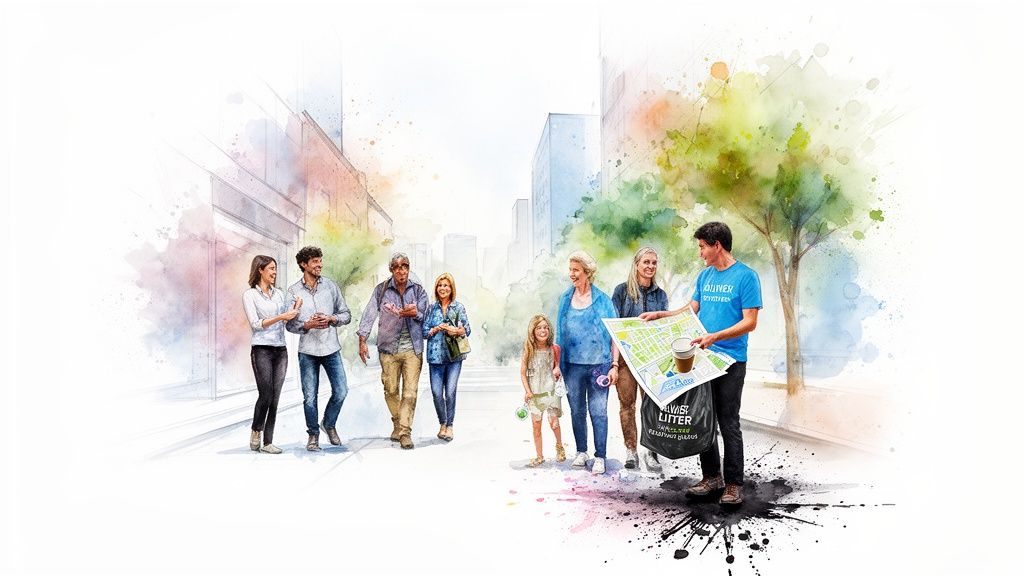
    Imagine exploring a new corner of your city not just as a tourist, but as a caretaker. Neighborhood walking tours with an environmental focus are fantastic outdoor group activities for adults that blend urban discovery with a mission. Your group embarks on a guided walk through a local neighborhood, uncovering its history and unique character while also identifying and addressing small environmental issues, like picking up litter along the way. It’s a chance for you to see your city with fresh eyes and leave it a little better than you found it.

    This approach transforms a simple walk into a shared adventure, connecting you to new places and to each other. I see it as an ideal activity for newcomers looking to understand their city's fabric or for long-time residents eager to explore all of its hidden gems. By combining light cleanup with learning, you create an accessible entry point for community service that feels more like an exploration than a chore.

    A diverse group of people, including volunteers, engaging in outdoor community activities with a map and litter bag.

    Pro-Tip: Partner with a local historian or a passionate community leader to guide the tour. Their stories bring a neighborhood's architecture, green spaces, and culture to life. I believe this adds an authentic, personal layer that Google Maps can't replicate, making the experience truly memorable.

    You can easily get one started by picking a theme, like "Historic Pubs and Parks" or "Street Art and Green Alleys," to attract a specific crowd. Promote it on social media as a beginner-friendly way to get involved with groups like Litter Caterpillars. I recommend ending the walk at a local coffee shop or eatery to support small businesses and give everyone a chance to connect. To get inspired, you can explore some of Chicago's unique neighborhoods and start planning your first route.

    3. Group Hiking and Trail Maintenance

    Imagine turning a day hike into an act of creation. A world where every step you take helps preserve the path for others. Group hiking and trail maintenance combines the physical challenge of exploring nature with the rewarding work of environmental stewardship. You and your group can adopt a trail in a local park or forest preserve, clearing overgrown paths, removing invasive species, and ensuring the route remains safe and accessible. It’s one of the most hands-on outdoor group activities for adults, forging a deep connection to the land you’re enjoying.

    This isn't just about pulling weeds; it's about you actively shaping the wilderness for the better. I see groups like those organized through the Chicago Parks Foundation or the American Hiking Society show how powerful this model can be. They empower volunteers to become caretakers of beloved natural spaces.

    Pro-Tip: Turn your hike into a story. I encourage you to document the "before" state of a cluttered or overgrown trail section and celebrate the "after" transformation. Sharing this visual progress builds a powerful sense of accomplishment and inspires more people to join your cause.

    Organizing is straightforward. Partner with your local park district for guidance and tools, and offer hikes with varying difficulty levels to include everyone. You can learn more about how a simple group outing can make a real difference by exploring the impact of trail stewardship and seeing what’s possible.

    4. Social Sports Leagues and Outdoor Games

    Picture yourself under the sun. You're diving for a frisbee or kicking a ball past the goalie, surrounded by friends who are cheering you on. Social sports leagues are fantastic outdoor group activities for adults that prioritize fun and friendship over fierce competition. You and your group can join or create a team for kickball, volleyball, or even frisbee golf, turning a public park into your very own stadium of camaraderie. It’s less about the final score and more about the shared laughter and high-fives I see along the way.

    The goal is to build community through accessible, lighthearted play. Look at groups like Rage Volleyball, which offers recreational leagues nationwide where anyone can join, regardless of skill. I've seen how they focus on creating a welcoming space where making friends is just as important as playing the game.

    Pro-Tip: Weave purpose into your play. You could create team names tied to your neighborhoods or a cause you support. I've even seen leagues require a small volunteer commitment as part of participation, such as joining one park cleanup a season, to strengthen community bonds beyond the field.

    You can start by joining an existing league or gathering friends for a weekly game. Use social media to find local pickup games or check out park district programs. I always suggest scheduling post-game social time at a local spot to build friendships. To see how recreational sports can build a strong, positive community, you can learn more about the Rage Volleyball model and its approach to inclusive fun.

    5. Community Garden and Green Space Projects

    Imagine turning a forgotten, vacant lot into a vibrant garden buzzing with life. Community garden and green space projects are incredible outdoor group activities for adults that let you put down roots, literally and figuratively. Your group can adopt a neglected patch of public land, transforming it into a pocket park, a pollinator haven, or a productive vegetable garden. This is more than just planting flowers; it's an act of permanent, beautiful change that nourishes both the environment and your community’s spirit.

    Three adults happily planting colorful flowers in a raised garden bed, surrounded by lush plants and gardening tools.

    The power lies in collective, consistent effort. I look at Caterpillar Park in Englewood, a space created by volunteers from the Litter Caterpillars. They turned an abandoned lot into a green oasis, showing how dedicated groups can create lasting assets. This kind of project offers a tangible legacy that grows and evolves with each passing season.

    Pro-Tip: Make your planting days a celebration. You should host a "Planting Party" with music, food, and drinks. Create educational signs for the plants you've chosen, explaining their benefits to local wildlife. I find this turns the hard work into a festive community event and a shared learning experience.

    You can start your own green space revival. Partner with local schools or community centers to find a suitable plot, and focus on native plants that thrive in the Chicago climate. I recommend creating a simple online sign-up for watering and maintenance duties to keep the garden flourishing. By documenting the transformation from a barren lot to a lush garden, you create a powerful visual story that will inspire your neighbors to grab a trowel and join in. For a deeper look at urban farming and community impact, you can explore the Growing Power model.

    6. Outdoor Documentary Screenings and Nature Talks

    Imagine gathering with friends under the stars. But not for a blockbuster movie. For a powerful story about our planet. Outdoor documentary screenings and nature talks are inspiring outdoor group activities for adults that turn a park or public square into a classroom and a catalyst for change. You and your group can organize an event to watch a film, listen to a local expert on conservation or ecology, and discuss how to take meaningful action together. It’s a perfect blend of entertainment, education, and community connection.

    This approach combines the relaxed atmosphere of a picnic with the intellectual spark of a great discussion. I see many cities hosting environmental film festivals in outdoor settings, drawing crowds to learn about critical issues. By choosing films that highlight both problems and solutions, you can motivate your group to move from awareness to action.

    Pro-Tip: Make your screening a complete experience. I suggest you invite a local biologist or a leader from an environmental nonprofit to introduce the film and lead a Q&A session afterward. Partner with a local food truck for snacks, and have a QR code ready that links to a resource guide with volunteer opportunities.

    You can easily get started by using a projector and a portable screen in a local park (be sure to check permit requirements). Promote your event on social media, focusing on the film’s theme and the opportunity for great conversation. I find these screenings are a fantastic way to build a volunteer pipeline, turning an evening of shared learning into a team ready for your next big project. For inspiration, check out the programming at events like the Chicago Environmental Film Festival to see how powerful stories can be.

    7. Outdoor Fitness Classes and Wellness Groups

    Imagine starting your weekend with deep breaths of fresh park air, surrounded by neighbors moving and stretching together. Outdoor fitness classes are incredible group activities for adults that fuse your physical health with the joy of community. You and your friends can join or organize anything from yoga and bootcamps to running clubs, all held in the open beauty of a local park. It’s about building strength and resilience together, turning a simple workout into a shared experience of wellness and connection.

    This approach thrives on accessibility and a welcoming spirit. I look at the global phenomenon of Parkrun, which hosts free, volunteer-led 5K runs every weekend. It’s not about speed; it's about participation and creating a positive, supportive atmosphere where everyone from seasoned runners to first-time walkers feels they belong.

    Pro-Tip: Integrate your wellness with service. I suggest scheduling a quick 15-minute park cleanup before your yoga session or after your run. This small act connects your group’s commitment to personal health with a shared responsibility for your community’s environment, making your fitness routine even more meaningful.

    Organizing your own group is simple. Start with a free yoga or stretching session on a Saturday morning and spread the word on social media. I recommend partnering with a local fitness instructor or even a health-conscious brand for equipment. By creating a consistent, friendly space, you build more than muscle; you build a resilient community. For inspiration on free, community-led fitness, you can explore the Parkrun model and see how it brings people together worldwide.

    8. Outdoor Skill-Building Workshops and Training

    Imagine learning how to build a rain barrel, identify invasive plants, or master basic wilderness first aid alongside your friends. Outdoor skill-building workshops are incredible group activities for adults that turn a day in the park into a hands-on classroom. Your group gathers to learn a practical, real-world competency from an expert, building confidence and capability that you can apply to future service projects or your own backyard. It’s about gaining competence, not just completing a task.

    The goal is to create a cycle of learning and doing. I see organizations like the Chicago Park District and local REI stores offering a wide range of these programs, teaching everything from Leave No Trace principles to urban ecology. By participating, you’re not just having fun; you're becoming a more skilled and valuable steward of your environment.

    Pro-Tip: Start a mentorship program within your group. I recommend pairing seasoned volunteers with newcomers for a specific skill, like using a new tool or leading a small team. This personal connection speeds up learning and builds strong bonds founded on mutual support and shared growth.

    You can easily set up your own workshop. Partner with a local expert, community garden, or nonprofit to host a session. I think you should focus on high-value, accessible skills first, like proper tool safety or basic plant identification. You could host a CPR and first aid certification day to prepare everyone for future events. To learn more about the types of skills that can benefit your group, you can explore offerings from outdoor education leaders for inspiration.

    9. Outdoor Social Dining and Picnic Gatherings

    Picture a long table in a sunlit park. It’s filled with shared dishes and new friends, the air alive with laughter and conversation. Outdoor social dining and picnic gatherings are incredible outdoor group activities for adults that turn a simple meal into a cornerstone of community. You and your group come together for a potluck, a themed barbecue, or a celebratory feast in a public space. I find it’s a powerful way to build genuine connections, transforming a casual get-together into a meaningful tradition.

    The magic lies in making the meal an event in itself. You should consider tying it to another activity, like a volunteer appreciation barbecue after a park cleanup or a solstice potluck to mark the changing seasons. I believe this creates a shared experience that feels earned and celebratory.

    Pro-Tip: Make it a potluck with a theme. An international heritage potluck where everyone brings a dish representing their background, for instance, sparks conversation and creates a rich, inclusive dining experience. I find this approach lowers costs and gives everyone a stake in the gathering’s success.

    You can easily set this up. Secure any necessary permits, especially for larger groups in places like Chicago parks, and establish clear food safety guidelines. By incorporating music, games, or celebrating milestones, you build a welcoming atmosphere that people will want to return to again and again. I know these gatherings are more than just food; they are about nourishing community bonds.

    10. Outdoor Art Projects and Community Murals

    Imagine turning a dull, gray wall into a vibrant canvas that tells your community's story. Outdoor art projects are fantastic group activities for adults that transform public spaces with creativity and color. You and your group can collaborate on painting a large-scale mural or creating a public sculpture, turning a neglected corner into a landmark. This isn't just about painting; it's a powerful act of collective expression that builds deep-seated neighborhood pride and visual identity.

    Two people painting a large board with colorful watercolor splashes, using paint rollers and surrounded by paint cans.

    The core idea is creative collaboration and ownership. I look at Philadelphia's Mural Arts program, which has created thousands of public artworks across the city. They engage community members in every step, from design concepts to the final brushstroke, ensuring the art truly reflects the people who live there. I believe this approach makes residents stakeholders in their environment's beauty.

    Pro-Tip: Host a "design day" where neighbors can vote on mural themes or contribute ideas. I think this ensures the final piece resonates deeply with everyone. Partner with a local artist to guide the process, but let the community's voice lead the creative direction.

    You can start small by securing permission for a single wall. Use social media to recruit volunteers and partner with local hardware stores for paint donations. I recommend documenting the transformation with before-and-after photos to create a compelling narrative that can inspire future projects and secure more support. To see how large-scale initiatives operate, you can explore the Mural Arts Philadelphia model and see its city-wide impact.

    11. Outdoor Documentary-Inspired Service Challenges

    Imagine turning the powerful message of an environmental documentary into a real-world mission. Outdoor documentary-inspired service challenges are exciting outdoor group activities for adults that transform education into action. Your group chooses an environmental theme, like plastic reduction or local biodiversity, and builds a team-based competition around it. You don't just learn about a problem; you actively work together to solve a piece of it, documenting your impact along the way. It’s like being the heroes in your own environmental story.

    The goal is to gamify volunteerism with a purpose. I think of events like the Great American Cleanup, but with a thematic, competitive twist. Teams might earn points for bags of invasive species removed, the number of native trees planted, or the most creative "upcycled" art piece made from collected waste. This structure channels competitive energy into positive, measurable outcomes.

    Pro-Tip: Focus on celebrating participation over just winning. You should create multiple award categories—like "Most Spirited Team," "Best Educational Post," or "Biggest Impact"—so everyone feels recognized. I believe this keeps the spirit of service and unity at the heart of the challenge, preventing it from becoming just another competition.

    You can organize your own challenge by picking a documentary or a local issue that resonates with your group. Create a simple scorecard, set a timeline, and use social media to share progress and inspire friendly rivalry. I know the real prize is the collective achievement and the story you create together. When you tie action to education, you build a deeper, more lasting commitment to protecting our shared planet.

    12. Outdoor Networking and Professional Development Events

    Imagine building your professional network not in a stuffy conference room. But while restoring a community garden or clearing a local trail. Service-oriented outdoor gatherings are fantastic group activities for adults that blend your career growth with tangible community impact. You and other professionals volunteer on a shared project, allowing for authentic connections to form naturally. It’s less about exchanging business cards and more about collaborating on a meaningful task, which I believe reveals character and builds trust far better than a typical mixer.

    This model turns networking from a transactional chore into a shared mission. I've noticed professional associations and even LinkedIn groups are starting to organize these events, recognizing that applying skills like project management or strategic planning to a volunteer project creates powerful bonds. It’s an opportunity for mentorship to flourish as senior and junior professionals work side-by-side, solving real problems together.

    Pro-Tip: Frame the event as authentic community service, not just a resume-builder. I encourage you to foster mentorship across all experience levels and host a casual post-event gathering at a local park or cafe to continue the conversations. This keeps the focus on genuine relationship building.

    You can initiate this within your own company or professional circle. Partner with a local nonprofit that needs skilled volunteers, or team up with your chamber of commerce. By focusing on the shared work and the collective impact, you create a space where professional growth and community service become one and the same. For ideas on how groups can organize with purpose, you can learn more about the Litter Caterpillars' community-first model and its values of kindness and unity.

    12-Item Comparison: Adult Outdoor Group Activities

    Activity Implementation Complexity 🔄 Resource Requirements ⚡ Expected Outcomes 📊 Ideal Use Cases 💡 Key Advantages ⭐
    Community Litter Cleanup Events Moderate — recurring coordination, safety & disposal logistics Low–Moderate — volunteers, gloves, bags, waste partnerships Regular visible cleanliness, steady volunteer retention, social cohesion Urban neighborhoods, underserved corridors, routine stewardship High-impact, inclusive, easy volunteer entry
    Neighborhood Walking Tours with Environmental Focus Low–Moderate — route planning and knowledgeable guides needed Low — volunteers, maps, light cleanup supplies Increased neighborhood awareness, new volunteer recruitment Newcomer engagement, outreach across multiple wards Educational, low-barrier, builds local familiarity
    Group Hiking and Trail Maintenance Moderate–High — permits, travel logistics, technical tasks Moderate–High — transportation, tools, trained leaders Protected trails, improved access, strong fitness community Regional parks, forest preserves, ecological restoration projects Combines fitness with conservation; attracts committed volunteers
    Social Sports Leagues and Outdoor Games Moderate — scheduling, venues, inclusive management Moderate — fields/courts, equipment, organizers Strong friendships, regular attendance, gateway to service Young professionals, recreational-focused recruitment Fun-first engagement that converts to service participation
    Community Garden and Green Space Projects High — land agreements, long-term maintenance planning High — soil, plants, water access, horticultural expertise Lasting beautification, food/education benefits, biodiversity gains Vacant lot transformations, food security initiatives Permanent visible change; skills-building and multi-season engagement
    Outdoor Documentary Screenings & Nature Talks Low — event planning and AV setup Low — AV equipment, permits, speaker honoraria Increased awareness, inspiration, volunteer pipeline growth Awareness campaigns, community education, pre-service outreach Low physical barrier; scalable and partnership-friendly
    Outdoor Fitness Classes & Wellness Groups Low–Moderate — instructor recruitment, liability management Low — instructors, minimal equipment, permits Improved fitness, recurring engagement, volunteer readiness Health-focused outreach, prep for heavier service tasks Regular habit formation; attracts health-conscious participants
    Outdoor Skill-Building Workshops & Training Moderate — qualified instructors and curriculum design Moderate — tools, materials, certified trainers Improved volunteer competence, leadership development Preparing volunteers for complex projects and safety-critical roles Builds capability and confidence; creates leadership pipeline
    Outdoor Social Dining & Picnic Gatherings Low — permits and food-safety planning Low — food coordination, seating, permits Strong social bonds, volunteer appreciation, retention Celebration events, post-service gatherings, cultural exchange High warmth and retention effects; accessible to all
    Outdoor Art Projects & Community Murals High — design approvals, property agreements, multi-day events High — artists, paint, scaffolding, permits Dramatic placemaking, neighborhood pride, reduced blight Beautification campaigns, community identity projects Highly visible, creative engagement; strong publicity potential
    Documentary-Inspired Service Challenges Moderate — rules, tracking, documentation systems Moderate — tracking tools, prizes, coordination Measurable impact, increased engagement, social media content Short-term campaigns, fundraising drives, team competitions Gamifies service to boost motivation and measurable outcomes
    Outdoor Networking & Professional Development Events Moderate — curated programming, balance of service/networking Moderate — venues, facilitation, coordination Professional connections, leadership recruitment, sponsorships Corporate volunteer days, young professional outreach Leverages career motivations for sustained civic engagement

    Your Next Chapter Starts Outside

    We’ve just walked through twelve different doorways. From community cleanups and trail maintenance to outdoor art projects and social picnics, each one is an invitation. An invitation for you to step out of the quiet isolation of your daily routine and into a world buzzing with connection, purpose, and fresh air. Think of this list not as a set of instructions, but as a map of possibilities for finding incredible outdoor group activities for adults.

    I see so many of us living like caterpillars, inching along in our own little worlds, focused on our immediate tasks. We're all good, well-intentioned people, but we're often separate. We’ve been told that changing the world is some grand, impossible task, so we focus on our own small leaf. But what if we started inching along together? The activities we covered show that building community and making an impact doesn't require a heroic solo effort. It just requires you showing up.

    Finding Your Fence to Paint

    Remember the story of Tom Sawyer? He turned the chore of painting a fence into the most sought-after activity in town. He didn't just get the fence painted; he created an experience. He made his friends feel like they were part of something exclusive, something adventurous. That's the real magic behind every idea I've shared in this article.

    • Community Litter Cleanup: It's not just picking up trash. It's you reclaiming your neighborhood's pride, one piece at a time, with people who care as much as you do.
    • Group Hiking and Trail Maintenance: It’s more than a workout. It's about you being a guardian of the wild spaces that give us peace, ensuring others can find that same solace.
    • Community Garden Projects: You're not just digging in the dirt. You are a co-creator of a living, breathing oasis that will feed and inspire your neighbors.

    The power of these outdoor group activities for adults lies in this shift in perspective. You're not just "volunteering" or "exercising." You are building something tangible, forging genuine friendships, and writing a new story for yourself and your community. Pride, identity, and unity aren't just for sports teams anymore. It's time for kind, dedicated people like you to claim that feeling.

    So, what are you waiting for? Your next chapter really does start outside. Don't overthink it. Don't wait for the perfect moment or the perfect group of friends. Just pick one. Show up. The adventure, and the people you're meant to meet, are already out there waiting for you.


    Ready to turn that first step into a powerful stride? At Litter Caterpillars, we make community cleanups simple, social, and incredibly fun, embodying the spirit of these outdoor group activities for adults. Join an event or learn how to lead your own at Litter Caterpillars and start your transformation today.

  • The Ocean Garbage Patch: My Journey From a Messy Room to the Sea

    The Ocean Garbage Patch: My Journey From a Messy Room to the Sea

    When you hear "ocean garbage patch," what do you see in your mind? I bet you're picturing a floating continent of trash, a solid island of plastic bottles and bags you could almost walk on. The real story is much stranger, and if I'm being honest, it's more disturbing.

    It's less of a solid island and more of a toxic, plastic soup. Imagine a colossal, swirling cloud of confetti-sized plastic bits, churning for thousands of miles just under the surface, all trapped by powerful, rotating ocean currents called gyres.

    Confronting the Mess, One Piece at a Time

    Young person on a bed with a jar of jam, sneakers, jeans, and a watercolor wave.

    I have a story for you. It's not about some huge, far-off environmental issue. It’s about my messy room. You see, for most of my life, I've had a terrible time cleaning and organizing my own things. As my living space got messier and messier, my life felt messier, too.

    Every single forgotten thing had a story, a sentimental weight that went way beyond its physical form. I'm thinking of an old jam jar shoved in the back of my fridge, a souvenir from a trip to Michigan four years ago. Or a bag of nuts I bought when I tried to eat healthy and failed spectacularly.

    These things weren’t just clutter. To me, they were anchors.

    The Weight of a Single Jar

    That jam jar weighed less than a pound, but in my head, it felt like a 500-pound weight of failure. I just couldn't bring myself to move it. It was so much easier to shut the fridge door and pretend it wasn’t there. I think you might know that feeling. It's the same paralysis that can wash over you when you hear about something as enormous as the ocean garbage patch. It feels too big, too distant, too heavy to even start thinking about.

    But my journey to understand our planet's plastic problem starts right there, in my messy room. It begins with a discovery: facing one tiny, insignificant piece of my own mess gave me the courage to take on the world's.

    This is the idea we’re going to explore together: The bravery you build in your own life is the exact same bravery we need to heal our planet. It’s not about being perfect. It’s about taking that first, hard step.

    This is exactly why I started Litter Caterpillars. I found out a strange truth: cleaning my own life felt impossible, but cleaning up public spaces with friends? That felt inspiring. It turned a chore into a mission.

    Throughout this guide, we'll look at the shocking reality of the ocean garbage patch through this very personal lens. You'll see how:

    • Picking up a single piece of litter connects you to a global fight.
    • Building a community in our own neighborhoods, like we do here in Chicago, is the secret to solving worldwide problems.
    • Finding the courage to do hard things, together, is how we transform ourselves and our world.

    What Is an Ocean Garbage Patch, Really?

    Let's ditch that idea of a floating garbage island. Instead, I want you to imagine a giant, swirling plastic soup. It’s less like a solid mass and more like a nasty smog that hangs just under the water's surface. This isn't one clump of trash. It’s a hazy mess of debris spread out over thousands of miles, where the sun and waves have broken down most of the plastic into countless tiny, confetti-like pieces.

    These little fragments, we call them microplastics, are the real heart of the problem. They turn huge areas of the ocean into a murky, polluted broth. This is what makes the garbage patch practically invisible from a boat and impossible to see on satellite photos. You could sail right through the middle of one on a calm day and not notice anything besides a weird, oily sheen on the water.

    The Great Pacific Garbage Patch

    The most infamous of these zones is the Great Pacific Garbage Patch—a massive monument to our plastic addiction. This is the one you’ve probably heard about, swirling in the ocean halfway between Hawaii and California. Its size just blows my mind.

    To give you some perspective, the Great Pacific Garbage Patch covers an estimated 1.6 million square kilometers. That’s an area twice the size of Texas, or three times the size of France. Inside this zone, scientists figure there are about 1.8 trillion pieces of plastic. That breaks down to roughly 250 pieces for every single person on Earth. While it’s mostly that plastic soup, the total weight is around 80,000 tonnes, which is like having over 740 Boeing 777 jets floating out there. You can get a deeper look at these wild stats over at wifitalents.com.

    This map really shows you the scale of the plastic concentration. It’s not just one spot.

    As you can see, the debris is most dense at the center, but the entire area is a huge soupy mess.

    Not an Island, but a Toxic Cloud

    So, if it’s not an island, what is it? The best analogy I have is a cloud. From far away, a cloud looks solid, right? But if you fly a plane through it, you realize it's just a whole lot of air and water vapor.

    The ocean garbage patch is exactly like that. It's not something solid you can stand on; it’s a three-dimensional pollution zone. The plastic junk is scattered from the surface all the way down to the ocean floor, with the thickest concentration floating in the top layer of the water.

    This is what makes it so dangerous. It’s a toxic, hazy cloud that has basically become part of the ocean itself. It's a permanent feature of our planet now, built one piece of trash at a time—trash that started in our streets, rivers, and on our coastlines. Getting our heads around this truth—that it's not an island, but a pervasive, soupy mess—is the first real step to tackling the challenge ahead of us. It’s a problem that's been woven right into the fabric of our oceans.

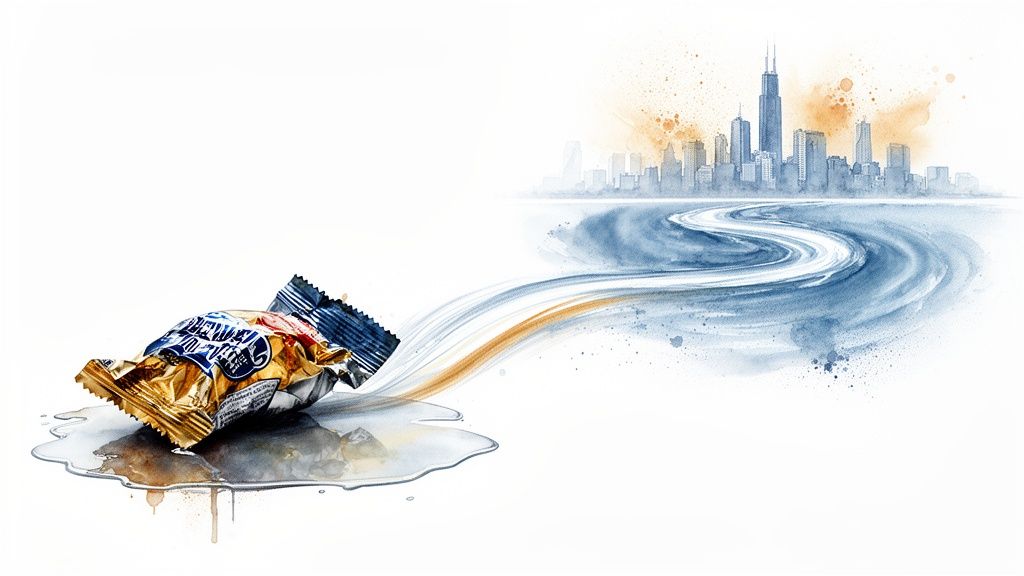
    Tracing a Candy Wrapper from Chicago to the Pacific

    Watercolor illustration of a candy wrapper spilling liquid, with a path leading to a city skyline.

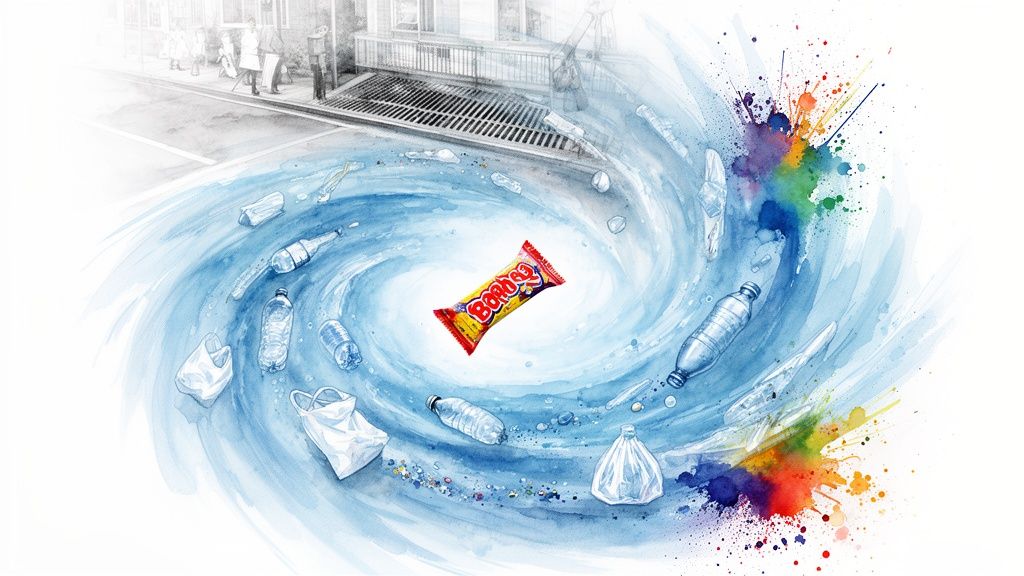
    This is going to sound crazy, but stick with me. I want you to picture one little candy wrapper, dropped on a busy street right here in Chicago, ending up in a massive ocean garbage patch thousands of miles away. It feels like a problem for someone else, somewhere else. A world away.

    But it’s not. The journey from our sidewalks to the middle of the ocean is terrifyingly direct. Let's follow the path of that single piece of trash. You’ll see exactly how a moment of carelessness in our city becomes part of a global crisis.

    Think about a bright red candy wrapper, let go near a bus stop in the Loop. It gets kicked around for a day or two. Then, a classic Chicago storm hits.

    That rush of rainwater is all it takes. The wrapper is swept into a storm drain, and just like that, its fate is sealed. It’s just entered a one-way highway to the sea.

    The Urban Expressway for Trash

    Our city’s waterways—the Chicago River, the canals, and Lake Michigan—aren't just scenery. I want you to see them for what they’ve become: expressways for our trash. That wrapper is now in the sewer system, which flushes it right into the Chicago River. We see the effects of this firsthand every week, and if you want to understand the real challenge we’re up against, check out our guide on cleaning up a river right here in our community.

    From the river, it's a quick trip into Lake Michigan. Now it’s in the Great Lakes system, starting a much longer trip. It drifts with the current through Lake Huron, Lake Erie, and Lake Ontario. It might take months, maybe years, but it will eventually pass through the St. Lawrence Seaway and get spit out into the North Atlantic.

    It has now officially left our neighborhood and entered the planet’s circulatory system. This is where the story gets truly wild.

    Riding the Great Ocean Conveyor Belt

    Out in the open ocean, that wrapper is grabbed by a force bigger than any river. It gets pulled into a massive, spinning system of currents called an ocean gyre.

    Think of a gyre as a planetary whirlpool, a slow-motion vortex as big as a continent. We have five major ones on Earth. They act like giant drains, sucking in anything that floats from thousands of miles away and trapping it all in their calm, stable center.

    This is the engine that builds an ocean garbage patch. Our little red wrapper from Chicago is now in the Atlantic, where it might get caught in the North Atlantic Gyre. Or, if it rides the currents just right, it could travel south, whip around the tip of Africa, and find its way into the Pacific.

    Once it’s caught in the gigantic North Pacific Gyre, its journey is over. It joins trillions of other plastic pieces—scraps of bags from Tokyo, empty bottles from L.A., and tangled fishing nets from who knows where. It will just sit there, slowly breaking down under the sun, becoming part of that toxic plastic soup we’re all fighting against.

    • Step 1: Trash enters a local waterway (a Chicago storm drain).
    • Step 2: It travels through a regional system (the Great Lakes).
    • Step 3: It enters a major ocean (the Atlantic).
    • Step 4: It is captured by a global force (an ocean gyre).

    That single candy wrapper, from a careless moment in our own city, has finished its journey. It’s now a permanent resident of the Great Pacific Garbage Patch. It’s the proof that when we throw something "away," there is no away. It all connects back.

    This problem is so much bigger than an ugly, littered ocean. The ocean garbage patch isn’t some passive island of trash just floating there. It's an active and devastating menace. To get the full picture, you have to hear the stories of the creatures that call the ocean home.

    I want you to picture a sea turtle, one of those ancient, graceful animals. It’s swimming and sees what looks like a beautiful, shimmering jellyfish—its favorite meal—pulsing in the water. But it’s not food. It's a plastic bag. The turtle eats it, and that single mistake can block its entire digestive system, leading to a slow, agonizing death.

    This isn't some freak accident. It’s happening constantly. Seabirds live out a similar nightmare. They fly for hundreds of miles, scooping up what they believe is food for their chicks. But they come back to the nest with a belly full of sharp, colorful plastic shards. They regurgitate this trash into their babies' mouths, and the chicks, their stomachs full of garbage they can't digest, starve to death.

    The Invisible Killer: Microplastics

    As gut-wrenching as those stories are, they’re only the most obvious part of the crisis. The real tragedy is unfolding on a microscopic level. It's an invisible threat that has already contaminated every corner of the ocean and is now making its way back to us.

    When those bigger pieces of plastic—the bottles, bags, and fishing gear—get beaten down by the sun and waves, they don't break down and disappear like a banana peel. They just shatter. They break into smaller and smaller pieces, becoming what we call microplastics. These are tiny fragments, often smaller than a grain of rice, and they are the true poison of the ocean garbage patch.

    It's like dissolving a poison tablet in a giant jug of water. You can't see the poison anymore, but you know the whole thing is toxic. That's what microplastics have done to our oceans. They’ve turned the water itself into a chemical soup.

    These tiny plastic bits act like little toxic sponges. They soak up all the nasty chemicals floating around in the seawater, like pesticides and industrial waste. So now you have a tiny particle that is both plastic and poison. You can see the shocking reality of this in our post with some powerful plastic pollution pictures.

    A Poison Pill Climbing the Food Chain

    And this is where the problem comes right back to bite us. The journey of these toxic microplastics starts at the very bottom of the food web.

    • First, plankton eat them. These microscopic organisms are the foundation of all life in the sea, and they're mistaking these tiny bits of plastic for food.
    • Next, small fish eat the plankton. With every plankton they swallow, the dose of plastic and the toxins stuck to it grows inside their bodies.
    • Then, bigger predators eat the small fish. A single tuna or swordfish eats hundreds of these smaller fish, accumulating all that plastic contamination into its own body.

    This process is called biomagnification. With every step up the food chain, the concentration of plastic and poison gets stronger. The predators at the very top end up with the highest, most dangerous levels of pollution in their systems.

    And who sits at the top of that food chain? We do. The fish that lands on your dinner plate could be carrying a lifetime of plastic pollution. This isn't a scare tactic; it’s the scientific reality we're just starting to wrap our heads around. The plastic we threw "away" is coming back for us, one microscopic piece at a time. This isn't just about biodiversity or ocean health anymore—it's about our own.

    How Do You Measure a Ghost?

    Trying to get a handle on the sheer scale of the ocean garbage patch is one thing. But how do you even start to measure something so massive, so spread out, and so… hazy? It’s not like you can point a satellite at it and get a clean picture. From space, it's mostly a ghost that haunts our seas.

    This means scientists have to get creative. They have to get tough. You can't fix a problem until you're brave enough to look it right in the eye and size it up. You have to get out there. And that's exactly what they've done, launching some of the most complex expeditions in modern history to map this invisible threat.

    They send out fleets of boats that crisscross the gyres, pulling special nets designed to skim the surface for debris. But that only shows you part of the picture. So, they also fly aircraft low over the water, using advanced sensors and sharp-eyed observers to spot and count the bigger killers the nets can miss—like those deadly "ghost nets."

    Uncovering a Deeper, Harsher Truth

    Early guesses about the size of the garbage patch were disturbingly low. It wasn't because the science was bad, but the tools were still catching up. More recent, groundbreaking studies have painted a much starker—and more accurate—picture.

    The most ambitious sampling project ever done for the Great Pacific Garbage Patch was a monumental effort. It involved 30 different boats, 652 specialized nets, and massive aerial surveys. This heroic work showed the problem was 4 to 16 times larger than we ever thought. The total mass is now estimated at a staggering 100,000 tonnes. You can dive into the incredible science behind these findings at The Ocean Cleanup.

    The data reveals a critical paradox. To truly understand what we're up against, the numbers are key.

    Understanding the Great Pacific Garbage Patch by the Numbers

    Metric Statistic What This Means
    Microplastic Count 94% of total pieces The overwhelming number of items are tiny fragments, creating a plastic "smog."
    Macroplastic Mass 75% of total mass The vast majority of the patch's weight comes from larger, heavier objects.

    This is the central contradiction. By count, the patch is an endless soup of feather-light microplastics. But by weight, it's a junkyard of nets, bottles, and buoys. This explains why it’s an invisible, soupy mess instead of a solid island of trash.

    The Real Dangers Visualized

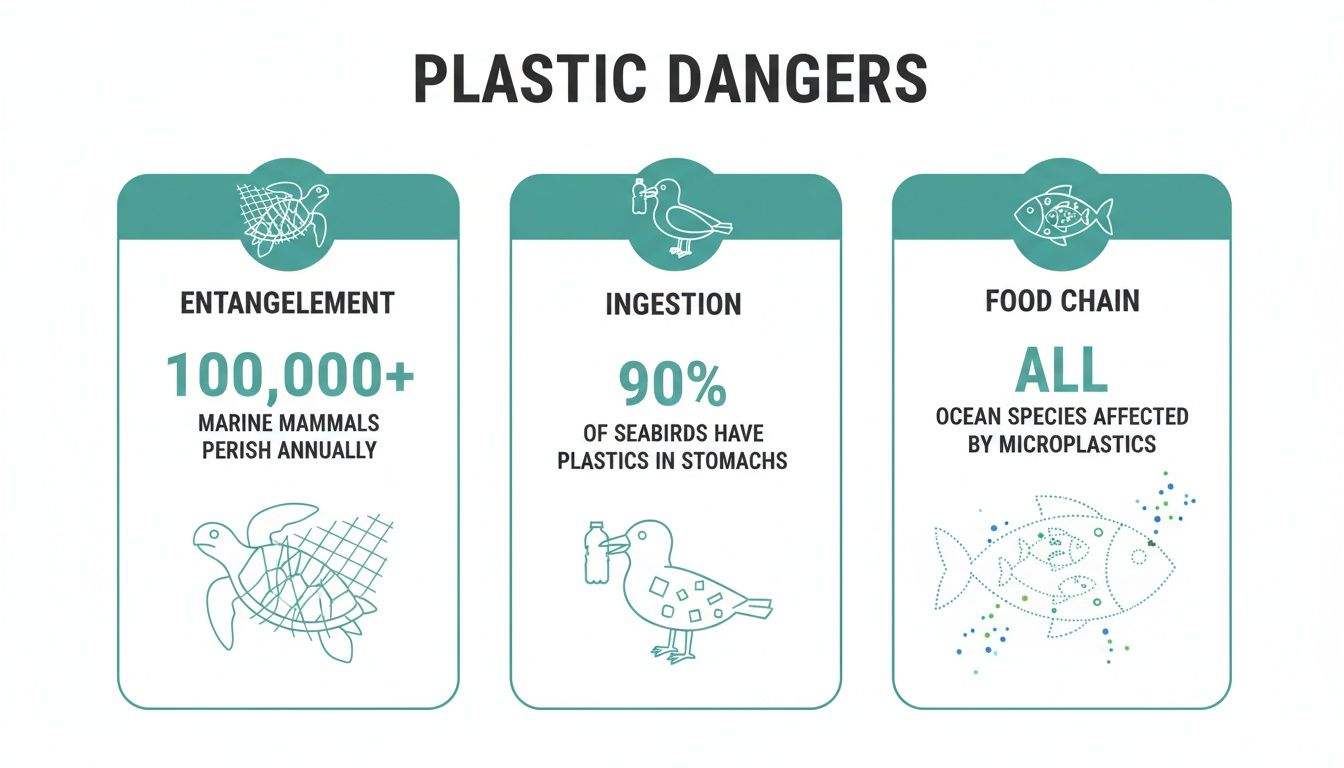
    This infographic cuts through the numbers to show the direct, brutal impact plastic has on the animals that call the ocean home.

    Infographic showing plastic dangers to marine life: entanglement, ingestion, and food chain contamination.

    From a turtle caught in a plastic bag to a seabird feeding plastic to its chick, the image makes the abstract danger of the patch devastatingly real.

    Measuring this mess isn't just about collecting data. It's an act of courage. It shows us exactly what we're facing. This scientific grit is what inspires the rest of us to act. It gives us a target to aim for and proves that even when a problem seems invisible, dedicated people can drag it into the light.

    You Can Be the Hero of This Story

    Thinking about the ocean garbage patch feels huge, doesn't it? It's so massive and far away that it can make you feel completely powerless. What can one person in Chicago possibly do about it?

    It turns out, you can do everything.

    I started Litter Caterpillars because I had trouble cleaning my own life and my own apartment. It was a private, impossible struggle. But I stumbled upon a strange truth: cleaning up public spaces with friends isn't just easier—it's inspiring. It builds a kind of courage and connection I never expected.

    A Chore That Becomes a Mission

    Remember Tom Sawyer? He was stuck with the awful chore of painting a fence, but he reframed it as a fun event that his friends actually paid him to join. That’s the exact spirit we bring to cleaning our city. We take a task that feels like a burden and turn it into a mission filled with friendship, pride, and purpose.

    This is your invitation to join that mission. We’re going to show you a few real, practical steps you can take right now. And the answer isn't just about trying to use less plastic, even though that helps.

    The real answer is about showing up.

    We are not perfect. We are Caterpillars, transforming ourselves and our city through service.

    The first step isn't about saving the world. It’s about discovering the strange, wonderful fun of making a difference right where you stand.

    From One Person to a Community of Power

    It’s normal to feel helpless when you see the scale of the ocean garbage patch. But what you do by yourself, when multiplied by a community, becomes an unstoppable force. This is how we fight back.

    Here are three ways you can start making a real impact today:

    1. Stop Throwing Things “Away.” Every time you hold a piece of plastic, don't think about throwing it "away." Instead, ask yourself, "Where does this actually go?" That simple mental shift is the first step. It forces you to see that there’s no magic place where our trash just disappears.

    2. Pick One Small Sacrifice. Don’t try to become zero-waste overnight. You'll just burn out. Instead, choose one single thing. Maybe you refuse plastic straws. Maybe you commit to always bringing a reusable bag. Maybe you switch to a reusable water bottle. Master that one thing until it’s a habit. That small win will give you the confidence for the next one. For more ideas, check out our guide on practical solutions for pollution in the oceans.

    3. Show Up for Your Community. This is the most important step. Seriously. Join a local cleanup. Feel what it’s like to work next to other people, turning a dirty street corner into something you can all be proud of. The courage you find out there is contagious. It’s the fuel that will power you to do more.

    You don't have to solve the entire ocean garbage patch by yourself. You just have to pick up the first piece of trash. We'll be right there with you, picking up the second.

    Alright, let's cut through the noise. When you start learning about the ocean garbage patch, the questions pile up fast. It feels huge, hopeless even. But every question is a first step. It means you're paying attention.

    Let's tackle some of the big ones head-on.

    So, Can We Just Go Out and Clean It All Up?

    This is always the first question, and I love it. It comes from that gut instinct to just fix the damn thing. The simple answer is yes, people are trying. But it's an unbelievably tough fight.

    The "garbage patch" isn't a solid island of trash you can just walk on. It's more like a thick, soupy plastic smog stretching over an area three times the size of France. Most of it is tiny plastic bits. Imagine trying to scoop smoke out of the air with a fishing net. That's the challenge.

    Big, heroic projects are out there, but they're slow and costly. The real, lasting win? It starts right here on land. We have to turn off the faucet before we even think about mopping the floor.

    Is This Plastic Going to Be There Forever?

    This one's a heavy thought. Plastic doesn't just rot away like an apple core. The sun beats down on it, and it photodegrades—which just means it shatters. It breaks into smaller and smaller and smaller pieces, down to microscopic specks. But it never, ever truly disappears.

    That's right. Every single piece of plastic ever made is still on this planet in some form. It's a terrifying idea. But I see it another way: it makes every bottle, every wrapper, every single piece of trash we stop from reaching the water a permanent victory.

    Why Should I Care? I Live in Chicago, Miles From Any Ocean.

    I get it. The ocean feels a world away. But remember that candy wrapper we found? It gets washed into a storm drain, then into the Chicago River, then Lake Michigan, then the St. Lawrence Seaway, and boom—the Atlantic. We are all upstream from the ocean.

    And this isn't just some far-off problem for fish. This plastic soup comes back to haunt all of us.

    • Our Food: Those tiny plastic bits get eaten by fish, which then end up on our plates. We're literally eating our own trash.
    • Our Climate: The ocean is the planet's lung and heart. Choking it with plastic cripples its ability to keep our climate stable.
    • Our Health: Nasty chemicals love to stick to plastic. As these plastics enter our food and water, those toxins come along for the ride.

    The ocean might seem distant, but its health is tied directly to our own survival. That's why every cleanup we do right here in Chicago is a direct act of ocean rescue.


    The problem is massive. It's easy to feel helpless. But our power isn't in trying to solve it all at once. Our power comes from showing up, together, and doing what we can, right where we are.

    At Litter Caterpillars, we turn that helplessness into action, sweat, and friendship. If you're tired of just worrying and ready to be part of the solution, join us for a cleanup. Come see how good it feels to make a real difference, one piece of trash at a time.

    Find your next chance to volunteer with us!
  • Join the illinois environmental council to drive statewide action

    Join the illinois environmental council to drive statewide action

    It all begins with that twisting in your gut, doesn't it? The moment you see a street you adore buried under a sea of trash. I know that feeling down to my bones. You see, for me, untangling the messes in my own life—my cluttered apartment, my complicated relationships—was a revelation. I discovered that cleaning things up, truly making them right, brings this strange, profound peace.

    That spark is the very soul of why Litter Caterpillars exists. It’s never been just about picking up someone else’s garbage. It's about seizing a piece of your world, your neighborhood, and wrestling it back into something you can be proud of.

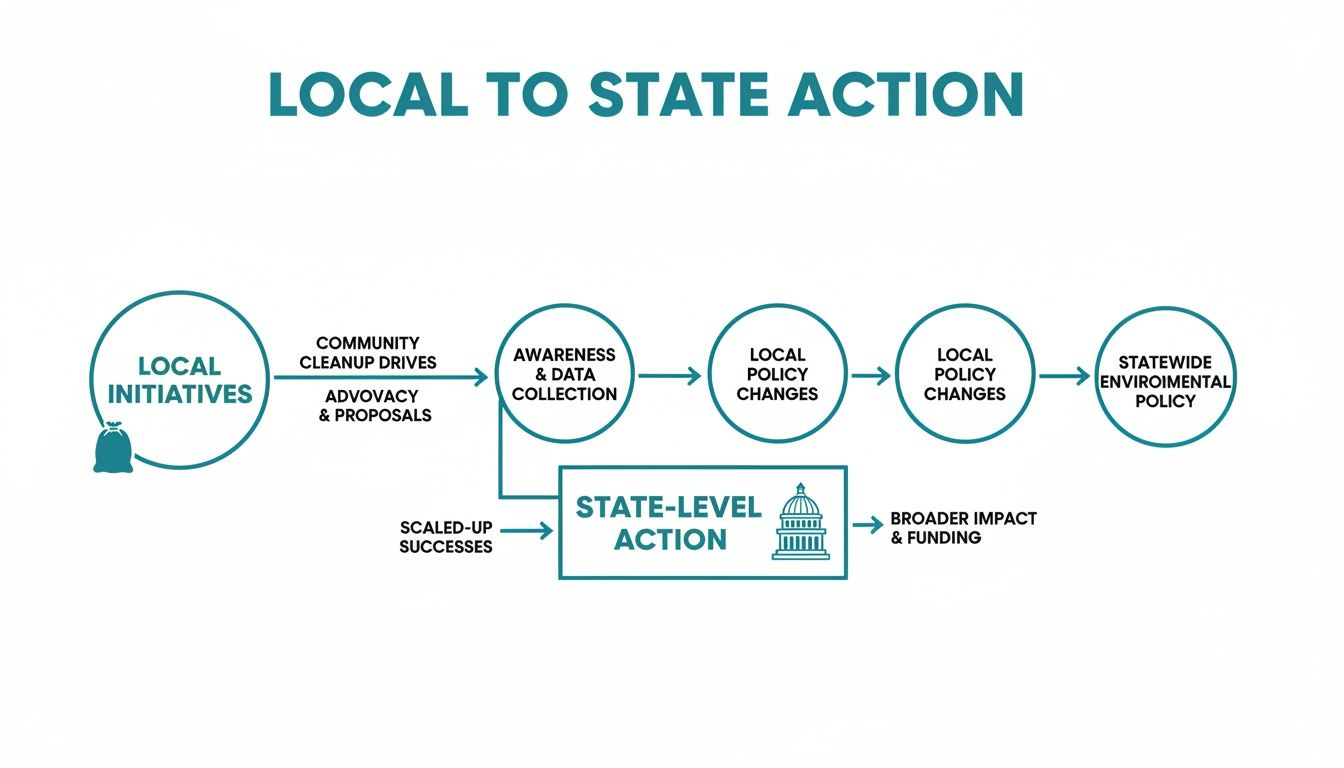
    From Our Sidewalks to the Statehouse

    But here’s the truth I’ve stumbled upon over the last few years: our relentless work on the ground, our sweat and our sore backs, is only the opening chapter. In this guide, I want to pull back the curtain and show you how our grassroots hustle on a drizzly Saturday morning connects directly, powerfully, to the monumental changes orchestrated by the Illinois Environmental Council.

    Imagine it like this: we are the frontline soldiers, the boots on the ground, and they are our strategic allies in the capitol building. They take the raw, gritty work we pour our hearts into and forge it into the unyielding steel of actual laws. This is the story of how our small, seemingly isolated acts of defiance ripple outward, gathering momentum until they create a tidal wave of change for all of Illinois.

    When you and I show up with our trash bags and grabbers, we’re doing something far more revolutionary than just cleaning a street. We’re sending a signal.

    Every single piece of litter we wrestle into a bag is like casting a vote for a cleaner, healthier future. We are demonstrating what we value, not with flimsy words, but with undeniable, back-breaking action. That action creates a powerful narrative, a story that echoes far beyond the confines of our own block.

    This chart I made shows you precisely what I mean. It lays out the beautifully simple, yet profoundly powerful, path from our weekend cleanups to real, enforceable statewide policy.

    Diagram illustrating the progression from local environmental initiatives to statewide environmental policy through state-level action.

    It’s crystal clear, isn't it? Our hands-on dedication is the very fuel that powers the advocacy engine, the machine that makes long-term, lasting change an actual reality.

    Turning Local Action Into Statewide Impact

    So, how does that incredible leap actually happen? How does you plucking a single plastic bottle from a gutter in Chicago somehow influence a lawmaker deep down in Springfield? That, my friend, is the alchemy of organizing. The Illinois Environmental Council operates like a colossal megaphone, amplifying the voices of thousands upon thousands of people just like us, spread across the entire state.

    They gather all our individual, scattered efforts, bundle them into an undeniable force, and translate our raw passion into the precise, unignorable language of policy and law. It’s a partnership of breathtaking power.

    You and I focus on the tangible—the immediate, visible mess right in front of us. They, in turn, focus on dismantling the broken, corrupt system that allows our neighborhoods to become dumping grounds in the first place. If you're intrigued by the mechanics of this, you should read up on how community organizing works and discover why it’s such a potent force for change.

    Why It Matters to You

    This profound connection is exactly why your effort on a Saturday morning matters so damn much. You are not just one person cleaning one lonely block; you are a vital part of a massive, statewide movement that is fiercely demanding a better future.

    When the Illinois Environmental Council steps into the ring to fight for stronger anti-pollution laws or to champion clean energy, they are backed by the undeniable actions of people like you. Your very presence at a cleanup proves that everyday Illinoisans care deeply. It gives them the real-world stories, the human faces, they desperately need to win those brutal political battles.

    We are the "why." They are the "how." And together, we get it done.

    What Is the Illinois Environmental Council?

    So, who exactly are these people at the Illinois Environmental Council? I like to think of them as the head coach for ‘Team Illinois Environment.’ Since way back in 1975, they’ve been the indispensable, unifying force that gathers hundreds of us smaller, local groups—the scrappy underdogs—together under one massive banner.

    Just picture it for a second. Imagine all of us—the Litter Caterpillars, the local garden clubs, the passionate conservation folks—all trying to scream at the state capital at the same time. It would be a cacophony, a meaningless wall of noise. The IEC is the conductor that gathers all those individual voices, all that raw energy, and harmonizes it into a single, powerful chorus that lawmakers in Springfield simply cannot ignore.

    They are our champions on the ground, fighting tooth and nail for the laws that protect our clean air, our fresh water, and the beautiful natural spaces that are our birthright. They're the brilliant strategists and the policy wizards who transform our passion into a genuine, formidable political force.

    From Our Streets to Their Scorecard

    Here’s how I see the whole thing playing out: when you and I are out in a park on a Saturday morning, getting our hands dirty, we're doing so much more than just picking up trash. We're making a bold, public declaration about what we, as a community, truly value.

    The Illinois Environmental Council takes that declaration, that statement written in sweat and effort, and carries it directly into the halls of power where laws are born. They are the central nervous system connecting our hard work on the streets to protective, top-down policies that change everything.

    And their influence is undeniably growing. One of their most devastatingly effective tools is the annual Environmental Scorecard, a report that grades every single legislator on how they voted on more than 30 crucial environmental bills.

    The results? They speak for themselves, loud and clear. In a recent legislative session, an astonishing 50 percent of sitting State House Representatives and 45 percent of State Senators earned a perfect 100 percent score.

    That's not just a small change; it's a seismic shift. It's proof positive that our collective environmental push is translating into real, tangible legislative victories. For a group like ours, it shows that our cleanups are part of a much bigger, more intricate ecosystem of change. You can dive into the full scorecard details on their website and see exactly where your own representatives stand.

    The Power of a Unified Voice

    This is precisely why their work is so absolutely critical to what we do. While you and I focus on the visible symptom—the litter choking our streets—the IEC attacks the disease at its source. They fight for policies that slash pollution at the starting line and hold massive corporations accountable for the messes they create.

    They provide our sweat equity with a permanent, legal backbone. They ensure that the hard work we pour into our neighborhoods doesn't just evaporate, but instead builds toward lasting, statewide change that protects the very places we fight so hard to clean. It’s a perfect, powerful partnership.

    The Big Fights They Win For Us

    Illustration of a wind turbine, U.S. Capitol, policy document, leaf with water drop, and growing plant.

    So what does the Illinois Environmental Council actually do? They're out there fighting the colossal battles we couldn’t possibly wage on our own, and they do it by winning one grueling policy fight after another. This is where it gets incredibly exciting, because their work directly impacts the quality of the air you breathe and the water you drink every single day.

    Think of it this way: while we at Litter Caterpillars are on the streets treating the symptom—the endless tide of trash—the IEC is going after the disease itself. They go to the source. They work to dismantle the broken systems that allow all this pollution to pour into our lives in the first place.

    They’re fighting for a future where our cleanups become less necessary, a world where there’s simply less toxic plastic being produced and fewer poisons leaking into the soil of our neighborhoods.

    Building a Clean Energy Future

    One of their most monumental victories is a law you’ve almost certainly heard whispers of: the Climate and Equitable Jobs Act (CEJA). This wasn’t just some minor skirmish; it was a historic, knockout blow against the fossil fuel industry. It's as if they're constructing a brand-new, beautiful house for Illinois’ energy future while the old one was rotting from the inside out, filled with toxins and decay.

    This single law sets our state on a direct path to 100% clean energy by 2050. Just let that sink in for a moment. Imagine a world with no more disgusting coal plants spewing filth into our skies. It also funnels a river of money into creating green jobs, especially for people in the very neighborhoods that have borne the brunt of pollution for decades.

    This means the work you and I do to make our blocks beautiful is now backed by a statewide promise of a cleaner, healthier life for every single person. It’s a straight, unbroken line from our efforts to a more just and sustainable Illinois.

    When you or I pick up a single plastic bottle, we're showing we care about our block. When the Illinois Environmental Council passes a law like CEJA, they are ensuring the entire state gets cleaner for generations to come. It’s the ultimate one-two punch.

    From Our Bags to Their Bills

    And they don't just fight the big, glamorous energy wars. They’re tackling the exact same plastic junk we curse on our cleanups. While you and I are bagging up endless single-use bottles and chip bags, the IEC is deep in the trenches in Springfield, pushing for laws that sever the plastic problem at its root.

    Here’s a quick glimpse at a few of the major fights where they serve as our champions:

    • Protecting Our Water: They work tirelessly to ensure that every single community, from the towers of Chicago down to the riverbanks of Cairo, has access to safe, lead-free drinking water.
    • Fighting Industrial Pollution: They hold the massive corporate polluters' feet to the fire, fighting for stronger regulations on factory farms and industrial plants that threaten our land and poison our rivers.
    • Saving Natural Lands: They champion the crucial funding needed to protect and resurrect Illinois’ breathtaking prairies, forests, and wetlands.

    Every bottle you pick up, every bag you fill—it's a story. It’s a testament. The Illinois Environmental Council takes all our small, individual stories and transforms them into a mountain of powerful evidence. You can see the direct, undeniable line from a discarded coffee cup on your street all the way to a high-stakes policy debate in the statehouse. Their success is our success, magnified a thousand times over.

    Our Part in a Bigger Story of Restoration

    A person plants seedlings in a vibrant field with butterflies and wildflowers, overlooking a distant lake.

    It’s so easy to feel small, to feel insignificant. I get it. You hear that Illinois has lost nearly all of its native prairies and wetlands, and the news hits you like a physical blow, a punch to the gut. But I want to tell you a story of hope—a story that shows how we, the Litter Caterpillars, are plugged into something so much bigger, so much more profound, than just one trashed lot or one neglected neighborhood.

    This is the story of an incredible, breathtaking comeback happening right here in our state. And every single one of us has a vital part to play.

    From Small Lots to Sprawling Prairies

    Do you remember when we first laid eyes on that trashed, forgotten lot and started dreaming up Caterpillar Park? We saw a patch of derelict dirt, choked with weeds and debris, and together, we dared to imagine what it could be.

    Now, I want you to picture that same fierce energy, that same defiant vision, but magnified to a massive, landscape-altering scale. That’s precisely what’s happening at places like the Midewin National Tallgrass Prairie. These are hugely ambitious projects, audacious efforts to bring nature roaring back from the brink, proving that healing our land is not just a dream but an achievable reality when thousands of people get involved.

    The numbers can be brutal, I know. It's true that Illinois has lost a staggering 90% of its original wetlands and that less than 0.01% of its native prairie remains. But even against those devastating losses, a powerful, determined comeback is underway. Since the early 2000s, incredible partnerships between groups like the Illinois Environmental Council, state agencies, and passionate volunteers have restored or enhanced over 100,000 acres of wetlands. That is a colossal victory for our water quality and our wildlife. You can see the proof for yourself and read about these incredible conservation wins in northeastern Illinois.

    Connecting Your Work to a Statewide Comeback

    This is where it all clicks together, where the puzzle pieces snap into place. The work you do with us on a Saturday morning isn't just a drop in an endless bucket. It is a critical, indispensable piece of this statewide mosaic of recovery.

    When you spend an hour with us clearing invasive buckthorn from a small city park, you are helping a massive forest preserve hundreds of miles away breathe a little easier. When you haul old tires out of a riverbank, you are helping a downstream wetland restoration project succeed. You are a vital, active part of the recovery.

    You are directly contributing to the health and vitality of our state’s entire ecosystem. This is the very essence of what it means to practice real what is environmental stewardship: taking personal, profound responsibility for the world that surrounds us.

    Our work sends a powerful signal. It demonstrates to everyone that we believe in bringing things back to life, whether it’s a single city block or thousands of acres of sprawling prairie. You aren’t just picking up trash—you are an active, crucial player in one of the greatest environmental comeback stories our state has ever seen. And that, my friend, is a legacy to be damn proud of.

    How You Can Join the Statewide Movement

    Are you feeling that fire in your belly? You know that surge of pride you get after a cleanup, when you look back at a clean street and know you made it happen? That feeling is the beginning of something much bigger. You’re ready to move beyond our weekend meetups, and I’m going to show you exactly how to channel that energy.

    This is your personal guide to plugging our raw Litter Caterpillars energy directly into the powerhouse that is the Illinois Environmental Council (IEC). Think of it as a beautiful partnership: we bring the fearless passion and the dedicated people, and they bring the statewide megaphone. This is the mechanism by which our hard, sweaty work on the ground transforms into real, lasting change that echoes across all of Illinois.

    From Street Level to State Level

    So, how do we actually make this leap? It's far easier and more accessible than you might think. The IEC has flung open several doors for people like us, whether you have five minutes to spare or you’re ready to dive headfirst into the deep end.

    A ridiculously simple first step is to become an IEC Activist. This isn't some massive, life-altering commitment; it just means you sign up for their emails. When a critical environmental bill is teetering on the edge of a vote, they’ll send you an alert with a dead-simple way to email or call your state representative. It’s an incredibly fast, surprisingly powerful way to make your voice roar without ever leaving your house.

    You can also show up to their events. The Illinois Environmental Council hosts everything from intimate online talks about clean water to their massive, high-energy annual Environmental Lobby Day in Springfield. These are amazing opportunities to meet other people who share your fire, to learn how the system really works, and to feel the immense, collective power of this movement. It’s genuinely inspiring.

    Powering Up as a Group

    For a scrappy crew like ours, the next monumental step is becoming an official member organization. The moment we join the IEC, we’re not just the Litter Caterpillars anymore—we become part of a powerful coalition of over 100 other groups fighting the exact same fight. Suddenly, our voice gets louder, and we gain access to a level of support and resources we could only dream of on our own.

    I’m also genuinely excited about their grant opportunities. This could be our chance to secure funding for bigger, more ambitious projects—just imagine getting the money for better equipment, or even transforming more empty lots into vibrant community parks just like we did with Caterpillar Park. It’s a real, tangible possibility.

    This entire journey, from picking up a single piece of forgotten trash to shaping statewide policy, is what real, meaningful change actually looks like. It's the very core of what being an active, engaged citizen is all about. If you want to delve into the philosophy behind this powerful idea, you should check out the real meaning of civic engagement in our guide.

    Ways to Connect With the Illinois Environmental Council

    Here's a quick, no-nonsense guide on the different ways you can get involved with the IEC, from individual actions you can take right now to powerful group partnerships.

    Action What It Involves Best For
    Become an IEC Activist Signing up for email alerts on key legislation and taking quick, powerful online actions. Individuals who want to make their voice heard instantly.
    Attend an Event Participating in town halls, webinars, or the annual, high-energy Environmental Lobby Day. Anyone wanting to learn more, feel the energy, and connect with others.
    Organizational Membership Your group (like us!) joins the IEC network for advocacy support, resources, and a louder voice. Volunteer groups and non-profits seeking to amplify their impact.
    Donate Providing financial support for their critical legislative and educational work. Individuals and groups who want to invest directly in statewide policy change.

    No matter how you choose to plug in, you’re taking a massive, important step. You’re helping to forge the connection between our gritty work on the streets of Chicago and the hallowed halls of power in Springfield. Let’s do this.

    Your Questions About Working With the IEC

    You've got questions. That's a fantastic sign. It means you’re already looking past the trash bag in your hand and thinking bigger, more strategically. I absolutely love it.

    When I first heard about the Illinois Environmental Council, I had a million questions myself. To me, it sounded like some big, faceless, official organization down in Springfield. I couldn’t for the life of me see how a bunch of us who just like picking up litter could possibly fit into that world.

    It turns out, we fit in perfectly. I’ve put together some straight-up answers to the questions I get asked all the time to show you how a single weekend with the Litter Caterpillars can connect you directly to a powerful, statewide movement.

    Do I Need to Be a Policy Expert to Get Involved?

    Absolutely, unequivocally not. This is the biggest, most damaging myth I hear, and it stops so many good, passionate people from even trying. You don't need to know the first thing about how a bill becomes a law. Seriously. I don't.

    The IEC’s entire job is to wrestle with the tangled, complicated policy stuff. They have the lawyers and the lobbyists who live and breathe that world. Your job is infinitely simpler, and honestly, a thousand times more powerful: just tell your story.

    When you talk to a lawmaker, they don't want a dry lecture on legal jargon. They need to hear why keeping your local park clean matters to you, one of their actual voters who can either keep them in office or kick them out. Your passion is your expertise.

    Think of it this way: you bring the "why," and the Illinois Environmental Council provides the "how." Your voice, as a real human being living in their district, is the living proof they need to show other legislators that these aren't just abstract issues on a piece of paper—they're real issues that real people care about deeply.

    How Can a Small Group Like Ours Influence State Law?

    I asked myself this exact question when we first started. We’re just one small group cleaning up one part of Chicago. How in the world can we possibly change anything in Springfield?

    The answer is collective power. On our own, we’re a single, easily dismissed voice. But as a member of the Illinois Environmental Council, we are suddenly part of a massive coalition of over 100 other organizations. All of a sudden, we represent thousands and thousands of people all across Illinois.

    When the IEC walks into the state capitol, they don't just speak for themselves. They get to say, “I’m here speaking for the Litter Caterpillars in Chicago, and the garden club in Peoria, and the conservation group down in Carbondale.” Our voice gets amplified a hundred times over.

    It's just like a choir. One person singing a song is nice, but it’s easy to ignore. A hundred voices singing the same song in perfect harmony? That’s a force. That’s something that makes people stop in their tracks and listen. By joining together, we stop being a small, insignificant group and become part of a massive team they simply cannot brush aside.

    What's the Difference Between the IEC and the Illinois EPA?

    Fantastic question. I know it's confusing, but the difference between them is incredibly important. Here’s the analogy I always use:

    Think of it like a football game, with a team and the referees.

    • The Illinois Environmental Protection Agency (IEPA) is the government agency—they're the referees. Their job is to enforce the rules that are already on the books. They issue permits, monitor pollution levels, and make sure everyone is playing by the current environmental laws.

    • The Illinois Environmental Council (IEC) is an independent advocacy group—we’re the players and the passionate fans. We are the ones on the field, pushing to change the rules of the game for the better. We fight for new, stronger, tougher laws to protect our air, our water, and our land.

    So, the IEPA is the agency that makes sure a factory is following today’s pollution laws. But the IEC is the group that probably fought for years, even decades, to get those pollution laws passed in the first place.

    The IEPA might manage the cleanup of a toxic waste site, but the IEC is the group that likely spent a decade convincing lawmakers to create the fund that pays for it. They both work tirelessly for a healthier Illinois, just from two very different, but equally vital, angles. You can check out the IEPA’s official role and history over on their website.


    Ready to turn your passion into action and friendship? The Litter Caterpillars meet every single week. Join us for our next cleanup

  • Your Guide to Exploring Blackwell Forest Preserve

    Your Guide to Exploring Blackwell Forest Preserve

    Sometimes you just need to get away. Not on a plane, not on a long road trip, but just… away. Away from the noise, the concrete, the constant hum of the city. For me, that place is a sprawling 1,366-acre sanctuary just west of Chicago. This is Blackwell Forest Preserve, and I want to tell you why it’s more than a park—it’s my escape hatch.

    Welcome To Your Blackwell Forest Preserve Adventure

    Think of this as me sitting down with you, sharing a map scrawled with my favorite spots. I’m not just going to give you facts; I want to tell you stories about this place, and help you find your own story here. Imagine a world of towering oaks, lakes that catch the sunlight like scattered diamonds, and hills that let you steal a glance at the Chicago skyline, a tiny reminder of how close, yet how wonderfully far, you really are.

    This is where I come to breathe. To move. To feel like myself again. I want to help you find that same feeling.

    A vibrant watercolor painting of a person walking on a path in a park towards a city skyline.

    More Than Just a Park

    Blackwell isn't a patch of green on a map. No. It’s land with a deep story, a history I can feel under my feet when I walk its trails. Glaciers shaped this ground, but it’s the people who gave it a soul.

    It’s a place holding a surprising past. I learned that back in 1967, Dr. Martin Luther King Jr. actually spoke here. He connected the struggle for civil rights to the simple idea of open, public spaces for everyone. He saw that access to nature wasn’t some fancy extra. It was a basic right.

    "Everyone’s welcome in the forest, and I think that’s a wonderful thing."

    That single idea—that’s the soul of Blackwell. It was built for you, for me, for all of us. I promise you, no matter who you are, there's a piece of this place waiting for you.

    Your Adventure Starts Here

    As we dive in, I'll show you what makes the Blackwell Forest Preserve a true gem. I want to walk you through:

    • The unbelievable story of how this land was utterly transformed.
    • My personal favorite trails for a good, heart-pumping hike or just a quiet moment.
    • The amazing wildlife you can actually see if you just stand still and listen.

    I’ve found so much clarity on these paths. I hope by the end of this, you’ll be itching to find your own story here. Let’s go.

    From a Garbage Dump to a Landmark? The Story of Blackwell

    Every place has a story. Most are boring. This one isn't. The story of Blackwell Forest Preserve is something I think about a lot, because it feels like my own life. We all have our messes, right? The parts of our past we'd rather just bury. Well, this land did exactly that. Literally.

    Glaciers carved this whole area thousands of years ago, leaving the rolling hills we climb today. But the really wild part of Blackwell's story, the chapter that gave it its grit, started in 1965. That's when a huge piece of this beautiful land officially became a sanitary landfill.

    Yes. A garbage dump. It's strange to stand in this vibrant, living place and picture it piled high with our trash. It’s like looking at an old photo of yourself you’d rather forget. But that mess became its greatest teacher. It forced the county to get smart about waste, about restoration, and about how to heal a piece of the earth we had broken.

    A Mountain Made of Trash

    Today, that old landfill is Mount Hoy, a massive 150-foot hill that gives you some of the best views in DuPage County. On a clear day, you can see 30 miles out, all the way to the Chicago skyline. Just stop and think about that. The ugliest, most shameful part of this land’s past became its highest point.

    This is the stuff that gets me. It’s a real-life, dirt-under-your-fingernails analogy for our own lives. It’s proof that we can climb out of our own messes to get a better view. This land shows us that even the most scarred places can be reborn into something strong and beautiful. It's a lesson I carry with me every single time I visit.

    This place is a partnership. It’s what happens when we decide to work with nature to fix our mistakes. It’s a testament to nature's will to heal and our ability to give it a helping hand.

    Blackwell Forest Preserve is a giant, a 1,366-acre beast of a park in Warrenville. Its history is layered with glacial savannas, an 1830s grist mill, and a quarry they filled to become Silver Lake. But for me, it’s this story—turning a landfill into a landmark—that defines the place. You can feel that gritty, resilient spirit in the air here. If you want to go deeper, you can dig into the full historical analysis from the DuPage Forest Preserve District.

    How To Choose Your Perfect Trail Adventure

    Alright, let's find your path. I remember my first time standing at a trailhead here, staring at the signs, totally paralyzed by choice. It's like standing in front of an ice cream counter with fifty flavors. But I learned fast that you can't really go wrong. You just have to pick a direction and start walking.

    Think of it like picking a soundtrack for your day. Do you need a long, winding acoustic song or a short, punchy pop hit? Let me show you a few of my personal favorites to help you find your rhythm.

    A Quick Guide to My Favorite Trails

    To make it easy, here’s a quick rundown of the main trails. Each one offers a totally different experience, so you can match the path to your mood.

    | Blackwell Forest Preserve Trail Guide |
    | :— | :— | :— | :— |
    | Trail Name | Distance | Difficulty | Best For |
    | McKee Marsh Loop | 6.1 miles | Moderate | A long, immersive hike with varied scenery. |
    | White Pine Pond Path | 2.3 miles | Easy | A quiet, reflective walk for clearing your head. |

    This little table helps you get started, but the real magic is in the stories of each trail. Let's dive deeper.

    For a Real Escape: The McKee Marsh Loop

    When I need to properly vanish for a few hours, my go-to is the 6.1-mile loop circling McKee Marsh. It’s what hikers call a “lollipop” trail—you walk down a straight path which opens up into a big, beautiful loop before you head back the way you came. It’s a perfect design, giving you a taste of everything.

    You’ll wander through wide-open, sun-drenched prairies that just explode with goldenrod and milkweed in late summer, buzzing with more butterflies than you can count. It's an incredible feeling of being small in a big, beautiful world.

    The trail itself tells a story in two parts:

    • Bobolink Trail: This section is mostly out in the open, taking you right through the heart of the restored prairie. Get ready for some sun.
    • Catbird Trail: Just when you need a break, the path ducks into the cool shade of massive, old oak trees. It’s a welcome change of pace.

    I love this blend of sun and shade, prairie and woods. It makes the loop feel like a complete journey.

    For a Quick Reset: The White Pine Pond Path

    If you're looking for something quieter, more meditative, I always point people toward the 2.3-mile path around White Pine Pond. This one isn’t about a big physical challenge; it’s an invitation to just slow down and breathe.

    This is where I go when my own thoughts feel like a tangled ball of yarn. Something about the simple act of walking among the quiet pines helps everything fall into place. It’s on these shorter walks that I’ve had some of my best wildlife sightings—like watching a family of deer grazing by the water, completely unbothered by me.

    The story of this place is as powerful as its trails. As you walk, it helps to know that much of Blackwell, including its highest point, was built from a literal landfill.

    A flowchart titled 'Landfill Restoration Decision Tree' showing options for landfills, leading to restoration or hills.

    It’s a real-life example of how we can heal a place, turning forgotten waste into something full of wonder. Every step you take is on land that was intentionally healed. You are walking on a story of redemption.

    No matter which path you choose, you’re not just going for a hike. You’re stepping into a story of resilience. And if you love exploring these kinds of reclaimed natural spaces, you should definitely check out our guide to the incredible trails at Waterfall Glen Forest Preserve.

    Discover The Mammoth Secret Of McKee Marsh

    Alright, let's talk about what I think is the true heart of Blackwell Forest Preserve, the place I always return to: McKee Marsh. This isn't just a pretty wetland. It’s a comeback story. It was DuPage County’s first big wetland restoration project, and now it buzzes with a kind of life you can feel in the air.

    When I walk the trails, it’s like listening to music. The hum of dragonflies, the whisper of wind in the reeds, a heron calling in the distance. If you're into birdwatching, this spot is a gold mine. You’ll see majestic herons, graceful egrets, and that sudden, electric flash of a bluebird. It feels like stepping into a world that's both ancient and brand new.

    Watercolor illustration of a paleontologist examining a partially excavated ancient mammoth skeleton in a marsh, observed by a heron.

    An Ice Age Revelation

    But there's a much deeper story buried here. A secret that completely changed how I see this land. Just imagine this for a second: It’s June 21, 1977. An operator, Gary Jones, is digging clay. Just another Tuesday. Then his machine hits something huge. Not a rock. Bone.

    What he pulled from the earth that day was the skeleton of a 13,000-year-old woolly mammoth. It turned out to be one of the oldest ever found in northeastern Illinois. Carbon-14 dating placed the bones at an incredible 13,130 years old, found in soil from before the last glaciers even melted. A single discovery that rewrote the history of Ice Age life right here. You can even learn more about this incredible mammoth find directly from the Forest Preserve.

    Knowing you’re walking on ground that holds such profound history adds a layer of awe to every step. It’s a powerful reminder that the earth beneath our feet is filled with stories we can't even imagine.

    There’s something humbling about walking through that kind of deep time. You're not just on a trail; you’re tracing the path of giants who were here thousands of years before any of us.

    A Living, Breathing Ecosystem

    Today, the marsh is this beautiful, thriving place, all thanks to that restoration work. It’s a living lesson in how nature can bounce back if you just give it a chance.

    The biodiversity is amazing. It's not just a collection of plants and animals; it's a real community.

    • Tall grasses and wildflowers: They provide the food and shelter that insects and small mammals need to survive.
    • Majestic oak trees: These stand like old guardians, offering shade and a home for countless birds.
    • The wetlands themselves: This is the critical habitat for amphibians, reptiles, and all sorts of waterfowl.

    Every single piece works together, creating a tough, resilient system. If this deep history gets you excited about our native ecosystems, you might like my guide on the different kinds of trees in Illinois that make places like McKee Marsh possible. A trip here isn't just a hike; it’s a conversation with history itself.

    Turn Your Visit Into Meaningful Action

    Have you ever left a beautiful place like Blackwell and felt that spark? A pull to do something more than just visit? I want to show you how to take that feeling and turn it into real-world action, the kind that protects these exact places.

    It might sound strange, but I figured something out when I started this journey: cleaning up messes left by other people is a lot easier than facing your own. I started Litter Caterpillars because my life was a complete mess, and I felt stuck. Picking up one piece of trash was a simple action I could control—a small win that started to add up.

    I learned that service is like a muscle. The more you use it, the stronger your sense of bravery, kindness, and community gets. It's a way to get your feet back on the ground when everything else feels shaky.

    From Visitor to Volunteer

    We host cleanup events in spots just like Blackwell all the time. Think of it as trading a weekend morning for a chance to give back and meet new friends who actually show up. You don’t need any special skills—just a willingness to be there with me.

    This is about more than just trash. It’s about taking pride in our shared spaces and, in the process, taking a little more pride in ourselves.

    I truly believe service is the fastest way to build courage. When you show up for a place, you start to show up for yourself in a new way. It’s a chance to give back to this incredible preserve and find a bit of your own strength along the way.

    Joining us is easy. It’s not some huge commitment; it’s just one morning. Let me show you how you can find an event and start your own story.

    How to Join a Cleanup Event

    I made the sign-up process as simple as I could. The hardest part should be dragging yourself out of bed on a Saturday, not fighting with a confusing website. I want you out there with us, not stuck behind a screen.

    Here’s the simple, three-step process:

    1. Visit Our Volunteer Page: This is our main hub for all upcoming events. We post all the dates, times, and locations here.
    2. Choose Your Event: Find a cleanup that works for you. We move all over the Chicago area, so you might find us at Blackwell one week and a city neighborhood the next.
    3. Sign Up: Found one? Just follow the link to sign up. We use platforms like Meetup to keep it simple, so you’ll get all the details and reminders you need.

    That’s it. You’re in. You can check out all our upcoming events and learn more about our mission in my guide to volunteer trash pickup events in the Chicago area. Your next trip to Blackwell could be the start of something amazing.

    Your Blackwell Questions, Answered

    Alright, let's talk logistics. I get it. Before you head out to a new place, even one in your own backyard, you've got questions. I've been there, and I’ve probably forgotten my water bottle more times than I can count, so I've got the answers you're looking for.

    Here’s my rundown on the most common things people ask me about visiting Blackwell Forest Preserve.

    Can I Bring My Dog?

    Absolutely. My dog comes with me all the time—it’s a fantastic spot for them to get their sniff on. Just keep them on a leash. It's a simple rule that keeps the deer from getting spooked and makes sure everyone, two-legged and four-legged, has a good time.

    And this should be obvious, but I have to say it: clean up after your pet. Please. It’s a tiny act of respect that keeps this place beautiful for the next person who comes along.

    What Are the Hours? Does It Cost Anything?

    Here’s the best part. The preserve is open every single day, from one hour after sunrise to one hour after sunset. That gives you a huge window to explore.

    And the price? It's completely free. There is no entrance fee to get in and enjoy the trails.

    That's it. No catch. An incredible natural space, open to everyone. For me, that's exactly how it should be. Sure, if you want to rent a boat or snag a campsite for the night, there are separate fees for those. But just for a day of walking? Zero cost.

    Is Fishing or Boating Allowed?

    You bet. If you're looking for a quiet day on the water, Blackwell is your place. You can fish at both Silver Lake and White Pine Pond, just make sure you have your Illinois fishing license with you.

    You can also bring your own kayak, canoe, or a small boat with an electric motor. In the warmer months, they even have rentals right there, so you can just show up and get out on the water. It’s perfect.


    At Litter Caterpillars, I believe that when you connect with a place like Blackwell, it changes you. It makes you want to protect it. Every can or wrapper we pick up is our way of saying thanks. If you feel that same pull and want to be part of a community that’s making a real, tangible difference, find your next cleanup event with us.

  • A Guide to Waterfall Glen Forest and Its Hidden Wonders

    A Guide to Waterfall Glen Forest and Its Hidden Wonders

    I need to tell you about a place, a secret really, tucked just beyond Chicago's reach. Imagine a forest where ancient oak trees stand like giants and a genuine waterfall whispers secrets that shift with every season. This is Waterfall Glen Forest Preserve, and for me, it's so much more than just a park.

    This Isn't Just a Map, It's My Story

    I want to pull you into this world with me. I need you to see why Waterfall Glen transcends being a mere collection of trails. It's the very place where my volunteer crew, the Litter Caterpillars, stumbled upon a mission that goes deeper than just clearing away trash. We unearthed something vital out here.

    For years, my own apartment mirrored the chaos in my life—cluttered, overwhelming. I talk about this constantly, how sorting through my own stuff felt like an impossible climb. Every single object held a story, a weight that pinned me down. The thought of cleaning up an entire forest? That was a mountain a thousand times taller. But then, I started coming here.

    I discovered something profound: cleaning a public space feels like scrubbing your own soul clean. It's a liberation. You're tidying a small fragment of the world, and in doing so, you mend something fractured inside yourself.

    How I Found My Way in the Woods

    This preserve became my personal reset button. I remember reading the poet Donna Vorreyer, who described this place as a living character in her work, existing in a "constant state of change and cycles." Her words struck me like lightning. That was it. That was exactly the feeling. The forest doesn’t judge your messy life; it simply persists. The waterfall thunders with life in the spring, only to transform into silent, crystalline sculptures when winter arrives.

    It's the very same journey we all embark on with Litter Caterpillars. We show up intending to clean, but we always leave with something more profound.

    • You get this visceral sense of accomplishment, watching a tangled mess untangle into pristine beauty right before your eyes.
    • You forge real friendships, bonds tempered by the shared fire of doing something that truly matters.
    • You connect with nature in a way that feels utterly impossible anywhere else near the city's hum.

    This guide is my story. It’s pieced together from all the hours I've spent wandering these trails, sometimes alone with my thoughts, other times with my crew. Just as we guide people through the nooks and crannies of the city in our tour of Chicago's parks, I want to help you discover the raw magic pulsating within Waterfall Glen. Let’s dive in. This place is for anyone who just needs to take a deep, cleansing breath and feel new again.

    Navigating the Trails of Waterfall Glen

    So, you’re ready to find your own path. The lifeblood of Waterfall Glen is its sprawling 9.5-mile main loop. Picture this incredible ribbon of crushed limestone weaving through sun-drenched prairies, ancient savannas, and woods so deep they feel like another time. The first time I walked it, every single bend in the trail felt like opening a door to a new room in a vast, secret mansion.

    It’s an analogy for life’s own journey, isn't it? It's long, presenting you with smooth, easy stretches and a few challenging climbs, but the feeling of completion you get at the end makes every step worthwhile. This main trail is your personal canvas. It’s perfect for a long, soul-searching hike, a heart-pounding run, or just a breezy bike ride to blow the cobwebs out of your mind.

    Let me break down how you can conquer this place, whether you have just one precious hour or an entire day to get beautifully lost in the soul of Waterfall Glen.

    The Main Loop: Your Grand Adventure

    The 9.5-mile main trail is the preserve's central artery. It’s a wide, meticulously maintained path that's surprisingly gentle underfoot, making it a dream for hikers, runners, and cyclists. I love that it’s a loop; there’s something deeply satisfying about circling back to your starting point, yet feeling like a completely different person after the miles you've traveled.

    This trail is your companion, marked with posts every half-mile like little friends cheering you onward. You’re never truly lost. The path meanders through a breathtaking tapestry of landscapes. One moment you're bathing in the warm sun of an open prairie; the next, you're plunged into the cool, dark sanctuary of an old oak forest.

    Sometimes the biggest hurdle is just making the decision to walk out the door. This little flowchart says it all—when that primal pull for nature strikes, the path leads directly here.

    Flowchart illustrating decisions to escape city life, considering desire for nature and remote work.

    It really is that simple. When you need nature, this is your sanctuary.

    Shorter Routes for Quick Escapes

    Don’t have the time to commit to the full 9.5 miles? Don't even worry about it. Waterfall Glen is a beautiful web of smaller, intersecting trails that empower you to craft your own adventure. You can carve out a short, potent walk that slots perfectly into a crammed schedule.

    These shorter paths are my secret weapon for a quick, potent dose of nature. They feel more intimate, like you’re stumbling upon a hidden corner of the woods that no one else knows, a secret shared just between you and the trees.

    Here's a quick rundown of the main options to help you choose your own journey.

    Waterfall Glen Trail Options at a Glance

    This table offers a quick snapshot of the main loop and a couple of my favorite shorter routes to help you plan your escape.

    Trail Name Distance (Miles) Surface Type Best For
    Main Loop 9.5 Crushed Limestone Long Hikes, Running, Biking
    Waterfall Dash < 1 Crushed Limestone Families, Quick Visits, Photos
    Prairie Meander 1 – 2 Dirt & Limestone Open Views, Bird Watching

    Whether you choose a marathon or a sprint, you're guaranteed an incredible experience. Here are a couple of my go-to ways to leverage the shorter trails:

    • The Waterfall Dash: This is your quickest victory. Park at the main lot on Northgate Road and just follow the short spur trail directly to the waterfall. It’s a simple, immensely rewarding walk, less than a mile round-trip, that delivers you straight to the preserve’s crown jewel.
    • The Prairie Meander: For a completely different flavor, start from the trailhead on Cass Avenue and lose yourself in the paths winding through the Bluff Savanna. You'll be met with these vast, sweeping views that feel like a world away from the dense, intimate woods.

    These routes are your lifeline when you just need to breathe. They prove you don’t need an entire day to connect with the wild, untamed spirit of Waterfall Glen. You just need to show up.

    Alright, let's talk about the main event—the waterfall. This is the reason most people make the pilgrimage out to Waterfall Glen in the first place.

    But let me frame your expectations correctly. This isn’t some colossal, thundering cascade you’d find plastered on a national park brochure. It's smaller, more personal. It feels like a secret you stumble upon, a tiered masterpiece on Sawmill Creek that rewards your effort for getting out there.

    A person on a bridge admires a beautiful multi-tiered waterfall amidst colorful autumn trees.

    Finding it is a breeze. If you use the main lot on Northgate Road, it’s just a quick stroll down the southern spur trail. I promise, you’ll hear its whisper before you see its face.

    So, When Should You Go?

    Honestly, when you visit is more critical than how you get there. The waterfall’s personality undergoes a complete metamorphosis with the seasons. It’s like the forest’s own mood ring, and each color tells a unique and compelling story.

    After a heavy spring rain, that thing is a beast. The water churns, powerful and alive, feeling like it’s washing the entire world clean. It reminds me of the catharsis we feel at a Litter Caterpillars cleanup—purging the old junk to make space for something new and vibrant.

    I truly believe a forest is the ultimate classroom for watching change unfold. It’s a relentless cycle of death and rebirth, a kind of reinvention that mirrors the transformations we all navigate in our own lives.

    Summer arrives, and the entirety of Waterfall Glen Forest is draped in this deep, heavy blanket of green. The air by the falls grows cool and misty—a perfect little pocket to escape the city’s oppressive heat and just breathe for a moment. It becomes a quiet, contemplative sanctuary.

    My Favorite Time at the Falls

    But if you’re asking for my personal favorite, it’s autumn. Hands down. The entire forest simply detonates in a riot of reds, golds, and oranges. The waterfall, framed by that blaze of color, is something surreal. It’s the kind of beauty that forces you to stop, to just stand and stare, completely humbled.

    Even winter offers its own stark magic. The waterfall frequently freezes solid into a wild, otherworldly ice sculpture. A profound quiet descends. You can see the very bones of the forest. Every season is a new chapter in its story, and I think you owe it to yourself to experience every single one.

    Getting There and Getting Started

    A little foresight will take you a long way. Think of this as the essential intel you need before you even think about lacing up your hiking boots. Getting to Waterfall Glen Forest is the easy part; where you park, however, can literally make or break your entire day, especially on a gorgeous weekend morning.

    The main parking lot off Northgate Road is popular for a very good reason—it’s your most direct line to the waterfall. But it fills up with astonishing speed. My advice? Get there early. And I mean early. Show up before 9 a.m. on a Saturday or Sunday, or you'll find yourself in a frustrating loop, circling for a spot that may never appear.

    The Weekend Morning Filter

    We use this very same strategy for our Litter Caterpillar meetups. There’s a certain magic to showing up on a weekend morning with a shared purpose. We've discovered it acts as a filter, attracting a specific kind of person: a giver. Someone who is willing to trade a little extra sleep for an experience that resonates with meaning. It sets a powerful, positive frequency for the entire day.

    If you’re not an early riser or if the main lot is a complete circus, pivot and try the parking area off Cass Avenue. It’s almost always less crowded and drops you right near the Bluff Savanna and the prairie sections. Starting your hike here offers a completely different, and equally beautiful, flavor of the preserve.

    Think of your visit to Waterfall Glen as a story you are writing. The trail is the main plot, absolutely. But the details—where you park, when you arrive, what you pack—that’s the stuff that adds texture and transforms a simple walk into a genuine adventure.

    The Bare Necessities

    Okay, let's talk gear. While the trails are remarkably well-maintained, you must remember this is still a wild space. You will find restrooms at the main parking areas, but they are just pit toilets, and they become scarce once you're deep in the woods. Plan accordingly.

    Most importantly: bring your own water. I cannot stress this enough. There are absolutely zero drinking fountains along the entire 9.5-mile loop. Dehydration is no joke; it’s a silent predator that can turn a beautiful hike into a miserable, even dangerous, ordeal. Do not get caught without it.

    Finally, a quick word on trail etiquette. The path is a shared space, a beautiful mix of hikers, runners, and bikers. It’s a community. So, I need you to act like it.

    • Stay to the Right: This is the golden rule. It’s just like driving. This allows faster people to pass you safely on your left.
    • Announce Yourself: If you're approaching someone from behind, a simple, friendly "On your left!" works miracles. Nobody enjoys being startled.
    • Keep Your Ears Open: This one is huge, especially if you listen to music. Keep the volume low or leave one earbud out. You have to be able to hear a cyclist or runner coming up behind you.

    Sharing the trail with a little kindness and awareness ensures everyone’s visit to the magnificent waterfall glen forest is a happy one.

    Join Us and Transform With the Litter Caterpillars

    This is where the story of the waterfall glen forest becomes our story. I started Litter Caterpillars because my own life felt like an unmanageable mess, and I discovered a strange kind of therapy in cleaning up our shared parks. It actually all began right here, in this very preserve.

    Something just clicked for me when I figured out how to reframe a chore as a mission. It’s like that old story of Tom Sawyer, who brilliantly convinced his friends that painting a fence wasn't work at all, but a privilege. What looked like a tedious job transformed into a shared adventure—something people were eager to be a part of.

    That’s precisely what we do. We take the simple act of picking up trash and we elevate it into something powerful and deeply enjoyable. We aren't just cleaning; we are forging a real community and changing ourselves, one small, deliberate act of service at a time. This is my personal invitation for you to join us.

    What We Stand For

    Our group is built on a few core beliefs that we live and breathe every single time we gather, especially here at Waterfall Glen. These aren't just empty words on a website; this is the real, tangible ethos of our crew.

    • Bravery: We show up. No matter what. Rain, snow, or blazing sun. Facing a little discomfort together is precisely what builds grit and turns a simple morning into a story you’ll actually want to tell later.
    • Kindness: We look out for each other on the trail. Kindness means we create a safe, welcoming space where every single person feels like they belong from the very second they arrive.
    • Unity: We bring people together from every walk of life, every background. The philosophy is simple: if you want to go fast, go alone. If you want to go far, go together.

    These values are the very bedrock of our group. They are the reason a weekend morning spent picking up litter feels more like a celebration than a task. It's about discovering your own strength through service.

    When you join us, you’re not just helping clean the waterfall glen forest. You’re making a powerful statement that you believe in the transformative power of showing up—for your community, and more importantly, for yourself.

    Your First Cleanup: What to Expect

    Joining us couldn’t be easier. The most important thing for you to bring is just your positive energy and a willingness to meet some new, like-minded people. We handle everything else.

    We provide all the necessary supplies for every single event:

    • Gloves to keep your hands clean and safe.
    • Trash bags for collecting all the litter we uncover.
    • Hand sanitizer because, well, it’s just a smart move.

    You don't need any special gear or prior experience. All you have to do is show up. We make our events easy to find and incredibly welcoming for newcomers. You can check out all of our volunteer opportunities in Chicago and see exactly where we'll be next.

    This isn’t about achieving perfection; it’s about making progress. It’s about taking one small step alongside a group of people who believe that together, we can make a real, visible, and lasting difference. We are the Litter Caterpillars, and I truly hope to see you on the trail.

    The Hidden Life of the Forest

    A watercolor painting of a deer, surrounded by colorful wildflowers, green oak leaves, and two small birds.

    Look, Waterfall Glen is so much more than just a place to burn off miles on a trail. It’s an entire living, breathing world, and most people just blast right past it, totally oblivious. I was guilty of that myself. For years, I just came here to hike, obsessing over my pace, and I completely missed the point.

    But once you force yourself to slow down, the place truly begins to speak to you. I want to show you how to see the waterfall glen forest for what it truly is. Imagine the towering oak and hickory trees as the skeleton. They're the first thing you notice, the massive structure holding it all together.

    The Forest Floor and Its Secrets

    But the real magic, the real story, is in the details. You have to get down low. In the spring, the forest floor is carpeted with these delicate wildflowers—trout lilies, spring beauties, wild ginger. They're called ephemerals because they don't linger. They erupt, live their beautiful, brief lives, and then vanish. Spotting them feels like you’ve been let in on a precious secret. You can learn more about the incredible trees you'll see in our guide on trees found throughout Illinois.

    It’s just like our Litter Caterpillars cleanups. Every single piece of discarded trash tells a dumb, meaningless story, but every plant and animal here is part of a much larger, more beautiful narrative. It’s all interconnected.

    I’m telling you, the best parts of this preserve only reveal themselves when you’re moving slowly. This isn’t a race. It’s a conversation with nature, and you have to shut up for a minute to actually hear what it’s trying to tell you.

    If you’re quiet and just a little bit patient, you’ll get lucky. The real show, after all, happens at the edges of the day.

    My Favorite Sights and Photo Spots

    I love coming here when the sun is just beginning its ascent or descent. That’s when the white-tailed deer grow bold, stepping out from the cover of the woods to graze. Seeing them is a stark reminder that you are a guest in their home. So, act like one.

    And listen! Just stop what you’re doing and listen. The air is thick with birdsong, this wild, ever-changing chorus. It’s the forest's own personal soundtrack.

    Here are a few spots I always hit for photos:

    • The Bridge over Sawmill Creek: It’s a perfect, natural frame for the woods and the creek. You simply can't take a bad picture here.
    • The Prairie Vistas: That enormous, wide-open sky set against the tall grasses is just breathtaking.
    • The Waterfall Itself: Yes, it’s the main attraction, but for a very good reason. Don't just take the standard head-on shot. Get low, get high, and capture the intricate way the water spills and dances down the tiers.

    Connecting with this hidden life is what makes Waterfall Glen truly special. It elevates a simple walk into something more. It turns it into a discovery.

    Your Questions About Waterfall Glen Answered

    People ask me a lot of the same questions before they head out to waterfall glen forest for the first time. I get it. After all our cleanups and hikes here, I've learned a thing or two. Let me get you ready.

    Are dogs allowed? Yes. But they must be on a leash, without exception. This isn't just some arbitrary rule; it's about respect. We are guests in the home of deer, coyotes, and countless other creatures. Keeping your dog on a leash protects them and ensures everyone feels safe and comfortable on the trail.

    What About Ticks and Bugs?

    Look, it's a forest. Of course there are bugs. Mosquitoes can be a nuisance in the summer, especially down by the water. The real thing you need to be smart about is ticks. They are a fact of life in the Illinois woods.

    But fear is not our way. Fear keeps you trapped inside. Bravery gets you out there.

    We don't let a little challenge stop us, whether it's a blizzard during a cleanup or a few bugs on a hike. Just be smart: stay in the middle of the trail, wear light-colored clothing so you can easily spot any stowaways, and give yourself a quick check when you get back to your car. It’s a simple, powerful habit.

    Is the waterfall always flowing? Nope. And that’s what makes it so interesting. After a heavy rain, it’s a roaring spectacle. During a dry spell, it might diminish to a mere trickle. It's a humbling reminder that nature is in charge, not us. You never get the same view twice.


    At Litter Caterpillars, being prepared is everything. It's the first courageous step in showing up for yourself and for your community. We’re all about transformation, one brave act at a time. Come see what we're about at https://www.littercaterpillars.com.

  • A Giver’s Guide to the Trees in Illinois

    A Giver’s Guide to the Trees in Illinois

    Illinois is home to an incredible world of trees. You've got the mighty Bur Oak—our state tree—the tough-as-nails Shagbark Hickory, and countless others just trying to make it in the city. The best trees in Illinois really just depend on where you’re standing. Are you in one of our sprawling oak-hickory forests, or are you navigating the concrete jungle of Chicago where only the strong survive?

    This guide is my personal introduction to all of them.

    Our Story Begins Under a Chicago Tree

    Happy people under umbrellas in a rainy watercolor cityscape with a large tree.

    Let me tell you how this all started. It wasn’t in some stuffy meeting room with slide decks and goals. No. It was me, a few friends, and some strangers who’d soon become family, all huddled together under a single tree during a wild Chicago hailstorm. You know the kind. The sky just opens up, throwing marbles at you from above.

    We were all freezing, maybe a little scared, but we were safe. That single, sprawling tree was our shelter. In that moment, it wasn't just wood and leaves; it was our guardian. It was a silent protector in a city that can feel so harsh.

    Finding Connection in Our Urban Forest

    Something clicked for me then. That tree taught me a lesson I’ll never forget: our connection to the world around us is real. It's powerful. It's personal. It’s a bond you feel deep in your bones, a primal sense of belonging that you can't just read about in a book.

    This guide is my invitation for you to find that same connection. I want you to see the trees in Illinois not as green background noise, but as living, breathing partners in our mission. They are our allies in building a better, kinder, and tougher city.

    This is your field guide to becoming an ally for our urban and wild forests. It's inspired by the simple, powerful act of showing up for your community and for the nature that protects it.

    From the ancient, gnarled oaks that have stood for centuries to the tiny, hopeful saplings we plant in forgotten city lots, these trees are symbols of resilience. They’re beacons of hope that remind me that growth is always possible. We see it firsthand in our work, like our efforts to bring more green life to communities like Garfield Park.

    This guide is more than just tree ID. I want to help you understand the stories these silent giants tell and learn how we can become part of their story, too. Let’s explore the magnificent trees that make Illinois our home.

    The Incredible Comeback Story of Illinois Forests

    Watercolor illustration of young trees, old stumps, and birds in a field at sunset.

    It’s hard to picture now, driving past endless miles of corn and soybeans, but Illinois was once almost entirely wrapped in a blanket of forest. Can you imagine it? A near-unbroken canopy of oaks, hickories, and maples stretching from the Wisconsin border clear down to the Ohio River. An ocean of green.

    Then, we showed up. For a century, from 1820 to 1920, the constant sound was the ring of axes and the grind of saws. In what felt like the blink of an eye, we cleared the land with brutal efficiency to build our farms and our cities.

    The loss was staggering. We wiped out nearly all of our original, ancient forests. It’s a loss so big it’s hard to even wrap my head around. It’s like tearing down a cathedral to build a parking lot. But that’s not where the story ends. It’s where the real work begins.

    The Quiet, Powerful Return

    This is the story of resilience that inspires everything I do. Since the middle of the 20th century, the trees in Illinois have been staging a quiet, powerful comeback. It wasn’t a single grand plan, but millions of small, stubborn acts of regrowth. Life finds a way.

    This isn't just a history lesson. It's living proof that recovery is possible. It’s a testament that even after we’ve made a huge mess, new life can take root, find the light, and flourish again.

    The numbers tell an amazing story. After hitting rock bottom in the early 1900s, our forests have bounced back to cover nearly 5 million acres. That’s a gain of around 2 million acres—an area bigger than the entire state of Delaware—reclaimed by nature. You can explore the full story of this remarkable forest recovery and what it means for the future.

    And it wasn't just about the number of trees, but the type of trees. Between 1962 and 1985 alone, the number of maples exploded, increasing by an almost unbelievable 41-fold. The forest was changing its own identity. It was adapting.

    From Wasteland to Woodland

    So how did this happen? It’s a story of changing priorities and a lot of dedicated people. As old farm fields were abandoned, pioneer trees like cottonwoods and silver maples were the first ones to rush in, their seeds carried on the wind and water to reclaim the bare soil.

    They were the first responders, preparing the ground for the slower, more patient species. Oaks and hickories started to follow, their acorns planted by squirrels who’d long forgotten their winter stashes. Slowly, decade by decade, the deep woods started to breathe again.

    This comeback story is the exact reason we do what we do as Litter Caterpillars. I look at a trashed-out lot—a forgotten space choked with weeds and garbage—and I see the potential for life. I see the ground where a new tree could grow.

    Every piece of litter we pick up is like clearing the way for a sapling. Each bag we fill is an act of faith in the future. We’re proving, block by block, that transformation is possible and that even the most damaged places can become vibrant and full of life again. The trees themselves showed us how.

    Meet the Real Stars of Our Neighborhoods

    Forget the skyscrapers for a second. It's time for you to meet the real, living landmarks of our local ecosystem. Think of this as my personal introduction to the most important native trees you'll find all across Illinois, from the wild riverbanks to your own city block.

    Getting to know these trees is like learning the names of the old-timers in your neighborhood. It changes how you see the place. A simple walk becomes a conversation, connecting you to the natural world in a way that feels like coming home after being away for too long.

    The Wise Old Guardian: Bur Oak

    Let's start with the undisputed king of the prairie, our official state tree: the Bur Oak (Quercus macrocarpa). When you stand next to a mature Bur Oak, you feel it. This isn't just wood and leaves; it's an ancient being. Its bark is so thick and deeply furrowed it looks like the wise, wrinkled face of a grandparent who has seen it all.

    That thick, corky bark isn't just for looks. It's fire-resistant armor. For centuries, as natural fires tore across the Illinois prairies, these oaks just stood their ground, their tough exteriors protecting the life inside. They are true survivors. Finding one is like shaking hands with history itself.

    You’ll know a Bur Oak by its acorns, too. They have a unique, fuzzy look, wearing a fringed, shaggy cap that covers more than half the nut. It’s unmistakable.

    The Rugged Individualist: Shagbark Hickory

    Next up is a tree with a personality you can't ignore: the Shagbark Hickory (Carya ovata). If the Bur Oak is a stoic king, the Shagbark is a rugged frontiersman. You’ll recognize it instantly by its bark, which peels away from the trunk in long, curving strips. It looks like it’s wearing a shaggy coat it refuses to take off.

    This isn't just a fashion statement. Those peeling strips of bark create tiny, sheltered apartments, perfect for small bats and insects. It’s a living high-rise for some of our state's most important tiny creatures.

    The Shagbark Hickory reminds me that sometimes, our weirdest features—the things that make us look a little rough around the edges—are the very things that provide shelter and value to others. It’s a powerful lesson in finding strength in what makes you different.

    In the fall, squirrels go crazy for their nuts. If you're lucky enough to find some, they have a sweet, rich flavor that’s a true taste of the Illinois woods.

    The Sky-Reaching White Pine

    We think of Illinois as a land of hardwoods, but we have our own magnificent native evergreen: the Eastern White Pine (Pinus strobus). These trees absolutely tower over the landscape, especially in places like Starved Rock State Park. Their feathery needles create a soft, hushing sound in the wind. It's a sound that stills your soul.

    Here’s a simple trick I use to identify a White Pine. Just count the letters in the word "W-H-I-T-E"—there are five. Now, look at the pine needles; they grow in bundles of five. It's a handy trick that never fails.

    These pines bring a different kind of beauty, especially in winter. Their green branches are a bold promise of life against the stark white snow. Their presence offers a sense of permanence and peace, a vertical reach for the sky that inspires you to stand a little taller yourself.

    Learning to Speak Tree

    Getting to know the trees around you is a journey, not a pop quiz. You don’t need to memorize Latin names or become a botanist overnight. Just start small. Start paying attention.

    • Look at the bark: Is it smooth like a Beech, shaggy like a Hickory, or deeply ridged and tough-looking like an Oak?
    • Check out the leaves: Are they shaped like an open hand, like a Maple? Are they simple and oval, or are they complex, made up of many smaller leaflets?
    • Notice the shape: Does it stand tall and straight like a Tulip Tree, or does it have wide, muscular branches like an old Oak?

    Each of these details is a clue, a piece of a story. By learning to read them, you start to understand the language of the forest. You’ll begin to notice the subtle shifts—the first buds on a Redbud, the insane fall color of a Sugar Maple, the stark and beautiful silhouette of a Sycamore against a winter sky. These are the unsung heroes of Illinois, and they have so much to tell us if we just take a moment to stop and listen.

    Planting the Right Tree in the Right Place

    Planting a tree is an act of hope. I get it. I see it as a promise to the future, a gift you’re giving to a neighborhood you might not even live in 30 years from now. But in a city like Chicago, it’s not just about digging a hole and walking away. You have to be a matchmaker.

    You’ve got to pair the right tree with the right spot. It’s like building a team—you wouldn’t put your toughest member on an easy job and expect them to feel useful. I’ve learned this the hard way, by seeing what thrives and what dies on our city streets. This is my playbook, learned from getting my hands dirty.

    The Street Fighters

    Let's start with the toughest job: the parkway. That little strip of hell between the sidewalk and the street. It’s a battleground. The soil is packed down like concrete, it gets blasted with road salt all winter, and it bakes in the summer heat reflecting off the asphalt. Only the strong survive here.

    These are the trees I call the ‘street fighters.’ They’re built for the front lines.

    • Ginkgo (Ginkgo biloba): These trees are basically living fossils, and they act like it—they’re almost indestructible. They take pollution, salt, and tight spaces without a fuss. Their fan-shaped leaves turn a crazy, brilliant yellow in the fall. Just one crucial tip: you must plant a male tree. The females drop fruit that smells famously awful. Trust me.

    • Honeylocust (Gleditsia triacanthos inermis): You see this tree everywhere in Chicago, and for good reason. It’s a workhorse. Its fern-like leaves create a nice dappled shade that doesn’t plunge your street into darkness, and it’s tough as nails. The ‘inermis’ part is key—it means you’re getting a thornless variety!

    • London Planetree (Platanus x acerifolia): A hybrid cousin of our native Sycamore, this tree is an absolute champion of city life. Its best feature is its peeling, camouflage-patterned bark. It sheds in patches to show off layers of cream, olive, and brown. It's a true piece of living art you can enjoy all year.

    Small Yards, Big Impact

    Got a small backyard? You don’t need a giant space to make a huge difference. For the smaller spots, you need a tree that delivers a big show without taking over the whole yard. You’re looking for a specialist, not a giant.

    My absolute go-to for this is the Serviceberry (Amelanchier). In spring, it’s covered in delicate white flowers, a critical first meal for waking bees. By summer, you get delicious berries you can share with the local robins (if you're fast enough). Then in fall, its leaves erupt in shades of orange and red. It’s a perfect, four-season performer that gives back constantly.

    Choosing the right tree isn't just a gardening decision; it's a community one. A well-placed tree becomes a shared asset—giving shade, beauty, and a home for wildlife that benefits everyone on your block for generations.

    A great first step on this whole journey is just learning to see the trees already around you. This flowchart is a simple starting point. I use it to help people figure out what they’re looking at by focusing on two of the biggest clues: the bark and the leaves.

    A tree identification guide flowchart illustrating steps to determine tree type based on bark texture and leaf characteristics.

    By just looking—really looking—at a couple of key features, you start to unlock the identities of the silent giants that make up Chicago's urban forest.

    For a quick reference, think of choosing a tree like picking a teammate for a specific challenge. Here’s a breakdown I put together for some common Chicago situations.

    Choosing Your Chicago Tree Teammate

    Situation Top Tree Choices Why It Works
    The Parkway "Hellstrip" Ginkgo (male), Honeylocust, London Planetree Ultra-tough. Handles salt, pollution, and compacted soil.
    Small City Backyard Serviceberry, Redbud, Pagoda Dogwood Four-season interest without getting huge. Great for wildlife.
    Need for Fast Shade Freeman Maple, Northern Catalpa Grows quickly to provide canopy, but be mindful of placement.
    Under Power Lines Crabapple, Hawthorn, Serviceberry Stays short and won't interfere with utility lines.

    This isn't an exhaustive list, but it's a solid start for finding a tree that won't just survive, but actually thrive, where you plant it.

    Trees to Think Twice About

    Just as important as knowing what to plant is knowing what not to plant. Some trees are just a headache waiting to happen in a city. The Silver Maple (Acer saccharinum) is a perfect example. Sure, it’s beautiful and grows incredibly fast, but its wood is weak and branches snap off in storms. Its aggressive, shallow roots are notorious for cracking sidewalks and busting into sewer lines.

    I love a Weeping Willow as much as the next person, but its water-hungry roots make it a huge risk near any kind of plumbing. Being a good tree matchmaker means thinking about the long game. It means you’re planting a legacy, not a liability.

    Why Every Single Tree Is a Community Treasure

    So why do I do this? Why do we haul ourselves out of bed on a Saturday morning to plant saplings or pick nasty, soggy trash from the base of a tree? Why are we so obsessed with the trees in Illinois?

    I'll tell you why. Because I’ve learned that every single tree is a quiet, tireless fighter.

    It's easy to walk past one and just see, well, a tree. Shade and leaves. But you're not just walking past a plant; you're walking past a living, breathing piece of infrastructure that’s working its branches off for you, 24/7.

    The Invisible Economics of Our Urban Forest

    Let's talk about money. Yeah, money. Because that leafy canopy over your street? That’s not just pretty. It’s an economic powerhouse. It's literally money growing on trees.

    It's a hard fact, not some fuzzy feeling. Those trees are boosting property values and slashing our insane summer energy bills by being the best natural air conditioners on the market.

    When you add up all the trees lining our streets across the state, the numbers get wild. Illinois has an estimated 6.5 million street trees, and their combined value is over $3 billion. They aren't just decorations; they're an asset, a public investment paying us back every single day. If you don't believe me, just read more Illinois forest facts and see how crucial these green giants are.

    An Ecological Goldmine in Our Backyard

    Okay, the money is cool. But that’s just the tip of the iceberg. The real magic is what these trees do for the living world all around us. They are the foundation of everything.

    Think of our forests as sprawling, chaotic, vibrant cities for wildlife. They're the apartments, the grocery stores, and the nurseries for a staggering number of creatures. You take away the trees, and the whole symphony of life in Illinois just stops.

    A single oak tree can support over 500 species of caterpillars. Those caterpillars then become the baby food that keeps our bird populations alive. When you plant one native tree, you’re not just planting a tree—you’re opening a five-star, all-you-can-eat buffet for the entire local food web.

    These giants are also our planet’s lungs, and we get to breathe the fresh air they pump out for free. They're constantly scrubbing the filth from our cars and factories out of the air we breathe. They suck up the carbon dioxide warming our planet and trade it for the clean oxygen we need to exist.

    Just look at the workload they carry:

    • Air Purifiers: They trap dust, ash, and all sorts of nasty junk floating in the air.
    • Water Managers: Their roots are like a massive sponge, soaking up stormwater runoff that would otherwise flood our streets and basements.
    • Wildlife Sanctuaries: They are the backbone of the habitats that support 75% of our state’s native wildlife.

    Every single tree is a champion, fighting for a healthier, wealthier, and more alive Illinois. That’s why we show up. That’s why we fight for every sapling and protect every old giant. We’re not just picking up litter; we’re defending our community’s most valuable treasures.

    So, You Want to Help? Here's How You Can Actually Do It.

    A diverse group of people planting a young tree, one person watering it.

    You feel that little nudge, right? That feeling after reading all this that you should do something. Good. Hold onto that. Inspiration is the easy part. The hard part—the part that matters—is turning that feeling into action.

    This is my personal invitation to you. This is where you stop just reading and start doing. I'm going to show you exactly how to get your hands dirty with us, the Litter Caterpillars.

    From Feeling Good to Doing Good

    Our mission is simple. We show up. Every single week, we’re out there cleaning up our city, and a huge part of that is protecting the trees in Illinois. When we haul bags of garbage away from the base of a tree, we're doing more than just making the street look pretty.

    It's a rescue mission.

    That trash isn't just ugly; it’s poison. It leaches chemicals and microplastics into the soil, contaminating the water and nutrients a tree desperately needs. It literally suffocates the roots, blocking out the air and rain they need to breathe. Our cleanups are the first line of defense for these silent giants.

    It’s about taking that good feeling you have right now and turning it into good work. It’s about building a real legacy of growth and kindness that you can point to and say, "I helped make that happen."

    Just look at Caterpillar Park in Englewood. We won that forgotten, trash-covered lot at a city auction. Now, we're transforming it from a wasteland into a living, breathing park, one cleanup and one tree at a time. This is the story we’re writing, proving no place is a lost cause if someone is willing to show up.

    Your Hands Can Build the Future

    Joining us is step one. You’re not just picking up somebody else's mess. You are reclaiming land for the community and for nature. You are becoming a guardian for the trees that give us shade, clean air, and life.

    The history here shows you just how big the stakes are. Illinois went through one of the most insane deforestation events in American history, losing an estimated 13.8 million acres of forest between 1820 and 1920. That history shows how fast things can be destroyed, but it also sets the stage for the comeback story that groups like ours are fighting for. You can read more about this historical shift to see why our work is so damn important.

    We’re just one part of a bigger movement. If you want to do even more, I want you to check out these other incredible organizations:

    • Openlands: These guys do amazing work planting trees all over Chicago and pushing for huge green spaces. Their community tree planting events are a perfect way to make a direct impact.
    • The Morton Arboretum: It’s a bit outside the city, but they have tons of volunteer opportunities. You can help with big forest restoration projects or care for their world-famous tree collections.
    • Chicago Parks District: They’re always looking for people to help with park cleanups, gardening, and stewardship days in local parks across all neighborhoods.

    This is all about becoming a guardian of your own environment. If you want to dig deeper into what that means, you might want to check out our guide to environmental stewardship.

    We are so much stronger together. That feeling you have right now? That's the beginning of something real. Let’s get to work.

    Answering Your Questions About Illinois Trees

    Out on the streets, picking up trash or digging a hole for a new sapling, I get asked a lot of questions. I love it. Questions mean you're starting to look closer. You're seeing the trees in Illinois not just as green background noise, but as living, breathing parts of our community.

    You're not the only one asking. Every question is a sign that you’re ready to become a real guardian for our city's forest. Here are the real answers to the things people ask me most often.

    What Is the Most Common Tree in Illinois?

    That’s like asking what the most common food is in Chicago—it really depends on where you are. If you head out into what's left of our wild spaces, you'll find yourself in oak-hickory country. Trees like the massive White Oak, the Red Oak, and the rugged Shagbark Hickory are the undisputed kings, the true backbone of our state's natural heritage.

    But here in the city? It’s a totally different ballgame. Life on a Chicago street is brutal. We depend on the tough guys: Honeylocusts, different kinds of Maples, and Lindens. I've seen these trees planted time and again because they have the grit to survive compacted soil, road salt, and everything else we throw at them.

    Can I Plant a Tree on My Parkway in Chicago?

    Yes, but you absolutely have to play by the city's rules. That little strip of grass between the sidewalk and the street—the parkway—isn't yours. It belongs to the city, so you can't just start digging.

    The best and easiest way is to request a free tree directly from Chicago's Bureau of Forestry. You can also sometimes get a permit to plant one yourself, but it has to be a species from their approved list. This isn't just red tape; I've seen it firsthand, it’s to keep you from planting something that will eventually destroy a sewer line or get tangled in power lines. Your first move is always to call 311 or search for the "Street Trees" program on the city's website.

    Think of it like this: cleaning up litter is a health check for our urban trees. When you join one of our cleanups, you're not just making a park look better—you're giving our trees a fighting chance to actually breathe and grow.

    How Does Cleaning Up Litter Actually Help Trees?

    It helps more than you can imagine. Picture a tree’s roots like its mouth. When trash sits on the ground, every rainfall washes a nasty cocktail of chemicals, oil, and microplastics from that junk straight into the soil. You're literally poisoning the tree's dinner.

    Worse, a thick mat of litter acts like a plastic bag over the soil. It smothers it, blocking water and oxygen from getting to the roots. It's like forcing the tree to drink through a clogged straw. Even holiday cheer can turn into trash; I always tell people to learn how to recycle Christmas trees in Chicago to help cut down on waste.


    Your journey to becoming a steward for Illinois's trees starts with one small action. Join Litter Caterpillars at our next event. We’ll supply the gloves, the bags, and the community. You just bring your willingness to do the work. Find your event at https://www.littercaterpillars.com.

  • 7 Incredible Sources for Plastic Pollution Pictures to Inspire Action in 2026

    7 Incredible Sources for Plastic Pollution Pictures to Inspire Action in 2026

    A single picture can change your world. Think about it. One photograph ignites a movement. It shifts your perspective. It can inspire you to take action. This is the power you hold when you share compelling plastic pollution pictures. But finding the right image, one that tells a story and moves people, feels like searching for a message in a bottle. Where do you even begin?

    I’ve been there. I’ve scrolled endlessly, trying to find that one perfect shot, the one that screams with the urgency of our planet’s plastic crisis for my social media post or a community presentation. That’s why I created this guide for you. It's not just a list; it’s your personal atlas to the most impactful visual resources I’ve found online.

    I will show you a curated collection of the best platforms for sourcing powerful images. For each one, I’ll show you exactly what they offer, complete with screenshots, direct links, and my clear guidance on usage rights. We'll explore everything. From free, high-quality photos perfect for activists like you on a budget to professional-grade editorial content for major campaigns. My goal is simple: I want to help you find the visuals you need to tell your story, inspire your community, and make a real difference. Let’s dive in and find your spark.

    1. NOAA Marine Debris Program – Photo & Multimedia Galleries

    When you need authoritative, compelling plastic pollution pictures for your school project, a nonprofit report, or a community presentation, the NOAA Marine Debris Program’s gallery is your first stop. Imagine it’s a national archive of our country’s fight against marine debris. It’s not just a random collection of images; it's a curated library, and it tells the real stories of pollution and cleanup from our oceans, our rivers, and our Great Lakes.

    What I love about this resource is its credibility. These aren't just snapshots; they are pieces of evidence. Each image I find there often comes with detailed captions telling me exactly where and when it was taken, providing the context I need to build a powerful narrative for you. You can see the direct impact of a hurricane on a coastline in Florida or the dedicated work of volunteers cleaning a beach in Oregon. It’s real.

    Why It's a Go-To Source

    This platform stands out because it's a U.S. government resource. That means most of the imagery NOAA created is in the public domain for us to use within the United States. For activists, educators, and nonprofits like us working on a shoestring budget, this is gold. You get high-quality, mission-aligned content without worrying about complex licensing fees. It’s an incredible tool for anyone documenting the problem and exploring the many solutions for pollution in our oceans.

    Getting the Most Out of the NOAA Galleries

    The website is straightforward, but here’s how I use it like a pro, and you can too:

    • Filter with a Purpose: Don't just browse. You should use their curated galleries like "Types of Marine Debris" or "Cleanup Activities" to find exactly what you need. Are you focusing on abandoned fishing gear? There's a section for that.
    • Check the Fine Print: I always do this. While most images are public domain, some are contributed by partners and may have different usage rights. Always click on an image and check the "Credit" or "Image Use" line. It's a simple step that ensures you're using the photo correctly. NOAA kindly requests a credit from you, which is a small price to pay for such a valuable resource.
    • Tell the Full Story: I suggest you pair a shocking image of debris with an inspiring one of a cleanup effort from the same gallery. This helps you create a more complete and hopeful message that moves people from awareness to action.
    Feature Summary How You Can Use It
    Public Domain (U.S.) I use images freely for educational, editorial, and nonprofit work without licensing costs. You can too.
    Authoritative Captions You can add credibility to your reports and presentations with accurate location and date information.
    Curated Galleries I quickly find specific types of pollution or cleanup photos to fit my campaign's theme.
    U.S. Focus You can showcase local and national impact, from the Great Lakes to the Gulf Coast.

    This isn't just a place for you to find plastic pollution pictures; it's a tool I use to build a more persuasive and authentic case for protecting our waters.

    Visit the NOAA Marine Debris Program Gallery

    2. NOAA Photo Library – Marine Debris & Plastic (Flickr albums)

    If the main NOAA gallery is a curated museum, then its Flickr presence is the sprawling, public archive in the museum’s basement. I think of it that way. This collection is a treasure trove for anyone like you who is digging deeper into the history and scope of plastic pollution pictures. It feels less formal, but it's vast, containing hundreds of historical and contemporary images that document decades of my country's research and cleanup efforts.

    I often find myself lost in these albums. Not just because of the shocking photos of entangled wildlife, but because of the stories they tell me. You can find a black-and-white photo of debris from the 1980s right next to a high-resolution shot of a modern-day beach cleanup. It's a powerful visual timeline of how long we’ve been fighting this battle and how the problem has evolved. It tells a story.

    NOAA Photo Library – Marine Debris & Plastic (Flickr albums)

    Why It's a Go-To Source

    I find this source fantastic for its sheer volume and the raw, unfiltered nature of its content. Because it’s on Flickr, a platform I know was built for photographers, you get multiple download sizes for free. The public-domain status of most NOAA-created images makes this a goldmine for students, activists, and small nonprofits who need powerful visuals without a budget. You'll find it perfect for showing the long-term impact of our throwaway culture.

    Getting the Most Out of the NOAA Flickr Albums

    The Flickr interface can feel a bit chaotic if you're used to polished stock sites. Here’s how you can navigate it effectively:

    • Explore the Albums: You shouldn't just search. Start with the dedicated album, "Marine Debris," to see the most relevant images grouped together. From there, you can dive into tags and related photos.
    • Always Double-Check Credits: This is crucial for you. I can't stress this enough. While most images are public domain in the U.S., some are from partners and have different rules. You must look at the description on each photo page for "Credit:" or "Image Use:" notes before you download. It’s a simple check that keeps your work honest.
    • Use for "Then and Now" Stories: The historical depth is this collection's superpower. I love pairing an old photo of plastic bottles from the 90s with a new one to show that this problem isn't new. This creates a compelling narrative about urgency and the need for lasting solutions for you.
    Feature Summary How You Can Use It
    Public Domain (U.S.) You can download and use high-resolution images for free in your projects, especially for NOAA-created content.
    Historical & Deep Catalog You can create powerful before-and-after or "then vs. now" visual stories for educational content.
    Flickr Album Structure I browse themed collections like "Marine Debris" to find specific, relevant images quickly.
    Multiple Download Sizes You can get the right image resolution for any use, from a social media post to a large presentation slide.

    This isn't just a random photo dump; it’s a living archive I use that offers a unique perspective on our long and complicated relationship with plastic.

    Visit the NOAA Photo Library on Flickr

    3. Getty Images – Plastic Pollution (Creative + Editorial)

    When your project demands the kind of plastic pollution pictures that stop you in your tracks, Getty Images is the industry standard. Imagine it as the world’s premiere visual archive, a place where top-tier photojournalists and creative photographers document our plastic crisis with unparalleled artistry and emotional impact. This is where I go for broadcast-quality visuals that can anchor a national campaign or a high-stakes corporate presentation you might be giving.

    What I admire about Getty is the sheer quality and scope. These aren’t just pictures; they are visual statements. One search can give you a heartbreaking editorial shot of a turtle entangled in a plastic bag, a powerful image from a G7 summit discussion on marine litter, and a polished creative photo of a family cleaning a beach. It’s a complete visual ecosystem for you to tell the story of plastic from every conceivable angle.

    Why It's a Go-To Source

    Getty Images stands out for its professionalism and reliability, especially for high-visibility projects. Their Rights & Clearance services provide me with peace of mind, ensuring that an image is legally sound for commercial or sensitive use. For organizations like yours that need to know their visuals are 100% buttoned up, this is an essential service. It moves your work from simply raising awareness to confidently leading the conversation and exploring how to reduce plastic pollution on a global stage.

    Getting the Most Out of Getty Images

    The platform is massive. I know. But with the right approach, you can find the perfect shot:

    • Differentiate Creative vs. Editorial: You should use the "Editorial" filter for real-world, news-focused events (like protests or policy meetings). Then you switch to "Creative" for more conceptual, art-directed images that evoke a specific mood or idea. Knowing the difference is key to finding the right fit for your message.
    • Plan Your Budget: Getty is a premium service. I've learned that you can purchase single images or use prepaid "image packs" for a better per-image rate. For ongoing needs, a subscription might be cost-effective. Plan ahead so you don't get sticker shock.
    • Read the License Carefully: You have to pay close attention to the license type. Editorial images often have restrictions and I find they can't be used for advertising. If you need to use a photo to promote a product or service, you'll need to find one with a commercial license or work with Getty to clear the rights.
    Feature Summary How You Can Use It
    Pro-Grade Curation I find high-impact, emotionally resonant images for major campaigns and presentations here. You can too.
    Rights & Clearance Services You secure legal peace of mind for commercial or rights-sensitive uses.
    Editorial & Creative I choose between real-world journalism and art-directed concepts to fit my narrative.
    Global Scope You can access a deep well of photos covering policy, wildlife, and cleanup efforts worldwide.

    For those moments when only the best will do, Getty Images provides you with the professional plastic pollution pictures needed to make a powerful, lasting impression.

    Visit Getty Images – Plastic Pollution

    4. Shutterstock – Plastic Pollution (Stock photos, vectors, footage)

    When your project demands a specific look or a creative concept beyond simple documentation, Shutterstock is the commercial powerhouse you turn to. This isn't a government archive; it's a massive global marketplace. A bazaar of plastic pollution pictures created by professional photographers, illustrators, and videographers. It’s your creative toolkit for building campaigns, social media assets, and marketing materials with a polished, professional edge.

    What I appreciate about Shutterstock is the sheer volume and variety. You can find everything. I've seen a heartbreakingly artistic shot of a turtle tangled in a plastic bag and a clean, minimalist vector icon of a recycling symbol. It's a different kind of resource, one I designed for when you need to buy a license to create derivative works like website banners, infographics, or even merchandise for a fundraiser.

    Why It's a Go-To Source

    Shutterstock stands out for its commercial flexibility. While I love free resources for reports and educational slides, Shutterstock gives you the licensing you need to confidently run a paid social media ad or print a large-scale banner. With a subscription, I get a consistent supply of fresh, high-quality content, making it a cost-effective choice for organizations that are constantly communicating with their audience about plastic pollution.

    Getting the Most Out of Shutterstock

    The platform is huge, but I can help you find the perfect asset quickly if you know how:

    • Think Beyond Photos: Don't just search for "plastic pollution." You should try "plastic waste vector" to find graphics for an explainer video, or "ocean cleanup aerial footage" for a dramatic opening to a campaign video. The combination of media types is its strength.
    • Use the Advanced Filters: On the search results page, I want you to use the filters on the left to narrow down by orientation (vertical for stories, horizontal for banners), color, and even the number of people in the shot. This saves you from scrolling through thousands of images.
    • Understand the License: For most digital and small print runs, I find the Standard License is fine. But if you're planning a massive print campaign or creating merchandise to sell, you'll need the Enhanced License. You must always check the licensing page before you commit.
    Feature Summary How You Can Use It
    Vast Creative Library You can find photos, vectors, illustrations, and videos to fit any creative brief or campaign style.
    Flexible Licensing You can purchase assets with clear usage rights for commercial marketing, advertising, and web content.
    Subscription Models I access a steady stream of content affordably; you can too if you have ongoing marketing needs.
    Powerful Search Tools You can quickly find specific image styles, orientations, and compositions for your exact needs.

    This is where you go when you need guaranteed quality and the legal clearance to use powerful plastic pollution pictures in every part of your campaign.

    Visit Shutterstock's Plastic Pollution Collection

    5. Adobe Stock – Plastic Pollution (Royalty-free creative)

    For those of us crafting professional-grade social media campaigns, designing flyers, or building impactful reports, Adobe Stock is where creative polish meets powerful messaging. When you need high-quality, royalty-free plastic pollution pictures that have a more artistic or conceptual feel, this is your destination. Think of it as your creative partner that lives right inside your design software, ready to supply the perfect image to make your project shine.

    Adobe Stock – Plastic Pollution (Royalty-free creative)

    What I find incredibly useful is the direct integration with Adobe Creative Cloud. You can search for an image, test it in your Photoshop or Illustrator layout, and then license it right there without breaking your creative flow. I see the pricing and licensing are clear and predictable, which removes my anxiety of accidentally misusing an image.

    Why It's a Go-To Source

    Adobe Stock stands out for designers and marketers like you who need more than just documentary photos. It's filled with illustrations and conceptual photos that can convey the feeling of the plastic crisis, not just the reality. The platform is less about raw photojournalism and more about providing a versatile creative asset for you. While I know the images require payment, the clear licensing terms and easy-to-use platform provide me with peace of mind and save valuable time.

    Getting the Most Out of Adobe Stock

    Here’s how I make this premium resource work for me, and you can too:

    • Test Before You Buy: I want you to use the Creative Cloud integration to place watermarked comps directly into your designs. This lets you see exactly how an image will look before you commit your budget.
    • Go Beyond Photos: Don't just search for "plastic pollution." You should try searching for illustrations, vectors, or even video clips. An animated graphic I use for social media can often be more engaging than a static photo.
    • Understand the License: Pay close attention to the Standard vs. Extended license. A Standard License is perfect for most digital and small-print uses (like your social posts or local event flyers). If you're planning a large-scale ad campaign or creating merchandise, you'll need an Extended License, which I know comes at an additional cost.
    Feature Summary How You Can Use It
    Creative Cloud Integration You can seamlessly search and license images directly within Photoshop or Illustrator to speed up your workflow.
    Clear Licensing Tiers You can confidently use images for web, social, or print by choosing the right license without legal guesswork.
    Illustrations & Vectors I create unique campaign visuals with artistic graphics that complement photographic content.
    Conceptual Imagery You can find powerful, artistic metaphors for plastic pollution to create an emotional connection with your audience.

    Adobe Stock is the perfect tool for you when your message needs that extra layer of professional design to capture hearts and minds.

    Visit Adobe Stock – Plastic Pollution

    6. Unsplash – Free “Plastic Pollution” Photos

    When you need visually stunning plastic pollution pictures that are both artistic and impactful for your blog, social media, or a design project, Unsplash is a goldmine. It's a massive community library of high-resolution photos contributed by photographers from around the world. I want you to think of it less like an evidence locker and more like an art gallery, offering creative, often beautiful, interpretations of the pollution crisis.

    What I find so powerful about Unsplash is its accessibility. For grassroots activists, student groups, or anyone like you working with a zero-dollar budget, this platform provides the visual fuel to get a message out. I find the quality is often breathtaking, giving you polished, professional-looking images that can stop someone from scrolling and make them think. You'll find everything from macro shots of microplastics to vast, somber beachscapes.

    Why It's a Go-To Source

    Unsplash is the go-to for speed and style. The Unsplash License is incredibly straightforward: you can use the photos for free, even commercially, without asking my permission. While attribution is appreciated, it’s not required. This simplicity removes a huge barrier for creators like you who need compelling visuals right now. It's the perfect resource for you to build a beautiful website or craft an eye-catching social media campaign to raise awareness about solutions for pollution in our oceans.

    Getting the Most Out of Unsplash

    The sheer volume of photos can be overwhelming, but I know you can navigate it like an expert:

    • Be Specific in Your Search: Instead of just "plastic," I want you to try "plastic bottle ocean," "ghost net," or "beach cleanup volunteer." The more targeted your keywords, the better your results.
    • Create Collections: You should use the "Add to Collection" feature to save your favorite images. This helps you curate a visual theme for a campaign or project before you start downloading.
    • Mind the Context: Because these are community-submitted photos, you must always self-vet them. Be careful with images featuring recognizable people or prominent brand logos to avoid any implied endorsement. I know the standard Unsplash license does not include model or property releases.
    Feature Summary How You Can Use It
    Free Unsplash License You can use high-quality photos for social media, blogs, and web design without any licensing costs.
    Community-Contributed You can discover diverse and artistic perspectives on plastic pollution from global photographers.
    Simple Search & Download You can quickly find and download the exact images you need to make your content pop.
    Creative Variety I move beyond typical documentary shots with more abstract and emotionally resonant imagery.

    Unsplash isn’t just for finding free plastic pollution pictures; it’s for finding the right picture that tells your story with beauty and urgency.

    Visit Unsplash for Plastic Pollution Photos

    7. The Ocean Cleanup – Media Gallery

    If you're looking for images that scream “solutions,” The Ocean Cleanup’s media gallery is your destination. This isn't just a collection of sad plastic pollution pictures; it's a visual diary of innovation in action. You get a front-row seat to their massive engineering feats, from the river-scouring Interceptors to the massive System 03 tackling the Great Pacific Garbage Patch. It’s storytelling gold for anyone like you who wants to pair the problem with a powerful, tangible solution.

    The Ocean Cleanup – Media Gallery

    What I find so compelling here is the narrative focus. Each album is a chapter in their mission. You can see the sheer scale of plastic they're removing from the ocean or watch an Interceptor prevent trash from ever reaching it. I see the images are professionally shot, dramatic, and perfectly suited for explaining complex technology in a single, powerful frame. They help you tell a story of hope and progress, which is just as important as showing the problem.

    Why It's a Go-To Source

    The Ocean Cleanup’s gallery stands out for its high-impact, solutions-oriented visuals. While other sites show the widespread nature of debris, this one gives you a focused look at one of the world's most ambitious cleanup operations. For content creators, educators, and advocates like you, these images provide the “after” to the typical “before” shot, illustrating that large-scale change is possible. I find it’s especially helpful if you want to contrast global efforts with local ones, like the community cleanups on a public beach at Lake Michigan.

    Getting the Most Out of The Ocean Cleanup Gallery

    The platform is designed for media and supporters. Here’s how you can use it effectively:

    • Follow the Story: I want you to browse the albums by project. If you're explaining how river cleanup works, head straight to the "Interceptor" album. Need to show the scale of ocean gyres? The "Great Pacific Garbage Patch" section is where you need to be.
    • Credit with Care: The Ocean Cleanup requires credit for their images. It's a simple request for access to their incredible library. You should always check the usage guidelines provided, as you’re not just using a photo—you’re sharing their story.
    • Use the B-Roll: Don't forget the video content! They offer broadcast-quality b-roll footage, which I find perfect for creating engaging social media reels, short documentaries, or presentation openers that capture your attention immediately.
    Feature Summary How You Can Use It
    Solutions-Focused Imagery You can show the "after" picture of cleanup technology at work, inspiring hope and action.
    Project-Based Albums You can quickly find visuals related to specific cleanup systems, like Interceptors or ocean systems.
    Clear Credit Guidelines You can easily understand how to properly attribute photos and videos to support their mission.
    High-Quality Video B-Roll I create dynamic video content for social media, presentations, and educational purposes. You can too.

    This gallery is more than a source for plastic pollution pictures; it's a visual testament to human ingenuity and a powerful tool I use for inspiring you to believe in a cleaner future.

    Visit The Ocean Cleanup – Media Gallery

    Plastic Pollution Photo Resources — 7-Source Comparison

    Source 🔄 Implementation Complexity ⚡ Resource Requirements ⭐ Expected Quality 💡 Ideal Use Cases 📊 Key Advantages / Expected Outcomes
    NOAA Marine Debris Program – Photo & Multimedia Galleries Low 🔄 — curated, browseable Low ⚡ — mostly public domain; verify credits ⭐⭐ — variable resolution Education, nonprofit storytelling, community cleanup reports Public-domain NOAA images with authoritative captions and location metadata
    NOAA Photo Library – Marine Debris & Plastic (Flickr albums) Low–Medium 🔄 — album/tag navigation Low ⚡ — free for NOAA content; check contributor notes ⭐⭐ — large historical catalog, mixed resolution Historical comparisons, project documentation, education Extensive archive and downloadable sizes; useful for before/after visuals
    Getty Images – Plastic Pollution (Creative + Editorial) Medium–High 🔄 — licensing/clearance workflows High ⚡ — premium licensing and clearance fees ⭐⭐⭐ — pro-grade, editorial depth Press, legal-sensitive publications, high-end presentations Strong legal support, consistent professional imagery and global coverage
    Shutterstock – Plastic Pollution (Stock photos, vectors, footage) Medium 🔄 — straightforward licensing options Medium ⚡ — subscription or on-demand costs; license limits apply ⭐⭐ — broad creative range; some “stock” look Marketing, social, web assets, composites Cost-effective scalable sourcing with many formats (photos, vectors, video)
    Adobe Stock – Plastic Pollution (Royalty-free creative) Medium 🔄 — integrated into Adobe workflows Medium ⚡ — predictable pricing; extended license cost for wide use ⭐⭐ — high-quality creative, less editorial Design workflows, quick edits for reports/flyers/social Smooth Creative Cloud integration with clear licensing tiers
    Unsplash – Free “Plastic Pollution” Photos Low 🔄 — simple search and download Very Low ⚡ — free (attribution appreciated); vet releases ⭐⭐ — high-res but variable and fewer editorial sequences Nonprofits, quick web/social content, volunteer groups Budget-friendly variety; easy downloads but releases not guaranteed
    The Ocean Cleanup – Media Gallery Low 🔄 — curated by project Low–Medium ⚡ — free with credit guidelines; some restrictions ⭐⭐⭐ — compelling, project-focused visuals Explainers, project storytelling, before/after cleanup posts Strong story-driven imagery with project context, captions and reuse guidance

    Beyond the Frame: Turning Plastic Pollution Pictures into Action

    We've just walked through a gallery of powerful resources. I showed you everything from the scientific archives of NOAA to the creative collections on Adobe Stock and Unsplash. You've seen the stark, heartbreaking reality of plastic suffocating our oceans and the quiet tragedy of a single bottle marring a beautiful landscape. These aren't just images; they are stories. They are data points. They are urgent calls for your help, all captured in a single frame.

    Remember the photo of the sea turtle tangled in a six-pack ring? I do. Or the stark overhead shot of a river choked with plastic waste? These plastic pollution pictures do more than just inform us. They make us feel something. They bypass the logical part of our brain that gets bogged down in statistics and connect directly to our hearts. This is their true power: to spark our empathy and ignite a desire for change.

    But looking at a picture, feeling that pang of sadness or anger in your gut, is only the first step. The real journey begins when you decide to do something about it.

    Choosing Your Lens for Change

    I want you to think of the tools we explored not just as image libraries, but as different lenses for your activism. Your choice depends on the story you want to tell:

    • For the Educator: If your goal is to teach and inform, especially with a focus on scientific accuracy, the NOAA Photo Library and Marine Debris Program galleries are your go-to. Their detailed captions and scientific context provide an unshakeable foundation for your presentations, school projects, or community workshops in places like Chicago.
    • For the Social Media Warrior: Do you need a steady stream of high-impact, emotionally resonant content? Unsplash offers stunning, free-to-use visuals perfect for your Instagram feed. Meanwhile, Getty and Shutterstock provide a massive arsenal of both creative and editorial images that I've seen stop the scroll and drive a message home.
    • For the Hopeful Innovator: If you want to inspire people with solutions and progress, The Ocean Cleanup’s media gallery is your best bet. Their images of massive cleanup systems in action offer a powerful narrative of hope and human ingenuity that you can share.

    The most important takeaway for you is this: you don't have to be a professional photographer to make a difference. You just have to be a storyteller. Use these plastic pollution pictures as your prompts. I want you to pair them with your own experiences, with the story of a cleanup you joined at Montrose Beach, or a conversation you had with a neighbor. Make the global problem personal, local, and undeniable.

    This journey from awareness to action is where I see real change born. It starts with an image that moves you, grows into a conversation you have, and finally blossoms into tangible action, right here in our own communities. Don't just share a picture; share a mission. Let these images be the fuel, not your final destination.


    Ready to move from seeing the problem to solving it? Our Litter Caterpillars are designed for exactly that-transforming your local cleanup efforts. These durable, reusable mesh bags make collecting litter more efficient and sustainable, so you can spend less time juggling trash bags and more time making a real impact on the plastic pollution you see in your own neighborhood. Get your Litter Caterpillars today and become part of the solution.

  • Littering on Beach: How One Act Sparked a Citywide Movement

    Littering on Beach: How One Act Sparked a Citywide Movement

    You know that feeling, right? That dream of a perfect beach day—sun, sand, waves crashing. But you arrive, and the dream shatters. The shoreline is a graveyard of plastic bottles, soggy wrappers, and cigarette butts. It’s more than just an ugly sight. It’s a punch to the gut, and for me, it was a personal call to arms, a siren's song I couldn't ignore.

    A boy stands on a polluted beach, looking sadly at plastic bottles and trash near the ocean.

    Confronting the Reality of Littering on Beach

    I remember a time my apartment was its own kind of polluted shoreline. A chaotic mess. It was a mirror, reflecting the clutter storming inside my head. Every single object held a story I felt I couldn't part with, and the sheer weight of all that stuff left me paralyzed.

    Funnily enough, clarity didn't come from cleaning my own disaster. It struck me when I started cleaning up someone else’s—our public mess. That simple, repetitive act of picking up trash on a Chicago beach began to untangle the chaos inside me, too. This strange connection, the one between our inner worlds and our outer spaces, gets right to the heart of the problem with littering on beach.

    The True Scale of the Problem

    When you see a single plastic bottle lying on the sand, what do you really see? Is it just one piece of trash? I want you to see it for what it is: the tip of an enormous, deadly iceberg.

    Think about it like this. Imagine every person who visited a beach last year left behind just one small thing. A bottle cap. A stray straw. A chip bag. Now, multiply that by the millions upon millions of beachgoers across the globe. The number explodes into something so vast it’s hard to even imagine.

    We’re not just talking about an eyesore here. We are talking about a relentless tide of harmful stories washing ashore. Each fragment of plastic is a potential killer for marine life and a real, tangible risk to our own health.

    Why This Mess Is Deeper Than You Think

    This isn't just about a few careless tourists. A gigantic portion of the trash on our beaches is a long-distance traveler. It gets swept from inland cities, flowing through storm drains and rivers, embarking on a secret journey that ends on our coastlines. A plastic fork dropped in a city park can, without a doubt, become part of the littering on beach crisis a hundred miles from where it was forgotten.

    Think of our waterways as the planet's circulatory system. When you and I start clogging those arteries with our garbage, the whole system begins to fail. This hits us exactly where it hurts:

    • Marine Ecosystems: Animals mistake our plastic for food. They get tangled in our discarded junk. They die.
    • Human Health: I've seen sharp objects hiding in the sand, just waiting for a bare foot. And those tiny microplastics? They're getting into the very water you swim in.
    • Local Economies: Those beautiful coastal towns you love? The ones that depend on tourism? They lose big when their main attraction is buried under garbage.

    The mess on the sand is a physical symptom of a much bigger, systemic sickness. It’s the accumulated result of millions of individual choices and collective oversights, all piled up in one tragic monument.

    Once you look at it that way, everything changes. It stops being someone else’s problem. It becomes our shared story. It becomes our shared responsibility. It’s an invitation to stop looking away and start seeing the solution, right there at your feet.

    The Ghost Tsunami Clogging Our Shores

    You know that feeling? You step onto a beach, bracing for the sand and sun, and it’s just… a warzone of waste. It looks like some invisible, ghostly wave of trash slammed the coast overnight. You’re not entirely wrong, but that wave didn't start in the ocean. Its source is often miles and miles and miles from the nearest shoreline.

    Let me paint you a picture. I want you to imagine a plastic bottle, tossed from a car window onto a street in Chicago. It sits in the gutter, completely forgotten. Then the next big storm rolls in. That bottle gets washed into a storm drain, starting a secret, silent journey through the city's hidden arteries.

    This is the real story of beach litter. It's a whole system, a complex web, not just one person being careless on one day.

    The 80/20 Rule That Changes Everything

    There’s a concept in this field that completely flipped how I see the problem. It’s the idea that roughly 80% of all the trash in our oceans and lakes comes from land. Let that sink in for a moment. The overwhelming majority of the junk we pull off our beaches didn’t come from boats or even from people at the beach.

    It’s coming from places you’d never suspect:

    • City Storm Drains: Just like that bottle in Chicago, tons of trash gets flushed from our streets straight into rivers and lakes.
    • Inland Garbage Cans: I see it all the time. A windy day flips the lid on a full trash can in a park fifty miles from the coast, and that’s the beginning of the journey.
    • Your Washing Machine: This one is a real shocker for people. Tiny synthetic fibers—microplastics—from our clothes wash down the drain with every single load you do, eventually making their way into our water systems.

    This is why yelling at someone on the beach to "pick up your trash!" feels like I’m trying to bail out a sinking ship with a teaspoon. The real flood is starting way, way upstream. It’s a systemic problem flowing from the heart of our cities right to the shores we're trying so desperately to protect.

    Think of it like this: Our cities are constantly shedding a skin of plastic wrappers, cigarette butts, and coffee cups. Our storm drains and rivers act like veins, pumping that waste directly into the heart of our planet—the oceans and the Great Lakes.

    And this isn't some abstract theory I cooked up. A massive cleanup effort not long ago covered just over 53 miles of shoreline across 25 countries. Volunteers hauled away a staggering 47.4 tons of trash. You can’t imagine what they found—medical syringes in Tanzania, and the usual suspects like Marlboro and Coca-Cola products everywhere else. It’s a direct receipt showing how our daily habits on land are trashing our beaches. You can dig into the full global cleanup results and what they found.

    This ghost tsunami of trash is relentless, a silent monster made of a million tiny choices happening far from the water. Understanding that path—from a street in Chicago all the way to the shores of Lake Michigan—is the first, most critical step. It shows me, and it shows you, that to really stop the littering on beach hotspots, we have to look upstream and choke off the source. We have to fix the system, not just point fingers at the person by the sea.

    The Devastating Impacts of Beach Litter

    When you see trash on a beach, it’s easy to feel that quick, sharp pang of disappointment. But that feeling doesn't even begin to scratch the surface. The real damage runs deep, like an invisible infection spreading through an entire ecosystem. What we see—the plastic bottles and bags—is just the symptom. The disease of littering on a beach is actively poisoning our wildlife, our health, and even our bank accounts.

    The sheer scale of this is hard to wrap your head around. Picture this: a staggering 80% of all trash found polluting shorelines across the globe is plastic. Every single year, about 8 million tons of plastic waste floods into our oceans. And much of it doesn't just disappear; it washes right back up onto the very sand where you and I hope to relax and play. The data behind this is eye-opening, and you can dig into the specifics of beach litter's impact to see for yourself.

    A Death Trap for Wildlife

    Let me tell you a story I’ve seen play out in my mind a thousand times, because I know it happens every single day.

    A sea turtle, ancient and graceful, glides through the water. It spots what looks like a jellyfish—its favorite food—dancing in the current. But it's not a jellyfish. It's a plastic bag that someone, somewhere, left behind.

    The turtle swallows it. That one mistake becomes a death sentence. The plastic gets lodged in its gut, leading to a slow, agonizing starvation. This isn’t some freak accident; it’s a constant, heartbreaking tragedy I see in my nightmares.

    And it’s not just about what they eat. Think of a seabird, trying to find food for its young, getting its legs hopelessly tangled in a discarded fishing line. The more it struggles, the tighter the invisible trap becomes, until it can no longer fly, can no longer feed, can no longer escape.

    Every bottle cap, every plastic straw, every six-pack ring you see left on the sand is a potential weapon. It’s an indiscriminate killer that doesn't care if its victim is a curious dolphin, a soaring albatross, or a gentle sea turtle.

    A lot of this trash travels a long way to become a coastal threat. The problem often starts miles inland, as this visual makes painfully clear.

    Concept map illustrating beach litter sources, showing litter flowing from inland cities to the beach and then to storm drains.

    It’s a direct pipeline from our cities, down storm drains, and straight onto the beaches we cherish.

    The Hidden Costs of Littering on a Beach

    The mess on the sand is more than just an eyesore. It represents a web of consequences that ripple through our environment, our health, and our local economies. The table below breaks down these hidden costs, showing how a single piece of trash contributes to a much larger problem.

    Impact Area Description of Harm Real-World Example
    Environmental Wildlife can mistake plastic for food, leading to internal injuries and starvation. Animals also become entangled in discarded items like fishing nets and plastic rings, causing injury, drowning, or strangulation. A sea turtle ingesting a plastic bag it mistook for a jellyfish.
    Public Health Sharp objects like broken glass, rusted metal, and medical waste buried in the sand pose a direct physical threat. Over time, plastics break down into microplastics and leach toxic chemicals (like BPA) into the sand and water. A child stepping on a shard of glass hidden just beneath the sand, resulting in a deep cut and a trip to the emergency room.
    Economic Coastal communities spend millions on beach cleaning. Littered beaches deter tourists, which hurts local businesses like hotels, restaurants, and shops. Property values in areas with chronic litter problems can decline significantly. A small beach town sees its summer tourism revenue drop by 20% after images of its littered shoreline go viral online.

    Each piece of litter contributes to this cycle of harm. It's a heavy price to pay for a moment of carelessness.

    The Dangers to You and Your Family

    The impact of beach litter isn't just "out there" in the ocean; it's right here, directly affecting you and me.

    Imagine your kid running barefoot through the sand, laughing one second and screaming in pain the next. A buried piece of broken glass or a rusty can has just turned your perfect beach day into a nightmare. These are the booby traps left behind by others.

    But the danger is also invisible. Over time, all that plastic trash doesn't just go away. The sun and waves break it down into microscopic pieces—microplastics. At the same time, those plastics leach toxic chemicals like BPA and phthalates right into the sand where we build castles and the water where we swim. You and I are literally soaking in a chemical soup of our own making.

    The Crushing Economic Cost

    On top of the ecological and health crises, beach litter comes with a massive price tag. Coastal towns are forced to spend millions of dollars every year—your tax dollars—just to clean up the mess. That's money that could be going to our schools, our parks, or our roads.

    Think about a small town that lives and breathes on summer tourism. What happens when its number one asset, a beautiful beach, is consistently covered in garbage?

    • Tourists Stop Coming: Families choose to go elsewhere. The photos they might have shared of a beautiful sunset are replaced with pictures of trash.
    • Local Businesses Go Under: The hotels, cafes, and surf shops that depend on those visitors watch their income dry up.
    • Property Values Plummet: Who wants to buy a house with a view of a landfill?

    A trashed beach isn't just an environmental issue. It’s a community-killer. It’s a wake-up call showing us that the consequences are personal, painful, and incredibly expensive for every single one of us.

    How Personal Mess Became a Public Mission

    I have to be honest with you. I didn't start Litter Caterpillars from some grand, noble vision. I started it because my own life was a complete and utter mess. I mean that literally. My apartment felt just as trashed as a shoreline after a long holiday weekend—disorganized, chaotic, and totally overwhelming.

    Looking back, my place was a perfect physical metaphor for the chaos storming in my head. Every single object had a story. That jar of blueberry jam from a trip I took four years ago? It wasn't just jam; it was a memory I was afraid to lose. That bag of nuts from a failed health kick? A stinging reminder of good intentions gone wrong.

    Each item might have weighed less than a pound, but to me, it felt like it weighed 500 pounds. I was completely frozen, unable to clean up the trash in my own home. I was just… stuck. The real breaking point, the moment the dam finally burst, came after I ended a long, turbulent relationship that had mirrored the mess around me. I knew then I had to build a new life from the ground up, one centered on cleanliness, consistency, and a bravery I didn't think I had.

    The Spark in the Storm

    Here’s the crazy part: I found the solution not by tackling my own personal disaster, but by cleaning up someone else's. I discovered it was infinitely easier to clean up the public’s mess than my own. This strange little insight became the bedrock, the founding principle, of Litter Caterpillars.

    Our very first cleanup was a true Chicago welcome. There were just three of us, buzzing with a nervous, electric energy, ready to take on the littering on beach problem one piece at a time. Of course, the second we started, the sky just tore open. Not rain. A full-on springtime hailstorm.

    We found ourselves huddled under a tree, soaked and shivering, watching as every single Uber we tried to order canceled on us. But right there, in that moment of shared misery, something amazing happened. We started laughing. It was cold, it was uncomfortable, but it was also… fun.

    We realized that suffering together, facing a ridiculous challenge, adds a special kind of flavor to life. It advances the plot. In that freezing hailstorm, huddled together while picking up strangers' trash, the very soul of Litter Caterpillars was born.

    From Personal Struggle to Public Service

    That first day taught me something profound. Cleaning up a public space wasn't just about making a beach look nicer. For me, it was a way to practice the very things I was struggling with in my own life.

    • Cleanliness: By tidying a park, I was building the muscle for tidying my own life.
    • Consistency: Showing up every week, no matter what the weather threw at us, taught me the discipline I craved.
    • Bravery: Facing down a blizzard to pick up trash? That’s a crash course in courage you can't get anywhere else.

    This journey, from a messy room to a city-wide movement, is my proof that you can change your inner world by changing your outer one. It’s not about being perfect from day one. It’s about taking that first small, absurd step. It’s about finding a weird new form of "fun" in the struggle and discovering that helping others is one of the best ways to help yourself.

    That simple act of picking up trash became my mission. It’s grown from three people in a hailstorm to a community of hundreds who show up every single week, ready to build a better city and, in the process, better versions of ourselves. If this idea fires you up and you want to join us, you can learn more about how to volunteer and clean up beaches with us. It all starts with one small act.

    Making Beach Cleanups Fun and Meaningful

    Three smiling volunteers on a beach with a flag and trash bag, participating in a cleanup.

    How do you get people to give up their Saturday morning to pick up someone else's trash? It's simple. You don't ask them to do a chore. You invite them on an adventure. That’s the entire heart of what we do at Litter Caterpillars. It’s how I turn what sounds like a tedious duty into something you actually look forward to.

    I have this little philosophy I call the 'Tom Sawyer' approach. You remember the story, right? He was stuck painting a fence as a punishment. He didn’t complain. Instead, he made it look like the most incredible, fun thing in the entire world—so much so that his friends started paying him for the privilege of helping out.

    That's our entire playbook. Service isn't a burden; it's a privilege. It’s an opportunity to grow, to connect, and to build a type of resilience you can't find anywhere else. The moment you see it that way, everything shifts. It stops being about the littering on beach problem and starts being about our shared power to fix it.

    Our Three Core Values

    Everything we do is built on three simple, powerful ideas: Bravery, Kindness, and Unity. These aren't just empty words I stick on a website. They're how we operate, week in and week out.

    • Bravery: This just means showing up. It means you are willing to pick up trash in a Chicago blizzard or a scorching summer heatwave. When you face challenges together, even when it’s uncomfortable, you build a unique kind of strength.
    • Kindness: We have a volunteer-first rule. Your safety and your happiness come before anything else. It's not just about being nice; we intentionally create an environment where real friendships can actually grow while you work.
    • Unity: We bring people together from every walk of life. You’ve heard the old saying: "If you want to go fast, go alone. If you want to go far, go together." We’re in this for the long haul.

    The Power of Pride and Identity

    Have you ever noticed how sports teams use flags, songs, and uniforms to build this intense, powerful feeling of pride and belonging? Why should that power only belong to sports or nations? I believe it’s time for kind people to step into our power, too.

    That’s why we have flags. That’s why we award badges. That's why we even have our own theme song.

    These aren't gimmicks. They are tools. They transform a scattered group of individuals into a unified team with a shared mission. They give us an identity to be proud of, turning a simple cleanup into a bold statement of who we are and what we stand for.

    This gives you a sense of belonging that’s so hard to find these days. We aren't just cleaning a park; we are representing a movement. We are showing the world what it looks like when kind, brave people decide to take ownership of their community. It’s a powerful, incredible feeling.

    Turning a Chore into a Calling

    When you join one of our events, you’re not just some anonymous volunteer. You become part of a team, and that changes everything. You get to explore a new Chicago neighborhood, meet people who actually share your values, and see the immediate impact of your work with your own two eyes.

    We've found that this structure helps people build consistency and purpose in their own lives. If you want to see exactly how we use these principles to create powerful group experiences, you should check out our guide on inspiring volunteer team building activities. It’s a deep dive into our methods.

    By mixing a spirit of adventure with a strong sense of identity, we've turned the thankless job of cleaning up after others into a meaningful and joyful calling. This is an open invitation for you to join us, get your hands dirty, and discover just how good it feels to do good.

    Your Guide to Taking the First Step

    You feel that little spark, don't you? That quiet voice in the back of your head that says, "I should do something about this." I know that voice intimately. It's the same one that got me started.

    It's so easy to feel that fire and then, almost immediately, feel crushed by the sheer size of the problem. But I'm telling you, taking real, meaningful action is so much simpler than your brain wants you to believe.

    This is your map. It’s a practical, no-fluff guide to turning that good intention into a pile of filled trash bags. Let's take that first step together.

    How to Join a Cleanup

    If you’re in Chicago, finding us is easy. We always want new faces and new energy. The best way to link up with the Litter Caterpillars is through our main channels:

    1. Meetup: This is our home base for all event schedules. Every weekly cleanup gets posted here with the date, time, and exact spot we'll be.
    2. Instagram: Follow us for the play-by-play. You'll get real-time updates, see photos from our cleanups, and catch the vibe of our community.

    Seriously, just show up. That’s the only rule. You don't need special equipment or experience; I promise we have everything you'll need. All we ask from you is a willingness to help.

    The most important thing you can do is simply start. Pick up one piece of trash. Invite one friend. Every great journey begins not with a giant leap, but with a single, small, deliberate step forward.

    Starting Your Own Cleanup Crew

    What if you're not in Chicago? That's even better. It means you have the power to bring this same energy to your own community. This whole thing grows when people like you decide to start their own crew.

    It feels like a massive undertaking, I get it. But remember our origin story: just three people caught in a hailstorm. You don't need a 501(c)(3) or a flashy website to make a difference. You just need a starting point.

    Here's the blueprint, straight from my playbook:

    • Pick a Spot: Find a local park, a messy riverbank, or a specific public beach that could use some love. Starting small keeps it from feeling impossible. If you want to know why some areas, like the public beaches near Lake Michigan, need so much consistent help, we break it down here.
    • Set a Time: Choose a date and block out a two-hour window. Weekend mornings are magic for attracting the kindest, most dedicated people you'll ever meet.
    • Get the Word Out: Make a simple event on Facebook, Meetup, or just text a few friends. Your invite can be as simple as, "Hey, I'm cleaning up [Location] on Saturday at 10 a.m. Want to join?"
    • Gear Up (Simply): You only need two things to start: gloves and trash bags. That's it. I beg you, don't overthink it.
    • Create a Vibe: On the day of the cleanup, just be a welcoming human. Thank every single person for showing up. Remember, the goal isn't just to clean—it's to build connections. Make it feel like a get-together, not a chore.

    This process strips away all the excuses. It takes that huge, scary idea of "saving the world" and turns it into a simple plan you can launch this weekend.


    Your First Cleanup Action Plan

    Feeling ready? It’s normal to feel a little unsure of where to begin. This checklist is your simple, step-by-step guide to get you from "I want to help" to actually making it happen.

    Step Action Item Litter Caterpillars' Tip
    1. Find Your Spot Choose a park, beach, or street that needs attention. Start small! A single block or a small park is a perfect first mission.
    2. Pick a Date & Time Set a 2-hour window on a weekend morning. Saturday at 9 a.m. is our go-to. It attracts dedicated folks and leaves the rest of the day free.
    3. Rally Your Crew Invite friends via text, social media, or a Meetup event. Don't be shy! A simple, "Want to help me clean up our park?" is all it takes.
    4. Gather Supplies Get basic gloves and heavy-duty trash bags. Ask people to bring their own if they can. Many hands make light work.
    5. On Cleanup Day Greet everyone, do a quick intro, and get to work. The goal is connection as much as cleaning. Make it fun, not a chore.
    6. Share Your Impact Take a "before" and "after" photo. Celebrate your success! Post it online. Your small victory will inspire someone else to take their first step.

    Following these steps transforms a vague idea into a concrete plan. You've got this. Your community—and the planet—is waiting for you.


    Got Questions? I've Got Answers.

    I get it. When you look at the scale of the litter problem, it feels massive. It’s easy to feel overwhelmed, to think, what can one person even do? That hesitation is normal, but I've learned that clear answers are the best way to turn that doubt into action. Let's tackle some of the questions I hear all the time.

    What’s the Worst Stuff We Find Out There?

    It changes from place to place, but the villains are almost always the same: single-use plastics. We're talking bottle caps, food wrappers, and straws. But the number one thing we find, by sheer count, is cigarette butts. They look so small, but their plastic filters are like little poison sponges, leaching a nasty chemical cocktail straight into the sand and water.

    Think about it—these tiny, throwaway items are landmines for birds and fish that mistake them for a meal. And don't even get me started on discarded fishing gear. Those nets and lines are devastating, causing a slow, cruel death for anything that gets tangled. The convenience you and I crave for a few minutes creates a disaster that lasts for centuries.

    But I Don't Live Near a Beach. How Can I Help?

    This is my favorite question because it cuts right to the core of the problem. A huge chunk of ocean trash doesn't start at the coast. It starts on a street, in a park, or along a river hundreds of miles inland. Your actions right here in Chicago matter. Immensely.

    Start simple. Cut back on single-use plastics in your daily routine. And make sure your trash and recycling bins have lids that actually close tight. A strong gust of wind is all it takes to turn your garbage into street litter.

    Every river, every storm drain, every little creek eventually leads to the ocean. Cleaning up a riverbank in the Midwest is a direct blow to the litter piling up on a beach far away. It’s all connected.

    Does Picking Up Trash Really Make a Difference?

    Yes. A thousand times, yes. It makes a world of difference, and don’t let anyone tell you otherwise. Every single piece of trash you pick up is one less hazard for an animal. Every cleanup you join shows your neighbors that you care, sparking something in them, too.

    The numbers can be scary. Some studies say ocean plastic could double by 2030. But here’s another number for you: a recent Global Ocean Cleanup pulled 47.4 tons of trash out of the water across 25 countries. You can read more about these global plastic crisis insights and solutions.

    That’s what we do at Litter Caterpillars every single week. We’re part of that hopeful, worldwide movement. Your action isn't just a drop in the bucket; it's the start of a wave.


    At Litter Caterpillars, we turn that desire to help into real, muddy, satisfying action every week in Chicago. If you're ready to stop wondering and start doing, to build real friendships, and to be part of the solution, we're ready for you. Join our next cleanup and see for yourself how good it feels to do good. https://www.littercaterpillars.com

  • How I Fought My Social Anxiety, One Piece of Trash at a Time

    How I Fought My Social Anxiety, One Piece of Trash at a Time

    Let me tell you a story about a four-year-old jar of blueberry jam. For me, social anxiety wasn't just sweaty palms in a crowd. It wasn’t a racing heart before a party. It was a physical weight, a quiet paralysis that made my world shrink day by day until it was the size of my messy apartment.

    It was the force that kept me from cleaning out my own fridge. That jam jar sat in the back, a small, sticky monument to a life I had put on hold. A souvenir from a Michigan trip four years ago. And like so many other things in my home, it felt immovable. Each item tethered to a memory, a failure, a future I was too scared to face. Cleaning up my own space felt impossible. Each piece of trash, no matter how small, carried the weight of my past. To me, that jar might as well have weighed 500 pounds.

    My Breaking Point

    My life hit a wall after a chaotic, painful breakup. Suddenly I was alone, surrounded by the physical and emotional clutter of a relationship that had drained every ounce of my energy. I was stuck. The person I’d been with was always out, always partying. I realized I had been living a life that wasn't mine. At all.

    That’s when I knew. Something had to change. A deep, fundamental shift.

    I made two promises to myself. First, I would mindfully engineer my social world. I would filter for kindness and filter out selfishness. I desperately needed people who gave more than they took. Second, I would directly confront the things that had always been my personal demons: cleanliness, consistency, and bravery.

    This journey to beat social anxiety didn’t start at a loud party. It didn’t begin at a networking event. It started with a quiet decision to face myself, my apartment, and the life I had let spiral completely out of control.

    Surprisingly, this path didn’t lead me to a therapist's office. Not at first. It led me to picking up other people's trash on the streets of Chicago.

    From a Messy Fridge to a Cleaner City

    I stumbled on a strange truth. Cleaning up other people's messes was profoundly easier than cleaning up my own. It disconnected the task from all the emotional baggage I was carrying. My own trash screamed failure; a stranger's trash was just… trash. This small insight was the seed that grew into Litter Caterpillars, a community cleanup group I started.

    This is the raw story of how I began to dismantle my fear. If you're struggling to figure out how to overcome social anxiety, you might find the answer isn't always about forcing yourself into the situations you dread most.

    Sometimes, it’s about finding a new way to show up in the world. It's about discovering an activity with a purpose that's bigger than your fear. If this approach resonates with you, you can learn more about how to start volunteering and find a group that fits.

    This was my first step. It wasn't about conquering a crowd. It was about conquering my own life, one small, messy, and surprisingly empowering step at a time.

    What Social Anxiety Actually Feels Like

    Let's get real about what it’s like to live with social anxiety. It’s not just being “shy.” It’s not being an “introvert.” It’s a full-body, five-alarm fire that goes off in situations most people don’t even think twice about. A complete system meltdown.

    For me, it was that gut-wrenching panic before making a simple phone call. I’d spend an hour scripting the first line, rehearsing it over and over, only to let the call go to voicemail anyway. Then, for hours, my mind would spin. A vicious cycle, replaying every word I managed to say in a conversation, absolutely convinced I sounded like a complete and utter idiot.

    And the inner critic? That voice is relentless. It’s the constant whisper that everyone is judging you. That your hands are shaking too much. That the blush creeping up your neck is a giant neon sign broadcasting your own inadequacy to the entire world. It’s an emotional and physical beatdown. Day after day.

    Why Your Brain Gets Stuck on Red Alert

    Think of your brain's fear center—the amygdala—as a security guard who’s had way too much coffee. A jumpy, overzealous guard. In social anxiety, that guard works overtime, flagging everything as a potential threat. A quick chat with a cashier? Threat. A team meeting at work? Major threat. It sees danger everywhere.

    Your brain actually gets rewired by this constant alarm. It carves a well-worn path for that fear response. The more you avoid the things that set off the alarm, the more you convince your brain the danger is real. You're teaching it to be afraid.

    The urge to just stay home—to say no to the party, to ignore the call—feels like self-protection. But that avoidance is the very thing that feeds the anxiety. It makes its cage smaller and tighter every single time you give in.

    This is the trap. The thing you do to feel safe in the moment is what keeps you stuck for the long haul. My own path out started when I saw this cycle for what it was. Sometimes, you have to hit a low point before you can find the fire to break free.

    A three-step process graphic illustrating the path from anxiety to rock bottom and ultimately to change.

    As you can see, that breaking point is often the catalyst. It’s the moment that finally forces us to find a new way forward. To decide to face the fear head-on.

    You Are So Far from Alone in This

    If this struggle makes you feel isolated, I need you to hear this: you're not. That feeling of your heart pounding as you think about joining a group of strangers for a weekend cleanup? That exact feeling is shared by 7.1% of U.S. adults. That’s about 15 million people. Think about that. You are part of a huge, unseen community.

    And there’s so much hope in what we know works. The science is on our side. Exposure therapy, the gold standard for treatment, shows that 60-90% of people see a huge drop in their symptoms after just 12-16 weeks of practice. That's incredible.

    In fact, studies show that getting out there in the real world—like joining a friendly group to pick up litter—can slash avoidance behaviors by 75% on average. You can read more about these stats straight from the National Institute of Mental Health.

    The numbers prove your experience is valid, but they also light up the path forward. It’s not about suddenly becoming a social butterfly. It’s about learning to sit with the discomfort and retrain your brain. It's about teaching that over-caffeinated security guard that it can finally, finally stand down. You can learn that the "threats" aren't threats at all.

    Finding Your Purpose to Push Through the Fear

    My biggest breakthrough didn't come from a therapist's couch. It happened on a miserable Saturday, stuck in a freak Chicago hailstorm with two people I’d just met. It was my first cleanup with a group I founded, Litter Caterpillars. As we huddled under a flimsy awning, something clicked. We were cold. We were wet. Our Ubers kept canceling. But we were suffering with a purpose.

    That hailstorm became my anchor. It taught me that having a "why" that’s bigger than your fear is the most powerful weapon you can wield. This is how you find your own hailstorm moment—an activity that completely flips the script on what you think you can handle.

    Three cheerful people in reflective vests participating in an outdoor community cleanup.

    Building Your Personal Exposure Ladder

    The idea of "exposure" therapy sounds terrifying, I know. It makes you think of being forced into your worst nightmare, like giving a speech to a stadium packed with critics. That's not what this is. We’re building a ladder. One tiny, manageable step at a time. The first step should feel almost laughably small.

    Your first step might literally be opening your front door and standing outside for 60 seconds. That's it. Or maybe walking to the end of the block and back. The point isn’t to conquer a huge fear on day one. It's to do one tiny thing your brain is screaming at you not to do, and survive.

    The secret is finding a structured, low-pressure social setting where the focus isn't on you. It's about having a shared task. A mission. Something that gives you something to do with your hands and a natural reason for being there.

    This changes everything. That crushing pressure to be charming or funny just melts away when the real goal is, say, pulling an old, rusty tire out of a bush together.

    The Power of a Shared Task

    My time with Litter Caterpillars taught me a crucial lesson. When you show up to clean a park, the task itself creates a perfect social buffer. It's like a shield. It solves three of the biggest problems social anxiety throws at you:

    • The Pressure to Talk: You don't have to scramble for things to say. The trash is the built-in talking point. "Wow, can you believe someone just left this here?" is the easiest conversation starter in the world. No clever anecdotes required.
    • The Fear of Awkward Silence: Silence isn't awkward when you're both focused on picking up litter. It’s just comfortable, parallel activity. You can work next to someone for 20 minutes without a word, and it feels completely normal. Productive, even.
    • The Worry About Being Judged: Let’s be real. Anyone willing to spend their Saturday morning picking up trash is probably not there to scrutinize your every move. An activity like this naturally filters for kind, non-judgmental people. The jerks are still in bed.

    It’s like being a character in a play. You have a role (cleaner), a set (the park), and even a loose script (talk about the trash). This structure removes the terrifying guesswork of a normal social event. It gives your anxious brain a job, pulling its focus away from the internal chaos and onto the outside world.

    Finding an activity with this kind of built-in purpose taps into a special kind of drive. You can learn more about how this works by exploring what intrinsic motivation is and how it helps you push through discomfort.

    Finding Your "Why"

    Your "why" doesn't have to be some grand mission to save the planet. It just has to matter to you more than staying home does. Think about what genuinely pulls at you. What do you care about?

    • Do you love animals? Volunteer to walk dogs at a shelter. The dog gives you a purpose and is an instant, non-judgmental buddy. They don't care if you say something awkward.
    • Find peace in nature? Join a group that maintains hiking trails or works in a community garden. Feel the dirt under your fingernails.
    • Are you passionate about books? See if you can help sort donations at your local library. The quiet rustle of pages is a comforting soundtrack.

    The key is to connect your action to a value you truly hold. When your motivation comes from a place of real purpose, it creates a strange and powerful kind of courage. You stop thinking, "I'm so anxious about meeting people," and start thinking, "Those dogs really need a walk," or "This park needs our help."

    This is how you find a reason to show up that's more compelling than your fear's reason for you to hide. It's how you start turning that suffering into a story. And your fear into fuel.

    Building Resilience Through Community and Action

    Social anxiety loves to keep you isolated. It's a hermit. It whispers that you’re the only one who feels this way and that hiding is the safest bet. But community is its kryptonite. Getting involved with other people on a shared mission is where the real, lasting change happens.

    I’m talking about the simple, almost profound act of just showing up. Again and again. Week after week. It's a quiet promise you make to yourself and to the group. Over time, that consistency builds a new kind of self-trust you can actually lean on. A foundation.

    The Psychology of Getting Your Hands Dirty

    The real shift happens when you’re forced to get out of your own head. An activity-based community service, like a cleanup, yanks your focus outward. You stop replaying every awkward word you might have said because you’re too busy looking for the next piece of trash or asking someone to help you lift a heavy bag. Your brain literally has a better job to do.

    This gives you a tangible sense of competence. You're not just thinking; you are doing. Your hands are busy, your body is moving, and you can see the direct result of your effort. A cleaner park is undeniable proof that you showed up. That you made a difference.

    Your inner story starts to change. The narrative shifts from, "I am the anxious person in this group," to, "I am one of the people cleaning this park." You begin to define yourself by your actions, not just your internal feelings.

    This action-oriented identity is a powerful shield against anxiety's lies. You're building a new mental muscle, one that gets stronger every single time you show up.

    Finding a Safe Place to Be Brave

    A truly supportive community doesn't happen by accident. You have to build it. At Litter Caterpillars, we built our entire philosophy on three pillars: bravery, kindness, and unity. We deliberately created a space where it's safe to be imperfect. Bravery isn't about being fearless; it's about showing up even when you're scared. Especially then.

    Kindness is our filter, and unity is our glue. You aren't just picking up litter. You are picking up resilience. You're building a new foundation for yourself, piece by piece, alongside people who actually get it.

    It's a surprisingly common struggle, and this approach is more effective than you might think. While an estimated 5-10% of people worldwide grapple with social anxiety—making it the third most common mental disorder—consistent community service acts as a powerful antidote.

    In fact, data shows that weekly group activities can lead to a 50-65% reduction in symptoms within just 3-6 months. One analysis even tied volunteering to a 40% drop in anxiety scores, a trend we’ve seen firsthand at Litter Caterpillars through three years of weekly cleanups. It's a clear roadmap for shifting your focus from internal fear to external purpose. If you want to go deeper, you can explore more social anxiety epidemiology research.

    How to Build Your Crew

    The goal is to find or create a community where your presence genuinely matters. You don't have to start something as big as Litter Caterpillars. It can be small. You just have to start.

    • Look for purpose-driven groups. Search for local park cleanups, trail maintenance crews, or animal shelter volunteer days. The shared task is your social safety net.
    • Start with one friend. Ask one person to join you for a simple, consistent activity, like a weekly walk to pick up litter on your own block. Building consistency with just one other person is a huge win. A massive step.
    • Be the spark. If you can't find a group, be the person who creates one. Post on a neighborhood board or a local social media page. You’d be surprised how many people are out there, just waiting for someone else to take the first step.

    By doing this, you're not just hoping to find friends; you're actively building your own support system. For more ideas on getting started, check out our guide to community building activities for adults. You're rewriting your story from 'I am anxious' to 'I am someone who shows up and contributes.'

    Rewriting Your Inner Story from Anxious to Brave

    A person gently places a caterpillar on another person, who has colorful butterfly wings, symbolizing transformation.

    Let's get one thing straight: you're never going to "cure" fear. It's not a disease. Trying to erase it is an impossible mission that will just burn you out. The real work is changing how you see it. Fear doesn't have to be a stop sign. It can be a compass, pointing you directly toward growth.

    It reminds me of the Tom Sawyer principle. His aunt punishes him by making him paint a fence, a boring chore. But he doesn't sulk. He flips the script. He masterfully reframes the work as an exclusive, can't-miss adventure, and soon his friends are begging him for a chance to paint.

    You can do the same thing with your anxiety. Those scary social moments aren't punishments. They are opportunities. Chances to practice being the person you want to become. This is about the internal work—the mental tools you need to fight back against the stories that keep you stuck.

    Challenge Your Anxious Thoughts

    Your anxious brain is an incredible storyteller. Seriously, it could win an Oscar for fiction. It can spin a whole epic of rejection and humiliation from a single missed glance. Someone looks away while you're talking, and your mind doesn't just think, "Oh, they're distracted." It screams, "I'm boring! They hate me! Everyone thinks I'm a fraud!"

    This is what therapists call cognitive distortions. It’s your mind playing tricks on you, and the first step is to stop falling for them. You have to become a detective. You must search for the facts, not just the feelings.

    When you feel that spiral starting, pull out these questions:

    • "What's the actual evidence this person is judging me right now?" (Spoiler: there's usually none.)
    • "What are some other, way more likely reasons for what just happened?" (Maybe they're tired. Maybe their shoe is untied. Maybe they're thinking about lunch.)
    • "If my best friend told me this exact story, what advice would I give them?" (You'd tell them to stop being so hard on themselves, wouldn't you?)

    Fighting these thoughts feels like house-training a puppy. It's messy at first. It feels like you're getting nowhere. But with enough consistency, you can train your mind to stop jumping to the worst-case scenario every single time.

    Build a New Identity

    For years, my identity was just "the anxious guy." That was the label I wore. It decided what I did and, more often, what I didn't do. But you are not your anxiety. It's something you experience, not who you are.

    This sounds small, but it’s a massive shift. At Litter Caterpillars, we do things that might seem a little silly, like using theme songs and giving out badges for milestones. But it's all intentional. These symbols create a sense of shared pride and forward motion. They give you a new identity to try on.

    You stop being "the anxious person" and start becoming a "Caterpillar"—someone who shows up, someone who helps out, someone who is brave enough to be in the middle of a transformation. Your identity gets tied to your actions, not your fears.

    What new identity could you build? Maybe you want to be "the person who loves walking dogs at the shelter" or "the one who helps out at the community garden." Give yourself a new role to play, and then start showing up for it. Act as if.

    Forgive Your Past Self

    One of the heaviest parts of social anxiety is the shame. All the parties you bailed on. The friendships that faded. The opportunities you watched fly by while you stood frozen on the sidelines. That regret can chain you to the person you used to be.

    You have to forgive yourself. Your past self wasn't weak or flawed. They were just trying to protect you from what felt like a very real danger, using the only tools they had at the time.

    Think of it this way: avoidance was a coping strategy. A flawed one, sure, but it's what you knew. Thank that part of you for trying to keep you safe, and then gently let it know that you’ve got a new strategy now. You're taking the wheel.

    This self-compassion is absolutely non-negotiable. Beating yourself up for past avoidance just fuels more anxiety for the future. True bravery starts with being kind to the person you were. You aren't erasing that chapter of your story; you're just finally, finally turning the page.

    Got Questions? Let's Talk.

    If you're still reading, it means a part of you is ready. Ready to do something different. That’s huge. But I also know that's when the "what ifs" start getting really loud. I’ve been there. Let’s get into those fears, because they’re real and they’re what hold us back.

    It’s completely normal to feel that knot in your stomach. The idea of just showing up somewhere new is terrifying. It feels like jumping into a cold lake—you know the shock is coming. But we aren't about cannonballing into the deep end here. We're about dipping a toe in. Then maybe an ankle.

    "But What if I Have a Panic Attack?"

    This is the big one, right? The fear that you’ll lose control. That you'll melt down right there, in front of everybody. I get it. I’ve had my heart try to beat its way out of my chest in a room full of people. I’ve felt that hot wave of dread that makes you want to dematerialize.

    Here’s the thing I had to learn the hard way: the point isn’t to never feel panic. The point is to learn you can handle it. That you can ride the wave.

    With a group like Litter Caterpillars, the focus is already on something else—the trash, the park, the task at hand. If you feel that panic creeping in, you have built-in outs. You can take a minute to yourself. You can get really focused on bagging up litter. You can just quietly tell someone, "Hey, I need a second." People are a lot more understanding than your anxiety wants you to believe.

    A game-changer for me was creating an escape plan that wasn't just "bolt for home." My plan became: "I'll walk to the end of the block, do my breathing exercise for two minutes, and then I will walk back." Just doing that proves to your brain that you are in charge, not the anxiety.

    "I'm Not in Chicago. How Can I Find a Group?"

    What we do at Litter Caterpillars isn't about some kind of Chicago magic—it’s about a simple, powerful formula you can find or create almost anywhere. You just need a shared activity and a regular meetup. That's the secret sauce.

    • Look for activity-first volunteer groups. Check out sites like VolunteerMatch or Meetup, and even local groups on Facebook. Search for things like park cleanups, animal shelter dog walking, or community gardens.
    • The shared purpose is everything. The activity needs to be the main event. This takes all the pressure off you to be a sparkling conversationalist. You’re there to do a thing together, and any chat that happens is a bonus, not a requirement.
    • Don't be afraid to start it yourself. Seriously. If you can’t find a group, be the one who starts it. It can be as simple as you and one friend deciding to clean up a local park every other Saturday. You might just be the person other people have been waiting for.

    "When Is It Time for Professional Help?"

    Community and self-help are incredibly powerful. They are life-changing. But they aren't a substitute for professional care, especially when things are really tough. I think of it this way: our group is the practice field where you run the plays. A good therapist is your expert coach, helping you perfect your technique and strategy.

    If your social anxiety is making it impossible to work, to keep up with your relationships, or even to leave your house, that's a clear signal to get professional help. If you're also struggling with depression or have any thoughts of harming yourself, please, reach out to a professional immediately. Today.

    A therapist who specializes in Cognitive Behavioral Therapy (CBT) can give you a structured plan that works right alongside the real-world practice you're getting. There is zero shame in getting that kind of expert guidance. It's a sign of strength to build the best support team you possibly can.


    This whole journey is about transformation. One small, brave step at a time. If you're in Chicago and you're ready to take that step with a crew that gets it, come join us at Litter Caterpillars. We’re here to help you find your purpose, build your confidence, and make a real difference—for the city and for yourself.

    Learn more and sign up at https://www.littercaterpillars.com. We'll see you out there.