
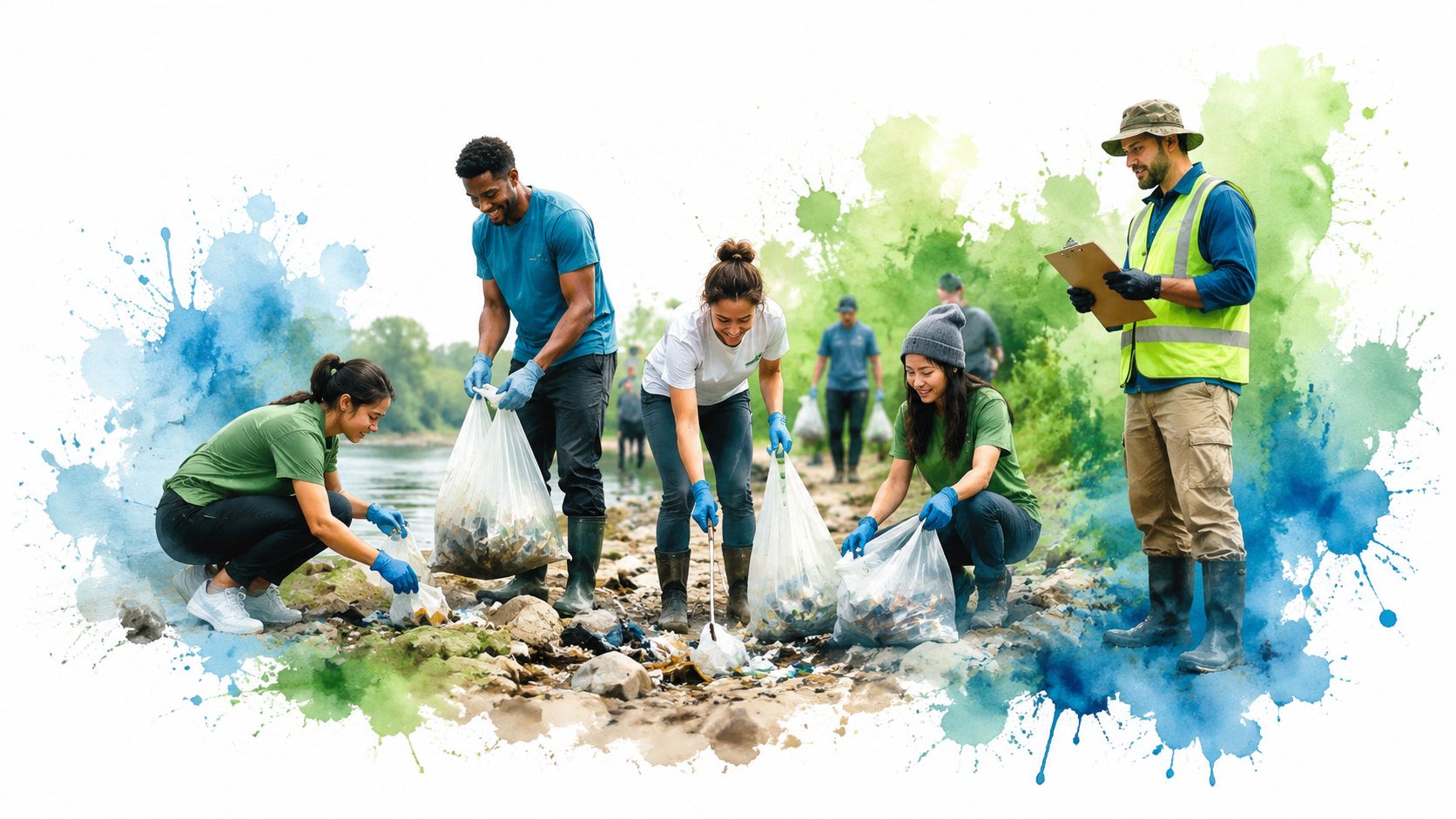
At one Saturday creek cleanup, a volunteer picked up a syringe alone, two people argued over gloves until voices rose, and a quiet newcomer drove home without saying goodbye. Nobody had bad intentions. Everyone had guessed at the rules.
Why a Volunteer Code of Conduct Actually Matters
Outdoor groups run on goodwill until the first awkward moment. A volunteer sees a sharp object, assumes someone else knows the procedure, and reaches down. Another person jokes about who should carry the heavy bag. A newcomer stays silent because the regulars already seem to know one another. The group finishes the cleanup, yet someone leaves hurt, unsafe, or unsure whether they belong.
I've learned to treat a volunteer code of conduct as a promise to the people holding the grabbers and trash bags. It tells beginners what they can expect, gives long-time volunteers a fair way to raise a concern, and keeps one loud personality from defining the whole morning. A written standard also gives you something to point to before a small disagreement turns into a friendship-ending argument.
The history of formal volunteer conduct goes back further than many group leaders realize. A peer-reviewed article titled “The code of conduct of the volunteer” appeared in Supportive Care in Cancer, Volume 6, Issue 2, pages 120–124, in 1998. The paper treated volunteer behavior as an ethical consensus problem and argued for explicit standards instead of relying only on informal goodwill. The PubMed record for the article documents that publication.
A promise volunteers can understand
Your code should protect people first. That means clear expectations around respect, confidentiality, accountability, safety, and conflicts of interest. A volunteer shouldn't need to decode legal language while standing beside a creek in the rain.
The five-part ethics framework of Citizenship, Respect, Accountability, Fairness, and Trust gives leaders a useful foundation. The Canadian Volunteer Administration Certification ethics guidance connects those ideas with accessible service, ethical decisions, stakeholder trust, and a helping environment. The same guidance points to the SAVMA Member Code of Ethics, adopted in December 2013, which calls for a safe working environment, protection from risk, adequate training, frequent positive feedback, confidentiality, and freedom from discrimination.
That structure fits a neighborhood cleanup better than a giant policy binder. You need enough detail to protect volunteers, yet not so much that nobody reads the document.
Practical rule: If a volunteer can't understand the rule while wearing wet gloves, rewrite it.
A good code creates fewer awkward confrontations because you can discuss behavior instead of attacking character. It speeds up onboarding because every newcomer receives the same answer. It also supports the health and social reasons people join outdoor service groups, including the ideas gathered in this guide to volunteer health benefits. Leaders who run faith-based teams can also borrow useful retention ideas from 10 retention strategies for church teams, especially around appreciation, communication, and belonging.
The Core Rules Every Volunteer Code of Conduct Should Cover
Start with one page. Write each sentence as if you're explaining it to a new volunteer before the first bag comes open. Settle the basic behavior rules before you add weather triggers, digital boundaries, or special requirements for a highway cleanup.
Write the baseline in plain English
Use direct sentences that tell people what to do.
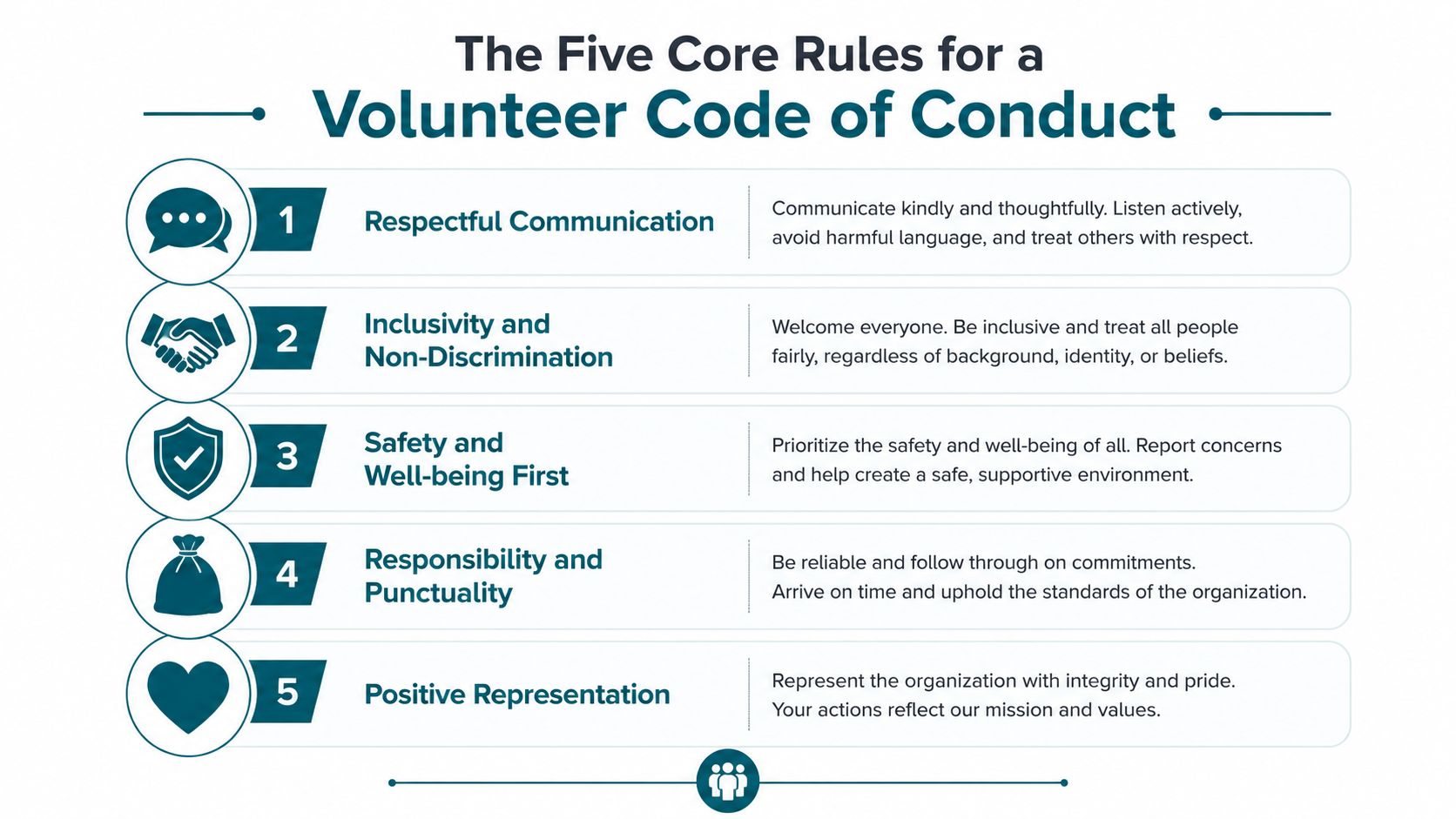
Respectful communication: “We speak to volunteers, residents, visitors, and coordinators with respect, both at events and in group chats.”
Safe litter handling: “We wear gloves, use a grabber for sharp or contaminated items, and ask an organizer when an object looks unsafe.”
No solo risky work: “We work with a buddy or small group near roads, water, unstable ground, heavy debris, or other hazards.”
Alcohol and substances: “Volunteers must not drink alcohol or use impairing substances before or during an event, and nobody may volunteer while impaired.”
No harassment or discrimination: “We don't tolerate harassment, bullying, threats, or discrimination based on race, gender, religion, disability, age, sexual orientation, or another personal trait.”
The fifth rule needs a firm line. A volunteer code example also includes a simple attendance expectation, tell the coordinator as soon as possible if you can't make a shift. This volunteer code clause reference shows how groups often pair conduct rules with attendance communication.
Keep the first draft readable
Put the rules near the top, then add reporting, consequences, and an acknowledgment line. Avoid phrases like “in accordance with applicable provisions” when “follow the organizer's safety directions” says the same thing. You can use a writing workspace or a Codex tool for marketers to compare versions, but don't let any tool turn a one-page promise into a policy maze.
Your baseline also needs a practical safety partner. The Western Australian government's Volunteer Management Guide connects the code with recruitment, role clarity, hazard identification, risk assessment, controls, complaints handling, and review cycles. That approach makes your document useful beside a riverbank, not merely tidy in a shared folder.
A Ready-to-Use Template and Two Real Sample Scenarios
Copy this block into a Google Doc or Notion page, then replace the brackets before your next signup.
[Group Name] Volunteer Code of Conduct
Event: [Event type]
Meeting spot: [Meeting spot]
Purpose: [One sentence explaining who you help and what volunteers do]
- Respect: We speak and act with respect toward volunteers, residents, visitors, and coordinators, online and in person.
- Safety: We use gloves and tools correctly, ask for help with sharp or hazardous items, and follow event safety directions.
- Buddy work: We don't work alone in risky areas. We stay with a buddy or small group when the organizer requires it.
- Sobriety: We don't volunteer while impaired, and we don't drink alcohol or use impairing substances before or during the event.
- Inclusion: We don't tolerate harassment, bullying, threats, or discrimination.
- Reporting: We report safety or conduct concerns to [organizer name or role] through [channel].
- Acknowledgment: I have read this code, understand it, and agree to follow it.
Name and date: [Name, date]
The same skeleton can support a relaxed park morning or a roadside operation. Only change the clauses that match the risk.
Two versions in practice
Neighborhood park cleanup: “Families and children may attend. Volunteers stay within the marked park area, use tools with care, and ask an adult organizer before handling unfamiliar objects.” A beginner should add clear language about child supervision, tool handoffs, and where families meet if they become separated.
Highway or river-bank cleanup: “Volunteers wear bright vests, work in buddy pairs, stay outside marked danger zones, and stop immediately when the lead organizer calls a pause.” A beginner should add clauses about traffic, water edges, weather, emergency access, and who has authority to end the event.
| Clause | Neighborhood Park Cleanup | Highway or High-Risk Cleanup |
|---|---|---|
| Meeting area | Marked park entrance | Designated safe access point |
| Work pattern | Families and small groups | Buddy system at all times |
| Equipment | Gloves, grabbers, bags | Bright vests, gloves, grabbers, extra safety gear |
| Stop rule | Organizer pauses for local hazards | Organizer pauses for traffic, water, storms, or unsafe visibility |
| Beginner addition | Child and tool supervision | Roadside, water, emergency, and evacuation clauses |
Save the finished document as a reusable Google Doc or Notion page. Keep a clean master copy, then create a dated version for events with special hazards.
Four Customizations for Outdoor, Friendship-Driven Groups
A generic code won't answer the questions that come up when a storm arrives, a group chat gets sharp, or three people vanish after signing up. Outdoor leaders need adjustable rules. Start with the condition that can hurt someone fastest, then tighten the social rules that protect trust.
| Customization | Default rule | Tighter version for high-risk work | Looser version for a small neighborhood group |
|---|---|---|---|
| Weather stop rules | The lead organizer may pause work when conditions become unsafe. | Name stop conditions, such as lightning, flooding, dangerous wind, poor visibility, extreme heat, or unsafe cold. Give every volunteer permission to leave. | State that the organizer checks conditions before arrival and may shorten the route or move to a safer block. |
| Off-event digital conduct | Separate personal speech from statements made for the group. | No posting identifiable details about volunteers, incident photos, private messages, or the organization's name for political, fundraising, or business promotion without approval. | Ask members to resolve personal disagreements privately and avoid tagging the group in heated arguments. |
| Attendance norms | Tell the coordinator early when you can't attend. | Require prompt notice for assigned safety roles and treat repeated no-shows as a scheduling issue. | Accept occasional cancellations without guilt, then ask people to update the chat when plans change. |
| Conflict reporting | Report concerns to a named organizer through a private channel. | Use a backup contact, written incident notes, and a clear escalation path. | Let a trusted regular receive the first report, then bring serious concerns to the lead. |
I'd tighten weather and reporting first. Weather can create immediate physical harm, while weak reporting leaves people alone with problems. Tighten digital conduct next, because screenshots and group-chat arguments can spread beyond the event. Tighten attendance last, unless a missed shift leaves someone alone near a road or water.
The 2025 volunteer code from the Christian College of Guidance and Support points toward a gap many outdoor groups still leave open, what happens when weather, fatigue, and difficult conditions test a volunteer's limits. Give leaders authority to stop work, and give volunteers explicit permission to step away without shame. Guidance on digital conduct also needs to address private messages, encrypted chats, screenshots, and posts made after the event. A volunteer may speak personally, yet they shouldn't imply that the group endorses personal politics, fundraising, or business activity.
Decision aid: If the problem could injure someone before you can hold a discussion, tighten the rule today.
How to Adopt and Communicate the Code Without Killing the Vibe
Don't unveil a formal document like a company merger. Bring it into the group the same way you bring extra gloves, with preparation, a quick explanation, and a place to ask questions.
Use the order small groups can actually manage
- Ask two trusted volunteers to review the draft. Choose one regular and one newer member. Ask where the language feels unclear, harsh, or unrealistic.
- Approve the final copy. If you have a board, let the board approve it. If you run the group informally, record the decision among the organizers.
- Add acknowledgment at signup. Ask each volunteer to read the code and confirm agreement before the first event.
- Explain it in person. Spend a few minutes on the rules that matter for that morning, especially sharps, buddy work, weather, and reporting.
- Pin reminders in the group chat. Keep the full code available, then post short reminders instead of repeating the whole document.
Use Meetup for the event description, Instagram for a friendly public summary, and Signal or WhatsApp for practical reminders. If you're choosing between tools, this guide to compare group communication tools can help you think through privacy, message history, and group access.
Try this announcement:
We're adding a short volunteer code so everyone knows how we handle safety, respect, weather, and concerns. It isn't a corporate rulebook. It's a shared promise that nobody has to guess what to do with a sharp object, an unsafe storm, or a tense conversation. Please read it before Saturday and message us with questions.
Store signed acknowledgments in a restricted Google Drive folder, an organizer-only Notion database, or the signup system you already use. Keep access narrow, record the date, and avoid collecting personal information you don't need. For the rest of your operating system, use these volunteer management best practices as a practical reference.
Reporting, Enforcement, and the Volunteer-First Discipline Flow
A reporting process fails when it asks volunteers to “tell someone” without naming the person, channel, response time, or next step. Write the chain down. Then follow it even when the person involved is your friend.
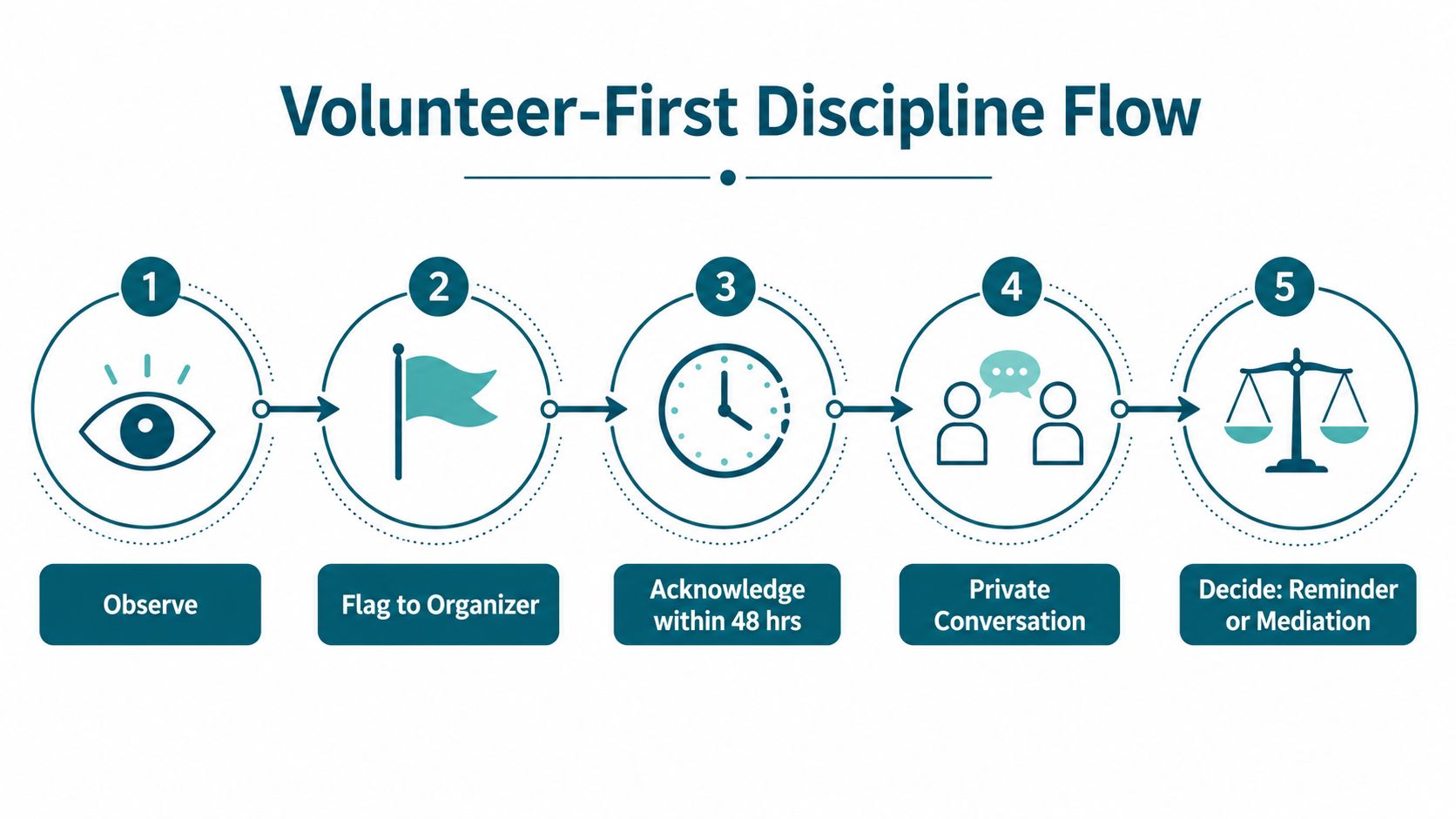
A simple five-step chain
Observe. Record what happened, when it happened, who saw it, and what immediate safety action followed. Stick to behavior. “Jordan shouted over Maya and blocked the path” is useful. “Jordan is toxic” isn't.
Flag it. Send the concern to the named organizer through a private channel. Offer an alternate contact when the lead organizer is involved.
Acknowledge within 48 hours. Tell the reporting volunteer that you received the concern and explain when you'll follow up. Don't promise a particular outcome before you speak with the people involved.
Hold a private conversation. Speak with the volunteer away from the group. Ask for their account, explain the reported conduct, and state the rule that applies.
Decide and document. A response can range from a friendly reminder or retraining to a written warning, mediation, removal from an event, or dismissal from the program. This municipal volunteer agreement illustrates how codes can connect reporting, organizational policies, legal duties, personal gain restrictions, and consequences.
Concrete triggers include harassment, threats, violence, discrimination, theft, data breaches, intoxication on duty, repeated safety violations, and social posts that target other volunteers. Guidance for challenging volunteers also recommends formal channels, a designated manager, incident documentation, resolution steps, and clear escalation or termination benchmarks. The VolunteerHub guidance on managing challenging volunteers gives examples of serious conduct that can justify immediate removal.
Volunteer-first discipline usually starts with a second-chance conversation when the conduct allows it. A written warning comes next when the behavior continues or the first conversation doesn't solve it. Remove someone immediately when they create serious danger, threaten people, harass someone, steal, breach private data, or arrive impaired.
If the accused person is your long-time friend, don't investigate alone. Ask another organizer to join, give the reporting volunteer a different contact, and use the same written standard. Friendship can remain part of your life. It can't decide whether another volunteer gets heard.
Use these conflict resolution strategies to prepare organizers before the first report arrives.
Your Volunteer-First Wrap-Up and Quick Checklist
People keep showing up at eight in the morning because the work gives them purpose, friendship, and a reason to walk the dog between trash bags. The code should protect that feeling without pretending every Saturday will feel easy.
Write the rules in plain language. Set the five core boundaries before adding custom clauses. Keep a reusable template for different event types. Adjust weather, digital conduct, attendance, and reporting to match the place where you work. Introduce the code face to face, store acknowledgments in a straightforward manner, and respond to concerns through a predictable volunteer-first chain.
Your seven-action checklist
- Draft one page: Write the purpose, five core rules, reporting contact, and acknowledgment line.
- Ask two volunteers to review it: Include one regular and one newer participant.
- Add event-specific safety clauses: Cover roads, water, children, tools, weather, or other hazards.
- Name the decision-maker: State who can pause work, investigate concerns, and remove someone from an event.
- Create the acknowledgment step: Add it to your signup flow and store confirmations in a restricted folder.
- Practice the briefing: Explain the code before the next cleanup in ordinary language.
- Pin the code and review it: Keep it visible in your chat and revise it when an incident reveals a missing rule.
Put this tone note in your onboarding document:
We wrote this code to protect the people who make these cleanups possible. Ask questions, speak up early, and give one another room to learn. The bags matter, yet the friendships are part of the work too.
Litter Caterpillars runs volunteer-driven trash pickups in Chicago, with weekly outdoor events, safety briefings, tool-based litter handling, and a volunteer-first approach to community cleanup. Visit Litter Caterpillars to find a cleanup, meet the group, and turn your own code of conduct into a friendly practice people can trust.
Leave a Reply