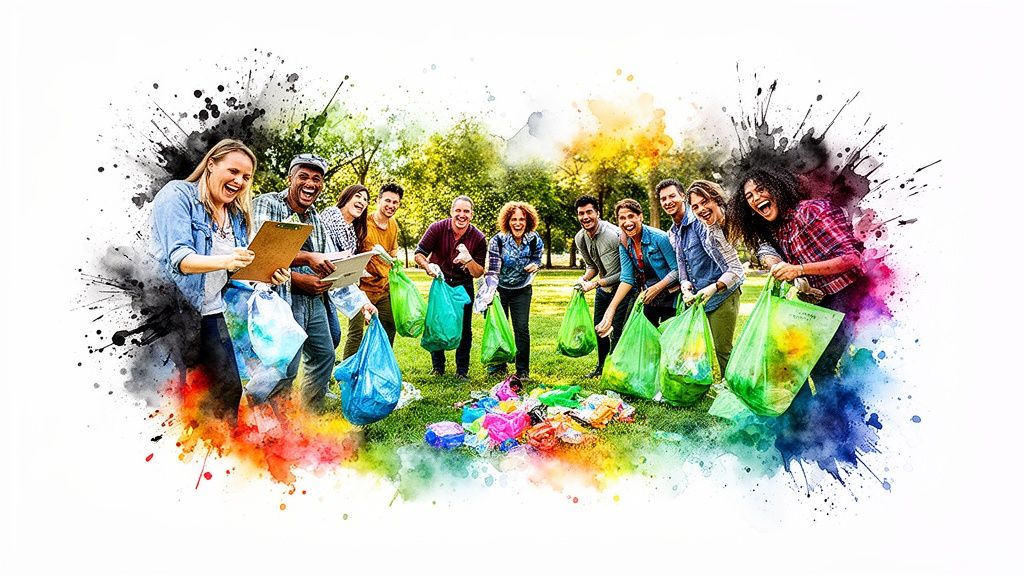
It can feel like a secret, but cleaning up other people’s messes is way easier than cleaning up our own. And somewhere between a plastic bottle and a forgotten shopping bag, a strange, new kind of fun is born, the kind that builds real friendships.
For three years, every single week, the Litter Caterpillars have shown up in Chicago. Rain, shine, blizzard, or heatwave. We discovered that suffering through a little hail together isn't a bug; it's a feature. It adds flavor. It advances the plot of your life. This isn't just a list of 'nice' ideas. This is a fearless guide to community building activities for adults that forge the kind of bonds that last, proving that changing your world (and finding your people) is a lot easier, and way more fun, than you think.
Making friends as an adult often feels like a puzzle with missing pieces. We wait for the perfect moment or the right group to appear, but the truth is simpler and more profound: shared purpose is the shortcut. It’s the powerful, magnetic force that pulls people together, transforming strangers into a team. When you work side-by-side to make something better, you skip the small talk and get straight to what matters.
This guide is our blueprint, built from thousands of hours spent on Chicago’s streets. We’ll show you how to turn a simple cleanup into a neighborhood celebration, how to build skills that empower you and your neighbors, and how to create a support system that feels like family. These aren't just theories; they are field-tested strategies for creating connection, sparking joy, and making a tangible impact. Let’s get started.
1. Weekly Themed Group Cleanups with Identity & Pride Elements
Imagine transforming a simple, solitary act like picking up litter into a weekly celebration of community, connection, and shared purpose. This is the magic behind consistent, themed group cleanups. It's more than just tidying up a neighborhood; it's about creating a reliable rhythm where people know they can show up, belong, and make a tangible difference together. By establishing a fixed day and time, you build a dependable social anchor in people’s lives, turning strangers into a true team.
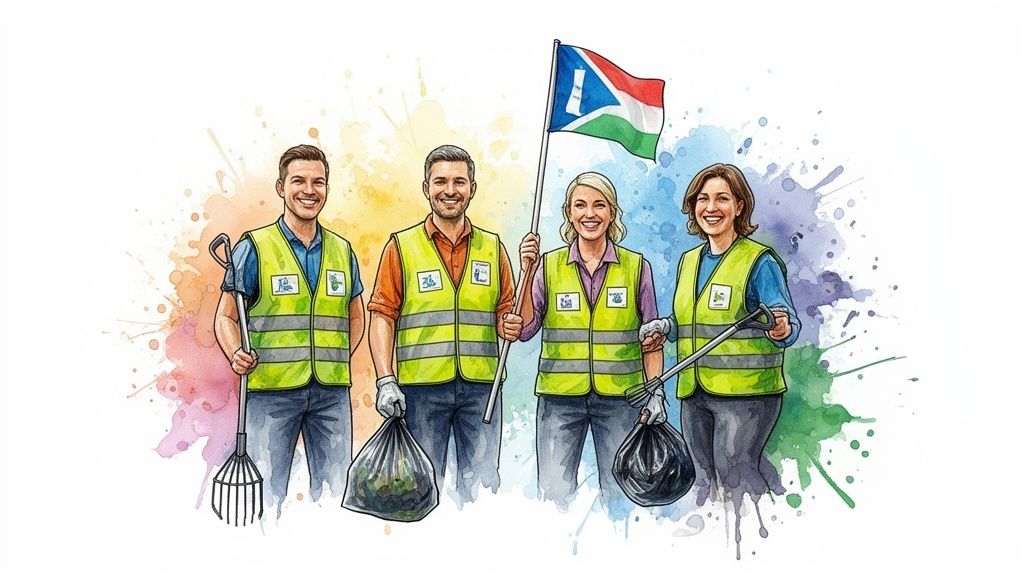
The secret sauce is identity. Think of it like a sports team. A logo, a team song, or even just matching vests gives everyone a visual cue that they are part of something bigger. Chicago's own Litter Caterpillars mastered this by creating a vibrant, consistent presence across the city's 50 wards for over three years. Their flag isn't just fabric; it's a beacon of hope and a symbol of unity.
How to Make It Happen
This approach is one of the most powerful community building activities for adults because it combines purpose with predictability. It’s perfect for new groups wanting to establish a strong foundation or existing organizations aiming to deepen member engagement.
- Set a Rhythm: Lock in a consistent day and time (e.g., every Saturday at 10 AM). This removes the mental load of scheduling and builds a powerful habit for your members.
- Build an Identity: Invest in simple, visible branding. This could be a shared theme song played at the start, custom-designed badges, or a group flag. These small symbols create immense pride and a sense of belonging.
- Rotate Locations: To build a city-wide community, rotate cleanup locations. This demonstrates an equitable commitment to all neighborhoods and keeps the experience fresh and adventurous for your volunteers.
- Celebrate People, Not Just Pounds: Focus on celebrating individual contributions and personal growth. Acknowledge a new volunteer’s first event or a regular’s 10th cleanup. The real victory is the community you build, not just the trash you collect.
2. Neighborhood Exploration & Friendship-First Service Outings
What if a community event felt less like a chore and more like an urban adventure with new friends? This is the heart of a "friendship-first" service outing, where the main goal isn't just cleaning a street, but discovering the soul of a neighborhood and forging genuine connections. It transforms service into a vehicle for exploration and belonging, making it perfect for newcomers or anyone looking to deepen their relationship with their city. The service activity becomes the perfect excuse to explore, ask questions, and meet people.
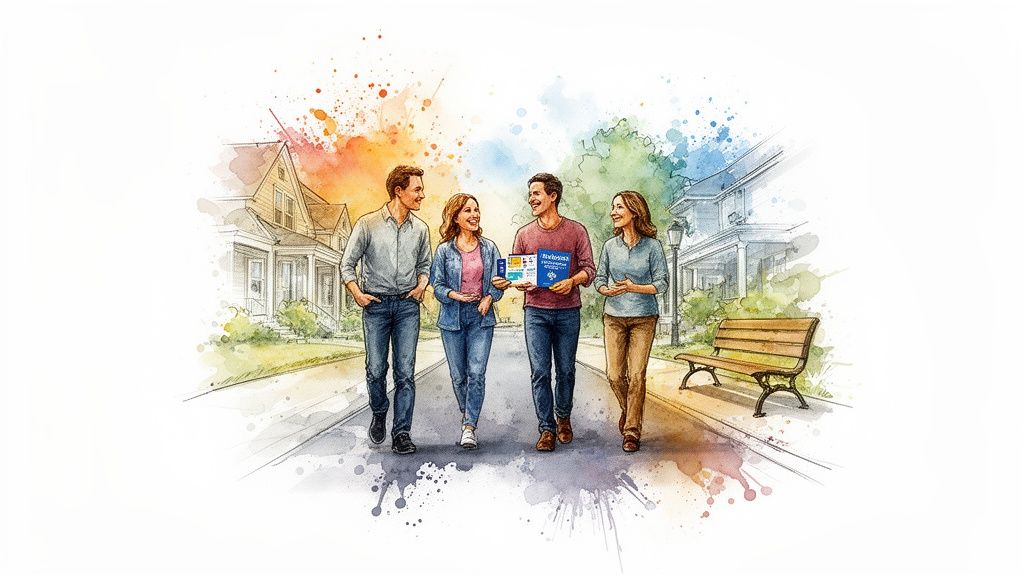
This approach shifts the focus from task to experience. Instead of just picking up litter, you’re on a guided tour of a community's hidden gems, led by the very people who live there. It’s an invitation to see the city not as a map, but as a collection of stories. Organizations like Litter Caterpillars use this model to explore Chicago's 50 wards, turning each event into a unique expedition. This method makes making an impact feel fun and effortless, proving you can build friendships and a better city at the same time.
How to Make It Happen
This is one of the most welcoming community building activities for adults because it lowers the barrier to entry and prioritizes human connection over output. It’s ideal for groups aiming to attract new members or those wanting to foster a more inclusive and adventurous culture.
- Frame it as an Adventure: Market your events as neighborhood tours or "service safaris." This sparks curiosity and appeals to people's desire for new experiences, not just their sense of duty.
- Create a "Passport": Design a simple booklet or digital tracker where volunteers can get a stamp for each new neighborhood they serve in. This gamifies the experience and encourages consistent participation across different areas.
- Invite Local Storytellers: Partner with long-time residents or local historians to share stories about the neighborhood's landmarks, history, and culture during the event. This adds incredible depth and value.
- Plan a "Third Place": Always schedule a post-event gathering at a local coffee shop, brewery, or park. This designated social time is where the real bonding happens, allowing conversations to continue naturally.
3. Skill-Building Workshops & Personal Transformation Circles
Community service is often a powerful catalyst for personal change. Imagine a space where cleaning up a neighborhood and cleaning up your own life happen side-by-side, supported by a group that understands both struggles. This is the heart of a skill-building workshop or personal transformation circle. It’s a brave space built on the truth that many of us, even those leading the charge, grapple with messiness, inconsistency, or disorganization in our own homes and habits.
These gatherings merge the accountability of recovery programs with the vulnerability of Brené Brown’s courage-building groups. It’s a profound acknowledgment that showing up for the community is an act of showing up for yourself. The weekly cleanup becomes more than a civic duty; it becomes the hands-on practice for the personal goals we set together, proving that small, consistent actions create massive change both inside and out.
How to Make It Happen
This is one of the most transformative community building activities for adults because it directly links external action with internal growth. It’s ideal for groups who want to foster deep, authentic connections and support members holistically.
- Lead with Vulnerability: Start by sharing a personal story. The Litter Caterpillars founder often talks about how her own journey from personal messiness to community service sparked the entire movement. This creates a foundation of trust and authenticity.
- Create Consent Structures: Make it clear that sharing is always optional. Use phrases like, "I'd like to open the floor for anyone who feels called to share." This ensures the circle remains a safe space, not a pressure cooker.
- Link Service to Personal Goals: Frame the cleanup as the "lab" for personal development. If someone’s goal is consistency, their accountability is simply showing up to the next event. The action reinforces the habit.
- Celebrate Personal Wins: Acknowledge personal victories with the same energy as community milestones. Cheer for someone who organized their closet for the first time just as loud as you would for collecting 10 bags of trash. This shows you value the whole person.
4. Community Land Transformation & Place-Making Projects
What if you could turn a forgotten patch of earth into a vibrant testament to your community's love and resilience? This is the heart of place-making. It’s a journey that moves beyond temporary cleanups into creating permanent, cherished assets, transforming neglected dumping grounds into beautiful, functional spaces that reflect the soul of the neighborhood. This isn't just about planting flowers; it's about planting roots of ownership and pride that will grow for years.
This deeper level of engagement forges an unbreakable bond among volunteers. When a group collectively dreams, plans, and builds something tangible, like Litter Caterpillars' Caterpillar Park in Englewood, they create a shared legacy. They turn an eyesore into a landmark, a symbol of what’s possible when people refuse to accept blight and instead choose to build beauty.
How to Make It Happen
This is one of the most profound community building activities for adults because it creates a permanent, positive footprint. It’s ideal for established groups ready to take their commitment to the next level, cementing their impact and inspiring long-term neighborhood investment.
- Listen First, Build Second: Begin by asking neighbors what they truly want for the space, not what you think they need. Host listening sessions to ensure the project reflects the community's desires and dreams.
- Document the Transformation: Capture every step of the journey with photos and videos. This creates a powerful story to share on social media, demonstrating your impact and inspiring others to join or donate.
- Create Diverse Roles: A transformation project needs more than just muscle. Create volunteer roles for designers, fundraisers, event planners, and maintenance crew leaders. This allows people with different skills to contribute meaningfully.
- Plan for the Future: Before the grand opening, establish a clear maintenance plan. Create rotating volunteer schedules or an "adopt-a-plot" system to ensure the space remains beautiful and cared for long after the initial build.
- Celebrate the Victory: Host a grand opening celebration to honor the volunteers and officially gift the space to the neighborhood. This event cements the feeling of shared ownership and marks a powerful moment of collective achievement.
5. Adversity Bonding Challenges & 'Flavor-Adding' Events
Most groups cancel events when the weather turns bad. We lean into it. This approach transforms potential setbacks like a sudden downpour, biting wind, or even a hailstorm into the very catalyst for your community's strongest bonds. It's founded on a simple, powerful truth: shared struggle creates unshakable connection. By intentionally embracing difficulty, you reframe hardship not as something to be avoided, but as an ingredient that “adds flavor” to the experience and “advances the plot” of your group’s story.
This philosophy is baked into the DNA of Litter Caterpillars. Our very first event was hit by an unexpected, freezing hailstorm. We could have scattered, but we stayed, laughing and working through the chaos. That single moment became our origin myth, a legendary tale of resilience that bonded the founding members instantly. It taught us that overcoming a challenge together is a far more potent community glue than a perfect, sunny day ever could be.
How to Make It Happen
This strategy is one of the most profound community building activities for adults because it builds not just camaraderie, but deep psychological resilience. It’s perfect for groups ready to move beyond surface-level connections and forge a core identity rooted in shared strength and memorable stories.
- Frame the Narrative: Use language that transforms difficulty into adventure. Talk about "adding flavor" or "advancing the plot." Lead with your own stories of overcoming challenges, like our founding hailstorm, to set an inspirational tone.
- Prioritize Safety Invisibly: Have robust safety protocols in place, but don't make them the focus. Volunteers should feel an exhilarating sense of challenge while knowing, implicitly, that their well-being is guaranteed.
- Capture the Moment: Document everything. Photos and videos of people smiling, laughing, and working together through tough conditions are powerful proof of your community's spirit. These images become legendary.
- Create a Ritual of Celebration: After a challenging event, immediately create a space for connection and reflection. Sharing warm drinks after a cold cleanup or celebrating in a dry spot after a rainy one allows the group to bond over their shared accomplishment.
6. Social Accountability Partnerships & Volunteer Matching
The biggest barrier to consistent action isn't a lack of desire; it's the quiet battle we fight alone to just show up. An Accountability Partnership transforms this solo struggle into a shared journey. It pairs two people together with one simple, powerful mission: help each other get out the door. This isn't about pressure; it's about mutual encouragement, turning the intimidating act of joining a group into an exciting pact between friends.
Think of the proven power behind an AA sponsor, a marathon training buddy, or a Peloton partner. These systems work because they build a direct, personal link of support. A simple text message like, “Hey, you still coming Saturday?” can be the difference between a volunteer staying home and them showing up to make an impact. It forges deep, meaningful friendships within the larger community, creating a resilient network of people who genuinely care for one another.
How to Make It Happen
This is one of the most effective community building activities for adults because it tackles the universal challenge of inertia head-on. It’s perfect for groups looking to boost attendance, reduce volunteer drop-off, and cultivate a culture of unwavering support. It also provides a structured way to find new volunteers by offering an immediate support system.
- Host "Partner Pairing" Events: Dedicate specific meetups for new and existing members to connect. Use simple icebreakers focused on shared goals or neighborhoods to help people find a good match.
- Match Strategically: When pairing people manually, consider proximity (can they commute together?), shared personal goals, and personality. The goal is to create a natural, easy connection.
- Keep Check-ins Simple: Create a simple text message template for partners to use (e.g., "See you Saturday at 10?"). Simplicity is key to making the system stick.
- Celebrate the Partnerships: Publicly celebrate partner milestones and share their stories on social media. This reinforces the value of the system and inspires others to join in. Framing it as mutual support, not judgment, is crucial.
7. Volunteer Recognition & Celebration Ceremonies
True community isn't built on tasks completed; it's forged in shared moments of acknowledgment and celebration. A recognition ceremony transforms volunteering from a transactional activity into a journey of personal evolution. It’s a powerful ritual that publicly honors the bravery, kindness, and growth of individuals, reminding everyone that their personal transformation is just as important as the physical work they do. This is how you build a culture where people feel seen, valued, and inspired.
The power lies in celebrating the story behind the contribution. Think of the military’s use of medals and ranks or even TED Talks elevating speakers to a global stage. These systems aren't just about rewarding effort; they are about creating symbols of identity and shared values. When you award a badge for consistency or a certificate for kindness, you’re not just giving paper or fabric. You’re giving someone a tangible piece of their own inspiring story, a symbol that says, “You showed up, you grew, and you made us all better.”
How to Make It Happen
This is one of the most profound community building activities for adults because it reinforces the human element of your mission. It's perfect for groups looking to deepen bonds, reduce volunteer burnout, and create a legacy of positive role models.
- Celebrate Transformation, Not Just Tasks: Frame recognition around personal growth. Did someone overcome their shyness to lead a small group? Did a volunteer invent a new, more efficient way to work? Share these stories to show that the real impact is personal.
- Create Meaningful Symbols: Develop simple, inexpensive but meaningful symbols of recognition like custom badges, certificates, or even special titles. Link each symbol to a core value, such as “The Kindness Captain” or “The Consistency Champion.”
- Empower Peer-to-Peer Recognition: Don't let recognition be a top-down process. Create a simple system, like a "shout-out jar" or a dedicated Slack channel, where members can publicly acknowledge and celebrate each other’s acts of kindness and bravery.
- Focus on Inspiration: When presenting an award, frame it as, “You inspire us because…” This shifts the focus from competition to collective inspiration. Feature recognized volunteers and their stories on social media to amplify their impact and motivate others.
8. Barrier-Free Volunteer Accessibility & Inclusive Participation Tracks
True community is a circle where everyone has a space, regardless of their physical ability, schedule, or life circumstances. This principle transforms volunteering from a simple task into a profound act of inclusion. By intentionally designing multiple ways to contribute, you’re not just getting more done; you’re sending a powerful message that every person’s contribution is valued and necessary. It’s about recognizing that strength isn’t just about lifting heavy bags, it’s also about coordinating logistics, offering a ride, or providing a warm smile.
This approach dismantles the hidden barriers that keep willing hearts on the sidelines. Think of organizations like Move for Hunger, which offers diverse roles from packing boxes and driving to coordinating events and virtual advocacy. They understand that the collective power of a community comes from embracing its diverse talents. By creating different "tracks" for participation, you ensure that anyone who wants to help can find a meaningful way to do so, fostering a genuinely welcoming environment.
How to Make It Happen
This is one of the most vital community building activities for adults because it prioritizes kindness and ensures your group’s growth is sustainable and equitable. It's perfect for any organization that wants to authentically live its values and attract a wider, more diverse group of members.
- Offer Diverse Roles: Create and clearly define roles that don't require physical labor. This could include a "Welcome Captain" to greet new volunteers, a "Social Media Ambassador" to document the event, or a "Logistics Guru" to manage supplies.
- Ask, Don't Assume: Proactively and kindly ask about accessibility needs in your sign-up forms or welcome emails. Frame it as a way to ensure everyone has a great experience, not as a burden.
- Make Accessibility the Default: Design your events with inclusivity in mind from the start. Choose locations that are wheelchair accessible and close to public transit. Consider offering childcare or creating family-friendly roles.
- Celebrate All Contributions: Shine an equal spotlight on every type of volunteer. Feature the person who coordinated transportation on social media with the same enthusiasm as the person who collected the most litter. This reinforces that every role is heroic.
9. Partnership & Sponsorship Development for Volunteer Support
Imagine your volunteer group is a well-loved local sports team. While the players' passion is the heart of the game, the support from the community, like local shops providing water or a restaurant offering post-game meals, makes the season possible. Strategic partnerships are that essential support system. This isn't about chasing corporate dollars; it's about building genuine relationships with businesses and institutions that believe in your mission and want to help your volunteers thrive.
This approach creates a powerful win-win scenario. Partners gain a meaningful association with dedicated community members, and your group gets the tools, spaces, or resources needed to create exceptional experiences. Litter Caterpillars, for example, partners with local Chicago businesses not for cash, but for tangible support like providing supplies or hosting events. It’s about creating a true ecosystem of community care where everyone contributes what they can.
How to Make It Happen
This is one of the most sustainable community building activities for adults because it amplifies your impact without compromising your volunteer-first philosophy. It’s perfect for groups ready to scale their operations or enhance the quality of their events.
- Start with Specific Asks: Instead of a vague request for "sponsorship," approach a potential partner with a concrete need. Ask a hardware store for 20 pairs of gloves or a local café for coffee for a chilly morning event. These small, tangible requests are easy to say "yes" to.
- Align Your Values: Seek out partners who genuinely share your community's ethos. A partnership with a local, eco-conscious business will feel more authentic and meaningful than one with a random corporation.
- Create "Partner Volunteer Days": Invite your partners to step away from the sidelines and join the action. When their employees volunteer alongside your members, it transforms a transactional relationship into a personal, shared experience.
- Celebrate, Don't Advertise: Visibly thank your partners on social media, at events, and in newsletters. Frame their contribution as support for the volunteers, ensuring the focus remains on the people doing the work, not just the brand providing the supplies.
10. Neighborhood-Based Micro-Communities & Ward Captains Leadership Structure
True, lasting change doesn't come from a single hero at the top; it grows from empowered leaders on every block. This is the heart of a decentralized, ward-based model. Instead of relying on a central command, you cultivate a network of passionate, local "Ward Captains" who become the champions for their own neighborhoods. This structure transforms a city-wide movement into a deeply personal, hyper-local mission, creating ownership and a sense of place.
This approach turns your organization into a living, breathing ecosystem. Each micro-community, led by its Ward Captain, can adapt to the unique needs, culture, and rhythm of its specific area while staying connected to the larger group's identity and mission. It's like a franchise model for doing good, where the core values are shared, but the local flavor is celebrated. This is how you build a resilient, scalable community that can make a genuine, lasting impact across an entire city.
How to Make It Happen
This is one of the most advanced community building activities for adults, perfect for established groups ready to scale their impact and empower their members. It’s about building leaders, not just followers.
- Identify Natural Leaders: Look for volunteers who consistently show initiative, welcome newcomers, and embody your group's spirit. These are your future Ward Captains.
- Define the Role Clearly: Create a clear, manageable role description for Ward Captains. Outline their responsibilities, like organizing local events and communicating with their ward's volunteers, so they know exactly how to succeed.
- Invest in Training: Develop a robust onboarding process and offer monthly training sessions. Equip your captains with the skills they need for leadership, conflict resolution, and effective outreach. For more ideas on this, explore our guide on community engagement strategies.
- Foster Peer Support: Create a dedicated communication channel (like a group chat) for all Ward Captains. This allows them to share victories, solve problems together, and build a powerful support network. The best mentors are often their peers on the same journey.
- Celebrate Your Captains: Your Ward Captains are the backbone of your organization. Acknowledge their hard work publicly, feature them in communications, and create pathways for their continued growth. They are the living proof that anyone can step up and make a difference.
10-Point Comparison: Adult Community-Building Activities
| Option | Implementation Complexity 🔄 | Resource Requirements ⚡ | Expected Outcomes 📊 | Ideal Use Cases 💡 | Key Advantages ⭐ |
|---|---|---|---|---|---|
| Weekly Themed Group Cleanups with Identity & Pride Elements | 🔄🔄 — scheduled leadership, branding upkeep | ⚡⚡ — basic supplies, apparel, comms | Predictable attendance; community cohesion; measurable cleanup impact; ⭐⭐⭐⭐ | Build regular volunteer base; newcomers seeking belonging; weekend engagement | Predictable touchpoints; strong identity/pride; easy impact tracking |
| Neighborhood Exploration & Friendship-First Service Outings | 🔄🔄🔄 — route planning, neighborhood research | ⚡⚡ — route guides, light refreshments, comms | Deep friendships; neighborhood knowledge; higher retention; ⭐⭐⭐⭐ | Newcomers, explorers, young professionals wanting social-first service | Service feels like adventure; natural conversation starters; local investment |
| Skill-Building Workshops & Personal Transformation Circles | 🔄🔄🔄 — facilitator training; psychological safety needs | ⚡⚡ — facilitator time, materials, small-group space | Faster vulnerability and retention; habit change; personal transformation; ⭐⭐⭐⭐ | People seeking growth, habit-change, and consistent accountability | Addresses root motivation; strong word-of-mouth via transformations |
| Community Land Transformation & Place‑Making Projects | 🔄🔄🔄 — permits, long planning, multi-stakeholder coordination | ⚡⚡⚡⚡ — funding, materials, partner support, maintenance plans | Permanent visible legacy; media attention; long-term ownership; ⭐⭐⭐⭐⭐ | Long-term volunteers; neighborhood revitalization projects; fundraising cases | Tangible lasting impact; attracts partners; inspires community pride |
| Adversity Bonding Challenges & "Flavor-Adding" Events | 🔄🔄 — safety protocols and messaging required | ⚡⚡ — gear, documentation, post-event hospitality | Intense bonding; resilience-building; compelling stories; ⭐⭐⭐⭐ | Adventurous volunteers seeking growth and memorable experiences | Creates memorable narratives; filters for values-aligned volunteers |
| Social Accountability Partnerships & Volunteer Matching | 🔄🔄 — matching logistics and check-in systems | ⚡⚡ — coordination time, simple templates/tools | Increased attendance and consistency; intimate friendships; ⭐⭐⭐⭐ | Introverts, newcomers, people needing accountability | Boosts show-up rates; fosters deep one-on-one support |
| Volunteer Recognition & Celebration Ceremonies | 🔄🔄 — event planning, inclusive design | ⚡⚡ — badges, certificates, events, social content | Reinforced pride and identity; role modeling; retention boost; ⭐⭐⭐ | All volunteers, especially those seeking validation and inspiration | Makes emotional work visible; creates aspirational volunteers |
| Barrier‑Free Volunteer Accessibility & Inclusive Tracks | 🔄🔄🔄 — program design for multiple tracks and accommodations | ⚡⚡⚡ — adaptive equipment, training, support services | Broader participation; diverse skills leveraged; stronger inclusion; ⭐⭐⭐⭐ | People with disabilities, caregivers, remote contributors | Expands volunteer base; honors inclusion; increases resilience |
| Partnership & Sponsorship Development for Volunteer Support | 🔄🔄 — relationship building and alignment management | ⚡⚡⚡ — staff time to cultivate partners, logistics coordination | Improved volunteer experience; reduced costs; expanded capacity; ⭐⭐⭐⭐ | Scaling operations; corporate engagement; supply/resource needs | In‑kind support, enhanced credibility, volunteer-first resourcing |
| Neighborhood-Based Micro‑Communities & Ward Captains Leadership Structure | 🔄🔄🔄 — distributed leadership training and governance | ⚡⚡⚡ — onboarding, regular training, coordination systems | Distributed ownership; leadership pipeline; sustainable scale; ⭐⭐⭐⭐⭐ | City-wide growth; building local leaders and deep neighborhood trust | Scalable, resilient model; hyperlocal customization and pride |
You’re Not Alone in This. Now, Go Advance the Plot.
We've just walked through a whole universe of community building activities for adults, from themed cleanups that spark neighborhood pride to personal transformation circles that build deep, resilient bonds. We’ve talked about turning forgotten lots into vibrant gardens, celebrating every small victory, and designing events where every single person feels not just welcome, but truly needed. But let’s be honest. This isn't just a list of things to do. It’s a map to a different way of living.
Think of your life as a story. Are you a background character, waiting for something to happen? Or are you the protagonist, the one who decides to turn the page? For a long time, many of us feel like we’re waiting. Waiting for the right friends, the right moment, the right feeling of belonging. The secret we've discovered, picking up litter on a Saturday morning with strangers, is that belonging isn’t something you find. It’s something you build, one brave and kind act at a time.
The Real Takeaway: From Ideas to Identity
The true power behind every activity we discussed isn’t the activity itself. It’s the shift in mindset that comes with it.
- Action Creates Connection: You don't make friends by thinking about making friends. You make them by doing things alongside them. Shared purpose is the most powerful social glue on the planet. When you work together to clean a park or plant a garden, the conversations flow naturally. The shared accomplishment forges a bond much stronger than small talk ever could.
- Vulnerability is a Superpower: Showing up to a volunteer event, especially for the first time, is an act of courage. It says, "I care, and I'm willing to be seen caring." This vulnerability is magnetic. It attracts other people who also care, creating a space where authenticity isn't just allowed; it's the entire point.
- You Are More Capable Than You Think: Many of our volunteers arrive thinking they're just there to pick up trash. They leave realizing they can lead a team, organize a project, or inspire a stranger. Service reveals the strength you never knew you had. It’s a direct path to personal growth disguised as a neighborhood cleanup.
The Tom Sawyer Effect in Real Life
Remember the story of Tom Sawyer tricking his friends into whitewashing a fence? He made the chore look so desirable, so exclusive, that everyone was begging to take a turn. That’s the magic we’ve tapped into. The "chore" of cleaning our city isn't a punishment; it's an invitation. It's a chance to be part of something bigger, to reclaim our public spaces, and to find our people while doing it.
We’ve seen it happen hundreds of times. A person shows up, quiet and hesitant, holding a trash grabber for the first time. By the end of the day, they're laughing with new friends, taking a proud selfie in front of 20 bags of collected litter, and already planning which event they’ll attend next week. They didn't just clean a street; they advanced the plot of their own lives. They chose to become a main character.
This is your invitation. Stop waiting for the community you crave to appear out of thin air. Grab a bucket, extend a hand, and start building it. The world is desperate for more kind people to step into their power and prove that making a massive impact is easier, and a lot more fun, than anyone imagines. Be brave. Be kind. And watch how beautifully your world, and your story, begins to change.
Ready to stop reading about community and start building it? Litter Caterpillars is your launchpad for meaningful community building activities for adults right here in Chicago. Join one of our upcoming events and discover how simple acts of service can lead to profound friendships and personal transformation.
Leave a Reply