

You're probably here because grocery money feels tight, your phone already has too many tabs open, and every official website seems written for someone with a quiet house and free time. That's not real life in Chicago. Real life is rushing from work to pickup, trying to keep your kid fed, and wondering if asking for help will turn into a three-hour paperwork headache.
I get it. WIC can look like one more bureaucratic maze. It isn't simple, but it is manageable when someone explains it like a neighbor would.
You Are Not Alone Navigating Support in Chicago
I think about the parent on the bus with a stroller, a backpack, and two grocery bags cutting into their hands. Their coffee is cold. Their kid is fussy. Rent is due soon. They're doing the math in their head, trying to figure out milk, cereal, fruit, diapers, everything. That person is not failing. That person is carrying too much.

That's why I want to talk plainly about WIC in Chicago, Illinois. WIC is food help for pregnant people, new parents, babies, and young kids. It also comes with nutrition support. I don't see it as charity. I see it like finally using a coat that was hanging in your closet the whole time while you were freezing outside.
And too many families still don't get it. In Illinois, only 36.3% of the 419,107 people eligible for WIC participated in 2021, leaving an estimated $164 million in benefits unused each year, according to the Illinois WIC access analysis from the Greater Chicago Food Depository.
That number tells me something simple. A lot of people who need help either don't know they qualify or get stuck halfway through the process.
Why this matters on a regular Tuesday
You don't need another lecture. You need a path.
If your pantry is low this week, use every support system you can. WIC is one lane. Community food help is another. If you need a nearby meal option while you sort things out, this Chicago soup kitchen guide can help you find somewhere to start.
Practical rule: If you think you might qualify, act like you do until a clinic tells you otherwise.
A lot of parents talk themselves out of help before they ever make the call. Don't do that. I've seen people assume WIC is only for someone else, then find out they were eligible all along.
My opinion
The hardest part of WIC in Chicago usually isn't the benefit itself. It's the mental weight. The forms. The waiting. The feeling that you have to prove you deserve groceries for your own child.
You do deserve to ask. Start there.
Who Can Get WIC Support in Chicago
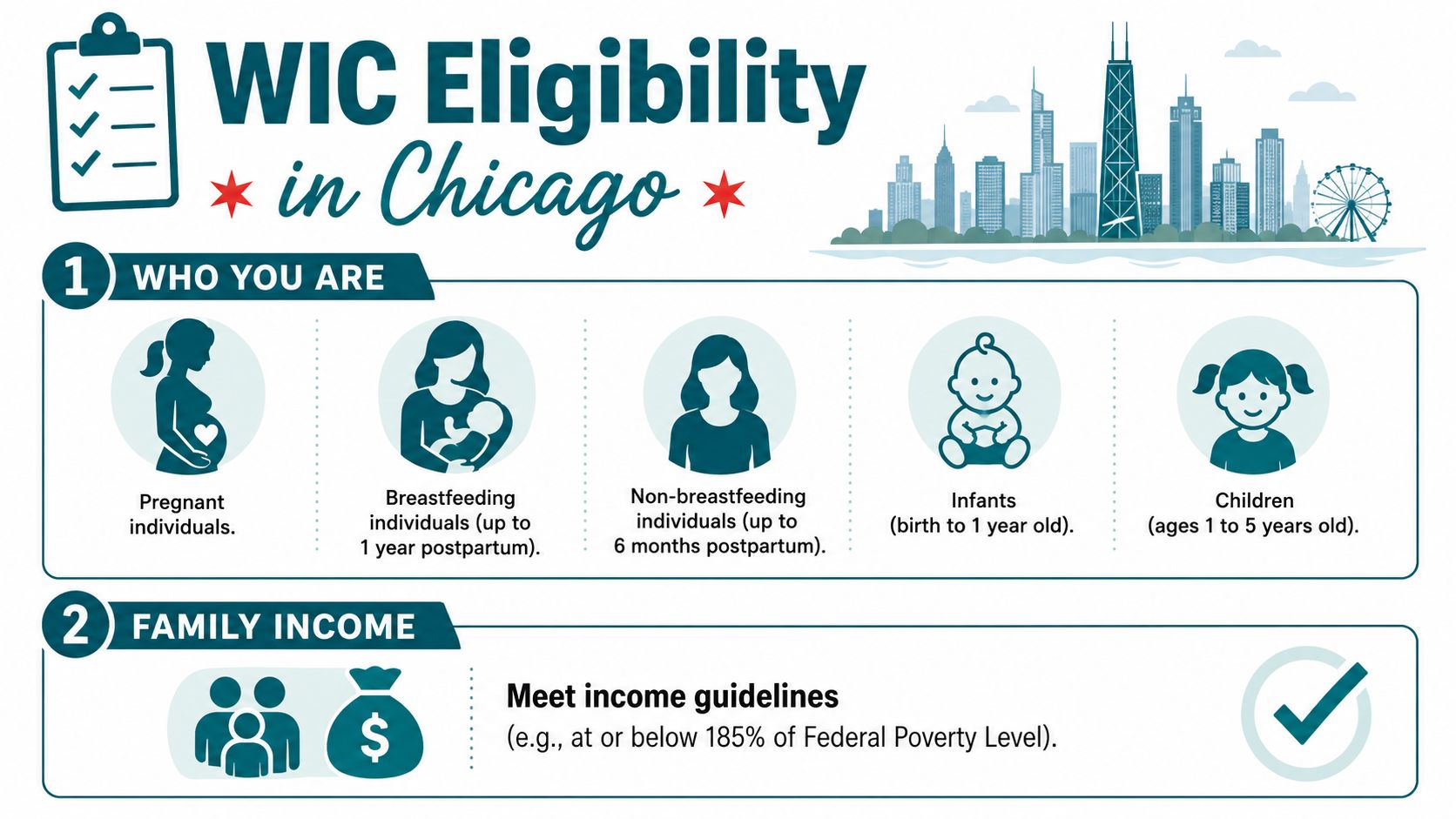
Let's strip this down. WIC eligibility usually comes down to who you are, your child's age, and household income. That's it.
The life stage part
You should check WIC if any of these fit you or your child:
- Pregnant and trying to keep food on the table
- Breastfeeding after birth, up to your baby's first birthday
- Not breastfeeding after birth, within the first six months
- An infant, from birth to age one
- A child under five
That's the first gate. If none of those apply, WIC probably isn't the program you need. If one does, keep going.
The income part
It's common for people to quit too early. Don't.
The infographic uses the familiar WIC guideline of at or below 185% of the Federal Poverty Level, which is the usual way people talk about the income screen. But my real advice is simpler. Don't try to self-reject from memory. Working families qualify all the time.
Think of income eligibility like a bouncer with a guest list. You might assume your name isn't on it because you have a job. Then you get to the door and find out you were invited the whole time.
Here's the shortcut many families miss:
- If you already get SNAP
- If you already get Medicaid
- If you already get TANF
…you're often automatically income-eligible for WIC. That can save you time and stress because those programs already show your household falls within income rules.
What Illinois numbers tell me
Illinois has a much lower WIC take-up rate than the country overall. An average month in 2021 showed only 37.9% of eligible Illinois children ages 0 to 4 receiving WIC, compared with 52.2% nationally, and common barriers include misunderstanding rules, time away from work, language barriers, and transportation difficulties, as shown on the Illinois WIC coverage page from America's Health Rankings.
If the rules feel confusing, that doesn't mean you're ineligible. It usually means the system is clunky.
My straight advice
Don't sit at your kitchen table trying to solve this like a tax problem. Call a clinic and ask, “I'm pregnant,” or “I have a child under five,” or “I'm postpartum. Should I apply?” Let the clinic tell you no. Don't do their job for them.
How to Find Your Neighborhood WIC Office
The search for a WIC office in Chicago can feel weirdly harder than it should be. You know the city. A place can be ten minutes away on the map and still be a whole journey with traffic, trains, kids, and weather. So don't look for “the” Chicago office like there's one giant front desk downtown. That's not how this works.
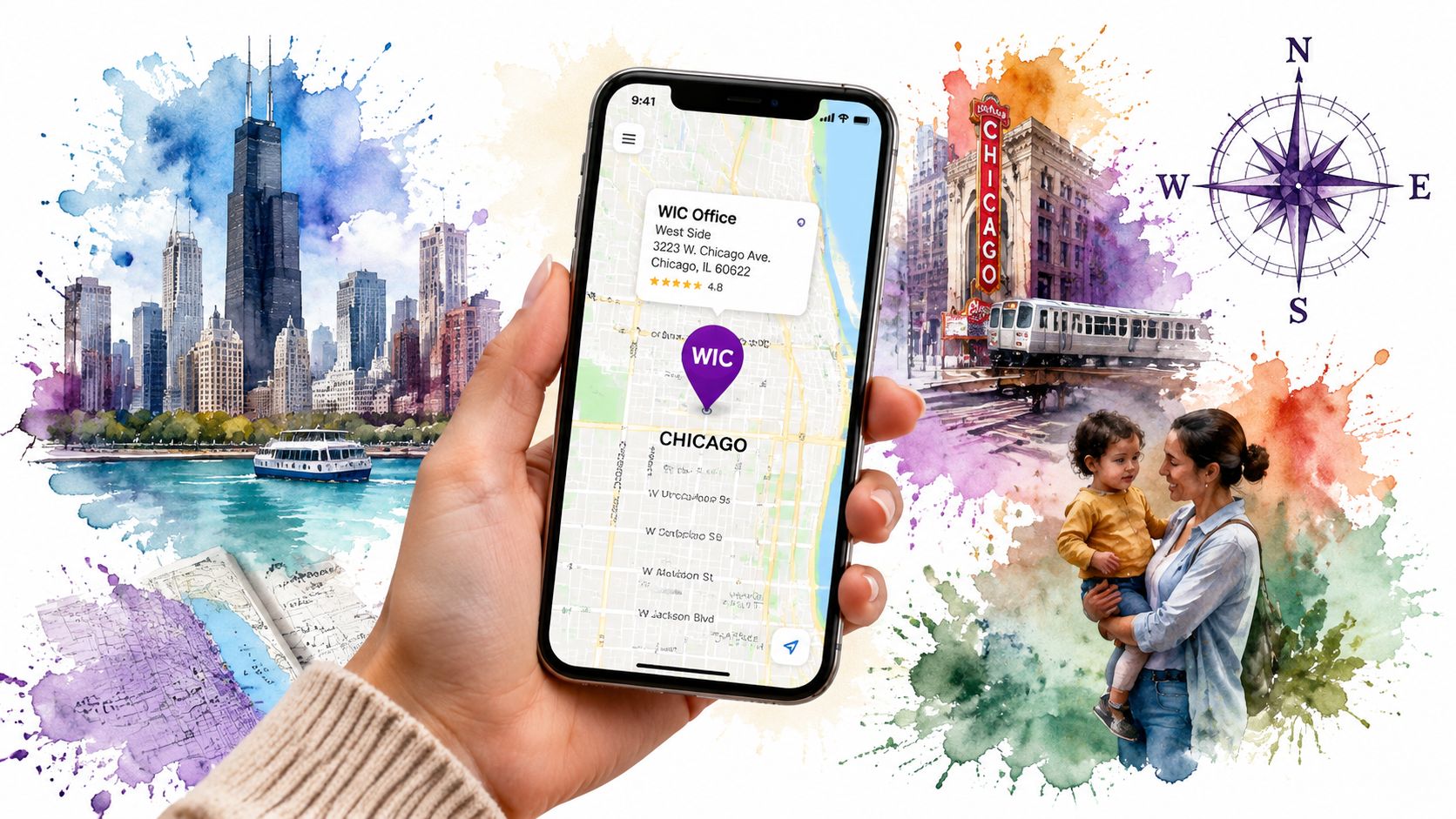
Start with your phone
Open Google Maps and search:
- WIC office near me
- WIC Chicago
- Illinois WIC clinic
- Catholic Charities WIC Chicago
- WIC grocery center Chicago
Save the top few that make sense for your route. Don't pick only by distance. Pick by your real life. Near your bus line is better than technically closer. Near your child's daycare is better than on the other side of the city.
Use referral help if you're stuck
A lot of families hit the same wall. They don't know where to go. The Greater Chicago Food Depository says it helps determine eligibility and refer families to a local WIC office, and Catholic Charities has 14 WIC grocery centers in Chicago, which tells you access is spread across neighborhoods instead of one central spot, as explained on the Greater Chicago Food Depository WIC help page.
That's why I tell people to stop searching for a perfect answer and start building a short list.
My three-call method
Call up to three places. Ask the same questions every time.
- Are you taking new WIC appointments right now?
- What documents should I bring?
- Do you have language help if I need it?
- What are your hours?
- Can I start anything by phone or online before I come in?
Write the answers in your Notes app. You do not need a fancy system. You need something you can read later when your kid spills juice on the counter and you forget everything.
Neighborhood rule: The best WIC office is the one you can actually get to without wrecking your whole day.
Think block by block, not citywide
Chicago is patchwork. One neighborhood can have easier access than the next. If you're new to the city or still figuring out what's nearby, this guide to Chicago neighborhoods to explore can help you get your bearings while you look for support close to home.
A lot of websites give broad program info. Fine. But if you're trying to handle WIC Chicago Illinois in real life, location beats theory every time.
What to Bring to Your WIC Appointment
Paperwork scares people off. I hate that, because the document list is simpler than it sounds once you sort it into piles. You usually need proof of who you are, where you live, and how much money comes into your household.
Consider packing for a day trip. If you have your wallet, your keys, and your phone, you're covered. Same idea here.
Your WIC Appointment Checklist
| What It's For | Examples of What to Bring |
|---|---|
| Proof of identity | Driver's license, state ID, child's birth certificate, hospital paperwork for a newborn |
| Proof of address | Utility bill, lease, rent receipt, official mail with your name and address |
| Proof of income | Recent pay stubs, employer statement, benefit letter |
| Proof of program participation if you already get benefits | SNAP approval letter, Medicaid card or approval notice, TANF paperwork |
| For children applying | Birth certificate, medical card, or other record that shows the child's identity |
| For a newborn or pregnancy | Hospital papers, pregnancy confirmation from a clinic if the office asks for it |
Don't overpack
You do not need to drag your whole filing cabinet across town.
Bring one solid document for each category. If more than one person in the household works, gather income proof for each worker if the clinic asks for household income. Put it all in one folder or large envelope. I like a cheap plastic folder because coffee spills happen and Chicago weather is rude.
Before you leave home
Run this quick check:
- Check names and address so they match your current household info
- Check dates so your mail or pay stubs look recent
- Check your phone battery because you may need to pull up records
- Check your child's bag because a hungry toddler can turn a short visit into a wrestling match
Bring more than you think you need, but organize it so you can find it fast.
My honest advice
If you're missing one document, call anyway. Don't disappear because your lease is buried somewhere or your printer is broken. Clinics deal with this every day. Ask, “I have these papers. Is that enough to start?” That one phone call can keep a small problem from becoming a missed month of benefits.
What Happens at the Clinic and Using Your eWIC Card
Walking into a WIC clinic for the first time can make your stomach tighten. You may expect a cold room, clipped voices, and a bunch of rules thrown at you. My experience is that it usually feels more human than that. Busy, yes. A little worn down sometimes, yes. But human.
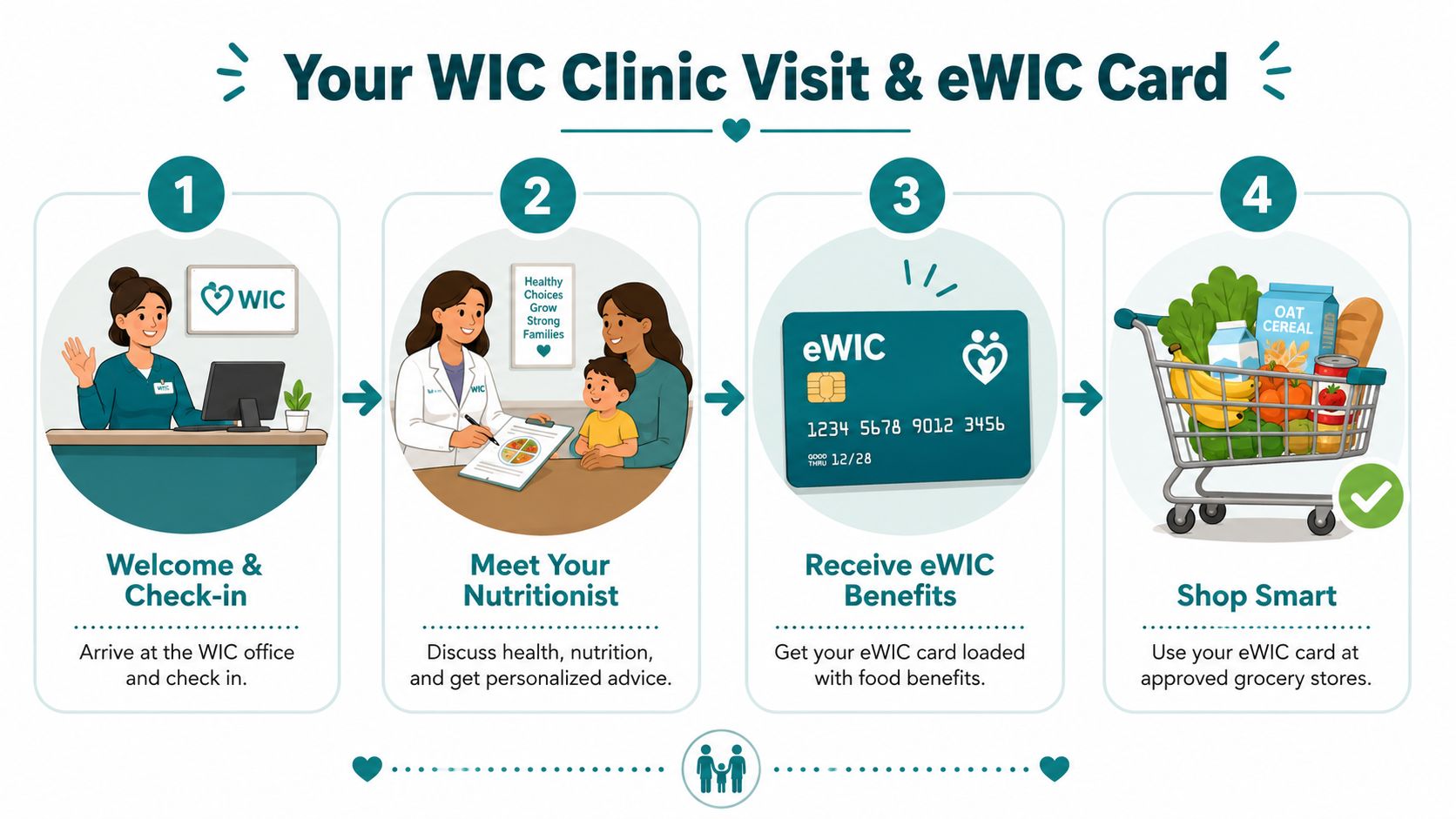
You'll usually check in, hand over your paperwork, and wait your turn. Then someone will talk with you about your household, your pregnancy or your child, and your food needs. They may measure height and weight and do a simple health screening, including a finger prick to check things like iron. It's quick. It's not there to shame you.
The appointment usually feels like this
A receptionist calls your name. You pull snacks out of your bag to buy peace. Your kid wants to touch everything. Then you meet with a staff member or nutrition professional who asks normal questions about what you eat, what your child eats, and what you need help with.
That conversation matters more than people think. If your baby needs a specialty formula, say it clearly. If you don't drink cow's milk, say that too. If your family shops at a certain store because that's what's near you, mention it. Speak up early instead of trying to “be easy.”
USDA says WIC food packages now include soy-based beverages, tofu, more fruits and vegetables, baby foods, and whole-grain options, and Chicago providers such as Catholic Charities also talk about access to specialty formulas, as noted in the USDA WIC FAQ page.
Your eWIC card is the tool you'll actually use
Once you're approved, you'll get an eWIC card. Treat it like a debit card with food benefits loaded onto it. That card is what turns all the paperwork into groceries.
A lot of people get approved and then hit a second problem at the store. They don't know which items are approved, they're rushed, the kid is tired, and suddenly buying cereal feels like taking a licensing exam.
This short video gives a useful visual before your first visit.
Make your first shopping trip easier
I strongly recommend this routine:
- Go once when you're not in a huge rush
- Use the WIC-approved food list from your clinic
- Ask a store employee if the shelf tags are confusing
- Separate WIC items in your cart so checkout is cleaner
- Keep your receipt so you can see what benefits remain
Your first WIC shopping trip may feel awkward. That's normal. By the second or third trip, it gets much easier.
The biggest mistake I see is staying quiet when something doesn't work. If a food item should qualify but won't scan right, ask. If your child needs a formula change, call the clinic. WIC works best when you treat it like an active tool, not a one-time approval letter.
Tips for Success and Finding More Help
Getting approved is great. Staying on WIC without chaos is the real win.
A lot of families fall off because life gets crowded. A child gets sick. Work changes. Transportation falls apart. Someone misses a letter. Then benefits stop and the whole process feels heavier the second time around. I want you to avoid that mess.
Protect your spot before problems start
Illinois has only 37.9% participation among eligible children, and families commonly run into barriers like misunderstanding rules, time away from work, language barriers, and transportation difficulty, according to the same Illinois WIC coverage analysis. That tells me one thing. You need a system, even a tiny one.
My version is simple:
- Set a phone reminder for recertification well before your benefits need renewal
- Keep one WIC folder for every letter, card, and clinic note
- Save the clinic number in your phone so you don't have to hunt for it later
- Ask for interpreter help early if English isn't your first language
- Call fast when your schedule changes instead of missing the appointment
Ask for accommodations like you mean it
If taking time off work is hard, say so. If the bus ride is rough with small kids, say so. If you need language help, say it when you book.
You are not being difficult. You are giving the clinic the information they need to help you show up and stay enrolled.
Build a backup plan for food
WIC is one piece. Use the rest of the support around you too. If you need nearby pantry help while you're getting settled, this page about Casa Catalina Food Pantry in Chicago may point you toward another layer of support.
Some weeks are smooth. Some weeks are a flat tire, a school email, a missed bus, and a broken stroller all stacked together. That's exactly when backup matters.
Missing one step doesn't mean you failed. It means you need to call, reset, and keep going.
My closing advice
Don't wait for the perfect morning, the perfect folder, or the perfect amount of confidence. WIC in Chicago, Illinois gets easier once you move. Call the clinic. Ask the dumb question. Bring the papers you have. Fix the rest after.
The system can be clumsy. You don't have to be.
If you care about making Chicago feel more supported, more connected, and more human, take a look at Litter Caterpillars. They bring neighbors together to do real good, make friends, and show up for the city block by block.
Leave a Reply