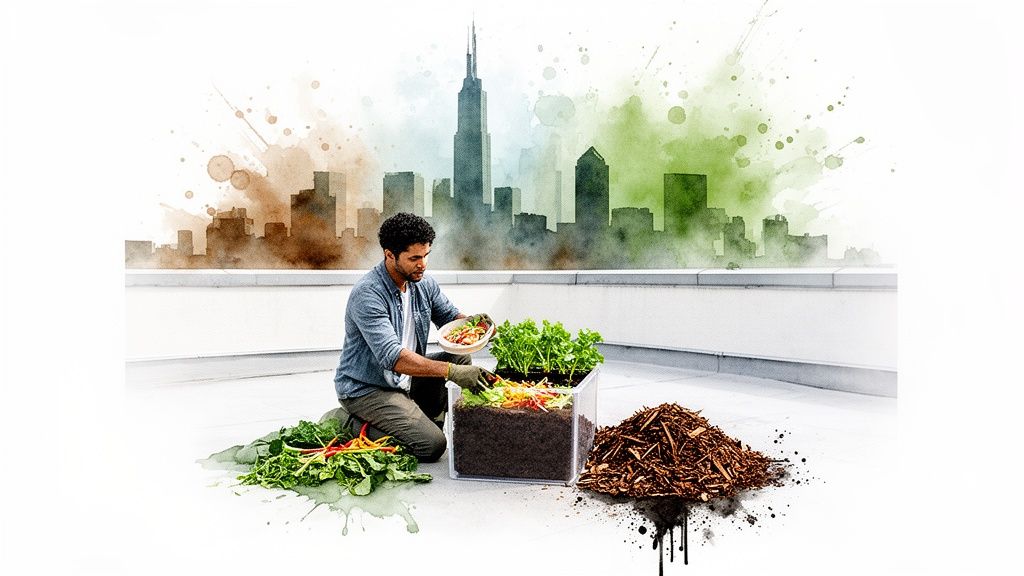
Composting in Chicago isn't just about shrinking your landfill pile or making nice soil. It’s a way for you to take back a little bit of control, to make a real, tangible dent in our city’s waste problem. Whether you have a sprawling backyard, a tiny balcony, or just a sliver of space under your kitchen sink, I can show you how you can join in.
My Journey Into Composting in Chicago
My story starts with a feeling I bet a lot of you know: being completely, utterly overwhelmed by my own stuff. My apartment felt choked with clutter. The trash can was this ever-growing monument to my own procrastination. Every item, every scrap, felt like it held a story, a memory, and it was all just sitting there, weighing me down.
This heavy feeling of being stuck pushed me. I had to do something, anything. I started with the kitchen trash, which was overflowing as usual. As I found myself sorting through old coffee grounds and slimy vegetable peels, a strange thought hit me. What if this "trash" wasn't trash at all? What if this was a beginning, not an end?
That one question kicked off my entire journey into composting in Chicago. I stopped seeing food scraps as gross, smelly waste and started seeing them as pure potential. That little mental flip was surprisingly, powerfully freeing.
Turning Waste Into a Weapon for Good
I quickly learned something surprising. Cleaning up messes—not just in my own apartment, but the city's messes too—felt incredible. It’s this weird kind of fun, a way for you to connect with your community and maybe even find a tougher, more resilient version of yourself. Composting stopped being some eco-friendly chore and turned into something that was actively changing me.
This simple act of turning food scraps into something useful gave me the courage to tackle bigger things. It was undeniable proof that your small, consistent actions really could lead to huge changes. I started to see the deep, unbreakable link between my own growth and the health of my community. This is the very idea that fuels everything I do with Litter Caterpillars.
Composting is an act of hope. You're taking something that would otherwise rot and stink in a landfill and giving it a new purpose, turning decay into vibrant life. It's your small rebellion against a throwaway culture.
Why It Matters for Our City
And let me tell you, we need this kind of rebellion right now. I was floored when I found out that food scraps make up about 20% of Chicago's total waste stream. All of that stuff—your fruit peels, your eggshells, your coffee grounds—gets dumped in landfills where it rots and releases methane, a really nasty greenhouse gas. For a city our size, that adds up to hundreds of thousands of tons of pollution we could be preventing every single year. You can discover more insights about Chicago's waste challenges and what we're doing to fix them.
Composting is our chance to flip that script. When you decide to compost, you're not just making some dirt for a garden. You are actively becoming part of the solution. You are taking a stand and joining a growing movement of Chicagoans building a healthier, tougher city from the ground up.
Finding Your Perfect Chicago Composting Method
Figuring out how you can start composting in Chicago is a lot like choosing how you want to get around the city. You wouldn't take the L if you were only going two blocks, right? It’s all about picking the method that fits your life, your space, and honestly, your personality. Let's figure out what works for you.
When I first started, I jumped straight into worm composting—vermicomposting—thinking it was the only real option for my tiny apartment. It was a spectacular, slimy failure. My first bin became a science experiment gone horribly wrong because I just kept dumping food in without balancing it. But I learned a ton from that mess, and that’s what this is all about: I’m here to share the simple, practical advice that makes this stuff easy.
From Big Yards to Balconies
If you’re lucky enough to have a backyard, say in a neighborhood like Beverly or Sauganash, an open-air pile is your best friend. Think of it as a slow-cooker for your soil. You just layer your "greens" (kitchen scraps) and "browns" (leaves, cardboard) and let nature do most of the work. I find it’s super low-effort and perfect for handling a lot of yard waste along with your food scraps.
For those of us with smaller yards or a bit of patio space—like what you might find in Lincoln Square or Andersonville—a compost tumbler is a game-changer. Imagine a personal cement mixer for your scraps. It’s a sealed barrel you turn every few days. This keeps pests out and, even better, speeds up the process like crazy. You can get finished compost in a matter of weeks, not months.
The most important step you can take is just to start. Don't let yourself get paralyzed trying to pick the "perfect" method. Choose one that seems doable and adjust as you learn. Your first batch of compost is a teacher, not a test.
And for my fellow apartment dwellers in the Loop, Logan Square, or anywhere else where space is tight, vermicomposting is pure magic. It’s a compact bin filled with special red wiggler worms that eat your food scraps and turn them into some of the richest fertilizer you’ll ever find. My early disaster taught me the key: go slow, don't overfeed them, and keep a good balance of bedding. Once you get the hang of it, it's odorless and incredibly efficient.
This little chart really nails that first moment of decision. It's about you turning that feeling of being overwhelmed into action.
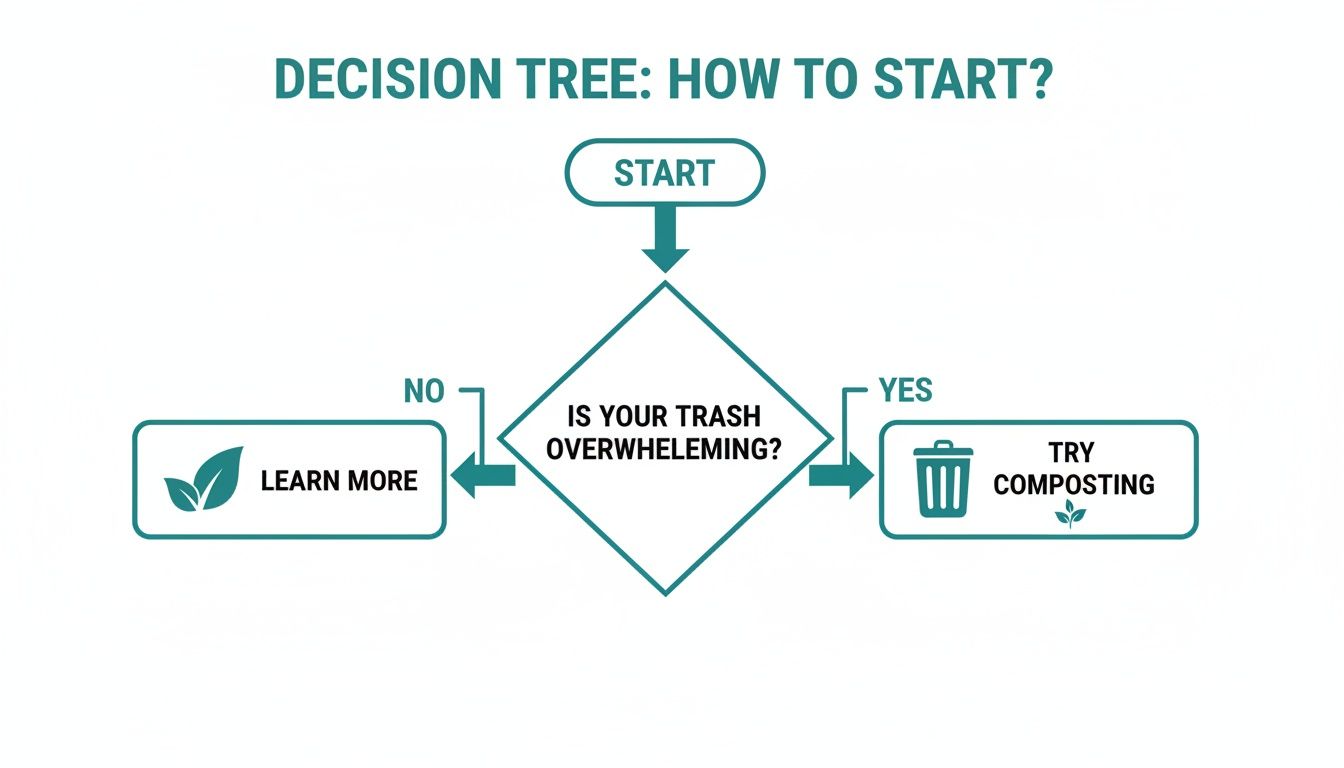
When your trash feels like too much, composting is a direct, empowering way for you to take back control.
Chicago Composting Methods at a Glance
Choosing isn't just about space; it's also about the time and effort you want to put in. Each approach has its own rhythm. To make it a little clearer for you, here’s a quick breakdown of the options we just talked about.
| Composting Method | Best for… | Space Needed | Effort Level |
|---|---|---|---|
| Open-Air Pile | Single-family homes with yards | A corner of the yard | Low |
| Compost Tumbler | Small yards, patios, decks | A few square feet | Medium |
| Worm Bin | Apartments, condos, balconies | Under the sink, a closet | Medium |
No matter where you live in this incredible city, there's a way for you to turn your waste into something wonderful. You just have to pick one and start.
What to Compost: A Chicago Cheatsheet
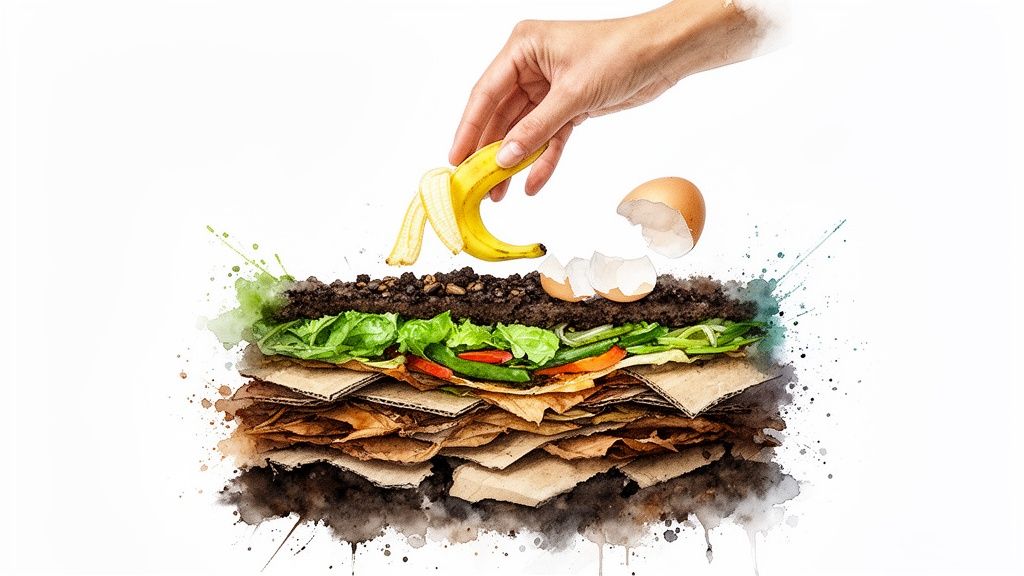
I’ve been there. You're standing over your kitchen bin, soggy banana peel in hand, completely frozen. Does this go in? That hesitation is real, but I’m here to give you the confidence to never second-guess your scraps again.
I want you to think of building a healthy compost pile like making a perfect lasagna. It’s all about the layers. You need the right balance of two key things: Greens and Browns. If you get this ratio right, you're well on your way to creating that beautiful, soil-enriching "black gold" right here in your Chicago home.
The Greens: Nitrogen Powerhouses
"Greens" are the fresh, wet materials that add nitrogen to your pile. This is the fuel that gets the microscopic organisms fired up and working their magic. These are the items that you generate directly from your kitchen prep.
You're probably creating a ton of these already:
- All your fruit and vegetable scraps (banana peels, apple cores, carrot tops)
- Coffee grounds and paper filters
- Tea bags (just make sure you remove any staples)
- Crushed eggshells
- Stale bread, pasta, and grains (use these in moderation)
These items break down fast and heat up the pile, kickstarting the whole decomposition process. They're like the zesty tomato sauce and rich ricotta in our compost lasagna. And if you're looking for more ways to cut down on waste, you might want to check out my guide on how to properly recycle in Chicago, which tackles a whole different set of materials.
The Browns: Carbon Builders
"Browns," on the other hand, are the dry, woody materials that provide carbon. These are crucial for structure and airflow, preventing your compost from becoming a smelly, slimy mess. I think of browns as the sturdy pasta layers in our lasagna, giving it substance.
The secret to happy, odor-free composting in Chicago is a simple ratio: I aim for roughly two to three parts "Browns" for every one part "Greens." This balance keeps air flowing and stops the pile from getting too wet.
You can find browns all around your home and yard:
- Dried leaves, twigs, and grass clippings
- Shredded newspaper and non-glossy cardboard (like toilet paper rolls and pizza boxes)
- Wood chips and sawdust (from untreated wood only)
- Napkins and paper towels
And yes, you can even compost that leftover deep-dish pizza crust! Just tear it into small pieces to help it break down faster.
A final, crucial tip is knowing what you should leave out. To avoid attracting unwanted city critters like rats and raccoons, you should never add meat, fish, bones, or dairy products to your home compost pile. Oily or greasy foods are also a no-go. You just stick to the greens and browns, and you'll create a clean, effective system that works for you and our city.
How to Join Chicago's Composting Movement
Look, you don’t have to do this all on your own. I get it. Starting to compost can feel like you're the only one on your block doing it, but I promise you, there’s a whole network of support growing right here in our city. Joining the composting in Chicago movement is about finding your people and your place, whether that’s a city-run program or a neighborhood garden.
It’s like finding a new favorite coffee shop. Once you know where to go, it becomes part of your routine—a simple, rewarding stop that plugs you into your community. Chicago is finally building the infrastructure to make composting a real option for everyone, and you’re getting in at the perfect time.
Chicago's Food Scrap Drop-Off Program
The city has officially stepped up its game by launching its own food scrap drop-off program. I remember the excitement when this was first announced. For so long, we apartment dwellers and folks without yards felt left out of the composting game. This program is your official invitation.
Think of it as a special recycling bin just for your food waste. You collect your scraps at home in a little container, and then you bring them to a designated spot when it’s full.
A few things I learned for my first trip:
- Find Your Spot: The city has a bunch of drop-off locations, so you can find one that’s easy to hit on your commute or during weekend errands.
- Know What's Accepted: They usually take all the "greens" we talked about—fruit and veggie scraps, coffee grounds, eggshells. But it’s always a good idea for you to double-check the city's specific list before you go.
- It’s Simple: The bins are clearly marked and super easy to use. You just dump your scraps and go! It’s a small step that makes a massive difference.
The Power of Community Gardens
Long before the city program existed, community gardens were the unsung heroes of composting in Chicago. These were our pioneers, the trailblazers who saw the value in turning neighborhood food scraps into life-giving soil for their vegetable beds. These gardens aren't just drop-off points; they are vibrant hubs of knowledge, connection, and grassroots action.
These local efforts were more than just a convenience; they were a statement. Research from DePaul University's Harvest Study found that between 2016 and 2018, an incredible 57% of community gardens studied were already composting on-site. I saw this happen even when city laws made it a pain, proving that the drive to build healthier communities was unstoppable. This powerful grassroots movement showed me that composting worked on a local level, paving the way for the city-wide programs we have today.
When you join a community garden's compost program, you're doing more than just diverting waste. You're plugging into a network of givers, learners, and doers who have been nurturing our city's soil for years.
Many of these gardens accept food scraps from their neighbors. It’s a beautiful, circular system where your kitchen waste directly helps grow food for your community. It’s an inspiring reminder that when we work together, we can reshape our city for the better, one bucket of scraps at a time. If you’re inspired by their work, you can check out our guide on how to get more involved with community gardens across Chicago.
How Composting Fuels Our Mission for a Better Chicago
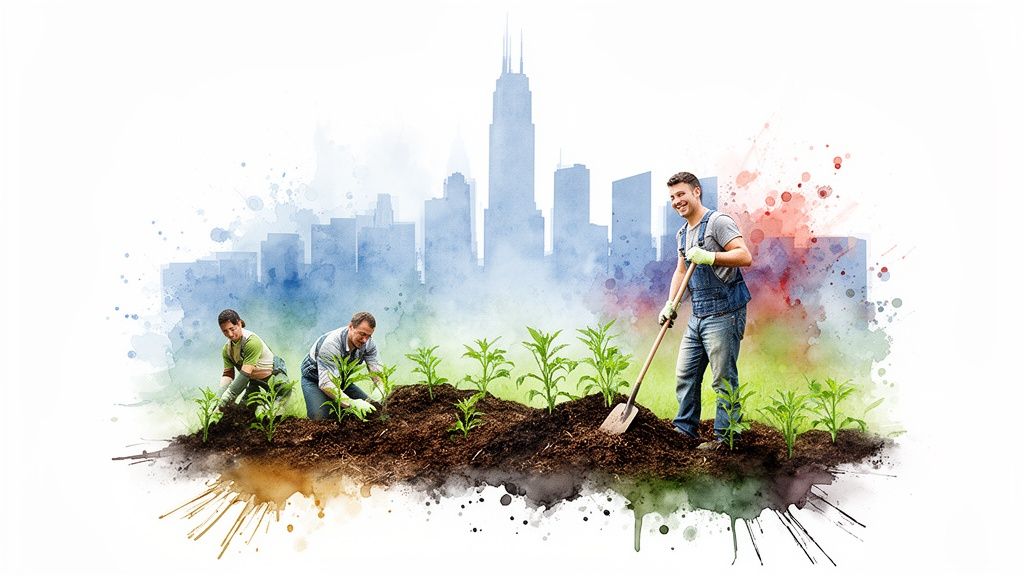
For me at Litter Caterpillars, picking up trash and turning food scraps into soil are two sides of the same coin. It might seem strange—one is about getting rid of decay, the other is about creating new life from it—but I believe they both come from the exact same place.
An act of service.
When you decide to show up for your city, whether that’s by bagging up litter or separating your coffee grounds, you’re making a powerful choice. You’re choosing to give. This is where I find we build character, bravery, and a real, tangible sense of community that you can feel in your bones.
Service Builds Stronger People
I’ve learned that the only way to grow is to face a challenge head-on. Picking up trash in a Chicago blizzard, with hail stinging your face, isn’t something you forget. It teaches you what you're made of.
Tending a compost pile has its own quiet tests. Is it too wet? Too dry? Does it have enough "browns" to balance the "greens"? Just like cleaning up a neglected street corner, composting asks you to pay attention, to be consistent, and to care for something outside of yourself.
These acts strengthen you. They teach you that you’re capable of more than you think. You learn to embrace the discomfort because you know it's the price of transformation—for you and for the world around you. This is the heart of my ethos at Litter Caterpillars.
From Empty Lot to Caterpillar Park
My big dream is to take an empty, forgotten lot in Englewood and turn it into Caterpillar Park. This isn't just some fantasy; it's a plan I am actively building. And how are we going to nourish the soil for this new green space? With the very compost we create.
This vision makes the whole process intensely personal. Every banana peel and eggshell you save is a direct contribution to that future park. It’s the literal fuel for our mission, turning what was once thrown away into the foundation for a place where kids can play and neighbors can connect.
Composting in Chicago is my way of proving that nothing is truly lost. It’s a promise that even from decay and neglect, we can cultivate beauty, nourishment, and a stronger community.
This is kindness and unity in action. It’s the belief that every small, positive effort you make ripples outward. When you separate your kitchen scraps, you're not just diverting waste. You are actively participating in a cycle of renewal that will physically reshape a piece of our city for the better.
You Are Part of a Movement
So, when you start composting in Chicago, you’re doing so much more than just making dirt. You are joining a movement of givers. You are aligning yourself with a community of people who show up, who aren't afraid of a little hard work, and who believe in the future of this city.
This isn’t about you being perfect. It's about you being willing to try, to learn, and to contribute in whatever way you can. Your compost bucket is a symbol. It’s a declaration that you believe in building a better Chicago from the ground up, one handful of rich, dark earth at a time.
Your Chicago Composting Questions Answered
I get a ton of questions about the real-deal, nitty-gritty of composting in Chicago. The "what ifs" and "is this actually possible for me?" moments are totally normal. So let's just get right into the ones I hear the most. For every single worry you have, I promise there’s a simple, real-world answer.
First up, the big one: "What if my compost starts to smell?" I hear you. Nobody wants a stinky mess, especially not in a city apartment or a crowded three-flat. That smell is almost always a sign that your compost lasagna is out of whack. It means you’ve got too many "greens" (your wet food scraps) and not nearly enough "browns" (dry carbon stuff like cardboard or dead leaves).
Think of it this way: your greens are the party, but your browns are the chaperones. You need about two to three times more chaperones to keep things from getting smelly and out of control. Just tear up some newspaper or a cardboard box, toss it in, give it a good mix, and that smell will disappear.
City Life and Composting Challenges
Another question I get all the time is, "I live in a high-rise, is composting really for me?" Absolutely. Vermicomposting—that's a worm bin—is your secret weapon here. When you keep it under a sink or in a closet, a well-managed worm bin is totally odorless and out of the way. My best tip for you? Don't overfeed your worms. Just give them small amounts of food every few days and always, always cover the new scraps with plenty of bedding.
Then there’s the whole "city drop-off vs. private service" debate. City drop-offs are free, which is a massive plus, but you're the one schlepping your scraps across town. Private services are super convenient with their curbside pickup, but they come with a fee. It really just boils down to your budget and what you've got time for. There's no wrong answer here, only the answer that works for you. You can even learn more about handling other types of waste in our guide to hazardous waste disposal in Chicago.
Learning From Our City's Past
Finally, people ask me how Chicago's recycling history plays into all this. It's a fair question, and the truth is, our city has struggled. Hard. With a waste diversion rate of just 9%, we're lagging way behind other big cities. Part of that is the ghost of failed programs like the old "Blue Bag" system, which just didn't work.
But that history is exactly why composting is so important right now. It gives us a direct, hands-on way to pull our own waste out of the system. We're learning from the past to build a better future, as you can see in reports about our city's waste programs. You can read the full story on Chicago's recycling challenges.
Composting gives you control. While the city-wide systems slowly get better, your compost bucket is a direct line from your kitchen to a healthier planet. It's an immediate, tangible impact that you can see and feel every single day.
Jumping into composting is one of the most powerful things you can do for a cleaner, tougher city. At Litter Caterpillars, we turn that spirit into action every single week. If you're ready to make new friends, build your own resilience, and help us transform Chicago, I'd love for you to join our crew. Find your next event and become part of the story at https://www.littercaterpillars.com.
Leave a Reply