
On a cold Chicago Saturday, a new volunteer showed up with gloves too big for her hands and no clue what a vacant lot had to do with her life. By 9 a.m., she was picking bottle caps out of wet grass and asking who decides what happens to this ground after we leave.
A Saturday Morning With a Crew That Cares About the Ground
The first thing I notice on a cleanup morning is how fast strangers become a crew. Someone sorts grabbers. Someone else ties open trash bags to a fence post so they don't fold in the wind. I usually see the same look on new volunteers' faces, a mix of curiosity and mild disbelief, because most of us grow up thinking land is something other people manage.
Then you bend down and start pulling junk from the soil. You see a cracked bottle half-buried by roots, a candy wrapper snagged in a thorny stem, a patch of compacted dirt where water keeps pooling. That's when the idea of resource management land stops sounding like a planning term and starts sounding like the ground under your shoes.
You don't need to own a farm to care about land. You just need to walk it long enough to notice what's happening to it.
A city block can teach the same lesson as a field or a reserve. If people dump on it, the space changes. If neighbors weed it, plant it, or keep an eye on it, the space changes again. The rest of this piece follows that simple question: who is responsible for land, and what does good stewardship look like when you're standing on it with a trash bag?
What Resource Management Land Actually Means
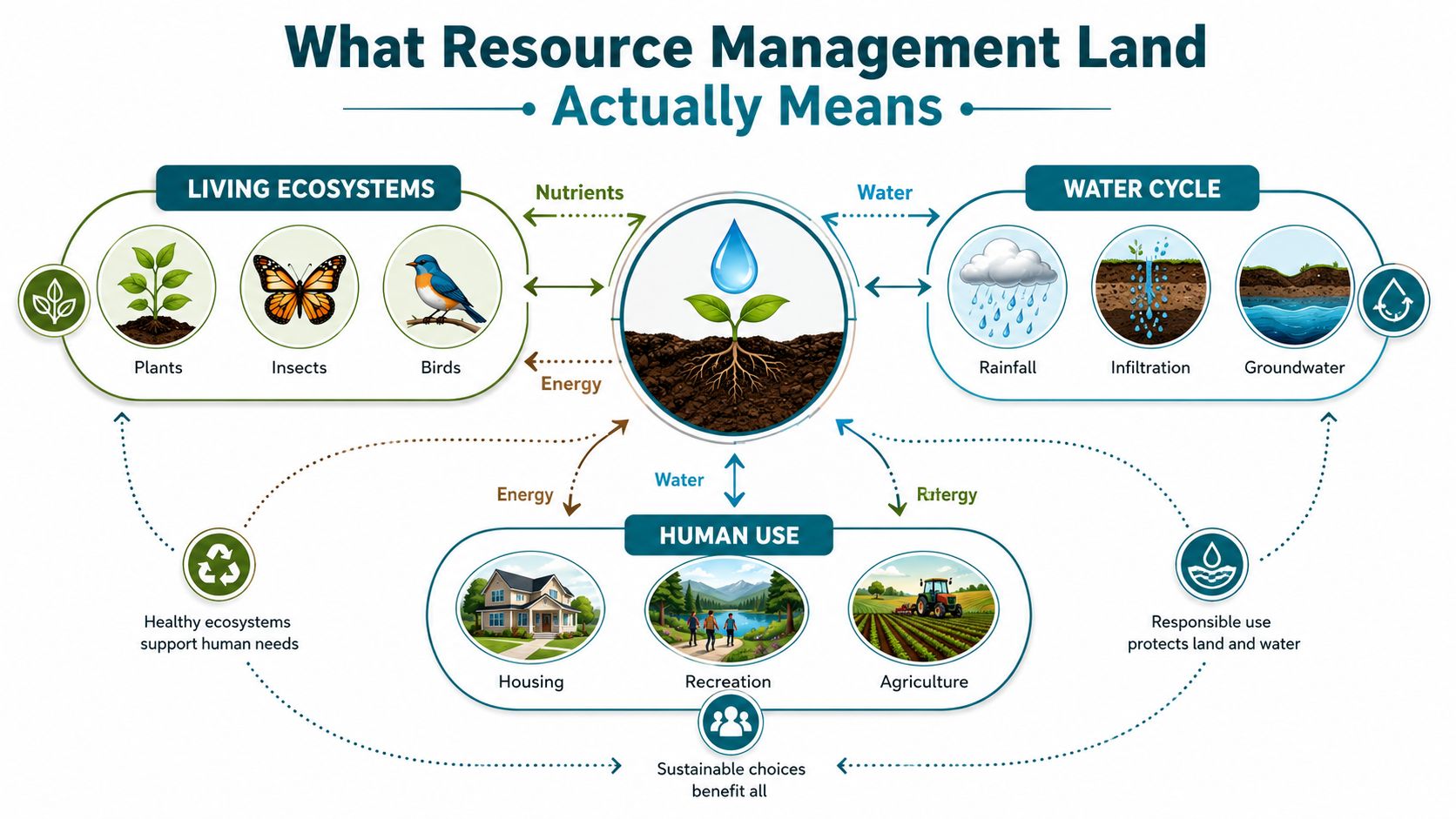
Land is not just dirt. A kitchen pantry is a helpful analogy. The shelf, the jars, the labels, the food inside, and the person who keeps it organized all matter at once. In the same way, land holds soil, water, plants, animals, settlement patterns, roads, buildings, and human activity together in one place, which is why the FAO defines land as a “delineable area” with all of those parts in view. The same FAO source says land resources planning means deciding before action, and land resources management means putting that plan into practice with stakeholder participation. You can read that framework in the FAO's land definition and planning note, which lays out the terms plainly.
Natural resource management takes that same idea and applies it to daily decisions. It means I don't treat water, soil, habitat, and use patterns as separate boxes. I look at them together, because a change in one place often shows up somewhere else later. That's why resource management land is really a system, not a plot.
A vacant lot helps make this concrete. If the lot has compacted soil, runoff, weeds, and no shade, I'm not looking at a simple cleanup problem. I'm looking at a small system with many moving parts. If a crew adds native plants, checks drainage, and keeps footpaths clear, the same lot starts behaving differently.
The language can feel abstract until you tie it to something ordinary. Your own alley, park strip, or community garden bed already works this way. The question is never just “what's on the land?” The core question is “how do the parts affect each other, and who keeps watch?”
If you want a plain-language companion to that idea, I like the way this short guide on environmental stewardship frames care for place as something you practice, not something you merely support from a distance.
The Three Pillars That Hold Any Stewardship Plan Together
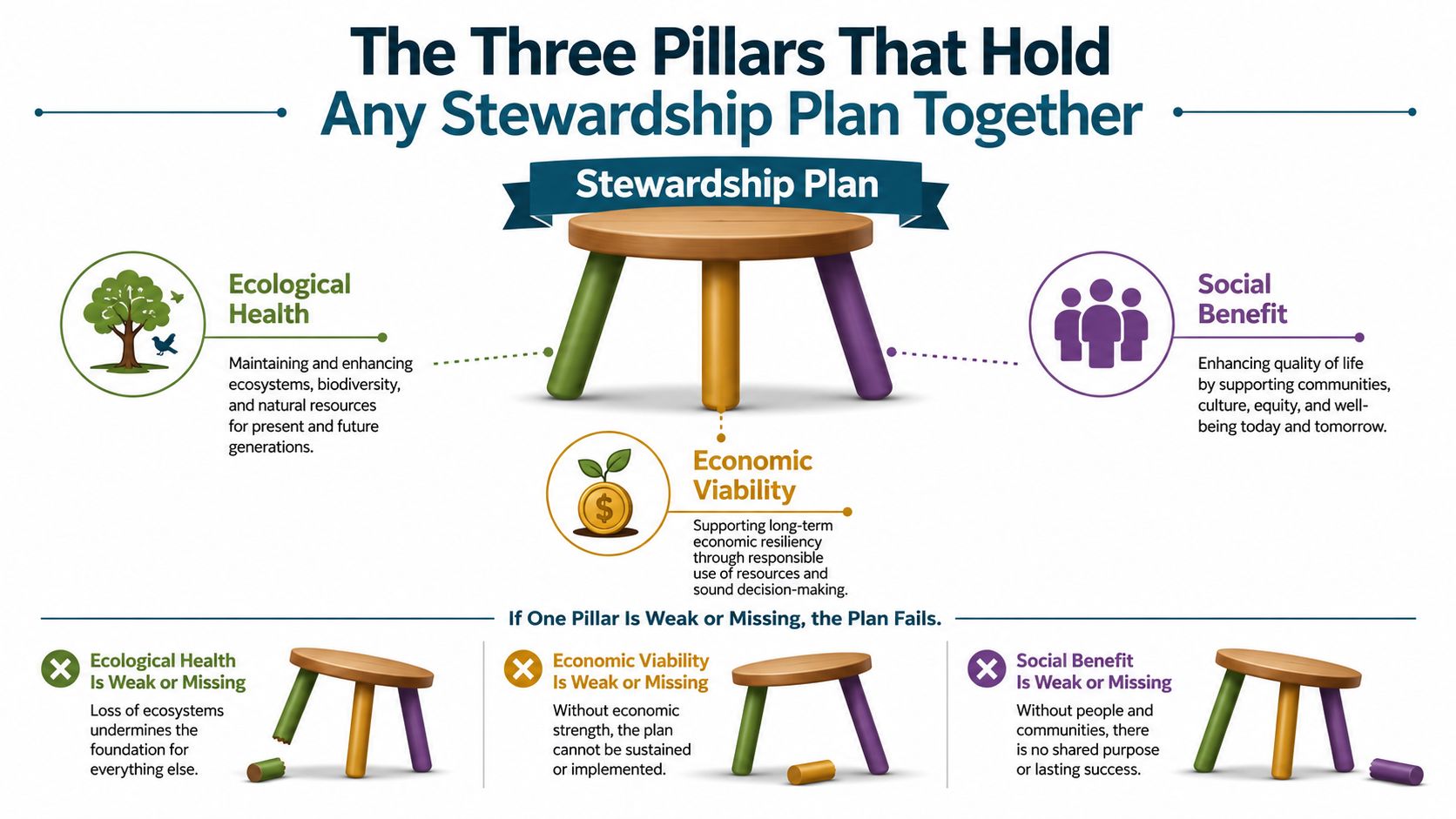
I use a three-legged stool when I explain stewardship. If one leg is too short, the whole thing wobbles. A good land plan works the same way. It needs ecological health, economic viability, and social benefit to hold steady.
Ecological health
This is the part people see first when they kneel down and touch the soil. Healthy soil filters rain better, roots hold ground in place, and plants create cover that keeps bare earth from washing away. In the ABS national land account, 56.2 million hectares of natural terrestrial vegetated herbaceous land became natural surfaces like bare earth between 2015 and 2020, which shows how fast land cover can change at large scale. The same release says land managed for resource protection in Australia increased by 14.1 million hectares between 2015–16 and 2020–21, and that land changes don't happen in a vacuum. They happen through decisions.
Economic viability
This pillar is easy to miss on a cleanup crew, but it matters. If a site stays flooded, overgrown, or unsafe, the people who live near it pay for that in time, upkeep, and lost use. Australia's national land account also reports that the total land value rose by 48.4% to $7,733.0 billion over the same period. That figure doesn't tell you how to manage a block, but it does tell you land is tied to money, tax bases, and long-term planning. ABS land account release
Social benefit
This is the part crews feel right away. A site that people can reach, use, and help maintain gets more eyes on it and more hands in it. If the event starts at a fair hour on a weekend morning, more people can show up. If the space feels safe and welcoming, neighbors stay longer and come back. That's not theory, that's basic human behavior.
Practical rule: if a plan helps trees but makes the site harder for people to use, or helps people but strips the soil bare, I know I've tilted the stool.
A Toolkit of Common Techniques You Will See in the Field
When I walk a site with volunteers, I like to sort the work into tools. That keeps people from treating every problem like a shovel problem. Some jobs need planning, some need biology, some need rules, and some need maps.
Six Core Techniques at a Glance
| Technique | What it solves | Example |
|---|---|---|
| Conservation easements | Keeps land from being developed in ways that clash with the long-term plan | A parcel stays open for habitat or low-intensity use |
| Soil and water management | Handles runoff, erosion, drainage, and plant health | A crew adds swales, mulch, or better grading |
| Zoning | Sets what kinds of use are allowed | A community garden stays legal under local rules |
| Ecological restoration | Helps a damaged site recover native function | Volunteers remove invasive plants and replant natives |
| Sustainable agriculture | Supports food production without stripping the ground | A small growing site rotates beds and protects soil |
| GIS mapping | Tracks where work happens and what changes over time | A team maps litter hot spots, plantings, or trail edges |
How the tools work together
A community garden might use zoning to stay allowed, soil testing to understand what the ground can handle, and GIS to map where the beds, paths, and problem spots sit. A prairie restoration might lean on ecological restoration first, then soil and water management when rain starts cutting ruts. A site near homes might need a conservation easement if the goal is to keep it open later instead of selling it off for another use.
I tell volunteers not to memorize the jargon before they can name the problem. Start with the trouble in front of you. Is the site eroding? Then soil and water matter. Is the use wrong for the neighborhood? Then zoning matters. Is the ground empty but full of potential? Then restoration or sustainable agriculture may fit.
One more thing. GIS sounds technical, but I think of it as a smart clipboard. It helps you see patterns you can't hold in your head after the third or fourth cleanup day. That makes it easier to explain why one corner keeps failing while another one starts to recover.
How Policy and Planning Decisions Actually Get Made
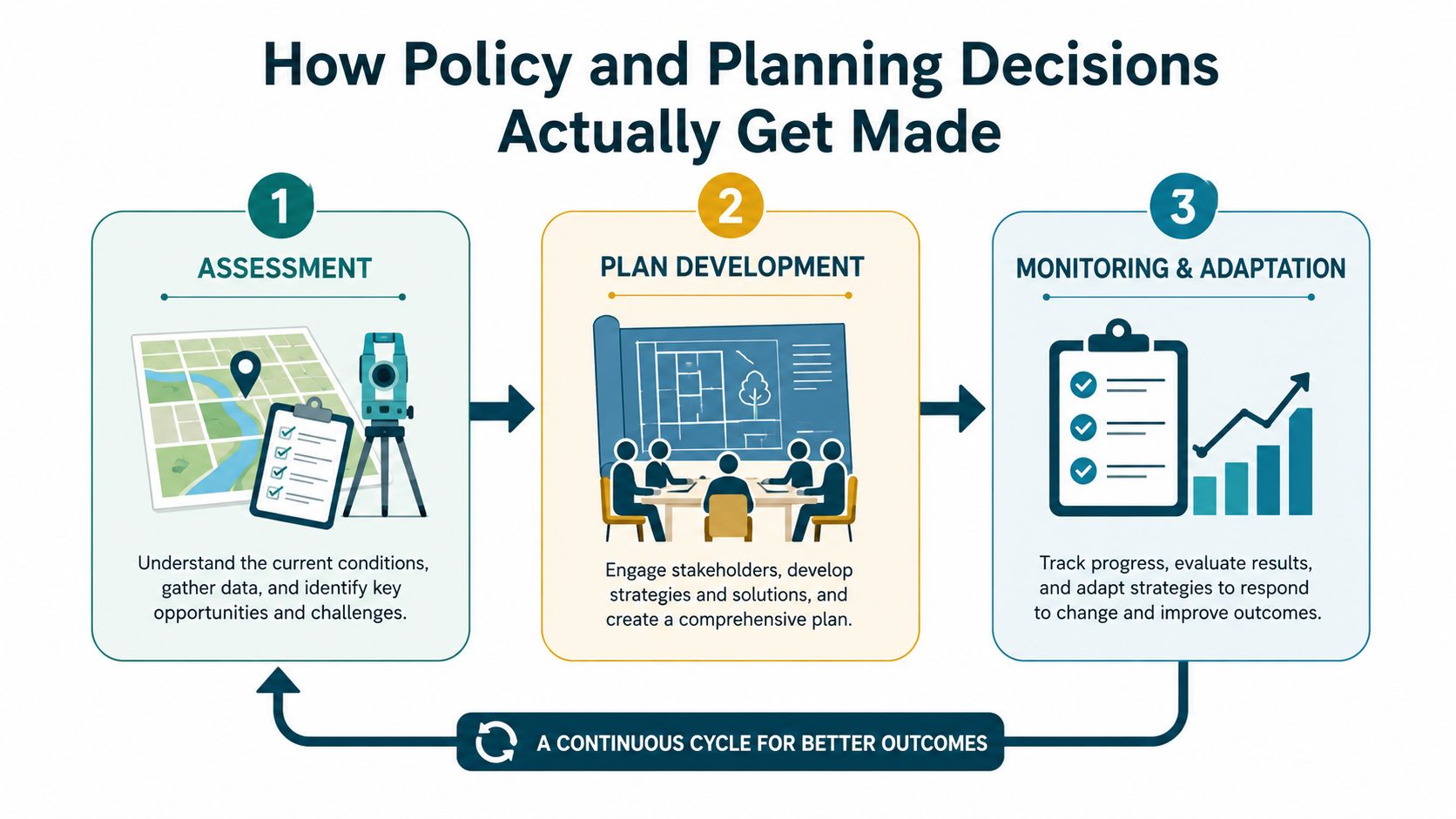
Land decisions happen in a back room. In practice, they move through a cycle. The USDA Forest Service says a land management plan has three named phases, assessment, plan development, and monitoring the plan's effectiveness. That makes planning feel less like a one-time speech and more like a loop. USDA Forest Service land management plans
What the cycle looks like on the ground
First, someone gathers facts. What's on the site? What's broken? What's used often, and by whom? Then planners write a plan that tries to answer those questions with real actions. After that, managers check whether the plan worked and change course if it didn't.
The Bureau of Land Management says its Resource Management Plans are the “blueprints” for how land will be managed, and the agency says these plans often run for about 20 years. That matters because a plan has to last long enough to guide real work, even when volunteers rotate out and staff changes. BLM planning overview
There's also a formal tribal-consultation step during preparation and amendment of resource management plans. The BLM planning fact sheet says the agency must consult with Indian tribes on a government-to-government basis. That is not a courtesy detail. It is part of the process. BLM planning fact sheet
I also need to talk about capacity. A plan can look clean on paper and still fail if nobody has the staff, tools, or budget to keep it moving. The hard part is not only writing a plan, it is keeping the system alive after the meeting ends.
If you want a plain example of how public access and land use can sit in the same conversation, this piece on a green city project gives a useful civic lens without turning land care into a classroom abstraction.
A public plan matters most when someone can still follow it after the first round of meetings ends.
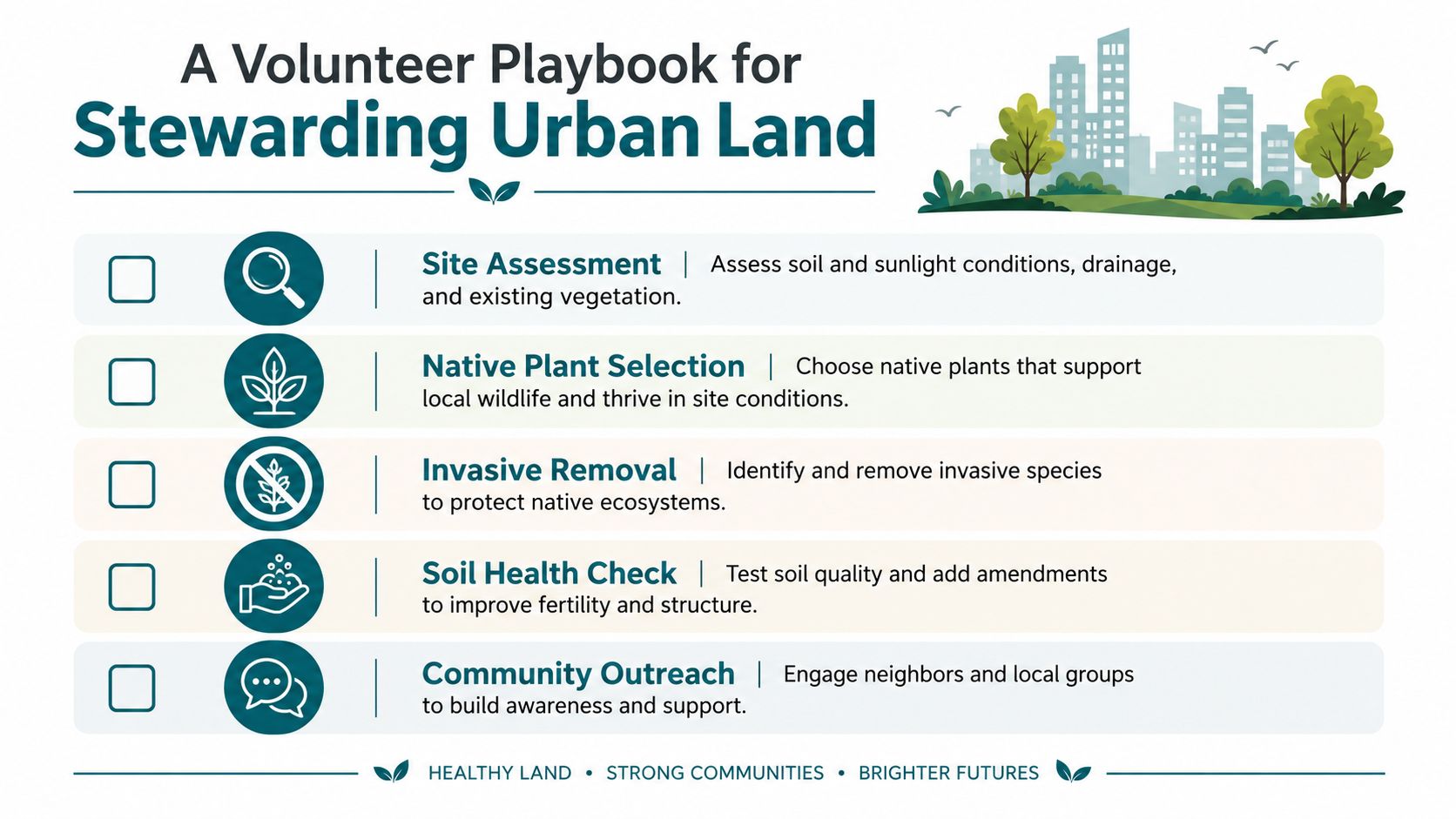
A Volunteer Playbook for Stewarding Urban Land
I like clean, repeatable volunteer events because they keep the work honest. If a neighbor shows up once, they should know what to do within five minutes. If they come back next week, the site should look a little better and feel a little safer.
Start with a site walk
Before I ask anyone to pick up trash, I want eyes on the ground. Look for broken glass, hidden holes, thorny growth, poison ivy, slick mud, and heavy debris that needs two people instead of one. I also check sun, shade, and where water sits after rain.
Pack a small kit
You don't need a giant setup. Gloves, grabbers, bags, hand sanitizer, water, a first aid kit, and a few trash tongs cover most normal work. If the site has sharp debris or tall weeds, bring eye protection and long sleeves too.
Keep the schedule humane
Weekend mornings work because they fit people who want to give time without wrecking the rest of their day. I've found that early starts also make it easier to build a routine. People show up, do the work, and still have the afternoon left for the rest of their lives.
Use partnerships with clear asks
I avoid vague partnership language. Ask a nearby business for water, a church for a meet-up spot, or a neighbor for a tool shed hookup. Don't ask people to donate just because they're present. Give them a simple role and a simple thank-you.
Measure what people can see
I like visible signs of progress. A cleared curb, a bag pile that's gone, a path that people can use again, or a corner that no longer looks ignored. That's enough for most neighbors to understand the work without a spreadsheet.
- Safety check: scan for broken glass, needles, and unstable ground before anyone fans out.
- Buddy system: pair new volunteers with someone who already knows the block.
- Clear exit point: decide where bags go and who calls the cleanup done.
- Visible finish: leave one spot cleaner than you found it, not just “less bad.”
If you want a simple way to help more people start, this guide on how to start a volunteer group gives a useful next step for community organizers.
Case Studies From Neighborhoods That Got It Right
One crew started with a grim block and a handful of volunteers who kept showing up. At first, they only picked up litter and trimmed edges. Then the same people came back every week, and the cleanup stopped feeling like a one-off event. The block changed because the habit changed.
Another group found an empty lot at auction and treated it like a long project instead of a lucky win. They cleared debris, checked the ground, added plants, and kept returning until the space started working for the neighborhood. That's how a blank parcel turns into a place people can use without wondering who owns the idea anymore.
A third crew took a neglected corner and worked it from three directions. They mapped the site, planted natives, and pushed for simple zoning choices that made the space easier to keep. None of those steps felt flashy on its own. Together, they made the block more usable.
What I like about these stories is that none of them starts with a giant budget or a perfect plan. They start with people who noticed a place and decided to keep caring after the first day was over. If your block has a story still waiting to be written, it probably starts the same way.
If you want help turning a messy block into a place people can care for, connect with Litter Caterpillars and join a crew that shows up, learns the ground, and keeps going together.
Leave a Reply