Tag: volunteer retention

  • Volunteer Community Connections That Actually Last

    Volunteer Community Connections That Actually Last

    At 9 a.m. on a Saturday, three strangers huddled under a picnic shelter while hail rattled off the roof. Their trash bags were half full, their Uber kept canceling, and by lunchtime they had exchanged numbers, shared a poncho, and made plans to meet again.

    The Hail Storm That Started a Friend Group

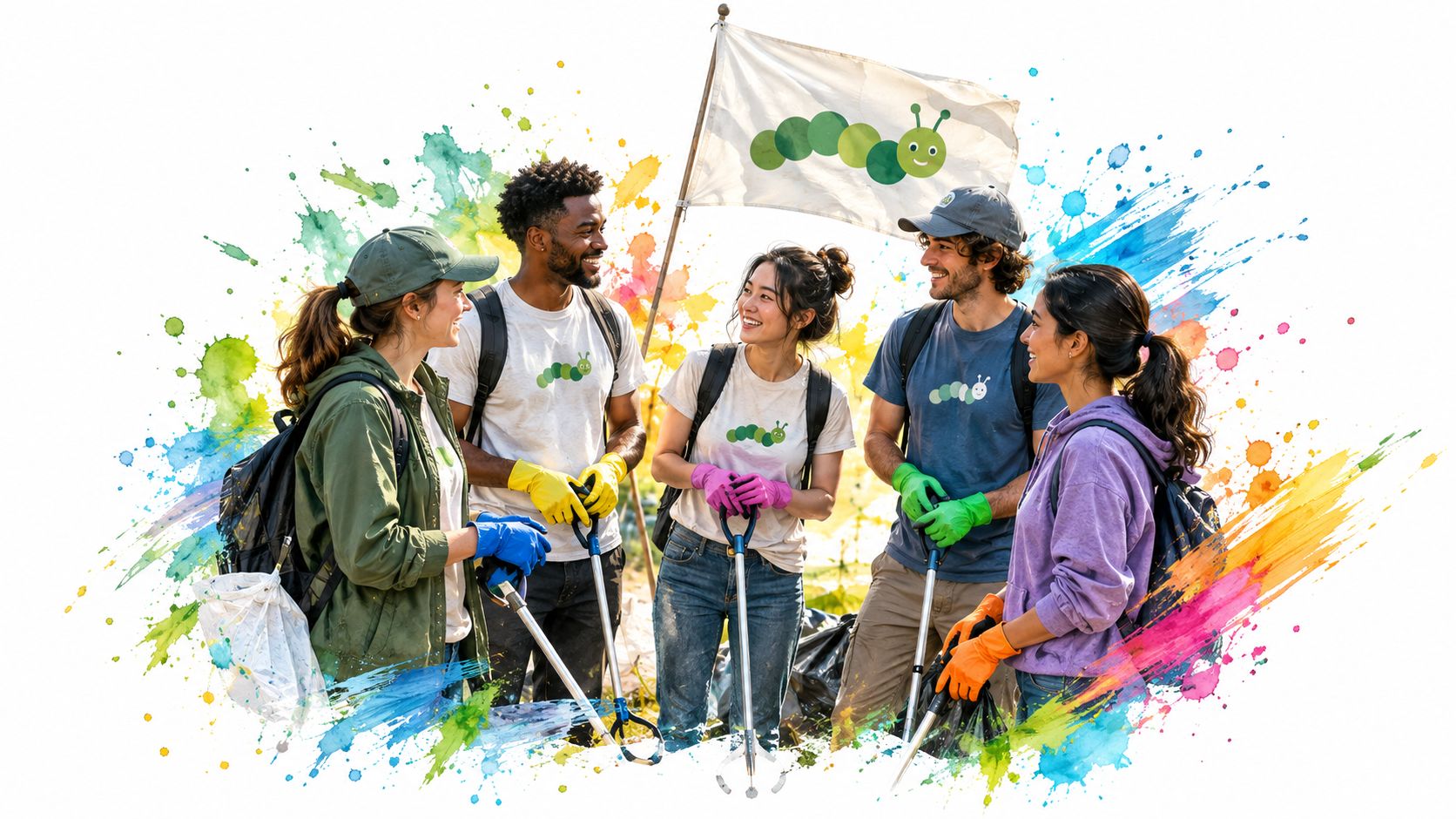
    The first cleanup had all the polish of a bad adventure. Three people arrived at a park, found a flag with a caterpillar on it, and started collecting bottle caps, food wrappers, and damp cardboard. Nobody knew each other. The morning felt ordinary until the sky turned white.

    Hail hit the path hard enough to make everyone run for the picnic shelter. Three newcomers squeezed onto one bench. One person held the grabbers, another tried to keep the bags from blowing away, and a third stared at a phone while an Uber driver canceled again.

    The problem gave them something to solve together. They compared ride options, messaged people in the group chat, and called someone who might drive over. Someone passed around a poncho. Someone else started humming the Litter Caterpillars theme song, which made no practical sense and somehow made the storm easier to take.

    Twenty minutes earlier, these people had been strangers. Under the shelter, they became a small crew with a shared problem, a shared joke, and a reason to keep talking after the weather cleared. They swapped phone numbers so nobody would get stranded. Later, they drank coffee and retold the story with exaggerated sound effects.

    That pattern explains why volunteer community connections often last longer when the event gives people room to meet before they work. The trash creates an excuse. The flag gives people a place to find one another. A Saturday morning gives the group a repeatable rhythm. The friendships grow in the gaps between tasks, during the walk to the next block, and while somebody searches for a missing glove.

    The scale of volunteering supports this local, relationship-based view. The United Nations Volunteers analysis summarized by NCVO reports that more than 1 billion people volunteer worldwide, with work equal to about 109 million full-time workers. Roughly 70% of volunteer activity happens informally, between people in their communities rather than through organizations. Women perform 57% of all volunteer work and 59% of informal volunteering, which connects volunteering closely to everyday neighborhood and care networks.

    The flip: Design the event so connection leads and cleanup follows. People may arrive for the litter, but they return for the people.

    Finding Your Volunteer Group Without Wasting Saturdays

    You don't need to spend every weekend testing random events. Use a short search path that tells you whether a group values repeat attendance, easy entry, and conversation.

    Start with the schedule

    Open Meetup and Eventbrite and search for “park cleanup,” “neighborhood beautification,” and “volunteer community connections.” Filter for weekend morning slots within a 20-minute drive of your home. A nearby event lowers the small friction that turns good intentions into a missed Saturday.

    Read the listing twice. Look for a recurring schedule, a clear meeting point, a named organizer, and a signup form that doesn't make you feel as if you need to justify your interest. The Litter Caterpillars Saturday volunteer page is an example of the kind of recurring weekend information that helps a newcomer decide quickly.

    Check the group before you arrive

    Search Instagram and TikTok for local handles posting trash-bag selfies, flags, park photos, and short clips from actual meetups. Comment on a recent post before you attend. Write something simple, such as, “I'm planning to join Saturday. Is the blue flag near the north entrance?”

    That comment does two jobs. It tells the organizer you're real, and it gives you a familiar name to look for when you arrive. You don't need a polished introduction. A small online exchange can make the first in-person greeting less awkward.

    Read the signals

    Marker Strong Signal Red Flag
    Schedule Recurring weekend mornings with a clear start time Vague dates or frequent last-minute changes
    Signup A short, low-pressure form Donation asks before you can attend
    Communication Open group chat for weather and ride updates No contact method after registration
    Welcome Instructions for newcomers and families Assumption that everyone already knows the route
    Equipment Clear notes about gloves, grabbers, and bags Volunteers expected to guess what to bring

    Look for an open group chat and join it the morning of the event. Groups with a Litter Caterpillars-style setup use chat to post cancellations, weather calls, ride-share options, and coffee plans. That last detail matters. A cleanup can end when the bags reach the pickup point, or it can continue at a nearby table.

    Copy and send this DM:

    Hi, I'd like to join your next cleanup. What's your rain policy, and do you provide gloves, grabbers, and bags? Are families welcome, and where should I meet the group?

    A good answer should make the first visit feel manageable. If the response sounds annoyed by basic questions, keep searching. Your Saturday should buy you a useful morning and a chance to meet people, not a guessing game.

    First Meetup Moves That Turn Strangers Into Friends

    A newcomer can stand in a group of twenty people and still feel invisible. I prevent that with visible signals and short, repeatable introductions.

    Before people arrive, I choose something that helps us spot new faces. Colored gloves work well. So do bright grabbers, name stickers, or a small marker beside the signup sheet. When a newcomer walks up, a returning volunteer should greet them by name within two minutes.

    Pair people before assigning tasks

    Don't send a first-timer down a path alone with a trash bag. Pair them with a returning volunteer for the first 15 minutes. The returning person can explain the route, show where sharp objects go, and keep the conversation moving while both people work.

    Use the two-question handoff:

    1. Ask where the person lives.
    2. Ask what brought them out today.
    3. Introduce them to one other person by name.

    The questions stay easy, but they open doors. Someone might live three blocks away, study at a nearby college, care for a parent, or know a coffee shop nobody else has tried. You don't need a forced icebreaker. You need a path from one name to another.

    Try this organizer script:

    “Hey, this is Maya. She's new and loves trail running. Can you show her the creekside loop?”

    The returning volunteer now has a clear job, and Maya has a person to follow. The introduction also gives the second volunteer a useful detail to remember.

    Make contact exchange feel normal

    Many people want to continue the conversation but hesitate to ask. Give them a natural line:

    “Can I grab your number? Our crew sometimes gets tacos after. Want in?”

    A phone number isn't a friendship contract. It keeps the door open for the next cleanup, a ride-share, or a quick coffee. If someone prefers the group chat, let that work too.

    At the end, take a same-day group photo and post it in the chat with names attached. “Saturday crew, Maya, Luis, Priya, and Devon” gives faces a second chance to stick. Then start a standing Tuesday lunch thread. It can survive a rainy weekend and keep the group from disappearing between events.

    Volunteer participation already creates repeated contact for many people. In NCVO's Time Well Spent findings, 89% of volunteers said they had met new people through volunteering, 78% had come into contact with people from different backgrounds, and 68% said volunteering helped them feel less isolated. The same survey reports that 77% said volunteering improved their mental health and wellbeing. Your job as an organizer is to turn those possible encounters into actual introductions.

    Safety and Logistics as the Retention Engine
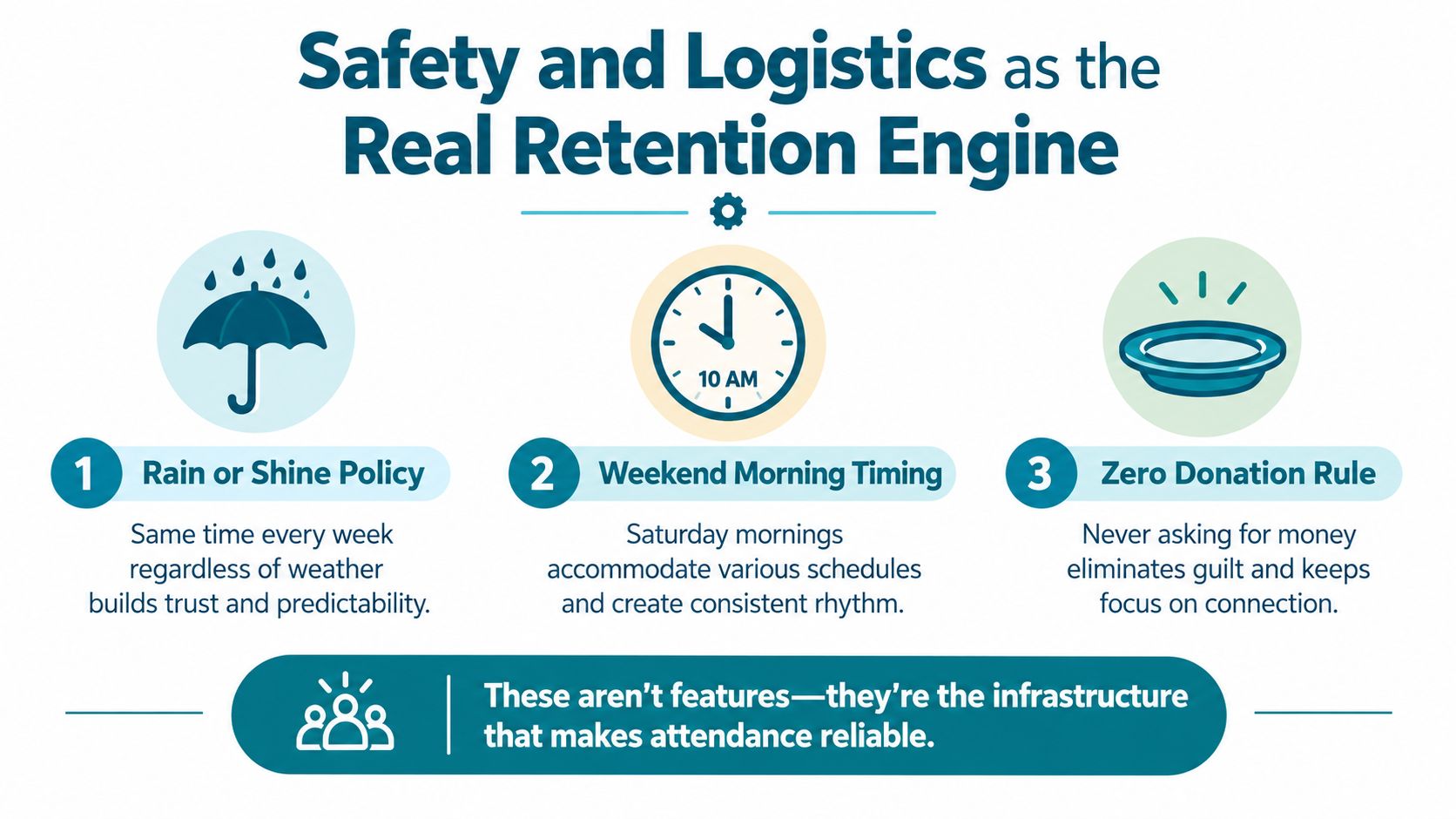
    An infographic titled Safety and Logistics as the Real Retention Engine detailing three key volunteer strategies.

    A soaked volunteer once arrived at our cleanup with no gloves, no clear meeting point, and no idea when the morning would end. She left after twenty minutes. People remember whether an organizer respected their time, explained the plan, and helped them get home. Those details turn a first cleanup into a second RSVP.

    Litter Caterpillars keeps its weekend-morning rhythm, flags, and theme songs, while leaving room for judgment when weather turns unsafe. A rain-or-shine promise should never mean standing outside through dangerous conditions. Weekend mornings also leave the rest of the day open for family duties, classes, shifts, or evening plans. A zero-donation rule removes the awkward question of whether a college student or gig worker is expected to pay to attend.

    The neighborhood cleanup guidance from STOHub recommends planning around weekend schedules and setting a backup date for weather changes. People can plan when the rhythm stays predictable. They also trust the organizer more when a clear weather decision arrives before they are left waiting.

    Build the morning before the morning

    Send a meetup pin 24 hours ahead. Include the nearest entrance, transit stop, and a landmark people can recognize from the street. State whether volunteers need gloves, water, closed shoes, or a reflective layer.

    Use the group chat for ride-shares, weather calls, and late arrivals. Assign every newcomer a buddy before the first bag fills. If someone arrives alone, a volunteer should walk over and bring them to the group, rather than pointing from across the park.

    The hailstorm crew showed why these choices matter. Uber drivers kept canceling, and nobody asked for money. Volunteers shared what they had, searched for rides home, and stayed together until each person had a safe option. The weather made the morning difficult, but the group did not leave one person to solve the problem alone.

    The Urban Institute volunteer management paper points to recognition, training, screening, professional development, and task matching as support for retention. Put that into practice by assigning a safe task that fits the volunteer, explaining it clearly, and recognizing the effort before departure.

    Retention test: If a newcomer can find you, understand the plan, get home safely, and know how to join again, your logistics are doing social work.

    Designing Events So Connection Comes Before the Task

    I've watched volunteers arrive early, work hard, and leave without learning a single name. The bags looked good at the end, but the group felt temporary. Pride changes that. When people feel they belong to a crew, they carry the memory of the morning with them.

    Start the social part before cleanup. Put the flags where people can see them from the path. Play a shared theme song from a Bluetooth speaker at the welcome circle. Take the group photo before anyone picks up a grabber. Recognize first-timers by name, then give them a small job that lets them participate immediately.

    Put the welcome before the work

    Use a two-minute pair-up. Ask each person to share why they came, then have partners introduce each other to the circle. Keep the prompt practical: “What brought you here today?” and “What part of the neighborhood do you know best?”

    A theme song can feel silly until you see what it does. People hum while they work. They laugh when someone misses a lyric. The cleanup stops feeling like a silent chore and starts feeling like a shared activity with its own identity.

    Give first-timers a named recognition moment:

    “Before we split up, let's welcome Maya, Luis, and Priya. They're joining us for the first time, and they're taking the creekside loop.”

    That sentence doesn't flatter people with vague praise. It gives them a place in the story of the day.

    Let coffee carry the friendship

    Choose a nearby coffee shop before the event and mention it during the welcome. The destination gives people a simple reason to stay after the work ends. Over coffee, conversations move away from litter and toward jobs, hobbies, neighborhoods, food, and plans.

    A rotating host keeps the same three people from carrying every introduction and every mood lift. One week, the photo lead welcomes arrivals. The next week, the supply runner brings the coffee list. Another volunteer picks the song and takes the group photo.

    The friendship-building activities from Litter Caterpillars can help organizers turn a cleanup into a social event with simple shared rituals. The point isn't to pack the morning with games. It's to create enough structure that people don't have to manufacture connection from nothing.

    The evidence supports this design choice. A 2025 study on volunteering and social connection describes low-formality social activities where relationships can form spontaneously and on more equal footing. A cleanup already has shared work. Add a welcome circle, a partner task, and a post-event table, and you give those relationships places to begin.

    Your 30 60 90 Day Plan for a Volunteer Circle That Lasts

    Friendship usually needs a rhythm before it needs a grand gesture. I use a 30, 60, 90-day plan because it turns a hopeful first visit into a series of small actions.

    Days 1 through 30

    Attend the first three events you can manage, and aim to show up at least twice. Learn two names beyond your own. Exchange contact information with one or two people through the group chat, then use it for something concrete, such as a ride-share, coffee plan, or reminder about the next route.

    Don't wait until you feel fully included. Return while the first names still feel fresh. Repetition makes the greeting easier for everyone.

    Days 31 through 60

    Deepen the connection by proposing a side hangout. Suggest coffee, tacos, a walk, or a shared lunch after cleanup. Join a small role, such as the photo team, supply runner, welcome host, or route checker.

    Attend one social event that isn't a cleanup. That change of setting helps you see people as more than task partners. You may discover that the person who sorts gloves also knows every independent bookstore nearby.

    The volunteer retention strategies from Litter Caterpillars give organizers a practical place to build this rhythm into their events.

    Days 61 through 90

    Anchor yourself by co-hosting an event. Bring a friend, welcome a newcomer, or mentor someone through their first meetup. Take ownership of one small responsibility, not the entire morning.
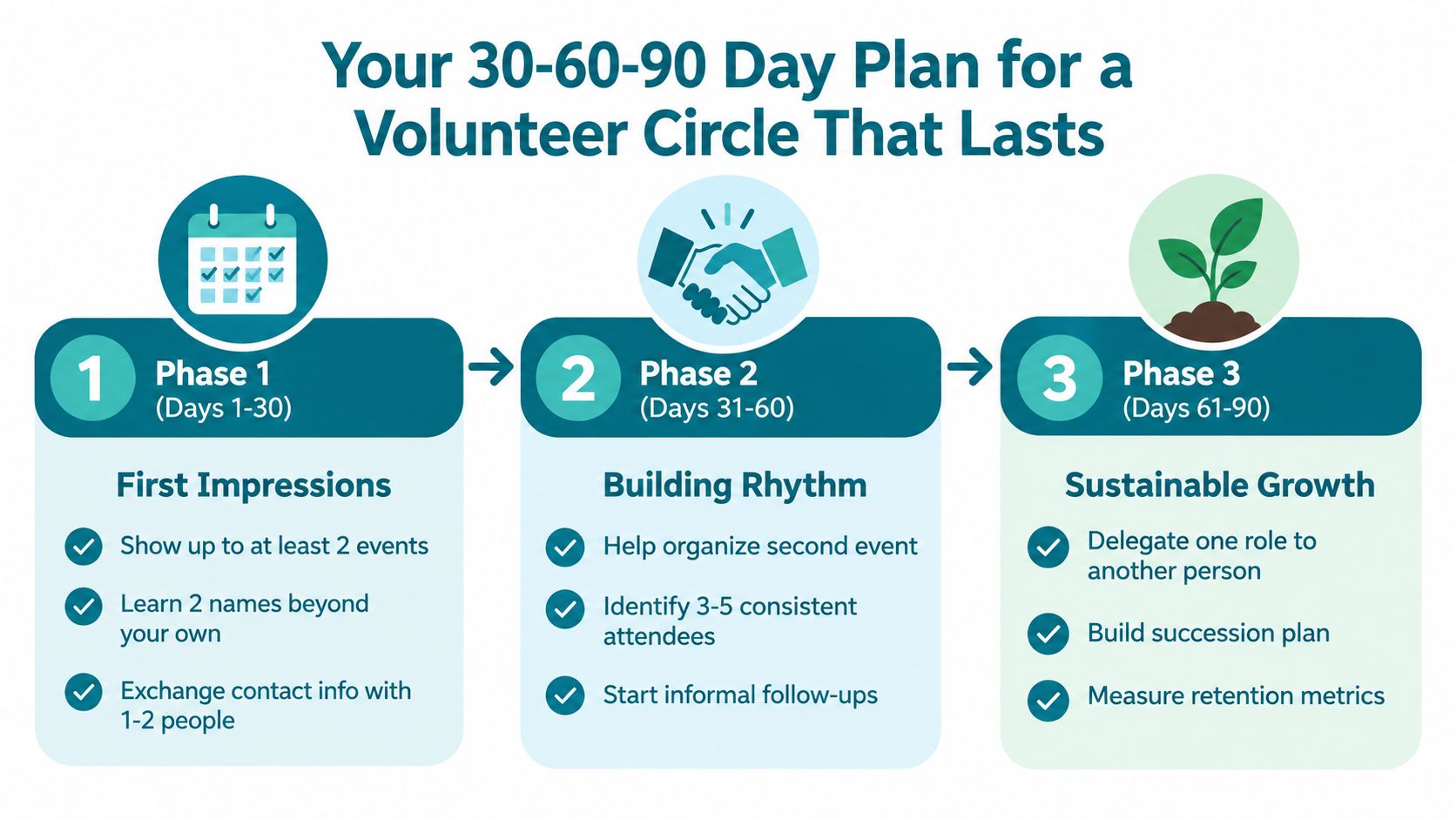
    A 30-60-90 day planning guide for building a long-lasting volunteer community through three phases of engagement.

    The plan works because it moves you from guest to participant to host. It also gives organizers a simple way to notice whether people return, take a role, and bring someone new. Those are useful retention signals, even when nobody tracks a formal scorecard.

    Here's the failure mode I trust most because I've watched it happen. One person organizes every route, buys every supply, answers every message, takes every photo, and keeps every newcomer comfortable. By month four, that person burns out, and the circle feels hollow because nobody else learned how to carry it.

    Hand off one task at every event. Ask someone else to choose the coffee spot, welcome the next newcomer, post the photo, or make the weather call. A volunteer circle lasts when people share the work of connection, not when one generous organizer performs it alone.


    If you're in Chicago and want a free weekend trash pickup where flags, group chats, shared work, and friendship all have a place, visit Litter Caterpillars. Choose an upcoming morning, join the conversation, and bring one person who could use a reason to meet the neighborhood.

  • How to Organize Volunteers for Cleanup Events

    How to Organize Volunteers for Cleanup Events

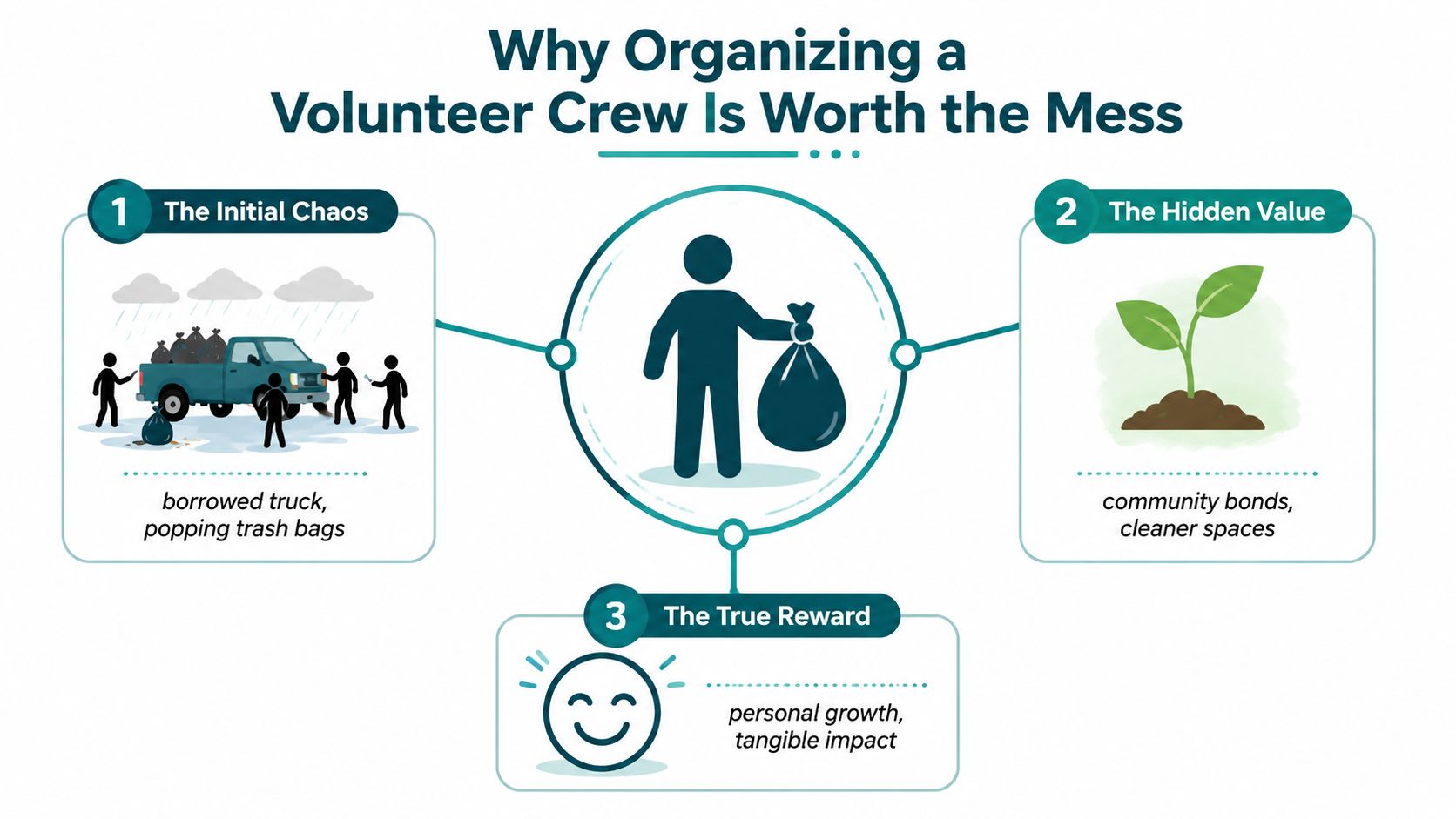
    The first Litter Caterpillars cleanup had three people, one borrowed truck, and trash bags that kept popping open in the rain. We huddled under a tree while Chicago threw hail at us, then went back to picking up cans.

    Three years later, we still meet every week, through heat, rain, blizzards, and the kind of wind that makes a trash grabber feel like a fishing rod. I've learned that how to organize volunteers has less to do with perfect plans and more to do with making the next Saturday easy to understand, safe to join, and worth remembering.

    Why Organizing a Volunteer Crew Is Worth the Mess

    That first pickup looked ridiculous. Water ran down the street, the truck bed filled with soggy bags, and every Uber seemed to cancel while we stood there shivering. Yet nobody wanted to leave empty-handed. We finished the block, loaded what we could, and took a photo that looked less like a nonprofit campaign and more like evidence from a minor weather disaster.

    That's the strange wealth a cleanup crew can build. You collect cleaner sidewalks, familiar faces, small jokes, and friendships that survive bad forecasts. You also get the quiet satisfaction of seeing a filthy stretch of Chicago become walkable again. The work stays physical and ordinary. That's exactly why people remember it.

    A recurring cleanup needs more structure than a casual “who wants to help?” message. A major 2023 volunteer-management survey found that 63% of nonprofits involving volunteers had a paid staff member or volunteer engagement professional managing volunteers, compared with 62% in 2003 and 65.2% in 2019. The median engagement professional spent 40% to 50% of their time on volunteer engagement in 2022, compared with about 30% in 2003. (The State of Volunteer Engagement)

    That doesn't mean you need a full-time coordinator for a Saturday cleanup. It means someone needs to own the details. A named person should know who signed up, where supplies are, what the weather looks like, and who can lead a new group.

    An infographic illustrating the challenges and rewards of organizing a volunteer trash cleanup crew.

    The mess teaches you what the spreadsheet misses

    You'll learn why vague meeting points create wandering volunteers. You'll learn why one experienced person can calm an entire first-timer group. You'll learn why a hot drink in November can matter more than a polished slogan.

    This field-tested playbook moves through the practical pieces:

    • Finding the first people: Where I post, what I say, and how I lower the ask.
    • Building one shift: Roles, time blocks, supplies, zones, and a clean ending.
    • Protecting the crew: Safety rules, waivers, emergency contacts, and incident notes.
    • Turning helpers into regulars: Onboarding, recognition, rituals, and shift leads.
    • Saving your evenings: Tools, templates, and a weekly rhythm that doesn't eat your life.

    If you want shirts, flags, or other identity pieces for a fundraiser, the 2026 nonprofit fundraising apparel guide from T-Shirt Envy can help you think through apparel without making it the center of the operation. Start with people, give them a clear job, and let the branding follow the friendships.

    Finding Your First Volunteers and Getting Them to Show Up

    Recruiting starts with a specific invitation. “Help clean Chicago” sounds noble, but it gives a stranger too many unanswered questions. Which neighborhood? What time? How long? Do I need equipment? Can I leave early?

    I use Meetup for the public event page, Instagram for photos and reach, and an open group chat for last-minute details. Litter Caterpillars also describes its approach to finding and coordinating participants through a Meetup page and group chat in its guide to finding volunteers.

    Give people a small first step

    My event copy usually names the exact place, the exact time, and the smallest reasonable commitment. You can adapt these examples:

    Meetup description

    Join us at McKinley Park near the fieldhouse on Saturday at 10 a.m. We'll clean the paths and nearby sidewalk for two hours. Bring water if you have it, and come for thirty minutes if that's all you can manage. We'll provide bags, grabbers, and gloves.

    Instagram caption

    Saturday cleanup at McKinley Park. Meet by the fieldhouse at 10 a.m. We're picking up litter, meeting neighbors, and heading home before lunch. Come for thirty minutes or stay for the full shift. First-timers are welcome.

    Neighborhood group-chat message

    Hey neighbors, I'm taking a small crew to clean the corner of 47th and Wolcott this Saturday at 9:30 a.m. We'll work for about two hours, but come for thirty minutes if you can. I'll bring bags and grabbers. Reply “in” and I'll send the meeting pin.

    Post early enough for people to see the invitation before their weekend fills up. Then send a direct reminder the day before. A reminder should repeat the meeting point, start time, expected duration, weather plan, and what you'll supply.

    The first event may feel like shouting into a canyon. Design the event so a small turnout can still finish a real patch of ground. One volunteer with a grabber can make a morning useful. Ten volunteers can make it lively.

    Screenshot from https://example.com/meetup-event-screenshot.png

    Invite by motivation, not by résumé

    People join for different reasons. One person wants a cleaner park. Another wants weekend friends. A student needs service hours. A newcomer wants to learn the city block by block. Your message should give each person a doorway.

    A 2025 volunteer-management survey identified role matching as a problem for 11.7% of organizations, alongside recruitment at 26.4% and retention at 9%. (Insight into Volunteering) I take that as a warning against one giant signup labeled “volunteer.” Write separate tasks instead: route scout, supply runner, photo helper, bag carrier, or zone captain.

    Designing One Cleanup Shift From Start to Finish

    A first-timer should know where to stand, what to carry, and when the work ends. If people need to decode the event while cars pass and bags blow down the sidewalk, you've already made the morning harder than it needs to be.

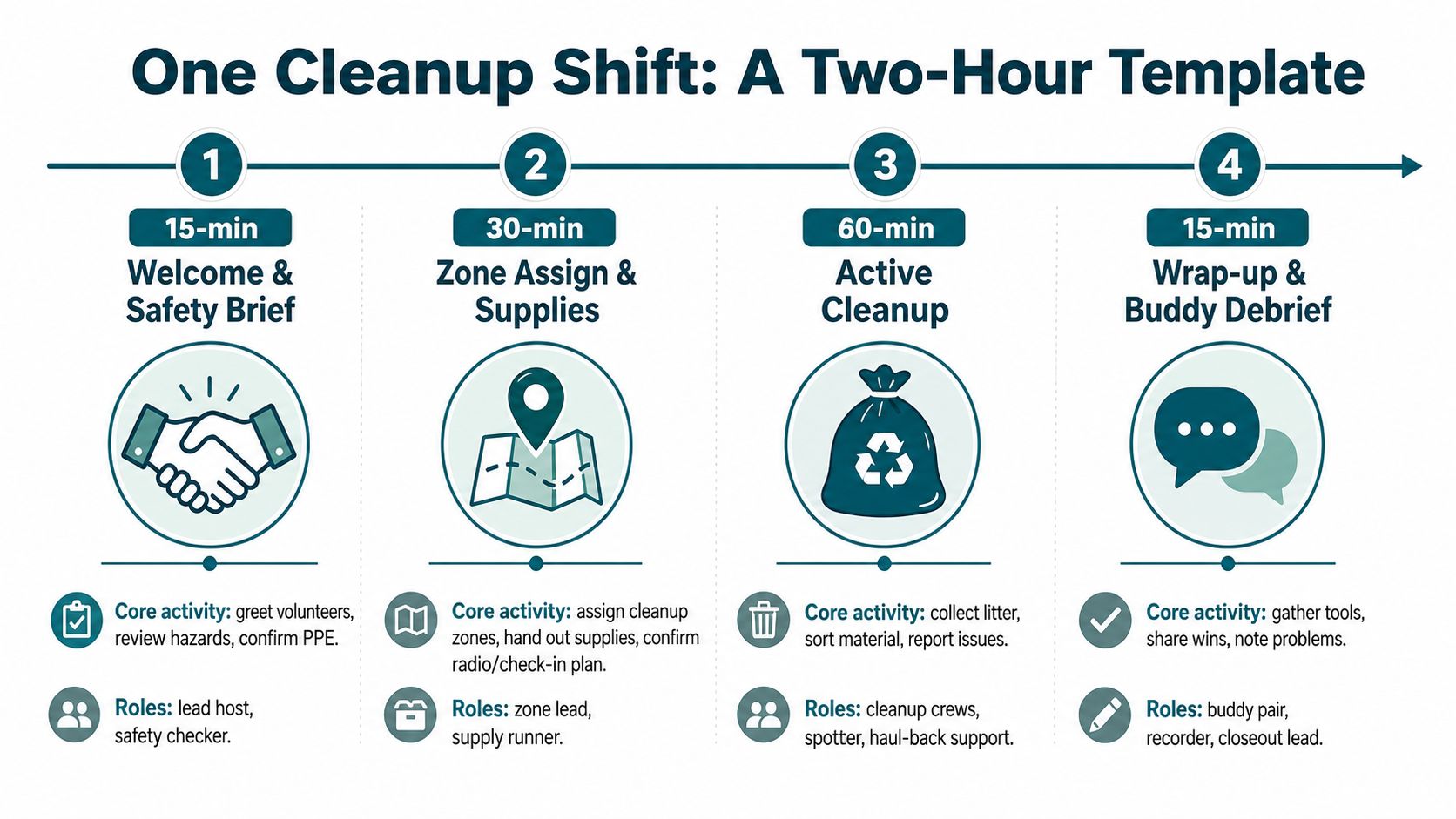
    I use a two-hour shape. It gives the shift a beginning, a middle, and a finish people can remember.

    An infographic titled One Cleanup Shift detailing a two-hour volunteer event schedule broken into four main phases.

    A simple two-hour template

    The exact breakdown can flex, but I plan the morning like this:

    1. 15 minutes for sign-in and safety: Welcome people, collect waivers, explain the route, point out the restrooms, and name the person handling questions.
    2. 75 minutes for pickup: Divide the area into assigned zones. Keep each group small enough for the captain to see everyone.
    3. 30 minutes for sorting and closing: Bring bags back, separate anything your local disposal plan requires, weigh bags if you track that, take a group photo, and finish with a cheer.

    A source on volunteer shifts recommends defining the task, location, and duration before anyone signs up. It also recommends immediate confirmation and reminders 48 to 72 hours before a shift, with day-of nudges for critical roles. (How to Schedule Volunteers) For a recurring crew, I split the schedule by area instead of dumping every assignment into one long list.

    Give every responsibility a name

    Keep the core crew roles to four:

    • Zone Captain: Explains the boundary, watches the group, and reports hazards.
    • Supply Chief: Carries bags, grabbers, gloves, sanitizer, water, and the sharps container.
    • Photo Lead: Takes the opening and closing photos, with permission from participants.
    • Waiver Wrangler: Checks forms, tracks attendance, and knows the emergency contact process.

    Here's my printable supply checklist:

    • Heavy-duty trash bags
    • Pickup grabbers
    • Work gloves in several sizes
    • Closed-toe footwear reminder
    • High-vis vests for roadside work
    • Sharps container
    • Hand sanitizer and wipes
    • Water and weather supplies
    • First-aid kit
    • Phone charger
    • Printed route map
    • Photo-release and emergency-contact records

    Draw the zone map like a child explaining a treasure hunt. Mark the meeting point with a star, the supply station with a square, and each boundary with a thick line. Write “return here” near the finish. Nobody should wonder whether the east side of the park belongs to them.

    The volunteer event planning guide can help you turn that outline into a repeatable event plan.

    Practical rule: Give people a clear job, a visible boundary, and a known ending. Confusion burns energy faster than trash pickup.

    Keeping the Crew Safe, Happy, and Protected From Liability

    Safety comes before fun, photos, and group identity. I'd rather have one untouched pile of litter than one volunteer walking away with an injury because I rushed the briefing.

    Start with rules people can understand without a legal dictionary. Closed-toe shoes stay on. Gloves stay on during pickup. High-vis vests go on near roads. Nobody reaches into a hidden pile. Nobody picks up needles, broken glass, or another sharp object by hand. The Zone Captain calls over the Supply Chief and uses the sharps container.

    A volunteer policy source says people should learn about foreseeable hazardous materials, equipment, and processes before they do the work. (Volunteer safety policy guidance) I explain the hazards before the first bag leaves the supply station.

    Build protection into the signup

    A short Google Form can collect:

    • Assumption of risk
    • Emergency contact
    • Photo release
    • Medical information the volunteer chooses to share
    • Agreement to follow the safety briefing
    • Permission to receive event updates

    Digital forms work better than a clipboard when rain turns paper into oatmeal. Keep the form readable, explain what volunteers should expect, and tell them how to ask questions before arrival. You can use these volunteer agreement templates from Closer Innovation Labs Corp. as a starting point, then ask a qualified professional to review language for your group and location.

    A cleanup group also needs a liability plan. You might arrange volunteer insurance, work with a sponsor nonprofit, or ask a local partner to review the activity before you invite the public. The Litter Caterpillars volunteer liability insurance guide gives organizers a place to begin that conversation.

    Make comfort part of safety

    Chicago weather doesn't care about your event calendar. I keep a stash of high-vis vests, watch heat and storms, and give people permission to stop. If someone feels unsafe stepping into the street, that person sits out. No debate, no guilt.

    In summer, shade matters. In November, hot cocoa can rescue the mood. At the end, I hold a short safety debrief and ask what felt unclear or risky. If an injury happens, I record it the same day with the date, location, people involved, what happened, and what action followed.

    Turning First-Timers Into Regulars Through Onboarding and Identity

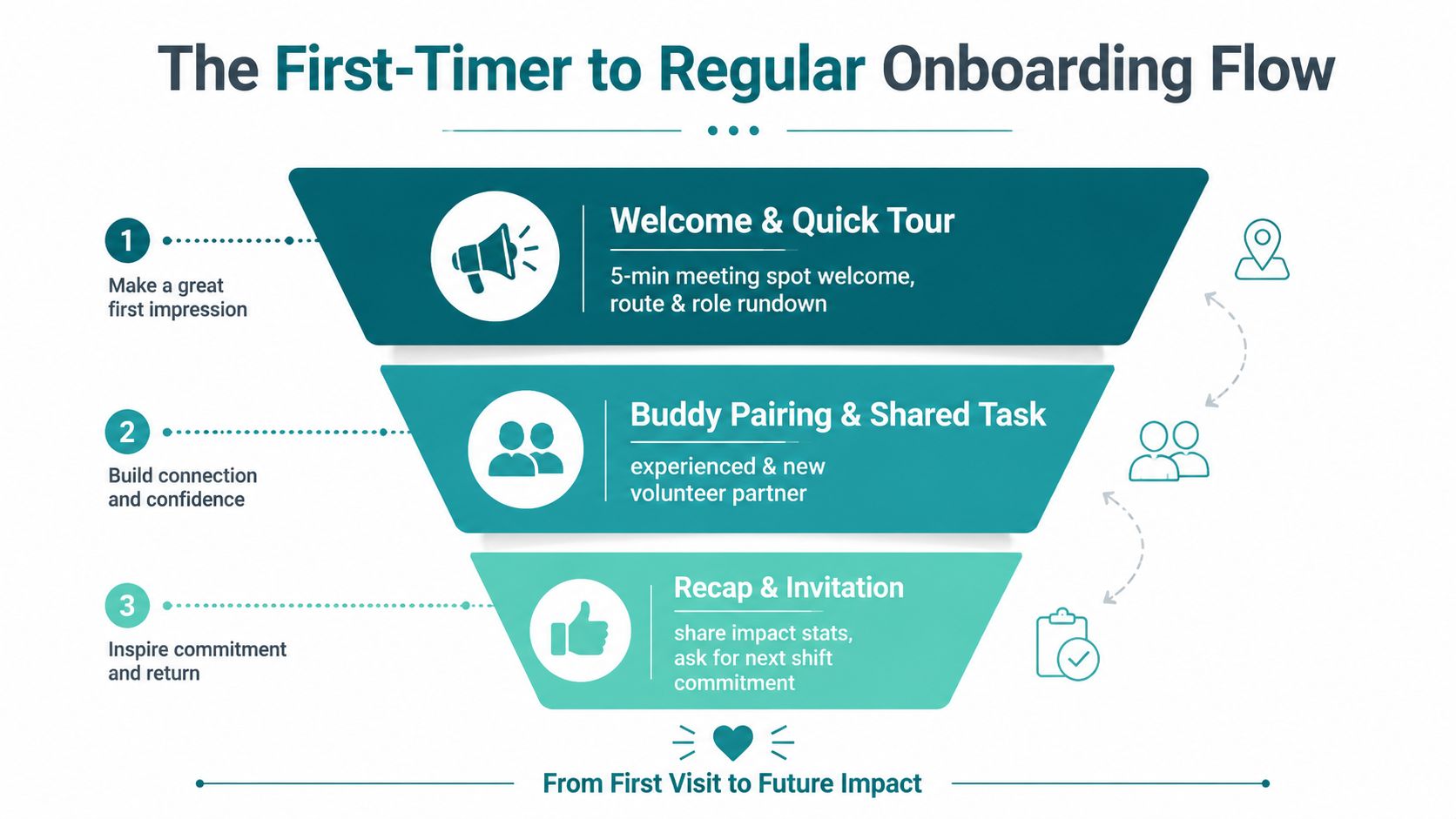
    The first shift decides whether someone sees your cleanup as a friendly invitation or a confusing errand. I try to make the first five minutes feel like entering a small club with the doors already open.

    I greet the new person by name, point out the meeting spot, explain the route, and give them one job they can finish quickly. Then I pair them with someone who has done a cleanup before. A new volunteer shouldn't spend the morning guessing which bag to use or wondering whether the group will notice if they fall behind.

    A systematic review and meta-analysis connected volunteer turnover with job satisfaction, affective commitment, engagement, organizational commitment, communication, organizational support, and leader-member relationships. (Volunteer turnover meta-analysis) A separate study found that appropriate training increased the odds of a volunteer becoming an organizational promoter by more than eight times, with an odds ratio of 8.457, in its original survey data. (Volunteer training and promotion study) I read that plainly: teach people what to do, answer them quickly, and let them feel useful.

    A three-step funnel infographic explaining the onboarding process for new volunteers to become regular contributors.

    Give the crew a vocabulary

    Names create memory. We have regulars, Zone Captains, the supply stash, the traveling flag, and the final cheer. A signature flag moves from park to park. A goofy theme song comes out of a Bluetooth speaker when the crew needs a lift. Stickers or photo badges can recognize five, ten, or twenty-five events.

    Recognition works because people want to know that someone noticed. A UK national volunteer-retention survey found that 80% of volunteers said they were likely to continue with their main organization over the next twelve months, while 53% said they were very likely. Attachment to the organization reached 52%, attachment to the cause reached 49%, and changing circumstances ranked as the most common reason for leaving at 33%. (Volunteer retention survey)

    That's why I'd choose a monthly Instagram shoutout, a Crew Member of the Month post, or a tiny trophy before I'd spend the whole budget on free pizza. Food is nice. Being known lasts longer.

    At the end of each shift, we form a recap circle. Each person shares one strange thing they found. Someone finds a garden gnome head. Someone else finds a receipt from a restaurant that closed years ago. The stories turn a pile of trash into a shared morning.

    Here's the handoff that keeps the founder from becoming a permanent bottleneck:

    1. Ask a reliable volunteer to lead one zone.
    2. Give that person the map, safety notes, contact list, and supply checklist.
    3. Let them run the briefing while you watch.
    4. Debrief privately afterward.
    5. Invite them to lead the next shift.

    A recent study found that experienced volunteers on a shift increased new volunteer retention by 52%, and by 125% for group volunteers. (Volunteer experience and retention study) Pairing people does more than make the work smoother. It gives a first-timer a human reason to return.

    Tools, Templates, and Weekly Rhythms That Save Your Sanity

    I don't need a complicated volunteer-management system for a Saturday cleanup. I need a few tools that each do one job and don't make me hunt through six apps for a phone number.

    • Meetup: Public event page, RSVPs, meeting details, and first-time discovery.
    • Instagram: Photos, volunteer stories, reminders, and repostable updates.
    • WhatsApp or GroupMe: Day-of logistics, weather calls, directions, and quick questions.
    • Google Forms: Waivers, emergency contacts, attendance, and post-event feedback.
    • Shared calendar: Recurring events, supply reminders, and leader assignments.

    The schedule below protects my Tuesday evening because I don't rebuild the event from scratch each week.

    Day Core Task Tool Used
    Sunday night Post the next cleanup Meetup and Instagram
    Tuesday Send an RSVP reminder Meetup and group chat
    Thursday Check the forecast and route Weather app and shared calendar
    Friday Confirm headcount and leaders Group chat and Google Forms
    Saturday morning Run the cleanup Printed map and supply checklist
    Sunday Post photos and thank-yous Instagram and group chat

    Keep four templates ready

    RSVP confirmation

    You're on the list for Saturday at [time] near [meeting spot]. We'll work for [duration]. I'll bring bags, grabbers, and gloves. Please wear closed-toe shoes. Reply here if you need directions or can't make it.

    Waiver form

    I understand the cleanup may include walking near roads, lifting bags, uneven ground, and contact with discarded materials. I'll follow the safety briefing, ask for help, and report hazards immediately. Emergency contact: [name and phone]. Photo preference: [choice].

    Shift-leader handoff

    Route: [area]. Meeting point: [location]. Supply location: [location]. Zone boundaries: [description]. Volunteers assigned: [names]. Weather plan: [plan]. Incident contact: [name and phone]. Closing task: [task].

    Recap post

    Today we cleaned [place] with [crew description]. We found [odd item], met [community detail], and left the route ready for the next walkers. Thanks to everyone who showed up. Next cleanup: [date, time, place].

    Set the event to repeat on your calendar. Save a weather-cancellation message. Keep one shared checklist for bags, gloves, grabbers, vests, water, first aid, and the sharps container. Your future self will thank you while drinking coffee instead of rebuilding a spreadsheet at midnight.

    Showing Up Is the Whole Point

    I used to think a successful cleanup needed a big crowd and a perfect result. Chicago corrected me. One volunteer, one Saturday, and one filled trash bag can start a habit that lasts longer than a grand plan sitting in a draft folder.

    The people matter more than the pound count. A first-timer who learns a neighbor's name may return next week. A regular who becomes a Zone Captain may bring someone who never would have come alone. A person who shows up in the rain learns that service can feel like a real part of life, not an item waiting for a convenient day.

    Build the smallest event you can repeat. Name the meeting spot. Bring enough gear. Give everyone a buddy. End with a cheer, a photo, or one ridiculous story from the sidewalk.

    My mantra is simple: make Saturday easy to join, useful to finish, and warm enough to remember.

    Post your next cleanup before the weekend ends. Choose one Chicago block, invite your group chat, and ask people to come for thirty minutes. Then show up, even if the forecast looks rude.


    Litter Caterpillars organizes weekly Chicago trash pickups where volunteers meet, learn the route, share gear, and clean together across the city's neighborhoods. If you want a practical place to start building your own crew, visit Litter Caterpillars, find an upcoming cleanup, and come see how a clear plan turns strangers into Saturday regulars.

  • How to Stay Committed When Motivation Fades

    How to Stay Committed When Motivation Fades

    The first time three of us picked up trash together, a Chicago hailstorm trapped us under a tree while every Uber canceled. We were cold, annoyed, and laughing anyway. Three years later, we still meet every weekend, because I learned that staying committed has less to do with feeling motivated and more to do with designing a life where showing up feels possible.

    The Hailstorm That Changed Everything

    The hail hit hard enough to sting my face. We had planned a simple cleanup, yet the weather turned the morning into a small survival story. Three of us crouched under a tree, watching canceled ride requests pile up on our phones, while trash waited along the street.

    I had started Litter Caterpillars because I struggled to clean and organize my own life. A piece of litter felt strangely heavy, even when it weighed almost nothing. Cleaning someone else's mess felt easier. Doing it with friends felt unexpectedly fun. The hail added a little flavor, the kind that makes an ordinary morning memorable.

    That morning changed my idea of commitment. I used to think I needed motivation first, followed by action. The order works the other way around. I took action, shared the discomfort with other people, and built a story I wanted to keep living.

    My rule: Make the next showing-up decision easier than the quitting decision.

    For three years, our group has picked up trash every week through rain, snow, bitter wind, and hot days. We meet on weekend mornings because the time filters out many distractions and attracts people who want to give their time. We use group chats, social meetups, flags, badges, and a theme song to make service feel social and recognizable.

    That doesn't mean I always feel ready. Some mornings, I want to stay in bed. Sometimes I look at the forecast and wonder why I'm doing this. Then I remember that bravery doesn't require comfort. It requires a small action that matches the person I want to become.

    You can apply the same idea to almost anything. If you want to write, prepare the desk before you need it. If you want to exercise, choose a place and time that remove decisions. If you want to volunteer, find a group with a regular schedule and a culture that respects your limits. You can read more about the service mindset behind our work in Care for Real.

    Commitment grows when your surroundings support it. Give yourself a cue, a place, a person, and a reason to return.

    Why Habits Take Longer Than You Think

    Two weeks into a new routine, the excitement has usually faded. The shoes remain by the door, the notebook stays open, or the volunteer reminder appears on your phone, yet showing up still feels like a decision. Commitment grows through a designed experience that makes returning familiar and manageable.

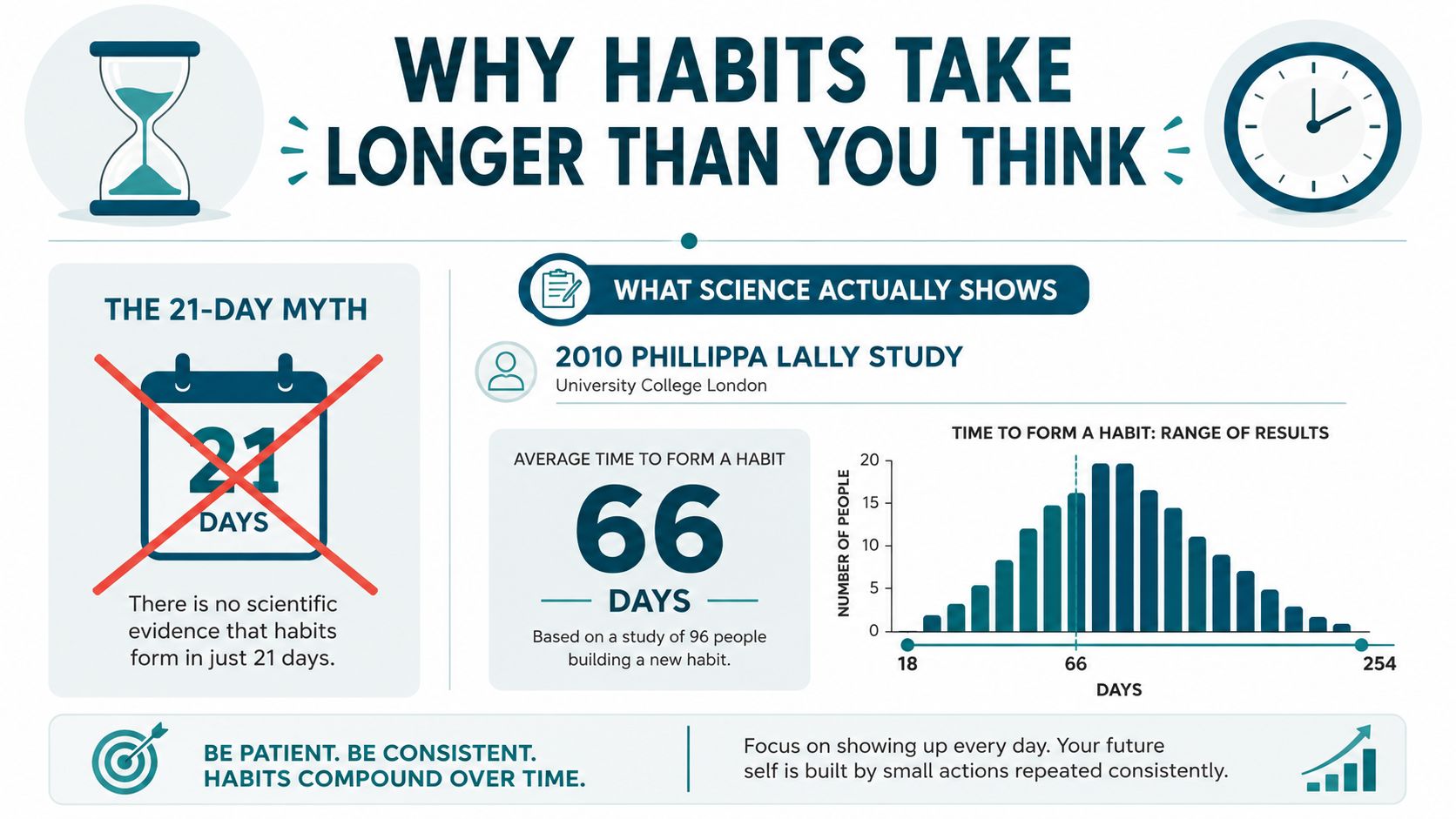
    The popular 21-day habit idea makes early difficulty feel like failure. Research offers a slower, more forgiving timeline. Phillippa Lally and colleagues reported in a 2010 study that a new daily behavior took 66 days on average to reach peak automaticity, while individual participants ranged from 18 to 254 days. The University of Surrey's explanation of the 66-day habit research provides background on those findings.

    An infographic showing that forming a new habit takes an average of 66 days, not 21.

    A 2024 systematic review and meta-analysis examined 20 studies with 2,601 participants. It found median habit-formation times between 59 and 66 days, while mean times ranged from 106 to 154 days, with some behaviors taking as long as 335 days. A routine can need months before it feels nearly automatic.

    A slower timeline gives you room

    Those findings point toward repeated practice, not passive waiting. Two difficult weeks often mark the beginning of the learning period. The routine still requires attention because the cue, action, and reward have not settled into place.

    Saturday cleanups benefit from a recognizable setting. A weekend-morning schedule, meeting point, bags, gloves, group chat, and identity badges reduce fresh decisions each time. The same activity returns in the same social context, and the visible result, a cleaner block, gives the effort a clear reward.

    Give repetition a place on your calendar

    Reserve a stable block for the behavior before the week fills up. Using blocks of time for focus can turn an intention into a calendar appointment rather than a choice controlled by your mood.

    For a first cycle, choose a manageable 6-8 week block and measure attendance instead of performance. Repeat the smallest useful version, then let your identity catch up with your actions. A regular cue and setting can support intrinsic motivation, giving you an internal reason to return when enthusiasm is absent.

    Building Your If-Then Commitment Protocol

    At 7:45 on a rainy Saturday, I have stood by the park entrance wondering whether anyone else would show up. A promise like “I'll volunteer more” offers no answer about the morning's decisions. The problem with vague promises is that they leave when, where, and how open at the moment you most need a plan.

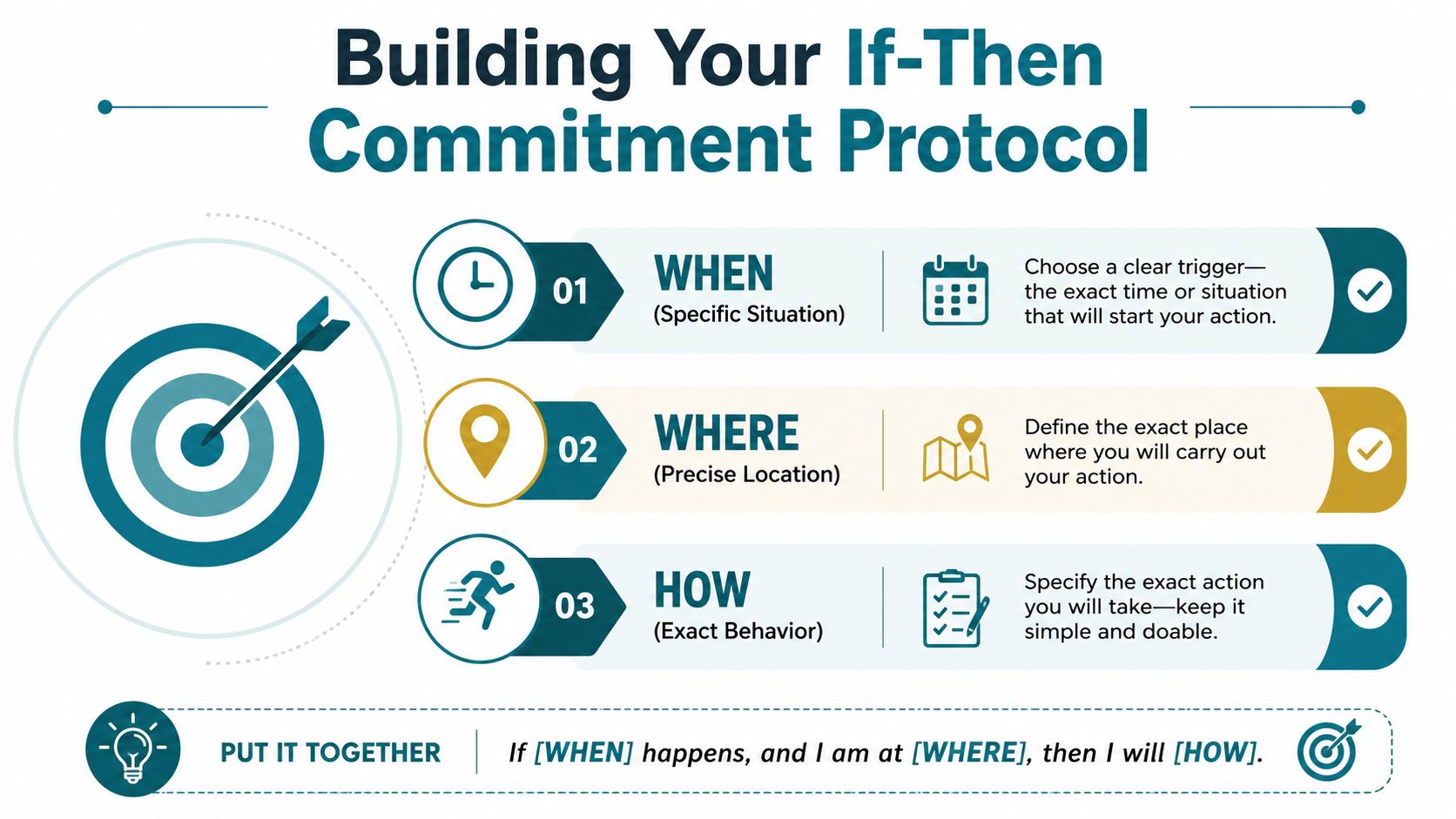
    An if-then rule closes those gaps. You name the situation, then pair it with an exact response. Research on 94 independent tests found a medium-to-large effect on goal attainment, d = 0.65, including starting tasks, resisting distractions, and leaving plans that no longer work. The research on implementation intentions explains how an anticipated cue can prompt a prepared action with less internal debate.

    A diagram outlining a three-step commitment protocol for achieving goals using a clear trigger, location, and action.

    Write the three parts

    Use a specific cue, place, and action:

    1. When: Name the situation. “If it's Saturday at 8 a.m.”
    2. Where: Identify the location. “At the park entrance.”
    3. How: State the behavior. “I'll put on my cleanup gloves and join the group for the first task.”

    My version reads: If it's Saturday at 8 a.m., then I'll meet my group at the park entrance, put on my gloves, and start with one bag of litter.

    The same structure works beyond volunteering:

    • Writing: If I finish breakfast, then I'll sit at my desk and write one paragraph.
    • Fitness: If I leave work, then I'll go directly to the gym and change before checking my phone.
    • Study: If I sit on the train, then I'll open my course notes and review one section.

    Specificity does the work. “Later” cannot start a routine. A named time and place can point you toward the first action.

    Write the rule before the difficult moment arrives.

    Put it on the fridge, in your calendar, or in a phone reminder. Then decide what happens when the plan meets resistance. If heavy rain cancels the cleanup, choose in advance whether you will reschedule, complete a smaller indoor task, or return the following week without guilt.

    An if-then plan cannot prevent every problem. It removes the argument that usually delays the first step.

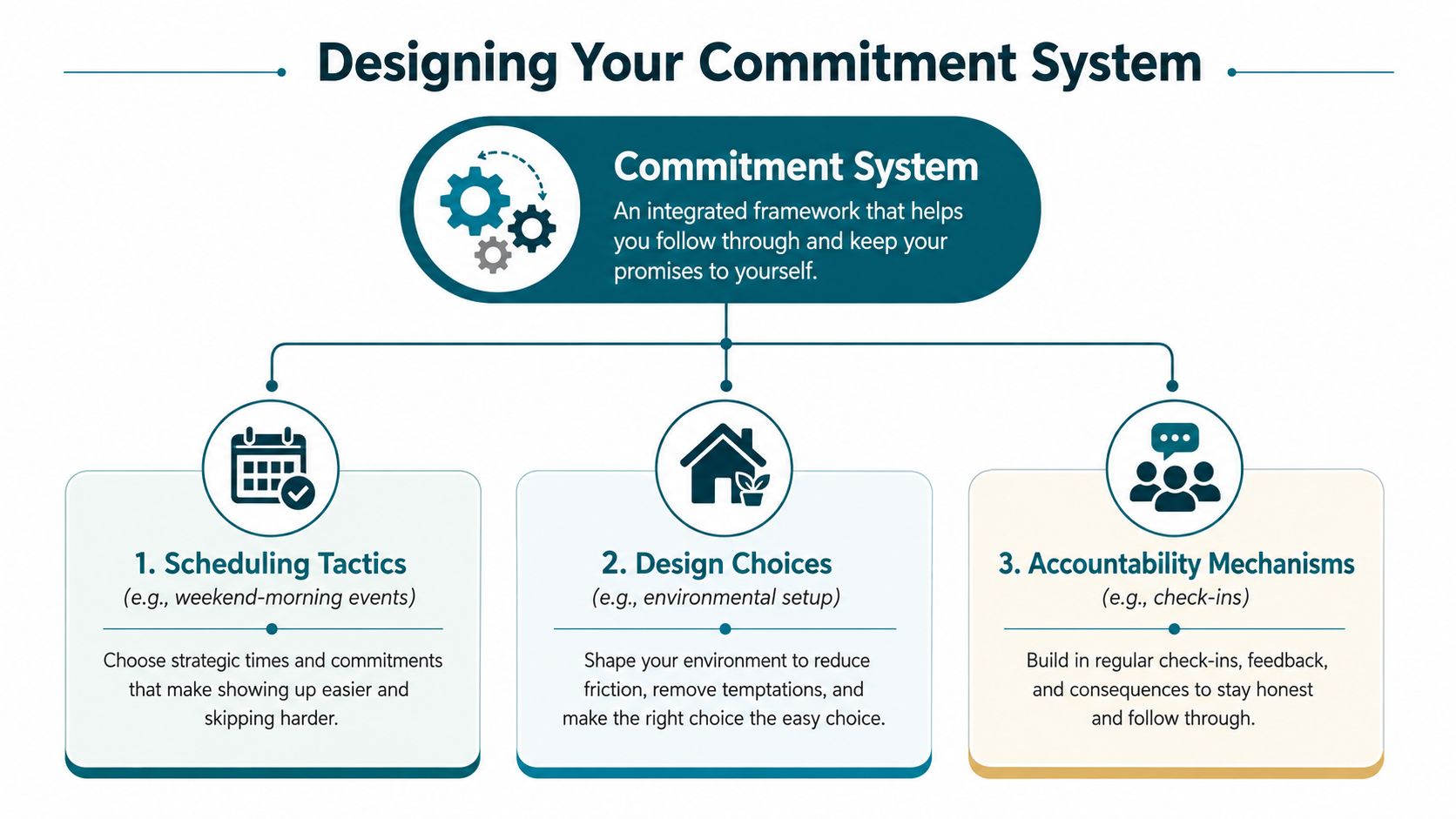
    Designing Your Commitment System

    Three years of weekend cleanups taught me a humbling lesson. On rainy mornings, after poor sleep, or during a stressful week, I have wanted to stay home. The group still met because we designed the experience to carry us through those moods. Our system rests on three parts: a dependable schedule, a welcoming environment, and visible signs of belonging.

    A diagram illustrating a commitment system framework with scheduling tactics, design choices, and accountability mechanisms.

    Start with the calendar

    We chose a weekend-morning slot, before errands and family plans crowded the day. New volunteers could see exactly when to find us, without waiting for a special campaign or a burst of enthusiasm. After three years, that recurring appointment still does much of the remembering for us.

    Pick a time that fits your actual life. Put it on the calendar, prepare equipment early, and make the first version manageable on a difficult day. A six-to-eight-week block can also make the commitment feel defined. You are agreeing to a clear stretch of sessions, rather than making an indefinite promise.

    Add people who notice your absence

    Our group chat handles practical details, from questions about meeting points to plans for the next cleanup. It also gives someone permission to ask, “Are you still coming?” A partner can provide the same support for a personal goal. The useful response is curiosity and honesty, not shame.

    A short weekly check-in creates room to adjust. We name what worked, identify the source of friction, and change the setup before frustration becomes disappearance.

    Give the behavior a visible identity

    Flags, badges, and a theme song turned attendance into something people could recognize and share. A badge on a backpack, a marked calendar, or a shared playlist makes the habit part of daily life. It reminds us that we belong to a group with a real practice, even on mornings when motivation is thin.

    Our volunteer-first approach protects that experience. Safety comes before output, and enjoyment comes before pressure. People are more willing to return when they feel respected, effective, connected, and able to manage the time involved. NCVO's volunteer-retention research discusses these conditions, including enjoyment, belonging, trust, feeling effective, and manageable time demands, in its findings on volunteer retention.

    Build the same structure around your goal. Schedule the action, prepare the setting, invite accountability, and choose one identity marker. Familiarity, social contact, and a clear time limit can make consistency easier to repeat.

    What to Do When You Fall Off Track

    You will miss a week. You may miss two. That lapse doesn't erase the work you already did, and it doesn't require a dramatic return.

    Volunteer retention research gives a more practical explanation for absence. People stop when their circumstances change, their health interferes, or they feel they've already done enough. Those reasons call for pacing and re-entry, not a lecture about willpower.

    Build the return before you need it

    Create a re-entry rule while things are going well:

    • After a missed session: Return at the next regular meeting instead of inventing a perfect restart date.
    • During a difficult week: Attend for a shorter period or take a lighter task.
    • After illness or injury: Ask what safe participation looks like, and wait when participation isn't safe.
    • When interest fades: Talk with a partner about changing the task, location, or social format.

    A fixed cue helps you find your way back. Research on habit formation describes repetition in the same context as a central part of building automatic behavior. A regular time and place keep the cue familiar, even when a gap interrupts the routine. A field experiment on recycling found improvement during the first two weeks, and the behavior remained consistent at a two-month follow-up. The recycling field experiment gives you a useful model for early practice followed by continued repetition.

    Treat a lapse as information

    Ask what blocked you. Did the time conflict with family needs? Did the task feel too hard? Did you lack a ride, equipment, or a person expecting you? The answer points toward a design change.

    You can also use a practical guide to overcoming procrastination when delay becomes the pattern. Come back without making an apology tour. The next action can be small, ordinary, and scheduled.

    A missed session is a data point. Your return is the practice.

    Commitment means binding yourself to future behavior, yet a binding can include humane terms. Leave room for health, changing responsibilities, and honest reassessment. A plan that lets you step back can keep you from walking away permanently.

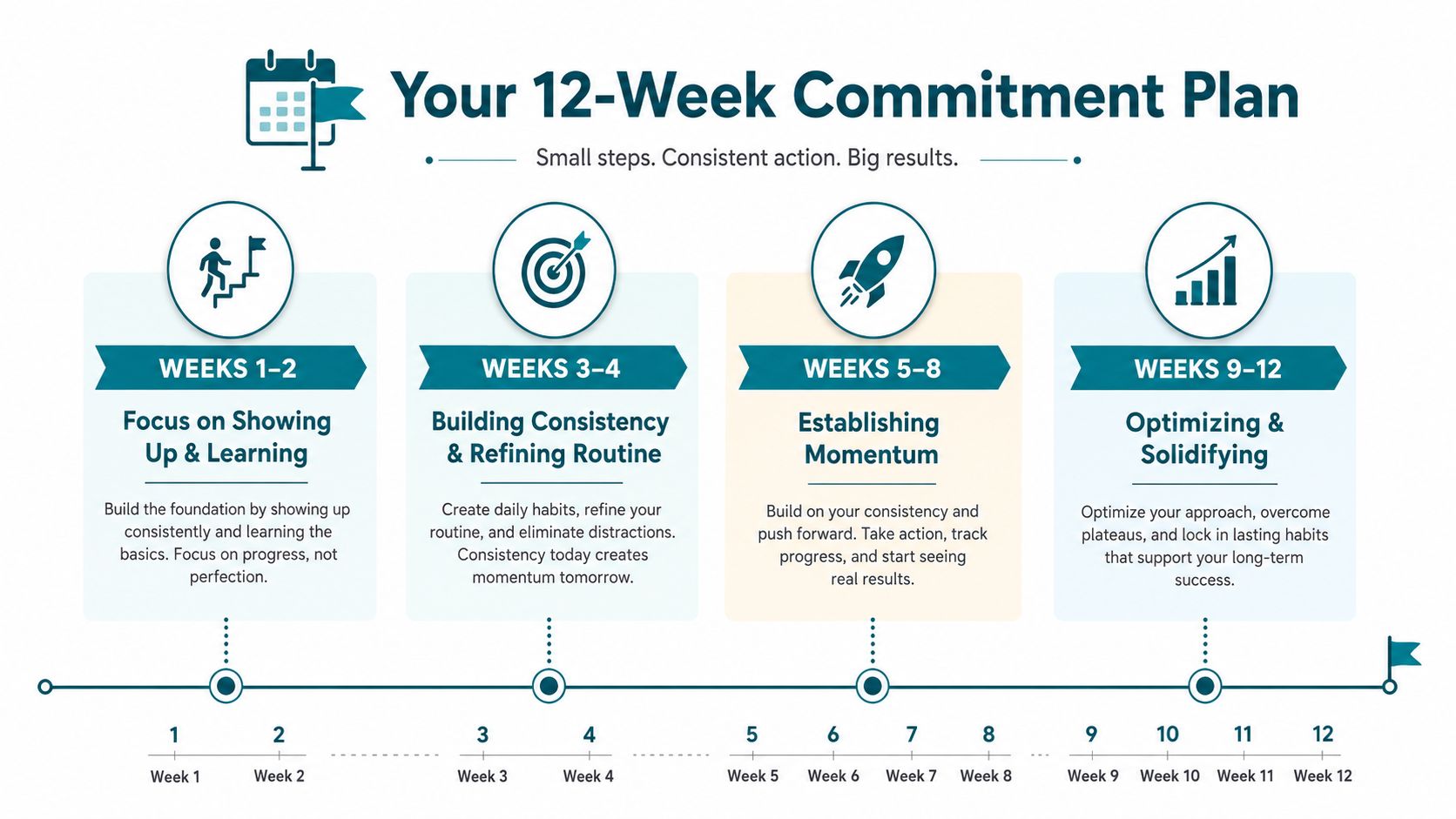
    Your 12-Week Commitment Plan

    I use a 12-week plan because it gives a new routine enough room to pass through excitement, boredom, friction, and adjustment. Real-world habit-building data found 6 to 8 week commitments, weekly reporting to an external referee, and monetary stakes among the most successful structures examined in that research on habit-building commitments. You don't need money to use the same structure. You can use a friend, group chat, or volunteer coordinator as your referee.

    A 12-week commitment plan infographic illustrating phases for building habits, consistency, and long-term success.

    Weeks 1 and 2, learn the route

    Show up and learn the routine. Don't measure yourself by bags collected, pages written, miles run, or any other performance result. Your milestone is simple: you know where to go, what to bring, and how to begin.

    Ask yourself, “What made starting easier, and what created friction?” Write the answer after each attempt. Change one practical detail, such as packing supplies the night before or placing your shoes beside the door.

    Weeks 3 and 4, add a witness

    Choose one accountability person. Send a short weekly message with three details: whether you showed up, what got in the way, and what you'll do next.

    Refine your if-then rule from the evidence you gathered. If your original cue fails, replace it with a cue you encounter reliably. Your milestone is a plan that describes the actual version of your week, not the imaginary version.

    Weeks 5 through 8, protect the middle

    Novelty fades. Keep the task small enough to survive a difficult morning, and let your group carry some of the social energy. Celebrate concrete wins, like arriving on time, completing one manageable task, or returning after a missed week.

    Ask, “What can I reduce without abandoning the goal?” Shorten the session, simplify the equipment, or choose a lighter role. Keep the appointment alive while you adjust the workload.

    Weeks 9 through 12, decide with evidence

    Look at your notes. Do you feel connected to the activity? Does the schedule fit? Does the group or setting help you feel effective? Are the costs to your health, time, or relationships reasonable?

    Your final milestone isn't automatic perfection. It's an honest decision to continue, change the format, or stop and choose a better goal. If you continue, renew the next block before the current one ends. If you pivot, carry the lessons into the next commitment rather than treating the experiment as wasted effort.

    Print the plan. Put the first appointment on your calendar. Then tell one person exactly when and where you'll begin.


    Litter Caterpillars meets on weekend mornings for volunteer trash pickups, with group chats and social meetups that help people find the routine and meet neighbors. Visit Litter Caterpillars to choose a cleanup, write your if-then rule, and take the first small step toward a commitment you can repeat.

  • Organizational Culture Building for Volunteer Groups

    Organizational Culture Building for Volunteer Groups

    The hail hit us sideways that first morning. Three of us crouched beneath a tree, shivering while every Uber cancelled, and somehow we kept laughing.

    That scene taught me more about organizational culture building than any values workshop could have. People learn who they are together when the weather turns, the work gets awkward, and someone still hands you another trash bag.

    How Shared Struggle Creates Instant Culture

    Most advice about organizational culture building starts with mission statements, posters, and values sessions. I've found that order backwards. A group discovers its real culture when people face an unpleasant task together and decide whether they'll keep showing up.

    That first Litter Caterpillars cleanup gave us three lessons. Cleaning someone else's mess felt easier than cleaning our own. Suffering together created a strange kind of fun. The hail added flavor to the story, a difficult chapter we could retell whenever a new person joined.

    A diverse team of professionals collaboratively lifting a large table, symbolizing unity and building organizational culture together.

    Hard moments reveal the rules

    Comfort can hide selfishness. A pleasant event lets everyone act agreeable for a few hours. A cold morning reveals who checks on a stranger, who shares gloves, who carries the overloaded bag, and who stays after the official end time.

    You don't need to manufacture misery. You need a real task with a clear finish line and enough difficulty to require cooperation. A neighborhood cleanup, food distribution shift, trail repair day, or community garden work session can create that setting. Give people roles, let them solve small problems together, and let the group talk afterward about what happened.

    Practical rule: Choose a challenge that asks people to depend on one another, then make room for the story that follows.

    Groups often fail because they chase comfort before trust. They plan polished introductions, fill the schedule with announcements, and avoid anything that might feel inconvenient. Volunteers then leave with pleasant memories but few relationships and no shared language for future decisions.

    A useful guide to improving organizational culture can help leaders map values, behavior, communication, and feedback. For a volunteer group, I'd add one question: What hard thing will we do together often enough that it becomes part of our identity?

    Design the return

    Shared hardship only builds culture when people can return safely and willingly. Set a dependable meeting rhythm, explain the task before people arrive, and make sure a leader models the behavior you want. If rain changes the plan, communicate early. If a volunteer struggles, give them an easier role without making them feel small.

    Over time, the repeated pattern matters more than one dramatic day. People remember the hail, but they trust the group because someone kept organizing the next cleanup.

    Defining Values That Actually Filter People

    A value that never changes a decision isn't a value. It's decoration.

    I write values as instructions for behavior. Bravery means showing up when the work feels uncomfortable and trying again after failure. Kindness means treating residents, teammates, and yourself with care. Unity means moving with other people instead of treating service as a private performance.

    Those words matter because they filter. They tell people what kind of group they're joining, what the group expects, and what the group won't reward.

    Turn ideals into visible choices

    Start with a recent moment that tested your group. Ask what a good volunteer did, what a harmful volunteer did, and what a leader should have done sooner. Then write the value around the action.

    “Excellence” might sound impressive, but it doesn't tell a volunteer whether to slow down for a new participant. “Bravery in bad weather” gives people a clearer picture. “Kindness during disagreement” tells a coordinator how to handle conflict. “Unity across neighborhoods” guides who gets invited and how teams share work.

    Use your values to decide:

    • Who joins: Choose people who want to give time and attention, not people seeking a personal audience.
    • When you meet: Weekend mornings can filter for people ready to build a service habit. That schedule won't suit everyone, and that's part of its purpose.
    • How leaders act: A coordinator who leaves early while others finish teaches a different value than the one written on the website.
    • What you praise: Recognize the person who welcomes a newcomer, notices a safety issue, or helps another volunteer finish.

    Your volunteer job descriptions should carry the same behavioral language. A role description can say that a person sorts supplies, but it should also explain how that person treats the team and responds when plans change.

    Make effort feel like pride

    Tom Sawyer understood a useful social trick. He turned an unpleasant fence-painting task into an opportunity his friends wanted to claim. I don't use that story to disguise bad work or pressure people into pretending they enjoy it. I use it to ask how a group can give honest effort a sense of pride.

    A badge, a team name, or a simple recognition ritual can make service feel like a chosen identity. The work remains work. The volunteer also gets a story, a place in the group, and proof that they did something difficult.

    Write values that attract generous people and repel behavior that drains everyone else. Your culture gets clearer each time a leader makes a decision in public and explains which value guided it.

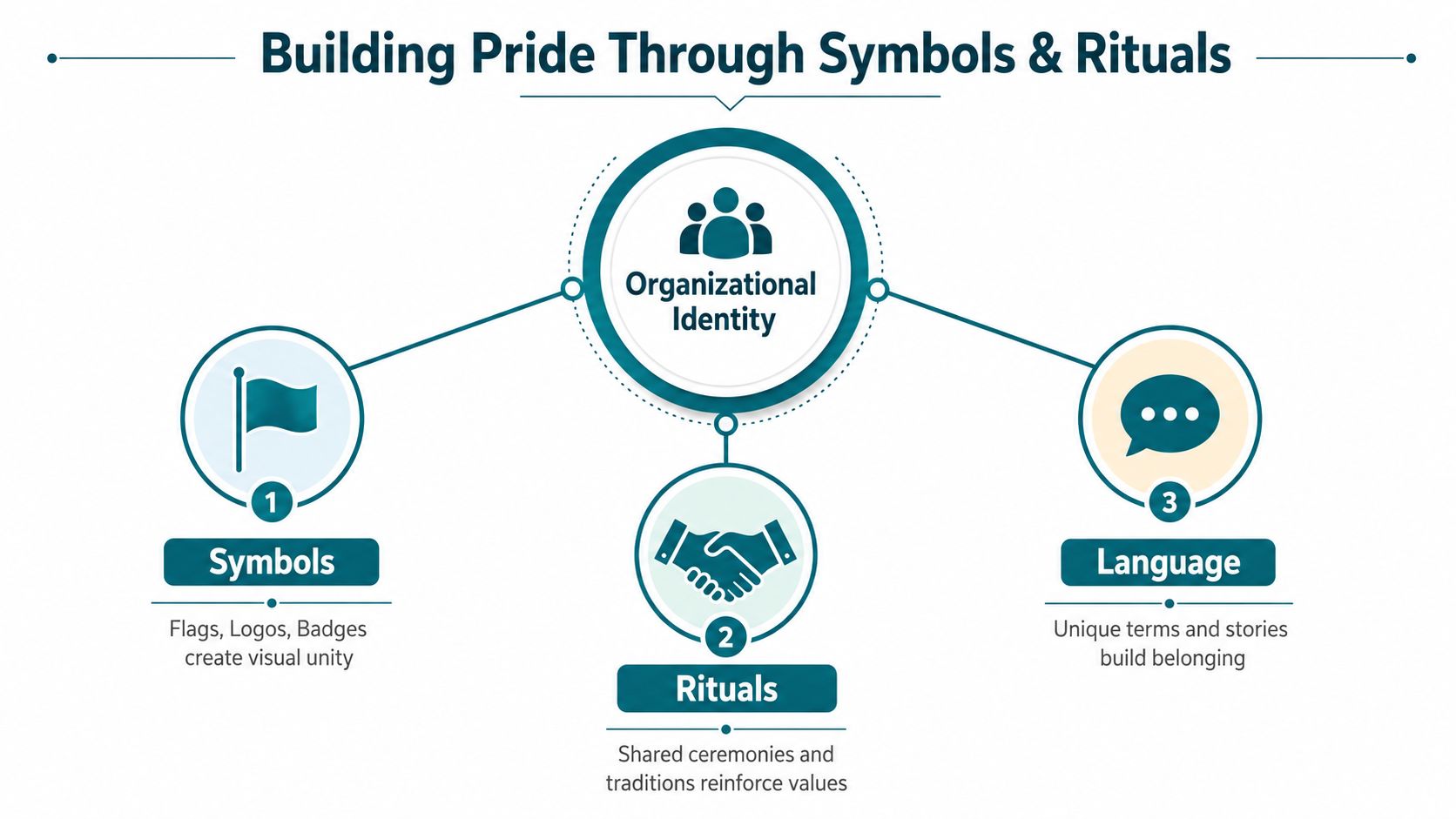
    Building Pride Through Symbols and Rituals

    On a cleanup morning, a flag can do what a long speech can't. It tells a new volunteer where to stand, gives the group a visible center, and lets people recognize one another from across a block.

    The Litter Caterpillars logo comes from that first hailstorm. It carries the memory of three people under a tree, waiting out the weather and choosing to keep the story going. A volunteer-made theme song gives arrivals another way to enter the group. Flags travel to events. Badges show progress. These objects help people say, “I belong here,” without needing a formal introduction.

    A diagram illustrating how organizational identity is built through symbols, rituals, and unique language for employees.

    Give the story physical form

    Choose one symbol from your group's own history. It might be a patched tool bag, a hand-painted sign, a shared color, or a small object from the first event. Don't copy a corporate badge system because it looks polished. Use something that people can explain in one sentence.

    Then build rituals around real moments:

    • A short welcome for first-time volunteers.
    • A safety check before the work begins.
    • A group photo after the final bag leaves the site.
    • A thank-you circle where people name a helpful action they saw.
    • A badge or token for learning a new role.

    Consistency matters more than cleverness. If you change the ritual every week, people can't anticipate it or pass it to newcomers. Keep the shape stable while letting the stories change.

    Let repetition build resilience

    A rain-or-shine schedule can become a promise. Volunteers know the group will meet, leaders know they must prepare, and the neighborhood sees a dependable presence. That doesn't mean ignoring unsafe conditions. A leader must change or cancel an event when conditions put people at risk, then explain the decision plainly.

    Language matters too. Groups develop terms for tasks, places, and small victories. Those words compress shared experience. A new volunteer learns them by listening, then starts using them with someone else.

    Recognition can stay simple. A handwritten note, a public thank-you, or a badge tied to a real contribution often carries more weight than a generic announcement. You can find practical ideas in these volunteer recognition ideas.

    The song below gives another example of how a volunteer's creative work can become part of a group's shared memory.

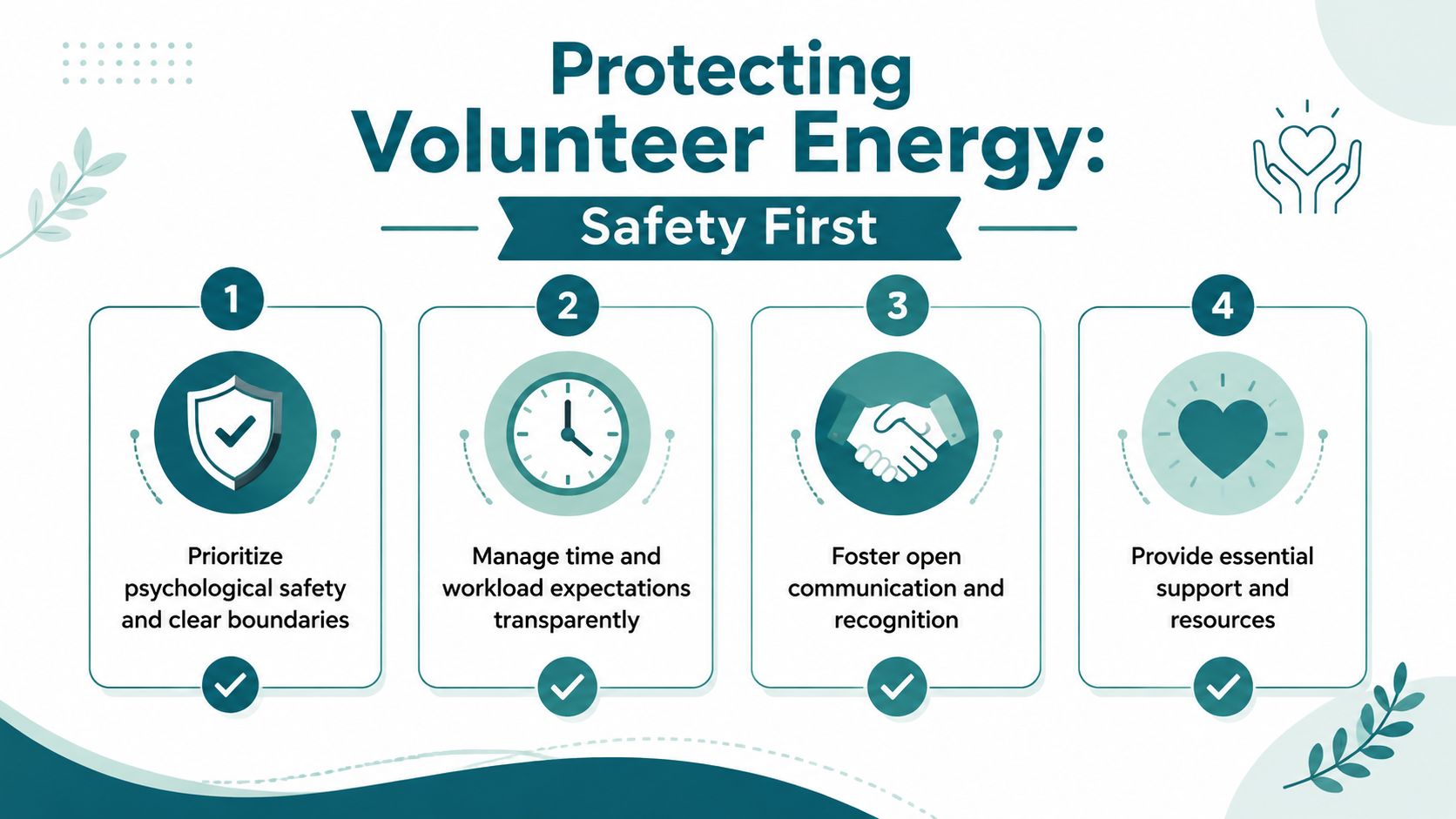
    Protecting Volunteer Energy With Safety First

    Volunteer energy lets a group keep moving, and it can disappear after one preventable injury, one humiliating interaction, or one event that leaves people confused and exhausted. I put safety first, happiness second, and fundraising somewhere outside the volunteer relationship.

    A volunteer-first policy starts with boundaries. Tell people what the task involves, what equipment you provide, which conditions can change the plan, and who makes the final call. Psychological safety matters too. People should be able to say “I'm uncomfortable,” “I need a break,” or “I don't know how to do that” without losing respect.

    A graphic titled Protecting Volunteer Energy showcasing four key steps for maintaining volunteer safety and well-being.

    Teach safety, then repeat it

    A safety orientation at the start gives people a common baseline. It should cover tools, lifting, traffic, sharp objects, weather, personal boundaries, and the process for reporting a concern. Keep the language plain and demonstrate the actions instead of reading a long policy aloud.

    Safety guidance for volunteer organizations recommends keeping current safe-work policies and procedures on a notice board or app, giving people a suggestions box for safety ideas, and holding regular meetings about safer ways to work. Safe Work Australia's volunteer safety guidance gives that rhythm a practical shape.

    A separate volunteer safety guide recommends an opening orientation followed by regular communication about health and safety. People forget instructions when they use them rarely, so repeat one small reminder before each event.

    Make participation easy and pressure-free

    Publish the meeting point, expected duration, clothing advice, accessibility notes, and cancellation process in the same place. Use Meetup, Instagram, and open group chats to help people find an event without a private invitation or a long application.

    Don't turn a service day into a donation pitch. A zero-pressure policy protects the reason people arrived. Let volunteers make friends, learn a role, and leave with enough energy to return. Schedule realistic work, provide pauses, and assign a person to welcome anyone standing alone.

    Volunteer-first practice: If your event needs volunteer energy to succeed, your planning must protect that energy before it asks for more.

    Leaders should watch for quiet signs of strain. Someone who stops talking, rushes through unsafe work, or avoids a familiar role may need a check-in. Ask privately, listen without defending the plan, and change the system when the same concern appears more than once.

    Measuring What Matters for Long-Term Retention

    At a cleanup in a neglected corner of the neighborhood, twelve people may sign in, yet only four return the following week. The attendance sheet records the first number. It cannot show who stood alone, who found a friend, or which confusing task sent someone home for good.

    Research on episodic volunteering found different retention drivers at different stages. For first-time volunteers, satisfaction and social norms predicted retention. For volunteers with 2 to 4 years of intermittent service, satisfaction and commitment predicted retention. Among sustained volunteers, financial support, social norms, satisfaction, and commitment all showed positive coefficients. The episodic volunteering research explains these distinctions.

    Track the reason behind the return

    Send a short pulse check after each event. Ask what felt good, what felt difficult, whether the volunteer felt welcomed, and whether they plan to return. Leave one open question for the detail a checkbox cannot capture.

    A small group can track:

    • First return: Did a new volunteer come back, and did someone introduce them to others?
    • Satisfaction: Did the work feel manageable, social, and worth the time?
    • Commitment: Does the volunteer take ownership of a role or invite someone else?
    • Support: Did the group provide the tools, information, and care experienced volunteers needed?
    • Friendship formation: Can people name someone they met through service?
    • Event consistency: Did cancellations, late starts, or unclear locations interrupt trust?
    • Ward coverage: Did the group reach the neighborhoods it planned to serve?

    A volunteer program evaluation framework can help organize these questions without turning a community ritual into paperwork.

    Read the answers by experience level, team, manager, location, and tenure where useful. An overall average can hide a local problem. One Litter Caterpillars crew may welcome newcomers at the curb while another leaves them at the edge of the circle.

    Experience Level Primary Retention Drivers What to Measure
    First-time volunteers Satisfaction and social norms Welcome quality, task clarity, social connection, return intention
    Volunteers with 2 to 4 years of intermittent service Satisfaction and commitment Role ownership, follow-through, feedback, continued participation
    Sustained volunteers Financial support, social norms, satisfaction, and commitment Support resources, leadership trust, recognition, mentoring, responsibility

    Keep the metric set small

    Culture-metrics guidance recommends 6 to 10 KPIs, combining early signals such as engagement or eNPS with outcomes such as voluntary turnover, absenteeism, productivity, and customer NPS, then segmenting results to find where culture breaks down. A volunteer group can borrow that approach without copying workplace measures.

    Choose one or two North Star measures, collect pulse responses on a fixed cadence, and pair the results with conversation. If satisfaction falls in one crew, speak with that crew before changing the whole program. Numbers mark the place to look. Volunteers explain what happened, and their experience shows whether the ritual is strong enough to bring them back.

    Common Mistakes That Kill Volunteer Culture

    I've watched groups chase a cheerful message while their actual schedule kept changing. I've seen leaders count every signup, ignore the people who felt lost, and call the result growth. A culture survives through repeated actions, so slogans can't rescue a broken routine.

    Gallup reports that 31% of U.S. employees were engaged at work in 2024, matching the low point last seen in 2014, while 17% were actively disengaged. Gallup also reports that global engagement declined again in 2025, reaching its lowest level since 2020. Those figures come from a workplace context, yet they give volunteer leaders a useful warning: enthusiasm needs daily reinforcement, not a one-time speech. Gallup's engagement report provides the details.

    Mistakes that look harmless at first

    Motivational messaging without action creates cynicism. If leaders praise kindness but ignore a volunteer who bullies others, people learn the actual rule quickly.

    Attendance as the only success measure rewards volume over experience. Ask whether people felt welcomed, learned a role, formed a friendship, and chose to return.

    Unsafe improvisation damages trust faster than a cancelled event. Give people orientation, repeat safety guidance, update policies, and accept that leaders may need to stop work.

    Donation pressure changes the relationship. Volunteers who arrived to serve can start feeling like customers on a list. Keep giving optional and separate from the welcome, recognition, and work itself.

    Inconsistent scheduling breaks the habit that brings people back. Publish a dependable rhythm, communicate changes early, and avoid making volunteers guess whether an event still exists.

    Trying to suit everyone makes the group hard to understand. Clear values will turn some people away, and that can protect the people who want the same kind of service.

    Fix the system, not the poster

    A culture review identifies three conditions that help people follow group norms: expectations must stay visible, people must broadly agree with them, and rewards or sanctions must carry enough intensity to matter. Read the culture review on norms and organizations for the underlying framework.

    Write the rules in plain language. Ask volunteers whether the rules match the lived experience. Praise behavior that keeps the group healthy, and address behavior that harms others quickly and consistently.

    Organizational culture change works better as a staged operating system than as a slogan campaign. One benchmark describes planning, analysis, integration, implementation, and operational maturity, while McKinsey reports that only about one in four large-organization transformations achieve long-term success, as summarized in this culture-change benchmark.

    For a volunteer group, the rollout can stay practical:

    1. Plan the behavior: Choose the actions you want people to repeat.
    2. Study the gap: Ask where current events fail those expectations.
    3. Integrate the rules: Put them into event plans, safety checks, recognition, and leader roles.
    4. Pilot the routine: Try it with a few teams and listen closely.
    5. Scale with evidence: Expand only after volunteers show that the routine works.

    Litter Caterpillars brings people together for weekly Chicago cleanups, rain or shine, with flags, badges, friendships, and safety practices that make service easier to repeat. Visit Litter Caterpillars to find an event, meet people who give their time, and help build a culture of care block by block.

  • Nonprofit Sustainability: Real Strategies That Work

    Nonprofit Sustainability: Real Strategies That Work

    We were halfway through a Chicago hailstorm when three of us bent down to pick up cups, wrappers, and broken bottle glass from the curb. One Uber after another canceled, and we laughed because the trash was easier to move than our own plans.

    That day taught me something I still use every week. Nonprofit sustainability starts when people keep showing up through bad weather, awkward moods, and unfinished work.

    Why Most Nonprofits Fail Before They Start

    I remember that first cleanup because nothing about it felt polished. We had no polished pitch, no neat budget deck, no donor list, just three people, a storm, and a block that needed work. That kind of beginning is messy, but it tells the truth about how volunteer groups survive.

    Start with the person, not the spreadsheet

    My own life was a mess before the group ever existed. I had trouble cleaning and organizing my space, and every little thing I owned felt stuck in place because I had attached a story to it. Trash looked small from the outside, but inside my head it carried weight, and that made consistency hard.

    So I built the group around the problem I needed to solve in myself. I wanted a circle that filtered out selfishness, because I had already lived through a chaotic relationship that made me tired of people who only wanted to party and take. That choice shaped everything that came after, from the tone of our events to the people who stayed.

    Practical rule: If your mission only helps other people and never helps your volunteers become better versions of themselves, you will keep losing the people who make the work possible.

    That is why so many groups fade early. They ask people to care, but they never give them a reason to belong. They ask for labor, but they never build a rhythm that feels human.

    Build a repeatable habit, not a heroic sprint

    Our first cleanup in the hailstorm was awful in one way and perfect in another. We were freezing, traffic was bad, and the day felt ridiculous, but the chaos created a story that people wanted to return to. I learned that sustainability grows from repeatable habit, clear identity, and a group that knows why it gathers.

    The Community-Wealth green manual lays out a simple loop, measure impacts, survey employees, determine priorities, create an action plan, and repeat, plus practical moves like energy audits and switching printers to double-sided the manual's five-step process. I use that kind of sequence in my head all the time. First I look at what hurts. Then I ask who feels it. Then I choose the next action.

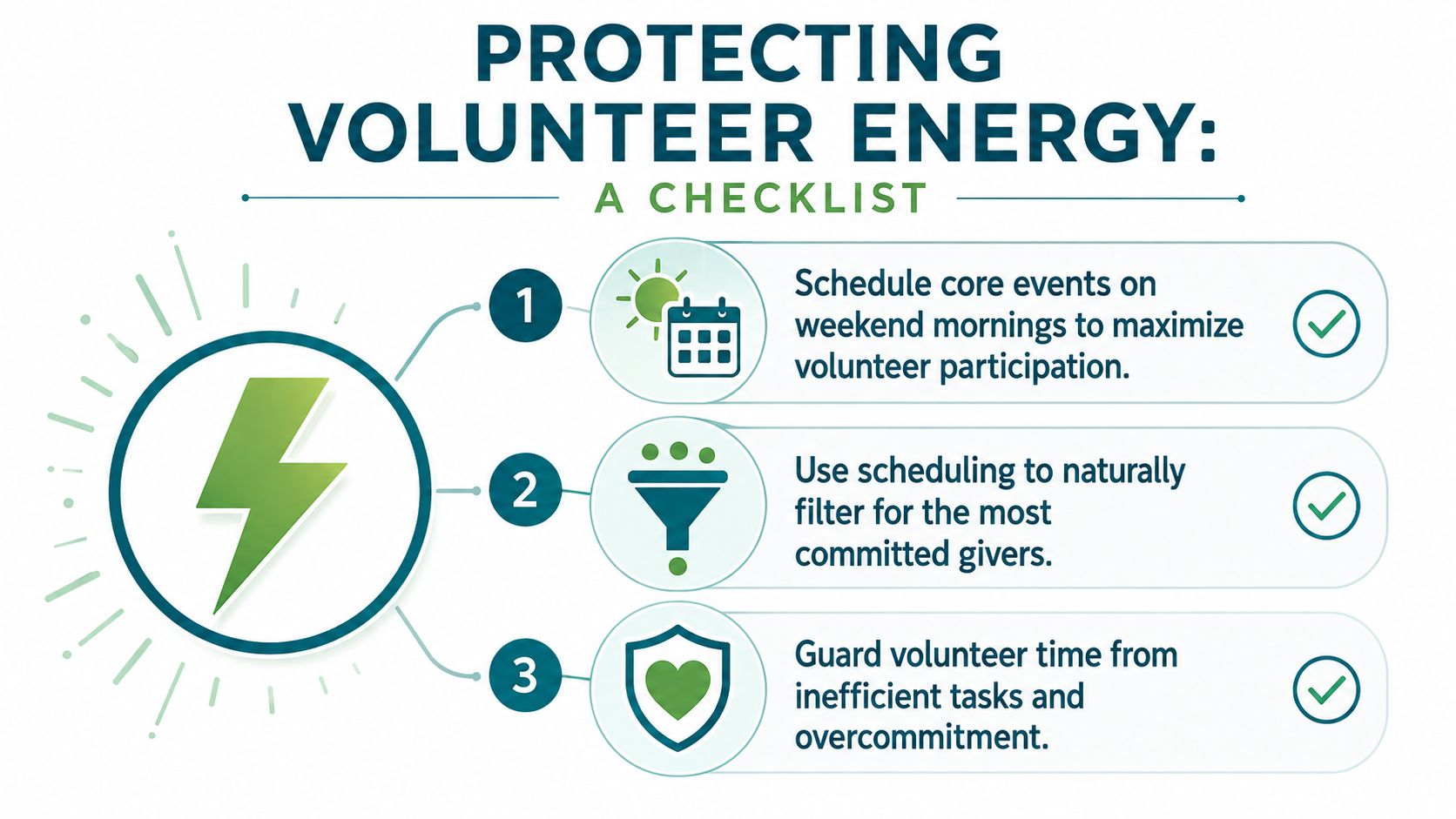
    The hardest mistake is thinking a nonprofit needs a perfect launch. It doesn't. It needs a reason people can feel in their bones, then a way to return next week without forcing themselves.

    Protecting Volunteer Energy Above All Else

    A checklist infographic titled Protecting Volunteer Energy with three tips for managing and sustaining volunteer commitments.

    I treat volunteer energy like a battery that drains faster than money ever does. If you spend it badly, you don't get a loud failure. You get silence, no-shows, and a group chat that goes cold.

    Schedule for the people you want to keep

    Weekend mornings work because they reward intention. The people who wake up early to pick up trash usually want to be there, and that matters more than raw turnout. If you schedule like a party, you attract party energy. If you schedule like service, you attract givers.

    That is why I keep events simple and predictable. I want people to know when to show up, what to wear, and how long it'll take. I also want them to leave with enough energy to come back.

    Practical rule: Make the first hour easy to understand and hard to fake. The wrong people drift off, the right people stay.

    The group's own retention advice lives at our volunteer retention guide, and the lesson is plain. Clarity protects energy. Confusion burns it.

    Safety comes first, happiness comes second

    I never ask volunteers to prove toughness. I ask them to stay safe, because nobody returns to a group that treats bruises like badges. Happiness comes second, but it still matters, because people remember how they felt more than what they carried.

    That means I choose routes with care, keep the task list visible, and watch the weather with a practical eye. Blizzard, heat wave, slush, or calm morning, the rule stays the same. People come before output.

    Never turn volunteers into fundraisers

    I don't pressure people for donations, because that changes the whole mood. Once a cleanup group starts treating volunteers like a donor pool, people feel it. They stop feeling like neighbors and start feeling like targets.

    A volunteer-first group needs a clean emotional contract. Come help. Make friends. Leave proud. That's enough.

    When you protect volunteer energy, you stop treating participation like a transaction. You start treating it like a shared ritual.

    Building Financial Reserves Without Chasing Donations

    On a hard week, I'd rather open the books and see a cushion than start asking volunteers to cover the gap. A cleanup group can keep its dignity intact by building steady support from grants, partnerships, and public backing, instead of turning every person in a glove into a walking fundraiser. That path feels slower at first, but it keeps the work from resting on volunteer guilt.

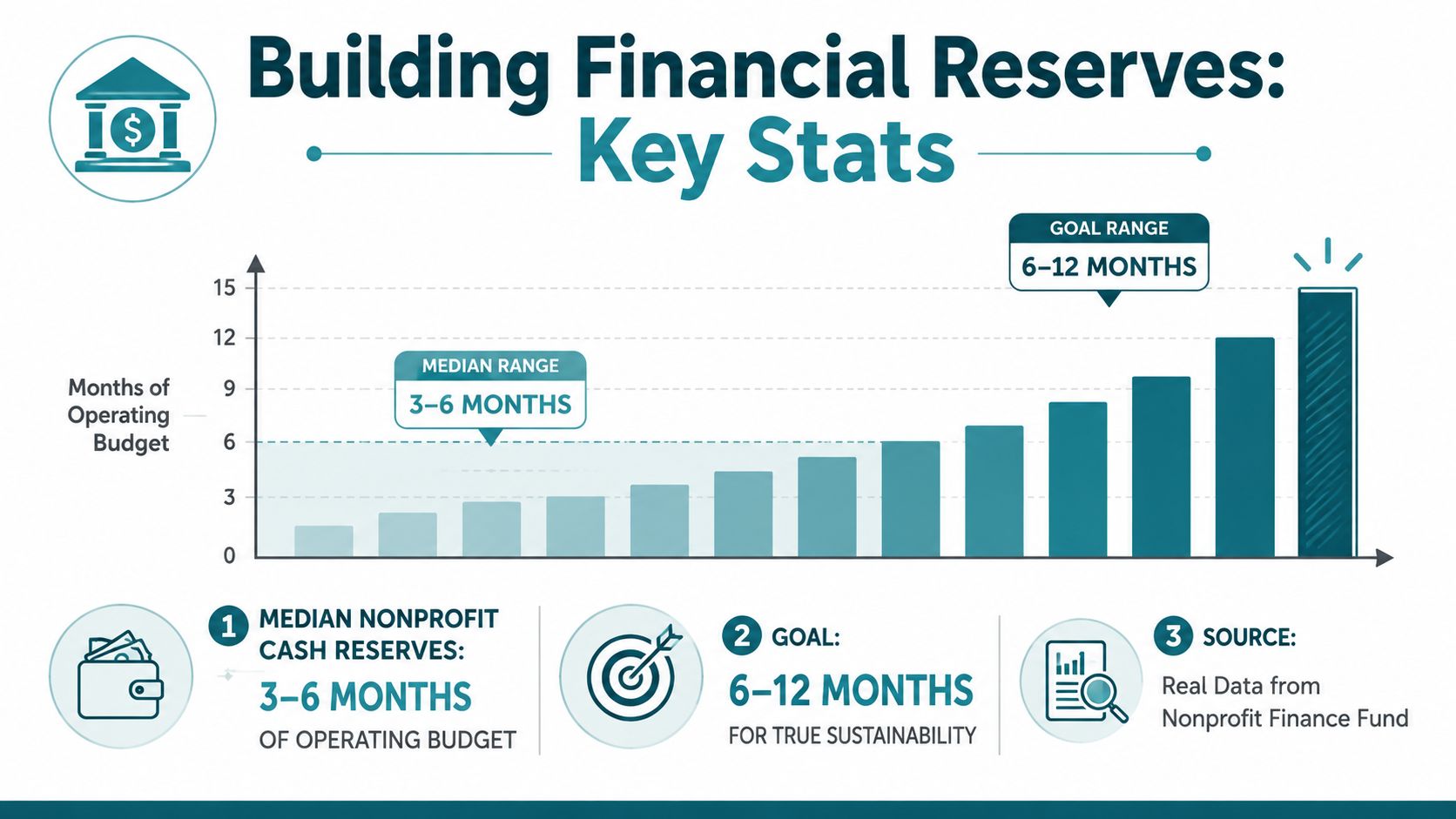
    The reserve numbers show why that matters. A 2025 survey found that 30% of nonprofits had no reserve funds at all, another 19% had reserves for less than three months of operating expenses, and only 15% had more than one year of reserves, while about two-thirds said unrestricted revenue did not increase from 2024 to 2025 (FNA Nonprofits Survey 2025 report). A thin cushion leaves no room for a missed payment, a broken tool, or a slow month.

    Read cash like weather

    I learned to read reserves the same way I read a storm line. If the forecast turns ugly and you already have supplies, you keep moving. If you do not, every surprise turns into a stoppage, and the crew feels it.

    A chart showing the recommended financial reserves for nonprofits as three to twelve months of budget.

    I start with simple cash targets. Cover the stretch you need to survive first, then build from there. The goal is not to pile up money for show, it is to keep the work alive when the month turns messy.

    Use outside support without changing your culture

    Public and philanthropic support already carries a lot of environmental work. In the United States, nonprofits focused on climate change were estimated to spend between $7.8 billion and $9.2 billion annually, with 49% going to mitigation and 14% to adaptation, and philanthropic sources supplied about 88% of that funding in fiscal year 2021 (Philanthropy News Digest). Federal energy and environmental infrastructure programs also invested $69.96 billion in nonprofit organizations from 2010 to 2024, with annual federal investment rising from $5.34 billion in 2010 to $29.79 billion in 2024.

    That gives you room to build a funding mix that respects volunteer time. You do not need to squeeze every dollar out of the same people who show up to haul bags and plant trees. A practical first pass is to look at corporate sponsorship ideas and judge them by fit, not desperation.

    A Practical Approach to Strategic Planning

    A lot of nonprofit planning fails because people confuse activity with direction. They make a long spreadsheet, then keep doing the same things with better formatting. I've done that too, and it doesn't save you.

    Pick a few outcomes and track them hard

    The strongest planning loop I've seen starts small. Define 3 to 5 mission-critical outcomes, turn each one into a quarterly metric, give each metric an owner, then review the results against resource, staff, and mission dashboards. That approach lines up with research that found a strong positive correlation between strategic planning and sustainability, with ρ = 0.759 and p < 0.01 (PMC study). The same study also reflects what McKinsey observed, nonprofits often track dollars raised, membership growth, people served, and overhead, but a better system also watches resource mobilization, staff effectiveness, and mission progress.

    I use three simple questions when I plan:

    1. What do we need to happen this quarter?
    2. Who owns each result?
    3. What will I check before the quarter ends?

    That keeps the work concrete. It also keeps me from hiding behind vague goals like “grow awareness” or “do more outreach,” which sound nice and do almost nothing.

    Measure more than money

    Money matters, but so do the people doing the work and the impact they create. If your dashboard only tells you how much money came in, you'll miss the moment your team starts fading.

    That is why I keep reviews short and regular. I want to know what broke, what held, and what needs a change before the next cleanup day arrives.

    For a visual version of that rhythm, the loop is simple. Define the outcomes. Build the action plan. Review, then adjust.

    The video below fits that same mindset.

    If you want a sample of how I think about partner work inside a plan, I'd point you to community partnership development.

    Earning Community Trust Block by Block

    The first time I saw an empty lot at auction, I didn't think about a logo or a media moment. I thought about what it would feel like to turn dead space into somewhere a neighborhood could use. That lot became Caterpillar Park in Englewood, and the path to it ran through a lot of small cleanup days.

    Trust grows from repetition

    We clean all 50 wards, including the places people avoid. That choice matters because trust usually forms where people expect you not to show up. When a group keeps showing up in rough weather and rougher blocks, neighbors start reading your behavior instead of your pitch.

    That's the deeper story behind community trust. People need to see consistency before they believe your words. They need to watch you pick up trash in the same place more than once. Then they start opening doors.

    Be a bridge, not a savior

    Research on low-infrastructure settings makes a sharp point. Many social problems persist because interventions don't reach underserved communities, and nonprofits often work best as bridging agents rather than inventing brand-new solutions from scratch (BYU Journal of Nonprofit and Social Innovation). I agree with that instinct. Most neighborhoods already know what they need. They need access, repetition, and someone who can keep the connection alive.

    That is why last-mile delivery matters more than clever branding. If a park, cleanup, or service path feels unreachable, the idea might be good but the impact stays out of reach.

    Make your reputation local and specific

    I don't think reputation comes from a big statement. I think it comes from one block, one event, one friendly face, and one follow-up text. People remember who listened, who came back, and who kept their word.

    The same logic applies to sustainable service. A nonprofit that earns trust block by block can keep going without shouting. It becomes familiar. Familiarity lowers friction, and lower friction keeps people involved.

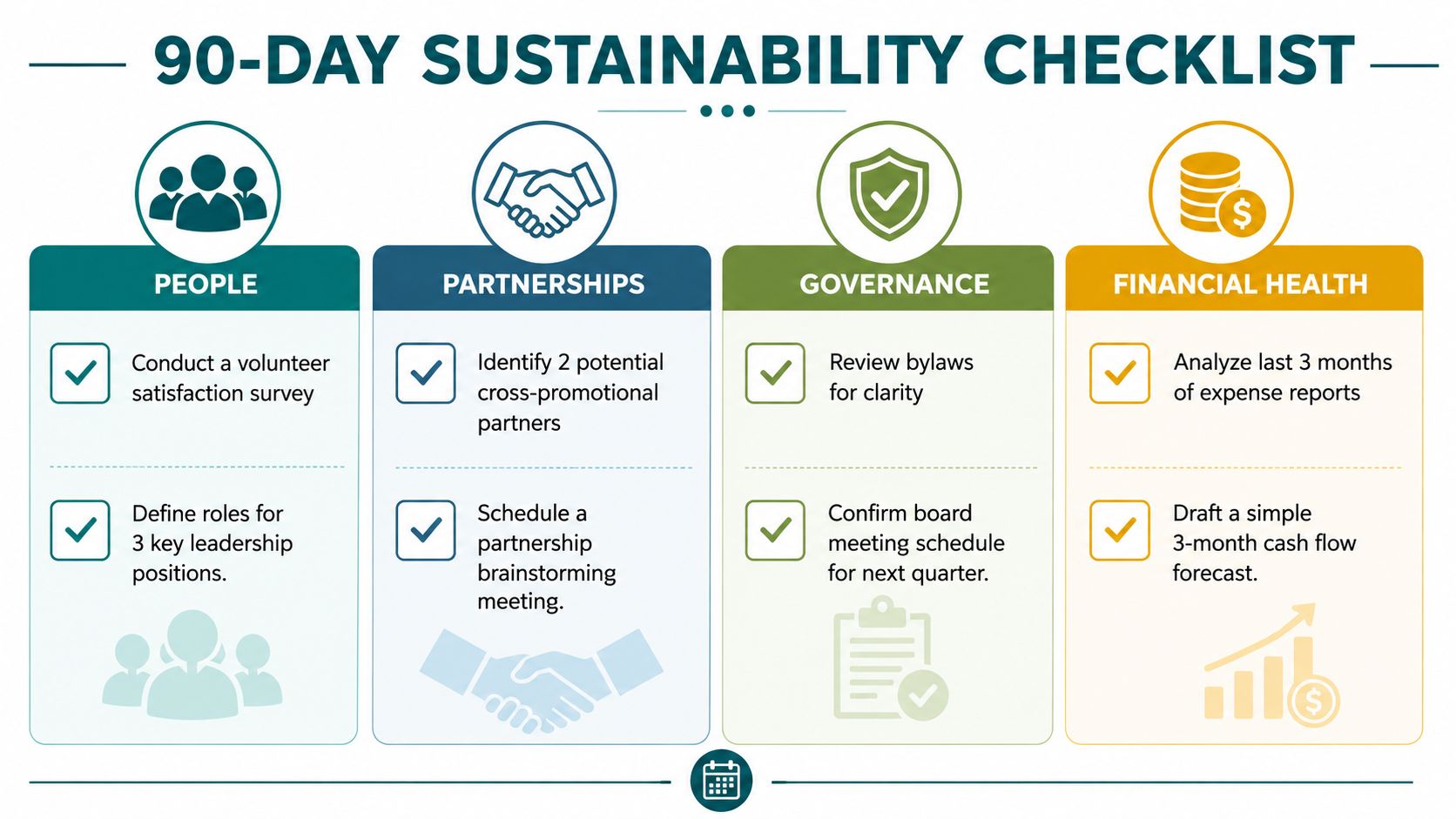
    Your Sustainability Checklist for the Next 90 Days

    If I had to rebuild a volunteer-first nonprofit from scratch, I'd stop talking about “big strategy” and spend the next 90 days on four things, people, partnerships, governance, and money. I've seen crews hold together through blizzards and heat waves when those four pieces were clear. I've also seen good missions stumble because nobody knew who was answering messages, who was checking supplies, or who was watching the bank balance.

    A 90-day sustainability checklist infographic for organizations covering people, partnerships, governance, and financial health categories.

    Days 1 to 30

    Start with the people who already carry the mission. Ask what helps them stay, what wears them out, and what makes the work feel worth it. Then name who owns the roles that keep things from slipping through the cracks, because volunteer energy disappears fast when every task floats around unanswered.

    A founder I know in Chicago keeps this simple. The group cleans across all 50 wards and helps build parks, but nobody gets pressured to donate money before they are welcomed onto a cleanup. That choice matters. It tells volunteers their time is the contribution, and it keeps the door open for people who want to help without being sold to.

    Days 31 to 60

    Move to partnerships and governance. Set one meeting with a possible partner, review your bylaws, and make sure your board schedule is clear for the next quarter. Write down what happens when a grant ends, who takes over, what changes, and what stays.

    Research on nonprofit sustainment shows that continuation can fall well below initial implementation, so the safe move is to plan for the handoff before the handoff arrives. A PMC study found that in one nonprofit partnership study, 56.8% of 937 partnerships continued for one year, even though implementation was very high at 98.4% overall and 89.1% for strongly implemented scoping items (PMC study). I use that gap as a warning. Getting a program started is not the same as keeping it alive.

    Days 61 to 90

    Finish with money and review. Look at your last three months of expenses, draft a simple three-month cash flow forecast, and set your first reserve target. Then run one quarterly planning review with your team and ask what moved, what stalled, and what needs a new owner.

    Practical rule: If you cannot explain your next 90 days in one page, your group is probably carrying too much guesswork.

    I also like to use one simple self-check at the end of each quarter. Did people show up? Did partners respond? Did the board stay useful? Did cash move in a stable direction? If the answer is mixed, that's fine. You adjust and keep going.

    If you want a crew that thinks this way in the world, Litter Caterpillars has built a volunteer-first model around cleanup, friendship, and steady action. Visit, join a cleanup, and see how a group can protect volunteer energy while staying useful block by block.

  • Volunteer Engagement Strategies: 10 Ways to Build a Tribe

    Volunteer Engagement Strategies: 10 Ways to Build a Tribe

    More Than Picking Up Trash

    I used to have trouble cleaning my own room. An old jar of blueberry jam in the back of my fridge could stop me cold because it carried a memory, and a bag of nuts from some failed health kick felt weirdly heavy. My place was a mess, and my life was too.

    Then I found out that cleaning up other people's messes felt easier. I started Litter Caterpillars with a tiny crew, and on our first day Chicago hit us with hail and slush. We hid under a tree, freezing, laughing, and watching our rides cancel one after another. That was the day I learned something strange. Hard service can be fun if people feel like they belong inside the story.

    A lot of volunteer engagement strategies sound clean on paper. Better onboarding. Better reminders. Better appreciation. Sure. Use all that. But if you've ever tried to get people out of bed on a cold Saturday morning to do wet, dirty, unglamorous work, you know the truth. People don't return because your signup form looks nice. They return because something in the group grabs them by the heart.

    The country has had a real drop in formal volunteering. The Council of Nonprofits points to research showing it fell more than 23% between 2019 and 2021, from 30.0% of the public to 23.2%, and nearly half of nonprofit CEOs surveyed in mid-2022 still said recruiting enough volunteers was a “big problem” (Council of Nonprofits on new volunteer data). So I stopped building for vague goodwill. I started building for identity, grit, friendship, and repeat attendance.

    These are the ten moves that helped us build a tribe.

    1. Community Identity and Pride Building

    The first time I realized this mattered, we were still a tiny cleanup crew with trash grabbers and bad weather luck. We didn't have money. We didn't have polish. We had a hail-storm origin story, a name people remembered, and eventually a theme song by Ella Duke that made the whole thing feel real.

    That changed everything. A volunteer stopped feeling like a random helper and started feeling like a Caterpillar.

    Three happy diverse volunteers in white shirts smiling against a watercolor background with musical notes symbols.

    Make people proud to join

    Sports teams know this. AmeriCorps knows this. Rotary clubs know this. Badges, uniforms, songs, rituals, and little symbols look small from the outside, but they tell a person, “You're part of something.”

    If you want better volunteer engagement strategies, give people a name they can wear in their own head. “I'm helping out” is weak. “I'm one of us” is strong.

    Here's what I'd build early:

    • A story-rich symbol: Our logo matters because it came from that first frozen cleanup. People remember stories better than graphics.
    • A simple ritual: Start every event the same way. Short welcome. Safety note. Group photo. Cheer. Repetition builds belonging.
    • Something people can earn: A badge, patch, glove color, or silly title can mean more than you'd think when it marks effort.
    • Shared language: We call people Caterpillars because transformation is the point.

    Practical rule: Don't buy identity off a shelf. Let volunteers help create it.

    If you want a deeper feel for why this works, I'd read our piece on civic pride and what it does to a neighborhood. Pride gets a bad rap because people confuse it with ego. I don't mean ego. I mean the healthy kind of pride that makes you stand taller with a trash bag in your hand.

    When someone says, “I'm proud to be part of this,” your retention problem gets lighter.

    2. Strategic Timing and Schedule Filtering

    We clean on weekend mornings on purpose. I didn't land there by accident. I wanted a schedule that attracted people who like giving more than drifting.

    That choice filtered our culture before I ever said a word.

    Your calendar recruits your people

    CrossFit gyms understand this. Dawn running clubs understand this too. If you meet early, consistently, and without apology, you gather people who like discipline, service, and rhythm. If your event moves around constantly, your culture moves around too.

    I've learned that schedule is moral architecture. It shapes who walks through the door.

    A few things happen when you lock in a repeat time:

    • Habits form faster: People stop negotiating with themselves every week.
    • Expectation gets simpler: “Saturday morning” becomes part of life, not a special event.
    • Values become visible: You demonstrate, “This is who we are.”
    • Drama drops: Fewer last-minute debates, fewer mixed signals.

    Be consistent enough to become part of someone's identity

    If you cancel often, people stop trusting the rhythm. If you move the time every other week, attendance becomes a gamble. I'd rather have a harder time slot with stronger consistency than an easier time slot with chaos.

    One of my favorite sights is a volunteer showing up sleepy, coffee in hand, because they've done it enough times that the choice is already made. That's when your group stops being an activity and starts becoming a practice.

    Some people won't like your time. Good. You're not trying to attract everybody.

    A lot of volunteer engagement strategies chase maximum convenience. I get why. But convenience alone doesn't build a tribe. Sometimes a little friction is useful if it filters for people who mean it.

    3. Low-Barrier Entry With Multiple Access Platforms

    A person sees your cleanup on Instagram. Another finds you on Meetup. Someone else joins because a friend dropped them into a group chat the night before. Good. That's how real life works.

    I don't want a future volunteer to solve a puzzle just to find us.

    Make the first yes easy

    For us, Meetup works well as a clean public doorway. Instagram helps us show the spirit of the crew. Group chats help with real-time coordination, jokes, weather updates, and “I'm running five minutes late” honesty.

    Different people need different doors. The shy person may lurk on Instagram first. The organized person may want a proper event page. The social one may trust a friend's text more than any website you build.

    Recent guidance on volunteer communication keeps pointing toward email, text, portals, segmented communication, and online communities, but the primary challenge is turning digital discovery into real belonging (Momentive Software on increasing volunteer engagement). I've felt that gap myself. The channel matters less than what happens after the first click.

    Use each platform for its real job

    Don't force every platform to do everything.

    • Meetup for discoverability: Let strangers find a clear date, time, and place.
    • Instagram for feeling: Show faces, muddy gloves, weird weather, neighborhood wins.
    • Group chat for momentum: Reminders, quick updates, and post-cleanup banter keep the pulse alive.
    • Email for substance: Put details, safety notes, and recaps somewhere people can find later.

    A lot of volunteer engagement strategies fail right here because they make newcomers feel dumb. “Fill out this form, wait for approval, read this packet, create a password, then maybe come next month.” No thanks.

    I want first-timers to feel like they can just show up. If they don't know the drill, I teach the drill on the sidewalk in two minutes. That's how you lower fear. That's how you grow.

    4. Volunteer-First and Never Monetize Volunteers

    I have a rule I value. I won't squeeze volunteers for money.

    If somebody gave me their Saturday morning, their body, their attention, and their goodwill, I'm not going to turn around and shake them upside down for a donation.

    Protect the energy people give you

    Volunteer energy is fragile. Once people feel used, it's hard to get the trust back. I'd rather build grants, sponsorships, and donor support somewhere else than muddy the relationship with the people doing the work.

    That rule has become part of our culture. It tells volunteers, “You are not a wallet with legs. You are a person.”

    The broader field keeps moving toward treating volunteer engagement as a formal management function instead of an extra chore. In a national survey of 1,210 nonprofit CEOs, the median Volunteer Engagement Professional in 2022 spent 40 to 50% of their time on volunteer engagement, compared with about 30% in 2003, and the share of organizations with no dedicated volunteer engagement specialist was cut roughly in half after the pandemic (The State of Volunteer Engagement report PDF). That matches what I've lived. Trust, follow-up, scheduling, recognition, and care take real work.

    Put the rule in writing

    I'd make this plain to your team:

    • Volunteers are there to serve, not to fundraise.
    • Safety comes first.
    • Happiness comes right after safety.
    • Recognition should be generous and non-monetary.

    If you want to build better repeat attendance, protect people from the feeling of being harvested. I wrote more about that in our guide to volunteer retention strategies.

    If a volunteer leaves feeling drained, guilty, or pitched at, you've taken more than you gave.

    A volunteer-first culture sounds soft. It isn't. It's disciplined. It forces you to build a real operating model instead of leaning on the easiest people in the room.

    5. Embracing Challenge and Reframing Difficulty as Growth

    I don't hide the hard part of cleanup work. Cold fingers. Wet shoes. Strange smells. Wind in your face. Blocks that look forgotten. I talk about all of it openly.

    Then I frame it the right way. This is the flavor.

    Hard days become the stories people carry home

    That first hail storm taught me something. Suffering, within safe limits, can bond people fast. You remember the day your gloves soaked through. You remember the sudden laugh when a trash bag turns into a sail in the wind. You remember the block that looked impossible until it didn't.

    Outward Bound figured this out long ago. Tough experiences, handled well, wake people up. I'm not running wilderness expeditions, but I do know this. Easy service is forgettable. A little hardship can turn a cleanup into a chapter in someone's life.

    The trick is balance. You never gamble with safety. You do tell the truth about the work.

    Sell the transformation, not the comfort

    When I recruit, I don't pretend every day is sunny and cinematic. I tell people Chicago has teeth. I tell them that's part of the fun. Some will opt out. Fine. The right people lean in.

    A few ways to handle challenge well:

    • Name the conditions clearly: Cold, heat, mud, and distance should never be a surprise.
    • Prepare people: Gloves, layers, water, and route expectations matter.
    • Celebrate resilience: After a rough day, say it out loud. “You did something hard.”
    • Tell the stories later: Hard days become folklore. Folklore builds culture.

    The weather is part of the event. It isn't always the enemy.

    Many volunteer engagement strategies try to remove every ounce of discomfort. I think that misses something human. A challenge can make people feel alive. It can also make service feel earned, and earned memories last longer than comfortable ones.

    6. Hyperlocal Neighborhood Coverage and Geographic Equity

    A city can tell when you only love its pretty parts.

    If you keep cleaning the same polished blocks because they photograph well, people notice. I wanted our crew to go where the mess was, even when those places were less convenient, less trendy, or farther from where volunteers lived.

    A hand placing a pin on a colorful watercolor city map representing location targeting and engagement.

    Make a map and mean it

    Litter Caterpillars works across all 50 wards in Chicago. That changes how volunteers see the city. It also changes how the city sees us. We're not just cleaning where it's easy to get brunch after. We're building a relationship with the whole place.

    That kind of coverage creates a different kind of pride. A volunteer who has served in many neighborhoods starts to feel stitched into the city itself.

    Here's what helps:

    • Map your territory: Put your service area where volunteers can see it.
    • Rotate neighborhoods on purpose: Don't let convenience narrow your mission.
    • Treat every area with equal respect: A block in Englewood deserves the same enthusiasm as a block downtown.
    • Build local ties: Residents, block clubs, and nearby groups can tell you what matters most.

    Repetition changes what people believe

    One cleanup can feel symbolic. Repeated presence feels real. If you return often enough, residents learn your name, volunteers learn the streets, and the work stops feeling like charity tourism.

    Place-based service is emotional. A person remembers where they worked. They remember the alley, the vacant lot, the corner store owner who waved, the kid who asked for a grabber. Geography turns abstract service into lived memory.

    I've found that some of the strongest friendships in our crew grew on blocks people had never visited before. Shared unfamiliar ground does that. It wakes up curiosity. It knocks loose assumptions. It gives people something real to talk about on the ride home.

    7. Friendship and Relationship Building as Primary Outcome

    If all you give volunteers is a task, they'll compare you to every other task in town. If you give them friends, that's different.

    Some people come to pick up trash. A lot of them stay because they start caring about the people next to them.

    Three smiling diverse volunteers sitting on a bench resting and holding coffee cups after a cleanup project.

    Build room for connection

    Habitat for Humanity crews often bond because they're side by side for long stretches. Running clubs do this too. The workout matters, but the talk before and after often matters more.

    Cleanup groups can copy that. Pair people up. Walk in small clusters. Get breakfast after. Let a new person carry a bag with someone who knows the ropes instead of leaving them alone with their thoughts.

    A few habits help a lot:

    • Do introductions every time: Even regulars forget names.
    • Create repeat pairings: Familiarity grows trust.
    • Celebrate personal moments: New job, birthday, breakup survived, exam finished. All of it counts.
    • Keep talking after the event: Group chats shouldn't die when the bags hit the dumpster.

    Treat belonging like part of the mission

    One practitioner guide I like points volunteer teams toward four core KPIs: New Volunteer Conversion Rate, Annual Volunteer Retention Rate, Annual Event Participation Rate, and Monthly Churn Rate. The same framework also recommends tracking average engagement per volunteer as total hours served divided by unique volunteers, and it suggests monthly reviews, quarterly deeper reviews, and annual year-over-year evaluations (VolPro on outcome metrics for volunteer programs). I like that because friendship is beautiful, but you still need to watch whether people return.

    If I saw event participation sagging or churn rising, I wouldn't only tweak reminders. I'd ask a human question. Do people have friends here yet?

    People rarely say, “I'm returning for the retention architecture.” They come back because somebody will notice if they don't.

    A lot of volunteer engagement strategies talk about appreciation. Good. But friendship beats appreciation for long-term staying power. A thank-you note is nice. A friend texting “you coming Saturday?” is stronger.

    8. Visible, Transformative Impact Projects

    Routine cleanups keep your muscles warm. Big visible projects light a fire in people.

    I learned that when our work started stretching past bags of litter and into places where you could see a whole space change character.

    A person planting a tree in a park transformation from a barren field to a green space.

    Give people something they can point at

    An empty lot turned into Caterpillar Park in Englewood is different from a single cleanup route. Cleaning a highway during a bike-event shutdown feels different too. People can tell the story later with a beginning, middle, and end.

    That kind of work changes volunteer psychology. Instead of “we helped a bit,” the feeling becomes “we built this.” That sentence has power.

    Big projects also pull in different kinds of volunteers. Some love weekly rhythm. Others wake up when there's a flagship challenge with a visible finish line.

    A few ways I consider this:

    • Start with one project people can see clearly.
    • Document the process, not only the finish.
    • Invite neighbors into the story.
    • Celebrate completion in public.

    Show the process so people can feel progress

    Photos and short videos matter here because transformation is easier to believe when people can see before and after. A muddy lot becoming a usable space lands in the gut.

    This kind of project also creates better recruitment material than a generic mission statement ever will. A newcomer can look at the work and think, “Oh, you do things.”

    Here's one example of a transformation story in motion:

    A person who spends one morning picking up loose bottles may feel helpful. A person who helps reshape a whole lot or corridor feels changed. That's a different level of ownership, and ownership is one of the strongest volunteer engagement strategies I know.

    9. Personal Transformation and Self-Leadership Development

    I didn't start this group because I had my life perfectly together. I started it because I didn't.

    That matters. People can smell fake perfection from a mile away.

    Let service change the volunteer too

    A lot of us come to volunteer work carrying something. Shame. Restlessness. Loneliness. Grief. A bad breakup. A sense that we've been drifting too long. I know that territory well.

    When I tell volunteers I used to struggle to throw away obvious trash in my own home, I'm not trying to be dramatic. I'm telling the truth. Service became a way for me to practice consistency, bravery, and self-respect in public.

    That honesty opens a door. It tells people they don't need to arrive polished.

    Some groups already understand this logic. Recovery communities often use service as part of healing. Teaching and mentoring programs often become growth experiences for the volunteers themselves. Cleanup work can do the same if you let it.

    Give people small chances to lead themselves

    Self-leadership doesn't need a workshop. It needs reps.

    • Ask someone to lead a warm welcome.
    • Let a regular choose the route.
    • Invite a quiet volunteer to bring a friend next time.
    • Trust people with simple responsibility before big responsibility.

    One underserved truth in volunteer engagement is that retention after the novelty fades is often an operating problem, not just a messaging problem. Independent Sector argues for strategic volunteer engagement that is resourced, reported on, and built into leadership decisions (Independent Sector on strategic volunteer engagement). I agree. If you want people to grow through service, you can't treat them like interchangeable labor.

    I've watched volunteers become steadier, kinder, and more confident because they kept showing up. I've seen people who felt awkward at first become the ones greeting everyone else. That's one of my favorite things in this work. Trash leaves the block, sure. But fear leaves the body too, little by little.

    10. Strategic Partnership Development and Community Cohort Recruitment

    You can build a strong crew alone for a while. Then you hit a ceiling.

    At some point, if you want more tools, more reach, better project support, and a steadier flow of new people, you need partners and you need cohorts.

    Recruit groups, not only individuals

    A university club can bring a whole pod of students. A neighborhood association can bring residents who already care about a corridor. A business can send a team that likes working together outside the office. A church group can show up with built-in trust.

    That changes the vibe fast. When people arrive with at least one familiar face, anxiety drops. New volunteers blend in faster. Attendance feels less brittle.

    I also like cohort recruiting because it sharpens your message. Students want one thing. Young professionals may want another. Neighbors want something else. If you speak to everyone the same way, your invitation gets mushy.

    Keep partnerships simple and active

    You don't need fancy memorandums full of legal fog for every relationship. You need clarity.

    Try this:

    • Pick a few natural partners: Neighborhood groups, schools, businesses, local nonprofits.
    • State the exchange plainly: Volunteers, tools, food, space, promotion, project support.
    • Make one person own the relationship: Drift kills partnerships.
    • Celebrate partners in public: People like being appreciated when it's sincere.

    The software side of this work is growing too. One market report projects the volunteer management platform market at a CAGR of 8.6%, growing from USD 1.25 billion in 2024 to USD 2.419 billion by 2032, and ties that growth to centralized databases, automation, mobile access, real-time updates, and analytics (Credence Research on volunteer management platforms). I don't bring that up to sound fancy. I bring it up because if you start building partnerships and cohorts, your coordination load jumps. You need systems that keep the human part alive instead of drowning you in manual follow-up.

    If you're trying to widen the top of the funnel, our guide on volunteer recruitment strategies has ideas that work well with this approach.

    The best partnerships don't feel transactional. They feel like a shared mission with names attached.

    Volunteer Engagement: 10-Point Strategy Comparison

    Strategy 🔄 Implementation Complexity ⚡ Resource Requirements 📊 Expected Outcomes (⭐) Ideal Use Cases 💡 Key Advantages / Tips
    Community Identity and Pride Building Medium, requires creative coordination and authenticity Design time, modest budget for badges/merch, volunteer input Strong retention, morale, organic recruitment ⭐⭐⭐ Groups seeking loyalty, brand differentiation, long-term volunteers Involve volunteers in design; keep symbols meaningful and authentic
    Strategic Timing and Schedule Filtering Low–Medium, planning + rigorous consistency Low financial cost, high scheduling discipline Reliable, values‑aligned participation; lower churn ⭐⭐⭐ Programs needing committed habitual volunteers (weekend/AM) Be consistent; communicate intentional timing as culture
    Low-Barrier Entry with Multiple Access Platforms Medium, multi-channel coordination Time for platform management, basic tools High recruitment and reach but lower initial commitment ⭐⭐ Rapid growth, diverse urban communities, discovery-focused recruitment Use Meetup for discoverability; ensure consistent messaging
    Volunteer-First and Never Monetize Volunteers Low, policy implementation + leadership discipline Needs alternative fundraising resources (grants/sponsors) Deep trust and volunteer loyalty; possible short-term revenue limits ⭐⭐⭐ Mission-driven groups prioritizing volunteer goodwill Put policy in writing; train leaders to redirect donation asks
    Embracing Challenge and Reframing Difficulty as Growth Medium, narrative work + safety management Safety protocols, staff oversight, storytelling effort Strong psychological commitment and memorable experiences ⭐⭐ Organizations aiming for transformational, resilient volunteers Prioritize safety; clearly signal this approach isn't for everyone
    Hyperlocal Neighborhood Coverage and Geographic Equity High, complex logistics and coordination Travel, scheduling, local partnerships, mapping tools Tangible equitable impact and community trust ⭐⭐⭐ Citywide equity initiatives and underserved-area outreach Map coverage publicly; build local leader relationships
    Friendship and Relationship Building as Primary Outcome Medium, needs social facilitation skills Time for social events, facilitators, small-team coordination Very high retention and wellbeing benefits ⭐⭐⭐ Retention-focused groups and community‑building missions Schedule social time; use consistent small teams for bonding
    Visible, Transformative Impact Projects High, planning, permits, specialized skills Significant capital, expert partners, project management Major media attention, funding, and visible legacy ⭐⭐⭐ Flagship projects to attract partners and prove impact Start small, document progress, involve community in design
    Personal Transformation and Self-Leadership Development Medium–High, requires vulnerable leadership & structures Mentorship programs, leader training, safe spaces Deep volunteer investment and leadership pipeline ⭐⭐⭐ Programs attracting personal-growth seekers and leaders Share founder stories, provide mentorship, set clear boundaries
    Strategic Partnership Development & Cohort Recruitment High, relationship management and negotiation Staff time, formal agreements, partner coordination Multiplied resources, credibility, expanded recruitment ⭐⭐⭐ Scaling organizations seeking funding, cohorts, or municipal support Choose 3–5 aligned partners, formalize simply, track partnership ROI

    Start Your Own Transformation

    That messy room I started with is still a work in progress, and so am I. I think that's healthy. I don't trust the kind of service story where the founder acts like he climbed a mountain, planted a flag, and solved himself forever. Real life is messier than that. Some mornings I still fight resistance. Some weeks I still need the group as much as the group needs me.

    That's part of why these volunteer engagement strategies matter to me. They aren't tricks for squeezing more labor out of people. They are ways to build a place where people can become stronger, kinder, and more alive together. If you've ever felt stuck, lonely, scattered, or scared of your own inconsistency, a good volunteer crew can help. Mine did.

    I'd start smaller than you think. Don't try to build the whole machine in one weekend. Pick one move from this list and make it real. Create a stronger identity. Lock in a consistent time. Open a second signup channel. Protect volunteers from being monetized. Add breakfast after the cleanup. Map your neighborhoods. Build one project people can point at. Any one of those can change the feel of your group.

    Keep your eye on returning faces. That is the test. A person coming once is interest. A person coming back is trust. If you're running a volunteer group, I'd watch the whole volunteer journey with care, because vague participation counts won't tell you enough. The strongest programs track things like conversion, retention, event participation, and churn so they can see where people are dropping off and fix the experience before drift turns into loss. You don't need to become a spreadsheet robot. You do need to pay attention.

    I also wouldn't wait for perfect conditions. We didn't get perfect conditions. We got hail, cold hands, and canceled rides. We got a weird little origin story and built from there. A lot of the best community work starts that way. You act before you feel ready. You learn in public. You laugh when things go sideways. You keep going.

    If you're in Chicago, Litter Caterpillars is one place to do that. We clean weekly, rain or shine, and we care a lot about friendship, safety, and showing up for every part of the city. If you're somewhere else, build your own version. Steal the spirit and make it fit your block, your weather, your people.

    The hardest part is starting. The best part is seeing who you become when you do.


    If you want a crew to join, Litter Caterpillars organizes volunteer-driven cleanups across Chicago and makes it easy to plug in through weekly events, neighborhood service, and a community built around friendship and resilience.