

We were halfway through a Chicago hailstorm when three of us bent down to pick up cups, wrappers, and broken bottle glass from the curb. One Uber after another canceled, and we laughed because the trash was easier to move than our own plans.
That day taught me something I still use every week. Nonprofit sustainability starts when people keep showing up through bad weather, awkward moods, and unfinished work.
Why Most Nonprofits Fail Before They Start
I remember that first cleanup because nothing about it felt polished. We had no polished pitch, no neat budget deck, no donor list, just three people, a storm, and a block that needed work. That kind of beginning is messy, but it tells the truth about how volunteer groups survive.
Start with the person, not the spreadsheet
My own life was a mess before the group ever existed. I had trouble cleaning and organizing my space, and every little thing I owned felt stuck in place because I had attached a story to it. Trash looked small from the outside, but inside my head it carried weight, and that made consistency hard.
So I built the group around the problem I needed to solve in myself. I wanted a circle that filtered out selfishness, because I had already lived through a chaotic relationship that made me tired of people who only wanted to party and take. That choice shaped everything that came after, from the tone of our events to the people who stayed.
Practical rule: If your mission only helps other people and never helps your volunteers become better versions of themselves, you will keep losing the people who make the work possible.
That is why so many groups fade early. They ask people to care, but they never give them a reason to belong. They ask for labor, but they never build a rhythm that feels human.
Build a repeatable habit, not a heroic sprint
Our first cleanup in the hailstorm was awful in one way and perfect in another. We were freezing, traffic was bad, and the day felt ridiculous, but the chaos created a story that people wanted to return to. I learned that sustainability grows from repeatable habit, clear identity, and a group that knows why it gathers.
The Community-Wealth green manual lays out a simple loop, measure impacts, survey employees, determine priorities, create an action plan, and repeat, plus practical moves like energy audits and switching printers to double-sided the manual's five-step process. I use that kind of sequence in my head all the time. First I look at what hurts. Then I ask who feels it. Then I choose the next action.
The hardest mistake is thinking a nonprofit needs a perfect launch. It doesn't. It needs a reason people can feel in their bones, then a way to return next week without forcing themselves.
Protecting Volunteer Energy Above All Else
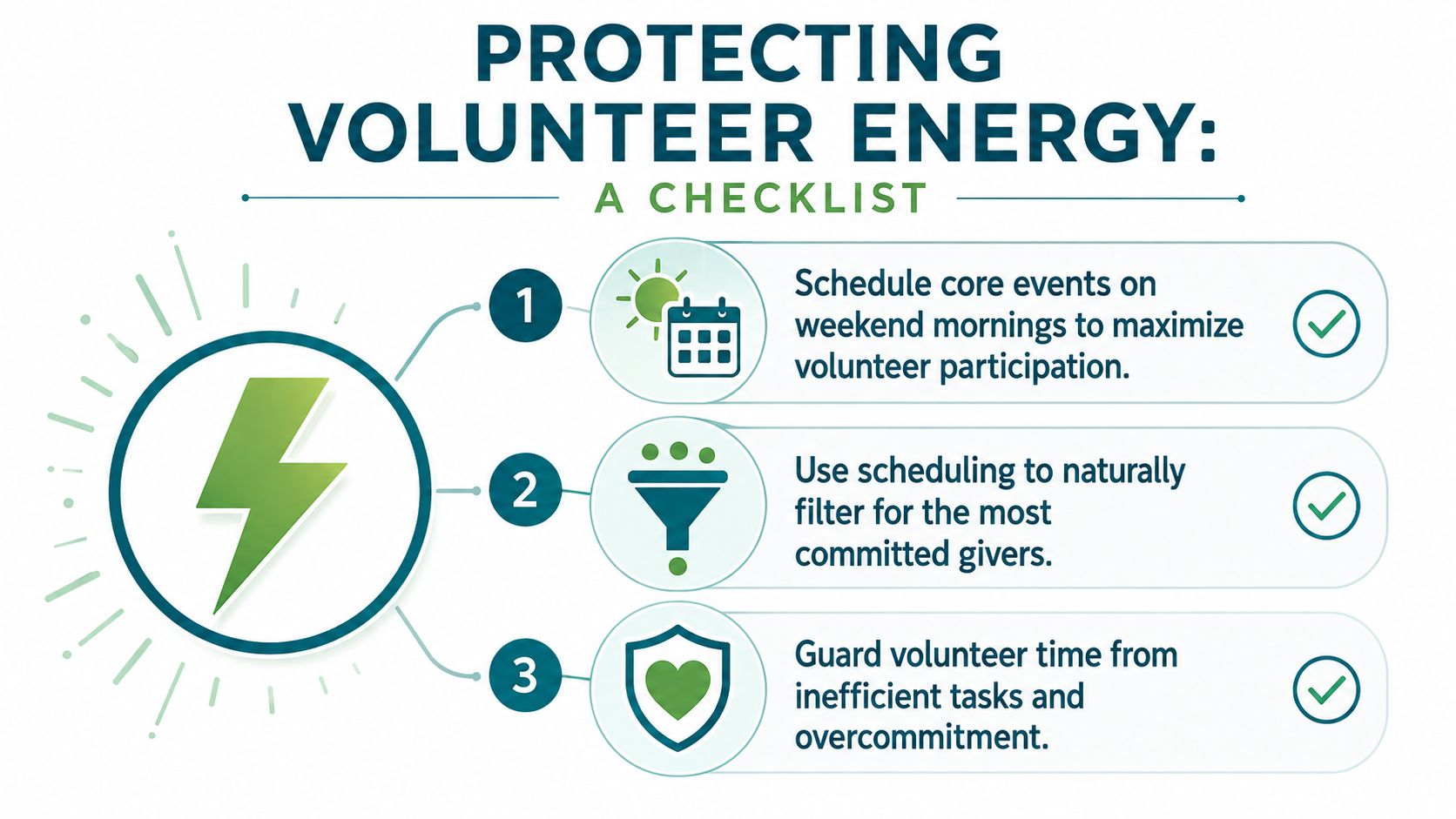
I treat volunteer energy like a battery that drains faster than money ever does. If you spend it badly, you don't get a loud failure. You get silence, no-shows, and a group chat that goes cold.
Schedule for the people you want to keep
Weekend mornings work because they reward intention. The people who wake up early to pick up trash usually want to be there, and that matters more than raw turnout. If you schedule like a party, you attract party energy. If you schedule like service, you attract givers.
That is why I keep events simple and predictable. I want people to know when to show up, what to wear, and how long it'll take. I also want them to leave with enough energy to come back.
Practical rule: Make the first hour easy to understand and hard to fake. The wrong people drift off, the right people stay.
The group's own retention advice lives at our volunteer retention guide, and the lesson is plain. Clarity protects energy. Confusion burns it.
Safety comes first, happiness comes second
I never ask volunteers to prove toughness. I ask them to stay safe, because nobody returns to a group that treats bruises like badges. Happiness comes second, but it still matters, because people remember how they felt more than what they carried.
That means I choose routes with care, keep the task list visible, and watch the weather with a practical eye. Blizzard, heat wave, slush, or calm morning, the rule stays the same. People come before output.
Never turn volunteers into fundraisers
I don't pressure people for donations, because that changes the whole mood. Once a cleanup group starts treating volunteers like a donor pool, people feel it. They stop feeling like neighbors and start feeling like targets.
A volunteer-first group needs a clean emotional contract. Come help. Make friends. Leave proud. That's enough.
When you protect volunteer energy, you stop treating participation like a transaction. You start treating it like a shared ritual.
Building Financial Reserves Without Chasing Donations
On a hard week, I'd rather open the books and see a cushion than start asking volunteers to cover the gap. A cleanup group can keep its dignity intact by building steady support from grants, partnerships, and public backing, instead of turning every person in a glove into a walking fundraiser. That path feels slower at first, but it keeps the work from resting on volunteer guilt.
The reserve numbers show why that matters. A 2025 survey found that 30% of nonprofits had no reserve funds at all, another 19% had reserves for less than three months of operating expenses, and only 15% had more than one year of reserves, while about two-thirds said unrestricted revenue did not increase from 2024 to 2025 (FNA Nonprofits Survey 2025 report). A thin cushion leaves no room for a missed payment, a broken tool, or a slow month.
Read cash like weather
I learned to read reserves the same way I read a storm line. If the forecast turns ugly and you already have supplies, you keep moving. If you do not, every surprise turns into a stoppage, and the crew feels it.
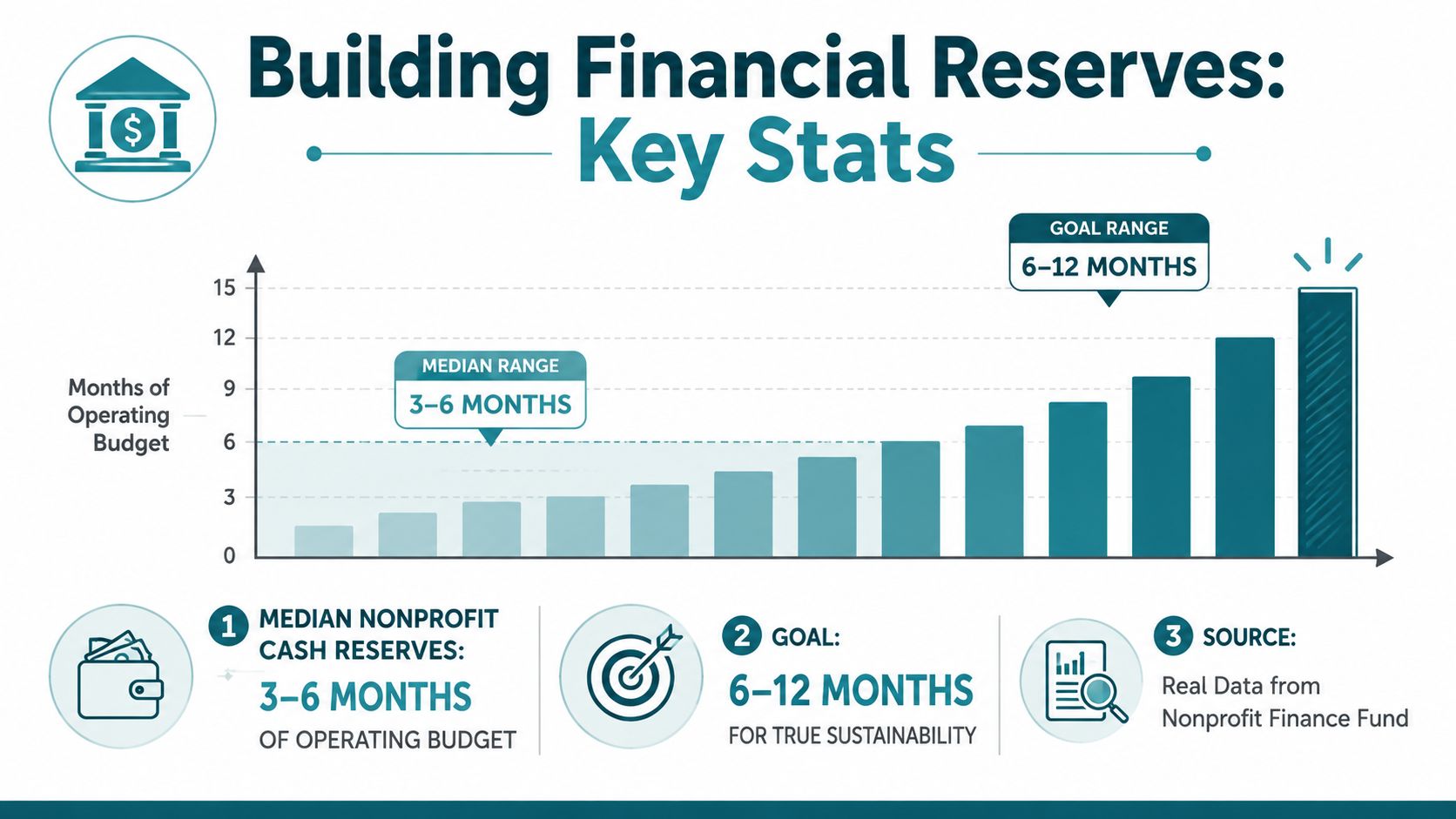
I start with simple cash targets. Cover the stretch you need to survive first, then build from there. The goal is not to pile up money for show, it is to keep the work alive when the month turns messy.
Use outside support without changing your culture
Public and philanthropic support already carries a lot of environmental work. In the United States, nonprofits focused on climate change were estimated to spend between $7.8 billion and $9.2 billion annually, with 49% going to mitigation and 14% to adaptation, and philanthropic sources supplied about 88% of that funding in fiscal year 2021 (Philanthropy News Digest). Federal energy and environmental infrastructure programs also invested $69.96 billion in nonprofit organizations from 2010 to 2024, with annual federal investment rising from $5.34 billion in 2010 to $29.79 billion in 2024.
That gives you room to build a funding mix that respects volunteer time. You do not need to squeeze every dollar out of the same people who show up to haul bags and plant trees. A practical first pass is to look at corporate sponsorship ideas and judge them by fit, not desperation.
A Practical Approach to Strategic Planning
A lot of nonprofit planning fails because people confuse activity with direction. They make a long spreadsheet, then keep doing the same things with better formatting. I've done that too, and it doesn't save you.
Pick a few outcomes and track them hard
The strongest planning loop I've seen starts small. Define 3 to 5 mission-critical outcomes, turn each one into a quarterly metric, give each metric an owner, then review the results against resource, staff, and mission dashboards. That approach lines up with research that found a strong positive correlation between strategic planning and sustainability, with ρ = 0.759 and p < 0.01 (PMC study). The same study also reflects what McKinsey observed, nonprofits often track dollars raised, membership growth, people served, and overhead, but a better system also watches resource mobilization, staff effectiveness, and mission progress.
I use three simple questions when I plan:
- What do we need to happen this quarter?
- Who owns each result?
- What will I check before the quarter ends?
That keeps the work concrete. It also keeps me from hiding behind vague goals like “grow awareness” or “do more outreach,” which sound nice and do almost nothing.
Measure more than money
Money matters, but so do the people doing the work and the impact they create. If your dashboard only tells you how much money came in, you'll miss the moment your team starts fading.
That is why I keep reviews short and regular. I want to know what broke, what held, and what needs a change before the next cleanup day arrives.
For a visual version of that rhythm, the loop is simple. Define the outcomes. Build the action plan. Review, then adjust.
The video below fits that same mindset.
If you want a sample of how I think about partner work inside a plan, I'd point you to community partnership development.
Earning Community Trust Block by Block
The first time I saw an empty lot at auction, I didn't think about a logo or a media moment. I thought about what it would feel like to turn dead space into somewhere a neighborhood could use. That lot became Caterpillar Park in Englewood, and the path to it ran through a lot of small cleanup days.
Trust grows from repetition
We clean all 50 wards, including the places people avoid. That choice matters because trust usually forms where people expect you not to show up. When a group keeps showing up in rough weather and rougher blocks, neighbors start reading your behavior instead of your pitch.
That's the deeper story behind community trust. People need to see consistency before they believe your words. They need to watch you pick up trash in the same place more than once. Then they start opening doors.
Be a bridge, not a savior
Research on low-infrastructure settings makes a sharp point. Many social problems persist because interventions don't reach underserved communities, and nonprofits often work best as bridging agents rather than inventing brand-new solutions from scratch (BYU Journal of Nonprofit and Social Innovation). I agree with that instinct. Most neighborhoods already know what they need. They need access, repetition, and someone who can keep the connection alive.
That is why last-mile delivery matters more than clever branding. If a park, cleanup, or service path feels unreachable, the idea might be good but the impact stays out of reach.
Make your reputation local and specific
I don't think reputation comes from a big statement. I think it comes from one block, one event, one friendly face, and one follow-up text. People remember who listened, who came back, and who kept their word.
The same logic applies to sustainable service. A nonprofit that earns trust block by block can keep going without shouting. It becomes familiar. Familiarity lowers friction, and lower friction keeps people involved.
Your Sustainability Checklist for the Next 90 Days
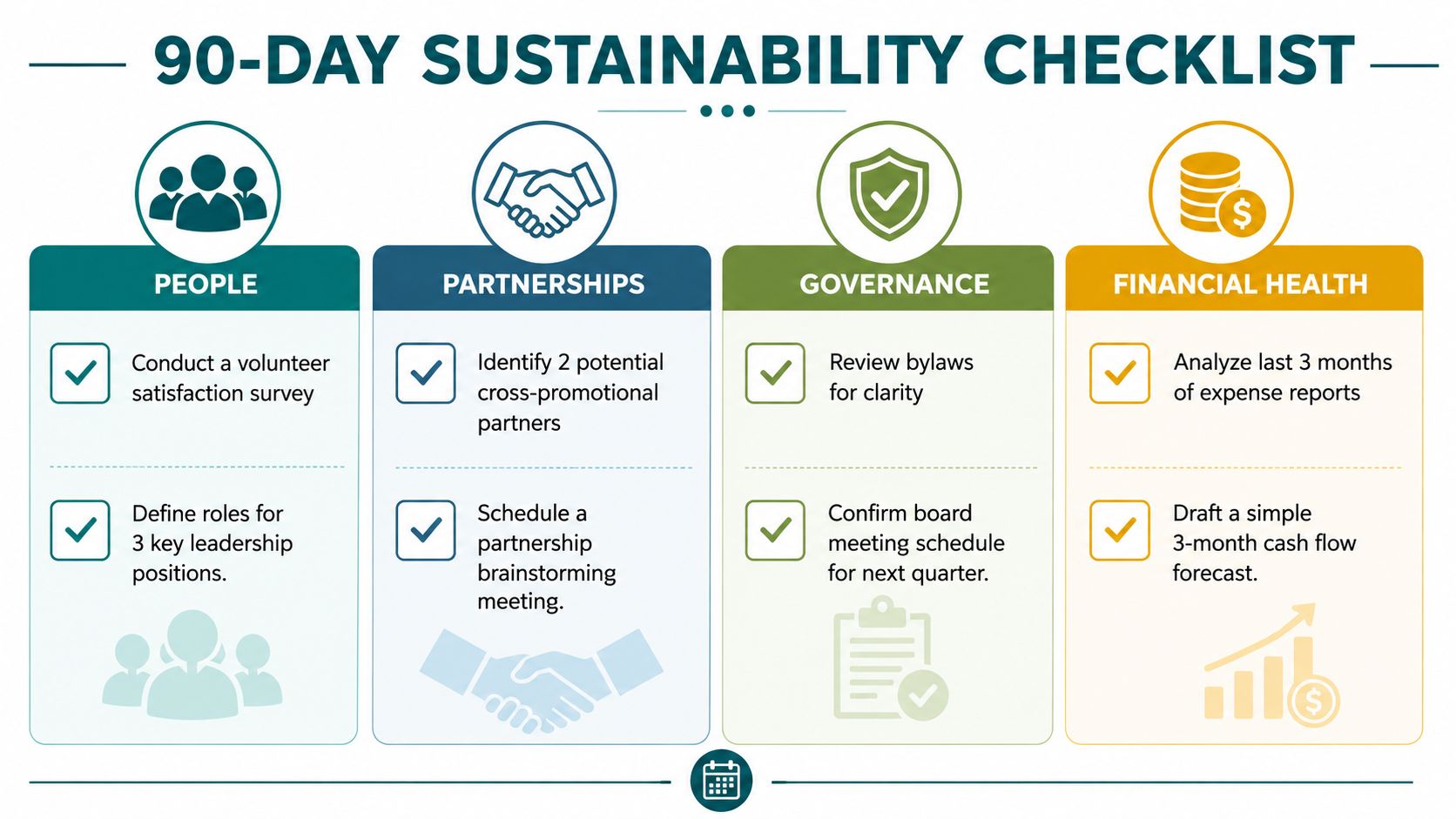
If I had to rebuild a volunteer-first nonprofit from scratch, I'd stop talking about “big strategy” and spend the next 90 days on four things, people, partnerships, governance, and money. I've seen crews hold together through blizzards and heat waves when those four pieces were clear. I've also seen good missions stumble because nobody knew who was answering messages, who was checking supplies, or who was watching the bank balance.
Days 1 to 30
Start with the people who already carry the mission. Ask what helps them stay, what wears them out, and what makes the work feel worth it. Then name who owns the roles that keep things from slipping through the cracks, because volunteer energy disappears fast when every task floats around unanswered.
A founder I know in Chicago keeps this simple. The group cleans across all 50 wards and helps build parks, but nobody gets pressured to donate money before they are welcomed onto a cleanup. That choice matters. It tells volunteers their time is the contribution, and it keeps the door open for people who want to help without being sold to.
Days 31 to 60
Move to partnerships and governance. Set one meeting with a possible partner, review your bylaws, and make sure your board schedule is clear for the next quarter. Write down what happens when a grant ends, who takes over, what changes, and what stays.
Research on nonprofit sustainment shows that continuation can fall well below initial implementation, so the safe move is to plan for the handoff before the handoff arrives. A PMC study found that in one nonprofit partnership study, 56.8% of 937 partnerships continued for one year, even though implementation was very high at 98.4% overall and 89.1% for strongly implemented scoping items (PMC study). I use that gap as a warning. Getting a program started is not the same as keeping it alive.
Days 61 to 90
Finish with money and review. Look at your last three months of expenses, draft a simple three-month cash flow forecast, and set your first reserve target. Then run one quarterly planning review with your team and ask what moved, what stalled, and what needs a new owner.
Practical rule: If you cannot explain your next 90 days in one page, your group is probably carrying too much guesswork.
I also like to use one simple self-check at the end of each quarter. Did people show up? Did partners respond? Did the board stay useful? Did cash move in a stable direction? If the answer is mixed, that's fine. You adjust and keep going.
If you want a crew that thinks this way in the world, Litter Caterpillars has built a volunteer-first model around cleanup, friendship, and steady action. Visit, join a cleanup, and see how a group can protect volunteer energy while staying useful block by block.
Leave a Reply