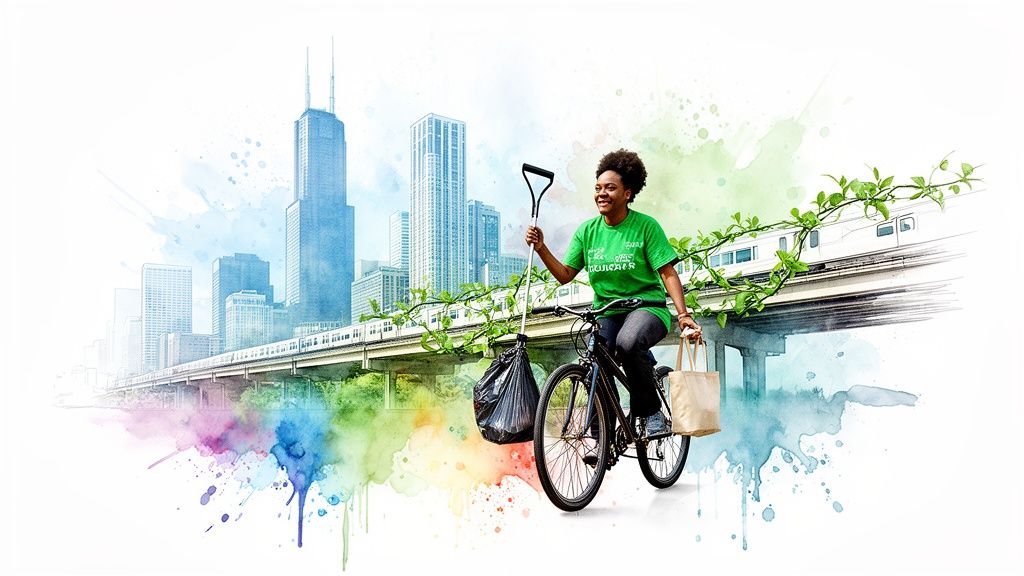
The first time I huddled under a tree in Chicago hail after a cleanup, every Uber kept canceling on us. We were cold, wet, carrying grabbers, and somehow more alive than we had felt all week.
Why Your Commute Is Part of Our Cleanup Story
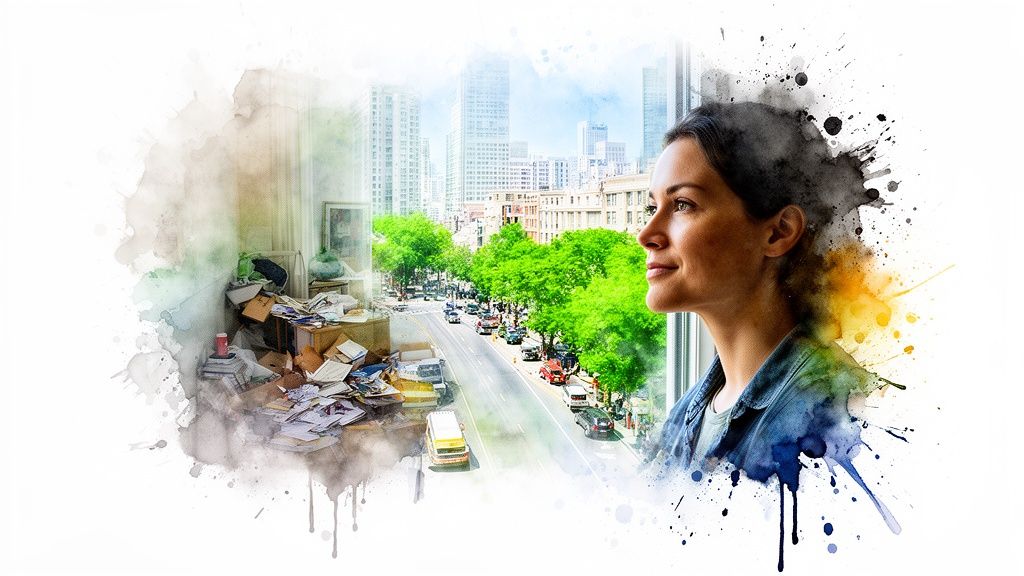
I started picking up litter for a strange reason. I could not clean my own life.
My room felt heavy. My fridge felt heavy. Old containers, expired food, random objects with emotional history. None of it weighed much, but every item felt enormous to me. I knew I needed a way to move again.
Then I started cleaning public spaces, and something clicked. A bottle on a sidewalk did not come with years of guilt. A chip bag in a bush did not come with a memory attached. I could bend down, pick it up, and keep walking. That simple act started loosening something inside me.
The mission starts before the cleanup
I learned that service begins long before your glove touches a piece of trash.
It starts when you leave your home. It starts with the shoes you put on. It starts with whether you rush into a car in frustration or step outside with intention.
When you walk to a cleanup, you notice the broken glass near the curb, the alley that needs help, the mural half-hidden behind weeds. When you bike, you feel the distance between neighborhoods in your legs. When you take the train, you see how one city contains many worlds, all stitched together by tracks and effort.
That matters.
Eco friendly transport is not just a technical choice. It is a mental shift. You stop treating the trip as dead time and start treating it as part of the work.
Travel can clean your mind too
I love the quiet discipline of a good commute. You grab your gloves. You check the weather. You head out even when the sky looks rude. That small act builds character.
A cleanup day can fail before it begins if you arrive angry, flustered, and disconnected. I have felt that. I have also felt the opposite. I have walked to a site with the cold air waking me up and arrived ready to serve.
Those are two different versions of the same morning.
Your route shapes your mindset. If you travel with intention, you arrive with intention.
For me, green travel and cleanup work belong together because both fight the same enemy. Carelessness. One kind leaves trash on the ground. Another kind treats every trip like someone else will absorb the cost.
A Saturday morning feels different when you earn it
There is a special feeling in getting somewhere the hard but honest way. Not miserable hard. Meaningful hard.
You bike through wind. You wait on a platform with a grabber tucked under your arm. You walk the last few blocks and see the street you came to help before anyone else does. That does something to you.
It turns you from a spectator into a participant.
I think a lot about bravery. People usually save that word for giant moments, but I think bravery often looks small. Getting out of bed on a freezing weekend morning is brave. Showing up in a neighborhood you have never visited is brave. Choosing a cleaner way to move through the city when the easier option calls your name is brave too.
Here is what I want you to carry with you. Your commute is not separate from the cleanup. It is the first bag you pick up. The first act of discipline. The first way you tell the city, and yourself, that you care.
What Makes Transport Eco-Friendly Anyway
A lot of people hear the phrase eco friendly transport and think it means buying something expensive or becoming some perfect climate saint. I do not see it that way.
It's like tools.
If you need to tighten one screw, you do not grab a sledgehammer. If you need to carry one backpack across a neighborhood, a private car can be the same kind of overkill. Big machine. Big space. Big side effects.
Use the right tool for the job
That is the simplest definition I know.
Eco-friendly transport means choosing a way to move that matches the task with less waste. Sometimes that is walking. Sometimes it is a bike. Sometimes it is a train. Sometimes it is sharing a ride instead of driving alone.
The point is not purity. The point is fit.
A short trip to a cleanup with light gear might call for walking. A medium trip with some flexibility might fit a bike. A longer cross-city trip might belong to the train or bus. If you need to haul supplies with friends, carpooling can make sense.
Why this matters in plain English
Road traffic carries a giant environmental burden. Road vehicles account for 75% of global transport CO2 emissions, with passenger cars and buses contributing 45.1%, and road transport responsible for about 15% of all global CO2 emissions, according to Neste’s transport emissions data room.
You do not need to memorize that. You just need to understand the pattern.
When a city leans too hard on private road travel for everything, the costs spread everywhere. Air. Noise. Space. Stress. Streets stop feeling like places for people and start feeling like channels for machines.
Green is not only about carbon
I care about emissions, but I also care about what a trip feels like on the ground.
A greener mode often does a few things at once:
- It uses less space: One person walking or biking takes up less room than one person in a car.
- It creates less noise: Quiet movement changes the mood of a street.
- It invites awareness: You see more when you are not sealed away from your surroundings.
- It can build community: Shared routes create chance encounters and repeated human contact.
That is why I resist reducing this topic to a lecture. The issue lives in your body. You feel it in a loud intersection. You feel it on a calm side street. You feel it when a train drops you off and the neighborhood opens up on foot.
Eco friendly transport is less about looking virtuous and more about wasting less.
My rule for daily decisions
I use a rough filter.
Ask yourself three questions before you go:
- How far am I really going
- What am I carrying
- What choice gets me there with the least unnecessary impact
That is it.
Not every trip will be ideal. Life is messy. Schedules break. Weather turns. But if you keep choosing the right tool more often, your habits change. Then your city changes with you.
Choosing Your Ride A Chicago Volunteer's Guide
Chicago does not ask for one perfect commuting style. It asks for adaptability.
Some cleanup mornings start with calm sunshine and a coffee. Others start with wet gloves, missed trains, and a grabber poking awkwardly out of your tote bag. I have learned to stop asking, “What is the best mode?” and start asking, “What is the best mode for this mission?”
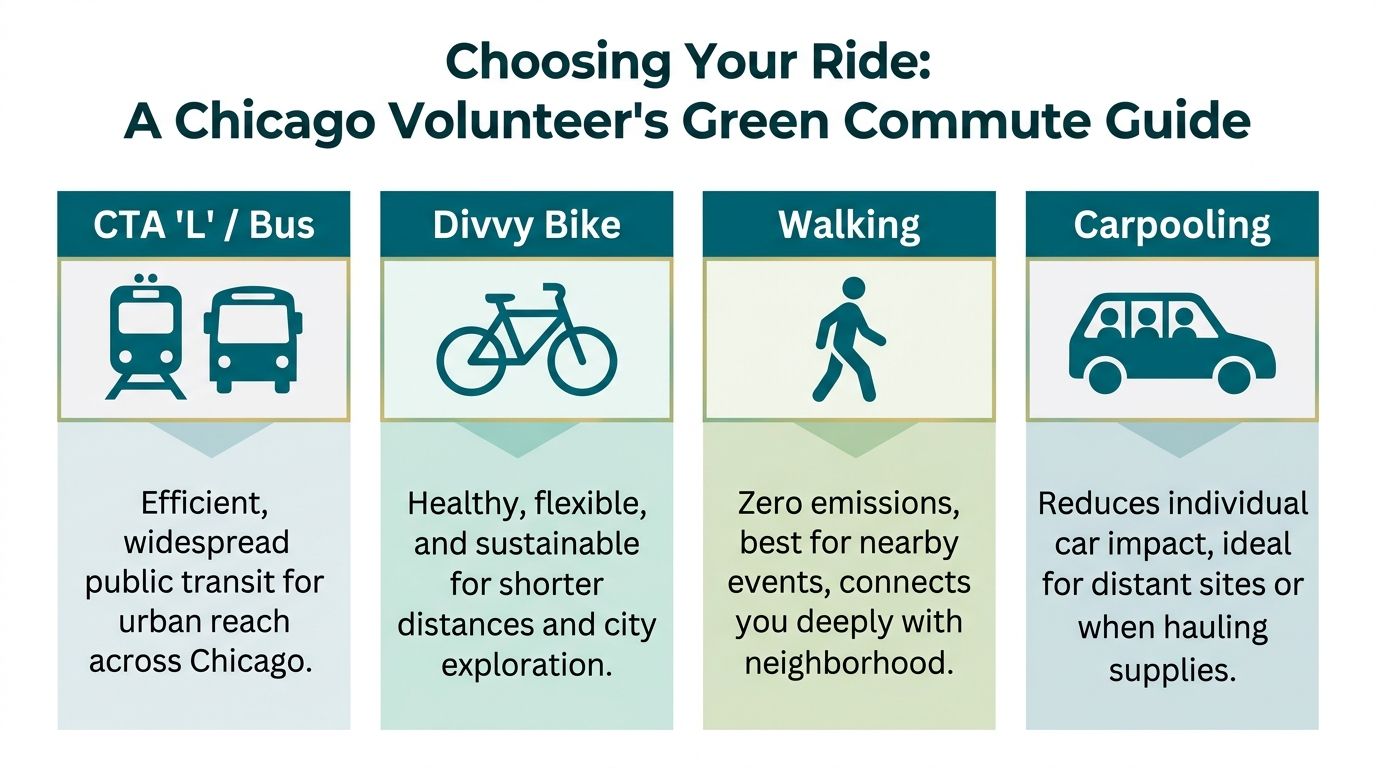
Four ways I think about the trip
Walking gives you intimacy.
You notice dumped cups in tree pits. You spot alleys you want to come back to. You arrive warmed up and grounded. If the event is close, walking is beautiful because it asks almost nothing except your attention.
Divvy gives you freedom.
You can improvise. You can stop. You can take the long way through a park if your mind needs air. A bike also turns the city into something you can feel, not just pass through. If you want inspiration for routes beyond cleanup day, I like this guide to bike trails in Illinois for 2026.
The CTA gives you reach.
Chicago stretches. A lot. Public transit lets you cross that stretch without making the whole trip about parking. And trains are strong on pure efficiency. Electric trains emit 88 grams of CO2 per mile per passenger, compared with 100 grams for buses and 400 grams for standard cars, according to this electric rail comparison.
Carpooling gives you practicality.
Sometimes you have extra supplies. Sometimes the site sits far from your easiest train route. Sometimes you are bringing snacks, water, gloves, and one oddly shaped sign. Sharing a ride can still be a thoughtful choice when it replaces multiple separate car trips.
Chicago Volunteer Transport Comparison
| Mode | Eco-Impact | Avg. Cost | Gear Friendly? | Adventure Factor |
|---|---|---|---|---|
| Walking | Very low impact | Low | Best for light gear | High if you like neighborhood detail |
| Divvy Bike | Low impact | Moderate | Good with backpack and clipped tools | High and playful |
| CTA L / Bus | Strong option for cross-city trips | Moderate | Good if you pack compactly | Medium-high, feels like an expedition |
| Carpooling | Better than solo driving | Shared cost | Best for bulky supplies | Medium, social and practical |
What I would choose in real volunteer situations
If the cleanup is near your home, walk.
You save yourself the hassle of locking up a bike or timing a train. You also get a preview of the street conditions before you arrive.
If you live a few neighborhoods away and the weather is decent, bike.
A bike works especially well when you want to stay mobile after the cleanup. Maybe you want to grab lunch with volunteers or explore a new stretch of the city while your energy is high.
If the event is across town, take the CTA.
The train and bus network let you show up without the mental drag of driving. I like that public transit turns travel into shared space. You are not isolated. You are already in public life.
If your group is hauling things, carpool on purpose.
Fill seats. Consolidate supplies. Make one trip do the work of several.
If you are unsure, choose the option that makes it easiest to show up. Consistency beats fantasy.
The hidden factor nobody talks about enough
The best commute is the one that leaves you ready to serve.
Some modes save time but drain your patience. Others take a bit longer but hand you your focus back. Pay attention to that. Your body knows the difference.
A cleanup is physical, social, and emotional work. Choose a ride that helps you arrive open, not depleted.
Navigating Chicago The Caterpillar Way
I fell in love with Chicago more once I stopped moving through it only for convenience.
The city changed when I started traveling through it for service. A station was no longer just a station. It became the threshold to a block that needed care. A bike lane stopped being paint on pavement and became a thread connecting people willing to help.
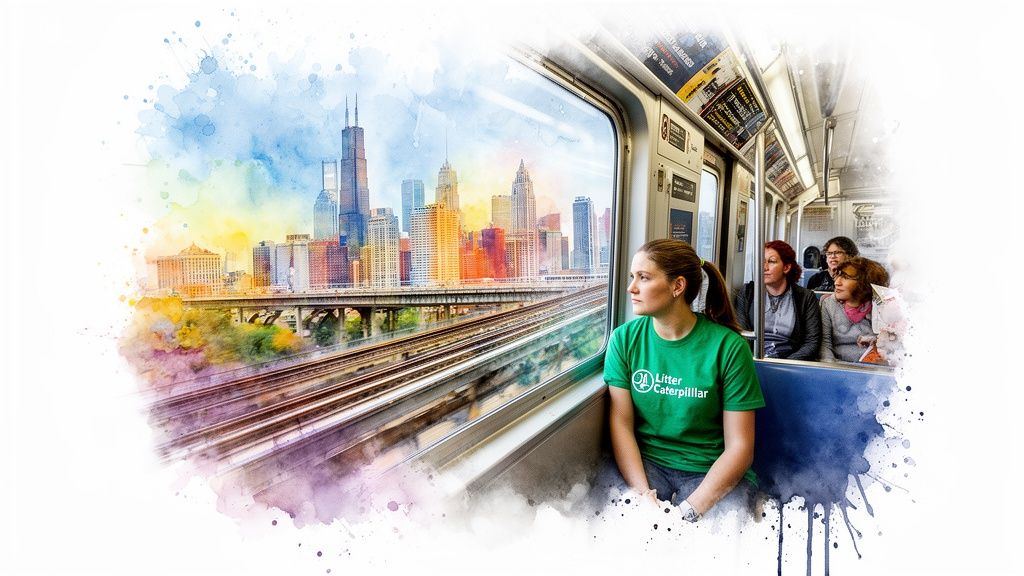
The train turns distance into possibility
One winter morning, I rode through gray skies toward a cleanup site with a grabber angled against my leg and gloves stuffed in my pocket. The platform was cold enough to make you question your life choices.
Then the train came. Doors opened. Heat. Light. Other people heading somewhere with their own reasons.
That is one of my favorite things about the CTA. It rescues the day from self-importance. You are just one person on a city artery, trying to do something useful.
Chicago’s train lines let you string together neighborhoods that too many people keep mentally separate. If you care about service, that matters. You cannot clean a whole city if you only move through the parts that already feel comfortable.
For a slower, street-level way to know the city beyond the tracks, I also like these self-guided Chicago walking tours. They help you build neighborhood memory, and that memory makes service more personal.
The bike convoy feeling
Bikes create a different mood.
A small group rolling to a cleanup has its own energy. You feel slightly ridiculous, slightly heroic, and fully awake. Someone has a trash grabber strapped to a rack. Someone else has work gloves clipped to a backpack. Somebody forgot water and realizes it halfway there.
Good. That is real life.
I love that kind of travel because it keeps the mission human-sized. You hear each other. You stop for a red light and joke around. You pass blocks where you want to return. The route itself becomes shared memory.
Protected infrastructure makes all of this more dependable. As noted in Earth911’s discussion of resilient bike infrastructure, Minneapolis has shown that year-round cycling is possible with protected bikeways, and the lesson is simple. Paint isn’t protection. If you want people to ride in rough weather, give them something real.
That line sticks with me because it applies beyond bikes. People act brave more often when a city meets their courage halfway.
Here is a short look at the spirit of getting out there anyway.
Bad weather reveals what you believe
Some of my favorite cleanup stories start with ugly forecasts.
Chicago has a way of testing whether your values are decorative or real. Wind, sleet, surprise snow, summer heat. The city asks, “Do you still mean it?”
Traveling to a cleanup in rough weather strips away excuses fast. If the sidewalks are bad, you learn what curb cuts matter. If the bike lane vanishes under slush, you learn what infrastructure was never serious. If the bus is your lifeline that morning, you learn what reliability feels like in your bones.
A city shows its character in blue-sky conditions. It shows its truth in bad weather.
I think that is why eco friendly transport has to be practical, not performative. It has to work on ordinary days and difficult ones. Otherwise it is just marketing.
Gearing Up for Your Green Commute
A good commute starts the night before. Not with philosophy. With packing.
I have made enough dumb mistakes to respect preparation. I have carried awkward gear in flimsy bags. I have underdressed, overdressed, forgotten water, and tried to look cool instead of being ready. Every one of those choices made the mission harder than it needed to be.
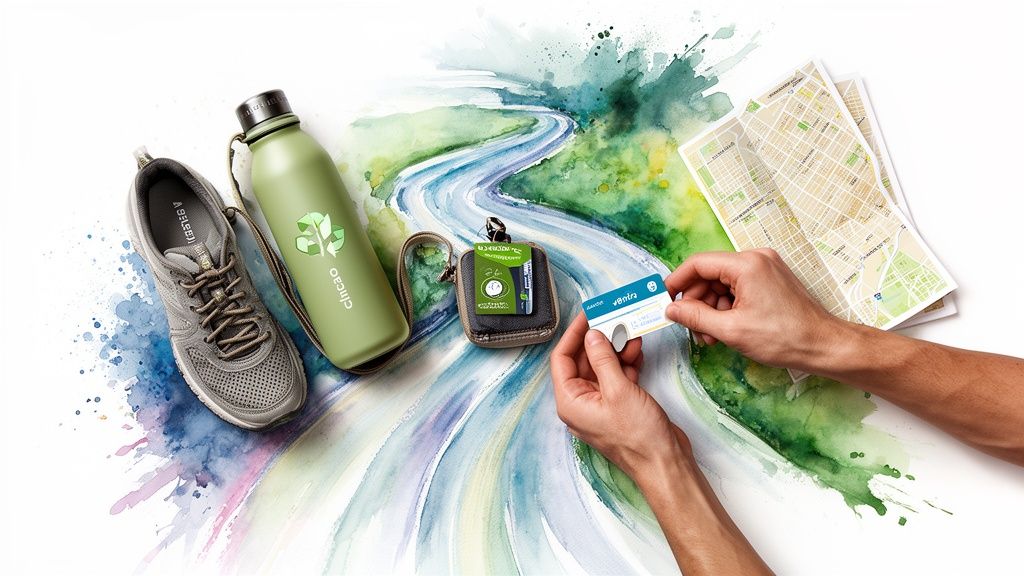
Pack like you plan to move
Your gear should help you travel, not trap you.
If I am taking transit, I want one bag that stays close to my body and leaves my hands free. If I am biking, I want the weight off my shoulders as much as possible. If I am walking, I want no item bouncing, swinging, or digging into my side.
Here is the practical checklist I would hand a new volunteer.
- Gloves first: Put them where you can grab them fast. Outer pocket beats buried at the bottom.
- Water matters: A reusable bottle saves you from starting tired and dehydrated.
- Compact layers: Chicago weather changes its mind. Wear light layers you can tie around your waist or pack easily.
- Transit card or phone ready: Do not fumble at the gate while holding gear.
- Small snack: Cleanup work feels longer when you are hungry.
- Simple bag: Backpack beats tote when you are moving through stations, curbs, and crowds.
Carrying odd gear without hating your life
Trash grabbers are useful. They are also awkward.
If you bike, strap a grabber to a rear rack or slide it along the frame if it fits securely. Test it before you leave. You do not want your heroic setup turning into roadside nonsense at the first bump.
If you take the train, collapse or shorten gear when possible and keep it vertical. That makes you a better neighbor on a crowded car. If you walk, switch hands often and avoid overpacking everything else.
I also like to use work gloves with enough grip to be useful but not so bulky that I lose dexterity. You do not need fancy. You need reliable.
Safety is part of the ethic
I do not think preparation is boring. I think it is respectful.
You respect your own energy. You respect the people meeting you. You respect the mission enough to arrive ready instead of scattered.
A few habits help a lot:
- Check the route before you leave: Especially if you are combining train, bus, and walking.
- Use lights on a bike when visibility drops: Early mornings and cloudy days can get dim fast.
- Wear shoes you trust: Cleanup work punishes flimsy shoes.
- Tell someone your route if conditions look rough: Basic, simple, smart.
Bravery works best when you pair it with preparation.
I have learned that eco friendly transport feels much easier when friction disappears. Pack the right bag. Secure the weird tool. Dress for movement. Then the trip becomes part of your rhythm instead of a problem you must solve from scratch every time.
Making Green Transport Fair for Every Neighborhood
If you only talk about eco friendly transport as a personal lifestyle choice, you miss the hardest part.
Not everyone starts from the same curb.
Some neighborhoods have better sidewalks, easier train access, safer bike routes, and more visible investment. Other neighborhoods get told to wait, adapt, or settle. Then people act shocked when the greener option feels harder to choose.
Access is a justice issue
That is not just inconvenient. It is unfair.
The U.S. Department of Transportation identifies 35% of census tracts as transportation disadvantaged, and work highlighted by the Systems Change Lab on access to green mobility notes significant disparities in public EV charging access for Black and Hispanic communities in major cities like Chicago.
I care about that because the gap shows up in everyday life. The cleanest option on paper means less if reaching it is harder, less safe, or less reliable depending on where you live.
What this means on the ground
When a neighborhood lacks dependable green mobility, people lose more than a convenient commute.
They lose time. They lose flexibility. They lose the sense that the city belongs to them equally.
That also affects volunteer work and neighborhood care. If people from one part of the city can move easily to serve and explore while others face extra barriers, the map of participation gets warped. The neighborhoods that most need solidarity can end up hardest to reach sustainably.
I think about this a lot when people praise urban sustainability in broad terms. Broad terms can hide sharp edges.
What I want cities and communities to fight for
I want a city where green movement does not feel like a privilege badge.
That means supporting improvements that make sustainable travel real in every ward, not just the fashionable ones. Better connections. Safer routes. Reliable service. Charging access where renters and residents in multi-unit buildings can use it. Infrastructure that respects people who do not have backup options.
If you care about clean streets, you should care about this too. Environmental work and mobility justice touch the same nerve. They both ask who gets protected, who gets ignored, and who gets told to work around preventable problems.
For a deeper look at the moral side of this, I recommend reading about environmental justice and how you create change.
A greener city that excludes whole neighborhoods is not a greener city. It is just a prettier version of the same old inequality.
I do not want that. I want the kind of city where a kid, a renter, a student, a retiree, and a volunteer with a trash grabber all have a fair shot at moving safely and sustainably.
Partner With Us to Keep Chicago Moving and Clean
A cleanup group can remove litter from a block. A network can change what a city believes about itself.
That is why I think local businesses, schools, clubs, and community groups have such a powerful role here. Eco friendly transport becomes real when people support it together. A lone volunteer can be brave. A whole neighborhood can make bravery normal.
What partnership can look like
It does not need to be complicated.
A bike shop can host a pre-cleanup tune-up morning. A café near a train stop can become a meeting point where volunteers gather before heading out. A community center can offer storage for supplies so fewer people need to haul everything across town. A local employer can encourage staff to join by transit, on foot, or by shared ride.
Those are small moves. They create real momentum.
Why this matters for businesses too
When a business backs cleaner and smarter movement through the city, it is not doing charity theater.
It is investing in streets people want to spend time on. It is helping neighbors meet one another. It is reducing the friction that stops good intentions from becoming action.
I think a lot of organizations underestimate how much people remember practical support. If you help volunteers get somewhere warm before a winter cleanup, they remember. If you offer bike parking, water refills, or a reliable meet-up corner, they remember that too.
That kind of support has soul.
The bigger story
The best version of Chicago is not just cleaner. It is more connected.
People travel across neighborhoods they were taught to fear. They discover local businesses they never would have seen from an expressway. They build confidence using trains, bikes, sidewalks, and shared rides in service of something bigger than themselves.
That is a city with momentum.
I want more of that. I want partnerships that make sustainable movement feel welcoming, capable, and full of pride. Not preachy. Not polished to death. Just real. Real people helping other real people get where they need to go so they can do good work together.
If you run a business or lead an organization, you do not need to solve every transit problem. You just need to take one honest step that makes green movement easier for your community.
That is how cities change. Not only by plans on paper, but by people who decide to make the next trip better.
If you want to turn a Saturday morning into something brave, useful, and memorable, join Litter Caterpillars. You can show up, make friends, explore Chicago, and help build a cleaner city one block and one green commute at a time.
Leave a Reply