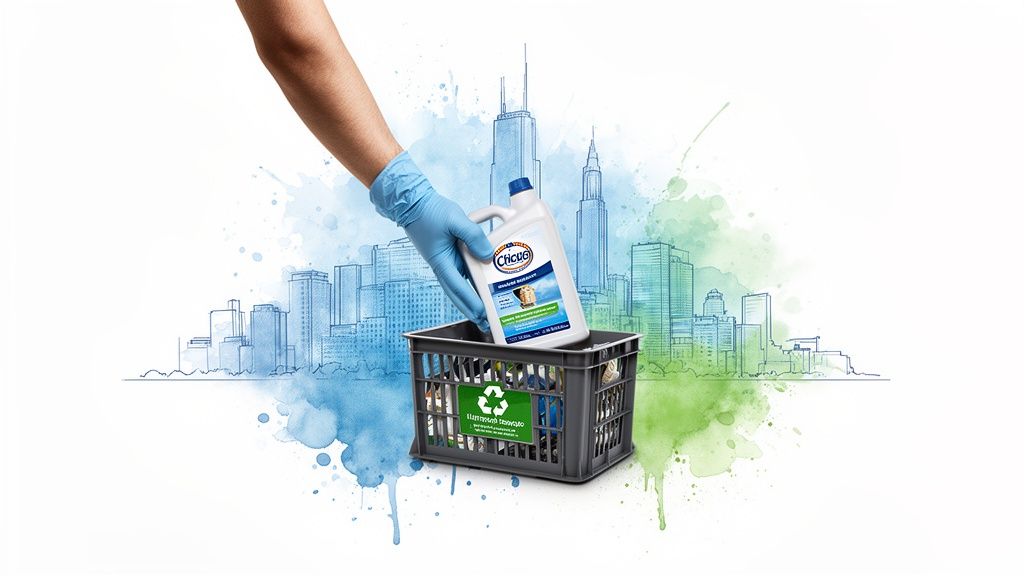
My apartment used to be a graveyard for things I meant to deal with… eventually. I'm talking about expired supplements, half-empty paint cans from a project I bailed on, and old electronics that felt like souvenirs from a past life. I know that figuring out hazardous waste recycling in Chicago feels like a huge, complicated mess. But trust me, it’s one of the best first steps you can take to reclaim your space and help me build a cleaner city.
Tackling Your Toughest Clutter in Chicago

Honestly, every one of those things in my old apartment was an anchor. A chain. That ancient laptop held forgotten projects, sure. The nearly-empty cleaning bottles were just monuments to chores I’d started and never finished, a constant reminder of failure. Each one weighed less than a pound, but emotionally, you know this, they might as well have been 500 pounds apiece. The weight crushes you.
It wasn't until I started cleaning up other people's messes on the streets of Chicago that I finally figured out how to deal with my own. That’s how my group, Litter Caterpillars, was born. I discovered a weird truth: tackling a stranger’s discarded junk was way easier than facing the junk in my own closet. This small act of service for the city started a ripple effect, a cascade, a revolution in my own life.
From Personal Mess to Public Mission
That feeling of being crushed by clutter is just a small-scale version of the city’s much bigger challenge with waste. It's a mirror. Chicago has a messy, toxic history here, with over 240 historical Superfund sites. A lot of these are the direct result of people improperly dumping stuff for decades. This isn't just a history lesson; it’s a powerful reminder of why what you and I do today matters so much.
When you and I handle our waste correctly, we aren't just cleaning our homes. We are actively preventing our neighborhoods from becoming the toxic legacies of tomorrow. I see it as a small act with huge, profound implications for environmental justice.
The Power of One Small Victory
I need you to see that managing your household hazardous waste isn't just another chore to add to your list. No. It’s a powerful first step in taking back control. It’s a single, decisive action. Think of it like a domino.
- It Declutters Your Mind: Getting rid of that old paint can or bag of dead batteries frees up mental space you didn't even realize was occupied. Suddenly, you can breathe.
- It Protects Our Community: You're making sure that nasty chemicals don't end up in our water or soil, which protects the health of every single Chicagoan. Me. Your neighbors.
- It Builds Momentum: Success breeds more success. Once you conquer this task, you’ll feel that surge, that power. You'll feel ready to take on the next one, and the one after that.
Starting small is a huge win—for you and for our city. In this guide, I'm going to show you exactly how to do it. I will turn that "I don't even know where to begin" feeling into a clear, confident plan. You'll see that hazardous waste recycling in Chicago is something you can absolutely, definitely do.
Figuring Out What's Hazardous in Your House
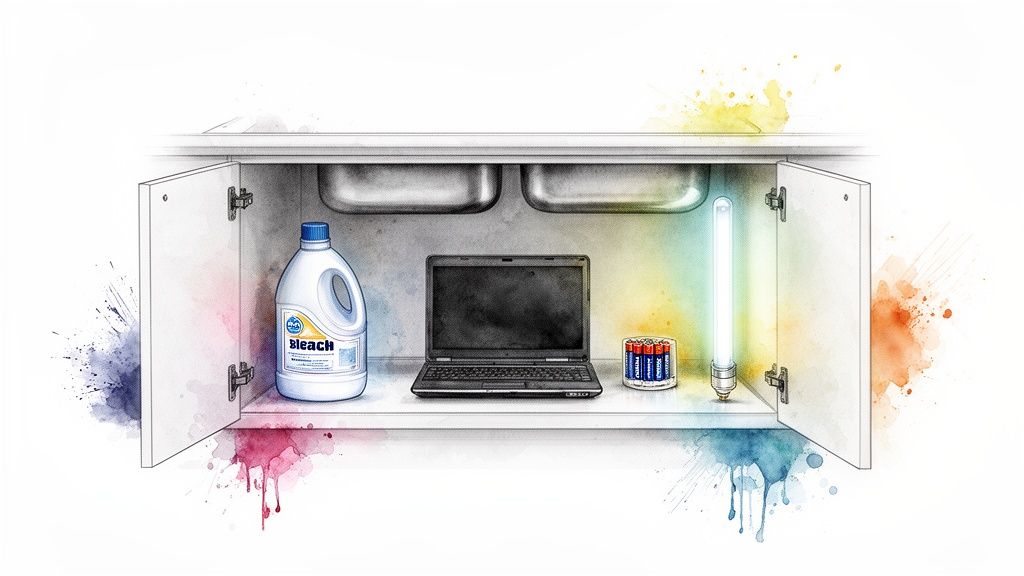
Okay, let's be real. Cleaning our own space is sometimes the hardest battle. I know for me, my life got messy when my apartment got messy. It's a reflection. It's so easy to let things pile up under the sink or in the back of a closet—that can of mystery paint, those old dead batteries, the half-used bottle of something powerful and smelly.
This isn’t just about tidying up. This is about taking control. You and I are going on a hunt. An expedition into the forgotten corners of your home to make your space—and our city—safer.
The Secret Language of Warning Labels
Here's my go-to rule: if you pick up a bottle and it screams "DANGER," "POISON," "WARNING," or "CAUTION" at you, you must listen to it. Those aren't just suggestions. They're telling you this stuff is serious business, not a toy.
Pouring it down the drain is a direct pipeline to Lake Michigan, where we all get our drinking water. Tossing it in the trash means it could leak, hurt a sanitation worker, or poison the ground. It doesn't just disappear. It’s like a ghost that comes back to haunt you.
It’s a bit like our philosophy at Litter Caterpillars. What you do in your own space has a ripple effect on the world outside. I truly believe that taking on hazardous waste recycling in Chicago is just another way we prove that small, brave actions create huge, positive change.
The Usual Suspects Lurking Around
You'll be shocked at what you find. I promise. That old laptop shoved in a closet? That crusty can of antifreeze in the garage? All of it is considered household hazardous waste (HHW). It’s wild to think that globally, only about 22.3% of e-waste ever gets recycled properly. So when you find and sort yours, it's a massive win. You are an exception.
To help you sort things out before you head to a drop-off, I’ve put together a quick cheat sheet for you.
Accepted vs Not Accepted at Chicago HHW Facilities
This table is your quick reference guide. It'll help you separate what the city's facilities will take from what you need to leave behind or handle differently. I don’t want you to get to the drop-off spot only to be turned away! That’s a real punch to the gut.
| Accepted Items (Bring These!) | Not Accepted (Leave These at Home!) |
|---|---|
| Aerosol cans (even if they feel empty) | Explosives or ammunition |
| All types of batteries (alkaline, rechargeable, lithium-ion, etc.) | Fireworks |
| Automotive fluids (antifreeze, motor oil, gasoline) | Medical waste (including needles/syringes) |
| Cleaning products (bleach, drain cleaners, oven cleaners) | Propane tanks (small camping-style are sometimes okay, but check first!) |
| Compact Fluorescent Light Bulbs (CFLs) & other fluorescent tubes | Smoke detectors (many can be mailed back to the manufacturer) |
| Old electronics (laptops, cell phones, VCRs, etc.) | Business or industrial waste (this is for residential stuff only!) |
| Hobby chemicals & paint (oil-based and latex-based paints, thinners) | Fire extinguishers (contact your local fire department for disposal) |
| Lawn and garden chemicals (pesticides, herbicides, fertilizers) | Latex-based paint is often accepted, but the city prefers you dry it out and dispose of it in your regular trash. However, they will take it if you bring it in. |
| Mercury-containing items (thermometers, thermostats) | Tires |
This list makes it way less intimidating, right? Now you know exactly what to grab.
So, where should you look?
- Garage & Basement: This is the jackpot. Look for old paint cans, weed killer, motor oil, and antifreeze. The forgotten soldiers of projects past.
- Under Sinks: The classic spot for harsh cleaners, drain openers, and corrosive chemicals. A dark kingdom of grime.
- Closets & Bathrooms: Nail polish remover, old-school mercury thermometers, and even some hair treatments. Who knew?
- Your "Junk" Drawer or Office: This is where electronics, old phones, and all those batteries hide out. Waiting.
Speaking of batteries, those little button cells and the ones in your power tools are especially nasty if they end up in a landfill. We have a whole guide on how to recycle batteries in Chicago if you want to dive deeper on that.
Sorting this stuff isn’t just a chore. It’s an act of taking responsibility. It's you deciding that these powerful chemicals belong in the hands of professionals, not in our water or soil. You are turning a boring task into an act of service. And that’s what we’re all about.
How to Prepare and Transport Hazardous Waste Safely
Alright, you’ve done the hard part. You’ve hunted down and gathered up all those sketchy, half-used chemicals from the shadows of your home. A true warrior. So, what’s next? Getting this stuff ready for its final ride is all about simple, safe preparation. I’m going to share some real-world tips we’ve picked up at our Litter Caterpillars cleanups, where we handle every kind of forgotten, leaky mess you can possibly imagine.
Think of it like you're packing for a road trip, but your passengers are a bunch of grumpy chemicals. Your main job is to make sure nothing spills, breaks, or throws a tantrum in the back of your car. It’s not complicated; it’s just about being mindful.
Secure Your Cargo Before You Go
First things first, you need to keep products in their original, labeled containers whenever you can. This is a huge help to the recycling staff because it tells them exactly what they’re dealing with. If the original container is leaking, just place the whole thing inside a second, bigger container that you can seal up, like a sturdy plastic tub or even a heavy-duty trash bag. Think of it as putting a troublemaker in a timeout.
I’ll never forget one cleanup where we found a can of old paint thinner that had rusted clean through the bottom. The moment we moved it, this small, stinky stream started running down the curb. A toxic little river. We had to double-bag it and stick it in a bucket just to move it safely—a perfect little lesson in always planning for the worst-case scenario.
Before you even think about loading up, give every bottle and jar a quick check. Make sure you screw all the lids on as tight as they’ll go. It's such a tiny step, I know, but it prevents some seriously massive, car-ruining messes.
Loading Up and Hitting the Road
Once everything is sealed up and secure, it's time to load your vehicle. Here’s a simple checklist to make sure your trip to the Chicago hazardous waste facility is a smooth and safe one.
- Keep It Upright: Place bottles and cans snugly in a box or bin so they can’t tip over when you take a turn. I usually just grab a cardboard box or a laundry basket. Simple.
- Use Your Trunk: If you can, transport everything in your trunk or the bed of your truck. This is a big one—it keeps any potential fumes away from you while you’re driving and contains any surprise spills. It’s a firewall.
- No Passengers Allowed: Never, ever transport hazardous waste right next to people or pets. If you absolutely have to carry something in the main cabin, you must keep the car well-ventilated by cracking a window.
This whole process is really just an exercise in mindfulness, a skill we practice every single week at our cleanups. For a full breakdown of the city's rules and all the drop-off locations, you can find more information in our complete guide to Chicago's hazardous waste disposal. Following these simple steps makes sure you, the sanitation workers, and our environment all stay safe.
Where to Take Your Hazardous Waste in Chicago
Alright, you’ve done the hard part. You’ve gone through your closets and garage, wrangled all those weird chemical containers, and packed them up safely. Now for the satisfying finale: getting it all out of your house for good. Let me tell you where to take this stuff so it’s handled right.
This is one of those city services that actually works, and works well. You have two solid, free options for disposing of your household hazardous waste. There are no excuses.
The Permanent Drop-Off on Goose Island
The city’s main hub for this is the Household Hazardous Waste (HHW) facility at 1150 N. North Branch Street. I’ve been there plenty of times, and I can tell you, it’s a smooth operation. It’s a simple drive-through, so you don’t even have to get out of your car. It's a beautiful thing.
Here’s how it usually goes down when I pull up:
- You’ll see the signs and get directed into a line. It moves pretty quick.
- When it's your turn, a crew of trained staff comes right to your car to unload the items from your trunk or back seat. You just pop the trunk and they handle the rest. You are the hero, and they are your pit crew.
- Best of all, it costs absolutely nothing. Zero fees for Chicago residents. It's a resource you and I should all be using.
The folks working there are pros—they know how to handle this stuff safely. You can drive away knowing you did the right thing for our sanitation workers and the environment. I recommend you do a quick check on the city’s website for their current hours before you head over, because they can change.
Community Recycling Events
If getting to Goose Island is a haul for you, you need to keep an eye out for the Community Recycling Events. The city sets these up in different neighborhoods throughout the year, bringing the drop-off point right to your corner of Chicago. They bring the mountain to you.
I love these events. It's a powerful thing to see your neighbors lined up with their old paint cans and used batteries. It’s a real, visible sign that people care and that we're all in this together. You can find the schedule for these pop-ups on the Department of Streets and Sanitation website.
Using these dedicated drop-offs is non-negotiable if you want to make a real impact. This is how we fight back against lazy, wishful recycling and make sure our efforts aren't wasted.
This matters so much, especially when you remember Chicago's history. The old Blue Bag program back in the 90s was a disaster, a complete and utter failure, recovering only about 10% of recyclables because everything was contaminated. That failure taught us a hard lesson: separating our waste properly and using the right facilities is the only way to guarantee materials are handled correctly.
These drop-off sites are our best allies in this fight. If you’ve got other stuff to get rid of, you can also check out our guide on other Chicago recycling centers. Now you know exactly where to go. No more excuses—let's get it done.
Beyond the Bin: Why We Clean the Streets
Let's get real for a minute. Complaining about how bad recycling is in Chicago doesn't get us anywhere. I get it, it feels good to vent. But it doesn't stop a single plastic bottle from ending up in the lake. It doesn’t stop another bin from being tagged as "contaminated" and dumped in a landfill.
This is where you and I come in. This is where we stop waiting for someone else to fix things. It’s the entire reason I started Litter Caterpillars in the first place. When the system fails you, you build your own.
Forget the Blue Bins. We’re Building a New System.
The hard truth? Chicago’s recycling rate is a disaster. For years, it’s been stuck at a pathetic 9%. That’s one of the worst in the whole country. We’ve all heard the stories of private contractors marking whole truckloads as ‘contaminated,’ trashing public trust and sending perfectly good recyclables to a landfill grave.
This is exactly why relying on the blue bins is a losing game. A bet you can't win. I decided we had to change the rules of the game.
Our approach is different. What if we stop the problem before it even starts? By picking up litter directly off the streets and sorting it ourselves, we make sure it never has a chance to contaminate someone's blue bin. It’s a direct strike against a broken system.
We are the quality control the city can’t—or won’t—provide. Every piece of trash we pick up is a small victory. It's an act of defiance that says to me, and to you, "This block will be clean. This part of our city will be cared for."
The Power of Just Showing Up
This was never just about trash. It’s about what happens when you decide to act. When we first started our weekly cleanups, there were only a few of us. A tiny army. But then something amazing happened. Consistency creates its own kind of gravity. It pulls people in.
People saw us out there. Week after week. In the freezing cold and the summer heat. They saw us making friends, having a weird kind of fun, and making a difference you could actually see. It’s proof that a small, determined crew can build something real where top-down systems have failed. It is the story of David and Goliath, retold on the city streets.
This Is About More Than Just Trash
This work changes you. I’ve seen it in myself and in every person who joins us. You find a strength you didn't know you had.
- You find your grit. There’s nothing like picking up trash in a Chicago winter to teach you how tough you really are. You become forged in that cold.
- You find your people. You connect with others who actually give a damn. People who show up. Your tribe.
- You feel that pride. Seriously, there's no feeling like looking back at a block that was covered in filth an hour ago and seeing it clean. That’s your work. You did that.
This is so much bigger than just hazardous waste recycling in Chicago. It’s about building a culture where we take care of our own home. It’s proving that we—the people who live here—are the most powerful force for change in this city. Every can you sort, every battery you drop off, every piece of litter you pick up is a vote for the Chicago you actually want to live in.
If dealing with all this hazardous waste has you fired up about building a better, cleaner Chicago, then I have an invitation for you. A challenge, really.
This is about way more than just picking up trash. It’s about forging real friendships, testing your own limits, and completely transforming yourself through the simple, gritty act of service.
Come grow with us.
At Litter Caterpillars, I believe service can transform you and our city. Join our next cleanup event and become part of the movement.
Leave a Reply