
Category: Uncategorized

  • Volunteer Event Planning That Actually Works

    Volunteer Event Planning That Actually Works

    Three of us showed up for that first Chicago pickup with gloves, trash bags, and too much optimism. The sky flipped from spring to hail to blizzard, Ubers kept canceling, and we ended up huddled under a tree like a bad weather cartoon.

    The First Pickup That Started Everything

    I remember looking at the street, the slush, and the mess on the curb and thinking one weird thing at once. Cleaning other people's trash was easier than cleaning up my own life, and somehow it was also more fun.

    That first outing taught me what most volunteer event planning guides miss. People do come for the task, but they come back for how the task feels, who they met, and whether the day had a pulse. If your event feels like a chore with a clipboard, people vanish. If it feels like a small crew with a shared mission, a little chaos, and a good reason to laugh, they return next week.

    I didn't know the terms for any of that then. I just knew I wanted a group where people could show up, do something real, and leave with a story worth telling. In Chicago, that story might involve hail, wind, heat, or a bike lane closed at the last second. That's fine. The plan only works if it can hold a little weather and a little personality.

    Volunteer event planning gets better when you stop treating it like a one-time cleanup and start treating it like a hangout people respect. The trash matters. The people matter more. The best events I've run have had both pieces in the right order.

    Define the Event Before You Recruit Anyone

    Start with one project, not a pile of them. That rule saves you from vague planning, and it keeps the event easy to explain when someone asks what you're doing, where you're doing it, and why they should care.

    Pick the scope first

    For a neighborhood cleanup, I start with a block, a park edge, or a route I can describe in one breath. Then I write the purpose in plain language, like cleaning litter from a specific stretch, helping a partner site, or testing a new volunteer route. After that, I choose the date and time around the people I want to recruit, the neighborhood's access, and how much daylight I can count on.

    A one-page brief is enough if it answers the basics. What is the project, where does it happen, who is coming, what do they need, and what permission do I need before anyone touches the site? The UK government's voluntary-event guide pushes planners to define the purpose, size, safety and access needs, budget, publicity, day-of schedule, and cleanup before anything else, and that sequence keeps me from recruiting into a foggy plan. I've found that same order works when I'm emailing a park office, a business group, or an alderman's office, because nobody wants a soft answer about scope.

    Practical rule: lock the event before you ask for help. Volunteers forgive a lot, but they don't forgive confusion.

    Build the timeline with slack

    The planning calendar needs room for real life. A simple event-volunteer checklist recommends adding a 15 to 20 percent time buffer, and that fits the way cleanup events go, with weather shifts, last-minute cancellations, and gear delays. I use that buffer whenever I know the site has road access, tricky parking, or a partner who needs extra lead time.

    If you want a reference point for what a cleaner signup flow looks like, I also keep a plain internal guide on how to find volunteers, because recruitment works better when the event brief and the outreach message are built together. The brief tells people what they're walking into, and the message tells them why the day is worth their Saturday morning.
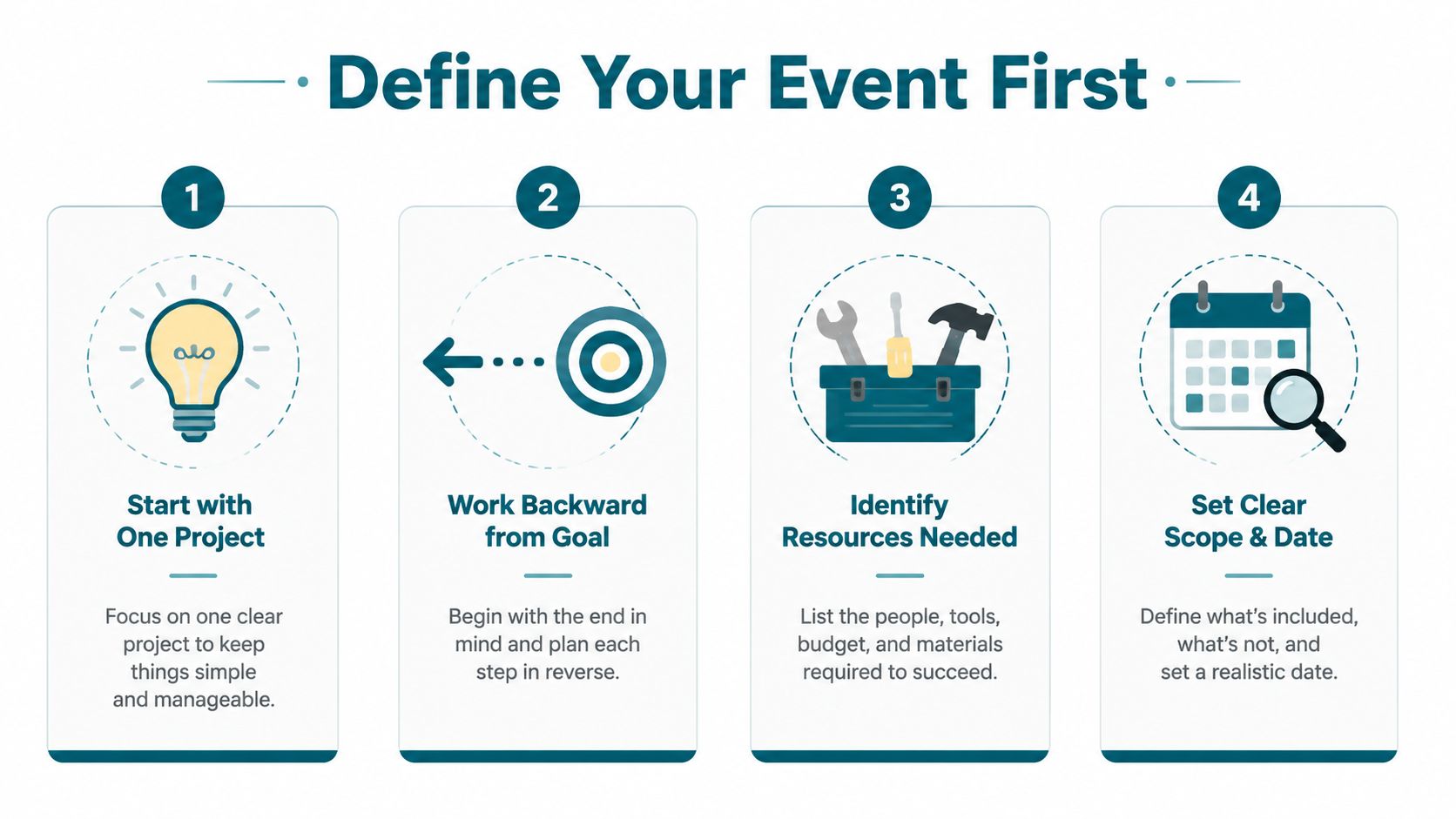
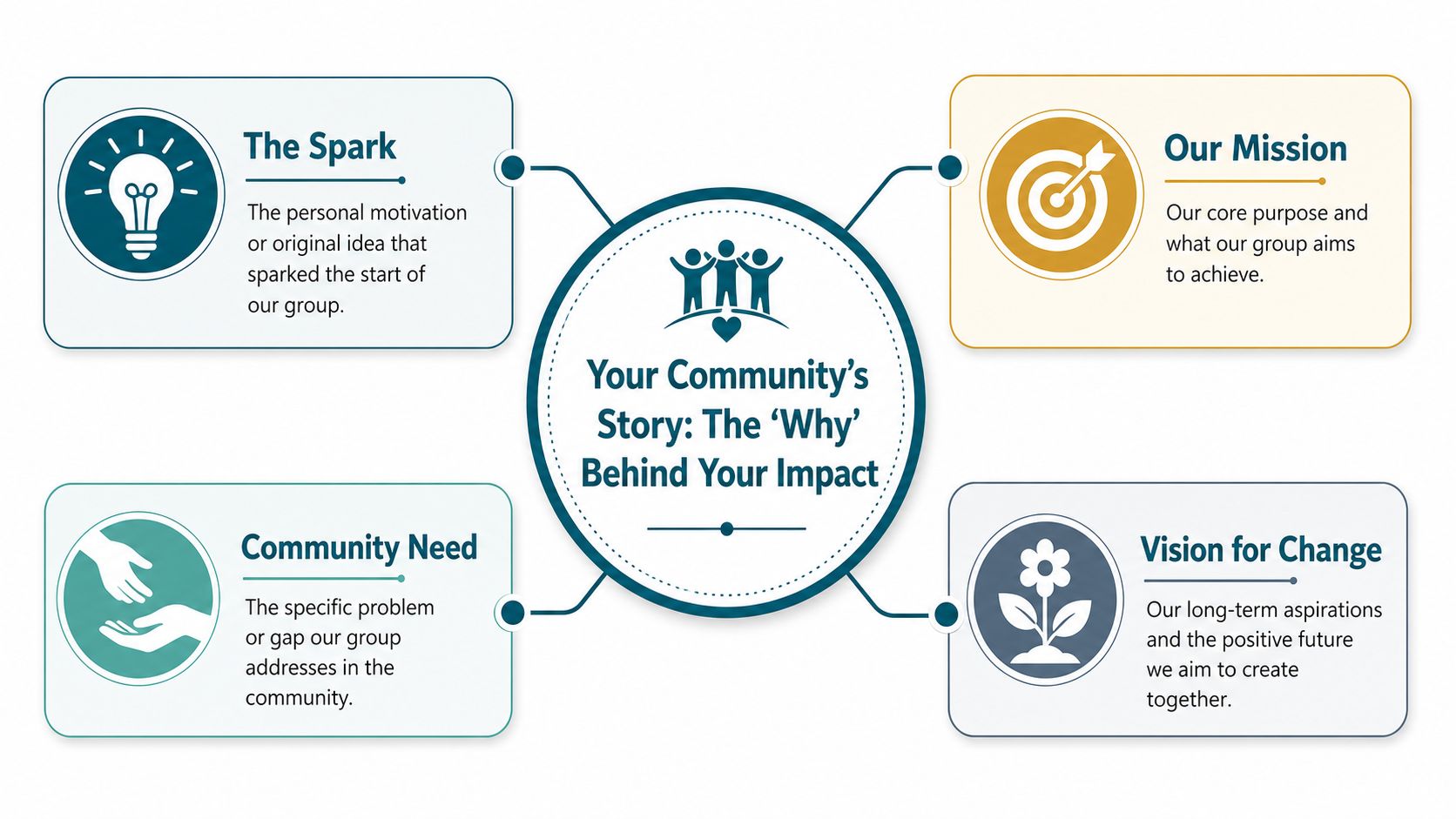
    A four-step infographic illustrating a process for defining an event with clear planning and project goals.

    Fill the page in under an hour

    If I can't write the event brief fast, the scope is too wide. I want a short document that names the goal, the site, the minimum permissions, the rough headcount, the budget, and the backup date logic. That is enough to move forward and still flexible enough to survive a rainy forecast.

    The trick is simple. Decide what the event is, then decide who needs to know, then ask for volunteers. When I reverse that order, I get no-shows, mixed expectations, and extra cleanup on the back end.

    Recruit Volunteers and Design Real Roles

    A signup sheet is not a plan. It's a pile of names with no shape, and that's where volunteer events start to wobble.

    Give every person a job that feels real

    I recruit where people already gather, on Meetup, Instagram, neighborhood Facebook pages, university service boards, corporate volunteer leads, and group chats that already have trust. Then I write the post like a person, not a flyer. I say what the cleanup is, where we're meeting, what kind of shoes people should wear, and what kind of energy the group has. If the post sounds like a county form, it attracts nobody.

    Then I split the work into roles. A check-in lead greets people and confirms names. A supplies lead hands out bags, gloves, and grabbers. A route lead keeps people moving through the block or park zone. A safety lead watches road edges, weather, and strain. A photo and storytelling lead gets consent and captures what the day looked like. A social lead keeps the chat alive before and after the event. Each role needs a backup, because one sick text can leave a hole.

    Keep the roles small enough that a new volunteer can say yes without guessing what the day will feel like.

    Match the role to the person

    Some people walk in talking to everybody. Put them near check-in, the welcome loop, or the route lead slot. Detail-oriented people do well on supplies or roster work. Calm, steady communicators work as team leads because they can answer questions without turning every question into a lecture.

    Role Core Responsibility Time Commitment Who Fits
    Check-In Lead Greet arrivals and confirm names Arrive early, stay through the opening huddle Friendly, fast with names
    Supplies Lead Hand out gear and track extras Early setup and end-of-day count Organized, practical
    Route Lead Keep the cleanup moving through assigned zones Full event block Clear communicator, good at pacing
    Safety Lead Watch weather, road edges, and buddy checks Full event block Calm, observant, steady under pressure
    Photo and Storytelling Lead Capture moments and note consent Flexible, part of the day Social, quick with a phone
    Social Lead Run the chat and reminders before and after Before, during, after Responsive, warm, consistent
    Backup Lead Step in if a lead drops out On call Reliable, nearby, easy to brief

    I keep a waitlist, too. If someone cancels, I don't leave the hole open and hope. I move the next person in and send a short message that tells them where to show up and who will meet them. Recruiting is a pipeline, not a post, and follow-up messages are part of the job.

    The best recruiting language sounds like an invitation, not a pitch. It should tell people they'll do something useful, meet people who care, and leave without getting trapped in a huge commitment. That's how you get first-timers to say yes.

    Build a Safety and Weather Plan You Will Actually Use

    Chicago weather has taught me not to trust optimism. I've cleaned in snow, heat, wind, rain, and the kind of cold that makes a phone battery give up before the volunteer does.

    Write the weather rules before the day

    A safety plan works when it is short enough to read at 6 a.m. I split mine into three parts. First, I write the weather thresholds for heat, cold, lightning, and rain. Second, I list the on-site rules for hydration, gloves, eye protection, sunscreen, and buddy checks. Third, I write the cancellation or pivot rule so nobody has to improvise when the forecast turns ugly.

    That matters even more for outdoor cleanup work near roads. If anyone steps onto a shoulder, I want cones, a spotter, clear permissions, and bright gear. During one highway shoulder cleanup tied to a bike-event shutdown, reflective vests and cones did more to keep people safe than any speech I could've given. The point was simple, the edge was dangerous, and everyone knew it.

    If you want a wider planning reference, the volunteer liability insurance guidance is a useful place to think through risk, because insurance, permissions, and a written safety plan belong in the same conversation.

    Use the weather to make the fallback, not to make the decision later

    One snowy cleanup ended with us huddled under a tree, cold and laughing while the cars kept sliding past. That day taught me to build a pivot into the plan, so I can move a crew to a covered park, switch to an indoor service task with a partner nonprofit, or defer to a new date with a message that goes out fast.

    The same logic helps in summer. On a hot day, gloves and water stop being optional. People tire sooner, tempers get shorter, and the day gets sloppy if I pretend the heat is a small thing. I'd rather shorten the route, add shade breaks, and keep the group moving than watch people fade halfway through.
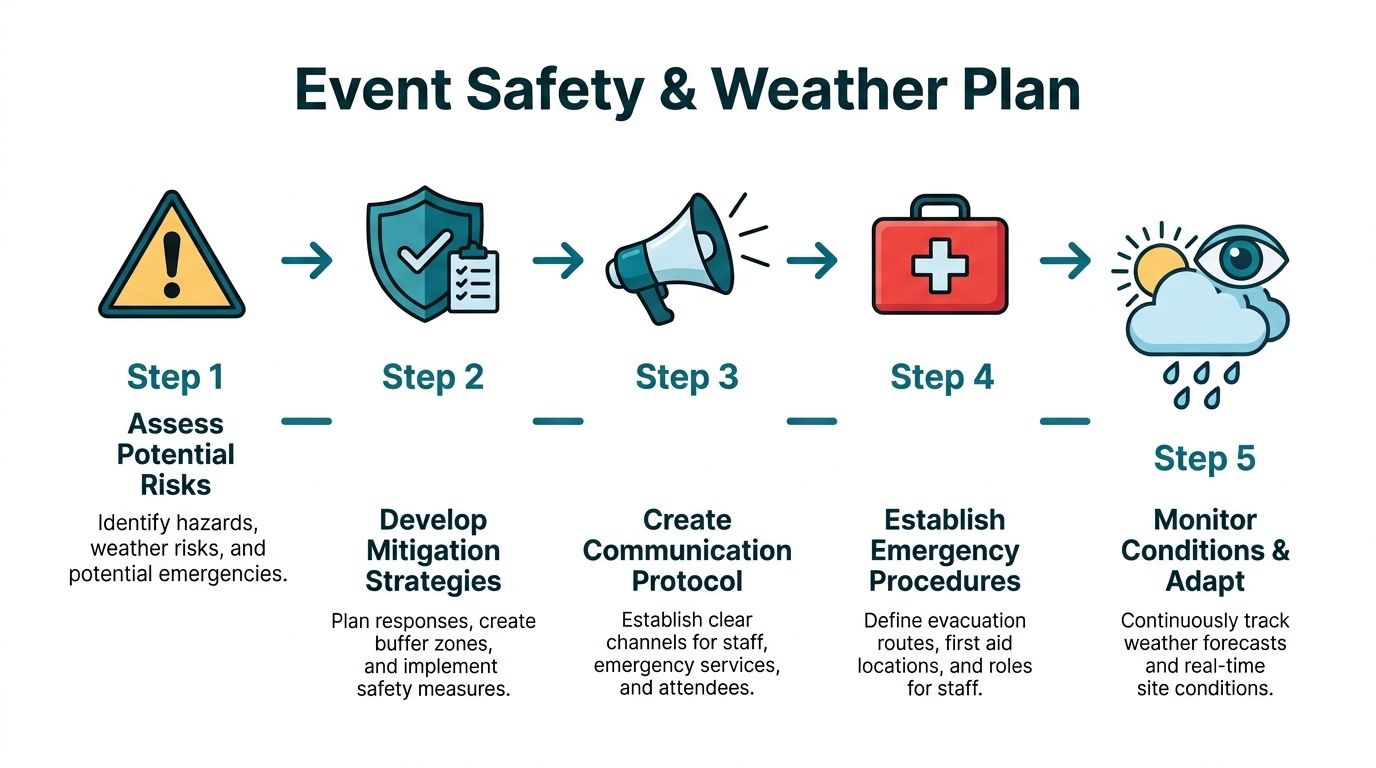
    A five-step infographic titled Event Safety and Weather Plan outlining the process for emergency preparation.

    Keep the rules visible

    A one-page safety sheet at check-in solves more problems than a long speech. I want people to know where to meet, what to do if someone gets hurt, who carries the first aid kit, and who makes the call if the sky turns. That sheet keeps me from repeating the same instructions ten times.

    The best weather plan is the one you can use without thinking too hard. If it feels fancy, it will fail when the wind picks up.

    Run the Day With a Simple Operating System

    The event day gets easier when I treat it like a small operating system instead of a scramble.

    Use a clean sequence from arrival to closeout

    I ask the lead team to arrive 15 minutes early for gear check and setup. The check-in table gets a printed roster, name tags, and a visible place to stand so new people don't wander around wondering if they're late. Then I open with a short huddle, a route map, a safety reminder, and a clear answer to the two questions every volunteer has, where do I go and what do I do now.

    The event itself runs in short shifts, and I keep them at no more than three hours when I can, because people stay sharper when the work block feels human. That schedule also gives me room for a water break, a snack pause, and a quick correction if a route gets messy or a bag pile grows too fast. DAV's guidance on short shifts fits what I've seen in the field, because nobody volunteers for a cleanup to get trapped all day with no structure.

    The day ends with a closing huddle, a fast feedback question, a group photo if people want one, and a clear handoff of supplies. That closing rhythm matters more than people think, because it tells everyone the day had a beginning, a middle, and a clean finish.

    Keep one channel, one map, one table

    I use one group chat for the day so updates don't scatter. I print a map with zone assignments so people can move without checking their phone every two minutes. I keep one check-in table visible so nobody has to guess where to start.

    For a basic scheduling setup, I keep a simple system in free volunteer scheduling software, because any tool is better than a dozen text threads when people are arriving at different times.

    Opening huddle script: “I'm [name]. We're cleaning [site]. Your role is [role]. Stay in your zone, wear your gear, check in with your buddy, and come to me if you see a hazard or get hurt.”

    Avoid the failures that sink cleanup days

    The worst day-of failures are easy to spot. No check-in table, no printed roster, and no backup lead will turn a decent morning into a mess. I also watch for vague route calls, because people need a clear start point more than they need a motivational speech.

    A clean operating system keeps volunteers calm. Calm volunteers work longer, ask better questions, and leave with enough energy to come back.

    Turn First-Timers Into a Crew That Comes Back

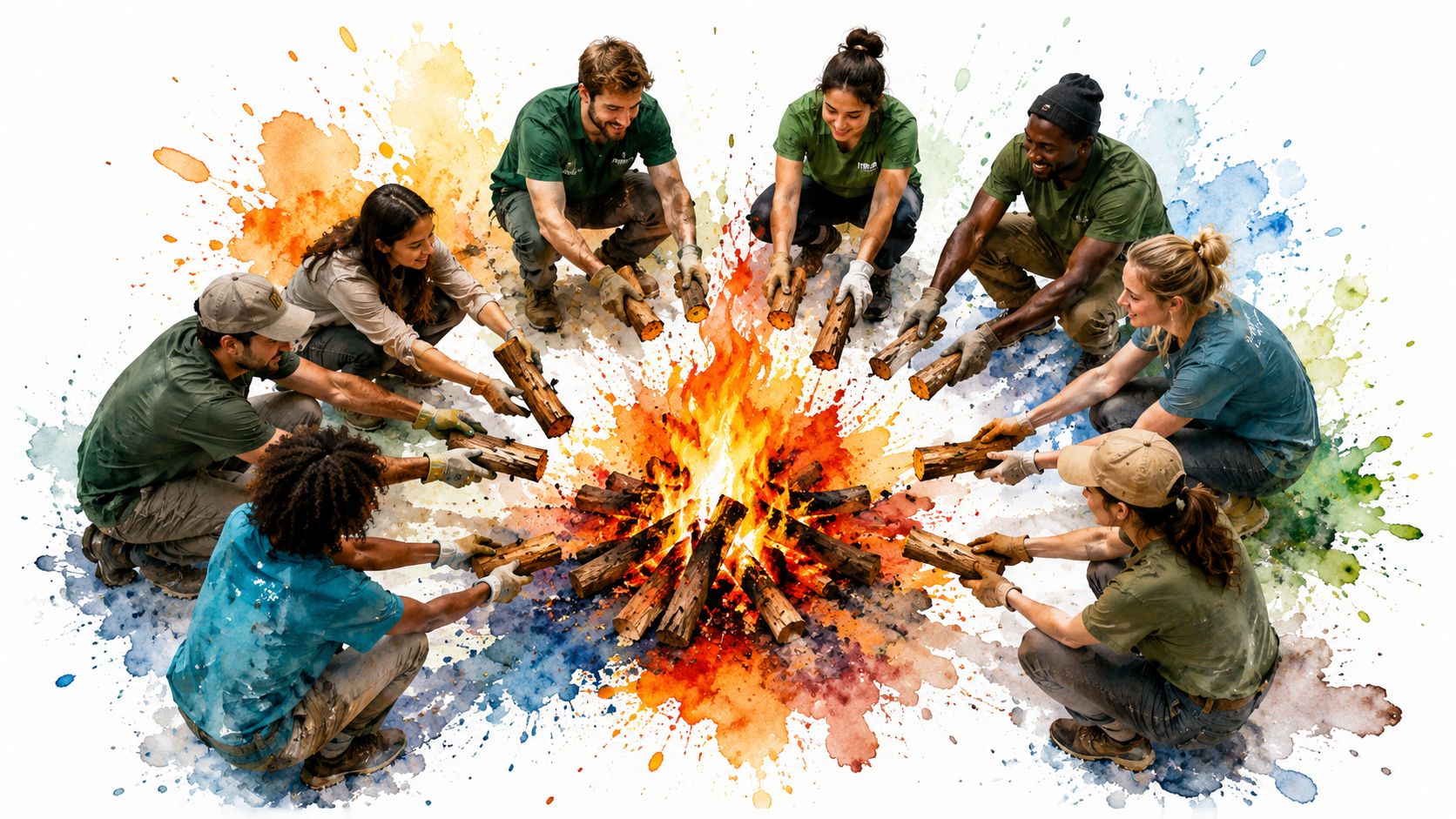
    The bags are only part of the work. A cleanup becomes a group when people leave with a reason to return, and that usually comes down to how they were treated after the trash was picked up.

    Make the follow-up feel immediate and human

    I send a same-day thank-you in the chat while the day still feels fresh. On Monday, I post a recap photo and tag everyone who said yes to being tagged. Then I send a one-question survey that asks what was clear, what was confusing, and what would have made the day easier. Short surveys get replies because they respect people's time.

    Small rituals help here too. A flag, a badge, a theme song, or one weekly habit people recognize right away gives the crew a shared marker to come back to. That is not decoration. It gives people an identity they can carry home, and identity is what kept me showing up when the weather got ugly and my mood did the same.

    Build the social layer on purpose

    Group chats, planning threads, and quick meetups are the social scaffolding that holds the work together. They let first-timers hear from regulars before the event, and they give new people a low-pressure place to ask what to wear, where to park, and whether they need to bring anything. Public recognition helps here too, as long as it never turns into a donation ask.

    Retention habit What I do What it changes
    Same-day thank-you Send a message right after cleanup People feel seen before the day fades
    Monday recap Post photos and tag opt-ins The event stays alive in memory
    Quick survey Ask one useful question I learn what confused people
    Small ritual Use a badge, flag, or theme song People start to feel like part of a crew
    Ongoing chat Keep one open thread New volunteers have a place to return

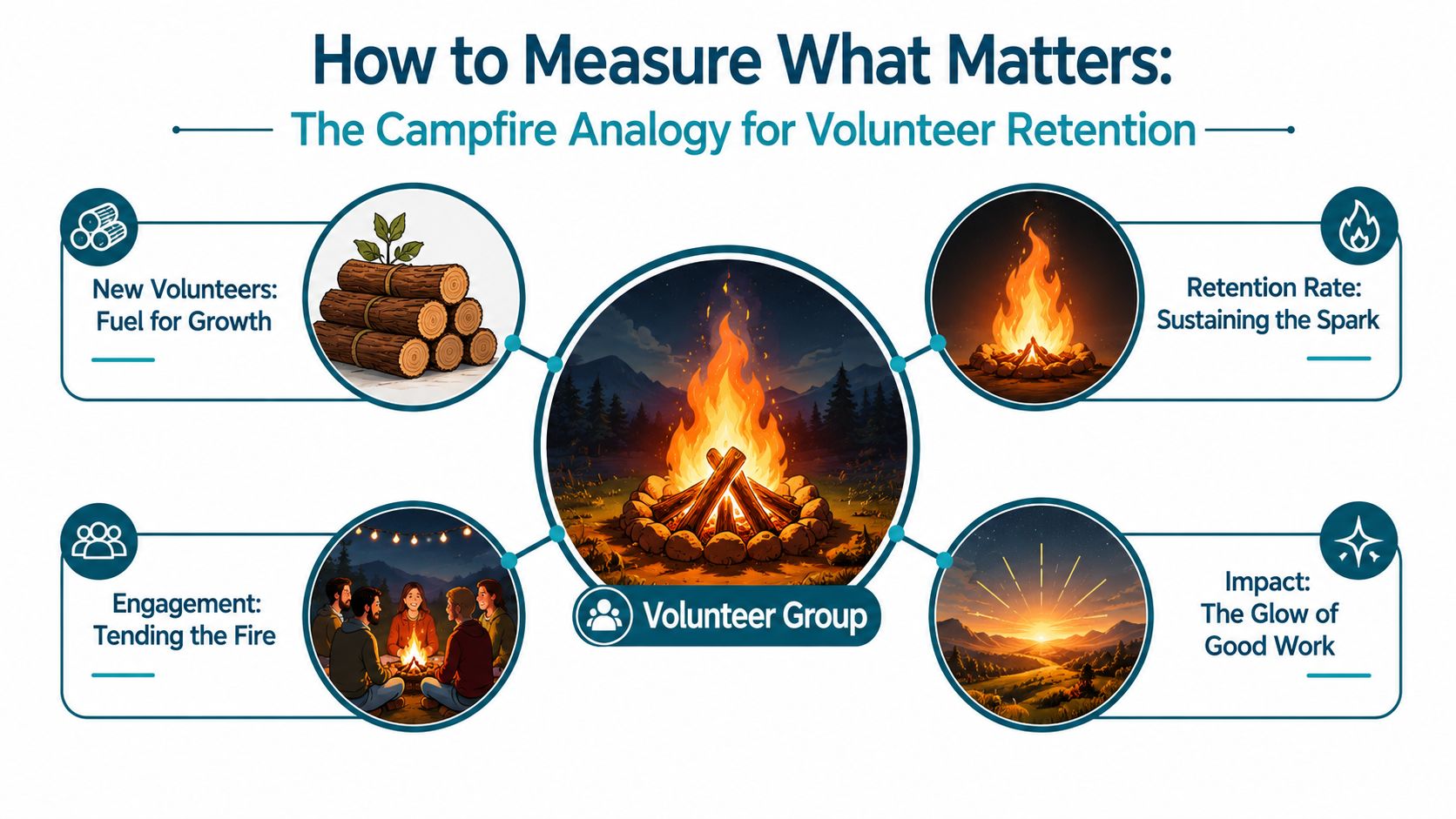
    What holds true across volunteer programs is simple. People do not volunteer once and disappear for no reason. They return when the day feels social, clear, and worth repeating. If sponsors ask for metrics, I track recurring participation and referral rate, even if I do it in a simple spreadsheet.
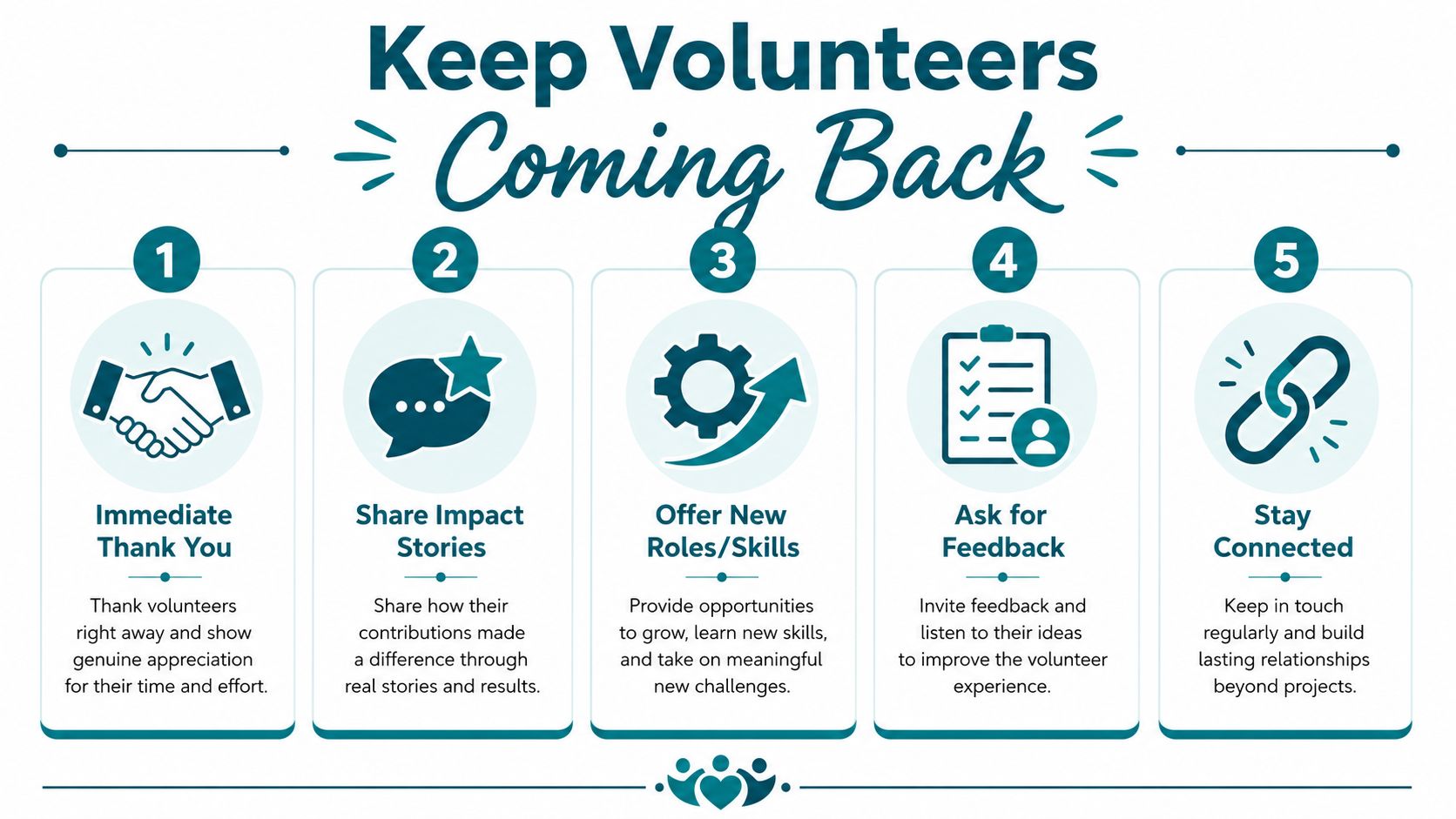
    An infographic titled Keep Volunteers Coming Back outlining five tips for volunteer retention and engagement.

    Make belonging visible

    People come back when they feel known. A volunteer who gets a thank-you, a photo tag, and a place in the chat is much more likely to become a regular than someone who only gets a sign-up link and silence afterward.

    That is the part most guides skip. The cleanup is real, but the crew is the reason the cleanup survives winter.

    Your Pre-Event Checklist and a Call to Show Up

    I keep my pre-event check simple enough to screenshot.

    Category Check Before Event Day
    Scope and date One project, one site, one time
    Permissions Park, business, or city contact confirmed
    Roles and backups Every role filled, backup names set
    Supplies and gear Bags, gloves, grabbers, name tags, water
    Safety and weather Heat, cold, rain, lightning, and pivot rule written
    Communication One chat, one roster, one map
    Check-in system Table, printed list, clear arrival spot
    Follow-up plan Thank-you, recap, survey, next invite

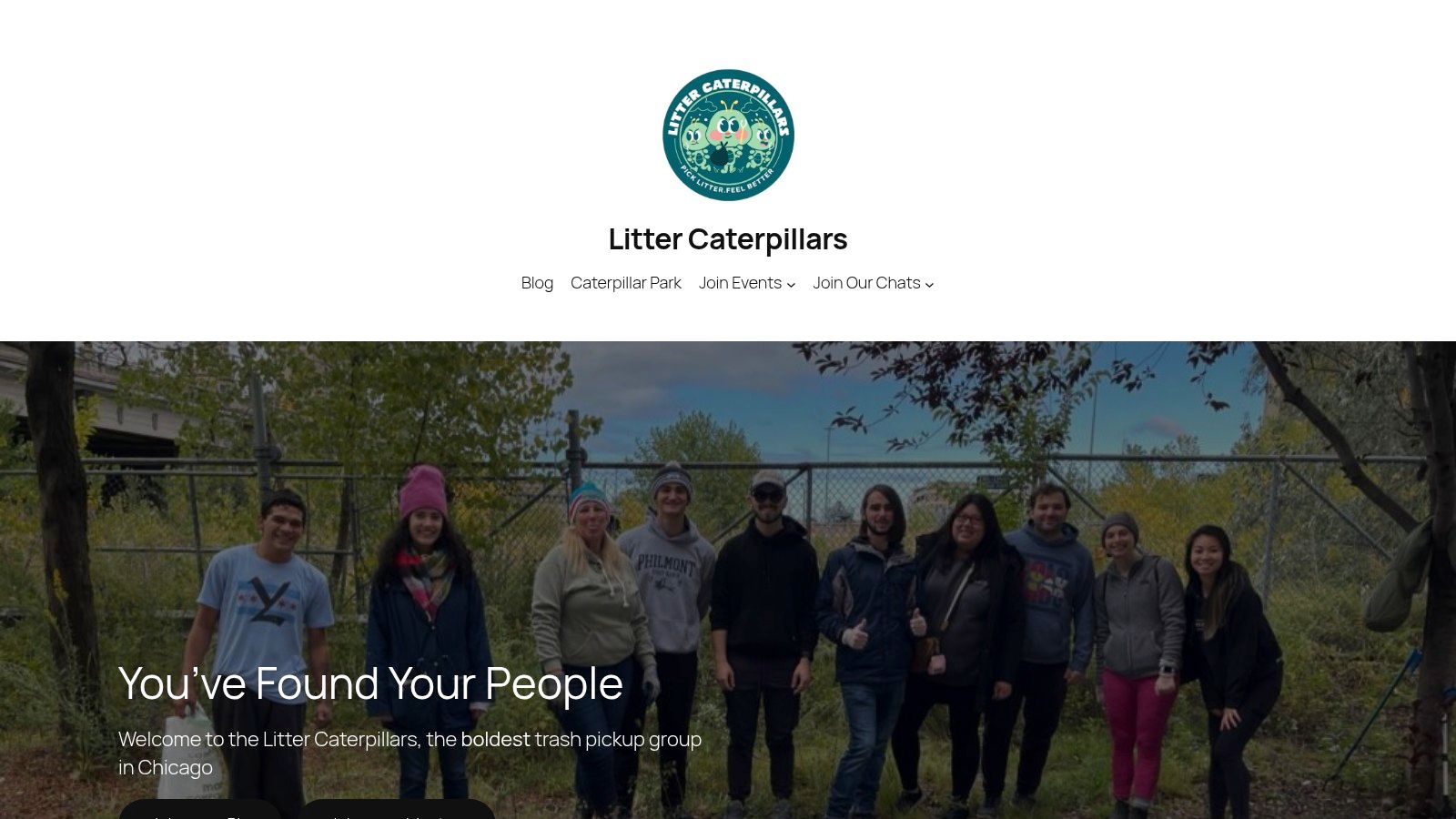
    Screenshot from https://www.littercaterpillars.com

    If you want a real Chicago example of this playbook in action, Litter Caterpillars uses weekly weekend morning cleanups, open group chats, Meetup, and Instagram to help people plug in and stay connected. Pick one project, pick one date, recruit eight people, and run it. Then fix the next one based on what happened.


    If you want a living example of volunteer event planning that puts people first, visit Litter Caterpillars. You'll see how a cleanup group can mix safety, structure, and friendship without turning the day into a boring form. If you're in Chicago and want a place to start, that's where I'd send you.
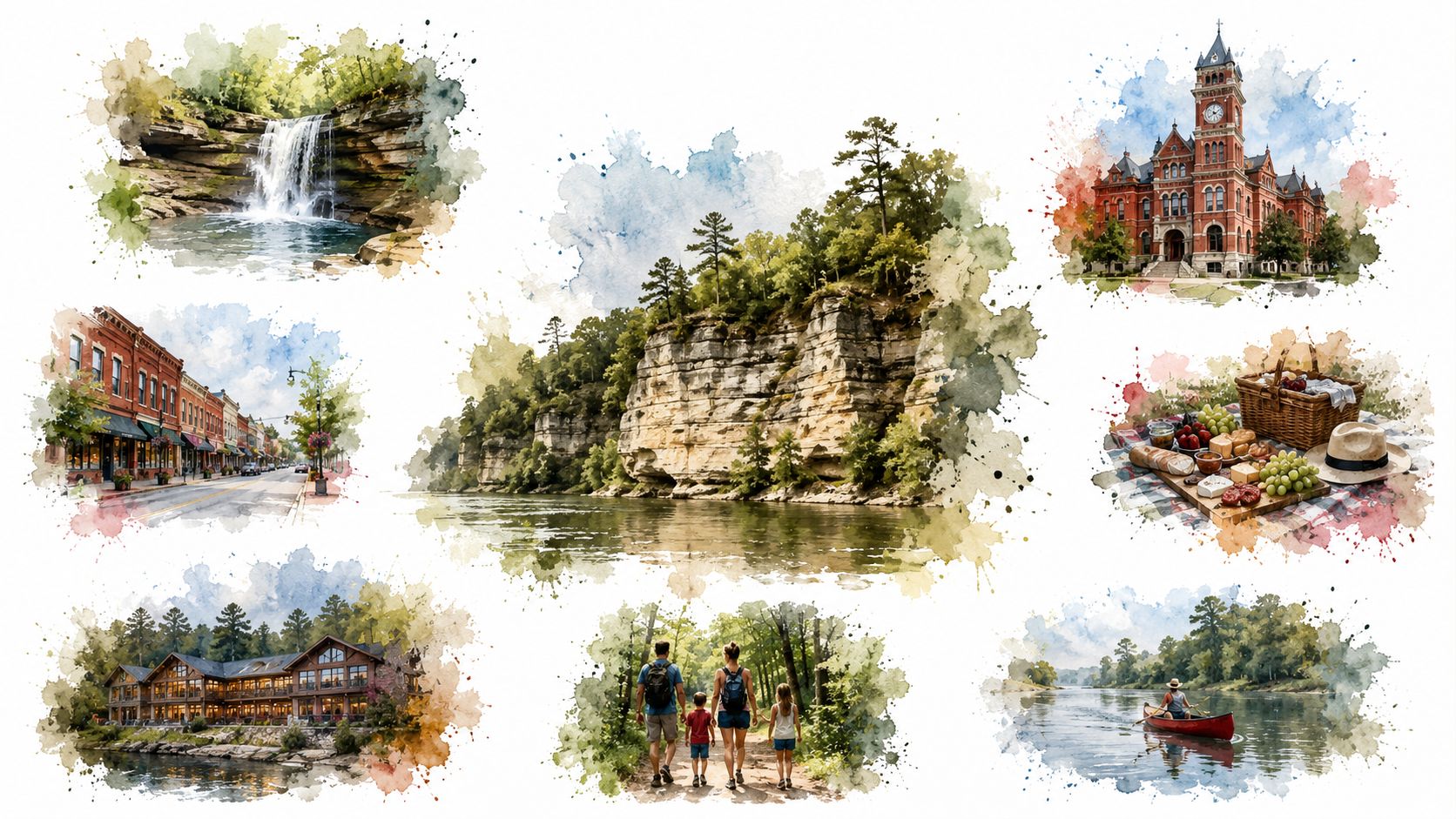
  • 7 Top Attractions Near Starved Rock State Park for 2026

    7 Top Attractions Near Starved Rock State Park for 2026

    I parked near Starved Rock on a windy morning, hiked through the canyons, and still left feeling like the day had more to give. That's the part people miss, the trail ends, but your trip doesn't have to. If you're looking for attractions near Starved Rock State Park, I'd treat the park as the first chapter and the surrounding towns, trails, and museums as the rest of the story.

    1. Matthiessen State Park

    Matthiessen State Park

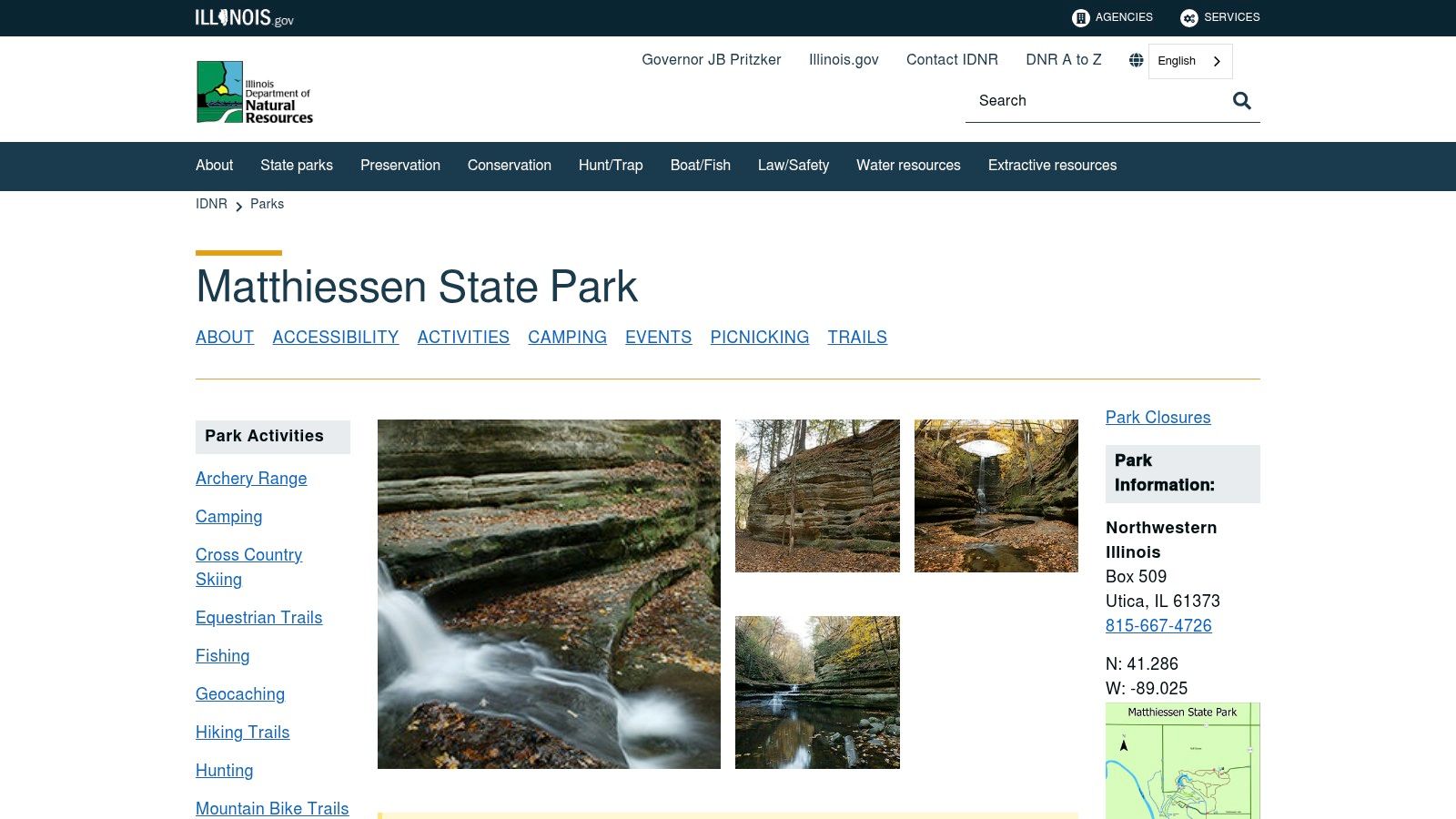
    Matthiessen is the move when you want the canyon feeling without the same shoulder-to-shoulder energy. I like it as the “second stop” after Starved Rock, because it gives you that deep sandstone look again, but in a tighter, quieter package. The Illinois DNR says the park's day-use trails run 7:00 a.m. to sunset, and that simple window matters when you're trying to fit real life around a hike Matthiessen State Park.

    Why I'd put it on the same day

    The Upper and Lower Dells feel like the kind of place where your camera suddenly starts paying attention. Water can move through the interior areas after storms, and bridges can close, so I'd keep my plans loose and my expectations flexible. That's part of the fun here, because the park asks you to read the day instead of forcing the day to read like a schedule.

    Practical rule: If Starved Rock feels crowded, Matthiessen is where I'd go to breathe without leaving the canyon country behind.

    A few things make it easy to choose:

    • Free entry: I don't have to spend energy on a permit process.
    • Mixed terrain: I get canyons, water, forest, and prairie in one compact loop.
    • Trail variety: I can keep walking, or I can stop before the day gets heavy.

    I'd also use the internal guide on a state park in Illinois near Chicago if you want a broader sense of how this whole corner of Illinois connects. Matthiessen feels like the kind of place that reminds you progress doesn't always need a grand reveal. Sometimes it's just another turn in the path, another rock face, another chance to keep going.

    2. Buffalo Rock State Park & Effigy Tumuli

    Buffalo Rock State Park & Effigy Tumuli

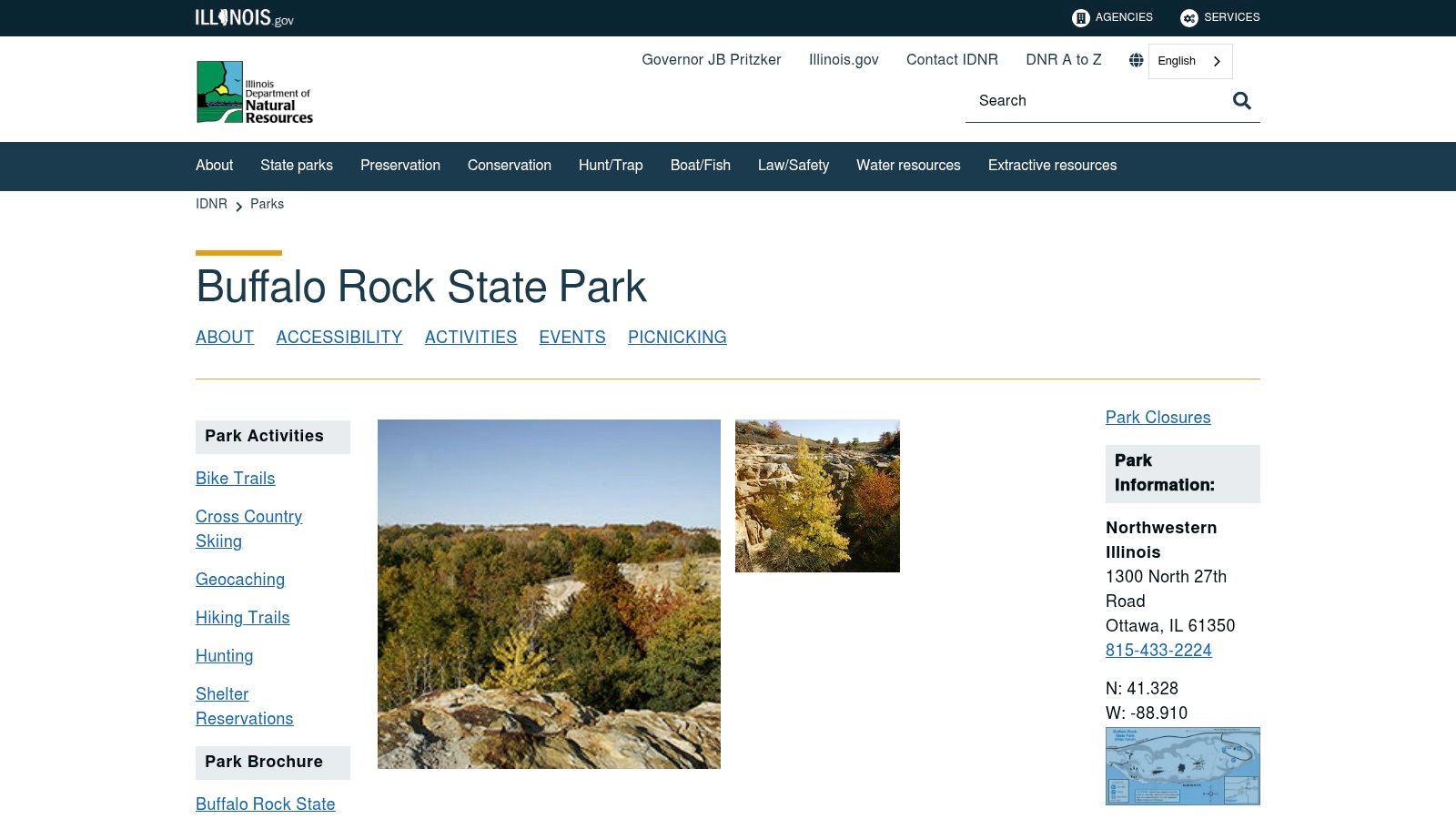
    The first thing Buffalo Rock gives you is the river. That matters. I'd go there on a day when I want to slow down, take an easy walk, and let the Illinois River set the tone before I've even decided what the rest of the afternoon should look like. The bluff-top overlook is the part that stays with me, and the Effigy Tumuli make the visit feel odd in a good way, like the park is giving you scenery and a little mystery at the same time Buffalo Rock State Park.

    The day I'd pick it is the day I want a reset without a hard climb. Buffalo Rock works for that because the pace is gentler, the picnic setup feels relaxed, and the whole place gives your head some room. If you're with family or a group that naturally spreads out, that easy rhythm keeps the outing from turning into a chore.

    What I like most is how straightforward it is. There's no need to build the day around a long trail plan or a packed itinerary. I treat Buffalo Rock as a clear, honest stop, the kind that fits neatly beside another nearby visit and still feels complete on its own. It also pairs well with a broader look at a forest preserve in IL guide if you want to understand how these outdoor spaces fit together.

    • River overlooks: The Illinois River view comes quickly and stays open.
    • Effigy Tumuli: The earthwork sculptures add a cultural layer to the walk.
    • Easy pacing: It suits people who do not want a strenuous day.
    • Close to Ottawa: Food and services are nearby when you want to keep moving.

    Buffalo Rock feels a lot like cleaning up a block you've walked past a hundred times, then finally seeing what was always there. You notice the details because you slowed down enough to notice them. That's the real appeal here, the park gives you a quieter stretch of river country, and in the process it gives you a little more room to pay attention.

    3. Illinois Waterway Visitor Center at Starved Rock Lock & Dam

    Illinois Waterway Visitor Center at Starved Rock Lock & Dam

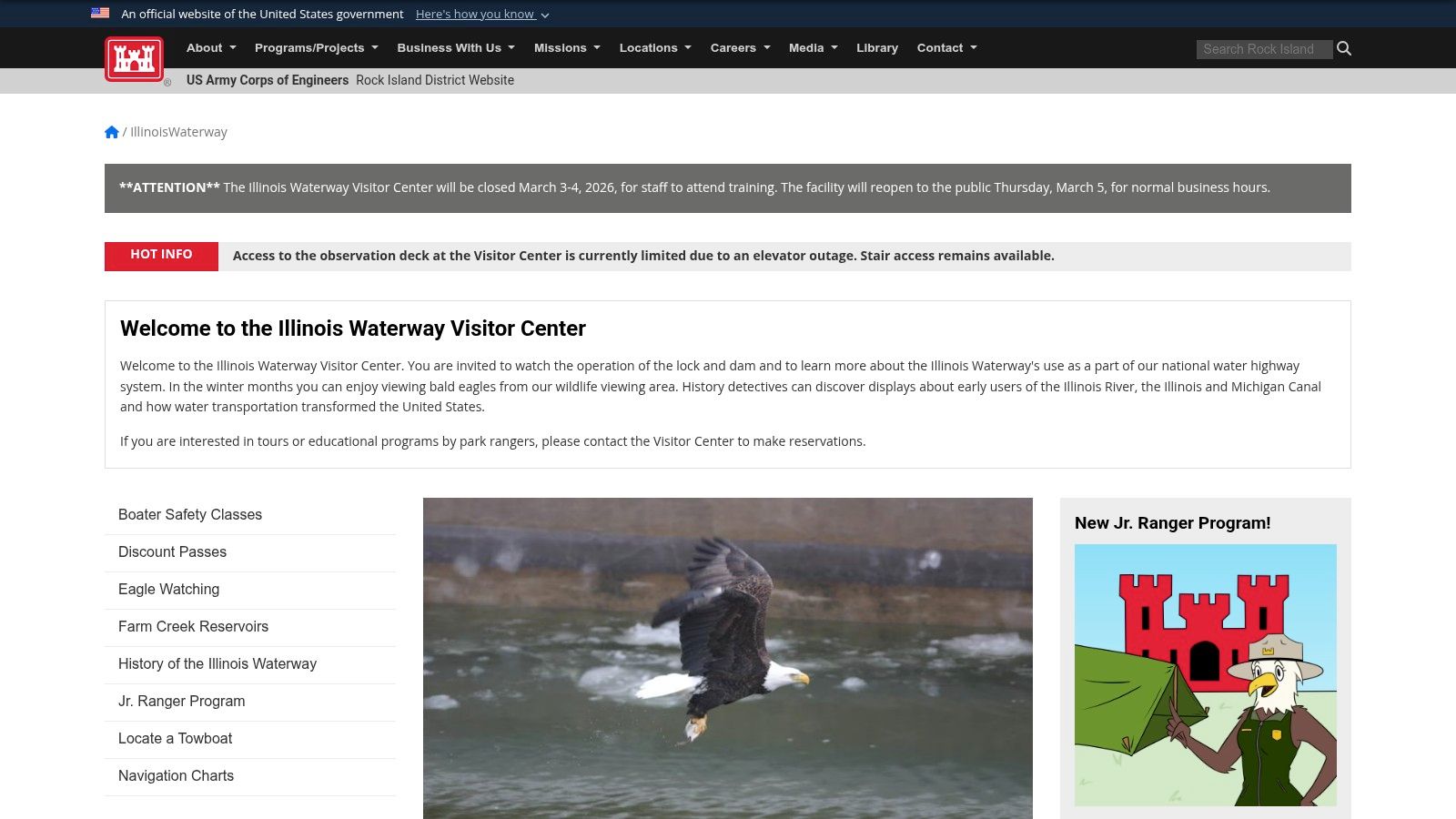
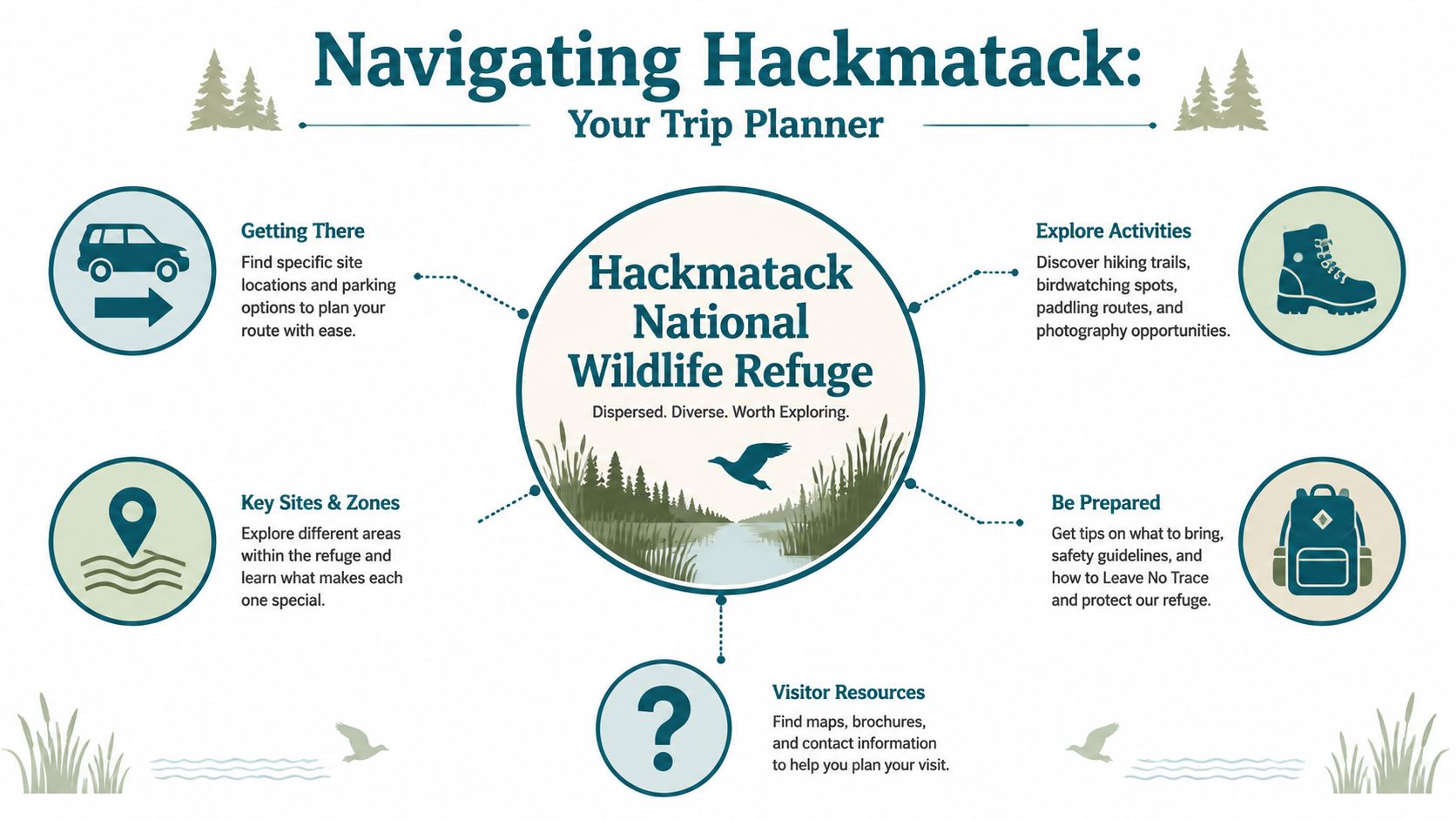
    The first time I stopped here, I was not looking for another hike. I just wanted to watch the river do its work. That is why the Illinois Waterway Visitor Center at Starved Rock Lock & Dam stands out to me. You get a close look at how barges move through the system, and the exhibits explain the Illinois Waterway and the I&M Canal through the Illinois Waterway Visitor Center.

    Watching the river teaches you something

    A lot of people hear “visitor center” and expect a quick indoor stop. This one feels different because the lock viewing area turns the visit into a live scene. You can stand there and watch towboats and barges pass through, then step back inside and connect what you just saw to the bigger river corridor. In colder months, the bald eagle sightings add a real sense of timing, like the season is giving you one more thing to pay attention to.

    I like this stop on days when I need a change of pace without leaving the area. The exhibit space is compact, so it works best as part of a larger outing rather than the whole plan. Still, it fits neatly between a hike, a drive, or even a slower afternoon when you want to stay near the water and keep your energy steady.

    The best part is how practical it feels.

    • Indoor exhibits: Useful when the weather turns or you want a break from the trail.
    • Live lock viewing: You see the river system in motion instead of reading about it later.
    • River traffic: Barges and towboats keep the stop active and interesting.
    • Cold-month eagle watching: A real bonus when the timing works out.

    If you want to pair the visit with something more hands-on, the canoeing Illinois River guide adds a good next layer. I like places like this because they change how you move through a day. You show up, watch how a working river carries itself, and leave with a sharper eye for the details around you. That shift sticks with you.
    4. Illinois & Michigan Canal State Trail

    Illinois & Michigan Canal State Trail

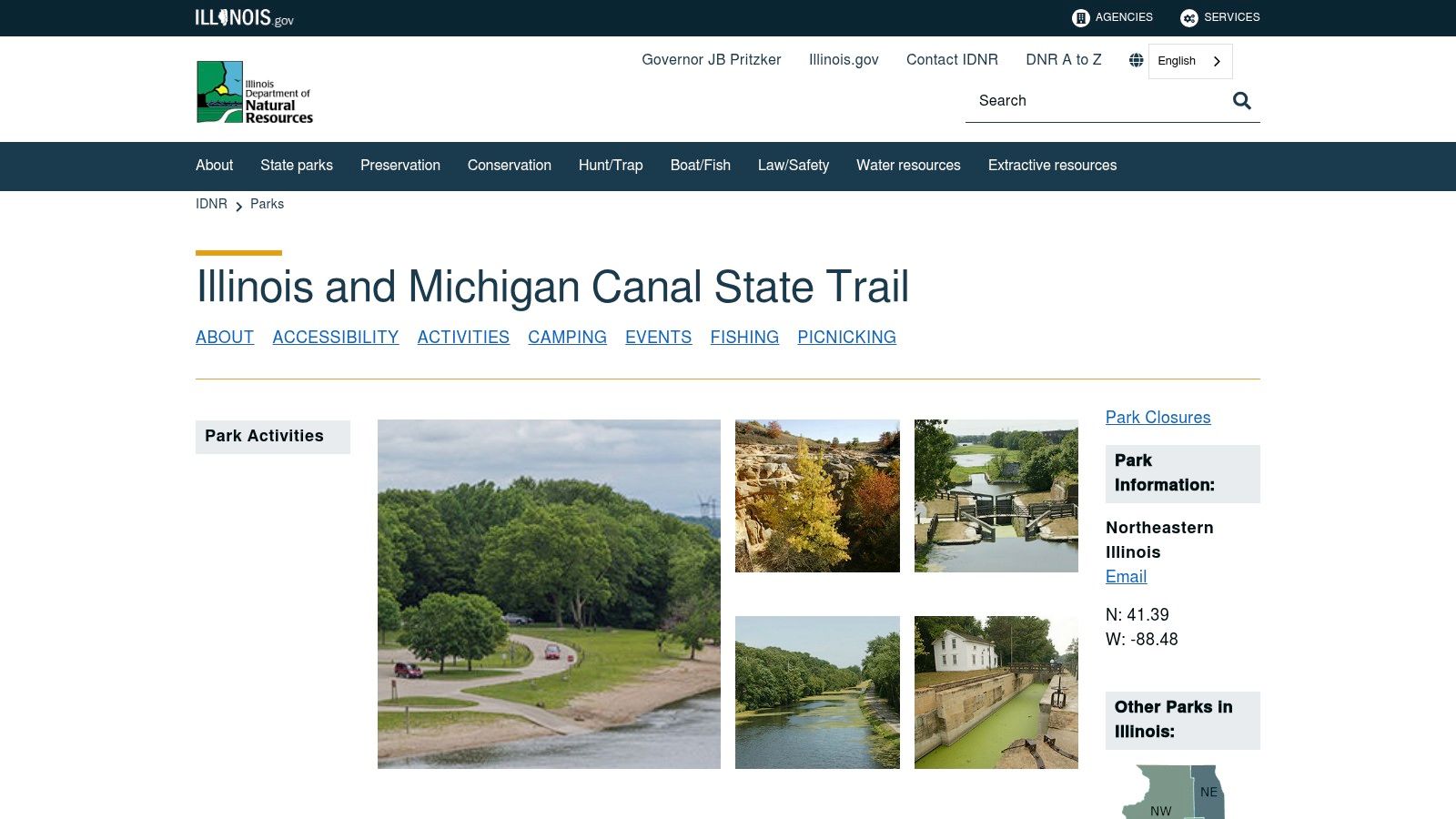
    A friend of mine once used this trail to reset after a crowded weekend in Starved Rock, and that made perfect sense to me. The Illinois DNR describes it as over 61 miles of crushed-limestone trail along the historic canal, so the route gives you room to keep moving without turning the day into a sprint Illinois & Michigan Canal State Trail. I like it because it connects towns, trailheads, and river views in a way that feels earned, not packaged.

    The best days here start with a simple decision. Park once, then let the canal shape the rest of the outing. If you want a longer ride, the trail can carry you across stretches of the region. If you want to move in shorter bursts, it still works, and it never feels like you have to commit to one giant plan just to enjoy it.

    One thing I respect about this trail is that it asks you to pay attention. After heavy rain, the surface can turn muddy, and local detours can change the rhythm of the route, so I'd check conditions before I set out for a longer ride. That feels honest to me. You work with what the day gives you, the same way you would when cleaning up a messy space, one practical choice at a time.

    What makes it worth the stop is how usable it is.

    • Flat route: Easier for bikes, runs, and long walks.
    • Town links: It lets me connect several stops in one outing.
    • Canal history: The trail adds texture to the day.
    • Low barrier to entry: It's easy to use without a lot of planning.

    This is one of the best attractions near Starved Rock State Park if you like trips that feel built by your own hands. You choose the route. You set the pace. You decide when the day needs another mile and when it needs a quiet break by the water.

    5. I&M Canal Visitor Center + Lock 16 Café

    I&M Canal Visitor Center + Lock 16 Café

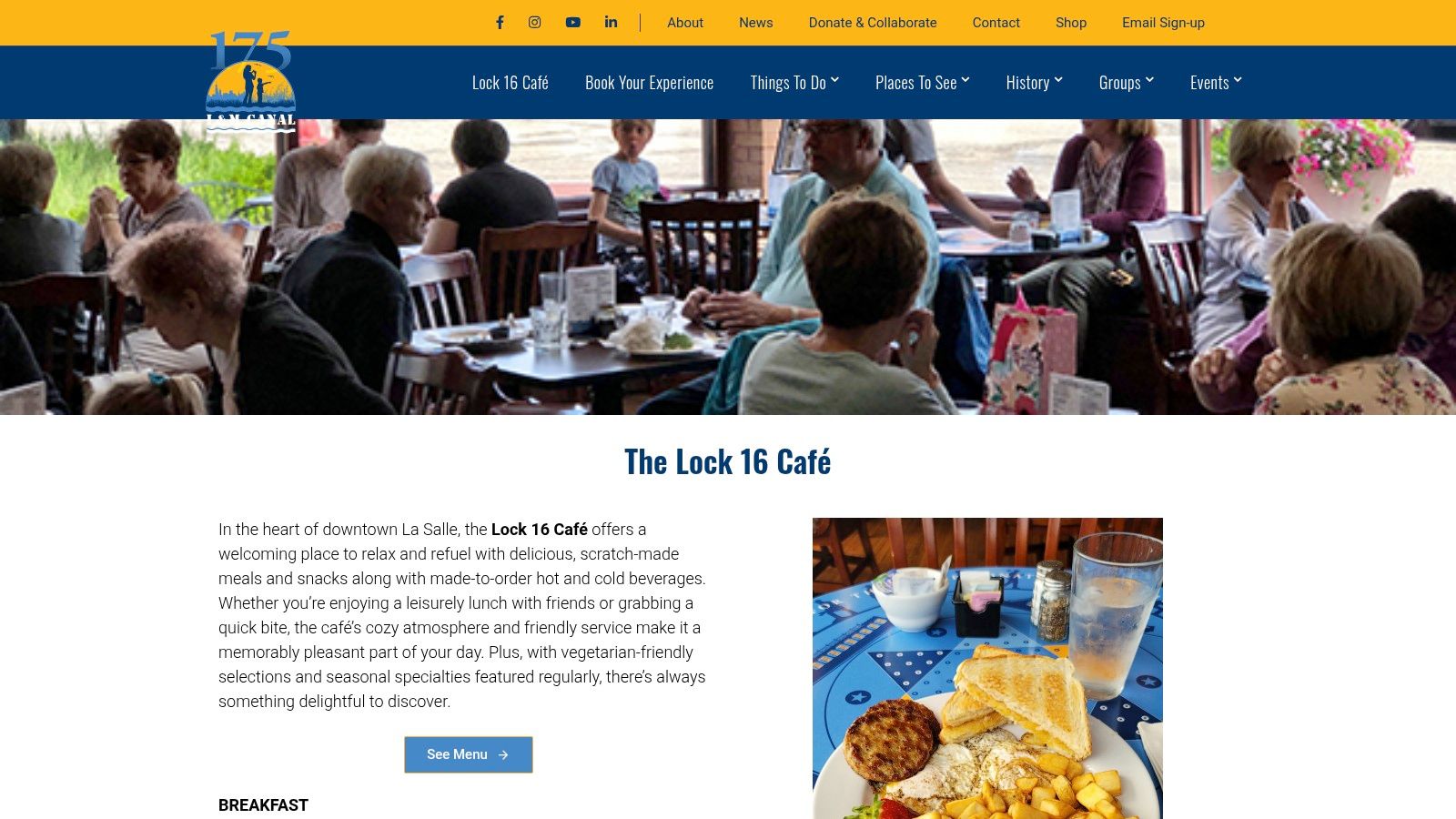
    The first time I stopped here, I came in hungry and left feeling like I had learned something about the place, not just eaten beside it. The Visitor Center in LaSalle gives you canal exhibits and a gift shop, and Lock 16 Café serves scratch-made breakfast and lunch right alongside it Lock 16 Café.

    A stop like this works best when your day needs a reset. After a hike, after a long drive, or after a morning of bouncing between trailheads, it gives you one clean break instead of three separate errands. You can look at the canal history, grab a meal, and keep the outing grounded in the same part of town.

    The place I'd use to regroup

    I'd go here when I want the day to slow down without losing its shape. It fits trail users, but it also fits anyone wandering through downtown LaSalle who wants something practical and low-pressure. The café keeps daytime hours, and the schedule can shift, so I'd check before building the whole lunch plan around it.

    What makes the stop worth it is how direct it feels. I can browse local history, pick up a small souvenir, and sit down to eat without crossing town or juggling a complicated plan.

    • Free Visitor Center: Easy to drop in.
    • Scratch-made meal: Good when hiking has turned me into a human vacuum.
    • Central location: I can keep moving through LaSalle or the canal trail.
    • Kid-friendly exhibits: Makes it easier for mixed-age groups.

    I'd pair this with a walk or a quiet afternoon nearby, because the place naturally invites that slower rhythm. It feels like wiping down the table before dinner, a small act that makes the rest of the experience better.

    6. Reddick Mansion

    Reddick Mansion

    I'd stop at Reddick Mansion when I want the day to slow down without turning flat. The Ottawa house has 22 rooms, Italianate style, and guided tours that bring out the period furnishings, the local history, and the Lincoln-Douglas debate site Reddick Mansion. It rewards the kind of attention you bring after a morning outside, when your eyes are ready to notice details instead of chase them.

    Good when the weather turns or your legs are done

    The timing matters here. Tours run Fri-Mon at 11 a.m. and 1 p.m., so I would not build a loose wander around it unless those hours fit your plan Reddick Mansion. That said, the visit has a calm, guided pace that works well when the park is no longer the main event and you want something more reflective.

    Accessibility is part of the picture too. The upper floors are only partly accessible, and a chairlift reaches the second floor, so I'd check the setup before I go if mobility is a concern. I like that kind of plain honesty. A place that tells you exactly what it offers makes planning easier and keeps expectations grounded.

    A few things make it worth the stop:

    • Guided tours: I get a real person walking me through the house instead of just reading plaques.
    • Historic rooms: The furnishings and architecture give the mansion real character.
    • Washington Square location: It fits neatly into a downtown Ottawa stop.
    • Indoor fallback: A solid option when the park day ends early.

    This is the sort of place that leaves you with a quieter kind of energy. After a trail, that matters. You step back out into town a little more aware of where you are, and maybe a little more aware of yourself too.

    7. Grand Bear Resort at Starved Rock

    I've seen trips to Starved Rock change shape the minute rain shows up or little legs get tired. Grand Bear Resort fits that moment well, because it gives you a place to stay, a place to play, and a place to reset without turning the weekend into a logistical puzzle. The indoor waterpark, wave pool, lazy river, slides, arcade, and on-site dining cover the part of the trip that happens after the trails, and the cabins and villas work well for families or mixed-ability groups Grand Bear Resort at Starved Rock.

    The indoor fallback I'd actually plan for

    A wet forecast does not have to cancel the mood of the trip. If the weather turns, if kids need something higher-energy, or if your group wants one base where nobody has to keep loading and unloading the car, this place makes the day easier. It also helps when your body wants a break from the trail but your head still wants the feeling of being away.

    What I'd check first is access. Waterpark passes can change by date and occupancy, and day passes are not always available, so I would confirm that before I built the rest of the plan around it. Room rates and availability shift with the season too, which is another reason to book carefully.

    A few practical reasons it works:

    • Indoor waterpark: A good fit for rainy weather and kids with energy to spare.
    • Lodging choices: Cabins and villas keep the group in one place.
    • Arcade and dining: Less running around, fewer decisions, more time to relax.
    • Short drive to the park: Easy to pair with a canyon weekend.

    I like having a stop like this in the mix because it gives the whole trip room to breathe. You can push hard on the trails one day, then recover the next without losing the rhythm of the weekend.

    7-Attraction Comparison Near Starved Rock

    Attraction Access & Complexity 🔄 Time, Cost & Resources ⚡ Expected Experience ⭐📊 Ideal Use Cases 💡 Key Advantages
    Matthiessen State Park 🔄 Short drive S of Utica; signed day-use trails; parking can fill on weekends ⚡ Half-day–full day; free entry; moderate footwear; some waterfall areas may close after storms ⭐⭐⭐⭐ Dramatic sandstone canyons & waterfalls; strong photography potential 📊 💡 Compact canyon hikes; a less-crowded complement to Starved Rock Varied terrain in a small area; often fewer crowds; free
    Buffalo Rock State Park & Effigy Tumuli 🔄 Easy bluff-top access; short, family-friendly trails; limited mileage ⚡ 1–2 hours; free; picnic supplies optional; seasonal e-bike rentals available ⭐⭐⭐ Wide Illinois River vistas plus large-scale earthwork sculptures 📊 💡 Family picnics, easy walks, scenic overlooks with cultural-art interest River overlooks with fewer crowds; family-friendly; close to Ottawa services
    Illinois Waterway Visitor Center (Starved Rock Lock & Dam) 🔄 Drive-to visitor center with indoor exhibits and outdoor viewing for locks ⚡ 30–90 minutes; free; variable hours, check before visiting ⭐⭐⭐ Educational exhibits and live lock/barge viewing; frequent eagle sightings in cold months 📊 💡 Quick educational stop or family-friendly add-on to nearby hikes Up-close engineering displays and real-time operations; free
    Illinois & Michigan Canal State Trail 🔄 Multiple trailheads along 61+ miles; flat crushed-limestone surface ⚡ Flexible (short to full-day); free; bike recommended; surface can be muddy after rain ⭐⭐⭐ Long, easy cycling/walking with historic canal interpretation 📊 💡 Group rides, “park once” exploration of multiple towns, family outings Extensive connected trail network; multiple access points; family-friendly
    I&M Canal Visitor Center + Lock 16 Café 🔄 Central LaSalle location with easy parking and direct trail access ⚡ 30–90 minutes; visitor center free, café items paid; café hours limited ⭐⭐ Informative exhibits plus reliable food stop; convenient regrouping point 📊 💡 Trail refueling, learning canal history, family pit stop Combines history, local goods and a café; convenient downtown access
    Reddick Mansion 🔄 Downtown Ottawa location; guided small-group tours with set times ⚡ 60–90 minutes; low-cost tours; limited tour days and partial upper-floor accessibility ⭐⭐⭐ Focused historic interpretation and well-preserved period architecture 📊 💡 Bad-weather alternative; visitors interested in local history and architecture Docent-led tours, original furnishings, strong local-history context
    Grand Bear Resort at Starved Rock 🔄 Resort property minutes from trails with on-site amenities and parking ⚡ Half-day to overnight; paid lodging and waterpark fees; day-pass availability varies ⭐⭐⭐ Indoor waterpark entertainment, lodging and kids' activities; good rainy-day option 📊 💡 Families seeking lodging plus indoor entertainment or mixed-ability groups Combines lodging and child-focused entertainment; close to Starved Rock trails

    Your Turn to Explore

    The best trips are the ones that change you a little. Maybe it's the quiet of a different canyon, maybe it's a plate of lunch in a small town, maybe it's watching a lock open while the river traffic slides through. I've always liked the idea that service, travel, and small acts of attention all do the same thing, they pull you out of autopilot and make you more awake.

    That's why I like attractions near Starved Rock State Park as more than a route map. You can hike at Starved Rock, then let one extra stop teach you something new about patience, history, or just how to spend a day well. If you're the kind of person who wants a trip with texture, pick one place, give it your full attention, and let the day keep unfolding from there.

    You don't need a perfect plan to make a good memory. You just need to show up, keep moving, and stay curious when the trail gets quiet.


    If you like the idea of turning small actions into real change, I'd love for you to check out Litter Caterpillars. We clean up Chicago block by block, rain or shine, and we know the same feeling you get after a good hike, the day feels better because you showed up for it. Join us, make friends, and bring that same energy back to your own neighborhood.

  • Resource Management Land: A Practical Guide to Stewardship

    Resource Management Land: A Practical Guide to Stewardship

    On a cold Chicago Saturday, a new volunteer showed up with gloves too big for her hands and no clue what a vacant lot had to do with her life. By 9 a.m., she was picking bottle caps out of wet grass and asking who decides what happens to this ground after we leave.

    A Saturday Morning With a Crew That Cares About the Ground

    The first thing I notice on a cleanup morning is how fast strangers become a crew. Someone sorts grabbers. Someone else ties open trash bags to a fence post so they don't fold in the wind. I usually see the same look on new volunteers' faces, a mix of curiosity and mild disbelief, because most of us grow up thinking land is something other people manage.

    Then you bend down and start pulling junk from the soil. You see a cracked bottle half-buried by roots, a candy wrapper snagged in a thorny stem, a patch of compacted dirt where water keeps pooling. That's when the idea of resource management land stops sounding like a planning term and starts sounding like the ground under your shoes.

    You don't need to own a farm to care about land. You just need to walk it long enough to notice what's happening to it.

    A city block can teach the same lesson as a field or a reserve. If people dump on it, the space changes. If neighbors weed it, plant it, or keep an eye on it, the space changes again. The rest of this piece follows that simple question: who is responsible for land, and what does good stewardship look like when you're standing on it with a trash bag?

    What Resource Management Land Actually Means

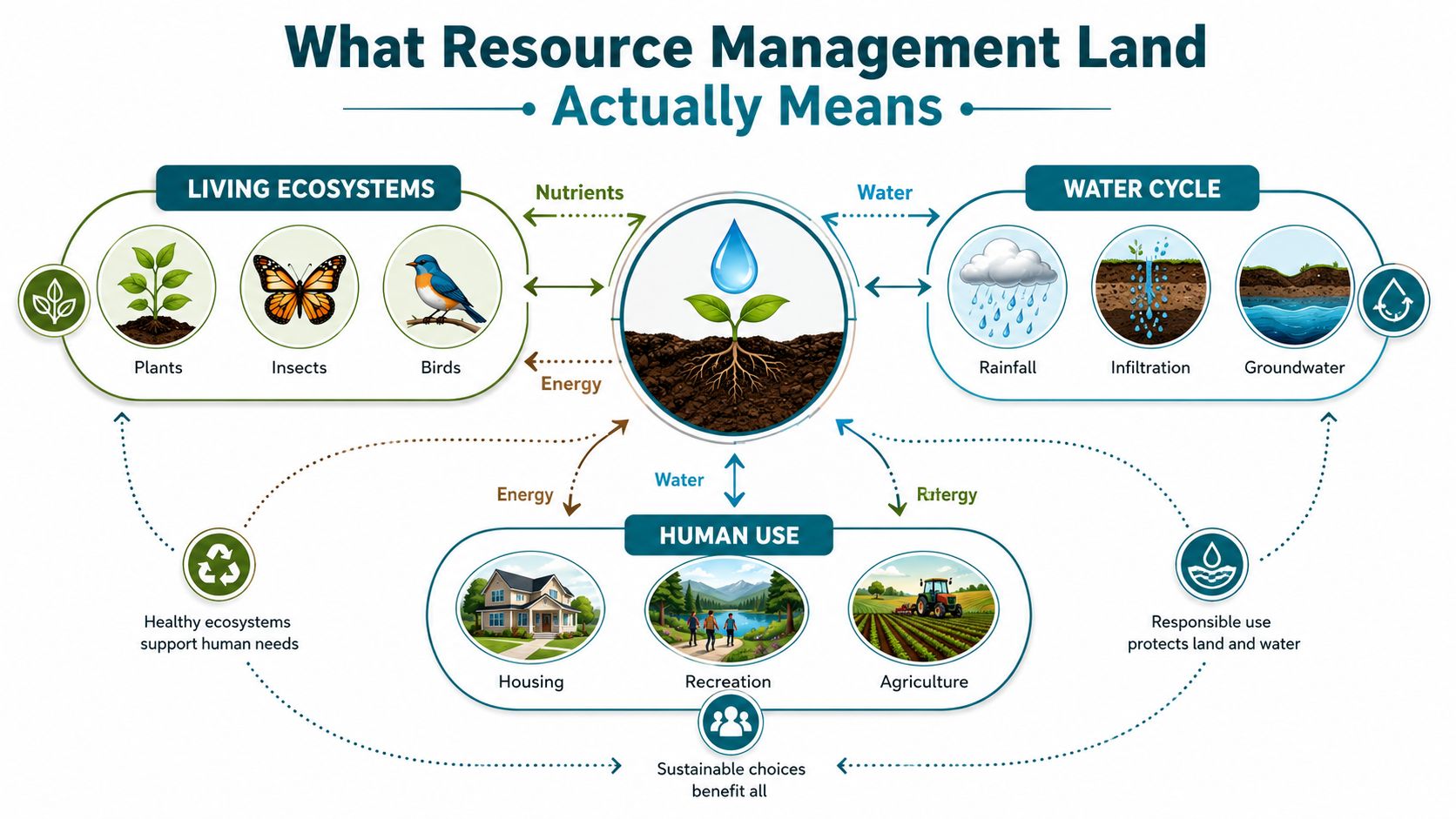
    Land is not just dirt. A kitchen pantry is a helpful analogy. The shelf, the jars, the labels, the food inside, and the person who keeps it organized all matter at once. In the same way, land holds soil, water, plants, animals, settlement patterns, roads, buildings, and human activity together in one place, which is why the FAO defines land as a “delineable area” with all of those parts in view. The same FAO source says land resources planning means deciding before action, and land resources management means putting that plan into practice with stakeholder participation. You can read that framework in the FAO's land definition and planning note, which lays out the terms plainly.

    Natural resource management takes that same idea and applies it to daily decisions. It means I don't treat water, soil, habitat, and use patterns as separate boxes. I look at them together, because a change in one place often shows up somewhere else later. That's why resource management land is really a system, not a plot.

    A vacant lot helps make this concrete. If the lot has compacted soil, runoff, weeds, and no shade, I'm not looking at a simple cleanup problem. I'm looking at a small system with many moving parts. If a crew adds native plants, checks drainage, and keeps footpaths clear, the same lot starts behaving differently.

    The language can feel abstract until you tie it to something ordinary. Your own alley, park strip, or community garden bed already works this way. The question is never just “what's on the land?” The core question is “how do the parts affect each other, and who keeps watch?”

    An infographic illustrating the interconnected relationship between living ecosystems, the water cycle, and human resource land management.

    If you want a plain-language companion to that idea, I like the way this short guide on environmental stewardship frames care for place as something you practice, not something you merely support from a distance.

    The Three Pillars That Hold Any Stewardship Plan Together

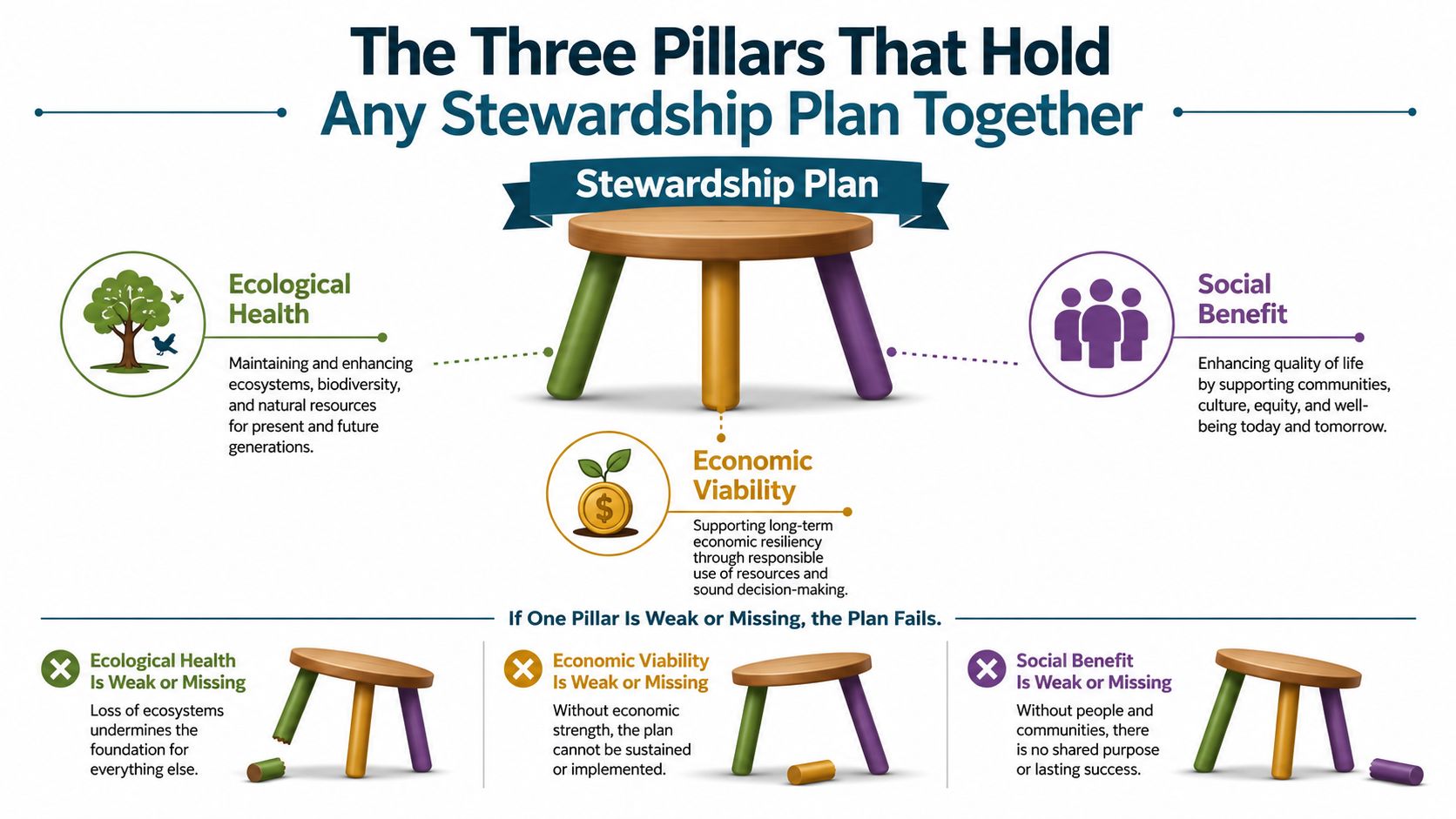
    I use a three-legged stool when I explain stewardship. If one leg is too short, the whole thing wobbles. A good land plan works the same way. It needs ecological health, economic viability, and social benefit to hold steady.

    Ecological health

    This is the part people see first when they kneel down and touch the soil. Healthy soil filters rain better, roots hold ground in place, and plants create cover that keeps bare earth from washing away. In the ABS national land account, 56.2 million hectares of natural terrestrial vegetated herbaceous land became natural surfaces like bare earth between 2015 and 2020, which shows how fast land cover can change at large scale. The same release says land managed for resource protection in Australia increased by 14.1 million hectares between 2015–16 and 2020–21, and that land changes don't happen in a vacuum. They happen through decisions.

    Economic viability

    This pillar is easy to miss on a cleanup crew, but it matters. If a site stays flooded, overgrown, or unsafe, the people who live near it pay for that in time, upkeep, and lost use. Australia's national land account also reports that the total land value rose by 48.4% to $7,733.0 billion over the same period. That figure doesn't tell you how to manage a block, but it does tell you land is tied to money, tax bases, and long-term planning. ABS land account release

    Social benefit

    This is the part crews feel right away. A site that people can reach, use, and help maintain gets more eyes on it and more hands in it. If the event starts at a fair hour on a weekend morning, more people can show up. If the space feels safe and welcoming, neighbors stay longer and come back. That's not theory, that's basic human behavior.

    Practical rule: if a plan helps trees but makes the site harder for people to use, or helps people but strips the soil bare, I know I've tilted the stool.

    A diagram of a three-legged stool showing how ecological, economic, and social pillars sustain stewardship plans.

    A Toolkit of Common Techniques You Will See in the Field

    When I walk a site with volunteers, I like to sort the work into tools. That keeps people from treating every problem like a shovel problem. Some jobs need planning, some need biology, some need rules, and some need maps.

    Six Core Techniques at a Glance

    Technique What it solves Example
    Conservation easements Keeps land from being developed in ways that clash with the long-term plan A parcel stays open for habitat or low-intensity use
    Soil and water management Handles runoff, erosion, drainage, and plant health A crew adds swales, mulch, or better grading
    Zoning Sets what kinds of use are allowed A community garden stays legal under local rules
    Ecological restoration Helps a damaged site recover native function Volunteers remove invasive plants and replant natives
    Sustainable agriculture Supports food production without stripping the ground A small growing site rotates beds and protects soil
    GIS mapping Tracks where work happens and what changes over time A team maps litter hot spots, plantings, or trail edges

    How the tools work together

    A community garden might use zoning to stay allowed, soil testing to understand what the ground can handle, and GIS to map where the beds, paths, and problem spots sit. A prairie restoration might lean on ecological restoration first, then soil and water management when rain starts cutting ruts. A site near homes might need a conservation easement if the goal is to keep it open later instead of selling it off for another use.

    I tell volunteers not to memorize the jargon before they can name the problem. Start with the trouble in front of you. Is the site eroding? Then soil and water matter. Is the use wrong for the neighborhood? Then zoning matters. Is the ground empty but full of potential? Then restoration or sustainable agriculture may fit.

    One more thing. GIS sounds technical, but I think of it as a smart clipboard. It helps you see patterns you can't hold in your head after the third or fourth cleanup day. That makes it easier to explain why one corner keeps failing while another one starts to recover.

    How Policy and Planning Decisions Actually Get Made

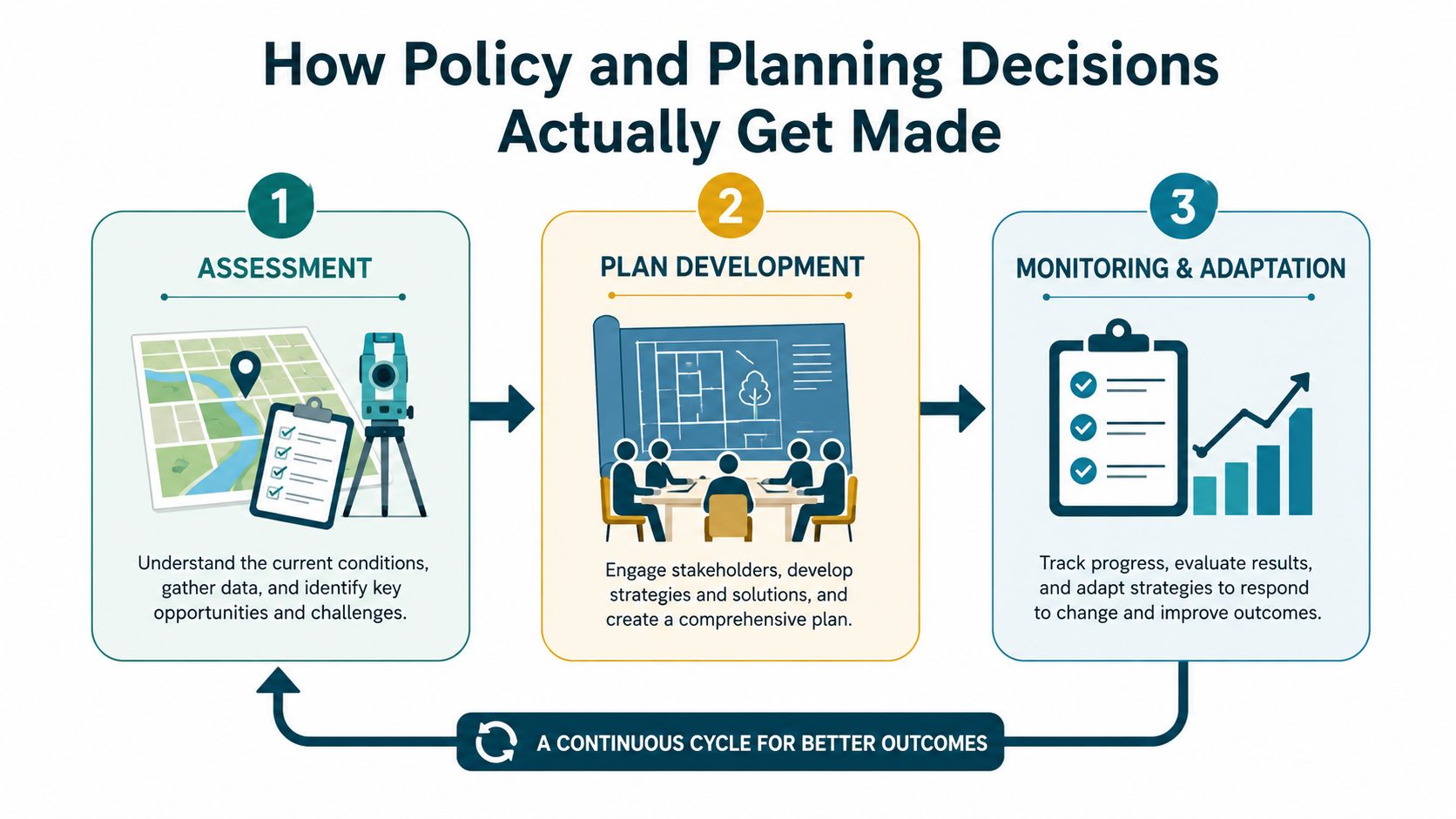
    Land decisions happen in a back room. In practice, they move through a cycle. The USDA Forest Service says a land management plan has three named phases, assessment, plan development, and monitoring the plan's effectiveness. That makes planning feel less like a one-time speech and more like a loop. USDA Forest Service land management plans

    What the cycle looks like on the ground

    First, someone gathers facts. What's on the site? What's broken? What's used often, and by whom? Then planners write a plan that tries to answer those questions with real actions. After that, managers check whether the plan worked and change course if it didn't.

    The Bureau of Land Management says its Resource Management Plans are the “blueprints” for how land will be managed, and the agency says these plans often run for about 20 years. That matters because a plan has to last long enough to guide real work, even when volunteers rotate out and staff changes. BLM planning overview

    There's also a formal tribal-consultation step during preparation and amendment of resource management plans. The BLM planning fact sheet says the agency must consult with Indian tribes on a government-to-government basis. That is not a courtesy detail. It is part of the process. BLM planning fact sheet

    I also need to talk about capacity. A plan can look clean on paper and still fail if nobody has the staff, tools, or budget to keep it moving. The hard part is not only writing a plan, it is keeping the system alive after the meeting ends.

    If you want a plain example of how public access and land use can sit in the same conversation, this piece on a green city project gives a useful civic lens without turning land care into a classroom abstraction.

    A three-step infographic showing the continuous cycle of assessment, plan development, and monitoring for policy decisions.

    A public plan matters most when someone can still follow it after the first round of meetings ends.

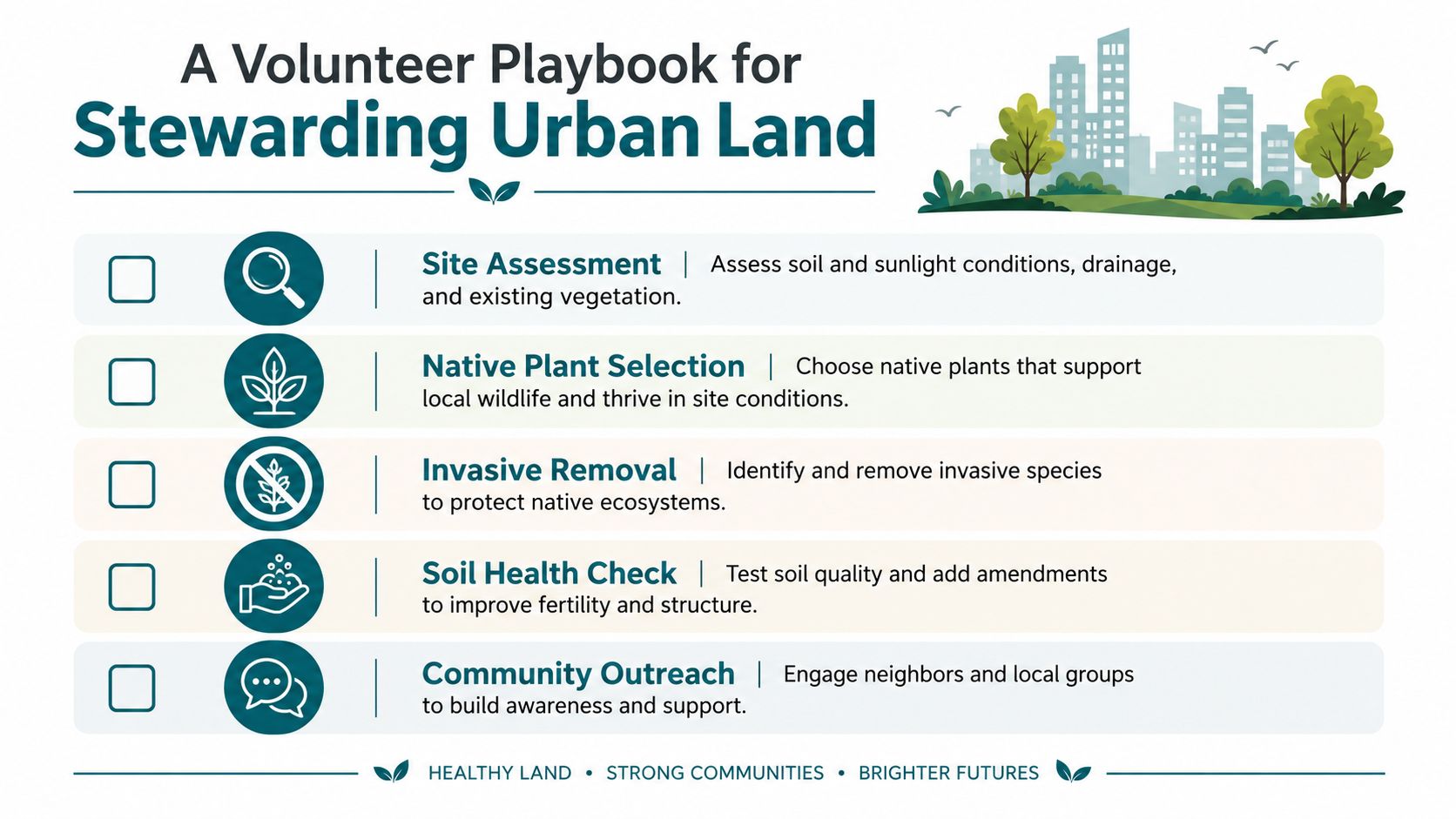
    A Volunteer Playbook for Stewarding Urban Land

    I like clean, repeatable volunteer events because they keep the work honest. If a neighbor shows up once, they should know what to do within five minutes. If they come back next week, the site should look a little better and feel a little safer.

    Start with a site walk

    Before I ask anyone to pick up trash, I want eyes on the ground. Look for broken glass, hidden holes, thorny growth, poison ivy, slick mud, and heavy debris that needs two people instead of one. I also check sun, shade, and where water sits after rain.

    Pack a small kit

    You don't need a giant setup. Gloves, grabbers, bags, hand sanitizer, water, a first aid kit, and a few trash tongs cover most normal work. If the site has sharp debris or tall weeds, bring eye protection and long sleeves too.

    Keep the schedule humane

    Weekend mornings work because they fit people who want to give time without wrecking the rest of their day. I've found that early starts also make it easier to build a routine. People show up, do the work, and still have the afternoon left for the rest of their lives.

    Use partnerships with clear asks

    I avoid vague partnership language. Ask a nearby business for water, a church for a meet-up spot, or a neighbor for a tool shed hookup. Don't ask people to donate just because they're present. Give them a simple role and a simple thank-you.
    Measure what people can see

    I like visible signs of progress. A cleared curb, a bag pile that's gone, a path that people can use again, or a corner that no longer looks ignored. That's enough for most neighbors to understand the work without a spreadsheet.

    • Safety check: scan for broken glass, needles, and unstable ground before anyone fans out.
    • Buddy system: pair new volunteers with someone who already knows the block.
    • Clear exit point: decide where bags go and who calls the cleanup done.
    • Visible finish: leave one spot cleaner than you found it, not just “less bad.”

    If you want a simple way to help more people start, this guide on how to start a volunteer group gives a useful next step for community organizers.

    A volunteer guide for urban land stewardship featuring steps like site assessment, plant selection, and community outreach.

    Case Studies From Neighborhoods That Got It Right

    One crew started with a grim block and a handful of volunteers who kept showing up. At first, they only picked up litter and trimmed edges. Then the same people came back every week, and the cleanup stopped feeling like a one-off event. The block changed because the habit changed.

    Another group found an empty lot at auction and treated it like a long project instead of a lucky win. They cleared debris, checked the ground, added plants, and kept returning until the space started working for the neighborhood. That's how a blank parcel turns into a place people can use without wondering who owns the idea anymore.

    A third crew took a neglected corner and worked it from three directions. They mapped the site, planted natives, and pushed for simple zoning choices that made the space easier to keep. None of those steps felt flashy on its own. Together, they made the block more usable.

    What I like about these stories is that none of them starts with a giant budget or a perfect plan. They start with people who noticed a place and decided to keep caring after the first day was over. If your block has a story still waiting to be written, it probably starts the same way.


    If you want help turning a messy block into a place people can care for, connect with Litter Caterpillars and join a crew that shows up, learns the ground, and keeps going together.

  • Explore Rainbow Park and Beach: Your Guide for 2026

    Explore Rainbow Park and Beach: Your Guide for 2026

    I still remember the first time I walked up to Rainbow Park and Beach and heard the city fade behind me. One minute I was in street noise and traffic hum, the next I was looking at water, sand, and a skyline that made me slow down without trying.

    Introduction

    That first visit hooked me because the place felt lived-in, not staged. I could see people arriving with towels, runners moving along the edge of the lakefront, and a few volunteers already bending down to pick up stray cups and wrappers before they got blown farther along the shore.

    Rainbow Park and Beach in Chicago has that kind of pull. It gives you a place to swim, sit, walk, and pitch in, all in one stop. If you want a lakeshore day that feels easy but still has a little motion in it, this is the stretch I'd point you to first. The practical part matters too, because a good beach day starts with the address, the hours, and a plan that doesn't leave you guessing.

    Understanding Rainbow Park and Beach

    One of the first things you notice at Rainbow Beach is how much room the place gives you to settle in. It sits in the South Chicago neighborhood as a 60.98-acre lakefront park, so the shoreline does not feel cramped or boxed in. You can spread out, find a quieter patch, or move toward a livelier corner without feeling like the whole day is pinned to one small stretch of sand. The park district also notes a gymnasium, fitness center, multipurpose rooms, handball courts, and one of the oldest community gardens in Chicago on the property, which makes the place feel bigger than a beach stop and more like a full neighborhood hangout.

    How the space feels on the ground

    The first time I walked through, I kept noticing how easy it was to shift from one mood to another without leaving the park. A friend can head for the water, someone else can sit on the grass with lunch, and another person can drift toward the courts or the garden and still feel part of the same outing. That kind of setup matters because a lakeshore day is rarely about just one thing.

    Rainbow Park and Beach works because it gives you options without making the day feel scattered. You can start with sand, move to open lawn, then follow your curiosity toward the garden or the indoor facilities if the weather or your energy changes. The community garden adds a different texture too, since it pulls the visit beyond the usual beach routine and gives you something living and local to watch besides the waves.

    The best shoreline spots let you change pace without changing the place.

    That is the part I keep coming back to here. I can stay for a short visit and still end up making a small loop, beach, path, lawn, garden, then back toward the water again. It keeps the whole outing relaxed.

    Why the layout matters for a visit

    The size of the park also changes how groups use it. Bigger lakefront spaces need a little more coordination because one person may want to stay near the water while someone else is looking for shade, a walk, or a game of catch. Rainbow Beach handles that well enough that splitting up does not feel like a hassle.

    I like telling friends to treat it like a layered outing. Bring a blanket, but keep your shoes close. Pack a snack, but do not plan to sit in one place the whole time. If you want a local example of that same easy mix of sand, room to move, and community energy, the setting around 12th Street Beach and its cleanup scene shows how a lakeshore can feel active without getting crowded. Rainbow Park gives you enough variety to make the day slower, longer, or more active, depending on who shows up with you.
    Planning Your Visit

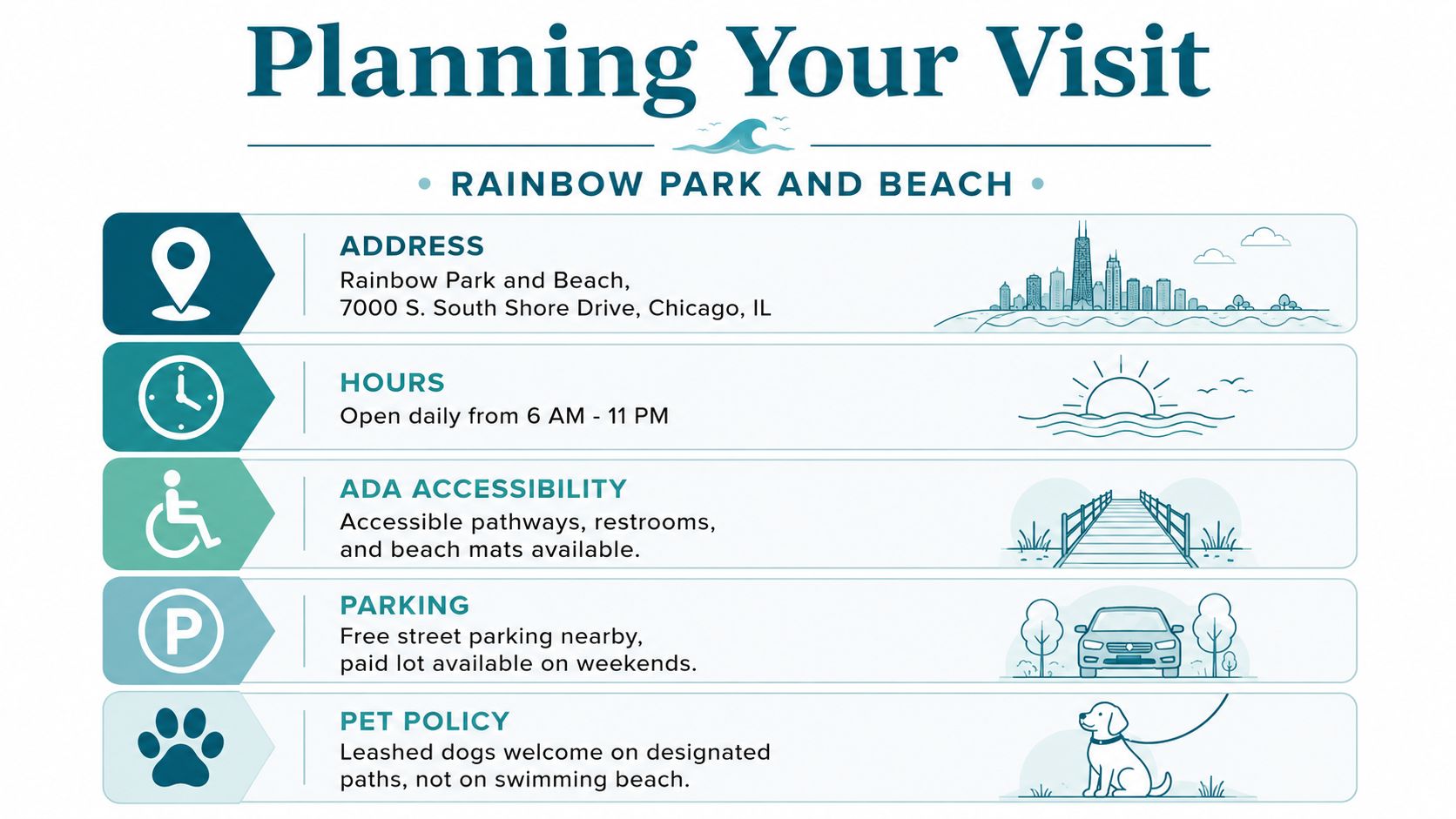
    The first time I tried to meet someone at Rainbow Beach, I almost went to the wrong spot because I trusted memory more than the map. Don't do that. Use the address, check the hours, and keep one eye on the cross street so you don't wander around South Shore with a cooler in your hand and no clear target.

    An informational infographic about Rainbow Park and Beach in Chicago showing address, hours, accessibility, parking, and pets.

    The basics I'd keep on your phone

    • Address: Rainbow Beach sits at 3111 E 77th St in Chicago, with South Shore Drive listed as the cross street in one listing (Time Out Chicago).
    • Hours: Choose Chicago lists public hours of 11 a.m. to 7 p.m. (Choose Chicago).
    • Natural area note: The Chicago Park District page for Rainbow Beach Natural Area lists the area as open from dawn to dusk, which is one reason visitors sometimes find official pages a little out of sync (Chicago Park District natural area listing).
    • Route check: If you're meeting friends, share the exact street address before you leave. A beach day feels much smoother when everyone lands at the same entrance.

    I'd also open the internal cleanup guide before you go, especially if you're planning to join a volunteer morning later or you want to compare what a South Side cleanup looks like in practice: 12th Street Beach cleanup guide.

    How I'd plan the timing

    I like to arrive earlier than I think I need to. That gives me time to find the right path, settle my stuff, and take a slow lap before the crowd builds. If I'm going for a short visit, I treat the hours like a hard boundary and leave myself a cushion on the back end. If I'm meeting a group, I pick one landmark, one entrance, and one fallback place to wait.

    Bring the exact address with you. Lakeshore parking and curbside drop-offs get messy fast when you rely on memory.

    If you're trying to make the day easy, keep your plan simple. Know where you're going. Know when the park listing says you can be there. Know whether you're using the beach, the garden, or the paths first. That small bit of prep saves more friction than any beach bag trick I know.

    Activities and Highlights

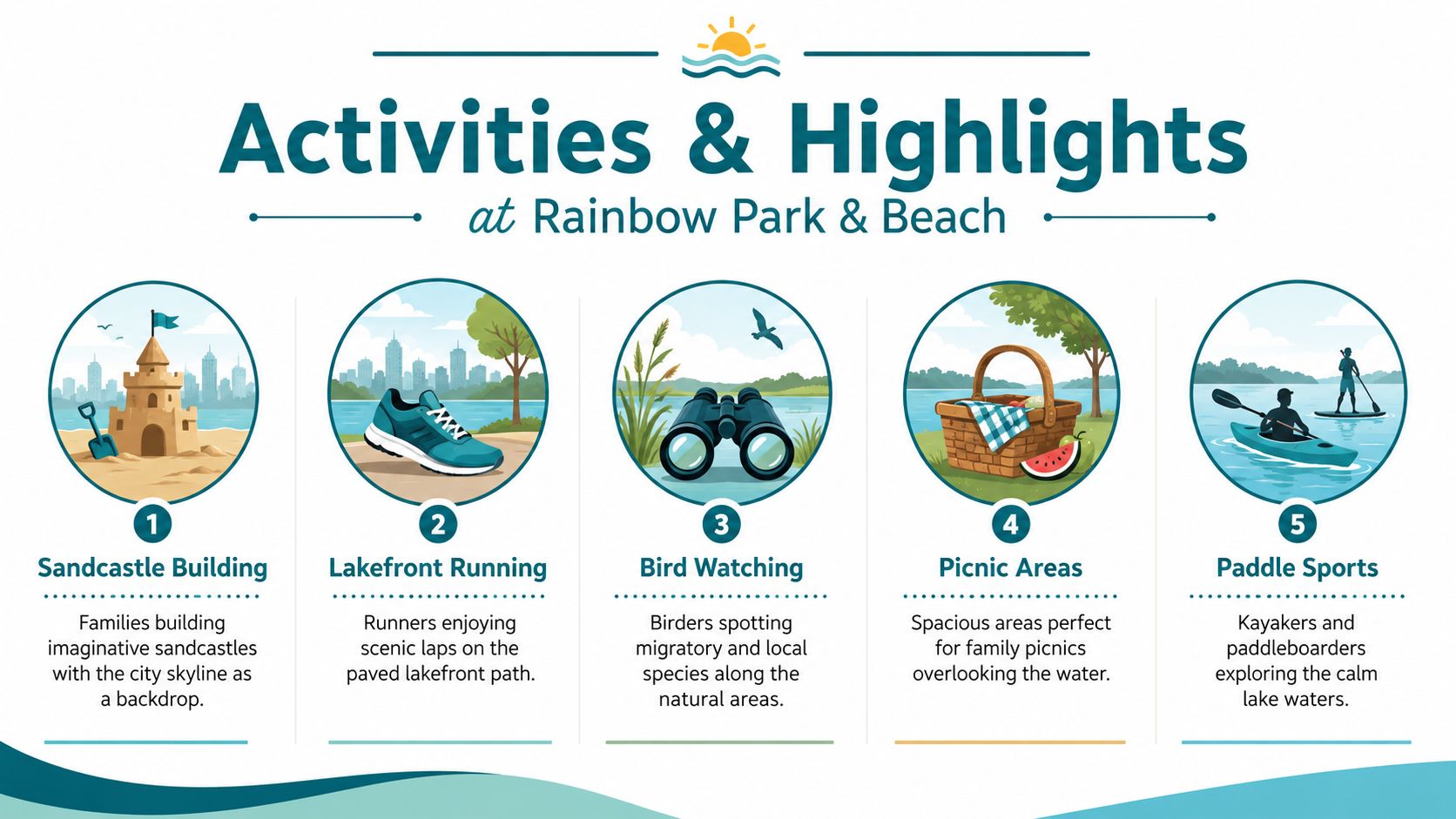
    I've seen Rainbow Park and Beach work for three very different moods in one afternoon. One friend came for a sand nap and never left the towel. Another laced up for a run and treated the lakefront like a moving meditation. I spent part of one evening just watching the light change on the water, and that alone felt like enough.

    A colorful infographic illustrating five recreational activities at Rainbow Park and Beach, including sandcastle building, running, and kayaking.

    Sand, grass, and easy company

    Families tend to spread out fast here. Kids build sandcastles, then wander back to the grass with wet feet and a snack in hand. I like the way the place gives you a little buffer between the shoreline and the rest of the park, so a blanket can become a lunch spot, then a reading spot, then a people-watching spot without much effort.

    When I'm with a group, I keep one simple rule. I pick a base spot with a view of the water and the path. That way, nobody feels trapped in one lane. Someone can run to the restroom or jog a quick loop, and the rest of us still know where to land when it's time to regroup.

    Running, watching, and staying still

    The lakefront path is what I notice when I want motion. Runners can move through the park without the day getting crowded in on them, and that rhythm changes the whole feel of the visit. I've also seen birders set themselves up early and stay patient, which is a skill I admire because it asks for the opposite of hurry.

    If I bring a camera, I look for low angles near benches and open stretches of shoreline. Water shots work best when I don't force them. I wait for a calm patch, then frame the lake and sky together. At sunset, the surface gets soft enough that even an ordinary phone photo can feel better than expected.

    Water time and casual play

    Paddle sports fit the mood when the lake settles down. If I'm not on the water, I still like watching kayaks and paddleboards move across it because they add a steady line to the view. That's also why I tell people to pack light enough to change plans. You may come for one activity and end up doing a different one because the weather, the crowd, or your own energy shifts halfway through.

    If you're carrying a tripod or a bag with camera gear, keep a towel handy. Sand gets everywhere, and it doesn't care how careful you are.

    For a quick detour into more active shoreline outings, I'd also check this guide to urban kayak outings in Chicago: urban kayaks Chicago guide. It pairs well with a lakeshore day like this because the vibe is the same, easy movement, open air, and a lot of room to wander.

    Seasonal Conditions and Safety

    One thing I've learned on Lake Michigan beaches is that the water can feel completely different from one week to the next. That's why I don't treat a beach visit like a fixed script. I check conditions, I pack for cooler air than I expect, and I pay attention to whether I'm there to swim or just to sit near the water.

    What the water-quality note tells me

    A beach-quality source for Rainbow Park Beach says it passed water quality tests at least 95% of the time (Swim Guide). I take that as a useful threshold, not a promise for every single day. It tells me the water checks have often gone well enough to give swimmers a clearer read than a vague “looks clean” guess.

    That still leaves room for common sense. I keep an eye on the sky, the wind, and the water itself. If the lake looks rough or the day turns chilly, I switch from swim mode to walk-and-sit mode. That way, the visit still works even if I never step in.

    Gear I'd actually bring

    I dress for change, not for the first five minutes of the forecast. A hoodie, a towel, sunscreen, and shoes that can handle sand all make the day easier. If I'm planning to stay past midday, I want something dry to pull on later, because lake air can turn cool faster than people expect.

    I also pay attention to my own pace. Summer beach days can look lazy from the outside, but they go better when you manage energy the same way you manage gear. Drink water before you feel behind. Give yourself a break before you need one. Leave enough room in the plan to sit down and do nothing for a while.

    If the lake looks unsettled, I stay on shore and enjoy the park anyway. I'd rather have a slow day than a stressful one.

    That's the balance I use here. The best beach trip isn't the one where you force every activity. It's the one where the weather, the water, and your plan can all stay in the same conversation.

    Nearby Attractions and History

    One of the reasons I like Rainbow Beach is that it never feels isolated from the rest of South Shore. You can stand near the water, look inland, and feel how the beach fits into a neighborhood that has always lived close to the lake. It feels like part of a larger shoreline routine, with the same easy rhythm you see at other South Side beaches.

    The setting gives the beach its character. South Shore brings a residential feel, tree-lined streets, and a lakefront that opens up quickly once you get close enough to the water. That mix makes the visit feel local right away. You are still in the city, but the pace shifts the moment the lake comes into view.

    The shoreline around it

    I like starting with the shoreline itself, because that is where the history feels easiest to read. The beach sits within a stretch of public lakefront that has long shaped how people on the South Side spend summer days. Families spread out with coolers, walkers follow the path, and regulars treat the water like part of their own backyard.

    That continuity matters. The beach does not stand apart from nearby habits, it carries them forward. A short walk along the edge shows the same mix of recreation and routine that gives Chicago's lakefront so much of its appeal.

    The area also works well for a slower wander after you leave the sand. A few blocks in South Shore can tell you a lot, with neighborhood houses, local corners, and the kind of everyday street life that makes the beach feel connected to the city instead of separated from it. When I bring friends here, that is usually the part they remember most, the way the view opens to the lake while the neighborhood stays close enough to feel present.

    Why I keep coming back

    I keep coming back because the place stays practical without losing its charm. I can sit for a while, walk the edge, or swim if the day feels right. I can stay for a quick reset or stretch the visit into a full afternoon.

    The area gives me room to choose my own pace. Some visits are nothing more than a shoreline walk and a bench stop. Other times I pair the beach with a longer loop through the neighborhood, and the outing feels fuller without needing a long list of stops.

    For a closer look at how the beach fits into broader community care, the volunteer side matters too. A local beach can look relaxed from a distance, but it stays that way because people keep showing up for it, including groups like Litter Caterpillars' public beach cleanup efforts.

    Volunteer Cleanups and Community

    I first noticed a cleanup crew here when I was still half in beach mode and half in “maybe I should leave already” mode. Then I watched people fan out with bags, grabbers, and a clear sense of where they were headed, and the whole place changed in front of me. Trash stopped feeling like background noise and started feeling like something real people could deal with together.

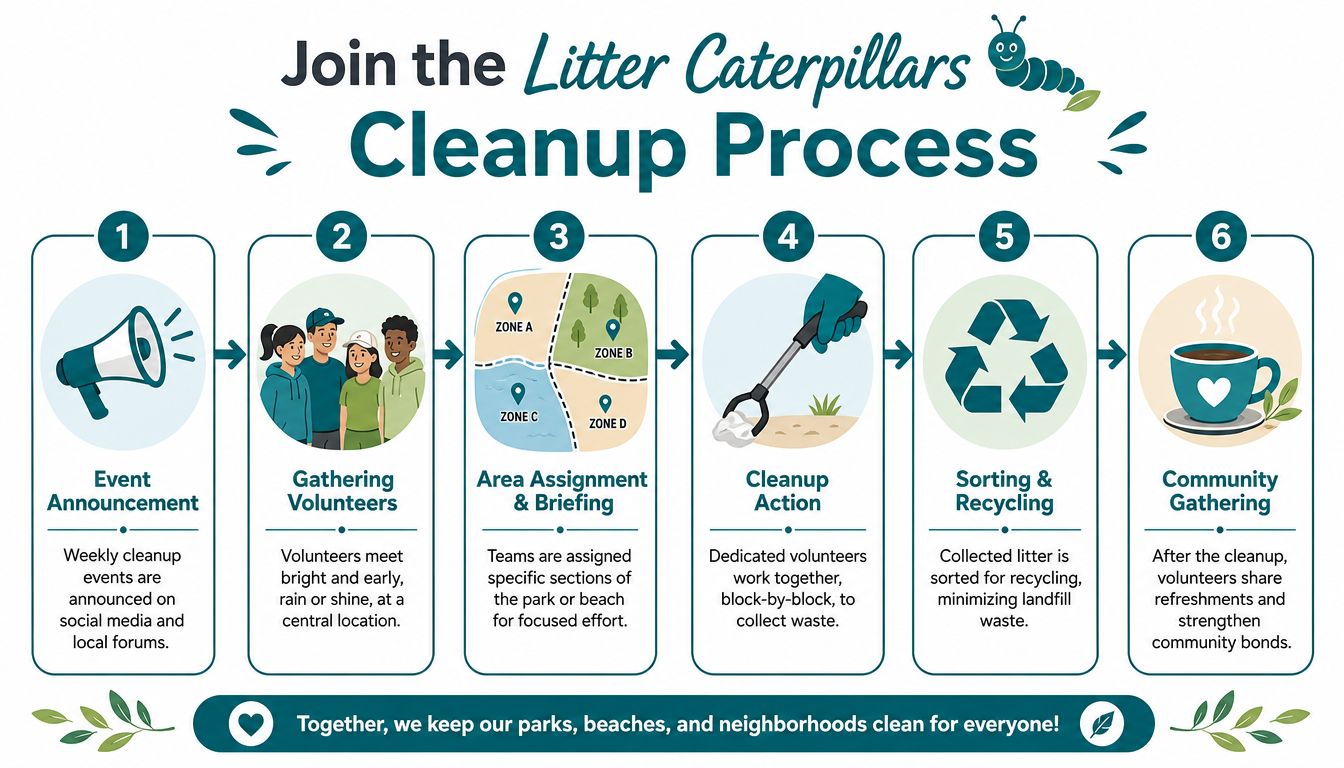
    An infographic titled Litter Caterpillars Cleanup Process showing six numbered steps to organize community cleanup events.

    How the cleanup rhythm works

    The strongest thing about a good cleanup crew is that nobody has to guess what to do next. A clear start time, a meeting point, and a simple split of the site make the whole effort calmer. The process matters because Rainbow Beach has a lot going on, and the park district listing shows it's more than a single sand strip, which means a cleanup works better when people divide the area by section instead of treating it like one giant pile of litter (Chicago Park District).

    That's the approach I'd use anywhere along the beach. One person handles the edge near the sand. Another takes the grass. Another checks the path and the garden perimeter. When everyone knows their section, the job gets less messy and more human.

    A simple way to join in

    If you want to show up for a cleanup, keep it straightforward.

    1. Check the event notice. Look for the meeting time and location before you leave.
    2. Bring basic gear. Gloves, closed-toe shoes, and water go a long way.
    3. Listen to the briefing. Ask which zones need attention first.
    4. Work the area in pieces. Move slowly, bag by bag, instead of rushing.
    5. Sort what you collect. Recyclables and trash shouldn't go into the same pile if you can help it.
    6. Stay for the closing chat. That's where people trade notes and meet each other.

    I like cleanups because they turn a visit into a shared task. If you want the deeper background on that kind of volunteer habit around the lakefront, this page is a good companion read: public beach lake Michigan cleanup guide. It helps when you want to think through the people side of shoreline care, not just the logistics.

    Conclusion

    Rainbow Park and Beach gives you an easy lakeshore day with room to move, rest, and pitch in. I'd go for the water, stay for the skyline, and leave time for a cleanup if you want the visit to feel even more grounded. Pack light, check the hours, and give yourself space to wander. If you're ready for a shoreline day that feels like yours, go now, bring a friend, and make the first stop.


    A CTA for Litter Caterpillars.

  • Natural Land Institute: Protecting Nature’s Future

    Natural Land Institute: Protecting Nature’s Future

    You might walk past a small patch of prairie or a tree-lined lot and wonder who keeps it from slipping back into weeds, trash, or pavement. I think that question opens the door to Natural Land Institute, because its work sits right at that meeting point between land, people, and long-term care. When you look closely, you start to see that conservation is not a single act. It is a series of choices about what to buy, what to protect, what to restore, and what to leave quiet.

    Introduction to Natural Land Institute

    A protected place can look simple from the trail. You see grasses bending in the wind, a wet pocket tucked below the trees, or a quiet edge of woodland, and it is easy to miss the careful work that keeps those features intact. The real question is who makes those decisions, and how they keep the land from being altered too quickly.

    Natural Land Institute works in northern Illinois as a private, member-supported 501(c)(3) land trust founded in 1958, with a focus on preserving land and natural diversity in 12 counties in northern Illinois. That matters because NLI is not structured like a park district. A park system is usually built for broad public use. A land trust has a different task, protecting land first and then deciding, case by case, how much access the site can support.

    That difference causes a lot of confusion. People often hear “protected land” and assume “public park,” yet those terms do not always mean the same thing. Conservation work often depends on restraint, because habitat may need rest, repair, or limited foot traffic before it can handle more use.

    Practical rule: when you see a protected property, ask two questions, who owns it, and how do people use it?

    That simple habit helps you read NLI's work more clearly. Once those two questions are in place, the rest of the picture becomes easier to follow.

    Natural Land Institute history and mission

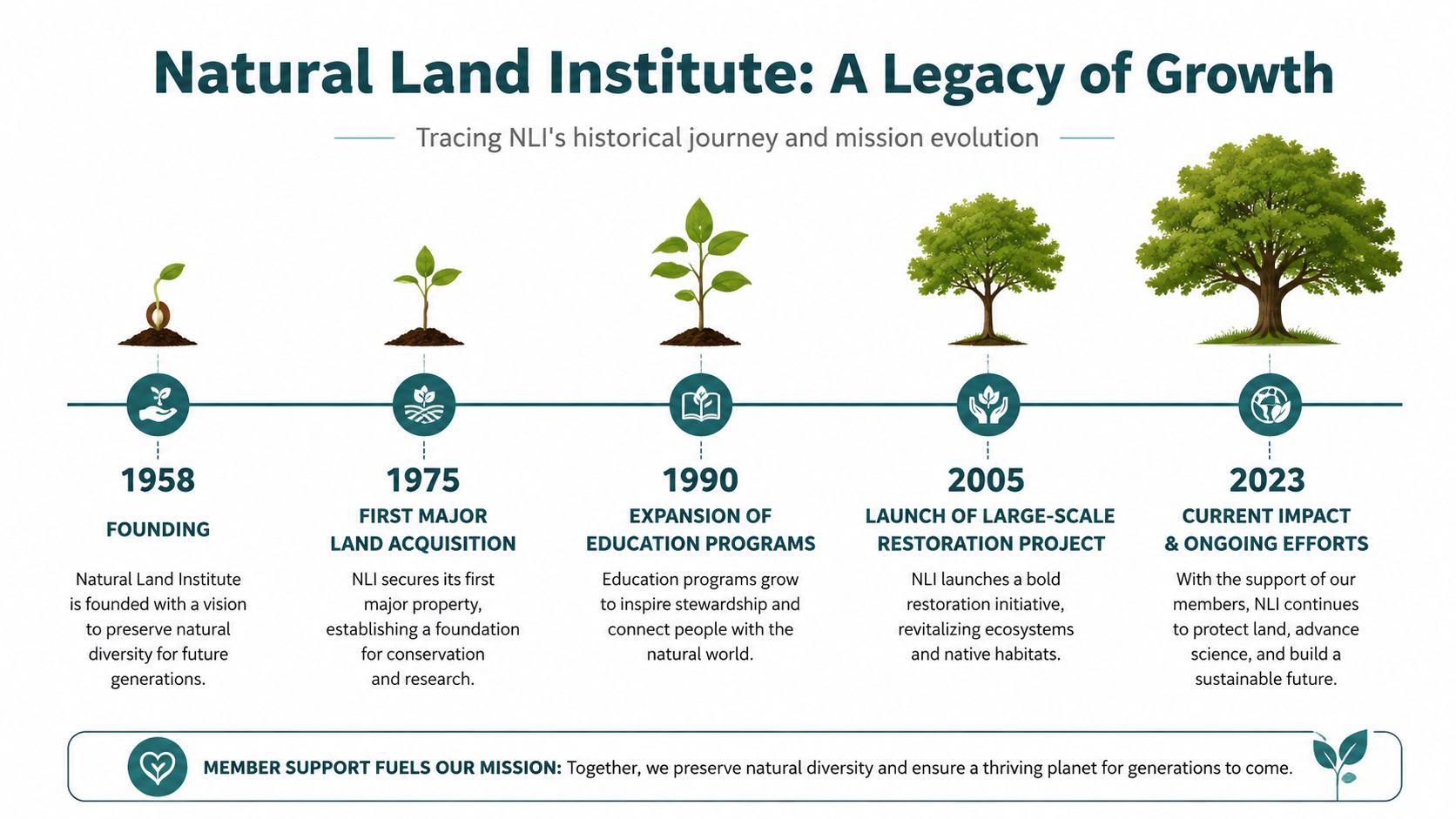
    NLI began with a simple conservation decision: protect land so it can keep doing its work long after the first season ends. In 1958, a small group started what became Natural Land Institute, and that early choice still shapes the organization's direction today. Over time, member support helped the group grow into a land trust focused on preserving land and natural diversity across 12 counties in northern Illinois.

    A timeline graphic showing the historical growth of the Natural Land Institute from 1958 to 2023.

    What member support changes

    Member-supported groups work differently from places that depend on one large funding source. When people join, donate, volunteer, or renew, they help keep the work moving from one season to the next. That matters for a land trust because protection does not end when a property is acquired. The ongoing work continues through monitoring, repair, and patient care, the kind of steady attention that keeps a trail from eroding and a wetland from being pushed past its limits.

    NLI's own materials show how broad that effort has become. The organization says it has protected more than 18,000 acres in Illinois since 1958 (2021 Annual Report). Another profile lists more than 16,000 acres protected, which means the number can vary depending on the source and the year being cited (Project World Impact profile). I treat that variation as a reminder to check the date on any conservation claim before assuming it is the final count.

    Why the mission stays narrow

    NLI focuses on one mission, protecting land and natural diversity. That may sound narrow, but the focus matters. A land trust works best when it knows exactly what it is guarding, the same way a forest path stays clear when each marker points in one direction instead of many.

    That clarity also helps explain why local groups and volunteers can fit into the work in different ways. Some help with stewardship. Some help with monitoring or events. Others support public understanding of why access rules exist in the first place. The mission stays centered on land protection, while the people around it form the network that keeps the work grounded.

    Explore Natural Land Institute preserves

    Some protected places welcome your boots. Others ask you to look from the edge and leave the ground alone. That difference is one of the first things I want you to notice when you visit land protected by Natural Land Institute. A preserve is not always a park in the everyday sense, and that's where many visitors get confused.

    How to choose a place to visit

    Start with the access rule, then look at the site size, then decide what kind of outing you want. If you want a walking destination, look for public access language. If you want to learn how restoration works, a site with limited access may still be the right fit for an organized event or a guided workday.

    Preserve Location Access Size
    Des Plaines Dolomite Prairies Land and Water Reserve Northern Illinois Check current access details before going Preserved natural area
    Nygren Wetland Preserve Rockton area Event-based and preserve-specific access Wetland preserve
    Silver Creek Woods Preserve Northern Illinois Sometimes open through organized programs Private protected natural area

    For the most up-to-date visitor guidance on one site, I'd start with the Des Plaines Dolomite Prairies Land and Water Reserve page.

    Why access rules vary

    A reserve can protect birds, plants, soil, or water quality by limiting where people walk. That can feel odd if you expect every protected acre to act like a neighborhood park. But conservation often needs quiet zones, especially where restoration is still underway or where rare habitat could suffer from too much traffic.

    I like to think of preserve access like opening doors in a house with delicate furniture. You don't swing every door wide open. You choose the rooms where guests can move freely, and you keep other rooms closed so nothing gets damaged. That's the same kind of judgment land trusts use when they decide how a preserve should work for visitors.

    Understand conservation programs at NLI

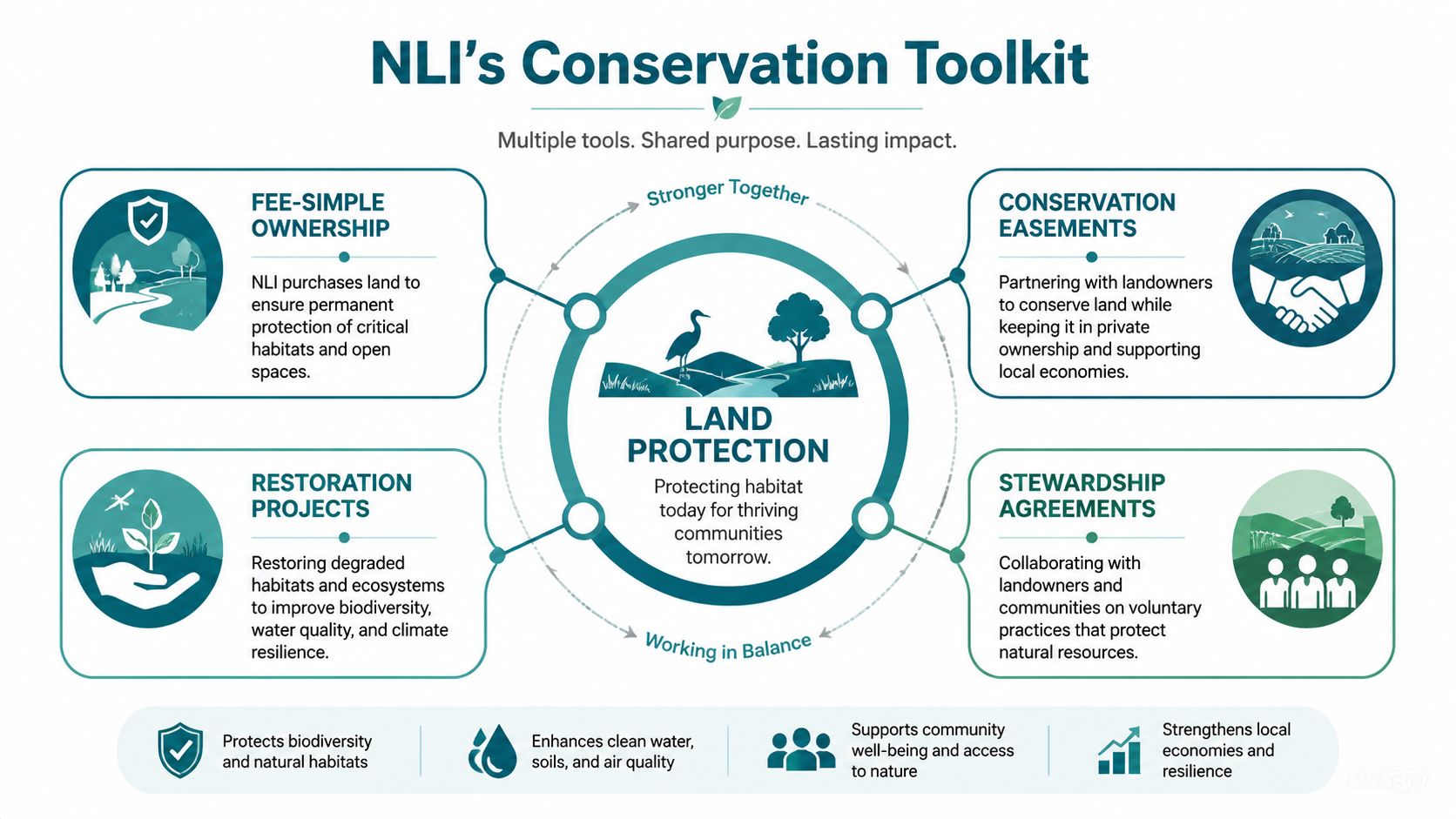
    A protected parcel can start as one kind of project and grow into several. NLI uses a range of conservation tools, and each one fits a different situation, like choosing the right path through a wet meadow instead of forcing every visitor onto the same trail.

    An infographic titled NLI's Conservation Toolkit illustrating four methods for land protection and environmental preservation.

    The hidden mechanics of protection

    NLI's public materials say the organization has protected more than 18,000 acres since 1958, but the work behind that total is spread across different methods, including easements, stewardship, and restoration. That matters because “protected” does not always mean the same thing. In one case, NLI may own the land outright. In another, it may work with a landowner who keeps the property while agreeing to protect specific natural features. In a third, the focus may be on bringing a damaged site back to health after acquisition.

    Why the tools work together

    The tools function like different sections of a field pack, each carrying a separate job.

    • Fee-simple ownership means the land trust owns the property and can direct how it is managed.
    • Conservation easements let a landowner keep the land while limiting actions that would harm habitat.
    • Restoration projects help a site recover from invasive species, erosion, or neglect.
    • Stewardship agreements set ongoing care expectations so the work does not stop after the first season.

    That mix shows why land protection and public access are related, but not the same thing. A place can be protected for habitat and still have limited public use, which matters to neighbors, donors, and volunteers who want a clearer picture of what “saving land” involves.

    The brief video below offers another way to understand how habitat work and land care show up on the ground.

    One practical way to support this work is through environmental stewardship programs, because stewardship is where protection becomes real maintenance, the steady care that keeps a site healthy after the initial conservation decision.

    Volunteer and partnership opportunities with NLI

    A lot of people hear “volunteer” and think about picking up trash by themselves. NLI makes room for something broader than that. When a land trust needs help, the work can include stewardship days, citizen science, and group-based support that fits better with a crew than with a solo schedule.

    Where a cleanup group fits

    If you already work with a team that likes outdoor service, you can bring those habits into conservation without forcing them into a parking-lot cleanup mold. Habitat work often needs hands that can pull invasives, clear light debris, watch for site issues, and follow instructions from staff. That is a natural fit for groups that already know how to show up, listen, and work safely.

    How groups can help without crowding the site

    I'd treat partnership like trail etiquette. Move with the purpose the site needs, not the purpose you arrived with. That means asking where help is useful, what tools staff want you to bring, and whether the land can handle foot traffic on a given day.

    • Stewardship days work well when you want supervised field work.
    • Citizen science works well when you can observe carefully and record what you see.
    • Easement monitoring walks work well when the site needs a check-in rather than a cleanup.

    If you want a starting point for group service ideas, the environmental volunteer opportunities page gives a helpful model for how volunteer crews can organize around outdoor work.

    A good partnership does not ask a preserve to change for your group. It asks your group to fit the preserve's needs.

    That mindset keeps people useful and keeps the land from taking more pressure than it can handle.

    Events membership and donation options

    If you want to help NLI, start with the path that fits your life right now. Some people give money. Some give time. Some do both. The practical choice is to pick one starting point first, then build from there.

    A simple way to join in

    Membership is the most direct first step if you want an ongoing connection to the organization. It works like joining a trail crew that keeps returning to clear the path, not just showing up once and leaving. Member support helps a land trust plan beyond a single season, and the group's long-running work has depended on that steady kind of backing.

    Donations work the same way in a different form. They give the organization room to keep caring for land that is already protected, which is a job that continues long after a preserve is acquired.

    If you would rather give time than money, watch for events tied to field work, outings, and seasonal gatherings. NLI's event listings include nature-focused fundraisers and on-site activities, so you can enter the work through a visit, a volunteer day, or a community gathering (NLI event listing). That path helps people see conservation up close, instead of treating it like something distant and abstract.

    What to do first

    1. Choose your role. Decide whether you want to visit, volunteer, donate, or join as a member.
    2. Check the event calendar. Look for field days and gatherings that match your schedule.
    3. Read the site notes. Some preserves need special access or event registration.
    4. Set a donation habit if you can. A recurring gift is often easier to keep than a one-time decision.
    5. Bring a friend or group. Shared plans are easier to keep.

    A simple next step is often enough. You do not need to know every land trust term on day one. You only need one clear way to begin, then let your involvement grow from there.

    Impact metrics and stewardship challenges

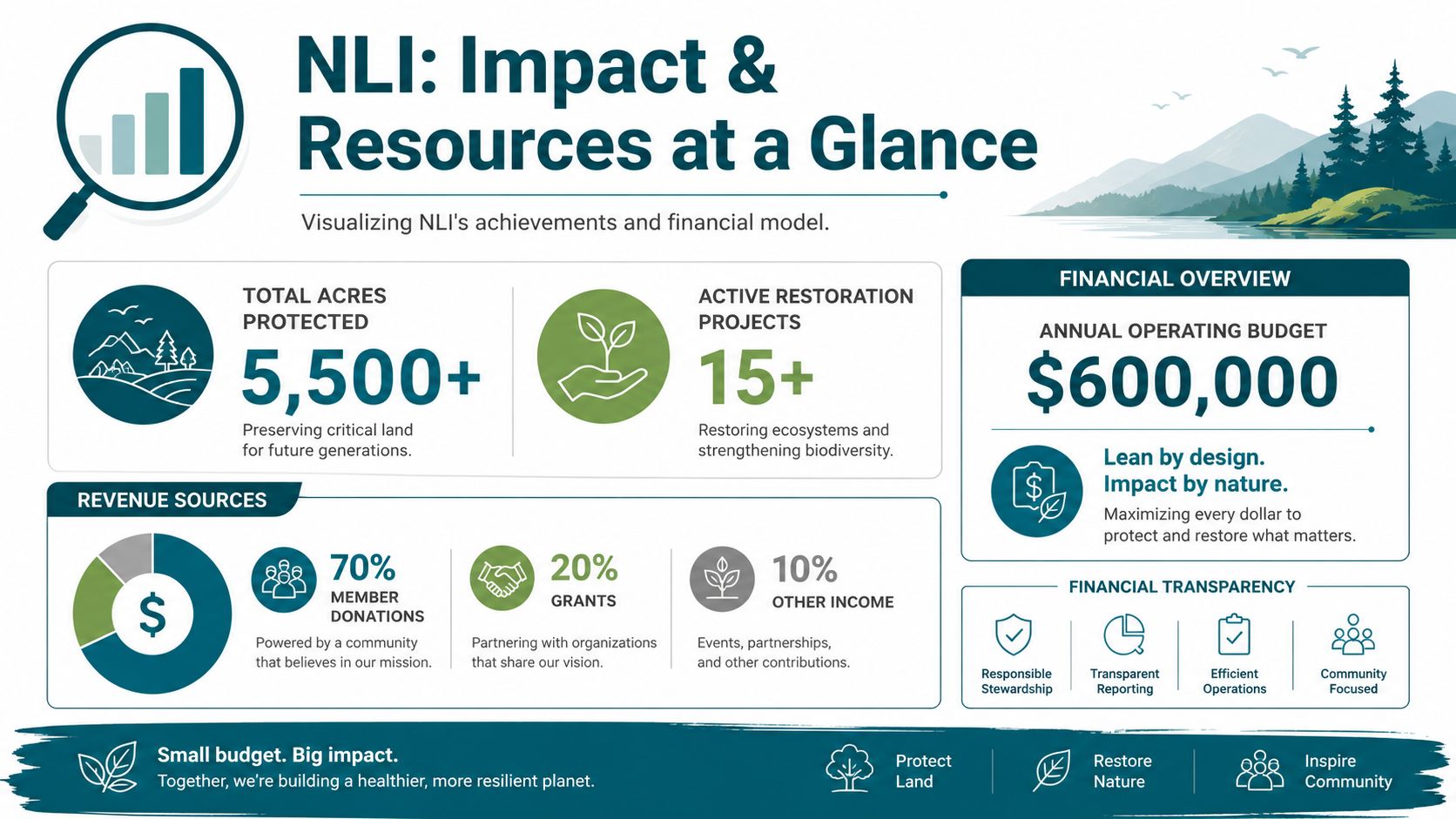
    A preserve may look quiet from the trailhead, but the work behind it is constant. Natural Land Institute's footprint in Illinois is measured in protected acres, and public reporting shows the organization has secured a large amount of land since its founding. That scale matters because each tract carries its own needs, from prairie burns to wetland care, and the work does not stop once land is acquired.

    An infographic showing Natural Land Institute's impact metrics, annual budget, and financial revenue breakdown for environmental protection.

    The financial side looks modest compared with the size of the conservation job. Public reporting shows a lean operating budget and a revenue mix that does not rely on a single source, which suggests the group has to plan carefully and keep many parts of its work moving at once. That is common in land protection. Protecting a place is one task, but keeping it healthy is a longer one.

    What the money has to cover

    Protected land does not pause for budget cycles. Invasive species keep spreading, trails wear down under use, and native plant communities need repeated care to recover and stay stable. Staff time, equipment, and field visits all cost money, and those costs continue after a preserve is secured.

    That is the part many people miss when they celebrate a land purchase.

    Why maintenance is the harder question

    The harder question is care over time. Climate stress, restoration work, and long-term monitoring all call for steady funding and patient labor, much like tending a garden that keeps changing with the seasons. The preserve may already be protected, but protection is not the same as hands-off management.

    That is why donors, volunteers, and neighbors matter in practical ways. Some people help by giving money, which supports ongoing stewardship. Others help by showing up for workdays, field tasks, or events that keep a preserve functioning as a living place instead of a frozen one. The question is simple to ask and harder to answer, who keeps paying attention after the public spotlight moves on?

    Practical rule: if you want a preserve to stay healthy, ask how it gets cared for after the ribbon-cutting ends.

    I think that is the clearest place for local support to matter. It keeps the focus on the ground truth of conservation, the work continues.

    Practical steps to visit and get involved

    Start with one preserve and one action. Check access rules before you drive out, because some protected places need event registration or limited use. Then choose one next move, visit, volunteer, join, or donate, and put it on your calendar today.

    1. Plan a visit. Pick a preserve and read its current access notes.
    2. Sign up for a volunteer day. Choose a stewardship event that matches your comfort level.
    3. Bring your group. Ask staff where a crew can help without disrupting habitat.
    4. Join as a member or donor. Pick a giving level you can keep up.
    5. Follow future events. Field trips and seasonal gatherings make it easier to stay involved.

    If you want to turn a single walk into a real habit of conservation, start now. A first visit teaches you how land trusts think, and the next step is yours to take.


    A CTA for Litter Caterpillars.

  • Lake Renwick IL: Your Guide to Birds, Trails, and Action

    Lake Renwick IL: Your Guide to Birds, Trails, and Action

    I once pulled a plastic bag out of the weeds near a pond edge and looked up just in time to catch a heron lifting off over the water. That's Lake Renwick to me. You bend down for the mess, then the place makes you look up.

    A Place Where You Can Transform

    Some places clean you out a little.

    Lake Renwick in Illinois has that effect on people who show up ready to pay attention. You come for birds, water, quiet, a walk, maybe a reset after a rough week. Then you start noticing the smaller things. A snagged fishing line. A crushed bottle by the grass. A trail edge that stays better when people act like they belong there instead of passing through like consumers.

    That's why I keep coming back to places like this. I don't only want scenery. I want a place that asks something from me.

    Beauty after damage

    Lake Renwick works on me because it didn't begin as some perfect postcard. It came out of hard use, disturbance, and time. I like places with that kind of honesty. They remind me of people who had messy years and still learned how to become steady.

    You don't have to start pure to become useful. A place can recover. So can a person.

    When you walk around Lake Renwick IL, keep that in mind. Don't rush straight into checklist mode. Let the place tell on itself a little. Watch the water. Watch the edges. Notice how care shows up in ordinary forms, from trail rules to seasonal closures to the simple fact that some areas stay cleaner because somebody bothered to pick up what didn't belong.

    Visit with your eyes open

    If you need a reset, this is the kind of outing that can change the day without pretending to solve your life. Go outside. Slow your pace. Bring binoculars if you have them. Bring a trash bag if you're that kind of person. If you need a nudge toward that mindset, spend a little time with this idea of reconnecting with nature through direct action.

    That's the mood I'd bring here. Curious, grateful, and ready to leave the place a little better than I found it.

    From Gravel Pit to Heron Haven

    The first time you learn what this place used to be, the quiet hits differently.

    Waterbirds now nest where machines once tore into the ground for gravel. Lake Renwick did not begin as a protected refuge. It came out of extraction, abandonment, and a long stretch of patient recovery. The preserve grew through land acquisition by the Forest Preserve District of Will County between 1989 and 2010, and today it covers 836 acres. A 320-acre portion with the heron rookery became an Illinois Nature Preserve in 1992. The lake itself took shape after a gravel quarry stopped operating in 1983, and the pits filled with water from an underground spring, according to the Lake Renwick Preserve entry.

    A worker in safety gear watches heavy mining machinery operating at a construction site near a scenic lake.

    The ground remembers

    You can still feel that history if you walk with your eyes open. The lake has a worked look to it. The edges, the depth, the open water, even the way the habitat lays out, all carry the mark of what happened here first.

    That matters.

    People often want nature stories to be tidy. Lake Renwick gives you the harder and better version. Damage happened. Recovery followed. Protection had to be chosen, then enforced, then maintained. Anyone who has spent a morning hauling bottles and bait containers off a shoreline knows the pattern. A place improves because somebody does the unglamorous work and keeps doing it.

    The gravel base helped create conditions that now support colonial nesting birds. That is one of the trade-offs written into this preserve. Industry altered the land. Time, water, habitat management, and restraint turned that altered land into something worth defending.

    If you care about reclaimed wild places, Hackmatack National Wildlife Refuge shows a similar kind of restoration work in action.

    Recovery needs protection

    The rookery now supports nesting by Black-crowned Night-Herons, Great Blue Herons, Great Egrets, and Double-crested Cormorants. That fact matters less as trivia than as responsibility. Birds returned because the site became usable for them. They stay because people are willing to limit access, respect closures, and keep pressure off sensitive areas during nesting season.

    That is the part visitors miss if they only chase the pretty view.

    The Litter Caterpillars mindset fits here perfectly. First remove what harms. Then protect what can grow. Then come back often enough that your care counts for something. Lake Renwick is one of the clearest examples I know of a place that rewards that attitude.

    Practical rule: If a landscape recovered from heavy use, treat every trail, overlook, and closure sign as part of the restoration work, not as a suggestion.

    Why this history stays with people

    A lot of preserves feel pleasant. Lake Renwick feels earned.

    You stand beside calm water, but the calm came after digging, truck traffic, and disruption. You watch herons lift over the rookery, and that sight carries more weight once you know what the ground had to become for them to use it. I have seen the same truth on cleanup days all over northern Illinois. People change when they help repair a place. Places change when enough people stop treating them like somebody else will handle it.

    That is why this preserve sticks with people who pay attention. It proves that restoration is real, but it also proves restoration is never finished.

    The Birds You Will Meet

    The first thing many people notice at Lake Renwick is sound. Wingbeats. Sharp calls. Rustling reeds. A sudden burst of motion over water that looked still a second earlier.

    The preserve has around 200 documented bird species, and the Heron Rookery Nature Preserve closes from March 1 to August 15 to protect nesting waterbirds during breeding season, according to this guide on visiting Lake Renwick Preserve and the Heron rookery.

    A woman sits on a wooden dock overlooking a lake with various birds and abstract colorful patterns.

    Start with your ears

    If you're new to birding, don't force yourself to identify everything at once. Start with contrast.

    Listen for the place where the sound gets busy. Then stop moving. Let your eyes work after your ears do. That one habit will get you more sightings than stomping around with your binoculars already raised.

    The birds people talk about most here are the big, memorable ones. Great Blue Herons have that tall, patient look. They can seem like they're carved out of driftwood until they shift one leg or spear forward. Great Egrets carry themselves differently. Cleaner lines. Brighter presence. They catch light fast. Black-crowned Night-Herons feel stranger to me, almost secretive, the kind of bird you appreciate more each time you see one.

    If you like places where waterbirds dominate the mood, you'd probably also enjoy reading about Hackmatack National Wildlife Refuge, another spot where slowing down pays off.

    What to watch for

    Try this on your first visit:

    • At the shoreline: Scan slowly for still shapes before you look for movement. Herons often beat you by freezing.
    • In open water views: Watch for flight paths. Big birds announce themselves with spacing and rhythm.
    • Near morning or evening light: Look at silhouettes first. Size and posture often tell you more than color.
    • When the place feels quiet: Stay put. Quiet often means birds are active but you haven't tuned in yet.

    The best birdwatchers I know don't chase every sound. They let the place come toward them.

    The nesting season matters because these birds need room. Human pressure changes behavior fast. That's why access gets tighter when breeding activity ramps up. You may want the closer view. The birds need distance more.

    A little motion helps if you want to get the feel before you go.

    You are entering their schedule

    That's the mindset that makes a trip to Lake Renwick IL better. You are not arriving at a performance made for you. You are stepping into a living place already in progress.

    When people understand that, they stop asking, “How close can I get?” and start asking, “How respectfully can I be here?” That second question is the right one.

    How to Explore Lake Renwick

    Some people visit once, walk a little, stare at the water, and leave thinking they “did” Lake Renwick. You can do better than that.

    This preserve rewards intention. If you know why you came, you'll move differently. Birdwatchers should hunt for sightlines and patience. Walkers should treat bends, edges, and pauses as part of the route. Anyone who likes a useful outing should bring one small bag for litter and grab what's safe on the way out.

    If you came for birds

    Don't start by marching as far as possible. Start by finding a clean view and staying there longer than feels normal. Waterbirds punish impatience. The first few minutes can look dead, then a neck lifts from the reeds, a wing opens, and the whole scene wakes up.

    My own rule is simple:

    1. Stop early: Your first decent overlook may be all you need.
    2. Scan left to right: Don't jerk your binoculars around.
    3. Wait after movement: Birds often settle and reappear.
    4. Keep your voice low: Even when other visitors don't.

    If you want a more active trail day after a quieter preserve visit, the Des Plaines River Trail near Chicago scratches a different itch.

    If you came to walk

    Walk Lake Renwick like you're reading margin notes, not speed-running a route. The good stuff sits at the edges. Wind on cattails. Ripples changing the light. Mud tracks. Feathers caught in grass. Those details give the preserve its character.

    Here's what works well on foot:

    • Travel light: Water, decent shoes, binoculars if you have them.
    • Leave your pace loose: Fast miles are for other trails.
    • Take the side glance seriously: Some of the best sightings happen off your main line of sight.
    • Respect barriers and closures: If an area is blocked off, treat that as part of the care plan, not a suggestion.

    What doesn't work is treating the preserve like a gym loop. You miss too much when every minute is about distance.

    If you want a fuller outing

    Lake Renwick has different access areas, and each creates a different mood. One visit might be mostly birding. Another might be more about a calm walk with a few stops to watch the water. Another might center on Turtle Lake and whatever pace that part of the preserve invites.

    I like to think of the place like a conversation. Some days it talks back fast. Some days you have to sit through the silence first.

    Field note: A good visit usually has one moment where you stop because something small caught your eye. Trust that moment. Don't rush past it trying to get to the “main attraction.”

    One more thing. If you carry out your snack wrapper and one extra piece of trash, your trip changes from recreation to stewardship. That switch matters. It changes how you remember the day.

    Planning Your Visit The Right Way

    The first mistake I see is simple. People pull into Lake Renwick assuming every entrance works the same, then they spend the first part of the day correcting avoidable problems instead of settling into the preserve.

    A little planning changes that.

    Lake Renwick Preserve has three public access points in Plainfield. Copley Nature Park and Turtle Lake Access are open year-round from 8 a.m. to sunset. Heron Rookery Nature Preserve is open from August 16 to February 28, with limited access during public programs from March 1 to August 15, according to the Forest Preserve access page for Lake Renwick.

    Read the rules like a caretaker

    If you want the preserve at its best, treat posted rules as part of the habitat management plan, not as obstacles between you and a good outing.

    The rookery has tighter seasonal controls for a reason. Nesting birds need distance and predictability. Extra noise, close approach, dogs, and bikes add pressure fast, especially in breeding areas. People who care about wildlife behavior should be the first ones to respect those limits.

    That is the trade-off here. Access gets narrower so the living part of the place stays strong.

    Access points and what to expect

    Access Point Open Season Key Rules
    Copley Nature Park Year-round, 8 a.m. to sunset Stay on marked areas, keep noise down, and give wildlife space.
    Heron Rookery Nature Preserve August 16 to February 28. Limited public programs during March 1 to August 15 Seasonal restrictions apply. No dogs or bicycles. Respect all closures.
    Turtle Lake Access Year-round, 8 a.m. to sunset Quieter entry point for a slower visit. Follow posted rules and pack out everything you bring in.

    Before you leave home

    Good visits usually come from four smart choices:

    • Check which access point fits your day: Birding, a quiet walk, and a short stop all call for different entry plans.
    • Confirm seasonal access before you drive: The rookery schedule can change what is possible.
    • Dress for waiting, not just walking: You may spend more time standing still than covering ground.
    • Bring one small stewardship item: A glove or spare bag is enough if you want to pick up safe litter on the way out.

    That last habit matters more than it sounds.

    I've seen people arrive ready to consume a place. I've also seen people arrive ready to notice, protect, and leave a trail edge cleaner than they found it. The second group gets more out of Lake Renwick. They pay closer attention. They act with more restraint. They start to understand that appreciation and responsibility belong together.

    Lake Renwick rewards that kind of visitor.

    Become Part of the Story

    The best visits change your role.

    You arrive as a watcher. You leave wanting to help. That shift matters more than any species list you jot down in your phone. A place like Lake Renwick doesn't need one more person treating it like a backdrop. It needs people who notice when a trail edge is cleaner, when litter near the water is dangerous, and when their own habits either add stress or reduce it.

    Service changes the outing

    I've learned something simple from cleanup work. It's often easier to pick up someone else's mess than your own. That sounds backward until you live it. Public service can train parts of you that private life keeps avoiding. You practice consistency. You build stomach for discomfort. You stop waiting for the perfect mood.

    That same ethic belongs at outdoor spaces. If you carry a small bag and pick up what's safe, you start seeing the preserve as shared responsibility. If you join a cleanup, even better. You meet people who act instead of only admire.

    Screenshot from https://www.littercaterpillars.com

    What that looks like in practice

    You don't need a grand plan. Start small and stay real.

    • Bring a glove and a bag: Pick up easy litter on your walk out, not on the way in when your hands and attention are full.
    • Model the tone: Keep your volume down, follow closures, and make that behavior normal for whoever comes with you.
    • Join local efforts when you find them: Cleanup groups build momentum because people see immediate results.
    • Leave one corner better: That's enough for a day. You don't need to fix the whole world before lunch.

    A public place becomes yours in the healthiest way when you care for it, not when you claim it.

    Growth is part of the work

    This is the piece people don't always say out loud. Service toughens you up in a good way. You get less precious. Less passive. You stop needing every outing to entertain you. Sometimes the meaningful part of the day is the muddy shoe, the full trash bag, the extra few minutes spent doing the boring thing that helps.

    Lake Renwick gives you plenty to admire. Birds. Water. Quiet. Recovery. But admiration alone is thin. Action sticks.

    So go. Walk slowly. Watch carefully. Respect the rules. Pick up one thing that shouldn't be there. Bring someone who needs fresh air and a better habit. That's how a preserve gets woven into your life. Not through slogans. Through repetition, attention, and a little earned pride.


    If you want a service-minded way to get outside, make friends, and leave places cleaner than you found them, check out Litter Caterpillars. It's a practical way to turn appreciation into action.

  • Noise Pollution Reduction: A Guide to Taking Back Quiet

    Noise Pollution Reduction: A Guide to Taking Back Quiet

    We were cleaning along a highway access road when the truck noise got so loud we had to shout from a few feet away. I remember looking at the trash bags in our hands and thinking that some messes sit on the ground, but some messes fill the air.

    The Noise We Do Not Have to Accept

    I got into noise pollution reduction the same way I got into cleanup work. I got tired of being told to treat ugly, stressful conditions like they were normal.

    One of our cleanups ran next to a road that typically only seen through a windshield. The litter was bad, but the sound was worse. Trucks growled, cars hissed over wet pavement, and every conversation felt like a small fight. By the end of that morning, I knew something simple. If a place is so loud that people can barely talk, that place is pushing people away.

    A man shouting in frustration beside a busy road with a large semi-truck driving by during rain.

    I found that in Chicago, noise levels are not evenly spread. They spike near roads and public transit, and they hit mid-to-low income neighborhoods harder, which is often where volunteers like us end up cleaning. When I measured a street during a bike-event shutdown we cleaned, the roar of idling cars hit 85 dBA, the threshold where hearing loss starts after 8 hours of exposure, based on the framing used in this Chicago noise and health research context.

    How you know your block is too loud

    You don't need a lab to notice trouble. Your body tells you first.

    Practical rule: If you're shouting at arm's length to hear someone, the noise around you is already in dangerous territory.

    That test changed how I look at ordinary places. A bus stop. A corner store near a major road. A cleanup route under the tracks. Places that look routine can sound punishing.

    A lot of people think quiet is a luxury, like a fancy park bench or a nice view. I don't buy that. Quiet is basic working equipment for a neighborhood. Kids need it to focus. Neighbors need it to sleep. Volunteers need it if they're going to stay out long enough to do good work.

    What recognition looks like on the ground

    When you start paying attention, you notice patterns fast:

    • Traffic surges make a block feel jumpy, even when nothing looks chaotic.
    • Idling vehicles create a steady wall of pressure that wears people down.
    • Transit corridors hit in pulses. Loud, brief, then loud again.
    • Cleanup work zones can pile on extra noise if you add engines, tools, and nearby traffic.

    That realization is part of why I believe in fixing your neighborhood without waiting for permission. You don't need to wait for a perfect city plan before you start naming the problem out loud.

    Noise is real. It is physical. It changes how long you want to stand on your own block. Once you notice that, you stop treating it like background scenery and start treating it like something you can fight.

    Why Noise Is More Than Just Annoying

    I think of sound like weather hitting the body. Soft sound is a light drizzle. A loud street all day feels more like standing in hard rain with no coat. You might stay upright, but you don't leave untouched.

    An infographic visualizing how different levels of environmental noise affect human health using weather metaphors.

    Noise becomes pollution when it is unwanted, repeated, and hard to escape. That last part matters. A loud festival that ends is one thing. A roadway that leans on your apartment every morning and night is another.

    The body keeps score

    We talk about noise like it's only about annoyance because annoyance is easy to describe. But the harm goes deeper than irritation. According to the European Environment Agency's 2025 report on environmental noise in Europe, transport noise pollution causes 73,000 premature deaths annually across Europe, along with 49,000 new cases of cardiovascular disease and 23,000 new cases of type 2 diabetes. The same report says chronic exposure leads to the loss of 1.5 million healthy life years each year.

    That's a public health problem, not a personality problem. The issue isn't that people are too sensitive. The issue is that the sound load is too high.

    A simple way to think about decibels

    You don't need to memorize a chart to use decibels well. You only need a rough map in your head.

    Sound feel What it resembles What it means
    Gentle Soft indoor background sound Easy to ignore
    Noticeable Normal city hum Present, but manageable
    Heavy Busy traffic Mentally tiring
    Harsh Persistent loud street or tools Protective action matters

    The point of the number is not trivia. The point is comparison. If one street makes you tense and another lets your shoulders drop, your body is reading a real difference.

    Sound is invisible, so people argue with it more than they argue with smoke. Your heart and your sleep don't care whether you can see the source.

    A cheap sound meter or even a phone app won't replace formal measurement, but it can wake you up. It can help you stop saying, "Maybe I'm overreacting," and start saying, "No, this corner is rough every day around the same time."

    That shift matters in environmental justice work too. If a neighborhood already carries more traffic, more industrial pressure, and more stress, extra noise lands on a body that's already doing too much. If you want a practical frame for that, this piece on environmental justice and how regular people create change is a good place to start.

    Your First Steps to a Quieter Life

    You can't control the whole city from your couch. You can control more of your home than you think.

    When outside noise keeps barging in, I treat my home like a shelter I have to tune. The goal isn't perfect silence. The goal is relief. A room that lets your nervous system unclench is worth a lot.

    Start with the room that matters most

    Pick one room first. Usually that's the bedroom, or the room where you work, study, or recover.

    I always begin with the windows. If sound leaks through them, I use heavier curtains and make sure they cover the edges instead of just decorating the glass. Then I look at the room itself. Bare rooms bounce sound around. Soft rooms absorb it.

    A few changes help fast:

    • Move soft furniture to outside-facing walls. A bookshelf, couch, or padded chair won't solve street noise, but it can dull the hard echo inside.
    • Use rugs where footsteps and reflections feel sharp. A room with fabric on the floor usually feels calmer right away.
    • Seal obvious gaps. If you feel air around a window or door, sound is probably slipping through too.
    • Choose your sleep position wisely. If one side of the room faces the street, place the bed where the room itself gives you more buffer.

    Build a sound routine, not just a soundproof room

    People often look for one magic product. Most of the time, noise pollution reduction works better as a stack of small moves.

    Here's a home routine I like:

    1. Morning reset
      Open windows when the block is calm, then close them before traffic swells.

    2. Midday buffer
      Use a fan or white noise machine if outside sounds arrive in bursts. A steady indoor sound often feels easier on the brain than random revving and horns.

    3. Evening protection
      Keep the bedroom darker, softer, and less reflective. Noise and light often gang up on sleep together.

    4. Personal gear
      Keep earplugs in the same place every day. If you're tired, you won't go hunting for them.

    What works and what doesn't

    Some fixes help because they reduce pathways or soften reflections. Some fixes only make us feel busy.

    Usually worth trying

    • Heavy curtains when the room has hard surfaces and street-facing windows
    • Door sweeps and simple seals where gaps are obvious
    • White noise machines or fans if outside noise comes in unpredictable bursts
    • Furniture layout changes that put soft, dense objects between you and the loudest wall

    Usually overrated

    • Tiny decorative panels in the wrong place
    • One houseplant and a prayer
    • Moving things around without listening to the room before and after
    • Leaving windows cracked on a loud corridor and hoping for peace

    I like houseplants, but I don't pretend a fern can beat a bus route. Plants can help a room feel calmer. The bigger win often comes from the habits around them. You close the window at the right time. You create a corner where you can read without bracing for the next engine blast. You make the room act less like a drum.

    That matters because the fight outside is easier when you have somewhere to recover inside.

    Tackling Noise at the Neighborhood Level

    A home fix is personal. A block fix is political, even when it looks simple.

    The first time I convinced neighbors to care about noise, I didn't start with theory. I started with a walk. We stood at one corner, then another, then near a calmer side street. Nobody needed a lecture. The loud spots made their own argument.

    An infographic titled Tackling Noise at the Neighborhood Level offering community-based solutions for reducing urban noise pollution.

    Run a neighborhood noise audit

    You can do this with a few people, phones, and a shared note.

    Walk the same route at different times. Mark where you have to raise your voice. Mark where kids wait for buses. Mark where traffic stacks up and idles. If a block has a school, a senior building, or homes close to a major road, pay extra attention there.

    A simple audit should answer four questions:

    • Where is it loudest
    • When is it worst
    • What is causing it
    • What nearby change might help first

    That last question keeps a group from drowning in complaints. You want handles, not just frustration.

    Pick fixes that match the block

    I like neighborhood noise work because you can see the trade-offs up close. A big wall may block sound, but it can also make a sidewalk feel dead or boxed in. Trees feel better, but they take time. New pavement can lower road noise, but only if the city is already planning work there.

    I installed noise barriers around our work zone during a downtown cleanup, and measurements showed levels drop from 80+ dBA to 70.09–79.11 dBA, a 10.67–13.95 dBA reduction, according to this study on barrier and porous concrete performance. The same source says porous concrete with crushed stone bases absorbs 0.8–5 dB more than regular concrete, and thicker porous layers boost absorption by 20–30%.

    That taught me a useful lesson. Noise work gets real when it touches materials, not just slogans.

    What I push for on a block-by-block basis

    Some neighborhood asks are more realistic than others. I like the ones that a small group can explain clearly in a meeting.

    • Green buffers
      Trees and shrubs won't erase a road, but they can soften the edge of it. They also make a street feel less exposed, which helps people use it.

    • Quieter surface choices
      If a street is already due for repair, ask what material is going down. Pavement texture changes what tires sound like.

    • Temporary barriers during work
      Construction and cleanup zones don't have to roar unchecked if crews plan for sound.

    • Better traffic flow
      A street with smoother movement often sounds different from a street full of stops, starts, and angry acceleration.

    If you want neighbors to join you, don't ask them to love policy first. Ask them to stand with you in the loudest place on the block for five minutes.

    That's how "me" turns into "we." One person hears a problem. A few people map it. Then the neighborhood starts asking for changes that fit the actual street instead of generic advice pulled from nowhere.

    How We Organize Our Community for Quiet

    Trash work taught me that volunteers stay engaged when the mission is clear and the next step is simple. Noise campaigns work the same way.

    When a group first notices a loud corner, people usually want to jump straight to outrage. I get it. But outrage burns hot and fast. Organizing needs a slower fire. We document. We compare times. We gather neighbors who live with it every day. Then we choose one ask that a city office or property owner can respond to.

    The first move is documentation

    I like a shared folder and a simple log. Date, time, location, what happened, how long it lasted, and whether it repeats. Video helps. Short notes help. A rough sound reading can help if you use it carefully and don't pretend it is more official than it is.

    Once you have a pattern, you can talk about the issue like an adult instead of like a person having a bad day.

    That matters with construction noise. Chicago's construction curfew bans noisy tools between 8 p.m. and 8 a.m., and if you violate it twice in a year, the penalty is $2,500–$5,000, according to this summary of Chicago construction noise rules. Rules like that give residents a clean opening. You're not asking for special treatment. You're asking for enforcement.

    The second move is a practical ask

    I never bring a complaint by itself if I can help it. I bring a complaint plus a fix.

    Here are the asks I trust most:

    • Adjust timing
      If a crew or business can shift the loudest activity out of the most painful hours, that is often the fastest win.

    • Plant screening where homes need it
      Vegetation between noise sources and homes can cut sound naturally. I've seen how trees create a better edge between traffic and people trying to live their lives.

    • Smooth the traffic pattern
      Changing traffic signals to improve flow can create a 5–10 dB drop, based on the same Chicago rule summary above. That kind of change matters on blocks where drivers race, brake, and lurch forward all day.

    Protect the volunteers

    Community groups make a mistake when they treat every willing person like unlimited fuel. Nobody is unlimited. If your campaign becomes all meetings and no joy, people vanish.

    So I keep a few rules:

    1. Small wins count
      One documented hotspot is progress. One resident who speaks up is progress.

    2. Safety comes first
      If a road is too exposed, the group doesn't prove courage by taking dumb risks.

    3. Roles should fit people
      One person logs data. Another talks to neighbors. Another takes photos. Another shows up at the meeting.

    4. Keep the social glue strong
      People stay when they like each other. That's true in cleanup work and noise work.

    A quiet campaign should feel like a neighborhood learning to defend itself without becoming harsh. Brave, yes. Mean, no. That's how you last long enough to win changes that don't disappear after one angry week.

    Our Story of Turning a Noisy Lot Quiet

    An empty lot near a busy street can feel like a mouth with a missing tooth. Wind moves through it. Trash collects in it. Noise slides right across it.

    That was the feeling with the lot that became a park in Englewood. It wasn't only ugly. It was exposed. The street had too much say over the space.

    Screenshot from https://www.littercaterpillars.com

    We didn't start with a grand theory. We started with irritation, effort, and repetition. People kept showing up to clean. We kept seeing the same truth. If you leave a space open to chaos, chaos keeps renting it for free.

    So we worked to turn that lot into something that could absorb care instead of neglect. A place with edges. A place with purpose. A place where people could stop, talk, and breathe without feeling pinned to the road. The story behind that effort lives in this account of the vacant lot transformation.

    What changed when the space changed

    Noise pollution reduction isn't always one giant intervention. Sometimes it is a chain of ordinary moves that finally start working together.

    We added green elements because living buffers change how a place feels. We thought about layout because open, hard, exposed space tends to throw sound around. We paid attention to how volunteers and neighbors moved through the area, because a quiet corner that nobody can use isn't much of a win.

    That work also changed how I think about "what's possible." During the COVID-19 lockdowns, seismic noise levels decreased by up to 50% worldwide, according to this research on global noise reduction and policy targets. The same source says the EU set a goal to reduce the number of people chronically disturbed by transport noise by 30% by 2030 compared with 2017 levels, while current outlooks project only about 19% without stronger measures. It also says about 45% reduction is technically achievable between 2017 and 2030.

    I take that to mean one thing. Big change is possible, but it doesn't happen from wishing.

    A short look at the spirit of that work helps more than any abstract pitch:

    Quiet is something you build

    I used to think of quiet as the absence of noise. Now I think of it more like a garden. You don't get it by demanding that the air behave. You get it by shaping the conditions.

    You slow what can be slowed.
    You buffer what can be buffered.
    You report what breaks the rules.
    You protect the people doing the work.
    You keep going.

    A noisy lot can become a gathering place. A harsh corner can become bearable. A group of volunteers can learn that cleanup is not only about what they remove, but also about what they restore.

    Quiet takes effort. So does every decent thing in a city. But once you've heard the difference between a place that batters you and a place that lets you stay, it's hard to go back to pretending noise is just part of the deal.


    If you want to build a cleaner, quieter Chicago with people who show up, join Litter Caterpillars. Bring gloves, bring courage, and bring a friend.

  • Hackmatack National Wildlife Refuge: Your Complete Guide

    Hackmatack National Wildlife Refuge: Your Complete Guide

    I still remember the first time the road noise dropped away and I could hear grass moving before I saw it. A few turns later, I was standing at the edge of Hackmatack, breathing like I'd been holding it all week.

    Finding a Wild Place Near Home

    Most of us think a real escape has to be far away. We picture a cabin, a mountain town, a long weekend with too much planning. Then you find a place like Hackmatack National Wildlife Refuge, and that idea starts to loosen.

    I came to it the way I come to a lot of places that matter. Tired, a little overstimulated, and wanting something honest. Not polished. Not crowded. Just somewhere I could walk until my thoughts quit buzzing. Hackmatack gave me that feeling almost at once.

    What struck me first wasn't a single trail or lookout. It was the fact that this wild patchwork sits between the Chicago and Milwaukee metro areas, in a heavily developed region, and still feels like a place where both wildlife and people can breathe again, as described on the Hackmatack National Wildlife Refuge overview.

    That matters if you live near pavement, traffic lights, parking lots, and schedules. It means you don't need a grand expedition to feel the ground steady you again. You can take a short drive, get out of the car, and hear wind instead of your phone.

    Why this kind of place hits differently

    A neighborhood park can help. A forest preserve can help too. If you want another nearby reset button, I also like browsing places like this guide to a forest preserve in Illinois. But Hackmatack feels different to me because it still has that slightly rough edge. It asks you to pay attention.

    You don't visit a place like this to check a box. You go because some part of you wants quiet that hasn't been manufactured.

    When I walked there the first time, I didn't need a big moment. I just needed to notice my shoulders drop. That was enough. Sometimes that's what a wild place near home can do. It gives you your own mind back for an hour.

    A Refuge Pieced Together Over Time

    Hackmatack doesn't feel like a neat rectangle on a map because it isn't one. It feels more like a quilt someone is still sewing together, one square at a time, across the Illinois and Wisconsin border.

    That shape changes how you experience it. You don't arrive expecting one giant gate and one central parking lot and one obvious route. You arrive with a little curiosity. You start to understand that this refuge grew through patience, partnerships, and a willingness to protect the pieces that still mattered.

    A place that took time to become visitable

    Hackmatack was officially established in 2012 as a bi-state, noncontiguous refuge across the Illinois-Wisconsin border. The first restored lands didn't open to the public until 2018, which gave the whole story a human pace. First came the idea, then the hard work, then the chance for you and me to walk into it.

    An infographic showing the five-step process of establishing the Hackmatack National Wildlife Refuge across Illinois and Wisconsin.

    I like that. So much of modern life trains us to expect instant access. Click, book, arrive. Hackmatack has a slower story. You can feel it in the way the place doesn't pretend to be finished.

    Why the patchwork feel is part of the experience

    When I first learned Hackmatack was noncontiguous, it clicked for me. Of course it feels scattered in an interesting way. The refuge was built around separate parcels rather than one clean block of land.

    That sounds technical until you picture it. Think of old fragments of prairie, wetlands, and woods that survived while roads and subdivisions closed in around them. Then think of people trying to reconnect those fragments over time so wildlife can move and habitats can recover.

    Here's how I'd explain the shape to a first-time visitor:

    • It feels exploratory: you're not entering one giant park. You're stepping into a network.
    • It rewards patience: some visits are about one short walk, one overlooked trailhead, one quiet opening in the trees.
    • It changes your mindset: you stop asking, “Where's the main attraction?” and start asking, “What can I notice here?”

    Practical rule: Go to Hackmatack expecting discovery, not polish. You'll enjoy it more.

    There's something almost comforting about that unfinished quality. It reminds me of community work in general. Cities get cleaned block by block. Habitats come back parcel by parcel. People recover that way too.

    So when you stand on a trail at Hackmatack, you aren't standing in a frozen, complete thing. You're standing in a place that took years to become walkable and is still being stitched together. I find that strangely hopeful. It makes every footpath feel earned.

    What You Will See in Hackmatack's Landscapes

    I remember one turn in the trail where everything shifted at once. The breeze that had been pushing hard across open grass suddenly softened. The light changed. My footsteps went from dry ground to softer earth, and somewhere ahead, a bird called from water I still could not see.

    That is Hackmatack for me. You do not get one single view or mood. You get a series of small arrivals, each one asking you to pay attention in a different way.

    Hackmatack protects a mix of tallgrass prairie, wetlands, and oak savanna, as noted earlier. On paper, that can sound like habitat jargon. On a walk, it feels personal. One area opens your chest. Another sharpens your hearing. Another makes you want to stay quiet for a while and just breathe.

    A person with a backpack hikes through the scenic, rolling prairies of Hackmatack National Wildlife Refuge.

    Tallgrass prairie

    The prairie is where many first-time visitors feel the refuge open up around them. Sky takes over. Wind becomes part of the experience. You start seeing motion everywhere, grass bending in long waves, seed heads flickering, birds rising and dropping back out of sight.

    On my first good prairie walk, I caught myself slowing down without meaning to. There was nothing flashy in front of me. That was the point. The openness cleared out the usual mental noise, and for a little while I stopped thinking in errands and screens and started thinking in weather, distance, and light.

    If you want to notice more at the edges of these open areas, it helps to know the trees that anchor them. A guide to the native trees of Illinois can make the transition zones feel richer and easier to read.

    Wetlands

    Wet ground changes your pace immediately.

    You hear it before you fully see it. Frogs, insects, red-winged blackbirds, the rustle of reeds, the faint movement of water under cover. Wetlands can look still from a distance, but up close they feel full of small jobs and hidden traffic.

    This is the part of Hackmatack that makes me most alert. I watch where I place my feet. I stop more often. I listen harder. That kind of attention feels restorative in a way that is hard to explain until you try it yourself. Caring for a place with your eyes and ears, even for an hour, can pull you back into your own life with a steadier mind.

    Here's the quick version I'd tell a friend before their first visit:

    Habitat What it feels like What I notice first
    Prairie Open, windy, exposed Sky and motion
    Wetland Soft-edged, alive, alert Sound and water
    Oak savanna Shaded, spacious, grounded Trunks, light, calm

    Oak savanna

    Oak savanna may be the setting that stays with you longest. It has room to breathe. The trees are present but not crowded together, so light reaches the ground in shifting patches and the whole place feels settled.

    I have sat under oaks in spots like this and felt my body finally catch up with the day. No dramatic overlook. No big reveal. Just filtered sun, rough bark, and enough quiet to notice that I had been carrying tension I did not need.

    That, to me, is part of what Hackmatack can do for you. It is not only a refuge for wildlife. It can become a refuge for attention, for patience, for the part of you that wants to be useful and present. Visiting a place like this, then caring whether it survives, has the same spirit as community cleanup work. You leave a little more connected than you arrived.

    Later, if you want a moving glimpse of the refuge's feel, this clip helps set the mood.

    Some places wake you up with spectacle. Others settle you down by giving your senses just enough to do.

    That is what these places did for me. The prairie opened me up. The wetlands sharpened my hearing. The oak savanna steadied me. Walk slowly enough, and Hackmatack starts introducing itself in ways that feel less like sightseeing and more like coming back to yourself.

    Your Guide to Activities at Hackmatack

    The first time I went to Hackmatack, I had one of those slightly restless moods where a normal walk would not have been enough. I needed something that would pull me out of my head and give me a job to do. So I gave myself a tiny assignment. Find one bird, follow one sound, notice one thing I would have missed if I hurried.

    That ended up being the whole day.

    Hackmatack is known for the U.S. Fish and Wildlife Service's Big Six outdoor activities: hunting, fishing, wildlife observation, photography, environmental education, and interpretation. On paper, that can read like a checklist. Out there, it feels more personal. Each one offers a different way to settle down, focus, and come home a little clearer than you arrived.

    If you want a quiet first visit

    Start with wildlife observation or photography.

    Those are the easiest ways in, especially if you are visiting with no grand plan. You do not need fancy gear. Binoculars help. A camera helps. Patience helps most.

    I like to begin by doing less than I think I should. Walk slowly. Stop before the trail tells you to stop. Let the place reveal itself on its own timing. A red-winged blackbird flicking between reeds, a turtle sliding off a log, a sudden hush that makes you realize something larger might be nearby. That kind of moment changes the pace of your whole visit.

    If you bring a camera, resist the urge to shoot right away. Spend the first stretch watching where light hits the grass, where shadows collect, where movement repeats. You start seeing patterns instead of snapshots.

    A simple rhythm works well:

    1. Start slower than feels natural.
    2. Pause often and stay still for a minute longer than you want to.
    3. Look behind you now and then. The return view can feel like a different trail.

    If you want a purpose-driven outing

    Fishing and hunting give the day a different kind of focus.

    They ask more of you. You need to know the rules, the seasons, the access points, and what kind of conditions you are walking into. That preparation is part of the appeal. The visit begins before you arrive, and that sense of intention can be grounding in its own way.

    Interpretation belongs here too, even if it sounds more academic than active. Really, it is just the habit of paying closer attention. You notice that one patch holds water longer. You notice where the grasses change height. You begin to understand why birds gather in one area and skip another.

    That shift matters. You stop consuming a place and start reading it.

    Here is who these activities tend to fit best:

    • Fishing: good for people who like repetition, quiet, and the calm that comes from doing one thing well
    • Hunting: good for people who prepare carefully and respect boundaries, timing, and habitat
    • Interpretation: good for curious walkers who want each visit to make the next one richer

    A good first day at Hackmatack can be small. One careful walk. One unexpected sighting. One moment where your mind finally stops racing.

    If you are bringing kids or friends

    Environmental education does not need a ranger talk or a clipboard.

    Some of the best versions of it are simple and a little playful. Give everyone a mission. Ask a kid to listen for three different bird calls. Ask a friend to photograph three textures, bark, water, and grass. Ask the group to name the exact moment the day started to feel different.

    That kind of outing stays with people because it gives them a way in. You are not just passing through a refuge. You are forming a relationship with it.

    I love Hackmatack for mixed groups for that reason. One person can be watching birds. Another can be taking photos. Someone else can be trying to identify trees or track changes in the ground underfoot. You all get to share the same place without needing the same agenda.

    And that may be the best part of this refuge. It gives you room to choose your own kind of attention. In a week full of noise, that can feel like service to yourself. When that quiet turns into care for the land, it starts to feel like service to a larger community too.

    How to Plan Your Trip to the Refuge

    Planning a trip to Hackmatack gets easier once you stop expecting one central entrance. This place works better if you think in terms of sites, not one big front door.

    That sounds less convenient than a standard park setup, but I think it makes the day more personal. You choose the kind of outing you want, then pick the access point that fits it.

    Pick your day before you pick your trail

    Ask yourself one question first. What kind of visit do you want?

    • Short reset: choose a simple walk and keep your gear light.
    • Longer wander: bring water, snacks, and time to stop often.
    • Birding or photography day: start early or go later when the light softens.
    • Reflective solo trip: pick a quieter window and leave room for slowness.

    An infographic titled Navigating Hackmatack, showcasing a trip planner for the Hackmatack National Wildlife Refuge.

    I've found that Hackmatack rewards a looser schedule. If you stack the day too tightly, you'll rush past what makes it good.

    Pack for a place that feels a little rough around the edges

    Because the refuge is a collection of spaces, I never assume every site will have the same comforts. I pack like I'm going somewhere simple and honest.

    My basic checklist looks like this:

    • Water and a snack: even for a short outing.
    • Shoes you trust: trails and ground conditions can vary.
    • Binoculars or camera: if you like giving your attention a job.
    • Bug spray and weather layers: the day can change fast.
    • A paper map or saved directions: useful when a place feels dispersed.

    A first-timer usually feels better with modest expectations. Think trail, parking area, open air, and fewer built extras than a busy recreation spot.

    Field note: If a place feels less packaged, that's often part of why it feels real.

    How I'd choose a first visit

    If you're going alone, I'd keep the first trip short. Arrive, walk, stop often, then leave while you still want more. That's better than overcommitting and turning the day into logistics.

    If you're going with a friend, decide your shared goal before you leave the house. Do you want pictures, birds, conversation, or quiet? A lot of outdoor frustration comes from two people wanting different days and not saying so.

    Here's a simple decision guide:

    If you want… Then plan for…
    A quick recharge A shorter walk and light gear
    A deeper look Extra time for stopping and observing
    Photos Better light and slower pacing
    Solitude Fewer plans, fewer expectations, more patience

    Hackmatack isn't hard to visit. It just asks you to plan with intention. Once you do, the whole place feels more welcoming. You stop trying to force it into the shape of a standard park and start enjoying it for what it is.

    Helping Grow and Protect Hackmatack

    The first time I joined a restoration workday at a place like this, I spent an hour yanking invasive plants with dirt under my nails and sweat running down my back. It was ordinary, repetitive work. Then I looked up and realized the afternoon had gone quiet in the best way. My brain had stopped racing. I was tired, useful, and more attached to the place than I'd been an hour earlier.

    That's what can happen at Hackmatack. A visit gives you the spark. Helping gives that feeling somewhere to go.

    Hackmatack exists as a patchwork that conservation partners have been trying to connect over time, as noted earlier. That matters on the ground. Better connected habitat gives birds, pollinators, and other wildlife more room to move, feed, and nest. It also gives people something rarer than another nice outing. It gives you a chance to return to the same living place and help it become healthier year by year.

    A diverse group of volunteers planting trees at Hackmatack National Wildlife Refuge on a sunny day.

    A lot of visitors start small. They come for a walk, spot a crane or hear frogs in a wet stretch, and leave with that stubborn thought: I want this to still be here in ten years.

    That instinct is worth trusting.

    You do not need special training to become part of the story. You need a little time and a willingness to care in public. For some people, that means showing up for restoration days and doing tangible work like pulling invasives or planting natives. For others, it means joining bird counts, helping partner groups, donating, or bringing back a friend who might fall for the place too.

    If service is part of how you reconnect with yourself, the ideas behind environmental stewardship programs that turn care into community action will feel familiar. The same principle applies here. When you help a place heal, you usually leave steadier than you arrived.

    A morning of stewardship changes the rest of your visits. You notice more. You step around fragile ground without being told. You pay attention to water levels, bird calls, seed heads, and the work it takes to keep a wild place from being loved to death.

    That shift matters. It turns a refuge from scenery into relationship.

    And in a week filled with screens, errands, and half-finished thoughts, that relationship can feel like its own kind of self-care. You give your attention to something rooted and real. You leave with sore legs, dirty hands, and the quiet satisfaction of knowing you added a little good to the world instead of just passing through it.

    Your Invitation to a Different Kind of Wild

    Hackmatack stayed with me because it didn't try too hard. It wasn't polished into entertainment. It gave me open sky, shifting ground, pockets of shade, and the strange relief of being somewhere that didn't need anything from me except attention.

    That's why I keep thinking of it as a personal invitation. Go find your quiet patch. Walk until your breathing changes. Stand still long enough to hear the place instead of your own mental noise. If you're lucky, you'll spot something that jolts you awake a little. A sudden wingbeat. A shape moving through grass. A call from deeper in the trees.

    You don't have to earn a day like that. You just have to go.

    Hackmatack National Wildlife Refuge is a good reminder that wildness doesn't always live at the end of a flight or a giant road trip. Sometimes it waits between familiar metro areas, in a patchwork of prairie, wetland, and oak savanna, ready to meet you halfway.

    So take the trip. Keep it simple. Bring water, decent shoes, and enough patience to let the place unfold. Then, if the refuge gets under your skin a little, let it. That's often how care begins.

    And if you find yourself wanting to give something back, trust that feeling too.


    If this kind of outdoor service speaks to you, take a look at Litter Caterpillars. They bring people together through hands-on care for the environment, and that same spirit of showing up, getting your hands dirty, and leaving a place better than you found it can change a weekend, a neighborhood, and sometimes your whole sense of yourself.

  • Volunteer Retention Rates: Keep Your People Coming Back

    Volunteer Retention Rates: Keep Your People Coming Back

    She showed up in a long coat, hands stuffed in her pockets, staring at the gray water and the even grayer trash stuck in the rocks. By the end of that morning, she was laughing with two strangers over a muddy broken bucket, and that changed how I think about volunteer retention rates.

    Why I Stopped Counting New Volunteers and Started Counting Friends

    A few years ago, I would leave a cleanup feeling weirdly proud of a big signup list, even if half those names never showed up again.

    Then I started paying attention to what happened after the photos.

    One winter morning in Chicago, a new volunteer arrived looking like she regretted every decision that had led her there. The wind off the lake cut through everything. She picked up a few pieces of litter in silence, and I could tell she was close to making this a one-time thing.

    A sad woman wrapped in a warm coat standing by a cold, windy Chicago lakefront in winter.

    Then one of our regulars made a joke about how trash pickup in bad weather feels like a sports movie with no budget and no prize money. She laughed. They started racing to fill their bags. By the time we packed up, they were talking about coffee.

    She came back because that cold, awkward morning became a memory with other people in it. A week later, she knew names. A month later, she was the one welcoming someone new.

    That was the moment I stopped treating retention like a math problem first.

    The spreadsheet missed the point

    People usually hear volunteer retention rates and jump straight to percentages. I get it. Numbers help. I still track them, and I still believe every group should evaluate its volunteer program with a clear process that looks at return rates, experience, and team health.

    But a spreadsheet can only record the outcome. It cannot show you the moment someone stopped feeling like a guest and started feeling like part of the crew.

    So my favorite retention question changed. I stopped asking, "How many new people did we get?" and started asking, "Who left with a reason to come back?"

    That question changes how you run the day. You introduce people more carefully. You notice who is standing alone. You create small jobs people can win at. You leave room for inside jokes, shared snacks, muddy gloves, and the kind of conversation that makes the work feel lighter.

    Practical rule: Retention gets stronger when people leave knowing at least one name and one story from the day.

    A volunteer group works like a neighborhood potluck. Food matters, but people return because someone saved them a seat. Cleanup events are the same. Bags, grabbers, and logistics matter. Friendship is what gives the whole thing a pulse.

    Recruitment gets attention. Connection gets results

    I still want new volunteers. Any growing community does.

    What changed is what I celebrate. I get less excited by a crowded signup form and more excited when someone comes back and says, "I brought my roommate," or, "Are the glove people going to be there again?" That is when you know the group has started to become a story people want to rejoin.

    Here is the shift that changed everything for me:

    • Old mindset: Count signups and call it momentum.
    • Better mindset: Notice who returned after the first awkward visit.
    • Best mindset: Build the kind of morning that turns strangers into teammates.

    I still use the spreadsheet. I respect the number.

    But if you want an honest read on the health of your community, start with a human question. Did people leave as strangers, or did they leave already half excited for the next chapter?

    How to Measure What Matters

    One Saturday, a cleanup looked packed at 9:00 a.m. We had new faces, full supply bins, and the kind of signup sheet that makes an organizer feel proud for five minutes. By noon, I had a different question. Which of these people would I see again next month?

    That question changed the way I measured everything.

    A campfire analogy infographic explaining key volunteer retention metrics like growth, engagement, and long-term impact.

    The formula is simple

    Volunteer retention rate is:

    (Volunteers who returned from the last period / Total volunteers in the last period) × 100

    If 200 people volunteered in one season and 120 of them came back in the next one, your retention rate is 60%.

    The math is easy. The judgment is harder.

    A retention number is not just a score for your program. It is a clue about whether people felt steady enough, useful enough, and connected enough to step back into the story.

    What the number actually says

    A high retention rate usually means people found something worth returning to. They knew where to stand, what to do, and who they were doing it with. The morning made sense to them.

    A low retention rate points to friction. Sometimes it is logistical. More often, it is social.

    I start with four questions:

    • Did people understand the flow of the event? First-timers disappear fast when they spend half the morning wondering what happens next.
    • Did anyone learn their name? People rarely return to a place where they felt invisible.
    • Did the work feel concrete? A full trash bag, a cleaner block, a before-and-after photo. Those moments stick.
    • Did we follow up soon enough? The first 24 to 48 hours matter because that is when the day still feels alive in their body.

    That is why I do not treat retention like a grade. I treat it like checking a pulse.

    Why I like shorter measurement windows

    Annual tracking looks tidy in a spreadsheet. It also smooths over the exact problem you need to see.

    A year-end number can hide a weak welcome process. Your regulars may keep showing up and make the program look healthy, while first-timers vanish after one event. If you check by month, by season, or by event series, patterns show up sooner. You can see whether a rainy cleanup hurt turnout, whether a new team lead kept more people engaged, or whether one location keeps producing return volunteers because the vibe there is better.

    That kind of review gets even more useful when you pair retention with a broader volunteer program evaluation framework instead of staring at a single percentage in isolation.

    Shorter windows help you catch the human story before it turns into a yearly summary.

    A tiny worksheet you can use

    Period Volunteers in last period Returned this period Retention rate
    Winter season 200 120 60%
    Spring season add your number add your number calculate it
    Summer season add your number add your number calculate it

    You do not need fancy software.

    You need a habit of checking whether your community is growing roots, or just passing through.

    The Unspoken Reasons People Keep Showing Up

    People don't come back for the reasons managers like to imagine.

    They don't stay because your signup form is tidy or because your reminder email has a nice subject line. Those things help, but they are background music. The deeper reasons are emotional and social.

    The clearest pattern I've seen is this. People return when the group feels like their people, the mission feels like their mission, and the work feels real in their hands.

    Attachment beats convenience

    Among volunteers who are likely to continue, the strongest drivers are attachment to the organization itself at 52% and attachment to the cause at 50%, followed by seeing the tangible difference they are making at 37%. The most common reason for leaving is changing life circumstances at 33%, according to NCVO's volunteer retention findings.

    That tracks with what I've lived.

    If someone feels attached to the group, they forgive a lot. A cold morning. A messy site. An early alarm. They can absorb inconvenience because the experience means something to them.

    If they don't feel attached, even a tiny hassle becomes an exit ramp.

    Belonging has a physical feel

    You can feel belonging in a volunteer group before anyone says a word about it.

    A regular waves at a newcomer. Someone hands over gloves without being asked. Two people start trading stories while sorting bags. A first-timer stops standing on the edge and starts moving toward the center.

    That is retention happening in real time.

    If you want practical ways to reinforce that feeling after an event, thoughtful volunteer recognition ideas can help, especially when the recognition feels personal and specific instead of generic.

    The work has to feel visible

    Volunteers want to see the before and after.

    Trash work teaches this fast. One block starts ugly and ends cleaner. A path becomes walkable. A lot looks less abandoned. Nobody has to invent meaning. The bag in your hand gets heavier, and the street gets lighter.

    That visible change matters because it answers the quiet question every volunteer carries. "Did what I did today count?"

    When the answer is obvious, people feel pulled back.

    Shared hardship can glue people together

    This is the part many groups miss.

    Most advice treats discomfort only as a problem to reduce. I get that. Burnout is real. Bad logistics can absolutely push people away. But there is another side to hardship when people choose it together and understand why it matters.

    I've seen volunteers bond faster in rough weather than at polished social mixers.

    One freezing cleanup can do what three coffee chats can't. People laugh harder when conditions are ridiculous. They help each other more. They remember the day more clearly. The struggle becomes a shared scene, and shared scenes build loyalty.

    A research summary on the "great volunteer resignation" points to burnout as a turnover risk while also noting that peer support and autonomy are strong drivers of retention, in this evidence-based strategy for retaining volunteers. That tension makes sense to me. Misery by itself drives people away. Chosen challenge with good people can pull them closer.

    Some of the best volunteer memories come from mornings that were objectively a terrible idea.

    So I don't think the goal is to make volunteering painless. I think the goal is to make it meaningful, safe, and shared.

    That changes how you design an event. Don't flatten every rough edge. Give people enough support to feel secure, enough freedom to feel useful, and enough togetherness to turn effort into friendship.

    How to Turn One-Timers into Your Core Team

    The fastest way to lose a new volunteer is to let them drift alone through their first event.

    I've watched this happen. A new person arrives. They smile politely. They don't know where to stand, what bag to grab, or whether it's okay to ask basic questions. Everyone else already seems to know each other. By the time the event ends, they helped, but they never quite landed.

    That kind of first impression creates a silent goodbye.

    A diverse group of volunteers in matching teal shirts smiling together, with a checklist of team-building strategies.

    Start with one human bond

    The simplest fix I know is pairing a new volunteer with an experienced one.

    I don't mean assigning some stiff mentor role with paperwork and scripts. I mean a real human pairing. "Hey, this is Maya. It's her first time. Chris, can you two work this block together?" That small move changes the whole texture of the morning.

    The reason is straightforward. This volunteer retention article from Givebutter says social connection is the strongest predictor of whether a new volunteer returns, and that buddying rookies with experienced volunteers creates a direct friendship hook.

    I believe that because I've seen it.

    A buddy answers the embarrassing questions before they become reasons to leave. They explain why the group does things a certain way. They crack jokes when the work gets awkward. They turn "I showed up to volunteer" into "I met someone."

    One clean block matters. One real connection matters more.

    Give people a role they can own

    People return faster when they feel useful, not managed.

    That doesn't mean dumping responsibility on them. It means giving them a lane. Let one person handle grabbers. Let another sort full bags. Let a regular choose the route. Let somebody with a loud voice do the opening briefing. Ownership makes people feel woven into the group.

    If you want the broader operating side of that, I like keeping a few simple volunteer management best practices in view, especially around communication, clear roles, and follow-up.

    Here are three moves that work well together:

    • Pair them early: Don't wait for a new volunteer to self-integrate. Introduce them to one regular by name and give them shared work.
    • Name their contribution: Say exactly what they helped do. "You cleared the worst stretch of that alley" lands harder than "thanks for coming."
    • Invite the next chapter: Before they leave, mention the next event in a personal way. "You'd like next week's route. It's got a lot of weird stuff."

    Identity helps people stay

    Groups become sticky when they have personality.

    That can be small. A color everyone wears. A running joke. A song you always play while packing up. A silly phrase for the toughest jobs. These things sound cosmetic until you watch what they do. They create texture. They give people something to belong to.

    People don't only return to tasks. They return to identities that feel good to wear.

    This short video captures the spirit better than a paragraph can.

    Recognition is stronger when it feels earned

    I like milestones when they mean something.

    Not in a fake corporate way. In a "you've been here enough times that people know your laugh" way. Recognition works best when it reflects a real story. Maybe someone kept showing up through bad weather. Maybe they reliably helped every first-timer all month. Maybe they took ownership of a frustrating task nobody wanted.

    You don't need expensive rewards for that. You need attention.

    Try this checklist at your next event:

    • Welcome with context: Tell new people why today's work matters on this specific block, not in abstract terms.
    • Use names quickly: Names turn a crowd into a group.
    • Create a tiny tradition: Group photo, coffee stop, post-cleanup recap. Repetition builds memory.
    • End with a direct invitation: Don't let people leave in a vague cloud. Give them a next date and a reason to come.

    If you do these things well, your core team won't feel like a mystery. It will feel like the natural result of people getting attached to each other through useful work.

    A Simple Dashboard to Track Your Community's Health

    I like spreadsheets because they don't pretend to be smarter than you.

    A simple dashboard can tell you a lot if you feed it the right questions. You don't need a giant software stack. You need a file you will open, update, and understand.

    The biggest mistake I see is tracking only one annual retention number. That is too slow. You need a shorter rhythm.

    According to these volunteer turnover statistics, you should measure retention quarterly, not annually, set 65% as a benchmark, and aim for 70% or higher. The same source recommends segmenting by cohort like first-time volunteers, those with 50+ hours, and corporate partners so you can see exactly where you're losing people.

    Start with one sheet and four columns that matter

    Build one tab called "Volunteer Health Dashboard."

    Use this table layout:

    Metric Q1 2026 Q2 2026 Target Notes
    Overall retention rate 65% benchmark, 70%+ target
    First-time volunteer return rate
    50+ hour volunteer retention
    Corporate partner retention

    You can add more later. Don't start with more.

    What each row helps you see

    Each cohort tells a different story.

    • First-time volunteers: This row tells you whether your welcome experience is working.
    • 50+ hour volunteers: This row helps you spot fatigue among your most committed people.
    • Corporate partners: This row shows whether organized groups are treating your events like a one-off outing or a repeat habit.

    If your overall number looks stable but your first-timer row drops, you probably have an onboarding problem. If your veterans start slipping, the issue might be burnout, boredom, or life changes catching up with them.

    Review it like a coach, not an accountant

    A dashboard is only useful if you react to it like a human.

    At the end of each quarter, ask:

    1. Which group came back most reliably?
    2. Which group slipped?
    3. What changed in the actual event experience?
    4. Who should I call, thank, or ask for honest feedback?

    That's the whole game. Notice patterns early. Adjust while the season is still alive.

    If you want your tracking to stay useful, keep your notes concrete. "Cold weather event with weak turnout." "New volunteers had no clear greeter." "Veterans carried setup again." Short notes beat polished summaries.

    A healthy volunteer community leaves clues. Your dashboard helps you catch them before they become exits.

    Your Volunteers Are the Story

    I still think about that first winter volunteer by the lake.

    If I had looked only at a dashboard, she might have become a simple category. New volunteer. First event. At risk of churn. Instead, she became a returning face because one rough morning turned into friendship, and friendship turned into momentum.

    That is what volunteer retention rates are really measuring. They are not just counting who came back. They are tracing whether your group feels alive enough for people to re-enter it.

    The numbers change when people feel held

    A longitudinal study found that the median volunteer retention rate rose from 60% in 2019 to 2020 to 70% in 2020 to 2021, according to this study on predictors of volunteer turnover. I don't read that as a story about better spreadsheets. I read it as a story about organizations taking retention seriously enough to design for it.

    When groups care about who stays, they start behaving differently.

    They communicate better. They support people better. They create more room for belonging, trust, and useful work. The rate moves because the culture changed first.

    Build a story people want to keep joining

    I don't think the healthiest volunteer groups chase retention as a trophy.

    They build mornings, afternoons, and habits that people miss when they're gone. They create the kind of service where effort feels shared and the next event already has emotional gravity before it even starts. The strongest communities do this almost by instinct. They make people feel expected, useful, and known.

    Your retention rate is the shadow cast by your community. Fix the community, and the shadow changes.

    That is why I care so much about names, jokes, buddy pairings, post-event coffee, weird weather, visible work, and direct invitations to return. Each one is a line in the same story. Each one tells a volunteer, "You weren't extra. You were part of this."

    My advice is simple

    Stop treating volunteers like inventory.

    Track your numbers, yes. Measure quarterly. Watch your first-timers. Protect your regulars. Learn from the people who stop showing up.

    But don't build your whole approach around fear of dropout. Build around warmth, purpose, and memory. Make the day feel worth retelling. Make the work feel shared. Make the next event feel like a chapter nobody wants to miss.

    Then the numbers have a chance to become a reflection instead of a struggle.


    If you want to join a cleanup crew that cares about friendship as much as the work, check out Litter Caterpillars. Come for one morning, meet good people, and see if you want to be in the next chapter.

  • How to Measure Community Impact: Guide for Volunteer Groups

    How to Measure Community Impact: Guide for Volunteer Groups

    You finish a cleanup and your body knows it before your brain does. Your gloves stink. Your back is tight. Your water bottle is empty. You look down the block and see a street that looked defeated three hours ago and now looks like somebody finally cared.

    Then you look at the pile.

    Bags. Broken glass. Fast food cups. Rusted cans. Cigarette packs. Maybe a tire if your day got weird.

    And then the question hits you. Sure, we filled bags. But what did we really change?

    I know that question well. I started cleaning streets during a season when my own life felt cluttered and jammed up. Cleaning other people's messes felt easier than facing my own. Strange but true. Out on the street, with a grabber in my hand and wind in my face, things got simple. Pick it up. Keep moving. Come back next week. Somewhere in that rhythm, I changed.

    That's why I care so much about measurement. Not because I love spreadsheets. I don't. I care because volunteers give you their Saturday morning, their sweat, their safety, and their hope. You owe them a real answer when they ask, “Did this matter?”

    If you want to learn how to measure community impact, start there. Start with respect. Start with honesty. Start with the belief that visible work deserves visible proof.

    More Than Just Bags of Trash

    You already know the first trap. You clean a block, count the bags, post the photo, and call it impact. I get it. A pile of trash is satisfying. It feels like a scoreboard.

    But a cleanup group isn't in the bag business. You're in the change business.

    A woman stands proudly next to a large pile of garbage bags labeled Community Cleanup, symbolizing environmental impact.

    When I first got serious about neighborhood cleanup, I thought hard work would speak for itself. It doesn't. Streets change. People forget. New volunteers show up with no memory of what the block looked like before. Residents notice a difference, but if you never capture it, the story disappears.

    That's why I treat measurement like cleanup's second half. The first half is doing the work. The second half is proving the work changed something.

    What the pile can't tell you

    A pile of bags can't tell you if the same volunteers came back because they felt connected. It can't tell you whether a resident finally stopped to say thanks after ignoring your group for months. It can't tell you if a corner that always felt abandoned now feels watched over.

    That kind of proof takes intention.

    Practical rule: If all you track is what you removed, you miss what you repaired.

    Sometimes the strongest record of your work is simple. A before photo. An after photo. A note that says, “Two residents asked how to join.” A screenshot of the group chat after the event. A quick log of which block got cleaned and who showed up. That's how a cleanup turns into a body of evidence, not a fading memory.

    If you want an example of what visible service looks like in the world, spend a minute looking at trash cleanup work in action. You can feel the difference between activity and proof.

    Measurement is respect

    I've seen groups burn out because they kept asking people to show up without showing them what their effort built. People need fuel. Proof is fuel.

    So yes, count the bags. Then go one step further. Ask what changed on that block, in your crew, and in the people who watched you work. That's where community impact starts to come into focus.

    Start with Your Story Not Your Numbers

    Most volunteer groups mess this up at the beginning. They start with a spreadsheet before they start with a sentence.

    That's backwards.

    If you don't know your story, your numbers will drift. You'll track whatever is easy. Bags collected. Gloves handed out. Posts published. None of that means much if it isn't tied to a living reason for why your group exists.

    Find the spark

    My own spark was personal. I had trouble cleaning and organizing my own life. Trash felt heavier than it should have. Tiny things carried emotional weight. Service outside gave me a way to build discipline and bravery inside. That became the engine.

    Your spark may be different. Maybe your block got trashed every Monday after the weekend crowds. Maybe your kids had to walk past broken glass on the way to school. Maybe you moved to a new city and needed friends who cared about more than brunch and talk.

    Write that down in plain language.

    A diagram illustrating the four key components to define a community story and understand its impact.

    Turn the spark into a mission

    A usable mission is short and human. It says who you help, what you do, and what change you expect.

    Try this fill-in-the-blank:

    • Who we show up for
      The residents, volunteers, and small businesses on neglected blocks.

    • What we do
      We clean littered areas consistently and invite people to join us.

    • What we think will change
      Streets look cared for, people build trust, and more neighbors step into service.

    That's enough to guide your measurement. You don't need corporate language. You need clarity.

    One good way to test your mission is this: if a new volunteer reads it in ten seconds, do they understand what they're joining?

    Build goals from the mission

    Once your story is clear, your goals stop being random. They become evidence of your values in motion.

    The best practice is plain. You need a baseline before the work starts, clear goals tied to your mission, people affected by the work helping define the metrics, mixed methods that combine numbers with stories, and honest reporting about what went well and what didn't, as outlined in this guidance on measuring community impact effectively.

    That means you should decide things like:

    1. What your baseline is
      What did the block look like before regular cleanups began? How many volunteers usually showed up? How did residents talk about the area?

    2. What “better” means
      Cleaner sidewalks? Stronger volunteer retention? More conversations with neighbors? Fewer repeat problem spots?

    3. Who helps define success
      Volunteers. Residents. Store owners. School staff. The people near the work usually know what progress looks like.

    If your mission is personal but your metrics are generic, your proof will feel hollow.

    For a good gut check, read a few volunteer testimonials from cleanup experiences. Listen for what people remember. They rarely start with numbers. They start with belonging, courage, routine, pride, and visible change. Your metrics should support that story, not replace it.

    Choose What to Count and What to Ask

    Here's the cleanest way I know to explain measurement. Outputs are the reps. Outcomes are the muscle.

    A cleanup group can do a ton of reps. Bags filled. Blocks covered. Volunteer hours logged. Those matter. But if you stop there, you're mistaking motion for change.

    Outputs tell you what you did

    Outputs are the easiest things to count because they happen right in front of you. You can tally them while still wearing gloves.

    Examples include:

    • Volunteer participation. Who came, how often, and from which neighborhoods or backgrounds.
    • Cleanup activity. Bags filled, blocks covered, sharp objects removed, graffiti reported.
    • Time invested. Start time, end time, volunteer hours, repeat attendance.

    These numbers help you stay organized. They also help you answer simple operational questions. Which locations need more tools? Which dates pull the best turnout? Which team leads keep events moving?

    Outcomes tell you what changed

    Outcomes are tougher. They ask whether your work had an effect beyond the event itself.

    Maybe residents start greeting the team. Maybe a business owner asks you to come back. Maybe volunteers say they feel safer, more connected, or more rooted in the neighborhood. Maybe a stretch of sidewalk stays cleaner longer because people stop treating it like a dumping zone.

    A strong warning from practice is this: many groups over-rely on outputs like trash bags collected and miss outcomes like whether residents feel safer or better about the area. To keep your measurement valid, use 3+ indicators and mix hard secondary data with qualitative input. Also, break your data apart by demographics because that kind of disaggregation reveals participation disparities in 60–70% of community projects, according to Bridgespan's discussion of impact measurement.

    That one habit changes everything. If the same type of person always shows up, your group may be active but still narrow. You won't see that unless you look.

    A simple table for cleanup leaders

    Metric Type What It Measures Example Why It's Useful
    Output Work completed Bags of trash removed from one corridor Shows effort and event scale
    Output Participation Number of volunteers who attended Helps with planning and retention
    Output Coverage Blocks, alleys, or lots cleaned Shows geographic reach
    Outcome Resident response Short comments about how the block feels now Captures lived experience
    Outcome Volunteer experience Group chat poll on pride, connection, or safety Shows whether people want to return
    Outcome Neighborhood condition over time Repeat photos of the same hotspot across weeks Shows whether change sticks

    Pick fewer metrics and ask better questions

    Most volunteer crews don't need a giant dashboard. They need a tight set of indicators they'll track.

    Try a small stack like this:

    • One operational metric
      Attendance by event.

    • One visible condition metric
      Repeat photo of the same corner each visit.

    • One experience metric
      A one-question volunteer poll after each cleanup.

    • One community voice metric
      A short note from a resident, worker, or passerby.

    That's enough to start seeing patterns.

    If you want a practical benchmark for shaping your own system, this kind of volunteer program evaluation approach is a smart model. It keeps measurement tied to real people instead of turning it into paperwork theater.

    Your data should fit in your hands. If tracking it feels heavier than the cleanup itself, you built the wrong system.

    Simple Ways to Gather Your Proof

    You don't need fancy software to measure community impact. You need habits. Your phone already has most of the tools.

    The trick is to collect proof while the day is still alive. If you wait until Sunday night to remember what happened Saturday morning, half the good stuff is gone.

    Screenshot from https://www.littercaterpillars.com

    Use the four-layer street version

    A solid framework breaks impact into four layers: participation, experience, outcome, and return. It also treats measurement as continuous capture instead of a once-a-year survey, as described in Sopact's overview of community impact measurement. I like this because it matches how cleanup groups live. You don't work once a year. You show up again and again.

    Here's the street version of those four layers:

    • Participation
      Track who came, who led, who was new, and who returned.

    • Experience
      Ask how people felt. Safe? Proud? Included? Tired but happy?

    • Outcome
      Record what changed in the place or in the people.

    • Return
      Show the evidence back to your volunteers and neighbors, then ask if it rings true.

    That last part matters. If your report says one thing and the block says another, trust the block and fix your method.

    Scrappy tools that actually work

    I like tools that survive dirt, rain, and low attention spans. Use what your crew will keep using.

    • Before-and-after phone photos
      Stand in the same spot each time. Face the same direction. If you can, save them in a shared Google Drive folder labeled by date and location.

    • Pinned Google Map
      Drop a pin for each cleanup site. Add photos and a one-line note. Over time, you build a visual trail of where your crew has worked.

    • Notes app or Google Form
      One volunteer can log attendance, unusual finds, resident comments, and follow-up needs in under two minutes.

    • Tally counter
      Cheap and effective for counting needles, tires, shopping carts, or illegal dump items.

    • Group chat poll
      Ask one question after the event. “How connected did you feel today?” or “Would you return to this spot next month?”

    Keep it moving while the energy is high

    Your best data often comes in the first ten minutes after cleanup ends. People are still buzzing. Don't waste that window.

    Ask a volunteer to record a quick voice memo. Grab one sentence from a resident. Snap the final photo before the bags get hauled away. Log the location before you drive off and forget the cross street.

    This short clip captures the kind of hands-on energy that numbers alone can't carry:

    Don't make data a second job

    The system should feel light. If your volunteers dread the paperwork, they'll skip it. I'd rather see a group consistently gather five simple data points than attempt a giant form nobody finishes.

    A clean weekly routine might look like this:

    1. Before cleanup
      Take the opening photo and note the location.

    2. During cleanup
      Count a few chosen items and track who joined.

    3. Right after cleanup
      Take the after photo and run one quick poll.

    4. That afternoon
      Save everything in one folder and write three sentences about what stood out.

    That's it. Small proof, gathered often, beats a perfect system you never use.

    Turn Your Data into a Powerful Story

    Raw data is like a pile of bricks. Useful, but nobody wants to live in a pile of bricks. You have to build something with it.

    For cleanup groups, that “something” is an Impact Snapshot. One page. One image. One fast read. People should understand the win before they finish their coffee.

    What goes in the snapshot

    Your snapshot should feel like a movie trailer, not a tax return. It needs just enough structure to be credible and just enough human texture to feel alive.

    An infographic titled Impact Snapshot showing community mission, achievements in trash collection and workshops, and future goals.

    Use this template:

    • Top section
      Your strongest before-and-after photo pair.

    • Middle section
      A few numbers from the event or the month. Keep them tied to the metrics you already decided to track.

    • Bottom section
      One short quote from a volunteer, resident, or local partner.

    • Footer
      The next action. Join us. Partner with us. Follow the next cleanup route.

    Pair evidence with voice

    A number proves activity. A quote proves meaning. Put them together and the story lands.

    A good quote isn't polished. It's real. Something like, “I'd walked past this lot for months and felt defeated. Today it finally looked cared for.” That line gives your numbers a heartbeat.

    When your numbers and your people say the same thing, trust grows fast.

    If you don't have a quote every time, use a short field note. “Two residents thanked the team and asked when we'd return.” Simple works.

    Keep the design rough but clean

    You do not need a designer to make this. Canva is enough. Google Docs is enough. Even an Instagram carousel can work if you keep it consistent.

    Stick to a repeatable layout:

    • same title placement
    • same photo size
    • same metric order
    • same closing invitation

    That consistency builds memory. After a few weeks, people start recognizing your receipts on sight.

    Build a public record

    One snapshot is nice. Ten snapshots become proof. People stop seeing your cleanup group as a one-off burst of energy and start seeing a pattern. Patterns earn trust.

    Many volunteer groups accidentally gain power through consistency. They keep showing up, keep documenting, keep reporting. Then a resident, funder, school, alderman, or store owner can scroll back and see that the work is real. No inflated claims. No fog. Just evidence stacked over time.

    Use Your Proof to Grow Your Army

    Proof changes how people respond to you.

    Without proof, you sound hopeful. With proof, you sound solid.

    That matters when you ask someone to wake up early and spend their weekend picking up litter. It matters when you ask a small business for gloves, trash bags, or water. It matters when you invite a neighbor who feels cynical and tired.

    People join what they can see

    Most volunteers don't join because of a mission statement alone. They join because they can picture themselves inside the work.

    An Impact Snapshot gives them that picture. They see the block. They see the faces. They see the kind of change a small group made in a short stretch of time. Suddenly joining doesn't feel abstract. It feels doable.

    Use your proof in a few direct ways:

    • Recruiting posts
      Share snapshots on Instagram, Meetup, email, or group chats with one clear invite.

    • Partner asks
      Bring a printed snapshot when you talk to a hardware store, coffee shop, school, or church.

    • Volunteer retention
      Send the snapshot to everyone who joined. Let them feel the win again while it's fresh.

    • Neighborhood trust
      Post it where local residents can see what happened on their block.

    Proof also keeps you honest

    This part matters just as much. Measurement doesn't only help you grow. It helps you correct.

    If a site keeps getting trashed again in two days, your method may need to change. If first-time volunteers come once and vanish, your experience may be weak even if the cleanup looked productive. If your demographic breakdown shows the same slice of people every week, your outreach may be narrow.

    That's good news. Honest proof gives you something to fix.

    Brave groups don't hide weak spots. They learn in public and keep moving.

    If you want to know how to measure community impact in a way that helps your crew, this is the answer. Track what you did. Listen for what changed. Show the evidence. Invite more people in. Repeat.

    That's how a cleanup turns into a movement. One block. One morning. One clear receipt at a time.


    If you want to join a crew that cleans hard, builds real friendships, and shows its work, check out Litter Caterpillars. Show up on a weekend morning, grab a picker, and help turn service into something people can see and feel.